




Abstract
Previous research has attempted to examine specific social aspects of the school inclusion of students with vision impairment, such as the development of social relationships with their teachers and peers and their participation in school activities. Based on Bronfenbrenner’s ecological system theory, this article presents a socio-ecological model that aims to embrace the different elements of social inclusion in school. Considering the components of this socio-ecological model, the findings of an empirical study that examined the school engagement of adolescents with vision impairment and its effect on their social competence are presented. Thirty-seven adolescents, with and without vision impairment, aged 12–14 years, participated in this study. Adolescents were divided into three groups: adolescents with severe sight impairment (previously ‘blindness’), adolescents with sight impairment (previously ‘low vision’) and sighted adolescents. Participants completed a questionnaire about their school engagement and disengagement, and their parents completed a quantitative scale about their children’s social competence. There were no significant differences found between the three participant groups in terms of school engagement, disengagement and social competence. Neither school engagement nor disengagement was a significant predictor of social competence. The findings of this empirical study revealed remarkable similarities in school engagement and social competence between adolescents with and without vision impairment. These findings may also suggest that other clinical and social factors, independent of visual functioning, affect the school inclusion and social competence of adolescents with vision impairment. Overall, the socio-ecological model developed for the purposes of this research can lead to the development of evidence-based interventions that will aim to improve the social inclusion of adolescents with vision impairment. Furthermore, the rationale of the empirical study may promote further investigation of the critical role of promoting less-intrusive classroom interventions to facilitate the school inclusion of students with vision impairment.
Keywords
Developing a conceptual framework for social inclusion
Previous literature focusing on students with vision impairment has extensively tried to investigate several social aspects of their school inclusion, such as social interactions with teachers (Thurston, 2014), the development of friendships with classmates (De Verdier, 2016) and their participation in curricular and extra-curricular school activities (Jessup et al., 2017, 2018). Based on these findings, it is evident that social inclusion is a multidimensional construct with multiple parameters. However, there seems to be a lack of a conceptual framework that has attempted to include all the dimensions of social inclusion in the school environment. Professionals in the field of vision impairment often report a lack of confidence in understanding and supporting the social-emotional needs of their students with vision impairment possibly stemming from a lack of professional training and a clear understanding of these special needs (Pilson, 2021). Students with vision impairment have also stressed the urgent need to raise disability awareness and educate staff and service providers about their specific needs (West et al., 2004). Consequently, it is expected that the development of a conceptual framework that analyses the different elements of social inclusion will help practitioners and academics to better understand the socio-emotional needs of students with vision impairment and therefore promote their social inclusion in school.
Only two studies have attempted to provide a conceptual framework for the social inclusion of adolescents with vision impairment in the school environment. Roe (2008) explained for the first time that the social inclusion of students with vision impairment refers to their socio-emotional development and despite having a significant effect on students’ academic learning, it needs to be conceptualised and approached as a separate concept. According to Roe, the social inclusion of students with vision impairment in school should be defined as the development of positive social relationships with their classmates. Roe’s suggestions have also stressed the important role of social skills in the development of these relationships, highlighting the importance of developing social relationships with peers on school belonging. However, Roe’s research could potentially be expanded to also include the important role that students’ relationships with their teachers may play in students’ socio-emotional development (see De Verdier, 2016; Rosenblum, 1998, 2000; Thurston, 2014). After Roe, Jessup et al. (2018) tried to define social inclusion and explain its different dimensions in the field of visual impairment. Jessup et al. defined social inclusion as students’ participation in school activities and relationships with a sense of belonging and acceptance, giving particular emphasis on the social relationships that students develop with their peers as well as with their teachers.
Overall, previous literature suggests that social inclusion as a concept encompasses the development of positive social relationships with teachers and peers (Worth, 2013), as well as student participation in school activities (Khadka et al., 2012). Indeed, these specific dimensions of social inclusion are expected to have a significant effect on the school belonging of students with vision impairment (Jessup et al., 2017, 2018). However, it appears that additional socioeconomic factors that may constitute a part of or play a critical role in the social inclusion of students with vision impairment, such as their age and country of residence, have been overlooked in previous research. In addition, one-size-fits-all approaches that systematically disregard individual differences and do not prioritise the heterogeneous needs of diverse student populations have been found to be ineffective in education (Weis et al., 2016). Thus, there appears to be an urgent need to develop a conceptual framework that will define the social inclusion of students with vision impairment by analysing the various factors that may be part of it. The development of this framework is expected to help school staff and other stakeholders (e.g. habilitation officers) better understand the socio-emotional needs of students with vision impairment and to reveal all the social (e.g. social support from teachers and peers) and demographic (e.g. age differences) factors that may influence them. In addition, it is expected to help professionals find new ways to prioritise the socio-emotional needs of students with vision impairment in school. Consequently, to better capture the different dimensions of social inclusion in school, a socio-ecological model based on Bronfenbrenner’s ecological system theory has been developed.
Bronfenbrenner’s ecological system theory examines human development as a complex system of relationships affected by multiple levels of the surrounding environment (Bronfenbrenner, 1995; Bronfenbrenner & Ceci, 1994; Bronfenbrenner & Evans, 2000). According to Bronfenbrenner, children’s development, is not only affected by their immediate but also by their larger environment, therefore, he divided individuals’ environment into five different systems: the microsystem, the mesosystem, the exosystem, the macrosystem and the chronosystem. The microsystem encompasses all the immediate environments with which children have direct contact (e.g. close family members, teachers and classmates) and the specific relationships that they develop with them. Following the microsystem, the mesosystem involves the connections which exist between children’s microsystems and their effect on children’s development, such as the social relationships that are developed between children’s parents and teachers and their impact on children’s academic learning. The exosystem highlights the fact that children’s development is indirectly affected by situations that occur in other social structures that may not directly affect the child but its microsystems (e.g. government decisions). The macrosystem suggests that cultural elements, such as nationality, socioeconomic status and the ideology and stereotypes that may characterise a particular social group, significantly affect children’s development. Finally, the chronosystem consists of the internal events (for instance, psychological changes) or the external events (for instance, their parents’ death) which occur with the ageing of the individual (Bronfenbrenner, 1977, 1986).
There are a limited number of studies that have applied Bronfenbrenner’s theory to explain the relationships between specific dimensions of social inclusion in school (e.g. peer rejection, social support provided by teachers and classmates and school belonging) and students’ socio-emotional development (self-concept and internalising problems; McMahon et al., 2008; Spilt et al., 2014; Williams et al., 2014). To my best knowledge, there is only one study that has used Bronfenbrenner’s model to conceptualise social inclusion; Allen et al. (2018) applied Bronfenbrenner’s ecological system theory to conceptually approach school belonging and other social factors that may affect it.
According to Allen et al. (2018), school belonging, which has been defined in their study as the extent to which adolescents feel included and accepted by others at school, is not an independent phenomenon that exists among students. In particular, Allen et al. conducted a quantitative meta-analytic review combining effect sizes across 51 studies and examining numerous factors that may affect school belonging. Through their meta-analytic review, the most significant predictors of school belonging emerged, and a socio-ecological model was developed with school belonging in the centre of it framed by the following factors: parental, teacher and peer support (microsystem), adolescents’ participation in school activities and perceived safety in the school environment (mesosystem), country of study and schools’ geographical location (macrosystem) and year of study (chronosystem). The findings of this review indicated that school belonging may also depend on students’ country of residence and schools’ geographical location and highlighted the cultural differences that may exist among different countries. The year of the study was included in the chronosystem of Allen et al.’s socio-ecological model because, as the authors of the study explained, mental health awareness has been promoted in educational institutions over the last decade; therefore, more recent academic articles may show more positive findings regarding student inclusion. According to the researchers of this study, the exosystem was not included in their review due to the limited number of studies focused on this aspect of school belonging.
The socio-ecological model developed for social inclusion
In this research, the socio-ecological model developed to conceptualise social inclusion draws its components from previous literature on the social inclusion of students with vision impairment (Jessup et al., 2018; Roe, 2008; Thurston, 2014), Bronfenbrenner’s ecological system theory and is also partially based on the socio-ecological model developed by Allen et al. (2018). Considering research evidence which has indicated that students’ placement in inclusive classrooms does not assure their successful inclusion, the main focus of the socio-ecological model developed for the purposes of this research was on the feelings that students with vision impairment develop in school. School belonging, which has also been here defined as the extent to which students feel accepted, included and valued at school (Allen et al., 2018), is found at the centre of this model.
Previous literature has highlighted the negative impact of a lack of social relationships at school on the feelings of school belonging in adolescents with vision impairment (Thurston, 2014; Worth, 2013). Thus, the social relationships that students with vision impairment develop with their teachers and classmates constitute this model’s microsystem. Research evidence has also underscored the exclusion of students with vision impairment from school activities such as PE classes (Lieberman et al., 2002) and its negative impact on their school belonging. Therefore, like the socio-ecological model of Allen et al. (2018), the inclusion and/or exclusion from school activities constitute the mesosystem of the socio-ecological model developed for the purposes of this research. It is also expected that the development and promotion of inclusive practices will reveal each school’s attitude towards the social inclusion of students with vision impairment which should be taken into consideration when examining the school belonging of students with vision impairment.
The current legislation focusing on the social aspects of the inclusion of students with vision impairment composes the exosystem of this socio-ecological model. In England, the SEND code of practice (Department for Education & Department of Health and Social Care, 2015) has been designed to address the processes which need to be conducted by the NHS, local authorities and schools to identify and meet the health and educational needs of students with SEND. In addition to this argument, the country where the student with vision impairment resides may also affect the school policies and attitudes towards the social inclusion of students with vision impairment, hence, this specific component constitutes the macrosystem of this model. Previous literature suggests that global South countries (e.g. developing countries in Africa) have introduced significantly less inclusive practices compared to global North countries (Manitsa & Doikou, 2020) due to the limited understanding of inclusive education and the absence of adequate financial resources (Donohue & Bornman, 2014; Sharma et al., 2013).
Finally, the age of the individual and their different life stages may significantly affect their socio-emotional development (see Peterson et al., 2000; Statham & Rhoades, 2001). It has been found that adolescents are particularly vulnerable to cognitive and physical changes (Sokol, 2009) that significantly affect their ego development and also cause feelings of frustration and anxiety (Laursen & Hartl, 2013). Previous research has shown that adolescents may be at greater risk of developing mental health issues (e.g. depressive symptoms) and engaging in risky behaviours (substance use, Blakemore, 2019). Adolescents with vision impairment may be at higher risk than their sighted peers because they not only have to deal with the usual developmental changes of adolescence but also with the challenges posed by visual loss (Laursen & Hartl, 2013). Therefore, considering previous research which has highlighted the socio-emotional challenges that adolescents experience, adolescence constitutes the chronosystem of this model. The socio-ecological model proposed for the purposes of this research can be found in Figure 1.
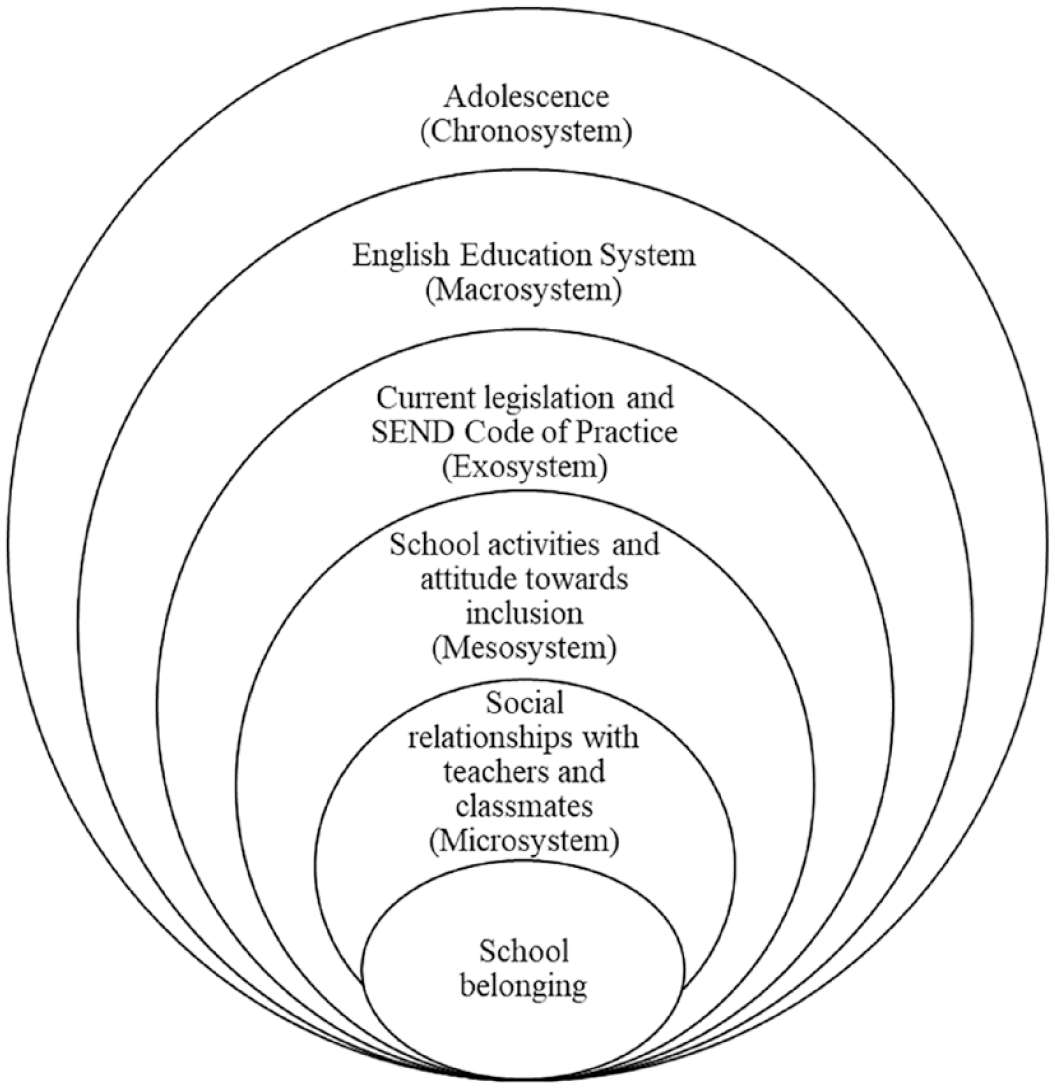
The socio-ecological model for the social inclusion of adolescents with vision impairment.
The purpose of this research was to develop an evidence-based framework of the social inclusion of students with vision impairment that can be used to facilitate stakeholders’ understanding of social inclusion and to address the specific socio-emotional needs of students with vision impairment. Based on this socio-ecological model, three empirical studies have been conducted by the researcher of this article and examined the following dimensions of social inclusion in adolescents with and without vision impairment: school belonging (study 1), the development of social relationships with teachers and peers (microsystem; study 2) and participation in school activities (mesosystem; study 3). The focus of this article will be on the third empirical study in this series of studies, the purpose of which was to examine adolescents’ inclusion and/or exclusion from school activities (mesosystem) and the effect of this situation on their social competence.
Current empirical study
The main objective of this empirical study was to examine the inclusion and exclusion of adolescents with vision impairment from school activities, defined here as their school engagement and disengagement, respectively. In this study, school engagement has been conceptualised as adolescents’ participation in school activities, as well as the behaviour they display when participating in these activities and the feelings they develop from that participation (see Wang & Degol, 2014; Wang et al., 2017, 2019). Although previous research has examined the participation of students with vision impairment in curricular (Celeste & Grum, 2010; George & Duquette, 2006; McGaha & Farran, 2001) and extra-curricular activities (Engel-Yeger & Hamer-Daher, 2013), the research into the feelings students develop and the behaviour they display when participating in these activities remains limited. It has also been found that regardless of student involvement in school activities, students with vision impairment may feel excluded from school (Celeste & Grum, 2010; Engel-Yeger & Hamer-Daher, 2013; Khadka et al., 2012). Therefore, it could be argued that planning and implementing inclusive school activities where students with vision impairment have the opportunity to work and collaborate with their sighted peers may not determine students’ feelings of inclusion and participation in school. Therefore, there appears to be an urgent need to further examine the feelings that adolescents develop when participating in school activities.
School disengagement, which was also examined in this study, has been conceptualised as the exclusion of adolescents from school activities and the negative feelings they develop when they are dissatisfied with their school life. Although in previous literature, school engagement and disengagement have been seen as opposites of the same continuum, Wang and Degol (2014) explained that school engagement and disengagement should be approached as two distinct constructs with different characteristics and outcomes. In particular, school engagement may be characterised by learning interest, whereas school disengagement may be characterised by exclusion and frustration. Based on this recent argument, school engagement and disengagement have been treated as two distinct constructs in the current study. Considering existing research that has highlighted the detrimental effect of lack of vision on student participation in curricular (Lieberman et al., 2002) and extra-curricular activities (Engel-Yeger & Hamer-Daher, 2013), it was expected that school engagement and school disengagement scores would be affected by the levels of visual functioning of adolescents.
Another concept investigated in this study is the social competence of adolescents with and without vision impairment, which has been defined as the social skills that individuals with vision impairment use to successfully navigate their daily life, public affairs and social interactions (Wagner, 2004). Considering research evidence that has highlighted the positive role of residual vision in socio-emotional development (R. Brown et al., 1997; Peterson et al., 2000; Preisler, 1991), it was expected that social competence would also be affected by the levels of visual functioning of adolescents.
The relationship between school engagement, school disengagement and social competence was also investigated in this study. Although previous research has shown that the participation of students with vision impairment in educational interventions alongside their sighted peers may positively affect the development of their social skills (see Jindal-Snape, 2005a, 2005b; Peavey & Leff, 2002), these studies took place in structured frameworks. Specifically, students with vision impairment were asked to interact with their sighted classmates as part of their participation in these educational interventions developed by researchers, indicating that the effect of their natural engagement in school activities alongside their sighted peers on their social competence has not yet been examined. Previous research has also underscored the positive effect that promoting less intrusive and more natural classroom interventions, such as the incidental teaching of social behaviours and friendship activities, has on children’s social competence (W. H. Brown et al., 2001). However, this appears to be the first study that attempts to examine the relationship between school engagement and social competence, as well as the relationship between school disengagement and social competence, in both adolescents with and without vision impairment.
To address the limitations of previous research that attempted to involve the general population of students with vision impairment by also including students with additional needs (see De Verdier, 2016; Jessup et al., 2017, 2018) adolescents diagnosed with learning difficulties and/or other types of disabilities were not included in the study. Furthermore, previous literature has not examined the differences in the socio-emotional development between adolescents with severe sight impairment (previously ‘blindness’ according to the UK classification system) and sight impairment (previously ‘low vision’ according to the UK classification system). However, previous research on the socio-emotional development of infants (Preisler, 1991) and younger children with vision impairment (Peterson et al., 2000) has underlined the positive role of residual vision in social interactions. Thus, this empirical study attempted to examine the diverse needs of adolescents with severe sight impairment and sight impairment by dividing participants into three groups according to their visual functioning (adolescents with severe sight impairment, adolescents with sight impairment and sighted adolescents).
Hypotheses of the study
The hypotheses of this study were:
Hypothesis 1. Sighted students will have higher school engagement and social competence scores and lower school disengagement scores than adolescents with visual impairments, with those who are the most severely sight impaired (compared with the group of adolescents with sight impairment) having the lowest school engagement and social competence scores and the highest levels of school disengagement.
Hypothesis 2. Across all three groups of visual functioning (severe sight impairment, sight impairment and sightedness), school engagement will be a positive predictor of social competence, whereas school disengagement will be a negative predictor of social competence.
Method
Participants
Thirty-seven adolescents with and without vision impairment, 57% of whom were female, participated in this study. Considering previous research which has shown that susceptibility to peer influence is higher during early adolescence than during later adolescence (Berndt, 1979; Furman & Buhrmester, 1992; Steinberg & Silverberg, 1986), the participants of this study were aged between 12 and 14 years. Twelve participants had severe sight impairment (M = 13.61, SD = 0.92), 12 had sight impairment (M = 13.90, SD = 0.76) and 13 were sighted (M = 13.47, SD = 0.88). Most participants with vision impairment had congenital sight impairment (87%) and 13% had acquired sight impairment. Most participants attended mainstream schools (70%), followed by participants attending mainstream schools with a resource-based provision only for students with vision impairment (16%) or mainstream schools with special resourced provision for students with SEND and complex needs (14%).
Material and measures
Adolescents completed a demographic questionnaire, as well as the short version of the Multidimensional School Engagement Scale (MSES; Wang et al., 2017). The MSES is a 30-item questionnaire that consists of two scales focused on adolescents’ school engagement and disengagement, respectively.
Adolescents’ parents completed the ‘Socialisation’ domain of the comprehensive interview form report of the Vineland Adaptive Behaviour Scale (VABS; Sparrow et al., 2016). The ‘Socialisation’ domain of the VABS includes 112 items divided into the three following sub-domains: ‘Interpersonal Relationships’ (43 items), ‘Play and Leisure’ (36 items) and ‘Coping Skills’ (33 items). The VABS is designed to measure the adaptive behaviour and social needs of individuals with SEND and has been used by several researchers in the field of vision impairment (see Celeste & Grum, 2010; Papadopoulos et al., 2011; Sparrow et al., 2005).
Procedure
Participants were mainly recruited through social media (e.g. Twitter), research advertising websites, school contacts and charity websites. Due to the COVID-19 lockdown, the study was conducted online. After obtaining oral and written parental and adolescent consent, adolescents were asked to participate in an online interview (via Zoom or Skype) that lasted approximately 15 minutes. Before the interview, parents were emailed a link to their online questionnaire. Parents needed approximately 20 minutes to complete the questionnaire.
Five £10 Amazon vouchers were offered to adolescents who were interviewed for this project as draw incentives for their participation. A £50 Amazon voucher was also offered after a draw to a charity that facilitated this study.
Prior to the study, a favourable ethical opinion was obtained from the Research Ethics Committee of (Name of the Faculty).
Results
To examine whether school engagement, school disengagement and social competence were affected by the levels of visual functioning of adolescents, participants were divided into the three aforementioned groups according to their severity of vision impairment. Considering previous research showing that analysis of variance and regression are robust to small sample sizes and Likert-type data (Norman, 2010), data were analysed using parametric tests. Descriptive statistics of this study are displayed in Table 1.
Means and standard deviations in school engagement, disengagement and social competence.
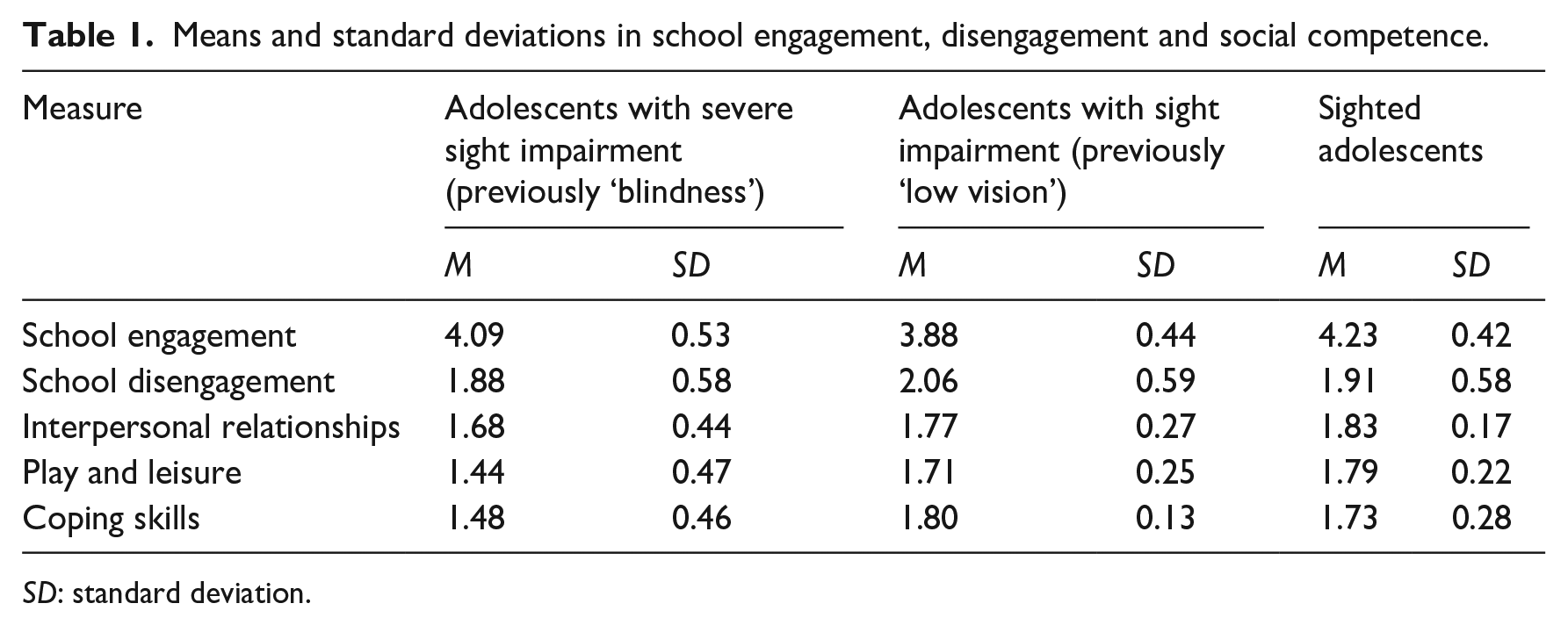
SD: standard deviation.
Two repeated measures ANOVAs were conducted to compare the effect of the extent of vision on school engagement, school disengagement and three sub-domains of social competence (Interpersonal Relationships, Play and Leisure, Coping Skills) in the three groups of adolescents that participated in this study. The analysis indicated that there was no significant difference between the three participant groups in terms of school engagement and disengagement, F(2, 34) = .942, p = .400, η2 = .043 and the three sub-domains of social competence, F(4, 60) = 2.08, p = .095, η2 = .12.
Two multiple regression analyses were conducted to examine the effect of school engagement and school disengagement on social competence across all groups of visual functioning. Neither school engagement (β = -.01, p = .924) nor the extent of vision (β = .13, p = .058) were significant predictors of social competence F(2, 30) = 1.96, p = .159. In addition, neither school disengagement (β = -.06, p = .524) nor the extent of vision (β = .13, p = .052) were significant predictors of social competence F(2, 30) = 2.19, p = .130.
Discussion
The findings did not support the first hypothesis of this study; no differences were found between the three groups of participants (severely sight impaired, sight impaired and sighted) in terms of school engagement and disengagement. Given the extensive report of the difficulties faced by students with vision impairment in previous literature (see De Verdier, 2016; Jessup et al., 2018; Thurston, 2014), it could be deduced that more positive steps have been taken towards their school inclusion that have positively affected their school engagement. Many countries around the world have tried to adapt their curriculum to the needs of SEND students since the Salamanca Statement in 1994 (Ainscow & César, 2006); therefore, given the time it takes schools to modify their curriculum and adapt it to the specific needs of their SEND students, it could be expected that the positive effect of these changes can now be seen. However, socio-cultural and educational differences might have also affected the findings of this study, which included participants from a limited number of schools in the UK, and similar findings may not apply to other countries or schools in the UK. Considering the socio-cultural and educational elements that might have affected these findings, more research is needed, focusing on the curriculum modifications that have taken place around the world over the last three decades.
The findings indicated that there were no significant differences in the social competence of adolescents with severe sight impairment, sight impairment and their sighted peers. Previous research suggests that students with vision impairment may not demonstrate any delay in the development of their daily living and socialisation skills when they receive early support from their teachers (Pavri & Monda-Amaya, 2001) and parents (George & Duquette, 2006). It is possible that the adolescents who participated in this study might have had the opportunity to receive guidance and practical assistance from their teachers and family members to meet all the challenges they faced in their social interactions, and for this reason, they did not show any deficits in their social skills. Research has also provided evidence that vision (re)habilitation services address key areas that contribute positively to the well-being of individuals with vision impairment, such as participation in social activities (Cimarolli et al., 2006). It could be assumed that the adolescents who participated in this study might have also received this type of support that positively contributed to the development of their social competence. There also exists a considerable body of literature that suggests that the presence of additional needs may significantly affect socio-emotional development, indicating that students with vision impairment and additional needs encounter more socio-emotional difficulties compared to their peers with vision impairment only (De Verdier, 2016; Jessup et al., 2017, 2018). Considering the participation of adolescents without additional needs in this study, it could be assumed that the lack of additional needs might have had a significant effect on social competence.
Although the findings did not confirm the predictive role of school engagement and disengagement on social competence, they could potentially suggest that factors other than the school environment may influence the social skills development of adolescents with and without vision impairment. As previously mentioned, adolescents might have received the social support they need to develop their social skills in other social settings outside school, such as their family environment. They might have also developed close friendships that positively affect their social competence in other social settings, such as their neighbourhood (Manitsa & Doikou, 2020). For adolescents with vision impairment, their participation in educational interventions alongside their sighted peers (Jindal-Snape, 2005a, 2005b; Peavey & Leff, 2002) might have played a critical role in the development of their social competence.
It is also important to highlight the potential limitations of this study. The restrictions of the COVID-19 pandemic made access to the sample more difficult, and the interviews with adolescents were conducted online. Considering previous literature which suggests that adolescents with vision impairment present with more emotional and behavioural difficulties compared to their sighted peers (Augestad, 2017), the findings seem unexpected. However, it could be argued here that the lack of in-person interactions with their classmates and teachers due to the COVID-19 pandemic might have led to a lack of differences between the three groups of adolescents who participated in this study. The difficulties that adolescents with vision impairment experience in their school engagement might have been more apparent if they had attended in-person school lessons. Thus, considering this study was conducted during the pandemic, it would be useful to repeat this study after the lockdown for COVID-19 to test whether home-schooling had affected adolescents’ school engagement scores. Furthermore, the focus of this study was early adolescence, which has significantly limited the age range of participants. As previous literature has shown that different stages of adolescence may affect socio-emotional development differently (see Berndt, 1979; Furman & Buhrmester, 1992; Steinberg & Silverberg, 1986), research focusing on middle and later adolescence should also be conducted to examine the effect of age on school engagement and social competence. In addition, considering the parametric statistical analysis conducted in this study, it could be said that its findings should be interpreted with caution. Future studies could further consider other statistical analyses more appropriate for smaller sample sizes, such as Bayesian analyses.
General discussion
Despite its limitations, this research expanded current knowledge on the social inclusion of adolescents with vision impairment through the development of a socio-ecological model that attempted to include the social dimensions of school inclusion, as well as additional components that may constitute a part of it. In the socio-ecological model proposed for the purposes of this research, particular emphasis was placed on each dimension of social inclusion. The development of this socio-ecological model can allow academics and practitioners to reflect on the socio-emotional experiences of students with vision impairment at school based on the findings of previous studies and to better understand their impact on their sense of belonging. Although the focus of this research was only on adolescents with and without vision impairment attending mainstream or special schools in the UK, this socio-ecological model could be applied to future research with students of different ages in other countries. However, it should be noted that this model will need to be adjusted and amended based on the needs of each group with vision impairment. Considering the different samples that future researchers may focus on in terms of age, socio-cultural differences and school environment, it is also important to consider additional factors that may influence the social inclusion of each student population, such as the presence of additional needs. However, it could be said that the proposed model opened the space for future research and practice by adopting a holistic approach to understanding some of the potential social (e.g. participation in school activities) and demographic (e.g. country of residence and current legislation) factors influencing social inclusion in the school environment. Considering previous research that has highlighted the socio-emotional challenges that students with vision impairment experience in school, the proposed model, which is aligned with the Curriculum Framework for Children and Young People with Vision Impairment (CFVI; Hewett et al., 2022), can also further promote the specialist training of all school staff and specific key points to focus on (e.g. not only social but also specific demographic factors that significantly affect school experiences). The proposed model is expected to provide new insights into the school experiences of students with vision impairment, giving professionals the opportunity to reflect on the factors that may influence their social inclusion and the provision of current support.
The empirical study analysed in this article represents the first known attempt to investigate the relationship between school engagement and social competence in adolescents with and without vision impairment. Although these findings are not in line with previous research, they can provide us with directions for future research and practice. Remarkable similarities were found between adolescents with vision impairment and their sighted peers, suggesting that they may be more alike than different in their socio-emotional traits. These findings could potentially indicate that other clinical (e.g. presence of additional needs; De Verdier, 2016) and social factors (e.g. teacher support; Pavri & Monda-Amaya, 2001), independent of visual functioning, may significantly affect school inclusion and socio-emotional development of students with vision impairment. Thus, it is important to conduct more research that will look beyond the impact of vision on school inclusion and uncover all the potential factors that may affect the school life of students with vision impairment. Furthermore, these findings may help stakeholders, such as school staff and policy makers, look beyond the sight loss of the individual with vision impairment and also attempt to prioritise other factors that affect their socio-emotional development, such as their age. For example, previous literature suggests that adolescents rather than children are more vulnerable to mental health problems that significantly affect their school lives (Forbes et al., 2019). Future research based on the elements of the proposed model may potentially reveal the social, clinical and demographic characteristics of the most vulnerable students who require the most intensive educational and social support. Thus, the findings of future research may help educational providers prioritise the needs of specific student populations who need urgent support and individualised provision.
This empirical study is also one of the first attempts to examine the effect of the natural engagement of students with vision impairment in school activities on their social competence. Despite its non-significant findings, the rationale of this study may open the research area of further investigation of the critical role of promoting less-intrusive classroom interventions (W. H. Brown et al., 2001) that will facilitate the school inclusion and socio-emotional development of students with vision impairment. Although previous research has highlighted the lack of social support provided to students with vision impairment in educational institutions around the world due to the lack of appropriate training and awareness, it has also underlined its positive effects on the socio-emotional development of students with vision impairment (e.g. self-esteem; Manitsa & Doikou, 2020). Thus, the rationale for the empirical study analysed in this article is expected to provide researchers and practitioners in the field of vision impairment an opportunity to reconsider the socio-emotional needs of students with vision impairment and the provision of social support at school. This can potentially be achieved through identifying the socio-emotional needs of this student population and tailoring current provision to their specific needs.
Footnotes
Acknowledgements
I would like to thank all the adolescents and their parents for their participation in this study. I would also like to thank Dr Fiona Barlow-Brown and Dr Maria Livanou for their comments on earlier drafts of this study.
Funding
The author(s) received no financial support for the research, authorship and/or publication of this article.
