




Abstract
This article attempts to widen the debate about the future of probation by way of an exploration of the role of probation pracademics within the context of the Professional Qualification in Probation (PQiP). Reflecting upon our own experiences of probation education (as former probation practitioners, now PQiP tutors and probation researchers), we draw upon transformative pedagogy to argue that pracademics are ideally placed to influence and shape the future of probation as a distinct occupation by enactment of three crucial functions within probation education: (re)formulation of probation values, building bridges between theory and praxis and protection of the ‘honourable profession’.
Keywords
Introduction
Previous research and commentary have highlighted how probation practitioners have consistently conceptualised probation as an ‘honourable profession’ characterised by a belief in the importance of the working relationship between practitioner and probationer in enabling change (Gosling et al., 2020; Mawby and Worrall, 2013; Worrall, 2015). There has also been welcome recent attention given to what characterises probation values and ethics (Dominey and Canton, 2022) and how reimaging probation education and training could better support and develop trainee probation officers in becoming critically informed practitioners who reflect upon their practice and champion the rights of those they supervise (Burrell and Petrillo, 2023). Whilst there have not been recent changes to how probation education is delivered 4 , this article is situated in the context of a practice environment trying to recover from persistent organisational change (Millings et al., 2023) and policy initiatives such as Offender Management in Custody (OMiC) and ‘One HMPPS’ 5 that further embed probation within prison service delivery and governance. Additionally, the increase in remote working since the pandemic, coupled with a dwindling experienced probation workforce (HMIP, 2023, 2024a, 2024b), is limiting opportunities for trainees to learn from ‘seasoned colleagues’ (CJJI, 2024: 3).
Despite these changes to the trainee probation practitioner learning context, little attention has been given to who is currently supporting the development of probation practitioners and thereby potentially shaping the future of probation as an occupation. It is this noticeable gap in the debate that this article seeks to fill through critical discussion of the role of probation pracademics within the context of delivery of the Professional Qualification in Probation (PQiP). Whilst there is an established history of probation practitioners moving to academia, we offer something new by reflecting upon our own experiences of probation education as former probation practitioners, now PQiP tutors and probation researchers. Specifically, we draw upon transformative pedagogy (Cranton, 2016; Mezirow, 1993) to argue that pracademics are ideally placed to shape the future of probation practice by virtue of the contribution they make in three contextual areas; forming the foundations of probation values, protecting the ‘honourable profession’ (Worrall, 2015) and building bridges between theory and praxis. We conclude by arguing that a failure to protect probation as a distinct occupation guided by clearly defined occupational values has serious implications for individuals subject to probation intervention in England and Wales.
Our pracademic ‘position’
Pracademic as a term has no clear origin (although commonly attributed to Posner, 2009) and debates continue to revolve around questions of its relevance (Hollweck et al., 2021; Netolicky, 2020), clarity (Wilson, 2019) and appeal to those who find themselves thus labelled (Dickinson et al., 2020). It has variously been used to describe a style of teaching (McDonald and Mooney, 2011), to define professional identity (Posner, 2009) and to denote an approach to collaborative research. Within the context of professional education, there is an established body of literature which explores the role of pracademics in delivery of social work (Owens, 2016), nursing (Hodgson, 2023) and teaching (Campbell, 2022) qualifications. For some, the pracademic epithet denotes spanning practice and academic worlds simultaneously; however, the authors identify as pracademics who have fully transitioned from lengthy careers in probation and youth justice to academia.
Who we are as an educator is informed by ‘our abilities, our past aspirations and the skills we develop’ (Ashwin, 2015: 12) and we are mindful that our position as probation pracademics affords us the power to influence practitioners, and arguably the future of probation practice. Therefore, we deem it pertinent to each provide a transparent exposition of our own positionality that goes beyond a shopping list (Folkes, 2022) to something that is meaningful within the context of formation of professional values. In recognition that the conditions for learning ‘intrinsically inform and shape’ professional identity (Burrell and Petrillo, 2023: 181), we have reflected on how higher education (HE) participation and our own probation qualification route transformed our values and influenced us as practitioners. Alongside this, we have also reflected (independently and collaboratively) on our positionality in relation to the typologies of probation workers offered by Mawby and Worrall (2013) 6 in recognition that occupational culture can shape individuals and organisations through transmission of values and shared practice wisdoms (Burke and Davies, 2011).
Ainslie – The ‘new breed’ of probation officer
As a white, female, working-class, first-generation graduate, from an area lacking in cultural diversity, HE was transformational. Simply put, I would not be where I am today without the opportunities provided through engagement with dialogic teaching practices on an undergraduate criminology degree that challenged the narrow hegemonic views I had been exposed to in my childhood. The resultant transformation of my views on crime and the criminal justice system prompted my decision to join probation in 2001. I am therefore part of the ‘culturally distinct group’ (Nellis, 2003: 944) that completed the Diploma in Probation Studies (DipPS) that was hotly contested at its point of conception in 1998 due to the break-away from social work professional education. Crucially, my engagement with the qualification occurred prior to the move to online learning and therefore I benefitted from face-to-face contact with academics alongside space for discussion with my peers as part of my professional development. Like Treadwell (2006: 8), I appreciated the attempts of the academics I encountered to ‘mount a sufficient critique’ of the occupation I had chosen to join, and I retain the view that the academic component of the qualification should not be reduced to simply ‘facilitating the imparting of knowledge’ (2006: 11). Reflecting on my own experience of probation education therefore reinforces for me the criticality of the involvement of HE in probation education, not least the way in which it can sustain probation as a profession as encapsulated by Dominey (2010): ‘The contribution of higher education is to deliver the level of analysis and wider perspective that enables staff to perform in role today, but also have ideas and visions for the job tomorrow and the capacity to realise these’ (Dominey, 2010: 157)
Riley – From ‘admin to academia’
Initially HE, (and education more widely) served as a mechanism for avoiding adverse outcomes, although later in life this changed to an appreciation for gaining new knowledge and enjoying the process of learning. A frank discussion with my social worker in my teenage years highlighted the limited opportunities likely available to me without formal educational qualifications. This conversation acted as a catalyst, igniting my positive relationship with learning and education.
My probation officer training differed from that of my co-author. I joined what was then a regional probation area as an administrative assistant in 2005 following completion of my undergraduate degree, the first and only female in my family to complete university education. Some months later, I became a case administrator before securing promotion as a probation service officer. My first experience of probation education – the VQ3, commenced 5 years into the role, followed shortly after by the probation officer qualification. At 30, I was one of the eldest amongst my peers and one of the last cohorts to undertake the Probation Qualification Framework (PQF) pathway. As the first cohort four months post ‘Transforming Rehabilitation’, like Cracknell (2016) my training took place during a period of uncertainty and service change, rendering it unrecognisable from its 100-year history (Deering, 2014). Experienced and skilled colleagues were sifted between newly formed private rehabilitation companies and a ‘National Probation Service’ based on a historical caseload snapshot. Whilst like my co-author I personify Mawby and Worrall's (2013) ‘Offender Manager’ typology, the skills, knowledge and understanding gained from ‘old school’ officers throughout my previous nine-year socialisation into the profession, meant that I learnt and developed my practice craft from ‘lifers’. As such my value base had already been shaped – by the practitioners I had previously worked alongside but also, through recognition and reflection of experiences in my formative years and the fine line between which side of the probation table I sat on.
Enduring values
Despite different positions and experiences in terms of our qualification route and subsequent trajectories within probation, both authors identify strongly with the enduring values (Robinson et al., 2013) that characterise probation as a profession. Regardless of a complex history of change driven by political ideology and subsequent organisational upheaval, we believe probation as an occupation remains at its core a person-centred profession. Whilst there is an absence of a monolithic occupational culture in probation (Mawby and Worrall, 2013), research has consistently shown that there is an enduring value base (Ainslie, 2021; Deering, 2011; Millings et al., 2023; Worrall, 2015) that persists in the face of organisational tumult. The belief in the capacity of people to transform their lives, a valuing of relational practice as the vehicle for change and a wider commitment to social justice have persisted despite the break away from social work qualification routes over 20 years ago. This is partly because ‘this is what it has been found to take to do the job well’ (Canton and Dominey, 2018: 43).
The metaphor of the writing ingrained through the centre of the stick of seaside rock, whilst cliched, resonates for us and is something openly discussed amongst our team of probation pracademics, regardless of the length of time elapsed since colleagues left frontline practice. It is the formation and protection of this enduring value base which interests us in the context of our work as educators of future practitioners. Occupational cultures are grounded in shared values that are taught to new members, shaping their thoughts and feelings (Schein, 2010) by the development of a social consensus (Rosenberg, 1990 cited in Ingram, 2015), belief system (Kaushik, 2017) and emotional logic (Ingram, 2015). Given the power and authority practitioners hold over the individuals they supervise, and therefore the impact they have upon their lives (and others around them), the ways in which practitioners think and feel about their work have significant consequences for people subject to probation intervention. If we accept the view that the process of professional socialisation 7 is more influential than formal education in the development of professional values (Durnescu, 2014; Grant, 2017), we find ourselves questioning who it is that transmits values as well as, considering whether these values can thrive in the context of the current probation qualification route and the wider probation context our learners find themselves navigating.
Learning in the current probation context
Prior to 1996, the pathway to probation officer qualification in England and Wales was deeply rooted in social work theory with prospective officers undertaking the Certificate of Qualification in Social Work. Since this time there have been various pathways to probation officer qualification. Between 1998 and 2010 prospective officers completed the DipPS, the PQF until 2016 and the PQiP to the present date. At the time of writing the current HE programme is delivered predominantly via online teaching methods either in 15 or 21 months, dependent upon prior graduate-level qualification. 8
Discussion of probation education and the qualification pathway is not a new debate and whilst it could be argued this has not been extensively researched or critiqued, concerns have been highlighted in numerous areas; professionalism, erosion of values, quality, and time constraints (Cracknell, 2016; Dominey and Walters, 2011; Nellis, 2001; Skinner and Goldhill, 2013; Smyth and Watson, 2018). Treadwell (2006) for example, reflected upon the change to a vocational approach to probation officer qualification, intended to blend academic learning with work in practice, instead suggesting the reality of reduced academic content and increased managerialism. More recently, Burrell and Petrillo (2023) discussed the limitations of learning in an online environment, the loss of reflective practice opportunities and impact of organisational reform.
In comparison to Scotland (where probation work is undertaken by criminal justice social workers) the probation qualification pathway in England and Wales is now long divorced from social work education and arguably the social work values once so integral to the profession. The erasure of these values mirrors the changing tide of official probation aims from ‘advise, assist, befriend’ to ‘assess, protect, change’. The persistent structural reorganisation (Robinson & Burnett, 2007) most recently evidenced by the ‘One HMPPS’ restructuring which aligns prison, probation and the youth custody service under a single operating model (HMPPS, 2022) could be viewed as a further erosion of the profession's identity. At a time when the profession is still healing from the impact of Transforming Rehabilitation (Tangen and Briah, 2018) and re-unification (Millings et al., 2023), the removal of an independent identity has been interpreted as the ‘nail in the coffin’ for the professionalism, independence and autonomy of probation as an organisation and vocation (Brown, 2023) and therefore a clear departure from the probation habitus (Robinson et al., 2013).
The absence of opportunity to learn incrementally (Cracknell, 2016) in an environment supportive of learning and reflection is further compounded by using trainees as a resource to fill the void left by exiting experienced practitioners and the absence of suitable mentors (HMIP, 2022, 2024c). Arguably, these learning conditions present challenges for the future of probation education and the future of probation practice more widely. Additionally, the move to more agile working in the field accelerated by the COVID-19 pandemic in 2020, has resulted in probation trainees increasingly working in ‘silos’ (Phillips et al., 2021), not wanting to bother already pressured experienced staff (HMIP, 2022a) and in the absence of mentors to support learning and skill development (CJJI, 2024; HMIP, 2023).
Recognising the challenges of the current practice context for PQiP learners, and the nature of the HE component of PQiP in terms of delivery and timescales, we turn our attention now to considering whether probation pracademics can (or indeed should) attempt to fill the gap left by exiting ‘lifers’ (Mawby and Worrall, 2013). In doing so, we explore the opportunities to protect the value base that shaped our own professional identity and practice and has persistently endured in the ‘service of second chances’ (Lammy, 2020).
Pracademia: What it has to offer
Within education programmes for the helping professions, (which we contend is an important concept to retain for probation) practice experience is valued (Owens, 2016), and pracademics are viewed as a natural choice to be educators given their intense curiosity about what underpins both their professional practice and previous practice experiences (Walker, 2010 cited in Hollweck et al., 2021). Existing pracademic literature highlights numerous arguments for the blending of academic knowledge and experience with practitioner expertise, brought to bear in approaches to teaching with a view to preparing students for the world of professional practice.
Specifically, McCabe, Morreale & Tahiliani (2016) argue that synthesis between theory and practice is crucial in the field of criminal justice given its applied nature. When considering this in the context of probation officer education, the ability of the pracademic to connect the dots between theory and practice (Hollweck et al., 2021) brings credence and authenticity. It also offers pracademics the opportunity to draw upon their practical ‘insider’ knowledge within their teaching as a means by which to support students in the application of theoretical understanding (Owens, 2016) and form a life of the mind for practice (Sullivan and Rosin, 2008). The Teaching Excellence Framework (OfS, 2022) additionally recognises that teaching can be enriched by professional practice, reflected by the inclusion of professional practice as evidence in its teaching and learning awarding assessment criteria. Whilst acknowledging the contribution made by non-pracademic academics in probation education, we suggest that practitioner experience can act to bridge the gap that can exist between the two fields (Morreale & McCabe, 2012). If career academics have limited understanding of the professional context, the ability of practitioner academics to draw upon ‘real world’ context, understand the reality of practice and needs of practitioners demonstrates the value of background in professional contexts. Seymour (2006) also suggests that the teaching of theory in isolation from practice, without connection, may limit its potential impact. Given the dynamic and fluctuating nature of the criminal justice field often impacted by regular ministerial and governmental change, pracademic expertise can offer ‘added value’ by explicitly connecting theory and practice and thereby strengthening the quality and credibility of educational programmes. Additionally, they can also create opportunities for collaboration across professional practice and academia as a means by which to mitigate criticisms of the potential lack of scholarly rigour which is sometimes attributed to pracademics (McCabe et al., 2016).
Transformative professional learning
Pracademics can then, contribute meaningfully to the professional development of PQiP learners and, in the context of values formation, this is achieved through the enactment of transformative pedagogy (Cranton, 2016). Core components of transformative learning are ‘gaining freedom from constraints, limited perspectives, and oppressive circumstances’ (Cranton, 2016: 79) which we view as significant in the context of a probation service increasingly subsumed and stifled by Civil Service norms and bureaucracy. By drawing upon our probation practice experience to inform our teaching, we aim to facilitate development of meaning perspectives that are more inclusive and permeable (Mezirow, 1993) thereby supporting the development of anti-discriminatory practice and greater consideration of the impact of probation supervision on those subject to intervention.
Relatedly, our previous practice experience enables us to make use of transformative approaches such as role play, which can disrupt learner perspectives (Taylor and Jarecke, 2009) and authentic case studies that have a vocational currency (Wood et al., 2016) and aim to promote engagement with issues relating to diversity and justice. We view our teaching as a potential source of resistance to a conformist and regressive model of probation practice that is at risk of developing in the current context. 9 Ultimately, what PQiP students learn has implications for the type of practitioners they become (Morley, 2008) and transformative learning approaches can provide the opportunity to restore emotion to learning and practice (Knight et al., 2016; Wakeman, 2014) in an effort to counter dehumanisation of those with criminal convictions.
Whilst our experience of working within probation is brought to bear in the creation of meaningful opportunities for transformation of student perspectives, our current position outside of probation (and crucially the Civil Service) provides us with the opportunity to engage students in scrutiny and critique of the profession (Butcher, 2022). This differs perhaps from HMPPS trainers who are tasked with conveying policy narratives that risk reproducing dominant risk-centric ideology and practices. As such, pracademics can be viewed as instigators of disjuncture (Fenton, 2015) which can be uncomfortable for learners as they explore the extent to which they can practice in ways aligned with their value base and the findings from research we present in the course of our teaching. We would argue however that such discomfort can be defended given the responsibility of the role they have chosen to adopt.
Contribution in context
In the context of an increasing loss of experienced practitioners in the teams our students are embedded within, coupled with our pedagogical knowledge and position as educators, we find ourselves questioning how probation pracademics can potentially shape the future of probation. By drawing upon pracademic and transformative learning literature and concepts, we now move to propose three contextual areas where probation pracademics can offer a unique and substantive contribution to the continuing development of probation as a profession with a strong occupational identity (Figure 1).
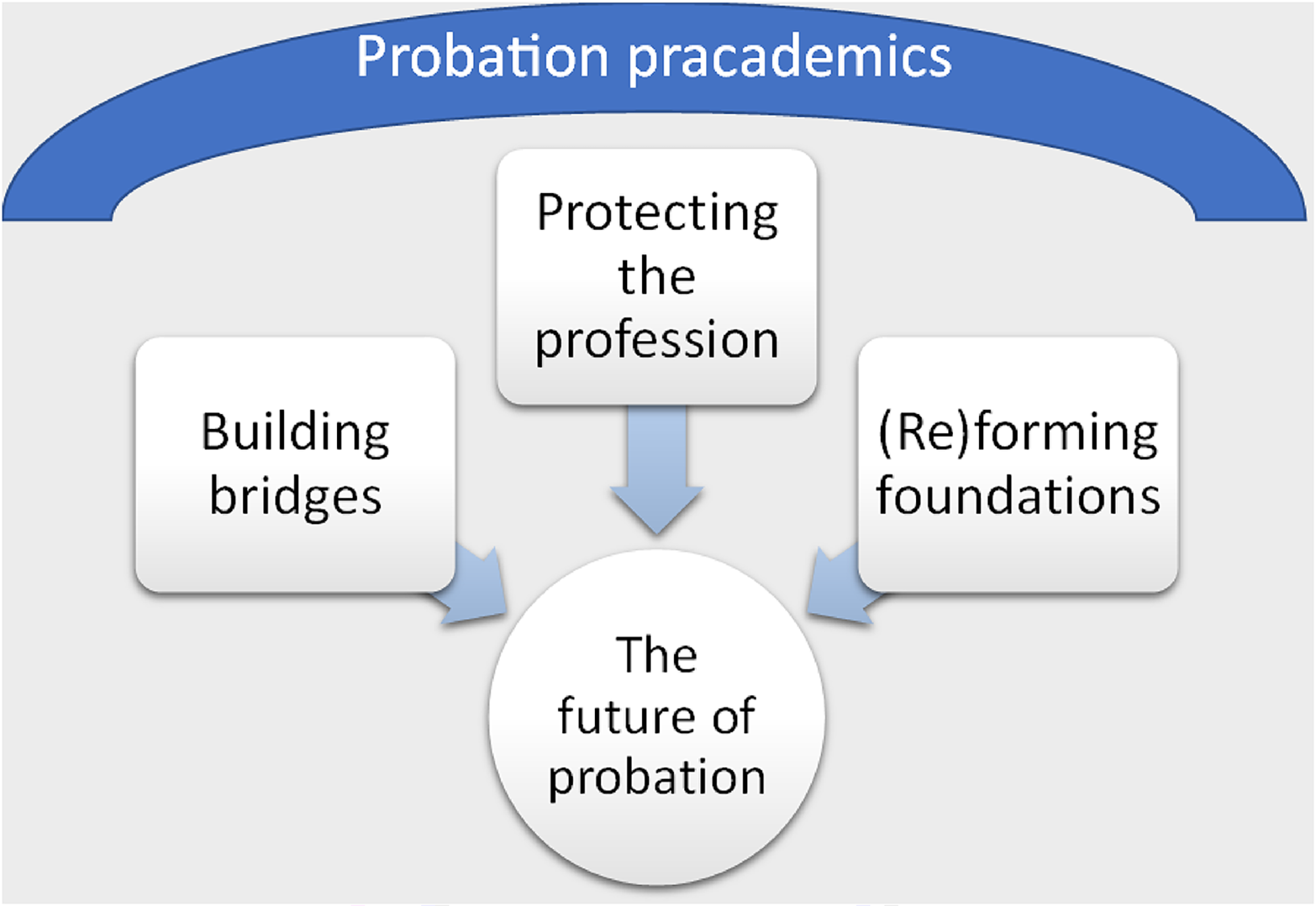
Probation pracademics contribution in context.
Forming foundations
A humane and ethical model of probation practice requires solid foundations grounded in the knowledge, skills and values of practitioners. Our argument here is that whilst pracademics have a perhaps obvious role to play in the development of knowledge and skills that underpin practice, we also contend that they are ideally placed to influence the forming, (or reforming) and reinforcing of values that can sustain a humane model of probation practice in the future. If we align with the view of Mair and Burke (2012) that there has been a loss of probation's roots, traditions and cultures, pracademics could be uniquely placed to counter this decline. However, we need to avoid the trap of espousing a naive belief in our ‘beneficent power’ (Brookfield, 2001: 3) that when exercised in the context of adult education can support learners in realising their full potential. Instead, we need to be mindful of the role we play in the administration and politics of knowledge and the ‘dynamics and contradictions of power’ at play (Brookfield, 2001: 2) for PQiP learners.
Reamer (2023) has argued the importance of ethical humility in probation practice, noting that the development of core competencies that characterise professional ethics are dependent upon practitioner ability to grasp and apply key concepts and decision-making protocols. As such, it would seem reasonable to argue that pracademics can support the development of ethical humility, primarily by virtue of their position as educators of such concepts and protocols but equally through their ability to engage students in discussions relating to the ‘vexing questions’ (Reamer, 2023: 4) that characterise probation work. A core component here is the ability of pracademics to model critical reflection in action (Grant et al., 2014), drawing upon their own practice encounters characterised by moral uncertainty and with a view to countering the potential for the ethical fading (Reamer, 2023) that can occur when organisations prioritise performance targets in the name of efficiency. In this way, pracademics adopt the role of ‘constructive ethics-related role-models’ (Owens et al., 2019), enhancing students’ confidence in their ability to deal with the moral dimension of probation work. As such, not only can pracademics support the founding and formulation of values that promote ethical probation practice, but we also see a role for pracademics in protecting the very essence of probation (Senior et al., 2016) as it continues to rebuild following the ravages of Transforming Rehabilitation and subsequent reunification (Burke et al., 2023; Tidmarsh, 2024).
Protection
Here we envisage pracademics as protectors of the ‘honourable profession’ of probation (Worrall, 2015). Protection from the impact of neoliberal policy that seeks to define probation in narrow ways focused on risk, surveillance and punishment (Ainslie, 2021) and New Public Management strategies that promote instrumentalism and efficiency (Rutherford, 1994). Worrall (2015) has previously explored the role of nostalgia in building future culture and identities that are ‘recognisably probation, and with a dwindling availability of experienced practitioners in the workplace, pracademics could be conceptualised as mentors or role models (as per the view of Cranton, 2016) who keep this nostalgia alive. ‘The model or mentor displays a love for the subject area, express contagious enthusiasm, encourages personal interactions, and is open and authentic’. (Cranton, 2016: 82)
Professional registration is undoubtedly one way in which to potentially protect (or create) identity as a profession moving forward (Tidmarsh, 2022). The Professional Registration Policy Framework (HMPPS, 2024) clarifies the intended purpose of the register to provide assurance that POs have the requisite qualification, knowledge and skills. We can therefore see how pracademics contribute to this through the educator role they inhabit. However, in respect of values, the policy framework is somewhat confusing given it oscillates between assuming that the reader is clear on what probation values are, whilst signposting to HMPPS core values and the Civil Service Code and stipulating that the official functions of probation work (assess, protect, change) are probation values. There is little evidence here of a clearly stated set of values grounded in human rights and the minimisation of harms as previously called for by Canton (2019). Given this lack of clarity, we currently question the ability of the register to offer ‘protection’ as we conceptualise it in this article; namely the protection of ‘classic probation values’ characterised by a duty of care and ‘ideology of service’ (Millings et al., 2023: 347). These currently endure, but as Millings et al. (2023) acknowledge, the influx of new staff post reunification has the potential to transform probation culture in the absence of a pre-TR organisational memory. Probation pracademics may be one way of sustaining this memory for a while longer.
Building bridges
Whilst acknowledging our core responsibility to develop our students’ professional knowledge base during PQiP, we are mindful that such knowledge rarely provides the insight required to respond to the complexity of probation practice. Probation practitioners need to be more than ‘unthinking followers of instructions and procedures’ (Thompson and Pascal, 2012: 313), instead developing the ‘professional artistry’ (Schon, 1983) required to integrate theory and practice (Kinsella, 2010). Here then, we envisage probation pracademics as builders by virtue of the way in which they provide the bridge between theory and praxis. Pedagogical literature emphasises the way in which learning is dependent on interactions between the learner and their environment (Illeris, 2003). For example, constructivism posits that we learn best collaboratively and with the support of a knowledgeable expert who scaffolds our learning through the zones of proximal development (Vygotsky and Cole, 1978) and Situated Learning Theory (Lave and Wenger, 1991) which foregrounds the potential offered by experiential learning and exposure to communities of practice who shape and support learning within the specific practice context. Given the concerns emerging about the lack of experienced staff within probation offices, it would seem reasonable to suggest that learner interaction with pracademics may be one possible way to bridge this widening gap.
Additionally, we see the potential for pracademics to encourage learners to connect meaningfully with the communities within which their practice takes place to actively tackle stigma and structural barriers to desistance (Ainslie, 2022). We question whether pracademics can (or indeed should) encourage greater activism in practitioners through the building of hope to counter the probable conflicts that arise from their engagement with teaching and learning during the HE component of PQiP. For Brookfield (2001: 4) such hope is the ‘oxygen of activism’ and pracademics need (we contend) to build hope and develop the disposition of practitioners as agents of change (Howes, 2017) at both individual and societal levels. Although we recognise this might be a measured hope in the context of specific challenges of the probation context in England and Wales at the time of writing, pracademics, through their teaching can build and maintain the space needed for learners to develop critical thought and relatedly emancipatory practice approaches (Morley, 2008).
Ultimately, our teaching provides more than improved knowledge and skills; these things alone do not necessarily lead to improvements in practice (Netolicky, 2020). Our contention is that pracademics are ideally situated to model, shape and protect the enduring values that have sustained probation as an occupation and are essential for ethical practice that seeks to recognise and address the complex ‘dimensions to discrimination and inequality’ (Burke et al., 2023: 232) that characterise the lives of those subject to probation supervision. In this way, pracademics can be seen to adopt the role of the ‘philosopher-teacher’ (Peters, 2003: 215) who assumes an epistemic and political role by encouraging learners to take a stand towards laws and institutions when necessary.
Why it matters
Like Dominey and Canton (2022), we are drawn to the work of Garland (1993) when considering who is currently shaping the values of probation trainees and for what purpose. ‘The pursuit of values such as justice, tolerance, decency, humanity and civility should be part of any penal institution's self-consciousness-an intrinsic and constitutive aspect of its role’ (Garland, 1993: 292)
Given that practitioner belief in the ability to make a difference is ‘at the heart of desistance research’ (Maruna, 2017: 6), it seems reasonable to argue for the protection of a set of probation values with belief in the capacity for change at the core. Without this, the role of probation practitioners in supporting desistance processes may well be negligible. Such a value base promotes the demonstration of empathy, interest and commitment which are recognised as essential components of desistance-supportive relational practice (Rex, 1999) alongside practice approaches that are empowering and aimed at increasing the agency required for desistance (King, 2014). In the absence of professional values that align to a humane and ethical model of probation practice, it is perhaps difficult to envisage future practitioners recognising the importance of providing opportunities for redemption (Maruna, 2001), acknowledging and responding to the emotional trajectories of desistance (Farrall et al., 2014) or holding hope on behalf of the individuals they supervise in the face of barriers to desistance (McNeill, 2014).
Likewise, protecting a commitment to social equity and respect for social diversity (Mawby and Worrall, 2013) needs to be a priority if probation in the future is to stand a chance of being able to counter the stigma faced by those who fall under its supervision and intervention (Canton, 2020). Whilst an opposition to imprisonment (Williams, 1995) may no longer be a feasible key feature of probation values given its position as part of HMPPS, protecting a commitment to justice should be paramount (Canton and Dominey, 2018). Without these values, the very ‘essence of probation’ (Senior et al., 2016) will be lost, at considerable cost we would argue, to those who come into contact with the service in the future.
One such group of individuals is young adults transitioning from youth justice supervision to adult probation provision. In this context, the role of the pracademic in bridging theory and praxis is arguably crucial given that there is currently limited training relating to how best to support transition (Riley, 2022). The explicit value base of youth justice unlike Probation is still rooted in social work adopting a ‘welfare’ approach where multidisciplinary teams ‘wrap around’ the young person, largely located within or overseen by the local authority. This is in stark contrast to the enforcement, punishment and public protection approach of adult probation services (Alliance for Youth Justice and Barrow Cadbury Trust, 2023). Given that 18–24 year olds make up approximately 22% of the probation population (HMIP, 2024c), 11 the need for practitioners to recognise and understand young adulthood as a dynamic developmental stage (Hughes and Strong, 2016) is vital in mitigating the ‘cliff edge’ that exists when legally becoming an adult.
Pracademics who have experience supporting young adults in criminal justice contexts are uniquely placed to communicate the importance of recognising that young adults have very distinct needs; increased vulnerability, developing maturity, trauma and adverse childhood experiences, life skills and diverse health needs (Coyne, 2022; Hughes and Strong, 2016; Price, 2020). By providing the bridge between theory and practice, pracademics can support practitioners to understand that recognising and responding to these specific needs is integral to practice which is both humanistic and meaningful and responds appropriately to the individuals they are working with. Likewise, they can use their own practice experience to bring to life the body of literature relating to the specific skills needed to engage young adults (Livingstone et al., 2015; Transition to Adulthood Alliance, 2013; Trotter and Evans, 2023, Wong et al., 2017). Bridging the gap between theory and praxis in this way could perhaps, go some way to reducing feelings of loss (in terms of relationships and specific support) that often result in non-compliance and subsequent enforcement action (Alliance for Youth Justice and Barrow Cadbury Trust, 2023).
Conclusion
Like Dominey and Canton (2022) we want to widen the debate about the purpose of probation and the values that shape probation practice. Clearly, there is a vital need for individuals with experience of probation and youth justice intervention having the opportunity to shape probation practice of the future (Mullen et al., 2022) but alongside this we have explored the contribution that probation pracademics might also make, particularly in transmission of values that can shape the profession. But if pracademics ‘can’ shape the future of probation and thereby impact on the experiences of those subject to intervention, we need also to consider whether it is right for them to do so. Currently, there is no requirement for pracademics to maintain practice experience or complete accredited continuous professional development activities (as per the current social work educator model) but admittedly this could change in light of the stated intention to mandate that probation practitioners meet the requirements for professional registration. One view could be that the longer pracademics are removed from practice, the benefits we have outlined earlier in the article begin to wane as the realities of practice change in response to organisational and policy upheaval.
We find ourselves contemplating whether there is a shelf-life for the pracademic contribution, or if we can maintain our relevancy and value through our commitment to research that involves ongoing contact with practitioners and service-users, thus providing them with a voice when they are both so often silenced. This is one way in which pracademics can maximise their ‘outsider’ status whilst bringing to bear their prior practice knowledge in ways that are meaningful and have value for all involved. It also perhaps opens the door for us to argue the need for practitioners to consider joining academia in future as a way in which to continue giving back to the profession and ensuring that the habitus of probation endures (Robinson et al., 2013).
Footnotes
Declaration of conflicting interests
The author(s) declared no potential conflicts of interest with respect to the research, authorship, and/or publication of this article.
Funding
The author(s) received no financial support for the research, authorship, and/or publication of this article.
