



Abstract
In England and Wales probation was regarded as social work for most of the twentieth century, but some thirty years ago the government rejected this conception. In the context of continuing deliberations about the purpose and character of probation, it is timely to revisit its relationship to social work. It is argued that a principal reason for the politically motivated repudiation of social work was its associations with care, but this rested on confusion about care and a comparable misunderstanding of the concept of control. Appreciation of social context is argued to be fundamental to the work of probation. Social capital is no less important than human capital in achieving desistance. The skills and values of social work continue to inform probation because they match up to the demands of the job. Reaffirming connections between the professions would enhance the policy and practices of both.
Introduction
Many countries regard the activities of probation agencies as social work undertaken in the criminal justice system. This used to be the case in England and Wales 2 , but this understanding was overturned when social work was rejected as a way of characterising probation's work. The Probation Service, set back and damaged by the project of Transforming Rehabilitation (Burke and Collett, 2015; Deering and Feilzer, 2019), has now embarked on a process of unification as a national service. Since the organisation of any agency should be fitted to its purposes, a review of the character, meaning and point of probation is timely. In a recent contribution to this debate, the House of Lords Justice and Home Affairs Committee (2023) remarking that ‘Caseloads are unmanageable and job satisfaction is low.’ (page 4), referred to an occupational ‘identity crisis’ (page 70). In this paper it will be argued that, while the matter of whether probation ‘is’ social work sounds like a stale debate, reopening discussion can illuminate much about what probation is or ought to be and in particular the values that should find expression in its practices.
How probation was separated from social work
The view that probation was social work within the criminal justice system was scarcely controversial and even taken for granted in England and Wales for most of the twentieth century. Indeed, while the idea that probation might be part of a unified Social Services Department now seems implausible, in the 1960s the possibility was seriously considered. An awareness that families were poorly served by the fragmented arrangements under which services were provided by separate agencies led to an enquiry into the organisation of social work (Dickens, 2011). The resulting Report of the Interdepartmental Committee on Local Authority and Allied Personal Social Services (the Seebohm Report) recommended the creation of generic social work departments. This report acknowledged that a further impetus to the enquiry and an influence on the Committee's thinking had been the 1965 White Paper The Child, the Family and the Young Offender. It was abundantly clear to many that crime was bound up with disadvantage and deprivation and that a social work service for families might reduce the incidence of offending.
Outside of the new amalgamated services, ‘probation had severed its umbilical cord from the rest of social work’ (Whitehead and Statham, 2006: 46). Nevertheless, it was to be many years until probation formally renounced its parentage. The political debates of the 1960s and 1970s were more about organisation than purpose or ethos: probation staff continued to regard their work as welfare, sharing with social services workers the commitment to social casework as a mode of intervention.
With the collapse of the broad consensus that had prevailed for most of the mid- twentieth century, crime and punishment became ever more salient as an arena for political contest (Downes and Morgan, 1994). As ‘[t]he emotional temperature of policy-making shifted from cool to hot … the welfarist image of the offender as a disadvantaged, deserving, subject of need’ was replaced by ‘stereotypical depictions of unruly youth, dangerous predators, and incorrigible career criminals’ (Garland, 2001: 10). Welfare was to give way to punishment and control as fitting responses to crimes, together with a stated ambition that much could be accomplished in the community (for fear of an expensive and ineffective prison estate becoming even more overburdened). The Criminal Justice Act 1991 envisaged a ‘centre-stage’ role for probation, but at the price of presenting its work as punishment - a characterisation with which many practitioners were ill at ease.
The project to characterise probation as the agency responsible for administering punishment in the community was always likely to struggle (Brownlee, 1998; Worrall and Hoy, 2005). Not only did staff not understand their work in this way, but it has always been problematic to convince the public that community supervision, whatever else it is, counts as punishment. Supervision can be extremely burdensome and even painful (Durnescu, 2011; McNeill, 2018; Hayes, 2018), but these punitive hardships are seldom acknowledged in public or political debate. However that may be, the envisaged role for probation made connections with social work politically awkward. Association with a caring profession was altogether at odds with how government wanted to present the service.
The structures of governance, however, did not make probation readily amenable to control. The service was made up of 54 local Probation Committees (later reconstituted as Boards and reduced in number to 42). While the Home Office retained a level of oversight and direction, considerable latitude was retained locally, with councillors among the membership of Committees to represent local interests. If political promises were to be credible, central government would need to assert a much stronger and more direct control. That probation was substantially dependent on central funding gave government the leverage necessary to effect their changes. The Statement of National Objectives and Priorities (Home Office, 1984) required local services to draw up their own plans within parameters set nationally. 1989 saw the first National Standards (for community service), with a full set promulgated in 1992 in support of the implementation of the Criminal Justice Act 1991. Changes in funding formulas from 1992 tightened the screw of control and enabled central government to mould policy and practice.
While the Home Office had increasingly been seeking to exercise a more immediate control, in its assault on probation as social work it was able to exert a direct influence on training. The overall qualifying framework and curriculum had (since 1971) been overseen by the Central Council for Education and Training in Social Work, on the basis that probation officers needed the same generic training as (other) social workers. Yet qualifying courses for probation officers in universities and polytechnics had to be approved by the Home Office, who also ‘sponsored’ students with (relatively generous) remuneration.
Concern began to be expressed that the distinctive knowledge required by staff was overlooked or suppressed, vanishing in a generic curriculum (Coleman, 1989) 3 . In response, the Certificate of Qualification in Social Work was replaced by the Diploma in Social Work in 1991. The new curriculum required much greater involvement from the agencies which were to employ their staff at qualification. ‘Streams’, including a probation stream, were devised to ensure that suitable knowledge was imparted. But they remained streams within a generic curriculum, still regarded as fully relevant to all social workers. Even though the probation stream came to be called the ‘jewel in the crown’ in social work education (Marsh and Triseliotis, 1996: 203), the government persisted in its concerns about over-genericism. It is likely there was also a suspicion that it was during their education that attitudes were shaped, perhaps including those that made staff inimical to the government's vision of probation as community punishment. If the ethos were to be changed, there had to be an altogether different approach (Dews and Watts, 1994). A social work qualification would no longer be required.
Political contest in this area intensified in the mid-1990s as parties competed for the claim to be ‘the party of law and order’ (Dunbar and Langdon, 1998). While promising to be tough on the causes of crime as well as on crime itself, as it came into government in 1997 New Labour did little to disturb the policy trajectory for probation. Punishment in the community would still be the watchword. And as the government moved quickly to set up a qualifying university education for probation officers, it was made clear that social work departments should not apply to deliver it.
Connotations of caring associated with social work, then, were still unwelcome. The administration seemed especially preoccupied with terminology. Probation service users had traditionally been referred to as ‘clients’, an established term for users of social services. But the House of Commons Home Affairs Select Committee (1998) averred: ‘We agree wholeheartedly with the Home Secretary's comments regarding the language used in relation to community sentences; in particular we deplore the use of the term ‘client’ to describe criminals who are serving sentences.’ (paragraph 152) The word ‘offender’ was now insisted on. ‘Deplore’ is a strong word and it is worth pondering why the Committee and the Home Secretary (Jack Straw) were quite so vehement. Most plausibly, their aversion rested not on the precise denotation of the word so much as its connotations: offenders are to be condemned and punished; clients are entitled to service and to respect. Seeking ever more punitive credibility, other changes in terminology followed. After-care was to become resettlement; the Criminal Justice and Court Services Act 2000 changed Community Service into Community Punishment; the venerable Probation Order was renamed a Community Rehabilitation Order.
By 2008, Mr Straw, now the country's first ever Minister of Justice, congratulated himself that ‘Probation officers now routinely talk of the criminals they are dealing with as “offenders”, which is what they are, and not the euphemistic nonsense of “clients”, when the client is the victim and the tax-paying public.’ (Mulholland, 2008) There was little (party) political objection to this kind of stance. Still, the year before, at a service celebrating the centenary of the 1907 Probation of Offenders Act, the Bishop of Worcester reflected: ‘“Clients” have become “offenders” it seems; and “offender” slides easily from being a statement of fact – that a person has committed an offence or some offences – into an assertion of identity; they like the publicans and sinners of the gospel reading become a social class, a “them”.’ (Worcester News, 2007). Some words can help to sustain a protective dignity without which people may be ‘distanced and so pushed outside the boundaries of the moral community’ (Glover, 1999: 337). Language matters and is one of the principal ways in which the meanings of punishment are conveyed. To be the agency of punishment in the community, probation had to end its association with social work and the lexicon of penal policy rewritten.
Care and control
For much of probation's history, practitioners, policymakers and commentators have wrestled with the problem of trying to reconcile its duties of welfare (originally ‘to advise, assist and befriend’) with its responsibility to enforce the orders of the court. Being ‘sentenced to social work‘ and thoughts of compulsory help jarred with many. One solution might be to argue that while compliance was compulsory, help could be optional (Bryant et al., 1978). Commonly this debate was framed in terms of an opposition between care and control and it was felt that unless this circle could be squared probation would have to abandon one of these missions (Harris, 1980). Any tension between these functions might have been less marked in the paternalistic times of probation's beginnings: for the wayward, to control was to care. The possibility that care might be the best way (not indeed to control but) to enable probation to secure compliance and reduce reoffending has been less considered.
The concepts of care, control and the relationship between them have been under-examined in these debates. A first thought is that ‘care’ and ‘control’ are an improbable pair of antonyms, seldom if ever set in opposition in any other context than this. One can look in vain in a dictionary or thesaurus of antonyms to find control and care as opposites, whether as nouns or verbs. The most common antonyms to care are words like carelessness, negligence, disregard or neglect; opposites of control include chaos, helplessness and (interestingly) neglect. This paper goes on to argue that both care and control have been misrepresented and the relationship between them – often presented as a stark incompatibility - has been especially misunderstood. In particular, their place in the work of probation is just the same as in (other branches of) social work.
Care
Robert Harris defined care as ‘concern for the well-being of another and a desire to sustain or enhance that well-being in a manner and direction agreed between carer and cared-for’ Robert Harris (1980: 169). Is there any respect in which care in this sense is at odds with the work of probation? There is never a time when concern for the well-being, rights and interests of the probationer (and a desire to sustain or enhance that well-being) should be set aside. A harder question is that of the ‘manner and direction agreed’. It may be that a probation officer will encourage and sometimes have to insist upon courses of action directly opposed to the preferences of the client. Skills of persuasion and methods like motivational interviewing may be used to try to reach sufficient agreement, although they may not succeed. Nevertheless individuals should always be consulted before decisions are taken that will affect them in important ways 4 . To proceed without conscientious regard to their views would be negligent and care-less.
None of this is to say that where their rights, interests and preferences conflict with others’, the probationer's should prevail: it will depend on the rights and interests at issue. Yet, more often than commonly supposed, the interests of probationers and of the wider community coincide. In particular, most people with convictions aspire to a future when they are not offending (Shapland and Bottoms, 2011; Shapland and Bottoms, 2017) It is the task of probation to encourage and support them in that endeavour. In that case, ‘the manner and direction’ of enhancing well-being are open for negotiation between officer and client and Harris's conditions of care are satisfied. Similarly, the misleading dichotomy presented by Straw, in his insistence that the client (intended beneficiary) of probation work is the public rather than the offender, dissolves: probation works in the interests of both and usually simultaneously.
There are, to be sure, affective qualities associated with care, for instance empathy, warmth and kindness. These too are practitioner qualities that can be shown to conduce to reduced reoffending (Dowden and Andrews, 2004). These findings chime with the experiences of both staff and service users. Rex (1999) found that probationers felt that officers who took a personal interest in them helped them towards desistance; staff believe relationships are at the heart of their practice (Deering, 2011; McNeill et al., 2005). Moreover, care is reciprocal: experiences of care nurture a capacity to treat others with care and respect (Brown Coverdale, 2018), which might be thought invaluable by cultivating the moral constraints that discourage people from crime. The persistent reluctance of governments to acknowledge these findings calls into question pretensions to be led by evidence and can best be explained by the belief that the connotations of care – and the corollary that social work must be kept at a distance – are inimical to control and punishment.
Respectful attention to the rights, interests and expressed preferences of the client, then, should be at the centre of a conception of care in probation's work: there is no sense in which this is opposed to attempts to bring about changes in behaviour. Many other branches of social work are in just the same position. In work with vulnerable children and their families, for instance, there will be times when decisions must be taken contrary to the wishes of some individuals, but it would be remiss to fail to consult them or to take account of those views. On the contrary, their preferences are an indispensable element in the assessment and planning of safeguarding. Care, then, is accomplished by a conscientious and sensitive attention to the rights, interests and views of everyone involved. This includes (but is not restricted to) discussions with service users. To practise in these ways is to be care-full, to fail to do so care-less.
Control
Control is an exercise of power. The word usually connotes physical constraint, manipulation, and orders or demands backed by threat or maybe inducements. These connotations distinguish control from other modes of influence like persuasion or encouragement. The notion that some people should control others, encroaching on fundamental rights of autonomy, ought to arouse suspicion: in almost all circumstances, attempts to control are deplored and may lead to criminal prosecution, especially when done coercively.
There are, it is true, more benign conceptions of control. For instance, while there should be profound misgivings about a controlling state, social contract theory rests on the idea that citizens are prepared to give up some autonomy for the sake of peace, good order and social flourishing. Yet there are some areas into which the state may not trespass and unless limits are put upon its controls it will be accurately described as totalitarian. Again, many people approve of the idea that parents may and ought to control their children, although others would prefer to speak of guidance and direction. This is normally accepted as legitimate - because it is rooted in love, concern for the children's future and, crucially, because it is recognised as a means of instilling self-control as young people grow up. External controls are progressively superseded by internalised self-direction. In the best cases parental instruction is backed by explanation, enabling young people to understand not only what is expected of them but why, so they can apply such principles to new circumstances as they increasingly come to take charge of their lives.
Good parents offer guidance and sometimes restraint, but allow children the latitude to work out their preferences and projects for themselves. Where there is undue reliance on external control, the mutual trust and confidence that marks a good relationship are imperilled. There is no attempt here to assimilate the relationship between parents and children to that between probation staff and those under their supervision. There are, nevertheless, some points of comparison. In particular, the endeavour should be to replace external controls with self-direction. Consultation and explanation - the care-full involvement of individuals in decisions that affect them - are central to this process.
Within the penal system, the usual justification for control is the legitimate project of crime reduction. But because impositions are often burdensome they also match the demands of retributive punishment: irrespective of its effectiveness, control sounds satisfyingly tough. Yet punishment and control, so far from being allies, are often in opposition. Indeed typically the first distinction in the philosophy of punishment is between deserved (retributive) punishment and (crime reductive) control as purposes and justifications. And empirically the evidence that punishment can reduce offending is extremely thin (Bottoms and von Hirsch, 2012). Punishment turns out to be a weak, ineffective and usually temporary mode of control, while many conventional punishments are, so far from controlling, criminogenic (Canton, 2017).
Another legitimate aim for probation is to ensure that court orders or conditions of release are properly respected. Politically this topic has often been discussed in the reassuringly tough language of enforcement. Yet there has been a dearth of evidence that strict enforcement leads either to enhanced compliance or reduced reoffending (Hedderman and Hearnden, 2000; Hearnden and Millie, 2004). Bottoms (2001) urged greater attention to normative considerations for cooperation, rather than reliance on threat: a relationship marked by trust and mutual respect is the basis of legitimacy. When orders or instructions are given without explanation, authority is exposed as bare power - and resented accordingly.
Insisting on compliance is an inescapable part of the duties of probation staff, fulfilling the expectations of the court and a precondition of any useful work. It will always involve some degree of monitoring and sometimes breach action. Yet how this is undertaken seems crucial: decisions must be and be seen to be fair, with due regard to the interests of those under supervision. Where individuals can see that their interests have not simply been set aside - even if these must sometimes give way to others’ - the most unwelcome decisions may be accepted as legitimate (Ugwudike and Raynor, 2013; Dominey, 2019). Even (perhaps especially) the most controlling practices, then, can and should be undertaken care-fully. This attention is an indispensable component of effective engagement.
Nobody wants to be ‘controlled’. If care elicits a reciprocal care, control will meet evasion, furtiveness and attempts to escape. Compliance and cooperation depend upon trust and mutual respect (Ugwudike and Phillips, 2020); officiousness, scolding and punitive threatening will encounter resentment and resistance - a hopeless basis for constructive community supervision (Weaver et al. 2021). Encouragement, kindness, good humour and attempts to establish warm relationships are not only reductively more efficacious, but are part of what it takes to get the job done at all.
It is doubtful, then, that it is ever morally acceptable to seek to control other people. It is legitimate to try to manage behaviour and sometimes this will require external measures. Here, it is better to use words like restraint, prevention or restriction. These are words that call for specificity – restraint (from what?), prevention (of what?). Control, by contrast - both at the level of the state and within the criminal justice system - is at risk of overreach, inherently expansive and incessantly pushing at its proper boundaries. It is this unbounded nature of ‘control’ that should cause the most consternation. Just as there must be limits on a state's justifiable control of its citizens, crime reductive interventions should not seek to control any aspect of an offender's life unless it can be shown to have a bearing on the chances of their offending.
Yet however the word control is to be understood in this context, its meaning is just the same in (other branches of) social work. Probation has to administer a sanction for a crime, to that extent setting it apart from other branches of social work, but many of these other branches also have to exercise the authority of the law in their own distinctive area of responsibility. While social work has often felt uncomfortable with these associations, its functions include activities that are backed by the insistence of the state and are to that extent coercive (Handler, 1943). The most obvious examples are child protection, where children may be separated from their parents, and mental health, where people may be compulsorily detained. The preferences of the clients may be overridden by the interests of others or in their own interests when they are believed to be incapable of recognising these for themselves. These activities, both in probation and other social work contexts, can and should be managed carefully with due respect for and attention to the interests of all parties.
To summarise: a misunderstanding of the concepts of care and control has confused the debate. Control, without assiduous attention to its moral boundaries, is an unworthy objective; care involves respectful attention to the rights, interests and preferences of those concerned. This is both a moral imperative and a precondition of effective engagement and the reduction of offending. Working care-fully is likely to encourage compliance with legal requirements and changes in behaviour which will be sustained much more reliably than when induced by external controls. Care elicits a reciprocal care which is a sentiment to be cultivated among people who have not always shown sufficient concern for others; control generates resistance and resentment. Here, probation is in the same position as most other areas of social work: social workers have to care and ‘control’ in just the same ways and to just the same extent.
Crime, desistance and social context
Probation was especially vulnerable to political assault because of its struggles to demonstrate its effectiveness in reducing crime. Nothing, it was often said, ‘works’ or could be shown to work. This conclusion was countered by emerging evidence in the mid- and late 1990s that some interventions, properly targeted and administered, appeared to reduce reconviction (Chui, 2003). These effective interventions were guided by principles of cognitive behavioural psychology, which emphasised the influences between thoughts, feelings and behaviour. Changes in behaviour were to be achieved by attempting to influence ways of thinking. As the focus sharpened, deficiencies in thinking skills became the target for intervention. Effective practice initiatives harmonised with the political presumption that causes of and responses to crime were to be found inside the heads of offenders. ‘Punishment in the community’ envisaged isolated and self-directed wrongdoers, with any attempt to invoke social context in understanding regarded as making excuses or simply irrelevant.
It is neither fair nor accurate to say that cognitive behavioural approaches neglect social context: the best accounts acknowledge disadvantage and insist on the importance of its being redressed in the processes of desistance (Robinson and Raynor, 2006). Nevertheless, the focus on thoughts, feelings and behaviour ‘entails the expectation that offenders, and not their social circumstances, must change, and encourages the abstraction of the offending act itself from the personal and relational context which could make it intelligible.’ (Smith, 1998: 108) Attention to social context foregrounds the structural, cultural and biographical circumstances that constrain the choices of so many individuals, making it more likely that they will have recourse to offending and making their desistance harder. No doubt probation officers have always been aware of the adverse social conditions that have denied opportunities and brought hardship to so many clients. Yet ironically it is mainly since the turn away from social work that an abundance of compelling evidence has shown the extent of social disadvantage and deprivation. A landmark here was the Social Exclusion Unit report (2002), showing that prisoners are disproportionately over-represented on pretty much all indices of disadvantage, the report linking their multiple needs and social exclusion with the large numbers of crimes they committed 5 .
An historically more recent recognition has been the extent and significance of personal abuse and trauma, scarring the lives of so many users of probation (McCartan, 2020). Responses to these often unrecognised traumas have usually been inadequate (Boswell, 2016). Notably, many women caught up in the criminal justice system have experienced devastating abuse, yet the compassion rightly felt for them as victims or survivors mysteriously evaporates when the predictable consequences of such abuse are manifested (Corston, 2007). While the relationship between trauma and behaviour is vexed and complex, there are compelling reasons to believe that offending is among the consequences of such damaging experiences (Fox et al., 2015). Yet however this is understood, Sarah Anderson insists that ‘involvement in offending does not erase the experiences of victimisation and disadvantage that populate their life histories. Nevertheless, through institutional and systemic responses that isolate the offence from the life history, we act as if it does.’ (Anderson, 2016: 412). Respectful attention to these earlier life experiences raises standards of both ethics and effectiveness.
Among the indices of change in late twentieth century political discourse, Garland identified the rejection of representation of offenders as ‘disadvantaged, deserving, subject of need’. Yet there is abundant evidence, as we have seen, of disadvantage and need. What, then, is to be said about ‘deserving’? Once again, probation and social work are in similar positions. From its earliest origins, arguments have taken place in social work about desert, with attempts to differentiate between those in genuine hardship and, on the other hand, those whose imprudence, intemperance, extravagance or indolence has brought their plight upon themselves (Solas, 2018). With the development of the welfare state, however, judgements about desert were progressively displaced by judgements about need. Some of these needs have been translated into rights - claims upon the state to enable those under its authority to have fair access to resources and thrive.
In contrast to the trajectory of social policy, however, criminal justice remains preoccupied with desert. Ordinarily concern and compassion are felt to be fitting responses to hardship and disadvantage, but it seems a criminal conviction suppresses any such sentiment. People with convictions are ‘offenders’ and so liable to just punishment, but this is not all they are and they continue to have claims, which could be conceptualised as rights - claims on the state and on the community to support them in overcoming their hardships. This should be considered a duty of all social agencies, including those responsible for implementing punishment.
An example of how a loss of social context can blunt compassion and distort policy responses is the association between domestic violence against women and their offending. At least 57% of women in prison and under community supervision are victims of domestic abuse (Centre for Women's Justice, 2023). This will include women who have been compelled to offend under the controlling coercion of abusive men. Here, the distinctive categories of offender and victim - serviceable in most contexts and often indispensable – break down altogether. Experiencing abuse or coercion is not best understood as a risk factor for further offending by the survivor; nor are poverty, homelessness and unemployment best regarded as reoffending risks. However compelling the associations between disadvantage and crime, some of these basic needs matter not only or even mainly because of their putative links with offending, but because they represent deprivations and hardships which cannot justifiably be discounted or reframed as risks.
Among the injustices that disfigure our society are racism and other dimensions of discrimination. Neglect of the ways in which these shape criminal careers and can frustrate attempts at desistance would not only warp policy but leave probation vulnerable to accusations of collusion. Like other social work agencies, probation has tried hard to oppose racism in its own practices. Still, periodic reviews commonly uncover bad experiences, reported both by staff and by service users, and although there are some improvements, the conclusion of a recent report is that this remains (and no doubt always will remain) ‘work in progress’ (HM Inspectorate of Probation, 2023). Some of the challenges go far deeper. It has been argued, for instance, that risk prediction algorithms incorporate and reproduce racial biases such that reliance on assessment instruments could propel people from minoritised groups towards unwarranted interventions (Ugwudike, 2020). Again, none of this can be fully appreciated - nor challenged - without an appreciation of the social context and the ways in which racism and other forms of discrimination can contribute to criminalisation and obstruct desistance.
To summarise: closer association with social work might have mitigated the hazards of losing social context in trying to understand offending - plainly a risk if psychological interventions are the favoured response. The contention that those who use the services of probation are undeserving could only be defended by reducing them to their worst behaviour. The tendency to essentialise people as ‘offenders’ obscures and suppresses other ways of understanding and identification. At times, probation is acquiescing in this process, if not actively endorsing it, whereas the challenge ought to be to find new identities and an associated different status. This too should be one of social work's guiding principles: that everyone is more than the worst things they have ever done, more than the problems that bring them to the attention of social work services.
Reaffirming probation as social work
While most offending behaviour programmes focus on thinking skills and the development of human capital, the cultivation of social capital is quite as important in reducing offending. The pathway out of offending should not be assumed to be a simple reversal of the route in: achievement of their own aspirations, personal relationships, opportunities for employment, accommodation and social resources are recognised to be strongly supportive of desistance (Shapland and Bottoms, 2017). Programmes are undoubtedly of value to some people, but are not necessary for some and almost always insufficient.
Like other branches of social work, probation must take into account both of personal agency and social circumstances in their constant mutual interactions. Motivation and abilities are necessary to take advantage of opportunities; opportunities must be available and recognised. This calls for encouragement, motivational work and skills development, but also for efforts to make opportunities and resources available. In overcoming obstacles to desistance or in ameliorating difficulties that have brought people into contact with social services, working with other organisations through brokerage, coordination and case management is central. Indeed the concept of ‘offender management’ derived from approaches originally developed in healthcare and social work (Holt, 2007).
There is a further – political – parallel. Many social workers have to confront the accusation that their personalised approaches conceal the structural origins of so much distress. The belief that many disadvantages reflect not only inequalities but also injustices generates moral and practical dilemmas around what has been called working ‘in and against the state’ (London Edinburgh Weekend Return Group, 1980; Walker and Beaumont, 1981). Individualised or family-centred approaches to social work can eclipse the overwhelming structural factors associated with clients’ struggles, risking collusion with injustice as well as limiting an understanding of the origins of many social problems and how best they might be mitigated. Similarly in penal policy one of the principal critiques of the ‘treatment model’ was that it translated structural, socio-economic disadvantage into individual pathology, obscuring and even exacerbating these injustices in ways that were both self-defeating and unethical (American Friends Service Committee, 1971).
Probation's professional repertoire has seemed substantially limited to trying to bring about personal change 6 . Centring on the assessment and management of individuals and pushing social context to the side have hollowed out probation discourse and suppressed its political and moral dimensions. Conceived as an agency of punishment – and now organisationally shackled to prison – probation has been discouraged from achieving its potential in community crime reduction 7 . Recent restructuring sets areas within a national, centrally governed Probation Service and distances it from the local dimensions of crime and desistance. Local areas should have the latitude to respond to their different economic and cultural situations: the responsivity of areas, no less than that of individuals, should be respected on grounds of effectiveness, but also as a component of legitimacy. The ‘sameness’ which bureaucrats tend to value, often mistaking it for justice and equity, could stifle local initiative and sensitivity to factors that matter to people in different communities. Here, perhaps, probation might learn from social services, where structure and lines of accountability at least make it possible for work to be responsive to local priorities.
Education and training
Probably for any profession, best practice takes place when staff endowed with knowledge and understanding deploy their skills in ways that give expression to the profession's values. Knowledge, skills and values accordingly constitute a serviceable framework for examining a professional curriculum 8 . It has already been suggested that while much of the social work curriculum is properly generic – for example, some knowledge of human growth and development, of psychology, of sociology, of relevant social structures and systems - different areas of social work require specialised knowledge. This challenge could be (was) met by distinctive streams.
Again, all social workers need certain skills, most of which are generic. Notably, both social services and probation work, under the authority of law, with involuntary clients to keep people safe and enable them to thrive. An involuntary client is not necessarily someone who engages reluctantly, or without appreciation – much less without benefit (Trotter, 1999). Involuntary clients are people who are clients whether they want to be or not: probation and social work are involved with involuntary clients in this same sense. Both require their clients (at least sometimes) to do things that they would not choose to do spontaneously or indeed would choose not to do. This calls for skills of engagement, developing relationships with people who may be suspicious or resistant, role clarity, motivational work, cultivating professional curiosity, problem-solving, analysis, judgement, teamwork, spoken and written communication, working purposefully in conditions of uncertainty. These are generic skills, even though they need to be honed and adapted to distinctive challenges. (There are, for example, particular skills in interviewing people who are bewildered - perhaps by mental distress or disability - and engaging with children.) However fundamental skills are common to all social work activities, can be explored in a university setting, and developed in practice. And all these skills are necessary for probation staff.
In their critique of genericism, Dews and Watts wrote of skills, but often what they were particularly rejecting were the values of social work. Many staff in probation at the time of the separation would have come across the authoritative statement of these values in the work of Father Felix Biestek (1957). Central to Biestek's account is the principle of respect for persons - an invaluable safeguard against the degradation or cruelty at which penal practices are commonly at risk. Biestek affirmed some particular values – values which practice and research have been shown to be essential to probation, even if now articulated in a different vocabulary. Thus: (Table 1)
Social work and probation values compared.
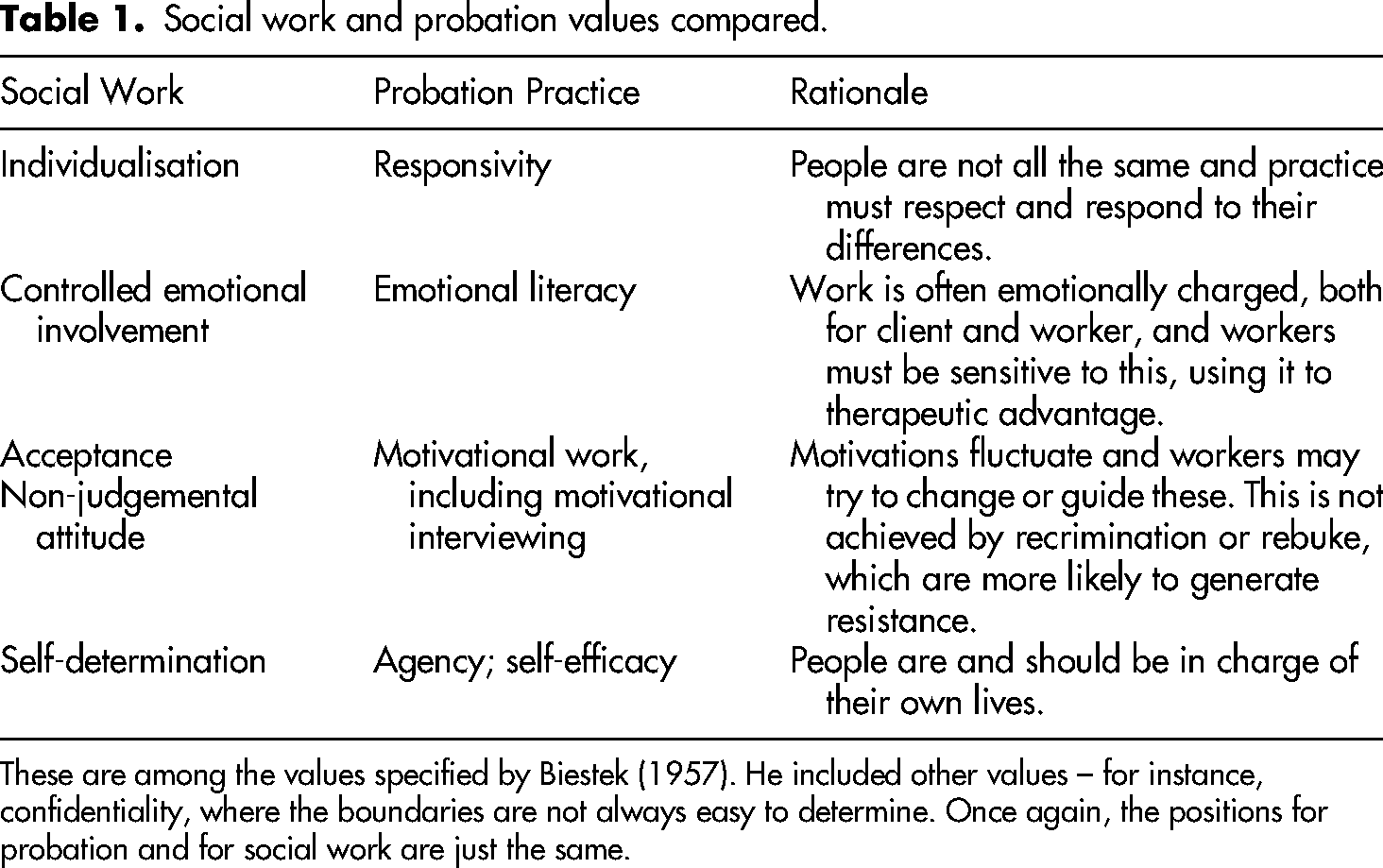
These are among the values specified by Biestek (1957). He included other values – for instance, confidentiality, where the boundaries are not always easy to determine. Once again, the positions for probation and for social work are just the same.
The principle of self-determination, which seems to have especially exasperated the Home Office, calls for particular consideration. This never meant that social workers were indifferent to the ways in which people acted: it affirmed the fundamental value of autonomy. Agency – taking charge of one's own life, actively seeking and creating opportunities - is a common feature of a desistance trajectory (Maruna, 2001; Farrall , 2011).
It is instructive, then, that while these values were likely to have been seen as the occasion for rejecting social work, they not only persisted in probation practice, expressed in a different terminology, but increasingly came to be recognised as essential to achieving compliance and reducing reoffending. They persist because they emerge from the challenges of staff trying to undertake difficult work in a principled manner.
Concluding reflections
Probation is social work, as so many countries recognise, and it is only political expediency that has encouraged successive administrations to repudiate that characterisation. Social work seeks to understand people, the difficulties that beset them and fitting responses to those difficulties in the context of social structure and circumstance, as well as in their psychological characteristics and their relations with others. This is how offending behaviour and desistance must be understood too and probation is limited and impoverished by neglect of social context. It is telling that youth justice in England and Wales has not lost sight of this and has managed to retain a strong social work ethos. Part of the explanation here, perhaps, is that it is politically easier to defend purposes of welfare and rehabilitation for young people, whose needs, vulnerability and capacity to change are more readily apparent than for adults. This makes it easier to defend a social work approach in response to their offences.
Nevertheless, despite the political posturing and reorganisation, there is a sense in which probation never left social work. As David Smith wrote, ‘… for all the rhetoric of punishment and public protection, risk management and enforcement, when practitioners decide what they are actually going to do to engage and motivate clients, help them access resources and convey a sense of hope in the possibility of constructive change, they will find themselves using ideas and skills that have emerged from social work theory and research.’ (2005: 634)
Safeguarding and public protection are essentially the same activity, even though different professions often have a different starting point in their complementary endeavour. A secure appreciation of one's role and its boundaries is essential in shared undertakings and this can only be fostered when the professions concerned have a deeper understanding of each other's responsibilities, resources, and ethos. So while it has been no part of my purpose to argue that probation or social work should take its educational model from the other, there is everything to be gained by closer alliances, including perhaps the sharing of modules in their respective curricula and even (although organisational difficulties should not be underestimated) exchanges in practice placement.
As for governance, any organisation ought to be structured, resourced and managed in ways that maximise its potential in achieving the purposes set for it. But sometimes it seems that probation policy has got this back to front – starting with governance without sufficient regard to the purposes, character and meaning of probation's work. Specifically, Transforming Rehabilitation was motivated less by ambitions to enhance practice than by ideological preferences for the involvement of the private and commercial sector. Again, while the reclaiming of the Probation Service and restoring it to the public sector was undoubtedly influenced by the transparent failures of TR, the creation of a centralised and national service – rather than a revival of the local Trusts - may well have been driven by the government's concern to have direct control over penal policy - which, as we have seen, became one of the principal battlegrounds in party politics and may become so again. Social services in England are the responsibility of Local Authorities and can be located within strategies for distinctively local provision. Probation should have position as well, as a key agency involved in promoting social (and not just criminal) justice.
This is an essential perspective for probation if it is to carry out its work in a manner that is both principled and effective, but has been ousted from what should be its central place by preoccupations with punishment and control. Rather than regarding other agencies as resources to address criminogenic need, probation could recognise its potential to put these other agencies in touch with some of their most needy and hardest-to-reach clients. As we have seen, research is now suggesting that that approach is invaluable in supporting desistance.
Political courage may be required to advance this understanding of probation. It is unfashionable to assert that probation has a duty to care for people under its supervision, or that the wider community has responsibilities towards people with criminal convictions as well as claims against them. It is therefore all the more important that probation and other social work services should stand as authoritative representations of how a good society should relate to those of its members who are struggling. No doubt these professions often fall short of the idealistic standards set out in this paper. Nevertheless, these are the values to which they should commit themselves and which they would be more likely to achieve if their historical connections were revived and reaffirmed.
Footnotes
Declaration of conflicting interests
The author declared no potential conflicts of interest with respect to the research, authorship, and/or publication of this article.
Funding
The author received no financial support for the research, authorship, and/or publication of this article.
