



Abstract
This article focuses on the feasibility of using a desistance-focused approach in the National Probation Service (NPS) in the post-Transforming Rehabilitation (TR) context. Findings are drawn from an exploratory study undertaken in one NPS Division, which used triangulation of three data collection methods: observations of one-to-one supervision sessions, documentary analysis and practitioner focus groups. Findings show that practitioners use elements of a desistance-focused approach, although not exclusively. Values based upon belief in the capacity to change and the need to offer support endure, despite mass organisational upheaval. The article concludes by suggesting that this ‘enduring habitus’ of probation could be an enabler for a desistance-focused approach but instrumentalism in policy and practice is a significant barrier.
Introduction
This article is based on findings from a small research study undertaken in 2018 which sought to explore the impact of theoretical and empirical findings emerging from desistance research upon probation practice in England and Wales; specifically, one-to-one supervision of service-users in the National Probation Service (NPS). 1 Practice approaches in the late 1990s and early 2000s became dominated by rehabilitative interventions delivered prescriptively, with the structural causes of crime frequently reframed as personal shortcomings or deficits that the service-user had responsibility for overcoming (McNeill, 2006). Alternatively, a desistance-focused approach was envisaged to allow ‘practice to become prospective and contextualised’ in such a way to recognise the social conditions that can impact on change efforts (McNeill, 2003: 156). McNeill later developed this further, promoting a ‘desistance paradigm’ for probation practice that forefronts processes of change (instead of interventions) and positions the practitioner 2 as ‘an advocate providing a conduit to social capital as well as a ‘treatment’ provider building human capital’ (McNeill, 2006: 57).
In a commissioned academic review as part of the National Offender Management Service (NOMS) Offender Engagement Programme (2010–2013), McNeill and Weaver (2010) highlighted that it was possible to operationalise desistance research and identified principles relevant to probation practice. They argued that probation practice needs to be shaped by eight general desistance principles that include: Being realistic (in recognition that it takes time for offenders to change and therefore lapses are to be expected); Favouring informal approaches to limit the damage of labelling; Using prisons sparingly (as they have a detrimental impact on desistance processes); Demonstrating hope and motivation to build positive relationships; Respecting individuality and avoiding taking a ‘one-size fits all’ approach; Recognising the significance of social contexts; Taking care to avoid using language that confirms negative perception; Promoting redemption and recognising efforts to give up offending.
These principles were developed further by McNeill et al. (2013) into 10 propositions for practice following a Desistance Knowledge Exchange Project. These propositions included meaningful service-user involvement in design, delivery and assessment of provision, moving away from risk/fear driven practices, practitioners connecting more with communities and improvements in how success is recognised and rewarded.
Additionally, studies of service-user perspectives have revealed the potential impact of probation supervision on desistance efforts (Barry, 2013; Farrall et al., 2014; Healy, 2010; King, 2014; O’Sullivan et al., 2018; Rex, 1999) and the pains that can be associated with desistance (Hayes, 2018; Nugent and Schinkel, 2016). Desistance scholars have argued therefore, that criminal justice policy needs to use such research, to reinvigorate practice (Farrall, 2016), and to act as a resource that helps practitioners understand the complex desistance processes they are responsible for supporting (McNeill, 2016). Drawing upon the desistance literature it is possible to highlight implications for specific areas of probation practice such as, assessments that need to take into account desistance-specific components such as age and maturation, social bonds and identity (Porporino, 2010; Rocque, 2017), and intervention that places the service-user at the centre of their own journey and is able to respond to the personal and social complexities of individual desistance efforts (Healy, 2012; McNeill and Whyte, 2007; Phillips, 2017; Shapland et al., 2012).
Above all else, research conducted across different jurisdictions and using differing methodologies continues to emphasise the importance of relational practice for supporting desistance (Burnett, 2000; Leibrich, 1994; Rex, 1999). Desistance is a subjective process that requires change in agency (Maruna, 2001), and therefore practitioners need to build trust, hope and motivation as well as make use of narrative approaches that can support the challenging process of reconstructing identity (Weaver and McNeill, 2010). The demonstration of hope by practitioners provides confidence to service-users that they can exercise control and achieve change (Weaver, 2014), and in the face of likely obstacles, the practitioner can be the one who ‘carries hope and keeps it alive when the person cannot do so for him or herself’ (McNeill, 2014: 169).
Progressing the desistance paradigm?
It therefore appears reasonable to argue that a desistance-focused approach to practice is desirable given the potential for positive outcomes at both individual levels and broader societal spheres. However, examples of probation research related specifically to desistance-focused practice are small in number with data collection largely occurring prior to TR (King, 2014; Phillips, 2014) or outside of England and Wales (Durnescu, 2018; Healy, 2010). These studies suggest that practitioners from various probation jurisdictions have only partly managed to work in accordance with a desistance paradigm of practice. Barriers appear to have been a shift in policy to emphasis on risk management (Healy, 2010), workload pressures and managerialist processes (King, 2014) and a lack of deployment of relevant skills (Durnescu, 2018). More recent studies in England and Wales highlight the impact of TR upon service-user narratives and perceptions of occupational competence (Kay, 2016), and the way in which TR has reduced autonomy for Community Rehabilitation Company (CRC) practitioners and made it harder for them to engage in people-focused practice (Tidmarsh, 2019). Research conducted in the post-TR context also highlights the monumental impact on staff in terms of employment relations and working conditions (Kirton and Guillaume, 2015), with practitioners in the NPS bearing the ‘relentless’ (Phillips et al., 2016), responsibility for working with individuals assessed as presenting a high risk of serious harm or with complex needs.
Therefore, the feasibility of undertaking desistance-focused practice in the current NPS context in England and Wales remains unknown and this study aimed to explore whether probation practice in the NPS has developed in accordance with the desistance paradigm outlined by McNeill (2006), considering the challenges of wide-scale reforms as a result of TR. By identifying current supervision approaches and gathering practitioner perceptions on using a desistance-focused approach, it was hoped that the enablers and barriers to desistance-focused practice could be identified; both at an individual practitioner level and more broadly at organisational level.
The study explored desistance-focused practice within the specific context of one NPS Division (post-TR reforms) with the following questions in mind: What approaches are evident in NPS practitioners’ supervisory practice? Do NPS practitioners believe they can practice in a desistance-focused way, in the NPS in the current climate? What are the barriers to, and enablers for desistance-focused practice in the NPS?
The focus of this article is on observations of supervisory practice and two of the key findings in respect of enablers and barriers for a desistance-focused approach.
Methodology
In recognition of the argument that the potential of a desistance paradigm depends on the legal and organisational context (McNeill and Whyte, 2007), the study focused on the post-TR situation in the NPS whereby the management and intervention elements of the supervisory process have become increasingly disconnected, with NPS practitioners primarily responsible for assessing and managing the risk of those they supervise (Burke and Collett, 2015). The study aimed to tackle the ‘slippery fish’ that is one-to-one supervision as it ‘remains rather elusive, ill-defined and variant’ (Porporino, 2018: 79).
An exploratory study using triangulation of three qualitative data collection methods was designed. Triangulation has been used in previous probation research (e.g.: Bauwens, 2010; Phillips, 2011; Tidmarsh, 2019) as an effective means by which to capture the complexities of probation practice (Durnescu, 2012). The research design was undertaken in accordance with adaptive theory (Layder, 1998), which facilitates exploratory design and whose basic assumptions incorporate use of triangulation. Accordingly, all three methods of data collection were guided by theoretical frameworks and conceptual schemes developed from desistance literature and probation practice research.
A selective literature review was undertaken to define orienting concepts that could be incorporated into a ‘practice-approach guide’ to be used at all three stages of data collection to offer structure and consistency across the research (Layder, 1998). Probation research tracks the move from practice approaches underpinned by social welfarism through to increasing use of group interventions and focus on risk management and public protection. As a result of pressures to improve effectiveness, Core Correctional Practice skills (Dowden and Andrews, 2004) identified via meta-analytical studies undertaken during the ‘What Works?’ era and dominated by Risk-Need-Responsivity principles, have driven practice skills training in England and Wales over the last 20 years. Research studies have subsequently developed structured observation checklists as a means by which to assess practitioner application of skills in supervision sessions (Raynor et al., 2014).
In accordance with adaptive theory the orienting concepts incorporated in the practice-approach guide were not an attempt to pre-determine findings, but were instead chosen as a means by which to organise data collection and provide a ‘secure foundation for conceptual innovation’ (Layder, 2013: 139). The four main practice-approach domains identified were as follows: Welfare or ‘advise, assist and befriend’: characterised by the provision of practical help and a focus on social welfare issues as opposed to criminogenic needs identified in OASys; Rehabilitative: characterised by a focus on criminogenic needs and identification and implementation of structured interventions aligned to RNR principles; Risk management: characterised by a focus on control and surveillance measures designed to constrain opportunities to offend and protect potential victims from harm; Desistance-focused.
Given that desistance-focused practice was the central interest of this study, careful consideration was given to how to define this practice approach. For the purposes of all methods of data collection, desistance-focused practice was conceived as being in accordance with the eight desistance-principles outlined by McNeill and Weaver (2010) in recognition that these principles emerged from the NOMS commissioned review of the desistance literature. These principles were more likely to be known by authors of probation policy and practice documentation and participants in the study.
Research methods were deployed sequentially to enable analysis of data to inform subsequent stages in the study. In this way, the documentary analysis was used to trial the practice-approach guide prior to use in the observations whilst also enabling reflection on the consistency or discrepancy between organisational expectations and observed supervisory practice. Documentary analysis and observation data was subsequently used to inform the focus group schedule and enable exploration of developing areas of interest. Documentary analysis was chosen to provide insight into organisational influences upon probation practice approaches. Policy documents, NPS practice guidance instructions and external assurance standards relevant to practice were selected for in-depth investigation with a view to identifying explicit and implicit references to practice-approach expectations. Subsequently, directed observations were undertaken of one-to-one supervision sessions using the practice-approach guide devised and deployed during the documentary analysis. Directed observation differs from structured or systematic observation as used in quantitative research designs. Rather than measuring the prevalence of behaviours using an inventory, directed observation is intended to make the behaviour of participants ‘intelligible in terms of qualitative, interpretive data’ (Layder, 2013: 74). As such, observations were directed by the research questions and directed to be seen in conjunction with the other two methods of data collection.
Site selection for the observations was based on time and accessibility limitations alongside recognition that the researcher was an existing Her Majesty’s Prison and Probation Service (HMPPS) manager (outside of the NPS) and previous senior probation officer, which could impact upon observations. Drawing upon existing professional networks, access was gained to a large multi-team probation office (which services urban and rural areas) where the researcher had never worked in an operational capacity. Purposive sampling was originally selected as a way in which to establish representativeness of data (Layder, 2013), by ensuring participants were representative of the wider NPS staff group working within community offender management teams and could therefore provide information of maximum relevance to the research questions. Volunteers were invited, by email from a gatekeeper, with no exclusions in terms of length of time practitioners had been in role or their professional qualifications. Despite the provision of notice, there were no volunteer responses prior to the site visit and consequently, convenience sampling was used with the researcher recruiting participants by direct approach during the week of the site visit. In recognition of the fact that observation can be anxiety provoking for some staff, assurances were provided in the participant information sheet that the research was being undertaken for academic study and did not involve evaluation of performance. It was hoped that this would limit the unavoidable impact of researcher presence upon participants’ behaviour during the observations. Practitioners provided informed consent in writing and were made aware of confidentiality and anonymity as well as the option to withdraw from the research up until a specified date. As service-users were not the primary objective of observation, verbal consent was considered sufficient (Walshe et al., 2011), however confidentiality and anonymity were explained, and assurances given that a refusal would not result in a negative outcome.
To maximise collection of data relevant to the research questions, supervision meetings at all stages of a community order or period of statutory licence were in scope. The original intention was to observe as many sessions with service-users as possible in a working week across a range of offences, however despite the willingness of practitioners to participate, some service-users withheld consent for observation to go ahead and this was respected. Additionally, some service-users failed to attend for the planned supervision session in the fieldwork week and consequently, all observations were undertaken with service-users convicted of sexual offences which was an unintended outcome. This represents a limitation to this study in terms of representativeness and has been reflected upon when analysing the observational data, as has recognition that volunteers may be practitioners who are more open to scrutiny of their practice (Bauwens, 2010).
The 10 sessions observed were delivered by 10 different probation officers (see Table 1) and ranged in length from 20 minutes to 90 minutes and showcased meaningful input with 10 white male service-users who were at varying stages of their supervision. Two were subject to Community Orders with one appointment being an unscheduled drop-in due to a crisis-situation and the other a last appointment pending revocation for good progress. Seven appointments were with service-users subject to licence that ranged from first month of release through to 24 months in the community. One session was a review with a serving prisoner via tele-conferencing, 2 years into a 17-year sentence.
Observations: practitioner participants.
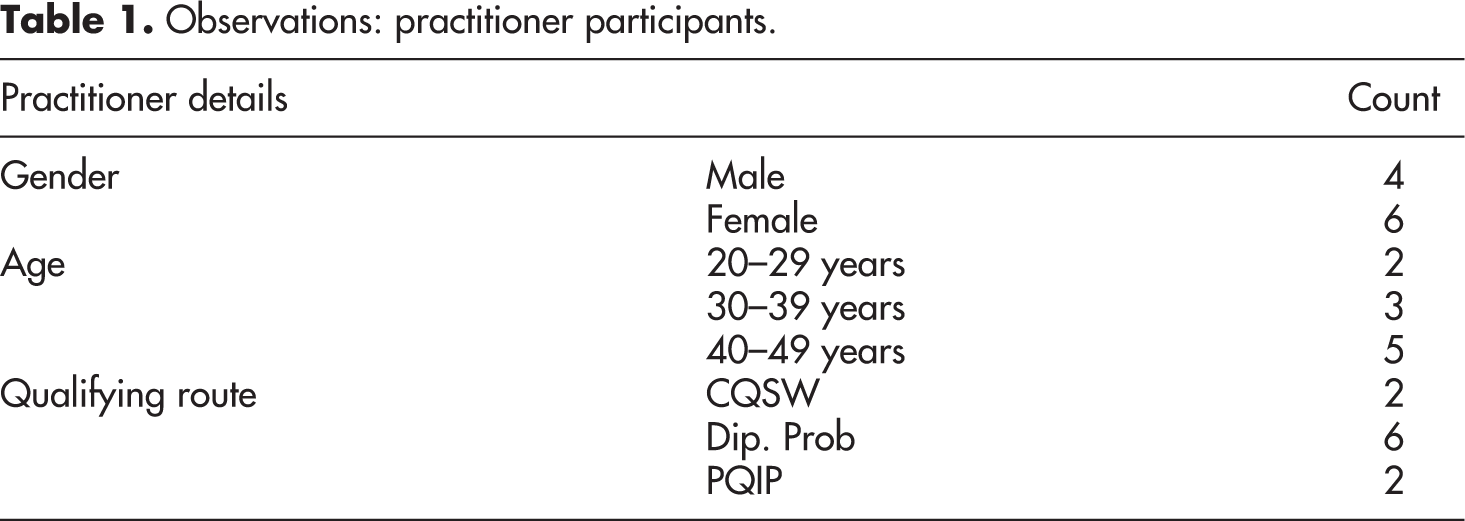
Detailed notes were made on the practice-approach guide to capture details relating to the practitioner’s plan for the session, body language, surroundings, session content and structure. Verbatim verbal exchanges were also recorded if they evidenced a certain practice approach. Care was taken to note where a certain practice approach was seen more frequently and in what circumstances, paying attention to variables such as the stage of the supervision process or staff training route.
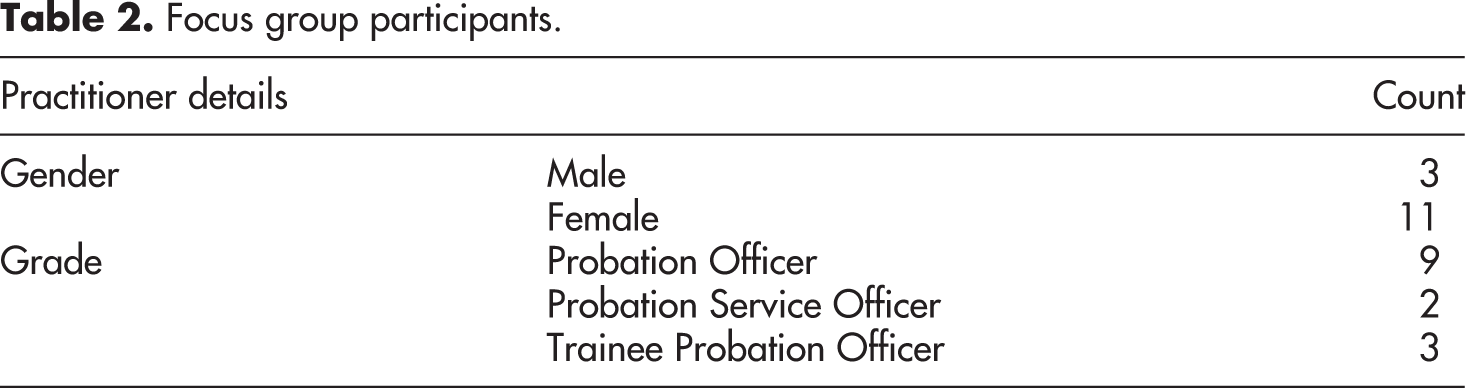
Finally, focus groups were considered an effective way in which to collect data related to practitioner perceptions in a short timeframe (Barbour, 2007). Three focus groups were undertaken in the autumn of 2018 within a single NPS Division. The clusters selected for the focus groups were chosen in recognition of the fact that they were serviced by two CRC companies and covered diverse demographic areas with inner city and rural offices. The 14 practitioners who volunteered varied in terms of gender, age (25–58 years) and grade (see Table 2) and to ascertain their perceptions on the feasibility of applying a desistance-focused approach to their supervisory work, focus group questions were devised using orienting concepts; namely the desistance principles identified by McNeill and Weaver (2010) as essential for practice. To ensure that participant perceptions related to current practice, a specific direction was provided in the setting up of the discussion to ask participants to think about supervisory practice in the last 6 months.
Focus group participants.
For each data set, deductive analysis was undertaken with coding in alignment with the orienting concepts used to define the practice-approach guide and focus group schedule. Use of a research log and memos, enabled reflection upon the relationship between the data sets and the orienting concepts to ascertain the practice approaches being used by NPS practitioners and whether they believed it is possible to practice in a desistance-focused way. Inductive thematic analysis was then undertaken across the data corpus (Braun and Clarke, 2006), to identify a set of enablers for, and barriers to desistance-focused practice which were considered with reference to desistance and probation practice literature, and with a mind to implications.
Findings and discussion
Observing fragments of desistance-focused supervisory practice
Observations highlighted the complexity of supervisory practice within the NPS and the skills required by practitioners. Analysis revealed the multifarious requirements of encouraging service-users to disclose sensitive information such as sexual fantasies or offence supportive attitudes whilst challenging cognitive distortions and simultaneously continuing to offer support and refrain from condemnation. Practitioners demonstrated that they considered not only what they were doing, but also how to maintain a working alliance.
Analysis suggests that practitioners do use aspects of a desistance-focused approach in supervisory work as per the principles outlined by McNeill and Weaver (2010). There was evidence of them interchangeably undertaking the role of counsellor to develop motivation, educator in the development of human capital and advocate in the building of social capital (McNeill, 2009). Practitioners made use of motivational interviewing (Miller and Rollnick, 2012), and pro-social modelling skills (Trotter, 2009), to support service-users in changing internal narratives and in processes of identifying obstacles to change and developing strategies to overcome them. For example, the technique of developing discrepancy was used to challenge condemnation scripts (Maruna, 2001), and encourage growth of a desistance-supporting identity, whilst supporting self-efficacy was achieved by the demonstration of hope and recognition of progress. You can trust yourself to go out on your own more. You’ve been on licence for over a year and you’ve achieved so much in that time. You have your flat and your job, but you need to build yourself a life. You cannot let this conviction determine who you are for the rest of your life. (Verbatim quote, practitioner to service-user, Observation 6) You did well not to respond like you have in the past; that’s evidence you are moving forward. (Verbatim quote, practitioner to service-user, Observation 4). This really isn’t the end of the world; you can stop drinking again. I appreciate that it’s hard, but it is completely doable, don’t give up now. You need to believe in yourself; I do. (Verbatim quote, practitioner to service-user, Observation 10) You say that you are a lost cause. Can you tell me the differences in yourself when you compare now to when you started the order? What differences do you want to make in the next 6 months? (Verbatim quote, practitioner to service-user, Observation 3)
Given that the NPS holds responsibility for supervision of those individuals assessed as representing a significant risk of harm to others, and that all of the service-users had convictions for sexual offences, it was envisaged that there would be substantial evidence of a risk management approach in supervision sessions. Many of the sessions observed included reminders to service-users of their obligation to abide with restrictive conditions imposed to constrain their opportunity to re-offend. These largely centred on discussions relating to exclusion zones, curfews, non-contact conditions and disclosure of developing relationships. These discussions were potential sources of conflict with several service-users challenging their curfews and arguing that such conditions were preventing them from moving forward. Practitioners required a range of knowledge to enable them to respond and engage in meaningful conversations; this included technical knowledge when working with service-users who had committed internet-based offences and legal knowledge of relevant legislation.
Practitioners were observed to be more directive when discussing risk management activities and it was the only time during the observations that enforcement was raised with service-users. It was also notable in these discussions that nearly all practitioners referred to joint working with the police in respect of surveillance and management functions. You understand this could be grounds for recall if you are charged. (Verbatim quote, practitioner to service-user: Observation 2) Because of what we have discussed today in relation to your drinking, I will be conducting a home visit in the next few days alongside the police, and you will need to agree to a check of your computer and phone. (Verbatim quote, practitioner to service-user: Observation 10)
However, whilst public protection appeared a priority for the practitioners observed, analysis indicates that risk management was an objective of supervisory practice as opposed to a defining practice approach (characterised in the research approach guide as practice focussed primarily on control and surveillance and dominated by rigid enforcement). This was demonstrated by practitioners continuing to relay care and commitment for service-users and by offering assurances of assistance with complex issues such as disclosures of offending to new partners or prospective employers. The reason why I’m asking these questions is because I want to keep you safe. I’m here to manage your risk but at the same time I need to make sure you are safe as well. (Verbatim quote, practitioner to service-user during Observation 2)
Instrumentalism as a barrier
Analysis highlights several themes indicative of barriers to desistance-focused practice. These included dissonance (characterised by a significant gap between official and frontline discourse) and practitioner pains (relating to caseload pressures, emotional labour, fear of accountability processes and insufficient training and professional development). The remainder of this article, however, focuses upon the theme of instrumentalism.
Analysis of the documentary data supports Robinson’s (2016) view that there are three prevailing narratives (managerial, punitive and rehabilitative) interwoven in policy, and analysis of observational data suggests this impacts directly on supervisory practice, namely the absence of a single approach. Canton (2012) has previously noted that the current trend within probation practice of instrumentalism risks suppressing the personal and moral dimensions of practice which are essential to a desistance approach. The documentary analysis would appear to evidence an approach of instrumentalism within practice. For example, effective engagement with service-users is equated to achieving risk management, and enforcement action is linked to securing public confidence (NOMS, 2015). Home visits are expected to be undertaken as part of surveillance activity, as opposed to a chance for interaction with the service-user and significant others in their social setting. Likewise, the rationale provided for the prompt commencement of orders is linked to public protection and not ensuring that service-users have swift access to support required to initiate and sustain desistance efforts. Despite explicit reference to desistance literature in several of the documents, there is the continued use of the term ‘offender’ which fails to recognise the importance of avoiding negative labels, and the presence of discourse that prioritises the management of perceived persistent risk (rather than recognition of strengths and development in personal growth) and fails to recognise that most service-users will achieve desistance. Social capital is misrepresented as the responsibility of practitioners to make referrals to partnership agencies, with a view to demonstrating value for money, as opposed to any recognition of their role as advocate to assist in access to community opportunities (NOMS, 2015).
Practitioners were observed using desistance principles in supervision in what could be interpreted as a means-to-an-end approach supportive of a ‘culture of utility’ (Millar and Burke, 2012). For example, several of the observations highlighted how practitioners worked with service-users to improve their social capital by promotion of community engagement. However, discussions post-observation revealed that practitioners’ intentions related to reducing risk by limiting social isolation, as opposed to recognition of the pivotal role of social capital in desistance journeys. Robinson (2016) has commented previously on how rehabilitation has been rebranded to become ‘part of a toolkit of measures oriented towards the protection of the public and the management of risk’ (2016: 40) and analysis of the data from this study suggests that there is a similar trend occurring in respect of a diluted desistance approach being provided by policy makers in documentation, linked to public protection aims, as an attempt at retaining legitimacy with the wider public. The current NPS offender manager reductionist line of assessing, monitoring and recording but not intervening with meaningful work (as espoused in policy documentation) is representative of an ‘efficiency credo’ where ‘pragmatism, efficiency and expediency are the themes that set the tone’ and the ‘tenor is one of smooth management’ (Rutherford, 1994: 3).
Analysis suggests that policy instructions fail to clarify a specified practice paradigm, instead practitioners are guided by documents that contain a mixture of expectations relating to risk management and rehabilitation (in a utilitarian form) with desistance often reserved as a footnote in much the same way that Lewis (2005) conceived rehabilitation as window-dressing when analysing penal policy in the lead up to the introduction of the Offender Management Model. The prioritisation of risk management continues to emphasise technical tasks that place the locus of control with practitioners rather than recognising the pivotal role of the service-user in the desistance journey (O’Sullivan et al., 2018). This continued fore-fronting of risk represents a barrier to desistance-focused practice by way of the threat it presents to the practice approaches required to support a desistance paradigm.
Enduring values – An enabler
Previous probation research has effectively used the concepts of ‘habitus’ and ‘field’ to develop thinking about probation practitioner values and approach to practice (Deering, 2011; McNeill et al., 2009; Robinson, 2016). Notably, practitioners have been conceived as possessing an enduring habitus (Grant, 2016; Robinson et al., 2013); namely they retain a disposition that believes in the capacity of change and the need to support the individuals they work with to address welfare needs as well as those linked specifically to offending. This disposition has remained consistent despite significant changes in penal policy discourse that increasingly prioritise public protection.
NPS practitioners have been subject to momentous change because of the TR-reforms; in particular, the definition of their role in explicit terms of risk management and enforcement tasks as opposed to responsibility for engendering change through relational practice. Despite this, analysis suggests that the enduring habitus of probation continues. Practitioners demonstrated a firm value base that believes in the capacity of service-users to desist, and also appears to drive commitment to one-to-one supervisory practice. It’s that belief in the ability to change isn’t it; it’s at the core of everything we do. We have to stick to that belief. (Focus Group A, Participant 1) Realism is important. We have to acknowledge it’s not an easy path, because it’s not is it, but you’ve got to keep plugging away at it. (Focus Group A, Participant 3) My starting point is that the people that we work with, they, through life’s experiences have lost the ability to dream, lost the hope that things can be better, and I come from a very emotional space. I tell them, you are still here, and you are still breathing, and you can make changes. They are going to be small and if you get knocked back you got to hang in there and I’m going to hang in there with you. (Focus Group B, Participant 6) So, we ran the test which was positive for cannabis but on the contrary I’m getting a really good message from the hostel manager saying he is doing really well and can we relax the curfew. It’s illogical but I’ve placed my confidence in him to bring a change. I relax the curfew to give him the freedom to change. Can you imagine if an inspector looked at that decision! (Focus Group B, Participant 8) I will celebrate their successes, so I send a card to say well done on getting a job or if they have a child. I got that from an old school probation officer who has retired now. I always send them a Christmas card that shows them, this is how it can be when you start to engage with people. It’s very basic stuff. (Focus Group B, Participant 5) I guess I’m old school, Jurassic even but I still think the old ones are the best in terms of assist and befriend. I can’t lose that element of my work, even more so with what they face today, so I will feed him via food bank vouchers and help him access money to buy shoes for the kids because I have his back. (Focus Group B, Participant 6) I know I’m supposed to hand them over to someone else to do the final appointment, but I want that chance to say well done and send them off with something really positive. I’ve always said to mine that they can still give me a call, even though they are not on probation. I know we’re not paid for that, but I would rather them come to me than commit an offence. (Focus Group A, Participant 5)
Conclusion
By using three methods of data collection, the research generated rich and contextualised data that enabled analysis of practitioner behaviour in the course of supervision, as well as exploration of their perceptions of the challenges to using a desistance-focused approach in one Division within the NPS in 2018. However, as a small study conducted in one NPS area, only analytical generalizability is possible (Silverman, 2006). The fact that observations were conducted solely with service-users convicted of sexual offences impacts on the ability to generalise findings about practice approaches currently used and as such, further studies need to ensure that a range of sessions were observed and analysed. In addition to this, the documents analysed were relevant at the time of data collection but, in view of the current review of probation services, future research needs to analyse any revised policy and practice documentation.
The enduring habitus of probation values can be seen as an enabler for progressing a desistance paradigm of practice but it would appear that the prevailing drive for efficiency and measurable binary outcomes does not lend itself to supervisory practice that is wholly supportive of desistance efforts. Documentation and observational data analysed, highlight the continued narrative of offender management, heavily influenced by instrumentalism, managerialism and punitive aims. A desistance-focused approach would instead benefit from recognition of the role of change management as the defining feature of practice (McNeill and Whyte, 2007), and acknowledgement of the role of relational practice in enabling personal growth in service-users, as opposed to a means by which to secure short-term compliance or increased ability to learn from accredited programmes.
Consequently, there is a need to consider whether a politically favoured coercive environment can ever support a non-coercive desistance paradigm (Porporino, 2018). Development of effective probation services requires political investment in equipping frontline staff with the key skills and creation of contexts for practice that provide them with realistic opportunities to exercise these skills (McNeill and Whyte, 2007). The Transforming Rehabilitation agenda has certainly not provided these enablers and currently, desistance-focused practice is too frequently referenced as a footnote or something to be considered after risk management activity. This study suggests that the current situation in one area of the NPS is one where practitioners find themselves with a ‘qualitatively different habitus to the intended field’ (Deering, 2011: 179), but this should inspire hope that a desistance paradigm of practice is still possible if penal policy allows it to move from the wings into centre stage.
At the time of writing, a review of probation services is underway which will inevitably result in further upheaval for practitioners and the service-users they support. The Draft Target Operating Model (HMPPS, 2020) uses the word ‘desistance’ just 26 times in over 196 pages and does little to inspire confidence that there will be significant changes that enable desistance-focused practice to flourish. Despite a positive commitment to moving away from the use of the negative label ‘offender’, there remains evidence of a narrow application of desistance concepts. For example, ‘overall increased desistance’ is said to be a desired outcome of the public (HMPPS, 2020: 20) and fails to recognise that desistance is a process belonging to the individual engaged in transformation, not others around them. Likewise, defining desistance as ‘how people with a previous pattern of offending abstain from crime’ (HMPPS, 2020: 152) fails to recognise the complexity of the process involving the transformation of identity, growth in social and human capital and the need for community engagement.
There is evidence of consideration of the desistance principles outlined by McNeill and Weaver (2010), for example building a trusting relationship to increase hope and sustain motivation and being realistic about the likelihood of lapse. Disappointingly however, there is no indication of how practitioners achieve this alongside the priorities of enforcement and public protection. Further contradictions arise with the assertion of the need for ‘informal and individualised approaches’ (HMPSS, 2020: 34), before moving on to outline higher levels of prescription in the delivery of Rehabilitation Activity Requirement and Post Sentence Supervision periods. Likewise, the updated Risk of Serious Harm Guidance (HMPPS, 2020) encourages the use of strengths-based approaches and outlines supervision and intervention as equal priorities alongside monitoring and control in the four-pillars approach to risk management. This could be viewed as a move towards incorporating desistance-informed practice, however the lack of use of concepts such as human and social capital can also be seen as a missed opportunity to support practitioners with embedding desistance concepts in risk assessment practice.
Most strikingly, the recognition that the relationship between the practitioner and service-user is the ‘principle means of supporting the journey to desistance’ (HMPPS, 2020: 34) is hardly supported by the proposed delivery model which sees the practitioner role firmly restricted to assessment, monitoring and enforcement activities with rehabilitation and resettlement services largely delivered by others through the ‘Dynamic Framework’. A commitment to strengths-based accredited programmes and approaches within NPS continues to be signalled, not least through the roll-out of the revised SEEDS framework which seeks to improve engagement with service-users through effective development of practitioner supervisory skills and embedding reflective supervision within a staff supervisory framework. There is a tendency however to equate such approaches to a desistance-informed approach, when in fact it would be more accurate to state that they contain desistance-informed elements. This may seem a pedantic point, but given the dissonance and instrumentalism identified within the documents analysed in this small study, it could be viewed as an ongoing barrier to practice that can support desistance in its broadest conceptualisation.
Arguably, whatever lies ahead, practitioners need policy and practice documentation that provide a clear mandate to focus on desistance-related factors, and the opportunity to practice in ways aligned to their enduring values. Without this, it may prove difficult for a true desistance paradigm of probation practice to flourish in England and Wales. An approach characterised by humanitarian values and with one-to-one supervisory practice promoted and enabled, could be viewed as more aligned to the beliefs of the practitioners in this study (and numerous previous probation research studies) and more likely to support the desistance approach by virtue of its focus on relationships and optimism that change is possible.
Footnotes
Acknowledgements
I would like to thank Dr Jake Phillips for his helpful comments on an early draft of this article. I would also like to thank the practitioners who kindly volunteered their precious time to participate in this research. You reminded me of why I remain so passionate about probation practice.
Declaration of conflicting interests
The author(s) declared no potential conflicts of interest with respect to the research, authorship, and/or publication of this article.
Funding
The author(s) received no financial support for the research, authorship, and/or publication of this article.
