




Abstract
Positive reinforcement is a key part of probation practice, and linked to client desistance from offending. The main way practitioners positively reinforce clients’ prosocial comments or behaviours is through praising them. However, praise is tricky in interaction, as people are under pressure to accept the positive assessment whilst also avoiding self-praise. Applying conversation analysis to 21 video recordings of probation sessions originally collected for the Jersey Supervision Skills Study, we examine how this important aspect of probation features and functions in practice, and how clients respond. Our analysis shows how practitioners and clients manage the practice and dilemmas of praise.
Keywords
Introduction
Positive reinforcements, such as praising and complimenting, are proposed to contribute to clients’ change processes in counselling and therapeutic literature by, for example, creating a positive atmosphere, acknowledging the positive actions clients have taken, enhancing clients’ self-efficacy and easing clients’ fears about being judged or the change process itself (Truax, 1966; Wall et al., 1989). Studies in correctional practices (Andrews et al., 1990; Raynor & Vanstone, 2016; Trotter, 1996, 2012) and child protection (Trotter, 2004) state positive reinforcement is central to effective practice with clients involved on an involuntary basis, under a prosocial modelling approach. This approach is based on learning theory, with the underlying assumption that people are influenced by the behaviour modelled by others and by positive and negative reinforcement of their own behaviours. Trotter (2015: 123) outlines four steps of prosocial modelling and reinforcement: “identifying client pro-social comments and actions; rewarding those comments and actions; presenting oneself as a pro-social model; and challenging antisocial or pro-criminal comments and actions.” In this paper, we examine the second of these steps: how probation officers reward or reinforce clients’ prosocial comments and behaviours through positive evaluations or assessments, and how clients respond.
Positive reinforcement in correctional practice
Trotter (2015) highlights the most powerful way a social worker can reinforce prosocial behaviours and comments is with praise. He advocates that praise should be used liberally and purposefully, and explicitly directed at the client's prosocial comment or behaviour. In their study of probation officers’ practice skills, Vanstone and Raynor (2012) included positive affirmation as a key element of prosocial modelling, and, under their canon of verbal/non-verbal communication skills as part of necessary relationship building skills, they highlighted probation officers should be placing emphasis on positives and expressing encouragement. They found prosocial modelling was correlated with client desistance (i.e., lower likelihood of reconviction) one year post order completion, and verbal and non-verbal communication skills were correlated with client desistance two years post order completion (Raynor et al., 2014; Raynor & Vanstone, 2016). Praise may help desistance by ‘de-labelling’ the individual, in promoting the prosocial elements of their behaviour and reflecting this back, effectively celebrating and reinforcing positive change (Kirkwood, 2023; Maruna & LeBel, 2010).
Trotter (2015) and Vanstone and Raynor (2012) give some examples of what positive reinforcement or praise might look like in a probation context: PO: It is good to see you. I appreciate your coming on time. It does make things easier for me. Did you come on public transport? Con: Yes. I lost my licence a few months ago. PO: Well, I am pleased to hear that you are not driving. Did you come by train? Con: Train and bus (Trotter, 2015: 121) …examples of praise relating to specific behaviour or thinking (‘that's very honest of you’, ‘that's very insightful’, ‘that's a big achievement’ ‘thank you for explaining and apologising for last week's absence’), and examples of encouraging pro-social behaviour and thinking (‘it's good that you resisted having a drink when faced with that difficult situation’ ‘admitting feeling guilty about letting your partner down was a big step’). (Vanstone & Raynor, 2012: 20–21)
These examples identify positive reinforcement as praising or complimenting any identified prosocial behaviour from punctual attendance at probation appointments to more trait like prosocial behaviours, e.g., honesty and insight. However, they do not address how clients respond to such positive reinforcement or consider the other functions it might serve in practice.
Praise as interaction
Research examining interaction has highlighted that praising and complimenting can be problematic for the recipient of the praise to manage. In her influential research, Pomerantz (1978) identified that, in English, people in ordinary conversations tend to downplay or deflect praise, as they balance the competing interactional pressures to both accept a positive assessment and avoid self-praise. For example: R: You’re a good rower, Honey. J: These are very easy to row. Very light. (Pomerantz, 1978: 102)
This is notable because, generally speaking, in conversation we typically agree with evaluative statements, with the common response being to upgrade the initial assessment (i.e., by providing a stronger evaluation; Pomerantz, 1978).
However, Shaw and Kitzinger's (2012: 231) research on home birth support phone lines highlighted these pressures may be different in institutional contexts, as they found a high proportion of compliments (just over half) were accepted by the praise recipients usually by a ‘thank you’ or similar, and often accompanied with a breathy laugh or smile voice, which worked to manage the issue of self-praise by displaying ‘surprise, taken-abackness, or never-thought-of-myself-that-way-beforeness’. Similarly, when Gathman et al. (2008) examined how participants in a research survey responded to interviewers complimenting their performance, they noted there were distinct differences between the patterns of responding in everyday ordinary conversation and this institutional context. Here, respondents were less likely to downplay or deflect the compliment, but tended to deal with the praise minimally (e.g., ‘okay’, ‘yeah’), or withhold any response at all. This is very rare in ordinary conversation but was common in this context, leading Gathman and colleagues to surmise the participants are orienting to the interview as a particular type of institutional activity. As the survey participants did not have the knowledge in this context of what constitutes a good or bad performance, they were unable to downplay or deflect the compliment as one might in ordinary conversation.
Giving praise is also not always positive as it can be used to reproach, criticise or interrupt; for example, praising someone's usual positive characteristic to highlight how they are presently being hypocritical (Golato, 2005). In institutional interactions, it can be used as a tool to achieve practitioners’ agendas, both those which are explicit (e.g., promoting positive change) and those which are not. For example, Weiste et al. (2021) demonstrated that practitioners in a mental health rehabilitation group used compliments to exert pressure on clients to respond (e.g., ‘Leo is an artistic person […] do you have some opinion?’ [228]), to close down discussion topics and to generate exclusion and prepare clients for a negative decision. It may also be used by clients to achieve social actions; for example, Hudak et al. (2010) noted that patients in medical interactions used compliments to pursue certain treatment options (i.e., by complimenting a surgeon's characteristic that aligns with a particular treatment approach). As such, both giving positive feedback, in the form of praise or compliments, and receiving it, is not as straightforward as it might initially seem. Understanding how this works in interaction in probation sessions will deepen our understanding of the function and role of positive reinforcement in this context.
Methods and data
Using conversation analysis, we studied 21 video recorded probation interviews which took place between 2007 and 2010 as part of the Jersey Supervision Skills Study undertaken in the British Channel Islands. Full reports of the study are available in Raynor, Ugwudike and Vanstone (2014) and Raynor and Vanstone (2016). Briefly, the study collected 95 video recorded interviews from probation staff, which were used to analyse the skills used by officers in the interviews. The skills analysis was guided by a checklist and manual (Vanstone and Raynor 2012) drawn from international literature on effective correctional skills, and produced a numerical score for each interview based on the observed use of skills. Subsequent analysis of reconvictions showed that clients from higher scoring interviews were significantly less likely to be reconvicted than clients from lower scoring interviews, although both groups were initially assessed as showing similar risks of reconviction. Information was also provided about which skills were strongly associated with desistance over one year and two years. The Jersey study did not cover in detail the response of clients to the skills used or the process of interaction: the focus was more on ‘what works’ than on ‘how it works’. The current study is intended as a contribution to filling this gap.
The authors received ethical approval for secondary analysis from the University of Edinburgh and the Jersey Probation Service, and twenty recorded interviews were selected from the higher and lower ends of the skill score distribution for analysis in order to maximise the opportunity to observe differences, together with a further ten interviews selected to show three sequences in which officers recorded repeated interviews with the same clients. The study of praise and positive reinforcement which is reported in this article is based on 21 of these interviews, involving 8 probation officers and 17 clients. Twelve interviews are at the higher end of the skill distribution and nine at the lower end. These 21 sessions were selected due to practical reasons, i.e., quality of the audio and video, and content of the session, i.e., report interviews were excluded. To preserve anonymity and avoid the use of official case identifiers, the interviews are labelled here with a letter for the probation officer, number for the client and H or L to identify high and low, e.g., B6H. Where the session is from a sequence the video is noted in the brackets (e.g., (#2)). All names and identifying information have been anonymised.
Conversation analysis is an approach that involves the detailed examination of talk as interaction (Schegloff, 2007). It attends to the unfolding nature of conversation, such as patterns in the turn-by-turn sequential ordering of interactions, typically through analysing detailed transcripts of audio or video recordings of ‘naturally occurring’ exchanges, including fine-grain detail such as hesitations, pauses and overlapping speech. This type of analysis reveals how intersubjectivity is created and maintained through interaction, such as when people check mutual understanding, correct themselves or repair misunderstandings. As well as being applied to ‘everyday conversations’, conversation analysis has been used to study a wide range of institutional settings, and provides insight into how the business of such institutions is done, with the potential to enrich our understanding, reveal surprising findings, and guide practice. Given the central role of talk and interaction for probation practice, conversation analysis is a valuable approach for understanding how it operates (Kirkwood, 2016; Mullins et al., 2022), such as in this case of exploring how praise features and functions within probation sessions.
The video recorded probation sessions were transcribed by a professional transcription service. The first author viewed all the videos with the transcripts and identified instances of positive reinforcement, in the form of praise or complimenting. The second author viewed examples of the videos and transcripts and assisted with coding ambiguous instances. In line with previous research in probation (e.g., Trotter, 2015; Vanstone & Raynor, 2012), positive reinforcement here was considered as any positive evaluation or assessment of clients’ prosocial behaviours, thoughts, comments, circumstances or other aspect. In conversation analysis research, positive assessment in interaction has been commonly used to identify the actions of ‘doing praise’ or ‘doing complimenting’ (Gathman et al., 2008; Golato, 2005; Hudak et al., 2010; Pomerantz, 1978). However, as discussed above, positive assessments are not always doing these social actions, and praise or complimenting are not always in the form of positive assessments, and can instead appear in the form of, for example, questions or corrections (Golato, 2005; Shaw & Kitzinger, 2012). As Trotter (2015; Trotter & Ward, 2013) highlight, what is considered ‘prosocial’ is value laden, and runs the risk of the practitioner (or researcher) moralising or imposing their own values. For the purpose of this analysis, what was identified as ‘prosocial’ was informed by previous research on probation practices and encapsulated behaviours, expressions, comments and attitudes consistent with pursuing a non-offending lifestyle, such as gaining employment, addressing drug use, ‘staying out of trouble’, or pursuing positive interests (i.e., Andrews & Kiessling, 1979; Raynor et al., 2014; Trotter, 1993, 1996, 2015; Trotter & Evans, 2012).
Across the 21 sessions, 188 instances of positive reinforcement, as praise, were identified. These instances could be as short as just one utterance (e.g., ‘congratulations’) or expanded over several utterances. These were analysed to identify 1) what the action or function of the positive reinforcement was and 2) how clients responded to positive reinforcement. The first author also identified 28 instances where there was an interactional opportunity for praise or positive reinforcement, but the probation officer did not pursue this, or it was delayed. These instances were identified as times when the client made a prosocial comment or action (e.g., reported reduced drinking or engaging in a positive interest), but this was not clearly positively assessed by the probation officers. These instances were identified and analysed to consider how clients respond when praise is a relevant action in the interaction but not present. Given the difficulties in pinpointing something that is absent, identifying these missed opportunities for praise is unlikely to be exhaustive but gives us some indication of the potential role of praise.
Findings
What action is praise doing in the talk?
The primary functions of praise identified in the data were: reinforcing clients’ prosocial comments or actions (i.e., thinking, behaviour, reported or demonstrated change, or characteristic) (130); encouraging engagement with the task at hand (78); and connecting with the institutional requirements (8). There were a small number of instances of more straightforward complimenting of clients’ skills (e.g., writing, remembering) or presentation (8), which did not explicitly link to an institutional agenda of engaging clients in tasks or promoting prosocial behaviours. Often the praise served multiple functions; for example, complimenting a client's problem solving during an exercise both reinforced the desired behaviour and thinking as well as encouraged their engagement with the task at hand.
Reinforcing prosocial comments and actions
Probation officers directly praised clients’ prosocial comments or actions through positive assessments; this was the most common action of the praise in the probation sessions and evident in 20 of the 21 sessions. In some cases, such as extract 1 below, probation officers linked the praise to clients’ wider character traits, for example, honesty or self-awareness. In this extract the client has been completing an exercise on problem solving, specifically identifying the physical responses to having a problem, as part of the Core programme. The Core programme is an individual offending behaviour programme designed and used in Jersey, consisting of a set of modules to be worked through flexibly, responding to individual needs. The modules focus on problem solving, offence analysis, the consequences of offending, victim awareness, reparation, and action planning to stay out of trouble.
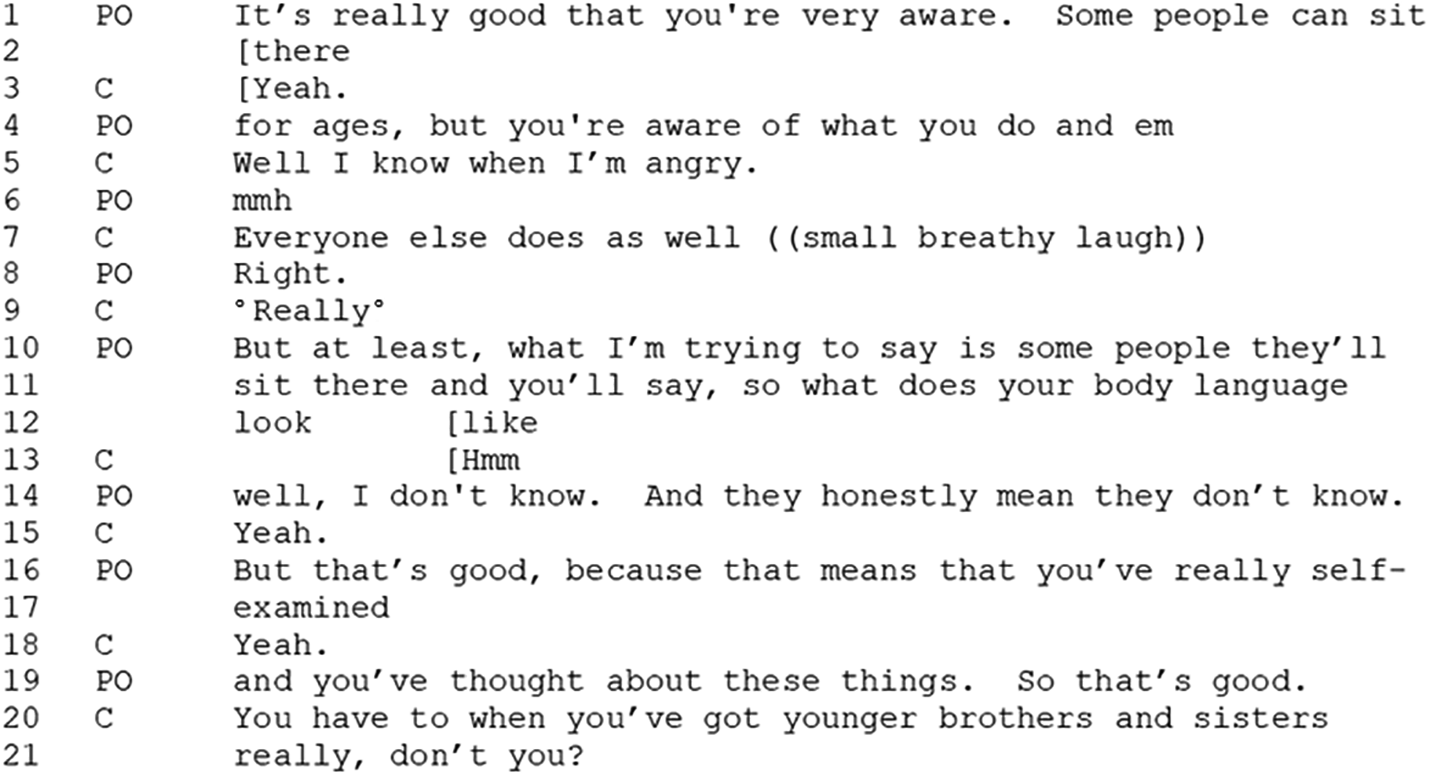
Here the probation officer is specifically stating what she is praising – the client's self-awareness – and why. Her first attempt to praise is downgraded / deflected by the client. Starting the response with ‘Well’ indicates that the praise is not wholly accepted (Heritage, 2015). Instead, the client sidesteps the praise by offering a matter-of-fact statement of agreement (as if knowing when oneself is angry is not praise-worthy), before further downgrading and managing the issues of self-praise with a joke and small laugh. However, the PO does not join in with the laughter, instead providing minimal agreement (‘right’), before attempting to reassert the praiseworthiness of the client's actions. By comparing with other people, the PO goes on to highlight this client's particular strengths (i.e., awareness) and behaviours (i.e., self-examining) as something special. This strategy, evident in previous research (Gathman et al., 2008), both serves to strengthen the compliment and makes it more difficult for the recipient to disagree with as they do not have the knowledge about other people's performances. Again, the client works to deflect the praise by offering a qualification for why this behaviour is necessary (lines 20–21). These client responses fit the more typical pattern found in ordinary conversation (Pomerantz, 1978), although, in these data such ‘typical’ responses were less common.
The way the praise is designed in extract 1 fits with professional guidance that praise should be purposeful and explicit. However, in many cases, the praise was brief (e.g., ‘well done’, ‘brilliant’), as in Extract 2.

Although the PO at line 2 is not explicitly stating the focus of the praise, it is clear in the sequence of the talk that this positive assessment is related to the client's reported action of going to an employment support agency. Due to the intersubjective nature of interaction where the people involved are constructing a shared meaning, it may not always be necessary for POs to be as explicit as the guidance suggests in order to reinforce the client's comments and actions. Being explicit and pointed about praise at every opportunity may actually result in stilted conversation and impact the sense of social solidarity in the interaction, exacerbating an expert / lay person dynamic. However, without being explicit there may be ambiguity about the focus of a positive assessment, verbal or non-verbal, which could potentially be interpreted as reinforcing negative comments and actions (as illustrated in extract 4 below). This further highlights the need for POs to be aware of what they are reinforcing, so they don’t unwittingly reinforce negative comments or behaviours.
Encouraging engagement with the task at hand
POs used praise to encourage engagement with the task at hand. This is evident in Extract 3 below, where the client is performing a roleplay to support her approaching the job centre for help.

The client has been struggling with doing the role play – as indicated by the hesitations, repetitions, laughter, and saying ‘I don’t know’ – and the PO encourages and supports her by praising her engagement with the task (‘you’re doing really well’, ‘you’re doing great’). Performing a roleplay may be unfamiliar and feel unnatural for clients, so praise can function here to indicate whether the client's performance is appropriate. The PO underscores the genuineness of the praise (‘honestly’) and urges her to continue (‘go on’). Trotter (2015) highlights the need for praise to be genuine in order to be effective. Interactional research has noted there are a number of ways people can communicate sincerity in their positive assessment, such as the claim to honesty that appears here, drawing comparisons (as seen in extract 1), and reaction tokens (e.g., ‘wow’) (Gathman et al., 2008; Goffman, 1978; Shaw & Kitzinger, 2012; Wilkinson & Kitzinger, 2006).
Where there is some ambiguity or possible misunderstanding about the focus of the praise, clients and POs can however work to repair this and ensure a shared meaning, as in extract 4. Here the client is generating a list of consequences related to her son's disability, as part of a programme exercise on problem solving.
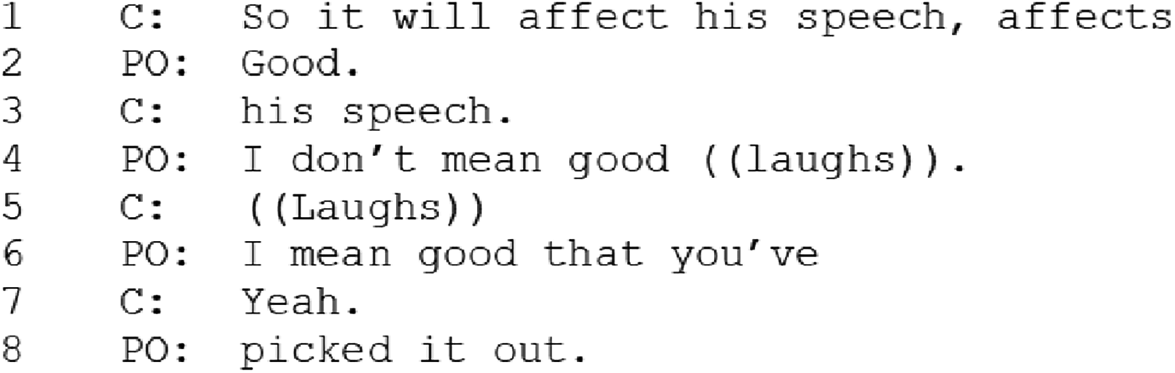
At line 2, there is a risk the PO's positive assessment can be heard as related to the impact of being disabled on the child's speech, rather than positively assessing the client's engagement with the task. Managing the delicacy of this with laughter and ensuring the correct shared understanding, the PO goes on to be explicit about the focus of her praise. The shared nature of the laughter here (unlike in extract 1), indicates they are both tuned in to the problematic and unintended meaning of the word ‘good’ in this conversation.
Connecting with institutional requirements
In a small number of instances praise was delivered prior to a question or comment that underlines the institutional requirements. The praise in these instances highlighted the client's compliance, progress and / or motivation before stating something they are compelled to engage with as part of their order. This is evident in Extract 5 below, where the client's drug use is being regularly monitored as a compulsory part of their probation order. The discussion here is around the client providing clean drug tests to demonstrate compliance with the conditions of their order. Prior to this, the client suggested they also take Naltrexone, an opioid blocker used to support recovery from drug use by preventing the cravings for and positive effects of opioids.
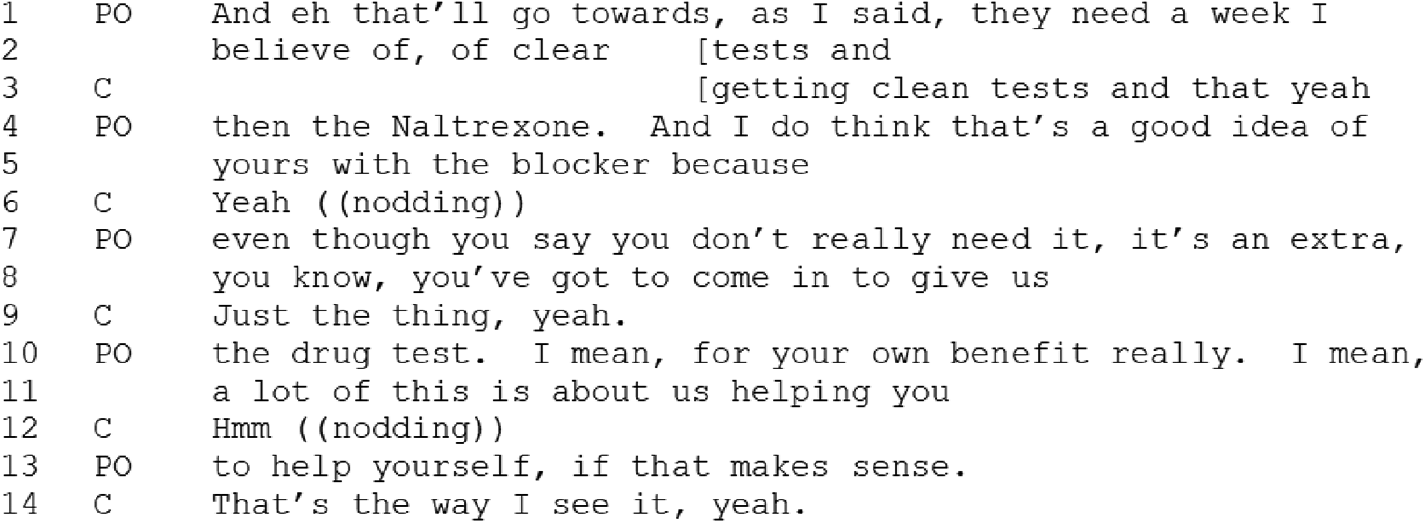
At lines 4 and 5, the PO praises the client's suggestion to take Naltrexone as a good one, firmly locating it as the client's idea. The PO implies this further demonstrates compliance with the conditions and purpose of the order (‘an extra’), on top of the institutional requirements to provide drug tests (‘you’ve got to come in to give us […] the drug test’). However, the PO is quick to then highlight these actions are not just about meeting the institutional agenda but for the client's benefit. In this way the PO merges the aspects of care and control, or the balance of encouraging motivation and self-efficacy in clients, whilst also being clear about the institutional and legal requirements. Although this action of praising was less common than praising prosocial behaviours or encouraging engagement with the task at hand, it demonstrates further how praise can be used to meet institutional goals of supporting clients to engage with processes in a self-motivated or voluntary way, even when they are involved on an involuntary basis. By praising the client's actions towards their rehabilitation and connecting these with the wider legal and institutional requirements, the PO is also engaging in role clarification where the purpose of probation and clarity about what aspects are and are not negotiable are made clear within a positive frame rather than a focus on the negative consequences. Trotter (2015) states such role clarification is related to good outcomes in probation, and other areas of work with clients on an involuntary basis.
How do clients respond to praise?
Interestingly, the most common response from clients to POs positive assessments or praise (in just over half of the instances and across 18 of the 21 sessions) was no response at all, either verbal or non-verbal, from what was visible on the video recordings, or simply a continuation of the task at hand. Following this, client responses were either minimal (i.e., ‘okay’, ‘yeah’, ‘mh hmm’) or oriented to a different action in the probation officer's talk, similar to findings in other institutional settings (e.g., Gathman et al., 2008; Shaw & Kitzinger, 2012). The typical responses to praise evident in everyday conversation, such as deflecting or downgrading, were less prevalent in these data, and there was only evidence of clear acceptance in 18 instances, which was usually in the form of ‘thank you’, or a variant of this, with only a couple of strong agreements (e.g., ‘it's what I’m most proud of’). In the data, praise or positive reinforcement was only explicitly rejected in 3 instances, and in each of these instances the probation officer reiterates the praise and works to encourage the client to accept it.
No response
As we have already seen in extracts 2 and 3, clients may not respond to POs’ positive assessments of their comments or actions. However, rather than this being about the client ignoring or avoiding the probation officer's positive assessment, it appears primarily due to where the positive assessment is being made in the sequence of the talk. Often, the sequential position of the praise leaves no clear or required slot for the client to respond, such as in extract 6 below. In this session the client is completing a problem-solving exercise on the Core programme about assessing the relevance and quality of information, using hypothetical examples.
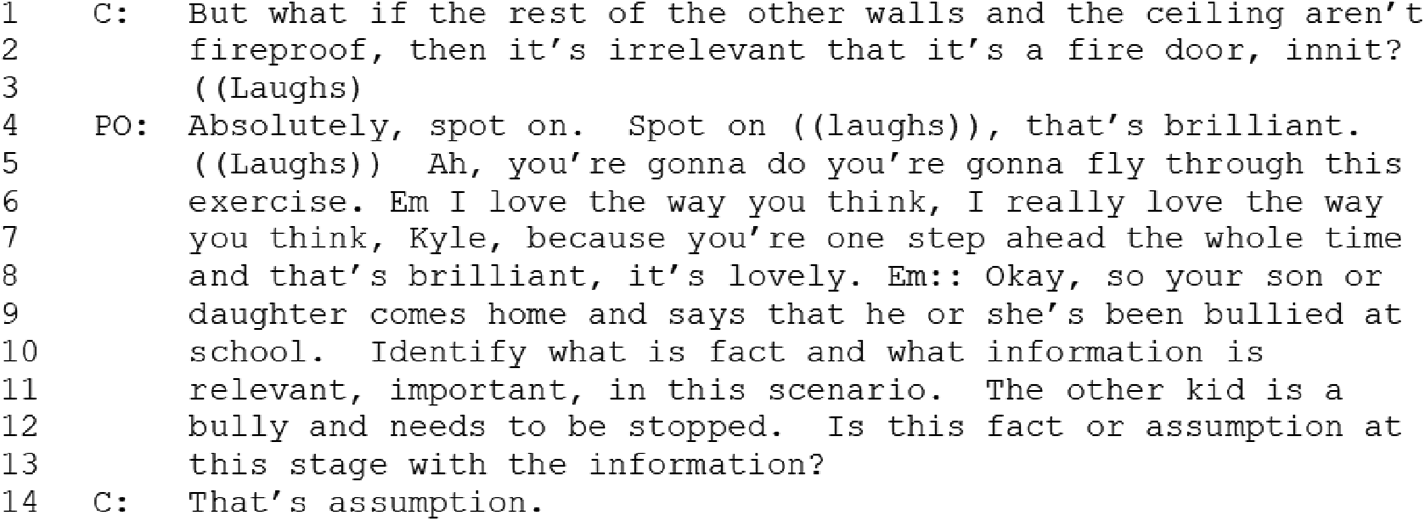
Here the PO praises the client's engagement with the task and highlights a positive trait (‘the way you think’), however it is positioned as closing the sequence rather than an assessment presented to the client to agree with or disagree with (Schegloff, 2007). This is further evidenced in how the PO continues on to describe the next stage in the task (‘Em:: Okay, so…’). Interactional research has demonstrated that assessments in this position – i.e., after an answer or response is given – can work to close the topic or interaction and provide the hearer's stance on the answer or response (Schegloff, 2007; Seuren, 2018). As such, the PO here evaluates the client's performance very positively, expanding this to praise them as a person but without requiring the client to provide any response. As noted, responding to praise, and such a high level of praise, can be very tricky for recipients as they manage the competing constraints to agree with the assessment and avoid self-praise. In this context it may be even more difficult, as the PO, given their professional role here, is in a privileged position to make such an assessment, leaving the assessment even more difficult to disagree with, but in a context where the client, having transgressed the rules of society by offending, may be under even more pressure to avoid self-praise. As such, praise in this position, by not warranting a response, relieves the client from having to manage the complex competing constraints. Furthermore, it reduces the risk of clients rejecting the praise, or otherwise downplaying or deflecting it.
Continuation of the task at hand
Where the PO does not hold the interactional floor, evaluations of answers do not warrant a response from the client, as in Extract 7 (which comes just before extract 1).
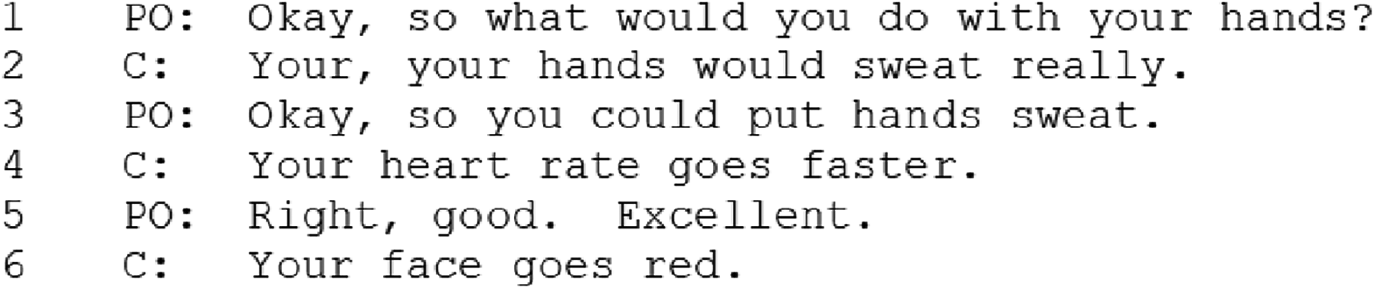
On line 5, the PO gives an evaluative stance on the client's utterance, which builds on a list of physical signs of having a problem, as part of an exercise in the Core programme. The client's response on line 6 continues the list, rather than responding to the praise. This does not mean the praise was not heard, but that it is treated as not requiring a response. In this case it is treated as encouraging the client to continue.
Minimal response
Where clients did respond to the praise, it was common in the data (just under a quarter of instances) to respond minimally, for example just saying ‘yeah’, ‘okay’ or ‘mh hmm’, as in Extract 8. Here the PO is praising the client's prosocial behaviour of abstaining from using class A drugs, highlighting it as a ‘great achievement’.

The client gives a minimal ‘yeah’. In this way the client acknowledges receipt of the praise but does not provide any assessment of it. Gathman et al. (2008) noted a similar pattern in their study of survey interviews, and they concluded, in that context, this response managed the participants’ lack of access to knowledge about the process or performance criteria of the survey. In probation sessions these minimal responses may be due to a number of competing constraints specific to this context which make it difficult for the client to provide a response. First, the PO holds the institutional authority to determine what is or is not assessable as positive and as such praiseworthy, which makes it difficult for the client to downgrade or disagree with them. Second, given the client is on a court order for committing an offence, they are not only under the normative constraints to avoid self-praise but also need to avoid appearing to exonerate themselves. Finally due to both of these constraints, the client lacks the authority to determine what comments or actions are prosocial, and therefore lacks knowledge about the institutional performance criteria, similar to Gathman and colleagues’ study (2008). The PO then holds the power to give praise, where the client has to balance accepting it without appearing to ‘let themselves off the hook’. As such, a minimal response fills the necessary interactional slot for a response but without getting tangled in the various issues of accepting or deflecting the praise.
Orienting to a different action
Similar to Shaw and Kitzinger (2012), a common response (just under a quarter of instances) to praise in the data was for the client to orient to a different action in the PO's turn, such as in Extract 9.
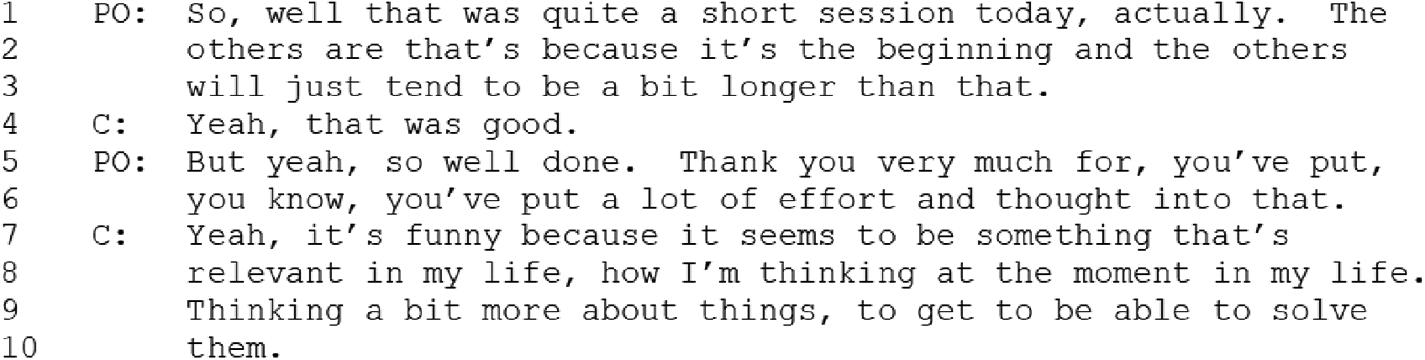
What's interesting about these forms of responses is they imply the praise is not being ‘taken up’ by the client. However, as Shaw and Kitzinger (2012:229) highlight: “the fact that the assessments are not responded to does not mean, of course, that they are not heard: It seems very likely that the recipient registers them and that the positive feedback they provide influences the unfolding course of the interaction”. Given the multiple constraints there are on responding to praise in interaction, and the specific constraints in this context, it is perhaps unsurprising that clients rarely accept praise and more often give minimal, if any, explicit acknowledgement. However, how clients respond when their prosocial comments or actions are not positively assessed, or the assessment is delayed, in probation sessions gives some indication that such feedback is considered by clients to be an expected part of the institutional business.
Missed opportunities for praise/positive reinforcement
In the data we identified 28 instances where there was an opportunity for the PO to positively assess clients’ prosocial comments or actions but they did not, or it was delayed. In Extract 10 below the client and PO are discussing an internet chat site the client has made, which the client is showing to the PO on his mobile phone.
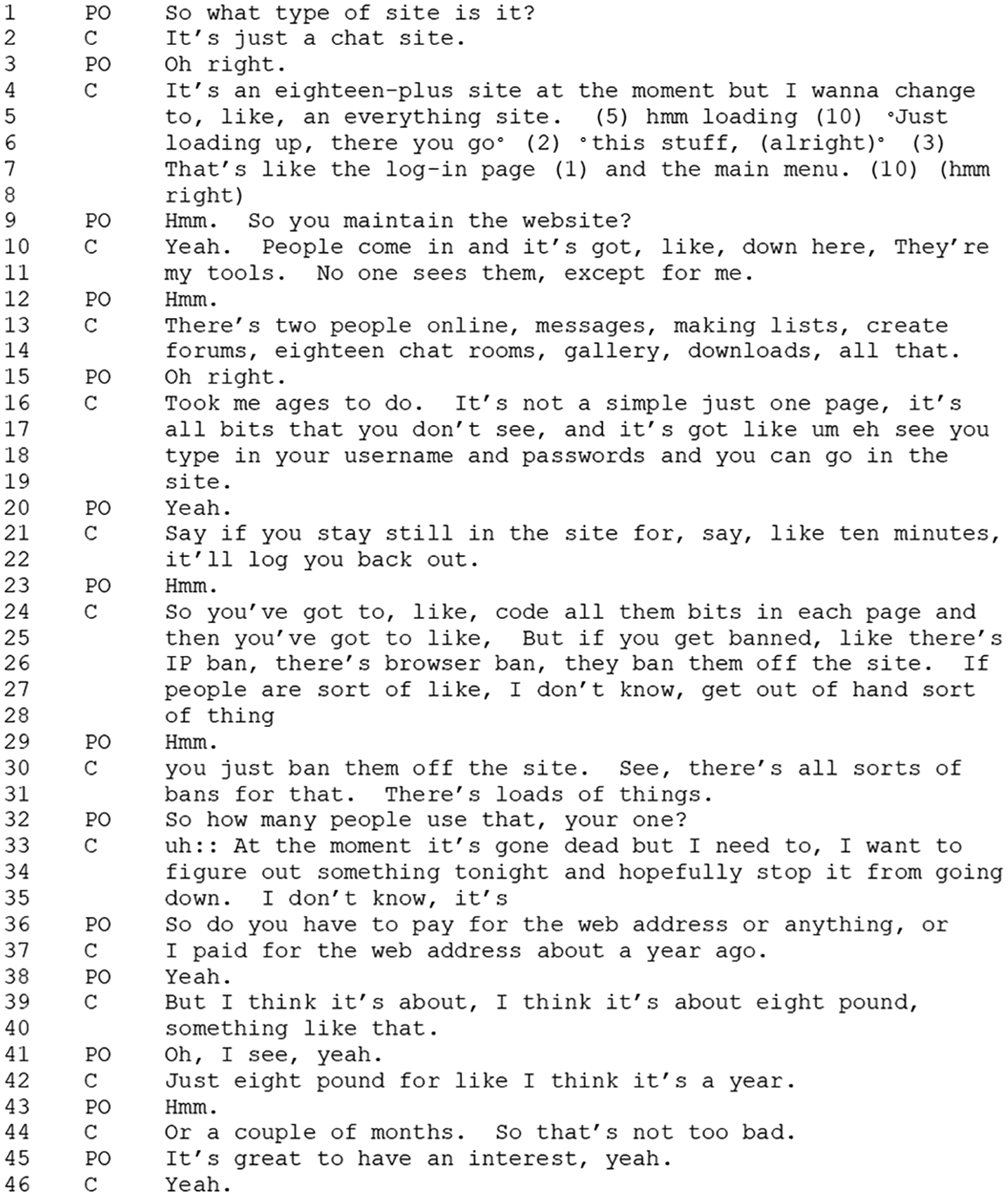
Over the first 15 lines, during which the clients shows the PO the chat site, the PO makes no direct comment about the site nor gives any evaluation of it; instead he asks the client one question (‘so you maintain the website’) and otherwise provides continuers (‘hmm’, ‘yeah’), which function to encourage the client to continue talking. This is the first point at which positive assessment is relevantly missing, where the PO could praise the site, the client's skill or interest. It is at lines 16 and 17 we see the client upgrade his bid for assessment as he outlines the difficulty of the task (‘took me ages to do. It's not a simple just one page,’), which he continues at lines 24 and 31. The PO's response is minimal, again providing continuers (‘hmm’), which align with the client's talk (i.e., encourage him to continue talking), but withhold affiliation or support for the content of this by omitting any assessment of the talk (Stivers, 2008). At line 32, where there is another slot for the PO to provide an assessment, instead he asked a related question (‘so how many people use that, your one?’) which serves to shift the topic away from the client's achievement to more practical aspects, e.g., cost.
By asking questions and aligning with the client's talk the PO could be interpreted as demonstrating interest in the client's actions. However, there is clearly an absence of a positive assessment as the client has provided bids for the PO to evaluate his creation of this website. It is eventually at line 45 where the PO provides some assessment, which is lukewarm at best. This positive assessment is delayed, in that there were several possible slots for praise from the beginning of the sequence. The assessment itself is also impersonal and general – that is, it does not have any specific link to the client's work and involves only a broad comment that could be applied to almost any way of spending time – and does not connect with the effort or skill involved in the work. The POs responses, or lack of, work to convey that the reported behaviours are not desirable or worthwhile, or that the PO is not interested. The PO's responses may indicate that an orientation to risk related concerns is inhibiting praise. However, the PO does not raise such concerns in this interaction, or at any point in the session, leaving the client's reports without any explicit assessment. Generally, in this data, where the client's reported behaviours or beliefs were cause for concern the POs challenged or confronted these, so this didn’t inhibit praise as much as result in a different action in the talk.
The client's pursuit of an assessment of his reported actions and behaviours indicates such assessment is expected in this context, where clients present their actions for evaluation and these are evaluated. As such, although praise may not be explicitly responded to when given, it clearly is a relevant aspect of the interactions in a probation context and noticeable when absent. Furthermore, giving positive assessments (where relevant) likely creates a sense of social solidarity, which is necessary for relationship building, through demonstrating warmth by recognising the client's reported efforts (Mullins & Kirkwood, 2022). This echoes Blimes (1988: 163, cited in Golato, 2005): “That is, if no praise is forthcoming, it is relevantly absent, leading usually to the inference that the work has been judged unworthy of praise. The fact that the work is not explicitly dispraised, on the other hand, does not lead to the complementary inference that the work has been judged too good to be dispraised”. The absence of praise then potentially negatively influences the unfolding course of the interaction, possibly by undermining the sense of solidarity in interaction.
These instances of absent or delayed positive assessment were more common in interactions where the POs were categorised as demonstrating low skills in the original Jersey Supervision skills study. In the high skills category, the POs tended to use praise, both brief and explicit, more liberally and frequently, in line with Trotter's (2015) advice. Furthermore, the design of the praise in the low skills category seemed to be downgraded, qualified or focus on negative aspects of the talk, as in Extract 10 where the PO refers to the client's achievement in building a website which he outlined was a difficult task, as ‘an interest’.
Discussion
Although praise is seen as an important part of effective practice, ironically it can create problems in the interaction. That is, for practitioners the challenge is how to praise clients without creating pressure for them to reject that praise; for clients, a normative response of deflecting or down-playing the praise could be seen as not complying with the institutional agenda. So examining how praise is enacted, how it functions, and how clients respond to this, is important for understanding a key part of probation practice.
As shown, practitioners could be explicit about what they were praising and why it was good. This would help identify and reinforce pro-social thoughts and behaviours, with the potential to build and sustain motivation for engaging with interventions and the process of desistance. In the moment-to-moment unfolding of interactions, praise could also help to clarify that their engagement with the tasks was going well and to encourage them to stick with it. In this way, it helps build social solidarity between clients and practitioners, as well as affirm that positive change is possible, key elements of desistance where change is acknowledged in the relationship and reflected back to the clients (Maruna & LeBel, 2010). However, where praise required a response from the client, explicit and continuous praising may be difficult for clients to directly accept and could create problems in the flow of the interaction.
Although clients tended not to respond explicitly to praise, this was often related to the way the praise was given, such as in a position that did not require a response from the client, in a conversational sense. This helped avoid the interactional trouble that may otherwise result, and allowed the task at hand to continue. Minimal responses (e.g., ‘yeah’) were a simple way for clients to accept the praise, giving due respect for the practitioner's authority to provide positive assessments, while avoiding potentially problematic responses of either rejecting the praise or seeming to self-praise. Orienting to a different action – such as commenting on the benefits of the probation intervention – was another strategy that dealt with the interactional constraints, where the client could implicitly accept the praise and align themselves with the institutional agenda.
Our coding and analysis of the data also showed that there were some instances where POs’ provision of praise was relevant, but was not given. Indeed, as shown in extract 10, clients could persist in describing their actions in ways that functioned to elicit praise, indicating that they treated probation sessions as an appropriate forum for discussing pro-social behaviour, and for POs to confirm and reinforce that their behaviour was correct and valuable. There may be many reasons POs do not praise clients’ reported behaviours or beliefs, for example concerns about risk or to direct discussions a different way. However, in these instances rather than an absence of praise there is a presence of another action, e.g., challenge or redirection. Although we can only speculate here on the implications of POs not ‘biting’ when their clients are fishing for compliments on their pro-social behaviour, we suggest that interactionally these minimal responses may jeopardise social solidarity and therefore engagement, as well as potentially convey that such behaviours are not desirable or worthwhile. This may point to why positive reinforcement, as praise, is an important aspect of probation.
Although we noted that missed opportunities for praise were more frequent in the sessions coded as demonstrating low skill, these are necessarily tentative comparisons as there are several factors which impact making such comparisons. Firstly, our data set was limited with only four POs in each category. Secondly, the length and content of the sessions was quite different between the low and high categories; the low skill category sessions were shorter and less likely to involve structured programme work and more likely to be report interviews or briefer check-ins. This may have limited the opportunities for clients to present prosocial comments and actions, and for POs to offer positive assessments. Thirdly, it is important to consider the clients’ stance and contribution in these sessions as influential to how the interactions have unfolded, that is whether they have provided accounts or examples of prosocial behaviours and attitudes to be assessed, and the capacity of the PO to provide positive assessment for prosocial comments and actions. Relatedly, whether the ethos of the organisation itself is prosocial or the individual practitioners are prosocial in their wider actions and values (e.g., being punctual, maintaining confidentiality etc.) will impact the interactions in situ that we have examined here.
As we have mentioned, defining praise can be difficult; we have treated it as one form of positive reinforcement, but it overlaps with related concepts such as compliments, not all of which might constitute praise. Moreover, as noted in previous research (e.g., Golato, 2005; Hudak et al., 2010; Weiste et al., 2021), not all apparent praise may function as forms of positive reinforcement, but could perform other social actions. The definition of ‘pro-social’ is also debatable and context-specific, which is important for considering how these particular interactions unfold. The data relate to a specific time, place and cultural context, and further research would be needed to explore how praise and other related forms of positive reinforcement manifest and function in criminal justice contexts.
Overall, our research demonstrates that praise is part of the business of probation practice, and its absence is noticed. However, praise raises interactional challenges that practitioners can manage skilfully to positively reinforce prosocial comments and behaviours and promote engagement. It highlights the ongoing relevance of positive reinforcement in practice, and the important role this has in maintaining ongoing engagement with clients. We hope this study helps practitioners understand the dilemmas clients have in responding to praise whilst also understanding that praise is a necessary part of practice. This study enhances our theoretical understanding of that nature and function of positive reinforcement, and provides concrete examples that can guide practice by giving insight into how and where practitioners can use praise effectively in their interactions with clients.
Footnotes
Acknowledgements
We would like to thank the Jersey Probation and After-care Service for supporting this project, particularly Mike Cutland and Brian Heath, Chief Probation Officers, and the original participants of the Jersey Supervision Skills Study. We would also like to thank Maurice Vanstone and the reviewers for their helpful comments on earlier drafts.
For the purpose of open access, the authors have applied a Creative Commons Attribution (CC BY) licence to any Author Accepted Manuscript version arising from this submission.
Declaration of conflicting interests
The author(s) declared no potential conflicts of interest with respect to the research, authorship, and/or publication of this article.
Funding
This work was supported by the Jersey Probation and After-Care Service.

Appendix
Jefferson (2004) transcription notation.
(.)
A micro pause - a pause no significant length.
(0.2)
A timed pause - long enough to indicate a time in seconds.
[ ]
Square brackets show where speech overlapping.
()
Unclear section.
(())
An entry requiring comment but without a symbol to explain it.
°word°
Indicates whisper or reduced volume speech.
:::
Colons - indicate a stretched sound.