




Abstract
Despite increasing academic focus on intimate relationships as positive influences on desistance, research has yet to examine the experience and impact of support provision for women who are intimate partners of desisters. This exploratory study draws on six in-depth interviews with partners of desisters to elucidate their experiences of support provision and the impact of desistance. This paper finds that women provide resources to their desisting partners, and that identities and agency can be strained through this provision. The desistance process entails an investment of emotional work and capital from intimate partners which is conceptualised in this paper as Desistance Emotional Work (DEW). Desistance research has not yet acknowledged the support needs of women who invest in their partner’s desistance, and so DEW should be considered further both theoretically and in policy and practice.
The gendered weight of desistance
Desistance from crime is a theoretical framework, which promotes an understanding of the ways in which people leave behind lives characterised by offending (Best et al., 2020). Desistance is usually considered to begin at the end of a period of involvement in offending and has been divided into three stages: primary desistance is defined as a short-term crime-free period; secondary desistance is presented as a more permanent move away from involvement in criminal activity including internal identity shifts (Maruna and Farrall, 2004); and tertiary desistance as complete social immersion and acceptance in the community (McNeill, 2014). Desistance has also been described as a journey towards social inclusion, achieved when a person with an offending history has developed and (has had accepted by others) a positive sense of identity, healthy social relations, and stable accommodation and employment (Farrall et al., 2010; Healy, 2012; Weaver, 2016). Debates concerning its application, its measurement and its parameters continue, but overall desistance is most helpfully regarded as a hopeful process, which promotes positive outcomes for individuals, communities and, somewhat more cynically, the State. In practice, desistance is best supported through strengths-based mechanisms: through creating scaffolding for positive relationships, job opportunities, and by enhancing existing skills and strengths to foster the pro-social resources needed to live a crime-free life (Best and Colman, 2020).
Whilst several factors have been identified as influential to desistance, the capacity for social relations to influence the process has received particular attention. A considerable proportion of the desistance literature identifies strong relationships and social bonds as paramount to successful reintegration and desistance (Nielsen, 2018; Nugent and Schinkel, 2016; Sampson and Laub, 1993; Weaver, 2014). Research has acknowledged the fundamental influence of intimate relationships on the desistance process. Laub et al's. (1998) noteworthy research examining the influence of marriage on offending trajectories argued that as social bonds are built over time, so is desistance. Sampson and Laub (1993) originally proposed this approach in their age-graded theory of informal social control, which, building on Hirschi’s (1969) social bonding theory, supported the notion that the formation of strong attachments by men to institutions of social control was identified as capable of playing a significant role in their movement away from crime.
In its male-centred development, desistance has been centred on heteronormative perspectives, consequently overlooking many women in the process. Although women's desistance has been more recently considered (Rutter and Barr, 2021), most women who are affected by desistance are not experiencing desistance themselves but are still proximate to the experience through supporting their partner's process. This brings unique challenges. Although relationships have been established as important to desistance for both men and women (Bersani et al., 2009), the risks of male desistance-lapse for women are pertinent (Barr, 2019). For women who are vulnerable or disadvantaged, intimate relationships with men who have offending/addiction histories can sometimes trigger offending/addiction problems in the women themselves (Laub and Sampson, 2003: 46). Research has also identified that men are protected against addiction relapse by marriage, whereas the opposite is true for women (Walitzer and Dearing, 2006). Women whose partners do not desist may be exposed to risks concerning influence on their own substance use/offending behaviours. For women with offending histories, it is also important to note that it is difficult for women to find pro-social relationships with men in the high-crime neighbourhoods they often return to (Leverentz, 2006) as would be beneficial to their likelihood of desistance (Barr, 2019).
Alongside socio-economic restrictions, crime involvement and victimisation risk, research has also identified gendered distinctions in intimate relationships concerning the relational emotional efforts invested by women. Outside of criminology, sociological and gender studies research has explored the disproportionate contributions women make to their relationships in association with levels of psychological distress. Research has shown that the investment of emotion women make in their intimate relationships is often not met equally by their male partner (Strazdins and Broom, 2004), and the toll this takes can negatively impact various life domains including mental health (Maslach and Schaufeli, 1993). Emotional work can be understood as: ‘Taking the time to listen to another's problems or worries, giving advice or guidance, taking the load off a partner, and showing warmth and appreciation… It is time-consuming, can be demanding, involves opportunity costs, and is often invisible, unacknowledged, or devalued.’ (Strazdins and Broom, 2004: 357)
Given the established inequity in women's contributions of emotional work in their relationships comparatively to men's, and the potential for experiencing a partner's incarceration to impact upon the gendered roles which the couple enact (Black, 2010), it is important to consider how the desistance process may further impact the level of emotional work undertaken by women partners of male desisters. Desistance may exacerbate gendered relational inequalities and emotional work through its heteronormative expectations of women in relationships with male partners to provide resources in support of the desistance process.
Access to not only positive relationships but to a range of supportive resources is important to desistance, and recent work has sought to reconcile the range of internal and external resources required for successful desistance (Best et al., 2021). Desistance research requires development to understand women's roles in providing capital, to ensure that support requirements are not disproportionately onerous for women. Theoretically, there is a gap concerning understanding of the resources that women are expected to provide to desisting men. In practice, although service provision for families affected by incarceration has improved and expanded over the past decade (Hartworth et al., 2016) the effects of incarceration do not end immediately post-sentence. There remains a hidden proportion of women who are not desisting themselves, but who provide desistance support in their intimate relationship, and for whom the lived experiences of this support provision are unacknowledged and largely unsupported in policy, research, theory, and practice. Women in this position may also experience an increased likelihood of offending/substance use as a direct result of this relationship (Leverentz, 2006; Walitzer and Dearing, 2006).
What desistance research has failed to establish in its promotion of positive intimate relationships, is the onus that this disproportionately places on women to provide associated support; stakes in conformity; familial care, and financial management. Similarly, desistance policy exemplifies the notion that policy is constructed within broader biased political climates: “male bias frames public policy in the sense that policies are implemented from the perspective of male work and life patterns” (Bakker, 2007: 546). This is not to say that women in this position would describe their partner or relationship as a burden, but that research and socio-structural processes burden them with the presumption of support provision despite a distinct lack of professional support or acknowledgement for the women in this position. Indeed, even the Farmer Report (2017), important for its advocacy of families as key to rehabilitation, perhaps does not sufficiently consider the range of associated gendered costs of supporting someone through the criminal justice process. In sum: desistance support provision often falls to women, with little professional support provision in place for the women themselves.
Method
As a result of the neglect of women's support provision from desistance research, this small, in-depth exploratory qualitative study established three aims:
To establish the gaps between desistance policy, research, and practice from gendered, partner perspectives; To understand women's experiences of intimate relationships with desisters; To explore the gap between desistance research and practice for female partners, and to align the research findings with the desistance narrative – acknowledging women's roles as both witnesses and participants in desistance.
The research design was informed by a feminist, “positive criminology”, standpoint: an approach to criminological theory, research, and practice, which focuses on the positive encounters and influences that distance people from crime and deviance (Ronel and Elisha, 2011), with desistance conceptually aligning with this standpoint. This meant that the research was designed in a way that would enable the exploration of the silences or unexplored voices of women whilst seeking to “focus on individuals’ encounters with forces and influences that are experienced as positive” (Ronel and Elisha, 2011: 305). Influenced by Hesse-Biber's research, the authors were keen to ensure that our research centred women's voices, explored, and thus empowered their experiences (Hesse-Biber, 2010: 129). The authors were aware of the potential for the study to invoke memories of potentially painful periods in women's lives through the recalling of traumatic events and the potential for secondary victimisation. Consequently, a strengths-based, appreciative inquiry approach in the design and conduct of in-depth interviews was taken (Robinson et al., 2013). The study was designed to embed a salutogenic framework that sought to ensure women felt empowered in the sharing of their stories and that their resourcefulness and resilience would be recognised: thus, acknowledging that women are experts of their own experience, and utilise a wide range of skills to manage their relationships with intimate partners and others (Smith, 1987). Our questioning sought to avoid focusing on risk and what went wrong, whilst still acknowledging challenges reported and faced by the women. Ethical approval was obtained from our higher education institution.
The call for participants was circulated by the project-specific Twitter account and to our professional networks, which included Women's Centres in the East Midlands of the United Kingdom and prison support networks. Whilst we acknowledged the limitations of using social media as a recruitment tool (Gelinas et al., 2017; Sah et al., 2020) the combination of approaches enabled the social media account to facilitate both ‘passive online’ (anyone interested in our topic area) and ‘active online’ (knowing we had followers who would be eligible for the study) recruitment. In total, 13 women contacted us for further information, of these: two women had an experience of supporting family members rather than intimate partners so did not meet the inclusion criteria; two decided not to take part after receiving follow up information; nine women initially agreed to be interviewed with six women taking part in in-depth one-to-one interviews with one of the researchers.
Pandemic-related institutional research restrictions meant women were offered the choice of online (Microsoft Teams) or telephone interviews: all chose online. To maximise privacy and build up a rapport with the women who contacted us we tried to ensure that there was a stable, secure internet connection and at the start of the interview we agreed with the women what would happen if the connection became unstable. Interviews lasted between one and two hours and questions were shaped around the themes of: familial background and upbringing; the history of their intimate relationship; experiences of supporting their intimate partner who is/has been in contact with the criminal justice system (including practical, emotional, and relational considerations); and exploration of any/potential support networks in place for the women. All participants were renumerated for their time and offered a £20 e-voucher of their choice.
Characteristics of the women
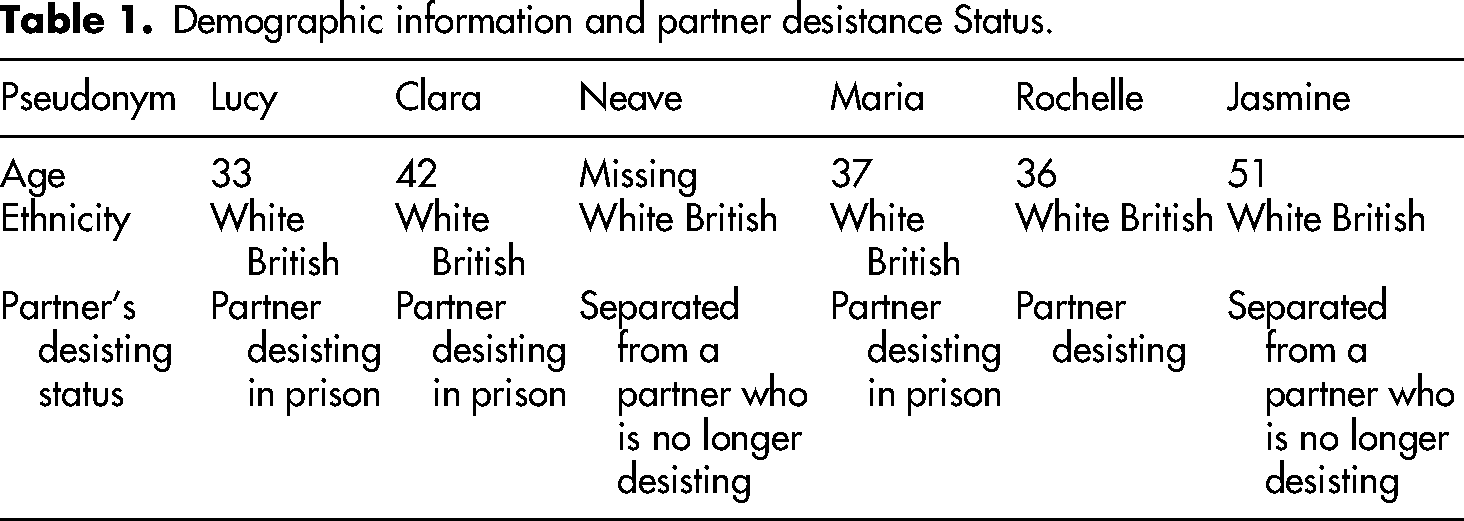
Table 1 shows the women's demographic information and partner's desistance status. As desistance is still a contested term without distinct conceptual boundaries, women were recruited for interviews should their partner have had contact with the criminal justice system and had attempted to take steps away from offending during their relationship. It was not a requirement that their relationship be ongoing nor that their partner was currently offending-free at the time of interview to take part, due to the acknowledged ebbs and flows in offending behaviour that often accompanies primary desistance (Maruna and Farrall, 2004). It was also considered important to include women whose relationships had not continued to help understand reasons for this and the impact on them, given the promotion of intimate relationships by desistance research and the difficulties around desistance maintenance past the primary stage.
Demographic information and partner desistance Status.
Analysis
As desistance is yet to centre women's experience of supporting desisters we considered it would be unreasonable to ask the women who shared their lived experience to situate their knowledge within the desistance literature. The nuances of desistance definitions, particularly primary desistance and desistance beginning in prison, mean that desistance measurement in research remains challenging. Desistance was inclusively understood as being present should the women have described that their partners were predominantly not offending at time of interview, or that their offending reduced during their relationship. All the interviews were transcribed, and the in-depth nature of the narratives allowed for coding using thematic analysis, which held a desistance lens over the women's stories. The women talked about a range of their male partners’ offending histories, including armed robbery, drug-related offences, domestic offences, and sexual offences. Throughout data collection, we scheduled debriefing sessions after each interview; this was to maximise reflexivity and minimise the potential of experiencing vicarious trauma (Dickson-Swift et al., 2008; Moran and Asquith, 2020). During our discussions, we were mindful of the emotional labour in the conduct of our research. Debriefings facilitated early discussion of thematic connections to the desistance field.
Results
Thematic analysis of the interview data revealed several key themes, those presented in this paper are: ‘Relational Strengths; The Pains and Strains of Relational Desistance Support for Women’; and ‘Women's Agency, Roles, and Identity During Relational Desistance Support’.
Relational strengths
“I love you and if we can get through that we can get through anything.” (Rochelle)
It is important to begin the discussion of the results of this qualitative research with acknowledgement of the positive experiences women highlighted in connection to their relationships. Across the six interviews, women poignantly discussed the uniqueness of their relationships, and the support and commitment they received from their partners. The relationship was often described as unlike other previous relationships, with different qualities and features, both in terms of their desirability and experientially. Jasmine described an immediate connection: “… he was just interesting because he was different to people that I’d met, and we were kind of instantly attracted. Not physically but sort of intellectually” (Jasmine). Even for women for whom the relationship did not last, there was an acknowledgement of the unparalleled aspects of the relationship which were enjoyed: “I’m glad I met him. I’m glad I went through the experience. He did show me different things in life.” (Neave)
The women also discussed the support and trust they shared with their partners. Clara outlined how, before his incarceration, her partner would help to motivate her when she was struggling with her mental health: “You know, like he’d get me out of the house and get me moving …he's like a best friend, just dead supportive, dead motivated and now I’m really struggling to do all those things” (Clara). For some women, the support described was empowering. Lucy, for example, described the pride her partner has in her achievements and how it rivalled that of her parents: “He's always supported me; he's always been my biggest champion. He's always believed and been proud of anything that I’ve achieved. He's probably prouder than my mum and my dad.” (Lucy)
Commitment, openness, and reciprocity were also positive features of the relationships described. Commitment to the relationship was detailed by most of the women despite their partner's contact with the criminal justice system, but with the understanding that their partner's desistance was fundamental to the continuation of the relationship: Rochelle described how after her partner's arrest, she “was prepared to stand with him, as long as he changed.” (Rochelle). Open communication was also a feature of the ongoing relationships, as highlighted by Clara: “And if you share, then you’re vulnerable. […] I’m pretty direct but we are equitable, genuinely I feel like that is true. He talks to me when he's going through, I know the stuff that will make him feel better, avoid his stuff, he's, I’m not taking drugs because of him. He's got me off, I’ve been clean for three years.” (Clara)
The reciprocal support described by the women demonstrates an example of the social capital that the women reported having access to as a direct result of their relationship, which is important to note considering the challenges the women discussed facing in the remainders of their interviews. Reciprocity, trust, support, openness, commitment in the face of adversity, and the unique features of their relationships were the foundation stones of the messages women wished to portray.
The pains and strains of relational desistance support for women:
“I’m a wreck all the time. I’ve never, ever been so in love with somebody and felt so alone.” (Lucy)
Although the women whose relationships were ongoing at the time of interview (n = 4) emphasised the positive aspects of their relationships with their partner, there were distinct challenges they discussed connected to the desistance process. For the women whose relationships were not ongoing at the time of the interview, this was directly connected to their partner's desistance/recovery lapse. Within this theme, therefore, clear subthemes emerged: ‘Hope and Heartbreak: The emotional work behind desistance support and capital provision’; and ‘The difficulties and gendered emotional work behind desistance lapse and return to offending for partners’.
Hope and heartbreak: the emotional work behind desistance support and capital provision:
“The only person I’ve really got is you.” (Rochelle)
It is often a characteristic of successful desistance that changes in social networks occurs (Boman and Mowen, 2017). Partners showed an awareness of this; Rochelle discussed how this transitional period placed further emphasis on the role of the relationship to provide support and capital in several areas: “Things have gone from strength to strength. So, he was working with the drugs team, going, and having appointments every single week. Picking up his prescription every day was very time-consuming, but I knew that it was important. […] He's cut a lot of people out of his life because he realised that actually seeing them is going to be a risk. So, I think that's probably one thing moving forward that he wants to work on, is getting a new support network for him, because he will quite often say “The only person I’ve really got is you” and as much as I can be there for him, you know, he needs to have his own independence and some positive friends, but he's cut a lot of people out.” (Rochelle)
Research on family members of incarcerated people has demonstrated the symbiotic harms this group experience which uniquely intersects with gender (Condry and Minson, 2021), with the ripple effects of incarceration creating lasting, gendered role strain (Comfort, 2018), often affecting social networks and capital access (Best et al., 2018; Hall et al., 2018). Providing support as someone who is isolated, to someone who is isolated, was similarly felt to increase the pressures of support provision for the women: “He [partner] should have been out when our son was here. He should have been out before our son was here. Our son will be four before he gets the opportunity to be out again. So, I don't think our relationship has been maintained, I think it's broken. It will probably remain that way until I see him out in the community […] Because it's hard, you have all this belief that these people are going to do it, that he's going to change, but he's going to come out into the community and he's going to prove me right about everything that I believed him about him. Then you get let down, not just by the justice system and the support that they don't give him, but also by his stupid decisions as well. That then means I’ve spent eight years on my own…” (Lucy)
Lucy described the burden of feeling hopeful about the ultimate success and longevity of her relationship. Feelings of guilt were also described by the women, with regards to their lives continuing whilst their partners were incarcerated. Maria described how even simple things such as cooking a meal were activities her partner could not partake in, and which discussing could resultantly cause strain and require emotional work - “I was cooking the other day and he was just like, “Oh, I wish I could make that.” Just little things like that […] I feel guilty.” (Maria). Even post-relationship, guilt remained in connection to Jasmine's own expectations of her relational contribution: “what I would like is to be able to walk away without all the guilt really.” (Jasmine). Feeling guilty and hopeful were key emotions that were clear in each of the interviews connecting explicitly to participants’ relationships with desisters, suggesting desistance-specific, gendered experiences of emotional work and investment into the relationship.
The difficulties and gendered emotional work behind desistance lapse and return to offending for partners
“It was horrendous. Seeing him go through that and I couldn't – whatever I suggested didn't seem to work. It was so frustrating.” (Rochelle)
When desistance begins and ends is still debated, and indeed primary desistance can include ebbs and flows in offending behaviour. The strains of lapsed or unsuccessful desistance were distinct for the women interviewed. Neave for example, whose relationship was not ongoing at the time of the interview, described the provision of resources that was not reciprocated and therefore inequitable: “I never get upset about anything. But him I do. […] All my emotions have just kind of like shut down, for a long time, because it's easier. When I met him, he had nothing. He literally had nothing. He didn't even have his own bed to sleep in. He had no money. I kind of reached out and helped him. He kind of did me over in a way.” (Neave)
The impact this had emotionally was distinct, demonstrating the capacity for relationships affected by offending and the criminal justice system to create emotional ripple effects which continued beyond the life span of the relationship. Desistance lapse was also described as having the potential to draw women into crime-related activity, something well supported by critical desistance research: “…He got drugs sent to my home, he asked me to keep them there and I said, no, I didn't agree to have them at my house, and he was trying to press me to bring them into the jail, so I didn't. I went on a visit, and I didn't bring them. […] So, I’d rang the jail, told them what he’d done and phoned the police, the police came round, they took it seriously, they took the drugs with them, and he's banned from contacting me. […] He has tried to get in touch a few times, but, no, I’m not starting, I’ve changed my number now.” (Maria)
Maria describes the ‘knifing off’ (Maruna and Roy, 2007: 105) of this relationship to protect herself from criminal involvement, and the process of accountability and labour associated with the reporting of this activity. Even for women whose relationships have overcome lapses in desisting behaviours, the emotional repercussions were clear. The emotional work of supporting a partner through desistance lapse was therefore characterised by a sense of helplessness and frustration. Should desistance not be achieved, the impacts of this for women interviewed who had children were also discussed as risky to their role as a mother: “I can't allow him to ruin my life. He can't take away everything that I’ve worked for and that is something that we’ve had to discuss quite a lot of times. I would lose my job if he did anything [crime] again… I would lose my kids.” (Lucy)
Unsuccessful desistance has the potential to have a distinct gendered impact. When desistance fails – the emotional work continues, and socio-structural expectations of women have the potential to over-burden them in terms of support expectations: “I’m 51 now and I’m absolutely struggling at the moment. I’ve got these two dogs that we took on two years ago that I’m now full-time responsible for. I’ve got ageing parents that I’m looking after, and I’ve got a full-time job that I have to keep on because – in difficult circumstances, but I have to do it to keep my head above water.” (Jasmine)
Experiencing challenging emotional and practical effects of partners re-engaging in offending behaviours are problems exacerbated by lack of support, which are compounded by feelings of shame and stigma associated with the criminal justice system.
Women's agency, roles and identity during relational desistance support
“If he went out and committed another crime, am I not worth that desistance?” (Lucy)
Desistance research has neglected to capture the impact of desistance support provision from heterosexual female partner perspectives, despite its impact on women's time, support systems, and emotional and physical resources. Analysis showed that women's freedom and choices were sometimes felt to be restricted by their relationships: agency was therefore identified as a key subtheme resulting from the impact of desistance support provision by the women interviewed. Neave and Jasmine, who were separated from their partners at the time of their interviews, both expressed a sense of regret and lost time. Lucy described how her actions are limited by her incarcerated partner's jealousy of her freedom: “I would say I probably don't socialise half as much as what I did before. He encouraged it to begin with, but he could never cope with it. He would ring me the next day as soon as they let him out and you could hear how tired he was from overthinking everything that I could have been doing. His response will always be, I never asked you to stop doing that or I never asked you to do this.” (Lucy)
Clara also suggested a perceived agentic limitation because of traumatic experiences, when she discussed how she felt she learnt submissive compliance in childhood, which translated into her experiences of abusive relationships later in life: “My mother sort of praised how she basically says that I used to do everything, my brothers would get me to do everything, all their chores, run around after them. And rather than say, - Hang on a minute, as a woman that potentially, I didn't want her to be… - She was like -Oh, you’re just so lovely and helpful, you’d do anything for anyone - And, yes, it led me into an adult to a massive string of abusive relationships….” (Clara)
The impact of the relationship and desistance-associated criminal justice barriers on the women's agency was therefore individualised but clear, in terms of both their actions and their choices in a range of circumstances. Concerning their roles, it is well evidenced that when closely bonded, relationships can also act as a stake in conformity for the partner (Hirschi, 1969; Toby, 1957) and the women showed an awareness of their relational role in this regard: “He says that I make him want to be a better man. He can't go doing things now, he has to think about me as well and the relationship, it's not just, oh, he's single it doesn't matter, who gets hurt.” (Maria)
The burden of relational expectations and roles was also identified, however, with women often feeling overwhelmed by the range of support they were expected to provide: “I’ve got to drop some of these balls but how do you decide whether you don't have contact with your children or you don't look after your parents or you don't look after you in-laws – what exactly is it that you decide to drop at this point.” (Jasmine)
It has been established that unsuccessful desistance and desistance lapse did at times exacerbate emotional work by the women interviewed. It was also identified during analysis that the acknowledged risk of desistance failure was felt to be a reflection on the sense of self-worth and value in the relationship and as a partner: “If he went out and committed another crime, am I not worth that desistance? Am I not worth turning around and saying - this is not worth losing my girlfriend and my kids over? Why is this family not worth it? And that is probably what I will struggle with the most if he chooses to reoffend.” (Lucy)
As a woman experiencing the repercussions of the failed relationship, Neave described the impact on her sense of self: “But I don't know who I am now, I’m lost I feel like I’m floating in the middle of the sea.” (Neave). Jasmine similarly identified a feeling of a sense of failure in her role as a desister's partner, with her expectations regarding his future so bleak that she is expecting the next communication to be notification that he has passed away: “To be able to go do you know what, I’ve finished here. My work is done and whatever comes next, when we’re notified that he's died, to not feel that part of that was because I didn't – there was something that I didn't do […] realistically I know that there is nothing more that I can do […] but that's a really difficult thing for your head to accept and get around, and your heart really doesn't even reflect that.” (Jasmine)
Women expressed a sense of resentment concerning investments in failed relationships, a sense of wasted time, and of giving more than they received in the relationship. They discussed the repercussions of the failed relationship on their sense of self; compounded by societal expectations of women's caring roles, and the conflicting expectations the criminal justice system had of them.
Discussion: integrating women partner's voices into the desistance landscape
This research revealed a range of both positive and challenging experiences for partners of desisters. Relationships were incredibly important to the women interviewed for this research, and at their best provided them with support and trust, communication, and commitment. These features align with existing research on the role of relationships in the desistance process and demonstrate the potential for reciprocal benefits to emerge for both partners. This finding is alluded to, for example, by Weaver’s (2012) research on male desisters, which highlights the reflexivity of intimate relationships and discusses how desistance is ‘co-produced within and between individuals in-relation’ (p.405). The women interviewed discussed the unique nature of their relationship in connection to their commitment levels, demonstrating the benefits they felt they received from the relationship and alluding to the reciprocal generativity of a range of capital types between partners.
There are specific challenges associated with supporting a partner to desist from crime. During the desistance process, it is well understood that social network shifts often occur (Giordano et al., 2002; Weaver, 2012). Although such shifts are often ultimately beneficial to the desistance process (Boman and Mowen, 2017), transitioning social networks and isolation because of stigma can leave women as the sole support system for their desisting partner – placing pressure on their emotional, social, and physical resources. Guilt was a particular emotion associated with the labour of supporting a desister for the women interviewed; as the women continued to live their lives whilst their partners were in prison, they felt conscious of information they shared with their partner over the phone, sparking jealousy. They also discussed feeling limited in how they were able to help their partner sufficiently in their desistance journeys, and the burden of feeling hopeful for the future. Literature on emotional work discusses the impact of unequal emotional work within relationships as having a disproportionate effect on women (Strazdins and Broom, 2004; Wharton, 2009), and the desistance process was seen to have the potential to exacerbate emotional work for women in relationships with desisters.
Women invested both their emotions and a range of resources into their relationships, and indeed work on the families of incarcerated people has emphasised that ‘women bear the burdens of caring’ (Codd, 2008: 3). They invested and provided access to a range of capital types, for example by driving partners to appointments; positive social capital through the relationship itself; and the development of a visible radius of trust (Fukuyama, 2001) through advocating for their partner in a range of social spaces. Partners of desisters, therefore, contributed a form of emotional, desistance-specific capital, which we have termed ‘Desistance Emotional Work’ (DEW). DEW refers to the emotional work and the range of support and capital types that the women provided to their desisting partners, which was reciprocated when desistance was successful through investment of shared relational strengths, but which could damage or deplete the women's resources when desistance lapsed or ended entirely. DEW includes, but is not limited to, emotional work particularly around guilt and hope; caregiving; parenting; practical and financial desistance support such as transport and prison visitation; and identity and agency change often as dictated by the socio-structural, as well as the desistance-related, context. Each of these aspects can develop positively or negatively alongside the desistance process. Desistance practice may be strengthened by acknowledging and capturing DEW within its remit.
Partners experiencing lapsed desistance could be particularly harrowing for the women interviewed. Where their partner did not move from primary to secondary desistance, it was shown to result in inequitable domestic and emotional responsibilities and labour; increase their proximity to and risk of involvement in crime (and therefore the potential to become ‘criminalised women’ (Rutter and Barr, 2021), and disrupt family life and relations. The interviews revealed a significant impact on women's time and choices in association with supporting a partner during desistance, particularly regarding the practical impacts of prison communication and visitation. The women found both power and powerlessness in their roles as partners, and their senses of self-worth were impacted by the relationship and by their partner's desistance status. Such challenges were heightened by socio-cultural expectations of women and their roles; for example, the women understood the positive impact their relationship may have on their partner's desistance process but also acknowledged the difficulty of balancing a range of caring roles including motherhood, being a daughter, as well as being a partner - each of which significantly impacted their available time. The culmination of these experiences suggest that DEW is gendered in its weight: the impact of socio-structural role expectations, including caring for family and motherhood, alongside the provision of DEW and the impact of this on the women's sense of self, intersected specifically with their gender. In the same way that the distribution of emotional work is gendered in relationships (Strazdins and Broom, 2004), DEW is a relational investment of human and social capital made by the women interviewed, which can have both positive and negative return dependent on the desistance status of their partner.
Provision of DEW was also seen to impact upon identity development. Identities can comprise a key aspect of the desistance process (Maruna, 2001) and identities can also exist in perceived tension: ‘in recovery from addiction’ and ‘mother’ for example were identities which are not always felt to exist harmoniously for women who were mothers in recovery (Collinson and Hall, 2021). Similarly, for the women supporting their desisting partners in this research, identities were socio-structurally bound and constrained, creating isolation because of stigma experienced; a lack of trust in others restricting access to support provision; and a weighted sense of responsibility because of the intersection of these experiences. Socio-structural barriers are acknowledged by the evidence-base to act as considerable obstacles to successful desistance (Best, 2016). When it comes to women's desistance, research has identified the significant stigmatic barriers experienced when attempting to reimagine their social identities; the shame and guilt they experience at higher levels than male desisters (Gålnander, 2020; Masson and Österman, 2017); but also, the benefits which desistance-focussed support can have (Barr, 2018). The women interviewed explored their own stigmatised identities during their interviews. Having felt marred by their association with the criminal justice system, they discussed the distinct lack of support available to women in their position who were not necessarily in contact with the criminal justice system or desisting themselves. DEW can therefore be exacerbated by the internalisation that the desistance process is a reflection on the women's ‘success’ as partners, and experiences of criminal justice-associated stigmatisation without sufficient availability of professional support can compound this.
To truly promote desistance therefore, research and practice may also benefit from capturing and understanding intimate partner DEW. Should intimate relationships act as a resource pool for desisting men, given the findings of this research and others as indicating the capacity for criminal justice proximity to create stigmatising and disintegrative experiences for women and families (Barkas et al., 2021), support provision should be standard during this process. This assertion is supported by research which demonstrates that experiences of role strain post-incarceration can create relational conflict (Comfort, 2018), having the potential to destabilise the desistance process. As criminal justice institutions such as prisons act as gatekeepers to this relational resource for incarcerated partners, through access to visitation for example, it is important to acknowledge in developing desistance the roles that each party plays in facilitating and nurturing DEW, and that appropriate support is available to each party accordingly. Practitioners should therefore consider the ripple-effects of informal support provided by partners and develop awareness of local gender-sensitive supportive initiatives, such as women's centres and charities like Partners of Prisoners, which are able to provide holistic support to women supporting men to desist.
Limitations
This research was subject to several limitations: First, the desistance field has primarily been applied to a gender binary, with a particular focus on men's desistance processes until recently. The oversight of women from the desistance field prompted this research, however the researchers wish to acknowledge the need for future desistance research to understand intimate relationships beyond this gender binary. In exploring women's experiences of supporting desistance in relation to the existing paradigm we also acknowledge our reliance on heteronormative definitions and research as a further limitation of this work, and welcome and will continue to contribute to feminist reconceptualisations of desistance. Recruitment through social media and digital interviews may also have limited the accessibility of the research to women without access to required platforms and equipment to participate. Demographically, the women interviewed were predominantly white and as such future research should endeavour to understand the experiences of ethnic minority women whose partners are desisting from crime, as the associated challenges they face are likely to uniquely intersect.
Conclusion
Desistance theory, research, and policy have long championed women's roles in relationships as pivotal to men's desistance processes. Even for relationships characterised by positive features, strong relationships encounter destabilising challenges unique to the desistance experience. DEW has been introduced by this research and was found to be uniquely shaped, positively and negatively, by the desistance process. To ensure that women do not continue to be isolated and overwhelmed in their relational experiences, methods of understanding and easing DEW should be explored to help empower them to access support and strengthen their identities, agency, and relationships. Future research should continue to explore the experiences of women and aim to identify and address support needs of people who are in intimate relationships with a desister as a fundamental aspect of desistance support. The situation of desistance research and practice within an awareness of partner DEW contributions and capital levels, alongside early support for women in relationships with people who offend, may be of particular benefit to marginalised women.
Footnotes
Acknowledgements
The authors want to thank all the women who responded to the call for participants. We are grateful for the time the women afforded us and the individual experiences they shared with us.
Declaration of conflicting interests
The author(s) declared no potential conflicts of interest with respect to the research, authorship, and/or publication of this article.
Funding
The author(s) disclosed receipt of the following financial support for the research, authorship, and/or publication of this article: This work was funded by University of Lincoln, with Quality Research UKRI Strategic Priorities ‘Policy Support’ Funds (QR Strategic Priorities Fund 2020–2021).
