




Abstract
The significance of employment to desistance and social integration is well established, yet 62% of those subject to a Community Payback Order in Scotland are unemployed (Scottish Government, 2022). This paper reports on the findings from a small-scale survey conducted with 29 people subject to community supervision in Scotland, to shed light on the various enablers and barriers they encounter in seeking, starting and sustaining employment, and their experiences of engaging in or with employment support initiatives.
Keywords
Introduction
As O’Reilly (2014: 468) observes, in many societies, ‘employment is often considered to be a prerequisite to full membership and inclusion’, and is a central strut in both social and penal policy reflecting the socio-cultural and economic value placed on work, as an indicator of both social integration and citizenship (e.g. Ager and Strang, 2004). Yet compared to a national unemployment rate of 4.6% (Scottish Government, 2021), 62% of those subject to a Community Payback Order (CPO), Scotland's principal community sentence, are unemployed (Scottish Government, 2022). Moreover, as Miller and Borchardt (2016) observe, on release, only 3% of people released from Scottish prisons progress to employment. Although there is an articulated Scottish policy commitment to supporting people with convictions into employment, there is sparse evidence of the differences that contemporary employment support projects are making, and existing evaluations indicate that they continue to have limited success with people with convictions (Community Justice Scotland, 2020; Scottish Government, 2020).
Despite the significance of employment to desistance and social integration, a wealth of research evidences the deleterious effects of contact with the justice system on employment outcomes. However, this literature is largely US based, and often focused on formerly/incarcerated people. There is a comparative absence of research from a UK perspective, and less focussing on Scotland. Accordingly, this article offers an original, albeit modest, contribution to this literature. Building on themes emerging from a comprehensive literature review, it summarises the findings from a small-scale survey conducted with 29 people subject to community supervision in the west of Scotland, to generate insights into their experiences of seeking, starting, and sustaining work and of their perceptions of engaging employment support initiatives, and of employers’ attitudes towards them. In so doing, this paper sheds light on two key tensions. Firstly, there is a disjuncture between participants’ attitudes and aspirations, and their perceptions of the kinds of work available to criminalised people. Secondly, a further disjuncture resides in the kinds of soft-skill based employability support that some received and the socio-structural and systemic challenges they encountered. This article concludes by advocating for a wider policy commitment to statutorily embed Ban the Box 1 practises, and by proposing that we need to move beyond our dominant reliance on building employability skills to investing in the kinds of structures of employment that can support both work generation and work integration for those distanced from the labour market.
Research context
Desistance
There is a wealth of research into desistance processes, the well-rehearsed contours of which we do not intend to repeat (for recent critical reviews see Graham and McNeill, 2019; Weaver, 2019). Various illustrative, but non-sequential, elements of this process have been advanced and relate to reductions in offending behaviours (primary or act desistance); changes in a person's identity to a non-offending role or identity (secondary or identity desistance); and changes in social (societal or community) recognition of someone as changed, and the development of a sense of belonging (tertiary or relational desistance) (Maruna and Farrall, 2004; McNeill, 2016; Nugent and Schinkel, 2016). Naturally, there is considerable interaction between these elements.
The significance of social relations, including employment, to this change process is well established, to the extent that they form a constitutive part of one's identity, with consequence for both within individual change (e.g. behaviour, personal identity) and social integration (e.g. social identity, social recognition, and a sense of belonging) (Power and Nolan, 2017; Weaver, 2015). Nonetheless, research has revealed a complex and contingent relationship between (un)employment, offending and desistance. Firstly, whilst employment may reduce the likelihood of re-offending, a lack of employment does not necessarily imply an increase in offending (Maruna, 1997). Further, problematising an oft-cited informal social control interpretation of the role of employment in influencing behavioural change (e.g. Laub and Sampson, 2003) is Skardhamar and Savolainen’s (2012) quantitative research on the sequencing of behavioural change, which suggests that participation in employment emerges as a consequence of desistance, rather than preceding it. Moreover, the strength of the association between employment and desistance has been found to depend on employment quality (van der Geest et al., 2011). Employment quality refers both to the nature of the work and working conditions. Yet, as Harding (2003) and Cherney and Fitzgerald (2016) - among others - note, for many justice-involved/affected people's employment prospects tend to be short-term, temporary, low-skill, low-level and low-wage work, precisely the kinds of labour opportunities that tend not to influence recidivism (Schnepel, 2018).
While Cromwell et al. (1991: 83) argued that ‘desistance [is] associated with the disintegration of the adolescent peer group and with employment and the ability to earn money legitimately’, the meaning attached to employment and offending may also change with maturity (Hagan and McCarthy, 1997; Uggen 2000). Indeed, the interaction between employment and investment in significant relationships and/or parenthood (which for some encourages and enables change) has been generally observed (e.g. Owens, 2009; Rhodes, 2008; Savolainen, 2009). Employment can provide the economic resources that facilitate family formation (Lichter, et al., 1991) and the realisation of the assumed social role as provider (Bersani et al., 2009). Providing for one's family can be a powerful motivator to obtain and sustain employment (Edin et al., 2001; Savolainen, 2009), although this may generate pressure to reoffend if efforts to do so in legitimate employment are unsuccessful (Moloney et al., 2009).
More broadly, Farrall (2005) suggests that work, and as part of that, association with a new social group, can be a mechanism for rebuilding who one is and forging who one will become. As Owens states, the impact of work goes beyond the effects of obtaining an income or even the injection of a daily or weekly routine; ‘employment is part of the idea of what is acceptable’ (Owens 2009: 50), akin to Giordano et al.'s notion of the ‘respectability package’ (2002: 1013), and communicates in itself, that one has a place in the world and a role to play – be it in society or one's own family. This suggests that employment plays a role in sustaining longer-term desistance and supporting economic participation, social inclusion and social integration and, thus, citizenship (Eley, 2007; Weaver, 2015). Conversely, anticipated stigma, employer discrimination and the repeated encountering of obstacles in obtaining employment can increase risk of re-offending and undermine desistance, as well as compounding pre-existing marginalities (Farrall, 2002; LeBel, 2012). Thus, it is clear that while employment has been generally associated with desistance, employment itself does not produce or trigger desistance; rather it is the meaning and outcomes of either the nature and/or quality of the work, or working conditions, or participation in employment and how these influence an individual's self-concept and social identity, and how these interact with their goals and relational concerns, that can explain this relationship (Weaver, 2015).
Obstacles to employment
There are many and varied obstacles to people with convictions accessing and sustaining employment. Justice involved/affected people share many problems with long-term unemployed people with regards to labour market attachment such as low levels of educational attainment, low self-esteem, and a limited educational and employment history and vocational skills (Ramakers et al., 2016). However, it is also true that they are often affected by wider, sometimes interconnected sets of challenges, which underpin offending in the first place, and which include physical and mental health concerns, substance use, low self-esteem, poverty, social isolation, and precarious housing and homelessness (Anazodo et al., 2019; Cherney and Fitzgerald, 2016; Goodman, 2020; Nugent and Schinkel, 2016; Weaver et al., 2021)
These already significant barriers are compounded by the stigma of a criminal record, and the subsequent willingness of employers to hire people with convictions (Miller and Borchardt, 2016; Pager, 2003; Weaver, 2018). Earlier survey research has demonstrated that in the UK as many as 56% of public sector employers and 81% in the private sector had ‘anxieties’ about employing someone with a criminal record (Fletcher, 2001). More recently, a YouGov/DWP (2016) 2 survey similarly found that 50% of employers would not consider employing a person with conviction, principally due to concerns about their reliability (45%) and public image (40%). Yet, the opposite experiences were reported by a small group of UK business leaders who actively recruit people with convictions. (Atherton and Buck, 2021). They described this employee group as hardworking and trustworthy, and their employment of people with convictions are enhancing their corporate image with customers and potential employees.
While empirical research into the attitudes and behaviours of employers in Europe is rare, evidence suggests that although criminal background record checks are not an extensive practice in a European context, excepting the UK, this appears to be on the increase in Europe (e.g. Backman, 2012; Boone, 2011; Larrauri Pijoan, 2014). The existing research in the US suggests that, in general, those with a criminal record fare worse in the application stage of employment (Pager, 2003; Pager et al., 2009a; Uggen et al., 2014), a finding that underpins the Ban the Box movement. In turn, employment prospects improve significantly for applicants who have a chance to interact with the employer and more so among those who elicit sympathetic responses in the course of the interaction (Ali et al., 2017). Of course, this will be influenced by the attitudes of the employer, but personal interactions can help convey signals as to the disposition of the candidate and help the employer develop an impression of their character. However, the ability to have such a hearing is not available to all applicants and the Ban the Box movement has had far less traction in the UK 3 than the US (Avery and Lu, 2021). Indeed, a recent survey of 80 large national employers, across the UK, undertaken by Unlock (2018) found that 70% asked about criminal records on their applications, despite the fact that ‘few – if any – of the jobs offered by these employers will be exempt from the Rehabilitation of Offenders Act 1974 – meaning employers are not legally obliged to ask about criminal records at any stage of the recruitment process (Unlock, 2018: 24). Moreover, the analysis of application forms revealed that 22% posed those questions in a way that was either potentially unlawful or misleading. Unlock argues that this is not only a mechanism for deselecting candidates but, in anticipation of employers’ discrimination, can have the effect of discouraging people with convictions from applying.
Winnick and Bodkin (2008), among others, refer to revised labelling theory (Link et al., 1989) to explain anticipated stigma and its consequences for disclosure. Anticipated stigma describes the expectation of experiencing discrimination due to having a stigmatised identity which can shape subsequent behaviours. A range of identity or stigma management strategies have been documented in research (e.g. Anazodo et al., 2019; Cherney and Fitzgerald, 2016; Goodman, 2020; Park and Tietjen, 2021; Winnick and Bodkin, 2008) with implications for employment outcomes – either by design (self-deselection) or default (what is accessible). These strategies may change over time, as Harding (2003) found that most jobseekers began their search by honestly reporting their background but, after a series of negative experiences, changed to a strategy of non-disclosure, which in turn has adverse consequences for the quality of the employment they were able to access, in relation to legitimate work, job type, job stability, and income levels (see also Park and Tietjen, 2021; Ricciardelli and Mooney, 2018). Perhaps unsurprisingly, many people with criminal records have limited expectations or aspirations when it comes to employment prospects, reflecting the kinds of work typically available to them (Goodman, 2020).
It is clear, then, that whether due to formal legal restrictions, anticipated or social stigma, or discrimination, the ‘mark of a criminal record’ (Pager, 2003) has significant consequences for people with convictions (e.g. Henley, 2018; Miller, 2021). The many and varied impacts and effects of criminal records has been referred to as an invisible punishment and an instrument of social exclusion (Travis, 2002), effectively solidifying people's marginal social positionality and identity. Some may become marooned in a form of ‘civic purgatory’ - resulting from the gaps between sentence completion, the cessation of supervision arrangements and legal rehabilitation - that signifies that they ‘are not yet regarded as being entitled to equitable treatment with other citizens’ (Henley, 2018: 290).
The Scottish legislative & policy context
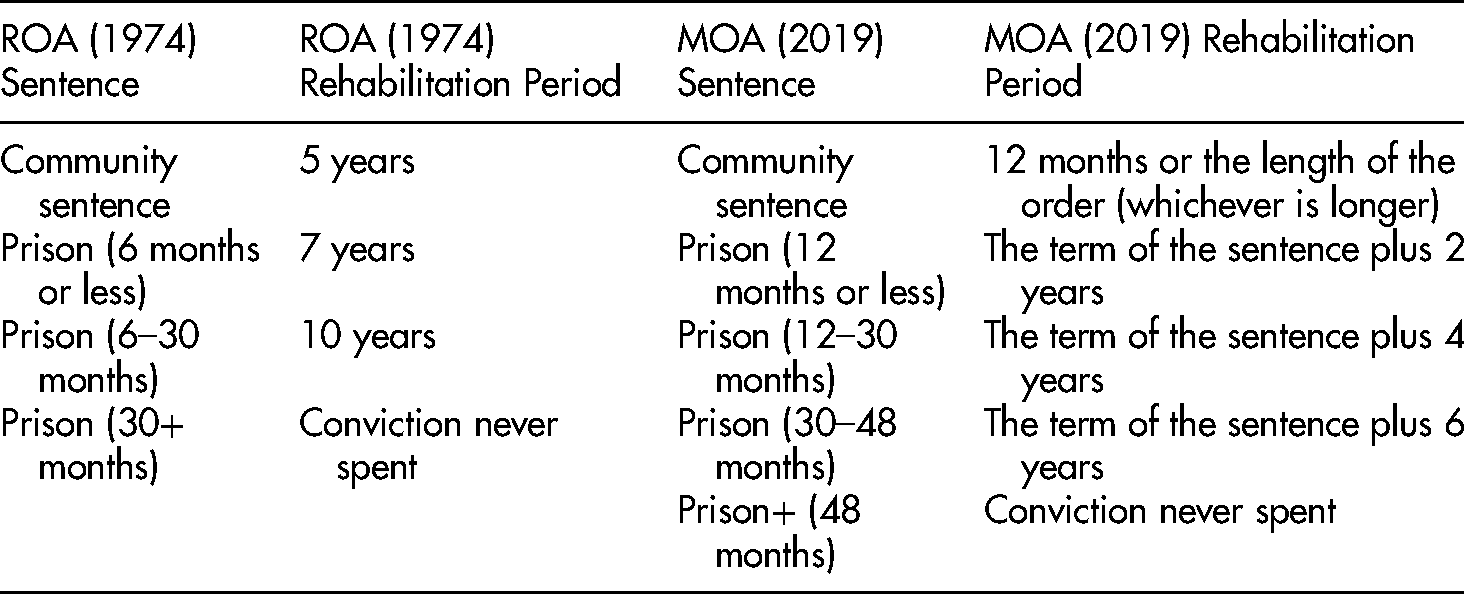
Given the significance of a sense of belonging, or citizenship, to desistance and social integration, this is a concern and one that, to a greater or lesser degree, is reflected – ostensibly at least - in contemporary legislative and policy reforms. The Rehabilitation of Offenders Act 1974 (ROA), the primary legislation surrounding the disclosure of criminal records, has recently been subject to a series of reforms, in Scotland and in England and Wales. In Scotland, these reforms have been enacted via the Management of Offenders (Scotland) Act 2019 and the Disclosure (Scotland) Act 2020. These Acts prescribe what criminal record information is allowed to be disclosed to, or withheld from, potential employers, when and in what context. The general purpose is to provide for a system of protection to individuals with previous convictions not to have to disclose these in certain circumstances, whilst also safeguarding children and vulnerable adults. After the specified ‘rehabilitation period’ has passed, the original conviction is considered spent and, unless the nature of employment requires it, does not need to be disclosed. The reforms to the ROA were intended to encourage reintegration by reducing the lengths of time in which a conviction becomes spent, and the changes introduced by the 2019 Act are summarised in Table 1, below. Additionally, the Disclosure (Scotland) Act 2020 specifies a range of occupations from which people are excluded on the basis of offence type, rather than sentence, and in relation to which spent convictions across a range of offences must always be disclosed.
Changes to rehabilitation periods.
In an effort to respond to the socio-economic marginalisation of people with convictions, and other groups who are distanced from the labour market, the Scottish Government’s (2018) flagship policy, No One Left Behind, explicitly recognises the link between unemployment, social inclusion and desistance as well as the impacts and effects of stigma, and employer attitudes. Despite this understanding, and the Scottish Government's investment in a range of employability and employment support arrangements, a number of barriers to improving the prospects of people with convictions in securing and sustaining employment remain. A recent evaluation of Fair Start Scotland (Scottish Government, 2020: 4) – Scotland's devolved employment support service – demonstrates its limitations in supporting justice affected people. ‘There are some groups for whom starting and sustaining work seems to be more difficult, such as … those with convictions’
It would seem, then, that while there is a recognition of the importance of employment for reducing reoffending and supporting positive outcomes, evidence of the efficacy of these initiatives with people with convictions in general, and those subject to community supervision in particular, is limited – both in terms of the availability of evidence, and evidence of efficacy (Community Justice Scotland, 2020; Scottish Government, 2020).
Research design and methods
This study had two objectives. Firstly, it sought to identify the factors that variously enable or constrain those subject to community supervision in seeking, starting and sustaining employment. Secondly, it aimed to explore the level of engagement and experiences that those subject to community supervision have had with prospective employers and employment support initiatives.
Given that we were interested in both experiences of seeking and securing employment, and each participant's perceptions of the factors and circumstances which enabled or constrained their success in this endeavour, our preferred data collection method to address these questions was qualitative (e.g. focus groups or semi-structured interviews). However, the data was collected between September and December 2021, and at this time Covid-19 cases were steadily rising. The Covid-19 pandemic has created challenges for researchers working on criminal justice topics, as services have become stretched, difficult to access, or face-to-face research has been paused (Richardson et al., 2021). Consequently, we felt that questionnaires offered the most flexible – and least institutionally burdensome – method for gaining an insight into the experiences of our participants.
Questionnaires were designed following a close reading of relevant Scottish policy documents, and wider literatures on the collateral consequences of criminal records, employment and employability in criminal justice contexts, and desistance. Surveys asked about key demographics (age, gender, ethnicity, criminal history, criminal justice involvement etc.), educational and employment experiences and history, experience of engaging with employment support initiatives, disclosure practises, experiences of engaging with employers and employment aspirations. Questions were asked in a number of different forms, including: multiple choice questions, Likert scales, and also open questions allowing participants to give free-text answers. Once the questionnaires were returned, the quantitative data was largely analyzed for descriptive frequencies, however we also used crosstabs to explore the association between responses where appropriate. The qualitative free-text data was analyzed thematically.
Following ethical approval from the University of Strathclyde, and relevant local authorities, we recruited participants through five justice social work services in the west of Scotland, and provided gatekeepers with both the digital link to the online anonymous questionnaire via Qualtrics, a GDPR compliant package, and also paper copies for participants who preferred to respond in this way, alongside participant information sheets and consent forms. Notably, no respondents returned paper copies, and while 41 people began the questionnaire, only 29 completed it. It may be that participants who finished the questionnaire had stronger literacy and IT skills than those who did not. Indeed, while just over half of participants who completed the questionnaire listed their highest level of education as secondary school, just over a quarter (n = 8 or 27%) had gone on to college, and a further 5 had some level of higher education.
Sample characteristics
Respondents comprised 26 men [89.6%], two women, and one participant who preferred not to say. While we lay no claim to achieving a representative sample, this is broadly consistent with the gender ratio of people subject to community payback in Scotland, 85.5% of whom are male (Scottish Government, 2022). Within our sample 86% [n = 25] were aged under 45, which is again comparable to the national data, which reveals that 72.5% of people subject to CPO are aged between 18–40 (ibid). Of the 27 participants who described their ethnicity, all identified as white/white Scottish/white British. Consequently our findings cannot speak to the additional barriers which people of colour and racial and ethnic minorities may experience; however the homogeneity of our sample reflects the national ethnic profile insofar as 96% of people identified as ethnically white in the most recent Scottish census (Scotland’s Census, 2011) 4 .
Our respondents reported varied levels of involvement in the criminal justice system, ranging from this being their first conviction, to having ten or more (with the largest number of convictions reported by a single participant being 60). Just under half of participants (n = 13) disclosed that they had previously been in prison, and for the majority of these participants, their longest period of imprisonment had been a short (less than four years n = 3) or very short (less than a year, n = 7) sentence. At the time of completing the survey, the majority of respondents were subject to community sentences, rather than post-release community supervision post-release, with the most common order being a Community Payback Order, Scotland's principal community sentence (Scottish Government, 2022).
Findings
Seeking (meaningful) employment
The majority of participants had been employed ‘on and off’ on either a full-time (n = 10) or part-time basis (n = 5), while just over a third had a history of steady employment, again as either full-time (n = 10) or part-time (n = 1) employees. Two participants had never been employed, while one described themselves as “underemployed”. At the time of completing the questionnaire, two-thirds of participants were unemployed, and only nine respondents were employed, broadly reflecting national figures (Scottish Government, 2022), although seven of these participants were working in temporary roles or on zero-hours contracts. Notably, while the two participants currently in more secure jobs had a history of steady employment, so did four of the seven participants now in temporary or zero-hours positions.
This shift into more precarious work reflects not only the neo-liberal flexibilization of labour markets in general (Sheppard and Ricciardelli, 2020), but resonates with wider research which has found that people who have criminal records may be forced to rely on temporary, informal, or insecure employment as they find it difficult to compete with non-criminalised people for higher-quality roles (Augustine, 2019). While this precarity can have detrimental and destabilising impacts on wellbeing, financial and social security, and feelings of self-worth (Miller and Borchardt, 2016), our findings suggest that participants generally held positive attitudes towards employment. For instance, of the nine participants who were currently employed, all but one felt that this had made a positive difference to their lives. Elaborating further in the free-text comments, participants explained that work not only provided additional financial income, but also the opportunity to gain new skills and new routines. Work provided a welcome distraction from other difficulties in their lives, and supported both their mental health and personal wellbeing.
Keeps me busy and distracted from issues in my life (Male, employed)
Kept in a routine, funding, helped me to grow up (Male, employed)
Financial, gaining more skills, improving my mental health and wellbeing (Female, employed)
Given that employment was seen as having multiple benefits, it is unsurprising that respondents who were currently working were more satisfied with their employment status than those who were not. Indeed, no employed participants expressed negative views toward their current employment status, though responses were evenly divided between those who held positive views towards their current position, and those who held more neutral views (in that they were neither satisfied or dissatisfied). Conversely, only one participant who was currently unemployed was satisfied with their current employment status, while the remainder expressed neutral (33%), negative (40%) or very negative (20%) views, implying that this cohort want to be employed. The additional free-text comments suggest that participants saw employment as a key means of either rebuilding their lives following their conviction, or for desisting from crime.
Want to get back into work as soon as possible (Male, unemployed)
I want to get a job and a steady income to move away from crime (Male, unemployed)
Participants held a wide range of ambitions for their future employment, with respondents identifying social care, landscape design, bike maintenance, cooking, voice acting, and “something creative” as potential future careers. These aspirations demonstrate that many participants saw the value of employment as going beyond financial recompense for their labour; they also wanted to access roles which utilised their skills, and reflected their interests and motivations or which held some meaning for them.
There was some optimism amongst participants that this goal of moving into employment was achievable. When asked about their views on seeking employment, three quarters of respondents rejected the assertion that it is “pointless” to apply for a job with a criminal record. Further, more than half felt that they would be able to get a job despite their convictions. However, this optimism appeared to wane when participants were asked in more detail about their expectations of employment. For instance, respondents had mixed views as to whether there were jobs available to apply for which would use their skills: just under half of participants gave a positive answer to this question, while a third were unsure, and the remainder disagreed. Participants were also uncertain as to whether the jobs which might be open to them would be of an acceptable quality; only 12 of the 29 participants felt that there were “good” jobs available to them to apply for which would offer them security, with around a third of participants disagreeing or strongly disagreeing with this statement, and around a fifth being unsure. Participants were also concerned that the jobs available to them might be poorly paid or fail to guarantee sufficient income, with less than half of participants indicating that they were confident that there were jobs they could apply for that would pay them enough to be financially secure. Thus, while participants held positive attitudes about the value and potential benefits of employment, their aspirations to achieve this were tempered by fears that they would be unable to secure work of a sufficient quality to generate those effects.
Perceptions of stigma and the criminal record
As noted, many criminalised people already experience a range of social inequalities and disadvantages (such as disrupted experiences of work or education, physical and mental health concerns, substance misuse, and unstable housing) which can constrain their ability to secure and sustain employment (Anazodo et al., 2019; Cherney and Fitzgerald, 2016; Goodman, 2020; Weaver et al., 2021). Furthermore, these disadvantages are experienced in a wider context of an ongoing rise in non-standard, low-paid, and precarious work, which leaves many people trapped in a cycle of unstable employment and in-work poverty (Sheppard and Ricciardelli, 2020). Consequently, to better understand why participants had mixed feelings about their potential to access high-quality and secure jobs, and how their criminalisation did (or not) shape these perceptions, we asked a number of questions directly relating to whether or not they felt their criminal record had impacted on their ability to find work.
In keeping with the above, participants expressed mixed views as to whether their criminal record had affected their ability to get any job, but were in broad agreement that a criminal record had at least some impact on the type and quality of job they might secure. For instance, participants were evenly divided in their views as to whether their criminalisation had impacted their ability to get a job, and while just under half felt they had lost out on job opportunities because of their criminal record, around a third felt they had not. However, the vast majority (n = 26 or 90%) of participants felt that a criminal record would influence what types of job they could secure. This resonates with Eley’s (2007) Scottish sample of justice-involved people affected by substance use, who similarly believed that the jobs available to them would be monotonous, manual and low paid. Moreover, a number of participants suggested in free-text comments that prospective employers did not trust them (see also Eley, 2007), or would not choose to employ a person with convictions:
It's not easy - employers ignore you. Even after I’ve done my time I’m still being punished, it's not right. (Male, unemployed)
Employers don't want to employ me (Male, employed)
Trust issues (Male, unemployed)
This perception that the stigma surrounding a criminal record could be a considerable impediment to gaining meaningful work is also reflected in the finding that only a quarter of participants felt that employers would hire a qualified person with a criminal record. The remainder were fairly evenly divided between those who were unsure if this would happen, and those who thought employers would not, even if they are qualified. Similarly, nearly two-thirds of respondents agreed or strongly agreed that, given the choice, employers would opt for someone without a criminal record, while a further quarter were unsure if this would happen. This perception appears, for some, to be directly shaped by their prior experiences, as almost a third of participants reported that they had been discriminated against due to their convictions:
Once you’ve got a record that's it basically, you can forget working and being treated as equal. (Male, unemployed)
Lost employment due to offence feel not supported (Male, unemployed)
Want to work but feel prejudiced due to criminal history (Male, unemployed)
Yet despite their anticipation that the stigma attached to a criminal record may represent a barrier to finding suitable employment, like Winnick and Bodkin’s (2008) US sample, the majority of our participants expressed a desire to be open with employers regarding their convictions. While our methods did not allow us to probe further, this might suggest something of the need to be accepted for their past and recognised as a citizen striving to live a decent life, and to feel that they have a secure place in the world. Nearly three quarters of respondents reported that they would always declare their criminal record on an application form if asked. Similarly, two thirds noted that they would declare their criminal record if they were offered a job, while only one in five would not. This preference for adopting a strategy of openness was also evident in a number of the free-text comments, further resonating with Anazodo’s et al. (2019: 575) Canadian sample across whom ‘repeatedly the theme of honesty emerged … as a central consideration to identity management’:
I will benefit by being truthful (Male, unemployed)
Just be honest and declare any convictions (Male, unemployed)
Always be upfront. (Female, employed)
Consistent with ‘preventative telling’ identity management strategies (Winnick and Bodkin, 2008), participants appeared to welcome opportunities to help employers to understand the wider context of their convictions, and also their own lives and circumstances, with around two thirds feeling confident that they would be able to “reassure an employer that they did not need to worry about employing me”, if given an interview. Thus, while our participants expected that stigma and discrimination would limit what types of jobs were available to them, this did not manifest in identity management strategies of secrecy, in terms of concealing their record, or of withdrawal, in terms of avoiding the situations in which rejection might occur, but a preference for opportunities to engage in preventative telling, to educate prospective employers (Link et al., 1989).
Navigating multiple barriers to employment
While participants perceived employer attitudes to be a considerable obstacle to overcome, this was by no means the only barrier which they faced. Of our 29 participants, all but two felt they had experienced at least one barrier to gaining employment, with one of these respondents noting that they had not as yet encountered any barriers as they had only just begun looking for work. Indeed, the majority of participants faced multiple obstacles to gaining employment, with these 29 participants reporting a mean of 4.4 barriers. These are ranked from the most to least prevalent in Table 2, below.
Perceived barriers to employment.
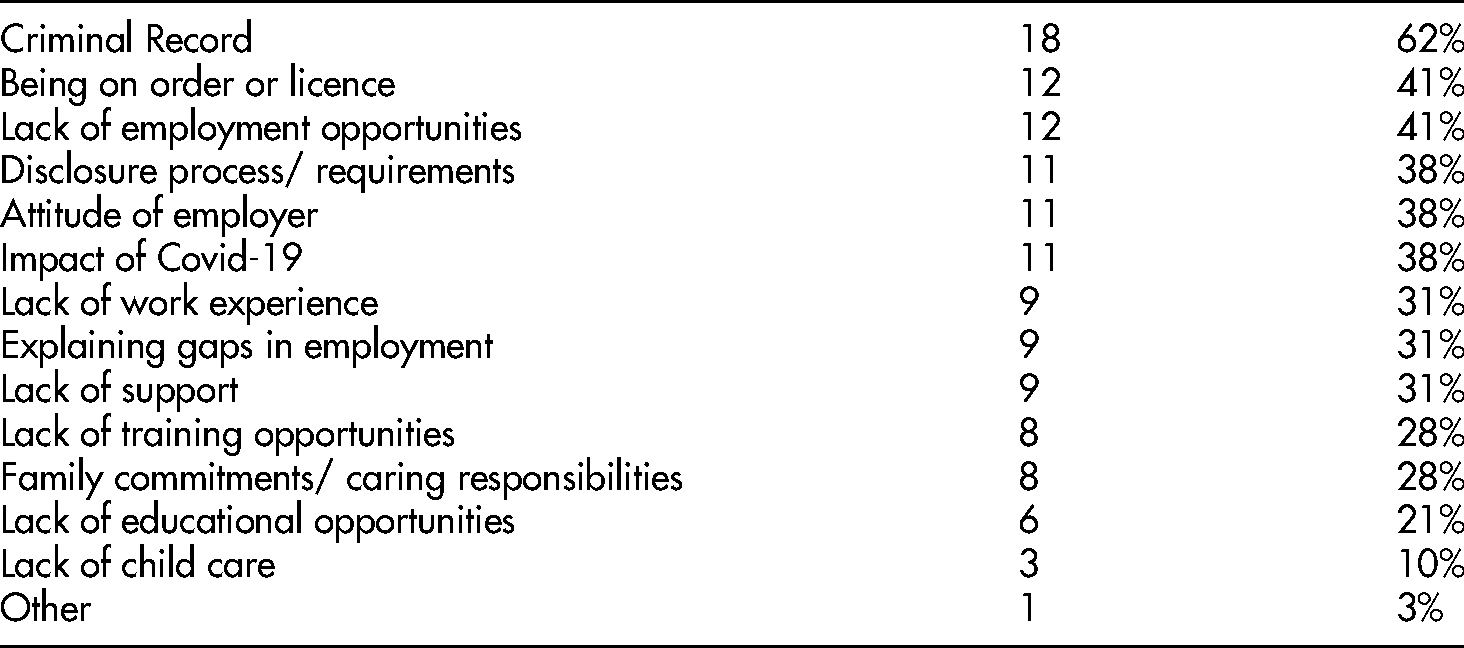
Notably, the barriers identified by ten or more respondents – or over a third of participants – are issues which might be considered as structural or systemic obstacles to securing employment. It is striking that three of the four most commonly reported barriers – having a criminal record, the need to disclose that record, and being on an order or licence – stem directly from the participant's contact with the criminal justice system, reflecting, among others, Varghese et al.’s (2021) finding that a criminal record is perceived to be the biggest barrier to work. While we were unable to probe reasons for this, we might hypothesise that this relates to the fact their conviction is undoubtedly unspent by virtue of being subject to community supervision, or that the demands of their order preclude participation in employment. Capece (2020), for example, explored how probation conditions impact self-perceptions of employability among recent releasees. Their results suggests a negative correlation between number of conditions and perceptions of employability among probationers. Arguably, the third most commonly reported barrier – a lack of employment opportunities – may be compounded by criminal justice supervision; where opportunities are scarce, people with convictions, and particularly those still justice-involved, find themselves in more intense competition for jobs with others without a criminal record or justice-involvement.
Yet, despite facing these multiple and systemic barriers to securing employment, participants reported accessing few supports which might aid them in navigating these obstacles. The most common type of support offered was help with finding vacancies to apply for, with just over a third of participants suggesting they had received this form of assistance from various professionals such as their social work/unpaid work officer, the Job Centre, third sector organisations, or recruitment agencies. However, a large majority of participants (n = 23 or 79%) had not received employability training to support them into work, with only a handful of participants suggesting that they had been able to access support on matters such as CV writing (n = 5), interview skills (n = 4), or general employability skills (n = 4). Similarly, only two participants had received support to help them to stay in work.
Notably, despite employer attitudes and disclosure requirements both being identified as key barriers by over a third of participants, the vast majority (n = 24 or 83%) had not received support or training on the issue of disclosure. The absence of support left participants poorly equipped to negotiate this complex issue, with less than half of participants suggesting that the disclosure process was easy to understand. It is therefore, perhaps unsurprising that only half of participants knew when they had to disclose their convictions, and that concerns regarding the disclosure process were frequently raised in the free text comments:
Has stopped me getting a job. Employers always ask. (Male, unemployed)
Holds me back due to disclose (Male, unemployed)
I need more information (Male, unemployed)
Thus, it appears that not only was employment and employability support accessed by only a few participants, but that there was a clear disjuncture between the type of support offered and the barriers that participants felt to be most pervasive. This undoubtedly reflects a limitation in employability policies and supports focused on upskilling individuals rather than investing in work generation and integration for those disadvantaged from the labour market (Weaver, 2016), which, in turn, often renders those seeking work individually responsible for overcoming wider systemic problems, over which they have little influence or control (Miller and Alexander, 2016).
Concluding discussion
In this paper we have sought to respond to the relative absence of UK based research into the perspectives of criminalised people on seeking, starting and sustaining work by offering insights into the experiences of people subject to community supervision in Scotland. As we have elaborated, the literature on desistance suggests many criminalised people express a desire for a stable and ‘conventional’ lifestyle, centred on reliable employment and family life (Owens, 2009). This aspiration to secure stable, and also personally meaningful, employment was evident in the views expressed by our respondents. Not only were those who were currently working happier with their employment status than those who were not, but these participants welcomed the consequent opportunities to develop new skills and new routines, and the related benefits for mental health and wellbeing. Yet, while there was some optimism amongst participants that they would be able to secure a job, they also expressed concerns that the jobs available to them would be low-skilled, insecure, and poorly paid. These concerns are not unfounded; most who were in work were employed in temporary or zero-hours roles, despite some having a history of more secure employment.
This limiting of opportunities open to participants resonates with other studies which suggest that a criminal record can be a significant barrier to employment (Pager et al., 2009b; Varghese et al., 2021). Indeed, for our participants, a criminal record was the most commonly identified barrier, followed by a lack of employment opportunities, the attitudes of employers, and the processes surrounding disclosure. These concerns might be thought of “anticipated stigmatisation”, whereby criminalised people expect that they will be discriminated against, judged or devalued by others as a result of their criminal record (Winnick and Bodkin, 2008). Despite this, just as Winnick and Bodkin found a strong preference for a strategy of “preventative telling” – or being honest and upfront with employers – our participants also expressed a strong desire to be open about their convictions. Yet, few reported accessing support in approaching how to tell prospective employers about their criminal record, or guidance as to when this might be necessary. This question of “when” to tell is especially pertinent in light of research which suggests that the opportunity to meet and build rapport with potential employers can reduce the discrimination criminalised people experience as a consequence of their convictions; but notably, such opportunities are less frequently afforded to people of colour (Pager et al., 2009b).
When our participants did report receiving support, this tended to focus on individual employability skills such as CV writing, job searching, or how to approach an interview. This again resonates with a large volume of US literature which details the propensity of organisations supporting criminalised or formerly incarcerated individuals to focus on individual employability or ‘soft’ skills (Halushka, 2016; Miller, 2014, 2021). Miller (2014) argues that this failure to tackle more systematic barriers - such as stigma, discrimination and the absence of meaningful employment opportunities - is symptomatic of carceral devolution, a process whereby the relationship between the individual and the state is redefined through the shifting of responsibility for rehabilitation to community organisations, who have little power to address these structural issues. This differential relationship with the state as a consequence of a criminal record, of course, has implications for the forms of citizenship accessible to criminalised people (Miller and Alexander, 2016; Phelps and Ruhland, 2021). While those subject to community supervision in Scotland remain under the purview of statutory social work services, often these services are under-resourced and over-stretched, with individual practitioners lacking any meaningful powers to address the socio-structural and systemic issues faced by their service users (Weaver et al., 2021). We therefore suggest that while many of our participants strive for the full citizenship enjoyed by those with ‘conventional’ lives, they are encumbered by a criminal justice system which imposes and exacerbates stigma (in the form of a criminal record), while doing little to address harms engendered by structural issues such discrimination, an absence of secure and stable employment opportunities, and the ongoing violence of deindustrialisation which is felt by many Scottish communities (Fraser and Clark, 2021).
Notably, the Scottish Government has recently set out its five strategic priorities for justice - one of which is supporting rehabilitation – and has explicitly recognised the role of employment and integration of people with convictions in achieving this aim (Scottish Government, 2022b). Building on the evidence and arguments advanced in this paper, we would suggest that for this aspiration to be realised, there is a need for more radical solutions which can meaningfully address some of these barriers to employment. We would therefore suggest that many progressive reforms argued to be necessary in the US – such as to delay background checks until after interview or training for employers which attempts to embed an inclusive culture that is supportive of “second chances” (Anazodo, et al., 2019) – would also be beneficial in a UK context. Among these, we propose the need for a policy commitment to statutorily require employers to ‘Ban the Box’. Support for this initiative in the US is growing: 37 states and 150 cities and counties have legislated for this in relation to public sector employers, and 15 states and 22 cities have extended this to private sector employers (Avery and Lu, 2021), and effective from December, 2021, the Federal Government legislated 5 for the ‘ban the box’ to apply to all federal agencies and contractors. In contrast, in the UK this remains optional and largely promoted by Business in the Community and Unlock. A mere 150 employers to date have pledged to do so (Business in the Community, 2022).
Despite current efforts, the stagnation of those with convictions in relation to labour market inclusion further suggests that we need to move beyond a reliance on employability supports that can build human capital, to address some of the systemic and socio-structural barriers to work integration, through job creation and supported employment schemes, closely targeted employability initiatives which respond to labour market deficits and facilitate access to quality jobs and greater investment in Work Integration Social Enterprises (WISEs). Globally, there are different models of WISEs, and similarly Social Cooperatives, but what they share in common is the provision of paid training or the creation of meaningful paid employment across a range of industries (for example environmental work, construction services, recycling, catering and so on) thus facilitating work generation for, and the work integration of, those distanced from the labour market, alongside holistic support. The nature of this support similarly varies depending on participants’ need and organisational context and provision but can include, for example, psychological services, drug treatment, accommodation, debt management and legal advice. Some such as Alternativa Ambiente 6 in Italy provide paid employment to people in prison, through the prison gate and in the community, alongside a permanent workforce, and even more broadly, people with disabilities or mental health issues, while others principally operate in the community; some provide work solely for people with convictions e.g. Homeboy Industries 7 in the US, whereas others include people affected by substance use e.g. Vagen Ut in Sweden. 8 Spear and Bidet (2005) note that WISEs are particularly effective in supporting integration into the labour market, as well as addressing the impacts and effects underpinning, and consequent to, social exclusion from it. Key to this is the distinct culture they nurture, in relation to their participative nature, community focus and embeddedness, and solidaristic characteristics, alongside the holistic nature of both the practical and relational support that many provide. Such structures thus represent powerful and important innovations to address the problems engendered by the effects of systemic and socio-structural challenges and disadvantages experienced by marginalised groups in general, and people with convictions in particular. Recent research (Roy et al., 2017; Weaver, 2016) provides important evidence to suggest their potential to support desistance, recovery and social integration, but this is largely untapped in Scotland, despite international evidence that participation in WISEs and social co-operatives lead to substantially reduced recidivism rates (Gordon-Nembhard, 2020).
However, not only are such structures providing paid work and holistic support a rarity in the UK, the potential of social enterprises for justice-involved and affected people has hardly been explored. We therefore argue that a more radical policy agenda should be matched with an equally bold and imaginative programme for future research. Qualitative, longitudinal and participatory methods may all be particularly helpful here, as these are well-placed to explore not only changes in individual attitudes and dispositions, but also the experiences and impacts of cycling between unemployment and precarious work. This is urgently needed as existing research has tended to dichotomise employment or unemployment in a way that does not differentiate between more nuanced labour market conditions in relation to diverse employment statuses (Bunting et al., 2019). It should also be noted that experiences of citizenship can be gendered, and that criminalised women may have very different experiences of facets of citizenship – including employment – than men, with women of colour experiencing a particularly diminished form of citizenship (Sered, 2021). Thus it is vital that any future research agenda draws inspiration from US studies which have sought to document and untangle the multiple (and differential) layers of exclusion experienced when the stigma of a criminal record is compounded by other forms of discrimination. This knowledge would be an essential tool for activists, academics, practitioners, and policy makers seeking to support employment and inclusion for all citizens.
Footnotes
Declaration of conflicting interests
The author(s) declared no potential conflicts of interest with respect to the research, authorship, and/or publication of this article.
Funding
The author(s) received no financial support for the research, authorship, and/or publication of this article.
