




Abstract
This article critically examines the restrictions on access to statutory compensation in Great Britain for victims of serious crime with criminal records. Drawing on original analysis of Criminal Injuries Compensation Authority transparency data it reveals the scale of the denial of victimisation as a so-called ‘collateral consequence of a criminal record’. The policy is then critiqued on the basis that it reproduces the problematic social construction of the ‘ideal victim’, delineates people with criminal records as subaltern citizens and gives rise to harmful secondary victimisation of applicants whose criminal records are often unrelated to their victimisation event.
Introduction
Policies and practices which lead to the less favourable treatment of people with criminal records – often dubbed ‘collateral consequences’ – are sometimes defended on the grounds that they may address public safety concerns. For example, in areas of employment involving close contact with children or vulnerable people, ‘enhanced’ criminal records checks give employers wide discretion to determine the suitability of applicants with an offending history (Thomas, 2007; Thomas and Bennett, 2019). However, restrictions on a range of other roles, particularly in relation to the administration of justice (e.g. police, prison, and probation officers) have also been regarded as permissible on the basis that they address concerns about ‘security’, or that they uphold the prestige of particular occupations (Henley, 2018a). These sorts of justifications can be broadly understood as attempting to use criminal records as a ‘risk management’ tool. Such approaches are not entirely without merit, as criminal records can act as a good predictor of future offending, albeit their ‘predictive validity’ for future offending appears to be lost after seven to ten years, an effect which is remarkably consistent across offence categories (Weaver, 2018; Hanson, 2018). The role of commercial interests and technological innovation in driving ever-wider dissemination of criminal records to private actors has given rise to what Corda and Lageson (2020) describe as ‘disordered punishment’, whereby the capacity of government and individuals to control the stigmatising effects of disclosure has been severely diminished.
‘Collateral consequences’ may also be defended on the basis that they reflect the censure attached to criminal offending. That is, on the grounds that (former) lawbreakers have, through their behaviour, rendered themselves ‘less eligible’ in their claim to the same rights and entitlements as other citizens (see Mannheim, 1939; Sieh, 1989). Restrictions on access to social security or other forms of public assistance are common in many US states (for instance, access to food stamps, student loans and business grants, see Huebner and Frost, 2019). Such ‘desert-based’ ancillary sanctions are less common in the UK, although one notable exception is the restricted access which people with criminal records face when applying for statutory compensation following victimisation through violent crime. This ‘denial of victimisation’ (Henley, 2018b) is unambiguously about the perceived ‘deservedness’ of applicants for compensation rather than any ‘risk’ which they may pose. It is therefore a particularly egregious example of post-sentence discrimination against those who have already been punished by the criminal justice system and paid their notional ‘debt to society’ (see Hoskins 2019).
This article provides the first critical examination of the scale of this denial of victimisation. It proceeds by, firstly, providing some background to the Criminal Injuries Compensation Scheme and criminal record-based deductions from awards made under pre-2012 schemes. It then examines how the post-financial crisis period of fiscal austerity acted as the pretext for further restrictions on the eligibility of people with criminal records under the 2012 Scheme. Secondly, the paper presents findings from secondary analysis of Criminal Injuries Compensation Authority data, with specific focus on decisions to reject claims or reduce compensation based on applicants’ criminal records. Finally, the paper argues that the denial of victimisation contributes to the problematic social construction of ‘ideal victims’, casts former lawbreakers as ‘less deserving’ citizens and compounds the trauma experienced by many victims of serious crime.
The criminal injuries compensation scheme and criminal record-based deductions
Publicly funded compensation for victims of serious crime has been a feature of the criminal justice landscape in Great Britain for more than half a century. In 1964, the Government established the Criminal Injuries Compensation Board – a non-statutory body which distributed ex gratia payments to victims of violent crime (or to dependants in cases involving the victim's death) with awards assessed by reference to the legal principles established for personal and fatal injury cases (Miers, 2018). Following the passage of the Criminal Injuries Compensation Act 1995, a new Scheme was established in 1996 administered by a new statutory body – the Criminal Injuries Compensation Authority (CICA). Under this new Scheme, CICA began to administer payments with reference to a tariff on which injuries of comparable severity were linked to different financial values ranging from £1000 to £250,000. An additional payment of up to £250,000 could be made in respect of loss of earnings or earning capacity linked directly to the injury, resulting in a total maximum payment under the Scheme of £500,000 (Home Office, 1995). At this point, a Criminal Injuries Compensation Appeals Panel (CICAP) was also established to hear appeals from claimants who wished to challenge the value of award or the decision of CICA to refuse a claim.
Subsequent revisions to the CICA Scheme have been made in 2001, 2008 and most recently in 2012 – but often with the effect of further limiting eligibility for compensation through a narrowing of the definition of ‘deserving’ victimhood (for an overview see Miers, 2018; 2019). Reduced awards or refused claims may result from a number of long-standing factors including: failure to report the crime which led to the injury; non-cooperation with police and the criminal justice system; failure to cooperate with CICA; and the victim's conduct before, during and after the incident in which they were injured (for instance, whether they intended to provoke a fight in which they were then injured or subsequently sought revenge against their assailant) (see CICA, 2008a; 2008b). However, the ‘bad character’ of victims – as evidenced, for example, by their criminal record - has also been used as a reason to reduce or refuse claims since the inception of the Scheme. Crucially, this applied to criminal records for offending unconnected to the victimisation event which was the subject of the claim. Under earlier iterations of the CICA Scheme, claims by applicants could be refused or reduced where: the applicant’s character as shown by his criminal convictions (excluding convictions spent under the Rehabilitation of Offenders Act 1974 at the date of application or death) or by evidence available to the claims officer makes it inappropriate that a full award or any award at all be made. (CICA, 2008a: para. 13(e))
Previously, the mechanism for determining deductions based on unspent convictions was based on a ‘penalty points’ system which applied deductions ranging from ten to 100 per cent based on the number of points applied to a case. Typically, more recent convictions or those resulting in custodial sentences attracted more penalty points. However, a large degree of discretion was still afforded to claims officers with guidance to the 2008 Scheme warning that: We are not bound by the penalty-points system, but we must take account of all unspent convictions. The penalty points are our starting point, but we consider convictions and penalty points together with all the other circumstances of the application. For example, we may make a smaller reduction or no reduction at all, if you were injured while helping the police uphold the law, or while helping someone who was being attacked. On the other hand, a low points score is no guarantee that we will make an award if, for example, your record includes violent or sexual offences. (CICA, 2008b: 66).
Miers (2019) has highlighted how claims officers deduce an applicant's ‘bad character’ in relation to non-conviction information available to them (which might nonetheless indicate involvement in criminal behaviour). This information could include: police cautions; any evidence of association in illegal drugs or crime; tax evasion; benefits fraud; or being subject to any number of court injunctions or civil preventative orders. Indeed, in Andronati v Criminal Injuries Compensation Appeals Panel [2006] the High Court held that the 2001 Scheme ‘did not place any limitations on the type of conduct which might justify the conclusion that an applicant's character renders an award of compensation inappropriate’ (para. 9; emphasis added). Despite this exceptional latitude afforded to claims officers in whether to refuse or reduce an award based on conviction and non-conviction evidence of ‘bad character’, the revised 2012 Scheme subsequently introduced even stricter limits on the eligibility of people with criminal records.
Following the 2007–8 global financial crisis and subsequent economic recession, an austerity programme was initiated by the Conservative-Liberal Democrat coalition government between 2010 and 2015. In his 2010 Spending Review, Chancellor George Osborne committed the Ministry of Justice to spending cuts of 23 per cent (HM Treasury, 2010) and, in 2013, to a further ten per cent cut (HM Treasury, 2013). Spending reductions were largely achieved during this period by cutting the number and cost of prison places, reducing the legal aid budget and through a programme of court closures. However, the impact of public spending restrictions on CICA awards made under the main tariff-based compensation scheme can be seen in Table 1 (below).
Value of compensation awarded through CICA tariff scheme 2010/11 to 2014/15.
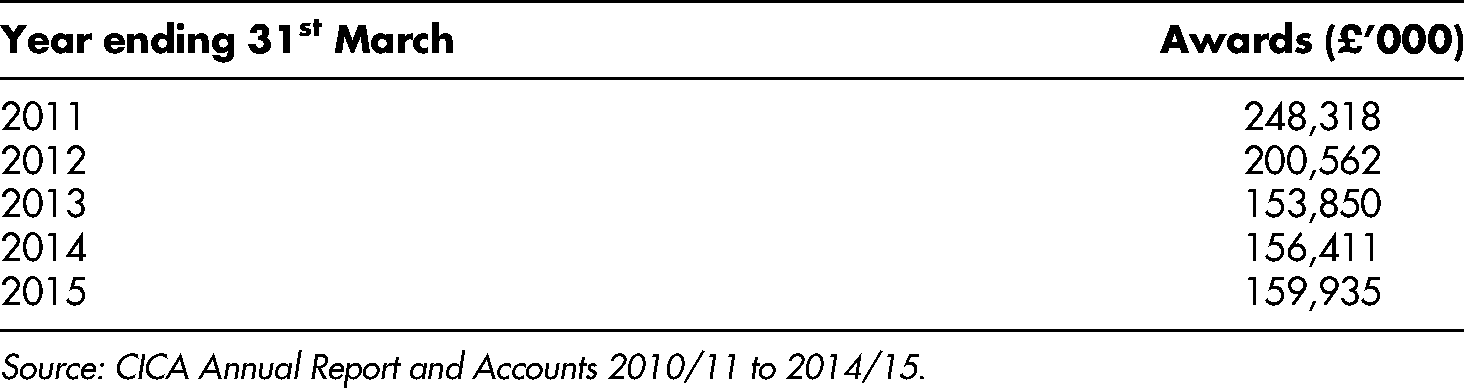
Source: CICA Annual Report and Accounts 2010/11 to 2014/15.
Proposals to further limit eligibility under the Scheme for people with criminal records were trailed in the media in late 2011. These were framed as necessary to reduce claims made by high-profile prisoners such as the Soham murderer Ian Huntley who had attempted to claim compensation from CICA following injuries sustained during an attack by another prisoner (‘No compensation for criminals injured in prison’, The Independent, 27 December 2011). The same report quoted a ‘senior source’ at the Ministry of Justice as saying: It is ridiculous that we are continuing to spend so much money on the injuries sustained by convicted criminals when so many victims of crime are still waiting for funds. There is around £5 m a year paid out to convicted criminals and we intend to bring that to an end. That will allow us to save around £20m during the lifetime of this Parliament. The Scheme is a taxpayer-funded expression of public sympathy and it is reasonable that there should be strict criteria around who is deemed “blameless” for the purpose of determining who should receive a share of its limited funds. We consider that, in principle, awards should only be made to those who have themselves obeyed the law and not cost society money through their offending behaviour. (Ministry of Justice, 2012a: 59).
Following the consultation period, the Ministry of Justice (2012b) published a response in June 2012 which set out the position that applicants with unspent convictions should not benefit from a revised Scheme under any circumstances where that conviction had led to a custodial or community sentence. It also stated that for unspent convictions which did not result in such a sentence CICA would ‘retain discretion to make an award in exceptional circumstances’ (p.46). A revised Criminal Injuries Compensation Scheme was subsequently approved on 13th November 2012 (Ministry of Justice, 2012c) which incorporated (in para. 26 and Annex D) the much tighter restrictions outlined in the consultation response.
The rigidity of the 2012 Scheme in relation to applicants’ unspent convictions has led to numerous challenges to the legality of the effective ‘blanket ban’ on those who had received a custodial or community sentence. These have largely been unsuccessful on the basis that parliament's intention in using convictions which are unspent under the ROA 1974 was clear and sets a ‘bright line’ rule to which CICA case officers should adhere. Nonetheless, several cases highlight the seeming harshness of this approach. For instance, in T.Q. v. Criminal Injuries Compensation Authority [2015] the appellant had been raped as a 12-year-old before becoming involved in problematic drug use. She later acquired a string of convictions for offences including possession of Class A drugs with intent to supply, assault on a police officer and harassment. In relation to her offending she received, amongst other court disposals, a two-year custodial sentence. In 2013 she sustained severe injuries after being sprayed with chromic acid by an unknown assailant to whom she had opened her front door. Whilst the perpetrator was subsequently imprisoned for this attack, the appellant's application to CICA was rejected on the basis that her convictions remained unspent. Her appeal against this decision failed, in part because the First Tier Tribunal judged that: In numerous areas of government policy making, it is legitimate and appropriate for those with unspent convictions to be treated differently to those with spent convictions. In our judgment, the provision of criminal injuries compensation is one such area. (para. 76.5).
Decisions made by CICA to reject claims have attracted controversy where they have related to victims of sexual violence and childhood sexual abuse. In particular, the Independent Inquiry on Child Sexual Abuse (2019: 77–78) has drawn attention to the links between childhood abuse and subsequent offending behaviour and has been critical of decisions to deny compensation to abuse survivors based on unspent convictions unrelated to their earlier victimisation. Similarly, the organisation Women Against Rape (2020) have highlighted how: Since 2015, at least 385 victims of sexual violence had been refused because of a conviction. Unspent convictions for non-violent and minor offences, including theft, drink-driving or an unpaid TV licence are routinely used to deny victims an award. The CICA claims that the state having once prosecuted us nullifies any claim we have for compensation as it was a drain on public resources. Instead, they should value the public service we performed of bringing a rapist or other violent criminal to justice, protecting everyone’s safety. To punish us twice – first for the crime that we committed, and secondly for the crime committed against us – is discriminatory. This affects some of the most vulnerable victims, penalising those who may have been criminalised as a result of the rape trauma they have endured. Victims often self-medicate with drugs or alcohol to soothe their pain, and then get convicted. Under the Rehabilitation of Offenders Act 1974, offenders must fairly bear the impact of their offending, which in our view includes exclusion from compensation of this kind, until their conviction becomes spent… and that it is important to continue to reflect the costs to society and to the state from offending (Ministry of Justice, 2020: 30).
However, in Mitchell, R. (on the application of) v Secretary of State for Justice [2021], the High Court have ruled that the refusal of the Ministry of Justice to carry out a public consultation on these issues was unlawful. Specifically, the Court has directed that the public should be consulted on whether the Scheme should be revised so that applications are not automatically rejected in circumstances where an applicant's criminal convictions are likely to be linked to their sexual abuse as a child. Following completion of this consultation, the Ministry of Justice will be required to announce whether the unspent convictions rule should be revised.
Data and methodology
This article now turns towards an evaluation of the precise scale of the ‘denial of victimisation’ under the 2012 Scheme. As a public authority funded through the Ministry of Justice in England and Wales and the Justice Directorate in Scotland (with separate provisions existing in Northern Ireland), CICA is required to publish data on its activities to comply with its duties under Schedule 1 of the Freedom of Information Act 2000. In addition to an annual report and accounts relating to the operational costs of the Authority, transparency data on the processing of claims, award values and case outcomes are also published for each financial year. Each annual dataset provides information for every processed case concluded in that year including: the age and gender of the applicant; a classification of the main injury sustained (based on CICA's guidelines); the value of any compensation awarded; the stage at which the claim was resolved (i.e. at first decision, review stage or following appeal); the basis on which claims were rejected or awards reduced; and whether the applicant was represented during the process (for instance, by a solicitor, friend or relative).
Whilst relatively comprehensive in scope, these datasets did not include some information where its publication might lead to the public identification of the victim (e.g. because fewer than three people were categorised as having similar injuries). A further limitation to the data was that whilst information was provided on applicants’ main injuries, this was not linked to the precipitating offence type which caused that injury. Where criminal records contributed to a reduction or rejection of an application for compensation, no information was provided on the nature of the convictions held by the applicant. Therefore, we were unable to analyse whether types of victimisation, or applicant criminal record, had an impact on award outcomes. Whilst data on the age and gender of applicants was provided, a detailed analysis of the impact of these variables was thought to be beyond the scope of this paper. Having established the impact of criminal records on compensation outcomes in this article, we hope to further explore the influence of other factors in future research.
Our research utilised secondary analysis of CICA data for the period 2013/14 to 2020/21 to explore the extent to which people with criminal records were subject to either refusal of their application, or a reduction in any compensation awarded, following the implementation of the 2012 Scheme. Figures on all processed claims for this eight-year period (n = 266,847) were incorporated into a single dataset to allow for longitudinal analysis. To focus the analysis on outcomes related to the more restrictive 2012 Scheme, legacy cases pertaining to claims considered under the earlier 1996, 2001 and 2008 Schemes were identified (n = 46,367). This allowed measurement of the impact of the 2012 reforms on claim outcomes and award values in comparison to earlier Schemes. These legacy cases were then separated from the main dataset resulting in a final population of 220,480 cases facilitating analysis of the 2012 Scheme's eligibility criteria in isolation.
The main distinction within the Scheme pre- and post-2012 is the increased use of unspent convictions as a disqualifying criterion, rather than any change to the use of other ‘bad character’ evidence as explained above. We have therefore proceeded on the assumption that observed differences within the datasets resulted from changes to the consideration of unspent convictions. Henceforth, we refer solely to ‘criminal records’ as a shorthand for the use of both unspent convictions and other ‘bad character’ evidence by claims officers. Some cases were categorised as having ‘multiple’ reasons for rejection or reduction of the claim (n = 17,506). Therefore, because we could not disaggregate individual cases where ‘unspent convictions’ or ‘bad character’ formed only part of the assessment, we took the conservative approach of not including these cases within the ‘criminal records’ group. Consequently, our approach to quantifying the denial of victimisation as a ‘collateral consequence’ is likely to exclude some cases where criminal records were, in fact, part of the overall assessment. Following this decision, a population of 11,040 cases were identified where criminal records were the sole reason for rejection of an application or reduction of the compensation awarded.
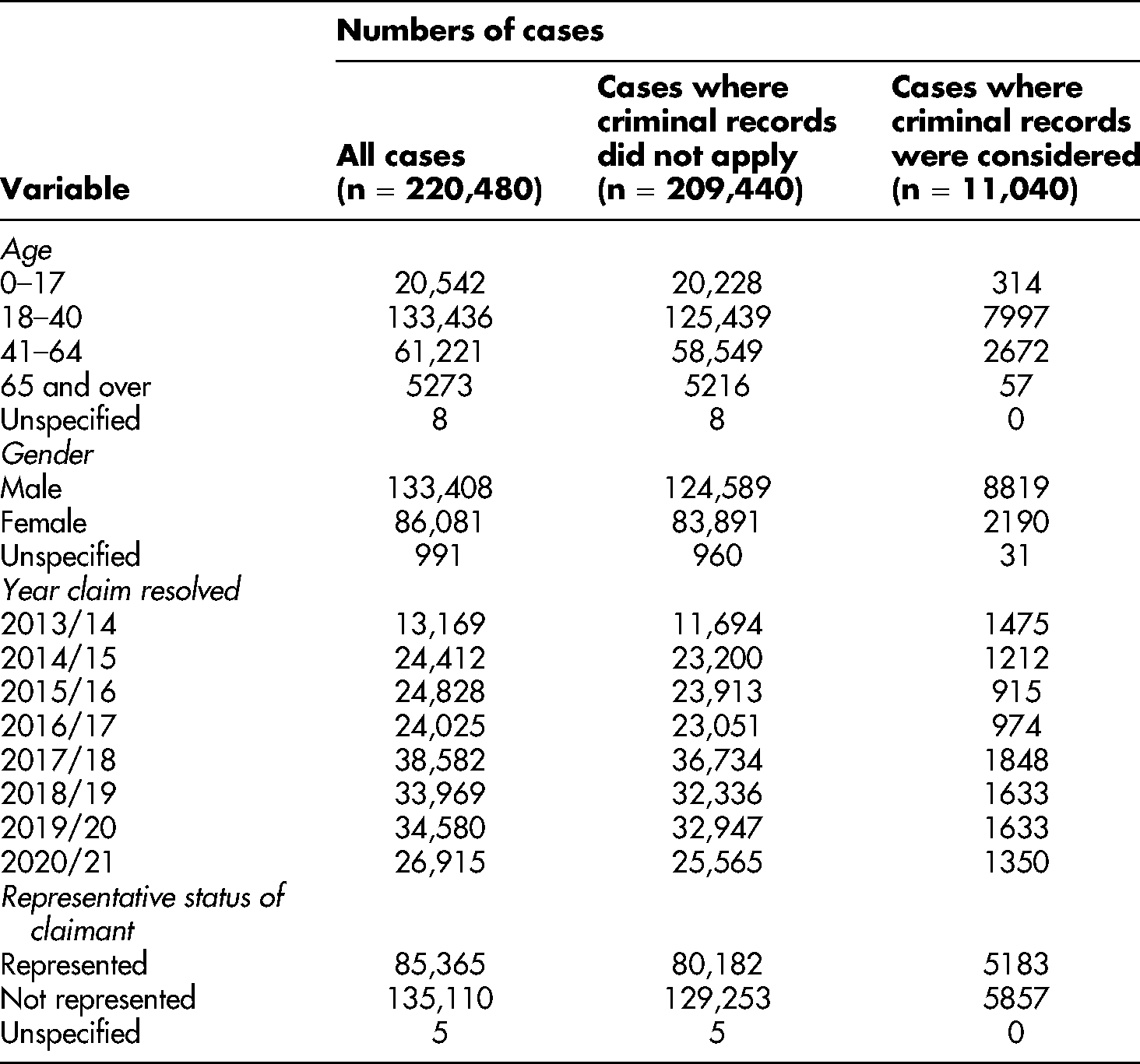
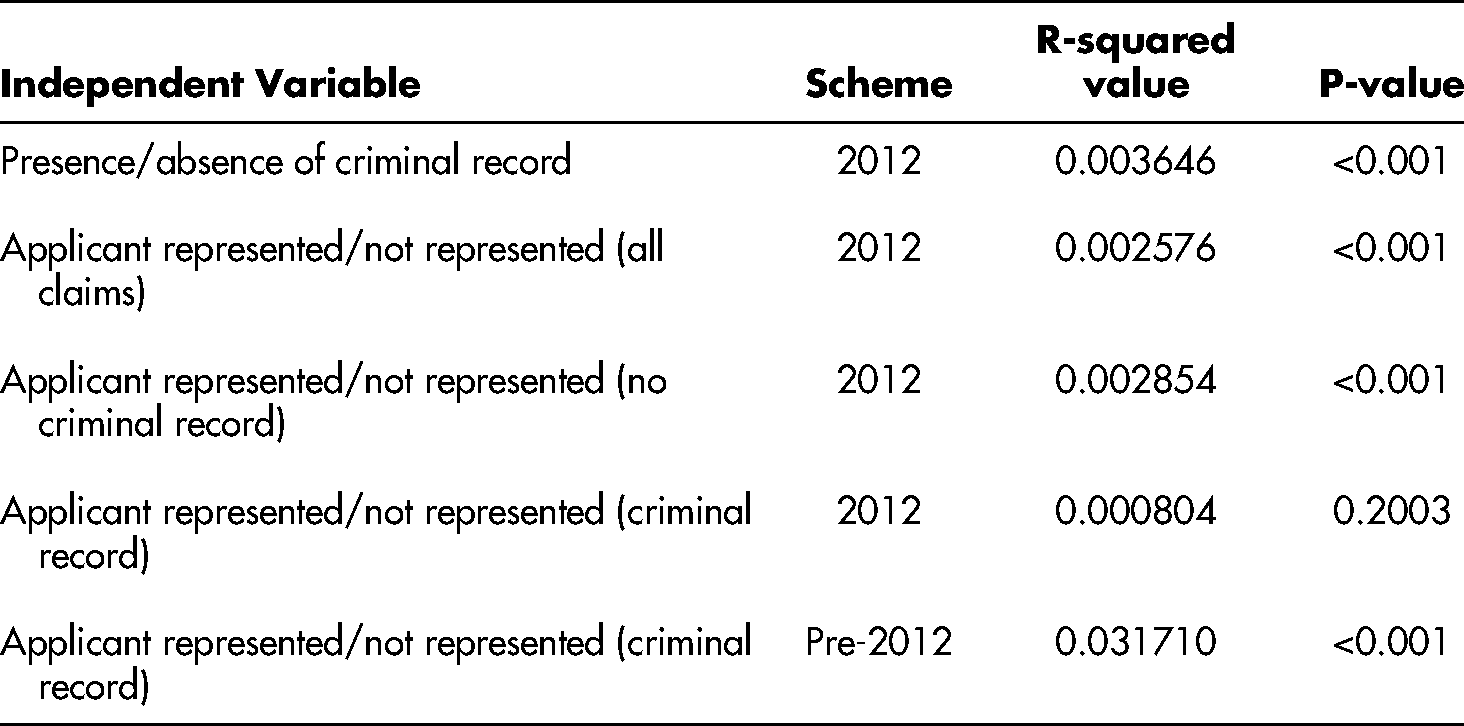
Our approach facilitated analysis of trends in CICA decision-making across the 2013/14 to 2020/21 period as well as producing a more generalised view of the consequences of eligibility restrictions imposed in 2012. Our analysis produced a range of descriptive statistics on median award values under the 2012 Scheme and earlier schemes (see Figure 1); the year in which claims were resolved by CICA (see Table 3); whether applicants were represented (also Table 3); and the final outcome of claims (recorded as ‘full award’, ‘reduced award’ or ‘nil award’) (see Table 2). This information was disaggregated and presented as follows: all cases, cases where criminal records were not considered during claim processing, and cases where this criterion was applied. A flowchart was then produced, which visualised the procedural stage at which cases were resolved for applicants where criminal records were considered (see Figure 2). Finally, based on cases where an award value larger than zero was reported by CICA, statistics on the monetary value of awards were produced (see Table 4). These showed the distribution of award values via maximum and minimum awards; awards at the 25th and 75th percentiles; and median, mean, and standard deviation values. Statistics were again disaggregated as previously described, with the addition of differentiated values for represented and unrepresented claimants. Finally, linear regression analyses were performed on the data to test the statistical significance of a range of relevant variables on final award outcomes (see Table 5).
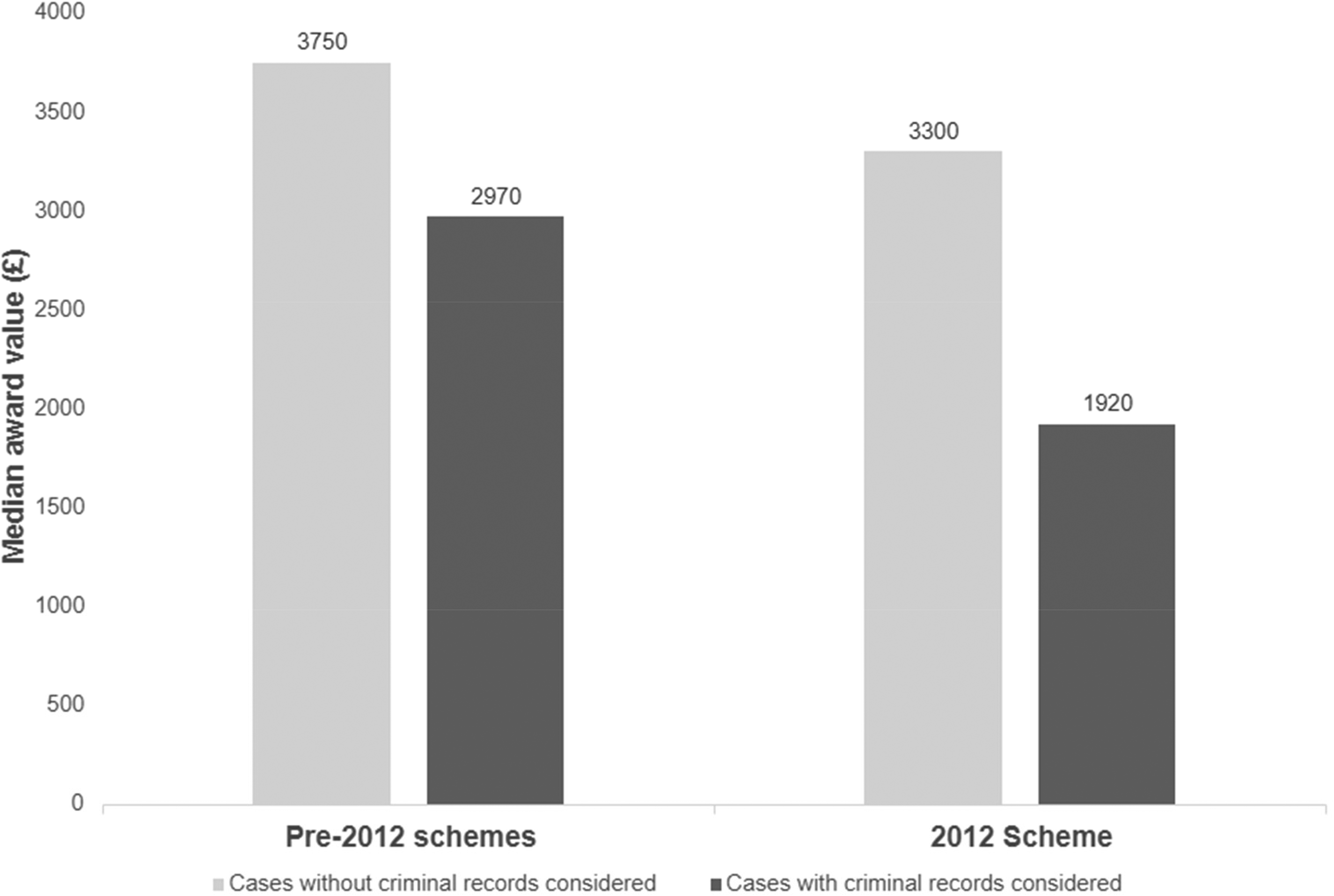
The effect of the 2012 CICA scheme on median compensation award values.
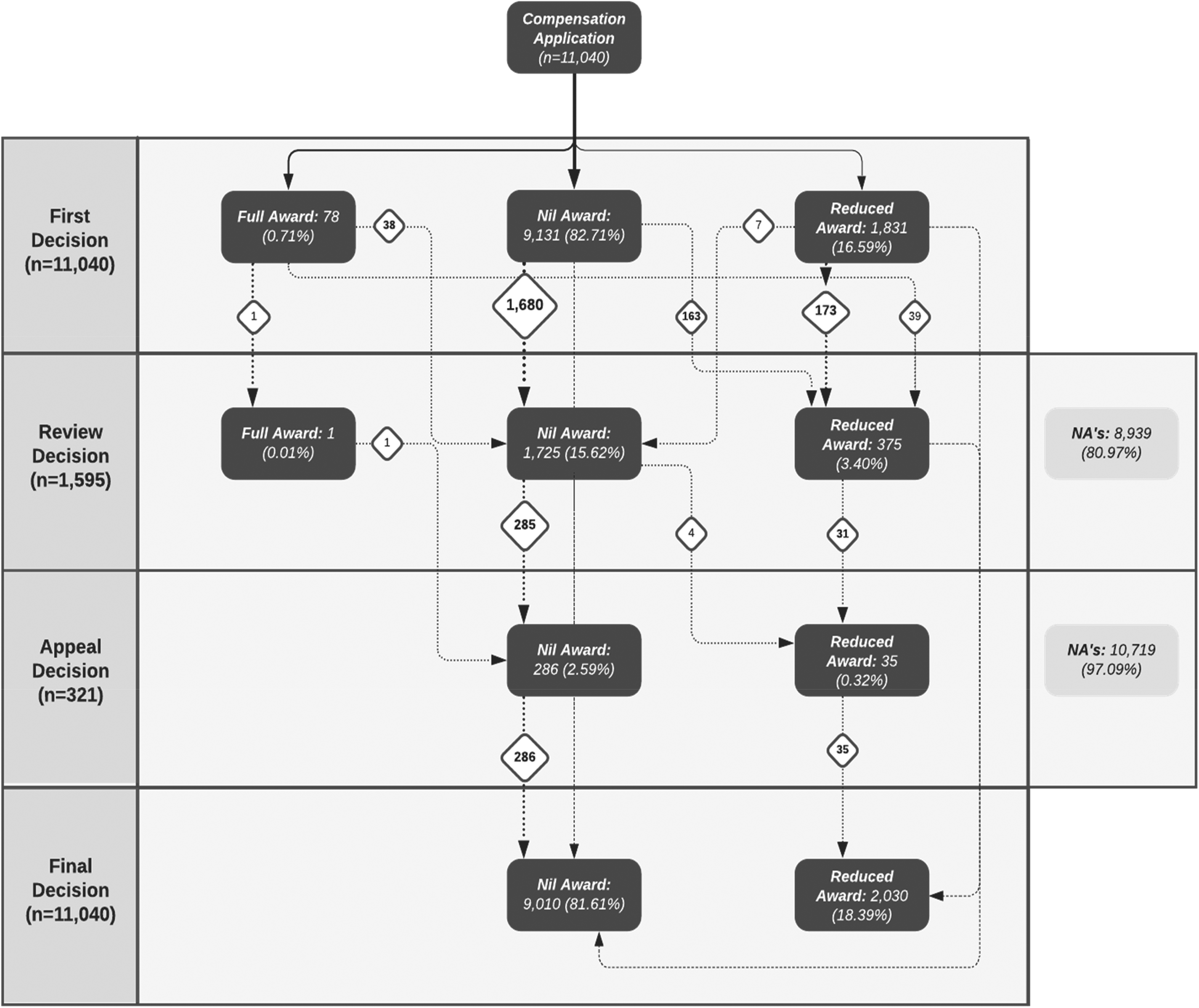
Compensation progression for applicants with criminal records under the 2012 scheme.
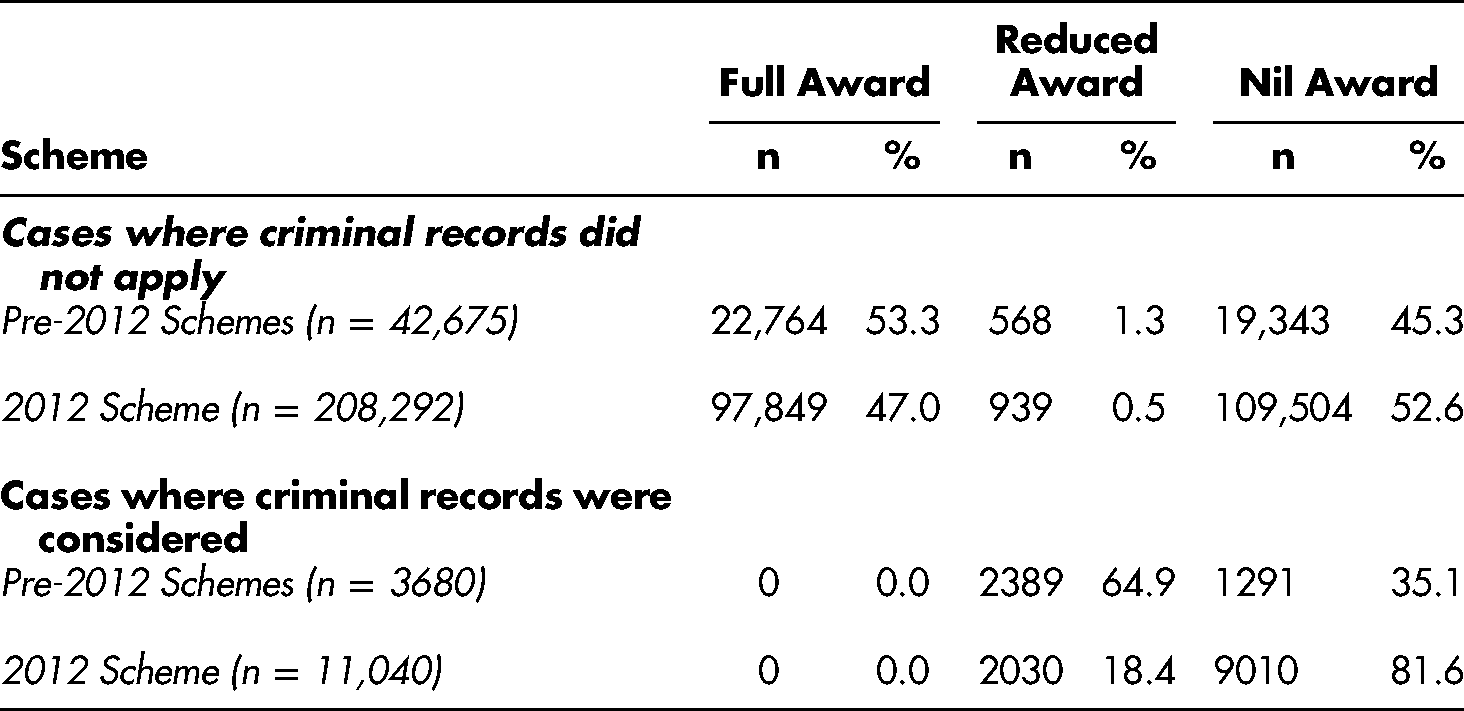
Comparison of outcomes of claims to CICA 2013/14 to 2020/21 for applications pre- and post-2012 reforms.
Numbers of CICA claims under the 2012 scheme completed between 2013/14 to 2020/21.
Award value statistics for CICA claims completed between 2013/14 and 2020/21.
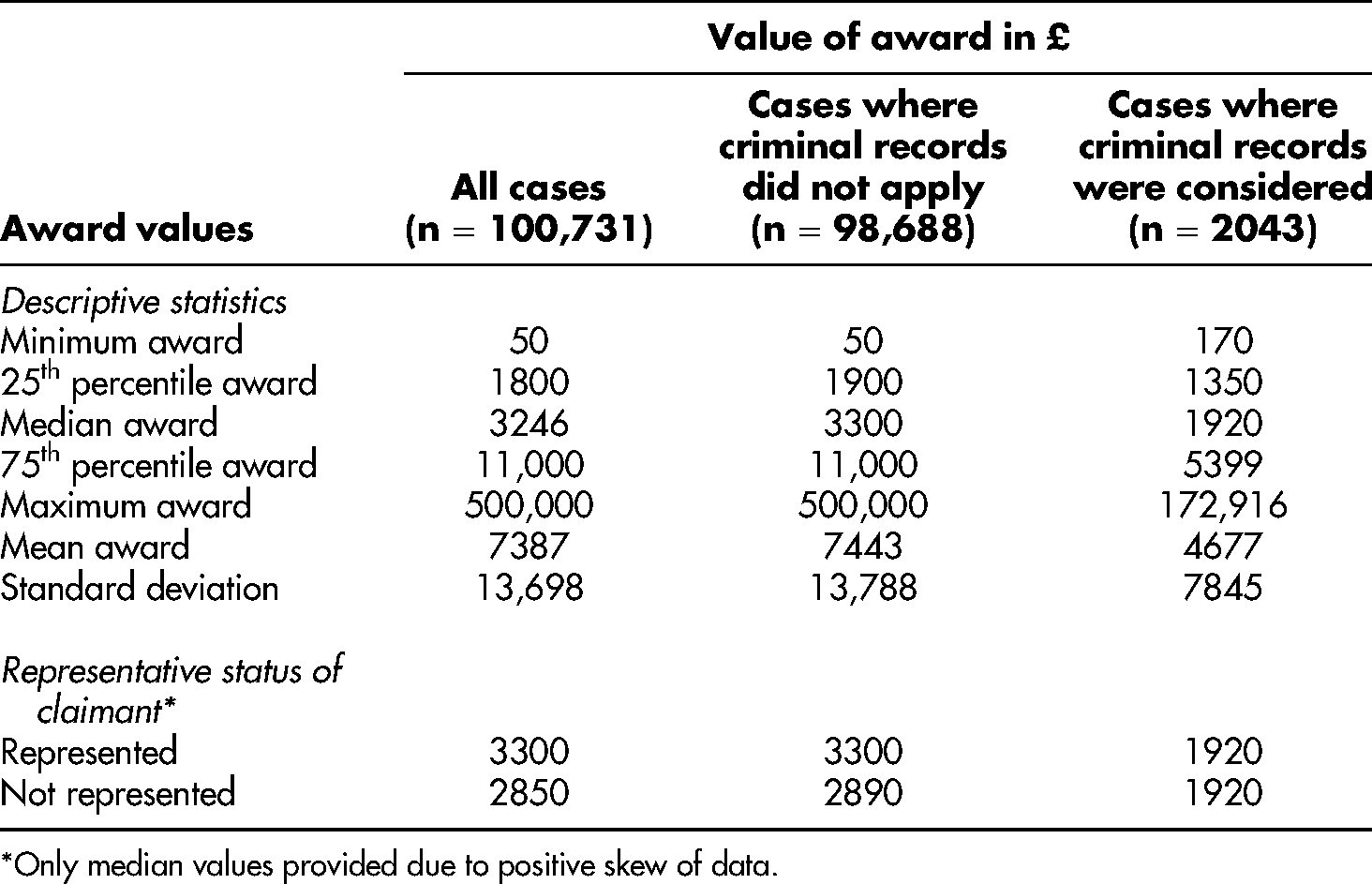
*Only median values provided due to positive skew of data.
Statistical test results for linear regression on value of award.
Findings
Our first finding relates to the effect of changes to eligibility for applicants with criminal records introduced under the 2012 Scheme when viewed in terms of claim outcome. Table 2 illustrates the impact of the stricter criteria which effectively introduced a disqualification on access to compensation for many applicants with unspent convictions, as compared to the earlier ‘penalty points’ system used by CICA in earlier iterations of the Scheme. The table disaggregates the claims into resolved cases where a ‘full’, ‘reduced’ or ‘nil’ award was the final outcome. It also distinguishes between outcomes for applicants both with and without relevant criminal records. Notably, whilst applicants without criminal records saw a higher proportion of cases resulting in no award being made under the 2012 Scheme, this effect was far more dramatic for applicants with criminal records.
As expected, the vast majority of cases involving applicants with criminal records (81.6 per cent) now result in no award being made. By comparison, under the pre-2012 Schemes, 64.9 per cent of applicants with a criminal record saw their case result in a reduced award. Only 18.4 per cent of such applicants now receive any form of award. Presumably these are applicants who did not receive custodial or community sentences but had other ‘bad character’ elements to their criminal record. Indeed, one noticeable feature of our dataset in relation to 2012 Scheme cases was the prevalence of criminal records as the criterion used by claims officers to reduce awards when compared to other bases for a reduction. Of all reduced awards for the period 2013/14 to 2020/21, over two-thirds of these cases (68.4 per cent) involved considerations of applicants’ criminal records.
Our next finding considers how these changes impacted on the value of awards given to applicants following the implementation of the 2012 Scheme. Figure 1 illustrates how applicants with criminal records were, as expected, subjected to significant reductions in the median value of awards when compared to those under earlier schemes. Under earlier schemes the ‘penalty’ for having a criminal record was a 20.8 per cent lower median award when compared to applicants without a criminal record. The introduction of the 2012 Scheme increased this ‘penalty’ to 41.8 per cent. Overall, the 2012 Scheme resulted in a 35.4 per cent reduction in median award values for those with criminal records. Interestingly, applicants without criminal records also saw a reduction of twelve per cent in median compensation awarded under this Scheme.
Focusing solely on applicants under the 2012 Scheme, Table 3 (below) provides data on claims processed by CICA for the eight-year period between 2013/14 and 2020/21. This provides information on the profile of applicants disaggregated between those with and without criminal records which formed part of the assessment of their case. The higher representation of male applicants in cases where criminal records were considered (79.9 per cent) can be accounted for by their higher prevalence within the population of people with a criminal record. A Ministry of Justice (2010) cohort study identified that 33 per cent of males compared to nine per cent of females have at least one conviction before the age of 53. Notably, applicants with criminal records were more likely to be represented (46.9 per cent) during the CICA process than those without (38.3 per cent). However, as we discuss below this appears to have a minimal beneficial impact on claim outcomes.
The progression of the 11,040 compensation claims where criminal records were considered under the 2012 Scheme is illustrated in Figure 2 (below). This shows the attrition of cases from the first decision stage, through to review and appeal stages and demonstrates the rigidity with which criminal records were applied as a reduction or rejection criterion. Only 167 cases during the eight-year period ‘upgraded’ their award outcome through the review and appeal processes after having originally been awarded no compensation. In all of these cases, the outcome was still a reduced award. In a further 85 cases, award outcomes were actually ‘downgraded’ by CICA with the majority of these representing a reduction from a full award originally made at first decision.
Table 4 presents descriptive statistics on the monetary value of 2012 Scheme awards for cases where the final award value was recorded as higher than zero. This data is again disaggregated between cases where criminal records were and were not considered. Apart from minimum award values (where other reduction criteria may have been applied to non-criminal records cases), award values were consistently lower where applicants were subject to consideration of their criminal record. In relation to the representative status of claimants, no difference was found in the median award values for cases where criminal records were considered between represented and unrepresented applicants. By contrast, for applicants without a criminal record, represented claimants received a median award which on average was 12.4 per cent higher than their unrepresented counterparts.
To test whether the differences in observed award values for applicants with and without criminal records seen in Table 4 were statistically significant, linear regression tests were conducted within the statistical analysis software ‘R’. Tests were also run on the relationship between observed award values and the representative status of claimants. To account for the positive skew in the distribution of award values our dependent variable (award values) were transformed into an equivalent logarithmic form. As anticipated, when testing award values versus the presence or absence of a criminal record, the lower award values observed for applicants with criminal records were statistically significant. In relation to whether applicants were represented in their application to CICA, this was found to have a statistically significant beneficial effect on the final award value in all circumstances except where the applicant had a criminal record considered. From this, we can conclude that representation makes little difference to the award value outcomes for claimants with criminal records due to the stringent eligibility requirements of the 2012 Scheme (linear regression demonstrated that representation did have a statistically significant beneficial effect on award values for people with criminal records pre-2012). The R-squared and p-values from our linear regression tests are presented in Table 5 (below).
Discussion
Critics of the Criminal Injuries Compensation Scheme have previously argued that the tariff-based system of payments lacks intellectual coherence given the ‘tension between the symbolic and material functions of compensation’ (Duff, 1998: 116). In particular, Duff points to the complexities of calculating awards which took on the function of representing not only ‘public sympathy with the victim’, but also ‘society's abhorrence of the offence’ (p.105). The ‘denial of victimisation’ in relation to previously criminalised victims of serious crime adds a further layer of complexity to these long-standing critiques. In what follows, we identify three key issues around the denial of victimisation: 1) that CICA policy reproduces the problematic social construction of the ‘ideal victim’ as first set out by Christie (1986) which hinges on notions of deservedness; 2) that denying compensation is an act which contributes to the delineation of subaltern citizenship, reinforced by the imagined mutual exclusivity of victimisation and offending; and 3) that when compensation is denied to people with criminal records, CICA – as representatives of the state – contributes to ‘secondary victimisation’ which may compound the harms associated with being a victim of violent crime. These complex, overlapping problems form the conceptual basis against which compensation reductions and denied claims are now considered.
The reproduction of the ‘ideal victim’
Early victimologists von Hentig (1948) and Mendelsohn (1976) focused on the extent to which the victim could be ‘blamed’ for their misfortune by considering whether their actions may have contributed to, or potentially prevented, their victimisation event. This examination of the prior conduct of victims is one of the hallmarks of positivist victimology. However, it is also seen within the policies of CICA which regard the examination of applicants’ previous character as legitimate information in making decisions on claims. The central problem identified within this paper is denying compensation to previously criminalised victims of serious crime which reproduces the problematic notion of the ‘ideal victim’ (Christie, 1986).
Christie’s (1986) work identified the role that society plays in assigning victimhood. He noted that membership of the category ‘victim’ was restricted to those deemed to have a ‘complete and legitimate’ claim to that label and the reality which this formulates. The generic nature of the term ‘victim’ is also problematic because it can be applied to an array of misfortunes which signify the interpretive process involved in the construction of crime victims (Kenney, 2004; Walklate, 2007). Of course, the victim label is not always desirable and may be accompanied with negative connotations (Fohring, 2018). However, the widespread denial of victimisation revealed above demonstrates that people with criminal records are all too often unable to attain this status on the grounds that their past conduct has somehow forfeited their right to compensation.
Victims of crime, once considered the ‘forgotten man’(sic.) of the criminal justice system (Shapland et al., 1985), now occupy an undeniable political space within criminal justice discourse and policy (Rock, 2004). Walklate (2012a) argues that the ‘powerful motif’ of the victim label is in fact a politicised notion, thus linking in with victim assignment practices which operate according to an agenda that does not always have the interests of the victim at the centre (Kenney 2004). Kenney argues that, at worst, following reforms in the 1970's, victims were used in order to facilitate a right-wing punitive agenda rather than on their own merits. The exclusionary victim assignment practices of CICA which our research examines, and which are in keeping with punitive ideologies, put paid to the notion of a ‘victim-centred criminal justice system’ - a popular tagline commonly used within the political arena (Jackson, 2003).
Delineation of categories of citizenship
Walklate (2012b) has noted that political recognition of crime victims and their status in relation to criminal justice policy formation has often been largely symbolic and rhetorical rather than meaningful. Indeed, the incorporation of victims into political discourse about crime and crime control had tended to occur with the intention of advancing punitive sensibilities and limitations on the so-called ‘rights of offenders’, rather than a more considered engagement with the needs of those who have suffered loss or harm after being a victim of serious crime. Drake and Henley (2014) have criticised the construction of a zero-sum game between the rights of ‘victims’ and ‘offenders’ within contemporary political debates concerning criminal justice. Within this polarising discourse, the rights of the former are seemingly only advanced at the expense of the latter. However, this ignores the fact that experiences of victimisation and offending are not mutually exclusive. As this article has shown, the resourcing of victim compensation has been no exception to attempts to construct a strict delineation between those who are ‘deserving’ of state support and those who are not.
Shapland and Hall (2007) point to the loss of trust and shattering of faith in society, shock, fear, anger, and changes to lifestyle as a consequence of criminal victimisation. Placing people with criminal records outside the scope of statutory compensation is therefore a powerful ideological move. This is because it formally delegitimises what might otherwise be regarded as a strong claim to recognition by the state as a citizen of equal merit (an example of the ‘civic purgatory’ described by Henley, 2018a). Miers (2019) points to the role of compensation in providing material realisation of the public's sympathy and social solidarity with victims. Thus, failure or refusal of the state to compensate victims of violent crime with unspent criminal records may be understood as a harmful practice of ‘Othering’ which further victimises them. This is precisely because it positions those deemed ‘undeserving’ outside of the normal rights and entitlements associated with full citizenship.
Secondary victimisation by the state
Shapland et al. (1985) identified that being a victim of crime engenders a severe and potentially lasting emotional distress, financial harm, and potential physical injury (see also Spalek, 2006; Hall and Shapland, 2007). Central to Shapland et al.'s research was the idea that formal recognition through the criminal justice process could confer therapeutic benefits on victims. However, those who are not formally recognised as victims by criminal justice agencies may be further harmed by interaction with the process. The designation of victim status is reliant on interactional processes present within the criminal justice response to interpersonal harm. Kenney (2004) argues that ‘victim assignment practices’ (p.225) carried out by institutions, both legal and therapeutic, can ‘exacerbate rather than alleviate the problem of helplessness’ (p.230). As a result of these assignment practices, there is potential for victims of crime to be negatively impacted by their criminal justice experiences.
The denial of formal recognition of one's victimisation through the CICA Scheme provides a clear example of a criminal justice process which may give rise to secondary victimisation. Our analysis reveals that, for the period 2013/14 to 2020/21, some 11,040 victims of violent crime with criminal records have been exposed to potential secondary victimisation following the refusal of their application to CICA or a reduction of their compensation claim. In addition, there remains an unquantifiable number of victims with unspent convictions who will have been dissuaded from even applying to the Scheme, given the publicity afforded to criminal records as a disqualifying criterion. Whilst this has clear implications for the financial status of those victims, the lack of symbolic recognition which this formal denial of victimisation represents may be regarded as particularly egregious. Indeed, political claims-making about the ‘victim-centredness’ of the criminal justice system could be perceived as somewhat hollow when a substantial number of victims fail to gain full recognition from the state. Whilst our focus in this article has been on the denial of victimisation as a ‘collateral consequence’ of a criminal record, we should also be mindful of the fact that this is merely one category of exclusion applied by CICA to crime victims in pursuit of their stated policy of only compensating the ‘blameless’. Such exclusions point to the conditionality of state support for victims and, as such, are worthy of further investigation.
Conclusion
The nexus of the penal and welfare functions of the state has long been a focus for academic criminology, particularly within the field of probation work (see Garland, 1985; Mair and Burke, 2011). Such work has explored inherent tensions between welfarist principles of helping lawbreakers to transcend the personal and material circumstances which may have given rise to their offending behaviour, whilst simultaneously holding them to account for their actions through punishment. At first glance, the Criminal Injuries Compensation Authority might be regarded as unambiguously welfarist in orientation, insofar as the raison d'être of the Schemes which it administers is to ameliorate the suffering experienced by victims of violent crime. However, as our analysis reveals the deductions imposed by CICA on applicants for compensation with criminal records situate it also – at least partly – within the penal sphere.
Whilst not forming part of the sentence for an offence which leads to the criminal record of the fully or partially disqualified applicant (and thus not a formally mandated ‘collateral consequence’ as a punishment for that offence), we argue that these deductions are nonetheless punitive in character on both a material and symbolic level. This is because, as well as the state refusing to address the material losses that can result from being a victim of violent crime, the withholding of compensation conveys to victims with criminal records that they are ‘less eligible’ for consideration than other members of society due to their seemingly deficient character. In this respect, there is a clear continuity of the tradition in which institutions comprising the state's penal-welfare apparatus are underpinned by expectations of less eligibility. Indeed, this principle first emerged to regulate the conditions of 19th Century workhouses following the Poor Law Amendment Act of 1834. It is perhaps unsurprising then that CICA - another ostensibly ‘welfarist’ institution involved in the administration of what might be regarded as punitive sanctions – provides a contemporary example of the persistence of less eligibility within criminal justice policy.
Footnotes
Acknowledgements
The authors wish to thank Miranda Boone, Marti Rovira and other members of the European Society of Criminology Working Group on the Collateral Consequences of Criminal Records for their constructive feedback on an earlier draft of this article. We are also grateful to colleagues in the School of Sociology and Social Policy at the University of Nottingham for their helpful insights at a research seminar where we presented preliminary findings from our research. Our final thanks go to David Miers for his insightful comments and suggestions on our manuscript.
Funding
The participation of Rhiannon Davies in this research was made possible through a School of Sociology and Social Policy paid placement. We are grateful to our colleague Elena Genova for her coordination of this scheme.
Declaration of conflicting interests
The author(s) declared no potential conflicts of interest with respect to the research, authorship, and/or publication of this article.
Cases cited
Andronati v Criminal Injuries Compensation Appeals Panel [2006] EWHC 1420 (Admin).
T.Q. v. Criminal Injuries Compensation Authority [2015] Tribunal Procedure (First Tier Tribunal) (Social Entitlement Chamber) Rules 2008 (Application No. X/13/721098).
A and B v Criminal Injuries Compensation Authority & Anor [2021] UKSC 27.
Mitchell, R (On the Application Of) v Secretary of State for Justice [2021] EWHC 2248 (Admin).
