




Abstract
How are ethnicity, citizenship, and social class articulated spatially in the postcolonial African metropolis over time? In this article, I examine the metamorphosis of the built environment as neighborhood plots of land change hands in the Parklands area of Nairobi: from old South Asian Kenyan bungalows and large family dwellings to newly built forms of apartment urbanism, underwritten by ethnic Somali developers. I propose “contentious plots” as an analytic that illuminates sedimented projects of constructing certainty through the built environment as a form of ethnic territorialization. Drawing on spatial and historical analysis, I argue that these contentious plots are conjunctural forms, where multiple histories and identities coincide and are spatialized. In the neighborhood of Parklands, zoned as “Asian” during the colonial era, such plots condense colonial and postcolonial questions of urban inclusion for older South Asian Kenyan and newer ethnic Somali residents. At the intersection of an Asian colonial-oceanic history of migration and a postcolonial-postconflict conjuncture of ethnic Somali rupture and resettlement, the Asian bungalow, the Somali apartment building, and the contentious plot on which they stand have become politicized forms. These contentious plots hence have deep social histories, revealing larger, unresolved questions of citizenship and belonging after national independence. Going beyond the Black/White binary of colonial and post-independence racial relations, therefore, I point to further axes of splintering that center Asian Kenyans and ethnic Somalis as interstitial spatial subjects of the city—and as communities at the core of accessing and producing urban space over time.
Introduction
In mid-June 2022, a middle-aged South Asian Kenyan property owner in the Parklands area of Nairobi, Ghassanji, told me he was upset by a visit to his old house, which he had been trying to sell. 1 The visitor, an ethnic Somali developer, had come to say that he wanted to purchase or conduct a “joint venture” on the parcel of land. According to Ghassanji, he also brought a message that his partners and other ethnic Somali developers in Nairobi were focusing on purchasing property in Parklands, as had been earlier done in other historically South Asian areas of Nairobi, such as South B and Eastleigh. Ghassanji was not surprised by this message but reflected that it was harsh to hear this changing of hands so bluntly spoken of by the visitor. He noted that it made him feel unsettled, reminding him of the insecurity and ethnicized undertones of earlier periods of time in this multi-ethnic city. This neighborhood was once made up of carefully set out bungalows and large double-story houses inhabited generationally by Asian Kenyans, with stone walls and painted gates. It now stands full of the large-scale changes wrought by high-volume apartment urbanism.
Were it not for the physical changes around the neighborhood, Ghassanji's anxieties might have sounded like speculation or rumor: a form of conspiracy thinking that seemed to mirror his increased isolation in the proximate area around his house and plot of land. Instead, following Ghassanji's line of sight and looking at local histories of real estate transactions in the area, allows one to gain tangible grounding in the changing contours of neighborhood space. Plots that exchange hands are noticeable occurrences month by month in upper-middle class Parklands, creating a type of conspiratorial present that various actors inhabit as they seek to pursue and defend their interests in the changing built environment. Interviews with property developers, real estate agents, and residents that I conducted in Nairobi's central areas show that mid-sized developers, largely from the ethnic Somali diaspora, often pool resources to remake space. Such rebuilding operates with multiple aims: turning a large profit, and materializing the aspiration for stability as a differentiated diasporic community seeks to establish itself in core areas of the Kenyan capital. Many of these apartments are built to sell to the Somali diaspora, thereby demonstrating a longer temporal commitment to building a home-base in Nairobi. Such a perspective also presents an alternative local geography of property in a city often characterized as driven by landlords and rental accommodation.
I argue that plots of land in the Parklands area function here as crucibles of communal life-making and ethnic territorialization through diasporic settlement—remaking socio-cultural worlds and economic possibilities. At the same time, such dynamics are experienced through local dispossession and as world unmaking for many Asian Kenyans displaced from core formerly Asian areas of the city. Owning and remaking what I call “contentious plots” in the neighborhood has hence allowed such forms of property to become an anchor for ethnic belonging and communal claims to urban inclusion amid uncertain times. Going beyond the Black/White binary of colonial and post-independence racial relations, I focus on further axes of ethnic and economic division that have been central to processes of spatial change: as interstitial spatial subjects, Asian Kenyans and ethnic Somalis in Nairobi have been central to city-making and at the core of questions of urban belonging over time.
Large numbers of ethnic Somalis have been long resident in Nairobi, well-integrated as Kenyan citizens. Some have found space to exercise multi-ethnic belonging in its various forms in the capital, despite increased surveillance and frequently violent profiling by state authorities (Al-Bulushi, 2024). Such surveillance has been particularly acute after the 2013 attack on Westgate Mall in the Westlands area of Nairobi, which followed on from Kenya's proxy war, ongoing since 2011 in Somalia itself, known as “Linda Nchi” (“protect the country”). My interviews primarily with property developers and real estate agents in the Parklands and South B areas show that many new developers here are more recently settled diasporic migrants. Such newer members of the Somali diaspora in Nairobi have often returned to East Africa after time away in North America or Europe, building lives in cities like Minneapolis and the Greater Toronto Area, working as business people, warehousers, or in transportation. Diasporic kin often pool resources for eventual returns to East Africa, or to enable more mobile transnational living.
In buying, building, and settling in Nairobi's centrally located urban areas, ethnic Somali developers and new ethnic Somali residents construct certainty through apartment blocks and land transactions, seeking to make Nairobi a socio-cultural and economic home. This cyclical return or relocation has carried particular significance after permanent, long-term return to Somalia became harder to realize. Pervasive insecurity in the long shadow of the Somali civil war from 1991 onward—and more recent instability in Central and Southern Somalia since 2009—make return to the country difficult (De Waal, 2020). This ethnic Somali diaspora is itself heterogeneous and comprised of class and clan-based sub-groups with diverse timespans of dwelling in the capital. 2 Driven by uncertainty and a desire for livelihood and belonging—in certain ways similar to the Asian Kenyan communities that earlier populated Nairobi's separated neighborhoods—parts of the ethnic Somali diaspora have thus begun to seek out and claim firm ground on which to build a home-base.
My empirical and theoretical interventions in this article are based on ongoing qualitative, observational, and archival research in central neighborhoods of Nairobi, as part of a larger project on real estate, social class, and citizenship. This project is also grounded in my own long-term residence in the Kenyan capital. As a member of the Kenyan diaspora of generational South Asian descent who has spent considerable time in Nairobi's changing neighborhoods from the 1980s onward, the areas I study have been a natural habitat and home, familiar even amid changing idioms of urban planning and zoning. As streets of pastel pink, yellow, and white bungalows and old townhomes are demolished in favor of high-rise apartment blocks with increasing Floor-Area-Ratios (FAR), higher building story allowances, and soaring density, I examine histories inscribed into the changing neighborhood.
Such an ethnography of property draws on an approach to the social relations within which property is enmeshed and which Katherine Verdery (2024) terms “the autobiography” of changing land regimes. Discussing the social life of a land parcel in Transylvania, Verdery writes, “if ‘parcel’ is seen as a changing concatenation of land and people, then a complete account of our parcel—let's call it 572/2—should include explaining the historical events that surround it” (Verdery, 2024: 130). In the case of Parklands, the plot of land is bound into histories of racialization and city-making through various periods of time, going beyond the Black/White binary of colonial and post-independence racial relations that is frequently rendered as the primary axis of splintering in accounts of the African city. Instead, spatialized social relations around the plot of land in Parklands show Asian Kenyans and ethnic Somalis as central to dynamics of city-making in Kenya's capital. Both groups have historically been constituted by a type of racialized spatial citizenship, enduring segmented space and uncertain belonging. Yet these communities also work as active agents to remake urban space, and in doing so elicit the ongoing relevance of questions about political and social inclusion in the life of the postcolonial polity. By examining new apartment construction in Parklands, I suggest that planning and building are modes of territorializing space through the built environment for these groups, amid pervasive uncertainty.
I began keenly mapping and observing changes to neighborhood building in 2018, and between 2022 and 2024 conducted 35 in-depth and semi-structured interviews with real estate agents, property developers, building professionals, and residents of various ethnicities, including some who had close ties to the municipal administration in the County Council of Nairobi. As part of the Asian Kenyan diaspora, I was able to interview and converse with interlocutors of similar ethnic and national heritage with relative ease. Additionally, my background as an urban studies and planning scholar focused on the changing built environment meant that there were points of mutual understanding and commonality with building professionals and developers of all ethnicities, who discussed their plans and proposals with me quite openly. Most of my interviews with the ethnic Somali diaspora concentrated on individuals who were real estate agents and property developers, reflecting in part the fact that residential communities were closed off with access negotiated through kin and social ties. This methodological approach reflects the article's focus on the built environment as it has changed through processes of redevelopment. I am conscious that these research possibilities and openings have necessarily affected the skew in my research findings toward developers, while still providing a nuanced picture of the dynamics of contention and ethnic territorialization over land and building in the area.
Contentious plots as conjunctural forms
I center my theoretical intervention in this article on the interconnectedness between the built environment, citizenship, and ethnic belonging in a changing capital city by exploring the concept of “contentious plots” at the local scale. 3 I outline pivotal moments around questions of belonging and citizenship at both the urban and national levels that center ethnicity and social class, and which are inscribed into these parcels of land that change hands. In doing so, I put forward the lived experiences of my interlocutors in relation to what I posit as unresolved questions of the making of multi-ethnic citizenship and belonging in postcolonial Kenya, made manifest through the built environment and urban land. Literature on changing urban environments often disconnects the urban question from larger-scaled questions of inclusion in the polity of national citizenship. By pointing to the imbrication of these unresolved postcolonial questions with changing rights and capacities to buy, sell, build, and dwell in the capital city, I demonstrate that the political life of urban development in Nairobi carries over contentious questions from the period independence was won. The local plot of land appears here as inscribed by historical contingency and ethnicized belonging, demonstrating that forms of racialized spatial citizenship have endured beyond the colonial period. These historically inscribed urban spaces reveal ongoing dynamics around class-based property formation and ethnic territorialization in this postcolonial city, with relevance to other contexts (e.g., Chari, 2024 on Durban, South Africa on the “racial-spatial fix”).
Central to my analysis is the claim that land parcels in neighborhoods such as Parklands are “contentious plots”: these parcels of land demonstrate the sedimented and contested dynamics of staking durable claims to the city. Methodologically, I spatialize Stuart Hall's conjunctural analysis to conceive of these plots as conjunctural spatial forms that fuse multiple interests and identities at key points of rupture and recalibration over time (Hall and Massey, 2010). These contentious plots suture two distinct historical questions: the postcolonial question of class, ethnicity, and citizenship for Asian Kenyans, and the postconflict question of building and remaking life in proximate distance to Somalia. Drawing upon the use of ethnography in the service of conjunctural analysis and the “multiple, interconnected spatio-temporalities” that such moments condense (Hart, 2024: 141), I center these contentious plots as conjunctural formations that are historically situated and contemporarily determined. These plots of land stand as spatial manifestations of various projects of global and regional reordering over time, bringing forward enduring questions over communal identity and contested belonging. These spaces are situated firstly in relation to the demarcation of colonial-period housing for Asians in Nairobi as part of the British settler colonial project in East Africa, and its waves of attendant labor and trade migration. Secondly, as part of newer Somali-led apartment urbanism, these plots of land are further positioned in relation to more recent waves of postconflict migration amid civil war and regional instability in the Horn of Africa since the early 1990s. I suggest therefore that Asian Kenyans and ethnic Somalis can be seen as important interstitial groups and agentic city-makers, complicating the Black/White binary of conventional racialized colonial frameworks. Such groups have instead produced novel forms of conjunctural space centered around ethnicity and community, which operate from within the lineaments of empire to complicate postcolonial geographies of property.
These contentious plots are conjunctural forms: they are microcosms of the spatial projects that inhabit the interstices of global formations of imperial conquest and national remaking, both colonial-oceanic and postcolonial-postconflict. In the case of Somalia's protracted conflict, situating neighborhood contentious plots as spatial markers of larger moments of conjuncture allows us to see the interconnected nature of global-local formations: here the aftermath of a regional geography of state breakdown and reformulation in the Horn of Africa brushes up against an oceanic geography of trade and labor migration, much of it occasioned through the needs and prospects opened up by British settler colonialism in East Africa.
The neighborhood propertyscape in Parklands hence brings together a number of unresolved questions in the history of the postcolonial state and the life of Nairobi as a city of sanctuary amid regional rupture. These changing parcels of land demonstrate that space in these neighborhoods is contentious across specific ethnic and class lines, where “contention” as an analytic lens speaks to territorialization and claims to space as well as their situatedness in larger circuits of rupture and resettlement. Far from being apolitical spaces, the new apartments in Parklands reveal competing historical claims to status in the city, involving ongoing negotiation over space and belonging as past histories fuse with present desires in neighborhood geographies (Image 1).
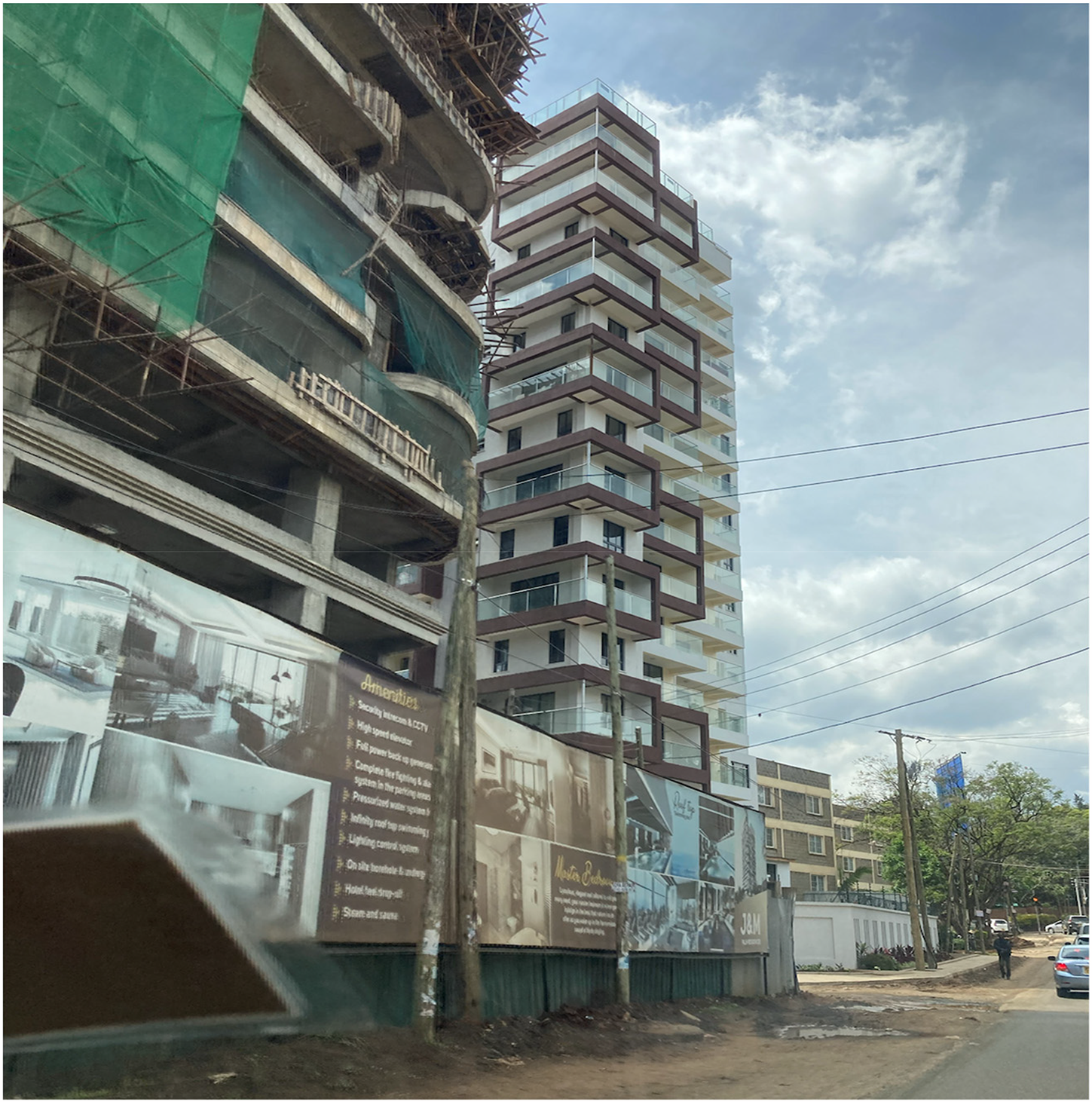
New apartment construction in Parklands, 2022. © Author.
Urban geographies of racialized citizenship
Questions of racialized space, class, and communal belonging are central concerns of my inquiry. I treat the built environment as an anchor for rights to the city, and the staking of lasting claims to more secure national citizenship. Ethnic Somalis in Kenya are far from a homogenous group, and many have historically faced questions over belonging and citizenship. Scholars of the geopolitical and cultural ideal of a “Greater Somalia” have shed light on the aspirations of Somalis in Kenya as deeply rooted and historically relevant to questions of communal belonging and identity (Weitzberg, 2017). Additionally, detailed work on the remaking of another former Asian space—Nairobi's Eastleigh—has tied the ethnography of Somali sociality to place and belonging for lower-income ethnic Somalis and refugees in the city (Carrier, 2017; Scharrer, 2018). Further scholarship contextualizes the dilemmas of security and precarity for urban Muslims and coastal residents of Kenya, including ethnic Somalis, as “citizen-suspects” within the reach of Kenya's security state (Al-Bulushi, 2021). 4
Comparative urban studies scholarship reveals the use of the built environment in projects of belonging and ethno-national settlement in other geographies. Planning scholar Hiba Bou Akar (2018) focuses on an “ethnography of spatial practices” in Beirut, Lebanon, that shows how sectarianism is spatialized when buildings become a site for anticipating war, such that sectarian geographies are formulated and reproduced through planning. Such a methodological approach is critical to a real estate ethnography that focuses on the settled and transactable plot, which is one of my concerns in the larger project of which this article forms a part. Centering the African city, I also situate my arguments about urban territorialization through building and ethno-national belonging in the larger context of a changing capital city. Scholars such as Constance Smith (2019, 2020) have written on building and dwelling in Nairobi at its present moment of construction, demolition, and building collapses. Contemporary Nairobi has also been termed a “tenement city” (Huchzermeyer, 2007), due to the density of building in lower-income neighborhoods. There has also been emphasis on the enduring coloniality of managing the city through “ecologies of exclusion” such as the police and urban infrastructure (Kimari, 2021: 1).
Scholarship on informality in Nairobi and its elite city ambitions (e.g., Huchzermeyer, 2011; Watson, 2014), often elides other modes of territorializing space and spatializing belonging, which this article explores. In focusing on upper-middle-class neighborhoods which confront redevelopment and remaking, I offer a situated perspective on the durable claims afforded by property-making in an ethnicized area of Kenya's capital. Here, apartment building construction and apartment buying are forms of class-enabled property formation that concretize claims to urban inclusion. In relation to the informal-elite binary, the life-worlds of such “middle-class” residents are largely elided in much scholarship in urban studies of cities in East Africa, as they produce and participate in changing city life (Chatterjee, 2011; Ghertner, 2012; Schindler, 2014, are a few examples of work analyzing and problematizing the “middle classes” in India). Even fewer studies focus on the intersection of ethnicity, class, and displacement in the context of African urban development, where the study of the complex and messy world of ethnic enclaving moves discussion beyond urban binaries.
Important existing studies of middle-class urban development include contributions by Kroeker et al. (2018) focusing on a range of middle-class experiences in African cities, and significant work by Mercer (2020, 2024b) on Dar es Salaam, Tanzania. Mercer's (2024a) scholarship on middle-class urbanism in Dar es Salaam illuminates the transformation of the city's peripheral land into a propertied, middle-class suburban frontier. Although Mercer (2024b) carefully examines the racialized divisions of city space operating at the local scale as well as the “coloniality of space” operating at the local scale, her concentration is not specifically on particular liminal categories of racialized ethnic urban dwellers, such as Tanzania's Asians. In South Africa, scholars have focused on ethnicized urban belonging during the long transition from Apartheid. Thomas Blom Hansen's (2012) study of the fears of Asian South Africans during this period illuminates anxieties of belonging at a time of national change, but does not distinctly focus on changes in the built environment and property-making as a core marker of agency, redefinition, and resistance for such communities. Chari's (2024) work on Asian communities in Durban and the “racial spatial fix” more directly parallels my investigations into changing projects of belonging in Nairobi's urban environment.
I focus on historical and observational dimensions of my research when discussing Nairobi's Asian communities in the next sections, and suggest that the changing propertyscape in Parklands reactivates communal anxieties around place in the city. Strategies of placemaking through property at a local scale are clearly visible in Parklands through transactable plots and the entangled communal histories they bring to the surface.
Parklands as historical microcosm
Parklands’ racialized neighborhood geography was established through previous iterations of colonial and postcolonial city master planning in Nairobi. Racial zoning existed in East African cities prior to the late 1940s, when it began to be codified in the first city master plan for Nairobi. British colonial zoning in East Africa was hence one example of a larger racialized formation, which operated across both ethnic divides and social class, working to segment, order, and divide (Myers, 2003). The racially zoned 1948 “Master Plan for a Colonial Capital” divided Nairobi into distinct areas across racialized and class defined contours: White settlers and colonial administrators occupied the majority of the city and its areas with higher altitude and better topography (White et al., 1948). Asian migrants who were essential middle-men for the colonial project served as both middle and lower-level administrators and business people, with lower-classed tradespeople zoned to inhabit areas such as Eastleigh, Ngara, and South B and C. The “Indian Bazaar” was designated for commerce for Asians, much like the confined space of the “African Market” was set up for popular trade. On the peripheries of the city, Eastlands was one of the only areas where so-called “African” Kenyans could live after working in the wealthier areas of the colonial capital (Hudani, 2023). The area and neighborhood zoning of the 1948 Master Plan continued to haunt future planning endeavors and dwelling patterns after independence. The 1973 “Nairobi Metropolitan Growth Strategy” largely maintained these segmented contours under different terms, still centering local geographies and neighborhood area divisions and hence enabling particular histories and experiences of space in the city. These historical spatialized divisions endure, influencing the production of social space and built form at a local scale in the changing city. These histories also contribute to the anxious belonging that haunts residents in the current, conspiratorial present.
Parklands is a neighborhood area striated by a rectilinear grid of roads, running from First Avenue to Sixth. Not quite a suburb in the North American sense, nor part of the central core of the city, it is an area decipherable in large part through the designs of the colonial master plan and the racialized space it codified. The area is carefully separated from the historic and contested grounds of Nairobi's City Park by a major artery, Limuru Road, which runs from the Central Business District (CBD) to the lush greenery and higher grounds of Muthaiga, Gigiri, and Runda. This curated separation was part of the colonial master-planning of Nairobi as capital city, where Asian areas such as Parklands served as a buffer between more popularly traversed districts in the CBD and Eastlands, and the cordon sanitaire of the Karura Forest that set apart areas settled by White colonial settlers—and later—foreign “expats,” UN workers and various local elites.
The grid layout of Parklands as an area occupied largely by middle-class Asians during the colonial and post-independence period was intended to give an orderly quality of life to many who served as British colonialism's business and administrative intermediaries. With their carefully set out bungalows with spacious central courtyards, or double-storied multi-generational homes with stone walls and painted gates, these dwellings were designed around the idea of an extended nucleated family. They later housed prominent lawyers, doctors, and members of the upper-middle-class Asian elite. Much later, newcomers to the area mixed in with longer-term residents, creating a class-based collage (Maps 1 and 2; Image 2).
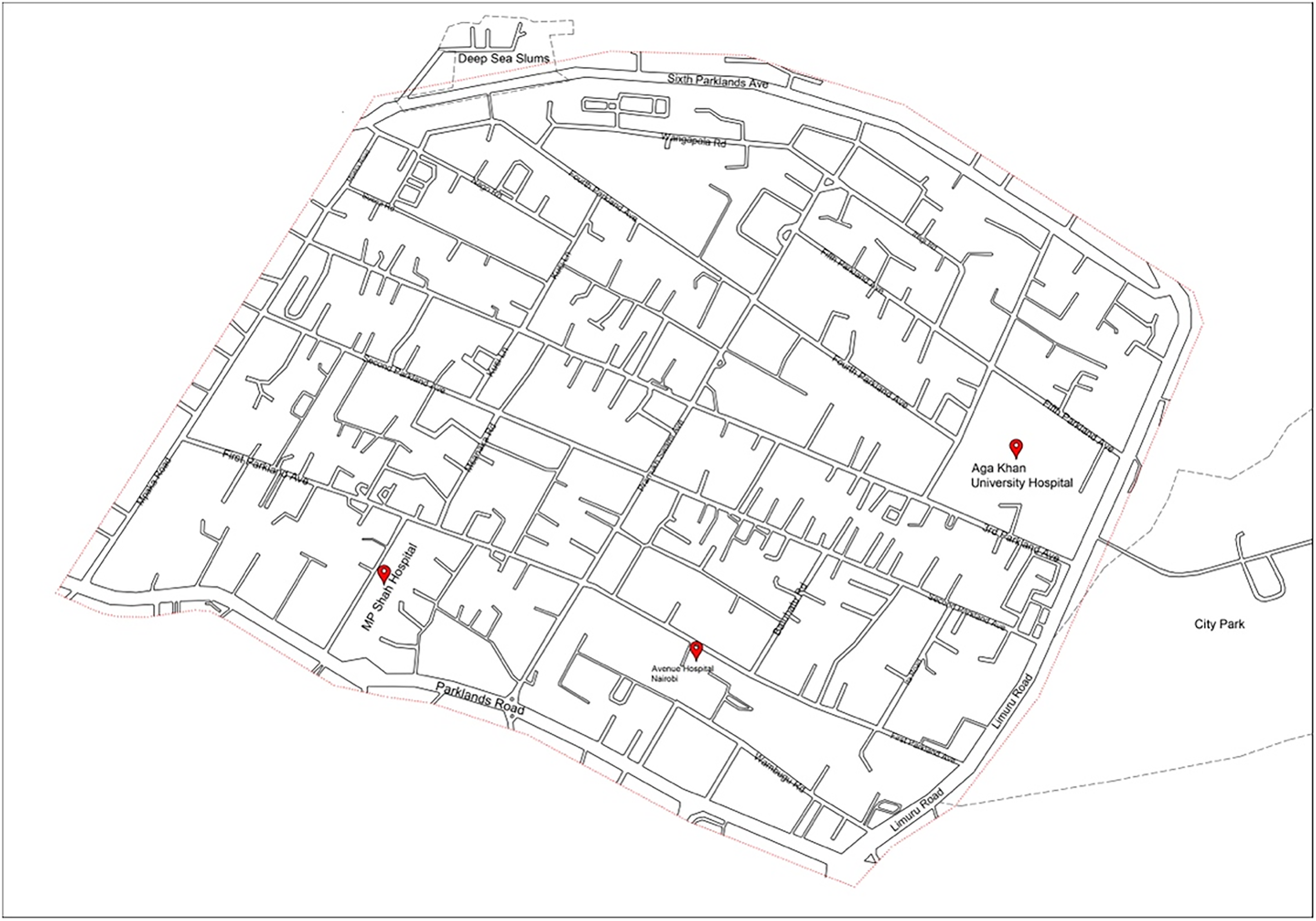
Road layout of Parklands, Nairobi. Commissioned from Architect Arif Rahman, 2024.
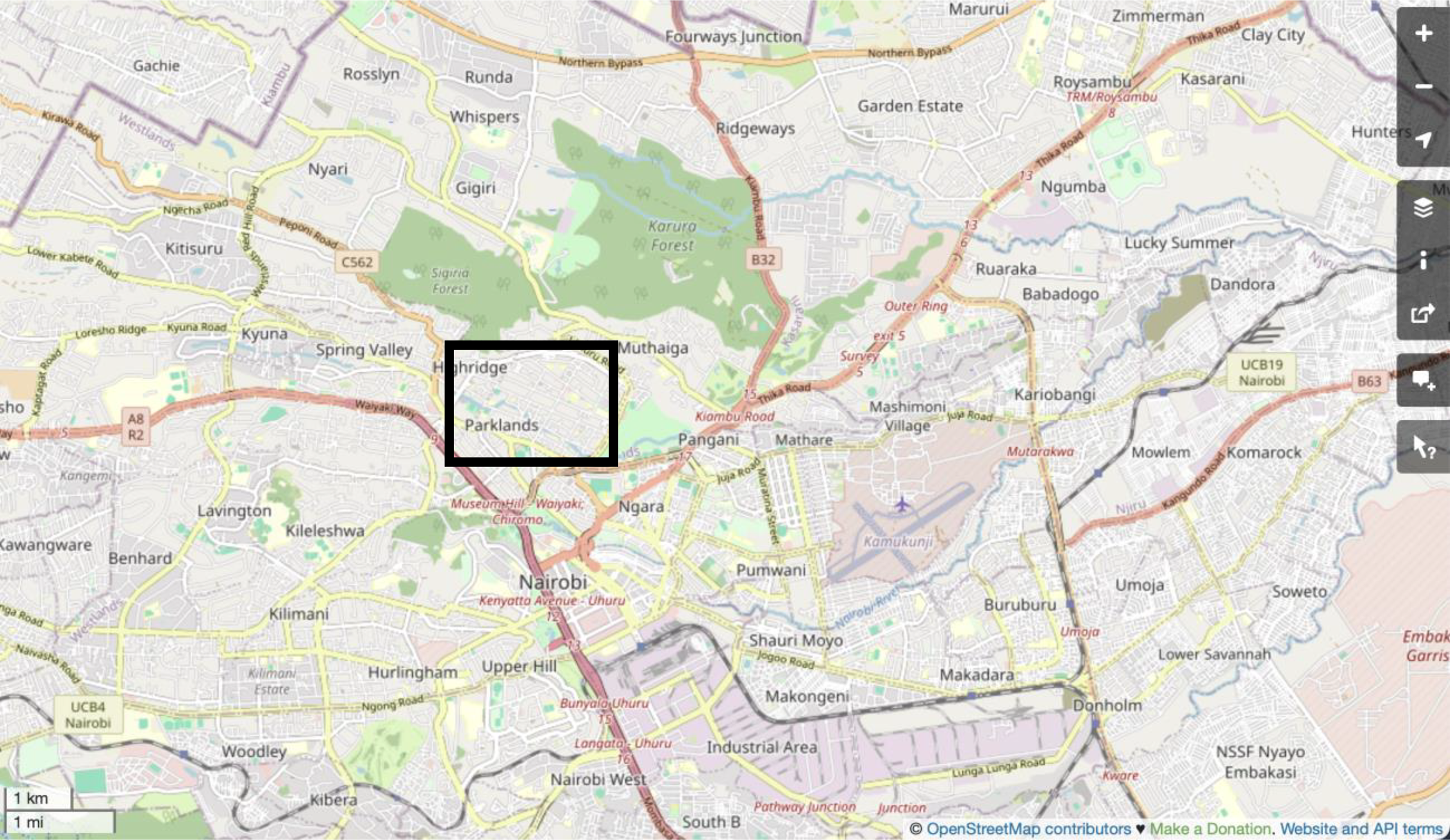
Map depicting Nairobi's central areas in relation to Parklands (highlighted). Open Street Map, 2025.
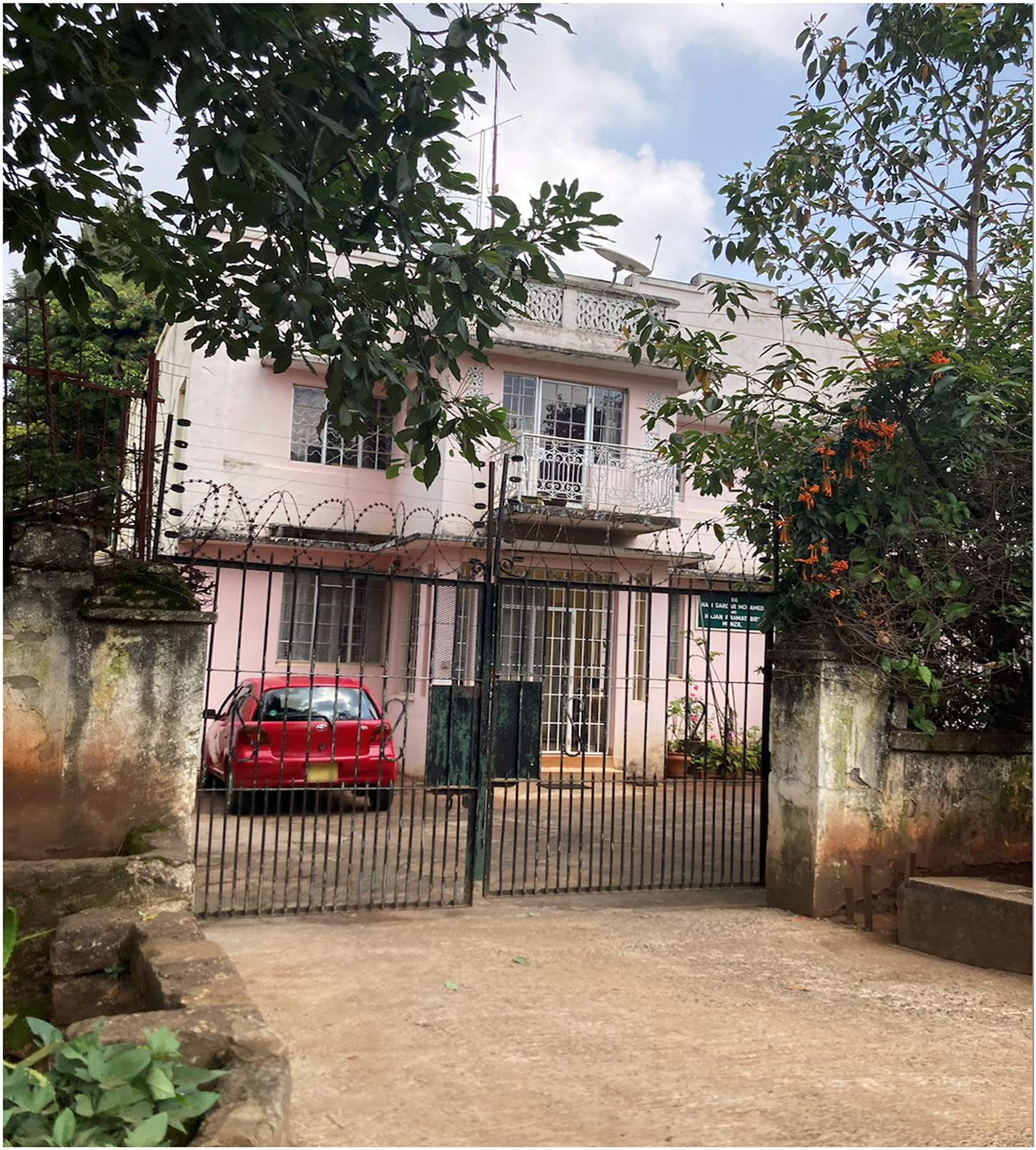
An old painted Asian house in Parklands, Nairobi, 2023. © Author.
Writing on postcolonial Delhi, Matthew Hull states of the emergent postcolonial neighborhood form that “colonial governance on the basis of community constituted them [area based communities] as empirical facts, eventually allowing native subjects to insist on self government” (Hull, 2011: 790). Influenced by international planning technologies, these “area-based communities” came to have their own civic life. While part of the exercise in governmentalizing community in Parklands can be traced to colonial strategies of communal regulation in a racially zoned Nairobi, in the aftermath of independence Asian communities began to learn from one another—if only by way of observation—and to construct certainty through communal social institutions to shield against precarious times. The significant social infrastructure of hospitals, schools, places of worship, and community centers that has grown up around Parklands over time has similarly been created by ethno-religious communities as they attempted to serve their own and extend support to other groups, amid the uncertainty of belonging in the city and in the service of social cohesion. In this context, the social infrastructure built around the masjid (mosque), the mandir (Hindu temple), and the gurudwara (Sikh temple) contributed to core aspects of neighborhood formation over time, which endure to the present.
Earlier migrants here included Sikhs conscripted as laborers to build the Nairobi-Mombasa railway under colonial rule. Members of other communities followed: as businesspeople and traders, expanding existing business and trade routes on the Swahili Coast, and combining them with labor and petty enterprise migration under the aegis of empire. To speak of Parklands was thus to consider its varied Asian communities and their own histories: Sikhs, Ithna’ashari Shias, Bohras, Sunni Muslims, Aga Khan Ismailis, and Hindus of various backgrounds (including Jains and Cutchis, Punjabi Lohanas, Gujarati Patels and Shahs).
Fears of insecurity and collective securitization have been palpable considerations for Asian Kenyans, many of whom were present after national independence in 1963, opting to adopt tenuous citizenship rights and normalize their existence in urban areas whilst also remaining conspicuously apart (Aiyar, 2015). Despite these communal anxieties, social and political figures such as Makhan Singh (Kenyan trade union leader), Pio Gama Pinto (assassinated Goan-Kenyan post-independence leader), and Fitz De Souza (one of Kenyatta's trial lawyers), functioned as both leaders on the national stage and as core members of local Asian communities. Over time, however, partaking in national politics soon became an exception rather than the norm for Kenya's Asians in Parklands, which later included both well-educated professionals and working-class shopkeepers and tradespeople. 5
Postcolonial uncertainty—Asian Kenyans
By mid-October 2022, Ghassanji reported that he had sold his plot of land on 2nd Avenue Parklands, with its single-story home and carefully grown fruit trees. An interlocutor I came to know through living in the area and who I interviewed multiple times during research, Ghassanji is typical of the remaining Asian property owners and families in Parklands, where anxieties about urban belonging are reactivated and plots change hands.
It is in Parklands that the spatialization of race has become synonymous with a type of middle-class post-independence Asian identity—a formation of identity that knew how to fall into place, becoming increasingly apolitical as political events proceeded in the post-independence period. In the aftermath of the independence years under Jomo Kenyatta, and then Daniel arap Moi, a coup attempt in August 1982 shook the Asian community. Nairobi's Asians became more conscious of their own spatial positioning and their precarious positionality in an in-between regarding citizenship and belonging. Here, in the interstices of the citizenship question as it played out in a turbulent post-independence East Africa, including through Idi Amin's Asian expulsions in the Uganda of the 1970s, and Julius Nyerere's ujamaa collectivization and villagization movement, questions of expulsion, assimilation, and belonging were core concerns (Hundle, 2018; Lal, 2015). Uncertainty and fear were amplified when many Asian-owned businesses in Parklands and in the trading areas of Ngara and Pangani were ransacked during the chaos of the attempted coup.
During the bouleversements of Kenya's post-independence period after 1963, and later, at the time of the 1982 coup attempt, at stake for Kenya's Asian minority was not just urban belonging but national citizenship. After independence, some Asian Kenyans who held onto British overseas passports rather than choosing to acquire Kenyan nationality at independence were thrown into a political crisis by the passage of the 1968 UK Commonwealth Immigrants Act (Ng’weno and Aloo, 2019). Effectively rendered stateless by the passage of the bill and denied entry into the United Kingdom, their position highlighted the precarity of citizenship and belonging for these former British subjects. Further, programs of “Africanization” later challenged the Asian minority's ability to work in the public sector and removed them from the civil service positions to which they had been accustomed during the colonial period (Hansen, 1999).
In recent times, for Kenya's Asian communities at once homogenized and recognized as the country's 44th “tribe” by former president Uhuru Kenyatta in 2017, national citizenship seems more secure during the contemporary period of economic openness and neoliberal reform (Nation, 2017). Uncertainty has instead grown through the medium of the built environment over the changing contours of enclaved, ethnicized space and belonging in urban centers. Real estate development on contentious plots has thus come to function as a territorializing apparatus for ethnic settlement in neighborhoods of the capital, breaking apart questions of local belonging and national membership after independence.
As is apparent from this discussion, tracing the changing built contours of the Parklands neighborhood and its local meanings requires historicized examination. Ultimately, remaking neighborhood plots creates durable claims to urban inclusion for ethnic Somali diaspora in Kenya's capital, even as such propertied projects displace Asian Kenyans from their historic communal areas of the city. I suggest that questions of building and belonging in Parklands are hence multidimensional: such projects of remaking unearth enduring problematics of multi-ethnic belonging and inclusive political community, which remain at the core of a postcolonial citizenship question in Kenya today.
Demonstrating the process of change affecting plots in Parklands over my study period, I now focus on the central role of daily routines and spaces of worship to a sense of communal identity, as the neighborhood is reworked from the scale of the parcel of land. I examine the changing texture of the built environment, and suggest that insecurities of belonging have been re-activated through the transformation of plots in the Parklands area. In a city where inclusion has historically been spatialized, parcels of land marked by communal identity and ethnic affiliation continue to function as sites for durable claims to urban space.
Re-spatializing belonging around the contentious plot
In Parklands, what Ghassanji once referred to as an “occupation through apartment buildings” 6 ostensibly began gradually, through cultural and religious ties and geographic spill-over from other areas of the city, such as Eastleigh and South B. 7 The construction of a masjid (mosque) on 3rd Avenue, which opened in May 2018, was the first visible sign of shared ties and communal belonging among Muslim worshippers in the Parklands area. Members of the Sunni Muslim community of Westlands and Parklands in Nairobi's upper precincts had been meeting in a makeshift plot: a vacant parcel of land of about one acre, located on Eldama Ravine Road. One resident estimated that this provisional site had been in operation since 1993, as the committee in charge of the Parklands masjid and madrassah (Islamic school) collected funds and legal permissions to construct permanent structures. Some of the fundraising involved large benefactors, yet others were smaller donors of more modest means.
Construction of the masjid began in 2014, and in time became a tipping point in influencing neighborhood geographies of property and belonging, as more ethnic Somalis began worshipping in the area and seeking land to purchase for apartment construction. As the construction proceeded, cars parked on the dusty sidewalks around the main avenue, the roads potholed and due for repaving. Every Friday traffic jams ensnarled the area as worshippers blocked congested roads that were also used to ferry young students from the nearby Oshwal Primary School. The worshippers came largely from Parklands, but some had connections to different quarters of the city. Over time, the demography of the pious began to change: Sunni Muslims of South Asian extraction worshipped with ethnic Somali Kenyans and newer Arab diasporic members. They were mostly men and gathered in white kanzus (robes) and black trousers, carrying tasbihs (rosaries) in their hands and wearing Islamic caps on their heads as they hurried toward the Friday call to prayers. The mosque construction took place on the corner of 3rd Parklands and 1st Parklands Avenue, on an inner road of the bustling area, opposite the Ismailia Parklands Housing Cooperative Flats.
When I returned to visit family in 2018, I noted the sudden rise in the number of apartment buildings around the precinct of 3rd Avenue. Many new diasporic migrants and builders wanted to be near the Parklands masjid to gain benefaction and blessings. The new apartments seemed to lean inward, as if to allow their residents to hear the prayers through their balconies. As a city planning scholar, I noted that the intricate and carefully designed ornamental stone fenestration of the mosque was overshadowed by a nearby apartment building, and soon thereafter another. Rather than the mosque as a space apart—an ornamental sacred space—it was instead crowded into by the growing number of apartment towers that seemed to me to be jostling for access to barakah or blessings for prosperity, and for spatially delimited good fortune: “It is like Mecca for many of us” a Somali real estate agent said in an interview, “we are blessed by being close to the masjid” 8 (Image 3).
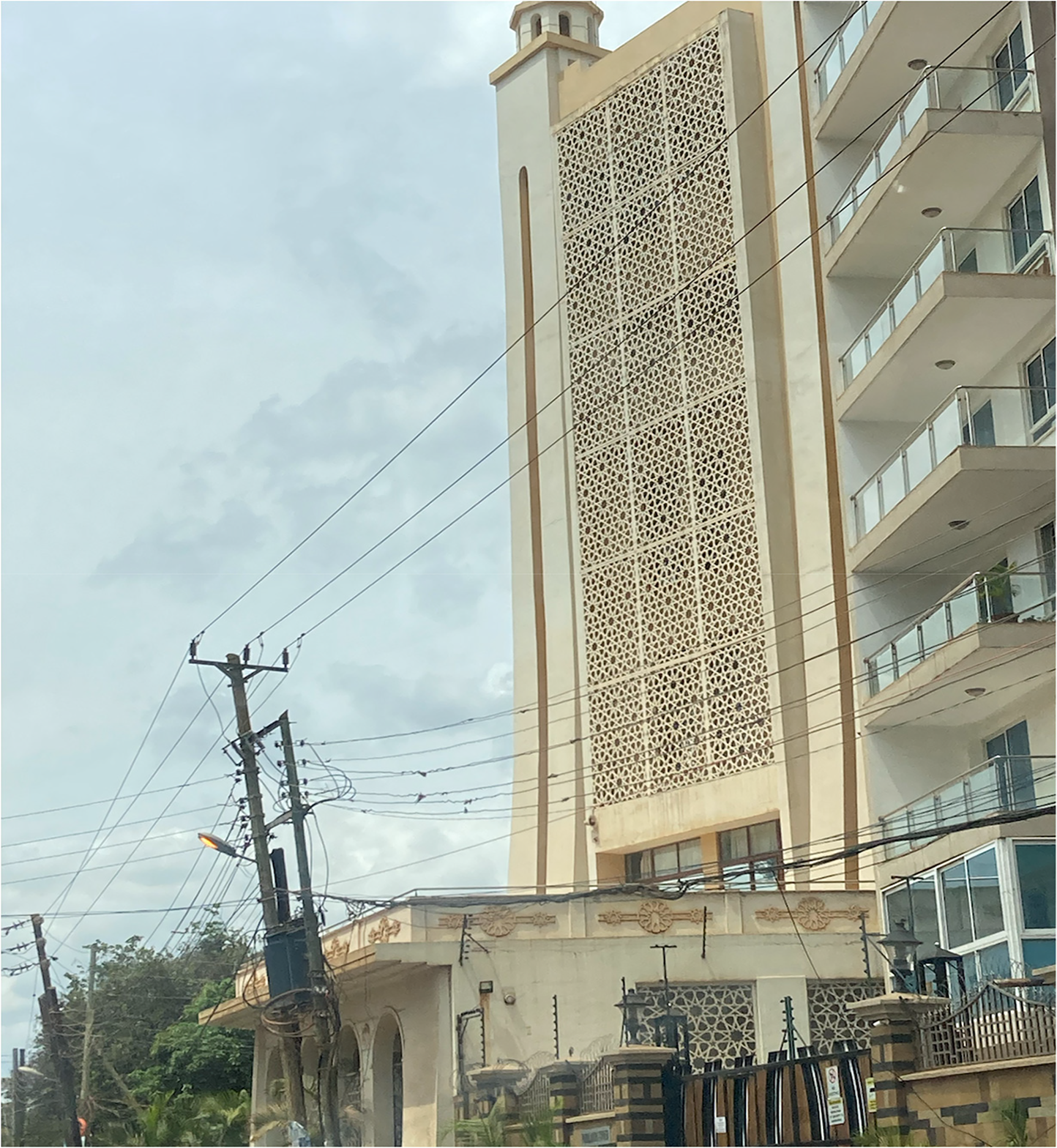
The Parklands masjid (left) and adjacent apartment building (right), Nairobi, 2023. © Author.
The nearest apartment building to the mosque, “Riverview Tower,” was practically leaning on its structure. Although it had a blank wall facing the mosque itself, its glass and metal balconies afforded good view of the gathering space outside and convenience to those who wanted to worship next door. This idea of barakah manifesting in spatial terms had been expressed to me a few times by both Asian and ethnic Somali women during my research. Two of my interlocutors shared the idea that journeying regularly from the home to the mosque offered to them and their families the opportunity to partake in practice and return directly again to the home, bringing barakah with them to their kith and kin as a powerful and intimate daily routine. Although this conception of transmitting barakah through practices of piety may have manifestly gendered and age-related markers (both were middle-aged women, caring for families, one pursuing independent work as a real estate agent), the spatial markers of spiritual beneficence were everywhere leaving impressions at this proximate, local scale.
For many of my male interlocutors, the Parklands masjid became a focal point for the neighborhood's changing geography of property, and a node for the exchange of information as well as speculation. An Asian Kenyan builder-developer, Yunus, recounted to me that many new ethnic Somali immigrants did not want to buy his substantial property but preferred smaller, more cramped, and less serviced options as they were closer to the gathering quarters of the mosque and hence afforded them blessings in spatial, material, and social terms. A younger man, Hadi, who was Asian Sunni Muslim and attended the Parklands masjid confided in an interview that ethnic Somalis met at the mosque and exchanged ideas of the day's property options and pending transactions. 9 Yunus bemoaned that several of his prospective clients would change their minds after consultations at the mosque that week: “They don’t want me to sell beyond the price they have talked amongst themselves that they should pay.” 10
For many Asian Kenyans, the idea that a longstanding way of life and durable claims to belonging were being rapidly overturned, one building at a time, by the building practices of ethnic Somali diasporic residents, threatened to erode ideas of place and ways of life built up since the colonial period in British East Africa.
Circularities of return—Ethnic Somalis in Nairobi
Although ethnic Somalis were a definite part of the capital's demographic composition during the colonial period, their presence was marginalized and controlled by the British administration, who often reduced their complex ethnic composition to stigmatized labelling as itinerant pastoralists in the North and sought to keep them out of the city. Classification on the basis of the juridical concept of status was significant: during the early colonial period, records show that members of the ethnic Somali Isaaq clan were deemed “non-native” for taxation purposes in the city. Such classification undermined their position as native to Nairobi and as legitimate members of the polity. Instead, ethnic Somalis were seen as “alien,” sitting uneasily between Asiatic and African populations in the city's racial make-up. The historian E.R. Turnton describes this shifting status in the city: In the period after 1919, the amount of non-native legislation applying to the “alien” Somali gradually increased, while by the middle of the 1930s there were only six native Ordinances from which they were exempted. It was hardly a very encouraging achievement; nor was there any obvious rationale behind the extension of native legislation to which they had to submit. Thus, the Isaq were considered to be natives under the Native Authority Ordinance but not under its corollary, the Native Tribunal Ordinance. While under the Registration of Domestic Servants Ordinance a truly ludicrous position was reached, whereby Somali were considered to be native or non-native according to the salary that they earned. Moreover, throughout this period, the Isaq found that important symbols of their status were being gradually undermined. Until 1928, the “alien” Somali were admitted to the Asiatic ward of the Nairobi Hospital, but this practice was then discontinued and, despite persistent efforts on their part, the Isaq never managed to regain this privilege. (Turton, 1972: 32)
Kenya's independence came after that of the Somali state and the Northern Frontier District of Kenya, bordering Somalia, included the trading hubs of Wajir, Garissa, and Moyale. These areas were considered by the Somali state to be part of a “Greater Somalia” that included parts of Djibouti and the Ogaden region of Ethiopia. Statistics show that there were ethnic Somalis recorded as settled in Wajir from 1911 onward, and that they numbered more than half a million in 2009 (ACCORD, 2015). The Somali presence in Nairobi began to be better established from the 1950s onward, when Asian businessmen from Eastleigh moved to Parklands and less congested areas of the capital. As Hannah Whittaker states of the uneasy question of the Somali urban presence, “many perceive the Somali to be temporarily encamped in the city, and negative stereotyping as refugees and illegal immigrants leaves Somalis living in Nairobi vulnerable to abuses by the government and the security force” (Whittaker, 2015: 119). An ethnic Somali question of status, citizenship, and belonging has hence been a longstanding problematic that colonial and post-independence governments have failed to adequately address. Instead, the post-independence state often relied on techniques of violent policing, surveillance, and stigmatization that tie in colonial and Cold War logics to the influence of mobile policing methods drawn from the US's transnational War on Terror.
Existing research on Somali refugees focuses on refugee camps as complex dwelling spaces in Northern Kenya, such as the long-established Dadaab camp (Montclos and Kagwanja, 2000; Siddiqi, 2023). Amid ongoing refugee crises, newer work examines the role of urban refugees and the city as a point of resettlement for refugees worldwide (Earle, 2023; Kassa, 2018). Yet, I suggest it would be mistaken to consider all Somali diasporic residents only as refugees. Even many of those who are more newly settled in the capital's neighborhoods do not fit the refugee paradigm—some are increasingly well-off compared to average Kenyans, and those in Parklands purchase two- to four-bedroomed apartments that range above 15–20 million Kenya Shillings per unit (US$114,504–$152,672, June 2024 exchange rate: US$1/131 Kenya shillings). In the designs of these buildings and the features that differentiate them from average apartment buildings (madrassahs on the ground floor in certain buildings, small convenience shops and pharmacies in others, many located close to the Parklands masjid), new Somali residents engaged in determinate placemaking, transforming the existing neighborhood plot to build durable claims to urban dwelling.
An urban businessman and ethnic Somali investor, Omar, told me he had recently come “back” to Nairobi with his family, moving from the frozen streetscapes of North America to East Africa so that his children could be brought up close to their homeland and with an appropriate sense of community and custom. 11 As a well-off middle-class man in his mid-40s, Omar was also keen to invest in the city, build his capital through funds pooled with family members and friends, and establish himself anew in Nairobi. Although this form of diasporic migration saw Omar's family move to Nairobi after a long time away—it was not since the civil war in Somalia started in the early 1990s that they had spent some time in the city—it was a “return” that was not unlike that of developers and new residents of Parklands that I came to interview and converse with. Farah Bakaari and Xavier Escandell write of the return visits undertaken by Somali parents living in the West (dhaqan celis) as a form of “counter-diasporic migration and reverse transnationalism” occurring between globalized parts of the world connected relationally (Bakaari and Escandell, 2022: 51). Two of my interlocutors had planned only to visit the city but eventually moved back after a few years of planning, saving, and bridging connections with kin. Amid questions of violent surveillance of Somali refugee populations and young Muslim men in Nairobi and particularly in coastal cities such as Mombasa (Al-Bulushi, 2021), such counter-diasporic movements can be seen as determinate and courageous—these transnational mobilities are alternative paradigms of connection and worldmaking.
During a meeting at a restaurant in Parklands in mid-2024, real estate agent Hoda, an ethnic Somali woman in her late forties, told me that Somali developers operate largely through clan and kin networks, and are able to leverage these for financing and pooling funds. Although Asian owners of old bungalows and townhomes were initially reluctant to sell, from 2010 onward there was an increased willingness to transact. Many owners accepted proposals to develop through joint ventures—financing agreements that see the landowner accept building on the property against an agreed-upon share of finished apartment buildings: “The landowner would contribute his land to the building process, and my Somali clients got financing for construction and gave 20 or 30% of the finished apartments in exchange,” Hoda explained. 12 As Nairobi is usually written in to the urban literature as a city of tenants and rental investment, it is also notable that many of these apartments are listed for long-term purchase through sectional title, with the developer often retaining the main title to the land. This type of property-making hence demonstrates an altered temporality to building and selling than purely speculative high-rise investment, and a different commitment to place and communities of identity through the construction of apartment buildings as new home grounds.
Asian owners such as Hassan, an Asian neighbor of Ghassanji who agreed to a joint venture in 2022, told me that the lag times involved were sometimes frustrating and risky, but the joint venture was one way to sell off his land. Asians who could afford to move increasingly looked to other areas of the city for housing, seeking to reproduce patterns of ethnic enclaving elsewhere. At first, many Asians were reluctant to sell, preferring to remain on familiar terrain. Once hard economic times hit and sales around the Parklands masjid began, a tipping point was reached. Asians who could afford to leave, sold so as to maximize gains due to falling land prices as Parklands became increasingly densely developed. 13 Many feared being isolated as lone Asian landowners in a rapidly changing area.
The contentious plot here in Parklands and into adjacent areas near Nairobi's well-known City Park, thus has come to operate as crucible of various postcolonial trajectories and postconflict conjunctures. The plot at once unearths questions of precarious postcolonial belonging for both ethnic Somalis and Asian Kenyans, and makes clear the spatial logics of staking durable claims to urban inclusion at the local scale.
Financial circuitries around the apartment imaginary
Some part of the current wave of apartment building can be traced to Nairobi's overall real estate boom—attributable to confluences of greater finance available for middle-class construction coming in from the Kenyan diaspora overseas through remittances and direct investment. Most recent investment in Parklands, however, has been structured more specifically through pooled resources brought in by the Somali diaspora. As property markets boomed in the mid-2000s, standard zoned half-acre plots of land with single story houses in Parklands suddenly rose in price, from 40 and 50 million (US$305,343–$381,679) to well over 150 million Kenya Shillings (US$1.14 million) in the late 2010s: 14 “Property owners and developers had stars in their eyes until prices began to dip in the 2020s, with corona [Covid-19], and economic stagnation,” a real estate agent surmised. 15 Whereas certain amounts of financing are legitimate, others are whispered into writing in Kenya's generally outspoken daily newspapers as a form of characteristic “Nairobi wash-wash” (Wangui, 2022). Apartment buildings and high-rise living are central to this “wash-wash” imaginary, where illicit financing makes its way into the city's built environments.
Writing on the urban imaginary around corruption across contexts, Ranganathan et al. (2023) detail the affective “plots” that connect corruption, land, and narrative forms in cities such as Mumbai and Lagos. Similarly, there is a history of deals and a politics of financing in Parklands that stands behind and supports the numerous apartment buildings springing up, leaving streets densely packed with concrete urbanism. The new wave of building here frequently exceeds the standards permitted by revised County Council plans and regulations on Ground Coverage (GC) and Plot Ratios (PR) permitted within each area. Building professionals with whom I spoke, including architects and structural engineers, regularly pointed out the increased density of construction and the soaring height of new buildings, adding more floors than was previously thinkable in this area. Of concern to planners has been the capacity of services like water, sanitation, and drainage to keep pace with the dozens of new buildings. Groundwater, too, has become stretched, with private boreholes sunk as a norm, leading to water-table depletion. As an additional concern, recent rain storms in May 2024 also resulted in largescale flooding, particularly inundating unfinished building sites in the neighborhood and pouring through roads clogged with construction debris.
Ethnic Somalis and Asian Kenyans have not been far from the limelight on issues of corruption in Kenya's public system. The public often remembers the infamous Goldenberg scandal in the early 1990s, concerning billions of shillings siphoned out by businessman Kamlesh “Paul” Pattni, as one highly visible instance of an individual from the Asian community's involvement with high powered financial crime. More recently, a 2022 article in the Kenyan newspaper, The Nation, investigated the laundering of billions of shillings of US government money, some of which found its way to areas like South B and C via ethnic Somali developers, and was moved from illicit liquidity to concrete and bricks in the built environment (Otieno, 2022). The article details how 30 billion Kenya shillings was acquired through the US government's Covid mitigation funds, particularly in the state of Minnesota, and siphoned out of the country. While most of the construction boom can be attributed to the hard work and concerted cooperation of the Somali diaspora, the imaginary of unaccounted-for money haunts rapidly developing neighborhoods like Parklands and South B (Image 4).
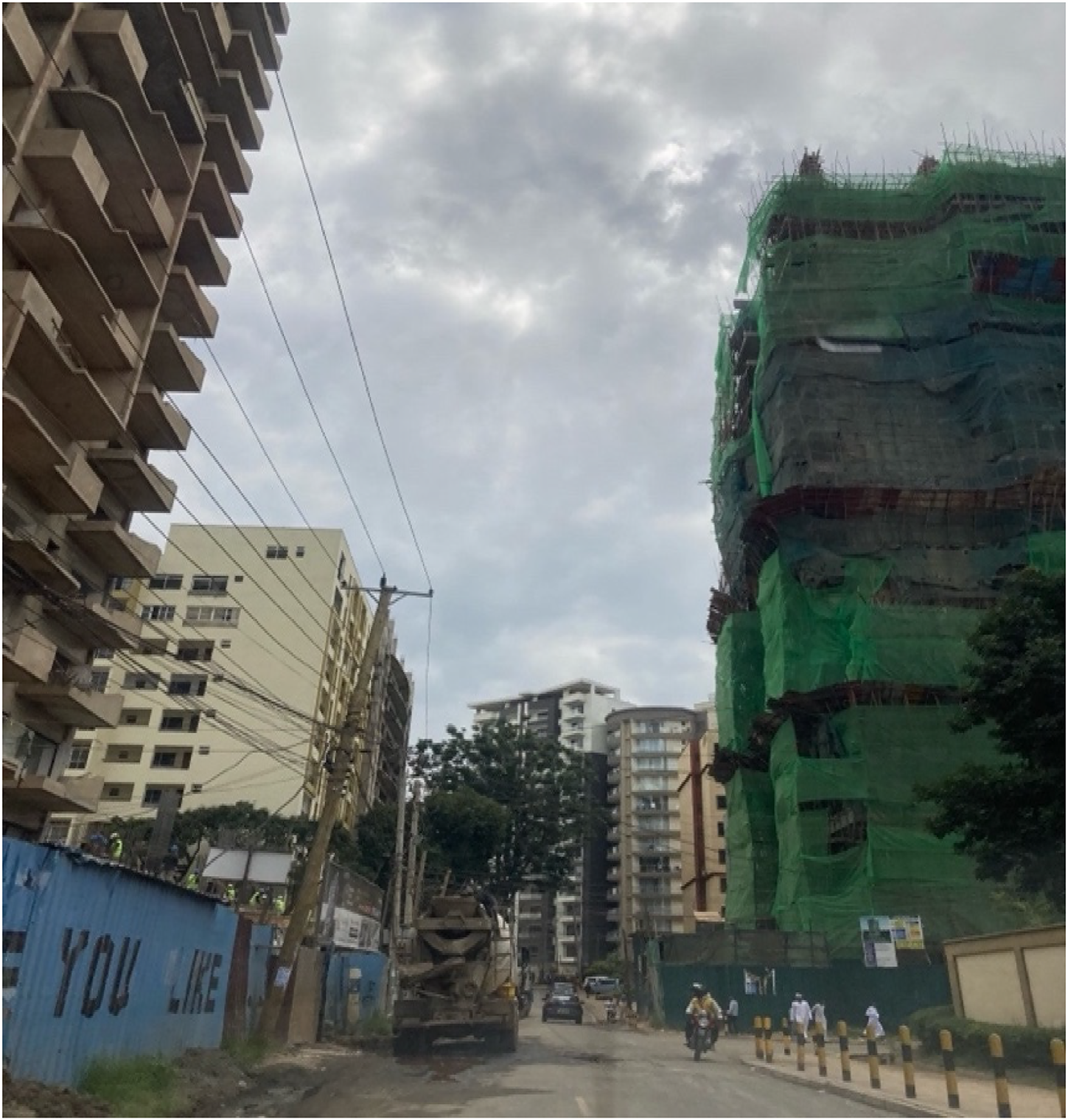
Construction of a cluster of apartment buildings in Parklands, 2024. © Author.
For working-class residents with whom I spoke, some of whom live nearby Parklands in certain areas of Eastleigh still dominated by Kikuyu landlords or in fast-disappearing informal settlements in the area, the apartment boom is a mystifying occurrence. The swift rise of apartment buildings has also heightened contrasts between these new dwellings and existing informal settlement areas, such as the Deep-Sea informal settlement, as land for redevelopment becomes scarce. The Deep-Sea settlement sits on one side of a new arterial road connecting Limuru Road to Ring Road Parklands, and to the Central Business District. Parts of Deep-Sea were demolished to make way for the highway, leaving unsteady shacks and corrugated-iron-sheet-and-wood housing on one side of the road, barely visible to motorists as they speed by. High-rise apartments sit on the other side of the road, looking over the remaining areas of Deep-Sea, and beyond: into Muthaiga and the Karura Forest. This intersecting road is hence a threshold space where stories of local ethno-national belonging entwine with the larger economy of precarity and unevenness in the city. When examined closely, therefore, the neighborhood breaks apart, revealing multiple displacements and particular histories of dispossession.
Moving from racially zoned master-planned areas with Asian-owned bungalows and townhomes, to new ethnic Somali apartment urbanism, building on the neighborhood parcel of land is changing, along with the larger city. With this change comes demographic shifts and different sets of stories and narrative arcs equally impacted by the financial implication of such spatial change. An elderly Kikuyu shop saleswoman remarked to me that although she realized they often were relatively wealthy, she felt sorry for Asian Kenyans moving out of the area: “If Parklands becomes too expensive, we can move elsewhere, maybe to Pangani or to the village. They [Asians] have been here a long time but they don’t have their own village to go to when things change.” 16 Price increases in the area mean that Asian owners selling their dwellings and moving to newer suburbs are hardly left out of pocket, although numerous Asian tenants of various means face displacement. Nonetheless, the saleswoman's statements demonstrate the lived uncertainty that accompanies changing city life, where the neighborhood feeds into larger questions about access to affordable dwelling in the city, as well as being a crucible of historic spatial relations and social histories at a local scale.
For newer ethnic Somali residents, the apartment building is not just a vehicle for profit and a mode of claiming contentious urban space—it is also a mode of building local ties for a close-knit ethnic group with its own familial lines, clans, and subgroups, many already deeply inscribed into Nairobi's history as a colonial and postcolonial capital. Sameer, a newer ethnic Somali resident who moved back from the United States to Kenya five years ago, and now owns a business in the area and also deals in real estate, expressed relief that his family could now find themselves settled “in a community, near the masjid, and near my cousins and friends – we have our old ways of life to continue, and as we get older, we have a new generation to raise.” 17 In this context, the apartment building in Parklands is more than a generic, repetitive spatial form—it is a conjunctural formation bound into particular, politicized local histories of the present, as well as to trans-local circuits of capital tied to diasporic mobility and resettlement.
Conclusion: Politicized spatial citizenship
In June 2024, Nairobi residents staged protests over inequitable access to opportunity and rampant corruption, sparking similar protests across the country that are still ongoing. At this moment of urban protest in Kenya, Nairobi residents’ demands help us think through the imbrication of questions of property ownership and urban inclusion. For many of Parklands’ ethnic Somalis and Asian Kenyans, at stake is not only urban inclusion but also a more secure foundation for national belonging and recognition as legitimate citizens of the multi-ethnic state. I have shown in this article that property-making through contentious neighborhood plots at the local scale is a means of territorializing claims to belonging in Nairobi's historic colonial and post-independence landscape. These shifting dynamics around property situate and specify more general accounts of spatial change, pointing to the historical particularity of development in many parts of cities like Nairobi.
Such local spatial claims also point to larger regional conjunctures—both colonial-oceanic and postcolonial-postconflict—that wrap around this urban confrontation amid contention over land and propertied belonging. The contentious plot is thus a conjunctural form: a condensed spatial knot of intersecting histories and questions of status and citizenship. As building continues in Parklands, the recognizable contours of life change for some, but the plot of land endures in a different form as a scale of continuity in this master-planned city. In this process, rebuilding on plots in the area reworks the threads of social class, ethnic identity, and place. Yet the remaking of property and localized claims to land leave questions of multi-ethnic belonging and political inclusion in the larger polity still unresolved.
On a more local scale, therefore, projects enacted through the built environment provide concrete forms of belonging for Parklands’ changing residents. Taking the contentious plot as a conjunctural form, I have posited the disappearing painted Asian bungalow and the emerging cluster of ethnic Somali apartment buildings as spatial manifestations of projects to consolidate and remake local ties, (trans-)national belonging, and ethno-national identity in this changing capital. Going beyond the binary of colonial and post-independence racial relations, therefore, this article has underscored further axes of splintering that pivot around interstitial spatial subjects of the city. Such interstitial subjects have their own communal histories of space and contested belonging that are vital to understanding enduring urban questions over time, centered around city-making through the contentious plot.
Footnotes
Acknowledgments
I thank D. Asher Ghertner and the journal's editorial team, as well the anonymous reviewers who refereed this article, for their helpful feedback. For their supportive engagement with my work, I thank Emma Shaw Crane, Lana Salman, Zahra Hayat, Maira Hayat, Sherine Ebadi, and Claudia Gastrow. I thank Hallie Wells for her meticulous copyediting. Work on this project was made possible in part by research grants from the Institute for the Arts and the Humanities and the College of Arts and Sciences at UNC-Chapel Hill.

Funding
The author disclosed receipt of the following financial support for the research, authorship, and/or publication of this article: This work was supported by the University of North Carolina, Chapel Hill (Faculty development research grant).
Conflicting interests
The author declared no potential conflicts of interest with respect to the research, authorship, and/or publication of this article.