




Abstract
Against the ‘normative concept of the networked city’, urban studies and infrastructure research have seen a shift towards investigations beyond the network that engage with the post-networked city, heterogeneous infrastructures, and other situations ‘on, off, below and beyond’ the grid, especially in southern cities. Expanding on debates around southern urbanisms and their socio-technical infrastructures, we explore a ubiquitous yet rarely discussed element of contemporary urban infrastructures: storage. In Nairobi, a city shaped by infrastructural heterogeneity and uncertainty, households of all backgrounds and sizes store water and electricity within various constellations of actors, practices and artefacts. We show how domestic storage, its artefacts and practices cumulate in a storage city that is not opposed to a networked or post-networked city but rather entangled with it. We present domestic storage as crucial infrastructure to the socio-technical functioning of Nairobi, discuss diverse storage artefacts and practices, and highlight how a focus on storage can contribute to re-imaginings of infrastructural articulations beyond networks and flows.
‘It’s so ingrained in us … I am storing electricity and water because my country is like this … You don’t think about it, it’s just instinct’. (resident interview in Ruaka)
Introduction
Despite the importance of infrastructures and basic services for urban lives and economies, many cities across the globe struggle with universal and centralised provision of water, electricity and other essential resources. Especially in southern cities, basic supply is less defined by the ideal of the networked city but rather by heterogeneous infrastructure configurations (HICs) involving diverse socio-technical sets of providers, sources, materialities and practices (Lawhon et al., 2018; Jaglin, 2014). Amidst such configurations, urban residents – for example in Nairobi, Kenya – have to navigate infrastructural uncertainty caused by rationings, blackouts and other interruptions. One way of making urban life possible amidst unreliable or heterogeneous infrastructures is storage.
For a long time, academic engagements with urban infrastructures have focused on the spatialities, temporalities, materialities, and politics of flows, circulations, mobilities and other kinds of movements (e.g. Bender, 2009; Graham and Marvin, 2001; Kaika, 2005). In line with recent provocations on infrastructural containment or confinement (e.g. Banoub and Martin, 2020; Furlong, 2022), we suggest expanding our understanding of infrastructures towards the artefacts and practices of domestic storage of water, energy and more. Focusing on the household and its storage artefacts, that is containers, as key sites and technologies of storage, this provides a new venue for investigations and imaginations beyond dualisms of connected/ unconnected, rich/poor, formal/informal, etc. Simultaneously, the everyday deployment of storage in Nairobi and elsewhere does not conflict with notions of networked or post-networked cities. Instead, in regards to uncountable sites, artefacts and practices of storage, we propose the notion of a storage city with multiple relations and connections to other systems and conceptualisations. Ultimately, we advocate for storage as infrastructure, given its enabling, imperative role for urban-infrastructural functioning in Nairobi. Such deliberate inclusion and shift in perspective may provide crucial insights for planning, design and governance of place-specific HICs across the networked/post-networked spectrum.
As a first step to grasp storage as infrastructure, we use the examples of water and electricity in Nairobi, Kenya. Drawing from existing literature, our paper is grounded in qualitative fieldwork in the wider Nairobi area in 2021 and 2022: more than 20 structured key informant interviews (government, utilities, NGOs, etc.); close to 30 semi-structured resident interviews; and multiple visits, strolls and informal conversations. We recruited resident respondents via existing contacts, social media and snowballing, and we based our final selection on diversity in terms of socio-economic situations, geographic location, residential architectures and infrastructural connectivity. We conducted the majority of resident interviews – which always discussed both water and electricity – in Eastleigh (dense central neighbourhood), Kibera (large informal settlement), Westlands (up-market area) and Ongata Rongai (rapidly urbanising suburb). The paper is organised in three sections: a theoretical and conceptual framing based on existing literature; an exploration of the underlying reasons for, and expressions of, domestic water and electricity storage in Nairobi; and a final discussion opening up tasks and questions for further engagements.
Networked, post-networked, storage city: From flows to storage
Our understanding of modern cities and their infrastructural functioning has been shaped by the universalising promises of ‘distributive infrastructures’, largely ‘comprised of pipes, cables, wires and tracks’ (Marvin, 1992: 228). As crucial parts of the ‘normative concept of the networked city’ (Graham and Marvin, 2001: 387), these infrastructures – and the flows, circulations and mobilities they enable – promised the ideal of a ‘unitary, orderly city’ (Monstadt and Schramm, 2017). However, the modernist vision of the ‘networked city’ was rarely ‘perfectly ‘realised” neither was it ‘a universal and uniform ‘thing” (Graham and Marvin, 2001: 88). For many southern cities, centralised networked infrastructures have rarely provided the promised services and supply in a universal manner (Furlong and Kooy, 2017; Graham and Marvin, 2022; Munro, 2020). Yet, urban residents as well as governmental and private actors have found myriad ways to distribute water, electricity and other resources or services: tapping of wires and pipes; decentralised distribution systems; off-grid supply modes; etc. (Chakava et al., 2014; Cirolia et al., 2021; Schramm and Ibrahim, 2021; Silver, 2015).
By highlighting the ‘vitality and multiplicity of actual delivery systems’ in southern cities, Jaglin (2014) questions the applicability of the networked city notion as a starting point for urban-infrastructure research and practice. Accordingly, calls for new vocabulary through more situated research in southern cities (e.g. Bhan, 2019) have contributed to a rise of new notions, such as HICs or the post-networked city. The post-networked city stands for ‘an urbanism of infrastructure that no longer assumes … convergence of socio-technical systems around a networked configuration’ (Rutherford and Coutard, 2016: 258), and often refers to off-grid infrastructures, for example boreholes and small-scale solar. Contrastingly, HICs include ‘the diverse ways that people access services within and beyond conventional city networks’, which conceptually ‘challenges the binary between networked and non-networked’ (Cirolia et al., 2021: 1611). Referring to different yet overlapping conceptualisations, both notions have been shown to be characteristic for many African cities (Hyman and Pieterse, 2017; Jaglin, 2016).
As part of the global ‘infrastructural turn’ (Graham, 2010), we have also seen a general expansion of what infrastructures are (or might be), from Simone’s (2004) ‘people as infrastructure’ to recent provocations on human bodies, non-human beings, time and more ‘as infrastructure’ (e.g. Andueza et al., 2021; Barua, 2021; Besedovsky et al., 2019). Other authors have pointed out that the increasingly ‘fuzzy boundaries’ of infrastructure may jeopardise sharpness and usefulness for academia and practice (Baptista and Cirolia, 2022: 930; see also Howe et al., 2016). Yet, a ‘wider infrastructural ontology’ (Barua, 2021; see also Addie, 2021) holds opportunity and value to fully grasp how basic services and resources are provided, distributed and accessed within and through configurations or systems ‘without which contemporary societies cannot function’ (Edwards, 2003: 188). From all the engagements and debates of the last decades, four key aspects define how we approach urban infrastructures for this paper. Firstly, we see the urban and its infrastructures as socio-technical assemblies of ‘materials, technologies, social institutions, cultural values and geographical practices’ (Graham and Marvin, 2001: 214), including diverse sets of human and non-human actors as well as processes of becoming (Alda-Vidal et al., 2018). Secondly, for the continuous becoming of infrastructure – for ‘infrastructuring’ (Simone, 2022) – we stress the importance of everyday practices and labour of urban residents in making the city work (Graham and McFarlane, 2014). Thirdly, we acknowledge infrastructural configurations in many southern cities as indeed heterogeneous. This involves ‘many different kinds of technologies, relations, capacities and operations’ (Lawhon et al., 2018: 726) and is mirrored in individual household dispositifs, a distinct socio-technical situation with ‘a specific set of actors, resources, material artefacts, technical knowledge, and formal and informal institutions’ (Rateau and Jaglin, 2022: 185). Finally, we do not see heterogeneity or any other deviation from a networked infrastructure ideal as developmental failures but – to the best of our abilities – we try to ‘provide a proper reading of infrastructural articulations’ (Guma, 2022: 63), as they actually are and not as they should be.
Following the infrastructure propositions above, and in line with the expansion of notions and definitions, our investigation approaches storage as infrastructure. Given their often distributive character, infrastructures remain predominantly conceptualised through circulation, flows, networks, or the lack thereof (e.g. Barua, 2021; Cirolia et al., 2021; Lemanski and Massey, 2022). As others have already pointed out, urban studies, infrastructure studies and related disciplines have rarely specifically addressed the moments, spaces, practices and artefacts of infrastructural containment or confinement (Banoub and Martin, 2020; Furlong, 2022; Millington, 2018; Shryock and Smail, 2018). Research on domestic storage in Nairobi may thus contribute to a wider infrastructural ontology – beyond the network, beyond the West, etc. – by building ‘explanations from empirical observations of what [urban residents] actually do, the practices they perform’ (Alda-Vidal et al., 2018: 105). For this, we start with analysing everyday entanglements of society and technology and merge those with the critical situatedness of postcolonial urban studies (Guma et al., 2019). It is not our aim, however, to come up with a definite conceptualisation of infrastructure. Instead, for the socio-technical, place-specific and constantly becoming infrastructural configurations of water and electricity in Nairobi, we simply aspire to show that domestic storage is more than ‘appliances’ or ‘ordinary tools’ but indeed infrastructure (Meehan, 2014; Shove, 2016). Ultimately, this shall contribute to the ongoing endeavour of a critical urbanism beyond the network towards heterogeneous and/or post-networked urban realities.
Domestic storage as diverse infrastructural practices and artefacts
Especially within highly erratic or heterogeneous infrastructural conditions – shaping much of urban Africa – storage of essentials becomes a highly visible, everyday phenomenon (Alba, 2018; Dakyaga et al., 2018; Munro, 2020; Rateau and Jaglin, 2022). Nairobi’s landscape is clustered with water tanks, jerry cans, so-called super drums and other water containers. Small power banks, larger battery systems, re-chargeable lights and comprehensive back-up battery technologies are on the rise also. While electricity storage is currently receiving much attention in techno-managerial and engineering disciplines (e.g. Elshurafa, 2020; Stadler and Sterner, 2018), its role in producing distinct urban-infrastructural realities – especially in southern cities – has only been addressed peripherally (e.g. Munro, 2020; Rateau and Jaglin, 2022). For water storage, non-domestic forms and scales – such as reservoirs and dams – have been investigated (e.g. Bijker, 2007; Kaika and Swyngedouw, 2000), and domestic water storage has been discussed as a vector for disease transmission or as a distinct cultural phenomenon (e.g. Acevedo-Guerrero, 2022; Lavie et al., 2020). However, the domestic storage of both water and electricity is rarely approached as key to urban-infrastructural functioning specifically. This leaves room for further investigations into situated, everyday infrastructuring through the use of and practices around ‘boring’ and understudied ‘things’ (Star, 1999), such as jerry cans and batteries.
Banoub and Martin (2020) describe sites of commodity storage as ‘more-than-human assemblages’ that simultaneously ‘constrain and enable accumulation’ (p. 1102). This mirrors the reflections of Shryock and Smail (2018) on ‘containers’, which ‘both enable and inhibit transaction’. Accordingly, the notion of storage is not juxtaposed or in conflict with infrastructural notions of networks and flows but is rather entangled with those through specific sites and artefacts, namely. For our paper, we focus on domestic spaces, that is the household, as sites of storage where infrastructures and resource flows become ‘integrated in the practices of everyday life’ (Rohracher and Köhler, 2019: 2375). Further, we start our investigations from the artefacts of domestic storage, the containers, that are crucial for the production of urban space and infrastructures in Africa. Consequently, we approach domestic storage as a socio-technical hybrid of human storage practices – in short, storing– and its artefacts – the storage containers. From this position, we unravel how those artefacts work, what domestic storage means for the notion and functioning of urban infrastructures, and how this relates to everyday practices of storage.
We focus on two key infrastructures and their usually flowing resources: water and electricity. From accounts on domestic water storage, we know that it is prevalent and diverse in southern cities and usually used to mimic continuous networked supply with tanks, jerry cans and such like (e.g. Burt and Ray, 2014; Furlong and Kooy, 2017; García-Betancourt et al., 2015; Kjellén, 2006). As one of the few works that not only describes but also conceptualises domestic water storage infrastructurally, Millington’s (2018) analysis of São Paulo’s water crisis in 2014/15 shows how ‘differentiated abilities of residents to store water’ produce individually experienced scarcity of water. According to Millington, in an acute water crisis, storage becomes a ‘visible’ infrastructure (see also Star, 1999) and thus a ‘point of contact – an intermediary infrastructure – between the household and the system’ (Millington, 2018: 31–32). However, focusing on a specific crisis and the allegedly sudden visibility of storage is not taking into account the potential regularity and constant visibility of domestic water storage, as infrastructures in general are often ‘anything but invisible’ but rather located along a ‘range of visibilities’ (Larkin, 2013: 336). For example, Alba (2018) highlights the prevalence and diversity of water storage in Accra where buckets, jerry cans, large water tanks, and more, are constantly visible and used by households with and without piped connections. The artefacts and scope of storage vary by socio-economic situation, and differences in storage styles and capacities can define ‘how residents access water in terms of quantity, quality and means of access’.
Electricity storage has become a common feature of urban life also and helps to ‘maintain modernity’s illusive promise of continuous, uninterrupted supply’ (Cross, in De Seta et al., 2017). Simultaneously, transitions towards renewables, e-mobility and the promises of smart cities are prominent in societal and academic discourses, potentially cumulating in a future ‘storage city’ full of ‘battery-powered gadgets and vehicles’ (Xylia et al., 2019: 40). However, accounts from urban Africa show that electricity storage is not just a topic for smart, future, world-class cities but is practised in diverse ways within heterogeneous and often unequal infrastructure configurations. From Rateau and Jaglin (2022) we know that in Cotonou and Ibadan some households use battery systems as back-ups for outages. Together with myriad other batteries, those systems have become part of individual electricity dispositifs for some, albeit rather affluent residents. From Gulu Town in Uganda, Munro (2020) tells stories of urban residents that use batteries and battery-linked solar panels to navigate an erratic and uneven electricity configuration. For both water and electricity, the universality and diversity of storage show how it relates to a lack of regular supply, how all kinds of households are affected and react to it, and how storage inspires thinking beyond the on-/off-network dichotomy.
Nairobi, a storage city: Water and electricity
Nairobi has always been shaped by infrastructural heterogeneity and inequality, largely rooted in ‘fast growth, colonial heritage, and lack of formal urban planning’ (Ledant, 2013: 338). While centralised, public infrastructures – such as piped water and electricity – were installed in settler-colonialist areas, the early decades of Nairobi saw little infrastructure provision to so-called ‘native locations’ (Ogot and Ogot, 2020; Slaughter, 2004). After independence, a ‘period of growth and optimism’ in the 1960s and 1970s, Nairobi struggled to expand basic services and infrastructures to its rapidly growing population. In the following decades, Nairobi experienced a surge of underserved informal settlements, a dismantling of urban services, such as waste disposal and public transport, and a decreased reliability of networked services, such as water and electricity (Ogot and Ogot, 2020; key informant interviews). From colonial times to the end of the 20th century, marginalised Nairobians lived without networked infrastructures (Akallah and Hård, 2020). Simultaneously, some urban elites unbundled themselves with generators, gated communities or the creation of an independent water network in the affluent suburb Runda (Wa Mungai, 2019; key informant interviews).
Since the 2000s, Nairobi has undergone massive urban-infrastructural transformations. While not without problems, slum-upgrading efforts have increased access to water, electricity and health facilities for some marginalised areas. At the same time, private and non-governmental actors provide services beyond centralised infrastructures (Chikozho et al., 2019; Corburn, 2021; Schramm, 2017). Nairobi of the 21st century is a place where urban forms and infrastructure conditions are heterogeneous (Schramm and Ibrahim, 2021; Wamuchiru, 2017). Amidst this heterogeneity, all residents face – directly or indirectly – persistent shortcomings of networked infrastructures, in the form of low pressure or voltage, lack of connections, planned and unplanned outages, and more. Despite recent improvements, and in light of rapid urbanisation of Nairobi, many of our respondents are certain that universal services and centralised infrastructures will remain challenges for decades to come (key informant interviews). In the past, present and future, Nairobians across the city ensure the availability of electricity, water and other resources through artefacts and practices of storage. Against the prevalence and scope of domestic storage stands a lack of recognition by utilities, officials and urban planning documents of its importance to the everyday functioning of Nairobi (e.g. NCC, 2014; key informant interviews); or as the water utility puts it, ‘our responsibility ends at the meter point’ (key informant interview). Apart from outdated guidelines on water storage in Kenya’s 1968 Building Code as well as technical standards and solar-specific import tax benefits for batteries, storage of both water and electricity is hardly subject to any governmental regulations or policies (key informant interviews). With virtually no interventions from above, but triggered by rationing programmes and reoccurring interruptions, Nairobi has become a storage city.
Mitungi and water tanks: Domestic water storage in Nairobi
The historically rooted inequalities as well as the current unreliability and heterogeneity of Nairobi’s water supply system have been well elaborated (e.g. Akallah and Hård, 2020; Gulyani et al., 2005; Ledant, 2013; Wamuchiru, 2017). The city’s networked water supply by the Nairobi County Water and Sewerage Company (NCWSC) is heavily affected by a massive daily water deficit of 300,000 cubic metres, against a demand of over 800,000 cubic metres. As a response, NCWSC has implemented a so-called equitable distribution programme, meaning water is distributed to neighbourhoods on specific days of the week only, with different days for different locations (key informant interviews). However, the programme has been shown to favour higher-income areas and the actual number of days as well as the amount and hours of water can be unreliable and unequal (resident interviews; Mutono et al., 2022; Schramm and Ibrahim, 2021). While geographic locations and socio-economic situations may define how much water connected households store, scarcity of piped water is universal and thus results in a heterogeneous universality of domestic water storage. More so because, despite improvements in recent decades, official numbers show that only 76% of households can access piped water, and even lower connectivity rates remain common in low-income areas and informal settlements (key informant interviews; Ledant, 2013; Mutono et al., 2022). Consequently, a heterogeneous landscape of water supply has emerged, in which households – connected or not – rely heavily on non-networked supply modes, such as water points. Water points usually feature large water tanks fed by the network or unknown sources, from which water users – mostly women and children – fetch water with jerry cans to then store at home or use to fill larger containers (resident interviews; key informant interviews; Sarkar, 2020). With or without access to the network, Nairobians across the city rely heavily on water storage.
For fetching, storing and water delivery services, jerry cans play a central role across the city. Called mitungi in Swahili, they are the unit of water pricing in many areas, usually selling from 0.5 to 5 Kenyan shilling (KES) for fetched water and up to KES 100 for delivered jerry cans. Mitungi hold 20–23 L and are usually made of plastic, often in yellow. Some of them have a boxy jerry can design but many are reappropriated, round, 20-litre cooking oil canisters (see Figure 1). Private vendors also deliver mitungi but usually take them back after they are emptied into the containers of the household. Since delivered water is significantly more expensive, mitungi handcarts are more prevalent in middle-income areas. In all cases, people use jerry cans and other small containers – such as buckets, old paint containers, and larger super drums of 100–250 L – to store water. The prevalent use of jerry cans extends to estates and households with piped connections or boreholes but where single units do not have larger water tanks, either due to financial or spatio-architectural reasons. In informal settlements, jerry cans fill up large chunks of the already small homes, while in underserved (lower-)middle-class areas they fill balconies, kitchens, bathrooms, stairways and other common areas (observations; resident interviews; Chakava et al., 2014; Sarkar, 2020). Mitungi are thus not only crucial for non-connected households but also for ‘grid-dependent middle-income neighbourhoods [that] are now more marginalized by water flows than are some of the poor neighbourhoods’ (Schramm and Ibrahim, 2021: 355). Jerry cans and the diverse practices they require – fetching, delivery, carrying up stairways, filling up when water comes, stacking, emptying into larger containers, etc. – have become crucial infrastructures for many Nairobians.
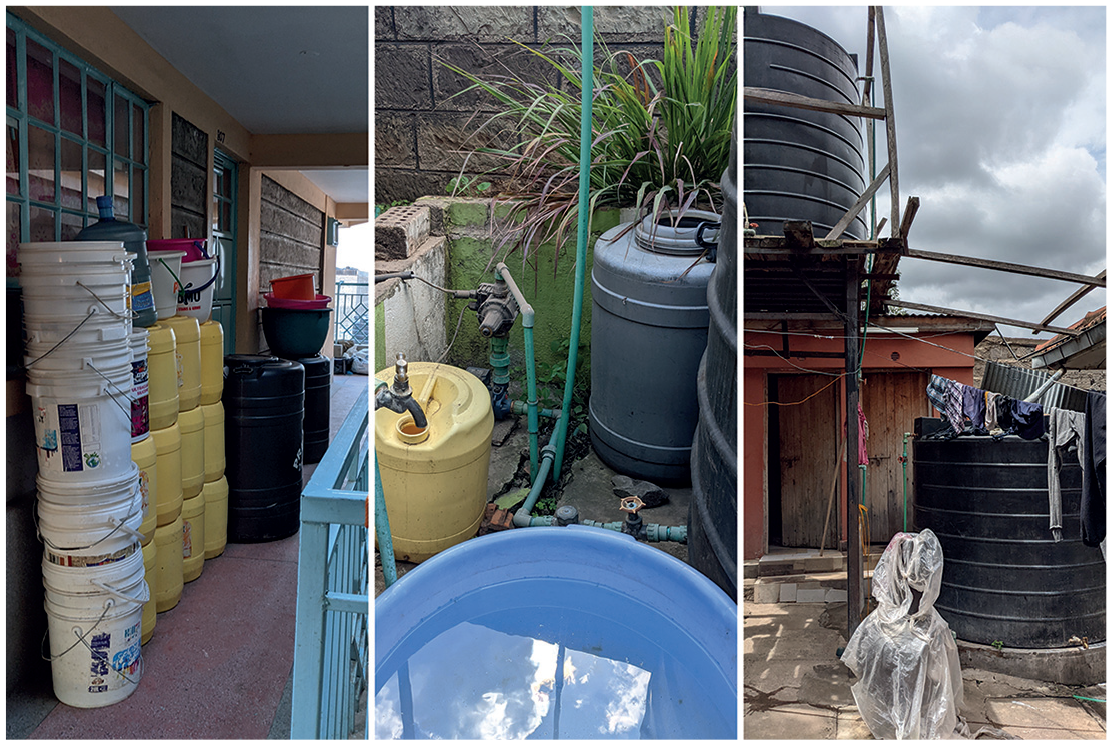
Artefacts of water storage in Pipeline, Buru Buru and Ongata Rongai (from left to right).
On the other side of the storage spectrum are large-scale water tanks made of polyethene with the most common sizes being between 1000 and 3000 L for single household use. Placed in yards, underground, on flat rooftops or elevated metal structures, plastic water tanks are the most visible artefact of domestic water storage in middle- and upper-class neighbourhoods (see Figure 1). Water tanks either are used by individual households or are shared within buildings with multiple units. In addition, homes may feature smaller tanks in their attics, or above their bathrooms, to ensure direct availability and water pressure in-house. Each building, and each household, has a very specific water storage dispositif with varying sizes and numbers of tanks, connections to underground or ground-level tanks, pumps, responsibilities for filling and potential cleaning, additional use of jerry cans and different water sources. For cases with piped connections, on the days with supply, water usually runs into a larger underground or ground level tank and is then pumped up to smaller ones. In case of water shortages, residents or property owners can order water via trucks that fill up tanks via large water hoses. Given the weight of thousands of litres of water, tanks require a stable foundation or structure. New residential developments usually have designated spaces for water storage underground and on flat rooftops, while older properties often place them in gardens or have retrofitted metal structures on pitched roofs (observations; resident interviews; key informant interviews). In all cases, water tanks demand investments of several thousand KES as well as space and alterations to architectures.
In recent years, Nairobi has also experienced a surge in private and public boreholes that has led to diminishing groundwater levels (Oiro et al., 2020). Boreholes always necessitate massive water tanks connected to other tanks within buildings or, in the case of multi-unit compounds, directly linked to outlets in single households. No matter if water comes from pipes or trucks or boreholes, domestic water storage with large tanks is performed in complex assemblies of various storage artefacts, pipes and other technical equipment as well as human practices of plumbing, pumping, filling and more. Together with property owners, house helpers, caretakers and others, urban residents with the financial and spatio-architectural capacity to use large tanks are constantly infrastructuring their own water security. There are, however, cases where residents are largely removed from the labour and intricacies of water storage, when – for example, in luxury high-rises or gated communities – the property management takes complete responsibility (observations; resident interviews; key informant interviews). Yet, Nairobians across the city are actively involved in the usage of water tanks on a household level, and – as for jerry cans – those have become crucial infrastructures in the city’s waterscape.
The prevalence and diversity of storage artefacts and practices show how, against the uneven geography of supply, water storage has become a nearly unifying feature of Nairobi’s urban-infrastructural lives. However, beyond narratives of connected versus non-connected or formal versus informal, individual water storage dispositifs tell stories about multi-layered inequalities and contestations. When low-income Nairobians lack the means to store, they are more vulnerable to water shortages, and the privileges of large-scale storage represent general socio-economic inequalities in Nairobi (Gerlach, 2008; Sarkar, 2020). While socio-economic factors are important, they do not tell the full story. Space and structural integrity of architectures define how and how much water can be stored – a 10 m2 shack or an older building not designed for rooftop storage cannot hold a lot of stored water. The proximity and regularity of water supply is crucial as well – households not connected to the grid but close to a reliable water point have less need to store than households on upper floors of apartment buildings with defective piped supply. Lastly, tenure status comes into play, and Nairobi has high rates of renting (KNBS, 2018). While homeowners can adapt their water storage dispositif to their needs, most tenants have agency over small-scale, in-house storage only. Since alterations and expansions of domestic water storage can lead to contestations between households and property management, this may decrease solidarity and further detach people from each other (Bize, 2017).
‘My stuff is just always charged’: Domestic electricity storage in Nairobi
To nuance and expand the notion of domestic storage as infrastructure in Nairobi, we turn to the city’s electro-infrastructural configuration. Kenya’s 2019 Energy Act mandates the government to ‘ensure all households are electrified’ (EED Advisory, 2020: 20). The electrification of the country lies largely in the hands of the Kenya Power and Lighting Company (KPLC), or for short Kenya Power, the country’s only large-scale electricity distributor, operating a national grid and some off-grid infrastructures. As the only off-taker in Kenya, the utility sources its electricity largely from the Kenya Electricity Generating Company (KenGen), and some smaller suppliers. Kenya’s landscape of providers is currently diversifying, as are its modes of electricity generation (e.g. the expansion of solar and wind power), but the country’s networked power supply has been, and will likely remain, dominated by hydropower, geothermal and fuel-based power plants (key informant interviews; EED Advisory, 2020; USAID, 2016). Domestic consumers in Nairobi, however, have little to no direct relations with KenGen and the different modes of power generation. When it comes to individual connections, service provision, metering and billing, households are solely in contact with KPLC.
Unlike the water deficit in Nairobi, ‘Kenya does not suffer from shortfalls in available [electricity] generation’ (Taneja, 2018: 5). A key issue, however, has been the lack of connections. The 2010s have seen a steep increase in connectivity rates with a reported 70% of the country’s population connected to the grid in 2017 (Smith, 2019; Taneja, 2018). For Nairobi, more than 90% of the population uses electricity as their main source of lighting (KNBS, 2018). According to Njoroge et al. (2020); this number mirrors connection rates in the informal settlement of Mathare, yet half of the self-reported connections in their study were unofficial, meaning without a KPLC meter. While upper- and middle-income Nairobi experiences a near to universal access to electricity, residents of informal settlements might still not be connected or resort to informally provided or shared access modes due to lacking infrastructure, high connection fees, and sabotage (observations; resident interviews; key informant interviews; Karekezi et al., 2008). Nevertheless, compared with Nairobi’s water configuration, and considering network connectivity only, the electro-infrastructural geography of the city is not as uneven, and at first glance individual electricity dispositifs appear to be less heterogeneous.
In the form of localised and large-scale blackouts as well as planned and unplanned interruptions, Nairobi experiences 90,000 power outages every year (Taneja, 2018). KPLC explains these outages by natural causes, sabotage and vandalism (key informant interview with KPLC) but failing equipment and accusations of mishandling and corruption by KPLC have been mentioned as well (Ombati, 2022; Taneja, 2017). Faced with a constant risk of outages, caused by an assemblage of human and material failures, Nairobians across the city are constantly working towards electricity security. On the one hand, back-up generators are prevalent in affluent areas (observations; Taneja, 2018). On the other, even those with generators – but particularly those without – are partially substituting interrupted supply by storing electricity. When roaming the streets and buildings of Nairobi, one can spot people charging devices at work or in public places to reduce costs or due to missing or cut-off connections at home. The domestic space is, however, the site where most of the charging – the storing of electricity – is performed (observations; resident interviews). As one respondent in Ruaka explains: It’s not really a conscious thing that I do, but I never want to be in a situation when the lights go out at home and my phone is at 4%, and my laptop at 12% … my stuff is just always charged.
With a large proliferation of smart phone ownership in Kenya, and considering Nairobi’s digitalisation (Guma, 2019; Silver and Johnson, 2018), charging phones, laptops and other smart devices has become a routine habit. For those with the financial capacity and the need, or desire, to be connected as much as possible, small power banks require additional attention, so that devices can be charged when the lights go out. For a long time, so-called uninterruptible power supply (UPS) batteries – back-up systems installed between a socket and an electric device, for example desktop computers – were used in offices and other commercial spaces but adaptations of this technology have made it to households. In affluent areas, as an alternative to generators, households might use inverters connected to in-home battery systems: When Kenya Power is working, then it charges the batteries, and then when the power goes out, it automatically switches … So, we have the light and the refrigerator, and a couple of outlets for charging devices (resident interview in Runda).
Individual dispositifs of electricity storage vary significantly, and households with more financial means are able to invest more and, thus, store more. While socio-economic inequalities in Nairobi permeate into the electric storage city, lights that are chargeable via cables or internal solar panels have spread across all strata (see Figure 2). Starting from small torches to nightstand lamps to bright outdoor lighting, lamps with in-built batteries are prevalent artefacts in many households (observations; resident interviews).
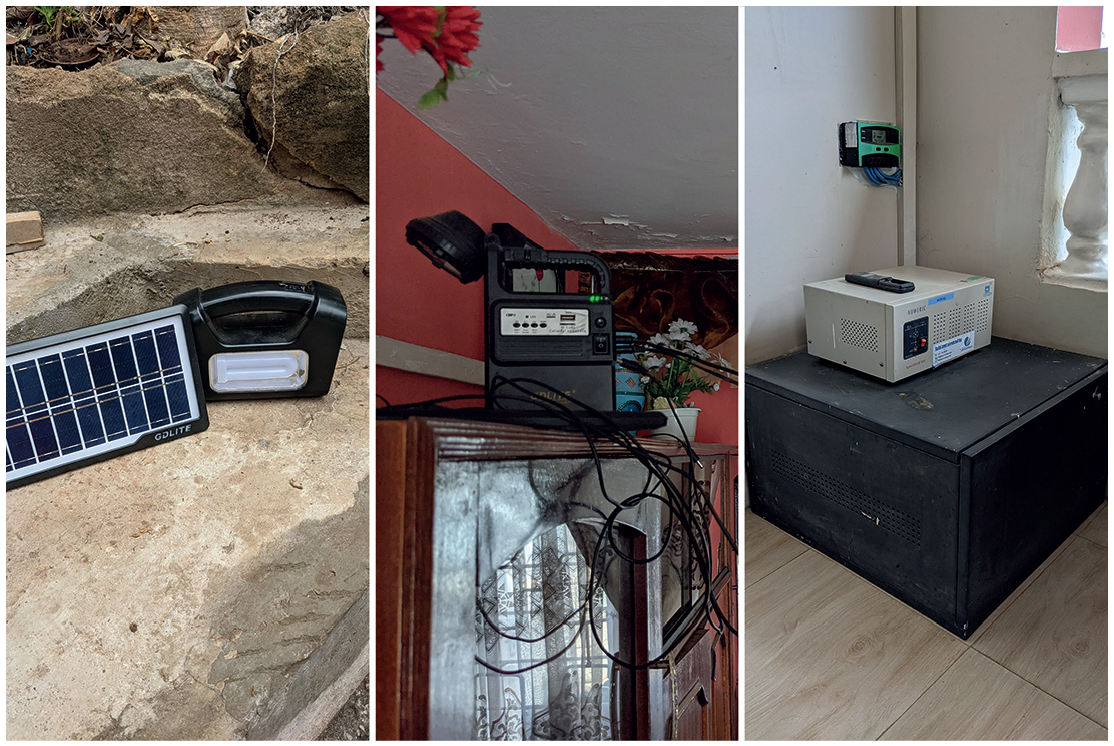
Artefacts of electricity storage in Eastleigh, Buru Buru and Ongata Rongai (from left to right).
What all alterations of domestic electricity storage have in common is that they do not mimic continuous, full-power supply but provide a base level for electric necessities (e.g. light) and a temporally limited fix until regular, networked supply is restored. With some exceptions, however, electric storage artefacts in Nairobi are yet again ‘intermediary infrastructures’ (Millington, 2018) in between households and a networked system. As urban life increasingly depends on electronic, digital communication and work, the artefacts used and the daily routines of charging – automatically or deliberately – have become important to the electro-infrastructural functioning of Nairobi as of today. Yet, batteries play also an increasingly crucial role in (urban) energy transitions in Kenya and elsewhere. With a global push towards renewables, e-mobility and smart technologies, electricity storage technologies are poised to become even more prevalent in the large and small infrastructures of nations, cities and households (cf. Gold and Foldy, 2021; Ngugi and Munda, 2021; Republic of Kenya, 2019; Xylia et al., 2019).
While an in-depth exploration of battery-supported electricity generation by households in Nairobi is beyond the scope of this paper, we want to highlight that the city and its surroundings have experienced a surge in small-scale domestic solar-power, with which homeowners move away from the networked city. Scope and technicalities vary but solar-power systems are often linked to in-house battery systems (see Figure 2) – similar to water tanks for boreholes – and households usually keep the pre-existing connections to KPLC – either with solar as the back-up or vice versa (resident interviews; key informant interviews; cf. EnDev and SNV, 2021). Should this trend continue, we are likely to see an increase in domestic storage capacities. Through non-generative uses and small-scale storage, Nairobi’s electric storage city is already entangled with networked supply. Through a further ‘splintering from below’ (Kooy and Bakker, 2008), triggered by individual power generation, the artefacts of domestic electricity storage and daily practices of plugging cables, turning switches and monitoring charging levels are now becoming an increasingly important part of the everyday infrastructuring of some Nairobians beyond the network. No matter if in relation to a networked city or its post-networked counterparts, the storage city of Nairobi with its heterogeneous, individual dispositifs is already here and likely to grow.
Storage as infrastructure: Key points, implications and open venues
Our situated exploration of domestic storage needs to be read and understood within multiple transformations that are currently re-shaping Nairobi, such as the increased volatility of water supply due to anthropogenic climate change, ongoing energy transitions, the increasing application of smart technologies and rapid urbanisation (EnDev and SNV, 2021; Guma, 2019; Myers, 2015; WASREB, 2018). These processes are reconfiguring Nairobi’s ‘infrastructure space’ (Easterling, 2016) and residential spaces as well as the conditions of and relations between the networked, post-networked, and storage city. As we have shown, however, domestic storage is already shaping residential architectures, urban spaces and everyday practices, all while it is simultaneously being shaped by place-specific infrastructural supply configurations, available materials, intended uses for stored resources, and individual situations (space, finances, architectures, need and desire to store, tenure status, etc.). Despite the diversity of storage artefacts and practices, it is evident that many Nairobians are constantly infrastructuring the availability of water and electricity by investing in, caring for and using various containers. Looking at all those activities that are hardly subject to formal rules and regulations, Nairobi is not simply a splintering or fragmented networked or post-networked city but, simultaneously or even more so, a city unified in its everyday task to contain resources that are usually flowing or otherwise moving through ‘pipes, cables, wires and tracks’.
All the above considered, it becomes evident that storage of water and electricity – and potentially of other resources – is an elemental part of urban life and infrastructural functioning. The deployed artefacts and performed practices form an ‘intermediary infrastructure’ (Millington, 2018) through which urban households either mimic the idealised, universal supply of the networked city, or find temporal fixes, or even enable a post-networked city. The domestic storage of water and electricity thus works as a buffer– in-between users and systems but also as an enabling buffer for the actual functioning of networked and non-networked systems and individual supply situations – which ultimately makes urban life possible in Nairobi. This enabling, imperative role of domestic storage for urban-infrastructural functioning elevates it beyond the status of an appliance or tool. According to Shove (2016: 246), appliances inhabit a mediating role between infrastructures and people, and constitute ‘the sensitive tips of infrastructures’, but – although they might affect supply and demand patterns – they are not imperative to urban-infrastructural functioning per se. Further, seeing storage containers in Nairobi as ‘ordinary tools’ that only help to perform ‘infrastructural work’ would negate the ‘proliferation of infrastructure’ into domestic spaces and everyday practices, as laid out by Meehan (2014) for water barrels and buckets in Tijuana. Artefacts and practices of storage are arguably located somewhere between systems and household, between our traditional understandings of infrastructure and of appliances or tools. Based on our investigation, we argue however that – at least for the case of water and electricity in Nairobi – domestic storage is more than appliances or connecting tips or stopgap-tools. Storage is infrastructure, and not just as a back-up for acute shortages, interruptions or other crises but as an everyday ‘point of contact’ (Millington, 2018) between households and various supply systems that all depend on it.
The constant and literal visibility of storage in Nairobi – juxtaposed with its relative invisibility in planning, policies and academia – is everything but a symptom of infrastructural failure. Indeed, it is an important part of infrastructuring contemporary cities. Storage ‘becomes a highly visible and charged element of the socio-material apparatus of household infrastructure’ (Bize, 2017: 1) that also shows how inequalities within HICs have diverse effects on different people. Individual water and electricity storage – in its quantities and qualities – depends on the supply dispositifs of households and their spatial, financial and architectural situations. Hence, individual storage is its own socio-technical dispositif, constituted by various, often interconnected containers, other technological artefacts and human actors within and beyond the household. An urban-infrastructural condition with various individual dispositifs emerges from practices and artefacts that all demand space, alterations to architectures, a slot in daily routines, and other practices of charging, plumbing, pumping, filling, plugging, fetching, cleaning, etc. This urban-infrastructural condition – the storage city– does not replace or stand in conflict with the networked city or post-networked city but forms intertwined relationships. While the networked city and post-networked city stand for mutually exclusive yet potentially overlapping urbanisms that revolve around universal, socio-technical networks or the lack thereof, the storage city is embedded in both, binds them together within households and their storage artefacts, and – ultimately – enables urban-infrastructural functioning across the networked/post-networked spectrum.
Implications for a ‘critical urbanism of the networked city’ and city making
Graham and Marvin’s (2001) postulated goal of a ‘critical urbanism of the networked city’ remains on the forefront of urban studies, especially because of expansions beyond the networked city notion. With universal network coverage becoming a ‘crumbling objective’ (Munro, 2020) in many southern cities, we advocate for more academic engagements with infrastructural moments and spaces of storage, confinement, containment and similar phenomena or notions.
For domestic storage of water and electricity, many questions remain open and leave plenty of venues for further investigations, in Nairobi and elsewhere. The materialities and artefacts of storage warrant further research on how and why they are produced, designed, sold, appropriated, maintained, and disposed. In Nairobi, for example, local but internationally connected economies of storage-artefact retail are highly prevalent. The specific activities, the everyday practices of households in ensuring and caring for storage need further unravelling as much as (power) relations, negotiations, potential contestations within, between and beyond households around storage need to be untangled. Additionally, domestic storage stands in relation to other forms of infrastructural storage, for example water tanks of vendors or large reservoirs of utilities. How different scales of storage are connected or rely on each other is as unclear as the specific implications of domestic storage for cohesion, fragmentation and (re)distributions within cities. Lastly, domestic storage can and should be investigated for other resources than water and electricity, such as other forms of energy, digital data and files (e.g. on phones and laptops), or money. When expanding the notion of the storage city towards other resources, we should be aware of the entanglements of different systems of supply and storage (Castán Broto and Sudhira, 2019). For example, water storage for multi-story residential buildings in Nairobi depends on electricity supply, as water needs to be pumped to rooftop tanks, and thus ‘water is powered’ (resident interview in Ruaka).
Ultimately, for present and future cities – especially but not only in the Global South – researching storage can provide new insights and recommendations for urban making through infrastructures. Recent provocations build on critical analyses of urban infrastructures in Africa to provide propositions to explicitly influence ‘decision-making processes with a diversity of possibilities for action grounded on situated knowledges and practices’ (Baptista and Cirolia, 2022: 936; see also Lawhon et al., 2022). Accordingly, the notion of the storage city, and further related research, may provide material for various disciplines of city-making – from design (e.g. of containers) and architecture to urban planning and governance – to reimagine and ultimately deploy place-specific infrastructural articulations beyond networks and flows.
Footnotes
Acknowledgements
A first draft of this paper was presented and discussed during the Beyond Splintering Urbanism workshop in March 2022. We want to thank the organisers, discussants, and other participants – especially Andy Karvonen, Jon Rutherford, Colin McFarlane, Alan Wiig, and Jochen Monstadt – for their critical and influential feedback.
Declaration of conflicting interests
The author(s) declared no potential conflicts of interest with respect to the research, authorship, and/or publication of this article.
Funding
The author(s) received no financial support for the research and/or authorship of this article. The open access publication of this article is supported by SAGE’s Open Access agreement with German Academic Institutions.
