




Abstract
Across Africa, cities have become fodder for grand-scale foreign investments and redevelopment projects signifying a distinct phenomenon synonymous with a new kind of urbanism. This paper offers a critical commentary on the proliferation of new infrastructure plans tailored as policy, technological fixes and solutions to urbanisation challenges, both real and perceived. We stir a conversation around the notion of ‘plug-in urbanism’: first, as an entry point for the study of a model of city building that is exceedingly determined by reflex prioritisation of assumedly universal and transferable corporate-driven policy agendas; secondly, as a critique of unidirectional, homogenising and determinist technological ideas and infrastructures; and thirdly, as a recourse to inclusive and holistic planning. We present the case of the Nairobi Expressway, a recently launched two- to four-lane 27 km viaduct, and the largest in Africa, as an example of a ‘plug-in’ infrastructure project: i.e. pre-packaged state-of-the-art development installation that comes complete and tailored as a magic bullet and obvious solution to identified mobility and transport challenges in Nairobi city. We demonstrate how in its parodic guise, the expressway highlights a project that is designed and financed by foreign authorities and sustained in line with foreign standard ideologies of what a world-class city should look like, yet in reality only leads to piecemeal and incomplete growth and development. Drawing from a standpoint of multiple urbanisms, we argue for more inclusive urban futures and visions that are responsive to diverse, popular and heterogeneous articulations of cities.
Introduction
In recent decades, African countries have embarked on a series of ambitious projects, with the goal to rebuild their infrastructure, achieve socio-economic development, and deliver modern and sustainable futures. Mounting interest in the region’s ‘infrastructure gap’ (Goodfellow, 2020; MGI, 2016) has seen peripatetic actors, networks of domestic and international development specialists and economists mobilise an infrastructure agenda around different kinds of best practices and global standards based on the promise of ‘fixing’, ‘closing’ or ‘plugging’ such gaps (AfDB, 2018; MGI, 2016). Touted as the ‘last development frontier’ (Watson, 2014: 216), Africa’s cities have become increasingly appealing as fertile grounds for corporate-led models of city building and development that correspond to set standards of finance, planning and service delivery. We refer to these models as ‘plug-in projects’: go-to projects that come complete from elsewhere, designed and conceived as obvious solutions to identified problems, and inserted or ‘pluggedin’ under the presumption that they are the ‘missing link’ in a puzzle, whereupon placing the right piece and guiding it to the right spot within the bigger picture, everything else is expected to ‘fall into place’.
In this paper, we offer a nuanced and critical understanding of a kind of urbanism that is shaped by the proliferation of new infrastructure plans and projects tailored as magic bullets, technological fixes and solutions to real and perceived urban problems. We stir a conversation around the notion of ‘plug-in urbanism’ to offer firstly, an entry point for the study of a model of city building that is exceedingly determined by reflex prioritisation of assumedly universal and transferable corporate-driven policy agendas, secondly, a critique of unidirectional, homogenising and determinist technological ideas and infrastructures that come as complete and prepackaged solutions, and thirdly, a recourse to inclusive and holistic city planning and development. On this basis, we argue for a model of city building that transcends blind faith in plans and projects which reflect what we refer to as a ‘parodic guise’: meaning plans and projects that while tailored to align with globally sanctioned trademarks and ideologies, are not suited to situated contexts; and while installed as obvious solutions and technological fixes, do not achieve their intended outcomes.
Accordingly, we draw from extensive reflections and collective deliberations relating to infrastructure development in city building processes in Africa, as well as ongoing research work on mobility infrastructure in Kenya since June 2020, to offer an illustrative case of the Nairobi Expressway, a two- to four-lane 27 km (17-mile) viaduct, that was officially opened to the public in July 2022. Built within the existing median of three major routes (Mombasa Road, Uhuru Highway and Waiyaki Way) and 10 interchanges in Kenya’s capital, Nairobi, the expressway is a first of its kind in eastern and central Africa, and is the largest expressway in Africa. It is part of the Northern Corridor, a crucial East African transport network that provides passage to 85% of cargo destined for several countries in the region including Uganda, Rwanda, Burundi, the Democratic Republic of Congo and South Sudan. As a plug-in project, the expressway comes complete and pre-packaged as a state-of-the-art development installation (Ambani, 2022; Mwangi, 2021); and is planned, conceived and advanced as a go-to solution and technological fix to Nairobi’s real and perceived mobility and transport challenges (Gakweli, 2019; Kamau, 2021). In its parodic guise, the expressway manifests a model that is financed and designed by foreign authorities, sustained in line with neoliberal and market-based ideologies as a public–private partnership, and promoted as the way of the future (The Standard, 2021). It mimics and replicates foreign standards, ideals and trademarks of what a ‘modern’, developed and ‘world-class’ city is or should look like (GoK, 2007, 2008; Sawlani, 2022), yet in reality, it only leads to piecemeal and incomplete growth and development.
We situate our critique in urban studies, bringing into the conversation perspectives of urban development, infrastructure planning and policy mobilities, to reorient our views of city building and development in the current context of global circulations, international flows and technological advance. Drawing from a standpoint of multiple urbanisms, we make a case for development that is inclusive, holistic and continuous, and one that considers the multi-dimensionality of urban formations, diversity of urban trajectories, and the needs of all citizens.
Plug-in urbanism through the lens of infrastructure
Infrastructure – especially large and complex socio-technical systems such as toll roads and highways, ports and railway lines, and broadband ICT and smart grids – has become a defining element of modern human social life central to how we think, plan and build urban regions and cities everywhere. Beyond their conventional conception as ‘the physical components of interrelated systems providing commodities and services essential to enable, sustain, or enhance societal living conditions’ (Fulmer, 2009: 30–32), infrastructure also constitutes a wide range of socio-political and cultural compositions. In urban studies, Graham and Marvin’s (2001) ‘Splintering Urbanism’ expands our view of infrastructure planning and development beyond the ‘modern infrastructure ideal’ of universal, uniform, networked coverage. Drawing scenarios from the development of flyovers, freeways and urban mobility in the Global South, Graham (2018) has demonstrated how the prioritisation of complex, networked and privatised tolled highways privilege the mobility of more affluent commuters, creating fast and ‘premium’ topological connections between emerging ‘islands of affluence’ while ‘bypassing’ intervening areas and bottlenecks at the surface level (see also, Graham and Marvin, 2001). Many scholars have offered different case studies from numerous urban regions across the Global North and South highlighting the impracticality of providing infrastructure through the ideal of universal, uniform, networked coverage (see e.g. Coutard and Rutherford, 2015). Yet this ideal continues to epitomise planning practices in many cities across the world, where plug-in projects are continuously promoted as the main, if not only recognised, organising reference in city building processes.
Over recent years, there has been an increase in the study of new globally connected and infrastructurally integrated megaprojects in Africa. Literature around transport systems and networks has been particularly interesting in highlighting African countries as new frontiers for infrastructure development and investment. This literature has examined recent spates of new intercity roads and railways (Goodfellow and Huang, 2021; Lesutis, 2022), highways, expressways and flyovers (Kimari, 2021; Mulwa, 2019), tram lines, light rail and dedicated bus lanes (Jacobsen, 2020; Wood, 2014), and related and complementary works (Enns and Bersaglio, 2020). In this literature, transport systems and networks are cast as domains that are animated by complex governance relationships and socio-economic concerns (Cirolia and Harber, 2022; Kimari, 2021), developmentalist aspirations, corporatist fantasies, colonialist legacies (Enns and Bersaglio, 2020; Lesutis, 2022) and new territorial and geopolitical trends of urbanisation (Wiig and Silver, 2019). These processes reflect ongoing infrastructure-led development in Africa where centralised forces at global, national and municipal scales accentuate the region’s ‘re-enchantment with big infrastructure’ (Enns and Bersaglio, 2020; Nugent, 2018) or what Kanai and Schindler (2019) have referred to as an ‘infrastructure scramble’.
As such integrated projects continue to unfold and gain traction, it becomes imperative to place them in the context and process of urbanism in which African cities are becoming sites for a new era of grand-scale investment at the heart of processes aimed at ‘plugging’ cities into global development discourses and value chains of policy ideas and practices. It is the aim of this paper therefore to draw attention to this kind of urbanism.
First, we question the homogenising and one-size-fits-all technological ideas and infrastructures that come complete, tailored and pre-packaged as obvious solutions to real and perceived urban challenges. Not only are such technological ideas and infrastructures problematic as installations that are dependent on exclusive models and technocratic doctrines, they are based on the hyped rhetoric of Africa’s infrastructure deficit and ‘gaps’ which as Goodfellow (2020) has rightly argued, is based on the misconception of Africa as a region whose burgeoning megacities lack substantial infrastructure. Our argument of plug-in urbanism questions the reductionist thinking of infrastructure deficits and gaps to be filled, closed or plugged, and draws attention to the actually existing infrastructure, including highly decentralised, incremental and popular forms, which for some elites and technical experts does not often amount to infrastructure ‘as we know it’ (
Second, we challenge exclusive models and doctrines determined by universal and transferable corporate-driven policy agendas of city building. We draw from ‘policy mobilities’ discourses that demonstrate how knowledge and capital circulate around the globe and how they are mediated, (re)moulded, and operationalised (McCann and Ward, 2011). ‘Policy mobilities’ studies show us how policies travel and how they land in particular contexts, rising ‘to the status of “models” or objects of emulation’ (Peck and Theodore, 2010: 170). Wood (2014) for instance shows how cities inherit technological machinery, technical capacity and development finance through visits across countries in the global economy of circulating ideas. We contend that such models and doctrines in and of themselves are not to be denigrated simply for mirroring utopian hype and emulating foreign ideals, ideas and expertise – after all, such models and doctrines have worked and prevailed in some of the world’s most admired cities. Rather, we critique the reflex and unquestioned faith in such parodic spatial plans and blueprints as the main and sometimes only organising reference for planning cities everywhere.
Third, and following our critique, we offer recourse beyond plug-in and parodic plans, towards more inclusive and holistic city building. We posit that urban planning and development processes ought to transcend linear, dominant and monolithic understandings of infrastructure and acknowledge the heterogeneity, incompleteness and open-endedness of infrastructure ‘not solely [driven] by neoliberal interventions’ (Guma, 2022; 60; see also Guma, 2020; Lawhon et al., 2018; Simone, 2004). As Simone (2019: 618) encourages us, we need to appreciate the role of ‘popular economies’ including ‘the variegated, promiscuous forms of organizing of things […] as well as the provision of social reproduction services that simultaneously fall inside and outside the ambit of formal capitalist production’ (see also, The Urban Popular Economy Collective et al., 2022). Consequently, our argument of plug-in urbanism offers a proposition for a vision of city building that takes into account multiple and diverse urban populations, formations and trajectories.
Nairobi Expressway as a plug-in infrastructure project
The Nairobi Expressway offers a great example of a plug-in infrastructure project in an African city. As a plug-in project, the expressway embraces standard models and heavy foreign influence and is sustained in line with corporatist and market-based ideologies through its public–private partnership model. It is an integrated, networked and extensive state-of-the-art development project (see, Figures 1 and 2) that has been advanced as a magic bullet and inserted or plugged as a technological fix to urban and transport problems, both real and perceived. While its conception dates back to 1997, the expressway was officially approved by the Kenyan Cabinet in 2009, but only deployed in 2020 – more than 20 years after its conception. Its delayed implementation was because the World Bank, as the main financier at the time, declined to fund the project in 2011 until Strabag, the then contractor, complied with its social and environmental safeguards, and land acquisition and Kenyan legal provisions (Mulwa, 2019). In 2016, the World Bank finally committed to provide US$380 million to the project, with construction anticipated to start in December 2016, but these plans still did not happen partly due to environmental concerns about the project (see, Cetric Africa Limited, 2020). It was in October 2019 that President Uhuru Kenyatta officially launched it, with the China Road and Bridge Corporation and its parent firm, China Communications Construction Company, as financier, designer and constructor (Cetric Africa Limited, 2020). But even then, the actual work of building only commenced in June 2020. After almost three months of public trial, the road was officially opened on 31 July 2022 by President Kenyatta. While the entire project was originally estimated to cost KES 65.2 billion ($599m), the cost went up to KES 87.9 billion – apparently due to design variations and increased costs of the required construction materials.
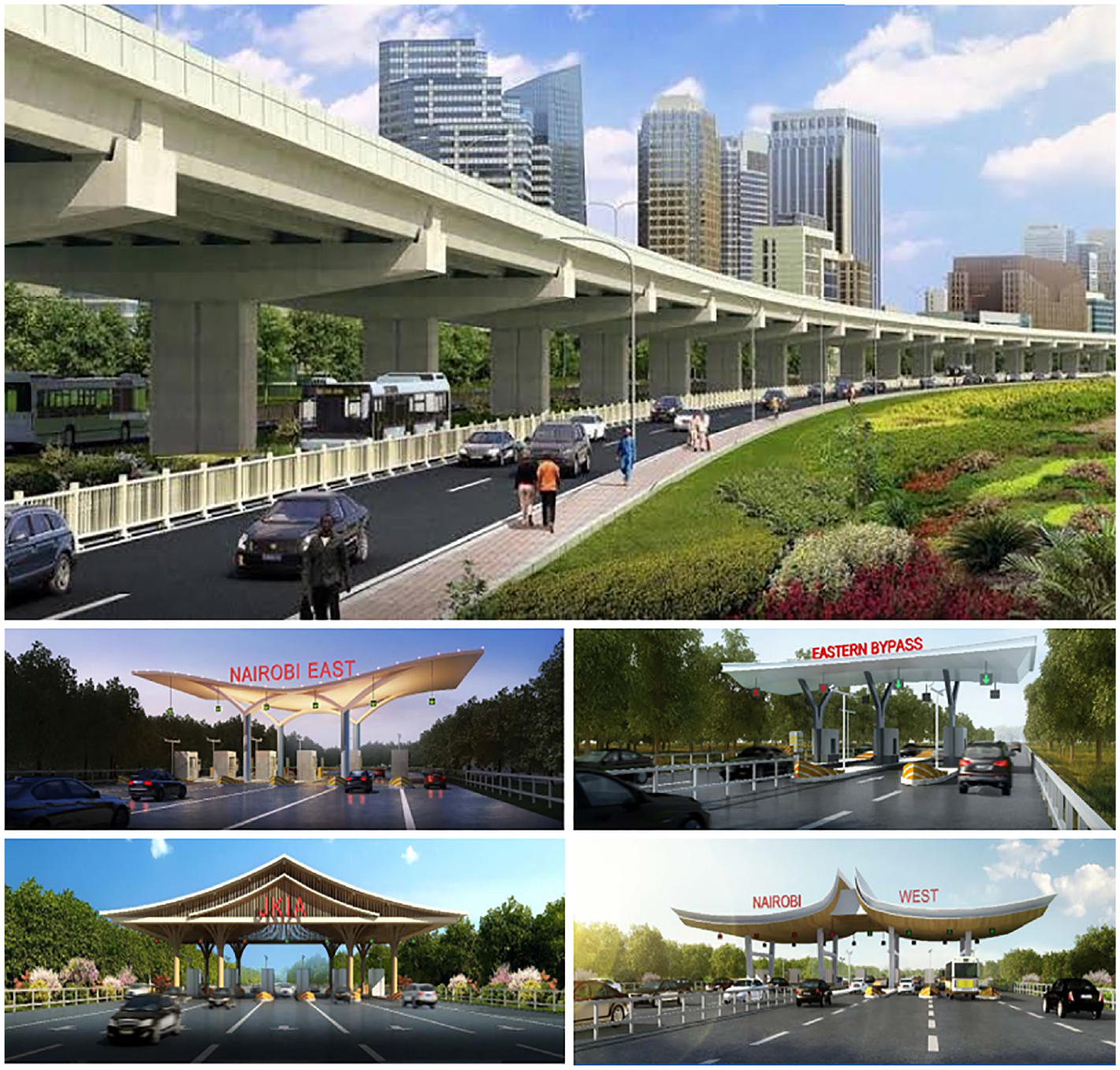
Artist impressions of (1) what a fully completed Nairobi Expressway would look like and (2) four (of 27) toll stations that highlight China’s visibility and sway in the architectural design and aesthetic embodiment of the infrastructure.
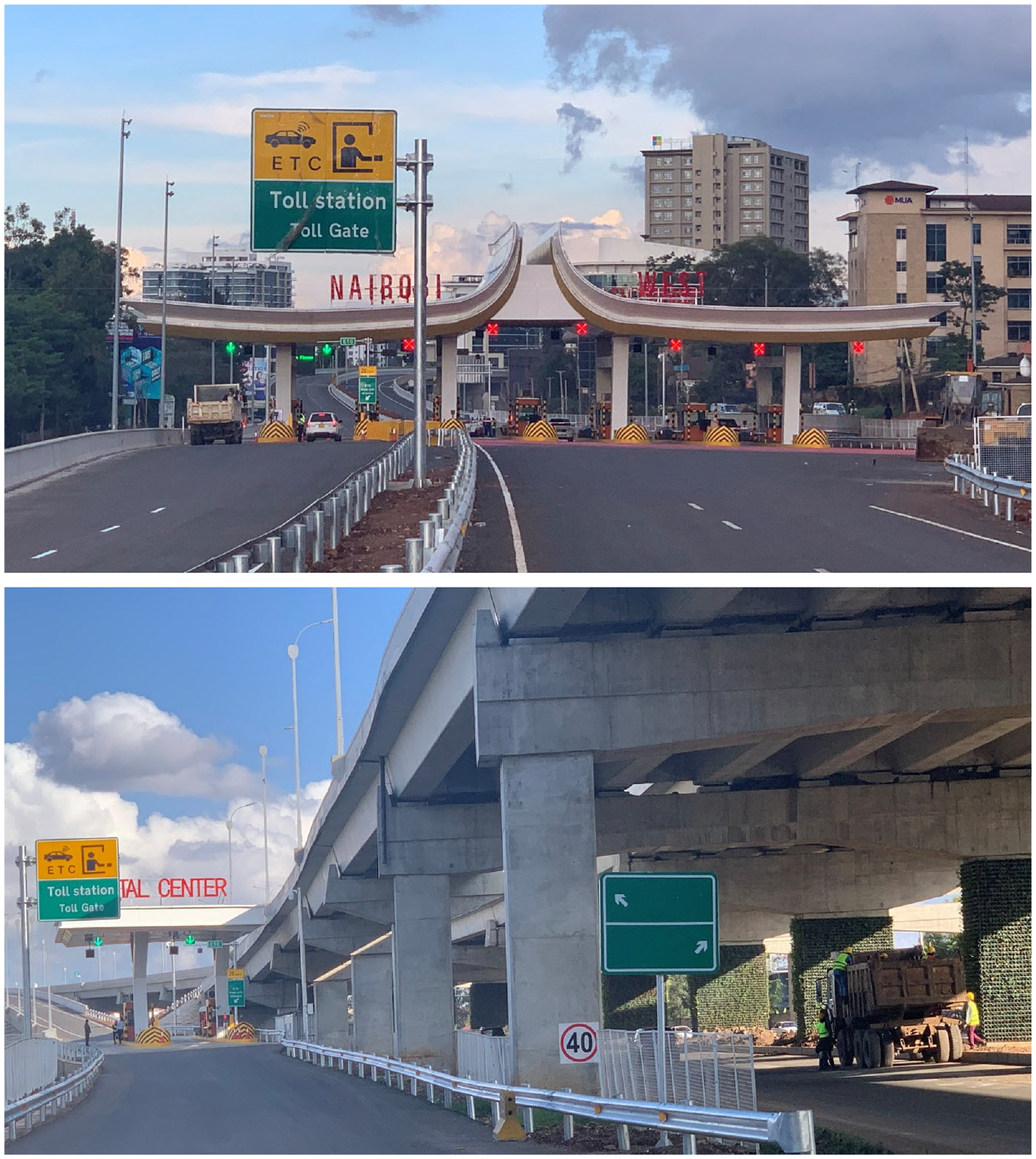
Images at the finalisation of the Nairobi Expressway construction shortly before its official inauguration.
Both in its conception, design and deployment, the expressway is an exemplary project in the framing and construction of Nairobi’s global, developmental and modernisation status. It ostensibly ‘plugs’ Nairobi into the global wheel of circulating ideas, finance and capital and sets the city on the path to being an international city. More implicitly than explicitly, the expressway echoes dreams and aspirations of master plans, including the ‘Nairobi Metro 2030 Strategy: A Vision for a World-Class Metropolis’ which encapsulates wider motivations to transform the ‘face of the city’ into a ‘global hub’ and ‘world-class metropolis’ through integrated, modern, networked and state-of-the-art infrastructure by the year 2030 (GoK, 2007, 2008). The Nairobi Metro 2030 Strategy was co-developed by McKinsey and Company, a global consultancy firm that has completed similar projects for cities like Mumbai in India. As a plug-in infrastructure project, the expressway seeks to homogenise the city-scape along the lines of the Nairobi Metro 2030 Strategy’s idea of urban modernity. It espouses universal standards and best practice models of city building and embodies Nairobi’s growing desire to build a networked city through hegemonic and globally circulating benchmarks.
For many global investors and domestic technical experts and practitioners in Nairobi, the expressway is a technocratic response and solution to mobility challenges in the city. The government’s most clearly stated objective for the project is to ease traffic congestion resulting from a soaring consumer middle class, rapid population growth, urban migration and vehicular volume in and out of the city centre (Gakweli, 2019). Thus, the expressway was expected to improve connectivity of goods, services and people between Nairobi and Kenya’s Northern corridor that provides passage to 85% of cargo destined for neighbouring landlocked countries, such as Uganda, Rwanda, the Democratic Republic of Congo and South Sudan. It was publicly applauded as the ‘missing link’ that would bridge Kenya’s critical infrastructure deficit (The Standard, 2021), the ‘game changer’ that would ease traffic congestion (Karumba, 2022), and a great determination for the future (Kiruga, 2022). For example, the Director General of Kenya National Highways Authority Peter Mundinia has been quoted saying, The Nairobi Expressway will bring much needed relief to the traffic congestion in Nairobi. It will significantly reduce time spent on the road from two hours at rush hour to 10 to 15 minutes. (Kamau, 2021: n.p.)
What is particularly interesting about the above quote, besides the fact that the expressway has clearly not provided this envisioned ‘relief’ six months since its launch, is that it highlights how technocrats and elites anchored their justification and logic for the expressway as a technological fix and antidote to the city’s perennial problem of vehicular congestion and other mobility-related challenges in the city. Technocrats saw the expressway as the SI (system international) unit or standard measure for (urban and infrastructure) development, a project that would reconfigure urban mobility and transportation fundamentally, or at the very least, ‘bring much needed relief’ to the traffic challenges in the budding city. Yet in reality, the expressway is simply a plug-in, in other words, an injection of a system that will neither eliminate the old road along its path, nor shift development to a superior mode, but rather simply offer a flyover option (among different other options) for those that can afford it.
The parodic guise of the expressway in Nairobi
Although it is not necessarily a project that was developed with comic attempt, the expressway inevitably ends up as a parodic venture especially to observers and residents who view it as a stereotypical copy and imitation of a foreign idea and an ill-fitting fetish of a project that in reality fails to reflect actual needs and demands on the ground. Indeed, the Transport Cabinet Secretary, Macharia, in a candid interview that aired on one of Kenya’s leading television stations, narrated how the whole plan for the implementation of the expressway was hatched in Beijing in 2019 out of the Kenyan delegation’s fascination with Chinese highways and infrastructure: We arrived at Beijing Airport and we were taken to Beijing city—it took about 25 minutes because the highway had six lanes on both sides and when we got to dinner, we asked our hosts: ‘How did you do this road? It’s fantastic!’[In our discussion, we asked whether a similar project can be done in Nairobi, they reflected on it and made a decision the same night.] I recall [calling] the president that same evening [after the discussion with our hosts] and the president was actually quite excited about the idea. That same night he called the Treasury Cabinet Secretary to board a plane to China ASAP to join the discussion. (Mwangi, 2021: n.p.)
While it is not completely out of order for policy makers to learn from projects elsewhere or for bilateral engagements to be muted over dinner between government delegations and other stakeholders, for a project of this magnitude, with the cost and risk of the expressway, it ought to have required more critical consideration. Yet, what becomes clear from the Cabinet Secretary’s words is that the project was driven mostly by the urge to replicate a foreign model based on a foreign encounter, where aspects of the project’s actual feasibility and viability only come as an afterthought (The Standard, 2021). In other words, it is not a project that is consciously anchored in the actual needs and realities of Nairobi, but one heavily entrenched in foreign standards, designs and expectations.
On a mission to inspect the progress of the expressway’s construction in Nairobi, the same Cabinet Secretary quipped, ‘We want to “gift” Kenyans this facility as soon as possible’ (Kimuyu, 2020). This statement in its general sense alludes to the expressway as a public good and a ‘gift’ from the state for all citizens. However, the irony here lies in the fact that the expressway is simply a business-oriented, profit-driven venture, designed to operate on a pay-as-you-use model as per the 30-year concession agreement in which China Road and the Bridge Corporation take 100% of the revenue risk as the investors who will manage the highway through a subsidiary, Moja Expressway, to recoup its investment (Ambani, 2022). Thus, motorists who use the expressway must pay fees operationalised in the form of toll charges, which according to a Government Gazette notice are between KES 100 (US$ 0.9) and KES 360 (US$3.0) exclusive of VAT. The pay-as-you-use model is not a new practice of road management in Kenya, where toll fees were introduced for the first time in the late 1980s but scrapped in the mid-1990s in favour of the road maintenance levy that is currently charged at KES 18 per litre of petrol and diesel. Yet, the fact that these fees are incredibly high for the urban majority and unaffordable to many has led to public outcry from residents who now view the project as an exclusive venture ‘with little value’ for most Kenyans (Kinyanjui, 2022: n.p.).
Beyond its inherently exclusionary nature as a road that is less easily accessible and affordable to the majority of residents, the expressway does not solve half of Nairobi’s mobility challenges since the urban majority mostly use popular commuter services where paratransit and mass transit solutions and considerations are required. For example, 48% of urban dwellers in the city complete their commute either with matatus (public transit vehicles, which form the largest mode of motorised commute) and motorbike taxi (locally referred to as ‘bodaboda’) to travel (Salon and Gulyani, 2019; World Bank, 2016), while up to 40% of all commutes in the Nairobi Metropolitan Area are non-motorised (Kamau, 2021). According to the World Bank (2016), 83% of all trips include walking as either a primary or a secondary mode of travel as people walk the last mile – for example, to supplement other modes of travel. Only 13% of all trips are vehicular (World Bank, 2016). Reliance on non-motorised transport or walking is only likely to rise in tandem with mobility challenges in the city. Yet, the expressway seeks to shape urban transportation around the ‘velocities and demands of the private vehicle’ (Twidle, 2017: 60) at the expense of an all-holistic approach aimed at designing streets with dignified space for all.
It is hard to see how such a plug-in project meets the goals of solving mobility challenges or guaranteeing a better future for Nairobi. As an insertion within the existing median of three major routes (Mombasa Road south of Nairobi, Uhuru Highway across the city centre, and Waiyaki Way north of Nairobi) with 10 interchanges in the city, the expressway is simply a road that primarily connects between Westlands (Nairobi’s prime business district and residential area highly preferred by expatriates), and Jomo Kenyatta International Airport (East Africa’s biggest and busiest airport and vital travel gateway to the region). In fact, it has created even newer mobility challenges for city residents and authorities. Take these two examples: one where some matatu termini have been decommissioned to pave the way for entry toll gates onto the elevated highway without alternative provisions for public transport commuters (Makong, 2022); and another where recently commissioned multi-million pedestrian footbridges have now been demolished to make way for the highway. These examples highlight the extent to which the new highway exhibits socio-spatial inequalities and disparities as well as a total disregard for Nairobi’s social realities, popular economies and spatial fragmentation. They draw us to a pivotal argument of plug-in urbanism where infrastructure does not in fact ‘fix’ or fully ‘plug’ identified gaps, but only opens a Pandora’s box of many unwelcome complications and gaps in development.
In reality, the expressway is simply a project that mirrors a utopian hype. It is imbued with superficially seductive ideas characterised by Nairobi’s masterplans whose aspirations echo values and service levels of the modern infrastructure ideal. It is predominantly a copy and paste project from elsewhere, and more so one that inherits and imitates foreign policy models, technological machinery and architectural styles and designs from China. This is even more explicit for urban residents as one of our interlocutors in her submission noted, The expressway design shows how China is slowly penetrating its way into Nairobi. I feel like I am living in a city that increasingly reminds me of Beijing. (Nairobi expatriate and resident, February 2022)
But even more importantly, the expressway has not necessarily turned out to be the ultimate solution to traffic challenges in Nairobi. Its framing as the ‘missing link’, ‘game-changer’ and guarantee for a better future, while initially raising expectations, is now the basis for ridicule and a source of ironic humour among residents who must deal with its consequences including: the ‘traffic as usual’ within the city, especially on the lower deck; the ‘very pathetic situation’ of roads (that continue to lack proper sidewalks, drainage, lighting and sustentation) elsewhere in the city; and the fact that the expressway investment will mostly benefit Chinese management more than it will the Kenyan government and populace who did not need it and could not afford it in the first place (see, African City Planner, 2022; Sawlani, 2022). What is apparent in Nairobi today is the extent to which the expressway has inevitably disordered the urban landscape, maimed everyday corporeal ecologies of social reproduction, and interfered with the pre-existing flows and patterns of mobility. Nairobi Expressway is likely to remain something of an enigmatic megastructure, one that the urban majority will continue either to protest, to resist or be bemused by through re-proactive articulations and disarticulations.
Beyond plug-in and parodic plans: A recourse to inclusive and holistic city building
This article set out to offer a nuanced and critical understanding of a kind of urbanism that is shaped by the proliferation of new infrastructure plans and projects tailored as magic bullets, technological fixes and solutions to real and perceived urban problems. Drawing from the mobility sector, we have demonstrated how plug-in projects like the expressway reflect a wider trend of city building that is aimed at bringing linearity and regularity to urban space, yet in reality only leading to piecemeal and incomplete growth and development on the ground. We have shown that this trend of city building exemplifies a parodic guise based on foreign standards and doctrines of what a modern and world-class city or infrastructure should look like. In principle, these standards and doctrines are not to be despised or denigrated at face value, since they have worked and continue to prevail in some of the world’s most admired cities. However, we argue that it is necessary to critically assess their viability in different contexts beyond problematic fixes or concepts.
Engagement with the notion of plug-in urbanism is imperative, firstly for approaching such city building and infrastructure development processes. It provides an entry point for examining models of city building that are exceedingly determined by assumedly universal and transferable corporate-driven policy agendas and trends of spatial planning. Secondly, plug-in urbanism challenges homogenising and one-size-fits-all technological ideas and infrastructures that come complete, tailored and pre-packaged as obvious solutions to real and perceived urban challenges. In this regard, the notion offers a prompt for a different way of thinking and planning cities beyond homogenising doctrines that are extremely dependent on exclusive and technocratic models. This is important considering that projects based on extensive, networked and market-based logics cannot be the only organising reference in city building in African cities, nor can they ever fully ‘fix’ or ‘plug’ the so-called gaps in the Global South.
And thirdly, and as a consequence of the above, engagement with plug-in urbanism offers a recourse beyond the reflex prioritisation of plug-in and parodic spatial plans and blueprints, towards more inclusive and holistic city building processes that are responsive to diverse, popular and heterogeneous articulations of cities. In other words, city building processes must strike a balance that incorporates socio-material experimentations and popular economies in city building processes (Simone, 2019; The Urban Popular Economy Collective et al., 2022). Rather than blindly pushing a premeditated set of top down and centralised technological ideas and infrastructures, policy makers, city planners and practitioners must also recognise that infrastructure in reality encompasses vast interventions including small, open and in-situ incremental articulations and resident engineered socio-material and techno-popular modes and experiments in city building processes (Guma, 2022; Lawhon et al., 2018; Simone, 2004). To think of more sustainable urban futures in Africa therefore is to think beyond conventions and categories synonymous with narratives of the ‘infrastructure gap’ (Goodfellow, 2020) towards more open and radically different visions of city building and development that take note of everyday, ordinary and quotidian modes of access.
In the context of the current global urban transition led by cities in the Global South, particularly Africa, newer and even more complex plug-in and parodic spatial plans and projects are likely to increase the urge to realise smarter cities, more resilient cities, and sustainable and connected cities (Guma and Monstadt, 2021). The enduring ecological and imperial injustices and more apparent socio-technical encounters and inequalities are likely to intensify calls for such projects as solutions to real and perceived urban challenges and ‘gaps’. However, it is going to take more than standard master plans, model plans, or development plans and visions to realise a more inclusive and sustainable urban future (Goodfellow, 2022). Thus, we suggest as a departure point development that is inclusive, holistic and continuous, and one that considers the multi-dimensionality of urban formations, diversity of urban trajectories, and needs of all citizens.
Footnotes
Acknowledgements
We would like to thank our key contributors from Nairobi, and everyone who has shared their valuable time and thoughts with us in our ongoing research work in Kenya. We acknowledge the critical comments and insights of the two anonymous reviewers, and the support of the editor at Urban Studies.
Declaration of conflicting interests
The author(s) declared no potential conflicts of interest with respect to the research, authorship, and/or publication of this article.
Funding
The author(s) disclosed receipt of the following financial support for the research, authorship, and/or publication of this article:
This work was partly supported through funding from GlobalCORRIDOR [grant no. 947779] at the Urban institute, University of Sheffield.
