




Abstract
In this article, I describe Mumbai’s sea as an “anthroposea” – a sea made with ongoing anthropogenic processes across landwaters – to draw attention to the ways in which it troubles both urban planning and the making of environmental futures. I focus on three moments in which Mumbai’s more-than-human life now emerges in the anthroposea. First, I describe the surprising proliferations of lobsters, gulls, and fishers in a sewage outfall. Second, I draw attention to the city’s flourishing flamingo population amidst industrial effluents in the city’s industrial zone. Finally, the article floats towards a popular city beach where citizen scientists at Marine Life of Mumbai show the ways in which the city’s phenomenal biodiversity is making homes in and with the city’s plastic waste. I argue that these ongoing and dynamic relations between urban waste and more-than-human life make unstable and tenuous the modernist distinctions of nature/culture on which environmental and urban projects depend. The anthroposea does not easily permit the making of near futures. Instead, by crossing spatial scales and epistemological boundaries, the anthroposea holds the city and its citizens in the muddy materialities of an ongoing present; a present in which the vitalities of waste are intransigent, permanent, and generate life in the city’s landwaters.
Introduction
The picture is of a Koli fisher, featured prominently in a study, Social Ecology of the Shallow Seas, that documents the extraordinary social and ecology diversity that inhabits Mumbai’s urban sea (Figure 1). The study was a response – a rejection of sorts – to a state environmental impact assessment (EIA) that rendered both fish and fishers invisible in Mumbai’s seas (Wagh et al., 2018). Conducted as part of a project to build a new coastal road on reclaimed land, the EIA effectively suggested that the sea was aqua nullius – empty space available for colonization by land.
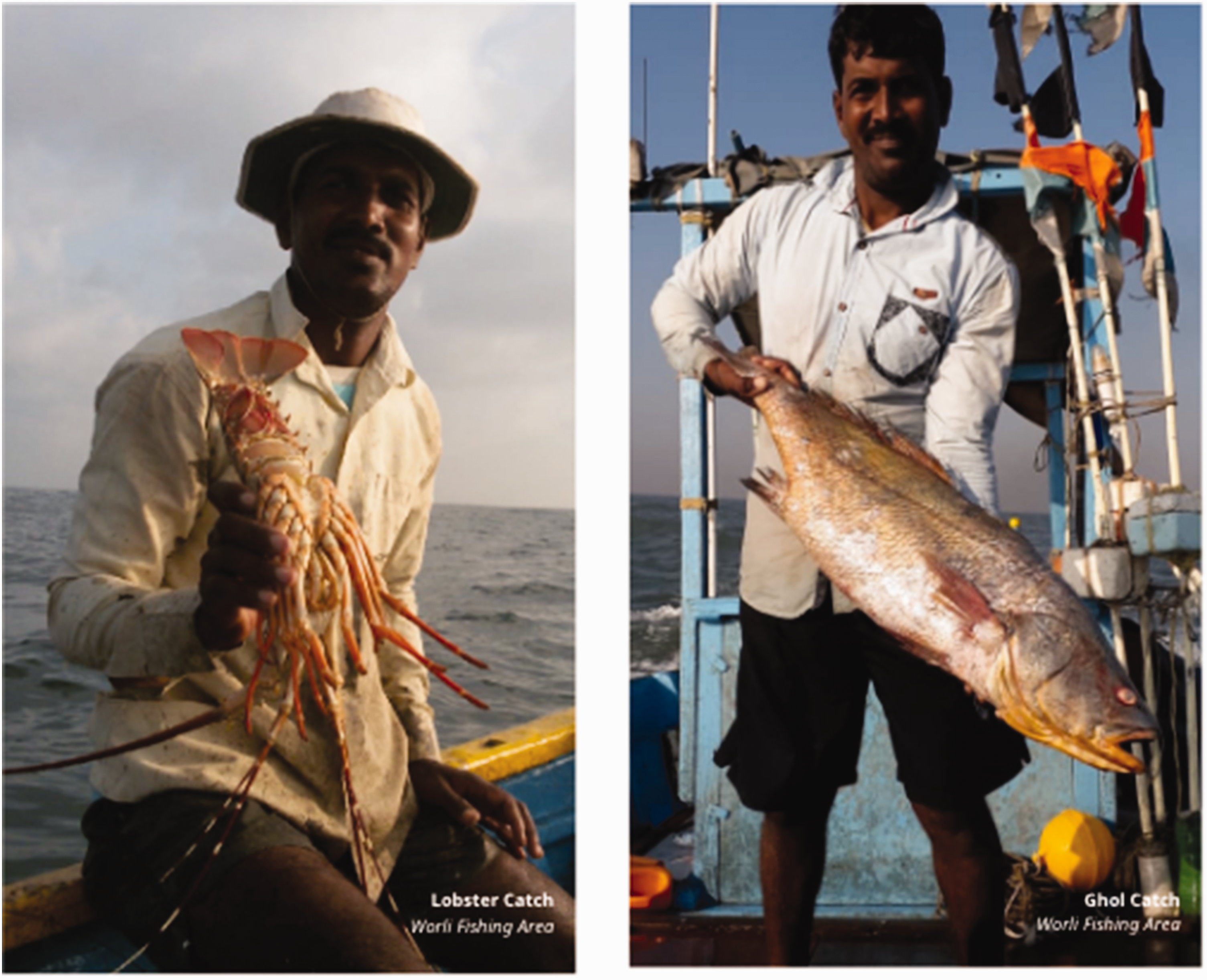
The ecologies of urban fishing. A Koli fisher holds up a lobster and grouper fish that he caught in Mumbai’s seas (Wagh et al., 2018).
In contrast to this claim, the photograph and the study draw attention to the value of non-human life and human livelihood that fills the sea which the construction of the road will bury in concrete. The lobster and the grouper are held as examples of the city sea’s extraordinary fecundity. As residents and activists protesting the road shared in a short video clip released a few months later, “there is so much life in the sea”. Yet, what are these “forms of life and life forms” that emerge in the sea (Helmreich, 2009: 148; Kirksey, 2015; Moore, 2012)? Mumbai’s sea, like other seas, is an “anthroposea” – a sea that is being made not just of water, tides, and non-human biota, but also with the debris, refuse, and metabolic waste of its more than fifteen million human (and nonhuman) residents.
In recent years, research in environmental anthropology and human geography have drawn attention to human and nonhuman life that proliferates in what Bettina Stoetzer has described as ruderal ecologies – “communities that spontaneously emerge in disturbed environments usually considered hostile to life” (Kirksey, 2015; Stoetzer, 2018: 297). Elsewhere, Anna Tsing has described the ubiquity of “third nature”— life that manages to live on, after and despite the detritus of capitalist systems (Tsing, 2005: 3), life that emerges in and from the condition of “permanent pollution” (Liboiron, 2021, emphasis added) of capitalist wastescapes.
In her research in the wetlands of Turkey, Caterina Scaramelli shows how infrastructures are not external to, but produce and exist within more-than human-ecologies (Scaramelli, 2019). Here, waste and rubble here do not merely emerge at the end of urban metabolic processes (Gandy and Jasper, 2017); they are constitutive of feral socio-natures, and are often the literal substrate upon which urban life is staged (Baviskar and Gidwani, 2019: 34; Rademacher et al., 2019; Tsing et al., 2020). 1
Mumbai has been built in the sea over the last three centuries. Like other coastal cities that were rapidly expanded in the eighteenth and nineteenth centuries, this is a city that is made in and on water (Ghosh, 2017; Prakash, 2010; Seasholes, 2003). It is made by cartographic and infrastructural acts that fabricate dry ground by separating it from the city’s subterranean and extra-terranean wetness (Venkataramani, 2021; Mathur and Da Cunha, 2009).1 Its infrastructural dreams and plans – like those of the coastal road I began this article with – have long been oriented towards generating a stable, solid, dry future. The sea, in these plans, is rendered passive, the wet grounds for the staging of the global city in the present and for the future.
Urban planning and infrastructure construction processes are inherently future oriented and optimistic projections. Plans generate possibilities for urban space by extending time (Abram and Weszkalnys, 2011). They depend upon technologies to enact categorical separations (between the dry and wet, culture and nature, politics and technics) to project urban futures. Plans bring urban futures into view. For example, a five-year plan, for the city (Chatterjee, 2000) requires both spatial and/or temporal boundaries to be fixed (e.g. the boundaries of the city, or for specific environmental resources to be protected) for the normative goals of planning (say of public health, or of sustainable fisheries) to appear as sites (grounds) and objects (figures) of intervention. Urban agencies are activated and empowered in the present by wielding futures; futures that are made thinkable through delineations and differentiations of categories, spaces and times made in the development planning process (Barad, 1996: 182; Bear, 2014).
In this article, I argue that if the infrastructures of modern urban planning provided “handrails” with which urban futures could be imagined and brought into being (Tsing, 2015: 2), the accreted effects of urban planning in the anthroposea have made it difficult to apprehend near futures in their wake. The ongoing mixes of the anthroposea do not provide a different set of promissory notes or alternative futures to which cities in the sea can be moored. Instead, the anthroposea is held together by the fraught ways of “being alive” in the ongoing present (Ingold, 2021), amidst the detritus-filled aftermaths of modern urban infrastructures (Benjamin, 2002; Gordillo, 2014).
Anthropologist Jane Guyer has described how the near future – a vital horizon of imagination and possibility – disappears from view among neoliberal and evangelical communities in Nigeria. For Guyer, the near future is “experienced as a kind of hiatus, whose intelligibility is explicitly in abeyance.” It is a future that is absent from the transition stories that were explicit in developmentalism (Guyer, 2007: 413). Building on Guyer’s work, I draw attention to the ways in which the near future is also disappeared from the view of fishers and ecologists working in Mumbai’s anthroposea. Living amidst the cascading catastrophes produced by urban development (and the proliferations of life these generate), Mumbai’s fishers and ecologists do not just demand a near future free of pollution; a near future in which the relations between the city and the sea, or the materialities of waste and food are settled and ordered through urban plans and projects. Instead, as they grapple with the anthroposea’s muddy materialities, their work draws attention to the vitality of dwelling in an ongoing present. Dwelling and making life in seas of excess, they insist that the vitality of non/human life in the anthroposea be allowed to continue, in all of its fraught murkiness.
To substantiate this argument, I think with the uneasy and unsettling ways in which Mumbai’s prodigious more-than-human life has made homes in the anthroposea’s muddy materialities. I first describe the surprising appearances of sewage, lobsters, and fishers in a volatile part of the anthroposea to urge an attention to the presence of life amidst detritus. Second, I draw attention to the city’s flourishing flamingo population in what has historically been its industrial core. Finally, the article floats towards a popular city beach, Juhu Beach, where citizen scientists at Marine Life of Mumbai (MLOM) showed me the ways in which the city’s biodiversity is making homes in and with the city’s debris. By focusing on the ways that flamingoes, lobsters, and shell binder worms make the city’s intertidal wetlands home, I suggest that their practices compel a reimagining of what the urban environment, or environmental restoration, might look like in the Anthropocene; a duration in which the Anthropos plays a constitutive role in composing the sea (Bergson, 1921).
This article is based on research that I conducted between 2015 and 2021 in Mumbai – including 12 months of continuous fieldwork in 2018–2019 – with fishers, scientists, and city officials. During this time, I conducted participant observation on fishing boats, accompanied amateur and professional scientists on fieldtrips to coastal and intertidal regions, and conducted semi-structured interviews in planning and environmental offices of state agencies. In addition, I also analyzed articles in news archives and city planning documents (e.g. the city’s development plan, storm water networks, coastal reclamation project documents, and so on). Finally, as the city proposed and proceeded to build a massive coastal reclamation in and across many of these regions, I shared information and analysis with groups (fishers, environmentalists, and neighborhood organizations) organizing for environmental justice in the city. Eager to decenter this ethnographic work and to situate it in and with the city’s academics, experts, artists, and activists thinking about the city’s intertidal regions, I also conducted collaborative and multimodal research on the city’s Inhabited Sea, with several of these groups. The resulting papers, films, images, and drawings are all accessible online at www.inhabitedsea.org, and inform this research.
The coloniality of planning
From its beginnings as a ring of islands connected by wetlands that would fill with the high tide twice a day, the colonial city of Bombay has been gathered and dried by a series of infrastructure projects over the last 200 years. New techniques of cartography enabled large engineering works that separated the city from the sea. Colonial officials in the eighteenth and nineteenth centuries dried the amphibious tidal flats by filling it with earth, building sea walls and breaches that blocked the passage of water through the heart of the city. Together, these projects produced a significant amount of dried urban ground from what was once sea or sodden earth. Yet, as Anuradha Mathur and Dilip da Cunha point out, “reclamation, did not just make land, [it] positioned land against the sea” (Mathur and da Cunha 2009: 19). Further, reclamation and cartographic representation didn’t just make Mumbai visible. They also made the sea invisible, as a useless empty space available for the terrestrial city to appropriate (Seasholes, 2003).
Rendering the sea invisible was a key technology of colonial planning. In her work on water rights in Australia, indigenous legal scholar Virginia Marshall (2016) describes an ongoing set of legal maneuvers by the Australian state to not see prior uses of water bodies on one hand and to see land and water as distinct formations in property law on the other, even though their realities are more muddy. She calls this the doctrine of aqua nullius. Aqua nullius, she shows, is a fiction that is brought into being to permit (legally and figuratively) the colonization of water – or what Isabel Hofmeyr (2019) evocatively calls “hydrocolonialism” – by the masters of private property. Elsewhere, I show how hydrocolonialism is at once a forceful intervention that dispossesses indigenous residents by separating the city from the sea, while at the same time permitting a series of urban infrastructures to occupy the sea both with ground, and with waste (see also Mulrennan and Scott, 2000). Put differently, hydrocolonialism is key to the production and the forgetting of the sea as an anthroposea.
Gyan Prakash (2010) identifies this process accurately when he argues that Bombay has been made by a double colonization. It has been constituted by the colonization of both native subjects by the British, and the sea by the logics of land. While the first colonization has ended, the second colonization continues to this day. Today, colonial relations endure in ongoing projects that remake the landwaters of the city into public and private property (Roane, 2022). In Mumbai, on one hand, massive landfill projects like the Coastal Road project continue to fill the city with earth, further encroaching on the littoral fishing grounds of the city’s Koli fishers. On the other, the city silently uses the sea as a passive container for the discharge of its solid and liquid wastes (Anand, 2022). Over the last four decades, the city sewerage department has, with the World Bank, designed massive sewage outfalls that release a significant amount of untreated sewage into the sea.
Both the road and the sewage outfalls now constitute the sea. Its tidal patterns, ecologies and chemical composition are composed with the city’s food, its ecologies and its waste. In Mumbai, colonial projects to fill in the sea with landfill and waste endure. They are urban projects that make the sea a space of deep ambivalence and uncertainty (Callon et al., 2009; Paprocki, 2021; Thompson et al., 1986). In Mumbai, as in other cities, sewage, storm water networks, rivers, and seas are braided in ways that preclude the conceit of urban infrastructures that seek to perform a separation of the city and the sea. As such, the sea is not a space of nature beyond the anthropogenic city. It is an anthroposea, made an ongoing spatial process in which infrastructure and ecology are deeply intertwined (Bhattacharyya, 2018; Scaramelli, 2019). 2
Today, urban planning formally ends at the coastline. Planners do not concern themselves with the near futures of the anthroposea. While urban infrastructure projects are situated in and depend on the sea, planners see the sea as beyond the boundaries of their interest and intervention. In their plans, the sea appears as empty, as undifferentiated and homogenous nature, as water in the singular, as a stable backdrop on which the city is staged. Even in the ongoing present, amidst rapidly rising seas, the increased likelihood of cyclones, and the regular occurrence of garbage tides, planners in the city are simply not concerned with the futures of the anthroposea.
Despite the city being built on and in the sea, planners I spoke with in Mumbai would insist that the sea was a matter that was beyond the domain of urban planning. “See, we call it land use planning”, Malini Krishnankutty, a professor of urban planning, told me wryly, when I had asked her why coastal dynamics were not considered in urban planning projects. For planners she worked with, the anthroposea was not the surrounds of the city; a world in which the city was enmeshed and made with. If the sea was visible in urban planning documents, Dr. Krishnankutty pointed out, it was only when it was identified as a future resource, as ground that might one day be available to planners to use (such as wetlands). The near futures of the anthroposea were not their concern if they did not have to do with making it land.
Aditi, another senior planner in the city’s regional development agency underscored the point Dr. Krishnankutty made days before. Spatial planners in the agency, she pointed out, were not concerned about climate or the sea. They had limited “capacities” to think with the different social and ecological relations of the anthroposea while making plans. For spatial planners, she pointed out, the imperative was to “do justice to the question of finite land”; to develop the most optimum occupations of that land to further economic activity. The sea, she seemed to suggest in contrast, was limitless and enduring; a world that was nevertheless beyond the finitudes of urban planning. Thus, today, planners continue to design infrastructure projects that make the sea the constitutive outside of the city; a passive “backdrop” that is actively made with reclamation and waste, landfill and infrastructure (Venkataramani, 2021).
Despite how planners represent their work (which is deemed to end on the coastline, see Burte and Krishnankutty, 2006) urban regions extend deep into the sea and are dependent on coastal processes to become cities. For instance, landfills, storm drains and sewage outfalls that deliver solid and liquid waste to the sea require for the sea to durably hold these wastes in place, without troubling the city. The sea is also expected to bear massive landfill projects along the coastline, without causing erosion or flooding in other locations. Yet, today, amidst the extreme weather events of climate change, Mumbai’s anthropogenic seas are not bound by planning and infrastructural processes. The sea does not keep things in place. Intensified rainfall, rising seas, “garbage tides”, coastal sewage and mudslides are now regular events in which matter, resources and waters are ever more frequently crossing the boundaries drawn for and set by different urban authorities. In so doing, they dissemble the normative assumptions of modern planning (such as categorical separations of matter, space and time) upon which these projects depend (Venkataramani, 2021; Zeiderman, 2019). 3 They also draw attention to the communities of more-than-human life that now inhabit the anthroposea, in and amidst the detritus of urban life.
Lobster lives
The earliest written records documenting the presence of Koli fishers in Mumbai stretches back to 1500s, before Mumbai, before Bombay, before the city was a city. In the time since, Kolis are widely recognized to be the autochthonous residents of the city; the city’s bhoomiputra, or, as colleagues Lalitha Kamath and Gopal Dubey have argued in a recent film of the same name, as Sagar Putra, as offspring of the sea (Sarkar, 2021). Today, they comprise between fifty and a hundred thousand residents in Mumbai (Parthasarathy, 2011; Senapati and Gupta, 2017) and live in 27 discrete Koliwadas, or fishing villages that are within city limits. Koliwadas are placed both within and beyond the city’s formal development planning process. That their boundaries remain unmapped by city agencies are of considerable concern to Koli residents who are justifiably suspicious of development projects that encroach on their customary lands.
One morning at the end of January 2019, I went fishing with Anthony, an artisanal Koli fisher and his son. We were looking for lobsters. They had cast nets that previous evening, and we began, as we often had, heading out to sea, under the bridge and past the stationary fishing posts into the open water. As the dark of pre-dawn became early morning, I was somewhat surprised by how close we were to the two structures that marked the sewage outfall. In several conversations before he had taken me out on the boat, Anthony had told me about how the sewage chased away fish (Anand, 2022). Sewage released by the outfall created a wall, he had said, that fish did not want to cross. So why were we fishing here? Why had he decided to cast his net as near the sewage outfall?
We could not have been more than 200 or so meters away when we found the first net. Because it was low tide, with water flowing south, we approached the nets from the southwest, starting with the one that was farthest south. I started helping pull the net with Anthony’s son kneeling unsteadily at first, but then, slowly standing up and pulling the net in as he did, trying to follow his lead. The boat rocked as we did so. Because these were ‘bottom nets’ nets that sat on the seabed, it took a good amount of pulling to get the nets up. I soon realized that this was because we were pulling not just the nets, and marine life but also mud. Black globules of mud stuck to every knot on the net, it stuck to our hands, and while I could not smell it, it looked like sullage to me.
As we pulled net after net, Anthony and his son would shout, “Aan/Bring it!” to the nets, calling on the sea to bring lobsters into the nets whenever it seemed like they were empty for too long. From the four nets we pulled up that morning, Anthony and his son would disentangle 20 or so lobsters and a few dozen small crabs (blue crabs and also red ones). In an indication not just of the changing nature of the fisheries in the urban sea, but also the particular qualities of the nets being used, fish, however, were few and far between. Most were small and largely treated as bycatch; separated and sometimes thrown back into the sea. Once we were done pulling up the nets, I was asked to sit at the back of the boat. I noticed that my hands and feet were covered in a crusty grey black crust. The anchors I pulled up too were full of the sticky mud. It was ambivalent stuff, and made me very ambivalent for fishing where we were (Fieldnotes, 29 January 2019).
The stuff troubled not only what I thought ought to be done with sewage in the sea but also all that Anthony had previously told me about sewage driving away fish. Why were we fishing near the sewage outfall? How was it that marine life, otherwise averse to oxygen poor waters, lived in its literal wake? Might Mhatre, a municipal sanitation engineer I had previously spoken with, be right? Dismissing my questions about pollution when I was pushing him about the water quality of grey water, he had said at the time that sewage was good lobster food (Anand, 2022).
When we were done, Anthony asked if I wanted to check in on the sewage outfall on the way back. I did, of course. As we headed in the direction, I began to see hundreds and hundreds of egrets and herons clustered at the outfall. The white carpet of birds seemed to be busy feeding off the fish that were feeding off the algae that were feeding off the sewage. In fact, it might have even been possible to follow the sewage in the sea by following where on the sea the gulls were sitting. They were clustered precisely between the two columns of the outfall and sitting alongside this axis and further south, indicating the direction of the tide.
How might we apprehend life that clustered in a guttery patch of the sea? There may have been few fish we caught, but there was lots of life out here by the outfalls. At least when I saw it, it was not a dead zone. Of course, we were there for the lobsters who were there for something that was there with the sewage. Other boats were around us too. The only boats I could see in the sea all around me were the five or six boats that had clustered around the outfall. Then there were the egrets and herons, all around the turbid sea, presumably because the fish were good around here. What kind of life emerges in the muck, amidst the refuse of the city? How do we read its futures when its ambivalent materialities are so valued in the present, amidst and despite fisher concerns of gutter water?
In her work on the ongoing legacies of PCBs in the Great Lakes region of North America, Michelle Murphy describes forms of life that emerge in capitalism’s toxic detritus as “alterlife”, life that emerges as a “kind of varied enmeshment and enfleshment in infrastructures” (Murphy, 2017: 498), For Murphy, “alterlife embraces impure and damaged forms of life, pessimistically acknowledging ongoing violence, living within and against the worlds technoscience helped make. Alterlife is resurgent life, which asserts and continues nonetheless” (Murphy, 2017: 500, emphasis added). Indeed the ecologies that emerge in the wake of sewage outfalls and other urban and industrial processes might be understood in these terms. The proliferation of alterlife reorients political claims, to center on the continuation of life in and amidst the ongoing violences of capitalist urbanization.
Looking online, upon returning to my office in the United States, I learned that the relation between coastal pollution, sea water, and lobsters is not particular to Mumbai’s waters, but it is in fact reported in many coastal fisheries around the world. On the east coast of the United States, for example, the proliferation of sewage treatment plants over the last three decades has made its famed lobster fishermen nervous, because of untreated sewage/waste/food that would not be permitted flow into the sea.
For instance, in 1995, a scientist at the Division of Marine Fisheries in Massachusetts pointed out that lobsters are nourished by sewage, and that when sewage would reduce on account of a new infrastructure project in Boston Harbor, there would be “a decrease in productivity in the harbor” (Zorpette, 1995). A decade later, a news article reported that lobster fishermen in Boston harbor opposed the commissioning of a new sewage treatment plant, saying that “their catch disappeared from traditionally rich expanses of sea bottom once the Lynn and Salem [sewage treatment] plants went into operation, and they fear a similar fate will befall Boston Harbor, one of the nation’s richest lobster fishing grounds.” (E Magazine, 2004). While Lynn Harbor was previously one of the region’s most prolific fishing grounds, fishers reported needing to go farther out to sea to catch lobsters and fish, on account of the sewage treatment plant’s water being cleaner. Their politics and organizing practices confound environmentalist demands for a less polluted environment, and instead draw attention to the generativity of polluted waters that fishers live on in the present.
Similarly, in the Seto Inland Sea of Japan, fishers have been critical of waters that they insist are too clean to sustain life (Fukunaga, 2022). 4 Fukunaga’s research shows how, after several years of industrial pollution in the mid-twentieth century, the government began to severely restrict water pollution events in the 1970s as they developed the waterfront for recreation via a series of landfill and reclamation projects. While fish catch initially grew, it soon began to decline in the 1990s. The quality of nouri that was harvested also declined. Fukunaga details how, in her conversation with fishers, they attributed blame to the transparent, cleared waters: “Clean water means that it contains almost nothing. No nutrients, planktons, or anything. We fishers want an abundant sea, not a clean sea,” one of her interlocutors pointed out (Fukunaga, 2022: 127).
Like Japan’s fishers, Mumbai’s fishers too see promise in a turbid sea. They find muddy brown waters (and not clear waters) as the water it is best to fish in. It is these waters full of stuff, they would point out, that are full of ecological relations, that make it a fecund fishery. If the colonizing operations of urban government seeks to separate the city from the sea, the ongoing practices of indigenous fishers in Mumbai reclaim littoral regions to redefine, contest and common the anthroposea of Mumbai (Kamath and Dubey, 2020). As JT Roane points out in a different context, fishers also “defy the separation of the social from the ecological and quietly forward an ethos of collectivity and reciprocity despite the atomization, thingification, and disposability imposed by the state” (Roane, 2022: 229). 5
The politics of ambiguity
“The sea’s material and phenomenological distinctiveness,” Steinberg and Peters argue, “can facilitate the reimagining and re-enlivening of a world ever on the move” (Steinberg and Peters, 2015). Like the ocean, the sea links the smallest organisms to the largest system across different scales (Choy, 2011; Helmreich, 2009). These entanglements, “put human and nonhuman agencies, forms of life and life forms, into a confusing spin cycle” (Helmreich, 2009: 148). Made by relations between anthropogenic waste and diverse kinds of life, the anthroposea raises critical questions not just about the qualities of its compositions, but also where these qualities (or toxicities) begin and end, both spatially and also temporally. Put differently, the anthroposea – composed of mixtures of waste and food, of infrastructure and ecology – relentlessly muddies the lines drawn by urban planners, who have long sought to bring modern cities into being through technologies and politics of separating matter and bodies in space and time (Ghannam, 2002).
Nevertheless, this is not to say that modern urban governments work just through the operations of simplification and separation. Their technologies of government also depend on keeping bodies, materials and spaces ambivalent and ambiguous (Anand et al., 2022; Kamath and Tiwari, 2022). For instance, sewage outfalls are deliberately designed so as to cast human waste outside of the city; to render the city clean by rendering the waters of its seas of ambiguous quality (Anand, 2022). As a result, urban fishers are not only compelled to work in these fraught waters. As the opening vignette illustrates, they are also compelled to defend them. 6 That is to say fishers do not just point out that the sea has been eviscerated of fish owing to coastal pollution. Instead, to defend against the ongoing expropriation of the sea by urban infrastructure projects, they insist that the work of fishing is viable, ongoing and even thriving in these waters. Theirs is a political demand for the “right to stay put” in the ongoing present (Weinstein, 2014) in and amidst the anthroposea.
In Mumbai, scientists remain unclear about the precise impacts of sewerage and coastal pollution on proximate fisheries. Some studies have indicated that the city’s fish catch, particularly on the city’s eastern coast formed by Thane Creek, has been found to have a high concentration of metals. 7 Nevertheless, they together notice the ways in which the same coastal waters are also sites in which flamingoes are flourishing. In the next section, I examine how recent flamingo migrations trouble ecological restoration projects, centered as these are on the production of pollution free, pristine environments.
Perfect pollution
Today, thousands of flamingoes visit the eastern coastline of Mumbai, in the anthropogenic waters sometimes called Thane Creek. As a water body rich in heavy metals and industrial effluent, Thane Creek is a somewhat surprising location to find these charismatic birds. Over the last century, the Creek has been made into a “forgotten place” (Gilmore, 2020), “a place of abandonment made by capitalism” (Anand et al., 2022; Ferguson, 1999). The creek has been actively ignored by the city’s planners, so that the nation-state’s petrochemical industries, the nuclear reactor and ports can operate in these landwaters. Together with the city’s industries, municipal domestic waste infrastructures also discharge their waste into the creek. Discharged slowly and silently, it is unclear how mixtures of water and in/organic matter affect the city’s human and non-human populations (Anand et al., 2022; Nixon, 2011). Thane Creek is at once an intensively policed, securitized space, and at the same time a “data desert”; an area where questions of water quality, ecology and social life are actively left unknown (Wiggin, 2022).
Yet, on account of these factors, Thane Creek is also one of the few regions in the state where mangrove populations have actually increased in recent years, as per government records (Bhalerao, 2021). Mangroves are increasingly visible and valorized actors in the city’s ecological politics. They are recognized, both by politics and the law, as a vital part of the city’s urban ecology that both purifies sediment and also protects the city from sea level rise. Their numbers have so increased, that in 2015, much of the city’s eastern coast adjacent to and in Thane Creek was declared a reserve forest on account of its mangroves. In December 2022, Thane Creek was recognized as an international Ramsar Site – a site deemed to be of ecological importance by the International Wetlands Convention (Scaramelli, 2019). The visibility of Thane Creek has been further enhanced by ongoing efforts of the state forest department. It recently opened a wetland museum in Airoli, on the opposite shore of Thane Creek, and begun to encourage publics to engage with its industrialized, wetland ecologies. 8
Flamingoes are not native to the city. City naturalists only began noticing the proliferation of bright pink flamingoes in the early 1990s in the muddy flats and mangroves of Thane Creek (Sunjoy Monga, personal conversation). In the time since, naturalists and curious urban publics have been visiting the mud flats every winter to see them. They have become popular visitors to the city in the time since. Noting their growing popularity, in 2018, the state forest department began offering boat tours of Thane Creek from its wetland museum in Airoli, so that city residents could get closer to the city’s massive, proliferating flamingo populations as well as the 100 species of birds that inhabit Thane creek. I was excited when a state forest department official offered to organize a visit for me to the wetland museum and on to tour the creek on a state forest department boat.
In October 2018, I arrived at the wetland museum during the high tide as instructed, to board my boat tour. 9 In many ways, the tour was surreal, almost dystopic. On one hand, it evoked the land-based safaris of India’s wildlife enthusiasts. But as two forest officers took me out on the boat in the airwater haze of the industrial city in the sea, the grey green ecology seemed anything but “pristine”. From the boat, the mangrove colonies along Mumbai’s shoreline looked dense and thick. They held the city together, almost looking like the city walls of a medieval town; a defensive fortification that resilience advocates say will protect the city from the sea. I was also impressed by the width of the creek – something I had never experienced when crossing it on the bridges that lay to the north and south of us. When I said as much, the forest officer, Mahesh, told me that the water was actually quite shallow and would recede in a few hours, revealing mud flats and rocky shores.
Even at high tide, the water was turbid and full of stuff. It was thick gray in color, and held lots of floating garbage. The official told me that garbage was a feature of the wetscape. Pollution often came in the high tide, he told me, and settled on the flats/mangroves in low tide. But pollution, he later acknowledged, also came to the creek from the different urban rivers that emptied water and significant amounts of garbage into the creek. It also came to the creek from the formal and informal sewage outfalls that discharged industrial and residential waste into the creek.
If the creek was full of garbage, the Forest Department had been working on different ways to collect it. For instance, they were experimenting with some booms, placed at the mouth of the city’s rivers and streams, that could collect floating debris before this was discharged into the creek. They also occasionally organized Sisyphean campaigns to clean up the city’s wetlands. Last year, Mahesh told me, the forest department collected 8000 tons of garbage in a series of cleanup campaigns. Their work even made the Limca Book of Records. This year they want to exceed the record they previously set. It was clear from the time I got on the boat, however, that I was meant to see the flamingos and not talk about waste. That is why most people came here. Yet, waste and flamingoes were irrevocably entangled in the creek’s ecology.
Flamingoes are now annual visitors to the city from Kutch, Pakistan, and Iran. As Rhea Shah has beautifully shown in her work Drawing on Wetness (Shah, 2021), flamingoes are nomadic birds, actively seeking different habitat when the Rann of Kutch – their regular habitat for much of the year – dries up after the monsoon. Shah shows that as flamingoes forage south for the winter, they stop only in those areas that offer shallow and expansive tidal flats, ideal conditions for their feeding and foraging. Their search for different habit is keenly attuned to the gradients of wetness – mudflats in particular, where they may both forage for food and also rest on the water (Figure 2).
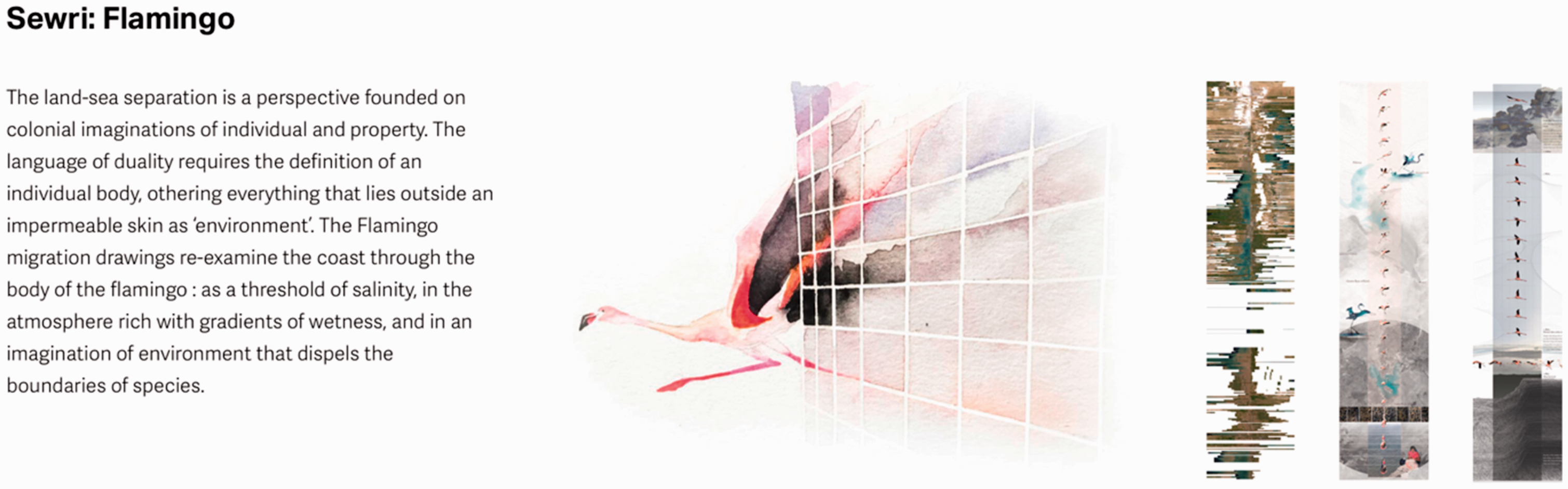
Rhea Shah, Drawing on Wetness, Inhabited Sea (Shah, 2021).
If flamingoes have recently begun visiting the flats of Thane creek, Shah shows, it is because they afford a shallow saline terrain in which to dwell. The mudflats are anthropogenic; themselves historical phenomena that have been co-created by human occupants of the city (see also Scaramelli, 2019). Experts and environmentalists I spoke with during my field research suggested that the increasing mangrove density and the widening mudflats on the city’s eastern shoreline was the result of decades of sediment accretion that had ensued from the city’s release of industrial and sewage waste at its margins (both from sewage and water treatment plants), as well as illegal dumping of construction debris into the sea.
Because the flamingo populations preferred mud flats that were situated on the Mumbai side of the creek, we rode closer towards that shore, right next to the inlets where the city’s water treatment plant released waters into the creek. By their numbers and patterns of dwelling, in and amidst the warmer waters of sewage and water treatment outflows, they seemed to prefer anthropogenic waters.
There were more flamingoes this year, Mahesh, told me, as we took the boat across the creek towards Mumbai, more than at any time before, he said. Mahesh suggested that the flamingoes flourishing did not just have to do with the volume of waste, but also the qualities of the ecology that it bloomed. The toxicity and the vitality of their habitat were inseparable. When they arrived from Kutch, Mahesh told me, the flamingoes were quite white in color. On more than one occasion, Mahesh would tell me that their bright pink color was a result of what they were eating in the creek, and might be a result of its pollution levels. I was not sure about this at the time.
Six months later, a news article in The Guardian featured some of the claims around the spectacular relationship between flamingoes and the city’s most polluted creek. The article noted that the city had long welcomed large flamingo populations, approximately 30,000–40,000 birds a year. In the winter of 2018–2019, the Bombay Natural History Society census recorded three times that number – 120,000. The news article cited several naturalists and environmentalists to claim that this was not despite but because of the creek’s famous coastal pollution that has generated an ideal ecological niche for flamingoes (Figure 3).
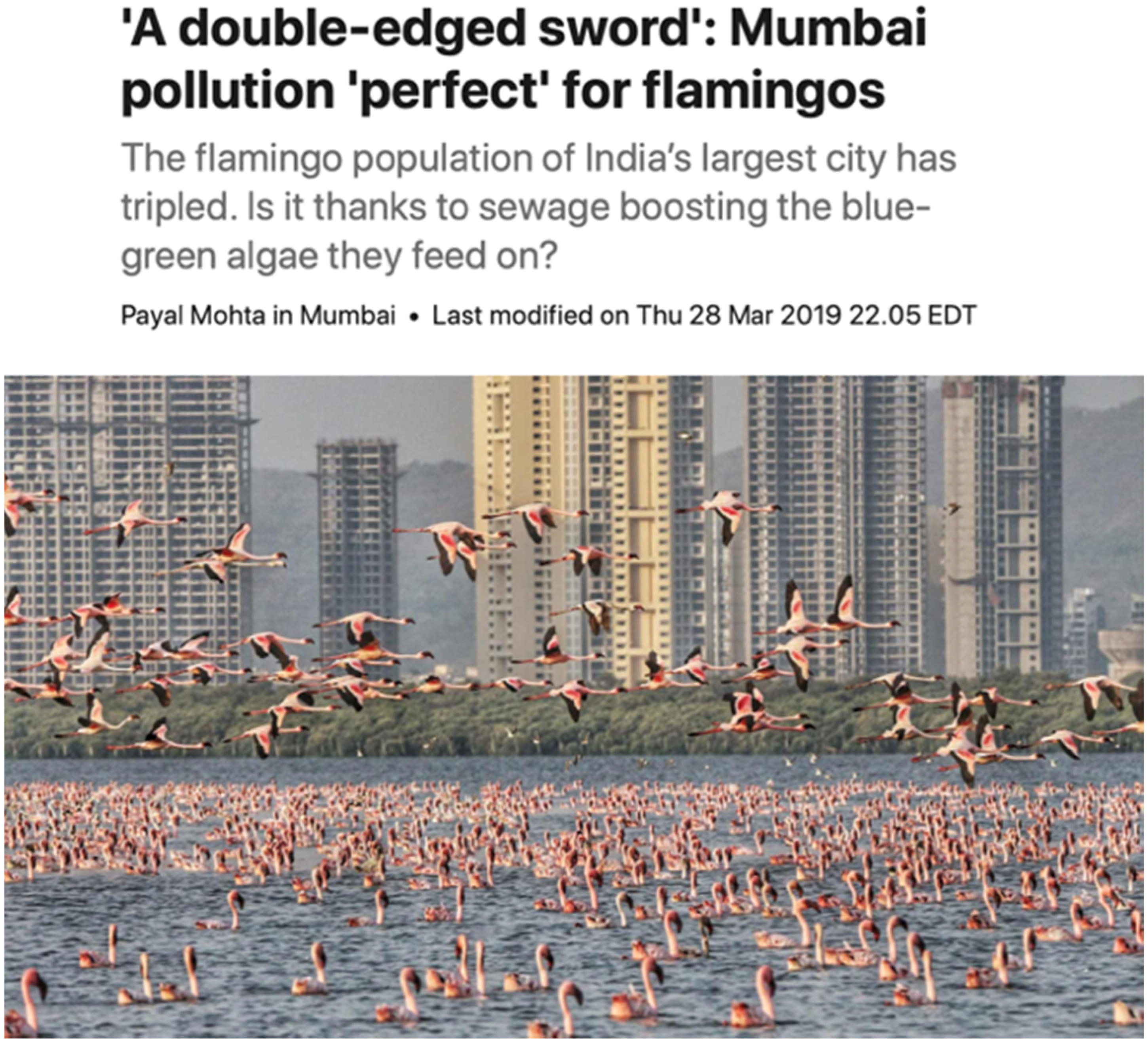
Perfect pollution in the news. The Guardian. 28 March 2019.
Making a similar point as the forest department official had made months earlier, the news article quoted the famous naturalist, writer and photographer, Sunjoy Monga. Speaking to The Guardian, Monga said that Mumbai’s coastal habitat might be a zone of what he called “perfect levels of pollution”. I quote from the article: Over the years the industrial discharge dispelled by the industries of the Sewri Bay may have warmed the water. The nitrate and phosphate levels in the creek water are just right for the prolific growth of the algae. (Mohta, 2019)
In making this point, I do not wish to argue that the deviations from the “good and true path of things” (Liboiron, 2021) do not have deleterious effects. Polluted airs and waters have caused massive bird and fish die-offs, including in the Arabian sea (Do Rosário Gomes et al., 2014; Craig, 2023; Kanngieser and Todd, 2020). They often replace what humans deem to be good forms of life, with what Deborah Bird Rose and Thom van Dooren identify as “unloved others” (Rose and van Dooren, 2011) – otherwise ignored forms of life and living that proliferate in hypoxic waste waters – such as salps, algae, jellyfish and squid. Flamingoes disrupt these expectations and orders because they are beautiful charismatic fauna that proliferate in the anthroposea. If flamingoes are thriving because of (and not just despite) sewage and coastal runoff, it is unclear what might be done to restore the urban ecosystem, or what doing ecological restoration would do in these emergent ecologies (Kirksey, 2015).
In December 2022, I spoke with Sunjoy Monga about the phenomenon, and about how it troubled our expectations of perfect ecologies. He pointed out that flamingoes have not always migrated to Mumbai. They began coming to the city in the 1990s, with the first occurrence of any flock of birds being documented in 1990. At the time, he directly traced their appearance in the city’s waters to the ecologies produced by the city. My presumption was that the warm water and other effluents in the shallower bay would have made ideal conditions for the flamingoes … All urban systems are in perennial shift …Flamingoes were a wonderful display of how something perceived as unknowingly bad could provide a good ecology for them. I used to call it the perfect level of pollution …. It is such a contrast... It baffles!
Monga’s account of birds thriving in wetland and waste ecologies resonates with research done in other landfills and waste dumps. For instance, Jacob Doherty points to the “filthy flourishing” of storks in Kampala, pointing out that “storks are both waste infrastructure and waste themselves, rendered disposable by the same state-centric views of infrastructure that make informal waste pickers precarious, and cast out from the imaginary of a clean, green, urban future” (Doherty, 2019: S321). For Doherty, storks and waste pickers flourish in their precarity, a precarity made by urban infrastructures and their always incomplete efforts to generate a green urban future.
That pollution generates a precarious ecology that is perfect for flamingoes, however, does not mean it is pollution, or perfect in every respect, just that it is perfect for flamingoes right now (Callon, 1986). Fishers have complained how the warmer, hypoxic waters have chased away fish, making the livelihoods of Koli fishers in Thane creek even more tenuous (Sarkar, 2021). The creek bed is also laced with neurotoxins. Studies of the region have dated petrochemicals and heavy metals in sediment layers dating back to the 1950s (Kumar et al., 2004; Quadros et al., 2009).
Nevertheless, perfect pollution is hard to address in the near future, without unmaking flamingo habitat at the same time. I asked Monga about what ecological restoration in Thane Creek might look like. He struggled with making sense of the question. “Restoration … no! [Flamingoes] don’t need restoration”, he replied. I wasn’t sure if he meant that they were abundant enough for such projects to be unnecessary, or that such projects, as traditionally undertaken, would drive flamingoes away. As we spoke, Monga suggested that the answer was a bit of both. “With a bird like the flamingo, there is no restoration possible. So long as its nesting sites are protected, there is no need”. And their feeding sites in Thane Creek, I asked? “No restoration, because [flamingoes] move and respond to a handful of sites”, he replied. I understood where he was going with this. Because the flamingo does not nest in Mumbai, it can always move elsewhere if the conditions change. According to Monga, while their nesting sites in Kutch should be protected, they did not need the wetlands in Mumbai to live. They just find them to be vital for now. They previously inhabited other ecologies, and might do so in the future. I was curious though, about whether the proliferation of flamingoes might help make the case for the restoration of Thane Creek. What if the creek was cleaned up? If, by some miracle the creek was cleaned, he said, “the birds might just disappear. The congregations of birds would not come.”
Building on his argument, that flamingoes neither need, nor would flourish amidst ecological restoration projects, Monga told me that flamingoes were already seeking out the disturbed geographies within Thane Creek. Where they originally wintered mostly in the Sewri's anthropogenic mudflats, Monga said, they are now found in parts of Thane creek that have recently become substantively urbanized. For instance, he told me that populations can now be found in Uran, near the new port. They are also found near the new housing and industrial developments in Navi Mumbai (New Bombay). In both of these locations, he said, scientists had previously noticed plankton in satellite imagery in previous years. Now flamingoes are found there too. In this sense, they follow the densification of the urban sea. They find and flourish in the human ecologies of the anthroposea.
How might we make sense of the ecologies that are brought into being in the anthroposea – a mixture of human refuse, industrial waste, and various forms of life, some beautiful, others abject, and yet others profitable, that inhabit its waters? How might these emergent natures be nourished or protected through human intervention and environmental action, when the categories of pollution, resource, food, and waste are in ongoing and dynamic relations with each other? For the naturalist Monga, the proliferation of charismatic flamingo species in the anthroposea was a marvelous, “baffling” phenomenon. While its flourishing in the anthroposeas of Mumbai could be explained, it could not be acted upon by conservation biologists or planners, using the conventional technologies of urban governance or ecological restoration – of ‘cleaning up’ the creek. Their beauty amidst refuse could only be observed and enjoyed in the ongoing present.
The proliferation of nonhuman life in the anthroposea has been a source of excitement not just for bird ecologists, but also for citizen scientists at Marine Life of Mumbai (MLOM). As they document the city’s intertidal fauna, members of the organization not only feature how intertidal habitats are being constituted with humans. They also draw attention to how the intertidal region is also constituted by energy and waste infrastructures.
Intertidal living
Marine Life of Mumbai is a group of citizen scientists who dwell in and document the prolific biodiversity of Mumbai’s intertidal regions. Initially composed of over a dozen committed volunteers that would run volunteer walks on the city shores, the initiative has since been formalized and is now managed by the newly instituted Coastal Conservation Foundation.
Over these public and private walks, MLOM has been meticulously photographing all that the life hosted along the city’s shorelines, uploading these onto an open access naturalist website for help to catalogue the different lifeforms they find in the littoral zone. Thus far, as of April 2023, they have logged 8187 sightings of 567 species of marine life in the intertidal zone – different kinds of coral, slugs, zoanthids, octopuses, crabs, mollusks, fish, and lobsters. By any measure, this is a phenomenal range and extent of biodiversity in Mumbai’s shores.
As part of the transdisciplinary project in the Inhabited Sea, two MLOM members, Shaunak Modi and Sejal Mehta dwelled in the worlds of crabs and cnidarians that flourish in the city’s intertidal regions. Their project, Intertidal Living, documented “the extraordinary plethora of life that is nurtured in this anthropogenic landscape” (Modi and Mehta, 2021). Here, their effort to make clear that non-human natures flourish in the city in the sea is quite explicit and oriented towards the city’s publics: We have attempted to take intertidal conversation outside science circles and bring it to people with narratives, to tell them about the animals that share their cities. Show them the surprising forest in their backyards. To break the notion that marine creatures like bright and busy crabs, swaying sea anemones are a construct of deep seas or pristine beaches. To show them that these wondrous creatures live right here, a few minutes from their busy, polluted living spaces. (Modi and Mehta, 2021)
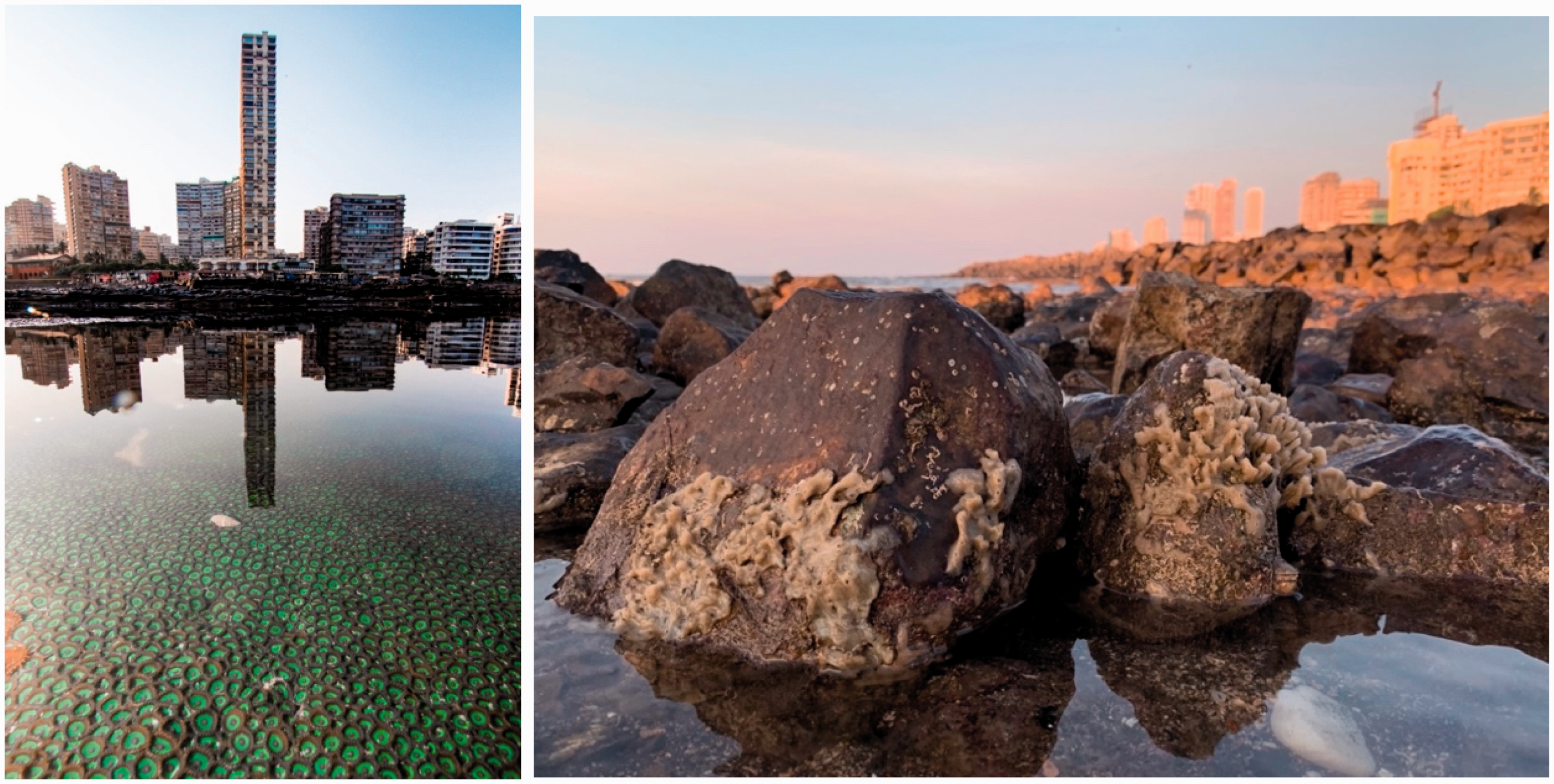
Zoanthids and sea sponge are urban residents that flourish in the Anthroposea (photos by Shaunak Modi).
Much of Mumbai’s intertidal life lives in an anthropogenic environment that is inundated by plastic, trash, and oil spills that frequently reach the city from nearby offshore oil wells. Different species make their homes not just on this ‘waste’ but also with it. These entanglements were vividly on display during the shore walks I would join MLOM for. Its citizen scientists would frequently point to the ways in which sea sponges, red algae, and worms proliferate in waters full of “nutrients” – a euphemism for biological waste. For example, Shaunak would say that sea sponges and worms proliferate in this anthropogenic terrain (this is why we would see these populations on so many shores). The same is true of red algae. Indeed, I was surprised at how much sponge we would see, marveling at the intricate colonies they would form on so many rocks.
The anthroposea does not just nourish Mumbai’s marine life. It also provides materials with which some intertidal biodiversity constitute their homes. Take, for instance, shell binder worms (Diopatra sp.), currently seen all over Mumbai’s Juhu beach. As they live under the sand, the worms often secrete a sticky tube. The tube invites and draws shells and other marine material into relation with their bodies, effectively producing a habitat that might be attractive to their prey (mollusks and other small animals). As colleagues at MLOM point out, the habitat seeking tubes of shell binder worms no longer bind just shells to their bodies. They now frequently bind other debris on the shoreline including “plastic and other man-made trash” too. In other words, they make their habitat and bodies with plastic. It is not just shell binder worms. Plastic bags, now plentiful on the city’s beaches, also host egg casings, crabs, and other marine life. Further, this garbage does not just rest on beaches and rocky flats but is entangled in the anthroposea – in the sand, in rocky flats, and in mangroves that inhabit this zone (Figure 5).
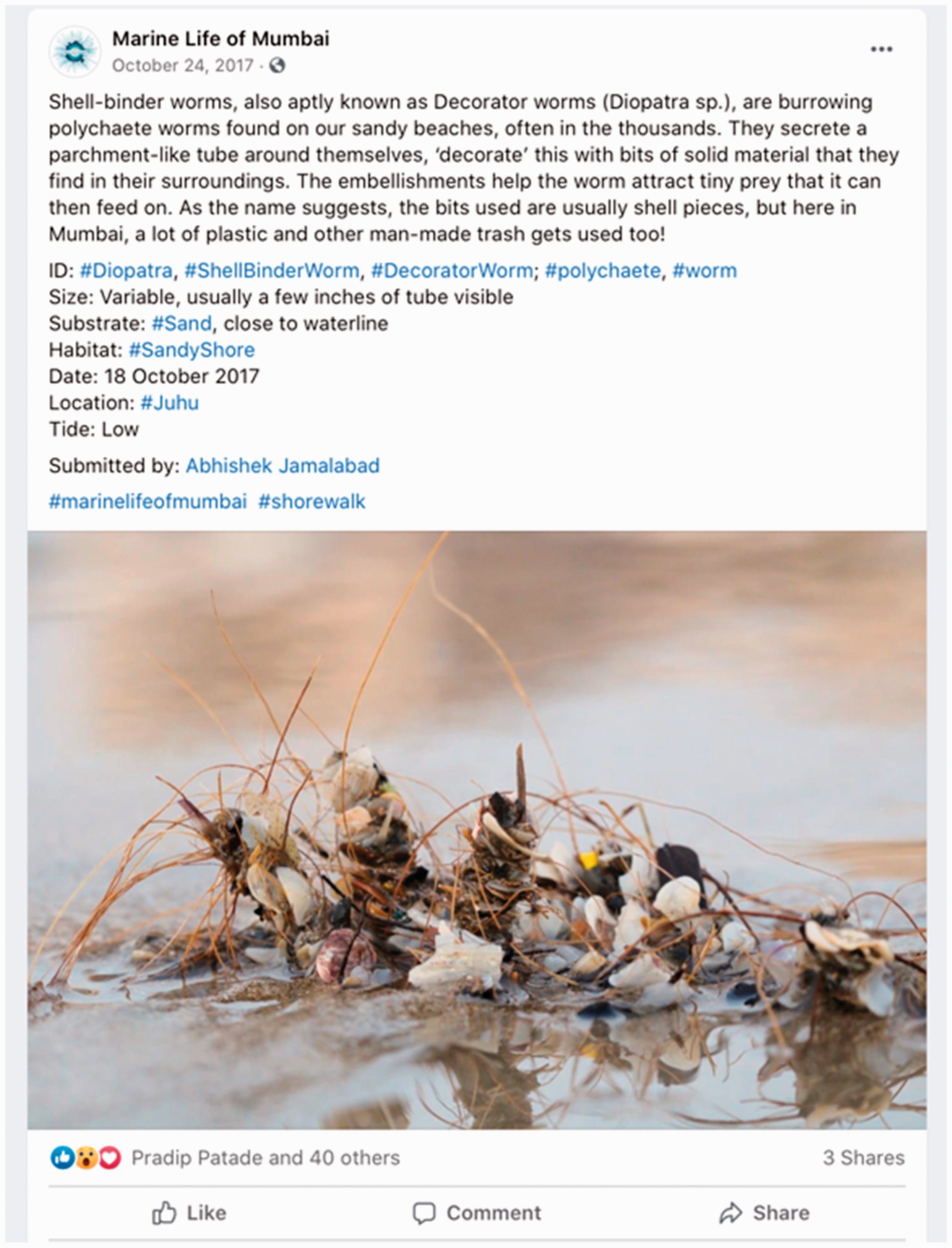
Anthropogenic homes of the shell binder worm. Facebook post by Marine Life of Mumbai, October 2017.
Given these entanglements, MLOM volunteers are very ambivalent of beach cleanup projects as they are currently executed. Clean-up efforts are not just ineffective – waste just returns to the shore after it is released in or near the sea. Cleaning the beach of plastic also disturbs marine habitat. Shaunak would tell me of how heavy machinery deployed to remove plastics during the city’s sporadic beach clean-up activities oftentimes destroyed intertidal life, injuring and removing much marine life that has made the city’s polluted coastlines home. Taken together, the city’s garbage and debris constitute the grounds of the intertidal region; they are the habitat of the marine life that MLOM valued and documented. Disrupting and removing the waste that constituted this ground also disrupted and removed marine life from the city’s shores.
To be clear, MLOM’s naturalists did not celebrate the pollution of littoral regions of the shores they walked. For MLOM’s naturalists, the detritus of modernity, while endemic to the anthroposea, is not “perfect”. Rather it is intractable, part of the city’s intertidal terrain; a dynamic terrain upon which they focused their eyes, lenses and stories. They recognized how restoration operations, currently underway by city officials in the anthroposea, were at best short-term fixes and at worst, harmful. They pointed out how clean-up projects seeking to disentangle the city’s waste from its habitat often victimized less powerful non-humans. In public and private conversations they complained how the anthroposea was composed of the waste of capitalism (particularly those of the shipping, oil refining and the packaging industries) that were producing the crisis at a larger scale, yet remained beyond the gaze of city officials (see also Mehtta, 2021: 202).
Rather than advocate for the restoration of the intertidal city through clean-up efforts, therefore, MLOM’s volunteers draw attention to the hidden environmental violences of state and corporate actors (see also Liboiron, 2021). They have been documenting pollution events like oil spills and leaks in the anthroposea, in an effort to hold polluters to account. They regularly photograph tar balls on the beach’s shores, manage a twitter account that features these regular occurrences, and attempt to attribute responsibility to polluters (oil companies and shipping companies) that fill the anthroposea with oil. They share data with journalists about the production and waste facilities that are responsible for the pollution (Nair, 2022). Their efforts to attribute responsibility are limited, not least because government agencies and government scientists work with the muddiness of the urban sea to conceal the responsibility of public and private corporations, whose projects proliferate oil and plastics in the anthroposea.
Conclusion
Three decades ago, David Harvey cautioned against the ways in which cities were read in the human geography and urban anthropology to be beyond nature. He insisted that, “in the final analysis, there is nothing unnatural about New York City” (Harvey, 1996). Indeed in the time since, environmental geographers, historians, and anthropologists alike have urged a recognition of cities as processes that are made with meaningful environmental relations (Cronon, 1991; Goh, 2021; Rademacher and Sivaramakrishnan, 2013). As with protected areas and national parks, humans have ambivalent effects in cities and are key actors in the creation of urban ecologies. Ecologists have shown how “edges,” “intermediate disturbance zones,” and places made with other non-human relations are critical sites for the proliferation of biodiversity (Pickett et al., 2008; Saberwal and Rangarajan 2003).
Of course, this does not mean that disturbance zones are good for all biodiversity. Some waste is generative of life for some and precludes life for others. For instance, social and environmental processes in Mumbai have caused for some marine species to disappear, and others to appear. The flamingo’s thriving in the biological waste of the anthroposea says little about the effects that heavy metals and other industrial contaminants have on them and other urban life. These effects have been rendered invisible by the infrastructures and technologies through which chemical relations are left unaddressed in the sea (Murphy, 2017). Nevertheless, that flamingoes proliferate in wake of urban pollution poses difficult questions around what the care for flamingoes might look like.
In urging an attention to the anthroposea’s volatility and vitality, I do not wish to evacuate responsibility from the municipal administration for permitting (legally and in the everyday) the permanent pollution of the city’s littoral regions. The mixing of sewage and industrial effluents in the sea likely causes significant fish die-offs and an acidification of the sea. This is neither a value-neutral nor a power-neutral process. As Kasia Paprocki points out in her book about climate dystopias in Bangladesh, who gets to imagine what futures do or do not look like is heavily inflected by power relations (Paprocki, 2021). Determined to construct city futures on land, planners overlook the muddy materialities of the anthroposea. The Mumbai Municipal Corporation works hard to render uncertain and invisible the causes and effects of 2.5 billion liters of sewage the city barely treats before releasing it into the sea every day. It works hard to leave plastics be in the sea. There is much that the city can do, and there is much that it is not doing to produce a sea of waste – waste that also has troubling lives in the city (Anand et al., 2022).
In this article, however, I only wish to highlight how to recognize the vitality of the anthroposea evacuates the near futures of urban planning and ecological restoration in cities. The near futures of ecological restoration and urban planning require stable boundaries of waste/resource, figure/ground, and nature/culture to be brought into being (Appadurai, 2015; Ballestero, 2019; Bennett, 2010). For example, a pollution-free sea requires water to be emptied of sewage, for plastics to be collected, or banned, or better still not be produced at all (Liboiron, 2021). While I subscribe to and participate in these normative projects, here I show how the life that proliferates in the contaminated boundary crossings of the anthroposea is a source not just of conceptual trouble. The “unscripted vitality” of the anthroposea complicates efforts to work towards different, ‘cleaner’ urban future because this would evacuate (or at the very least, devalue) the human and non-human life that has since emerged and now dwells in the mix (Baviskar and Gidwani, 2019). As such, the anthroposea renders ambiguous various projects of environmental restoration in Mumbai; not least because the ongoing compositions of the anthroposea cannot be parsed out, or separated into their different elements as it mixes at different temporal and spatial scales.
The simultaneous renderings of the sea as nature, as a trough for the deposition of anthropogenic waste and as the outcome of more-than-human entanglements are not new (Helmreich, 2015). Like other waters and lands, Mumbai’s anthroposea has long been made with human activity (Barnes, 2014; Bhattacharyya, 2021). 10 Here I draw attention to the sea as a vital space that is densely occupied not only by urban citizens practicing their livelihoods, and more-than-human ecologies, but also by the waste and discard of humans and industrial processes; processes that refuse the framing of the sea as ‘environment’ that is outside of or beyond urban relations. These have implications for how urban futures can be envisioned, and how environmental worlds are inhabited.
Recall the vignette with which I opened the article. In holding up the lobster, the Koli fisher was also holding, in some senses, the transformed habitat that made the lobster. This is habitat that is made in the wake of sewage outfalls, coastal pollution, and rising sea surface temperatures. The sea that the fisher was claiming as a fishery is not a site of pure nature beyond city limits or even a site of overfishing. He is very aware of the human compositions of the sea. Like others, he consistently complained of urban effluents – sewage and plastic – in the sea. He has protested how anthropogenic effluents and coastal reclamation undertaken for the Mumbai coastal road have chased away valuable fish species from their urban habitat. Nevertheless, his livelihood is now made with, in and by this transformed habitat. It is in and with this alterlife that he makes political claims to livelihood.
By holding up a valuable species that thrives in oxygen-poor sewer-seawater, the photographs of the fisher in the report are mobilized to demand that the road project be stopped not for its infringements on the pure natures of a coastal ecology, but to protect the vital, teeming fisheries that persist and are made in the wake of coastal pollution and the anthropogenic seas that these make. Theirs is a demand to continue flourishing in the ongoing present of the anthroposea as a hardworking, modern urban resident, despite and amidst the detritus of the city. What does it mean, therefore, when fishers demand that the anthroposea, produced with the refuse of modern life, be saved from a road that promises to deliver modernity and speed to the city? As the fisher holds his lobster up as food and as livelihood, caught amidst the waters of the anthroposea, he asks for an attention to and care for the generative wetscapes of the present – wetscapes in which food, waste and pollutant exist and constitute each other through ongoing relations.
Today, the lives of fishers, flamingoes and crabs are made in the anthroposea. Noticing these emergent mixtures, suspends the certainties of urban and ecological action for a near future. The modern futures of Mumbai have long been built on the assumption that land can be made dry, that coastlines can hold, or that the sea is empty nature. Those working in the volatile anthroposea today – composed of mixes of humans and nature – refuse the pretenses of this conceit. Through their work in the vital waste-resource-lives of Mumbai’s anthroposea, they demand a different kind of accounting; one which enlists ways that more-than-human-life can thrive not in the future but in the fraught muddiness of the ongoing present.
Footnotes
Acknowledgements
This article is based on field research conducted in Mumbai between 2018 and 2022. I am grateful for the help of several interlocutors, experts and colleagues in Mumbai. My thanks to Dilip da Cunha, Lalitha Kamath, Mojes Koli, Malini Krishnankutty, Anuradha Mathur, Sejal Mehta, Shaunak Modi, Rohit Mujumdar and Rhea Shah for supporting and inspiring this project with their sparkling research and insight. I also received very generative feedback on drafts of this article over the past four years. My thanks to Austin Zeiderman, Chandana Anusha, Nida Rehman, Aparna Parikh, Shaunak Modi, Stuart McLean, Sunjoy Monga, Jane Dwares and the members of Penn Envirolab for very helpful feedback and edits that made this a better article. Early versions of this article were presented in seminars and as invited lectures at the South Asian Urban Climates conference at Cambridge University (2019), the National Institute for Advanced Studies Bangalore (2019), the Environmental Anthropology Collective at Yale University (2021), the Making and Unmaking of Volatility workshop at the University of Cologne (2021), the Department of Anthropology at the University of Georgia (2021), the Department of Anthropology and Sociology at the Graduate Institute, Geneva (2022), and at the online workshop on Urban Liquefaction (2022). My gratitude to the organizers of these events for the invitation, and to the participants for their feedback.
Declaration of conflicting interests
The author(s) declared no potential conflicts of interest with respect to the research, authorship, and/or publication of this article.
Funding
The author(s) disclosed receipt of the following financial support for the research, authorship, and/or publication of this article: I would like to acknowledge that field research and writing for this project were made possible by grants from the National Science Foundation (Award Number: 1852987), the Wenner Gren Foundation, as well as a Global Inquiries Fellowship from the School of Arts and Sciences at the University of Pennsylvania.
