




Abstract
In this article, I consider the relationship between urban planning and context by investigating the planning practices associated with a land-use plan in Bordeaux described as “adapted to context.” Invested with flexible rules, the plan description followed a tendency in French urban planning concerned with being strategic, prospective, and participatory. It was also the result of metropolitan planning. Through an ethnographic account, I show how local politicians’ references to context related to concerns with mayoral authority in times of planning powers transferred to the metropole. Using permit reviewers’ skills, mayors mobilized flexible rules to manipulate building permit decisions prepared in compliance with the metropolitan plan. It is widely acknowledged that urban planning is affected by as well as affecting different contexts. I outline a complementing approach by drawing on engagements with context in anthropology and STS-scholarship, to propose that the practices associated with the same notion in Bordeaux are telling of how urban planning contributes to making contexts. Since calls for context direct attention and shape which issues and local communities are prioritized, these insights on the relationship between planning and context urge attention to how appeals to context, as never value-neutral or ready-made, gain importance across different urban planning issues and settings.
Introduction
In late 2016, the council of Bordeaux Métropole gathered to approve their Plan Local d’urbanisme (PLU), the local land-use plan that set out the strategy to reach the projected vision for the city year 2030. The plan expressed the objective to “enhance [the metropole’s] existing qualities of landscapes and living environments” in order to create an “attractive metropole” (Bordeaux Métropole, 2016) through its sectorial action plans on housing, mobility and environment, and the detailed zoning regulations. The council meeting concluded a six-year long plan revision process resulting in a compilation of written texts, maps and other graphical representations that concretized the strategy in detailed building rules regulating the development rights within any piece of land. Before proceeding to vote, the metropolitan councilor in charge of urban planning addressed the audience composed of metropolitan councilors, public officials and journalists. The councilor explained that the plan had been revised based on the objective to “have less rules and more tools, for the plan to be more operational and less coercive.” It was invested, he concluded, with the ambitions to prepare “a regulatory framework more adapted to context (un règlement beaucoup plus adapté au contexte).” The council meeting continued without the metropolitan councilor sharing any details as to which contexts the plan was adapted.
The unspecific proposition about the plan as “adapted to context” was present also in the plan itself, where it stated that a funding principle for the revision was to “produce a document functioning more as a ‘tool box’ in service of a qualitative metropolitan development, than a collection of standards.” The PLU was also to facilitate an “urbanisme de projet” by proposing rules that “can be better adapted according to the context (permettent de mieux s’adapter au contexte)” (Bordeaux Métropole, 2016). This description entailed that the revised plan proposed an alternative mode of planning from what had previously dominated. It was a shift away from what the metropolitan councilor, as a panelist at another public meeting on the metropolitan urban strategy, characterized as a “regulatory urbanisme (urbanisme réglementaire)” with the primary concern to “impose rules and regulations.” He described how the revised PLU differed, because of it being the political desires and the desires of the citizens that make up the project [of the PLU] and the project that makes up the building regulations
This proposed shift in Bordeaux aligned with ambitions by the national government to reform urban planning legislations to transfer “from an urban planning based on rules, to an urban planning oriented around projects (urbanisme de projet)” (Ministère de l’Écologie du Développement Durable des Transports et du Logement, 2011). Bordeaux’s revised PLU and propositions to reform urban planning legislations are episodes within a longer history of ambitions by the national government and urban experts summoned through the notion of projet in opposition to the plan, to signify a transition away from centralized, prescriptive planning towards a more strategic and prospective planning relying on collaboration between public actors, private actors and civil society (Arab, 2018; Ingallina, 2008; Pinson, 2006).
The efforts invested in the revised plan in Bordeaux thus join the extensive and well-established critique towards modernist technocratic top-down planning. This critique includes ethnographic and historical studies denouncing the injustices produced by modernist planning efforts by French colonial policy (Wright, 1987), in the US (Peattie, 1992) and Brazil (Holston, 1989). Planning scholars have advocated for urban planning to become considerate of local histories, communities, and cultural diversity (Sandercock, 1998b), and altered conceptualizations of urban planning to acknowledge it as a practice situated in complex social and political relations of ethical implications (Fainstein, 2000; Healey, 1992; Sandercock, 1998a). Calls for planning to become more attentive to the local quality of places have impacted urban policy and governance in France and elsewhere, as evinced by Healey’s (1997) influential ideas on collaborative planning for which participatory processes as well as “social contexts [are] acknowledged as of importance” (Harris, 2002). Collaborative planning has been re-interpreted and put to work in diverse geographical settings and planning issues (Hillier and Metzger, 2015).
The emergence of context as a notion for planning has spurred debate about how planning endeavors ought to be attentive to the local and particular, as well as how to deal with the tension in planning literatures “between the acknowledgement of context-related diversity, and the desire to produce normative theoretical positions” (Watson, 2003: 365). In acknowledgement of this tension, planning theories have inquired the usefulness of theory as generic and universal, and elaborated theories about how planning efforts occur to accommodate diversity and situated practices (Forester, 2012; Sandercock, 1998a; Watson, 2016). In these literatures, references to context often index external factors such as political, economic, social and cultural institutions that impact and are being impacted by planning processes (Othengrafen and Reimer, 2013; Valler and Phelps, 2018).
In this article, I ask what can be learned about the relationship between planning and context from attention to how actors mobilize the notion of context in urban planning. I do this by exploring what a plan “adapted to context” came to mean, and the dynamics with which it was entangled, once it was put to work among the everyday practices of permit reviewers, planners and politicians in Bordeaux. The unspecific references to context as something that Bordeaux Métropole’s plan was adapted to, spurred my interest in unpacking the implications of this proposal. While only making up a few sentences in the plan composed of over a thousand pages across different documents taking up seven cardboard boxes when stored physically (Figure 1), the proposal was central to the stakes about planning powers that the plan were embedded in. As Seaver aptly notes in a debate about how to extract meaning out of Big Data, although “it is common sense that to put things in context is good and to take them out of context is bad, this simple take overshadows the fact that often our disagreements lie precisely in determining what context is” (2015: 1105). Bearing this in mind, my engagement with the issue of context in this article is two-folded.
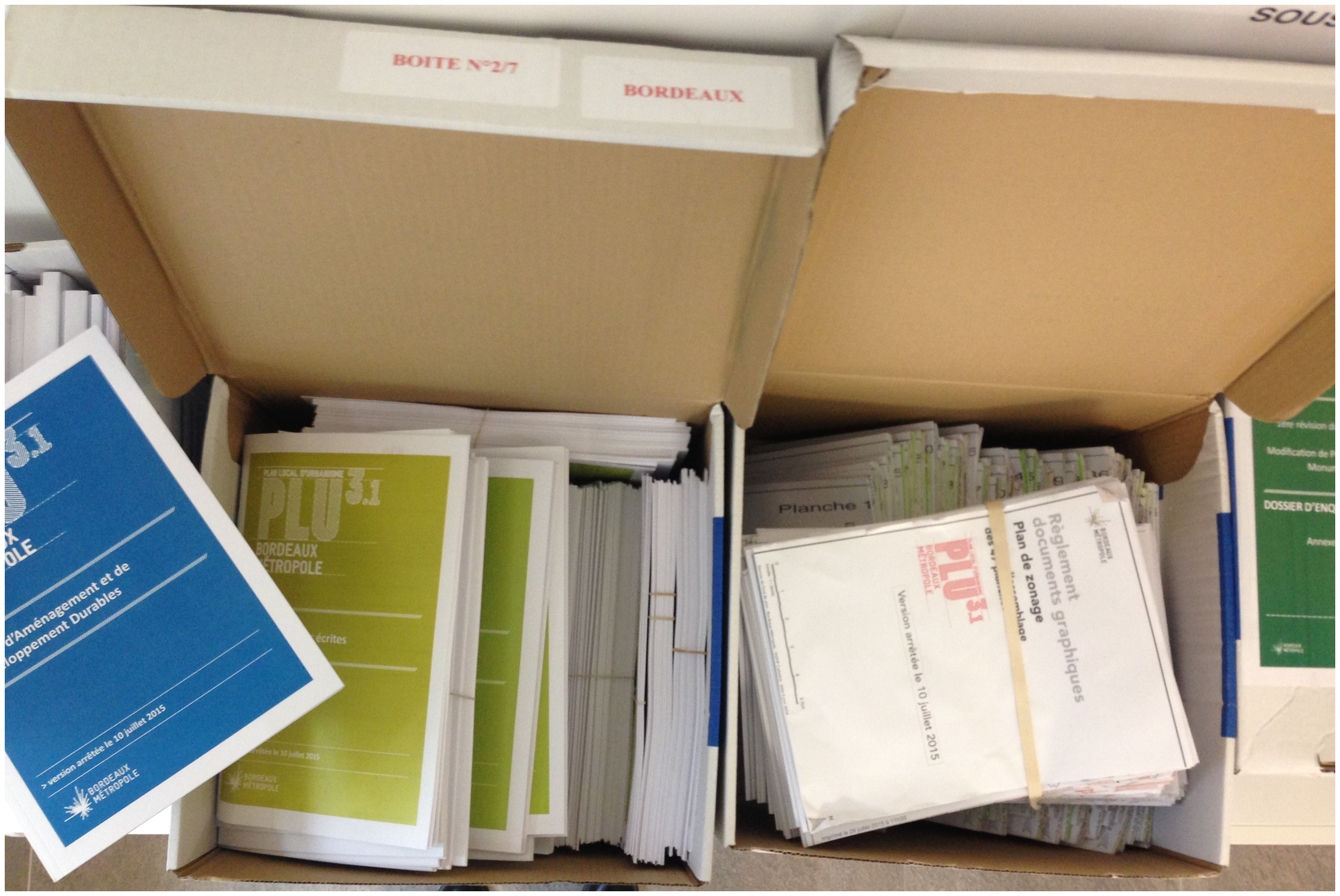
A selection of the PLU documents in its boxes. Photo by the author.
First, I inquire how the notion gained traction in Bordeaux. It was absent in documents and political protocols from the plan revision initiated in 2010 only to appear towards its conclusion by 2016. In between, planning and local government reforms further increased the financial weight and planning powers to the metropole at the expense of municipalities. The proposition of a plan “adapted to context” obfuscated the politics at work around this formulation of mayors seeking to exert authority over the materialization of the metropolitan PLU. In other words, struggles over planning powers between municipalities and the metropole provide an important context for how I frame the episodes from Bordeaux. Second, I propose an analytical approach that draws from anthropology and STS to emphasize that recourses to context are political processes through which certain issues are brought forth as relevant while others are downplayed (Asdal and Moser, 2012; Dilley, 1999). Through this analytics, I explore how calls for context in Bordeaux were associated with the strategic mobilization of flexible rules to redistribute decision-making moments from the legal capacity of the metropolitan PLU to mayoral impact on permit review procedures. While it is productive to analyze context as constituted of diverse factors that affect how planning practices unfold in different locations, I argue that there is also the risk that appeals to context obscure more than enlighten the dynamics at work. In Bordeaux, the plan as adapted to context obfuscated the struggles around which level of government was legitimate to define urban development, and entitled to act as interpreter of the local conditions for planning decisions to address.
Inquiring how the use of context as a characteristic of the plan was put to work in Bordeaux led me to permit review procedures that engaged permit reviewers, architects, mayors and developers in questions about how to interpret and apply the building rules with regard to specific development proposals. The article thus attends to permit reviewing as a part of planning processes that has received scarce ethnographic attention, with Pérez’s (2016) work on urban experts’ interpretative practices in permit reviewing in Bogotá as one exception.
The article is based on eight months of fieldwork in Bordeaux throughout 2016–2018 with analysis of documents, political protocols and recorded council meetings between the stays. In Bordeaux, I attended council meetings, workshops and permit review meetings. Mayors that double as councilors in the metropole, planners from a semi-public urbanism agency, and planners and permit reviewers from the metropole administration participated in these meetings, and they are all urban actors figuring in this article with whom I made a total of 40 interviews. Throughout the fieldwork, the practices through which the plan was put to work resonated with Gururani’s characterization of planning in Gurgaon as a “live and lively process and a contested domain that generates unexpected collaborations and conflicts that can make the plan possible, or not” (2013: 120). Fieldwork across the two years of the plan being in force summed up episodes that impede analysis of the fate of the PLU in terms of failure or success, legally appropriate or irregular, to instead attend to creative (mis)uses of rules framed as an urban planning adjusted to context.
In what follows, I outline the article’s analytical approach to inquire context as the result of situated practices and political processes. I then turn to explore what the notion of context came to mean in planning work in Bordeaux. First, I describe how planners involved in the plan revision reasoned around the plan’s capacity to attend to context as corresponding to urban environments of differing character. Second, I detail how the plan revision unfolded in times of changing power dynamics between the metropole and municipalities, and how it was charged with expectations among mayors to be able to put their marks on building permit applications. Thereafter, I describe how the flexible rules functioned as means to motivate refusals of building permits, and thus offered opportunities to exert mayoral authority in spite of the urban development projected by the metropolitan plan. I conclude by suggesting that the practices associated with the PLU point to how planning itself is a practice involved in defining contexts.
Context as an analytical approach
Bordeaux’s planning actors are not alone in emphasizing the importance of context to urban planning. It is commonly agreed in planning literatures that “one cannot investigate the effects of the planning system independent of its political economic context” (Taylor, 1998: 107). The importance of attending to planning’s relationship with context is recurrently reinforced, as evinced in suggestions that “planning practice adapts to the context in which it operates” (Valler and Phelps, 2018: 699) and that “spatial planning—such as planning issues and objectives, norms, methods, and instruments—is bound to specific local (cultural) contexts” (Othengrafen and Reimer, 2013: 1269). Others have emphasized a more relational relationship cautioning against treating “‘context’ as an external force ‘acting on’ planning practice” (Healey et al., 1999: 342), which suggests that planning practices are not delineable as a context with internal logics and rationality detached from others, but informed by diverse factors that shape their forms. Moreover, what goes on in planning may “redefine[ing] politics, producing new sources of power and legitimacy, changing the force field sometimes for better, sometimes not, and rarely in predictable ways” (Sandercock, 2005: 330).
Although contemporary planning theory has largely absorbed post-modernist assumptions about diversity, power relations, and situated practices, Watson (2016) notes that there are tendencies to presume theories as generalizable and useful to explain urban phenomenon across the world, or contexts. Efforts to address these tendencies include studies of urban informal settlements that demonstrate how informality is constitutive of formal governance practices (Roy, 2005), and the use of Canadian planning processes to rethink dominant theories of property through Indigenous epistemologies that take inclusion instead of exclusion as the starting point (Dorries, 2022). They also include efforts to consider how the uses of collaborative planning can be supportive for planning issues taking place in cities of rampant inequalities and social injustices (Mohan, 2023; Noureddine Tag-Eldeen, 2015). Collaborative planning emerged from Healey’s practice-near studies of English planning (1997) to propose the transformative potential of bringing actors from local social and environmental contexts into planning processes (Harris, 2002; Healey, 2003). With its attention to the local and particular, critique against the collaborative planning program suggests that it fails to account for how broader structures of, for instance, economic and political contexts condition power hierarchies that inform planning (Tewdwr-Jones and Allmendinger, 1998). In response, frameworks have been elaborated to index contexts as norms and regulations of institutions, and understandings, values and resources shaping practitioners’ agency, that impact the potentials for collaborative planning to be realized (Calderon and Westin, 2019). These approaches to the relationship between planning and contexts share an inclination to treat them as separable, at least analytically, although they are interactive and relational and thus shaping each other.
Here, I propose a complementing understanding to this relationship by considering how planning contributes to the making of context pieced together from work among linguistic anthropologists and STS-scholars. Context is a key concept in anthropology since its early days. It is often used to denote how situated and cultural factors produce diversity of social phenomenon, and thus favor attention to the particular (Seaver, 2015). Contemporary anthropology maintains the importance of this concept, but understandings of what it means have shifted through epistemological debates calling into question the positivistic uses of context as ready-made external explanans of a phenomenon. By demonstrating the role of the ethnographer’s pre-conceived ideas in analysis of the factors mattering for a given social practice, Fabian (1995) observes that researchers inevitably enter any field of research with expectations of what is important to pay attention to, and by consequence, what not to attend to. Any proposed context can thus be subject to contextualization, since recourse to “context” is “constituted in a practice that is individually and therefore historically situated and determined” (Fabian, 1995: 48). Based on the assumption that they are produced through practices, Dilley proposes that their appearance “involves making connections and, by implication, disconnections” (1999: 2). Since there is no objective limit to what counts as a context – it is “unsaturable” (Dilley, 2002) – the analysist inevitably makes choices as to what will count and not as to what matters for how a given phenomenon occurs (Strathern, 1996). Captured in the verb of contextualizing, they come about through interpretative acts that rely on cognitive perceptions rather than given, essential universals. If not self-evident and pre-existing, establishing the presence of a context is a political project of piecing together certain interests and elements to bear as relevant.
In a similar line of reasoning about the emergence of context through practices, STS-scholars proposed that social sciences should avoid presuming external factors as explanatory forces (Latour, 2005). As an alternative to looking for explanatory factors for why social realities appear the way they do, Latour, among others, made an ontological argument about the need for attention to the ways in which actors construct meaning and social realities in the first place. It brings attention to how social actors, for instance in scientific communities in the US (Latour and Woolgar, 1979) and medical institutions in the Netherlands (Mol, 2002), perform worlds, conjure up certain factors or interests as central and how they gain legitimacy. A common worry with such focus on agency and worlds in the making is that they lose sight of context altogether and fail to account for forces beyond the studied actors that impact their practices (Asdal, 2012). STS scholars have elaborated ways to avoid using context as an “external framing device,” and turned to interrogate how it is performative and generative, for instance by studying how practices of accountability in farming in the UK emerge in encounters between established contexts of legal and political kinds, as well as situated and local caring practices (Singleton, 2012: 427). Asdal and Moser suggest to stay attentive to both agency, emerging practices and context by inquiring how the latter are produced, since they “are not simply there to be found and explicated, they are always being made: they are made through an array of disciplinary, textual, technoscientific, political, legal, and administrative practices” (2012: 300). One line of inquiry then, is examining context as the result of practices, and asking about how they are produced and gain importance in specific settings, such as planning work. This can include attention to factors that impact how they occur, since context-making as an “interpretative practice may be exercised by individual agents, by contrast, the form, the content and the direction of these moves, as well as the condition of possibility of contextualisation itself, rarely if ever are the product of individual agents” (Dilley, 1999: 35).
I use this approach as an entry point for inquiring the relationship between context and planning in Bordeaux, and more specifically inquiring the implications of this notion in the local planning practices. In focus is less the what of contexts, and more the by whom and how they are engaged with. The title of this article – planning context – alludes to a shift in analytics from planning as iteratively formed through relations to diverse contexts, to references to context as a site of struggle in its own right. I thus approach context as not merely influencing, or being influenced by, planning, but something that planning actors deliberately attempt to conjure up, and control. This is not to suggest to what degree the studied case of planning in Bordeaux is actually attentive to the local and particular, but to discuss how we can understand context partly as a product of planning. This is important, since what gets prominence as a context of relevance attract attention and conditions what is perceived as possible to do, as Forester (2016) points out in an editorial piece on the importance for planning studies to engage with, and be precise when referring to, context.
The account that I bring forth is itself the result of an analysis pieced together into an ethnographic account in a “world of infinite interconnections and overlapping contexts” (Amit, 2000), where I focus more on political institutions and urban experts, and less on people affected by the studied processes. While I centralize the gripping of contextualizing powers among politicians, planners and developers, these actors conjured up population groups, types of buildings and neighborhoods as more desirable than others which is evocative of how planning processes privilege and neglect diverse issues and populations. By consequence, those issues that in planning are being manifested as mattering will get more attention and appear as possible to act on, but these are not static. As Forester proposes for planning practice, being concrete about what ‘context’ refers to in a given setting provides opportunities to reformulate issues and “look for more productive working relationships and innovative coalitions than we might otherwise have done” (2016: 171).
Urban planning politics in Bordeaux
French urban planning, with its history of legal-administrative formalism and belief in centralized technical expertise (Rabinow, 1989), presents a fruitful case for exploring situated implications for a planning concerned with context. It is renowned as a centralized enterprise operating through impartial execution of policy that relies on ideals about republican citizenship, and struggling to accommodate diversity and pluralism (Dikeç, 2006). There is meanwhile a tension between the centralizing tendencies and local pragmatism (Abélès, 1991), which is apparent in the role of the mayor who “occupies a strategic position between the political system (national and political) and the societal environment” (Médard, 2006: 657). While their position is changing, for instance through policies strengthening intercommunal governments, the mayor remains a prominent figure in French socio-political life (Demazière, 2018). This is the case in Bordeaux, where planning practices unfold in the intersection between national policy and local politics.
The tensions between the member municipalities and the intercommunal organization central to the planning episodes that I describe are not new. A state decree in 1966 forced the creation the intercommunal organization Communauté Urbaine de Bordeaux of member municipalities jointly managing sectorial policies of water, waste, transport, and planning. The then mayor of Bordeaux, Jacques Chaban-Delmas, became its president. A pragmatist, the president established a mode of governance known as the “système Chaban” (Médard, 2006) characterized by an agreement that the organization would continuously allow for mayors’ local agendas to be respected. Creating the intercommunal organization was one of the national government’s several subsequent attempts to reduce the “institutional fragmentation” produced by country’s over 36,500 municipalities (Demazière, 2018). In 2015, the most recent attempt was instituted through the creation of metropoles (Métropoles) as a more integrated form of governance structure, partly motivated by concerns about French cities’ competitiveness in European and global markets (Griffith, 2017). More than a model for local government, the metropolization is a governance model enhancing concentration of jobs, markets and social and spatial relations with tendencies of increased social inequalities (Galimberti et al., 2017; Gaussier et al., 2003). This meant a concentration of administrative and financial powers, through the right to levy taxes, to Bordeaux Métropole. The “decentralization of urban planning” instigated through an act in 1982 that transferred more powers to municipalities (Goze, 1987), has undergone a recentralization through enhanced planning powers of intercommunal organizations visible, for instance, in the requirement of joint land-use plans. Meanwhile, approving building permits is a responsibility of the municipality (Melot, 2009).
What many residents refer to as “Bordeaux” constitutes both a geographical and sociological space, as well as a space with a complex political organization (Victoire, 2014). The urban environment of the member municipalities is connected in a continuum of developments and public transportation. Meanwhile, administrative and political boundaries are present through direct elections being held at municipal level, through which metropolitan councilors are indirectly elected. The intercommunal organization, Bordeaux Métropole, has 28 municipalities with a population of around 780,000 inhabitants. They reside across the member municipalities whose respective populations range from 1000 to 70,000, with Bordeaux being the largest with 250,000 inhabitants (Figure 2). Consequently, the administrative and economic capacity differ greatly between the municipalities, as does the size of their territories. Bordeaux municipality has built its urban development agenda around the image of a large city on par with major European cities. Meanwhile, there is a sentiment among residents across many of the member municipalities of living in smaller towns with their own centers, potentially linked to the region of Bordeaux as relatively rural until recently (Galimberti et al., 2017).
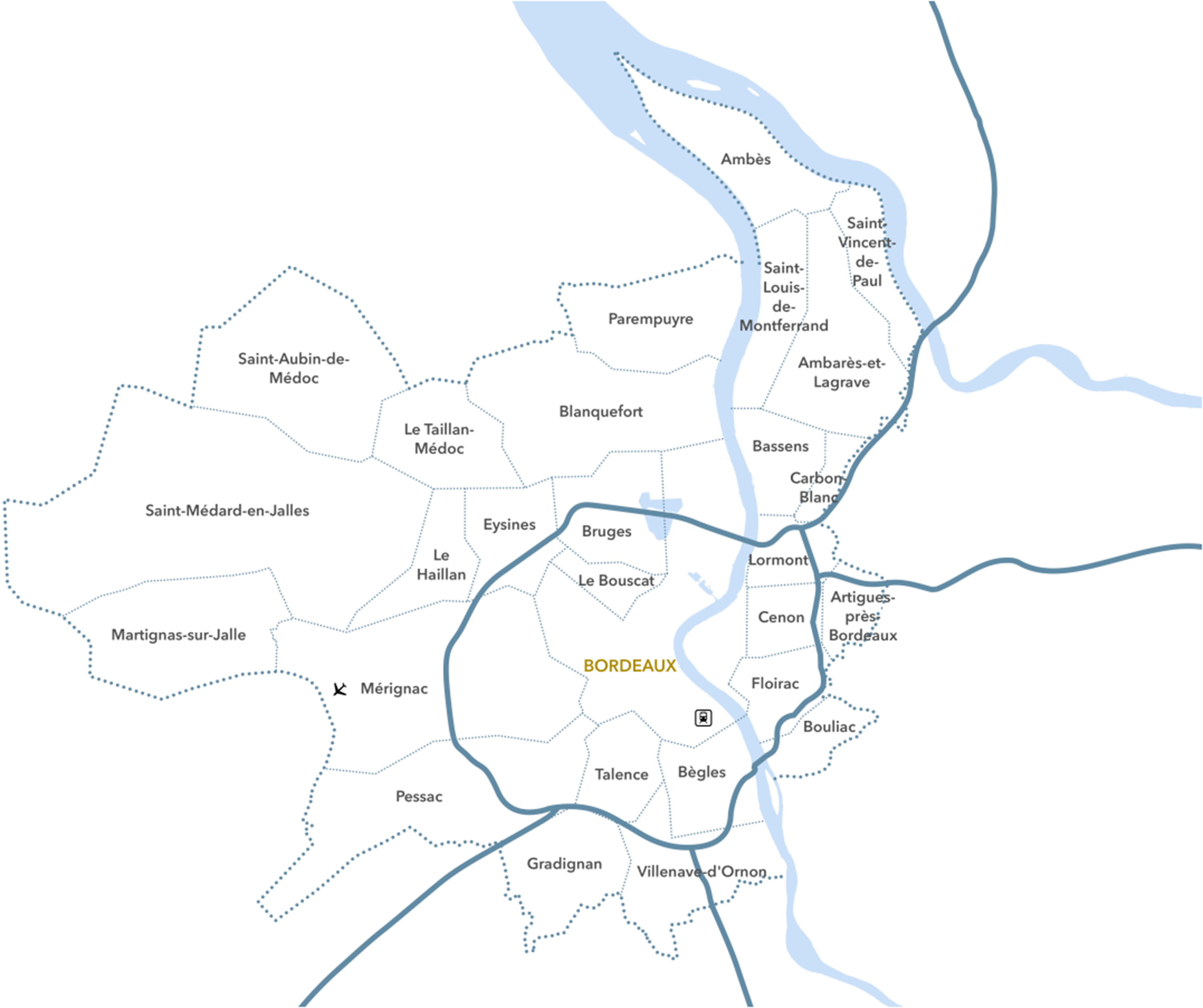
The 28 member municipalities of Bordeaux Metropole with the river Garonne meandering through. The blue lines represent the main highways. Illustration by: Carte Bordeaux Metropole by Henry Salome, CC BY 3.0.
Bordeaux was a “city without projects” (Marieu, 1997) during the second half of the 20th century, with a declining population who moved to the neighboring municipalities (Victoire, 2014). Legacies of this period include infrastructural road projects and neighborhoods such as Mériadeck, that testifies to modernist planning endeavors with its raised concrete park with public administration offices and high-rises separated from the street, on a demolished working class neighborhood (Gonzalez-Lafaysse, 2017). In 1995, after the first change of mayor since 1947, Bordeaux elaborated a comprehensive urban development agenda with many projects that were channeled through the metropolitan administration, in line with how metropoles’ largest municipalities tend to dominate development agendas and mobilize local elites (Pinson and Le Galès, 2005). In this landscape, with several larger municipalities having contributed to the imaginary of Bordeaux Metropole as a larger urban region, mayors’ role as guardians of local life and development agendas remains important.
Flexible building rules
When I searched for persons involved in preparing the PLU, many threads led to Leila and Aurélien, two seasoned planners that figured in the coordination team of land-use plans for the past 20 years. Our first encounter, among several to follow, took place in their offices a couple of months before the revised plan was approved. Leila and Aurélien suggested that “the new PLU is much more contextualized (ce nouveau PLU est beaucoup plus contextualisé).” In comparison to the quantified rules of the previous plan, the revised one posited “qualitative rules (règles qualitatives)” that were less precise and more flexible, they explained. This was motivated, Leila detailed, because during the permit review procedure they would encounter land plots with particularities that normative, quantified rules would fail to valorize. Due to land plots with varying character even within the same neighborhood, there were always “particular cases for which the normative quantitative rules don’t fit.” Therefore, she continued, they elaborated rules that “give the conditions” for when they can be applied “depending on the context (en fonction du contexte).”
Failing to find any mention of qualitative or adaptable rules in the written regulatory framework, I asked Leila for examples of such rules in the PLU. She referred me to a paragraph titled “Special rules related to ecological continuities, wetlands, the valorization of natural resources, built and landscape heritage” succeeded by a list of elements that warranted an alternative application of the rules stated in preceding paragraphs. She explained that the aim was, on a case-by-case basis, to protect trees, wetlands and other elements not being safeguarded through other regulations in the plan. The agency planners expressed aspirations for the plan to acknowledge the existing material realities across the 55,000 hectares of Bordeaux Metropole, which are far too complex and diverse for any planner or plan endeavor to encompass. With the plan being legally binding for the kinds of developments approvable across 10 years that the plan is in force, at least, the flexible rules offered an opportunity to adjust their application to various environments encountered in permit applications.
Another characteristic of the revised plan, Leila explained, was that they had “contextualized the regulations a lot (on a beaucoup contextualisé le règlement)” by dividing the territory into smaller zones each with their own rules: For instance, the multifunctional urban zones will be found across vast parts of the municipalities. These zones have shared rules, but they are also attributed certain specific rules in a certain municipality, for a certain zone or sector, for instance because of the urban morphology calling for different rules regarding heights […] so we have a tool box that allows for a regulation extremely adapted to the territories.
In other directions, they oversaw constructions of the major development project Bassin à Flot. On the grounds of demolished port facilities in the historical craftsmen’s district, Bacalan, several thousand apartments and office spaces were being built (Figure 3). Such major development projects for new housing constituted another zone category with few detailed rules. Instead, Auélien explained, it was decided to “relax the rule (allège la règle), put experts around the table and decide the rules as we go along.” In these zones, public–private collaboration guided the elaboration of projects and rules. While multi-unit buildings figure in the urban landscape since the 1950s following local government affordable housing policies (Victoire, 2014), it has since about a decade become a more common feature through multiple major redevelopment schemes.
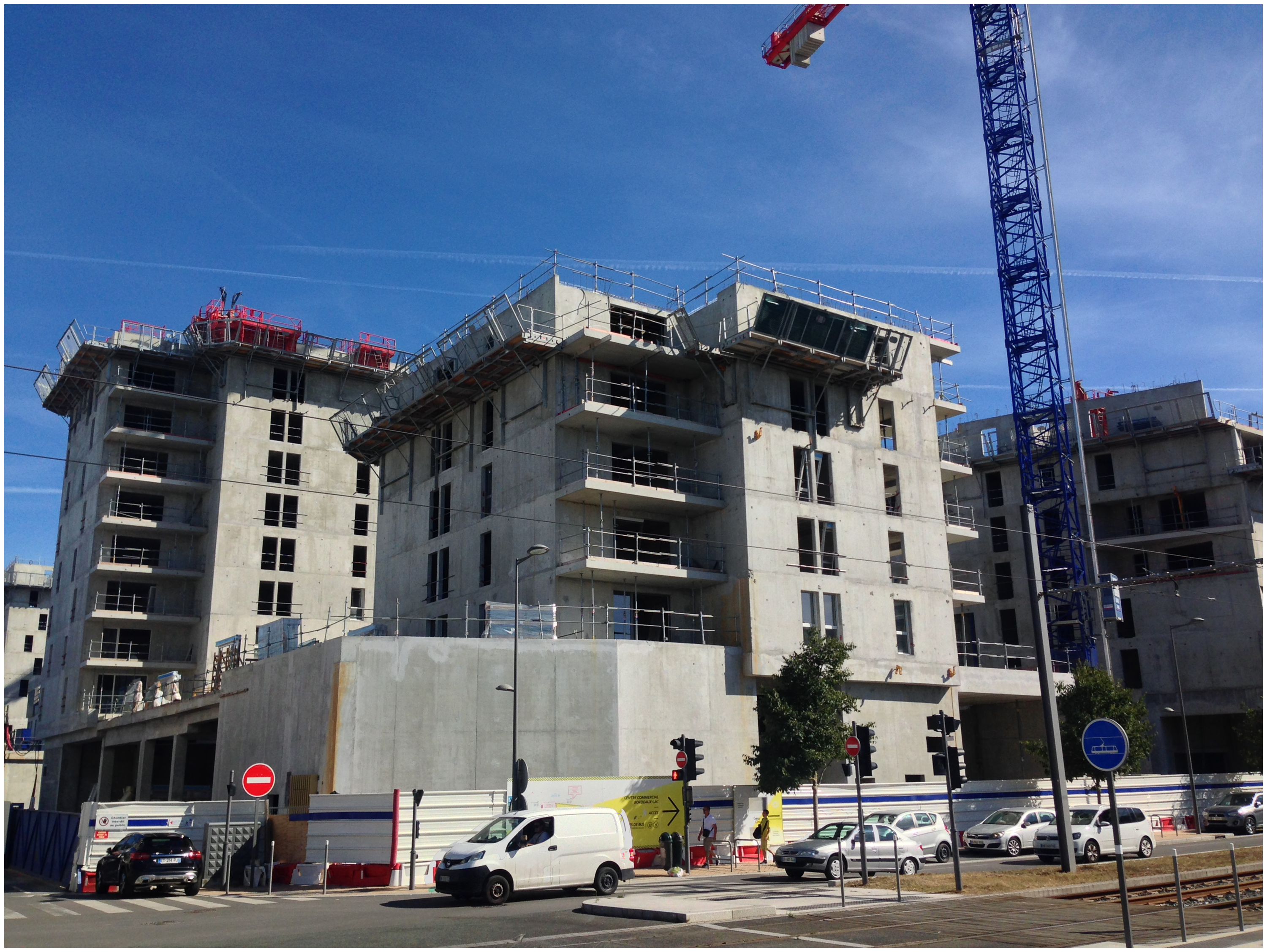
Constructions in Bassin à Flot. Photo by the author.
Yet another zone category regarded neighborhoods with a mixture of private housing developments, townhouses and multiunit buildings of differing architectures. Leila explained that they in these zones “stabilize the existing urban environment” by only allowing developments aligning with the existing buildings, for instance in terms of height, width and architectural designs. These zones include areas with one to two-floor row houses (échoppes) constructed in the 19th century by workers and artisans, and row houses of later construction present across the metropol (Figure 4).
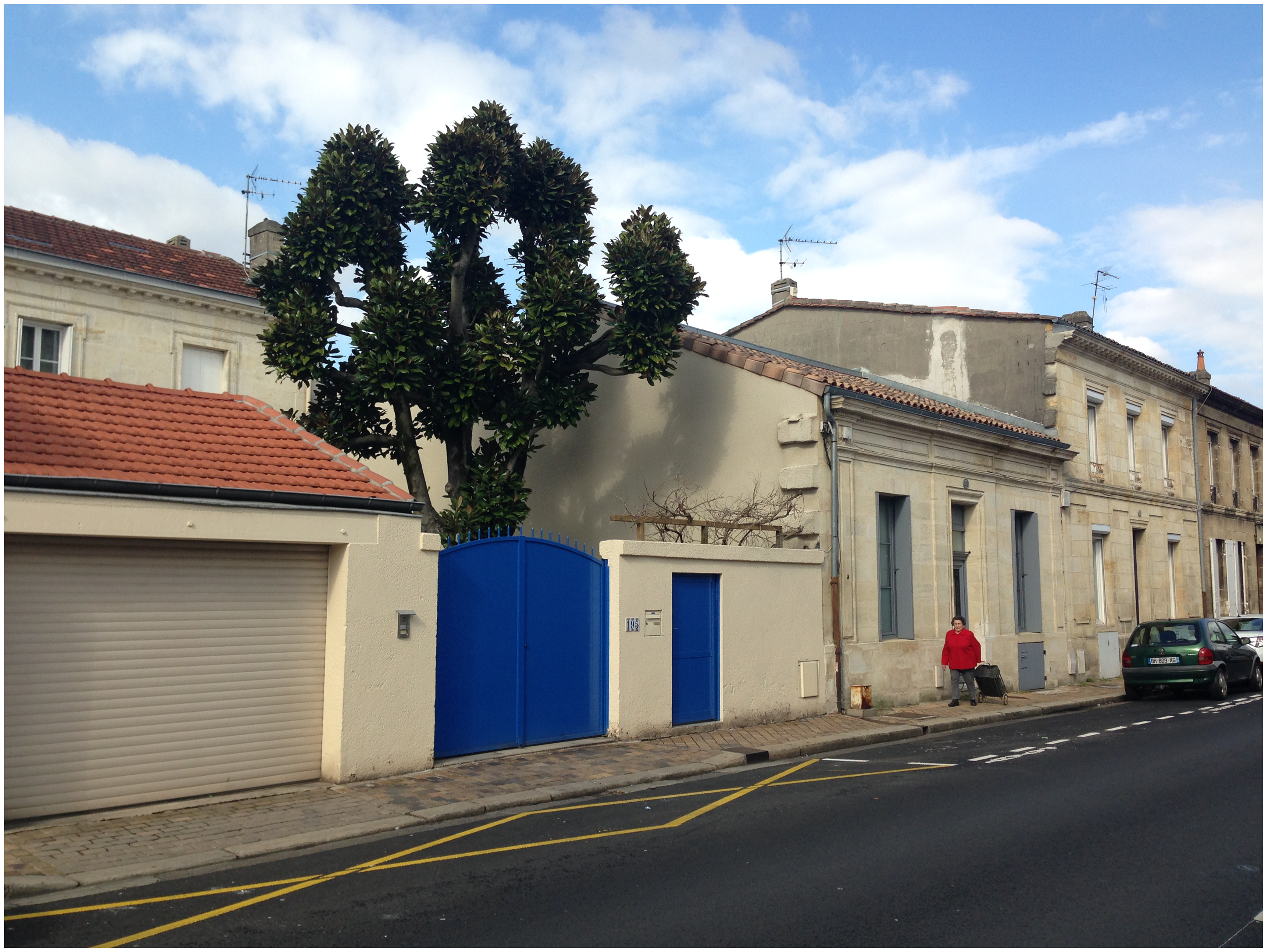
Row houses of 19th century architecture mixed with more recent constructions present across the metropole. Photo by the author.
In the agency planners’ account, the revised PLU was adapted to context by the building rules being prepared on a small scale. The context at hand was the built urban environment in its physical and esthetical aspects. They brought forth how the flexible rules with which the plan was endowed ensured that in its application, it accommodates and adjusts to particularities of the built environment.
Municipal concerns in a metropolitan plan
Whereas the planners brought attention to the relationship between the flexible rules and the built urban environment as a matter of contextualization, mayors’ concerns aimed towards the degree to which the plan accommodated their agendas. Leila and Aurélien observed an increasing interest among mayors in the latest PLU revision, compared to previous revisions. They described the growing interest as spurred through mayors’ experiences of encountering the permits applications prepared in line with the first metropolitan PLU.
The intercommunal organization approved its first shared land-use plan, a POS (Plan d’occupation des sols), in 1981. The POS specified the development rights associated with a piece of land. The planning legislation, with roots in the post-revolution civil code seeking to reduce arbitrary decision making, postulates that the POS is binding on all parties, permit applicants as well as municipalities (Booth, 2005). The importance of municipal exceptions was accentuated by the statutory power of the POS. Municipalities were concerned that the POS proposed building rules that allowed them to approve or reject permit application in relation to their local agendas. The primacy of the municipality to determine its local agendas made it a collection of per-municipality zoning regulations, which Aurélien exemplified as each “having their POS à la carte.”
The “à la carte” arrangement for the POS was restricted in early 2000s. The loi Chevènement placed more responsibilities with the intercommunal organizations relating to strategic planning, and their administrations’ technical expertise grew (Pinson and Le Galès, 2005; Serrano et al., 2014). Meanwhile, the loi SRU (Loi relative à la Solidarité et au Renouvellement Urbain) pushed for cross-sectorial planning and replaced the POS with the PLU. The new plan was endowed with a strategic center piece to be prepared as a shared vision for the metropole’s development discussed in municipal and metropolitan councils before approved, and thereafter translated into detailed building rules. Meanwhile, the PLU kept the statutory power of the POS. Bordeaux’s first PLU was approved in 2006, reduced the amount of constructible land across the municipalities in line with national objectives requiring of land-use plans to hinder urban sprawl. The zoning regulations focused future developments to available land plots in already built-up areas, and prohibited new constructions on vaster areas which took place under the POS. In addition, the regulations allowed for higher buildings than the existing ones in many places, which developers took as an opportunity to construct multiunit buildings in neighborhoods characterized by two-floor buildings.
These kinds of developments were particularly debated in the municipalities on the left river bank that host more affluent households, and a population used to an urban environment characterized by row houses and single family houses privately owned. It was also at these municipalities that the PLU proposed construction of social housing to counter the uneven distribution across the metropole, since the traditionally left leaning municipalities on the right river bank were the major providers of affordable housing. The first PLU thus came to materialize in a restructuring of the urban development agenda: from mayors overseeing their own interests at municipal level to a metropolitan development agenda settling on concentrating constructions in existing neighborhoods and reducing the expansion of town houses and single-family houses, the defining character in many member municipalities.
Leila recounted that when the first PLU was approved, “certain politicians still looked at permit reviewing from a distance.” Mayors’ experiences of signing permits during the first year with the PLU from 2006 were formative for its revision starting in 2010. Mayors formally sign permits since 1945, but the technical responsibility to review permits was only transferred from state field services to municipalities following the 1980s decentralization laws (Booth, 2005). Bordeaux, the largest municipal administration, carries out permit reviewing internally since around 1995. Smaller municipalities with less technical competence began reviewing during the 2000s. It was thus a relatively recent thing for municipalities to control permit review procedures, and this responsibility became actualized under the PLU that projected a metropolitan development agenda with less consideration of the municipal ditto.
One morning in Spring 2017, I took the bus towards the southwest, to interview a mayor in office since four mandate periods on a right-center list. Entering the pathway through the park to the lime stone municipality administration building, I passed boards on which permit decisions signed by the mayor were on display as a reminder of the distributed presence of PLU decisions (Figure 5). He shared his analysis as mayor and metropolitan councilor, in charge of urban planning when the plan revision was launched. The mayor explained that “even if the POS was metropolitan, it was still personalized per municipality.” The PLU, he continued, introduced “a tendency towards uniformity […] because the joint plan doesn’t consider local particularities.” While affirming that the ongoing merging of several municipal services into the metropolitan administration would achieve economies of scale, the mayor argued for permit reviewing to remain within the municipal administration. “Signing a permit is a strategic act,” he affirmed and suggested that “the mayor should be able to put projects into their context (faire une mise en contexte) to see if they [the permit application] can be accepted or not, whether they are regulatory or not.” This was now possible, he continued, since the revised PLU has “much broader rules so that each municipality can draw from them in order to find the right tools corresponding to their territory.” While this suggestion is telling of a concern with the plan’s consideration of the built environment, it also emphasized a concern with the distribution of decision-making authority for urban development.
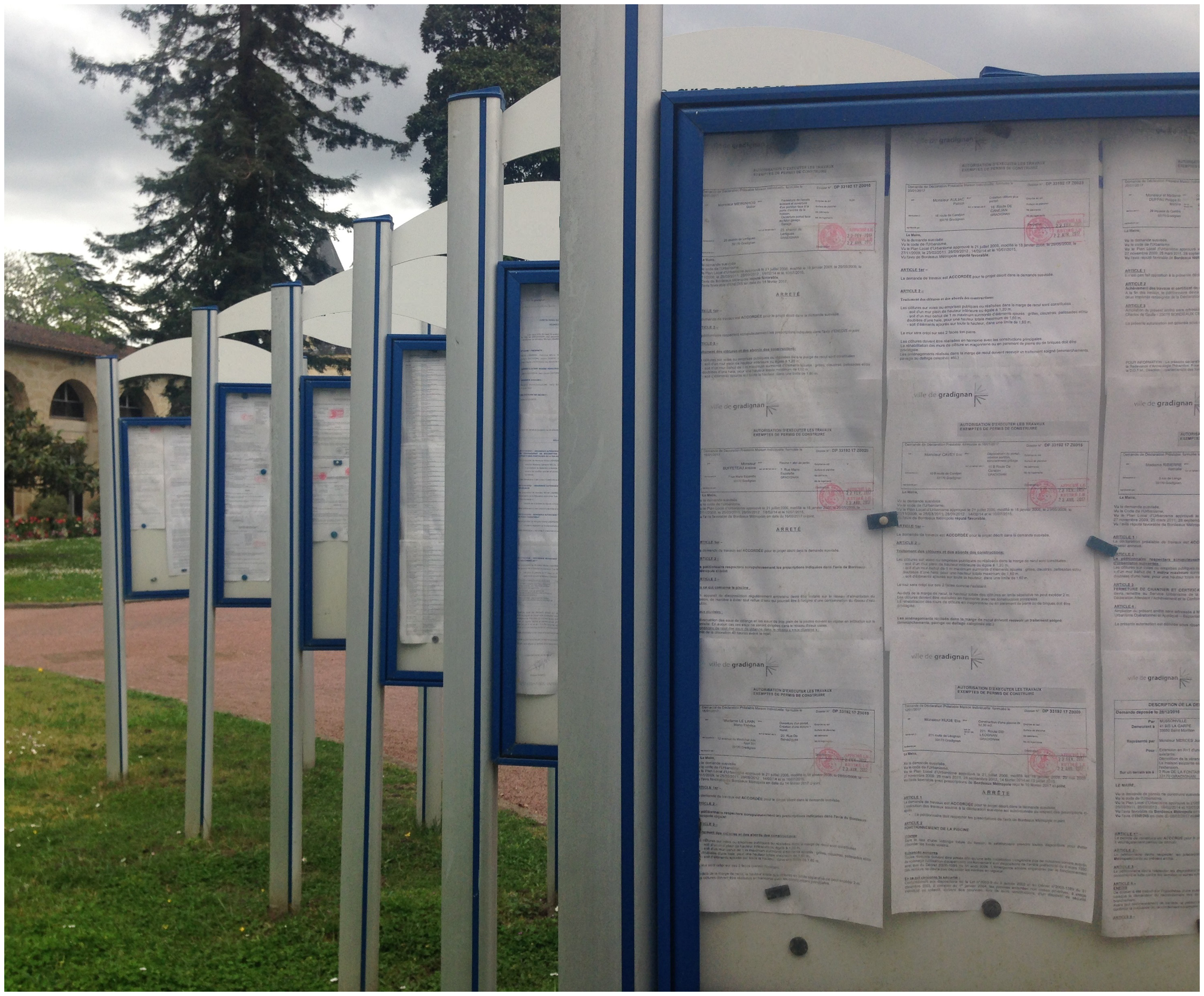
Signed building permit decisions at display in front of a municipal administration. Photo by the author.
The interest in the PLU’s flexible rules as relating to municipal authority was confirmed by Edmé, a high-level official who worked in the metropole administration during the revision period. He recalled debates taking place in the bureau – the office in the metropole’s building where the councilors who are also mayors meet in their dual roles – when the PLU revision began. Edmé described how “municipal logics” surfaced in these debates. The reasoning among mayors were to “let us to do our projects, as local politicians we are the most legitimate to arbitrate or to define what we want and don’t want in our municipality.” From his current position overseeing the realization of public development projects, Edmé noted how mayors approached the PLU as “a sort of a theoretical volume of what can be constructed.” They repeatedly wanted to construct less by means of refusing permits and reducing the heights of proposed projects, he suggested. In his account, the plan was adapted to context by accommodating municipal logics. It was in permit reviewing that these logics played out.
Flexibility to refuse building permits
The tension between municipal concerns and the metropolitan plan in the realm of building permits was accentuated in 2018. Yet, two years to the 2020 election, mayors made public statements about refusing building permits for apartment buildings, and promised to continue doing so. One mayor declared having “refused permits for more than 1000 apartments in one year” and promised to “impose that R + 1 [two-floor buildings] is the maximum height allowed in Bègles outside of project zones” (Cheminade, 2018). Another mayor: “over one and a half years, I have refused building permits equaling close to 3000 apartments and during this period we have refused three times more building permits for multiunit buildings than we have approved” (Delhoumeau, 2018). Among additional cases appearing in local news outlets, these public precisions of refused permits related to the 2014 elections, when mayors who constructed – maires bâtisseurs irrespective of political parties – were voted out of office for the benefit of campaigns run on promises to reduce new constructions.
The public statements about refused permits were confusing when I read them as conflicting with the boundaries drawn up by planning legislation between mayoral decision-making and the regulatory framework of land-use plans. They remained confusing when appearing simultaneously to reports and public debates about a lack of housing, and particularly affordable housing. If Bordeaux was going through a “metropolitan awakening (éveil métropolitain)” (Godier et al., 2018) in economic, political and administrative terms since around a decade, the process of metropolization was manifested in sociospatial injustices (Galimberti et al., 2017). Long-term residents were concerned with households being forced to move outside of the metropole and commute in congested traffic, due to increasing housing prices. Throughout 2017 and 2018, housing prices rose by 12.7% in Bordeaux and by 13.6% and 16.4% in adjacent Merignac and Pessac, respectively. A growing population and high demand on housing have stimulated investments and increased housing prices. Real estate developers’ advertisements encouraged investments by private investors that receive tax reductions when purchasing housing to be made available on the rental market (Dedeurwaerder, 2015). The share of well-paid households in the tertiary sector is growing in the inner-city, and poorer households are forced further out from the metropole (Dembski et al., 2019). The latter’s mobile precariousness was an important fuel for the Yellow Vests (Gilets Jaunes) mobilization (Godier and Tapie, 2020), and the scope of the issue in Bordeaux made it a stronghold for the movement.
In concert with high demands on constructible plots and financial speculation, developers increasingly proposed apartment buildings in areas of private housing developments, which, by 2014, made up two thirds of housing in the larger urban area (Victoire, 2014: 23). Meanwhile, the PLU projects social housing developments in the western municipalities to address the uneven distribution across the metropole. This policy, and apartment buildings in general, have received vocal opposition from residents in public debates and through appealed permits. The last decades of major redevelopment programs and apartment buildings on land plots between private housing developments were, a planner suggested, “national preoccupations imposed locally that are legitimate, but that collide with deeply anchored logics among inhabitants and councilors.” The changes in the built environment clashed with long-term residents’ image of their neighborhoods, both in terms of the kind of buildings, and the social and class composition of those living there.
It is in the light of the ongoing urban developments and the continuation of these projected by the PLU as a representation of the metropolization, togetherwith the lived social injustices and mobile precarity, that mayors’ public mentioning of permit refusals make sense. Land-authorizations have become a “principal responsibility of municipalities and a symbol of the decentralization” (Melot, 2009: 192), whereas the strengthened position of the metropole and the changes in the urban environments it manifests through propose a recentralization imposed by the state. The mayors refusing permits manifested as an opposition towards the effects of the metropolization by bringing forth the municipality as the legitimate source for local agendas and of a democratic legitimacy that the metropole lacks. It functioned as a means to ensure municipal authority in the wake of a metropole associated with increasing housing prices and higher apartment buildings.
The flexible rules in the revised PLU secured opportunities to correct the spatial outcomes produced by the first PLU, by ensuring that municipalities can tweak permit decisions away from the degree of constructions allowed by the plan. So far, I have described mayoral concerns about authority over the implementation of the land-use plan which was present in the idea of a plan adapted to context. In what follows, I show how the plan was put to use in instances of permit reviewing.
Permit reviewing as contextualizing
When I spent time with permit reviewers, I noted how they were never far from a folder with paper sheets. While permit reviewers had different ways of organizing these folders in cupboards and desks, they shared the habit of placing them in folders of different colors and naming one category “strategic permits” (Figure 5). These files warranted closer exchanges with the head of department and sometimes directly with mayors. Permit reviewing, they corrected me, was little about “applying” (appliquer) the rules, which I initially used in my questions mimicking the term I had accounted in official writings about the procedure. Instead, they suggested, it required of them to “interpret (interpréter)” the rules. The interpretative practices were put to work in specific ways in the review of the strategic permits.
Permit reviewers are charged with the task to prepare the decision to refuse or approve a building application based on regulations detailed in the PLU. In case of appeals, the court largely turns to the PLU when adjudicating a contested permit decision, since these rules are binding on both applicants and the municipal government. Raymond was a senior metropolitan official tasked with reviewing the parts of applications pertaining to architectural rules. This meant evaluating permits based on the “Article 11,” as public officials referred to the sections in the PLU relating to exterior and aesthetic elements of constructions. These sections contained varying amounts of detailed rules in different zones, but one formulation was recurrently brought up in discussions among reviewers about permit refusal: “the placement of constructions, their architecture, dimensions and exterior aspects must be adapted to the character, and in the interest of, neighboring buildings, sites, natural and urban landscapes.” This is an example of a qualitative rule that manifests what must be complied with – that new constructions are adapted to the character of the existing ones – without defining in numbers or materials what in the existing environment make up this character.
Architect-officials like Raymond were charged with the task of defining the specifics of this formulation, and providing evidence for how proposed constructions aligned with their surroundings. It was a task charged with temporal tensions as the city’s morphology consisted of layers from different epochs as well as different rules. In addition, not all existing constructions were regular from the viewpoint of the planning legislation – the metropole nor municipal administrations control changes in the built environment in an absolute sense. The task was complicated also because municipalities with less technical competency in permit reviewing asked architect-officials for assistance to refuse selected applications. Raymond explained this as an instance of the metropole administration being useful for municipal interests: The files that municipalities ask me to review are often permits that they don’t want. They use me to prepare refusals. […] But they don’t explain to me why they don’t want the particular project, what there is behind this expectation of the politicians, if it’s the density, because they can’t stand the developer, or if it’s because of being apartment buildings…
Developers were attuned to the use of Article 11 to refuse permits, as became apparent in a meeting between planners from the coordinating team of the PLU, and developers that wanted to learn how to make use of the revised plan. The usefulness of the meeting relied on the assumption that planners’ intentions with the plan corresponded to how it was implemented. Soon into the meeting, developers shared experiences of review procedures that contrasted such assumption. A developer representative explained having received refusals on applications “with motivations based on the Article 11, and when I went to see the mayor about this they repeated that the permit was refused but wouldn’t detail the reasons why.” Another developer added agreeing that “there is the rule, and there is the negotiation.” The developer representatives suggested that their attempts to accommodate the building rules in permit applications were futile, since they were refused regardless. A planner responded, somewhat dissatisfied that their intentions with the plan was thwarted, that “it’s not because something is written in the land-use plan that the mayors will force themselves to follow it […] We are powerless against that kind of use.” She shared examples of cases where the Article 11 was used to motivate refusals when the actual concern was the height of a building.
A ministerial report about the Article 11 suggests that the interpretative allowances of such rule formulations were used for various purposes not only in Bordeaux (Wellhoff and Perignon, 2010). From a legal point of view, these discissions may suggest that applicants’ questioning the accuracy of permit decisions could appeal these court. Developers with “professional intimacy” (Mack and Herzfeld, 2020) of local planning politics knew that the capacity of signing permits conferred to mayors constituted a broader realm of power than the up-front PLU regulations. As an architect told me, if you want to build in Bordeaux “you cannot afford to turn your back on the municipality.” Meanwhile, connections with mayors could also lead to favorable applications. This was backed by a mayor who explained to me that “the intelligent developers know that they have to be willing to discuss and negotiate – everyone must find their share […] the developer who makes aberrant things by force will find themselves penalized.” The high demand for land in Bordeaux put many municipalities in a relatively advantageous position to use pre-emption rights and land acquisitions as means to bargain with developers, in addition to the Article 11 as a source for jeopardizing the success of applications.
The examples of mayors selecting permits to be refused, and asking for administrative support to motivate decisions, illustrate what the capacity to sign permits mean in practice. The flexible rules secured opportunities for mayoral interests to be injected into decisions on permit applications.
Conclusion
I started out this article by asking what can be learned about the relationship between planning and context from attention to how urban actors in Bordeaux mobilize the notion of context in planning work. In Bordeaux, it was in the less spectacular aspects of planning such as zoning regulations and permit review procedures that the implications of the plan as adapted to context surfaced. In these instances, appeals to context-adapted planning functioned as a subtle resource through which conflicting aspirations – between municipal and metropolitan agendas, residents and desired population growths, and predictive and prospective planning ideals – were negotiated. I suggested in the introduction that the article focuses more on the by whom, and less on the what of context. The ways in which flexible rules were mobilized among mayors can certainly be summoned up as relating to contexts with specific properties. For instance, permit refusals were oriented toward apartment buildings and constituencies that own their own home. Moreover, it is possible to situate the episodes from Bordeaux in the broader contexts of spatial injustices, weakened legitimacy of political institutions, and conditions for planning in neoliberal economies.
To think with the understanding of context, as constituted in political processes of making connections and disconnection (Dilley, 2002), sheds light on another dimension of these episodes. The practices with which the notion was associated in Bordeaux had to do with the authority to impact and define how the urban development projected through the PLU was implemented. The use of the notion in Bordeaux carried disagreements as to which level of government was legitimate to make urban development decisions – the metropole or the municipality (or the mayor). The plan, as adapted to context, was about the possibility to issue decisions on permit applications irrespective of their fulfillment of regulatory requirements. As such, it regarded the by whom of context, or in other words, the capacity to decide what mattered and at what moment those decisions were made. It entailed a struggle over what Dilley describes as the “ability to define a context in a particular way or to initiate a series of contextualizing moves in a particular direction” which is to centralize certain realities “in the light of the other possible” (2002: 454). The flexible rules put to work through permit reviewers’ interpretative practices were such contextualizing acts that weave together different links and elements into specific connections. By analyzing the ways in which context was put to use in a local planning practice through an analytical lens of the same notion, I argue that the insights from Bordeaux demonstrate how planning practices contribute to generating and establishing certain issues as more urgent and relevant to attend to than other issues. This implies that in addition to impacting and being impacted by different contexts, planning is a practice that itself is responsible of conjuring up contexts.
Politicians’ involvement in preparations and executions of plans is nothing new (Abram, 2014; Mack, 2019). By highlighting municipal manipulations of permit reviewing, I do not intend to suggest that this involvement, in its own right, is surprising. Nor do I, by including the accounts of developers’ discontent with how the permit procedures unfolded, intend to suggest that mayoral authority was a main force of urban development processes. The episodes in Bordeaux are examples of the intensified public–private negotiations in France observed by Pollard (2022) that give importance to local government’s “regulatory capacity” to control urban development processes. Policies for flexible planning serve to pursue economic development and favor private sector involvement in many countries impacted by neoliberal logics, including Denmark and England (Olesen, 2014; Waterhout et al., 2013). Such policies are present also in France (Pollard, 2018), but the properties of flexible rules were used in Bordeaux to reassert municipal authority. They were entangled with maneuverings through government institutions and planning legislation, and played out among local politicians anxious to secure control in processes of shifting planning powers to the metropole. The manipulation of permit decisions through flexible rules reminds of the undetermined outcomes of flexible planning that, as Gururani proposes, “encompasses a range of political techniques through which exemptions are routinely made, plans redrawn, [and] compromises made” (2013: 121).
The insights on the relationship between planning and context from Bordeaux urge attention to how appeals to context, as never value-neutral or ready-made, come about, appear, and gain importance across different urban planning issues and settings. While alluding to a benevolent sensibility toward local particularities, diversity and participatory processes, the workings around the plan adapted to context in Bordeaux were prioritizing the privilege of certain local issues and communities at the expense of others. Claims for context entail processes of weaving together as much as disconnecting and excluding. They also direct attention, resources, and shape what is considered relevant, and even possible. This calls for attention to situated uses of the notion through non-normative standpoints that put aside judgements of attending to context as either good or bad, benign or malign, in its own right. At stake are the premises through which what counts as a relevant context is defined, and to what effect.
Footnotes
Acknowledgements
This article is based on fieldwork carried out in Bordeaux between 2016 and 2018. I am grateful for the generosity of interlocutors and colleagues in Bordeaux. For the generative and helpful feedback on earlier drafts of this article, I thank Simone Abram, Nikhil Anand, Alize Arıcan, Maria Håkansson, Jennifer Mack, and Jonathan Metzger. Early versions of this article were presented in seminars at the Department of Anthropology at Stockholm University and the Division for Urban and Regional Planning at KTH. I thank the participants in these seminars who shared feedback that helped improve the article..
Declaration of conflicting interests
The author declared no potential conflicts of interest with respect to the research, authorship, and/or publication of this article.
Funding
The author disclosed receipt of the following financial support for the research, authorship, and/or publication of this article: This work was financially supported by the Swedish Research Council/Vetenskapsrådet (grant number #2014–01414).