




Abstract
In this paper, I investigate the changing connections between atmospheric pollution, spectral colour, ideas of a spatially ‘modern’ built environment, and racism. In the nineteenth century, the blackening effects of air pollution were seen as creating disordered spectral colour in the city, in a manner that was sometimes associated with ideas of the physical regression and degeneration of the urban population. By the middle of the twentieth century, however, this colour disorder was more often depicted as the sign of an ‘out of joint’ temporality in which the ‘bad old’ Victorian era was haunting the present. This enabled urban reformers to advocate for planning as a force that could exorcise these spectres and instead create a clean, white and unpolluted urban environment, with a colour palette that was restrained rather than vivid. However, in the post-war context of mass immigration, this created a series of associations in which ideas of urban decay were all too easily associated with racialised blackness, with new immigrants figuring simultaneously as a blackening and blighting influence on urban neighbourhoods, and as too vivid in their sartorial colour choices to ‘belong’ within British culture.
The air plays such a big part in the theory of colour.
– Baudelaire, The Salon of 1846
Imagining modernity: atmospheric pollution and disordered colour
It was a town of red brick, or of brick that would have been red if the smoke and ashes had allowed it; but as matters stood, it was a town of unnatural red and black like the painted face of a savage. It was a town of machinery and tall chimneys, out of which the interminable serpents of smoke trailed themselves for ever and ever, and never got uncoiled. It had a black canal in it, and a river that ran purple with ill-smelling dye, and vast piles of buildings full of windows where there was a rattling and trembling all day long, and where the piston of the steam-engine worked monotonously up and down, like the head of an elephant in a state of melancholy madness. It contained several large streets all very like one another, and many small streets still more like one another, inhabited by people equally like one another, who all went in and out at the same hours, with the same sound upon the same pavements, to do the same work, and to whom every day was the same as yesterday and tomorrow, and every year the counterpart of the last and the next. (Dickens, 2001: 20–21)
This is Charles Dickens’s 1854 description of Coketown from Hard Times. The urban area he describes is shaped by fossil fuel capitalism, as a new steam-driven industry transforms both the place in which it sits, and the surrounding society. At the heart of Coketown sits the piston: the fetishistic logic of the paragraph makes the social relations that govern the ownership of the factories vanish, so that the machine itself appears as an agent. It nods with the sad autonomy of a psychologically damaged, caged elephant, subjecting the faceless, nameless inhabitants of the area to its monotonous discipline in their ceaselessly similar working day. This, in turn, finds its architectural expression in a town of geometrically identical streets. But Coketown is governed by a monotony of repetition, not of stasis: machinery, people, and place are all driven by a restless, yet uniform motion in this ‘severely workful’ place (Dickens, 2001: 21). And above it all, as its master sign, are the snakes of uncoiling air pollution, unwinding endlessly across the sky. In fact, the only irregularity in Coketown is the startling, motley industrial colourscape that all this productivity produces: brick-built buildings are ‘unnaturally’ streaked, canals run black, and rivers are dyed purple.
It would be an inattentive reader who missed the racialised language of this atmospheric transformation. The blackening effect of the smoke and ashes might be distinctively modern, but its disruption of colour is described in terms of regressive racialisation: as a result of air pollution, the town looks like ‘the painted face of a savage’. ‘Savagery’, by definition, is a term that plugs into the wider temporal structure of Eurocentrism (Chakrabarty, 2000): a key conceptual pillar of the colonial mindset is the idea that, at any given moment of historical time, different cultures represent varying stages of so-called ‘civilisational advancement’ (Bernasconi, 1998; Fanon, 2021; Habib, 2017; Susan Buck-Morss, 2009). In this racialised world picture, white European nations are framed as inhabiting a developmental temporality that is somehow ‘ahead’ of more ‘backwards’ non-European cultures, so that looking across geography at any given moment becomes an exercise in looking across developmental history. The colonial worldview, in other words, centres on an idea of anachrony: the ‘present’ of the metropole and the ‘present’ of the colony are chronologically simultaneous, yet stagist history writes the former as inhabiting a developmental temporal frame that lies in the future of the latter. It should go without saying that this condescending conceptualisation can only exist because it ignores the fact that global north and global south are demonstrably coimbricated in a whole variety of simultaneous spatial and social relationships in any present moment, and indeed that the modernity of the metropole is enabled by the exploitative and violent extraction of multiple forms of value from the colony (Hartman, 1997; Lowe, 2015).
The striking thing about Dickens’s Coketown, however, is that the anachronism is present at the spatial centre of modernity, in the contemporary metropole. Coketown’s colourscape is both the signature of the latest in coal-powered manufacturing modernity, and a sign of savagery, of something troubling and regressive at the heart of industrial capitalism. In this paper, I will endeavour to place this description at a particular juncture in history, to show that it forms part of a wider debate about the changing relationships between atmospheric pollution, spectral colour, and conflicting ideas of a spatially ‘modern’ city. A key idea in my argument is that there is a ‘politics of spectral colour’ in the urban environment that interacts, in complex ways, with racial politics. Hitherto, much work on colour in the urban environment has tended to focus on the distinctive tones of particular places, often in ways that assume a certain constancy over history and a kind of materials-focused localism (see, for example, Batchelor, 2001; Düttmann et al., 1981; Lancaster, 1996; Lenclos and Lenclos, 1999; Porter, 1982; Wigley, 2001). As I hope to show, this ignores not only the changing material history of colour but also its distinctive representational politics, in particular the implications of ideas about colour appropriacy for questions of racial violence. This paper begins a project that seeks to open up urban aesthetics as a new field of diachronic critical study, exploring the ways in which arguments about urban design have a colonial politics that can reinforce spatial and environmental forms of racism, part of a wider ‘gratuitous violence that occurs at the level of a structure that constitutes the Black as the constitutive outside’ (Sharpe, 2016: 28).
My argument centres on a key theoretical insight, that anachrony is not a fixed term, but a conceptual structure that can take a number of different forms. In other words, the idea of air pollution as something that is temporally ‘out of joint’ with the present changes its shape and its intellectual coordinates over time. In the nineteenth century, the blackening effects of fog, smoke, and soot were seen as both an exasperating material problem of the contemporary city and as a possible cause of regression and degeneration, often in racially-inflected language that relied on an invocation of geographical otherness (see section ‘ A fit of the vapours: air pollution, urban disorder, and disease’). By the middle of the twentieth century, however, the dominant framing of anachronism surrounding air pollution had shifted into a less geographical and more temporal form: instead of the comparison being to colonial geographical others, writers saw smoke, soot, and fog as a hangover from Britain’s own Victorian past, a symptom of need for urban reform (section ‘‘An aerial slum’: air pollution, the grey city, and the birth of urban planning’). Air pollution at this juncture became a kind of master metaphor for a wide range of social, economic, and spatial problems in the contemporary city, picturing all of these as relics of the past, and creating a powerful argument to advocate for urban planning as a force that could exorcise these spectres and instead create a clean, light and unpolluted urban environment.
The soot-laden atmosphere thus got rewritten as a form of urban trauma, its presence a symptom of hidden impediments to the teleological march of time from the present into a hopeful and reformed future. Only removal of these obstacles by an appropriately reformed class of planners could set the ‘out of joint’ clocks of modernity ticking again, restoring the city to a light-coloured modernity (section ‘Light, bright, but restrained: urban colourscapes in mid-century modernist plans’). However, while this might feel like a more ‘progressive’, less racialised way of picturing urban problems, it redefined the British urban colourscape as a place of neutral, light colours, where ‘blending in’ with one’s urban context was not only an aesthetic, but also a political, priority. This, combined with the instability attendant on the very expansiveness of blackening air pollution as a metaphor for all urban ills, meant that, in the post-war context of mass immigration, the association of blackness and blight was rapidly re-racialised. In the Windrush era, new immigrants consequently fell victim to a discourse in which they fell foul of an impossible colour contradiction, being framed as both ‘too black’ and ‘too colourful’ for the modern, reformed British city (section ‘Keeping Britain white: the racial politics of urban colour’).
Atmospherics: materiality, affect, representation
This paper makes an empirical argument, but my ambition is also to develop a convincing theoretical case for a different approach to the investigation of ‘urban atmospheres’. A turn towards the affective and the embodied has been the hallmark of much recent scholarship in the spatial disciplines, with ‘atmosphere’ emerging as a pivot between the material and social qualities of a place, the multi-sensory phenomenological ways in which it is encountered, and the affective impacts of that experience as they are registered by the body, often described in a Spinozist-Deleuzian language of movement and unfolding and shifting intensities (Anderson, 2012; Massumi, 2002; Thrift, 2004). In this picture, material atmospheres surround and press onto a sensory human body that subjectively registers affective impacts in ways that bridge between personal and social experience.
However, in my view there are four main problems with this general approach. I should emphasise that, since work on affect is highly variegated, not all writing on urban atmospheres is characterised by all four of these problems at once: in fact, they are most often encountered in a more piecemeal fashion. Firstly, ‘atmosphere’ is surrounded by a deliberate conceptual indeterminacy: it can refer to anything from the tangible, physical air of a place, its climate and weather, its literal, breathable mixture of gases to completely immaterial aspects of place that have a collective/transpersonal affective or even embodied resonance. Consequently, there can be a slide between the literal and the affective dimensions of atmosphere: as Matthew Gandy has provocatively asked, ‘When does air become an atmosphere?’ (Gandy, 2017: 357). In some cases, this ambiguity is creatively productive, allowing writers to capture elusive qualities of our experience of place that unfold new readings (Ingold, 2006; McCormack, 2008); in others, however, this language becomes a kind of vague gesturing towards the complexity of our spatial experience, leading to a significant loss of critical precision and nuance.
Secondly, as many other writers have persuasively argued, some of the earlier literature on atmospheres (e.g. Pile, 2010) had a tendency to make generalising claims about the effect of the atmosphere on the body, in a manner that prioritised immediacy and immanence at the expense of ignoring the ways in which structural factors like race, gender and sexuality frame and impact experience (Curti et al., 2011; Kobayashi et al., 2011; Rose et al., 2010; Tolia-Kelly, 2016). At its most extreme, this reintroduced a normative universal subject into the discussion of place experience by the back door (Barnett, 2008), ignoring the ways in which identity and forms of discrimination inflect our experience of the affective and literal atmospheres of a place (for a sophisticated alternative approach, see Ahmed, 2004). When it comes to air pollution specifically, this creates a paradox: at the same moment that scientific and empiricist work on air quality research has built an increasingly persuasive case that the impacts of polluted urban atmospheres fall most heavily on populations who are poor and black, geographers developed a theory of affective atmospheres that in some cases risks eliding precisely these dimensions of embodied experience.
Part of the problem may lie in a third issue: the unyielding nature of the commitment to non-representational theory that underlay much of the early theorisation of ‘atmospheres’. It is extremely difficult for any theory of affect that focuses on immanent, pre-cognitive effects in an anti-intentionalist manner to pay heed to the role that affect can play in the ideologically-laden construction of signification and meaning (for a brilliantly articulated critique of this point, see Leys, 2011, whose work is deepened into a racially grounded critique by Berg and Ramos-Zayas, 2015). Further, a scholarly focus on the effects of atmosphere on the pre-cognitive body can also preclude attention to agency in the reverse direction: the ways in which representations of atmospheres can contain forms of spatial agency which holds sway over bodies, working in deeply discriminatory ways. Of course, not all work on affect is open to this criticism: indeed, much recent scholarship has responded to the need for a racially-sensitive theory by developing conceptualisations that are more sensitive to cultural representation, more aware of identity as a process rather than a static category, and more attentive to postcolonial scholarship (see, for example Ashley and Billies, 2017; Berlant, 2011; Sharpe, 2016). However, while this work has devised sophisticated ways of incorporating the affective and the material, it has tended to do so in a way that leaves the concept of ‘atmospheres’ behind.
However, attentiveness to both race and representation also requires a certain degree of historicity. The fourth problem with some affective theories of the atmosphere is that their relationship to temporality is often poorly defined. An ‘atmosphere’ in the geographical literature can refer to something relatively permanent: a haunted quality that attaches to a place and affects certain observers in certain ways. But it can also mean something highly ineffable and ephemeral, a coalescence that is merely momentary in nature and that may not be in any way exactly repeatable. Further, at a conceptual level, the ways in which we define and understand ‘the atmosphere’ itself has a history, which has to be considered once we depart from a pre-cognitive model of immediate affective impacts. To make matters more complex still, historical shifts in the way that we conceptualise atmospheres often themselves thematise time, for example by seeing certain kinds of atmosphere as anachronistic, as discussed in section ‘Imagining modernity: atmospheric pollution and disordered colour’.
In this paper, I will attempt to deal with this issue by exploring time at three levels. Firstly, as already outlined, I will argue that the way in which we conceptualise the atmosphere and its affective impacts shifts over time, and has its own conceptual and practical history. Secondly, I will argue that temporal change is thematised in historical discussions of the atmosphere, via the concept of anachrony, so that time becomes an internal dimension. In the process, I hope to demonstrate that anachrony is a far richer and more internally varied spatial concept than much contemporary geographical literature, with its near-exclusive focus on Derridean hauntology, has suggested. Thirdly, I hope to show that different models of anachrony sit within wider traditions of historiography that affect the ways in which we picture the relationship of the present to the future, with distinct spatial consequences. In particular, because time is a central component in Eurocentric ideas of urban modernity (as I argued above), attentiveness to temporal models can be essential in understanding the racialisation of atmospheric concepts and affective spatial experience.
My endeavour is one that brings the material, affective, and representational aspects of atmosphere together, to yield a more precise understanding of their complex relationships. My argument is that it is only by moving between the material/spatial, affective/embodied, and representational/temporal readings of urban atmospheres that we can grasp the racialised way in which British urban atmospheres were understood and the violence that this inflicted on black communities. I hope that this lens enriches standard histories of air pollution (Ashby and Anderson 1976, 1977a, 1977b; Bowler and Brimblecombe, 2000; Brimblecombe, 2011; Corton, 2015; Jarrige and Le Roux 2020; Luckin, 2003; Markham, 2019; Mosley, 2008; Stradling and Thorsheim, 1999; Thorsheim, 2004), and adds a new, cultural geographical dimension to the literature that draws attention to the ways in which the health impacts of air pollution disproportionately affect poor, black and marginalised communities. was understood, and the violence that this conceptualisation inflicted on black communities.
Throughout the writing, I have also treated smoke, soot, and fog as a single complex, rather than separately, for the simple historical reason that the boundaries between these manifestations are blurred in the period I scrutinise. Long before there was a full scientific understanding that particulates from coal fires mixing with water vapour under conditions of a temperature inversion create foggy conditions, different manifestations of air pollution were seen as part of the same constellation of urban problems. The history of their separation is a fascinating one, but it lies beyond the scope of this paper.
A fit of the vapours: air pollution, urban disorder, and disease
The idea that the smoky urban atmosphere constituted a form of urban disorder has a long history. John Evelyn’s famous 1661 Fumifugium describes London’s smoke-laden atmosphere in a whirl of black-and-red metaphors that deliberately blend Greco-Roman and Christian geography and mythology. The British capital consequently resembles ‘the face rather of Mount Aetna, the Court of Vulcan, Stromboli, or the Suburbs of Hell, than an Assembly of Rational Creatures and the Imperial set of our incomparable Monarch’ (Evelyn, 1661: 6). However, while Evelyn’s concerns pivot on a contrast between rationality and flaming chaos, the contrast is spatial and mythopoeic, giving it a rather different feel from the racialised Eurocentric temporality of Dickens’s ‘savagely’ streaked city. Rationality, Christianity, and imperialism are linked, but the comparison does not rely on a Hegelian stagist view of history: instead the advanced British capital is compared, with dismay, to a range of pagan or devilish landscapes that exist outside of historical time. Perhaps unsurprisingly, the fire that is the origin of the problem is also much more prominent in this comparison from the pre-steam age than it is in later nineteenth century texts, where it is smoke, soot and fog that are the focus.
Of course, Evelyn’s concerns are firmly rooted in miasmatic theories of disease: the idea that illness was caused by atmospheric conditions, including pollution but also creeping fogs containing rotting plant matter and stagnant water (Halliday, 2001; Kannadan, 2018; Karamanou et al., 2012). These were believed to create bad air, which caused disease when it lingered in an area. However, at the crux of Evelyn’s argument is a controversial new idea: that air pollution from seventeenth-century coal-burning domestic fires and industry should be viewed as a pathogenic agent similar to fog, rather than as a preservative against it, as many contemporary physicians believed. His spatial solution was to suggest the zoning of coal-burning industry to an area five to six miles south of the Thames, removing it from residential areas, but also improving the ‘too cold and uliginous vapours which perpetually ascend from these Fenny grounds’ (Evelyn, 1661: 17). Fumifugium thus mixes an older theory of disease and a new idea of industrial smoke as a pollutant that was harmful to health. Indeed, a blend of miasmatic and pollutant theories arguably continued until the twentieth century: as Bill Luckin has argued, ‘eclecticism reigned supreme until the 1880s and 1890s, with the parameters of what was now frequently termed “vapour” theory becoming ever more elastic’ (Halliday, 2001; Luckin, 2006).
Despite this ambiguity, however, by the mid-nineteenth century, there was a noticeable shift towards the idea that atmospheric pollution represented a major health issue. This probably reflects the increasing tangibility of the issue in urban areas once steam-driven industry had moved from water-powered rural locations into the fossil-fuel driven factories of cities like Dickens’s fictional Coketown (Malm, 2016). The growing urban workforce increased the problem, with pollution from coal-burning fires and cooking ranges contributing to visibly worsening atmospheric conditions, a process that intensified to the 1870s and 1880s (Brimblecombe, 2011; Corton, 2015). Waves of attempted urban reforms followed: the 1840s saw the emergence of the first smoke abatement campaigns in northern England, the first inquiries into smoke as a nuisance, and the first (unsuccessful) attempts at parliamentary regulation. All focused on industry as a source of pollution, rather than domestic fires. The year 1853 saw the passage of the first rather toothless legislation, under the leadership of Lord Palmerston, with smoke abatement subsequently included in the sanitary acts of 1858, 1866, and the Public Health Act of 1875 (Ashby and Anderson, 1976). However, these early measures simply failed to outpace the growth of the problem, with the 1880s witnessing as many as 55 serious fogs a year in the capital (Luckin, 2003).
Spectral colour played a distinctive role in the representation of concerns about smoke, fog and soot, as the visible tint of the urban atmosphere was taxonomised in a new colour chart of pollution. The whiteness of country fogs was increasingly seen as an indicator of purity rather than disease, while the contamination of urban fogs was evidenced by their dull colour. Dickens’s final work, Our Mutual Friend (1865) is paradigmatic: Even in the surrounding countryside it was a foggy day, but there the fog was grey, whereas in London it was, at about the boundary line, dark yellow, and a little within it brown, and then browner, and then browner. But they are worse and more frequent in London and other large cities than in the country; what would there be a white mist becomes a brown, sometimes almost black, one in the metropolis. (Dickens, 1865: 2:1)
Further, this atmosphere was increasingly imagined in terms of a tangible precipitate. A key difference between country and urban air was that the latter became a touchable presence, depositing itself on urban surfaces to create a distinctive industrial colourscape of greys and blacks. The urban atmosphere left a literal trace: as influential air pollution campaigner F A R (Rollo) Russell noted in 1880, city fog was “brown, reddish-yellow, or greenish”, and marked whatever it touched: “particles of soot attach themselves to every exposed object” (Russell, 1880). The disorder it created was one of “matter in the wrong place” (Russell, 1880: 1), a confusion of the terrestrial and the aerial. As the Times noted on 10 August 1853, the city had become a place that it was impossible to keep clean: “We white-wash, and distemper, and paper, and paint, and gild, and clean … doing the work over and over again, but all to no avail” (quoted in Corton, 2015: 35). Importantly (and I shall return to this point), fabrics, too, were greyed out, changing the appearance of the human body. For Edward Carpenter, who wrote a series of article on smoke in The Clarion from April to June 1894, the population became electively “black-coated, dark-raimented”, spending inordinate amounts of time in interiors where they obsessed over “what furniture they will buy, what curtains for their windows, what clothes for their backs, which will least show the dirt in which they are steeped” (Carpenter, 2017: 30). Atmospheric colour disorder was not merely an outdoor affair: it had both crept indoors, and become embodied.
Concerns also began to be voiced about the impacts of this unusual colourscape on both physical health and affective and emotional responses to the city. The blackening effects of air pollution on ecologies were well recognised in terms of a loss of greenness (one notable exception was the London plane, Platanus x hispanica, which was sufficiently tolerant of pollution to survive). As Dickens notes of Birmingham in The Old Curiosity Shop (1840–41), the atmosphere affected the ecology of the city, produced a second rural to urban colour gradient of green to grey that mapped onto the aforementioned taxonomy of white to grey fog colours. As Nell and her grandfather move towards the heart of industrial Birmingham in the novel: coal-dust and factory smoke darkened the shrinking leaves, and coarse rank flowers … the struggling vegetation sickened and sank under the hot breath of kiln and furnace, making them by its presence seem yet more blighting and unwholesome than in the town itself–a long, flat, straggling suburb passed, they came, by slow degrees, upon a cheerless region, where not a blade of grass was seen to grow, where not a bud put forth its promise in the spring, where nothing green could live but on the surface of the stagnant pools, which here and there lay idly sweltering by the black road-side. (Dickens 2008: 338)
Yet it is worth pausing to notice that this same colour contrast could also be a source of regional pride. Elihu Burritt’s Walks in the Black Country and its Green Border-land (1868) famously notes that the industrial Midlands are ‘black by day and red by night’ (Burritt, 1868: 1), but contrasts this with the description of a completely black, subterranean world of coal production, the ‘inky vaults and tortuous pathways’ (p. 2) of the mines. This is a text that refuses the association of grime with urban blight, instead insisting on the transmutation of black fossil fuels into golden wealth (though Burritt is less clear about the variegated socioeconomic distribution of these glittering riches): To be sure, the nuggets they [the mines] have yielded to the pick have been black and rough, and blackened and rough men have sent them to the surface. And when they were landed by the noisy and uncouth machinery of the well and windlass, they made no sensation in the men who emptied the tubs, any more than if they were baskets of potatoes. But they yielded gold as bright and rich as ever was mined in Australia or California. (Burritt, 1868: 3)
Notably, any sense of ecological crisis attached to the loss of greenery in the Black Country is tempered by a bird’s eye spatial perspective that places its mines and industry in a halo of green space. It is “beautifully framed by a Green Border-Land; and that border is rich and redolent with two beautiful wealths—the sweet life of Nature's happiest springs and summers, and the hive and romance of England's happiest industries” (p. 5). Industry and ecology might be spatially zoned, as Dickens suggests, but for Burritt, the early greenbelt ensures that they are compatible—provided a broader spatial viewpoint is adopted.
Campaigners against air pollution, however, were quick to draw analogies between the loss of natural greenness around industry and both the affective greyness of melancholia, and the pallor of physically weakened human bodies. F A R Russell was convinced that air pollution was comprehensively draining all literal and metaphorical colour from urban life, and driving the population of London to drink: “Flowers from the country, the spring green of the black funereal trees of parks and squares, the health and spirits of the people, soon fade to one sickly hue” (Russell, 1880: 32–33). In ‘An Artist’s View of the Smoke Question’, Frederick Leighton portrayed foggy air pollution as a fundamental challenge to the skill of the colourist, but in language that suggests a wider concern for its affective impacts: ‘‘To us … the quenching of light, the blotting out of colour, is an approach to the drying up of the very life springs from which we are fed and set in motion” (quoted in Cleere, 2014: 69–70). 1
The loss of colour caused by air pollution quickly gained an association amongst campaigners for clean air with the idea that the population was degenerating. Carpenter, writing in 1894, argued that the atmosphere was causing a loss of vigour in the population: “There seems to be evidence to show that the inhabitants of London and our large manufacturing towns die out after three or four generations unless reinforced by fresh blood from the country” (Carpenter, 2017: 26). Similarly, in Russell’s later work, The Atmosphere in Relation to Human Life and Health (1896), lack of urban colour finds its mirror in the wanness of “sickly, pale, feeble” bodies that fell easy prey to disease (Russell, 1896: 91). In his eyes, the dirtiness of the atmosphere was causing “the lowered vitality of a large portion of the population”, and even contributing to “the rapid degeneration and extinction of town families” (Russell, 1896: 35). This argument quickly raised questions about the health of the country as a whole: in 1887, Lord Reginald Brabazon expressed concerns that fog was weakening urban bodies to the point that many Londoners were no longer fit for military service (Stradling and Thorsheim, 1999).
The case against air pollution gained a racialised series of implications in the wider nineteenth century scientific literature on pulmonary research. In both the US and UK, deeply flawed medical studies associated lowered lung capacity and reduced physiological capability with both atmospheric pollution and racial blackness (Braun, 2015; Lujan and DiCarlo, 2018). This provided a biologically racist addition to a conceptual association which connected the idea of an urban population whose vitality was being ‘greyed out’ by air pollution, and a series of aesthetic arguments that the blackening of the contemporary city represented a regression to a savage state. When Dickens talks about Coketown resembling “the painted face of a savage”, and when Carpenter complains that London’s inhabitants were becoming habituated “to evils which would shock the aesthetic sense of savages” (Carpenter, 1890: 25), we should read these judgements about urban beauty in an expansive manner. They establish a constellation of ideas that associates the blackening caused by atmospheric pollution with colour disorder, degeneracy, a biologically racist view of black bodies as physiologically inferior, and a geographical form of anachrony, in which a non-European ‘other’ is pictured at a different stage of civilisational advancement. I will return to discuss the long historical tail of this chain of associations at the end of this paper.
‘An aerial slum’: air pollution, the grey city, and the birth of urban planning
The early twentieth century saw the remoulding of this link between air pollution, loss of colour, and the physical and affective ills of the contemporary city. This was in part because the effects of pollution came to function as symptom and synecdoche for a multitude of sanitary, social, political, moral and affective disorders in the contemporary city. Sprawl, dilapidation, overcrowding, poor ventilation, unsanitary conditions, traffic congestion, lack of green space, aesthetic ugliness, and depression were linked into one complex under the signature of smoke and fog. For instance, Ebenezer Howard’s 1898 Tomorrow: A Peaceful Path to Real Reform sees air pollution as the central problem of the unreformed city: “the air is so vitiated that the fine public buildings, like the sparrows, rapidly become covered with soot, and the very statues are in despair” (Howard et al., 2003: 8). For Howard, however, the existing city was beyond help: it was instead necessary to scrap the existing urban fabric and start all over again, on previously undeveloped land so that new and improved settlements could benefit from the “free gifts of Nature - fresh air, sunlight, breathing room, and playing room” (Howard et al., 2003: 114).
This shift away from a more literal approach to air pollution and towards a more symbolic treatment was accompanied by a changing temporal framing of the atmospheric problem. Whereas the later nineteenth century had pictured smoke, soot, and fog as a problem of modernity that created unexpected resonances with contemporary but supposedly backwards ‘savage’ cultures, in the early twentieth century, the polluted urban atmosphere and the greyed out city that it was creating were increasingly viewed as a historical anachronism, a vestige of the ‘bad old’ Victorian city that had somehow survived into modernity, a ghost from the laissez-faire past that was urgently in need of exorcism by an organised and distinctively modern state. The sense that an alternative future was possible was fuelled by contemporary shifts to regulate industrial pollution at source, the effectiveness of spatial zoning in shifting pollution away from the wealthier areas of towns and cities, the advent of gas cookers to replace coal-fuelled ranges, and the increasing use of electricity as a source of power in industry and at home. A general meteorological shift towards windier conditions also helped to make fogs less frequent (Brimblecombe, 1981). As a consequence, it became possible to imagine a future where the air was clear and the city was no longer a landscape of greys and blacks. This new sense of optimism is perhaps best encapsulated by H G Well’s pronouncement that generations to come “will know nothing of carbon-laden fog veils and sooty bricks and the blackened stems of trees against the spring” (Coburn and Wells, 1913: 2). Similarly, Joan, the tragic sentimental heroine of Children of the Fog: a novel of Southwark imagines a magical second city underneath the Thames, which has been properly planned and is therefore productive and gently colourful. It is “well ordered, no fog or smoke … All along the roads are trees laden with fruit” (Guest, 1927: 253).
In the meantime, however, the blackened, dark, unplanned Victorian city had become a symbol of all of the social and political ills of urban decay, building an increasingly powerful argument that urgent spatial reform was necessary. As a Leader in the Manchester Guardian argued: Fog … is compounded of industrial grime, and oppresses the spirit. It hangs over cities, somehow making tangible and immanent the squalor that is in them, and on which they batten. It is an aerial slum. (quoted in Marsh, 1947: 108)
Similarly, the catalogue for an RIBA exhibition held at the National Gallery in February 1943 connects air pollution with ‘murk’, under which is comprehended a loss of nature, the repetitiveness of industrial work, and slum housing: The ‘civilised’ tradition of the eighteenth century, with its finely laid-out streets and squares, its trees and green spaces - a tradition that, although evolved for and by the wealthy, influenced the general character of English towns - went by the board. Towns soon became murky and congested, and those who could afford it moved outside where they could spread themselves. But for most of the people there was no alternative; they were trapped in the smoky man-made inferno, bound by their wages to drab joyless houses or disease-ridden slums. (Anonymous, 1943)
This was a shift towards a model of traumatic anachrony, in which the past was casting a literal blackening shadow over the present. The subsumption of urban ills under the aegis of air pollution thus created a powerful rhetorical space for the emerging profession of urban planning to argue the case for the transformative effects of a very different approach to the city. An article titled ‘Plan for Posterity’ from the guide to the architecture and town planning section of the 1951 Festival of Britain, laments “dirty, drab, congested towns” in the same breath as mentioning disease, crime, and even child abuse, before confidently diagnosing that “All this is traceable directly to lack of planning” (Dunnett, 1951: 5). In mid-century urban plans, figure-ground diagrams of the city frequently show the built area as a dark, spreading lesion, expanding ever outwards in birds’-eye view, an image that demands intervention (Larkham, 1997).
In the hands of Lewis Mumford, this temporal narrative of air pollution as a Victorian anachronism whose harms were visible in the disordered colours of the contemporary city gained a Marxian resonance. In his 1934 Technics and Civilization, he analysed the “carboniferous capitalism” of the industrial era in colour terms. The dominance of iron and coal within laissez-faire economics had precipitated a change of hue: ‘Their colour spread everywhere, from grey to black: the black boots, black stove-pipe hat, the black coach or carriage, the black iron frame of the hearth, the black cooking pots and pans and stoves. Was it mourning? Was it protective coloration? Was it mere depression of the senses?” (Mumford, 2010: 163).
However, like H G Wells, Mumford’s diagnosis was optimistic: the industrial or ‘paleotechnic’ era was about to be replaced by the ‘neotechnic’ phase, a more enlightened epoch. “Light shines on every part of the neotechnic world,” he wrote, it filters through solid objects, it penetrates fog, it glances back from the polished surfaces of mirrors and electrodes. And with light, colour comes back and the shape of things, once hidden in fog and smoke, becomes sharp as crystal. (Mumford, 2010: 245)
This sense of blackening as the master signifier of an urban spatial disorder that was a kind of haunting by the mistakes of preceding ages also explains the rather heartless welcome with which some of the more social democratic planners greeted wartime bombing. The destruction was imagined as a form of ‘ventilation’, literally and metaphorically letting in clean air, and with it light and colour, to the blackened, foggy Victorian city. In an article on Hull, Max Lock applauds the open spaces that have resulted: Hitler at least has brought us to our senses. We, the British public, have suddenly seen our cities as they are! After experiencing the shock of familiar buildings disembowelled before our eyes - like an all too real Surrealism - we find the cleared and cleaned up spaces a relief. In them, we have hope for the future, opportunities to be taken or lost. These open spaces begin to ventilate the congestion of our cities and maybe also of our imaginations. (Lock, 1943)
For Lock, this restoration is imagined in gendered terms, in a metaphor that pivots on colour. He compares the fabric of the British city to the complexion of a woman who has been disguising her diseased state “by the use of cosmetics”, yet who refuses to see a doctor. Urban reform emerges in this metaphor as the just imposition of masculine rationality: the woman can be cured with the help of a major operation, just as the British city can be fixed via major interventions from professional planners.
For Alfred Marsh, however, it was the material impositions of atmospheric pollution on women that was more of a concern. He worried that they were subjected to undue “psychological strain” as they worked incessantly to keep atmospheric dirt out of the home. The only alternative open to them was simply to give up and learn to tolerate dirt and gloom, “at the expense of standards of cleanliness … [and] a degradation of aesthetic and similar values”. This option, however, entailed a lifetime of disordered aesthetic perception, and even an unhealthy and perhaps somewhat sexualised affective hunger for colour: “The appreciation of beauty and colour, of seemliness and amenity, is dulled and degraded in a dirty, dingy environment, and recompense is sought for, if at all, in the garish and tawdry” (Marsh, 1947: 77).
Light, bright, but restrained: urban colourscapes in mid-century modernist plans
By the 1940s, a new cadre of professional planners were increasingly imagining the new city in terms of a very different colour palette that made heavy use of pastel shades of green, yellow, and white, often with light orange accents. This new brightness connoted illumination, spectral colour, and enlightenment all at once. For example, the animated Halas and Batchelor ‘Charley’ public information films, made in technicolor for various government bodies, repeatedly use a pastel-shaded palette of green open spaces, yellow roads, and white buildings to connote reformed modernity. ‘Charley in New Town’ (1948) contrasts this with claustrophobic dark oranges, blacks, purples and browns of an unplanned, older built town where the atmosphere is full of industrial soot and grime (the solitary exception is a bright green tree, which is presented to provoke reflection on the lack of play space for children) (Halas and Batchelor, 1948). To escape this nightmarish environment, Charley joins his local planning committee and he and his fellow members literally break through the solid roofs of their dark houses to imagine a new city, where most of the buildings are surrounded by large airy open public spaces. What they produce is a kind of generic vernacular modernism, with buildings entirely shorn of architectural particularity and detail, their whiteness simply connoting a utopian, yet achievable, promise of clean modernity.
Both the colour palette and aesthetic of the Charley films borrow from the work of Abram Games. His wartime posters for the Army Bureau of Current Affairs urge hope and solidarity in the war effort, despite the urban destruction associated with the blitz. Figure 1 shows his rendition of Kensal House in Ladbroke Grove, constructed in 1937 as the first modernist block for working class residents, with its iconic cream facade full of the promise of an improved, post-war world. Repeatedly, Games’s posters adopt a similar visual contrast, using two colour schemes to render the old world against the new, in two spatial planes. The visual comparison between the dark, broken and emphatically sepia-toned old city and a bright and colourful future in which there will be decent public services is powerful, even today. Like Lock (though with rather more humanity), Games reimagines destruction as opportunity: while the present city might not be worth fighting for, the brightness of the future holds hope and promise (Games, 2019; Moriarty et al., 2003).
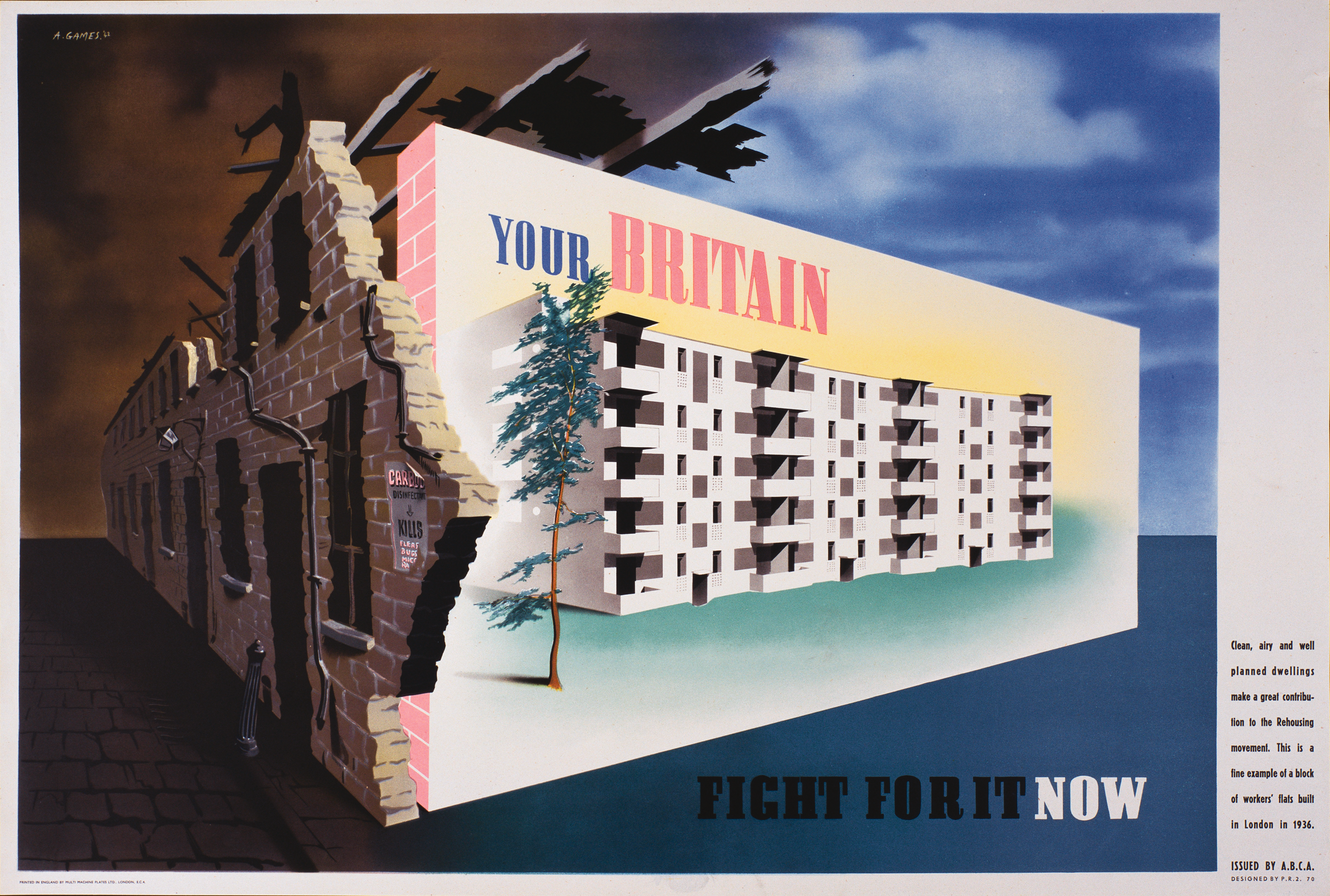
Abram Games ‘Your Britain: Fight for it Now: Kensal House, Ladbroke Grove, London’. 1942 © Estate of Abram Games.
This concern to create a light, bright modern environment began to change aesthetic choices about architectural colour. Some mid-century plans show some evidence of a shift in fashion away from dark-coloured windows towards the lighter colours that became popular in the later twentieth century, in large part because the dark paints that were compatible with a sooty atmosphere were seen as out of place in the new, modern towns. A 1936 guide to town and country planning recommends the avoidance of “discordant” colour, and recommends: “white, cream, buff, grey, and some shades of green … for external carpentry and joinery” (Prince, 1936: 26). Max Lock objected particularly to the darkened windows and doors that had characterised Victorian paint schemes: “Many delicate architectural details are hidden under heavy greens and browns” (Lock, 1952: 130). When the new Waterloo Bridge was opened in gleaming white, MP Herbert Morrison noted that “It would be a great pity if it was allowed to get begrimed and dirty. Its whiteness is one of its glories”, but quickly questioned, “Can we keep it white in our smoky, foggy London?”
‘Brightness’ is a key term in mid-century planning, but it tends to connote light rather than bright colours. In their plan for Bath, Abercrombie, Owens and Mealand praise the city’s architecture for its “delightful colouring and general effect”, a reference to the lightness of the stone that suggests a degree of aesthetic restraint regarding the application of colour (Abercrombie et al., 1945: 16). Similarly, Lock’s plan for Bedford states that “Bright colours can introduce an air of gaiety to a town” (Lock, 1952: 130) but the example given is a cream-coloured facade. James, Pierce and Rowley, authors of the plan for Norwich, advocate light-coloured paint for windows but splashier colours for doors: “The local tendency to paint doors and surrounds, windows and other features a uniform dull brown is to be deplored … The use of light-coloured paint for windows and door surrounds is strongly recommended.” (James et al., 1945: 17). Reilly and Aslan’s plan for Birkenhead contains an entire section called ‘Proposals for Brightening the Town’, but once again here ‘bright’ connotes light rather than loud colour, this time with an emphasis on hygiene as the planners request that “every effort be made to make it look cleaner” (Reilly and Aslan, 1947: 117). The authors object with particular force to the use of cinder to blacken mortar, even suggesting a remission in rates of 6d in the pound for all new buildings that use white mortar instead.
Part of the underlying rationale for this light but restrained colour scheme was that colour was intended to signal a unified approach to design in the city. Anything too bright or eye-catching was to be eschewed: Patrick Abercrombie argues against changing the “drab” streets around the historic centre of Warwick, arguing that “a degree of plainness is required of them in order that they should set off - act as foils to - their more colourful neighbours” (Abercrombie and Nickson, 1949: 103). Minoprio and Spencely agree in their plan for Worcester: “the colour and texture of materials need to be controlled in the interests of the city as a whole” (Miniprio and Spencely, 1946: 59). For some, this argument took on a distinctive social resonance: Reilly and Aslan warn against a “too varied” colour scheme with a social argument that it indicates a lack of community-mindedness: “Everyone seems to be a law unto himself, and the point of view of the public, once so important here as elsewhere, is not now sufficiently considered” (Reilly and Aslan, 1947: 121). In their plan for Leamington, Pierce and Rowley note the problem of multi-storey buildings where each floor is occupied by a different family, without the whole having been properly and safely converted into flats. The social and environmental disorder of the interior is evidenced by a visually cluttered environment on the outside, in which “different colours of paint spoil the composition” (James et al., 1945: 19). The outside of a building is here intimately connected to the social health of its interior, with both making an argument for a social democratic form of economic planning, as opposed to speculative development. This language of public harmony in colour could take on an explicitly left-wing resonance: a Labour party pamphlet on housing complaints against both the “drab uniformity” of Victorian tenements and the “‘individual’ lines and angles, and violently clashing colours” of the speculative builder’s estate, comparing them with the “considerably better” state of council housing (Labour Research Department, 1945: 6). If laissez-faire economics had left the city literally blackened and drained of colour, the new economic, social and spatial planning would produce a carefully-considered uniformity of approach to colour, one that used lightness to underline the hygiene, harmony and social cohesion of the modern city and eschewed loud, bright, individualistic colours.
Keeping Britain white: the racial politics of urban colour
However, the replacement of a geographical model of anachrony (the association of air pollution with degeneracy and savagery) with a temporal model (the idea that air pollution was a hangover from the ‘bad old’ Victorian city that had to be removed) was never complete. The insistence with which urban planning drew the contrast between (spectral) blackness and blight and (spectral) lightness and urban reform was all too easily re-racialised, with the ‘dark’ side of the binary becoming once again coded with a series of racist beliefs. Part of the problem was that the blackening effects of air pollution had become a master metaphor for such an expansive and inchoate range of urban problems that arguments about spectral colour—the blackening of city—were easily translated into a series of arguments about racial colour that associated black bodies with urban blight. Moreover, in the context of post-war immigration, the earlier, nineteenth-century association between urban blackening, regression, and degeneracy was compounded by the mid-century emphasis on a lightness, homogeneity, and uniformity in urban planning, to produce a situation in which black immigrants were placed at the crux of an impossible colour contradiction: they were both too black, and too bright to ‘belong’ in modern Britain.
Much of the source material in this section airs deeply discriminatory views, and is upsetting to read. In writing this paper, I have at times wondered whether the intellectual objective was sufficient to justify the repetition of some of these racist viewpoints firsthand in the text. Given the need to establish the deleterious effects of the relationship between atmospheric pollution, spectral colour, aesthetics, and urban reform on the black communities, however, I have decided on balance to include them, rather than describing their contents secondhand. However, I do so in the hope that my condemnation of their arguments and attitudes is clear, and that airing them will mean that future debates on urban colour are more attentive to issues of racial discrimination.
Let us begin with the idea that the ‘blackness’ of immigrants created ‘blackened’ areas of urban blight. For Carter, Harris and Joshi, the mid-century saw the resurgence of a biologically racist association between race and the British urban environment: “Black people not only created slums, it was argued, but these ‘new Harlems’ had their provenance in the ‘racial character’ of the inhabitants” (Carter et al., 1987: 63). Of course, such views confused cause and effect: immigrants lived in poorer, decaying neighbourhoods because they were often unable to obtain housing except in poor quality areas identified as blighted by planners, and therefore earmarked for slum clearance (Phillips and Harrison, 2010; Rex et al., 1967; Rhodes and Brown, 2019). Further, racism could itself cause depreciation of land and property values, as white residents framed black areas as undesirable (a phenomenon that was recognised as early as the 1940s, see, for example, Little, 1947: 104).
Yet biological racism reversed this order of priority, claiming an essentialist relationship between racial blackness and urban squalor. For example, Michael Banton, writing in The Coloured Quarter (1955), quotes a minor official on black immigrants: “They are happier living in dirty conditions in Golding Street because it is closer to their nature” (Banton, 1955: 185–86). 2 The old environmental racism that associated black skin with dirt and disease (Picton, 2013; Raney, 2005; Said, 1978; Zimring, 2015) was thus repurposed in an era of germ theory to build a set of spatial arguments that the black community actually enjoyed impoverished spaces. In other words, the same black and grey spaces that had been defined as temporally and geographically anachronistic in the nineteenth and early twentieth century discourses on air pollution were now described as the places where new black immigrants were bound to feel ‘at home’.
However, while atmospheric and racial blackness blended into one another in spatial discourses of urban blight at the level of the street, black bodies themselves were simultaneously criticised for being too colourful, for showing a preference for vivid hues rather than blending in with the prevailing dark palette of contemporary British modernity (Nead, 2017). Spectral colour thus started to be an element within mid-century responses to immigration, as racism made bright colour a signal of supposed backwardness. In particular, rather than representing a self-fashioning choice, use of colour in dress was seen as a failure to demonstrate the same restraint shown by the ‘sensible’, sober dress of the white population. As I argued earlier, dark clothing was not actually chosen by the white British population, but was rather imposed upon them by the polluted state of the urban atmosphere, yet racist commentators reinterpreted fashions that were necessitated by fossil fuel pollution as a matter of restrained aesthetic choice on the part of the white population. They became a sign of belonging, while the aesthetic choices exercised by the black population were recast as a failure of taste and a spatial signal of otherness.
What makes this particularly poignant is that many black Caribbean immigrants to Britain made special efforts to arrive in Britain in brightly coloured dress. As fashion historian Carol Tulloch notes, self-image was assiduously cultivated by many as a way of conveying a desire “to be seen by the British public as respectable” as well as compliance with “cultural, social and economic values—on a more prosaic level, simply coping” (Tulloch, 2016: 108). Arthur France, cofounder of the Leeds West Indian carnival, recalls “no matter how poor the family was, you had to make sure you had a tailor-made suit, because you’re going to England and you have to look well-dressed” (Grant, 2019: 52). Similarly, Stuart Hall recalls brightly coloured smartness as a cultural feature of black Caribbean life, commenting on a stream of recent arrivals at Paddington Station: They had made extraordinary efforts within their means to dress up to the nines for the journey, as West Indians always did in those days when travelling or going to church: the men in soft-brim felt hats, cocked at a rakish angle, the women in flimsy, colourful cotton dresses. (Hall, 2017: 153)
3
However, observers were quick to write these outfits down as a failure to understand British mores. “When I came to Britain I wore a plain pink dress with a large white bow”, writes Beryl Gilroy “and got stared at. People wore sensible colours - Pink got dirty in the grime of the 50s” (quoted in Tulloch, 2016: 190). Sheila Patterson recalls watching a miserable crowd of immigrants from the Caribbean waiting to disembark on a bitter February day, dressed in flimsy “pastel-coloured summer clothes, now stained and crumpled” (Patterson, 1963: 14). Men’s clothes, as well as women’s, were seen too ‘loud’. Anne Partridge, participating in a Mass Observation interview in 1939, noted: “Their [black immigrants’] taste for bright colours persists here for the young men buy very many suits and cock their hats in a dandified fashion” (Mass Observation, 1939). In particular, the ‘Zoot suit’ worn by black Caribbean men drew on defiant African American style to exaggerate the lines of white male tailoring. Its combination of loud cut and comparatively bright colour provoked a series of deeply racist reactions associating it with African ‘backwardness’. The anachrony of the ‘blackened’ Victorian city haunting the modern city was thus replaced by the supposed anachrony of ‘regressive’ black colonial bodies in the metropole. As one offensive article in Tailor and Cutter commented in 1948: it is easy to connect the three - the Negro, Swing and the zoot suit … It is a reflection of the Negro's connections with the tropics - where his instincts were attuned to extremes of growth and colour and heat and excitement and are now reflected in his adoption of these sartorial exaggeration. (106, see also Nead, 2017).
Colour thus became deeply toxic for this newly arrived population. Stuart Hall wearily catalogues a series of stereotypes that linked affect, rationality, and colour choice, in a manner that points to the need to consider atmospheres in a manner that is sensitive to race. Immigrants were voluble, excitable, high-spirited, quarrelsome, truculent and aggressive …. Black people had easily aroused tempers, whereas the British (actually, the English) were practised in the refined art of managing themselves. The migrants didn’t understand the virtue of reserve. They were stronger in the emotional department than in rational calculation. Besides, they were too inclined to show off, lacking moderation and restraint. (Hall, 2017: 188)
For Hall, disapproval of colourful clothes formed an element within this complex, enacting a form of violence. Criticising new arrivals for their lack of sartorial ‘taste’ when it came to colour and cut became as a means of taxonomising immigrant bodies as ‘out of place’: “You could hear, as intended, the disapproving stage whispers: ‘Too loud’” (Hall, 2017: 187; for an elegant discussion of the ways that contemporary scholarly literature on race fostered this by focusing on the ‘in-group’ racialised characteristics of the British, see Waters, 1997).
By the 1950s, the spectral lightness of the utopian reformed city of the mid-century had become coded as racially as well as literally light-coloured. The geographical anachrony that surrounded the colour effects of air pollution in the nineteenth century, and the historical anachrony that dominated arguments for the reform of the greyed-out city in the twentieth century combined in a new formation, in which the ‘urban atmosphere’ that was the focus of attention was racialised, rather than literal. The racist slogan ‘Keep Britain White’ thus has resonance in the domain of spectral as well as racial colour, but it is only by understanding the representational history of arguments about air pollution that this can be seen.
Conclusion
This paper has demonstrated that there is a distinctive ‘politics of spectral colour’ in British arguments about air pollution and urban reform. The way that atmospheric dirt was imagined as ‘out of place’ shifted over time, moving from a Eurocentric and geographical form of anachrony in the nineteenth century to a more temporal and historical argument about hangovers from the Victorian laissez-faire past in the twentieth century. However, the symbolic power of smoke, soot, and fog as signifiers of all kinds of urban ills, and the emphasis on modernity as white and uniform left a strong association between the blackening of the city and urban blight, with black bodies also figuring as a presence that was somehow ‘out of place’ in British modernity. The legacy of arguments about air pollution was thus readily racialised in the context of debates about mass immigration, leaving the Windrush generation trapped in an impossible colour contradiction.
I hope that, in making this argument, I have made three contributions. Firstly, at a theoretical level, my aim has been to show the importance of considering the affective dimension of atmospheres in a manner that is attentive to representation. As Lawrence Grossberg has argued, affect, and with it atmosphere, function in some geographical work as a ‘magical term’, leading to vague gesturing towards the embodied and non-representational, rather than more precise specification of the modalities and apparatuses of affect. “In too much work done by people who talk about affect”, Grossberg argues, there is a kind of immediate effectivity of affect on the body … Affect then becomes a magical way of bringing in the body. Certainly, there is a kind of mediation process but it is a machinic one. It goes through regimes that organize the body and the discourses of our lives, organize everyday life, and then produce specific kinds of effects. Organizations of affect might include will and attention, or moods, or orientation … and the various culturally and phenomenological constituted emotional economies. (Grossberg, 2010: 316)
I hope that, in bringing together the material, representational, and affective aspects of atmosphere in this paper, I have managed successfully to navigate these multiple dimensions.
Secondly, my main aim in this paper has been to argue the need for a more critically aware approach to the politics of urban aesthetics. Much current work in the fields of architecture and urban design is woefully naive in this area, to the point that it could be argued that a fetishistic approach to aesthetics, denuded of all historical, economic, and cultural context, dominates in much of the literature. As a result, the relationship between issues of structural power (including race) to judgements about beauty and questions of urban form (and reform) tends to get lost. The history that I have outlined in this paper remains a live one today, in a number of ways. The endlessly coiling snakes of smoke that unfurled above Dickens’s Coketown may have been reduced by the Clean Air Act of 1956, to be replaced by often invisible forms of carbon-based pollution, but the association of black communities with bright colours remains highly prevalent. Witness the kind of well-meaning public art designed to ‘elevate’ deprived areas, which often deliberately deploys bright colour as a signal of multicultural diversity in places where the black community still disproportionately resides. There is a troubling history to this, that requires a more incisive and critical approach to ideas of urban beauty from both scholars and public artists alike.
More pressingly, the environmental justice movement today is drawing renewed attention to the uneven racialised geographies of contemporary air pollution, and their relationship to established racialised patterns of social inequality, both in Britain and elsewhere (Mitchell and Dorling, 2003; GLA, 2023). While atmospheric pollution has changed form since the mid twentieth century, becoming less obviously visible, and concomittantly less ‘blackening’ in its effects, its consequences still disproportionately impact poorer BAME urban communities, as legacies of wider environmental racism mean that these groups continue to be more exposed to unseen airborne toxins than wealthier white demographics in both the US and UK. Further, there is now an undeniable connection between global northern fossil fuel use, and patterns of climate disruption that also disproportionately impact poorer black communities in the global north, but especially in the global south. If the geological term ‘Anthropocene’ has become controversial because of its tendency to erase structurally significant racial differences in fossil fuel use (Yusoff, 2018), then our use of the term ‘atmosphere’ also needs to reflect the structural differences that mean that some groups have hitherto been beneficiaries of burning carbon, while others have witnessed the increasing precarity of their communities. My hope is that by understanding the history of the relationship between air pollution, ideas of ‘appropriate’ urban colour, and urban reform, we can grasp how urban aesthetic choices can be part of a wider system of ‘slow violence’ (Davies, 2022) against certain groups, enabling us to search for new and more egalitarian solutions to our current predicament as we face the crisis of climate breakdown.
Footnotes
Acknowledgements
I would like to thank the anonymous referees, whose supportive, helpful, and clear feedback improved this paper. Thanks also to Malcolm Tait, Yasminah Beebeejaun, and Matthew Gandy for their experienced advice on navigating the review process. Naomi Games deserves special acknowledgement for her generosity in allowing me to access and reproduce a high-resolution version of the Abram Games work in  .
.
Declaration of conflicting interests
The author(s) declared no potential conflicts of interest with respect to the research, authorship, and/or publication of this article.
Funding
The author(s) disclosed receipt of the following financial support for the research, authorship, and/or publication of this article: This research is supported by the National Institute for Health and Care Research (NIHR) Oxford Health Biomedical Research Centre [NIHR203316]. The views expressed are those of the author and not necessarily those of the NIHR or the Department of Health and Social Care.