




Abstract
To improve SME growth and competitiveness, governments often encourage business owner-managers to make use of external sources of support. Whether they seek this depends on the degree to which they perceive themselves to need assistance. Additionally, its use can be constrained by market failures. In this paper, we model whether SME owner-managers seek information and advice from formal sources, including public and private providers. In 2011, the researchers conducted a telephone survey of 1202 SMEs (1–249 employees) in England to assess the use and non-use of external support between 2008 and 2011. Using a contingency approach, we model various influences on the use and non-use of formal support and identify those owner-managers who face more concerns but have less confidence in their capabilities. We find that the demand for support, especially from private providers, is fuelled by a firm’s objective to grow and a size threshold, although this is moderated by various concerns which increase the likelihood of using public sources. The willingness to take informal advice can act as a stepping stone to using formal sources. Whilst market failures affected less than a fifth of firms, those with women directors were particularly affected as were newly founded firms.
Introduction
Compared to large firms, SMEs tend to operate more informally and may be satisfied with lower performance (Cliff, 1998; Gimeno et al., 1997; Storey et al., 2010) which policymakers may view as a loss of potential economic output. To improve output and SME competitiveness, one mechanism available is to encourage and support the use of business advisers. Although they are not the only conduit for knowledge, advisers can diffuse new methods, knowledge and best practice to SMEs (Bryson and Daniels, 1998). Moreover, governments have raised concerns over the potential market failures in business advice, resulting in suboptimal use of the formal support available to SMEs (Wren and Storey, 2002). Consequently, governments across most OECD countries support advisory services to SMEs (Mole and Bramley, 2006).
Existing work views advice as a resource available to business owner-managers (Bennett and Robson, 2003; Chrisman, 1999; Chrisman and McMullan, 2000, 2004; Chrisman et al., 2005; Robson and Bennett, 2000a, 2010), yet some do not seek advice. Whether they take advice depends on several factors: the trust between owner-manager and adviser (Bennett and Robson, 2004; Johnson et al., 2007; Kautonen et al., 2010); the degree to which they feel able to interact with advisers and implement advice (Anyadike-Danes et al., 2011; Gooderham et al., 2004; Mole et al., 2009; Scott and Irwin, 2009); and whether the owner-manager cocoons themselves within a wall of silence (De Vries, 2000). However, all these studies have hinted at various influences and attitudes rather than attempting to compare each of these competing and complementary explanations.
This paper draws upon a survey of 1202 SMEs in England conducted in 2011 designed to assess their demand for various kinds of external support and identify the main barriers to the use of support. We take a contingency approach to model whether a small firm owner-manager takes information and advice from formal sources, distinguishing between public and private providers. We model concerns and capabilities to identify those owner-managers who face more concerns and have less confidence in their own capabilities. We make four main contributions to the literature. First, we show how management’s objectives to grow the business lead to a higher demand for private sector business advice, although various concerns relating to managing the development and financing of the business may encourage them to seek help from public providers instead. Secondly, we show that there is a clear firm size threshold effect in the demand for external support as SMEs with more than ten employees make significantly greater use of formal sources of information and advice. Thirdly, the relationship between informal and formal sources is complementary as informal advice acts as a stepping stone. And fourthly, we shed light on the market failures in business support showing that they are most acute for certain types of business, particularly for newly formed businesses and those with a higher proportion of women directors.
The first section that follows outlines the theory and previous empirical evidence relating to the use of external business support. The next section describes the data and modelling approach used in the current study. The results of the logistic regressions are then presented before we discuss their implications for business support policy.
Theory
Types of assistance
External support to SME owner-managers takes various forms and is delivered by a variety of providers, operating within different market environments and interacting with clients in various ways (Ramsden and Bennett, 2005). One distinction is between informal assistance (i.e. gratis advice delivered in a more casual setting such as that provided by friends, family, and business associates) through advice networks (Heyden et al., 2013; McDonald and Westphal, 2003; Vissa and Chacar, 2009) and formal assistance (i.e. delivered by private sector consultants and professional organisations, normally for payment, or government sponsored business support agencies). A second distinction is between generic codified knowledge (e.g. information about government regulations and corporate taxation) and tacit knowledge that is highly context dependent (e.g. strategic advice relating to alternative paths of development) (Chrisman and McMullan, 2004). A related distinction is that between transactional assistance, i.e. information to support the day to day operation of the business and transformational support, i.e. strategic advice to help achieve a stepped change in the growth and development of the business (Alexiev et al., 2010; McDonald and Westphal, 2003; North et al., 2011).
More usefully, other writers have referred to a continuum of services with operational services that are ‘objective’ and independent of the relationship between the client and service provider at one end and strategic services that are ‘subjective’ and dependent on the relationship between client and service provider at the other (Hjalmarsson and Johansson, 2003). This notion suggests that external business support in practice involves varying degrees of both operational and strategic services. Whilst the initial contact between a business owner-manager and their adviser might transfer generic and codified knowledge, this may evolve into a more symmetric relationship involving tacit and contextualised knowledge as the level of trust and confidence increases (Mole et al., 2014).
Why seek external assistance?
A resource-based theory perspective emphasises the competitive benefits to be gained from seeking and taking-up external business assistance. Bennett and Robson (2003) cite various leading authors on business growth and competitiveness (Penrose, 1959; Teece, 1986; Teece et al., 1997) in arguing that external sources of advice increase strategic knowledge leading to competitive benefits and increasing the business’s potential. External assistance can overcome information and knowledge gaps (Chrisman and McMullan, 2004) particularly in the smallest and youngest businesses because of their resource and skill deficiencies, although this assumption is sometimes contested (Johnson et al., 2007). It has been argued that the increasing turbulence of global markets and the pace of technological change push owner-managers to the specialist expertise provided by consultants to make transformational changes and take advantage of new market opportunities (Fincham, 1999).
Why some SMEs do not seek external assistance?
Although evidence from a series of SME surveys in the UK undertaken by the Centre for Business Research (CBR) indicated that the majority (over 90%) of businesses made use of external assistance over a three-year period (Bennett, 2008; Bennett and Robson, 2003; Robson and Bennett, 1999), this is challenged by other evidence showing under a third of small firm owner-managers seeking formal external assistance over a two-year period (Johnson et al., 2007). Other studies found a large proportion of company executives do not use formal external assistance, despite its likely benefits (McDonald and Westphal, 2003). These discrepancies between studies reflect differences in research design and methodology, with the CBR data being drawn from an omnibus national survey of over 2000 SMEs (including businesses up to 500 employees) whereas the Johnson et al. (2007) findings were essentially a by-product of a sub-regional labour market study (the South Yorkshire Employer Survey) of 1500 businesses employing less than 50 employees. Interestingly, the authors in the latter study considered that the predominance of micro and small businesses in their sample had been a factor in the low take-up of business support. The studies also differed in their definition of external assistance, with Johnson et al. (2007) excluding informal assistance and more routine forms of assistance associated with auditing and banking whereas the CBR survey included social contacts such as family and business friends as well as formal professional contacts. Furthermore, the high usage in the CBR data may reflect the fact that the surveyed businesses themselves defined the scope of external advice to include any help in achieving their business objectives.
Various explanations have been proposed as to why SME owner-managers do not seek external assistance. First, they may make suboptimal use of advisory services because they have insufficient information to make an informed choice. Bennett (2008) argued that because of their smallness and limited market power, owner-managers suffer from imperfect information, limiting their awareness of the provision of external assistance. Secondly, even when they have a good awareness of its provision, entrepreneurs may harbour doubts about its value and reliability, since advice is an experience good (Spence, 1973). This might include concerns about the expense of obtaining expert advice, doubts about whether it provides good value for money and concerns about the time needed to fully implement and benefit from the advice. It could also include discouraged advisees (Scott and Irwin, 2009) who may have been put off by their own previous experience or that of business friends/associates. Thirdly, there may be various relationship concerns, as taking advice invariably involves personal interaction between business owners and external advisers as well as task interaction (Ramsden and Bennett, 2005). These could relate to possible power imbalances and disparate ‘world views’ between advisers and entrepreneurs (Dyer and Ross, 2007). Some owner-managers may be unsure of their ability to deal with ‘smart and sophisticated consultants’ on equal terms. Fourthly, moral hazard dilemmas exist, such as whether advisers can be trusted to provide the impartial advice that will be useful to the business (Hjalmarsson and Johansson, 2003). SME owner-managers may be concerned that advisers do not fully understand the needs of their business. For example, when they recommend alternative courses of action, advisers instinctively communicate advice based on their own risk preferences rather than those of clients (Hadar and Fischer, 2008).
Empirical factors influencing the use of external assistance
Previous empirical studies distinguished between the characteristics of users and non-users of external assistance; most focused on characteristics of the business itself (Heyden et al., 2013) or attributes/traits of the business owner-managers. However, comparing their findings is complicated by differences in the types of assistance covered, with some studies including both private and public providers (e.g. Bennett, 2008), others focusing on a particular type of provider (Mole et al., 2011), whilst others (e.g. Johnson et al., 2007) do not distinguish between different sources of advice. There is a lack of consensus on the influence that a number of business and management characteristics have on whether or not SMEs seek external assistance. As we have suggested, this may stem from the methodological idiosyncrasies of the studies as well as differences in the scope of external assistance included. Our present study attempts to provide a more comprehensive approach, covering not only both private and public sector provision of external assistance, but also taking account of other possible influences besides business and management characteristics. In so doing, we have found a contingency approach to be a useful way of distinguishing between various types of influence that may have some bearing on whether or not SMEs seek external assistance.
A contingency framework
Essentially, contingency theory involves two propositions: first, that there is no right way (to seek advice); and second, that what you do depends on the situation (Schoonhoven, 1981). From its origins in the management sciences, contingency theory has been applied to understanding various aspects of enterprise behaviour, e.g. in relation to export entrepreneurship (Ibeh, 2003). Its adoption may introduce moderating influences into bivariate relationships which are usually exogenous to the organisations (i.e. SMEs) or actors (i.e. business owner-managers) of primary interest, to reduce the risk of making misleading inferences and permit a better understanding of contingent relationships (Rauch et al., 2009).
To apply a contingency framework to try to improve our understanding of the factors influencing whether SMEs make use of external assistance and, for those who do, whether they use private or public sector providers or both, we distinguish between the following four sets of influences: antecedents, management orientation, management attitudes and external influences.
Antecedents
Antecedents concern the possible influences of various ‘internal’ characteristics of the business and the business owner-manager.
Business characteristics: Suggest Some researchers, who take a resource-based view of the firm, suggest external support responds to a lack of knowledge of founders (Chrisman and McMullan, 2000), so we expect younger firms (particularly during the start-up and post start-up phases) to need assistance, especially where founders have little previous business experience. Also, given public support for new ventures in ‘guided preparation’ (Chrisman and McMullan, 2000; Rotger et al., 2012), we might expect younger firms to make greater use of public providers (Bennett and Robson, 1999). Since larger businesses may draw upon the required skills and professionalism internally, resource-based theory suggests a negative relationship between advice seeking and firm size (Bennett and Robson, 2003; Johnson et al., 2007). However, Boter and Lundström (2005) conclude that arguments that small firms have a weak resource base and need external support do not translate into the smallest micro companies being the most intensive users of external support services. On the contrary, larger SMEs are likely to be more complex businesses and have a greater range of support needs (e.g. in relation to employing people, international trading and financing) than the smallest businesses. These resource needs reflect more complex decisions with higher stakes, both of which have been linked with increasing demand for external advice (Brockner et al., 1984; Gino and Moore, 2007; Gino et al., 2012; Yaniv, 2004). Previous evidence therefore indicates that the relationship between firm size and the use of external assistance is not as straightforward as the resource-based view might suggest.
Entrepreneur/Owner-manager characteristics: There is some disagreement in the literature concerning the influence that characteristics of the entrepreneur and the management team have on seeking external assistance and the source of assistance used. For example, specifically in relation to the use of Business Link services, Atherton et al. (2010) did not consider the personal characteristics of owner-managers, citing previous evidence that personal characteristics had no effect (Robson et al., 2008). A contrary view is that held by Scott and Irwin (2009) who investigated the influence of gender, ethnic and educational differentials on obtaining external advice from different sources, highlighting the influence of ‘human capital’, leading us to expect better educated owner-managers to seek out sources of assistance and more confidently engage with external advisers; whereas those without qualifications or having lower level qualifications are likely to be less aware of sources of support and the benefits of using them.
The extant literature displays some disagreement over gender effects on external assistance. One argument suggests that female entrepreneurs find it more difficult to access traditional business networks (Carter, 2000), relying instead on social networks (Robson et al., 2008) and, when they do seek formal advice, on public providers. Thus, Scott and Irwin (2009) found that female entrepreneurs were almost twice as likely as their male counterparts to access external support from public providers and Mole et al. (2009) found that the probability of receiving Business Link assistance increased as the female share of the partners and directors increased. On the contrary, Robson et al. (2008) studied the use of external advice by Scottish SMEs, concluding that the gender of the key decision-makers in the business had no statistically significant relationship with take-up of either formal or informal external advice.
Management orientation
The pursuit of business growth can be expected to stimulate SMEs to use external assistance. Johnson et al. (2007) hypothesised a positive relationship between growth orientation and seeking external support because growth and associated organisational changes provide a severe challenge to the internal resource and knowledge base of the firm, most obviously in relation to the skills and capacities of a relatively small management team. Several studies have explored this relationship, notwithstanding questions about the direction of causality (i.e. whether growth leads to seeking advice or whether advice stimulates growth), the findings are equivocal, although again this may reflect differences in the ways in which growth was measured and questions about it posed. Using data relating to owner-managers’ objectives rather than actual business performance, Johnson et al. (2007: 1992) concluded that ‘growth orientation (using anticipated employment growth as a proxy) is a key factor that predisposes businesses to use external support’; Robson and Bennett (2000b: 200), using several business performance measures, found that ‘the use of external advisors has surprisingly little relationship with each of the measures of growth: where it does it is chiefly for employment growth.’
We suggest that this lack of a clear relationship with business growth is because firms facing difficulties which threaten their very survival are ‘pushed’ into seeking outside support, although the cost of private sector advice may push them towards seeking advice from publicly subsidised or ‘free’ sources.
Management attitudes
Owner-managers’ attitudes to involving external advisers in their business will vary considerably. Some see themselves as independent entrepreneurs, distrusting ‘outside’ influences (De Vries, 2000) and therefore unlikely to engage with external bodies. By contrast, other owner-managers consciously pursue external linkages and have an ‘open’ orientation to receiving information and advice (Edwards et al., 2010). A possible indicator of their disposition to obtain formal external assistance could be their use of informal assistance, entrepreneurs who have drawn upon advice from friends, family and business associates being more disposed to seek support from formal sources. Therefore, informal sources of advice and decision-making involvement by ‘outsiders’ (Arendt et al., 2005) prepare owner-managers to approach more formal sources.
Also, influencing whether an owner-manager seeks external assistance will be their confidence in their own ability to successfully tackle the challenges facing the business. This may depend on the gap they perceive between their internal resources (staffing, skills, finance, etc.) and those required in order to achieve business objectives and/or tackle the problems faced (Chrisman et al., 2005).
External influences
It is generally accepted that the nature of a firm’s operating environment exerts an important mediating effect on the decisions and actions that managers take. For example, more hostile conditions (characterised by precarious industrial settings; intense competition; and a relative lack of exploitable opportunities) stimulate some firms to become more entrepreneurial (innovative and risk-taking) than more benign conditions (characterised by richness of investment and marketing opportunities) (Covin and Slevin, 1989; Wiklund and Shepherd, 2005; Zahra and Neubaum, 1998). Heyden et al. (2013) showed that in more stable external environments business executives tended to seek advice internally to the firm.
To take account of these moderating influences on management behaviour, we argue that an owner-manager’s awareness of the various challenges and problems that their business has faced over a given period, together with their assessment of their ability to deal with such concerns, indicate how various external factors have affected decisions with regards to seeking formal business assistance.
We can expect the relationship between the use of external assistance and other factors to be influenced by the sector/business activity that an SME is engaged in, reflecting the impact of different market environments on the support needs of SMEs (Heyden et al., 2013; Johnson et al., 2007). For example, Bennett and Robson (2003) found relatively traditional sectors with more stable technologies made the least use of business support, whereas the higher-use sectors were those experiencing technological and organisational changes, such as publishing, the media, and business services (Heyden et al., 2013) and those affected by government regulations (e.g. food manufacture).
Methods
Sample
In 2011, the researchers conducted a CATI telephone survey of 1202 employer SMEs (1–249 employees excluding single-person businesses) in England. The survey was designed to provide statistically robust evidence of recent use and non-use of external business support, focusing on the last three years (or since established in the case of new businesses). During the interviews owner-managers were asked about the recent challenges and problems that their business had faced and whether they had managed to resolve these. They were asked if they had made any use of external assistance that was important to the operation of their business from public or private sector organisations during the previous three years and whether this had taken the form of: (i) information to support the day-to-day operation of the business; or (ii) more strategic advice to help introduce a stepped change to grow the business, be more profitable, or employ more people. They were asked who provided that assistance, in what format, and for their assessment of its impact on business performance. The non-users of external support were asked about their reasons for not seeking external assistance and whether, in view of their concerns, they now felt that they could have benefitted from assistance.
Starting from a random stratified sample from the national Experian database, quota sampling captured sufficient numbers of firms across key categories (which were not mutually exclusive). The initial business sample was 10 times the required survey target with firms sampled from five employment size bands: 1–4 employees; 5–9; 10–19; 20–49; and 50–249. Half the sample were assigned equally to each band and the other half proportionally according to the business sizes in the population of existing firms, thereby achieving a sufficient sample of larger SMEs. Further, non-interlocking quotas ensured the sample broadly represented the business population by industry, region and age of the business. Hence, the sample included the views of young (defined as less than three years old) and more established employer SMEs.
Modelling approach
The modelling of the characteristics of users and non-users involves a categorical binary dependent variable, holding the value of either 1 or 0. The logit model technique probabilistically categorises a case as either 1 or 0, using a set of explanatory variables (as listed in Appendix 1). The significant explanatory variables jointly determine whether a case is categorised as 1 or 0. The models themselves are tested through a chi-square statistic, and a pseudo R-squared statistic indicates the proportion of the variation that the model explains. In these models the partial effect depends on holding all the other variables constant. The sign of the co-efficient tells us whether the variable had a positive or negative effect (Wooldridge, 2002). To appreciate the magnitude of the effect we must estimate it at its mean with all the other variables held constant. Most often, we discuss the sign and significance of the variables. The descriptive statistics for the variables are shown in Appendix 2 and the correlations between them in Appendix 3.
The characteristics of users of formal business assistance
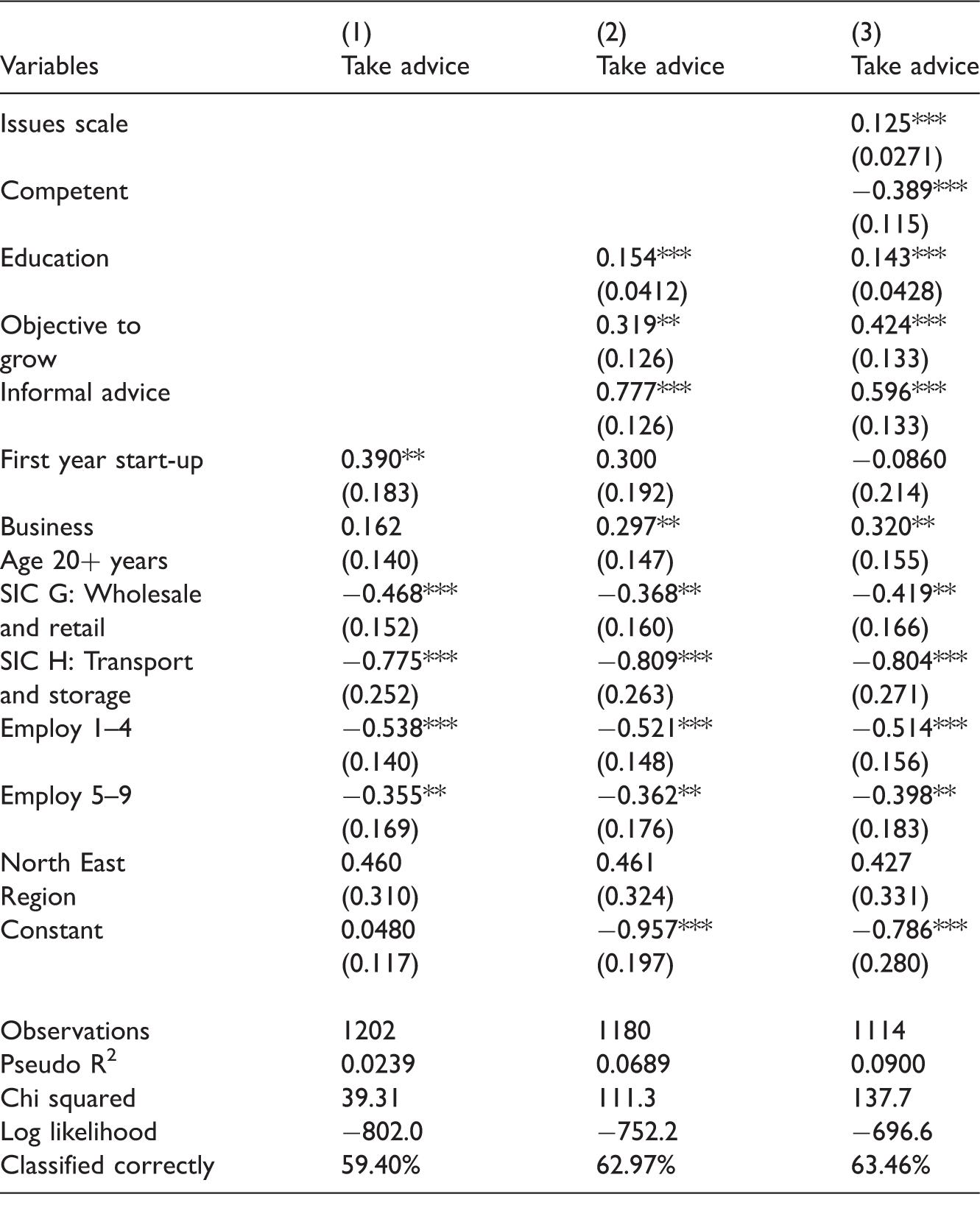
Our survey found that 39.9% of the employer SMEs made some use of formal assistance during the 2008–2011 period. The characteristics of users were examined through a logit model where 1 equalled use of formal support (public or private) and 0 indicated that no support was used.
Logit regression results for the characteristics of users of business support.
Note: Standard errors in parentheses.
p < 0.01, **p < 0.05, *p < 0.1.
The base model had a chi-squared statistic that showed it to be highly significant, classifying 59.4% of the cases correctly. In this model, firms in their first year of trading were more likely to take assistance. This is encouraging since experience in the first year is significant for the firm’s future survival (Carroll and Hannan, 2000; Saridakis et al., 2013). A sectoral effect was strongly felt, with firms in the financial and business services and personal and consumer services sectors most likely to seek support. Finally, in the base model clear firm size thresholds were evident with those firms employing more than ten employees more likely to use formal assistance and micro firms with between one and four employees the least likely. Interestingly, there was no significant regional variation to the use of external assistance.
Model two added the growth expectations of the business, willingness to take informal advice and the education of the owner-manager. Consistent with previous work, those with an objective to grow their business were significantly more likely to seek formal assistance (Johnson et al., 2007). Those who took advice from informal sources over the three year period also took advice from formal sources, whether public or private. The impact of education (measured by National Vocational Qualifications levels ranging from one to five) was positive and significant indicating that those with longer education backgrounds were more likely to use formal assistance (see also Scott and Irwin, 2009). These three factors altered the relationship between firm age and advice, where older established firms were more likely to take advice, once the modelling controlled for the negative correlation between firm age and attitudes to growth. The model classified 63.0% of the cases correctly. The chi-squared was highly significant increasing from 39.3 to 111.3 with the addition of these three variables (pseudo R-squared = 6.9%).
The third model incorporated two more variables reflecting external influences: a scaled measure of concerns and the degree to which the firm could cope with them (i.e. competence). To develop the scale, SME owner-managers were asked a series of questions concerning the challenges and problems facing the firm, including dealing with regulations, accessing finance, and managing growth and development. A factor analysis found these answers load onto the same factor to form an 11-item additive scale with a Cronbach’s alpha of 0.7798. In the logit model the scale was positive and significant. Those firms that faced many concerns were more likely to seek formal assistance compared to those who perceived fewer areas for concern. Respondents were then asked whether they believed that the firm had the capability to deal with their concerns. The measure took values from nought to two, with nought indicating that the firm lacked the ability to deal with the concerns; one that the firm had the ability to deal with the concerns to some extent; and two that the firm had the ability to deal with the concerns completely. This measure was negative and significant indicating as expected that it was those firms lacking the ability to deal with their concerns that were most likely to seek external assistance. The model correctly classified 63.5% of cases and the chi-squared was highly significant increasing from 111.3 to 137.7 with the addition of the two variables (pseudo R-squared = 9%).
To summarise, which SME owner-managers took formal assistance was dominated by the threshold effect of firm size as expanding beyond 10 employees does seem to push firms into seeking formal assistance. Also, SMEs in certain consumer service sectors were less likely to seek outside help. Although educational background was significant, those firms that believed in their capability to deal with their issues were, not surprisingly, less likely to seek assistance. The demand for business assistance was fuelled by a manager’s objective to grow their business and also their willingness to listen to advice informally.
The characteristics of users of private or public assistance
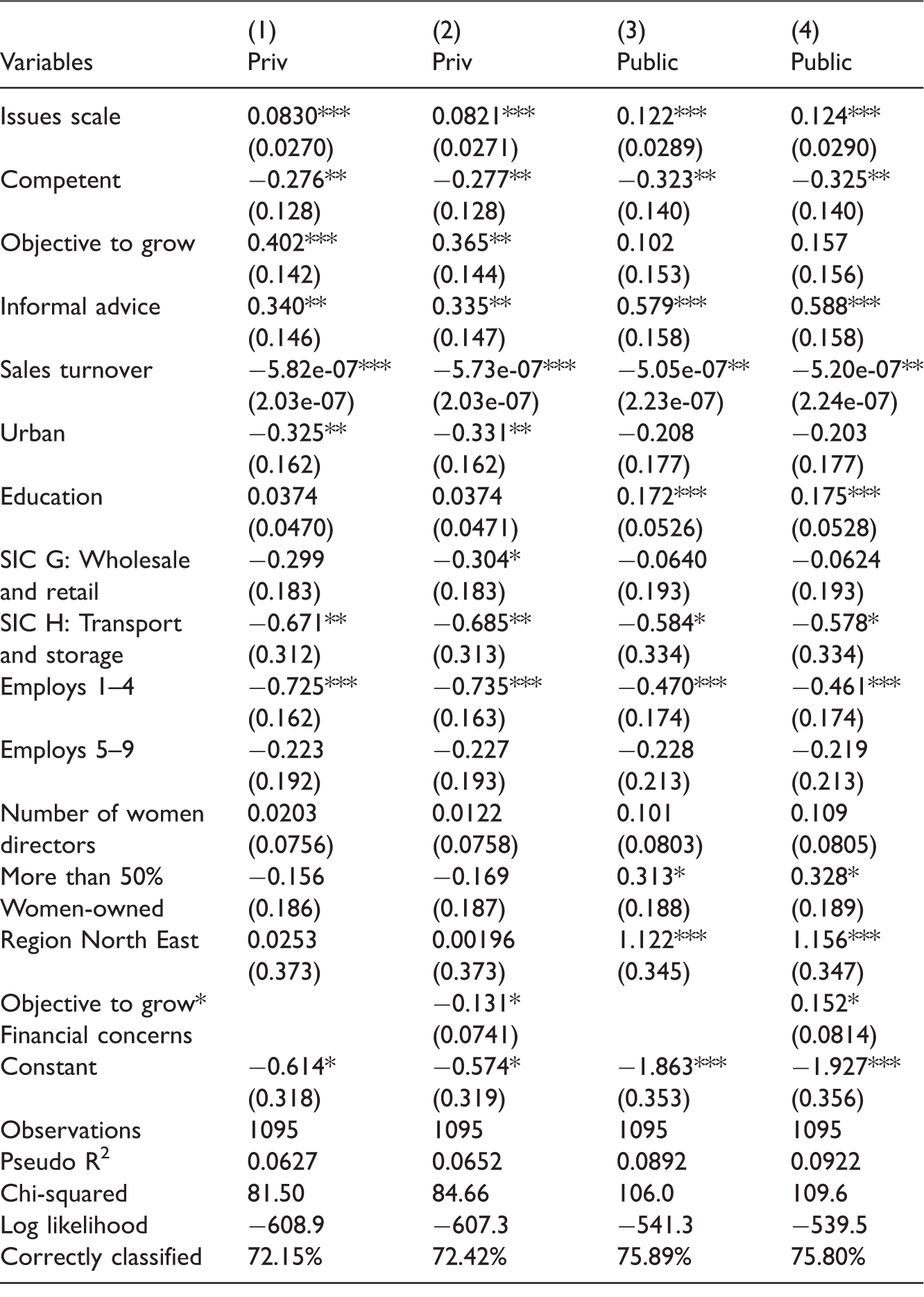
Logit regression results for the characteristics of users of private sector or public sector business support.
Note: Standard errors in parentheses.
p < 0.01, **p < 0.05, *p < 0.1
Model (1) showed that the demand for external assistance was pushed by owner-managers reporting concerns in running their business that they felt less competent to deal with (Chrisman et al., 2005). The objective to grow pushed the firm to seek assistance from the private sector; moreover, other evidence in the survey suggests that growth particularly pushes the firm to take strategic advice (Pearson Chi2 (1) = 139.2867 Pr = 0.000). Again, the willingness to take advice from informal sources was linked to taking advice from formal sources. There was a significant but small effect from sales turnover. Some impacts were from sector and firm size effects with firms in wholesale, retail, hotel and restaurant sectors and micro firms less likely to seek assistance from private sources. The model also included potential influences from the number of women directors, women-led businesses and regions but none were significant. Finally, the second model (2) showed an interaction effect whereby financial concerns moderated the impact of the objective to grow. Thus, when firms had financial concerns and the objective to grow they were no more likely to seek assistance from private sector sources.
Models (3) and (4) examine the use of publicly supported assistance and correctly classified 75.9% (pseudo R-squared = 8.9%) and 75.8%, respectively (pseudo R-squared = 9.2%). The results of the third model were similar to those relating to private assistance. Again the demand for assistance from public sources was pushed by the owner-manager reporting concerns in running their business which they felt less competent to deal with (Chrisman et al., 2005). Also the willingness to take advice from informal sources was linked to seeking assistance from the public sector. The model identified the same sectors as previously and firm size was significant with the micro firms least likely to seek assistance from public sources.
In contrast to the private provision, two owner-manager characteristics and a regional effect were significant suggesting certain differences between the clients of public and private sector providers. First, the impact of education was significant showing owner-managers with higher qualifications more likely to avail themselves of public sources of assistance. Secondly, women-led businesses were more likely to seek assistance from public sources, confirming the results of previous research (Mole et al., 2009; Scott and Irwin, 2009), suggesting women entrepreneurs have greater confidence in public advisers, finding it easier to approach public organisations for assistance. Thirdly, firms in the North East region were significantly more likely to take assistance from publicly supported sources, reflecting the greater provision of public business support agencies in relation to the small business population (Mole et al., 2011). Fourthly, the objective to grow was insignificant for the public sector case, possibly indicating that more survival oriented firms rely on public support. Finally, model (4) showed an interaction effect whereby financial concerns moderated the impact of the objective to grow. When firms had financial concerns and the objective to grow they were more likely to seek assistance from public sector sources. Contrasting models (4) and (2) suggests that the joint presence of financial concerns with an objective to grow increases the likelihood that an SME owner-manager would take publicly supported assistance whereas the objective to grow on its own predicts that private sources of assistance would be sought. Figure 1 graphically displays this moderating effect.
Taking advice: Financial concerns moderate the objective to grow.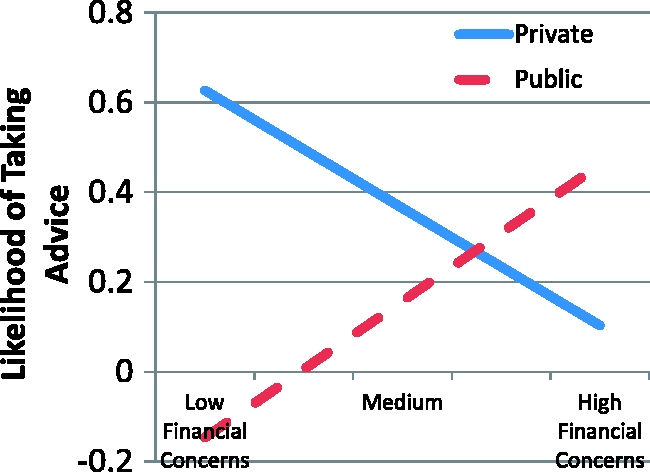
Market failure and non-users
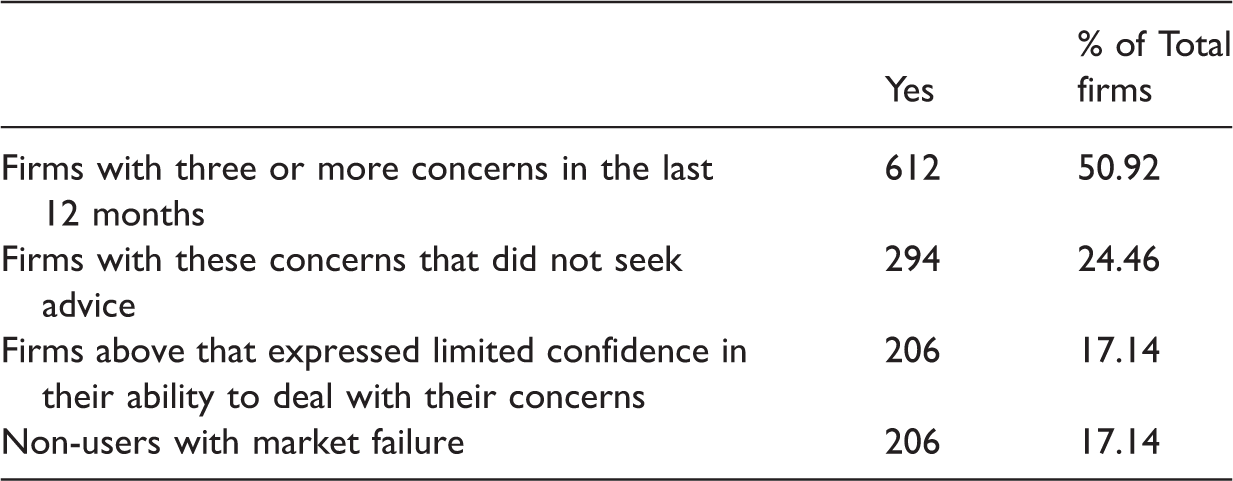
Non-users with market failure.
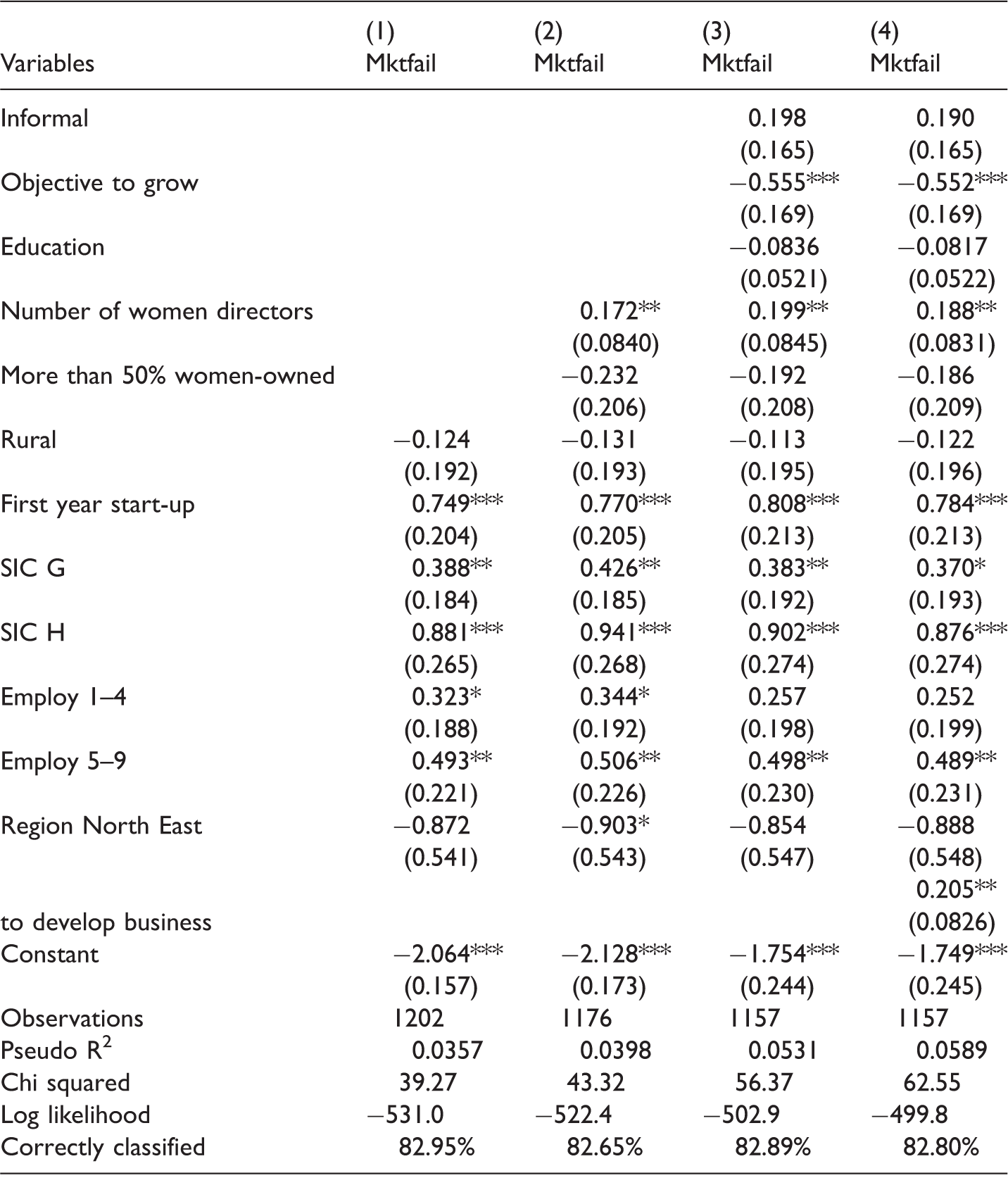
Logit regression results for the characteristics of the market failure group.
Note: Standard errors in parentheses.
p < 0.01, **p < 0.05, *p < 0.1
Model (2) (chi-squared 43.3, pseudo R-squared 4.0%) introduced the composition of the management team. Whilst whether the SME was a women-owned business proved insignificant, there was a significant and worrying representation of women directors in the market failure group. A greater number of women directors increased the likelihood of becoming a business with concerns that it could not solve yet did not seek assistance. This latest evidence supports those who have suggested (notably Carter, 2000; Scott and Irwin, 2009) some reluctance by female entrepreneurs and managers to seek external advice, particularly from private sector sources.
Model (3) (chi-squared 56.4, pseudo R-squared 5.3%) introduced the education level, the objective to grow and the degree of informality. The education level was insignificant as was, surprisingly, the degree of informal advice. The objective to grow was negative indicating that those who pursued growth were less likely to inhabit this market failure group, which appears beneficial from an economic development perspective. However, model (4) (chi-squared 62.6, pseudo R-squared 5.9%) examined the interaction between the objective to grow and the concern to develop the business. The interaction of the concerns to develop the business moderated and reduced the effect of the objective to grow, undermining the positive story on growth ambitions. Figure 2 shows that a business with a desire to grow and no concerns with developing the business is less likely to be in this market failure group; however, when a business not only has a desire to grow but also has a high level of concern with developing the business, it is as likely as not to be included in this market failure group. Of course this may be a reflection of the recessionary period when the research was undertaken, since many growth-orientated firms found developing their businesses especially challenging because of demand and financial constraints.
Firms with an objective to grow are likely to take advice but not if they also report high levels of concerns with development and sales.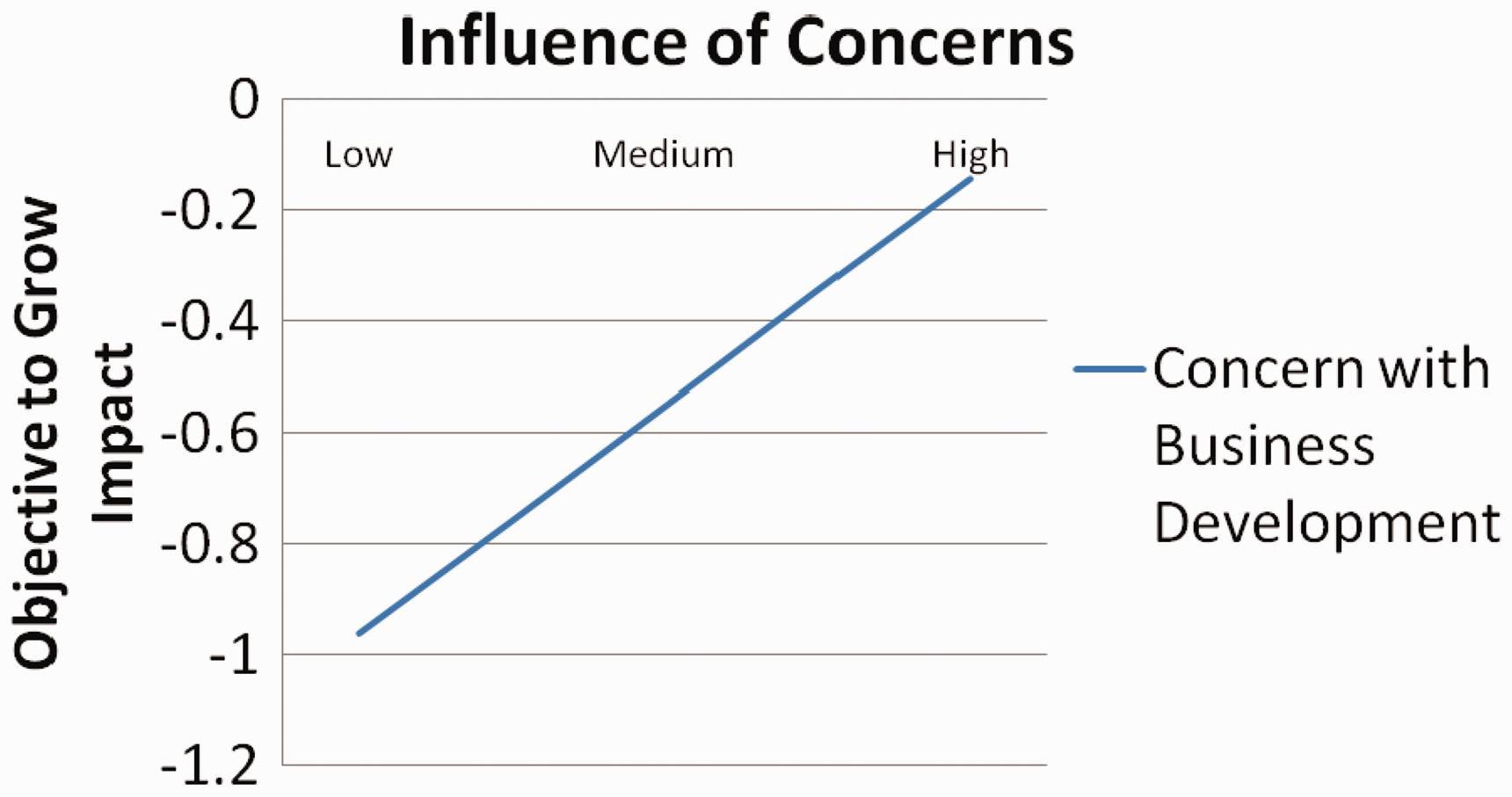
Overall, the SMEs in the market failure group were less growth-orientated, with concerns about developing the business and financial management dampening the impact of the objective to grow. They were more likely to be newly founded, possibly displaying a certain overconfidence amongst some new entrepreneurs in their ability to solve problems themselves (Fraser and Greene, 2006). They were also more likely to be in the 1–4 and 5–9 employee size groups, with the threshold of around 10 employees again being evident. The research reinforced the push to seek assistance as a result of concerns that managers had about their business, supporting the perceived knowledge gap hypothesis (Chrisman and McMullan, 2000). However, whilst this seems straightforward, it questions why some firms have concerns whilst others, who may be in similar positions, do not. More research is needed regarding how some SME owner-managers develop and recognize their concerns, as well as the relationship between the perceived competence of the management and the objective position of the business.
Reasons for market failure
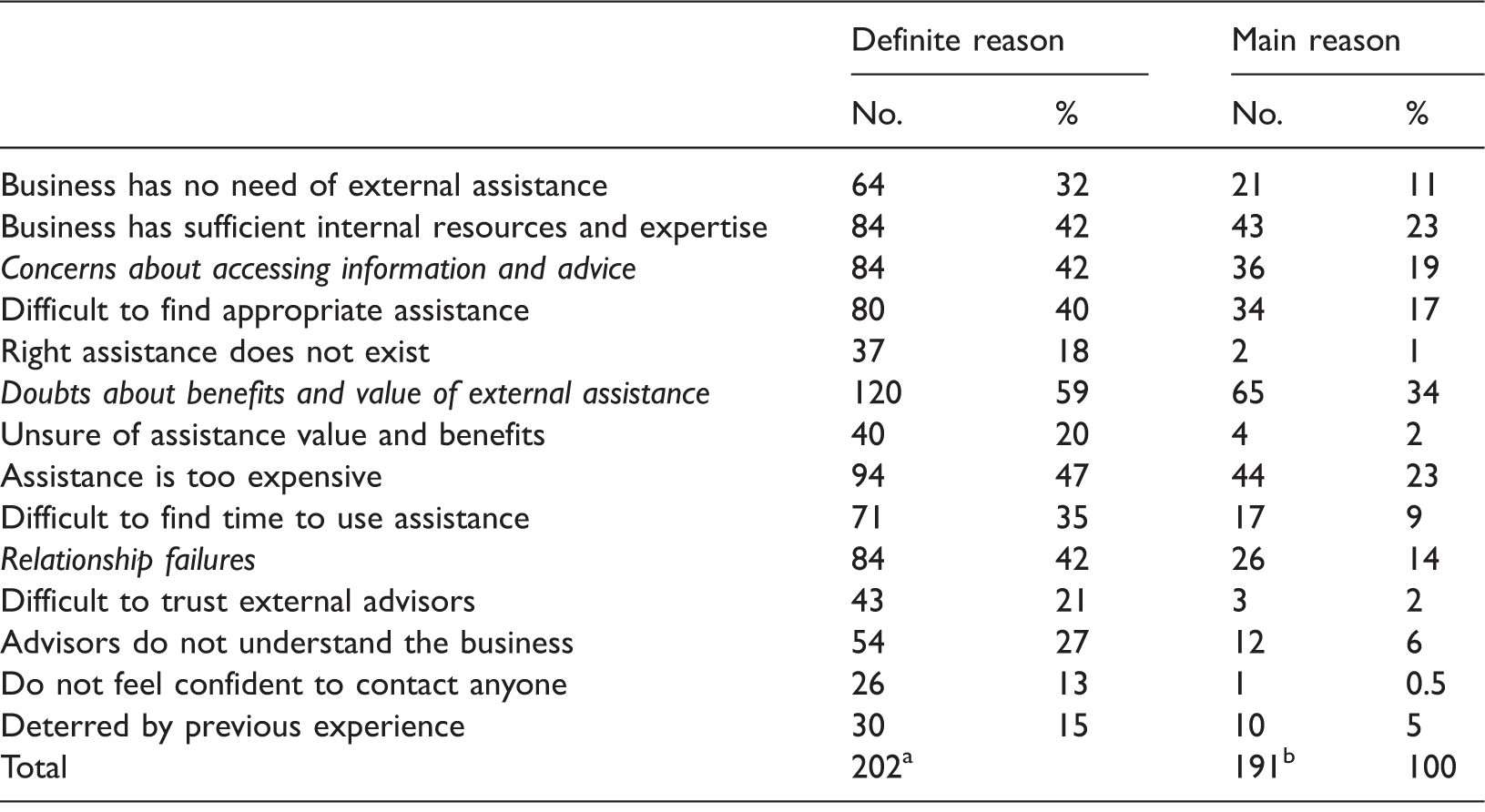
The literature summarised earlier enables us to identify several reasons for market failure relating to business support. The interviewed owner-managers of firms which were non-users were given a list of 12 reasons for not seeking external assistance and asked to identify those that definitely described their position. As most businesses thought more than one reason applied to them, they were also asked to identify their main reason for not using external assistance. The reasons can be broadly grouped into the following three main categories:
Concerns about access to information and advice. This comprises two survey responses: (i) cannot find suitable assistance; and (ii) do not believe that the right type of assistance exists. Doubts about the costs, benefits and value of assistance. This comprises three responses: (i) assistance is too expensive; (ii) difficult to find time to use assistance; (iii) unsure of the potential value and benefits of assistance (e.g. where benefits are not clear or immediate). Relationship issues. This comprises four responses: (i) difficult to trust external advisors; (ii) advisors do not understand the business; (iii) not confident to contact anyone for assistance; and (iv) deterred by own previous experiences or those of others.
Reasons given by SME owner-managers in the market failure group for not using external business support.
Four firms in the market failure group did not identify definite reasons.
15 Firms in the market failure group did not identify a main reason.
Concerns over their relationship with advisors definitely described the position of 42% of the market failure group and was identified as the main reason by 14%. In particular, concerns about trust and whether advisors would understand the business were identified as a definite reason by 20% and 27% respectively, whereas being deterred by their own or others previous experience was a definite issue for 15% of them.
Concerns over accessing information and advice also definitely described the position of 42% of firms and identified as the main reason by 19%, mainly because of the difficulty of finding a suitable provider. There is some evidence therefore of an ex ante information asymmetry in the market for advice, although the ex post asymmetry of not being able to assess the value of advice in relation to its cost until after the outcomes become evident (possibly several months afterwards) appears to be the greater barrier to seeking external assistance (Bennett and Robson, 2004; Godek and Murray, 2008).
Conclusions and implications for policy
This paper draws upon a unique CATI survey of 1202 firms to examine the extent to which SMEs in England sought external assistance from both private sector and publicly supported providers over the 2008–2011 period. It produced new evidence to compare with earlier studies based on different methodologies and definitions of what constitutes external assistance. By adopting a contingency approach, our study distinguished between various types of influences on whether or not SMEs seek external assistance. Thus, we found that certain business characteristics, notably the firms’ employment size and sector activity, played a role as did certain characteristics of the owner-manager, particularly their education level and gender, with women-led businesses more likely to seek assistance from public sources. Management orientation towards the growth of the business was also an important influence, particularly affecting the demand for strategic advice from private sector sources, whilst their assessment of their ability to tackle the challenges and problems facing the business also influenced whether or not they resorted to external assistance. In this regard external influences such as the financial and recessionary conditions during the study period influenced the demand for external support, especially by those businesses struggling to survive. Based on whether or not non-users of assistance were able to deal with their concerns, we concluded that there continue to be market failures in business support, affecting almost one-fifth of SMEs. We now consider some implications for business support policy arising from our findings.
If the objectives of business support policy are to connect advice with business growth, this implies an approach that enables growing companies to link with private sector sources of advice. Hence, recent public programmes involve diagnostic support that brokers further support from private consultancy (Hjalmarsson and Johansson, 2003; Mole and Keogh, 2009; Mole et al., 2008), this being the approach used by Business Link in England during the surveyed period. Whilst our research showed many growth orientated SMEs used formal external advice from private sources, we also found other SMEs that were trying to grow but experiencing problems in doing so did not seek external advice. This would indicate that the Business Link brokering approach was not capturing all the SMEs that could have benefitted from external assistance.
A key finding with regard to the propensity to use formal external advice is the threshold of around 10 employees. We suggest that about this size businesses become more complex, requiring a greater range of expertise and management skills, yet are still too small to justify employing staff with the required knowledge and expertise internally. We need future research to understand this trigger more effectively. However, evidence from business demographics indicates that 70–80% of start-up firms that last for 10 years never exceed 10 employees (Anyadike-Danes et al., 2011); hence, the threshold is not only an indication of success but also a harbinger of new challenges. That firms below the threshold were discouraged from taking external advice should be a concern for policy-makers.
Our analysis of the reasons for market failure indicates that it was the cost of assistance together with uncertainty over its benefits that deterred most of the smaller firms facing unresolved problems. Owner-managers with no experience of formal external assistance are inclined to undervalue its benefits and are reluctant to pay market rates. It is not simply a case of making SME owner-managers aware of private sources of information and advice (e.g. via on-line knowledge banks), but also convincing them that private providers can make a positive difference and offer value for money.
Since 2010, the resources devoted to the public provision of business support in England have been substantially reduced with the shift away from a ‘provision based paradigm’ in which public agencies provide direct support to a ‘framework based paradigm’ where government sets a framework for private sector support (Richard, 2008). More specifically, Business Link’s advice service delivered by their advisors on a face-to-face basis was replaced by an on-line and telephone service to signpost businesses to private providers for more intensive advice. Consequently, public business support has become more suited to providing generic, codified knowledge and less suited to providing the tacit knowledge likely to be associated with making strategic decisions. This digital transformation of business support aimed to increase the proportion of small businesses availing themselves of the wide range of external support available from private sector sources (BIS, 2010).
Our findings draw attention to two adverse consequences of this trend. First, this may increase the over-dependence of many SMEs on a restricted number of trusted sources rather than seeking out specialists more appropriate to the problems and challenges that their business faces (Kautonen et al., 2010). Consistent with previous research our findings showed that accountants are the main private sector providers of information to SMEs and second only to consultants as the most important providers of strategic advice, suggesting that accountants have become the main beneficiaries of the withdrawal of government from the direct provision of advice to small businesses in recent years. Client businesses perceive them as a trusted and reliable source of assistance beyond their traditional compliance role, often cemented by personal relationships that have developed over time (Gooderham et al., 2004; Jarvis and Rigby, 2012). Private sector providers may have an incentive to lock clients into their network of services whereas the advisory service provided by Business Link was arguably in a position to provide an impartial brokerage function.
Second, during our research (2008–2011), public sector provision of business support was important to certain types of business, notably those women-led businesses who had the greatest reluctance to approach private providers. Our findings also indicate free or publicly subsidised business advice, often delivered on a face-to-face basis, assisted businesses that were struggling to survive or constrained in their pursuit of growth, especially by financial problems and concerns. This role was clearly important for many SMEs during a period of recession and financial stringency. Further research is needed to see if the shift away from public direct support is adversely affecting the prospects of those types of SME facing particular challenges.
Footnotes
Acknowledgements
The research on which this paper is based was commissioned by the Department for Business, Innovation and Skills (BIS) in 2011 and the authors would like to thank the project manager and members of the steering group for the guidance in the research. However, the authors emphasise that the interpretations in the paper are those of the authors and do not necessarily represent the view of BIS. The authors are also indebted to BMG Research for carrying out the CATI survey of SMEs.
Declaration of conflicting interests
The author(s) declared no potential conflicts of interest with respect to the research, authorship, and/or publication of this article.
Funding
The author(s) received no financial support for the research, authorship, and/or publication of this article.