




Abstract
Sandwich type polyelectrolyte nano-thin films (PENTFs) were prepared by using polyallylamine hydrochloride and polyacrylic acid from layer-by-layer assembly process with spin coating system. Their nanostructures have been studied by scanning electron microscope, atomic force microscope, and attenuated total reflectance Fourier transform infrared spectroscopy. In order to understand the effects of the initial concentration of thorium, initial solution pH, temperature, and contact time on the reaction between thorium and PENTF, an experiment data set was designed according to Box–Behnken model. The analysis of variance calculations for regression model were carried out in 95% confidence level and were checked for fitting experimental data and predicted values. The correlation coefficient value (R2) obtained as 94% showed that there was a correlation between the predicted and the observed values. The optimum pH, temperature, initial concentration of thorium, and interaction time in studied ranges were found as 2.81, 35℃, 160 mg·L−1, and 120 min, respectively. At these conditions thorium (IV) ions adsorption yield was obtained as 89 ± 2%. The Freundlich, Langmuir, and Dubinin–Radushkevich isotherms were used to investigate the characteristics of the process. These characteristics data imply that the Freundlich model fits better than the Langmuir model for the Th (IV) sorption onto PENTFs with KF and n values were found to be 20.6 mg·g−1 and 1.08 L·mg−1, respectively. The thermodynamic parameters were also computed as negative ΔH value suggest that adsorption of Th (IV) is exothermic nature. The calculated negative and positive values of ΔG indicate that the sorption process is favorable (energetically) while running below 40℃ and over this point the process status change to non-spontaneous, respectively.
Introduction
The structural content of heavy metals and their distribution on the earth’s crust, surface, and underground waters are current research topics of great importance. Heavy metal pollution is one of the most important environmental problems because of its effect on human health and ecosystems (Choppin, 2003; Gunay et al., 2007). Sources of heavy metal pollution are mining and smelting of metalliferous ores, fuel production and energy sector, agronomic practices, fertilizer and pesticide industry and its applications, electrolysis, electro-osmosis, electroplating, surface finishing industry, photography, leather working, metal surface treating, electric appliance manufacturing, aerospace and atomic energy installation, etc. There are four types of heavy metals, including toxic metals (such as Cu, Zn, Ni, Pb, Hg, Cr, Cd, As, Sn, Co, etc.), precious metals (such as Au, Pt, Ag, Pd, Ru, etc.), strategic metals (Zr, Ti, Ge, Si, etc.), and radionuclides (such as U, Th, Am, Ra, etc.) (Wang and Chen, 2006). The presence of radionuclide ions in wastewater is a major environmental problem. Thorium is a toxic, heavy and radioactive metal element. Thorium, one of the most studied radioelements, is a heavy element that could exist in natural samples, wastewater, and underground waters. The removal of radionuclide ions from wastewater is an important issue in aquatic waste purification because these ions are hazardous to the environment and human health due to their high toxicity even at low concentrations and their long half-life time (232Th, is relatively stable, with a half-life of 14.05 billion years). The reason of thorium pollution in natural waters is directly related to industrial activities such as mining, nuclear power generation plants, nuclear weapon production, and various laboratory activities (Kaygun and Akyil, 2007).
The removal of radionuclides such as thorium and uranium from aqueous solutions, especially from contaminated sources, is an important topic in environmental control. The removal of thorium and uranium from the wastewaters has been studied with numerous sorbents such as: zeolites (Akyil et al., 2003; Aytas et al., 2004), natural and modified clays (Humelnicu et al., 2009; Popovici et al., 2006), activated carbon (Someda and Sheha, 2008), microorganisms (Tsuruta, 2002), different cellulosic material types (Bontea et al., 2006), bacteria (Andres et al., 1993; Galun et al., 1983a), actinomycetes (Strandberg et al., 1981), fungi (Galun et al., 1983b; White and Gadd, 1990), and yeasts (Shumate et al., 1978).
In order to remove the heavy metal and radioactive metal pollution, many processes like adsorption (Aslani et al., 1998; Kilincarslan and Akyil, 2005), precipitation (Bhanushali et al., 1999), coagulation (Tresintsi et al., 2013), ion exchange (Akyil et al., 1996, 2003), cementation (Sun et al., 2014), electro-dialysis (Inoue et al., 2004), electro-winning (Liu et al., 2013), electro-coagulation (Verma et al., 2013), and reverse osmosis (Khedr, 2013) have been developed. Of these, the adsorption is one of the most effective methods used in the purification of heavy metal and radioactive metals from contaminated wastewaters.
Recently, nano scale thin films were produced with sequential additions of the weak polyelectrolytes on a substrate. Oppositely charged polyelectrolytes are known to form strong, multiple cooperative bonds and can facilitate the assembly of various highly complex polymeric structures (Mittal, 2010). These sandwich type polyelectrolyte nano-thin films (PENTFs) can create an alternative process to existing technologies for selective removal of the desired metal pollution from contacted solution with easy adjustment to ensure the desired pH, thickness, and functionalities (Sugunana et al., 2005).
The experimental design, based on statistical fundamentals, is undoubtedly a powerful tool to obtain optimized process conditions, for the development of product formulations within the desired specifications or simply to evaluate the effects or impacts that certain factors have on expected responses. The growing need for the optimization of products and processes, minimizing costs and time and maximizing efficiency, productivity, and product quality, among other goals has led professionals from different backgrounds to pursue systematic techniques for experimental design. Experimental design is used to reduce the number of experiments or repetitions and to improve the quality of the information obtained from the results. This means considerably less labor and consequently, less cost and efficient use of time (Rodrigues and Lemma, 2014). There are numerous examples of applications of the experimental design methodology and response surface analysis.
Response surface methodology (RSM) is a combination of experimental designs and statistical techniques for empirical model building and optimization. RSM was originally developed for the model-fitting of physical experiments by Box and Draper (1987) and Box and Wilson (1951) and later extended to other fields. The Box–Behnken design (BBD) is a quite excellent design for RSM because it allows: (i) estimation of the parameters of the quadratic model, (ii) detection of lack of fit (model error) of the model, (iii) building of sequential designs, and (iv) use of blocks. A comparison between the BBD and other response surface designs (one factor, central composite design, optimal, miscellaneous, and three-level full factorial design, etc.) has demonstrated that the BBD is slightly more efficient than the central composite design but much more efficient than the three-level full factorial designs (Ferreira et al., 2007). Experimental design has been widely used in many science fields such as agriculture (Li et al., 2013), pharmaceuticals (Martins et al., 2012), food (Tekindal et al., 2012), separation chemistry (Kütahyalı Aslani et al., 2014), and engineering (Aslan and Cebeci, 2007).
In this study, the obtained sandwich type PENTFs were characterized by using atomic force microscope (AFM), scanning electron microscope (SEM), and Fourier transform infrared spectroscopy (FTIR). This characterized sandwich type PENTFs were investigated in the use of thorium (IV) ions adsorption. The thorium (IV) ions uptake experiments have been carried out by the batch technique. The affecting parameters were analyzed using BBD as the experimental design method. The four independent variables such as pH, initial concentration of thorium, interaction time, and temperature on the sorption were selected for this study. This experimental design and statistical analysis provided a polynomial equation which can be used to predict adsorption values within the range of the independent variables and also to draw the response surface plots. Sorption isotherms and thermodynamic studies related to the process were also performed.
Materials and methods
Indium-tin oxide (ITO)-coated glass substrates were purchased from Sigma-Aldrich. All chemicals used in the experiments were analytically pure grade and used without further purification. The solutions were prepared in deionized ultra-pure water (resistivity, ρ > 18 MΩ.cm). The stock solution of thorium was prepared by dissolving an appropriate quantity of thorium nitrate pentahydrate [Th(NO3)4·5H2O] in a diluted solution of nitric acid so as the thorium concentration in the resulting solution was 1000 mg·L−1. The solutions were prepared by diluting the stock to the desired Th (IV) concentrations. The pH of the solutions was adjusted by adding ammonia and nitric acid solution dropwise. The pH measurements were carried out using an Ai-On digital ion analyzer (model MI 8100) combination with a glass pH electrode and a reference electrode. All other chemicals used were of analytical grade (99%) and purchased from Sigma Aldrich. The positively charged polyelectrolyte polyallylamine hydrochloride (PAH) Mw = 56,000 (Sigma Aldrich) and the negatively charged polyelectrolyte polyacrylic acid (PAA) Mw = 10,032 (Sigma Aldrich) were used for the fabrication of the film (Figure 1). The concentrations of the polyelectrolyte solutions were prepared to be 10−3 molar with using ultra-pure water. These obtained stock solutions were stored in a refrigerator.
Chemical structure of polyallylamine hydrochloride (PAH) and polyacrylic acid (PAA).
Formation of sandwich type PENTFs
ITO (7Ω/cm2) coated glass substrates were used as a substrate to construct the bilayers. These substrates were ultrasonically agitated for 15 min in an isopropyl alcohol, Milli-Q water, acetone and again Milli-Q water, sequentially, and dried for 5 min under an atmosphere of nitrogen. Then, all substrates were treated with oxygen plasma (Model Femto, Science Cute-MP, USA) for 5 min with 10 sccm oxygen gas flow and 100 W power for efficiency increase of surface activation prior to coating and film deposition. The layer-by-layer (LbL) assembly process with spin coating system (Model SPIN150) was used to form alternating films of polyanion and polycation, resulting in stable sandwich type PENTFs (Figure 2). The freshly surface-coated substrates were stored in nitrogen medium and used within 24 h for the adsorption experiments.
Schematic illustration of the structure of (polyallylamine hydrochloride/polyacrylic acid (PAH/PAA)) bilayers on indium-tin oxide (ITO) substrate.
Batch sorption experiments
Sorption process is an important technique in separation processes, which is used in heavy metal removal from aqueous solution. In this study, sandwich type PENTFs have been used for the adsorption of thorium (IV) ions from aqueous solution. Sorption experiments were carried out according to the BBD matrix. The parameters of pH (X1), initial concentration of thorium (X2), contacting time (X3), and temperature (X4) have been investigated in batch experiments. And the optimum sorption conditions were also determined as a result of the experimental design method.
Adsorption percent (%) was determined by the following equation

In addition, the adsorption capacity (qe) of the sorbent was determined using the following relationship
Absorption spectrum of (1) Arsenazo III (λmax: 536 nm) and (2) Th-Arsenazo III complex (λmax: 668 nm). Independent variables and their levels in the experimental design.


Experimental design for optimization of parameters
The use of an adequate experimental design is very important during the investigation of the effects of multiple parameters for efficiency of process. In order to study the effects of multiple parameters on the sorption efficiency, it is important to design a proper experimental set-up. Therefore, RSM is a useful tool in the investigation of interactions arising from multiple variables (Box and Draper, 1987). RSM is a combination of statistical and mathematical techniques used for improving, developing, and optimizing the processes and used to evaluate the relative significance of several affecting factors even in the presence of multiple interactions. RSM usually consists of three steps: (1) design and experiments, (2) response surface modeling through regression, and (3) optimization. The biggest advantage of RSM is the reduced number of experiments needed to describe the effects of multiple parameters and their interactions (Gunaraj and Murugan, 1999). BBD, which is one of the response surface methodologies, was used to optimize the thorium sorption efficiency of sandwich type PENTFs. This experimental design consisting of three levels (low, medium and high coded as −1, 0, and +1) in 29 runs was performed to optimize the levels of four chosen independent variable parameters, that is, pH, initial concentration of thorium (mg·L−1), shaking time (min), and temperature (℃). For statistical calculations the four independent variables were designated as X1, X2, X3, and X4, respectively, and were coded accordingly

The sorption efficiency of sandwich type PENTFs was multiply regressed with respect to the different parameters by the least square methods as follows

In a system involving three independent variables, 14 coefficients (coefficients of the 6 interaction effects, 4 quadratic effects, and 4 main effects) and one intercept term have to be determined. β0 is the intercept term, βi (i = 1, 2, … , k) is the linear coefficient, βii (i = 1, 2, … , k) is the quadratic coefficient, βij (i = 1, 2, … , k; j = 1, 2, … , k) is the interaction coefficient, ɛ is a random error, Xi and Xj represent the coded independent variables in this model (Venil et al., 2011). In this study, equation (5) can be given as a second-order polynomial equation

The accuracy and fitness of the above model were evaluated by coefficient of determination (R2) and F value. The predicted values for thorium sorption were obtained by applying quadratic model (Design-Expert® Software Version 7.1.10). The optimum values of the variable parameters for metal sorption were obtained by solving the regression equation, analyzing the contour plots, and constraints for the variable parameters using the same software.
Experimental data points used in Box–Behnken statistical design and observed and predicted values for thorium adsorption yield of PENTFs.

PENTFs: polyelectrolyte nano-thin films.
Results and discussion
Results of atomic force microscopy
To characterize the roughness and morphology of sandwich type PENTFs formed on ITO substrate, the atomic force microscopy (AFM) (Ambios, Q-Scope 250, Santa Cruz, Spain) was used. The cross-sectional images of the obtained films were taken with a SEM (FEI Quanta250 FEG, Hillsboro, OR). Besides, the obtained sandwich type PENTFs were characterized by using attenuated total reflectance FTIR (ATR-FTIR).
According to the obtained images; Figure 4(a) displays the AFM image of the bare ITO substrate surface. Commercial ITO thickness was determined to be about 7–8 nm. Its surface has been found to be uniform and smooth. The assembled PAA/PAH sandwich type polyelectrolytes on the ITO substrate surface were uniformly distributed (Figure 4(b)). After spin coating, the thickness was measured at about 37 nm.
Atomic force microscope (AFM) images of (a) the bare indium-tin oxide (ITO) substrate surface and (b) the assembled polyacrylic acid/polyallylamine hydrochloride (PAA/PAH) sandwich type polyelectrolyte.
Results of SEM
The cross-sectional images of the obtained films were taken with a SEM. The obtained SEM images were shown in Figure 5(a). The formation of structure was determined in these images. Details of surface micro-structure of PENTF molecule are obtained from the scanning electronic microscopic studies which facilitate direct observation of the surface morphological features of adsorbent. The surface of PENTFs is highly heterogeneous and rough, and clearly visible structures, particularly after thorium (IV) ion adsorption (Figure 5(b)).
(a) Cross-sectional images of synthesized polyelectrolyte nano-thin film (PENTF). (b) Cross-sectional images of synthesized PENTF-Th.
Results of the ATR-FTIR
ATR-FTIR was performed by using the Thermo Scientific Nicolet iS5 FTIR spectrometer. The FTIR spectra of PENTFs before and after adsorption of thorium (IV) were used to clarify the vibrational frequency changes of the functional groups in the adsorbent. The spectra of adsorbents were measured within the range of 4000–650 cm−1 wavenumbers. The ATR-FTIR spectra of PENTFs and Th (IV) adsorbed on PENTFs are shown in Figure 6(a, b). The absorption bands in the region 3200–4000 cm−1 can be evidence to the N-H stretching of primary–secondary amines and O-H in organic acids. The main distinguishing feature observed in the PENTFs after sorption of Th (IV) is the presence of additional peaks between 1464 and 1540 cm−1 (Figure 6(b)). The peaks appear indicating the asymmetric stretching band of the carboxylic acid salts (probably, thorium carboxylate bonds) in the region between 1550 and 1510 cm−1. The bands of vibration arising from the amine groups are observed in 2848–2940 cm−1, 2944 cm−1 (Socrates, 2004). Furthermore, the information extracted from ATR-FTIR spectra is also thoroughly summarized in Table 3.
Fourier transform infrared spectroscopy (FTIR) spectra of polyelectrolyte nano-thin films (PENTFs) and Th (IV) adsorbed on PENTFs. FTIR-ATR spectra data of PENTFs. FTIR-ATR: Fourier transform infrared spectroscopy-attenuated total reflectance; PENTF: polyelectrolyte nano-thin film.
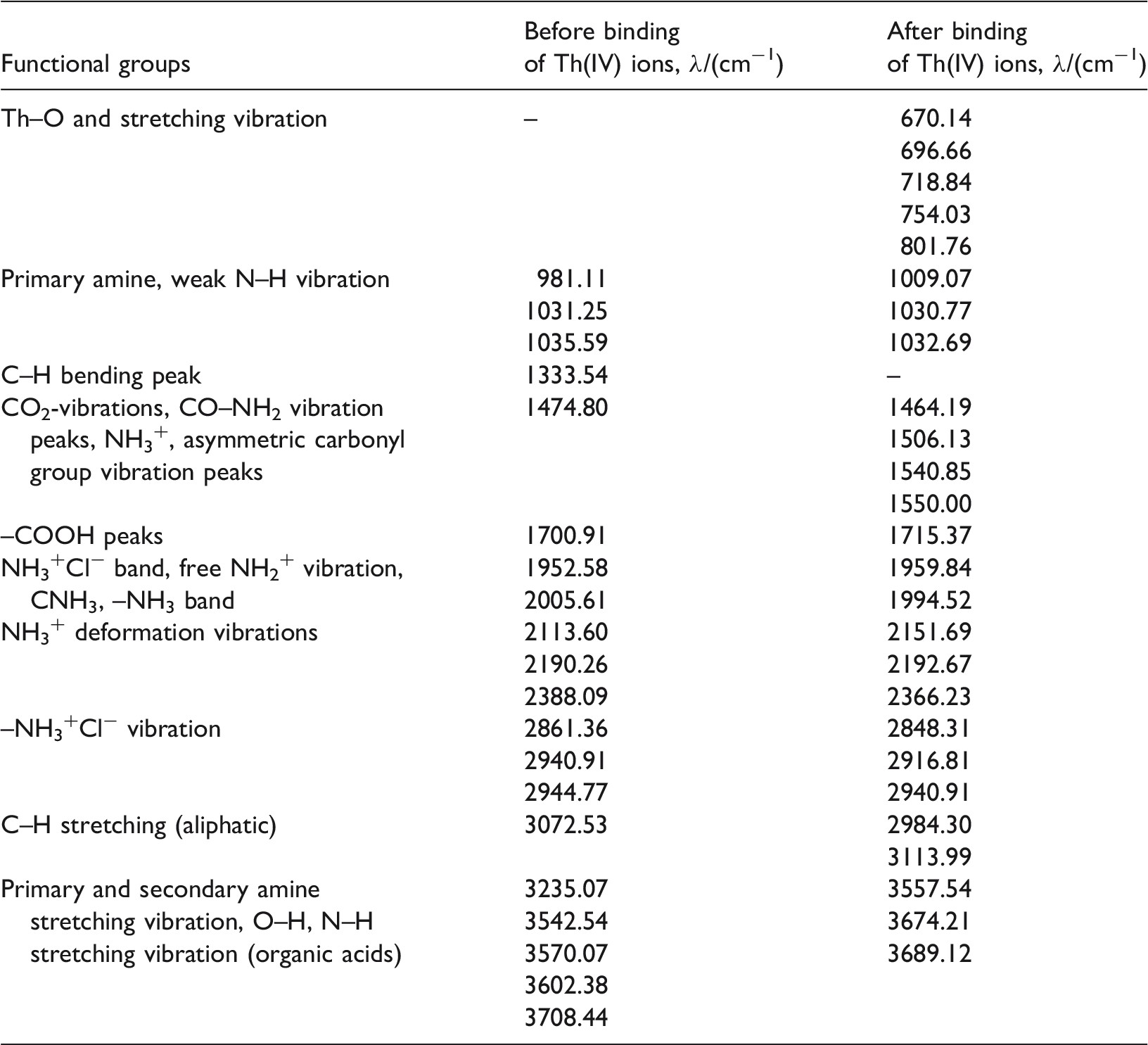
These differences and minor shifting values of signals between IR spectra on Figure 6(a) and (b) may be due to the bonding of thorium (IV) to the sandwich type PENTF structure. The carbonyl groups of metal (and some non-metal) carbonyl compounds absorb strongly at 2180–1700 cm−1 due to the CO stretching vibration (most carbonyl complexes have a strong, sharp band in the region 2100–1800 cm−1). The additional peaks observed around 1540–1460 cm−1 and also increase of the intensity of the peaks from 2800 to 3000 cm−1 can be interpreted as the formation of intermolecular bonding of the thorium ions on the amine and carboxyl groups. The additional peaks between 1540 and 1460 cm−1 are assigned to the symmetric and asymmetric –COO stretching vibrations of carboxyl groups during metal complexation reactions (Kazy et al., 2006). An obvious change in the peak position and intensity at 900–650 cm−1 region could be assigned to the formation of intense (M–O) and (O–M–O) bonds (M: metal ion). Thus an obvious change in the peak position and intensity at 900–650 cm−1 region of the Th (IV)-loaded PENTFs spectrum can be assigned to the formation of Th–O and O–Th–O bond. In Th(IV)-loaded PENTFs, distinct peaks at the between 800 and 650 cm−1 and changes in peak position and intensity around 650–1050 cm−1 can be assigned to the asymmetric stretching vibration of Th–O and stretching vibration of weakly bonded O atom with Th(IV). For thorium (IV) nitrate complexes, the occurrence of two strong absorptions in the 1550–1645 and 1035–1000 cm−1 regions are attributed to v4 and v2 modes of vibration of the covalently bonded nitrate group, respectively, suggesting that the nitrate groups are inside the coordination sphere (Agarwal et al., 2004).
Adsorption results
The results for each run was performed as per the experimental design for thorium uptake percentage of PENTFs are given in Table 2. Multiple regression analysis was used to analyze the data to obtain an empirical model for the best response and thus a second-order polynomial equation (equation 6) was derived as follows

Model summary statistics.

The value of R2 and adjusted R2 are close to 1.0 that is very high and has indicated a high correlation between the predicted values and the observed values. The presence of multiple R value of 0.97, regression is statistically significant, and only 3% of the total variable portion cannot be explained with this model. On the other hand, R2 is determined as 0.94. This means that regression model provides an excellent explanation of the relationship between the response (thorium adsorption (%)) and the independent variables.
Analysis of variance (ANOVA) for quadratic model for thorium adsorption on the PENTFs.

df: degree of freedom.
R2 = 0.9433; CV = 5.81%.
Estimated regression coefficient and corresponding F and p values.

X1, X2, X3, and X4 are the main effects; X12, X22, X32, and X42 are the square effects; X1X2, X1X3, X1X4, X2X3, X2X4, and X3X4 are the interaction effects.
Effects of main parameters
In this study, the adsorption of Th (IV) onto the PENTFs was investigated at different pH values ranging from 1 to 5. pH was found to be statistically non-significant (p > 0.05, p = 0.1448) for the sorption. The negative coefficient value belongs to pH for PENTFs (X1 = −2.03) and interpret that the pH has a negative effect on adsorption of Th (IV) from aqueous solution by PENTFs. According to Figure 7(a), thorium adsorption was increased up to pH 3 (over 89%) and then it shows tendency to decrease due to the hydrolysis of thorium (IV) in solution and form the thorium complex ions such as Th(OH)n+.
Effect of investigated parameters on Th (IV) sorption onto polyelectrolyte nano-thin films (PENTFs). Effect of (a) solution pH, (b) initial Th (IV) concentration, (c) contact time, and (d) temperature.
Initial Th (IV) concentration was found to be statistically significant (p < 0.0001) for the sorption. The positive coefficient value belongs to initial Th (IV) concentration for sorbent (X2 = +7.30) and interpret that the initial Th (IV) concentration has a positive effect on sorption of Th (IV) from aqueous solution by PENTFs sorbent. Figure 7(b) shows the increase in Th (IV) adsorption by increasing initial Th (IV) concentration with other variables being at fixed levels.
The adsorption of Th (IV) on the PENTFs was investigated at different contact time values ranging from 7 to 200 min. Contact time was found to be statistically non-significant (p > 0.05, p = 0.8947) for sorption. The positive coefficient value belongs to X3 ( + 0.18) shows that the contact time has a positive effect onto the sorption of Th (IV). Figure 7(c) illustrated that the sorption of Th (IV) increases when the contact time increases.
Different temperature values ranging from 20℃ to 50℃ was tested for this process. Temperature effect on adsorption was found to be statistically significant (p < 0.05, p = 0.0344). The positive coefficient value belongs to temperature (X4 = +3.08) imply that temperature has a positive effect on Th (IV) adsorption from aqueous solution by PENTFs. Figure 7(d) shows the temperature effect of Th (IV) adsorption onto PENTFs with other variables being at fixed levels. It means that the sorption of Th (IV) increases when solution temperature increases.
Three-dimensional response surface plot
Response surface plots as a function of two factors at a time, maintaining all other factors at fixed levels, are more helpful in understanding both the main and the interaction effects of these two factors. These plots can be easily obtained by calculating the values from the model taken by one factor where the second varies with constraint of a given percentage adsorption yield value. The yield values for different concentrations of the variables can also be predicated from the respective response surface plots (Figure 8). The maximum predicted yield is indicated by the surface confined in the response surface diagram.
Response surface graphs for interactions of investigated parameters.
Interactions between independent variables are shown in 3D surface plots with other variables being at fixed levels (Figure 8 (a)–(f)). The combined effect of pH (X1) and initial Th (IV) concentration (X2) was found to be statistically significant (p < 0.0001, p < 0.05) for PENTFs. The rate of thorium (IV) ions adsorption showed to be significantly dependent on pH and the initial thorium concentration. It was observed that percentage thorium (IV) ion removal increased with decreasing initial concentration of uranium. Figure 8(a) shows the combined effect of two independent variables of pH (X1) and initial Th (IV) concentration (X2). From the contour plot the maximum thorium removal was predicted at the initial thorium concentration of 160 mg·L−1 and pH of 2.81, due to the below pH 3, the predominant thorium ion would be the positively charged Th4+, consequently towards the binding sites of PENTFs is sufficient. Beyond this range there was a significant decrease in the thorium removal due to hydrolysis of thorium and formation of positively charged Th(OH)33+ and Th(OH)22+ ions at the above pH 3.
Figure 8(b) shows the interaction between contact time (X3) and temperature (X4). It was observed that percentage Th (IV) ions removal increased with decreasing contact time and temperature. A combined effect of contact time (X3) and temperature (X4) was found statistically significant (p < 0.0001, p < 0.05) for PENTFs. From the contour plot the maximum thorium removal was predicted at a contact time of 120 min and temperature of 35℃. It was found statistically non-significant (p > 0.05) for PENTFs.
Optimal conditions
The optimum condition of adsorption process was found as initial pH of 2.81, temperature of 35℃, initial thorium concentration of 160 mg·L−1, and contact time of 120 min. At this condition Th (IV) ions adsorption yield was obtained as 89 ± 2%.
Sorption isotherms
The studies on the isotherms of sorption process are able to provide detailed information about the sorption capacity of the interaction between the solute and sorbent. In this study, the equilibrium data between the solute and sorbent were obtained according to the Langmuir, Freundlich, and Dubinin–Radushkevich (D–R) isotherms.
The Langmuir equation, which has been successfully applied to many sorption cases, is given by equation (7)

The Freundlich equation, which was applied for the sorption of Th (IV), is given as

If equation (8) is rearranged linear equation (9) can be obtained

D–R isotherm is generally applied to express the adsorption mechanism with a Gaussian energy distribution onto a heterogeneous surface (Dabrowski, 2001; Gunay et al., 2007). The model has often successfully fitted high solute activities and the intermediate range of concentrations data well.
The linearized form of the D–R isotherm can be expressed as


Meanwhile, the parameter ɛ can be calculated as

Sorption isotherm constants for the sorption of thorium onto PENTFs.

PENTF: polyelectrolyte nano-thin film.
Thermodynamic results
The thermodynamic parameters include the changes in enthalpy (ΔH), entropy (ΔS), and Gibbs free energy (ΔG). These parameters are important to know the heat effect on the sorption process. The thermodynamic parameters were estimated using equilibrium constant. The values of ΔH and ΔS are calculated from the slopes and intercepts of the linear variation of ln Kd with reciprocal temperature (T−1) using the relations (13), (14), and (15)


The distribution coefficient, Kd, is a measure of sorption contaminants to solids and is defined as the ratio of the quantity of the adsorbate adsorbed per unit mass of solid to the amount of the adsorbate remaining in solution at equilibrium. It is the simplest, yet least robust model available. This model originates from thermodynamic chemistry (Alberty, 1987; US Environmental Protection Agency (EPA), 1989a). And it can be treated as an equilibrium—partitioning process when solute concentrations are low (e.g. either ≤10−5 molar, or less than half solubility, whichever is lower) (U.S. Environmental Protection Agency (EPA), 1989b).
Thermodynamic parameters for thorium sorption onto PENTFs.

PENTF: polyelectrolyte nano-thin film.
Conclusions
In this study, anionic and cationic polyelectrolyte monomers containing active amine and carboxyl groups, respectively, were used to synthesis of sandwich type PENTFs. This material was obtained on the ITO-coated glass plates sequentially by spin-coating technique. The usability of these obtained sandwich type PENTFs in sorption of thorium ions was investigated. Sorption parameters were examined by means of experimental designs, the statistical evaluations of the interaction among parameters and the results as well as the main parameters were performed.
The effects of the initial concentration of thorium, medium pH, temperature, and contact time on the adsorption were studied. The ANOVA of the obtained model was carried out in 95% confidence level and was checked to fitting of experimental and predicted values, as well. The values of the F and p related to the model were calculated as 16.65 and <0.0001, respectively. These results show that this model is statistically significant. The correlation coefficient value (R2) obtained as 94% showed that there was a correlation between the predicted values and the observed ones. The optimum conditions of adsorption process were found as the initial pH of 2.81, temperature of 35℃, initial concentration of 160 mg·L−1, and contact time of 120 min. At this condition thorium (IV) ions adsorption yield was obtained as 89 ± 2%.
Footnotes
Acknowledgements
The authors wish to thank directory of Ege University, Institute of Nuclear Sciences.
Declaration of Conflicting Interests
The author(s) declared no potential conflicts of interest with respect to the research, authorship, and/or publication of this article.
Funding
The author(s) received no financial support for the research, authorship, and/or publication of this article.