




Abstract
The low gas permeability of coal formations with limited coal pores and fractures leads to difficulty in coalbed methane exploration. High-voltage electrical pulse has a potential application in enhanced coalbed methane recovery. In this study, we discuss the microscopic characteristics of anthracite coals treated by high-voltage electrical pulse. We find that C, O, and other coal elements constituting oxygenic groups, which mainly account for gas adsorption, decreased slightly after high-voltage electrical pulse treatment, indicating that elemental variation may have little influence on gas adsorption. The scanning electron microscopy and low-pressure nitrogen gas adsorption (LP-N2GA) results show that the cumulative micropore volumes of high-voltage electrical pulse-treated coals were much larger than those of original coals. The mercury intrusion porosimetry results show that the cumulative macropore volumes, which act as gas migration channels in coal increased. Additionally, high-voltage electrical pulse-treated coals were found to have smaller entrapment areas, indicating that gas migration was enhanced.
Introduction
Coalbed methane (CBM) is considered to be a major hazard in coal mines. A traditional method to solve this problem is gas drainage through boreholes. Drained CBM from coal seams is also recognized as a potential energy resource. The concentration of drained CBM from coal seams before mining varies from 60 to 95%, or even more (Karacan et al., 2011). However, the gas drainage rate, which is defined as the percentage of drained methane in total methane (which contains both drained methane and methane from ventilated air), is too low. For example, the gas drainage rate is as low as 22% in China (Yuan et al., 2013), which indicates that most CBM is directly discharged into the atmosphere.
Enhanced coalbed methane recovery (ECBM) is the most common method used to solve this problem, such as CO2 injection, hydraulic slotting, and hydraulic fracturing (Czerw et al., 2016; Jamshidi and Jessen, 2012; Lin et al., 2015; Prusty, 2008, Saghafi, 2010; Zhou et al., 2013; Zou et al., 2014). However, these methods have unavoidable limitations. For example, CO2 injection decreases the concentration of drained methane. The hydraulic technology uses too much water and leads to environment pollution. Moreover, water is not able to penetrate the aromatic structures of the macromolecular network (Prinz and Littke, 2005), which blocks gas migration in coal. Recently, we proposed a new ECBM technique known as high-voltage electrical pulse (HVEP), which has the potential to improve coal permeability (Yan et al., 2016).
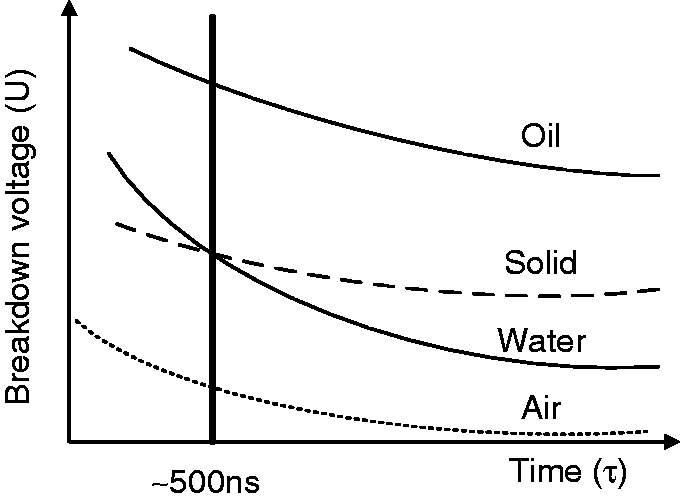
There are two types of HVEP. The first type is based on the electrohydraulic effect shown in Figure 1(a) and has three steps. Two electrodes are placed in water. Then, the water is subjected to a high voltage and a shock wave is generated due to the state change of the water from liquid to vapor. Finally, the shock wave strikes the solid materials, resulting in cracking or fragmentation (Delius, 1994; Scott, 1978; Zhong and Preminger, 1994). The limitation of this method is that the shock wave pressure is too low to generate enough desirable cracks or fragments in high hardness solid materials. The second method is called electrodynamic fragmentation. In this method, two electrodes are placed and connected to two opposite sides of a solid material, as shown in Figure 1(b) (Andres et al., 1999). Because the breakdown voltage of the solid material is lower than that of water when the rise time of the electrical pulse is less than 500 ns, as shown in Figure 2, the solid material, rather than water, will be punctured (Yutkin, 1955).
Schematics of the two different types of HVEP technologies. Breakdown voltage for different materials versus time (Yutkin, 1955).
Recently, the second method has been used widely in mineral treatment (Andres, 2010; Shi et al., 2013; Wang et al., 2011, 2012), coal liberation (Ito et al., 2009), and food processing (Sarkis et al., 2015). All current research shows that HVEP can lead to cracking or fragmentation in solid materials when a sufficient voltage is used. These cracks are similar to fractures in coal formations and assist in CBM migration and gas drainage (Moore, 2012). Our study found that HVEP can generate abundant cracking or fragmentation in coal. Another important factor affecting gas drainage is coal pores. In this study, we mainly focus on the microscopic characteristics of coal that was treated using HVEP. The effect of HVEP on the variation of physical and chemical properties affecting the sorption capacity of coal must be taken into account in an analysis of such coals as specific collectors of mine gases.
Experimental setup
Experiment apparatus
Because the electrical conductivity of most mineral ores is lower than that of water, the HVEP technologies shown in Figure 1(b) need solid materials to be placed in water. Actually, most types of coals have high electrical conductivities. For example, the breakdown field strength of anthracite coal is only 1.6–1.7 kV/cm, which is much lower than that of air (18–18.3 kV/cm) (Yan et al., 2016). Therefore, immersing coal in water is unnecessary due to its lower breakdown voltage. Instead, coal can be directly exposed to air.
The experimental apparatus is shown in Figure 3 and includes an AC power source, HV DC power source, HV switch, capacitor, and experimental cavity. The AC power source has a Chinese standard alternating current power supply with a voltage of 220 V, 50 Hz. The HV DC power has a maximum voltage of 50 kV and a direct current supply. The HV switch is used to generate a high-voltage pulse and the rising time of electrical pulse is about 5–7 µs. The capacitor is 8 µF. Needle electrodes were used. The experimental cavity must be grounded for safety. Additionally, the microscopic characteristics were tested and analyzed after HVEP treatment.
Sketch of experimental apparatus.
Experimental samples
Characteristics of the coal samples (proximate analysis results).

GHS: GuHanShan Coal Mine; LH: LinHua Coal Mine.

Coal samples.
Experimental procedure
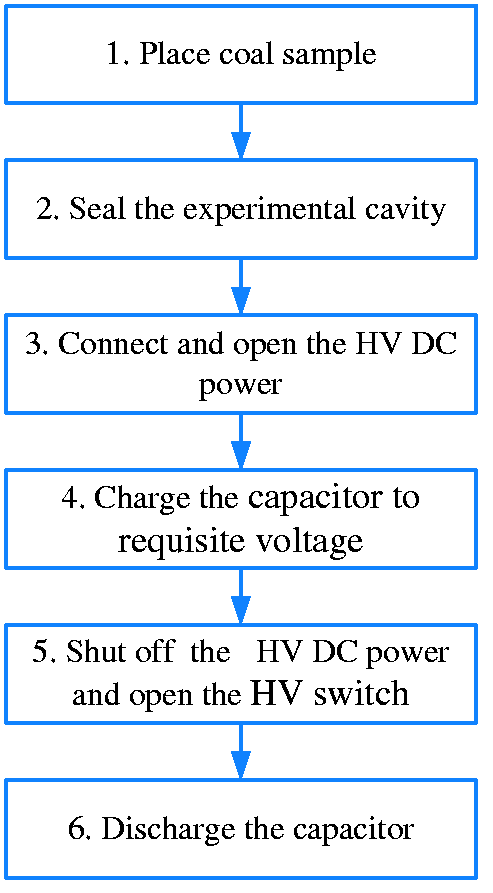
The experimental procedure is shown in Figure 5 and has six steps:
Place the cylindrical coal samples into the experimental cavity and ensure that the needle electrodes (anode and cathode electrodes) make firm contact up and down the round surface of the coal samples. Seal the experimental cavity to avoid injury from flying coal fragments. Connect the HV DC power source to the capacitor connected to the needle electrodes. Apply voltage using the HV DC power source until the requisite value needed to charge the capacitor is reached. Shut off the HV DC power source and open the HV switch. The capacitor will discharge, cracking the coal sample. The capacitor must be fully discharged using a grounding rod for safety purposes prior to the next experiment. Experimental procedure.
Results and discussion
Spectral analysis
When applying a HVEP to a coal sample, the coal sample will instantaneously crack in a few microseconds. Meanwhile, the transient current can reach tens of thousands of amperes, leading to transient high temperatures, which may alter the chemical content of the coal. As a result, the gas sorption characteristics of the coal will change due to the variation of physical and chemical properties affecting the sorption capacity of coal (Stefanska and Zarebska, 2002). The spectral analysis results using an electric refrigeration spectrometer (Bruker QUANTAX 400-10) are shown in Figure 6. Figure 7(a) shows that there are obvious burn marks in coal treated by HVEP. Figure 7(b) shows that C, O, Al, and Si decreased slightly after the HVEP treatment. Elemental Fe disappeared and N appeared. The coal elements responsible for gas adsorption are mainly inorganic components, such as C, O, H, and N, especially C and O, which constitute the oxygenic groups in coal molecules (Hao et al., 2013; Huang et al., 2014). Because there is only a slight difference in the C and O concentrations, this may point to the chemical element variations having a small influence on gas adsorption.
Spectral results for the LH coal sample. (a) Original coal and (b) HVEP-treated coal. Comparison of the spectral analysis results before and after the HVEP treatment.

Scanning electron microscopy (SEM) and low-pressure nitrogen gas adsorption (LP-N2GA) results and discussion
SEM images can assist in determining the distribution of coal pores and fractures in the coal surface. Figure 8(a) shows that there are some intergranular pores and endogenetic fractures in the original coal, which is untreated by HVEP. The coal surface is also smooth. However, the SEM image in Figure 8(b) shows that there are many small particles due to high temperature burning. Additionally, the number of fractures per 5 cm of anthracite coal is usually less than 10 (Yang and Li, 1979). Figure 8(b) shows that there are six fractures per 100 µm, which obviously exceeds the maximum value for normal anthracite coal. Additionally, the orientations and shapes of these fractures are more irregular than those of normal endogenetic fractures, meaning that these are exogenetic fractures caused by HVEP. The newly arisen fractures and pores are favorable to gas desorption and migration.
SEM images: (a) original coal and (b) HVEP treatment coal.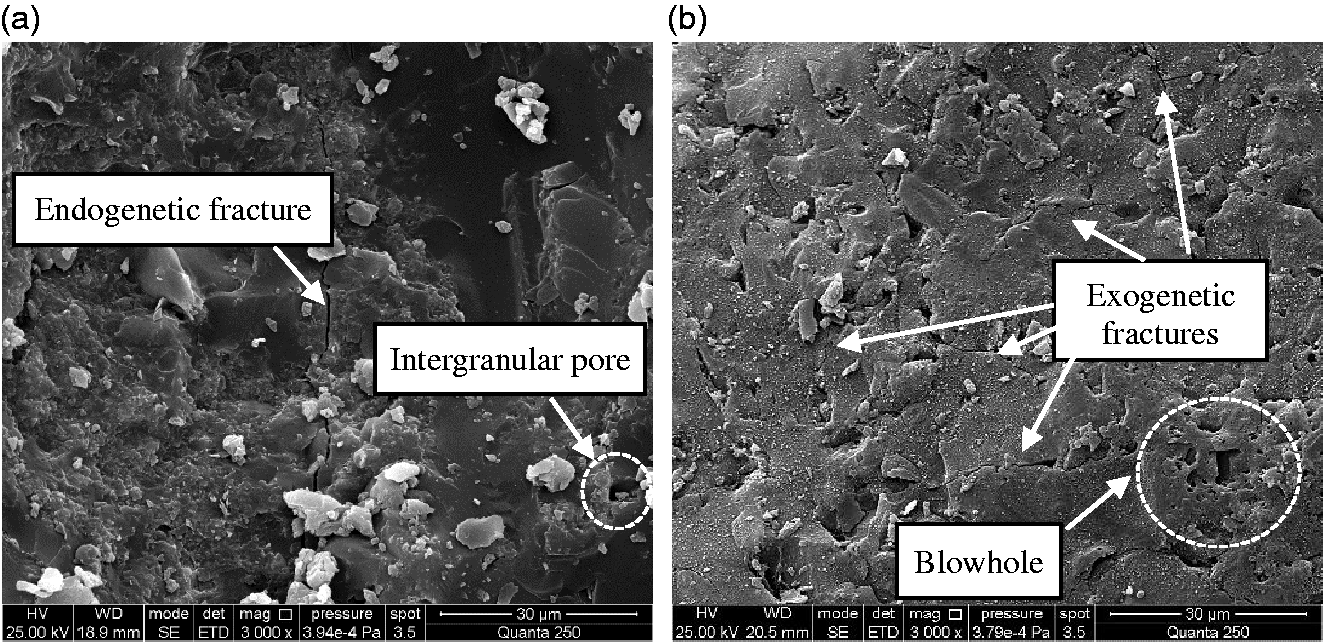
Fractures and holes mainly provide gas migration channels for CBM. However, coal pores strongly affect gas desorption and adsorption. To reveal the effect of HVEP on the coal pore distribution, the LP-N2GA technique was used to analyze the micropore and mesopore distributions. Two different types of anthracite coals were selected to avoid randomness in the test results. The LP-N2GA results shown in Figure 9 show that the pore widths are all less than 25 nm. The cumulative pore volumes of the HVEP-treated coals are much larger than those of the original coals. The dV/dd curves are multimodal. There are two peaks for both HVEP-treated and original coal. The two peaks lie between 0.9 and 5 nm. Because the diameter of a single methane molecule is 0.414 nm, the newly arisen micropores can also supply the methane accumulation medium.
LP-N2GA results for HVEP-treated coals and original coal: (a) GHS coal sample and (b) LH coal sample.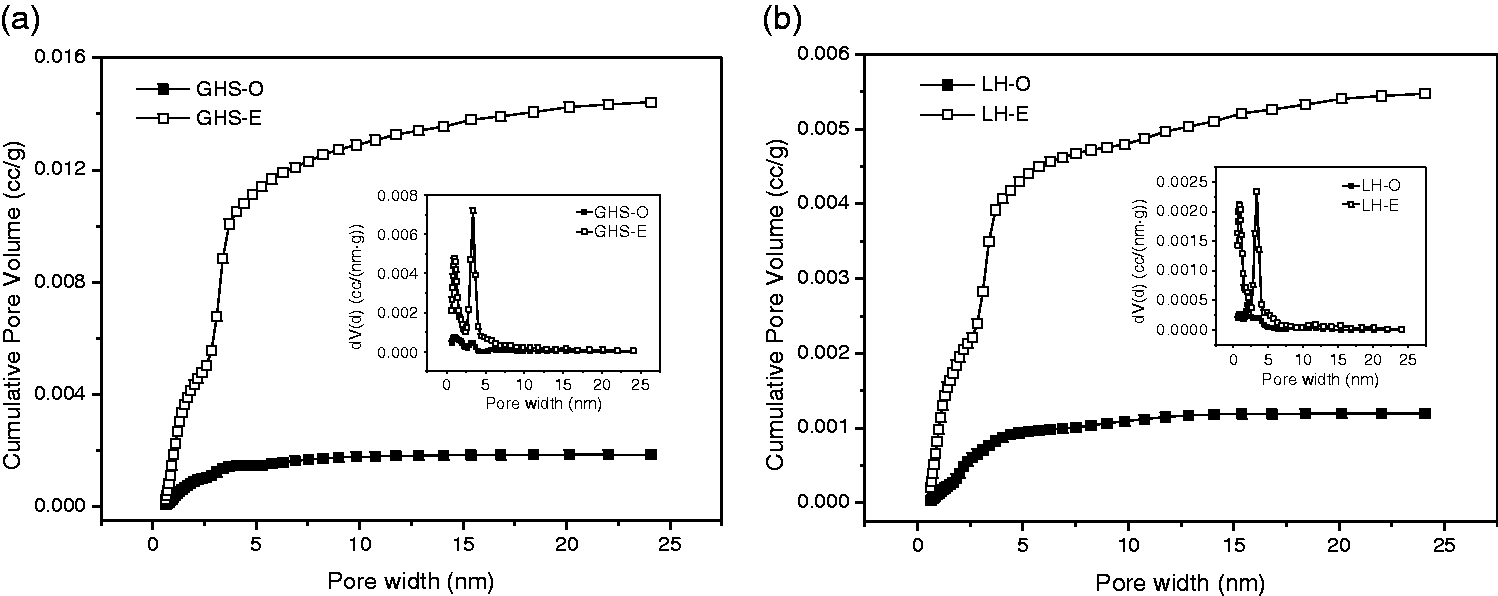
Mercury intrusion porosimetry (MIP) results and discussion
The LP-N2GA results mainly give the micropore and mesopore distributions. However, pores with diameters lager than 100 nm are more valuable for gas migration and drainage. The MIP technique was also used to compare the coal pore distributions, especially macropores. The results are shown in Figure 10. The cumulative pore volumes clearly increased due to the HVEP treatment for both LinHua Coal Mine (LH) and GuHanShan Coal Mine (GHS). The total porosities of GHS original and HVEP-treated coals are 2.8778 and 3.5385%, respectively, and the corresponding values for LH coal are 3.4262 and 3.6674%, respectively.
MIP results of HVEP-treated and original coal: (a) GHS coal sample and (b) LH coal sample.
The pore size diameter percentages are given in Figures 11 and 12. Because macropores are more valuable to gas drainage, we mainly compared pores with diameters larger than 100 nm (also known as seepage pores). The macropores obviously increased after HVEP treatment. The percentages of pores with a diameter larger than 100 nm in original and HVEP-treated coal are 8.67 and 15.38%, respectively, and the corresponding values for LH coal are 5.34 and 9.77%, respectively. These results indicate that the HVEP technique increased the percentage of macropores, which can supply gas migration channels in coal.
Pore diameter distribution in the GHS coal: (a) original coal and (b) HVEP-treated coal. Pore diameter distribution in LH coal: (a) original coal and (b) HVEP-treated coal.

Coal is recognized as a type of heterogeneous material with complex networks of pores, such as cylindrical pores and bottleneck pores (Li et al., 2016; Moore, 2012). Mercury can be withdrawn from cylindrical pores along its intrusion path. In contrast, bottleneck pores usually cause mercury hysteresis and entrapment. Although bottleneck pores can serve as gas migration pathways, gas flow resistance is encountered during gas drainage. The high electric current caused by HVEP changed the pore structures and, in turn, may have also affected the throat/pore ratio in bottleneck pores. Mercury intrusion/extrusion curves of two coal samples using MIP are shown in Figures 13 and 14. The mercury intrusion/extrusion curves show that there were obvious entrapments in original coals. However, HVEP-treated coals had smaller entrapment areas, which indicate that the gas migration can be enhanced. This may be caused by enlargement of throats of bottleneck pores under HVEP which led to high electric current that generated transient high temperature and thermal stress in the coals.
Mercury intrusion/extrusion curves for the GHS coal sample: (a) original coal and (b) HVEP-treated coal. Mercury intrusion/extrusion curves for the LH coal sample: (a) original coal and (b) HVEP-treated coal.

Conclusion
In this work, HVEPs were adopted to enhance gas permeability. The main findings are as follows:
Elemental C and O, which are primarily responsible for gas adsorption, decreased slightly after the HVEP treatment. Because of the small difference in the C and O concentrations, there may be a small influence from elemental variations on gas adsorption. The SEM and LP-N2GA results show that the cumulative pore volumes from HVEP-treated coal are much larger than from original coal. The newly arisen micropores can supply methane accumulation media. The MIP results show that the cumulative macropore volumes clearly increased due to HVEP treatment in both LH and GHS coal. The HVEP technique increased the percentage of pores with diameters larger than 100 nm, which can supply gas migration channels in coal. Additionally, HVEP-treated coal with smaller entrapment areas indicated that gas migration was enhanced.
Footnotes
Declaration of Conflicting Interests
The author(s) declared no potential conflicts of interest with respect to the research, authorship, and/or publication of this article.
Funding
The author(s) disclosed receipt of the following financial support for the research, authorship, and/or publication of this article: Financial support for this work was provided by the Scientific Research Foundation of the State Key Lab. of Coal Mine Disaster Dynamics and Control (2011DA105287—FW201509), National Natural Science Foundation of China (51474211), and the Innovation Team of CUMT (2014QN001). Their contributions are gratefully acknowledged.