




Abstract
The use of bottom ash of expired drugs incineration for removal of Cu(II) ions from aqueous solution has been investigated. Analytical techniques have been employed to find characteristics of adsorbent materials. The removal of Cu(II) was conducted in batch system, and the effects of pH, adsorbent dosage, initial concentrations of copper ions, and contact time on adsorption efficiency were studied. Optimum adsorption was achieved at a pH 5 and equilibrium was established within 15 min of the process. The equilibrium adsorption data were analyzed using eight adsorption isotherm models: Langmuir, Freundlich, Temkin, Redlich–Peterson, Dubinin–Radushkevich, Toth, Harkin–Jura and Halsey isotherms. The energy value obtained by application of Dubinin–Radushkevich model was 2.593 kJ/mol indicating that physisorption was the dominant mechanism of sorption. The values of the correlation coefficient (R2) of the isotherms gave the best fit (>0.99) with the Langmuir, Toth, and Redlich–Peterson isotherms. The adsorption capacity (qm) from the Langmuir isotherm for Cu(II) was found as 13.335 mg/g. The equation constant n of Toth isotherm model is found to be close to 1 (0.945), confirming that the adsorbent studied presents homogeneous surface under conditions used. It is concluded that bottom ash of expired drugs incineration can be used as an effective adsorbent for removing Cu(II) from aqueous solution.
Introduction
The presence of heavy metals in water courses constitutes one of the most serious pollution problems. Nondegradable and very toxic, they can affect the quality of water supply and cause many problems on aquatic life. Even at low concentrations, these elements can be accumulated through the food chain and affect animals, plant life, and therefore human health. Copper is one of these elements which constitute a real health hazard. Though essential for human health, it can be very harmful above specified concentrations limits, causing anemia, kidney damage, stomach intestinal distress, coma, and eventual death (Kanda et al., 2003). Copper is also considered like irritant to the skin giving dermatitis, itching, and keratinization of the sole of feet and hands (Sitting, 1981). This trace element can be responsible for “pink disease” among infants when a concentration of 0.8 mg/l in water is consumed and is carcinogenic to animals. Once copper is released in water it can eliminate all fish as well as marine plants for miles downstream from the source. This metal is widespread in the environment because it is released naturally and mainly through human activity. It is used as an excellent conductor of electricity and in all gauges of wires for circuits. It is also utilized in electroplating, in paints, in analytical reagents, in pigments, in fertilizer industry, and in many other fields (Gupta et al., 2000). In addition, copper mining wastes as well as acid mine drainage contributes widely to copper release. Copper can also be found in food as contaminant, for example, in mushrooms, liver, shellfish, chocolate, and nuts (Nuhoglu et al., 2003). According to the Agency for Toxic Substances and Disease Registry (U.S. Department of Health and Human Services, Public Health service Atlanta, 1999), the maximum recommended concentration of Cu(II) for drinking water by Environment Protection Agency is around 1.0 mg/l, therefore efforts must be deployed to meet this requirement. Several treatment technologies such as solvent extraction, ion exchange, and precipitation have been suggested and employed to remove heavy metals from aqueous solution. But these technologies are not only expensive, but they also create another problem with metal-bearing sludge (Brady et al., 1994). Adsorption is one of the most cost-effective treatment technologies, but the adsorbents used can be very expensive, thus cheap and efficient material are needed to be used as suitable adsorbents. In this paper, efforts have been made to investigate the use of bottom ash of expired drugs incineration (BAEDI) as an economical and available adsorbent for removing copper from aqueous solutions. As a first step, characterization of the BAEDI was carried out in order to examine the possibility of its use as adsorbent. Later the adsorption capacity was evaluated under various conditions of pH, contact time, copper concentration, and BAEDI dosage. The adsorption isotherms were studied to explain the probable mechanism of adsorption and to provide several information such as maximum sorption capacity, energy of sorption, homogeneity/heterogeneity, affinity between sorbent and adsorbent that can be useful for the comprehension of the process taking place.
Several kinds of bottom ash of waste incineration have been suggested as adsorbent in sorption process but the one we propose in this study present the particularity to be nearly free from heavy metals.
Material and methods
Adsorbent and characteristics
The expired drugs (amoxicillin, paracetamol, voltarene) were incinerated in Nar 500 (ECFERAL Algeria) incinerator under a temperature of approximately 850℃. BAEDI sample was utilized as an adsorbent in this study. Conventional analytical techniques were employed to ascertain the characteristics of the adsorbent. The moisture content was determined by weighing 5 g of BAEDI. The sample was placed in the oven and heated for 24 h at a constant temperature of 105℃. Once removed the sample was put rapidly into a desiccator in order to avoid moisture uptake from atmosphere. The sample was reweighed. The loss of mass constitutes the amount of moisture content of the BAEDI. Bulk density was determined according to Archimedes’s principle (Toshiguki and Yukata, 2003) using 5 cm3 pycnometer. pH was measured using a pH meter (HANNA pH211). The point of zero charge (PZC) was determined by the use of the solid addition method (Oladoja and Aliu, 2009). Forty-five milliliters of (0.01 M) NaCl solution was transferred into a series of 50 ml conical flasks. The pH values of the solution were adjusted from 2 to 10 by adding either (0.1 M) NaOH or (0.1 N) HNO3. After making the total volume of the solution exactly 50 ml in each flask by adding NaCl, the accurate pH0 values of the solutions were noted. BAEDI (0.15 g) was added to each flask. The suspension was then agitated for 48 h. The pH values of the supernatant liquid were noted. The difference (ΔpH = pHf − pHi) between the initial pH (pHi) and final pH (pHf) values was plotted against the pHi. The point of intersection of the resulting curve with pHi gave the PZC. All chemicals and reagents used in this study were supplied by Panreac Barcelona Spain. The specific surface of the BAEDI was measured by BET method at 77 K using a Micromeritics ASAP 2010 (BET surface area measurements) apparatus. Chemical composition of the BAEDI was analyzed by X-ray fluorescence (XRF-40 Philips). FTIR spectra of the samples were obtained on PerkinElmer Model System 2000 using KBr pellet method.
Preparation of synthetic stock solution
A total of 3.96 g of (CuSO4, 5H2O) 99% was dissolved in 1 l of distilled water to prepare 1000 mg/l of copper stock solution. Samples of different concentrations were prepared from this stock solution by appropriate dilutions. The pH values of the solution were adjusted from 3 to 8 by adding either (0.1 M) HNO3 or NaOH (0.1 M). Batch adsorption experiments were carried out by shaking a series of bottles containing various amounts of BAEDI and copper at different pHs. When the adsorption was realized, the ash particles were separated from suspensions by filtration and the residual concentration of copper was determined using an Atomic Absorption Spectrometer PERKIN ELMER A700 at a wavelength of 324.8 nm.
Experimentation
Batch adsorption tests were carried out to study the effect of various parameters on the adsorption efficiency of copper ions on BAEDI. Parameters such as pH of the mixed solution, quantity of the adsorbent, initial quantity of copper ion, and agitation time were studied. The amount of Cu(II) adsorbed per unit of BAEDI (milligram copper per gram BAEDI) was calculated according to a mass balance on the copper concentration (equation (1))

Effect of pH of the aqueous solution
To study the influence of pH on copper adsorption, 100 ml of the concentration (50 mg/l) was taken in each of conical flask. A total of 0.2 g of BAEDI was added to each solution. The pH values of the solution were adjusted to 3, 4, 5, 6, 7, and 8 and the flasks were further agitated until equilibrium was obtained. At the end of mixing, the BAEDI particles were separated from suspensions by filtration. In addition to adsorption tests, a set of blank tests were conducted without BAEDI in order to evaluate the removal by metal hydroxide precipitation at various pHs (5–11). The initial concentration of these aqueous solutions was 50 mg/l and the final concentration was measured by atomic absorption spectroscopy.
Effect of dose of adsorbent
The adsorption of Cu(II) on BAEDI was studied by changing the quantity of BAEDI in the test solution while keeping the initial Cu(II) concentration (50 mg/l) and temperature as constant at equilibrium time (0.1–0.4 g) of adsorbent were added to 100 ml of copper solution 50 mg/l at pH = 5.
Effect of initial copper concentration
The adsorption experiments were carried out in the copper concentration range of 5–1000 mg at pH = 5 and 3 g/l of BAEDI.
Effect of contact time
The effect of contact time on removal of copper ions was studied for a period of 70 min. A total of 0.3 g of the BAEDI was added to different conical flasks containing 100 ml of 50 mg/l solution at optimal value of pH. The flasks were closed and placed in a rotary shaker, and for each of the different contact times chosen (1, 2.5, 3.5, 5, 6.5, 9, 10, 12, 13.5, 15, 20, 25, 30, 35, 40, 45, 50, 55, 60, 70 min) the content of each flask was filtered and analyzed.
Adsorption isotherms
The equilibrium retention of adsorbate onto adsorbent is well described by mathematical models based on some assumptions related to the type of coverage, the homogeneity and heterogeneity of the solid surface, and the interaction between adsorbate species. These models called adsorption isotherm may explain the probable mechanism of adsorption. In the present study, equilibrium data were analyzed using the Langmuir, Freundlich, Temkin Redlich–Peterson, Dubinin–Radushkevich (D–R), Toth, Harkin–Jura, and Halsey isotherms.
Langmuir adsorption isotherm
The Langmuir isotherm (Langmuir, 1916) based upon three assumptions, sorption is limited to monolayer coverage, all surface sites are identical and can accommodate only one adsorbed atom, and interaction forces between adsorbed atoms are negligible. The Langmuir equation may be written as

Equation (2) can be expressed in its linear form as

A plot of (Ce/qe) versus (Ce) gives a straight line, if the sorption process is described by the Langmuir isotherm equation. The values of qm and b are obtained from the slope and intercept of the straight line plot.
Furthermore, favorability of adsorption of copper on BAEDI was tested using the essential characteristics of the Langmuir isotherm model, expressed in terms of a dimensionless constant called separation factor RL, which is defined by the following relationship

Freundlich adsorption isotherm
This model is used to describe the adsorption occurring onto heterogeneous surface (Hutson and Yang, 2000). It is described by the empirical equation proposed by Freundlich


The Temkin isotherm
Temkin and Pyzhev (1940) suggested that because of indirect adsorbate/sorbate interactions the heat of adsorption of all the atoms adsorbed would linearly decrease with coverage. The Temkin isotherm may be written as

Equation (7) can be expressed in its linear form as

AT is Temkin isotherm equilibrium binding constant (l/g), b is Temkin isotherm constant related to heat of sorption (J/mol), R is universal gas constant (8.314 J/mol/K), T is temperature at 298 K. The plot of (qe) versus (ln Ce) enables the determination of the isotherm constants.
Redlich–Peterson isotherm
Redlich–Peterson model, unlike the Freundlich and Langmuir isotherms, can be applied to both heterogeneous and homogeneous system. It is considered as a compromise between these two models (Jossens et al., 1978). The R–P isotherm can be applied in the following equation

Equation (9) can be expressed in its linear form as

D–R isotherm
The D–R model (Kilislio and Bilgin, 2003) can explain the physical and chemical characteristics of adsorption with its mean free energy. D–R model has commonly been applied in the following equation


The mean adsorption energy E (KJ/mol) can be obtained by using the expression

The adsorption process is said to be dominated by physisorption for the energy values less than 8 KJ/mol, by chemical ion exchange mechanism for those between 8 and 16 kJ/mol and by chemical particle diffusion for the greater than 16 kJ/mol (Bering et al., 1972).
Toth isotherm
Toth model is often useful for describing heterogeneous systems. Toth equation describes well many systems with submonolayer coverage (Artur et al., 2003). It has the form

The Toth isotherm may be rearranged to give a linear transform

The values of parameters of Toth model can be evaluated by nonlinear curve fitting method using Sigma-plot software.
Harkin–Jura isotherm
The Harkin–Jura (Akmil, 2006) equation accounts for multilayer adsorption and can be explained by the existence of a heterogeneous pore distribution. The Harkins–Jura isotherm can be expressed in its linear form

Frenkel–Halsey–Hill isotherm
This model is suitable for multilayer adsorption and heteroporous adsorbents. The Halsey adsorption isotherm can be given as

The Frenkel–Halsey–Hill isotherm (Halsey, 1948) can be also expressed in its linear form

Results and discussion
Characterization of adsorbent
Major physical properties of BAEDI from drug incineration.

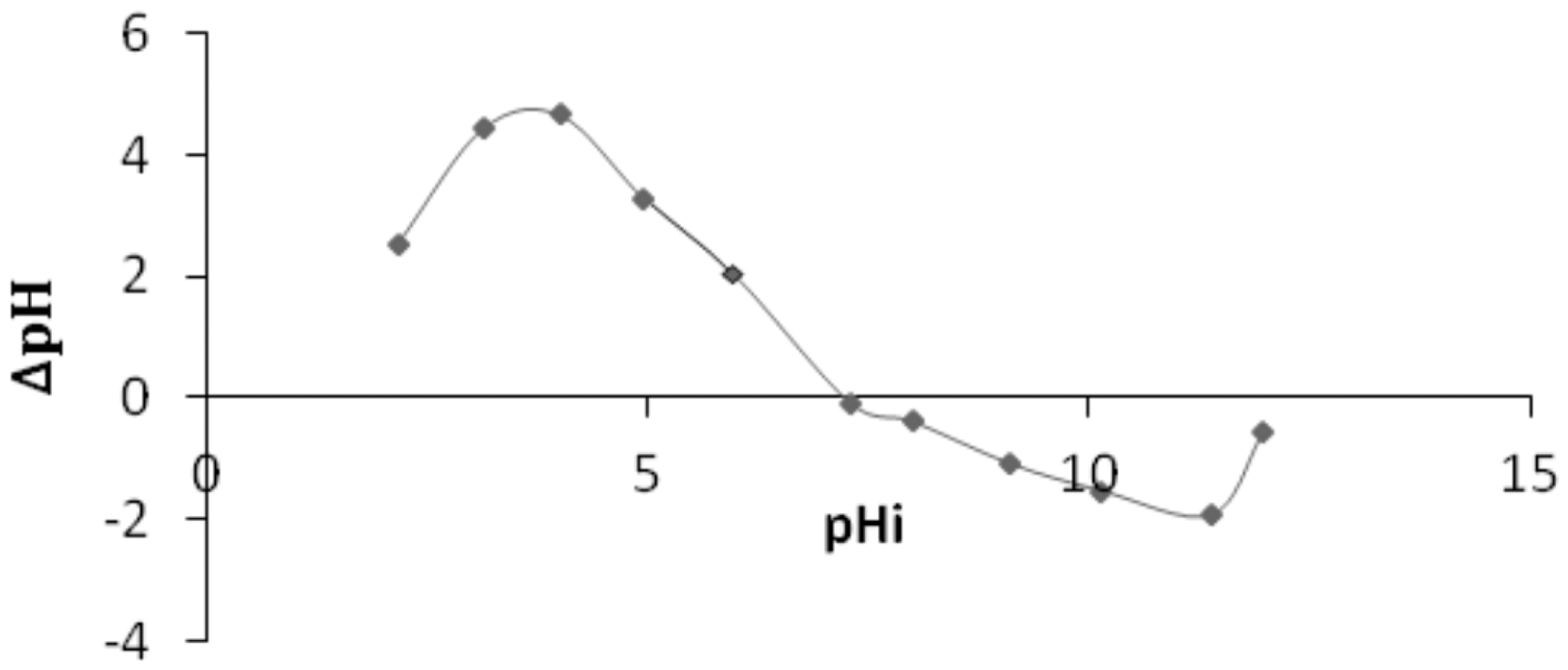
Point of zero charge for BAEDI. BAEDI: bottom ash of expired drugs incineration.
Elemental analyses of BAEDI.
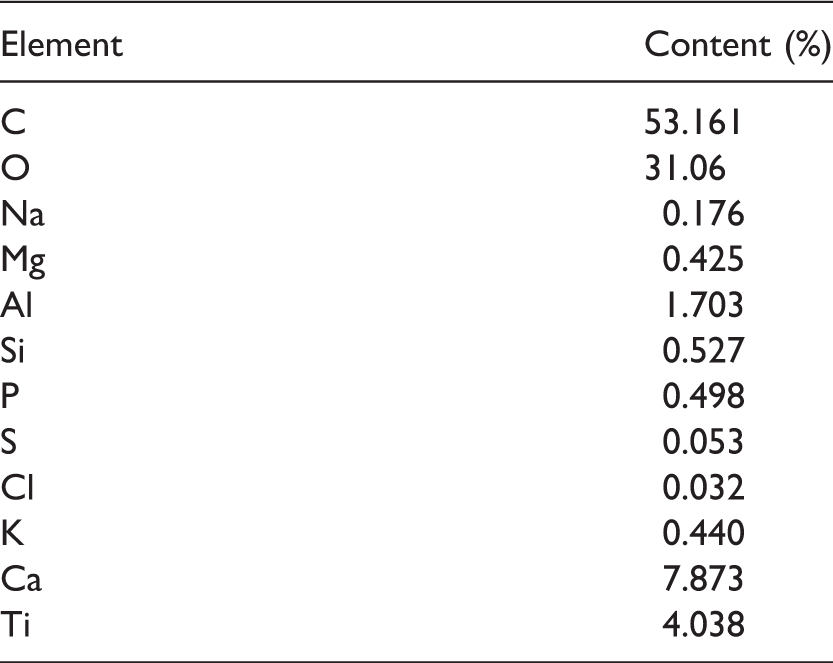
BAEDI: bottom ash of expired drugs incineration.
The FT-IR technique was employed to identify some important functional groups, which are capable of adsorbing metal ions (Chandler, 1997; Meima and Comans, 1999). The FT-IR spectrum of BAEDI is shown in Figure 2. The main peaks identified are placed around 3472, 1611, 1444, 1000, and 500 cm − 1.
FT-IR spectrum of BAEDI. BAEDI: bottom ash of expired drugs incineration.
The bands around 3472 and 1611 cm − 1 are associated to stretching and deformation vibrations of OH and H–O–H groups. The peak at around 1444 cm − 1 might be assigned to the presence of O–C–O stretching vibration in carbonate. The peak around 1000 cm − 1 is attributed to asymmetric stretching vibrations of Si–O/Al–O bonds. The peak around 500 cm − 1 is caused by the in-plane bending vibration of Si–O–Si (Fernandez et al., 2004; Han et al., 2010; Hanif et al., 2009; Johnson et al., 1995; Moller, 2004; Rendek et al., 2007). FTIR studies reveal that several function groups which are able to bind with heavy metal ions, in particular Cu(II) ions, are present in BAEDI.
Batch studies
Effect of pH
The percentage removal of copper from the aqueous solution is strongly affected by the pH of the solution as illustrated in Figure 3.
Effect of pH solution on the removal of copper (1) with use of bottom ash and (2) without use of bottom ash. Effect of pH copper adsorption capacity.

As pH increased from 3 to 8, it can be expected that the BAEDI surface became more negatively charged. With increasing pH beyond the PZC the negative charge density on the surface of the adsorbent increased, resulting in enhancement in the removal of copper. However, as can be seen in Figure 3 copper ions precipitation began from pH 6. Theoretically when the ion product exactly equals the value of solubility product constant (Ksp) precipitation will start. For a solution of 50 mg/l copper ion precipitation starts at pH equal to 5.72. The curves observed in Figure 3 exhibited a distinct improvement in copper removal when BAEDI was used. The removal of copper from the aqueous solution passed from 59 to 99% by using BAEDI at pH 8. This is due to the availability of more negatively charged surface facilitating greater copper removal by electronic attraction mechanism. At lower pH values (3 to 5) no precipitation occurred, removal was totally assured by adsorption, and rose to more than 60%. The major mechanism responsible for metal uptake in this range may be ion exchange and electronic attraction. Though adsorption may give best results at pH values greater than 7.2 as illustrated in Figure 4, we opted for the pH value of 5 to avoid precipitation.
Effect of adsorbent dose
The percent removal of copper II increased with the increase in adsorbent dosage due to the increase in adsorbent surface area as shown in Figure 5. The maximum removal rate of 80% occurred at the concentration of 3 g/l of adsorbent. After this point, further increase in BAEDI dosage brought no increase in percent removal. This may due to the overlapping of the adsorption sites as a result of overcrowding of adsorbent particles or else to the screening effect of the outer layer imposed by the high adsorbent dosage, thereby shielding the active sites from metal (Tumain et al., 2008). In certain cases, the excess particles can be deposited on the walls of the container creating heterogeneity in the solution. Thus, no contact with metal solution occurred.
Effect of BAEDI dose on copper removal. BAEDI: bottom ash of expired drugs incineration.
Effect of initial copper concentration
The result on the effect of initial copper ions concentration in the solution on the rate of metal adsorption on BAEDI is shown in Figure 6.
Effect of initial copper concentration on adsorption capacity.
First an increase in adsorption capacity with increase in metal ion concentration was observed. This may be explained by the presence of more copper ions in solution available for binding onto the active sites of the BAEDI. Subsequently, the adsorption reached to a saturation value, this can be due to the fact that all adsorbents have a limited number of active sites and at higher concentrations the active sites became saturated (Barbosa et al., 2000).
Effect of agitation time
As shown in Figure 7 adsorption was a function of time. It was noticed that in the initial stage the adsorbed concentrations vary considerably and at some point of time, the rate of adsorption became constant.
Effect of contact time on copper adsorption capacity.
The initial rapid uptake can be explained by the presence of large number of vacant sites, as time proceeds the adsorption concentration reached a constant value beyond which no more copper ion was removed from solution. This is due to the accumulation of metal ions on the vacant sites. The adsorption attained a state of dynamic equilibrium between the amount of the copper ions desorbing from the BAEDI and the amount of metal being adsorbing onto the same adsorbent (Bello et al., 2010). The equilibrium was reached rapidly after 15 min as this may be interesting for practical application of adsorption in wastewater treatment.
Adsorption isotherms
The adsorption isotherm was obtained by plotting the weight of copper adsorbed per unit weight of BAEDI (qe) against the equilibrium concentration of the solute in solution at constant temperature (298 K) and pH = 5 (Figure 8).
Isotherm adsorption of copper onto BAEDI. BAEDI: bottom ash of expired drugs incineration.
The Langmuir, Freundlich, Temkin, Redlich–Peterson, D–R, Toth, Harkin–Jura and Halsey isotherms were applied in this study. The values of model parameters are evaluated using Sigma plot software (version 12).
Value of constants for each isotherm model used in the studies.

It is clear from Table 3 that the best model fit was achieved using a Langmuir, Redlich–Peterson, and Toth isotherm. As can be seen in Table 3 the value of correlation coefficient obtained for these three models (R2 > 0.99) showed that these models are suitable to describe the adsorption of copper on BAEDI. From the data calculated in Table 3, the value of the maximum monolayer coverage (qm) adsorption from Langmuir model was very close to the experimental value. The separation factor of Langmuir model RL was greater than 0 but less than 1 indicating favorable adsorption. Redlich–Peterson model approximates Langmuir model at low solute concentration. The equation constant n of Toth isotherm model is found to be close to 1 (0.945) and this value confirms that the adsorbent studied presents homogeneous surface under conditions used, for this value Toth model is nearly reduced to the Langmuir adsorption isotherm equation. The D–R approach was applied to distinguish the physical and chemical adsorption of metal ions on the basis of its mean free energy E per molecule of adsorbent. The energy value obtained according to this model (2.593 kJ/mol) was less than 8 kJ/mol. This result indicates that the adsorption of copper ions onto BAEDI follows physisorption process. While the correlation coefficient in D–R model is comparatively small, the adsorbent capacity according to this model (12.838 mg/g) remains very close to the experimental value.
Relatively low values of correlation coefficient were obtained for the Harkin–Jura and Halsey isotherms, the models, unlike Langmuir isotherm, are suitable for heterogeneous surface of adsorbent, thus confirming the homogeneous nature of the adsorbent surface.
The maximum adsorption capacities of various low-cost adsorbent for copper adsorption.

It can be observed that the BAEDI shows reasonable capacity and can be used as a good and inexpensive adsorbent for removal of copper II ions from aqueous solution.
Conclusion
In this study, tests were performed to evaluate the use of bottom ash of some expired drug incineration (amoxicillin, paracetamol, voltarene) as an adsorbent for copper ions. In the first stage of the study, the characterization of the adsorbent was done. No presence of potential heavy metals was observed. The main elements found were carbon and oxygen. The effects of operating parameters such as pH, contact time, sorbent dose, and initial metal dose on copper sorption capacity of bottom ash were studied. The results suggest that the adsorption was influenced by pH solution, the concentration of the copper ions, dosages of adsorbents, and contact time. The optimum pH was 5 to avoid precipitation. It was found that adsorption of copper onto BAEDI is a very rapid process with equilibrium time of 15 min.
Adsorption equilibrium was described by the Langmuir isotherm as well as Toth and Redlich–Peterson models. It can be concluded that the BAEDI can be used for removal of copper ions from solutions with maximum metal uptake of 13.33 mg/g.
Adsorption of Cu(II) ions by BAEDI is an economically feasible technique for removing metal ions from a solution. The adsorbent is available and inexpensive. Furthermore, the recovery of ash from any kind of waste incineration should be encouraged in order to preserve natural resources, and the feature of this particular ash is the presence of less heavy metals in its composition. It is suspected that better results can be obtained with other heavy metals for which precipitation occurs beyond pH 7.2, a choice of greater value of pH can be made so that surface will be more negatively charged, thus resulting in the enhancement of metal removal.
Footnotes
Declaration of Conflicting Interests
The author(s) declared no potential conflicts of interest with respect to the research, authorship, and/or publication of this article.
Funding
The author(s) received no financial support for the research, authorship, and/or publication of this article.