




Abstract
A novel hydrophilic Pb(II) ion-imprinted polymer (Pb(II)-IIP) was synthesized using lead ion as a template ion, 2-(allyl sulfur) nicotinic acid as functional monomer by precipitation polymerization method. The adsorption capacity of Pb(II)-IIP to Pb(II) was saturated at 16 min, and the adsorption process is consistent with the quasi-second-order kinetic adsorption model. The optimum adsorption capacity of Pb(II)-IIP was 29.67 mg/g, about triple than Pb(II)-NIP, and the adsorption is in accordance with the Langmuir isothermal model, which indicates that it is dominated by single layer chemical adsorption. X-ray Photoelectron Spectroscopy (XPS) and Energy Dispersive Spectrometer (EDS) data confirm that the chelate ratio of Pb(II) to 2-(allylthio) nicotinic acid is 1:2. In the presence of competing ions, the adsorption capacity of Pb(II)-IIP to Pb(II) is much larger than that of other ions, which indicates that Pb(II)-IIP is less disturbed by competitive ions. The experiment of application of practical wastewater shows that Pb(II)-IIP has a Pb(II) removal rate of 97.2% or more in practical industrial wastewater, which is in accordance with national emission standards. It is proved that Pb(II)-IIP is an effective material to remove Pb(II) in industrial wastewater.
Introduction
As the development of industrialization, a wide variety of chemicals wastes such as heavy metals and persistent organic pollutants, including pesticides, have been clearly documented in almost every biota (soil, water, and air) (Cheng, 2001). Heavy metal pollution caused great harm to human beings (Guo et al., 2010; Xiao et al., 2010). It is well known that heavy metals can block the functional groups of vital enzymes resulting in damages to several organs like nerves, liver, and bones of human (Ewan and Pamphlett, 1996). In addition, some heavy metals such as lead, nickel, chromium, etc. have been listed as a human carcinogen (Alloway, 1995; Diels et al., 2002). Unfortunately, heavy metal pollution is widespread all over the world, especially in developing countries. The major sources of heavy metal pollution are mining, smelting, electroplating, and surface finishing industries, which are still discharging lots of toxic heavy metals such as Pb, Cd, Cu, Zn, and Ni to the environment (Choudhary and Sar, 2009; Malik, 2004).
On the other hand, many heavy metals are valuable resources for industrial applications, so the recovery and recycling of heavy metals processes great significance. Further, strict environmental regulations enforce industries to apply environment-friendly, low-cost, and efficient treatment technique for heavy metal removal and recovery. At present, many methods have been used to remove the heavy metals in the water, such as chemical precipitation (Barrera-Díaz et al., 2012), membrane separation (Kumbasar, 2009), biological treatment (Chai et al., 2009), and adsorption (Ahluwalia and Goyal, 2007). However, most of them are expensive, inefficient, and labor intensive, or lack of selectivity. Moreover, other disadvantages, such as high reagent requirement and unstable removal performances, are also associated with above-mentioned methods.
Ion imprinting technology, which is developed on the basis of molecular imprinting technique as a new separation technology (Bayramoglu and Arica, 2011; Dichey, 1949; Vatanpour et al., 2011), has been applied for removal of lead from the wastewater. Liu et al. (2011) synthesized the lead ion-imprinted polymer (Pb(II)-IIP) to remove the lead from wastewater, and the results showed that the lead ion-imprinted polymer exhibited adsorption capacity of 35 mg/g within 40 min. Li et al. (2009) prepared the Pb(II)-IIP through surface imprinting sol–gel method, adsorption equilibrium saturation capacity were 22.7 mg/g. Zhang et al. (2011) reported maximum adsorption capacity of Fe3O4@SiO2@IIP for Pb(II) was 18.35 mg/g, and its time of absorption balance was reached at 35 min. However, the material adsorption rate is slow, and the particle sizes of adsorption material are not uniform. Therefore, the adsorption capacities of these reported IIPs are not high enough for practical applications. The ion-imprinted polymer, which are prepared by precipitation polymerization method, has a uniform particle size distribution, high yield, do not need to add stabilizer and surface active agent, and avoid interference to other nonspecific adsorption of ions. Bojdi et al. (2014) applied 4-vinyl pyridine as functional monomer, which obtain good microspheres with the particle size between 25 and 45 nm. Shamsipur et al. (2014) prepared a nano-sized silver(I) ion-imprinted polymer with average particle sizes of 52 nm using ethylene glycol dimethacrylate (EDGMA) as crosslinking agent. Therefore, the precipitation polymerization can effectively control the particle size and morphology.
Herein, a novel hydrophilic Pb(II) ion-imprinted polymer (Pb(II)-IIP) was synthesized using lead ion as a template ion, and 2-(allyl sulfur) nicotinic acid as functional monomer by precipitation polymerization method. To demonstrate the performance for removal of lead, the Pb(II)-IIP was compared with Pb(II) nonimprinted polymer (Pb(II)-NIP) in terms of adsorption capacity, dynamic capacity, selectivity, and regeneration tests. The parameters of the removal process were also optimized.
Experimentation
Materials and reagents
2-(allyl sulfur) nicotinic acid obtained from Aladdin (Shanghai, China), lead nitrate from West-Long Chemical Co. Ltd. (China), EDGMA, andazodiisobutyronitrile (AIBN) were purchased from Aladdin Reagent Co. Ltd (Shanghai, China).
Materials and instrument
Fourier transmission infrared (FTIR) spectra were recorded using a VERTEX70 FTIR apparatus (Germany) from 4000 to 400 cm−1. Scanning electron microscopy (SEM, Japan, Shimadzu) was employed to characterize the morphologies. The Brunauer–Emmett–Teller (BET) method was used to calculate the specific surface area of materials based on N2 adsorption/desorption isotherms (Micromeritics, Amirica). A ContrAA 700 (Analytik jena, Germany) flame atom absorption spectrophotometer and an atomic fluorescence spectrometer with a limit of detection of 0.005 µg/l (AFS, AFS-2202E, Beijing Haiguang, China) were used to determine the concentration of metal ions. Thermogravimetric analysis was performed with a DSC/DTA-TG device (STA 449 C Jupiter Netzsch, Germany).
Preparation of Pb(II)-IIP
First, 1 mmol of Pb(NO3)2 and 2 mmol of functional monomer 2-(allyl sulfur) niacin were ultrasonic dissolved in 110 ml of methanol/ultrapure water (V/V = 4:1) solution, and the solution was refluxed for 2 h at 35℃ under the protection of nitrogen. Following, 20 ml of methanol containing 2 mmol of crosslinking agent (EGDMA) and 55 mg initiator (AIBN) was added to the above solution successively, and the reaction solution was heated up to 70℃ for 24 h. Finally, the obtained samples were washed using methanol/deionized water interval. To remove the template ion Pb(II), the above white precipitate was eluted using 1 M HNO3. Then, the solid precipitate was soaked with 10 wt% ammonia aqueous overnight and washed by water to neutral. Finally, the obtained Pb(II)-IIP was dried in vacuum oven at 60℃. Furthermore, the non-ionic-imprinted polymer (Pb(II)-NIP) was prepared without Pb(NO3)2 at the same reaction conditions.
Adsorption of Pb(II)
Twenty milligrams of adsorbent of Pb(II)-IIP or Pb(II)-NIP was taken into 20 ml of Pb(II) solution with different initial concentrations at 25℃. After shocked 6 h, the adsorbent was separated, and the atomic absorption spectrophotometer was used to detect the concentrations of Pb(II) in the solution. The equilibrium adsorption capacity was calculated by the following equation

To study the adsorption kinetics of Pb(II), 300 mg of Pb(II)-IIP or Pb(II)-NIP was added into 300 ml of 250 mg/l Pb(II) solution, then shocked at room temperature and analytical samples were taken from the mixture solution at given time intervals and immediately filtered to remove the adsorbent. The concentrations of Pb(II) were measured by atomic absorption spectrophotometer. The selective adsorption was evaluated using other ions that are the same valence and close to ion radius of Pb(II). The applicability of the adsorbent in environmental water samples is to measure whether the adsorbent has the important index of industrial production potential, thus, four different kinds of industrial wastewater, wastewater sample 1 clear liquid (iron), wastewater sample 2 (tungsten) source wastewater, wastewater sample 3 (after extraction of nickel wastewater), and four wastewater samples (lithium wastewater), were selected to study, respectively.
Results and discussion
Preparation of Pb(II)-IIP
The size of the polymer particle can be adjusted during the preparation of Pb(II)-IIP by precipitation polymerization method. Before polymerization, the template ion of Pb(II) and functional monomer was prepolymerized for 2 h, the purpose is to make Pb(II) and functional monomer more fully chelate coordination so as to form a stable complex. After that, the polymerization was initiated by the way of thermal initiation of free radicals, and the rate of magnetic stirring was optimized to control the particle size of the polymer. The preparation of the Pb(II)-IIP is shown in Figure 1. After the polymerization, ultrapure water was used to remove material that did not participate in the reaction. The obtained precipitation was eluted with HNO3 and the template ion Pb(II) in the polymer was replaced with H+ ion to form a hole. This size and shape of the imprinting cavity has specific recognition and unexpected structure activity. These bare ligands in imprinting cavity contained N groups of template ion Pb(II) and have a specific memory function for Pb(II), which can enhance the anti-interference ability of Pb(II)-IIP to the environment and the solution of the target of Pb(II) ion selective recognition.
Synthesis route of Pb(II)-IIP.
SEM analysis
SEM images of Pb(II)-IIP and Pb(II)-NIP are shown in Figure 2. We can clearly see that Pb(II)-IIP and Pb(II)-NIP particles are spherical with good dispersion, the average size of is much less than that of Pb(II)-NIP, which may be attributed to the introduction of Pb(II) ion, which makes the Pb(II)-NIP has a larger surface area and more adsorption sites for the target Pb(II) ions in the solution.
SEM photographs of Pb(II)-IIP (a) and Pb(II)-NIP (b). SEM: scanning electron microscope.
XPS analysis
The XPS spectra of Pb(II)-IIP before and after Pb(II) adsorption are shown in Figure 3. From the full spectra of the Pb(II)-IIP before and after Pb(II) adsorption (Figure 3(a)), Pb(II)-IIP mainly contain C, O, and S elements. After Pb(II) adsorption on Pb(II)-IIP, the characteristic peak of Pb appeared, confirming the adsorption of Pb(II) on Pb(II)-IIP. In addition, the XPS spectra of Pb5s and Pb4f shown in Figure 3(d) also demonstrate the adsorption of Pb(II) on the surface of Pb(II)-IIP. The XPS spectra of S2p before and after adsorption are shown in Figure 3(b) and (c); it is not hard to find that the peak of S2p shifted from 163.48 to 163.48 eV after the adsorption of Pb(II), which can be attributed to the combination of Pb(II) and 2 -(allyl thio) nicotinic acid (ANA) in –SH. Furthermore, the peak of N1s decreased from 399.38 eV (Figure 3(e)) to 399.31 eV (Figure 3(f)) in the process of adsorption of Pb(II), indicating that N elements also have chelation for Pb(II). The above results showed that the S and N atoms in the 2 -(allyl sulfur) nicotinic acid provided the adsorption active site for the Pb(II) ions.
XPS spectra of Pb(II)-IIP. (a) Full view of Pb(II)-IIP before and after adsorption of Pb(II) ions (b, c) S 2 p; (d) Pb; (e, f) N 1 s. XPS: X-ray Photoelectron Spectroscopy.
Specific surface area measurement
The nitrogen adsorption/desorption isotherms of Pb(II)-IIP and Pb(II)-NIP are shown in Figure 4. The specific surface area of the Pb(II)-IIP and Pb(II)-NIP, calculated from the BET method, were 87.95 and 46.01 m2/g. Compared with Pb(II)-NIP, Pb(II)-IIP has a larger specific surface area, which can effectively enhance the adsorption of Pb(II) on the surface of sorbent. Furthermore, we can obviously see that the Pb(II)-IIP and Pb(II)-NIP are mesoporous from the hysteresis in the nitrogen adsorption/desorption isotherms.
Nitrogen adsorption/desorption isotherms of Pb(II)-IIP and Pb(II)-NIP. NIP: Non-ionic Imprinted Polymers. (a) Adsorption isotherms Pb(II) ions on Pb(II)-IIP and Pb(II)-NIP, and the corresponding (b) Langmuir and (c) Freundlich isotherms. NIP: Non-ionic Imprinted Polymers.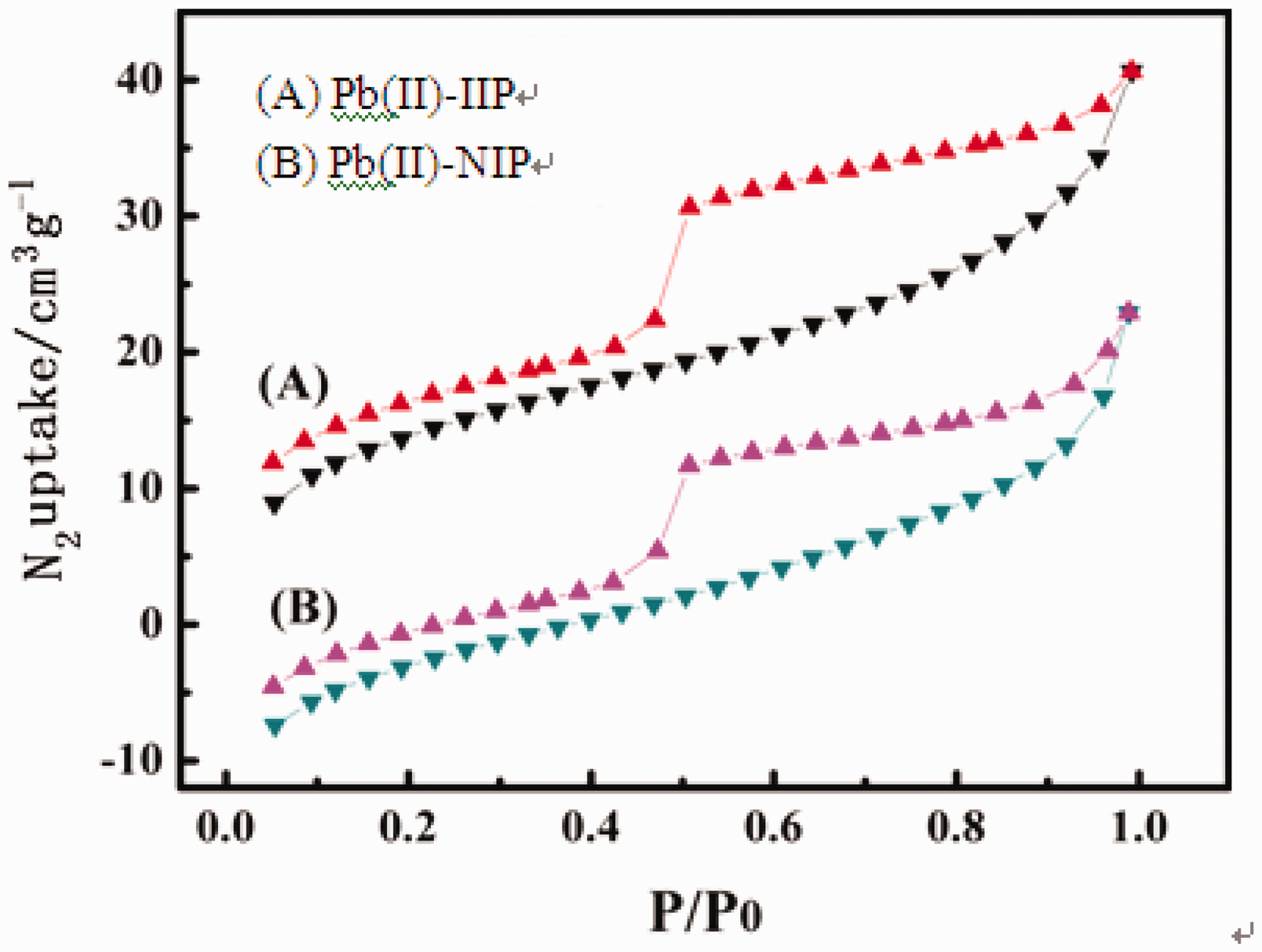

Adsorption experiments
Sorption isotherm
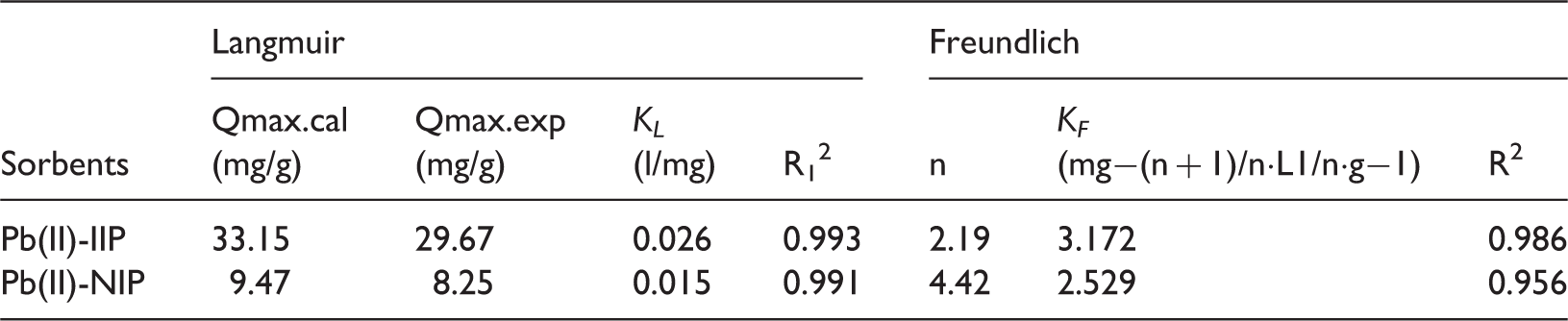
Figure 5(a) shows the adsorption of the Pb(II) on the surface of Pb(II)-IIP and Pb(II)-NIP. The adsorption capacity of Pb(II)-IIP was suddenly increasing with the raising concentration of Pb(II). Then the adsorption slowed down and tended to saturation situation. It can be seen that at low concentration before 200 mg/L, with the increase of solution concentration of Pb(II), the adsorption capacity of Pb(II)-IIP increases rapidly, after that the adsorption process slowly reached saturation. Adsorption capacity of 29.67 mg/g for Pb(II)-IIP is significantly higher than that of Pb(II)-NIP (8.25 mg/g), which shows that Pb(II)-IIP has more adsorption sites than Pb(II)-NIP.
In the system, the equilibrium adsorption capacity has a direct relationship with the concentration of the solution. Langmuir and Freundlich adsorption models were usually used to fit the data to calculate the adsorption capacity. These models were represented, respectively, by


Langmuir and Freundlich adsorption isotherm constants for Pb(II)-IIP and Pb(II)-NIP.
IIP: Ion Imprinted Polymers; NIP: Non-ionic Imprinted Polymers.
Comparison of the maximum adsorption capacities of Pb(II) ions among different adsorbents.

Adsorption kinetics
The adsorption kinetics curves of Pb(II) on Pb(II)-IIP and Pb(II)-NIP are shown in Figure 3(a). We can see from the diagram, Pb(II)-IIP and Pb(II)-NIP adsorption rate is fast in the first 5 min, the capacity of adsorption increased rapidly. With the extension of time, the adsorption capacity increased slowly and then reaches balance. The balance time is about 16 min. Experimental phenomena show that the adsorption sites of Pb(II)-IIP can be quickly combined with target ion, when the adsorption sites tend to be saturated, target Pb(II) ion suffered resistance, so the rate of adsorption is gradually reduced.
Pseudo-first-order kinetics model and the pseudo-second-order kinetics model had been widely used in the fitting of the dynamic adsorption, which can directly reflect the adsorbent mass transfer rate.


Qe (mg/g) is the adsorbent adsorption capacity when the adsorption reaches balance; Qt is the adsorption capacity of t time; K2 (g, mg−1, min−1) is the secondary dynamic adsorption constant; h0 (1 mg/g min) is the initial adsorption rate.
The fitting results of Pb(II) adsorption kinetics are shown in Figure 6(b) and (c). Dynamic adsorption model parameters are shown in Table 3. According to the linear correlation coefficient R2, it is found that the fitting coefficient (R2) of Pb(II)-IIP and Pb(II)-NIP is greater than that of the pseudo-first-order rate equation, which is 0.998 and 0.995, respectively. Calculated by the accurate secondary rate equation, the maximum adsorption capacity is 42.92 and 9.01 mg/g, respectively, that is closer to the experimental value. The results showed that the adsorption of Pb(II) on Pb(II)-IIP and Pb(II)-NIP is well fitted by pseudo-second-order model. In addition, compared with the initial adsorption rate (h0), Pb(II)-IIP has higher adsorption rates almost triple than Pb(II)-NIP. All of those suggested that the adsorption process gives priority to pseudo-second-order model, which is dominated by chemical adsorption.
(a) Adsorption kinetics for Pb(II) adsorption on Pb(II)-IIP and Pb(II)-NIP, and the corresponding (b) pseudo-second-order kinetics isotherm, and (c) pseudo-second-order isotherm. NIP: Non-ionic Imprinted Polymers. Kinetic parameters of the pseudo-second-order for Pb(II)-IIP and Pb(II)-NIP. IIP: Ion Imprinted Polymers; NIP: Non-ionic Imprinted Polymers.

Adsorption selectivity
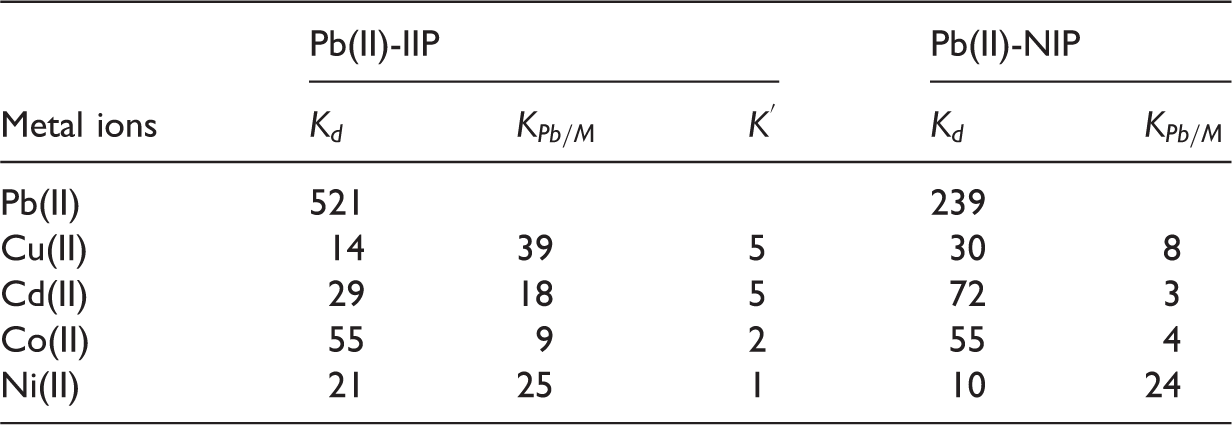
To investigate the adsorption selectivity of sorbents, these interference ions, such as Cu(II), Cd(II), Co(II), and Ni(II) were used in the process of competitive adsorption. The adsorption capacity of Pb(II)-IIP and Pb(II)-NIP for each ion in the mixed system is shown in Figure 7; it can be observed that Pb(II)-IIP is a small amount of adsorption for Cu(II) and Co(II), but it is less than the target ion Pb(II). At the same time, it can be seen that Pb(II)-NIP has obvious adsorption under the same conditions. The above results indicate that Pb(II)-IIP has the same imprinted sites as the target ion Pb(II) and the size of the imprinted cavity, which is helpful to improve the selectivity of Pb(II).
Selectivity for Pb(II) on Pb(II)-IIP and Pb(II)-NIP. NIP: Non-ionic Imprinted Polymers.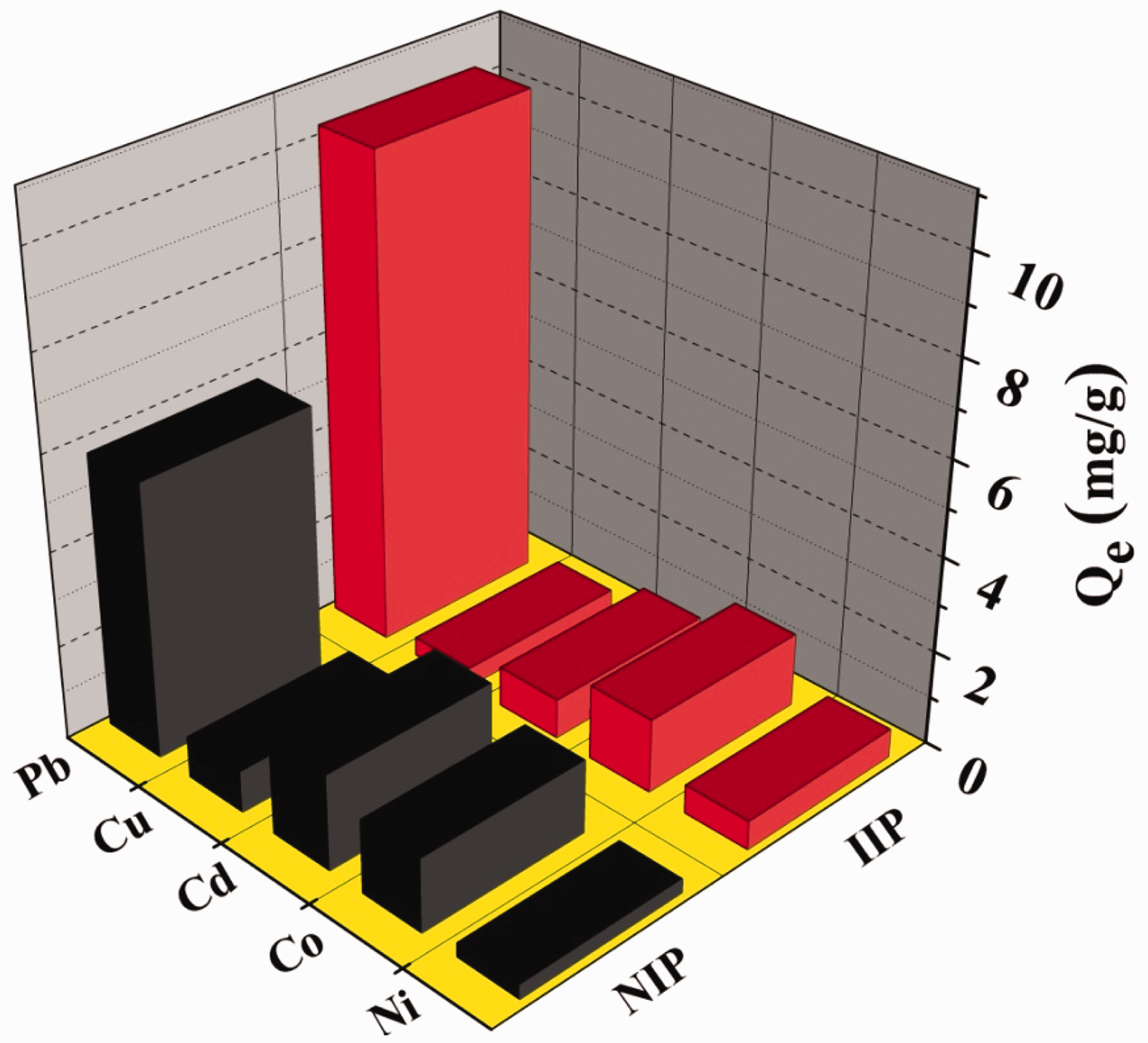
Selectivity parameters of Pb(II)-IIP and Pb(II)-NIP for Pb(II) ions.
IIP: Ion Imprinted Polymers; NIP: Non-ionic Imprinted Polymers.
Regeneration
The reuse of adsorbent is an important factor to evaluate the efficiency and practicability of materials. In this study, this experiment is a stand with five adsorption/desorption regeneration cycles. Desorption using 0.5 mol/l nitric acid as eluent, regeneration cycle adsorption capacity is shown in Figure 8. The experimental results show that the adsorption capacity of Pb(II) on Pb(II)-IIP decreased about 14.1% after five times recycling test. This is because the spherical adsorbent has good mechanical strength and stability, and the elution of nitric acid on the Pb(II)-IIP adsorption site does not cause great damage. The results showed that Pb(II)-IIP had excellent ability to regenerate Pb(II).
Desorption regeneration cycles of Pb(II)-IIP. IIP: Ion Imprinted Polymers.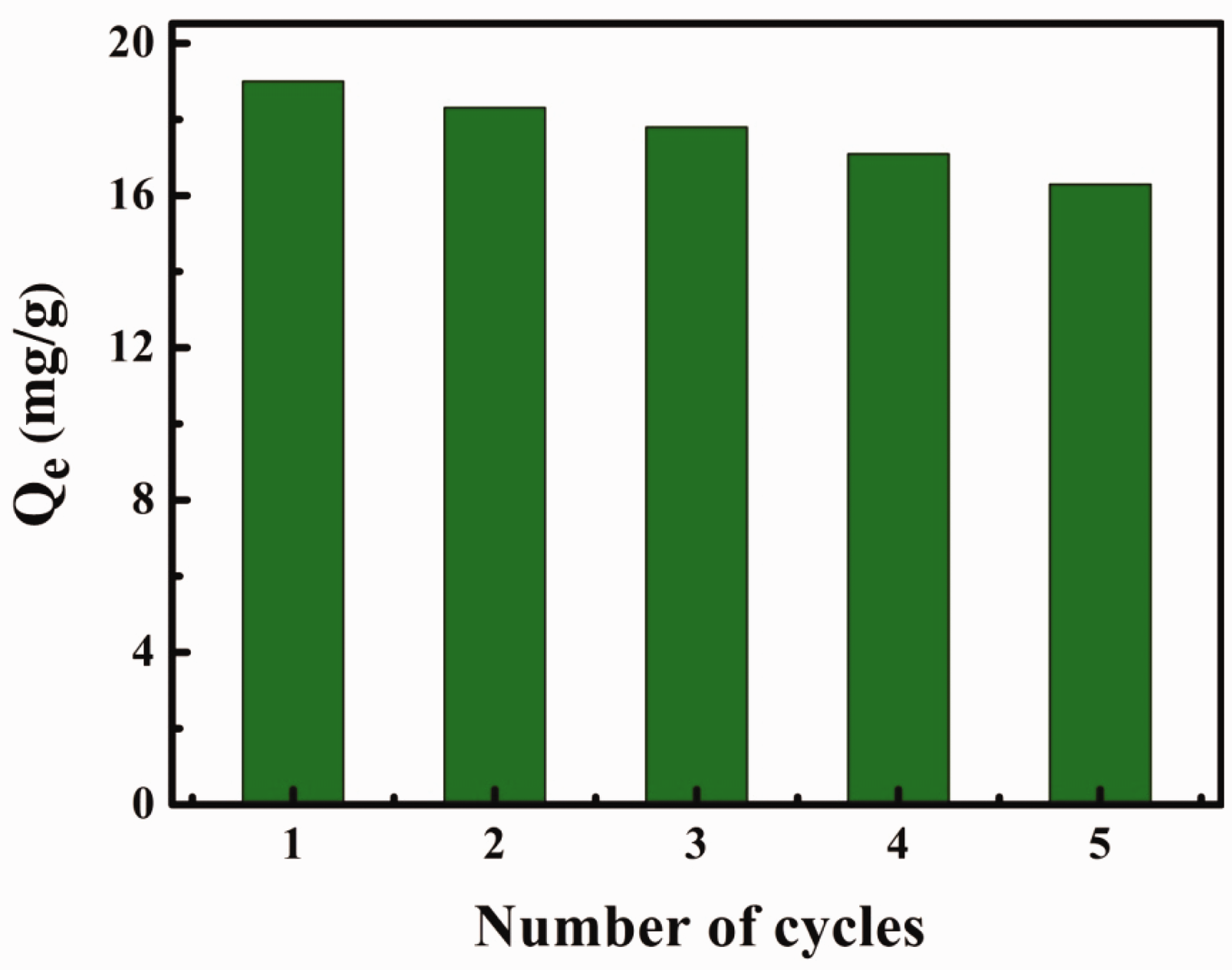
Conclusion
In this study, Pb(II)-IIP is synthesized for the selective removal of Pb(II) from wastewater by a precipitation polymerization method using ANA as a thio-functionalized monomer. This thio-functionalized monomer can not only coordinate with Pb(II) but also have a double bond for further polymerization to avoid additional grafts. The adsorption kinetics of Pb(II)-IIP featured a particularly rapid initial step to approach equilibrium within 16 min, and the experimental data fit well with the pseudo-second-order kinetic model. The saturation adsorption capacity (29.67 mg/g) is two times larger than Pb(II)-NIP, and the adsorption process obeys the Langmuir isotherm model. The practical application shows that Pb(II)-IIP can effectively remove Pb(II) from industrial wastewater with a removal rate of more than 97.2%, which indicates it has great potential in selectively removing Pb(II) from industrial wastewater.
Footnotes
Declaration of Conflicting Interests
The author(s) declared no potential conflicts of interest with respect to the research, authorship, and/or publication of this article.
Funding
The author(s) received no financial support for the research, authorship, and/or publication of this article.