




Abstract
Falling youth turnout in Europe has increased interest in measures that can encourage electoral participation among young voters, including the promotion of volunteering. Recent studies show that volunteering can increase turnout among young people; the effects are moderated, however, by family background. This highlights the potential importance of other institutions that structure political socialisation on the volunteer/voting relationship, of which gender is a powerful example. This article examines that potential and shows that while volunteering increases first-time voter turnout among young men, there is no evidence of such benefit for young women. Data limitations prevent hypotheses explaining this relationship from being tested, but the article argues that this reflects the impact of gendered political socialisation on the types of volunteering young men and women engage in, with that of men being more productive of resources that encourage turnout.
Introduction
The falling turnout of young citizens – particularly those among lower socio-economic strata – is a serious challenge confronting many established democracies (Armingeon and Schadel, 2015; Franklin, 2004; Garcia-Albacete, 2014). The habitual nature of electoral participation not only means that overall turnout has declined (as older, more active cohorts are replaced) but that socio-economic divides are widening as non-voting habits are increasingly concentrated among poor young adults (Franklin, 2004; Garcia-Albacete, 2014). While voting is not the only form of participation available to democratic citizens, and non-electoral activities such as protesting and petitioning have become more important (Dalton, 2022; Norris, 2002), the singular importance of voting in selecting political elites and informing government decision and policy-making has driven interest in measures that could increase first-time voter turnout, such as the promotion of youth volunteering. While volunteering has long been argued to facilitate political participation (e.g. Putnam, 2000; Roker et al., 1999; Verba et al., 1995; Jeong 2013), data limitations have inhibited the ability of previous research to test the hypothesis that children who volunteer become more likely to vote (Kim and Morgul, 2017; Van Ingen and Kalmijn, 2010). Recent studies have utilised the increasing availability of household panel data to overcome such obstacles and show that while youth volunteering can reduce age inequalities in turnout, its effect is dependent on the structuring of young volunteers’ political socialisation by parents’ political engagement and socio-economic resources (Fox, 2024; Kim and Morgul, 2017; Malschinger et al., 2023).
This suggests a potential for other institutions that structure political socialisation to also moderate the effect of volunteering on political behaviour. Gender is a key example of a social institution that structures volunteering, political participation, and political socialisation (Martin, 2004), meaning it could structure the relationship between them as well (Cicognani et al., 2012; Erentaite et al., 2012). Young women are more likely to volunteer, for example, but less likely to do so for organisations relating to politics; they are also less likely to be encouraged to participate in politics by parents, vote, report an interest in politics or feel politically efficacious, but more likely to engage in individualised non-electoral activity such as boycotting (Grasso and Smith, 2021; Houle, 2022; Stefani et al., 2021; Wilson, 2000). A limited literature – including Cicognani et al. (2012) and Erentaite et al. (2012)–has explored this potential for gender to affect how volunteering and political participation are related: Cicognani et al. (2012) argue that while both young men and women who volunteered show an increased expectation of voting in adulthood, the effect is stronger for young men, while Erentaite et al. (2012) argue that childhood civic participation is a stronger predictor of young women’s anticipated political participation. Neither provides persuasive evidence of gender structuring the effect of volunteering on voting behaviour, however, because (1) both relied on cross-sectional data and measures of anticipated electoral participation, preventing direct observation of associations between childhood volunteering and adult voting, and (2) neither accounted for the effect of confounding factors – such as childhood political engagement or familial politicisation – that predispose young people to both volunteer and vote (Fox, 2024; Kim and Morgul, 2017; Marta and Pozzi, 2008; Van Ingen and Kalmijn, 2010; Taylor 2021).
This research overcomes some of these hurdles by employing the UK Household Longitudinal Study (UKHLS), examining the effect of childhood volunteering on vote likelihood in a sample of newly eligible voters in the 2015, 2017, and 2019 UK general elections. It uses data on childhood and parents’ political interest to account for childhood politicisation and familial socialisation, and on political interest, political efficacy and the belief voting is a civic duty to examine (1) whether volunteering can reduce gender divides in those characteristics and (2) how volunteering affects first-time voter turnout through its impact on those characteristics. The analyses find that the effect of volunteering is dependent on both the gender of the volunteer and the politicisation of the family home. Volunteering increases vote likelihood for young men from political disengaged households, through encouraging a greater interest in politics and belief in voting as a duty. There is a similar but much smaller effect for young men from politicised households. There is no significant effect, however, for young women regardless of parental politicisation: volunteering has no discernible effect on their political interest, political efficacy, civic duty or likelihood of voting. While volunteering can reduce socio-economic inequalities in youth turnout between young men (and so reduce their contribution to generational turnout decline), it widens gender divides in political engagement and turnout between young people from depoliticised backgrounds.
Literature review
Youth volunteering, political socialisation, and adult participation
While definitions are contested and evolving, there is a consensus that in essence, volunteering refers to the donation of an individual’s time to a cause for a specific group, institution, or individual (beyond family) (Wilson, 2000). Political science has long viewed volunteering as a key element of the civic culture, providing opportunities for individuals to acquire resources that facilitate political participation (Lowndes, 2004; Putnam, 2000; Verba et al., 1995). These include transferable civic skills; greater awareness of local issues and institutions, which can increase the motivation to participate in politics and raise feelings of political efficacy; and broader social networks and attachments to the local community, which can be a source of both resources and motivation encouraging political activity (Birdwell et al., 2013; Flanagan et al., 1998; Quintelier, 2008; Roker et al., 1999; Taylor, 2021; Verba et al., 1995; Wilson and Musick, 2000).
Volunteering during childhood or adolescence (youth volunteering) is particularly important because these benefits occur during the formative years of political socialisation: the period by which people have developed the biological and cognitive capacity to engage with politics and start to form political opinions, values, and attitudes which inform their political behaviour (Bartels and Jackman, 2014; Jennings et al., 2009). During these years, children rely heavily on guidance and cues from external agents to help shape their response (Hanks, 1981; Jennings et al., 2009; Jennings and Niemi, 1981). As children age and are exposed to such influences over a sustained period, and repeatedly express their responses to political stimuli, those characteristics become habitual, becoming less resistant to external influence and crystallising into lasting political traits (Amna, 2012; Dinas, 2013).
This is why the formative years are important for interventions intended to affect voting behaviour: if young people can be supported to vote during the formative years this can encourage lasting habits of electoral participation in adulthood. Voting in one’s first election is an important example of a socialising event that shapes subsequent habits of electoral participation (Franklin, 2004). Young people who vote in their first elections are likely to vote in subsequent elections until a lasting habit that makes electoral participation likely throughout adulthood is formed, while those who do not vote in their first elections are likely to develop lasting habits of abstention. For this reason, research into turnout decline increasingly focuses on the obstacles experienced by first-time voters, such as increasing economic precarity (Kostelka and Blais, 2021; Schäfer et al., 2019), an increasingly fragmented media environment (Ohme et al., 2017), failures in political campaigning (Gherghina and Rusu, 2021), and a declining tendency among first-time voters to see voting as a duty (Blais and Achen, 2019).
The impact of any such intervention does not occur in isolation from prior socialising influences, however. Political socialisation has been shown to begin in relatively early childhood, with van Deth et al. (2011) and Bartels and Jackman (2014), for example, finding evidence of the formation of independent political attitudes in children before the age of 10. And while political socialisation may not begin until a child is approaching 10, other aspects of socialisation start even earlier, and children grow up in environments (e.g. the family home) which will contribute to their political socialisation (e.g. parents’ political engagement or wealth) before they start to form independent political attitudes or choose to volunteer (Hyman, 1959; Jennings and Niemi, 1981; McFarland and Thomas, 2006). The impact of any socialising event, activity, or experience occurring during childhood or adolescence will to some extent be shaped, therefore, by prior socialising influences and the political characteristics young people have already started to form.
These early socialising experiences are heavily influenced by parents: they are typically the source of the first political cues children are exposed to and reinforce those cues through continued interaction (Gniewosz et al., 2009; Hyman, 1959; Jennings et al., 2009). Parents also shape the features of the family home, including how big a role politics plays in family life, and access to resources that facilitate political participation in the form of economic, social and cultural capital (Dederichs and Kruse, 2023; Jennings et al., 2009; McFarland and Thomas, 2006). Circumstances that shape parents’ political engagement and participation – such as socio-economic status – therefore become important structures in the political socialisation of their children by influencing the political cues and learning parents provide (Malschinger et al., 2023). This is why the political socialisation of children from wealthier households is fundamentally different from that of those from poorer households: their parents are more likely to be politically engaged and active, meaning they are more likely to have been exposed to cues, experiences and influences that encourage political interest and participation by the time they reach adolescence (Jennings et al., 2009; Neundorf et al., 2016). By the time children start to participate in activities such as volunteering, their political socialisation is already well underway, and the impact of volunteering (or other events and activities experienced during adolescence) will be shaped by those prior socialising influences – and most of all, the political characteristics of their parents.
For this reason, interventions intended to affect the political engagement and participation of young adults have different effects on children who had politically engaged (and typically wealthier) parents relative to those with politically disengaged (and typically poorer) parents. The impact for children with engaged parents is reduced because such children are already being socialised in a way that encourages political participation in adulthood (Fox, 2024; Neundorf et al., 2016); indeed, both volunteering in childhood and voting in adulthood may be a result of that socialising experience. For children with disengaged parents however, the impact is greater because they have had less access to resources and influences that encourage political engagement during their socialisation. Interventions such as volunteering could provide a rare stimulus to engage with politics alongside a rare opportunity to connect with and form social networks that provide political information. This is known in studies of political education as a ‘compensation effect’ (Neundorf et al., 2016), whereby the positive effect on political participation is greater for those otherwise least likely to be socialised into being politically active. Further evidence of such effects has been found for associational membership (Van Ingen and Kalmijn, 2010) and volunteering (Fox, 2024).
The role of gendered political socialisation
That the effect of volunteering on voting is dependent on prior socialisation means other factors or institutions that structure early political socialisation could also moderate that relationship. Gender is a key example of an institution that shapes the way parents interact with and raise their children (Martin, 2004), yet its role in structuring the effects of youth volunteering on political participation has received little attention, and those that have examined it suffer from the methodological limitations common to this field outlined above (Cicognani et al., 2012; Erentaite et al., 2012). Political socialisation can be described as gendered in that ‘[t]he social construction of gender . . . produces cultural stereotypes about gender roles and attitudes . . . [that] reward men and women differently for the same behaviours’ (Cicognani et al., 2012; Coffe, 2013; Grasso and Smith, 2021; Houle, 2022: 336). This has both direct and indirect consequences for the formation of political characteristics. The direct consequences reflect differences in the cues and experiences boys and girls are exposed to during their formative years. Different expectations of the social roles children will perform leads parents to encourage certain behaviours and attitudes in different ways, usually resulting in girls being less interested in electoral politics than boys. Parents are less likely to discuss politics with their daughters, for example, to encourage them to pursue political careers, or to be politically active (Bos et al., 2020; Gordon, 2008; Pfanzelt and Spies, 2019). Girls are also likely to be socialised into prioritising compassion and caring behaviour while minimising conflict, an outlook that could make the conflictual aspects of (particularly party and electoral) politics unappealing and seem irrelevant to their social roles, while boys are more likely to be socialised to confront conflictual situations and take on public and leadership roles (Houle, 2022).
The indirect effects of gendered socialisation arise from its impact on behaviour and social relationships that affect access to resources that facilitate or obstruct political participation (McCulloch, 2014). Women are less likely to pursue careers or take on community roles relating to politics, instead favouring community activities relating to social care, education and hobbies (Briggs, 2017; Cicognani et al., 2012; Portney et al., 2009; Stefani et al., 2021). They are consequently less likely to access social capital relating directly to institutionalised politics, but more likely to develop that useful for community politics (Lowndes, 2004). In addition, women remain more likely to take on primary responsibility for family care and household duties, resulting in additional obstacles to career and earnings progression, and constraining access to financial and workplace resources that facilitate political activity (Day and Devlin, 1997; Grasso and Smith, 2021; Stefani et al., 2021).
There is a consensus that gendered socialisation sits at the heart of gender divides in political engagement, attitudes, and participation – though the role of the culture and structure of political institutions, party politics, election campaigning, and candidate recruitment being organised in a manner that excludes women should not be overlooked (Belknap and Kenny, 2024; Franceschet et al., 2015; Kenny et al., 2022; Smulders et al., 2019). The traditional view of men as more engaged and active has given way to a nuanced view emphasising differences in the nature of political and civic activity preferred by men and women. This reflects differences in the way political socialisation shapes the development of the skills, motivation, and resources underpinning political behaviour (Cicognani et al., 2012; Coffe and Bolzendahl, 2010; Houle, 2022; Lowndes, 2004; Pfanzelt and Spies, 2019; Portney et al., 2009; Stefani et al., 2021). The distinct social roles girls are socialised to perform, for example, place more emphasis on care, compassion and maternalism than confrontation, competition and conflict, encouraging women to develop more community and care-oriented forms of social capital (Lowndes, 2004), as well as different conceptions of the functions and opportunities afforded by political activity (Cole and Stewart, 1996; Franceschet et al., 2015). This results in some qualitatively different manifestations of political engagement from men: the motivations women exhibit for participating in politics, for example, are more likely to emphasise care and the conditions of others (Franceschet et al., 2015). While women are often shown to be and report feeling less politically knowledgeable (Kostelka et al., 2019), they are more likely to exhibit similar levels of knowledge about issues of greater concern to their community and/or family roles (Ferrin et al., 2019; Pereira et al., 2014). This, in turn, affects men and women’s propensity for certain forms of political activity. Girls and women are, for example, more likely to engage in ‘private’ and ‘flexible’ activities outside of the electoral arena, such as political consumerism and petitioning, as well as activities related to the community and/or the circumstances of those within it, such as volunteering (Grasso and Smith, 2021; Houle, 2022; Jenkins, 2005; Lowndes, 2004; Stefani et al., 2021). They are less likely than boys and men to engage in ‘confrontational’ activity, such as protesting, joining political parties, or standing for public office (Briggs, 2017; Grasso and Smith, 2021). The activities and engagement of girls and women are no less ‘political’ than those of men, therefore, but tend to be of a distinct nature whereby greater emphasis is placed on power relations outside formal democratic structures and within communities or in relation to specific issues – a perspective often referred to as ‘cause-oriented politics’, in contrast with the ‘formal politics’ focused on formalised democratic institutions favoured by men (Dalton, 2022; Norris, 2002).
Gendered socialisation also produces gender divides in volunteering. Girls and women typically favour volunteering relating to social care, poverty, health, education, hobbies, or religion – in other words, organisations relating to the local community, family, and care – while men are more likely to volunteer with professional organisations or those relating to sport, the economy, and politics (Birdwell et al., 2013; Erentaite et al., 2012; Wilson, 2000; Wymer, 2011). Moreover, when they volunteer, women are less likely to hold leadership or administrative roles, instead favouring manual roles relating to service delivery or fund-raising (Cicognani et al., 2012; Day and Devlin, 1997; Helms and McKenzie, 2014). Such differences are important because different types of volunteering – in terms of whether it is associated with an organisation, the nature of the organisation (e.g. related to politics, sport or hobbies), and the type of activities undertaken (e.g. administrative roles vs public speaking) – vary in terms of how productive they are of resources related to political participation (Cicognani et al., 2012; Quintelier, 2008; Stolle and Rochon, 1998; Wilson et al., 2020). Contrasting someone who volunteers for a political campaign with someone who volunteers in a food bank, for example, both may develop transferable skills and social capital, but the party volunteer is more likely to be exposed to opportunities to develop political skills and knowledge, and meet politically active people. The food bank volunteer, on the other hand, is more likely to see poverty and inequality firsthand and gain a more personal insight into their effects on people’s lives.
This also creates a potential for volunteering to produce different social networks and capital for boys/men and girls/women. That men are more likely to volunteer for political campaigns, for example, means that when they volunteer, they are more likely to come into contact with other men; the social network they form is, as a result, more likely to contain people interested in and knowledgeable about formal politics (Lin and Dumin, 1986; Putnam, 2000; Sapin et al., 2020; Verba et al., 1995). The social networks of women volunteers, on the other hand, are less likely to contain such resources, but more likely to provide social capital facilitating the issue and/or community-based forms of political participation that women are socialised to favour. By shaping the type of volunteering men and women are likely to engage in, therefore, gendered socialisation also has a knock-on effect of conditioning the type of social capital volunteers access and the forms of political participation it facilitates (Lin and Dumin, 1986; Sapin et al., 2020).
Gendered socialisation also shapes the political attitudes, values, and behavioural characteristics of boys and girls by the time they start volunteering, with consequences for their motivations for doing so and the opportunities they hope to exploit. The greater emphasis on social care and community building in the socialisation of girls is related to them being more likely to view volunteering in a positive light, for example, and to see volunteering as a civic responsibility (Birdwell et al., 2013; Jenkins, 2005). Providing care for others is also a more common motivation for volunteering for girls and women than boys and men (Wymer, 2011). Differences in motivation can shape the effects of volunteering by influencing the specific activities volunteers undertake, what they focus on acquiring or learning from the experience, and how they see volunteering contributing to their role in the community and/or future plans (Meier and Stutzer, 2008; Yeung, 2017).
Hypotheses
The effect of gendered political socialisation, therefore, on young people’s political attitudes, values, and behaviour, their social roles and relationships, and their volunteering means it has the potential to moderate the relationship between volunteering and voter turnout. It creates variation in what is meant by ‘volunteering’ when the activity is measured among boys/men and girls/women, and the benefits they are likely to seek from doing so. It affects the way men and women view their social roles and responsibilities, their political values and attitudes, and their methods of participating in politics. The result is that the consequences of volunteering – and the substantial variation in what that can refer to, which is also likely structured by gender – could be very different for young men and young women.
This gives Hypothesis 1 (H1): the effect of youth volunteering on attainer turnout will differ for young men and young women.
The literature does not give a reason to expect a particular direction or magnitude of the gendered effect of youth volunteering. It is possible to gain some insight into why any differences exist, however, by examining the effect of volunteering on characteristics that link it to voter turnout: interest in politics, political efficacy and the belief that voting is a civic duty. There is, again, no basis for expecting a particular direction of any difference in the volunteer effect by gender, but three sub-hypotheses can be tested:
Hypothesis 1a (H1a). The effect of youth volunteering on political interest will differ for young men and women.
Hypothesis 1b (H1b). The effect of youth volunteering on political efficacy will differ for young men and women.
Hypothesis 1c (H1c). The effect of youth volunteering on civic duty will differ for young men and women.
Previous research on the compensation effect (e.g. Fox, 2024) shows that volunteering should have a greater effect on those from depoliticised backgrounds:
Hypothesis 2 (H2). The effects of youth volunteering will be greater for young people from depoliticised households.
It is also possible, however, that this will interact with the consequences of gendered political socialisation. This could result in a further difference in the effect of volunteering for young men and women, depending on whether they grew up in politicised or depoliticised households:
Hypothesis 3 (H3). The moderating effect of politicisation of the parents’ household on voter turnout will vary for young men and young women.
Research design
Data
The hypotheses are tested using UKHLS, an annual panel survey of approximately 40,000 households in the UK. Every member of participating households over the age of 11 is surveyed, with information provided allowing respondents to be matched to their relatives. It collects data on volunteering, gender, political engagement and voting behaviour, making it one of the few surveys in the world capable of observing the effect of volunteering on an individual’s later turnout while accounting for the confounding effects of their prior political engagement and the political characteristics of their parents. There are, however, two trade-offs. First, UKHLS does not collect data on the nature of volunteering activity – respondents are asked only whether they have volunteered for an organisation within the previous year. While it can provide a robust test of hypotheses relating to gender differences in the average effects of volunteering on attainer turnout, therefore, it cannot test hypotheses that may explain such differences, such as them resulting from men and women favouring different types of volunteer activity or doing so for different organisations. This limitation is revisited in the conclusion and identified as an important avenue for further research. Second, including data only from the UK, the study has no capacity to empirically examine the generalisability of its conclusions beyond this context. The analyses can at least be taken as suggestive of likely findings in similar contexts on the basis that research on volunteering, turnout and gendered political socialisation spanning European and American democracies routinely finds similar relationships (Garcia-Albacete, 2014; Grasso, 2016; Kim and Morgul, 2017; Wilson, 2000). Further research is nonetheless needed to confirm this assumption, which is revisited in the conclusion.
Sample and analysis details
The UKHLS sample was limited to attainers in the 2015, 2017, and 2019 UK general elections (the only elections for which data required for this study are available in UKHLS). This both focusses the research on the first-time voters of interest but also removes the possibility of reverse causation, in which voting may increase the likelihood of volunteering. The data from the three groups was pooled so they could be analysed in a single model, increasing sample size and providing greater confidence that Type II errors would be avoided. 1 There were 4504 attainers in 2015, 2017, and 2019 in UKHLS, determined by their reported age and stated eligibility to vote in the previous election. After limiting the sample to those with no missing observations for all required variables (detailed below), this fell to 794. Such a small figure – particularly after sub-dividing by gender and politicisation of family home – does mean limited statistical power for significance testing and so raises the risk of Type II errors (i.e. concluding an effect that exists in the population is not statistically significant). It does not raise the risk of a Type I error (i.e. concluding an effect is significant that does not exist in the population), however, nor inhibit the capacity of the model to provide valid significance tests with the available data. Biases in non-response (particularly for questions relating to political activity) do, however, mean the sample is not representative of all attainers in the 2015/17/19 elections, raising the risk of Type I errors. A comparison of their characteristics with the 4504 attainers in UKHLS (see Supplemental Appendix A) confirms – other than being more politically engaged and likely to volunteer – the two are broadly similar.
The dependent variable was self-reported vote likelihood in the UKHLS wave corresponding to respondents’ first general election on a 0–10 scale (full details about all variables used in the analysis are provided in Supplemental Appendix B). This is a measure of intended turnout that is commonly used in studies of adolescent political behaviour and that is closely correlated with the more commonly used recalled vote measure (Cicognani et al., 2012; Grasso and Smith, 2021). While recalled vote is a more valid measure of voting behaviour (Smets and van Ham, 2013), the response rate for that question in UKHLS was far lower than that for vote likelihood, meaning an even smaller sample size had it been used. Moreover, this analysis used structural equation modelling (SEM), and SEM software packages cannot use binary dependent variables without losing the capacity to produce fit statistics and compare group effects, both of which are pivotal to this research. 2 SEM is a technique that allows theorised relationships with multiple causal pathways to be estimated in a single model (Carmichael and Brulle, 2016). This makes it particularly useful for studying the effects of volunteering, because a single model can estimate the effects of volunteering on vote likelihood (relating to H1) through its impact on political interest (H1a), efficacy (H1b), and civic duty (H1c) at the same time (a typical regression framework would require a separate model for each hypothesised relationship). In addition, this can be done while controlling for the confounding effects of childhood political interest and parents’ political engagement on both volunteering and vote likelihood at the same time (something which typical regression models cannot do because they only estimate the effect of independent variables on a single dependent variable, and assume all independent variables have independent effects). The use of a SEM framework not only makes this analysis more straightforward but vitally makes controlling for confounders (a step missing from much existing research – see Youth Volunteering, Political Socialisation and Adult Participation above) feasible – but this comes at the cost of using vote likelihood as a dependent variable rather than recalled vote.
The independent variable measured volunteering for an organisation in the previous 12 months on a scale from ‘never/almost never’ to ‘infrequently’, ‘at least several times a year’, and ‘at least once a week’. Mediating variables measured political interest (indicating whether respondents were ‘not at all’, ‘not very’, ‘fairly’, or ‘very’ interested in politics), political efficacy (whether respondents felt qualified to engage with politics and whether they felt better informed about politics than others) and civic duty (whether respondents agreed voting was a duty), both of which were measured using Likert-type scales (‘strongly disagree’, ‘disagree’, ‘neither’, ‘agree’ and ‘strongly agree’). The models controlled for the effect of childhood political interest (indicating whether respondents were ‘not at all’, ‘not very/fairly’, or ‘very’ interested in politics).
While the variables used were identical for all three attainer groups, the UKHLS wave in which the relevant data was measured varied: for 2015 attainers, data on childhood political interest was taken from wave 3 (when they were aged 15–19), on volunteering from wave 4 (when they were 16–20), and on their political engagement and vote likelihood from wave 6 (when they were 18–22). For the 2017 and 2019 attainers, the equivalent data was taken from wave 7 (when they were 16–18 and 16–17, respectively), wave 8 (17–19 and 17–18), and wave 9 (18–20 and 17–19). 3 Gender in the analysis was represented by respondents’ self-reported sex when they joined the UKHLS panel, and politicisation of the family home was measured by respondents’ parents’ political engagement: respondents with at least one parent who reported being ‘fairly’ or ‘very’ interested in politics in the year before their volunteering was measured were classed as coming from a politically engaged household (in which at least one parent was likely to provide cues and stimuli that encouraged political activity), and those for whom both parents were ‘not at all’ or ‘not very’ interested in politics were classed as coming from a politically disengaged household.
The SEM used in this analysis is illustrated in Figure 1. 4 The arrows indicate hypothesised causal effects: the model theorises that volunteering indirectly affects vote likelihood through political interest (H1a), political efficacy (H1b), and civic duty (H1c), and that volunteering and adult political engagement are affected by childhood political interest. 5 To capture the effect of gender (H1) and parents’ political engagement (H3), the sample was divided first by gender, then by gender and parents’ engagement, and the models run for each sub-sample. In total, six SEMs are reported below: the first two (Figures 2 and 3) compare the average effects of volunteering for men and women; then the effects of volunteering for men and women with disengaged parents (Figures 4 and 5), and engaged parents (Figures 6 and 7) are reported.

Theoretical SEM.

SEM for men.

SEM for women.

Males with disengaged parents.

Females with disengaged parents.

Males with engaged parents.

Females with engaged parents.
Results
Descriptive statistics
Table 1 provides descriptive statistics relating to the attainers’ volunteering, political engagement, and vote likelihood divided by gender and parents’ political interest. The data lends some support to the expectation that volunteering will have a different effect for young men and women (H1): men who volunteered, for example, gave an average score of 8.4 on the vote likelihood scale, compared with 7.3 for those who did not volunteer; this 1.1 point gap is more than double that between women who volunteered (who gave a score of 7.6) and those who did not (7.1). This was despite young women being more likely to volunteer, with 30% doing so compared with 26% of young men. There is also support for H2 – both men and women raised by disengaged parents received more of a boost to their vote likelihood from volunteering than those raised by engaged parents – but there is also support for H3, with the effect larger for men with disengaged parents. The vote likelihood of women from disengaged households, for example, was 5.9 if they did not volunteer, compared with 6.9 if they did – a 1-point difference, compared with 0.3 for women from engaged households. The difference was 2.2 points for men from disengaged households (increasing from 5.4 to 7.6 if they volunteered) and 1.4 for those from engaged households.
Descriptive statistics (%).
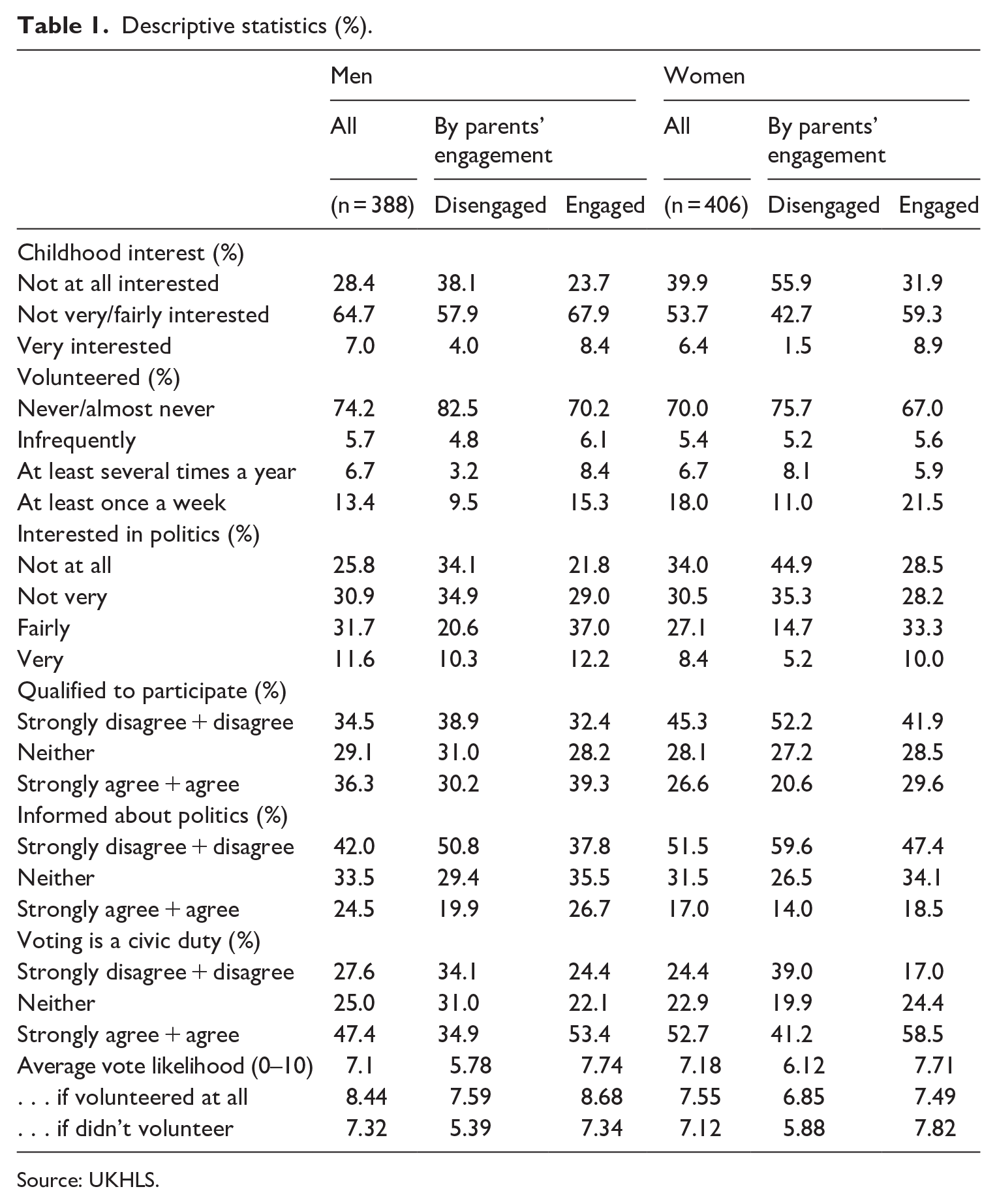
Source: UKHLS.
Structural equation models
The results of the SEMs are summarised in the figures below, with full tabular output in Supplemental Appendix C. The figures report coefficients for each relationship in the model, which can be interpreted as OLS regression coefficients. Figures 2 and 3 report the results for all men and women, and confirm that there are indeed differences in the volunteer effect consistent with the expectation of H1: volunteering had a stronger effect on the vote likelihood of young men than young women, driven primarily by volunteering having a greater positive effect on men’s political interest. Figure 2 shows that volunteering increased men’s vote likelihood by raising their interest in politics (0.16***) and belief in voting as a civic duty (0.14***), both of which had positive and significant effects on vote likelihood (1.27*** and 1.33***, respectively). Volunteering also increased political efficacy (0.17*** and 0.15***) but this was not significantly related to vote likelihood. Figure 3, on the other hand, shows that while the effects of interest, efficacy and duty on vote likelihood were the same for women as for men, volunteering had no significant effect on interest or efficacy for women, and only a negligible effect on civic duty (0.08†). Wald tests confirmed that the differences in volunteer effect between men and women were significant for interest (H1a) (χ2 = 8.16, p-value = 0.004) and efficacy (H1b) (qualified (3.52, 0.001) and informed (4.98, 0.026)), while that for duty (H1c) (0.56, 0.456) was not. Calculating the total effect of volunteering on vote likelihood shows that a one-unit increase in the frequency of volunteering raised the average vote likelihood score for men by 0.39 points (p = 0.000; 95% confidence interval 0.18–0.58), compared with a non-significant 0.12 points for women (p = 0.198, −0.06 to 0.30). 6 Finally, another (unreported but available on request) model was run in which a direct effect from volunteering to vote likelihood was added for men and women, testing the possibility that there was a volunteer effect on turnout not captured by its effect on political interest or civic duty. This was, however, negligible and non-significant for both groups.
Figures 4–7 divide the samples of men and women by their parents’ political engagement: Figures 4 and 5 show the effects of volunteering for men and women raised by disengaged parents, while Figures 6 and 7 show the effects for those raised in engaged households. Figure 4 shows that volunteering had a positive, significant effect on political interest (0.31***) and civic duty (0.29**) for men from disengaged households, both of which were greater in magnitude than the effects reported in Figure 2. There were also small, positive but non-significant effects on efficacy. Figure 5 shows, however, that there were no such effects for women from disengaged backgrounds: volunteering had small, non-significant effects on interest (0.05), efficacy (0.08 and 0.11), and duty (0.16). For men with politically engaged parents (Figure 6), the SEM reported significant but very small effects from volunteering on political interest (0.10*), qualified (0.17**), and informed (0.16**), but a non-significant, negligible effect for civic duty. For women with engaged parents (Figure 7), all the effects from volunteering were tiny and non-significant.
Wald tests confirmed that the effect of volunteering on political interest for men from disengaged households was significantly greater (χ2 = 5.78, p = 0.002) than that for women from disengaged households and men from engaged households (χ2 = 4.94, p = 0.026). The effect of volunteering on civic duty for men from disengaged household was also significantly greater (at 90% confidence) than that for men from engaged households (χ2 = 3.04, p = 0.0812). This difference is even more important because the Wald tests also confirmed that the effect of civic duty on vote likelihood was significantly greater for men from disengaged households (χ2 = 10.057, p = 0.002). In other words, seeing voting a civic duty had a stronger effect on the turnout of men from disengaged households, and volunteering can reduce the gap between them and their counterparts from engaged households because it gives a greater boost to their likelihood of viewing voting as a duty. Comparing men and women from disengaged households, the Wald tests showed that, while the effect of volunteering on civic duty was greater for men, this difference was not significant (χ2 = 0.70, p = 0.403); the same was also true for both efficacy measures (χ2 = 0.25, p = 0.614 for qualified; χ2 = 0.02, p = 0.896 for informed). The difference for political interest (χ2 = 5.78, p = 0.016), however, was significant, confirming that youth volunteering increases the likelihood of first-time voting for young men from politically disengaged backgrounds in a way that it does not for young women: by raising their interest in politics.
Comparing women from engaged and disengaged households, while the coefficients hinted at marginally stronger effects (particularly for civic duty) for the latter, the Wald tests found that none of the differences were statistically significant. Regardless of their parents’ engagement, therefore, there is no evidence that youth volunteering had a positive effect on the political engagement or vote likelihood of young women. The Wald tests also confirmed that despite the effect of volunteering being smaller for men from engaged than disengaged households, it was still greater than that of women from engaged households for all coefficients except civic duty (χ2 = 0.20, p = 0.666), including interest (χ2 = 3.98, p = 0.046), qualified (χ2 = 3.55, p = 0.060), and informed (χ2 = 6.41, p = 0.011). While small, therefore, this shows that youth volunteering among those from politically engaged households provides a (small) benefit for men that is not found for women. This means that H2 is only partially supported, therefore, because H3 is supported: the compensation effect – in which volunteering has a greater effect on those from depoliticised backgrounds – is only apparent for young men. The consequences of gendered socialisation are greater than the effects of family home politicisation, to the extent that even for women from depoliticised backgrounds, there is no significant benefit to be had for their turnout from volunteering.
The total effect of volunteering
To identify and contextualise the full effect of volunteering on first-time voter turnout, Table 2 shows the total effects of volunteering on vote likelihood for the four groups in the unit of the 0–10 vote likelihood variable (along with standard errors and confidence intervals). On average, a one unit-increase in volunteering increased the self-reported vote likelihood of men from disengaged households by 0.91 points, and of men from engaged households by 0.21 points. Both coefficients were statistically significant and the difference between them was also significant at 95 per confidence. The benefit of volunteering for men from disengaged households is, therefore, several times that of their counterparts from engaged households. That said, the average vote likelihood scores provided in Table 1 (5.8 for men from disengaged households and 7.7 for those from engaged households) show that even with the volunteer benefit added (increasing the scored to 6.7 and 8.0, respectively) there remains a considerable difference between the two, and the score for men from disengaged households is still low. Table 2 shows the total effect for women from disengaged households was greater than for men from engaged households, at 0.30, but the coefficient was not significant, nor was it significantly different from the negligible (0.03) non-significant effect for women from engaged households. In addition to reducing the difference in vote likelihood between young men from engaged and disengaged households, respectively, volunteering widens the gender divide in vote likelihood between young men and women from disengaged households. Young women reported a higher vote likelihood overall (see Table 1): 7.8 for those from engaged households and 5.9 for those from disengaged households. Volunteering effectively removes the gap between those from engaged households, but young men from disengaged households who volunteer become markedly more likely to vote (by almost a point) than young women from such backgrounds.
Total effect of volunteering on vote likelihood by gender and parents’ political engagement.
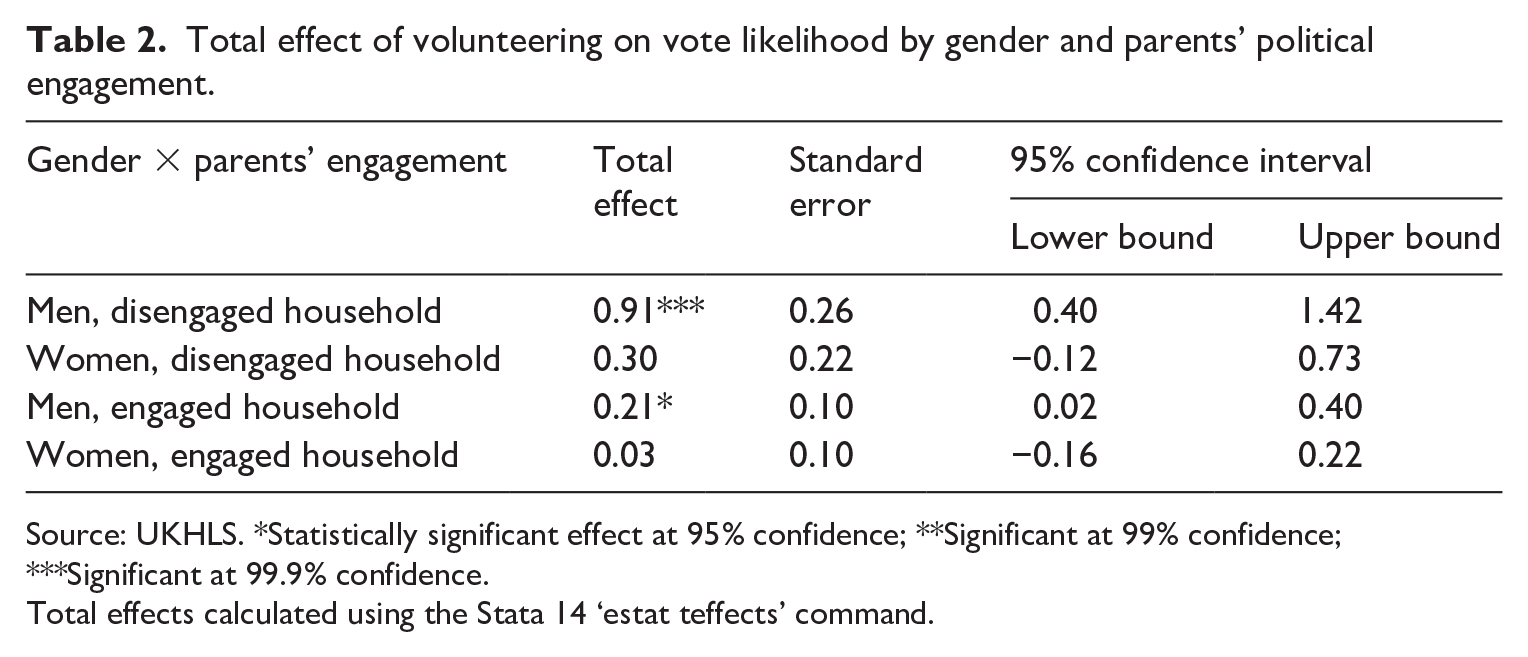
Source: UKHLS. *Statistically significant effect at 95% confidence; **Significant at 99% confidence; ***Significant at 99.9% confidence.
Total effects calculated using the Stata 14 ‘estat teffects’ command.
Conclusion
Growing interest in the potential for volunteering to help address low youth turnout has led to renewed efforts to overcome the challenges associated with identifying the benefits of volunteering for political participation – particularly those stemming from selection and confounding effects associated with political socialisation and childhood politicisation. Using panel data and accounting for the effect of childhood and parental political interest on both volunteering and adult political engagement, this study has examined the effect of childhood volunteering on the likelihood of newly eligible voters participating in their first general election in the UK. Considering recent research showing the effects of youth volunteering on adult voter turnout are conditional on factors structuring political socialisation, such as parental political engagement, this study has also considered the potential for that effect to be shaped by both parents’ political engagement and the structuring effect of gender on political socialisation, overcoming some of the methodological limitations that have hindered the capacity of previous research to do so.
The analyses showed that the effects of volunteering are strongly conditioned by gender – to an even greater extent than by volunteers’ parents’ political engagement. Volunteering was shown to have, on average, a positive effect on the first-time vote likelihood of young men – because it increased their interest in politics and belief that voting is a civic duty – but no such effect for young women. It was expected that volunteering would have a greater effect on the vote likelihood of first-time voters from politically disengaged households – echoing the compensation effect identified in previous research. While such a compensation effect was found, it was only apparent for young men: young men from depoliticised households became significantly more likely to vote if they volunteered in childhood, but there was no significant benefit to the vote likelihood of young women from similar backgrounds. While this study supports the view that youth volunteering can help to increase youth voter turnout and reduce socio-economic inequalities in the young people who do vote, therefore, it also shows that this comes at the cost of widening the gender divide in turnout among young people from depoliticised, poorer households.
The evidence of a gendered relationship between volunteering and turnout is an important contribution to understandings of both the political effects of volunteering and the way gendered socialisation affects relationships between different forms of civic and political behaviour. A major limitation of this research is, of course, its inability to offer an empirically supported explanation for this gender difference. This is, unfortunately, beyond the capacities of currently available data. The literature review identified a possible explanation for this effect: that young men and women are socialised into engaging in different types of volunteering, the benefits of which are more productive of resources that facilitate electoral participation for young men than young women. Testing such a theory, however, would require data on the volunteering patterns of young men and women that differentiated between types of volunteering (e.g. by measuring the nature of organisations volunteered for). While such data is routinely collected in surveys of volunteering, it is not available in UKHLS or any other panel study that contains the data necessary to validly estimate the effect of childhood volunteering on adult political participation, that is, measures of childhood volunteering and adult voting; measures of childhood political interest prior to volunteering; and measures of parents’ political engagement and/or socio-economic status. Without such data, it is not possible to adequately control for selection effects arising from being politically engaged in early childhood or from being raised by politically engaged and active parents, leading to biased estimates of the effects of volunteering (Fox, 2024; Kim and Morgul, 2017; Van Ingen and Kalmijn, 2010). With existing data resources, it is not possible to test the hypothesis, therefore, that the gendered effect of volunteering identified in this research reflects gender differences in the nature of youth volunteering (nor, indeed, any other potential explanation). A clear direction for further research is to overcome this obstacle and provide the means of testing explanatory hypotheses for the gender divide.
The findings of this research also highlight three additional avenues of further study. The first is to investigate the way other social institutions structuring political socialisation may also affect the relationship between volunteering and political participation. Gender and family politicisation are two prominent examples of such institutions, but so too are ethnicity and religion, both of which have considerable effects on political and civic behaviour and for which divides – in turnout, for example, as well as political interest, conceptions of citizenship and political ideology – have been identified and linked to differences in political socialisation (Begum, 2023; Martin et al., 2019; Tilley, 2014). Just as important is the potential for these institutions to interact with gender, with studies on the intersectionality between ethnicity and gender increasingly identifying substantial distinctions between, for example, the conceptions of ‘politics’ of black and white women (Cole and Stewart, 1996) and preferences for different forms of political participation between women from different ethnic communities (Brown, 2014).
Second is consideration of how gender and volunteering interact to affect non-electoral forms of political participation. Activities associated with cause-oriented politics, such as protesting, petitioning, or boycotting, have become more important in the participatory repertoires of democratic citizens in recent decades, providing a means of expressing political agendas and influencing political elites beyond the constraints of the electoral cycle (Dalton, 2022). Yet such activity is even more heavily structured by socio-economic status than voting, leaving young people from poorer backgrounds even less likely than their wealthier counterparts to take part in protests, sign petitions or engage in political consumerism (Grasso and Giugni, 2022; Yurttaguler and Pultar, 2023). Assessing whether volunteering encourages non-electoral political participation (another analysis beyond the capacity of UKHLS) would further elaborate on the potential for volunteering reduce inequalities in democratic participation. Moreover, that the gender divide for cause-oriented activity is different from that traditionally associated with voting (see above) means the interaction between gendered socialisation and volunteering may produce different effects for boys and girls in this area. Such research is needed to determine, therefore, the extent to which the findings of this study generalise to non-electoral forms of political activity or are limited to the electoral arena.
Finally, the wider implications of this research should also be considered for other measures argued to increase the electoral turnout of under-represented groups, such as all-women shortlists, quotas, political education, or reductions in the voting age. The effectiveness of such measures is to some extent dependent on their capacity to overcome structural obstacles to participation that often have their roots in primary political socialisation. This research has shown that while youth volunteering can reduce inequalities in political participation reflecting politicisation of the family home (strongly correlated with socio-economic status), this is only true for men; it does not overcome the differences in political participation and engagement between young men and women rooted in their respective socialising experiences and influences. This research imposes on advocates of volunteering a responsibility to find out how the gender gap in its effectiveness can be reduced. Advocates of other measures to address inequalities in electoral participation must establish the extent to which those approaches are also capable of overcoming deep-rooted structural obstacles to participation among under-represented groups if there is to be any confidence in their effectiveness and equity.
Supplemental Material
sj-docx-1-pol-10.1177_02633957251344575 – Supplemental material for The role of gender in shaping the effect of volunteering on first-time voter turnout
Supplemental material, sj-docx-1-pol-10.1177_02633957251344575 for The role of gender in shaping the effect of volunteering on first-time voter turnout by Stuart Fox in Politics
Footnotes
Acknowledgements
The author would like to thank Dr Ekaterina Kolpinskaya, Dr Martin Hansen, Dr Orly Siow, and members of the audience at the 2022 Annual Conference of the Elections, Public Opinion and Parties specialist group for their invaluable feedback and advice on this research. The author would also like to thank the editor and anonymous reviewers for their feedback and helpful suggestions for improving the article. All errors are the responsibility of the author alone.
Data availability
All data files associated with this study are available from the author on request.
Funding
The author(s) disclosed receipt of the following financial support for the research, authorship, and/or publication of this article: This research was supported by funding from the Understanding Society Policy Fellowship Scheme (grant number: RCS2772).

Supplementary Information
Additional supplementary information may be found with the online version of this article.
Notes
Author biography
References
Supplementary Material
Please find the following supplemental material available below.
For Open Access articles published under a Creative Commons License, all supplemental material carries the same license as the article it is associated with.
For non-Open Access articles published, all supplemental material carries a non-exclusive license, and permission requests for re-use of supplemental material or any part of supplemental material shall be sent directly to the copyright owner as specified in the copyright notice associated with the article.
