



Abstract
This paper contributes to the literature by examining gender inequalities in political participation and political engagement among young people from a comparative perspective. By analysing data on young people from nine European countries collected in 2018, we examine gender inequalities in participation in various modes of conventional and unconventional activism as well as related attitudes, broader political engagement and key determinants, cross-nationally, in order to provide a detailed picture of the current state of gender inequalities in political activism among young people in Europe. Our results allow us to speak to extant theorising about gender inequalities by showing that the extent of political inequality between young men and women is less marked than one might expect. While the gender gaps in political participation for activities such as confrontational types of protest are small or absent, we find that young women are actually more active in petitioning, boycotting, and volunteering in the community. Young men instead are more active than young women in a majority of the nine countries analysed with respect to more institutional forms of participation linked to organizations and parties, various types of online political participation, and broader political engagement measures, such as internal political efficacy and consumption of political news through various channels. However, young men also appear to be more sceptical at least of certain aspects of democratic practice relative to young women.
Introduction
Political participation is fundamental for democratic government since it allows the people to have a say in how society is run (Bessant and Grasso, 2019). However, research has documented important inequalities in political engagement within populations (Giugni and Grasso, 2021). In particular, studies have examined gender inequalities, finding mixed evidence. Today, across the globe, we have made strides towards gender equality and as such one might expect to find smaller political inequalities between women and men, particularly among the youngest generations. Is this the case? Is there a significant difference in the level and types of political participation between young men and women? To analyse these questions, we look at recent evidence from an original survey conducted in 2018 across nine European countries and focus on young people, that is, those aged 18–34 when the data were collected: born between 1984 and 2000, so, Millennials or Gen Y-ers. This focus on young people from a comparative perspective is key for contributing to the extant literature in novel ways as it allows us to focus in on contemporary levels of gender inequalities which would have been impacted on by recent patterns of socialisation, i.e. of the last 20 years or so (Grasso and Giugni, 2021). Moreover, while previous studies have revealed important findings in relation to gender inequalities in political participation, we are interested in extending the analysis of gender inequalities across a wider variety of political participation indicators, as well as among indicators linked to broader political engagement. Importantly, we develop on previous work through the analysis of recent cross-national data on young people’s political participation and their broader political engagement across nine European countries.
As have others (e.g. Coffé and Boldenzahl, 2010), we also aim to develop on previous research by analysing not only inequalities in institutional forms of participation linked to the workings of the democratic government (Janoski, 1998). While these modes are important, they provide only a limited picture and it has become increasingly essential to analyse inequalities by gender in modes of action linked also to ‘citizen-initiated and policy-oriented’ or ‘activist’ types. Indeed, as Coffé and Boldenzahl (2010) note, we have now adopted broader approaches to the analysis of political participation in the literature (Dalton, 2006, 2008; Giugni and Grasso, 2017; Norris, 2002; Wattenberg, 2002). It is therefore important to look at inequalities according to different types of actions and related attitudes since different types of resources are required for different types of actions and people make sense of them differently (Coffé and Boldenzahl, 2010; Dalton, 2006; Pattie et al., 2003). As such, only looking at one type of political repertoire could potentially underestimate or overestimate the picture of gender inequalities, and thus not provide an accurate reflection of the actual gender gap situation. Indeed, women have been found to be active in more informal efforts and organizations (Bourque and Grossholtz, 1998; Coffé and Boldenzahl, 2010; Sarvasy and Siim, 1994; Siim, 2000; Stover and Cable, 2017) and as such, it remains important to analyse other modes of political action and related attitudes side by side to come to a deeper understanding of where gender inequalities might lie. In addition, analysing patterns across nine European countries allows us to see to what extent findings can be generalised across contexts, forms and related participatory attitudes. As Pfanzelt and Spies (2018) note in their study on Germany, ‘studying youth engagement is highly informative because participation at early age paves the way for future engagement’. We extend the focus by analysing data on young people from nine European countries examining a wide variety of indicators of political participation and also broader political engagement in order to move forward research in this area.
Previous research
Gender inequalities in political participation and political engagement
Just as there is much scholarship which addresses participatory inequalities between younger and older age groups mainly relating to rates of participation and shifts towards alternative repertoires (Dalton, 2008; Giugni and Grasso, 2020; Grasso and Bessant, 2018; Pickard, 2019; Sloam, 2014), there is an extensive literature which likewise, addresses participatory inequalities including according to gender. With respect to previous evidence, one of the key seminal studies, Schlozman et al. (1994) examined gender inequalities in participation and particularly their existence with respect to different types of civic activity in the United States. They noted how the gender gap was seen to emerge from a ‘distinctive processes of social learning and adult roles that centered women in the private domain of the home’ (Schlozman et al., 1994: 963). However, they noted that this ignored gender inequalities in political resources to facilitate participation, and that when also considering informal, unconventional, and more local forms of participation, that findings would be likely to differ, noting also calls for a broader notion of politics ‘to include all collective involvements that influence the life of the community, even those charitable and organizational activities’ (Schlozman et al., 1994: 964).
Schlozman et al. (1995: 268) addressed these questions by examining the idea that women are more likely than men to anchor their participation in concern for the good of the community; to be active on behalf of issues involving children and families, human welfare, broadly shared interests such as consumer or environmental concerns, and international peace
... while noting that by looking only at formal repertoires that political scientists are not considering repertoires of participation that are also fundamental for the study of gendered political participation. Verba and Nie (1972: 181) found that ‘compared to men, women are slightly less likely to be affiliated with an organization’ and yet – more recently, women’s organizations have contributed to promoting dialogue around the world (Hughes et al., 2018). Verba et al. (1978b: 235) noted that while they ‘had expected to find a different sex-related participatory pattern for campaign and communal activity’, they found no differences. Schlozman et al. (1994) argued that other than in voting (see also Carreras, 2018; Rai, 2017), women are generally less active than men (for more recent studies, see Carreras, 2018; Espinal and Zhao, 2015; Kittilson and Schwindt-Bayer, 2012; Liu, 2020; Nir and McClurg, 2015).
Burns et al. (1997) tackled the question of the impact of gender inequalities in the household on gender inequalities in political participation and in this context noted that the size of the gender gap, however, does not vary systematically with the difficulty of the act, nor do active women specialize-as feminist theory would predict them to do-in voluntary organizational, nonelectoral, or informal community activity. Interestingly, the greatest gender disparity appears in connection with making financial contributions to electoral campaigns or other political causes. Compared with women, men not only are more likely to give money but also write larger checks when they contribute.
Studies have shown that women are more likely than men to engage in consumer politics (Acik, 2013) and to sign petitions or raise money for a social or political group, but they remain less likely to join a demonstration (Coffé and Bolzendahl, 2010). Despite well-developed literatures relating to youth inequalities and gender inequalities in political participation, there is a relatively undeveloped scholarship relating to young women and political participation (Taft, 2010). A few studies nevertheless tackle this topic. Hooghe and Stolle’s (2004) study of American 14-year-olds found that girls favoured participation more linked to social movements whereas boys preferred more radical and confrontational forms. Campbell and Wolbrecht’s (2006) study analysed the effect of female political role models upon young women’s likelihood of participation in the US. Furthermore, qualitative studies such as Gordon (2008)’s based on ethnographic research with two high school student movement organizations on the US West Coast, find that young women experience greater opposition from family to their participation, especially if there is a perceived risk.
While scholarship has noted the importance of online activism to young people (Ekstrom and Sveningsson, 2019), Bode (2017) notes how women are more likely to go online for social interaction while men are more likely to seek information, for example, by reading the news. Duggan (2013) notes however that women are more likely to use Facebook and Instagram. Moreover, previous works arguing that, in general, women and girls are socialised to be ‘nice’ (Babcock et al., 2003), polite (Smith-Hefner, 1988), and to try not to hurt the feelings of others (Fuchs and Thelen, 1988; Garner and Power, 1996) suggest they might avoid activities such as posting about politics (Bode, 2017) which have the potential to be divisive. While some worry about online ‘slacktivism’ (Morozov, 2011) evidence suggests it rather complements offline actions (Xenos et al., 2014).
As such, while there is some evidence that women may be more active than men in less confrontational unconventional activities such as petitioning and political consumerism, it is not simply a matter of women being more active in unconventional versus conventional activities, but rather there seems to be a distinction in terms women’s greater proclivity towards participation between different types of more or less confrontational unconventional or protest activities. Briggs’ (2008) study which analyses interviews with young women regarding their interest in politics and in political issues, further reminds us that the principle of adopting a wide definition of political participation which includes for example action in the community is equally as pertinent to the study of young people’s gendered political participation. As such, based on all this evidence, we expect that:
H1. Young women will be more active in consumer politics, petition signing, and community participation than young men.
H2. Young men will be more active than young women in more confrontational types of participation such as demonstrating, striking, or occupying and more conventional, traditional or institutional participation related to political organizations and parties such as attending meetings or contacting a politician, donating money, wearing a campaign badge, and also in online political participation.
Verba et al. (1997) noted how studies had shown higher rates of political knowledge and political efficacy among men. These gender differences have often been understood as ‘the manifestation in politics of a more general set of predispositions that differentiate women and men, in particular, men’s greater aggressiveness and taste for conflict’ (Verba et al., 1997: 1052). Verba et al. (1997) explain the difference between men and women in political interest, information, and efficacy in terms of the extent to which it can be accounted for by differences in other social characteristics associated with gender, interpreted as particular manifestations of more general differences between women and men or explained by the fact that the political world has traditionally been dominated by men.
Moreover, Pfanzelt and Spies (2018) found evidence in Germany for a lower confidence of women in their personal and political skills (see also Fraile and Gomez, 2017). Some scholars in turn have noted how inequalities in political interest might be due to gendered inequalities in confidence influencing responses to surveys rather than reflecting true differentials in interest and related measures themselves (Galligan, 2014). Based on all these strands in the literature, we therefore expect that:
H3. Young men will be more broadly politically engaged such as in terms of media use for political information, feelings of political efficacy, and more positive attitudes to democracy and the democratic process.
Explaining gender inequalities in political participation
Verba et al. (1997) noted how some studies have historically attributed gendered political inequalities to the role of resources (e.g. Baxter and Lansing, 1983), whereas others linked these differentials to gendered roles within society (e.g. Flora and Lynn, 1974). Schlozman et al. (1994) argued that participatory inequalities between men and women can be explained in part by gender inequalities in resources including financial and civic skills (see also Shorrocks and Grasso, 2020). The idea that women would be more likely to eschew confrontation (Gladue, 1991) further relates to the ‘inhibition thesis’, i.e. the idea that women may not act politically due to their socialisation into gender roles (Hooghe and Stolle, 2004; Verba et al., 1978a). As noted, two key aspects are stressed in the literature and seen as potentially leading to gender differences in participation: socialisation – the fact that young girls and boys might be raised in different ways which affect their political engagement – and resources – the differences in those attributes which can be seen to support participation. While a number of factors can be understood to link to the gender gap in political participation (Burns et al., 2001: 358–359), resources such as income, education, time, and civic skills are widely understood as important (see also Shorrocks and Grasso, 2020). Historically, the fact that women have tended to look after children has meant they have had less time or resources to engage politically in more formal terms particularly (Okin, 1989; Phillips, 1991; Taylor, 2016). Moreover, also opportunities through institutions can be unequal where culture is dominated by men particularly at elite level (Lowndes, 2000; Norris, 1997). In addition, experiences and events such as having children or having one’s own family could be seen as socialising women out of engagement when other pressures on time become preponderant (Andersen, 1975; Burns, 2002: 480; Jennings and Niemi, 1981). The fundamental issue here is that being less participatory generally translates into lower representation and therefore into greater political inequalities where the interests of women are reflected even less in the sphere of political decision-making thus causing a pernicious spiral of reduced visibility and political voice. This is even more of a concern if this is down to lower resources and a subjugated status to start with, therefore suggesting that women are more likely to not have the means to participate and to make their voices heard. Social processes such as those linked to gender inequalities thus are an important concern for the health of democracy in contemporary societies. Indeed, as noted by Burns et al. (1997: 373) ‘the family is society at its most private; the state is society at its most public’ and the two are connected in many ways. In summary, we expect that inequalities in participation by gender should be linked to resources, such as, importantly, education. Having small children to take care of is further an important element to consider with respect to political activity and time left available for this, while on the other hand, conceivably becoming a mother might also stimulate women to engage politically, particularly once children grow older. Gender ideology is also likely to be a relevant factor as are more leftist progressive economic values. Feelings of political efficacy are also likely to be linked to different types of political participation with sourcing of political information, associational membership, and support for democracy and the democratic process. As such, our final hypothesis is that:
H4. The differences in political engagement between young men and women will be explained through differences in resources (education and time, the presence of young children in the home), gender ideology, more leftist economic values, political efficacy, consumption of political information/news, associational membership, and support for democracy and the democratic process.
Data and methods
The data employed for the analysis in this article was collected in the context of the Horizon 2020 collaborative project “Reinventing Democracy in Europe: Youth Doing Politics in Times of Increasing Inequalities” (EURYKA) funded by the European Commission (grant agreement no. 727025) in 2018 across nine European countries on young people aged 18–34. (The Swiss part of the project was supported by the Swiss State Secretariat for Education, Research and Innovation (SERI) under contract number 16.0103.) Context is kept relatively constant as we focus on nine European democracies with similar cultural and religious traditions, similar advances in women’s rights and similar democratic arrangements. The large samples of data collected using quotas (age, gender, region and education level) reflecting national population statistics for youth allow us to conduct detailed intra-group analyses exploring inequalities in participation. Another innovation of the study is that we include a large array of political activities and wider political engagement indicators in our analyses. Thanks to our innovative dataset, we are able to analyse differences amongst young men and women cross-nationally for a larger range of political actions than previously employed. Findings in previous literature suggest that it is important to study differences in political engagement not just between older and younger people but also between young women and men. To date, however, we have lacked the data to examine in detail inequalities within groups of young people across different types and modes of political participation cross-nationally and as such this is an important contribution to the literature of the current investigation.
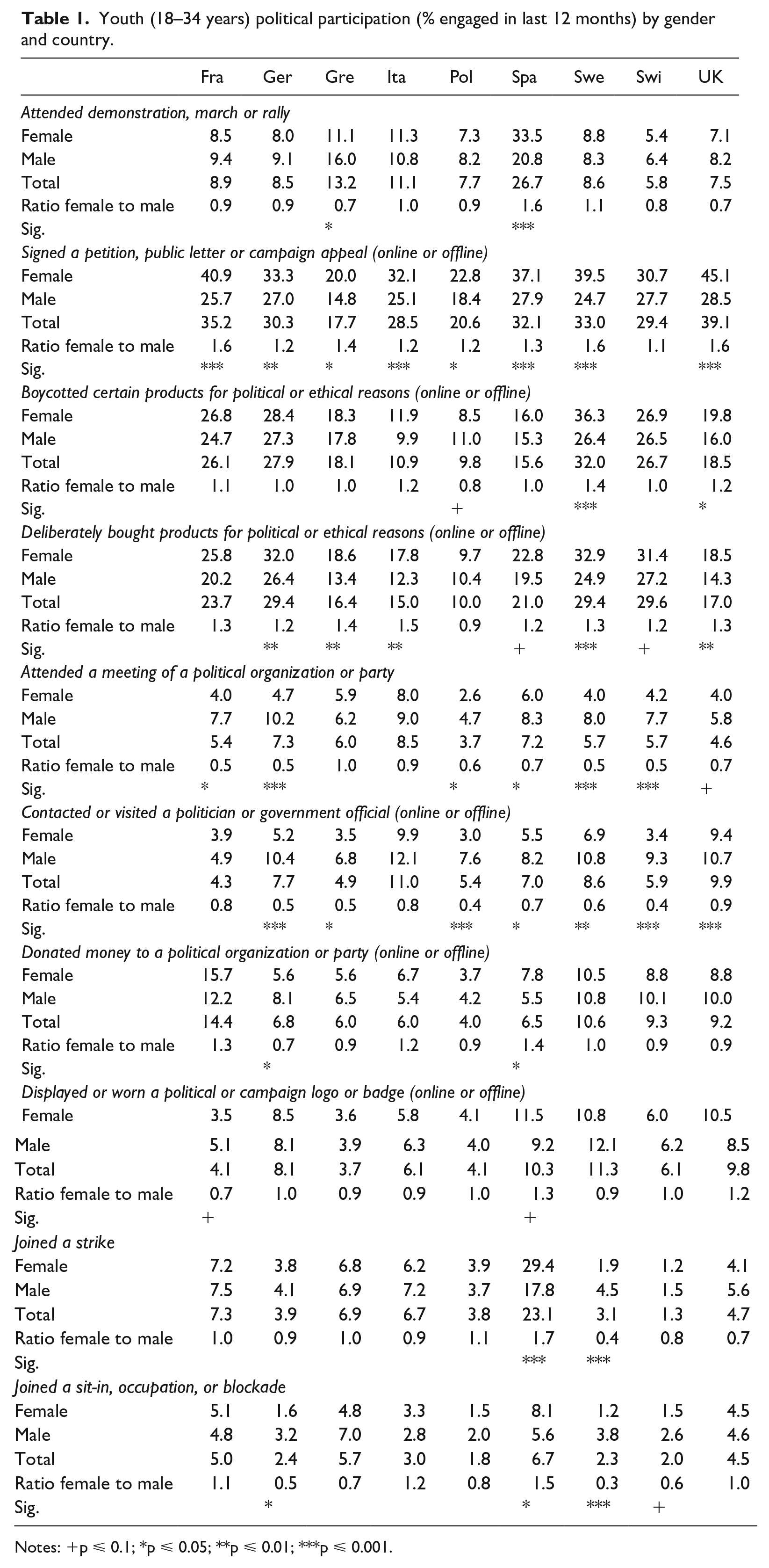
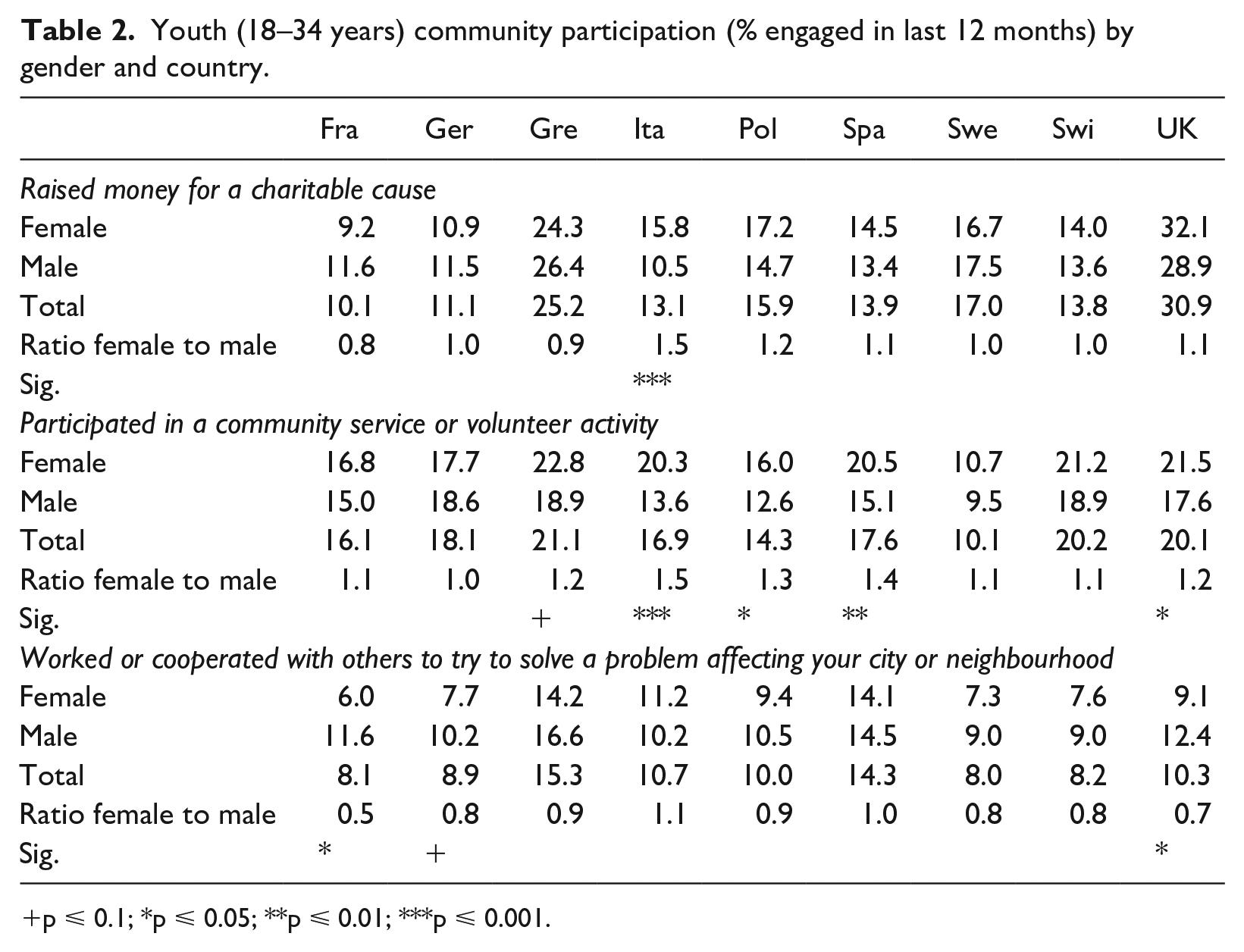
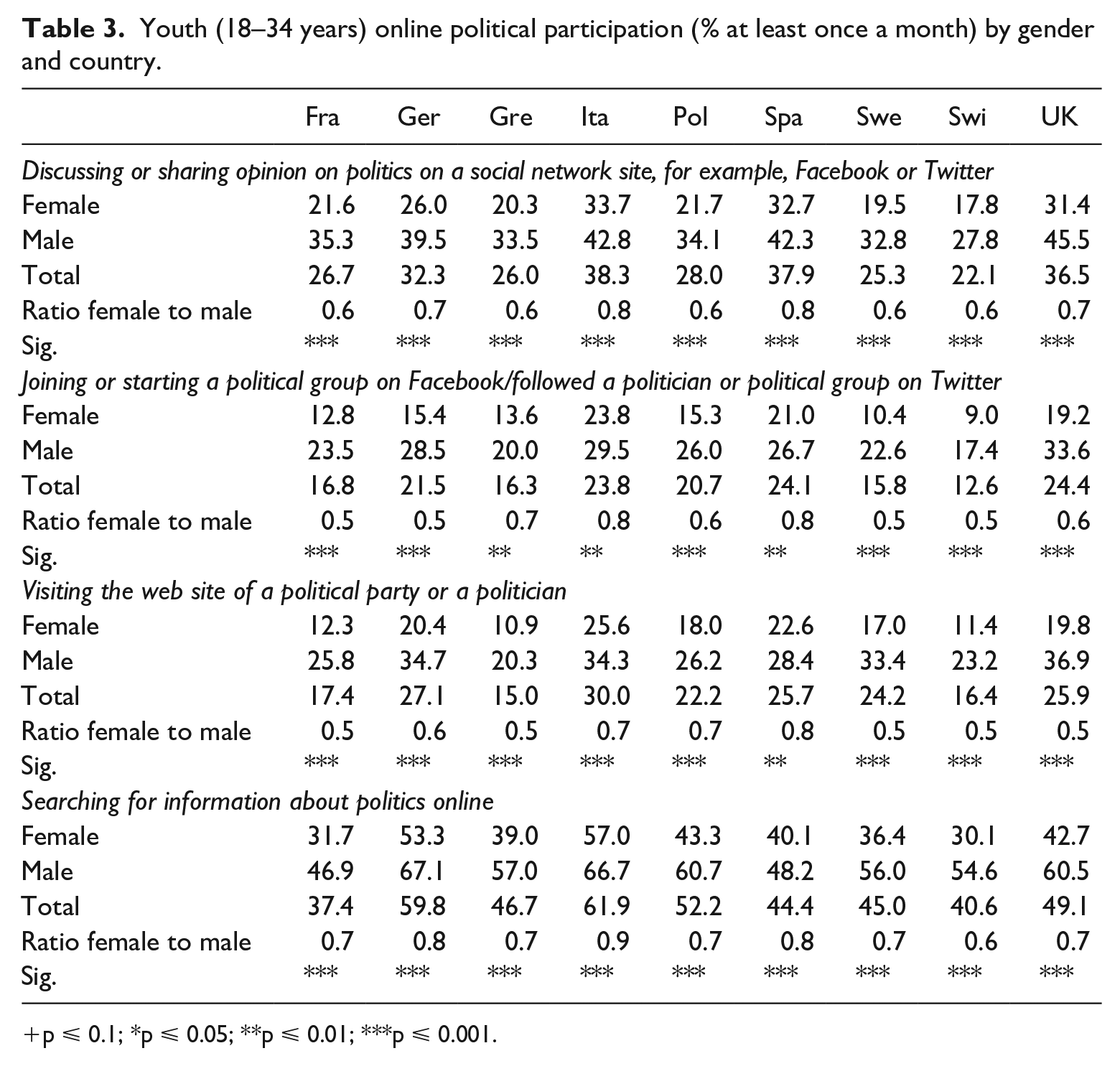
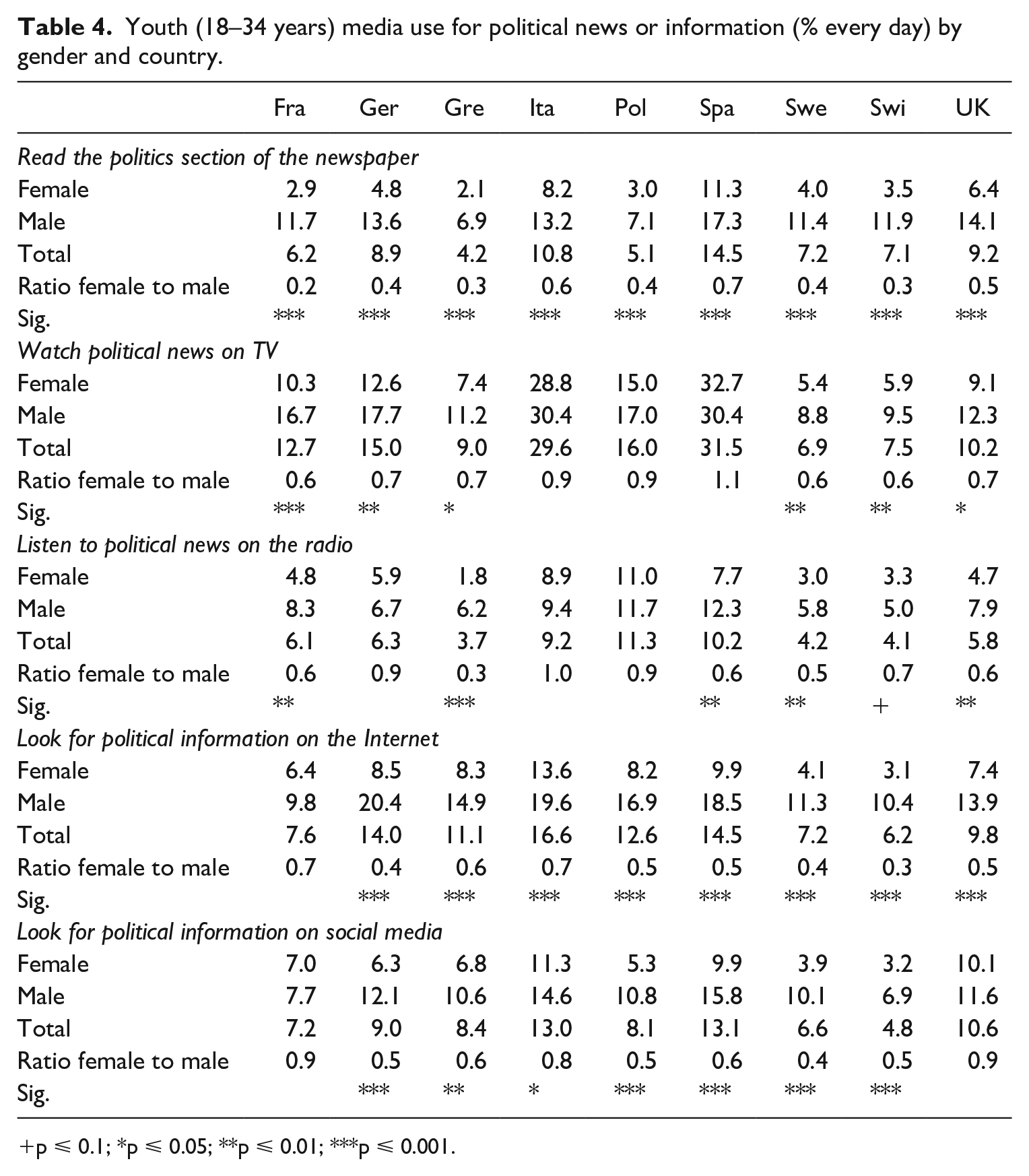
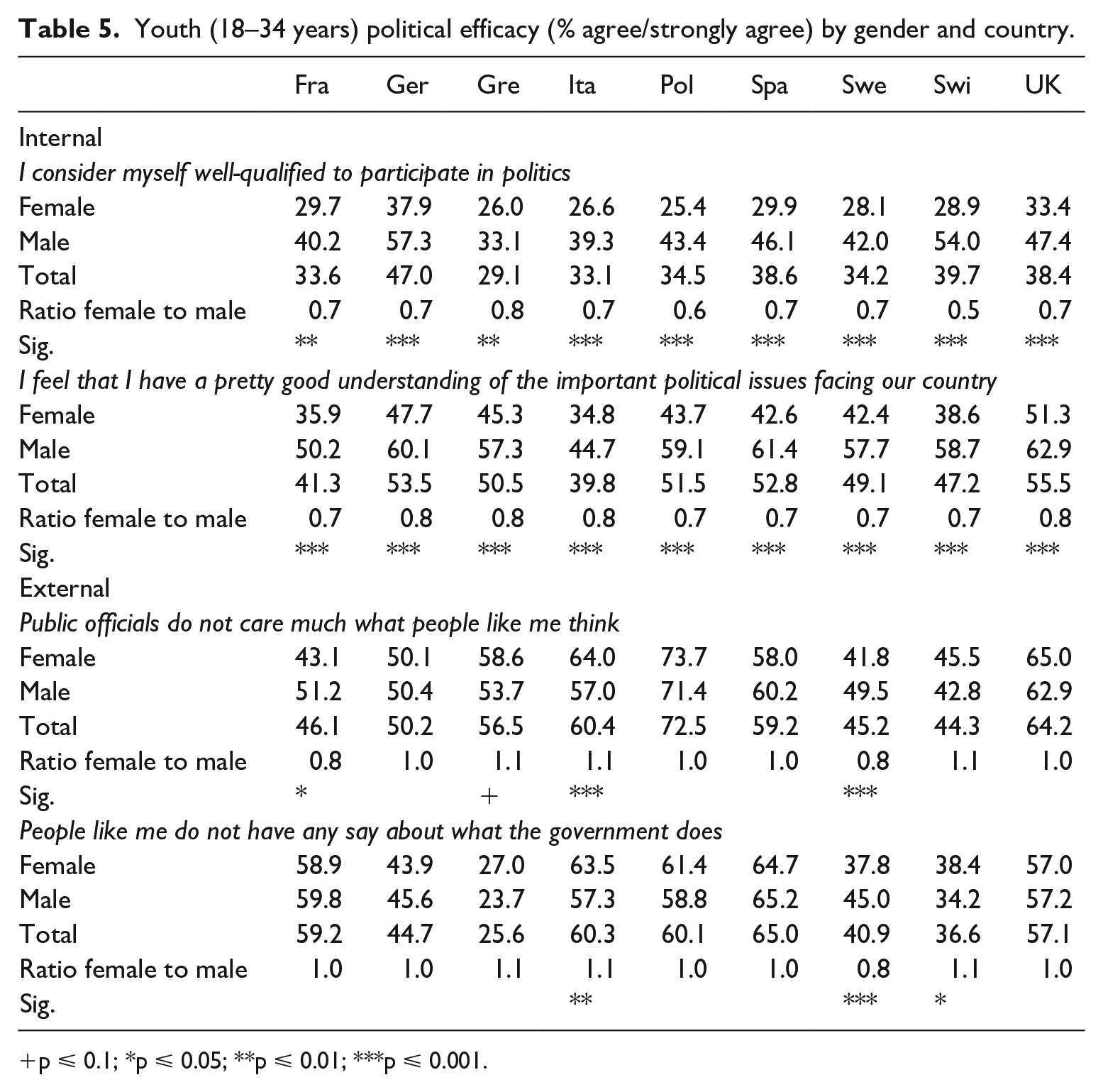
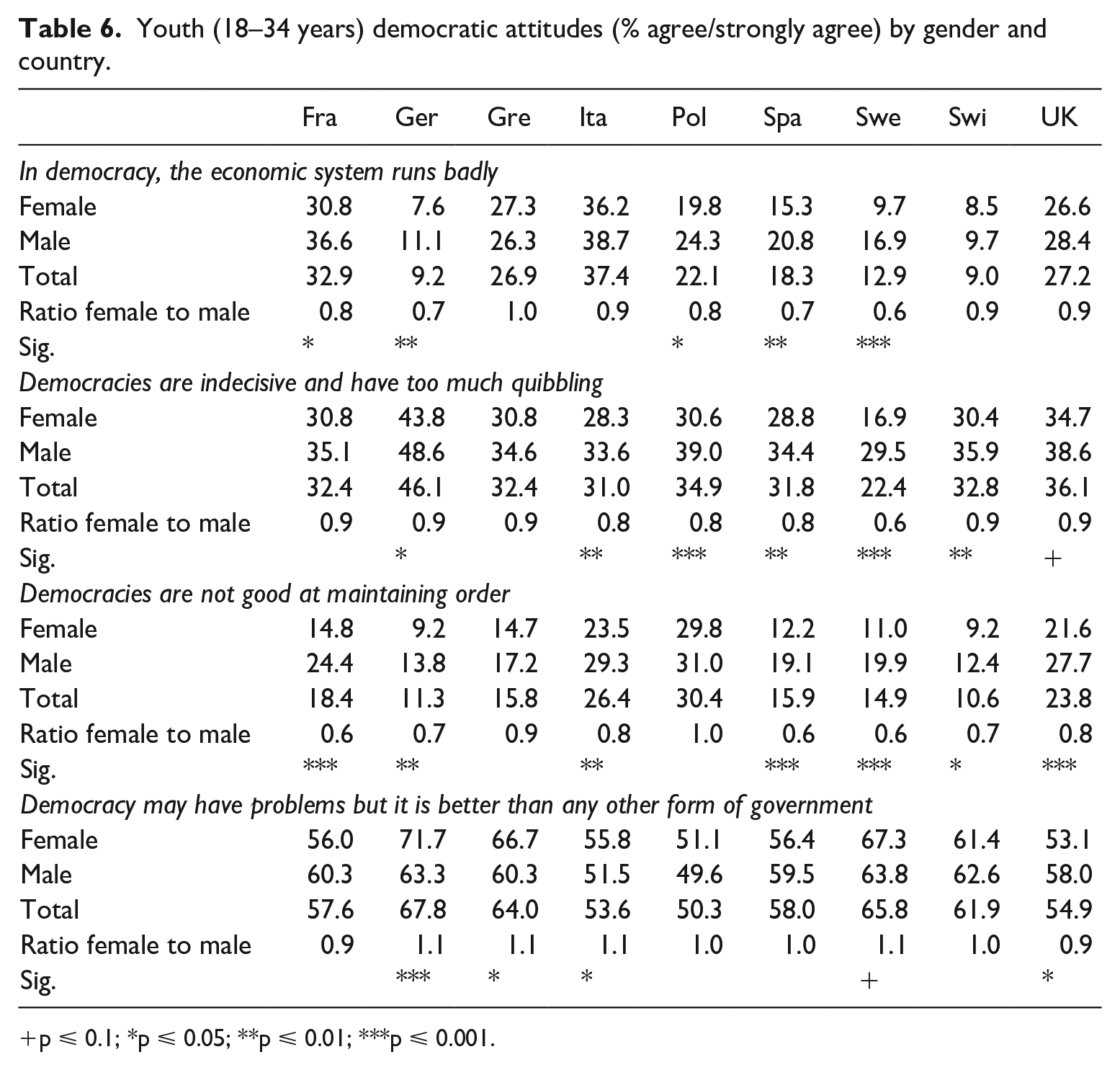
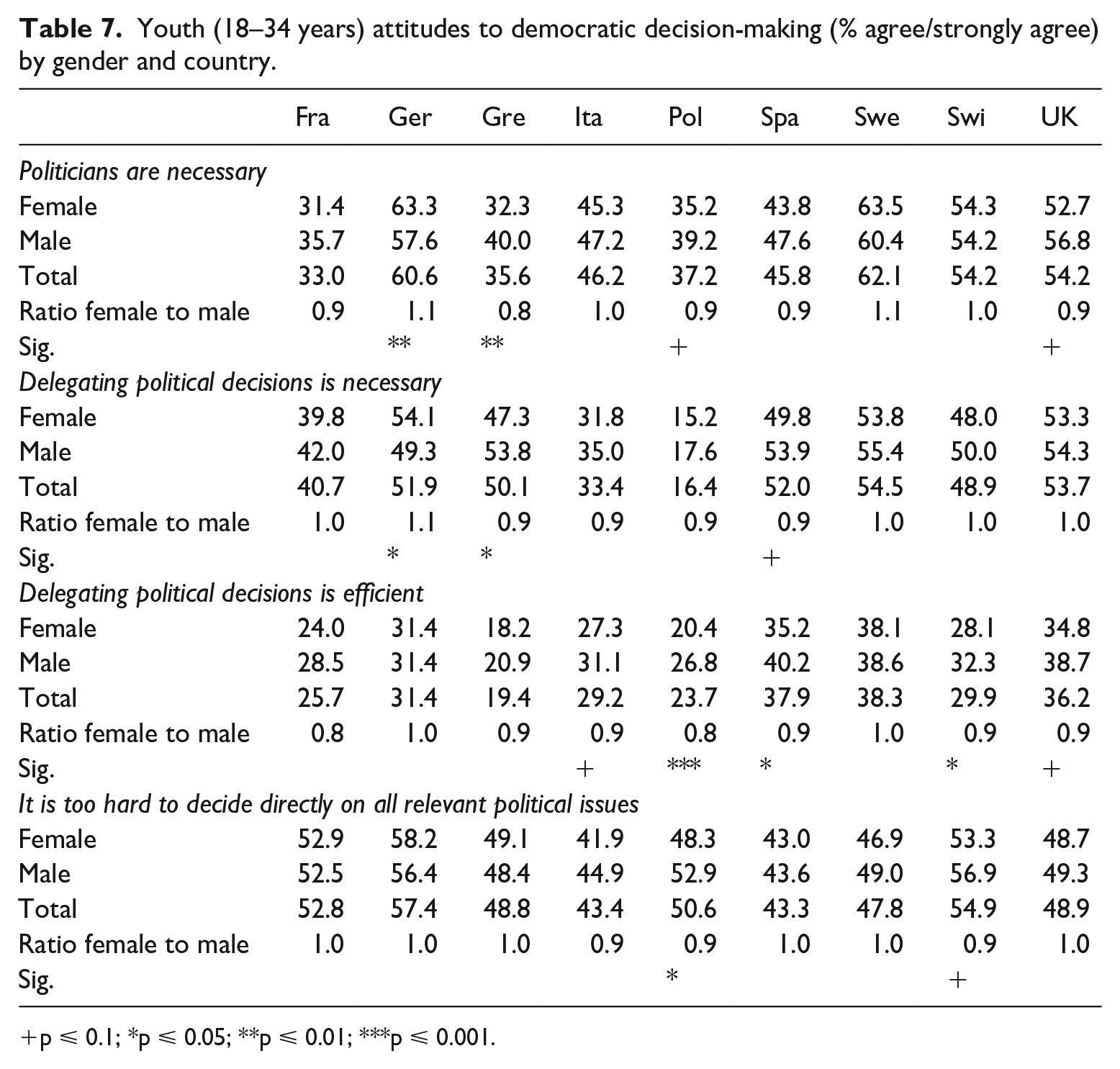
In terms of the measurement of the various variables, to examine intra-generational inequalities, we examine differences by gender between young men and young women. The political activities we look at specifically are listed in Tables 1 to 3. For wider political engagement, we look at political news or information (see Table 4), internal and external political efficacy (see Table 5), democratic attitudes (see Table 6), and attitudes to democratic decision-making (see Table 7).
Youth (18–34 years) political participation (% engaged in last 12 months) by gender and country.
Notes: +p ⩽ 0.1; *p ⩽ 0.05; **p ⩽ 0.01; ***p ⩽ 0.001.
Youth (18–34 years) community participation (% engaged in last 12 months) by gender and country.
p ⩽ 0.1; *p ⩽ 0.05; **p ⩽ 0.01; ***p ⩽ 0.001.
Youth (18–34 years) online political participation (% at least once a month) by gender and country.
p ⩽ 0.1; *p ⩽ 0.05; **p ⩽ 0.01; ***p ⩽ 0.001.
Youth (18–34 years) media use for political news or information (% every day) by gender and country.
p ⩽ 0.1; *p ⩽ 0.05; **p ⩽ 0.01; ***p ⩽ 0.001.
Youth (18–34 years) political efficacy (% agree/strongly agree) by gender and country.
p ⩽ 0.1; *p ⩽ 0.05; **p ⩽ 0.01; ***p ⩽ 0.001.
Youth (18–34 years) democratic attitudes (% agree/strongly agree) by gender and country.
p ⩽ 0.1; *p ⩽ 0.05; **p ⩽ 0.01; ***p ⩽ 0.001.
Youth (18–34 years) attitudes to democratic decision-making (% agree/strongly agree) by gender and country.
p ⩽ 0.1; *p ⩽ 0.05; **p ⩽ 0.01; ***p ⩽ 0.001.
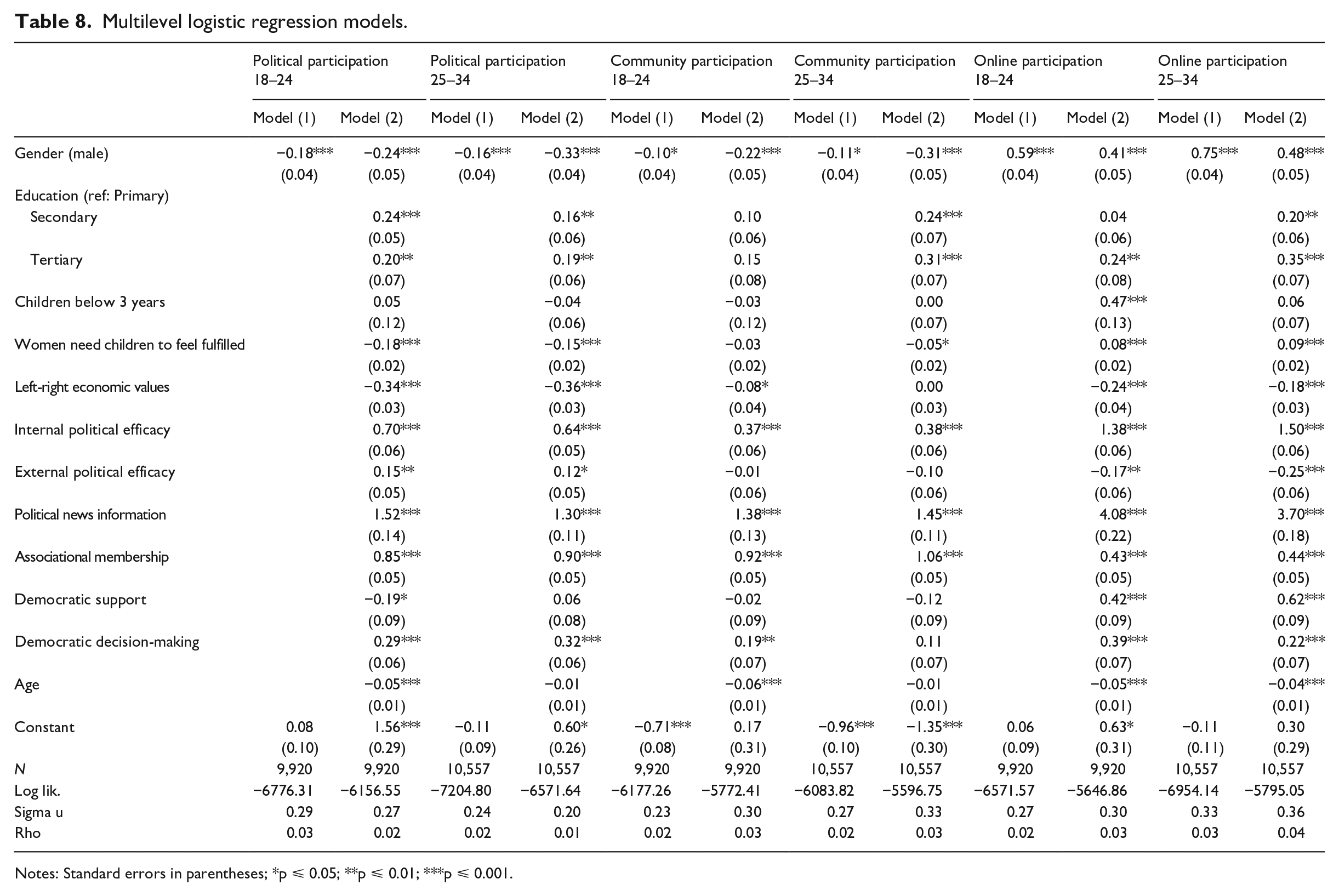
First, in the analysis that follows, we look at cross-tabulating gender and looking at significant differences between young men and women across the nine countries included in our study for each of the selected indicators to test H1-3. Second, we create and run multilevel logistic models for three combined measures of whether someone did at least one type of action in the last 12 months/once a month amongst each of the three domains of political participation, community participation and online participation with gender only in the models 1 and then including the other relevant independent variables to test H4 in the models 2. The multilevel models take into account country differences.
Results
In this section, we turn to examining the evidence in favour or against our hypotheses by looking at the data in our Tables. We first examine Tables 1 to 3 on political participation to analyse H1 and H2. In line with stereotyping which likens women’s behaviour and participation to the ‘idealized vision of a mother’ (Valdini, 2019: 43), ‘maternalist’ thinking has argued that ‘motherly wisdom’ makes women more likely to be addressing certain types of political affairs, for example, those linked to community or child-rearing (Moore, 2018). Moreover, feminists have been important elements of various other movements that have used consumer politics and other protest tactics (Grosse, 2019) and Fisher (2019) reported a majority of organizers and participants of the 2019 climate strike in the United States identified as female. As such, there are reasons to believe that there are specific forms of action – mainly consumer politics, petitioning and community action – that are more likely to attract young women relative to young men (H1), while young men are more likely to be politically active than young women in the rest (H2). The evidence presented in Tables 1 to 3 shows that indeed in a majority of the countries studied young women are more active that young men in petitioning, and also in some types of consumer politics (buycotting), but there is no such supporting evidence for boycotting itself. We can also see support for H1 with respect to community participation in the form of service or volunteer activity, while there is no such evidence for raising money for charity or coming together to solve problems in a majority of the nine countries. As such, there is at least some evidence to support H1 showing young women more likely to participate than men in some of these activities (petitioning, buycotting and participating in community service or voluntary activity) whereas in the others there are no gender differences in a majority of the countries under scrutiny.
With respect to H2, we also find mixed evidence. There are indeed significant differences in political participation between young women and men in a majority of the nine countries analysed here for more institutional forms of participation linked to organizations and parties such as attending their meetings or contacting a politician, and also large ones with respect to all four modes of online participation. However, there is no such evidence for donating money, wearing a badge or the more confrontational forms of protest such as demonstrating, striking, and occupying where significant gender differences were not found in most countries under study. As such, supporting H1, young women were more active than young men in three relatively popular, less confrontational unconventional activities (petitioning, buycotting and community volunteering) and, supporting H2, young men were more active than young women in six more conventional and information gathering types of activities (attending meetings of a political organization, contacting politicians, and the four online participation activities). The remaining eight activities showed no significant gender differences in a majority of the countries analysed indicating that gender differences in participation do not appear as marked among the young generation today as they may have been amongst the general population in the past. We also find at least some support for gendered repertoires of specific types of activities as claimed in the literature and as reflected in the evidence we found supporting H1 and H2 in part.
Next, we turn to examining the evidence for H3 in Tables 4 to 7. We can see that there is initially support with respect to four indicators out of five of media use for political news or information (excluding TV) showing young men report being more politically engaged than young women across a majority of the countries studied. The evidence in Table 5 also shows support for H3 with respect to internal political efficacy and young women less likely to say they see themselves as qualified to participate in politics and to have a good understanding of political issues facing the country than young men. This was not the case for external political efficacy where there were no significant gender differences in most countries. Against H3, however, we can see in Tables 6 and 7 that young men are more likely in most countries to be more critical of democracy than young women (that the economic system runs badly, that democracies are indecisive and have too much quibbling, that they are not good at maintaining order) but they are also more likely than young women in a majority of countries to think that delegating political decisions – and presumably – having representatives is efficient, reflecting perhaps their lower proclivity for more populist stances.
Finally, we turn to the evidence for H4 in the models presented in Table 8, finding mixed evidence. What we find, first, in the models 1 including only gender, is that overall young women are more active than men in political activism and community participation, but they are less active than men in online political participation. Accounting for the various relevant theoretical factors, as shown in the models 2, would further increase the activism gap between women and men for political and community participation and narrow it down that for online participation. Overall, in the models 2 controlling for all the relevant independent variables simultaneously, we find that while education tends to support participation, this is not always the case; having children below 3 years in the household does not appear in and of itself to diminish participation; more traditionalist gender ideology (women need children in order to be fulfilled) appears to have a detrimental effect on political activism but not on online political participation; more leftist economic values appear to generally have a positive effect on participation (higher values for left-right economic values indicate more rightist positions); internal political efficacy as expected has a positive effect whereas external has a negative effect in some cases (value items in the scale are in negative form); the consumption of political news and associational membership all have a positive effect whereas that of democratic attitudes is more mixed. We reflect on some of the implications of these and the other results in the next section.
Multilevel logistic regression models.
Notes: Standard errors in parentheses; *p ⩽ 0.05; **p ⩽ 0.01; ***p ⩽ 0.001.
Conclusion
In his seminal study, on ‘Gender Roles and Inequalities in Political Participation’ Jennings (1983) looked at differences in eight countries, at the salience of politics in the home and at parent–child conversations about a series of topics. A clear sign of the gendered nature of politics was that he found that despite the fact that children were more likely to speak to their mothers in general, fathers tended to be spoken to most about politics; this was seen as ‘an extension and manifestation of the generally greater political role-played by men even at the mass public level’ (Jennings, 1983: 375). In this article, our focus on young people allowed us to look at the current state of gender inequalities in political participation and broader political engagement to provide a detailed picture for understanding contemporary patterns and as such what we might expect in democracies in the future given the more recent processes of socialisation. Overall, we found that gender inequalities in political participation and political engagement among young men and women were not as marked as might have been expected based on previous evidence.
Over the decades since the 1960s to 1970s, the political landscape is understood to have changed a great deal with the demise of mass parties and trade unions and other large collective organizations (Giugni and Grasso, 2019a; Grasso, 2016), opening the way to the rise of new social movements and issue-based politics focusing on new values as opposed to the more traditional left-right conflict focused on economic, redistributive, and traditional emancipatory politics (Dalton and Wattenberg, 2002; Giugni and Grasso, 2019b). Moreover, values along the social axis ranging from libertarianism to authoritarianism or from freedom of choice to traditionalism are understood to have become more prominent for political activism with respect to the traditional unidimensional distinction between economic values of left and right (Grasso and Giugni, 2018; Grasso et al., 2017).
As Furlong and Cartmel (1996) noted, political engagement can be understood in different ways and there are different aspects that can be studied. Some young people may be politically interested but not engage in political actions; others may not vote but engage in demonstrations; still others may engage but remain sceptical about their abilities to achieve change or not express support for emancipatory politics and social change. These are all important factors that deserve further scrutiny in order to better understand inequalities in political action between young men and women. In particular, gender has been traditionally understood to remain an important stratifying force with respect to understanding who engages. Important inequalities in both conventional and unconventional participation have been found in previous studies with respect to younger generations (Grasso, 2013; Grasso et al., 2019). It seems critical, with respect to young people and claims of political apathy and detachment from the political sphere, to investigate the role of inequalities for their political engagement and particularly so amongst young women as gender has traditionally been seen as being linked to lower resources and political exclusion. Research has shown that young people have low interest in party politics, that party politics is perceived as ‘boring’ and irrelevant. However, research has increasingly shown young people’s engagement in new social movements and unconventional forms – in many cases particularly amongst young women. Indeed, when we look at these newer modes of engagement young women can actually be seen to be very much politically involved and engaged today.
Moreover, while studies have shown that young people feel that professional politicians do not represent their interests in Britain (Henn and Foard, 2014), young people will still ‘do it themselves’ (Pickard, 2019) to engaged politically in their most preferred ways (Karampampas et al., 2019). Earlier qualitative research had already shown young people’s detachment from more institutional politics (Diplock et al., 2002; Henn et al., 2002; O’Toole, 2003; White et al., 2000) but here we have also shown that this is more so the case for young women as they are significantly less engaged than young men in conventional activities. However, young men are also more likely to have embraced online political participation whereas young women are more engaged in less confrontational forms of unconventional activism (petitioning, buycotting) and community volunteering. As such, this research further emphasizes that when studying young women’s political participation, it is critical to look at modes of engagement beyond the conventional institutional sphere, including various forms of unconventional activism and community participation (Grasso et al., 2017). Future research might want to further develop on this work to understand if and how life-course events might lead to depriving women of opportunities for political engagement and for their broader presence in the public sphere. In addition, more quantitative work engaging more directly with the bourgeoning intersectional and critical approaches (Chun et al., 2013; Laperrière and Lépinard, 2016) could also be fruitful avenues for developing this research line in the future.
Footnotes
Funding
The author(s) disclosed receipt of the following financial support for the research, authorship, and/or publication of this article: This project was funded by the European Commission under H2020 (grant agreement no. 727025). The Swiss part of the project was supported by the Swiss State Secretariat for Education, Research and Innovation (SERI) under contract number 16.0103. The opinions expressed and arguments employed herein do not necessarily reflect the official views of the Swiss Government.
