




Abstract
This paper studies the influence of the context in shaping the effects on later voting behavior of first experiences with voting. I leverage from changes in the political context in Spain produced by the Great Recession to answer whether individuals’ first voting experience affects the electoral support for mainstream parties differently depending on the different political context that first voters experienced before and after the Great Recession. I use a novel database of pre-electoral surveys between 2000 and 2015 and a difference-in-differences analysis. I exploit the exogenous variation produced by the legal voting-age threshold in Spain (18 years-old) among people of the same cohort. I find that, after the Great Recession, second-time eligibility voters have a higher probability to vote for mainstream forces than their counterfactual equals. The results show that, in a context of political change, first voting experience strengthens the vote for mainstream parties. The results show that previous voting experience creates favorable inertia for mainstream parties that slow down the change of a political system.
Introduction
Research in Political Science has increasingly been paying attention to the so-called “voting shock” or first voting experience (Bhatti et al., 2016; Brown, 2021; De Kadt, 2017). Exposure to elections has been considered as the germ of habitual vote formation (Coppock and Green, 2016) or as a barrier for change in current electoral patterns (Holbein and Rangel, 2020). Despite the amount of research on the topic, there is still a debate in the literature about what is the impact of previous experience with voting across different specific political and institutional contexts (Bhatti et al., 2016; Dunaiski, 2021; Górecki, 2013). These recent papers suggest that the institutional context under which the first experience with voting happens modifies the effects that such experience may have in the future. Along these lines, this literature finds that first experience with voting might not always have relevant effects or that it may have more durable or intense effects depending on the context in which voting socialization happens.
Analyzing the effects of first experiences with voting in different contexts becomes particularly relevant given recent phenomena such as the decline of mainstream parties (Hernández and Kriesi, 2016; De Vries and E. Hobolt, 2020) or the emergence of new political cleavages (Ford and Jennings, 2020) which could be, at least partially, explained by the context in which political socialization happens for different cohorts of voters. In addition, answering questions such as why and how the decline of traditional parties occurs is relevant because it may lead to revisiting classic questions such as why party systems were so stable in the past (Lipset and Rokkan, 1967).
Within this framework, this article makes three main contributions to existing literature. First, it shows how the impact of voting experience is shaped by the context, and by economic and political events. Second, it offers evidence of the operation of voting experience as a mechanism that slows down party system change in a context conducive to it. Third, the effects of experience with voting on slowing down party system change provide a complementary explanation of why changes in the political system occur slowly (Lipset and Rokkan, 1967).
I study voting shocks in Spain between 2000 and 2015 using pre-electoral survey data from the Spanish Sociological Research Center (Centro de Investigaciones Sociológicas, CIS). I use a quasi-experimental design to study how contextual changes shape the effects of first experiences with voting on subsequent electoral behavior. Spain provides an excellent opportunity to exploit a natural experiment due to its contextual change in the period before and after the Great Recession. Amidst the Great Recession, Spain suffered a political system crisis that affected the popularity of mainstream parties (De Vries and E. Hobolt, 2020; Orriols and Cordero, 2016; Vidal, 2018). As a result, several new parties gained substantial electoral support over time. In this context, I analyze whether experience with voting has a causal effect on electoral behavior, and in particular, on the support for mainstream parties.
My empirical strategy leverages detailed pre-election surveys that allow me to focus on the specific group of individuals (21 years-old in the elections analyzed here) who were around the eligibility threshold (18 years-old) in the previous election. CIS surveys contain information about which individuals of 21 years old were eligible in the previous election and which ones were not. Exploiting this information, I distinguish individuals that were just short of 18 in the previous election and, thus, were not able to vote, and those that were eligible just by days or weeks. I, therefore, identify two groups within otherwise equal individuals of 21: second-time and first-time eligible. Both groups are exposed to the same external influences, but they diverge in their voting eligibility in the previous general election. As eligibility is determined by the random event of the exact birthday, individuals’ first-time voting experience occurred, just by chance, under different contextual circumstances, allowing me to identify the causal effect of being previously eligible. Thus, the hypothesis tested here is that in a context of mainstream parties’ decline, previous experience with voting anchors the vote to mainstream parties of those who have already voted, slowing down the speed at which new parties become viable options.
I find that this is indeed the pattern that emerged after the Great Recession (a context of party system change) leading as a result to a different effect of first voting experience on electoral support for mainstream parties. While until 2008, before the Great Recession and the surge of new challenger parties, both the first timers and the second timers show a similar electoral support for mainstream parties, after 2008, once the popularity of mainstream parties start to decrease, their vote choice differs significantly in the two elections following the Great Recession: 2011 and 2015. First-time voters are significantly less likely to vote for mainstream parties compared to same age voters that are eligible for the second time. This finding supports my main hypothesis that voting experience works as an anchor to established parties and shows that voting experience in this context slows down political change.
Previous work and theoretical argument
A significant proportion of previous work on the effects of voting experience has been aimed at demonstrating the mere existence of such effects. This literature has shown that prior exposure to elections is a significant predictor of future voting behavior. Exposure to elections—or political socialization, Meredith (2009)—strengthens political identities (Dinas, 2014a; Franklin, 2004; Franklin and van Spanje, 2012), creates a habit of voting in the future, increasing turnout (De Kadt, 2017; Dinas and Riera, 2018; Franklin, 2004a; Franklin, 2004c; Gerber et al., 2003; Green and Shachar, 2000; Plutzer, 2002; Shachar, 2003), and shapes the age cleavage (Bhatti and Hansen, 2012), generating behaviors that differ between old—most experienced and young—still being formed voters (Achen, 2002; Franklin and Van Spanje, 2012; Van der Brug and Franklin, 2004). Furthermore, previous experience with voting also affects early voters’ attitudes (Mullainathan and Washington, 2009; Schulte-Cloos, 2019), the likelihood to vote for populist parties (Aassve et al., 2022) and the vote for minor parties in the case of first-time exposure to a second-order election (Dinas and Riera, 2018).
An emerging body of literature has put into question some of the above findings, opening new debates on the effects of voting experience (Bhatti et al., 2016; Bechtel et al., 2018; Dunaiski, 2021; Górecki, 2013). Some studies have found that effects of previous experience on political engagement or turnout might not be as large as previously thought (Holbein and Rangel, 2020; Jessen et al., 2021). Some others have provided evidence that the impact of previous voting differs, and might not even exist, depending on the context in which political socialization happens. For example, experience does not seem to affect voting in political systems with compulsory voting (Bhatti et al., 2016; Dunaiski, 2021). Thus, the effect of prior experience with voting might be conditioned by the institutional framework, the social context or the political environment, being still an open question which specific contextual characteristics (e.g., election type or its salience) affect the impact of prior experience with voting on electoral behavior (Dinas, 2017; Franklin and Van Spanje, 2012).
In this article, I show how voting experience shapes voting in a changing political context and whether this effect goes beyond the vote itself. My research contributes to the literature by presenting an analysis of whether and how previous experience with voting affects the probability of voting for mainstream parties in a context of decreasing support for them. Additionally, I provide a novel explanation about why in many circumstances political system changes occur quite slowly. The main argument is that voting experience has a different impact depending on the political context, making experienced voters more likely to maintain previous voting behavior when contextual changes that could favor a change in political behavior occur. The context that leads to a change in behavior of experienced versus non-experienced voters, in my case, is the economic and political crisis surrounding the Great Recession. The change in the context creates a difference between first-time eligible voters and second-time eligible voters. A likely mechanism that might explain such an effect is that experienced voters, who are potentially affected by cognitive dissonance, will exhibit greater support for mainstream parties over time. Cognitive dissonance is the psychological tension or constraint that past behavior imposes on current behavior. In the face of a persuasive external influence, such as a social context change that is more adverse to the mainstream parties, the lack of experience makes first-time voters more sensitive to external shocks and more permeable to new political options since they are not constrained by the dissonance that previous voting behavior may induce on current behavior. Therefore, first-time voters, who do not experience any cognitive dissonance, simply because they were not eligible in the previous elections, will be more likely to vote for challenger parties.
Although there were many changes in Spaniards’ electoral behavior as a consequence of the Great Recession, the hypothesis posited by this article is that it took longer for these changes to affect the political system due to the role of previous experience with voting. Consequently, although the new contextual situation that emerged during the 2008 Great Recession created a window of opportunity for the success of new parties (Hernández and Kriesi, 2016; Kriesi and Schulte-Cloos, 2020), previous voting experience slowed down political change.
The decline of mainstream parties and the party system breakup in Spain
In recent years, we have witnessed a global collapse of mainstream parties in many contexts (Hernández and Kriesi, 2016; Abou-Chadi and Krause, 2018; De Vries and E. Hobolt, 2020). Several studies point out parties’ policy positions, their political communication strategies, and their limited ability to adapt to recent changes in citizens’ political attitudes as the main reasons of their decline. Spain is a prominent example of the globally widespread phenomenon of the downfall of mainstream parties’ support. However, it is not the only case: similar trends are observed in many other countries such as Austria, Belgium, Denmark, France, Germany, Greece, Iceland, Ireland, Netherlands, Sweden, or Portugal (De Vries and E. Hobolt, 2020: p. 37).
There are two elements that underline the suitability of Spain as a case of study. On the one hand, the collapse in the support of mainstream parties has affected both left-wing and right-wing parties at the same time. On the other hand, the fall has been sizable enough so as to modify the party system. Until 2011, the main elements of Spain’s political system include the continuity of the same parties and the alternation in national office between the center-right People’s Party (PP) and the center-left Socialist Party (PSOE). Therefore, I classify parties as mainstream or challengers based on whether they have participated in a cabinet (Hobolt and Tilley, 2016; De Vries and E. Hobolt, 2020). This is similar to the niche-mainstream parties’ classification used broadly in the literature (Abou-Chadi and Krause, 2018; Adams et al., 2006; Hernández and Kriesi, 2016). Having government experience provides parties with the ability to implement policies based on their strong electoral support. In contrast, those that have not governed, challenger parties, can only propose policies, but not directly implement them. Moreover, another system feature that is worth noting has been the continued presence of regionalist parties in sub-national governments. In a decentralized country such as Spain, sub-national institutions share the legislative and executive power with the national branch. For this reason, it seems reasonable, and consistent with established definitions of mainstream parties, to also consider as such those that have been dominant at the regional level before political change, despite having a small representation at the national level (i.e., the Basque Nationalist Party (PNV), Convergence and Union (CIU) from Catalonia, Canarian Coalition (CC), and the Regionalist Party of Cantabria (PRC)). Since the beginning of the Great Recession, there has been a decrease in support for parties with governmental experience in Spain. During this new period, grassroots movements perceived mainstream parties as part of a flawed political system in need of modernization. This unusual political context led mainstream parties to lose 43% of their votes. While in 2008 mainstream parties had obtained about 88% of overall support, their electoral performance was around 54% in December 2015 (see Figure 1). Running parallel with the electoral fall of mainstream parties, several new challenger parties such as We Can (Podemos) and Citizens (Ciudadanos) in 2015 registered unprecedented support. While it is not this article’s purpose to examine the economic and political determinants of this phenomenon, factors such as economic austerity policies, the bursting of the real estate bubble, high unemployment rates, unpopular labor reforms, and the large number of corruption cases are often cited as the reasons for the loss of electoral support of traditional parties (Hernández and Kriesi, 2016; Hernández, 2018; Hobolt and Tilley, 2016; Orriols and Cordero, 2016; Vidal, 2018). Decline in Mainstream parties’ support over time. It represents the voters’ support in percentage for mainstream (solid olive green) and challenger (dashed coral) parties from 2000 through 2015. Despite the mainstream parties’ electoral decline beginning in 2011 amidst the Great Recession, the two-party system remained in place until the 2015 election, when We Can (Podemos) and Citizens (Ciudadanos) made their first entrance into the Spanish parliament.
Research design
Descriptive statistics and balance.

***p < 0.01, **p < 0.05, *p < 0.10. The diff. column displays the coefficient of a bivariate regression of treatment status on each of the variables.
As Table 1 confirms, there are minimal compositional differences between these two groups. Hence, experienced and novel voters are affected by the same external factors and are subject to parallel political, social, and economic conditions, the only difference between them being that treated individuals had an early voting experience. Since individuals are similar in observed and unobserved factors and assignment into the treatment or control is based on birth date, a random event, the natural experiment fulfills regular validity assumptions (Sekhon and Titiunik, 2012; Titiunik, 2021). Thus, the comparison between both groups allows to identify the causal effect of early exposure to voting on support for mainstream parties in different contexts. The intention to vote for the major parties is calculated from the survey question about intention to participate in the next election along with the question about which party the individual plans to vote for. The consideration of mainstream or challenger parties is based on the above mentioned operationalization made by the literature (Adams et al., 2006; De Vries and E. Hobolt, 2020) extended also to regional parties.
The core of the empirical strategy is to estimate a difference-in-differences regression. This research design allows for exploring the difference in trends of support for the mainstream parties among voters split by their previous eligibility status, and by whether their first election occurred before or after the contextual change. For the strategy to be valid the identifying assumption is that there are no significant differences in the intention to vote for the mainstream parties among treatment and control groups before the contextual change. Figure 2 shows that the parallel trend assumption is met: second-time eligible—treated group—and first-time eligible—control group—follow a similar pattern of support for mainstream parties before the Great Recession starts. Trends in the electoral support for mainstream parties. The red solid line is the average intention to vote for mainstream parties amongst experienced voters, and the blue long-dash depicts the same intention amongst debutant voters. The vertical bands represent the standard errors of each average. The light green dot dash line represents the difference in intention to vote for mainstream parties between 2nd timers and 1st timers over time and vertical bands represent the confidence interval of these differences in means at the 95% confidence interval.
The model is implemented in a regression framework of the following type
Experienced (Exp) is a dichotomous variable that takes, in each election, value 1 for those voters who were able to vote in the previous election, and 0 for debutant ones; hence, it captures differences between experienced and first-time voters’ probability of voting for mainstream parties before the contextual change. After is a dummy variable that takes value 1 for the entire period after 2008 (i.e., the start of the economic crisis), and 0 otherwise. It captures aggregate-level factors common to treatment and control groups that change the intention to vote for mainstream parties (Y) after 2008. The estimated Average Treatment Effect on Treated (ATT) is captured by β3, the main coefficient of interest. It captures the change in support for mainstream parties between experienced voters and debutant voters following the contextual change. I expect this coefficient to be positive. Finally, X represents a vector of sociodemographic controls.
Findings
Main results
Impact of experience with voting on intention to vote for mainstreams parties.

***p < 0.01, **p < 0.05, *p < 0.10.
(1) and (2) ordinary least squares (OLS) regression coefficients with clustered standard errors in parentheses.
Further analysis
In this part, I check whether the context changes the effect of experience with voting on other variables beyond voting for the main parties. I run exactly the same model as the main specification (labeled as “treatment”), but instead of voting intention for mainstream parties, I use as dependent variables ideology, political interest, abstention, vote for incumbent, vote for PP, and vote for PSOE. As shown by Figure 3, the lack of significant effects in this test suggests that voting experience only has an impact on the probability of voting for mainstream parties but does not produce further impacts on other political variables. Particularly interesting are the results for the vote for the incumbent, the vote for the PP and the vote for the PSOE. The absence of a statistically significant effect in these five tests reflects how the contextual change affects only the vote for the mainstream parties and not the vote for either party in particular. Furthermore, these results show that the main estimation results are not driven by the effect of a party being part of the government or the policies implemented. Falsification tests with placebo outcomes of interest. It represents the ATT of difference-in-differences models using alternative definitions of the treatment group and outcomes. The bands represent the statistical significance in each model at 95% confidence intervals.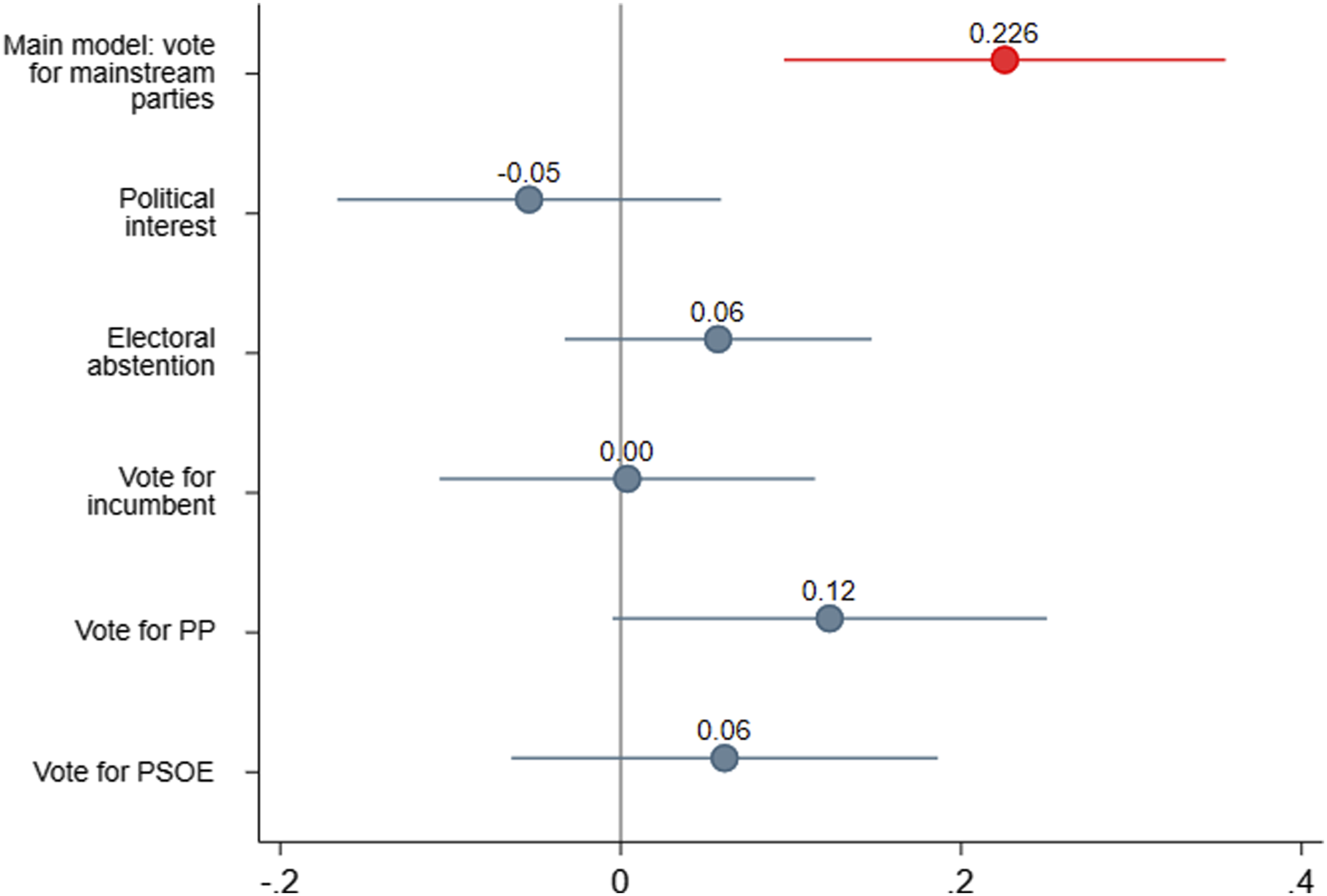
Placebo test: The influence of age
The main result of second time eligible voters being less likely to vote for new parties might be generated by an age effect rather than by prior eligibility. This is possible due to the fact that there might be up to a 12 months age difference between individuals that are 21 years-old at the time of the survey. To check that age is not driving the results, I run several falsification tests in which I artificially change the age threshold that leads to classification into treatment and control. I analyze each cohort o voters between 18 and 27 years-old, splitting individuals into treatment and control groups depending on whether they are in the upper or lower age range of each age group. In each of these comparisons, there is no difference in the context under which voters in the artificial treatment and control group had their first voting experience. If the effect I am capturing in the main model is the effect of having prior experience with voting, the only differences in support for the mainstream parties should be seen in this main model. If age is explaining the main results, at least in part, I should see a significant result when I analyze other age thresholds different than 21 years old, for which there is the same age difference between the artificial treatment and control groups, but no difference in eligibility status. Figure 4 shows that age is not driving the main results: the only significant results appear at the 21 year old threshold. These patterns are consistent with a causal interpretation of my main results. Falsification tests with placebo age thresholds. It represents the ATT of difference-in-differences models using alternative definitions of the treatment group and outcomes. To perform the age tests, I have only considered individuals that were in the same situation regarding eligibility in previous elections. The bands represent the statistical significance in each model at 95% confidence intervals.
Discussion and concluding remarks
Green and Shachar (2000); Gerber et al. (2003), Dinas (2014b), and Coppock and Green (2016) found empirical evidence that exposure to previous elections generates a positive reinforcement of prior electoral behavior, which is also the seed of voting as a habit. Within this framework, the imprint of the first experience with voting has been found to be crucial for other future voting behaviors (Aassve et al., 2022; Brown, 2021; De Kadt, 2017). My results, together with some other recent works such as Bhatti and Hansen (2012); Bhatti et al. (2016) and Dunaiski (2021), show that some of the previously found effects depend heavily on the context under which the first experience occurs. More specifically, my article shows that in a changing political context experience matters more than in a stable political context.
Another contribution of the article is that it provides results that can be interpreted causally due to the use of a natural experiment: the period of political change that emerged in Spain after the Great Recession. As a similar change occurred in other Southern and Central European countries, my results are potentially generalize. I find that only in the post-Great Recession context voting experience generates a different behavior among otherwise similar voters. One interesting implication of the results is that the electoral punishment to the performance of mainstream parties that occurred in the context of the deep economic recession of the Great Depression, which affected, among others things, the job prospects of young people, is buffered for those who came of voting age before the Great Depression. This is consistent with theories that argue that cognitive dissonance is generated only in the presence of an external persuasive influence (Festinger, 1968; Harmon-Jones and Mills, 2019). The results imply that the lack of voting experience makes first-time eligibility voters more responsive to external shocks in a political system. Due to first-timers not having previously experienced the act of voting, their political identity is less formed, in line with the evidence found by Dinas and Riera (2018), and they are more permeable to new political options.
In addition to extending the knowledge about the relationship between voting experience and the political context, the results of this article have an additional interesting ramification related to how experience shapes the speed at which political changes may occur. In particular, my results show that previous voting experience slows down political change and contributes to the high stability of party systems that Lipset and Rokkan (1967) found some decades ago. Hence, a large social transformation seems to be a prerequisite for modifying the electoral status quo.
Footnotes
Acknowledgments
I thank to Carlos III University of Madrid Department of Social Sciences and Instituto Carlos III – Juan March (IC3JM), Complutense University of Madrid Department of Applied, Public and Political Economy and European University Institute for their research support and useful feedback. In particular, I thank to Joaquín Artés, Pedro Riera, Sandra León, Beatriz Rodriguez-Sánchez, Elias Dinas, Amuitz Garmendia, Margarita Torre, Ignacio Jurado, and Ignacio Sánchez-Cuenca for their helpful discussions.
Declaration of conflicting interests
The author declared no potential conflicts of interest with respect to the research, authorship, and/or publication of this article.
Funding
The author disclosed receipt of the following financial support for the research, authorship, and/or publication of this article: The author gratefully acknowledges financial support from the Spanish Ministry for the Economy, Industry and Competitiveness and the Spanish State Research Agency (Grant PRE2018-083918 & CSO2017-82881-R), from the Spanish Ministry of Science and Innovation and Spanish State Research Agency (Grant PID2020-119460RB-I00) and from Spanish Center of Sociological Research (doctoral thesis award).
