




Abstract
Electoral volatility and clientelism were traditionally analysed through the lenses of clientelistic behaviour by political actors. However, we know very little about the importance of volatility for the formation of attitudes towards clientelism within the electorate. This article addresses that gap by analysing the extent to which volatile voters are more likely to accept electoral clientelism as a political practice. We bring evidence from Romania, which is a crucial case due to its extensive use of clientelism in elections over time and high electoral volatility. The analysis uses individual-level data from a survey conducted on a national representative sample of 4316 respondents in 2021. Contrary to the theoretical expectations, the findings illustrate that loyal voters accept clientelism easier, which holds when controlling for variables such as targeting awareness, political interest, income, or education. These results have important implications for the study of elections and voting behaviour.
Introduction
Volatility and clientelism are two central processes related to elections, which have received extensive attention in the literature. Traditionally, electoral volatility has been linked to economic factors, political elites, stability of party systems, cultural segmentation, institutional fragility, party ideology, patterns of government alternations, or social cleavages (Powell and Tucker, 2014; Roberts and Wibbels, 1999). Electoral clientelism, defined as the process through which political parties use the privileged access to state resources to cement their support within society (Hopkin, 2006; Stokes et al., 2013) was often studied in relation to voter profiles. Some studies analyse the efficiency of clientelism when citizens are provided with goods, money or other political and social benefits, while others concentrate on the negative practices (Brun and Diamond, 2014; Kuo, 2018; Mares and Young, 2019).
Electoral volatility and electoral clientelism build on similar characteristics of voters such as alienation from politics, efficacy, and particular socio-demographic profiles. So far, the relationship between these two variables was approached in the literature from supply-side perspectives with a focus on behaviour. Existing explanations posit that clientelist party systems feature high electoral volatility, partisan voters are more exposed to clientelistic inducements due to the party machine, or exposure to clientelism leads to unstable ballot preferences (Gans-Morse et al., 2014; Hicken, 2011; Weghorst and Lindberg, 2013). In brief, the use of clientelism by political actors (supply side) shapes electoral preferences. However, we do not know whether electoral preferences matter for attitudes towards clientelism among voters (demand side).
This article addresses this gap in the literature and analyses the extent to which electoral volatility at the individual level influences the acceptance of electoral clientelism as a norm in the political system. Understanding this effect will contribute to the literature on clientelism and electoral behaviour in two ways. First, it highlights the circular character of clientelism and voting preferences, which is currently limited to a unidirectional relationship. If the use of clientelism leads to volatile behaviour and the latter leads to greater acceptance of clientelism, then the use of clientelism reinforces its acceptance. While this may sound intuitive, in the current form there is a missing link that allows for deriving such conclusions and closing the circle. Second, it can provide evidence about another source of the attitudes towards electoral clientelism. It complements existing findings on how the functioning of political system and institutions, or levels of political knowledge, shape the acceptance of clientelism (Gherghina et al., 2022).
Our analysis focuses on the positive version of electoral clientelism characterised by a wide range of inducements from goods and money offering to promises of preferential access to social benefits and jobs (Mares and Young, 2019). We use ordinary least squares (OLS) regression and draw on individual-level data from an original nationwide survey with 4316 respondents conducted in Romania in January 2021, shortly after the most recent national and local elections (2020). Romania is a crucial case (most likely) where we would expect such a relationship to occur due to its extensive use of clientelism in elections over time, high electoral volatility and a combination of established and new political parties running in elections. The latter two characteristics strengthen the competition and make electoral outcomes more uncertain. Since all these features are common to other countries in Eastern Europe, Romania can be seen as a representative case for many new democracies in the region.
The next section reviews the literature and builds arguments that connect the electoral volatility and the acceptance of clientelism. The third section presents the research design with emphasis on the case selection, data source, and variable measurement. Next, a brief overview of Romanian party politics and electoral clientelism is presented. The fourth section includes the results of the statistical analysis, which are situated within the existing research and daily politics in the country. The conclusions summarise the key findings and discuss their implications for the broader field of study.
Electoral volatility and acceptance of clientelism
Much of the literature linking electoral clientelism and electoral preferences examines who is targeted and how. The general consensus focuses on the people who are likely to accept ‘bribes’ (Corstange, 2018). Core and swing voters are targeted for different reasons. Core voters are supporters that identify culturally, ideologically and politically with a political actor (Corstange, 2018). Political actors use electoral clientelism as a strategy to enforce their partisanship and to make sure that core voters will remain loyal (Gans-Morse et al., 2014; Hicken, 2011). Core voters are easier to target because they are embedded in party networks and the latter do not risk wasting resources (Mares and Young, 2018; Rauschenbach and Paula, 2019). These networks rely on clientelistic political machines with three types of actors – patrons, brokers, and clients – and the relations between them (Schaffer and Baker, 2015). Clientelism is conveyed in an organised manner to loyal supporters embedded in networks of individuals that parties develop systematically (Schaffer and Baker, 2015; Yıldırım and Kitschelt, 2020).
Swing voters have no partisan feelings, prefer to be independent on the political arena, change their political preferences and usually support only those actors that promote policies that are in line with their expectations (Weghorst and Lindberg, 2013). They are open to electoral alternatives when they are targeted with clientelist practices by those who want to maximise their votes (Gherghina, 2013; Hicken et al., 2022; Stokes, 2009). Swing voters are hardly identifiable because they are not embedded in political networks. Political actors risk wasting resources if they fail to identify them, their expectations or needs (Hicken et al., 2022; Rauschenbach and Paula, 2019; Weghorst and Lindberg, 2011). Swing voters can be motivated by short-term rewards, but they are more rational and sophisticated in their political choices because they are not constrained by political ideologies or group loyalties (Dassonneville, 2012; Dassonneville and Stiers, 2018).
Our central argument in this section builds on these observations and on the differences between core and swing voters. We argue that there are three characteristics that accompany electoral volatility that can make swing voters more likely to accept electoral clientelism as a norm of the political game: the limited emotional attachment, low interest for electoral competition and individual self-importance. First, partisanship involves emotional attachment between voters and political actors, which can be either instrumental (e.g. ideological beliefs, party performance) or expressive, that is, generated by social identity (Huddy et al., 2015). This attachment creates a collective identity among partisans and creates a border that differentiates the in-groups from out-groups. To them, the party image and principles matter, and their aims are directed towards stable long-term ideological objectives rather than short-term goals (Huddy and Bankert, 2017). Volatile (or swing) voters do not have emotional attachment and are thus more open to alternatives. This includes, among others, political actors that provide them with short-term benefits (Dassonneville, 2016; van der Meer et al., 2015). They can have a highly utilitarian approach of politics and find it easier to support the political actors that give them something palpable (Manzetti and Wilson, 2007; Mares and Young, 2019; Stokes, 2009). These palpable issues can also include clientelistic goods that volatile voters may see as acceptable means to be persuaded.
Second, low interest in electoral competition among volatile voters could favour the acceptance of clientelism. In electoral competitions, political actors seek to inform and persuade voters through various communication strategies and actions (Bischof and Senninger, 2018; Grossman and Helpman, 1994). Electoral competitions are informative, help voters identify the political actors that are closer to their expectations, or provide reasons to enforce their loyalty. By keeping an interest in them, voters become more responsive to the political messages and vote (Griffin, 2006). However, this does not apply to volatile voters who often manifest a general disinterest towards electoral competitions (van der Meer et al., 2015). For volatile voters, long-term strategies or promises may not be sufficient incentives to support specific political actors. They could perceive these processes as being too complicated or even useless, and look for short-term benefits to help them decide who to support (Dassonneville, 2016). Electoral clientelism is a simple process and provides voters with short-term benefits. As such, volatile voters may be inclined to accept it as part of the electoral game.
Third, individual self-importance could drive volatile voters to support electoral clientelism. The meaning of self-importance in this context is different than the one associated traditionally with political efficacy in which citizens believe that they can understand and influence the political world (Campbell et al., 1960). Unlike the partisan voters who share a common identity and who consider themselves important for the political party to which they belong, volatile voters could perceive themselves as being insignificant for politicians (Dassonneville and Stiers, 2018). Consequently, actions that give these voters a feeling of importance may be appealing to them. One of these actions is electoral clientelism in which voters are provided money, goods, access to services (Kuo, 2018; Mares and Young, 2019), and also access to entertainment during the election campaign (Brun and Diamond, 2014; Deuskar, 2019). Aside from the transactional dimension, these initiatives could be perceived by voters as signs that they are important and valuable for politicians (Mares and Young, 2019). Volatile voters may consider electoral clientelism as a form of attention to their needs and thus find it acceptable to receive such inducements.
These arguments make us hypothesise that electoral volatility favours the acceptance of clientelism. One could flag reverse causality and argue that the acceptance of clientelism could determine electoral volatility. There are two main reasons that this is highly unlikely: voters’ political sophistication and the sequence of events. First, political sophistication is the unconscious accumulation of political information over time, which explains political behaviour and is linked to innate abilities and decisions to engage in political processes (Gordon and Segura, 2014; Luskin, 1987). While voters differ in levels of political sophistication, it is unlikely that many will alter political preferences based only on the short-term material incentives provided by clientelism. It is also unlikely that they will wait for the next elections to see which political actor will provide them with other material incentives (Dassonneville, 2012). Second, there is evidence that electoral volatility occurred in many countries before electoral clientelism (Richardson, 1991; Stokes, 2009). Also, high electoral volatility is present in many countries that have very low levels of clientelism, but many clientelistic regimes have high electoral volatility (Hicken, 2011).
Control variables
In addition to the main effect of electoral volatility, we control for six variables that are often associated with electoral clientelism: clientelistic targeting awareness, interest in politics, political knowledge, income, age, and education. First, awareness about clientelistic targeting may influence attitudes about clientelism. On one hand, people who are exposed to such practices may be accustomed, and consider clientelism as part of the electoral process. On the other hand, individuals may reject clientelistic inducements because they consider it manipulative and distorting of the electoral competition. Second, citizens who are interested in politics may reject electoral clientelism because they perceive it as a direct threat to the trustworthiness of politics, and as a practice that endangers political representation (Piattoni, 2001). Third, individuals with higher political knowledge usually make informed decisions, are attentive to political evolutions, and understand electoral strategies (Enns and Kellstedt, 2008; Highton, 2009). Citizens with high levels of political knowledge could reject clientelism because they are aware this is a strategy that alters the democratic processes (Galston, 2001).
Fourth, communities with low economic development are more likely to create favourable environments for clientelism (Corstange, 2018; Stokes et al., 2013). Poorer citizens are willing to provide their votes to clientelistic political actors because they consider themselves to be included in the process of equitable distribution of the state’s financial resources (Auyero, 1999; Pellicer et al., 2021; Stokes et al., 2013). Fifth, previous studies show inter-generational differences in political participation – including elections and meaning of voting – and in the ways of understanding politics (Grasso et al., 2019). For this reason, it is also important to account for such a difference in the acceptance of clientelism. Finally, lower-educated citizens are inclined to alienate themselves from political activities, rarely inform themselves regarding political processes, and tend to not trust political actors because they do not feel represented (Visser et al., 2021). 1
Research design
This article uses individual-level data from an original nationwide survey conducted in January 2021 in Romania. The country is an appropriate case for analysis due to the extensive and documented use of electoral clientelism in its local, legislative, and presidential elections over time (Gherghina and Volintiru, 2017; Mares and Young, 2019). Most parliamentary political parties engage regularly in electoral clientelism across the country, within and outside their electoral strongholds. The voters are exposed to the process either directly as recipients of clientelistic offers or indirectly by knowing someone who received clientelistic offers (Gherghina, 2013). Moreover, the country has high levels of electoral volatility, comparable with other countries in Eastern Europe (Emanuele et al., 2018), which makes electoral outcomes uncertain and could push political competitors – both established and new – to engage in clientelism.
The survey was conducted 5 weeks after the national legislative election and closed 1 week later. The timing of the survey was chosen to minimise respondents’ memory bias. According to the legislation, the campaign starts 1 month before the election date. The electoral clientelistic exchanges occur during the campaign and a survey conducted soon after the elections can gauge attitudes towards recent events. The survey includes 4316 respondents with complete answers and uses a quota sampling method representative of the Romanian population at the national level according to gender, education, age and income. All the quotas are relative to the most recent official statistics available for the country, that is, the 2011 census. To ensure territorial coverage, the survey includes an equal number of respondents from the counties (roughly 100) and twice as many from the capital city due to its population size. Romania is divided into 41 counties of different sizes in terms of population and territory, plus the capital city Bucharest. The latter is 1.9 million inhabitants, while the largest county is almost 800,000 people. Each county includes villages, towns, and cities. The survey used a questionnaire in Romanian and the average length for completion was 11 minutes.
The variable measurement is presented in Appendix 1. The dependent variable of this study is the acceptance of electoral clientelism. It is a cumulative index of four forms: vote buying, products offer (food, feast), the promise of preferential access to public service or goods, and job promise after election. The index has high internal consistency: the value of Cronbach’s alpha is 0.95. The survey asked the same question for each form of clientelism and the index has values that range between 0 (complete rejection of all four forms of clientelism) and 40 (the complete acceptance of all forms of clientelism).
The electoral volatility is a dichotomous variable about the vote for the same party, coding 1 for negative answers to make the interpretation of results relative to volatility instead stability. In the ‘no’ category we included also those respondents who cast a vote in any of the two elections since abstention in an election also reflects volatility. We excluded from the analysis all those respondents who were below 18 years old – the legal age of voting in Romania – in 2016 because that would have inflated the level of electoral volatility. We analysed volatility in both national and local elections to see if the patterns differ: the correlation between the volatile respondents at both levels is 0.68 (non-parametric coefficient), statistically significant at the 0.01 level. This shows that although the elections were only 2 months apart in 2020, a few respondents were volatile in only one of the two types of elections.
The first control variable – awareness about clientelistic targeting – is based on a question (Appendix 1) asked for both national and local elections so that we can use the two variables separately in the analysis (Figure 2). The correlation between the targeting awareness in the two elections is 0.58. The remaining control variables are measured with the help of questions that are common in international surveys. The descriptive statistics for all variables is available in Appendix 2.
For all the variables, the ‘DK/NA’ answers are treated as missing values and are excluded from the analysis. The analysis uses OLS regression. Due to the skewed nature of the data (Figure 1) we ran a robust regression and Poisson regression for rare events. The results of these alternative statistical models greatly resemble the OLS results and we use the latter because they offer a straightforward presentation and interpretation of the results. The test for multi-collinearity shows that the independent variables and controls are not highly correlated: the highest value of the correlation coefficient is 0.40 and the variance inflation factor (VIF) values are lower than 1.38.
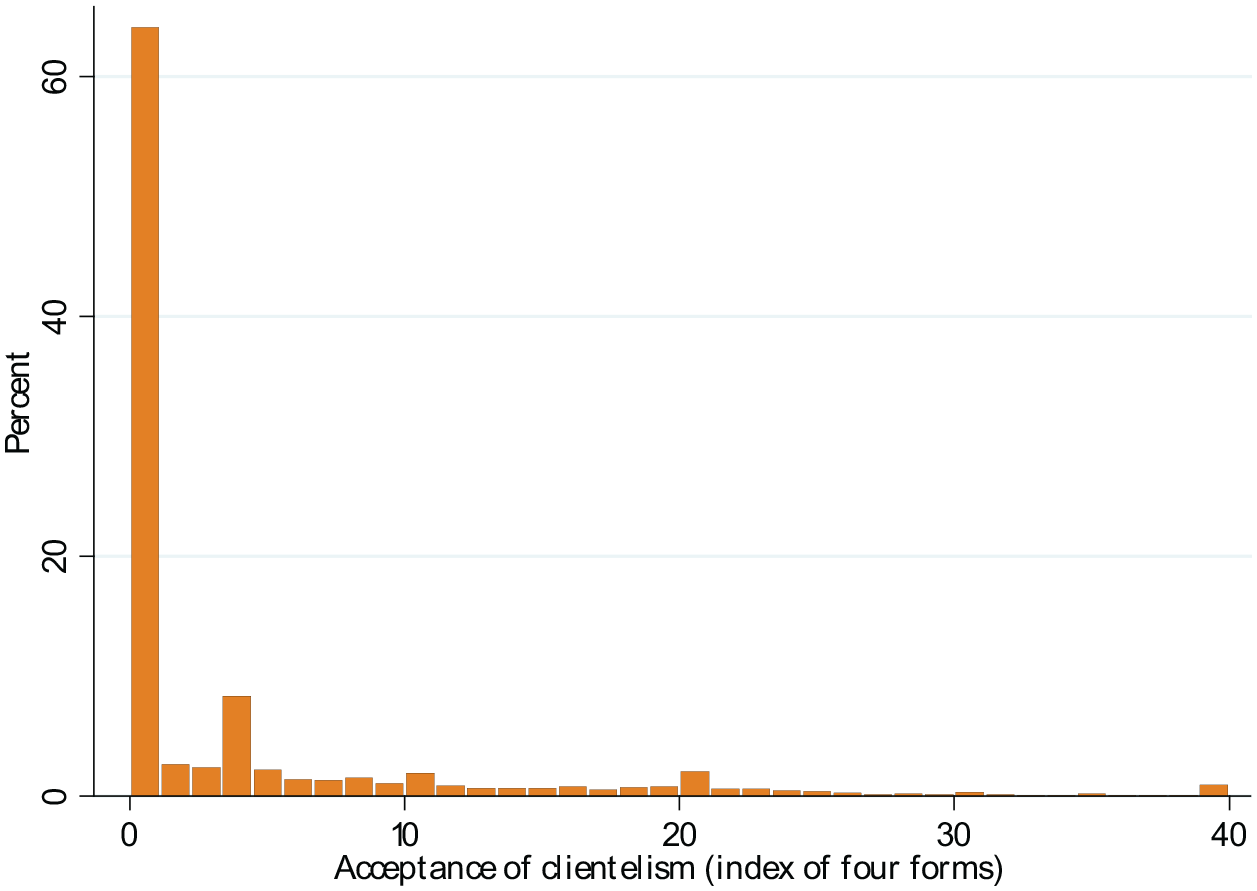
The acceptance of clientelism among the Romanian respondents.
Political parties, electoral volatility, and clientelism in Romania
This section provides a brief overview of the political environment and electoral clientelism in Romania, also covering some legal provisions meant to limit this practice. The local elections are organised every 4 years for four positions: two at the level of the locality (the mayor and the local council) and two at the county level (the president of the county council and the county council). The mayor and the president of the county council are elected according to a first-past-the post system, while the two councils – local and county – are elected using a closed-list proportional representation system. The national elections are organised once every 4 years, usually half a year after the local elections, for both Chambers of the Romanian Parliament. The Deputies and Senators are elected similarly, using a closed-list proportional system at the national level in which every county is represented proportional to its population. There is an electoral threshold of 5% for political parties and 8%–10% for electoral alliances and coalitions, depending on the number of parties.
The Romanian political system in the two recent decades consists of two large competitors – the Social Democrats (PSD) and National Liberals (PNL) – and other political parties that are either newly formed or relatively minor. The PSD is the major party in the country, winning the popular vote in all but one of the national legislative elections organised since the regime change in 1989. It has also had a relatively stable electorate since 2000, gaining around one-third of the votes. It is a successor of the Romanian Communist Party and inherited both its organisational structure and elites. The party has been often accused by clientelist practices by its opponents and has been riddled by corruption allegations since the late 1990s.
The PNL is currently the second largest party and acquired this position after merging with the third largest party in 2014. Unlike the PSD, the liberals had many ups and downs in terms of electoral support in post-Communist Romania. It often ran in electoral alliances: 2016 and 2020 was the first time when the party ran on its own in two consecutive elections. The electoral support of the party stabilised around 20%–25% in the past 15 years. In 2012, the PSD and the PNL formed an electoral alliance that gained almost 60% of the popular votes. At the national level, between 2012 and 2020, both parties were often part of the government coalitions and had direct access to state resources. At the local level, the two parties alternated in winning the elections (in 2012 their alliance won, in 2016 PSD and in 2020 PNL). They also both have a high number of mayors and local councillors on a regular basis. This access to power allows them to distribute public resources and to make credible threats regarding deprivation.
The Save Romania Union (USR) was formed before the 2016 national elections and gained seats both in 2016 and 2020. The party has a strong pro-European stance with much of its support coming from young people in large urban areas. In 2020, USR ran in an electoral alliance with Freedom, Unity and Solidarity Party (PLUS) in both local and national elections. The two parties merged in 2021. The Alliance for the Union of Romanians (AUR) was formed in September 2019 and got fourth in the 2020 national elections with more than 9% of the votes. It is a radical-right populist party with strong religious and nationalist rhetoric, similar to neo-Marxism, which sometimes capitalises on environmental issues (Doiciar and Creţan, 2021; Gherghina and Mişcoiu, 2022; Popescu and Vesalon, 2022). Among the small parties, the only continuous presence in the parliamentary arena is the Democratic Alliance of Hungarians in Romania (UDMR), which gets 6%–7% of the votes based on ethnic identity from counties with a sizeable Hungarian minority.
The electoral volatility is quite high throughout the country (Gherghina, 2014; Giugăl et al., 2011), which is reflected in two major processes. First, since 2012, every election brought a new entry to the parliamentary arena. Parties that were formed shortly before the elections exceeded the threshold but very few of these new parties survive. This means that those who vote for them in the first place change their preference 4 years later. For example, the Alliance of Liberals and Democrats in Romania (ALDE) was formed in 2015 as a splinter from PNL. The party then gained parliamentary seats in the 2016 elections and joined the government coalition next to PSD until 2019. The ALDE then merged with another newly formed party (PRO Romania) and failed to meet the electoral threshold in the 2020 legislative national elections. ALDE merged with PNL in 2021, thus ending its episodic existence.
Second, the government composition differs from one electoral cycle to another. Since 1992, there was no instance in which the party leading the government coalition for a full term in office joined the coalition government after the subsequent legislative elections. Since 2012, no formateur lasted in government the full term in office. For example, in 2012, the coalition government included the PSD, the PNL and two smaller parties. The PNL left the government coalition in early 2014 and the remaining parties had a coalition until the end of that year. ALDE joined the government coalition, which lasted until the end of 2015 when a technocratic government replaced the coalition after street protests and corruption allegations against the government emerged following a fire that led to many deaths in a nightclub in Bucharest (Creţan and O’Brien, 2020).
Electoral clientelism has occurred in all types of elections in the past two decades (Gherghina, 2013; Giugăl et al., 2011; Mares and Visconti, 2019; Mares and Young, 2019). Clientelism has evolved to take different forms from the provision of money, food, or objects to jobs or preferential access to services. Until 2012, the provision of goods was widespread and not considered clientelism. Then, the government issued an emergency decree that only allowed for specific gifts with a value lower than 10 RON. 2 The gifts allowed during campaigns were postcards, DVDs, pens, mugs, T-shirts, caps, and capes and jackets with their electoral sign (Pepine, 2012), while everything else was called clientelism and subject to imprisonment between 6 months and 5 years. In 2016, the Campaign Finance Guide put an end to any gifts and forbade electoral competitors from purchasing, offering, distributing or giving, directly or indirectly, any goods, for example, pens, mugs, watches, T-shirts, jackets, lighters, alcoholic beverages, cigarettes, and so on (Permanent Electoral Authority, 2016). In spite of these legislative provisions, clientelism continued to emerge in the 2020 local elections. Due to the COVID-19 pandemic, the election campaign took place in special conditions with limited interaction between candidates and voters. Nevertheless, the local media reported many incidents of clientelism throughout the entire country. For example, one report presents photographic evidence illustrating how a voter from a village in a Southern county receives money from a car belonging to a local councillor (Mirea, 2020).
Analysis and results
The distribution in Figure 1 shows that many Romanian respondents (roughly 60%) completely reject any form of clientelism. This is in line with earlier findings from the region according to which many voters find clientelism unacceptable although the incidence in their country is high (Gherghina et al., 2022). In spite of this dominant attitude, there is much variation among those who find clientelism acceptable to some degree.
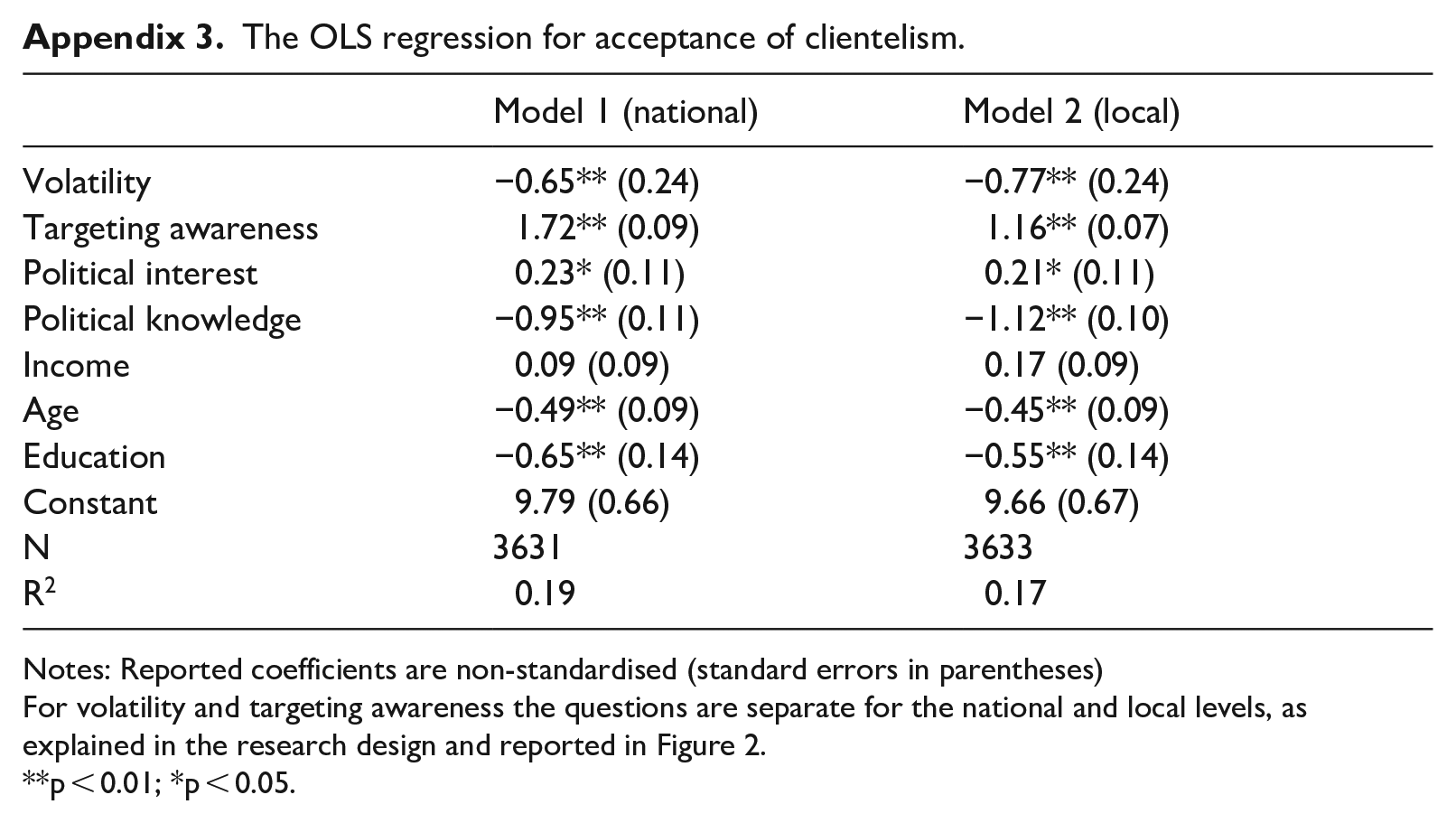
Figure 2 plots the average marginal effects on the general acceptance of clientelism for volatility in both national (Model 1) and local elections (Model 2). The results of the two statistical models are very similar which is why (a) we interpret only one of these and (b) the analyses in the following pages include only the effects at the national level. The complete OLS results are available in Appendix 3.
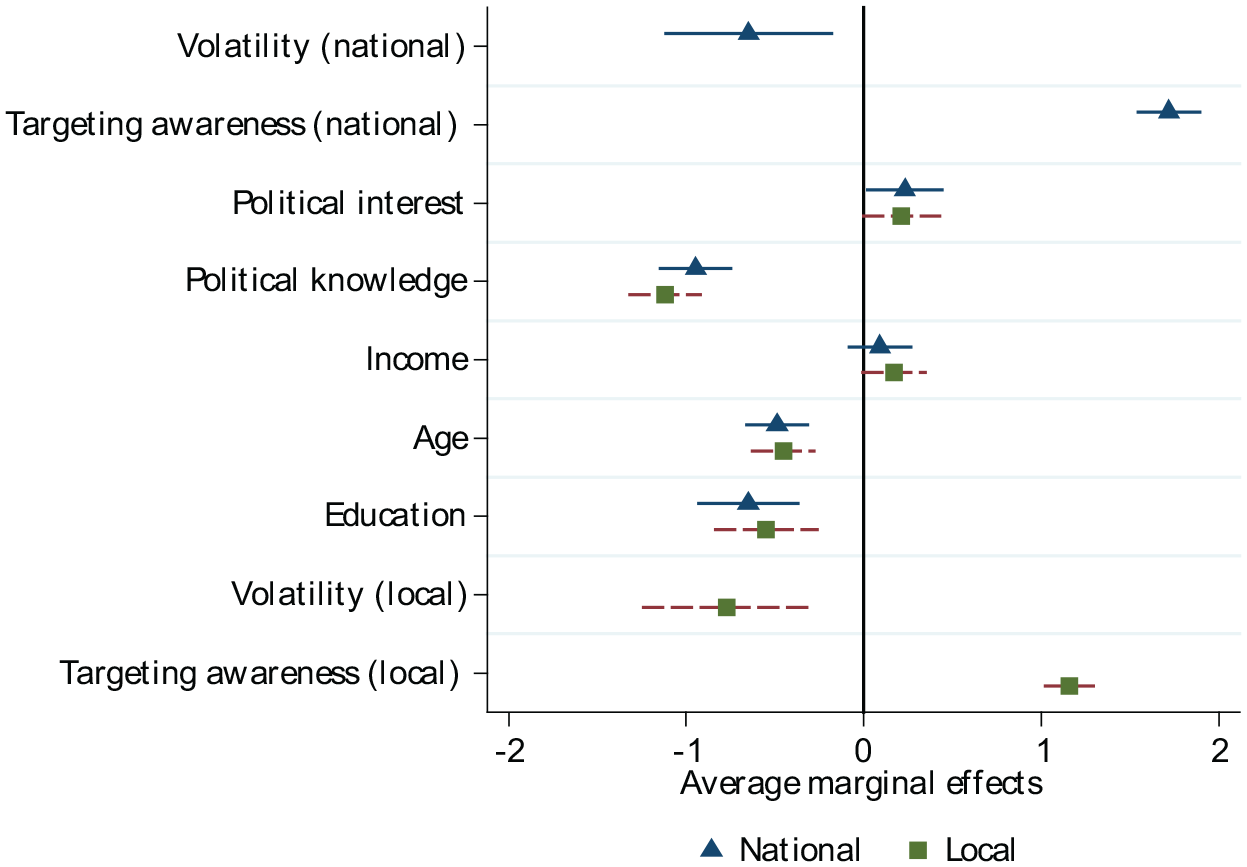
The effects on general acceptance of clientelism.
Contrary to our theoretical expectations, electoral volatility has a negative effect on acceptance of clientelism (p < 0.01). This means that those who vote for the same party are more likely to accept clientelism than those who vote differently in consecutive elections. This finding has at least three possible explanations. One of them is that political parties target their own electorate with clientelistic inducements so that they can mobilise their voters. This is in line with previous studies indicating that political parties in Romania use clientelism in their strongholds (Gherghina, 2013; Giugăl and Costinescu, 2020). As a result of these actions, the loyal voters become familiar with such inducements and they may be more inclined to accept them as a common practice in the political system. The clientelistic exchanges may be seen by loyal voters as a means through which political parties seek to connect with them, which complements the classic means of communication with the electorate (Gherghina, 2014; Poguntke, 2002).
An alternative mechanism conducive to the acceptance of electoral clientelism is the emotional attachment developed towards parties over time. Some loyal voters display emotional attachment and when clientelism is used by their preferred party, they accept without considering its moral implications or potential problems. We know that voters are lenient towards – and sometimes supportive of – co-partisan politicians accused of electoral fraud, corruption, or violation of basic democratic norms committed by candidates (Beaulieu, 2014; Breitenstein, 2019; Graham and Svolik, 2020). Similarly, clientelism is more accepted as long as it comes from those political parties that people vote for on a regular basis.
A third possible explanation is that voters who change their preferences may seek to base their decision on ideological or programmatic reasons rather than on the provision of money, goods, and services by political competitors. They could reject clientelism more than loyal voters because they may perceive it as an attempt to influence their choice. Another alternative explanation is that volatile voters may change preferences because they are in the quest for a party that is better than their previous choice. Clientelistic inducements as a means to gain electoral support can hardly be considered reflections of a ‘better’ competitor. This observation is linked directly with the choice for newly emerged parties such as AUR in the 2020 election. The party had as a central theme of campaign the corrupt practices of politicians (including vote buying). While this theme is typical for anti-system parties (Gherghina and Mişcoiu, 2022; Popescu and Vesalon, 2022), it is relevant in the discussion about clientelism and volatile voters’ tendency to reject it since AUR voters were all volatile.
Many control variables have relatively strong and statistically significant effects. The voters who are aware of clientelistic targeting are likely to accept clientelism. The effect is stronger for the awareness in national elections compared with the local elections, but both effects are statistically significant at the 0.01 level. One possible explanation is that people get accustomed and consider these inducements as a natural component of the electoral process. If exposure of citizens to clientelistic practices increases their acceptance, then political actors are unlikely to curb them in the future. People who are highly interested in politics are more likely to accept clientelism. This also casts doubts about potential changes in the future in a country like Romania with high incidence of clientelism. Corroborated with the findings for volatility, this observation strengthens the idea that those who accept clientelism are not citizens who do not care about politics and are available to the highest bidder. On the contrary, they have stable electoral preferences and an interest in politics, which illustrates that the acceptance of clientelism is associated by some voters with the way of doing politics in the country. However, this understanding does not always reflect the objective reality, as it is illustrated by the effect of political knowledge: people who know little about politics are more tolerant of clientelism. These people are out of touch with the political realities and hardly understand the negative effects of clientelistic practices.
Younger citizens are more likely to accept clientelism, which may be related to the limited experience with politics and a biased understanding of the process. Since clientelism was present extensively in the recent elections, such voters could consider that it is a natural part of the game. This can be a reflection of age cohort differences observable both in participation and in understanding of politics (Grasso et al., 2019).
Poorly educated citizens appear to be more tolerant towards clientelism, which is in line with the previous observation about knowledge. This result confirms the conclusions of previous studies. Lower-educated citizens are prone to perceive themselves as being insignificant on the political scene and uncertain that they can make rational decisions compared with other citizens with higher levels of education (Agerberg, 2019). The lower-educated citizens in Romania are more likely to accept it for two reasons: it is not a politically sophisticated process that means that they have to support a political actor that provides them (material or non-material) benefits, and by accepting clientelism they believe that political parties appreciate them. These potential explanations are in line with previous observations from elsewhere (Vicente and Wantchekon, 2009; Visser et al., 2021) and with those from the Romanian case in which clientelism is communicated straightforward to voters so they understand it easily (Gherghina, 2013; Giugăl and Costinescu, 2020).
Income does not have an effect on the acceptance of clientelism and people facing economic hardships are not more likely to accept clientelism than those who are well-off. The absence of a causal link between poverty and acceptance contributes to the literature on economic incentives of clientelism in two ways. First, it illustrates that people’s attitudes towards clientelism move beyond economic grievances or at least beyond the most basic form, that is, income. This finding is either a matter of political sophistication in which people see beyond their immediate gains or an operationalisation issue in which economic vulnerability requires more refined measurement. Second, attitudes are not the direct result of targeting. While poorer communities are targeted more intensely due to their economic vulnerability (Corstange, 2018; Pellicer et al., 2021; Stokes et al., 2013), this situation does not expand to attitudes towards the process. This reflects that clientelistic attitudes and behaviours differ in the population and the cultural acceptance of the phenomenon (Caciagli, 2006) is not driven by its use.
Figure 3 runs the same model for volatility in national elections for all forms of clientelism, as a robustness check for the observations. The effects are similar across the four forms of clientelism, with very small variation. The effect size, statistical significance and model explained variance (R2) are similar to the model used for the previous figure for the general acceptance of clientelism. Volatility has a negative effect, being somewhat stronger for products and weaker for job promises. Among the controls, income does not have a strong or significant effect on the acceptance of clientelism. The model for job promises shows the strongest effect of age and low education, which is quite intuitive. Young voters who are seeking a job and promises from political parties may be seen as acceptable. Low educated citizens may consider job promises as acceptable because they may lack the competitiveness on the job market, which in Romania requires increasingly degrees and qualifications for good jobs.
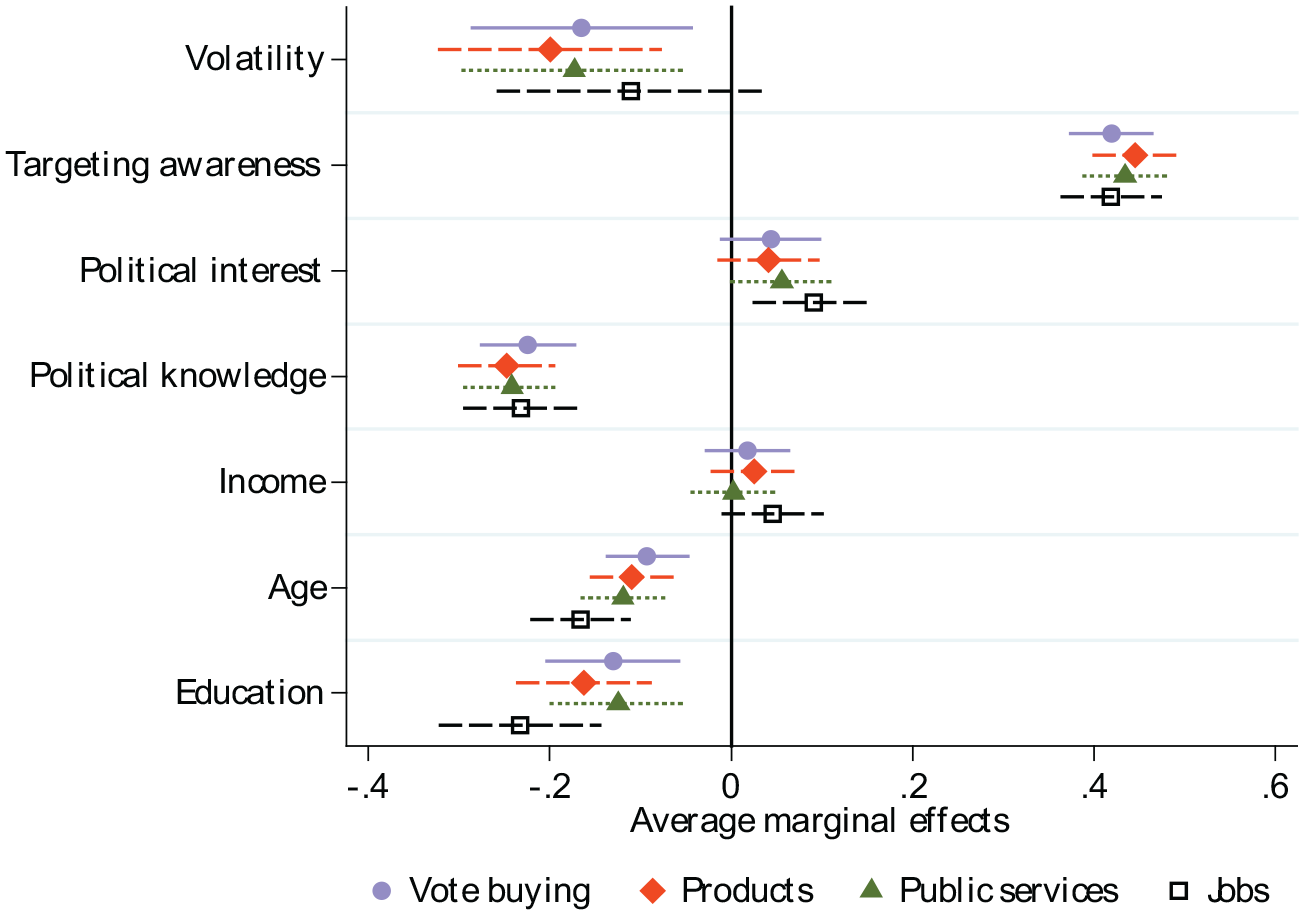
The effects on acceptance of different forms of clientelism (National level).
Figure 4 presents the linear prediction for the general acceptance of clientelism based on a person’s level of political knowledge and voting for the same or a different party (volatile voter). After fitting the linear regression, we obtained predictive margins for each of the levels in the interaction of these two variables. The interaction is done post hoc analysis using the strongest effect among the controls (Figure 2). The predictive margins show how at low levels of political knowledge the loyal voters are considerably more inclined to accept clientelism in general compared with the volatile voters. The attitudinal gap between the two types of voters is narrowed when the level of knowledge increases. Even at the maximum level of knowledge loyal voters have a higher propensity towards the acceptance of clientelism compared with volatile voters.
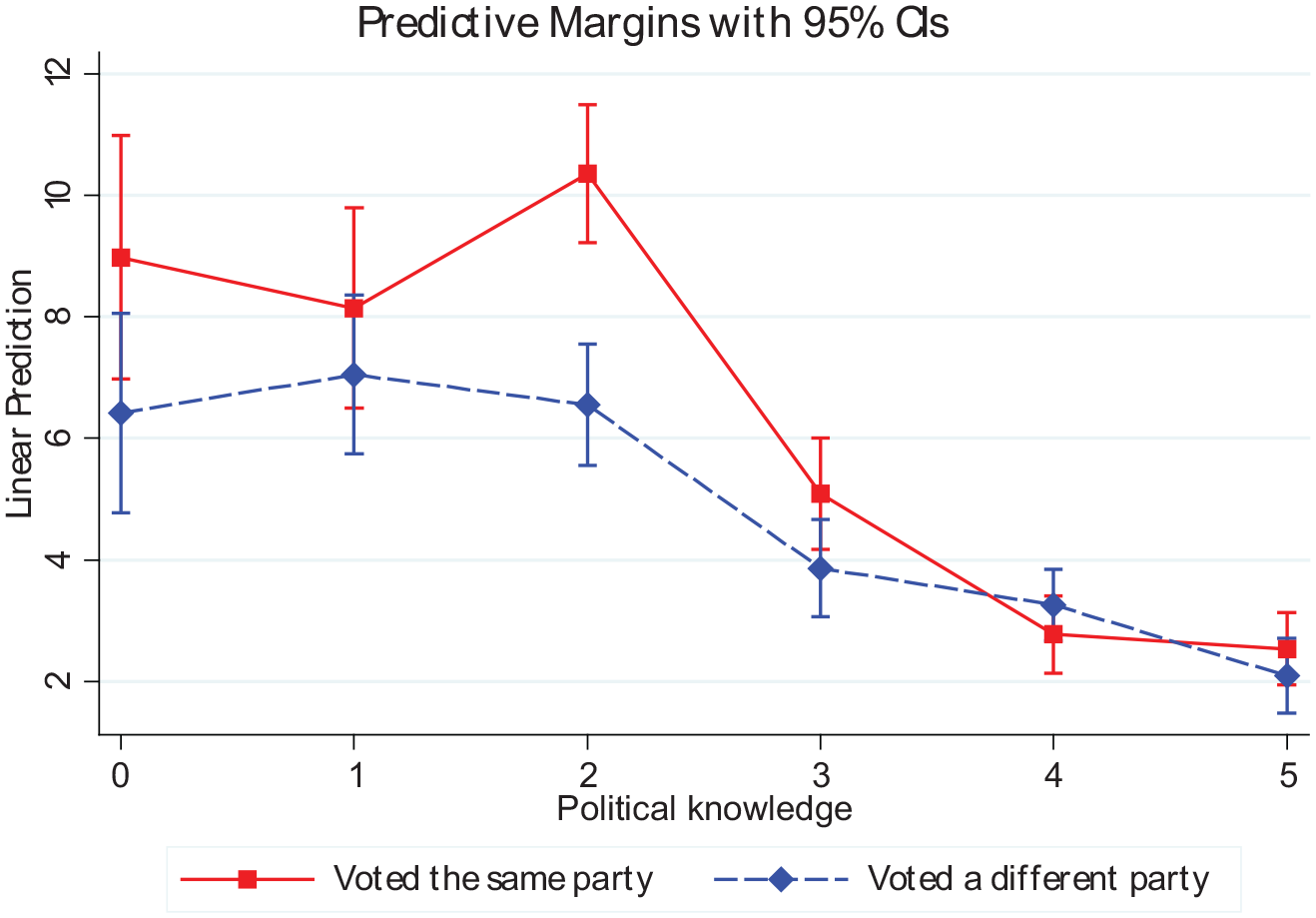
The effects of electoral volatility and political knowledge on acceptance of clientelism.
Conclusion
This article sought to identify the effect of electoral volatility on the acceptance of clientelism at the individual level in Romania. The findings contradict the theoretical expectations and show that loyal voters are more inclined to accept clientelism. These results hold also when controlling for several variables ranging from political interest or objective political knowledge to income or education. This is in line with previous observations according to which partisanship matters in the distribution of electoral clientelism (Gans-Morse et al., 2014). Our analysis reveals that the importance of partisanship is expanded beyond the realm of clientelistic behaviours and also shapes attitudes. Loyal voters find it easier to accept electoral clientelism as a norm of the political system than volatile voters. They may consider short-term rewards as part of a broader long-term commitment to the party based on group belonging and ideology.
These findings have implications for the study of elections and voting behaviour beyond the case analysed here. They may be applicable primarily to new democracies in Eastern Europe but also to countries worldwide that share Romania’s characteristics in terms of clientelism and volatility. Individuals who are available on the electoral market are more reluctant to accept the idea of clientelistic offers. Voters’ changing political preferences are shaped by something different than the provision of goods or services. As such, their attitudes are linked more to formal rather than informal practices in elections. In their case, the use of electoral clientelism does not reinforce its acceptance. Although volatile voters are targeted by clientelistic inducements, this is not reflected on greater acceptance. This finding indicates no vicious circle in which the use of clientelism, volatile behaviour, and its acceptance reinforce each other. From a democratic normative point of view this result is positive because there are limited possibilities to distort political representation, accountability, and responsiveness. This happens especially in countries with high volatility where there are fewer voters who accept clientelism as an ordinary practice.
Moreover, these results contribute to the ongoing literature about the targets of clientelism. We show that loyal voters are more responsive to the idea of clientelism compared with the swing voters and thus the political parties may be in a better position if they focus on this particular group of voters. In addition to its mobilising potential, the provision of clientelism contributes to establishing long-lasting relations with loyal voters. Such an approach is less costly for political parties because they target those who already find the parties appealing or are already in their networks (Hicken, 2011; Mares and Young, 2018; Rauschenbach and Paula, 2019). In brief, it is more difficult for parties to strengthen the acceptance of clientelistic appeal beyond their traditional electorate. Finally, the stability of voting preferences is a source of clientelistic acceptance in addition to those outlined by previous studies: the assessment of the political system, perceptions of institutional performance, and political knowledge. Since these are characteristics acquired in the long run, the positive attitudes towards clientelism have deep roots that are comparable with the cultural acceptance of the phenomenon.
Our approach draws on a quantitative perspective that could explore general patterns. Although our statistical models show the existence of an important relationship between electoral volatility and the acceptance of clientelism, this requires further explanation and nuance. Further research could address this and use semi-structured interviews or focus-groups with electorally volatile and party loyal citizens to provide detailed explanations about the underlying mechanism behind this relationship. As an alternative avenue for further research, studies could either test the applicability of this framework to other political settings that are similar or different to the case-study covered here (Romania) or add new control variables that could increase the acceptance of electoral clientelism.
Footnotes
Appendix
The OLS regression for acceptance of clientelism.
| Model 1 (national) | Model 2 (local) | |
|---|---|---|
| Volatility | −0.65** (0.24) | −0.77** (0.24) |
| Targeting awareness | 1.72** (0.09) | 1.16** (0.07) |
| Political interest | 0.23* (0.11) | 0.21* (0.11) |
| Political knowledge | −0.95** (0.11) | −1.12** (0.10) |
| Income | 0.09 (0.09) | 0.17 (0.09) |
| Age | −0.49** (0.09) | −0.45** (0.09) |
| Education | −0.65** (0.14) | −0.55** (0.14) |
| Constant | 9.79 (0.66) | 9.66 (0.67) |
| N | 3631 | 3633 |
| R2 | 0.19 | 0.17 |
Notes: Reported coefficients are non-standardised (standard errors in parentheses)
For volatility and targeting awareness the questions are separate for the national and local levels, as explained in the research design and reported in Figure 2.
p < 0.01; *p < 0.05.
Acknowledgements
The authors thank Mihail Chiru, Zachary Dickson, the participants to the panel on electoral clientelism at the Annual Conference Midwest Political Science Association (7–10 April 2022) in Chicago and the two anonymous reviewers of this journal for their constructive comments and very useful suggestions on earlier versions of this article.
Funding
The author(s) disclosed receipt of the following financial support for the research, authorship and/or publication of this article: Research for this article was supported by a project funded by the Romanian Executive Agency for Higher Education, Research, Development and Innovation Funding (UEFISCDI) with the number PN-III-P1-1.1-TE-2019-0460.
