




Abstract
Studies on electoral clientelism are increasingly focusing on the demand side and explaining how voters react to electoral inducements. However, there is limited research about how candidate attributes and partisanship can determine citizens’ reactions to clientelism. This article therefore tests the relative weight that voters place on candidate attributes and partisanship in their reactions to clientelistic targeting in the context of a new democracy. We use evidence from an original conjoint experiment conducted in 2021 in Romania, where electoral clientelism is frequent. Our findings show that citizens react negatively to clientelistic inducements in general, but the effects vary based on the targeting strategy used by politicians. These negative effects are considerably weaker among co-partisans. This observation is especially relevant when testing the effect of partisanship in a political setting where it is low.
Introduction
Partisanship and electoral clientelism are two determinants of voting behaviour in contemporary societies. Partisanship, conceptualised as individuals’ affective orientation towards a political party (Campbell et al., 1960), influences voters’ short-term choices and mass political behaviour, because it carries emotional and cognitive loading. The emotional component lies in establishing an affective attachment with voters that generates an orientation towards support (Huddy et al., 2015). The cognitive component is a heuristic function for voters in which partisanship provides information shortcuts and simplifies the complex choices that voters face during elections (Brader and Tucker, 2012). Electoral clientelism is a pervasive politician–voter linkage, which is defined as the provision of particular benefits such as money, goods and preferential access to public services and funds (including welfare) in return for political support (Kitschelt and Wilkinson, 2007). 1 Electoral clientelism continues to thrive in many countries despite evidence that it can be a costly and inefficient electoral strategy (Stokes et al., 2013). As such, understanding how voters react to clientelistic targeting is a central part of understanding electoral behaviour.
With some exceptions (e.g. Greene, 2022), the relationship between partisanship and attitudes towards electoral clientelism has received little scholarly attention to date. This is somewhat surprising for two main reasons. First, we know that partisanship has an effect on several processes that overlap with components of electoral clientelism. For example, the heuristic value of partisanship can generate negative consequences for democratic accountability because it ‘crowds out’ other information about political candidates (Kirkland and Coppock, 2018). Partisanship has been shown to moderate citizens’ perceptions of voter fraud, violations of democratic norms, and corruption (Anduiza et al., 2013; Beaulieu, 2014; Breitenstein, 2019; Graham and Svolik, 2020). Citizens appear to be willing to prioritise co-partisanship over other candidate qualities, and to prefer co-partisan candidates even when they have engaged in corruption or hold anti-democratic positions (Breitenstein, 2019; Graham and Svolik, 2020). This also happens when citizens have information about the actions of malfeasant politicians (Anduiza et al., 2013). Second, voters’ reactions to clientelism are not always direct and can be moderated by several factors related to the political system (Gherghina et al., 2022; Mares and Visconti, 2019).
The present article addresses this gap in the literature and seeks to answer the following research question: To what extent does partisanship affect voter reactions to clientelistic targeting by candidates? Our quest for an answer involves a two-step process: (1) we test the effects of clientelistic inducements on candidate assessment, and (2) we analyse whether these effects differ between co-partisans and other respondents. We use data from an original conjoint survey experiment embedded in a nationally representative survey (n = 1010) carried out in Romania in May–June 2021. The conjoint approach is appropriate for our purposes as it allows an examination of the complex multidimensional choices that people make when evaluating political candidates across issue areas, and it also performs well in terms of external validity and can mitigate potential problems with social desirability bias (Bansak et al., 2021; Hainmueller et al., 2015; Horiuchi et al., 2021). Romania provides an excellent empirical setting due to the high incidence of electoral clientelism over time, its competitive party system and its low levels of partisanship (see the research design). The first two characteristics are important because they reflect the familiarity of the nation’s citizens with electoral clientelism, the possibility of forming an opinion about it and the different source of clientelism. Low levels of partisanship make Romania a crucial (the least likely) case where a moderating effect could be observed.
This study contributes to three strands of literature. First, the findings enrich the emerging literature on the demand side of clientelism (Auerbach and Thachil, 2018; Nichter and Peress, 2017; Pellicer et al., 2014; Wegner et al., 2022) by identifying the supplementary factors that determine the acceptance of clientelism by voters. Co-partisanship can nuance and complement previous explanations that include cost–benefit analysis, the socio-economic status of recipients, and their attitudes towards politics in general. For example, middle-class voters were reportedly inclined to repudiate the practice of electoral clientelism in Argentina (Weitz-Shapiro, 2014). However, since middle-class voters are the core constituency of non-clientelistic parties in many countries, it is possible that partisanship plays a role in shaping attitudes towards clientelism. Recent literature has highlighted the puzzle that electoral clientelism flourishes even in the absence of credible monitoring and in the presence of high reputational costs (Bahamonde and Canales, 2022; Hicken and Nathan, 2020). Our results show that partisan bias can shape voters’ reactions to clientelistic targeting even if they otherwise disapprove of the practice, and thus explain why politicians do not necessarily incur reputational costs by engaging in electoral clientelism.
Second, our findings take the research on partisanship beyond the traditional approach covering the formal processes associated with elections. Partisanship is one of the core concepts in electoral studies and is often studied in relation to the impact on political support, policy preferences or voting behaviour. Our study illustrates how partisanship can have effects on the informal practices associated with many elections. Our analysis nuances the results of prior studies conducted in unstable party systems, which were much less conclusive than those in stable party systems where party–voter ties are clear (Brader and Tucker, 2012; Konstantinidis and Xezonakis, 2013; Mayer, 2017). Third, we find that party affiliation is stronger in relation to candidate choice among post-communist respondents than previous studies have suggested. We also illustrate that the role of co-partisanship in the formation of attitudes towards clientelism is similar to its role in attitudes towards corruption.
The next section reviews the literature and formulates two testable hypotheses, then the third section presents the research design of this study with an emphasis on the case selection, data and methods of analysis. The fourth section presents and interprets the results of our analysis. The concluding discussion summarises the key findings and discusses the implications of our study for the broader field of research.
Theoretical Expectations and Hypotheses
This section outlines the theoretical expectations about the effect of partisanship on voter reactions to clientelistic targeting by candidates. We formulate two major arguments. The first centres around the potential effect of clientelistic inducements on candidate assessment by voters. We identify several theoretical reasons to believe that baseline attitudes are generally negative. The second argument presents the reasons to believe that these attitudes are more variable and conditional upon co-partisanship.
Effects of Clientelism on Candidate Assessment
There is consensus in the literature that clientelist relationships entail ‘a realm of submission, a cluster of bonds of domination in opposition to a realm of mutual recognition, of equality and cooperation’ (Auyero, 1999: 299). Clientelism which aims to swing voters or to depress turnout may undermine political competition, the quality of substantive representation, and democracy itself, because citizens could base their voting behaviour on a different rationale from programmatic politics. It inhibits political freedom and political participation because it hinders individuals from developing consistent policy positions and motivates politicians to preserve economic inequality (Kitschelt and Wilkinson, 2007; Ruth, 2016; Weitz-Shapiro, 2012). Despite these negative effects on democracy, voters’ attitudes towards clientelism vary to some extent. This happens in part because clientelism can serve another purpose that is not detrimental to democratic quality, such as encouraging voter turnout among supporters. The empirical findings regarding acceptance of clientelistic targeting are heterogeneous – although many voters reject it, as we discuss in the following paragraphs, some people find it rewarding, are grateful for its existence and internalise norms of reciprocity with those who provide clientelistic inducements (Auyero, 2000; Finan and Schechter, 2012; Lawson and Greene, 2014; Szwarcberg, 2015). The honest reporting of clientelistic exchanges is distorted by social desirability bias to a variable extent (Gonzalez-Ocantos et al., 2012; Stokes, 2005), thus suggesting that social norms around the practice are not universally negative.
This asymmetric relationship between politicians as patrons and the voters as clients involves an exchange that may be perceived negatively by the client. The providers of clientelistic inducements are seen as egoists who are only concerned about rising in the political hierarchy, achieving selfish objectives and pursuing their own interests (Auyero, 1999). In communities experiencing conflict over the distribution of resources, voters are more likely to negatively interpret clientelism and may punish candidates using it (Mares and Young, 2019). Individuals with a higher socio-economic profile and access to resources that keep them away from clientelistic ties are likely to develop critical attitudes, as they acknowledge that clientelism can have short-term benefits for both candidates and communities, but cannot reconcile it with their own political values and beliefs (Hilgers, 2009). There are some exceptions to this view, with evidence indicating that experience with electoral clientelism moderates condemnation (González-Ocantos et al., 2014). However, this is contested by studies showing that even in countries in which electoral clientelism is a continuous practice, and in which many people have been exposed to it, condemnation is high (Bratton, 2008; Gherghina and Luțai, 2023). Generally speaking, many citizens in post-communist countries disapprove of clientelistic inducements, finding them unacceptable under any circumstances (Gherghina et al., 2022; Mares and Visconti, 2019).
In several ways, electoral clientelism and corruption are complementary because they both rely on similar functioning mechanisms, refer to state capture and involve the availability of resources (Trantidis and Tsagkroni, 2017). Many forms of electoral clientelism are considered corrupt due to the illegal use and distribution of resources (Singer, 2009). Perceptions of corruption among politicians reduce people’s trust in them (Uslaner, 2017). Considering the close relationship between corruption and clientelism, this logic could potentially be applied to politicians using clientelism: people may trust them less and have negative attitudes towards them. Political actors using clientelism face a credibility problem, as, on the one hand, politicians who are redistributive in their orientation will be able to make more credible promises about the distribution of resources after elections (Kramon, 2018). On the other hand, politicians who provide clientelistic incentives could face a credibility problem regarding their ability to win the electoral competition without such incentives. The redistribution of resources could therefore be interpreted as an attempt to compensate for limited programmatic appeal in which candidates try to establish credibility among the population with well-networked brokers (Hicken et al., 2022). Based on these arguments, we expect clientelistic targeting to have a negative effect on the assessment of candidates:
H1: Targeting voters with clientelistic inducements has a negative effect on candidate assessment.
Co-partisanship and the Effects of Clientelism
Our central argument in this section builds on the ‘trade-off model’ about voters’ behaviour towards corrupt politicians placed in a context of social identity. The ‘trade-off model’ explains that voters can elect malfeasant politicians in the knowledge that they were involved in illegal activities, due to perceiving the existence of benefits from those politicians (Breitenstein, 2019). In other words, voters sometimes overlook corruption because they believe politicians deliver in other ways (Winters and Weitz-Shapiro, 2013), such as good performance in office or the promotion of public policies, but also similar partisan affiliation. In relation to the latter, people may accept some losses from the public budget – one key electoral clientelism resource – if they and the politicians belong to the same (ideological) group. In line with social identity theory, people place value and emotional significance on the membership of their group, resulting in perceptual and attitudinal biases. Partisanship is a particular type of social identity (Greene, 1999; Huddy et al., 2015) in which citizens favour the in-group to which both they and the politicians offering clientelist inducements belong. These positive attitudes can rest on emotional attachment to other in-group members, but can also be driven by the reasoning that a victory for their co-partisans will bring them or the group concrete benefits (Jung, 2018).
Partisanship shapes the ways in which individuals process information and acts as a perceptual screen. It influences how people perceive particular issues, or even objective political events (Bartels, 2002; Brader et al., 2012; Campbell et al., 1960). It involves information filtering through along the lines of partisanship, which is a set of pre-existing beliefs and identities, and increases the likelihood that people will adopt their party’s views on policy issues and the biased evaluations of co-partisan candidates (Brader and Tucker, 2012; Green et al., 2004; Jung, 2018). Partisanship reduces voters’ information costs by aggregating complex sets of information relating to various policy and other programmatic dimensions. Partisanship therefore functions as ‘a [heuristic] shortcut by which citizens can make up their minds regarding both how to vote and where to stand on policy issues’ (Brader and Tucker, 2012: 403).
Previous studies have found that partisanship appears to moderate citizens’ evaluations of political candidates. Citizens prioritise candidates’ partisanship over allegations of electoral fraud or even violations of basic democratic norms committed by candidates (Beaulieu, 2014; Graham and Svolik, 2020). Citizens can even hold strong anti-corruption views and still vote for a corrupt co-partisan candidate (Breitenstein, 2019; Klašnja, 2017). They appear to often vote for a co-partisan, but malfeasant, candidate rather than a high-integrity candidate representing another party, even when the voters have information about malfeasant activities by the former candidate (Anduiza et al., 2013). Voters react similarly to allegations of corruption towards politicians in office. An experiment about a mayor who allegedly took bribes to dispense public contracts to particular bidders found that co-partisan voters were less inclined to believe that the mayor was guilty or to agree to punitive measures compared to other respondents (Klašnja and Tucker, 2013).
Based on these arguments, we expect co-partisan respondents to be more forgiving of clientelistic targeting carried out by representatives of their ‘own’ party. The negative effect of clientelistic targeting on candidate assessments is likely to be less pronounced when the political candidate comes from a political party that the respondent supports:
H2: The negative effect of clientelistic targeting on candidate assessment is weaker when the candidate and the respondent are co-partisans.
Research Design
To investigate these hypotheses, we used data from a conjoint experiment embedded in an original survey on a nationally representative sample for the Romanian population in terms of age, gender and region of residence (n = 1010). 2 The point of reference was the most recent official statistics available for the country, that is, the 2011 Romanian census. The data were collected between May and June 2021 via an online panel. The data collection took place half a year after the most recent legislative elections (December 2020) so that citizens would still have fresh memories about the campaign and be able to match the hypothetical scenarios with real situations. Conjoint experiments are useful for our purpose because they allow the examination of the complex multidimensional choices that people make when evaluating different issues areas simultaneously, such as political candidate attributes (Bansak et al., 2021; Hobolt et al., 2021). Conjoint experiments have been shown to perform well in terms of external validity (Hainmueller et al., 2015), and to be able to mitigate the potential problems with social desirability bias that can arise when studying respondents’ attitudes towards sensitive topics such as electoral clientelism (González-Ocantos et al., 2014; Horiuchi et al., 2021).
Case Selection
Romania is an appropriate case for our analysis due to the extensive use of electoral clientelism, its competitive party system and low levels of partisanship. First, there is documented use of electoral clientelism in local, legislative and presidential elections in Romania over time. Evidence shows that most parliamentary political parties regularly engage in electoral clientelism across the country, within and outside their electoral strongholds (Gherghina and Marian, 2023; Gherghina and Volintiru, 2017; Mares and Young, 2019). Clientelism is an important component of the electoral linkage strategies used by political parties in Romania. Voters are targeted with many types of clientelistic offers: cash, small goods, and/or preferential access to public services such as welfare or healthcare (Gherghina and Luțai, 2023; Gherghina and Volintiru, 2017; Mares et al., 2018). The direct exposure to the process is often documented in media reports detailing how the exchanges take place. The indirect exposure is reflected in surveys where respondents acknowledge that they know someone who has received clientelistic inducements. The widespread use of clientelism by political parties in Romania was crucial for the case selection for two reasons. On the one hand, it isolated the potential mediating effects for voters’ attitudes. For example, in contexts where the partisan identity of some groups is based on a strong repudiation of clientelism, the expected attenuated condemnation may not be observed. Since all the parliamentary parties in the Romanian system engage in clientelism, it is unlikely that some partisans may not have double standards. On the other hand, Romania is a political setting in which partial reverse causality is unlikely to occur. A tolerant attitude on the part of voters towards clientelism cannot influence preferences for specific clientelistic parties when most parties behave like this.
Second, the country has a multi-party system in which four or five relevant political actors compete. The Social Democratic Party (PSD) is the major political party that has won all but one legislative elections in the post-communist era, but which has joined roughly half of all the coalition governments. Two other parties gain seats on a regular basis and have been part of government coalitions – National Liberal Party (PNL) and Democratic Alliance of Hungarians in Romania (UDMR). In the most recent two legislative elections, two newly emerged parties gained seats: Save Romania Union (USR) in 2016, which also came third in 2020, and Alliance for the Union of Romanians (AUR) in 2020. Third, partisanship is limited in Eastern Europe, a region which has been characterised by the high availability of voters to new competitors and high electoral volatility for several decades (Emanuele et al., 2018; van Biezen, 2003). Partisanship in Romania is as weak as can be found in the region, as few citizens display strong attachment to political parties, and party preferences at the polls frequently change (Gherghina and Tap, 2022).
The Conjoint Experiment and Variables
We examined our hypotheses with a conjoint experiment where the respondents were presented with a table containing the profiles of two hypothetical candidates for the Romanian parliament. The following prompt appeared first on the screen: People can have different opinions on what kind of politicians they would like to represent them. In the following we are going to present you depictions of hypothetical candidates in Romanian parliamentary elections. The depictions contain information about the politicians’ background, political positions, and campaign strategies. You will be presented with six pairs of hypothetical candidates in Romanian parliamentary elections. After each pair, we will ask you to choose the candidate that you would like to vote for. Please read the description of each of the candidates very carefully before you make your decision.
The respondents were then shown a table of two hypothetical candidates with varying attributes. Table 1 shows the full set of attribute values for each of the attributes. The attributes were chosen to correspond with a number of theoretically relevant variables that are expected to affect the respondents’ candidate choices: (1) the clientelistic targeting of voters – derived from the country’s experience with clientelism – with three values: no clientelistic strategies, preferential access to welfare services and attempts to buy votes with 250 RON; (2) the candidates’ party affiliation was restricted to the most prominent Romanian parties: the PNL, the alliance between the Save Romania Union – Freedom, Unity and Solidarity Party (USR-PLUS), the PSD and the AUR; and (3) a campaign promise related to increasing employment in Romania with two values: no promise, or a promise to increase the number of jobs in Romania. In addition, we included two background characteristics that are commonly added in conjoint experiments, candidates’ gender and education (Breitenstein, 2019), in order to make the profiles more realistic to respondents. The attribute combinations were not restricted in any way. Each respondent was presented with six randomised comparison tables, meaning that the respondents evaluated a total of 12 candidates. Online Appendix 3 in the Supplementary Online Information presents a screenshot of an example conjoint table from the experiment, and Online Appendix 4 gives an English translation.
List of possible attribute values.
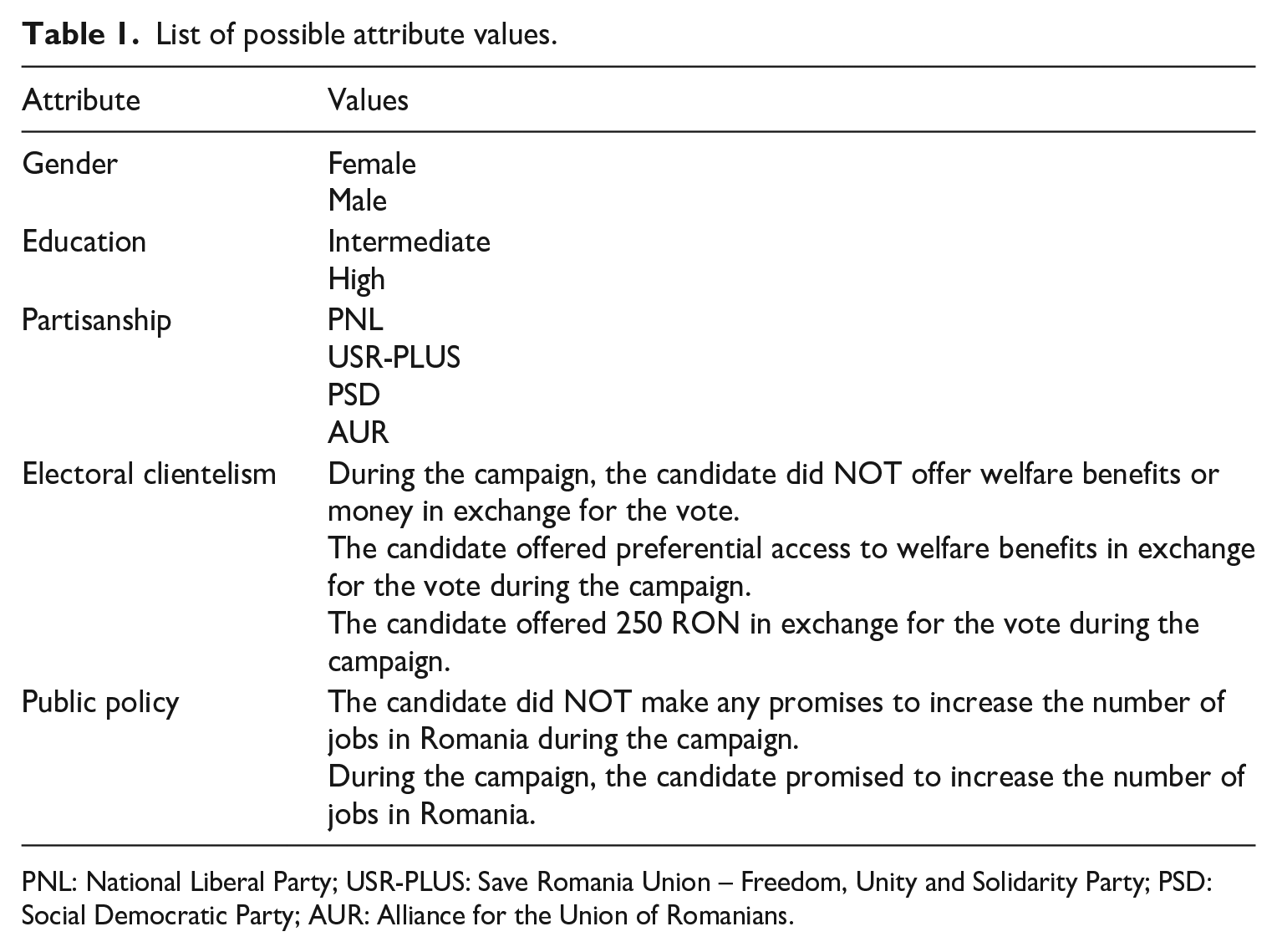
PNL: National Liberal Party; USR-PLUS: Save Romania Union – Freedom, Unity and Solidarity Party; PSD: Social Democratic Party; AUR: Alliance for the Union of Romanians.
The dependent variable of this study was measured using a ‘forced-choice’ design. After being shown the candidate profiles, the respondents were asked which candidates they would vote for in an election: ‘If you had to choose between these two candidates in elections, which one would you vote for?’. Available answers were ‘Candidate 1’ and ‘Candidate 2’. Respondents’ partisanship was measured with a standard question used in the Comparative Study of Electoral Systems (CSES) surveys. The respondents were asked if they feel close to a political party, and if they gave a positive answer, they were then asked to choose one from the list of current parliamentary parties; they also had the option to answer ‘other’. 3 The party congruence variable was constructed on the basis of the candidate’s partisanship and respondents’ partisanship: it was coded 1 if both the candidate and the respondent were from the same party, and 0 otherwise.
We built a second party congruence variable based on the candidate’s partisanship and the answers to the survey question about the respondents’ party choice in the 2020 elections. We did this because although voters may not have strong partisanship, the electoral system in Romania (as the next section explains) is based on proportional representation with closed party lists. This means that citizens must choose between candidates’ partisan affiliation in elections even if they are not committed partisans or if their party identities are in flux. We used the following question to gauge their ‘preferred’ partisan identity: ‘Which of the following parties did you vote for in the 2020 legislative elections?’ The respondents were presented with a list of Romanian parties (the four in the experiment plus UDMR and the option of ‘other’) and the option ‘I did not vote’. While we were mostly interested in examining the difference between partisan and non-partisan groups based on the respondents’ partisanship, we used this measure of party support to examine if party labels function as a heuristic for citizens who are not committed partisans.
To test H1, we estimated the average marginal component effect (AMCE) which ‘summarizes the overall average effect of an attribute when respondents are also given information on other attributes’ (Bansak et al., 2021: 29). AMCEs are estimated with linear regression with respondents clustered standard errors (Hainmueller et al., 2014). The results are presented as coefficient plots in the main body of the article and the full regression results are presented in Online Appendix 5 in the Supplementary Online Information. To test H2, we examined the descriptive differences in the effects between the different respondent sub-groups: partisans and non-partisans. We estimated the conditional AMCE or the AMCE for a sub-group of respondents (Bansak et al., 2021). We were aware that conditional AMCEs may be misleading in this case because regression interactions are sensitive to the reference category (Leeper et al., 2020). Consequently, we focused our empirical investigation on examining the differences in marginal means estimates between the different sub-groups, without relying on a specific reference group (Leeper et al., 2020). This approach is in line with a growing number of studies using conjoint experiments (Hobolt et al., 2021).
Analysis and Results
We start this section with a brief overview of the party system and electoral clientelism in Romania. The national legislative elections are organised once every 4 years. Deputies and Senators are elected similarly, using a closed-list proportional system at the national level in which every county (constituency) is represented in proportion to its population. The Romanian parliament after the 2020 elections comprises two large parties and three smaller parties. The large parties are the Social Democrats (PSD) and the National Liberals (PNL), which often alternate in government but sometimes also join forces as has been the case since September 2021. The PSD is the major party in the country, winning the popular vote in all but one of the national legislative elections organised since the regime change in 1989. It is the main successor of the Romanian Communist Party having inherited both its organisational structure and its elites (Gherghina, 2014; Marian, 2018). Since 2014, the PNL has been the second largest party in the country. It has often joined electoral alliances, but in the most recent two consecutive elections (2016 and 2020), it ran on its own. The electoral support of the party stabilised at around 20%–25% over the last 15 years (Gherghina and Luțai, 2023) and it has been the formateur of all coalition governments since November 2019. The other three parliamentary parties are either newly formed or relatively small. The following lines present the other two parties which were also included in the conjoint experiment. USR-PLUS was formed as a merger between USR – formed between the 2016 legislative elections – and PLUS, which emerged in 2019. The party has a strong pro-European stance but has recently been riddled with internal conflicts. The AUR was formed in September 2019 and came fourth in the 2020 national elections with more than 9% of votes. It is a radical-right populist party with a strong religious and nationalist rhetoric.
Electoral clientelism has often been encountered in all types of Romanian elections in the past two decades, including the 2020 legislative election (Gherghina, 2013; Gherghina and Tap, 2022; Mares and Visconti, 2019; Mares and Young, 2019). Over time, clientelism has taken different forms ranging from the provision of money, food, goods and conveyance, to preferential access to services (Gherghina, 2013; Gherghina and Volintiru, 2017; Mares and Visconti, 2019; Mares and Young, 2019). This happens even though vote buying has been explicitly forbidden and punishable by law since 2009 by a prison sentence of between 6 months and 3 years (Romanian Law 286, 2009). In 2016, the Campaign Finance Guide elaborated by the electoral authority put an end to any gifts. The document forbids electoral competitors from purchasing, offering, distributing or giving directly or indirectly any advertisement objects (Permanent Electoral Authority, 2016).
Our first test sought to understand the extent to which a candidate’s engagement in clientelistic targeting would produce a negative effect on candidate favourability among the Romanian respondents (H1). Figure 1 presents the estimated AMCEs for all the candidate attributes along with their 95% confidence intervals (left side) and the marginal means estimates (right side). These results provide strong empirical support for H1: that engagement in clientelistic targeting markedly reduces candidate favourability among the Romanian respondents. When a candidate targets voters with vote buying, this reduces the probability that the respondents will choose this candidate by nearly 30 percentage points on average, when the respondents are given information about all the other candidate attributes. Targeting voters with preferential access to welfare benefits reduces candidate favourability by nearly 18 percentage points.
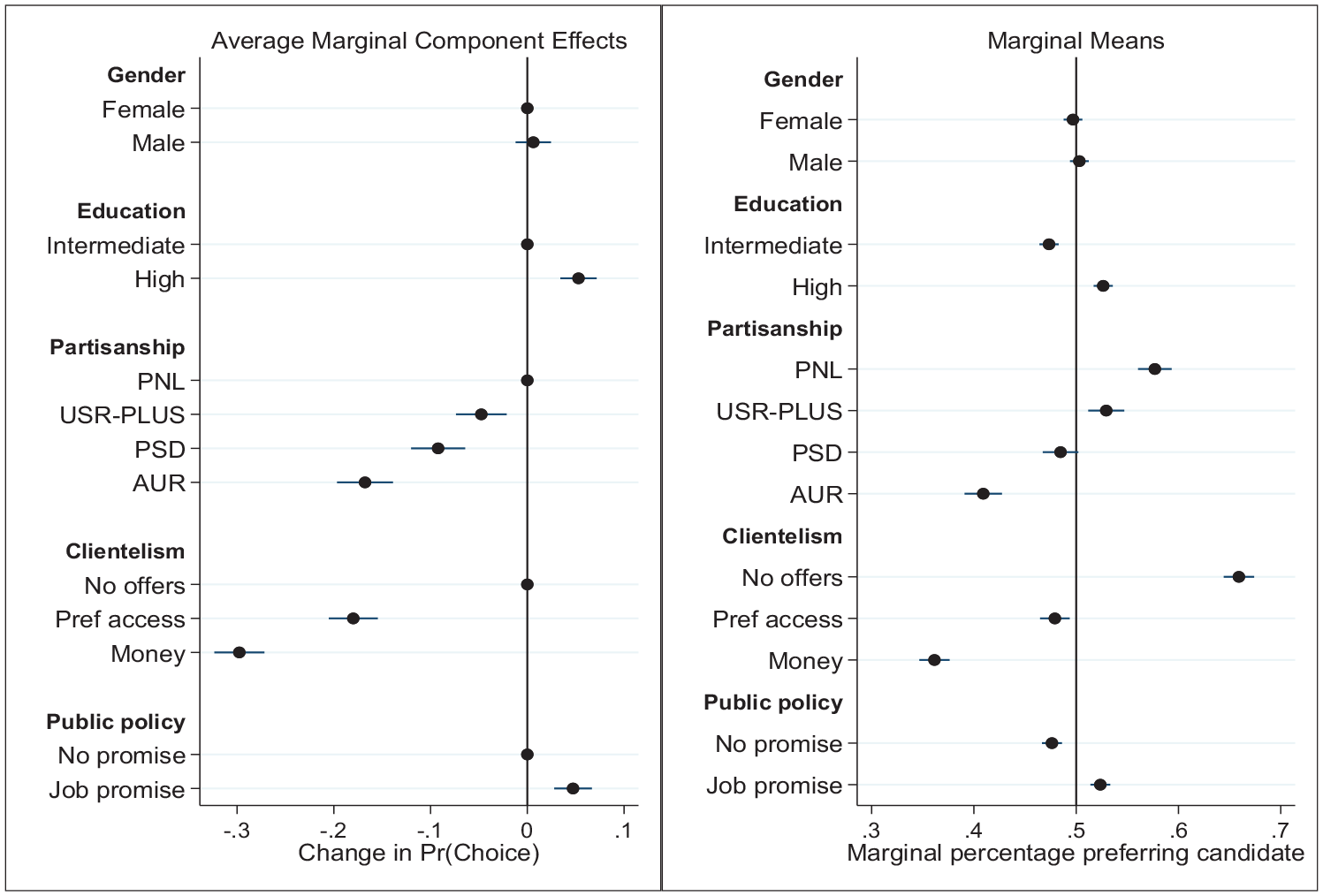
Direct Effects of Candidate Attributes on Candidate Favorability (AMCEs and Marginal Means).
The marginal means estimates shown in Figure 1 (right side) illustrate these differences in an even clearer manner. They show that almost 66% of the respondents would pick a candidate who did not use clientelistic targeting in the election campaign, everything else being equal. Vote buying thus clearly reduces the favourability of the candidate among the respondents, as around 36% of the respondents said they would pick a candidate who has engaged in vote buying. However, almost 48% of the respondents would still pick a candidate who would offer them preferential access to welfare services, suggesting that this mode of clientelistic targeting is less severely punished by the respondents. These results, therefore, suggest that vote buying clearly reduces candidate favourability among the Romanian respondents, while ‘welfare clientelism’ does not have such a negative effect on candidate favourability.
Candidates’ party affiliations had a relatively strong effect on their favourability among the respondents. In particular, candidates’ affiliation with the radical right-wing populist party AUR reduced the probability that they would be selected, by nearly 17 percentage points. This negative effect is similar in magnitude than the negative effect of clientelistic welfare targeting. Party affiliations appear to play a role in Romanian respondents’ evaluation of political candidates, although most respondents did not identify themselves as party supporters. These effects appear to be particularly strong in the case of voting ‘against’ a radical right-wing party rather than supporting a specific political competitor. This observation is in line with previous findings according to which voting for the lesser evil is quite common in Romanian elections (Mares and Visconti, 2019). Party labels thus appear to act as an important heuristic for voters even when most people do not identify themselves as partisans when asked directly in surveys.
Clientelism and partisanship were the two candidate attributes that affected most candidates’ favourability in our experiment. The effects were much stronger than the programmatic policy promise to increase the number of jobs in Romania. For example, the AMCE estimates show that making a programmatic policy promise to voters increased the candidate favourability only by just over five percentage points, indicating that Romanians are rarely swayed by programmatic policy promises. This evidence goes against common practices in Romanian election campaigns, which are characterised by extensive promises ranging from salary and pension raises to increased public investment (Andrei, 2020). While such promises may prove effective in influencing vote preferences, they have a very limited influence on voters’ perceptions about candidates.
We now turn to examining whether the effects of clientelism differ between the co-partisan respondents and other respondents (H2). We tested the sub-group differences between the co-partisans (i.e. when the respondents and the candidate represented the same party) and non-co-partisan respondents. The conditional AMCEs in Figure 2 (left side) indicate that the effect of clientelistic targeting was negative among both non-co-partisans and co-partisans. However, this negative effect was less pronounced when both the respondent and the candidate were from the same party. The marginal means estimates in Figure 2 (right side) show large differences in the effects between the different groups of co-partisan and non-co-partisan respondents. While less than 35% of the non-co-partisan respondents would pick a candidate who engaged in vote buying, almost 60% stated that they would pick this candidate when the candidate represents the same party that the respondents support. The results also show that while less than 46% of the non-co-partisan respondents would pick a candidate who targeted voters with access to welfare benefits for votes, almost 68% would pick this candidate when there was partisan congruence. Overall, there are clear differences in the effects of clientelistic targeting on candidate favourability between the co-partisan respondents and other respondents, thus supporting H2.
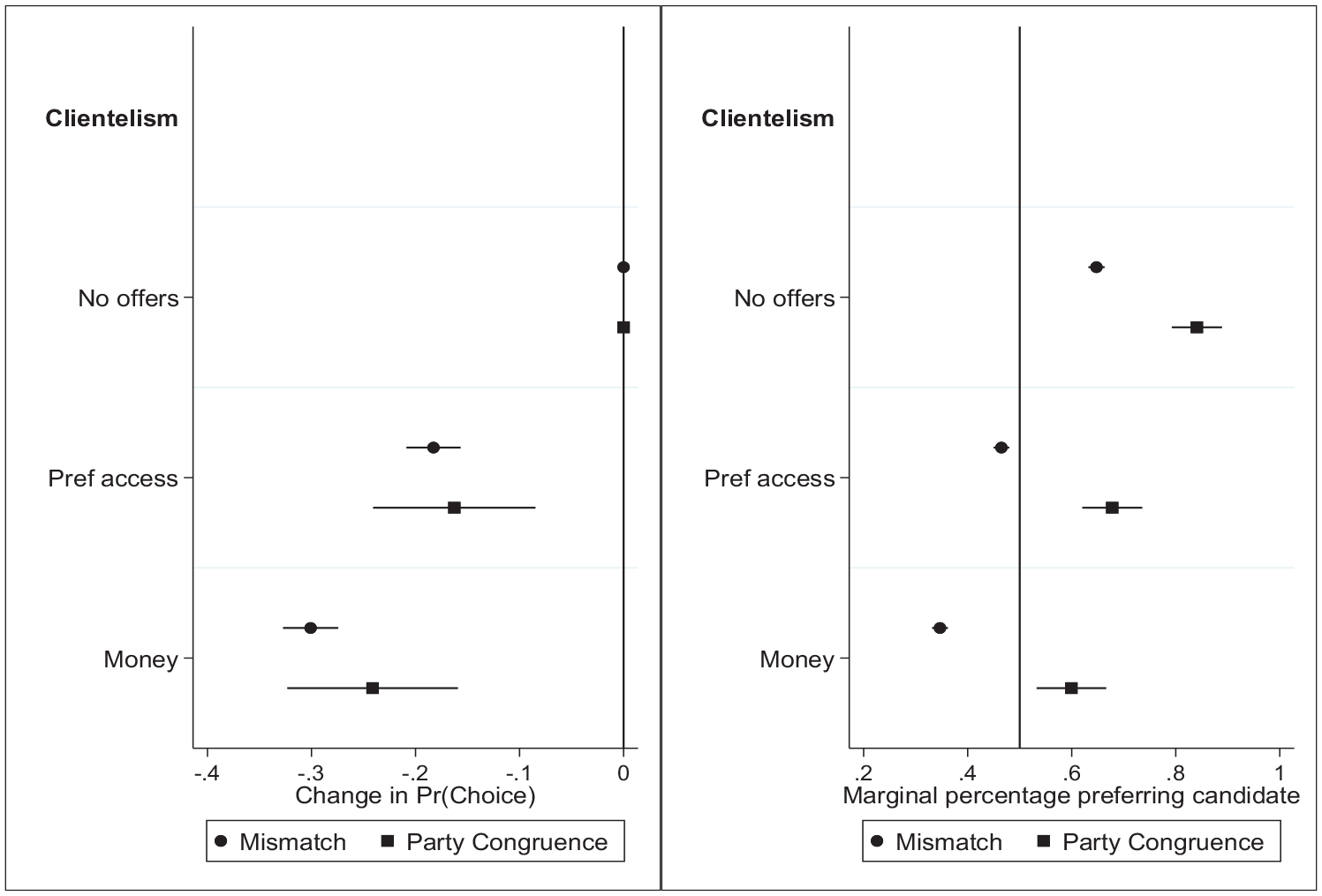
Conditional Effects of Clientelistic Inducements on Candidate Favorability across Party Congruence.
The results were similar when we examined the respondents’ party affiliation based on their vote choice in the 2020 parliamentary elections (Figure 3). The marginal means estimates show that while less than 33% of the non-co-partisan respondents would pick a candidate who would have engaged in vote buying, almost 52% would pick this candidate when the candidate represented the same party that the respondents say they voted for in the 2020 elections. The results also show that around 42% of the non-co-partisan respondents would pick a candidate who would have engaged in welfare clientelism. In comparison, almost 65% would pick this candidate when the candidate was from the respondents’ preferred party in the 2020 elections.
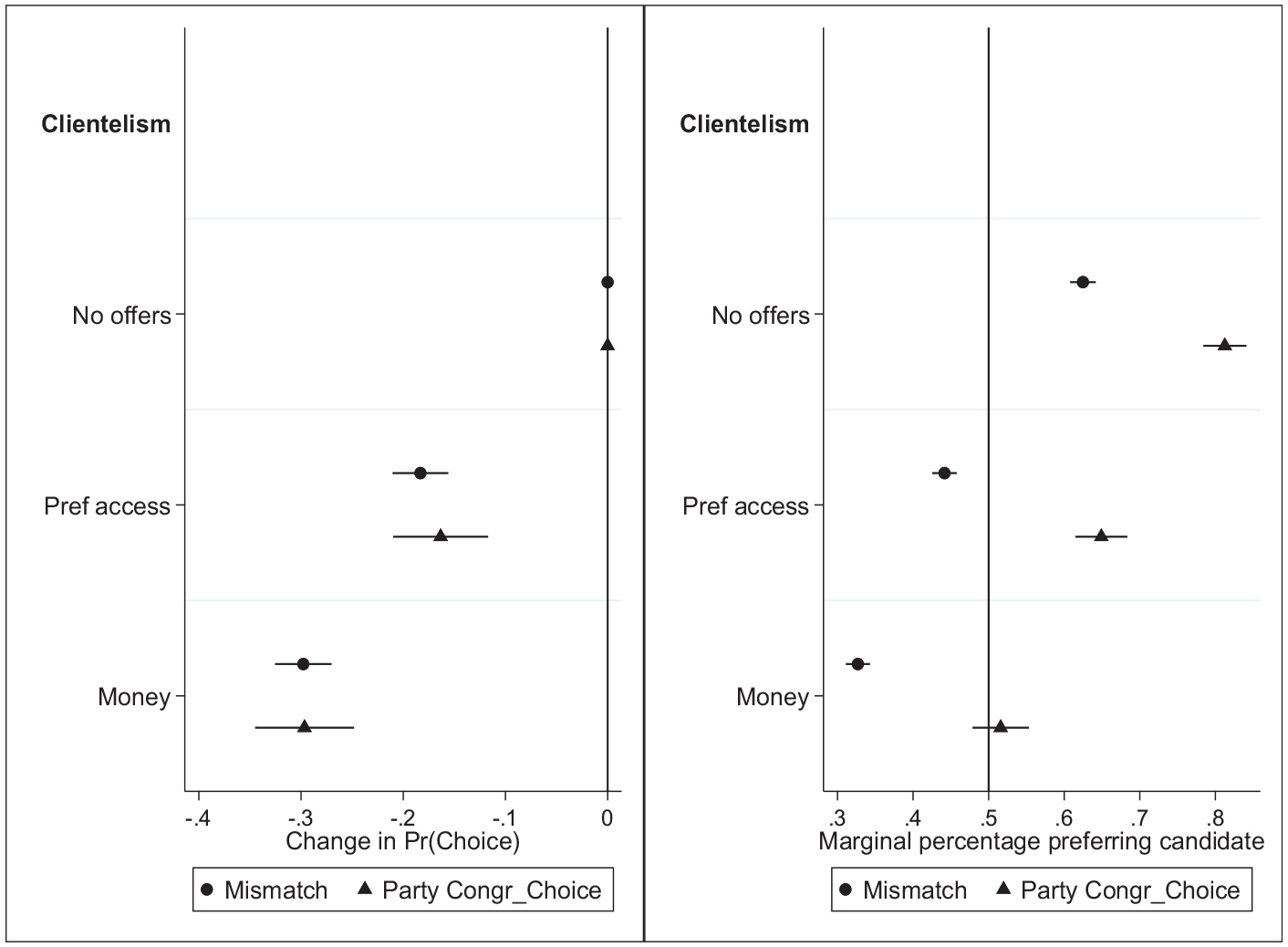
Conditional Effects of Clientelistic Inducements on Candidate Favorability across Party Congruence When Measured by Respondents’ Vote Choice in the 2020 Parliamentary Elections.
For diagnostic checks, we checked for potential ‘carry-over’ effects’ and ‘profile order’ effects (Hainmueller et al., 2014). The results presented in Figures 4 and 5 in the Supplementary Online Information suggest small differences in effects depending on the profile order, but these differences are not so substantive that they are likely to bias our results.
Discussion and Conclusion
Politicians target voters with clientelistic inducements in many of the world’s democracies. Despite the prevalence of electoral clientelism, we know little about how voters react to these targeting attempts, and how reactions differ among sub-groups of voters. This article has investigated these questions with the help of an original conjoint survey experiment conducted in Romania in 2021. The findings make three key contributions to the literature. First, we studied the direct effects of clientelistic targeting on candidate favourability among Romanian respondents. We hypothesised that Romanians’ assessments of political candidates would be negatively impacted by the use of clientelistic targeting. We found that clientelistic targeting had a very strong negative effect on candidate evaluations among the Romanian respondents, in line with previous studies (Gherghina et al., 2022; Mares and Visconti, 2019). However, there were relevant differences in the effects of different strategies. Romanians appear to perceive clientelistic targeting in the form of offering preferential access to welfare services less negatively than outright vote buying with cash (Mares and Visconti, 2019). This may reflect the explicit prohibition by the Romanian legislation of such a practice. People may also consider the provision of welfare benefits as a duty of politicians, and thus may react less harshly to these offers, even when they are suggested on a quid pro quo basis. Our results add to the recent literature that has found that citizens’ reactions to clientelistic targeting can vary substantially on the basis of the strategy used (Mares and Visconti, 2019; Wegner et al., 2022).
Second, our conjoint experimental approach allowed us to examine the effect of candidates’ partisanship on their favourability among Romanian respondents relative to other candidates’ attributes. Our results show that even though very few Romanian respondents identify themselves as partisans or to have joined parties, party labels still function as important heuristics for voters choosing between political candidates. In particular, we found that party affiliation with the radical right-wing populist party AUR had a strong negative effect on candidate favourability. This underlines the usefulness of testing for these effects with a conjoint experimental design that allows estimation of the relative weightings of various candidate attributes on candidate choice rather than asking about these candidate attributes separately in a more traditional survey (Bansak et al., 2021).
Third, building on earlier literature on the moderating effects of partisanship on corruption perceptions, we hypothesised that the negative effect of clientelistic targeting on candidate evaluations would be weaker when both the respondent and the politician were from the same party. Our sub-group analysis of the results supports this hypothesis. Our findings thus align with earlier works which have suggested that partisan bias shapes voters’ reactions to clientelistic targeting (Greene, 2022). They also add to the growing literature on voters engaging in ‘partisan double standards’ and punishing malfeasant candidates from their own party less severely than those from other parties (Breitenstein, 2019; Graham and Svolik, 2020). These results suggest that even having credible information about clientelistic activities of candidates may not dissuade voters from voting for the clientelistic politicians if they come from their preferred party. This kind of behaviour distorts the function of elections as an accountability mechanism. It may also explain why politicians are not severely electorally punished for clientelistic campaign tactics, and why clientelism continues to flourish in many countries around the world despite the fact that many voters appear to take a very negative view of the practice. The findings of this article thus contribute to the growing literature that investigates the limitations of democratic elections as a means of ‘throwing the rascals out’.
Supplemental Material
sj-pdf-1-psx-10.1177_00323217231178994 – Supplemental material for Partisanship and Tolerance for Clientelism: Evidence from a Conjoint Experiment in Romania
Supplemental material, sj-pdf-1-psx-10.1177_00323217231178994 for Partisanship and Tolerance for Clientelism: Evidence from a Conjoint Experiment in Romania by Sergiu Gherghina and Inga Saikkonen in Political Studies
Footnotes
Acknowledgements
Previous versions of this paper were presented at the 2022 Midwest Political Science Association Annual Conference in Chicago and the 2022 American Political Science Association Annual Meeting in Montréal. We thank the conference panel participants, the editors and the anonymous referees for their excellent comments on the paper.
Author note
Department of International Studies and Contemporary History, Babeș-Bolyai Unversity Cluj, Cluj-Napoca, Romania.
Declaration of Conflicting Interests
The author(s) declared no potential conflicts of interest with respect to the research, authorship and/or publication of this article.
Funding
The author(s) disclosed receipt of the following financial support for the research, authorship and/or publication of this article: This research was funded by the Academy of Finland (Grant 316897) and by the Romanian Executive Agency for Higher Education, Research, Development and Innovation Funding (project number: PN-III-P1-1.1-TE-2019-0460).

Supplementary Information
Additional Supplementary Information may be found with the online version of this article.
Contents
Appendix 1: Respondent characteristics.
Appendix 1 Table 2. Respondent characteristics.
Appendix 2: Survey questions measuring partisanship used in the analysis.
Appendix 3: Example conjoint table from the experiment.
Appendix 3 Table 3. Example conjoint table from the experiment.
Appendix 4: English translation of the example conjoint table.
Appendix 4 Table 4. English translation of the example conjoint table.
Appendix 5: Regression results.
Appendix 5 Table 5. Regression results.
Appendix 6: Experiment diagnostic checks.
Appendix 6 Figure 4. Diagnostic check for carry-over effects.
Figure 5. Diagnostic check for profile order effects.
Notes
Author Biographies
References
Supplementary Material
Please find the following supplemental material available below.
For Open Access articles published under a Creative Commons License, all supplemental material carries the same license as the article it is associated with.
For non-Open Access articles published, all supplemental material carries a non-exclusive license, and permission requests for re-use of supplemental material or any part of supplemental material shall be sent directly to the copyright owner as specified in the copyright notice associated with the article.
