




Abstract
This article analyses the relationship between the COVID-19 pandemic and the evolving United Kingdom (UK) Eurosceptic discourse in the context of the UK’s departure from the European Union (EU). It applies a mixed-method approach of content analysis and critical discourse analysis of newspaper reporting of the EU’s handling of the pandemic vis-à-vis the UK during the first lockdown and the rollout of the vaccination programme. During the first lockdown, UK newspapers opted for muted politicisation and polarisation – they downplayed the success of strategies within the EU Member States, but attacked the EU. While during the vaccination rollout they shifted to vocal politicisation and vaccine nationalism which praised the UK, heavily criticised the EU and claimed the EU’s Member States suffered as a result of EU incompetence. Against this backdrop the COVID-19 pandemic has put into motion a self-reinforcing discursive shift in which the UK’s ability to go it alone not only justifies Brexit, but serves to prove that it will be a success.
Introduction
Within the debate on COVID-19, politics and the media, the United Kingdom (UK) is something of a unique case study. Compared with its European neighbours, its early management of COVID-19 was less successful with the Government of Boris Johnson failing to act swiftly to minimise infection and death rates. Indeed, during the early months of the crisis the UK had one of the highest infection and death rates of any European country (Ritchie et al., 2020). By contrast, in the early months of 2021 the UK’s vaccination programme significantly outpaced its neighbours, as the EU approved vaccines later and struggled with supply issues, particularly that of the AstraZeneca vaccine. Against this backdrop the UK’s relationship with the European Union (EU) was changing – at the beginning of the pandemic it was in its transition period from leaving the EU and had formally departed by the time of the rollout of the vaccination programme in 2021. The ongoing fallout over Northern Ireland and Article 16, however, draws attention to the extent to which the UK is fully independent and has taken back control.
The right-wing and Eurosceptic dominance of the UK media is well-documented (e.g. Copeland and Copsey, 2017; Daddow, 2012; Jackson et al., 2016; Rawlinson, 2019) with Daddow (2012: 1219) characterising it as ‘vigorously partisan hostility bordering on a nationalist and in some arenas a xenophobic approach to coverage of European affairs’. The absence of a Europhile voice to counterbalance the noise of Eurosceptic reporting is regarded as a contributor to the growth of Euroscepticism over the past three decades (Copeland and Copsey, 2017), as well as the outcome of the 2016 UK referendum on EU membership (Jackson et al., 2016). Within the UK the print media continues to play a pivotal role in political discourse, especially when compared with other European countries, and acts as a mirror of society and the primary political communication platform; it remains instrumental in the process of forming public opinion, is the primary theatre for the discursive recontextualisation of events and for tagging and disseminating new issues to create a mainstream national narrative. As noted by Zappettini et al. (2021: 589) ‘the role of the media in creating and swaying public opinion can hardly be overstated’. The authors argue that one of the key shifts accounting for this influence has been a ratcheting-up of the role of emotions within the broader political discourse and thereby that of the media. Analysing the media therefore requires an understanding of the role that emotions can play, particularly in the context of the discourses produced, which have experienced a shift away from logos towards pathos. In other words, from reasoned debate about the issues of the day to a more direct appeal based on emotionality or constructs which are no longer connected to truth-based logics. This needs to be further contextualised by the shift of semiotic resources which have been deployed by the media, and their associated pragmatic implications (Zappettini et al., 2021: 588–591). As example, emotionally laden representations within the British tabloid press during the Brexit negotiations depicted the EU as a bully and the UK as a victim, which drove public discourses (Zappettini, 2021). In particular, the emotional language of the tabloid press has been instrumental in shaping UK/EU relations over the longer term, as it effectively managed to drive the Brexit agenda along ‘pathos over logos’ lines (Zappettini, 2021).
In this context, this article interrogates the relationship between COVID-19, the UK media, and the continuation of Euroscepticism following the UK’s departure from the EU and addresses two research questions: first, how did the UK print media report the UK Government’s handling of the COVID-19 pandemic vis-à-vis the EU and its Member States?; and second, what does the COVID-19 pandemic further reveal regarding the UK print media’s contribution to the evolution of Euroscepticism? To answer these two questions, we adopt a mixed-method approach of content analysis (coding) and critical discourse studies to analyse newspaper reporting for two specific time periods: the first UK lockdown (16 March–2 June 2020) and the vaccine rollout (18 January–8 February 2021).
The first approach – content analysis – enables the condensing of a large corpus of data to analyse the patterns of reporting at the macro-level level in the context of how the UK media has portrayed Europe’s (EU or Member State) handling of the crisis vis-à-vis that of the UK. The second – critical discourse analysis – enables the analysis to further interrogate media reporting by analysing what recontextualisation of discursive practices of Euroscepticism, and discursive resemioticisations, have been reflected in the coverage of the crisis.
The analysis finds that the main discursive topics identified during the pandemic correspond to those of the Brexit prism, but COVID-19 represents a critical juncture within Eurosceptic discourse. Drawing from political studies and institutional theory, we understand critical junctures as situations of uncertainty that put in motion path-dependent processes and self-reinforcing trajectories which participate in consolidating a distinct discursive and institutional set-up (Capoccia, 2016; Capoccia and Kelemen, 2007 see also Koselleck, 1979). During the first period, reporting was characterised by muted politicisation and polarisation. The single European Member States performed better than the UK, but reporting downplayed the differences and featured considerable factual reporting. When it came to the EU, however, the supranational institution was heavily criticised with claims that the EU would not survive the pandemic. In the second period the reporting shifted to vocal politicisation and ‘vaccine nationalism’ which overwhelmingly praised the UK Government’s vaccination programme, heavily criticised that of the EU, and claimed the EU Member States suffered as a consequence of EU failure. Within this shift the COVID-19 pandemic represents a critical juncture because it has put into motion a self-reinforcing discursive rearticulation of the UK’s relationship with the EU. Brexit was reported as out of the equation and as a ‘neutral’ element of COVID-19 during the first phase, but re-entered the discursive field during the second phase of the analysis. In this regard, Brexit was intentionally mobilised by the media to fit with the logic of Euroscepticism, was considered instrumental for the success of the UK’s vaccination programme and, therefore, was the driver of new argumentation strategies justifying Brexit and calling into question those who oppose it (Freeden, 2021). UK Eurosceptic discourse, having been nurtured during Brexit as a conflicting amalgam between ‘the real and the imaginary, as well as the past and the expected future’ (Krzyżanowski, 2019: 382; see also Maccaferri, 2019), finally finds in the pandemic a material terrain for pursuit. In this sense, the recontextualisation of Euroscepticism is a ‘process in the making’ which acquires a new ideological significance by a discursively renegotiating progression through a specific discursive contingency: the Covid pandemic.
The structure of the article is as follows: in the second section we outline our methodology which is applied to British newspaper reporting of developments in Europe during the crisis for our two time periods; in the third section we present the results of the content analysis; and in the fourth section we analyse the main discursive frames found within the two crisis, followed by the final interdiscursivity analysis. We conclude with some reflections on our findings.
Dataset and methodology
In order to analyse the reporting of COVID-19 in the UK and the EU and its Member States, three crucial methodological issues needed to be addressed: first, which newspapers to include in the analysis; second, the time period of the analysis; and third, how to categorise the reporting of the EU. To gain an accurate sample of reporting we selected 7 national newspapers and their Sunday equivalents, resulting in 13 newspapers based on circulation figures provided by the Audit Bureau of Circulation. Our selection of newspapers was designed to provide a thorough representative sample of UK print and digital reporting, which takes into account the increasing complexities of the political landscape. For example, newspapers can be categorised as being either left versus right or tabloid versus broadsheet, but an additional dimension to this relates to their positioning during the 2016 referendum on EU membership. Not all right-wing newspapers supported the UK’s departure from the EU with the Times opting to support remain, but Daily Mail supporting leave. Meanwhile, the Sunday editions of both newspapers took opposing positions to their weekday editions with the Sunday Times opting to support leave and the Mail on Sunday supporting remain (cf. Jackson et al., 2016). In addition the Metro is a freesheet which is not overtly editorialised and backed neither remain nor leave during the 2016 referendum. We selected The Sun and The Sun on Sunday (centre-right, tabloid, remain); The Daily Mail (centre–right, tabloid, leave) and The Mail of Sunday (centre–right, tabloid, remain); The Metro (centre freesheet and non-partisan during referendum); The Times (centre–right, broadsheet, remain) and The Sunday Times (centre–right, broadsheet, leave); The Telegraph and The Sunday Telegraph (centre–right, broadsheet, leave); The Guardian and The Observer (centre–left, broadsheet, remain); The Mirror and Sunday Mirror (centre–left, tabloid, remain).
As we are interested in the changing dynamics of UK media reporting and discourse during the handling of COVID-19 we chose two specific time periods which correspond with different management strategies of the pandemic. The first corresponds with the first lockdown between 16 March and 2 June 2020; while the second covers the beginning of the vaccine rollout between 18 January and 8 February 2021 and the fallout between the UK and the EU on the supply of the AstraZeneca vaccination. While the two time periods are of different lengths, the second, by its nature, was shorter. As the aim of the research is to analyse developments overtime, rather than comparing the two case studies per se, the difference in length of the case studies does not undermine the findings of the research. To compile the dataset for each of the time periods we searched Factiva with the search term ‘Covid-19 or Coronavirus and (EU or individual names of the Member States)’ for the first period and ‘vaccine and (EU or individual names of the Member States)’ for the second. To gain a representative sample of the newspaper articles and to ensure that pandemic management and the vaccination programme were the main topics of the articles, rather than being mentioned in the context of another main news story, the search was limited to the headline and first paragraph of the news article, which included editorials and opinion pieces as well as general reporting. By default, Factiva includes both print articles and those which appear on the respective websites of the newspapers. During the coding process, any duplicate articles were removed from the final dataset. This gave a total of 656 articles for the first period and 458 articles for the second period.
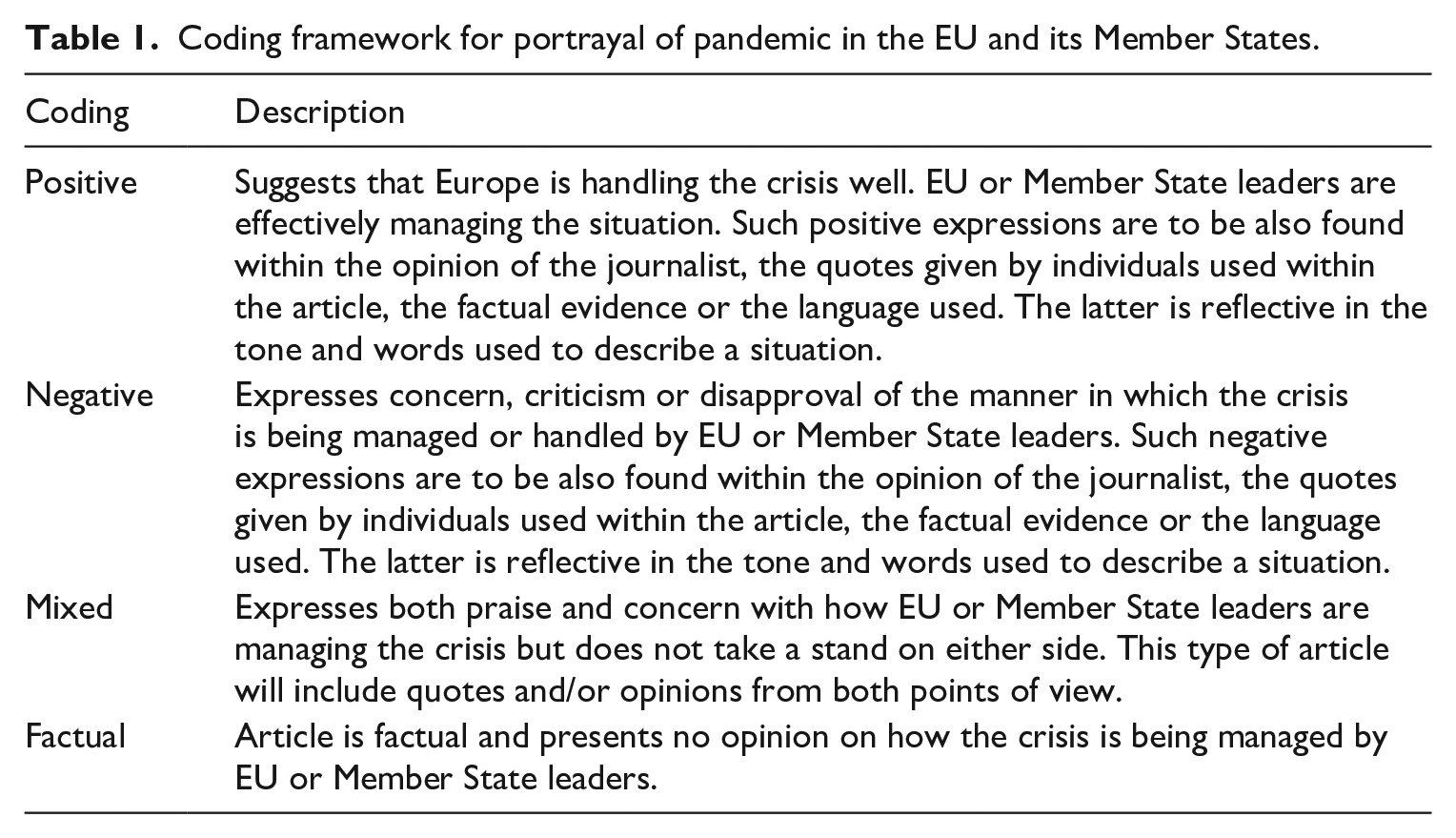
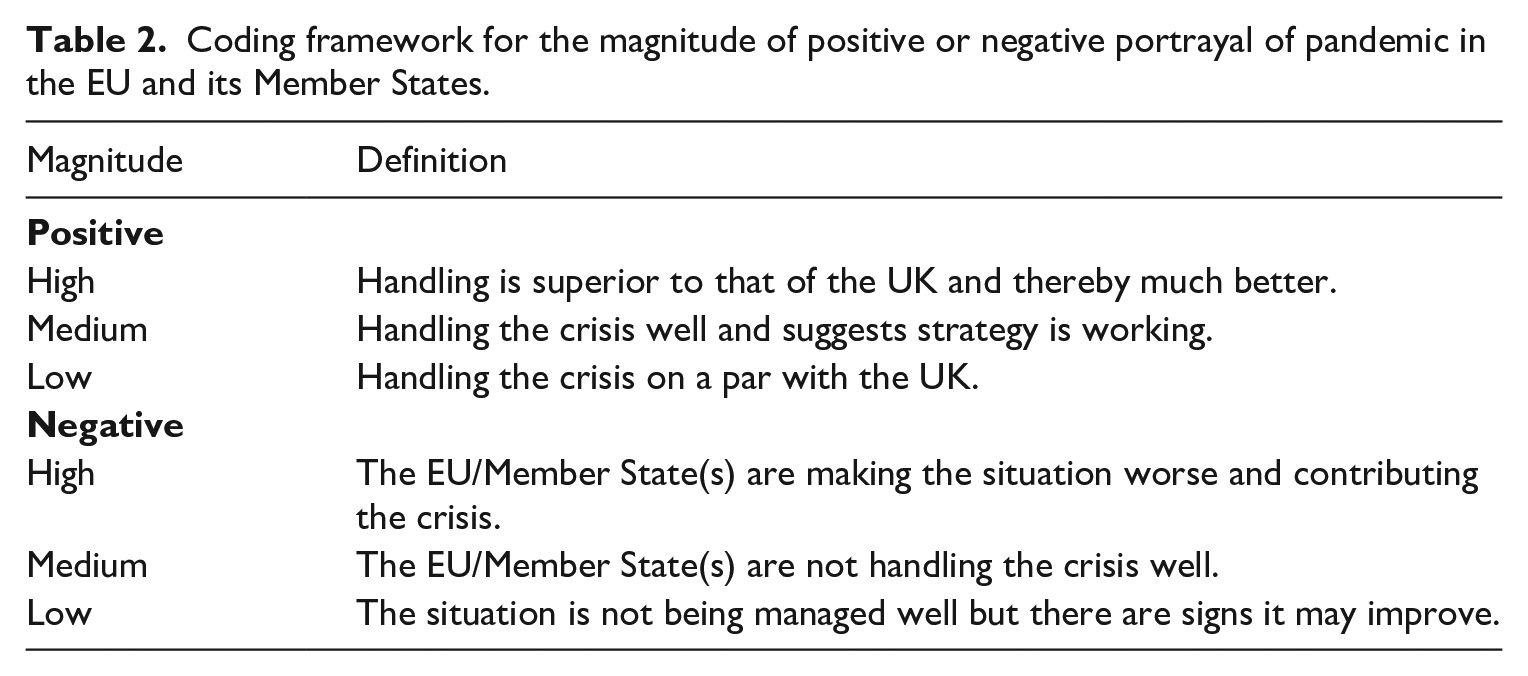
To analyse the political impact of COVID-19 and its longer term political implications for Euroscepticism in the UK, we adopt a mixed-method approach to the dataset. The first stage – content analysis – enables the condensing of qualitative data (1114 newspaper articles) into smaller analysable units through the creation of categories and concepts derived from the data (Lockyer, 2004) and is comprised of two parts. The first involves categorising the portrayal of the handling of the crisis in terms of the views expressed by the journalist or individuals quoted within the article (positively, negatively, mixed or factual). To provide greater depth to the analysis the second part captures the intensity with which a positive or negative portrayal is made (high, medium, low). This enables the analysis to broadly capture the emotive reporting within the articles, an important feature of UK newspaper media reporting (Zappettini et al., 2021). After constructing the framework it was applied to a pilot test and subsequently amended as necessary (see Gibbs, 2007: 44–46). These categories are summarised in Tables 1 and 2. To reduce the level of subjectivity in the dataset, increase consistency and to improve intercoder reliability, both authors were involved in the classification of the newspaper articles and took the lead on individual newspapers. To ensure we were applying the framework in an identical way, we consulted each other on difficult cases and cross-checked completed datasets.
Coding framework for portrayal of pandemic in the EU and its Member States.
Coding framework for the magnitude of positive or negative portrayal of pandemic in the EU and its Member States.
The second stage – critical discourse analysis – is also comprised of two parts and explores the main topics that emerge from the data and the interrelated discursive shifts. Within this stage we solely focused on editorials and comments within our dataset, as they represent the main arena to explore the resemioticisation of discourses facing a new critical-political juncture. We consider discourse as the terrain in which there is the reproducing and/or misrepresenting of society (Fairclough and Wodak, 1997), while the political field is conceived at the intersection between narration of the present and recontextualisation of the past (Sträth, 2006). Editorials and comments have historically played a central role in the construction of the Eurosceptic discourse (Anderson and Weymouth, 1999), especially during the EU referendum (Firmstone, 2016), and still contribute to the rearticulation of the Brexit discourse (Rawlinson, 2019). Within the context of the media’s impact on political discourse, editorials and comments represent a newspaper’s collective opinion as they possess the important and consequential power of reinforcing a position and have significant implications for the public perception of salient political issues (Gavin, 2018). The purpose is thus to provide a more fine-grained analysis of discourses and their process of resemioticisation to complement the broader patterning observed in the content analysis. We therefore outline the topics, the narratives, and discursive dynamics employed to make the reporting trends salient in the public sphere. The assessment is event-specific and argumentation-oriented aimed at circumscribing the key-topics and discursive strategies for the two time periods of the dataset. The first part identifies the key discursive themes, the articulation of discourses in the text (process of topicalisation; cf. Fairclough, 2013), and the argumentation strategies (e.g. de/legitimation; cf. Zappettini, 2019) that are developed to report the EU-UK vis-à-vis the pandemic. The second part integrates and compares the analysis by isolating the processes of intertwining of topics, enactment and recontextualisation of discourses (interdiscursivity; cf. Krzyżanowski, 2010; Wodak et al., 2009 [1999]) by utilising the methodological pathway of the ‘discourse-conceptual analysis’ (Krzyżanowski and Wodak, 2011). The topicalisation of press discourses is conducted via an interdiscursivity matrix which lays emphasis on the reorientation of Euroscepticism, on one hand, and the resemioticisation of the Brexit question, on the other hand (Figure 1).
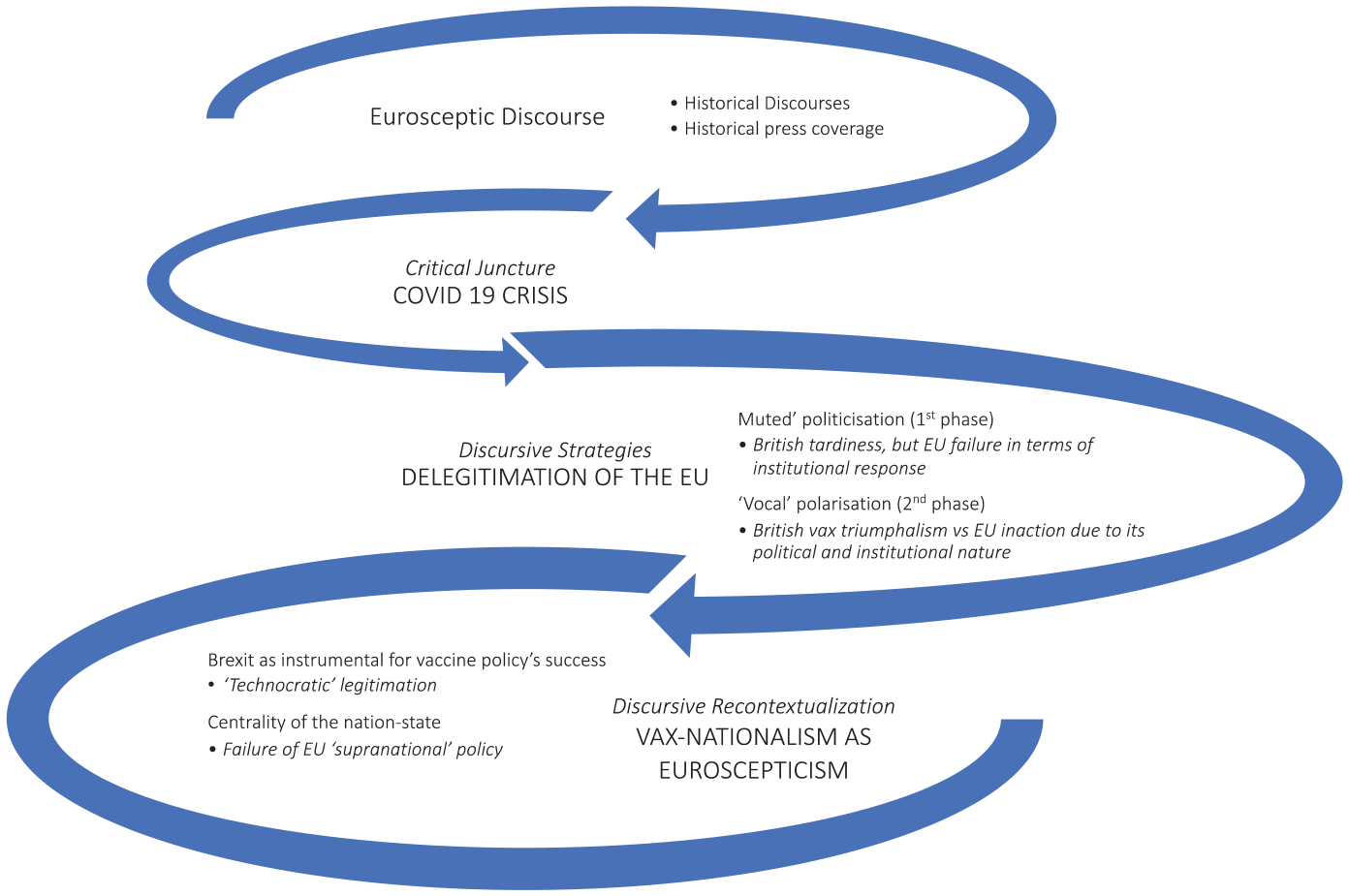
Interdiscursivity.
Results: Content analysis
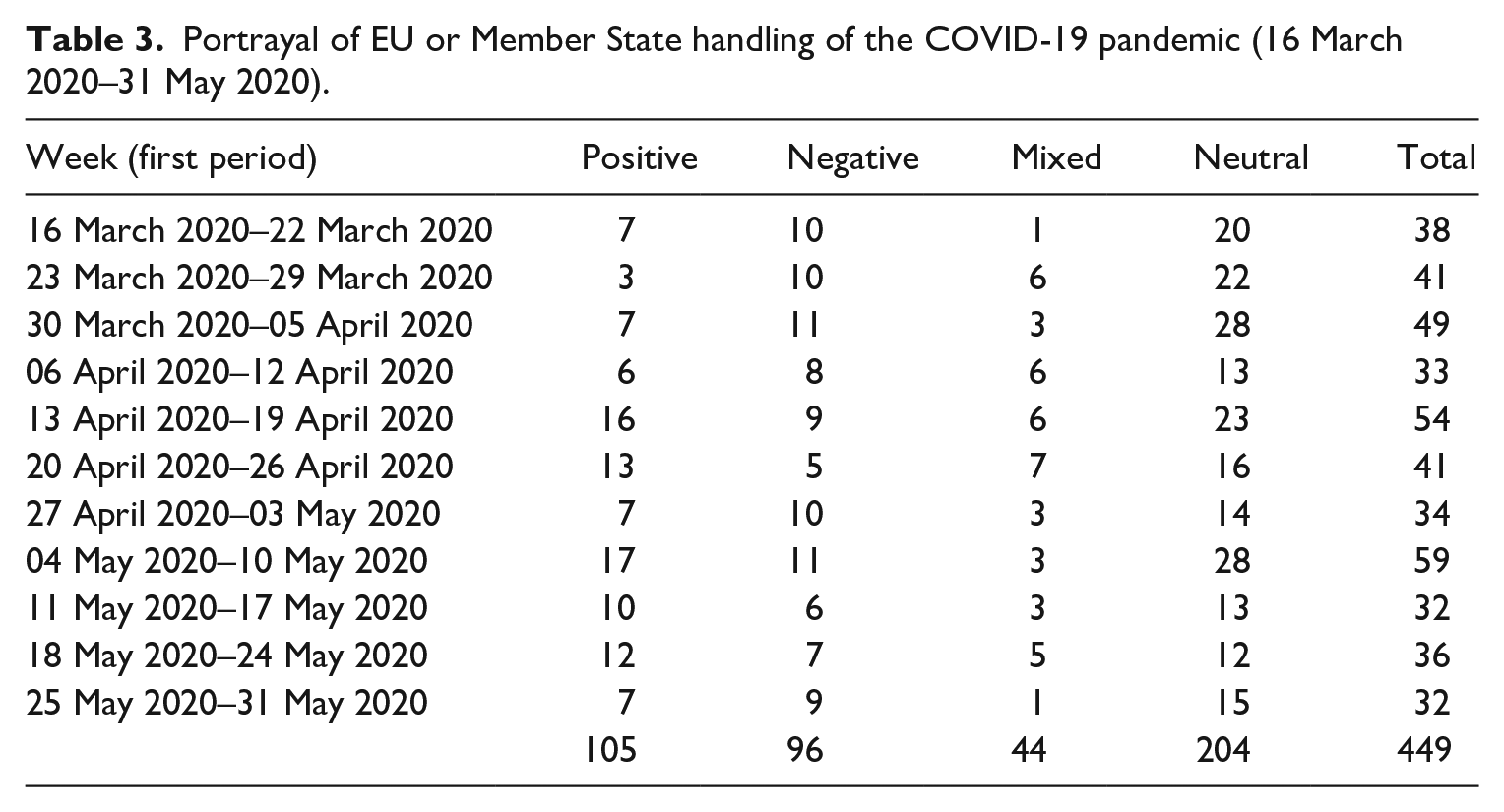
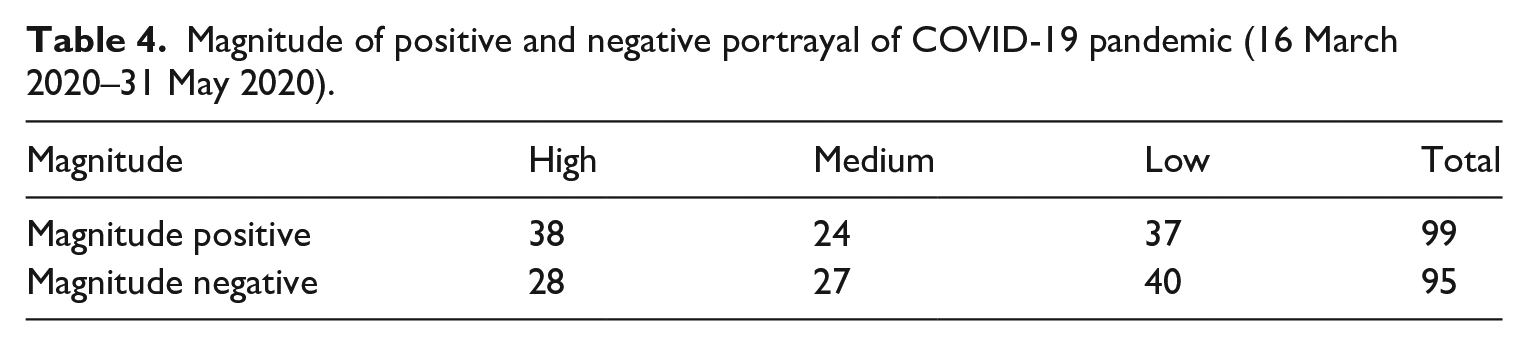
Taking into account the analysis of press coverage, two different styles of reporting can be identified for the two periods. During the first period, despite evidence from Italy and Spain of the seriousness of the virus, the UK was late to lockdown and hesitated in its plan to manage COVID-19. The government appeared to be unprepared, particularly in the context of adequate testing and the provision of personal protective equipment (PPE) for healthcare workers, including those working in care homes. The overall result for the UK was one of the highest death rates in Europe, although it did not have the highest infection rate. Despite the mounting evidence against the UK Government’s response to the crisis and the better handling within its EU neighbours, newspaper reporting on the situation was muted. The reporting was either factual or balanced by a spread of articles within the respective newspapers in which equal criticism was given to both the UK and the EU. The overall result (from Table 3) illustrates that rather than criticising the UK’s approach and the relative success of its neighbours, UK newspapers predominantly emphasised factual reporting (204 in total). Positive and negative reporting was almost evenly split (105 vs 96 in total), while mixed or balanced reporting was the least (44 in total). Chart 1 illustrates the percentage of articles for each week within the time period based on their reporting of the crisis. With the exception of the week commencing 18 May 2020 when positive and factual reporting was equal, factual reporting dominated newspaper coverage. The overall result was to downplay both the negative situation in the UK and the relatively better situations across the EU and its Member States. The second stage of the coding framework is further supportive of the finding. The magnitude of the positive and negative press reporting (high, medium, low) was pretty evenly split, further demonstrating the somewhat muted tone of the UK press when things are going better on the Continent relative to the UK (Table 4). A final point to note is that positive and negative reporting was evenly spread across the newspapers, including the more pro-remain newspapers, The Guardian and The Mirror.
Portrayal of EU or Member State handling of the COVID-19 pandemic (16 March 2020–31 May 2020).
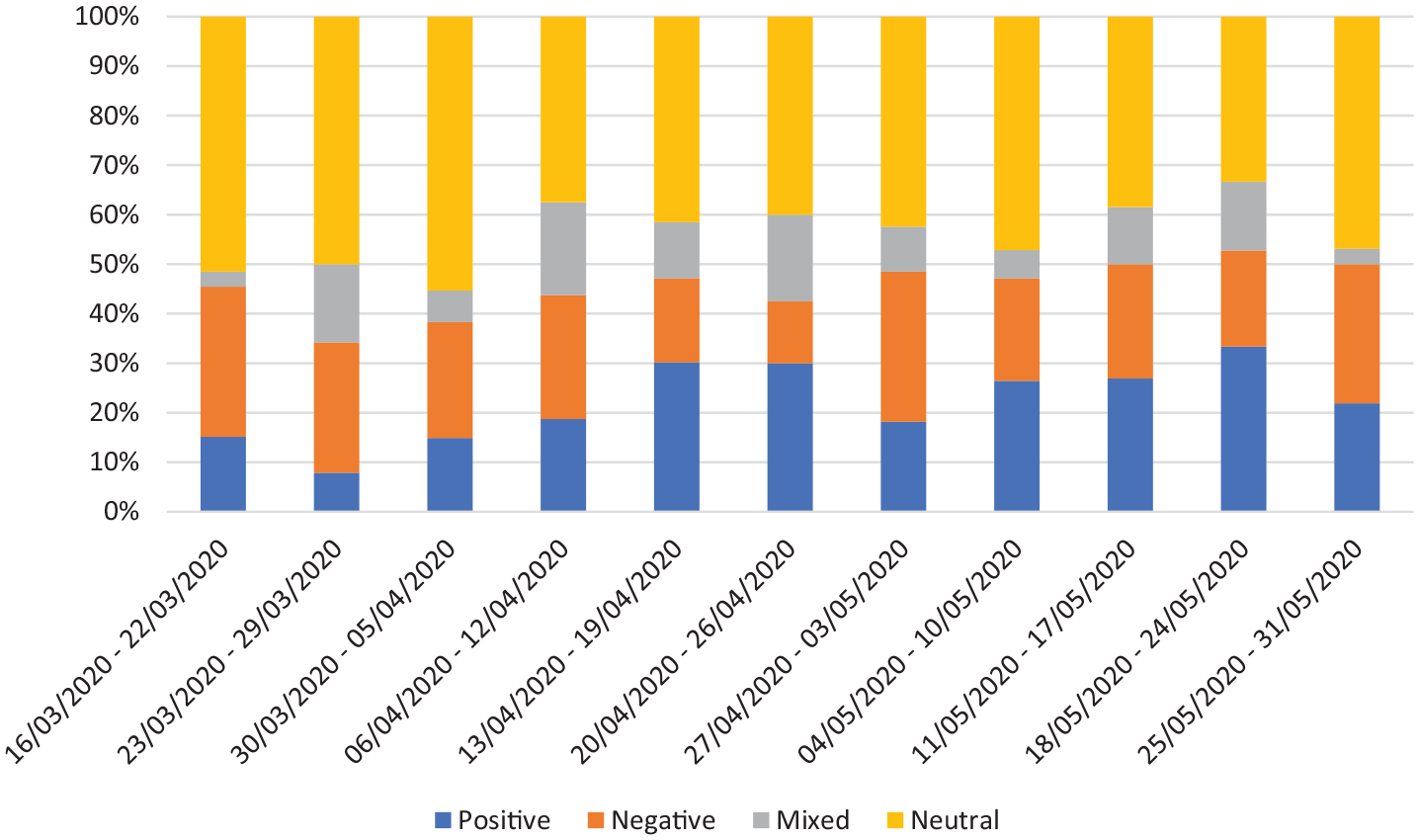
Portrayal of EU or Member State handling of the COVID-19 pandemic as a percentage (16 March 2020–31 May 2020).
Magnitude of positive and negative portrayal of COVID-19 pandemic (16 March 2020–31 May 2020).
The second period reveals a very different style of reporting by UK newspapers. By the middle of January 2021 the UK was moving forward with its vaccination programme, having been the first European country to approve the Pfizer and AstraZeneca vaccines. This contrasted with the EU, which approved both vaccines later and had limited supply of the AstraZeneca vaccine. Relations between London and Brussels soured when the EU argued that the shortfall in AstraZeneca’s supply should be addressed by AstraZeneca factories based in the UK. The national press was quick to respond to the fallout and shifted its reporting to an overwhelming negative response to developments in the EU with negative reporting featured in all of the newspapers. As illustrated in Table 5, some 145 or 71% of the articles were negative. Throughout the 3-week period only two of the articles reported developments within the EU and its Member States positively (one in the Guardian and the other in the Telegraph) and 58 articles or 28% were factual. When it came to the magnitude of the negative reporting, just over half of the articles or 54% adopted a highly critical position regarding developments in the EU and its Member States, 17 or 12% were medium and 50 or 34% of the articles were low-level criticism (see Table 6 and Chart 2).
Portrayal of EU or Member State handling of the COVID-19 pandemic (18 January 2021–1 February 2021).
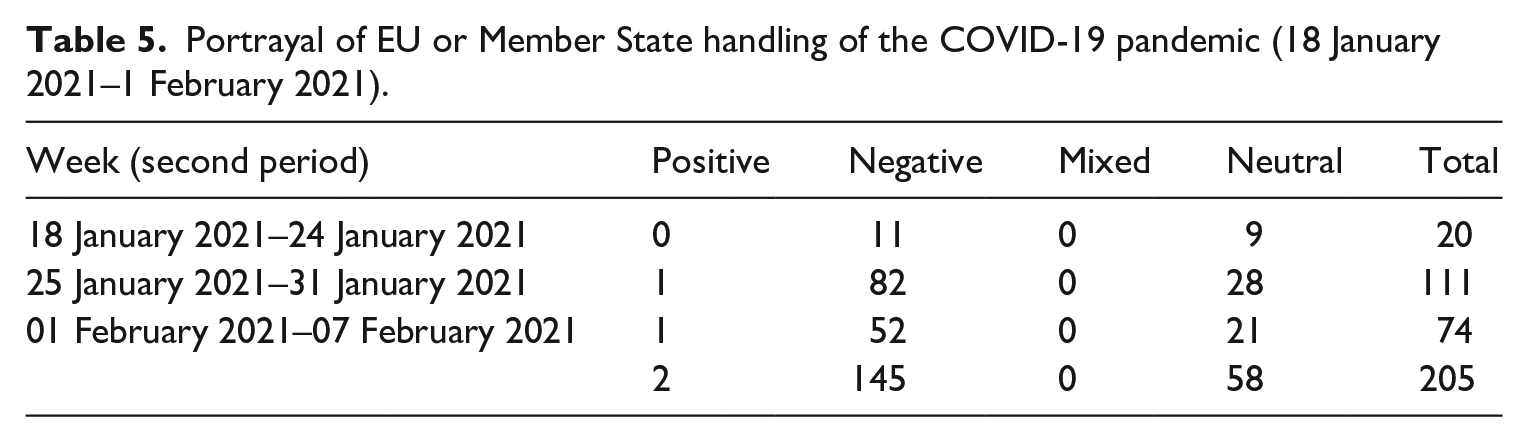
Magnitude of positive and negative portrayal of COVID-19 pandemic (18 January 2021–7 February 2021).

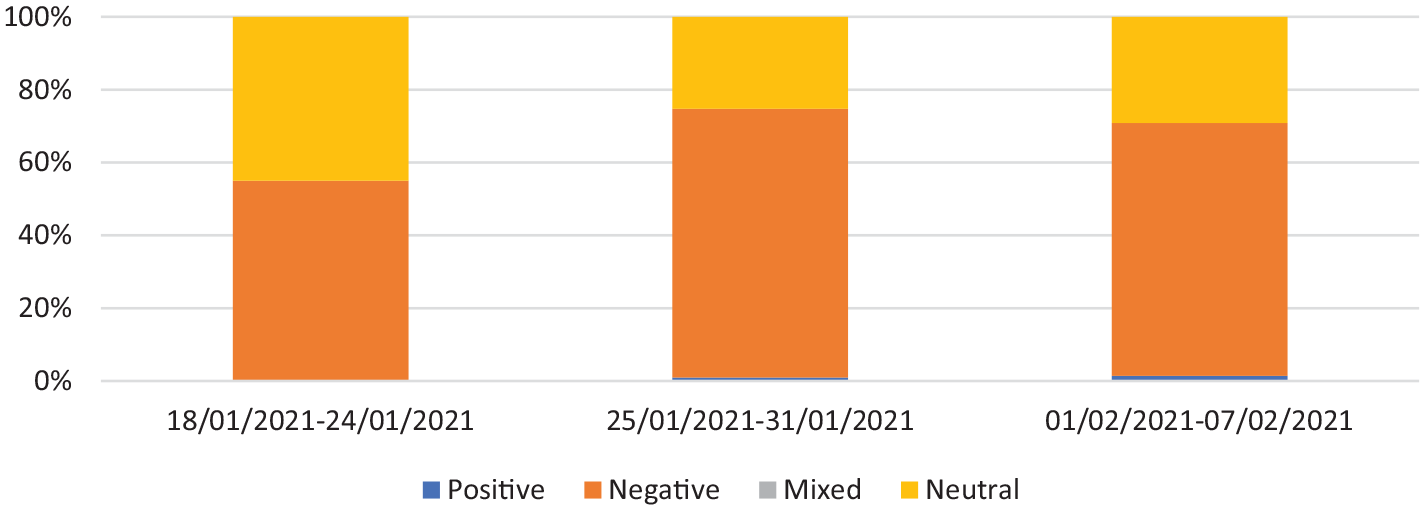
Portrayal of EU or Member State handling of the COVID-19 pandemic as a percentage (18 January 2021–07 February 2021).
Results: Discourse analysis
‘Muted’ politicisation (from 16 March 2020 to 2 June 2020)
Looking at newspaper coverage, at first the pandemic crisis in Europe was reported as ‘a warning’ (Daily Telegraph, 21 March 2020), especially with reference to the dramatic situation in Italy, the first European country affected by the diffusion of the virus which proclaimed a strict lockdown from 9 March (Guardian, 14 April 2020). However, when the situation worsened and almost all European governments implemented stricter measures and stringent rules of self-isolation, the confrontation between the UK’s late response and the European Member States’ reaction became more frequent, with a change of tone which culminated in openly calling for more rigorous policies (Telegraph, 12 April 2020; Metro, 7 May 2020), denouncing ‘UK stupidity’ (Guardian, 6 May 2020) which, accordingly with The Times, had given to the British people ‘the worst of both worlds’: health and economic crisis at the same time (12 May 2020).
The country that performed better was Germany: a total of 14 editorials were dedicated to Germany’s response considered a ‘model’ (Daily Mirror, 23 May 2020). The British Government was described as ‘lag[ging] behind [. . .] from testing to hospital beds, from small business to plotting a path out of lockdown’ (Daily Mail, 21 April 2020), while Germany’s ‘proactive stance and stricter guideline’ (Times, 4 May 2020) was putting ‘the UK to shame’ (Guardian, 22 April 2020). The no-lockdown policy of the Swedish Government aimed to avoid an economic crisis and represented a potential alternative model (Telegraph, 24 May 2020); but after the Swedish U-turn, the beacon of Nordic effectiveness went to the more conventional response chosen by Denmark (Sunday Times, 17 May 2020). Even the Mediterranean countries acted more competently than the UK: Greece was ‘beating coronavirus despite a decade of debts’ (Guardian, 15 April 2020); the French Sécu (social and medical system) was described as actually reliable in contrast to the ‘British romanticisation of [the] health system’ (Daily Telegraph, 2 May 2020); and Italian and Spanish discipline during the lockdown was celebrated as a fundamental contribution to the national effort (Guardian 14 April 2020; Telegraph, 4 May 2020, and 18 May 2020). The style of reporting was initially based on balanced commentaries and turned to criticism of the UK, albeit factual reporting still dominated the coverage. When it came to the EU itself, a pattern of ‘muted’ (i.e. concealed and indirect) politicisation appears evident. Noticeable in this regard is that while the confrontation between the UK and the European states praised the single country’s response versus the incompetent British Government’s performance, the coverage of the EU’s reaction to the pandemic was in contrast reported as a complete failure, reproposing the discursive elements of the long-established Eurocriticism of the British press (Copeland and Copsey, 2017; Daddow, 2004).
The first and straightforward level of the process of discursive rearticulation was the economic crisis which would inevitably follow the pandemic: while the effectiveness of the policies put forward was a responsibility of each single Member State which implemented them, as outlined above, contrariwise the accountability for the economic crisis would be inevitably the EU’s liability (Daily Mail, 7 May 2020). ‘The whole European edifice – accordingly with The Daily Telegraph – risks losing its raison d’etre’ due to ‘the unstoppable centrifugal consequences’ injected by COVID-19, which shows ‘the EU’s fragility’ (1 April 2020) corresponding with the ‘Eurozone’ (Daily Telegraph, 3 April 2020; Daily Mail, 7 May 2020). The tension between the Northern and Southern Member States threatened ‘to erase’ the EU (Times, 10 April 2020) by putting the European project into ‘intensive care’ (Daily Telegraph, 9 May 2020) or by further boosting ‘anti-EU populists’ and ‘reshaping the continent in dangerous ways’ (Guardian 14 May 2020). The EU’s failure was perceived as intrinsically linked with the ‘nature’ of the European project. While for the Eurosceptic right-wing press the supranational dimension is to be blamed (Telegraph, 14 April 2020; Sun, 21 May 2020; Daily Mail, 30 May 2020), for the more sympathetic press such as The Guardian, COVID-19 has undeniably exposed the lack of solidarity in the European project (24 April 2020; 28 April 2020; 11 May 2020; 25 May 2020). In both cases, the recontextualisation of the pandemic discourse points to the EU as the final recipient of ‘equal criticism’, reproposing and reinforcing the historic British Eurosceptic discourse (Kopecký and Mudde, 2002).
This process of recontextualisation was also evident in the use of wartime analogies and rhetoric. Employing military metaphors as a discursive strategy in representing the challenges to be faced is a well-documented practice (Abdel-Raheem, 2021; Panzeri et al., 2021). Within British political discourse this was translated in metaphors such as ‘conquer the Covid’ (Daily Telegraph, 8 May 2020), ‘Spirit of 45’ and ‘war time spirit’ (Times, 1 April 2020) climaxing in the ‘Protect the NHS’ campaign (McCormick, 2020). The war time military rhetoric concentrated on a generic appeal to the nation’s effort and was mirrored in analogies such as ‘health professionals, doctors, nurses and care workers [were] the front line’ (Daily Telegraph, 8 May 2020). By contrast, the EU’s supranational character was paralleled to historical dissolutions of previous, broadly conceived, internationalist experiences and ‘their failure’: Coronavirus has sent the European project into intensive care. It may eventually struggle back, but it will be an altogether more feeble entity. The League of Nations, after all, limped on for further 13 years after its effective destruction in 1933, when Germany and Japan withdrew. So, likewise, the EU may continue to survive rather as the late Holy Roman Empire survived – a shell, a title, a memory. But, whatever happens, the nation-state is back. (Daily Telegraph, 9 May 2020)
It is worth highlighting that in this phase Brexit was not part of the pandemic discourse. Clearly, it interacted with the coverage of the Covid-19 crisis, especially with reference to the end of the transition period and the request for a further extension (Guardian, 4 April 2020; 19 April 2020; 3 May 2020; Times, 22 April 2020; Sunday Times, 2 May 2021), yet upholding the usual perspective of factual (i.e. presumed unbiased) reporting. Overall, the comments reproduced the well-documented press partisanship: The Guardian stressed that the coronavirus crisis exposed ‘how pointless the Brexit cause is’ (1 April 2020), while for The Daily Telegraph the refusal to extend the Brexit transition period was based on the consideration that ‘the EU will demand ‘massive’ payments to help deal with the impact of the Covid-19 pandemic’ (19 April 2020) and for the Daily Mirror it will be worse than ‘the coronavirus induced recession’ (17 April 2020).
‘Vocal’ polarisation (from 18 January 2021 to 8 February 2020)
The second timeframe of our analysis corresponds with the beginning of the mass vaccination programme in the UK, the end of the transition period, and the UK’s formal departure from the EU on 1 January 2021. While these two events are unrelated, in terms of discursive interactions, the finality of Brexit was a background issue and was engaged with during a process of the recontextualisation (Krzyżanowski, 2016) of the UK–EU relationship vis-à-vis the pandemic coverage. With the General Election of 2019 and the compelling victory of Boris Johnson’s Conservative Party under the ‘Get Brexit Done’ slogan (cf. Tormey, 2020), the issue that had tormented British politics since 2016 appeared to be settled (Prosser, 2021). This moment of verbose univocity was interrupted by the outbreak of the pandemic and vexed by the Government’s inaction. In January 2021, however, this picture was completely turned upside down by the UK approving the vaccination programme before other European countries and in this context, Brexit assumed a new and distinctive discursive significance.
During the second time period Brexit became prominent. While in the first period The Daily Telegraph had already spoken of a clean Brexit as a ‘positive’ consequence of the crisis (9 May 2020; 13 May 2020), during the second period ‘vocal’ polarisation initiated a confrontation between the EU’s tardiness versus the rapidity and resolution that the UK Government had shown. Or, to use a Guardian headline, the clash between the UK as the ‘Covid vaccine ‘speedboat’ compared with the EU ‘tanker’’ (5 February 2021). The winner of the ‘vaccine battle’ was this time a very ‘vaccine-confident’ Britain which as early as the end of January, accordingly with The Daily Telegraph, had already seen ‘a surge in holiday bookings for the summer’ (23 January 2021). The climax of Brexit was a bombastic British ‘vaccine triumphalism’ which directed the pandemic discourse of newspapers by reiterating the antagonism of EU ‘failure’ already enacted in the first period (Guardian, 27 January 2021; Metro, 27 January 2021; Sun, 27 January 2021; Daily Telegraph, 29 January 2021). Apart from the still ‘relative success story’ of Germany (Guardian, 26 January 2021), the ‘UK’s vaccine gamble had paid off’ (Daily Telegraph, 27 February 2021) and the verdict was incontrovertible: ‘Face it, we’ve done jabs roll-out better’ (Metro, 29 January 2021) up to the point where ‘Britain vaccine victory will boost the stock market’ (Daily Telegraph, April 2021) and a ‘buoyant Britain can give the world a boost’ (Daily Mail, 1 February 2021) but indeed ‘pivots to the new frontiers’ by being generous with the EU: ‘We have a national interest – The Daily Mail remarked – in seeing the EU overcome its immunisation roadblocks’ (6 February 2021; also Daily Telegraph, 29 January 2021). Even when factual the style of reporting reveals a hidden sense of revenge: ‘Brexit is done. We don’t need to bait Brussels’ (Guardian, 31 January 2021).
The war analogies employed to support the unprecedented challenge the NHS had faced in the Spring of 2020, were in the second phase ‘ill-used’ to describe the implementation of a fundamental health policy, culminating in the ‘vaccine war’ over the supply of the serum and its shortage in Europe (Daily Mail, 27 January 2021; Daily Telegraph, 28 January 2021; Guardian, 28 January 2021). This was unequivocally described by The Times as ‘a battle against Britain’ (30 January 2021). The EU ‘vaccine fiasco’ was either depicted as a political failure – ‘Thanks God they weren’t in charge’ (Daily Mail, 30 January 2021) – and as an ‘institutional failure’ (Daily Telegraph, 27 January 2021) as well as a lack of leadership – ‘Shame on EU leaders’ (Daily Telegraph, 30 January 2021; also Sunday Mirror, 31 January 2021). While during the first period the dyad of the UK–EU confrontation had been ‘action/inaction’ in relation to the governance of the pandemic, in the second timeframe the process of polarisation was further exposed through a distinctive antagonistic language which, in some cases, recovered distorted and overstated historical analogies such as ‘vaccine Cold war’ (Daily Telegraph, 30 January 2021), ‘vaccine protectionism’ (Times, 26 January 2021), ‘vaccine global scramble’ (Times, 27 January 2021). Crucially, this chain of discursive rearticulations has combined and compounded to sustain a process of polarised recontextualisation which instrumentally opened the door for the Brexit argument. According to The Times, the ‘success on vaccine’ had shown how ‘Britain can prosper outside the European Union’ (8 February 2021) whereas for The Daily Telegraph ‘the EU’s chaotic vaccine programme has reinforced the case for Brexit’ (1 February 2021); indeed ‘like a dream come true’ (30 January 2021). Conversely, whether ‘the vaccine supply row has split EU’s solidarity’ (Times, 27 January 2021) and the ‘hardcore remainers are now going through the five stages of grief’ (Daily Telegraph, 2 February 2021), being a ‘revelatory crisis for Brussels’ and showing the ‘democratic deficit at the heart of the EU’ (Daily Telegraph, 31 January 2021), even for The Guardian, which applied the same headline used by The Daily Mail, though from opposite perspective, the EU’s vaccine crisis has represented ‘the best advert for Brexit’ (respectively, 31 January 2021 and 28 January 2021).
‘Vaccine nationalism’ as a form of Euroscepticism: The interdiscursivity matrix
The final stage of our study investigates how the discursive strategies of delegitimising the EU enacted by the new critical juncture, the COVID-19 crisis, in both periods were repositioned and reordered into a new discursive nexus. The process of resemioticisation of topics and discourses evolved upon a context situated between Euroscepticism and Brexit, which combined and compounded to form a recontextualised of Euroscepticism whose new signifier we term ‘vaccine nationalism’ (Figure 1). The process of the recontextualisation of topics into a new discursive matrix emerged first, on the fringe of the well-established Eurosceptic discourse within the context of factual reporting (Table 3), and from a phase of muted politicisation, which gradually climbed up the discursive field to reach a stage of vocal polarisation (Table 5). The discursive strategies performed in both phases were built upon a hostile confrontation between Britain and the EU (Charts 1 and 2) and the terms of the opposition were the supranational institutional and political nature of the EU. The first phase was characterised by a discursive progression of not explicit politicisation (Table 4) which de facto replicated the traditional Eurosceptic argument and newspaper discourse: although the British tardiness to react to the pandemic was acknowledge and highly criticised, the response of the EU to the COVID-19 crisis was nevertheless considered an institutional failure in light of the absence of a coordinated policy and due to the fact that the single Member States acted alone. In the second phase the dyad Britain–EU was mirrored through the discursive lens of the vaccine: the British triumphalist discourse reinforced again the argument of the institutional failure due to the EU’s inaction and slowness to implement a vaccine policy (Table 6). In both phases the process of recontextualisation was not only a relocation of arguments and antagonism across the spatio-temporal level but also a repositioning of discourse prioritisations. Initially presented as patriotic and later as nationalist, the resemioticisation of the Britain-EU dyad vis-à-vis COVID-19 was further intensified by the military analogies and war rhetoric used to describe the apex of the crisis (phase 1) and eventually engaged with the question of Brexit (phase 2). In this process, Brexit was resemioticised as a supposed ‘neutral litmus test’: in relation to the EU’s institutional framework, Brexit acted as a ‘technocratic legitimation’ to support the vaccine policy’s success vis-à-vis the EU’s supranational nature; at the same time, as having been instrumental in that policy’s success, Brexit emphasised the centrality of the nation-state and therefore the failure of the EU (or any) supranational politics. This dynamic was an act of ideological formation within the framework of a new critical juncture – the pandemic – which accelerated the institutionalisation of specific British newspapers’ attitudes towards Europe while, at the same time, recontextualising old topics.
The first discursive trajectory was the process of resemioticising Brexit as an objective and verifiable instrument, thus perceived as a ‘technocratic’ strategy which, by keeping separate ‘vaccine production and politics’ (Example 1), made possible the success of the vaccination policy in the UK vis-à-vis Brussels. In this sense, the recontextualisation of Brexit can be seen as a form of ‘technocratic legitimation’ (Examples 2 and 9) that emphasises unmediated and unilateral decision based on efficiency and meritocracy (cf. Bickerton and Accetti, 2021).
Example 1
Brexit supporters probably will not be gifted a better argument for leaving the European Union than the bloc’s botched vaccine rollout. Not only is it a risposte to doubters of the UK’s competence on tackling Covid 19 [. . .], it is also an example of why the UK should do things differently to the EU. [. . .] This is doubly important for ministers because proving that the UK can benefit from divergence has been one of the hardest arguments to win since the referendum. Bound up as these decisions were with the shape of the post-Brexit rulebook, the advantages to be gained from regulatory divergence were difficult to discern until a deal was struck. [. . .] The challenge now is to make sure that vaccine policy is not the exception that proves the rule and that divergence amounts to much more than crude regulation. Instead, it is about doing things differently to do them better. (Times, 8 February 2021)
Example 2
Ursula von der Leyen accidentally makes the case for Brexit as she tries to explain EU vaccine delays. [. . .] She admitted that the bloc of 27 countries took longer to make decisions over contracts for Covid 19 jabs than a single country would. (Daily Telegraph, 5 April 2021)
The second trajectory refers to the outcome of the discursive relocation of the EU–UK pandemic confrontation which re-enacted a more conventional facet of Eurosceptic discourses by reclaiming the supremacy of the nation-state (Example 3) as opposed to the failure of the EU’s ‘spiteful vaccine supranationalism’ (Times, 27 January 2021). In this sense, ‘vaccine-nationalism’ can be seen as a form of shifted Euroscepticism (Examples 4 and 5).
Example 3
If nothing else, the Coronavirus crisis has brought into sharp focus the pre-eminence of the nation state in trying times and the impotence of the European Union. [. . .] If the EU rules had been applied, the NHS would have been more unprepared and ill-equipped and lots more people would have died. [. . .] We need the maximum freedom to implement measures now, for recovery and growth that suit us, not the lowest common denominator of EU countries, nor what is best for France and Germany. (Daily Telegraph, 20 April 2020)
Example 4
For when historians pore over the Covid pandemic, they will surely conclude this is one area where otherwise much-maligned Government took on the cynics and naysayers and, as the old saying goes, knocked it out of the park. Our vaccine scheme is, in fact, a historic success story that will provide not just a literal shot in the arm to millions of Britons, but proverbial one to our post-Brexit pharmaceutical and biotech industries, as well as our standing on the international stage. This was no happy accident. For it stemmed from a series of crucial decisions that were taken under immense pressure. (Daily Mail, 30 January 2021)
Example 5
We’ve got the vaccine, so why care about costlier EU trinkets? [. . .] it’s been a tough week for the enemies of Brexit, watching as the EU’s second-rate politicians scrap over vaccine consignments. [. . .] If anything good comes out of this drama, it will hopefully be a bit of national togetherness in our collective fury. (Sunday Times, 31 January 2021)
The emergence of new patriotic discourses during the pandemic is not restricted to the UK (cf. Elias et al., 2021; Woods et al., 2020; Zhao, 2021), but in a UK context resulted in the fetishisation of the NHS as the ideological axis around which government policy and pandemic communication rotated. The newspaper reporting embraced and celebrated the NHS’s effort and virtuousness both in the first period by reiterating the trope ‘Stay at home. Protect the NHS. Save lives’ and in the second timeframe as a central element of the vaccine triumphalism (see for a paradigmatic summary: ‘I owe them my life’ – Boris Johnson pays tribute to NHS staff, Guardian, 12 April 2020). The combination of the NHS’s celebration with the ‘opportunity’ offered by Brexit, as propagandised by the government, assumed a recontextualised significance by reproposing the ambivalence between patriotism, understood as a positive sentiment of belonging and protection, versus nationalism, considered as an assertive doctrine of greater or lesser aggressive defence of sovereign interests (Example 5). A historical–ideological tension that has constantly characterised British (and other) Eurosceptic discourses (Gifford, 2015; Van Der Zwet et al., 2020), which finds in the pandemic crisis a new discursive terrain for escalating (Example 4). Although vaccine nationalism might refer to a ‘Trumpian kind of response to the issue, demanding My country first!’, nonetheless ‘there is a moral argument for prioritising its own people’ (Guardian, 1 February 2021); hence, if this attitude might be undoubtedly labelled as a new form of ‘nationalism’, Britons should be ‘simply patriotic about our world-beating vaccines’ (Times (27 January 2021). Clearly, by intertwining Brexit with the NHS totem and the discourse of Euroscepticism with that of the NHS, the focus shifted towards evident identarian constructions defined by ‘us versus them’ propositional structures such as ‘our vaccine versus EU failure’ (Daily Telegraph, 1 February 2021) or ‘our NHS versus EU Commission’ (Guardian, 7 February 2021) or ‘our pharmaceutical industry versus EU bureaucrats’ (Daily Mail, 1 February 2021). Here again, Brexit acted as a factual policy device contributing to the process of ‘technocratic’ legitimation (Examples 1 and 9), especially in relation with the pro-remain Scotland: ‘500,000 fewer Scots would have been vaccinated under EU scheme backed by SNP’, (Daily Telegraph, 4 February 2021).
The conceptual logic beyond the discursive strategies of delegitimising the EU ran parallel but contrary with the process of the legitimation of Brexit. The selective reproduction of its meaning ‘translated’ both the politicisation’s and polarisation’s dynamics (first and second periods analysed) into a matrix of self-reinforcing interchangeable constructs which subsidised a recontextualised shape of Euroscepticism redefined through the COVID 19-vaccine dyad and a new notion of ‘effective’ Brexit (Examples 6, 7 and 8).
Example 6
There is a fundamental tension between the inescapably global nature of this disease and the desire of every government to ensure its citizens are not left behind in the battle for resources. [. . .] Despite the interconnectedness of today’s world, long supply chains look fragile in a crisis. Far better to have essential products continuously under national control. (Times, 27 January 2021)
Example 7
If it was the ‘ideology’ of Brexit that the UK is better off taking decisions by and for itself rather than in lock step with the European Commission and 27 other nations then that can take the credit for saving British lives. (Sunday Times, 31 January 2021)
Example 8
Driven mad by Britain’s stratospheric vaccine success, the EU’s derangement must have deepened yesterday. For the UK has delivered a record 600,000 daily jabs against Covid. It was a fitting response to the EU Commission’s bullying. [. . .] on the anniversary of Brexit, doesn’t this saga illustrate perfectly why we were right to leave the neurotic, centralised bloc? Still there should be no triumphalism. [. . .] Many predict Brexit Britain would be a diminished nation. They are wrong. But we must not be complacent in proving we are an unmatched force for good. (Daily Mail, 1 February 2021)
Even The Guardian (7 February 2021), which had remained fiercely pro-Europe for both periods analysed in our study, finally surrendered, introjected the topoi and the pandemic discourse, and participated in constructing a new discursive Eurosceptic hegemony (Example 9).
Example 9
The desire for a pan-European approach to vaccine procurement and distribution was in essence right. [. . .] Both the dilatory procurement and risk-averse delivery strategy were self-made disasters, originating in a centralised federal mindset that does not work. [. . .] The commission should never have arrogated vaccine procurement and distribution to itself as if it were a Soviet planner. It has neither the expertise nor the experience.
Acknowledging Boris Johnson’s courage, who ‘under intense pressure, rolled the dice, secured an exclusive vaccine contract [. . .] before regulatory approval, to allow the building of UK vaccine production capacity’ and with the help of ‘a well-prepared NHS has rolled out the vaccinations with stunning efficiency’, The Guardian admitted that the EU should learn from ‘the “freedom” of Brexit’. The Brexit lesson must have taught the EU that its future lies in returning to its original solidaristic social-market oriented nature as ‘equally, whatever success Britain has in future will be because it, too, is finding its way to be “European”. Brexit’s destiny – the newspaper concluded – is to be a trigger for that realisations in both Britain and the Continent’.
As we have shown, the process of recontextualisation was triggered and accelerated first by the impact of the crisis, then by its perceived overcoming. Although the pandemic was far from being over at the end of the second period, a sense of denouement and resolution of the dramatic ‘Covid-crisis’ was palpable in the editorials and comments. Noticeably, the narration of a crisis has been central in the deployment of the Brexit discourse during the referendum campaign (Bennett, 2019) and, more generally, is a salient historical topos of British Eurosceptic discourse starting from the 1956 Suez crisis and especially in relation to the economic stagnation which framed both the decision to join the EU in 1973 (Daddow, 2004) and the 1975 first European referendum (Saunders, 2018). Structures and linguistic features as well as discursive representations of the concept of crisis are therefore at the core of current Euroscepticism, namely immigration, sovereignty or the welfare state, and have found new fertile ground when a health crisis reoriented the discourse.
Conclusion: A post-Covid post-Brexit Britain
The COVID-19 pandemic has provided a new fertile ground for the recontextualisation of UK Eurosceptic discourse. In analysing the relationship between the COVID-19 pandemic and Eurosceptic discourse the analysis adopted a two-stage mixed-method approach focusing on two different time periods within the crisis – the UK’s first lockdown (16 March–2 June 2020) and during the vaccine rollout (16 March–2 June 2020). The first stage involved a content analysis of UK newspaper articles for the two time periods to capture the type of reporting and the scale of its magnitude. The second stage involved identifying the main topics found within the two periods and via an interdiscursive analysis their resemioticisation into a new discursive matrix. The research draws attention to the significant role played by the media in the context of driving Euroscepticism in the UK (cf. Zappettini, 2021). In line with Hart et al. (2020) the analysis finds that the main discursive frames identified during the pandemic – politicisation and polarisation – correspond to those of the Brexit prism: from muted politicisation and polarisation (first period) to vocal politicisation/vaccine nationalism (second stage). Our content and discursive analyses reveal that during the first period, when the UK Government’s approach to handling the crisis was less successful than its European neighbours, the media praised developments within the EU Member States, but also attempted to downplay the differences between the two with factual reporting. When it came to the EU, however, the media attacked the supranational organisation and claimed it would not survive. During the second period, media reporting shifted to overwhelming praise the UK Government’s efforts in its vaccination programme, while heavily criticising the EU’s failure to deliver on its own programme. Within this process, the critical juncture represented by the COVID-19 crisis acted as the instrument upon which Euroscepticism has been recontextualised and resubstantiated. Our analysis has confirmed the shifting of Brexit from a vague and imaginary articulation prior to the crisis, to one in which Brexit was necessary to ensure the UK’s vaccination programme was a success (cf. Krzyżanowski, 2019). Brexit was increasingly perceived as a technocratic instrument that is essential for the future success of the UK and in this respect, the UK’s departure from the EU is a fait accompli which should not be challenged. The news media does not wish to engage in future considerations of the UK having a closer relationship with the EU than the current arrangements. Meanwhile, adhering to the recent body of literature on neo-nationalism (cf. Delanty, 2021) the episode also serves to demonstrate the patriotic drum-banging of British, but predominantly English nationalism, that will in the future, continue to present Brexit as an imaginary success, regardless of the material reality.
Footnotes
Funding
The author(s) disclosed receipt of the following financial support for the research, authorship and/or publication of this article: This project has gratefully received funding from QMUL’s School of Politics and International Relations and the Centre for European Research.
