




Abstract
In explaining the outcome of the 2016 EU referendum in the United Kingdom, can theories emphasizing the importance of economic factors be reconciled with the fact that many people appeared to vote against their economic self-interest? This article approaches this puzzle through case study research that draws on fieldwork and a process of reciprocal knowledge exchange with local communities in five local authorities in England and Wales. It argues that the Leave vote can be attributed partly to political discontent associated with trajectories of relative economic decline and deindustrialization. Building on the growing literature about the role of narratives and discourses in navigating uncertainty, it contends that these localized economic experiences, interpreted through local-level narratives, paved the way for local-level discourses of resilience and nationwide optimistic messaging about the economic impacts of Brexit to resonate. Local and national-level discourses discounting the potential economic costs of leaving the European Union played a crucial role in giving precise, somewhat paradoxical, political content to the sense of discontent. The article contributes to the growing focus on place and community in understanding political behavior and invites further research on local discourses linking macro-level trajectories and micro-level voting decisions.
The findings of most quantitative impact assessments of Brexit have been pessimistic. Brexit has been predicted to have negative effects on inflation, the income distribution, and living standards; on employment; on immigration; and on trade and GDP. 1 According to a cross-departmental analysis by Her Majesty’s Government, the accumulated impact of Brexit on UK GDP after fifteen years would range from −3.9 percent to −9.3 percent. 2 Moreover, a range of studies predict that the impacts of Brexit across UK regions and industries are likely to be asymmetric. Some expect Leave-voting areas to be hit the hardest by rising trade barriers, declining purchasing power, and the loss of EU funds. 3 A recent study showed that “areas of the UK that voted to leave the EU have suffered the biggest economic hit” as a result of the loss of household purchasing power and weak business investment since the 2016 referendum. 4 These findings pose a paradox for theories that explain the outcome of the 2016 referendum on the basis of economic factors. Why would economically motivated voters choose what was likely to be, by most scientific accounts, an economically damaging outcome?
We address this puzzle by analyzing different ways of thinking about the economic consequences of the 2016 referendum in five case study areas: Barnet, Ceredigion, Mansfield, Pendle, and Southampton. We draw on evidence collected via interviews and focus groups with local stakeholders, fieldwork, local news sources, and gray literature, conducted in the framework of the research project “Debating Brexit at the Local Level: A Mixed Methods Comparative Study.” While a range of quantitative studies have generated invaluable insights into the origins of the Brexit vote, 5 our focus on the puzzle of economically motivated, economically damaging voting in a small number of cases enabled us to examine context-specific configurations of variables. This design also allowed us to combine a macro-level analysis of long-term local economic trajectories with a micro-level analysis of how these trajectories are interpreted and translated into voting choices by individuals.
We argue that context-specific economic conditions and trajectories, especially relative economic decline, the spread of low-value-added business models, and the decline in the quality of infrastructure and public services, played an important role as determinants of the Leave vote. They did so not only by generating a widespread sense of political discontent but also by giving rise to defensive and nostalgic conceptions of local pride and narratives of blame toward outsiders. Such conceptions and narratives created a fertile ground for the emergence of a predominant local discourse about resilience in the face of crisis that resonated with national-level tropes about Brexit, leading local actors to play down the potential risks and overstate the expected benefits of leaving the European Union. The higher the degree of uncertainty over the type of impact that Brexit would have on the economy, the greater the impact of these discourses about resilience.
The article is structured as follows. In the next section, we situate our research in the literature and develop our theoretical argument. We then outline our case-study-based, participatory methodological approach. In the fourth section, we provide a brief overview of the demographic and socioeconomic realities characterizing each of our case studies. Next, we present the first part of our empirical evidence, showing how local economic trajectories of relative decline gave rise to both political discontent and to discourses of nostalgic pride and blame shifting. In section 6, we show that the discourses of nostalgic pride and blame shifting analyzed in the previous section created a fertile ground for the resonance of optimistic messages about the ability of local communities to cope with a potential crisis, helping to entrench discontent around the issue of Brexit. In section 7, we conclude.
Drawing on Local Predominant Discourses to Navigate Uncertainty: The Theoretical Argument
Given the negative economic forecasts by a range of experts and “Project Fear,” why would voters support the Leave option with its likely adverse consequences?
One potential answer is that Brexit was never about people’s economic situation. It was about their “basic outlook; whether they take a cosmopolitan or a more insular view of the world.” 6 Scholars have pointed to the importance of a shift in generational values, increasingly negative attitudes toward immigrants, and the prevalent perception of a loss of sovereignty. 7 However, this interpretation is contested by a number of prominent accounts that suggest that structural transformations inherent to globalization, the advance of the knowledge economy, and the adoption of neoliberal economic policies have created the circumstances that allow populist or antisystem politics to develop. 8 Recent developments have sought to move on from this debate by identifying the ways in which cultural and economic factors reinforce each other in driving such outcomes. 9
Our fieldwork findings support those developments as we identify context-specific ways in which economic and cultural sources of political discontent can intertwine. Specifically, we suggest that the experience of relative economic decline gives rise to feelings of frustration and neglect, defensive perceptions of local identity, and resentment against the most visible manifestations of changing economic models, which in turn fuel political discontent. Our argument builds on the growing interdisciplinary literature that emphasizes the importance of territorially unequal trajectories of development for today’s political cleavages. 10 Andrés Rodríguez-Pose influentially included Brexit as one of several populist voting outcomes across the world that reflected a revolt of the “places that don’t matter.” 11 Indeed, substantial spatial economic imbalances in the United Kingdom between the south and the north and between well-integrated cities and postindustrial towns have paved the way for geographically polarized voting behavior across the United Kingdom. 12 A decline in local housing markets and the relative vulnerability of certain areas to Chinese import competition contributed to localized economic stresses and resentments that fueled the Leave vote in certain areas. 13 After all, individuals draw conclusions about the state of “the national economy” via their proximate, local-level economic experiences. 14
Nevertheless, these observations only further contribute to our puzzle. If some form of economic deprivation, marginalization, or threat was a significant motivator of the Brexit vote, then why were the potential economic consequences of the antisystem outcome not a primary consideration for voters? In order to address this question, it is necessary to acknowledge the importance of uncertainty and the mediating role of discourses in translating political discontent into concrete voting behavior. The structural transformations associated with globalization and deindustrialization, and a concomitant emphasis on innovation and deregulation, have made the economy less predictable. 15 According to Richard Bronk and Wade Jacoby, in such uncertain political environments, individuals increasingly rely on a mixture of narratives and discourses about what the future might look like. 16 These act as heuristics that help actors navigate complex, uncertain environments by combining “various inputs from current and prior experience to produce impressionistic judgements.” 17 This context is fertile for populist actors who “invent future scenarios (such as the United Kingdom prospering more outside the EU’s Single Market than within) without facing the possibility of firm refutation.” 18
A number of studies point to the role of different nationwide discourses in shaping people’s long-term views about the European Union, as well as in mobilizing the public on issues within a short time period, as occurred during the campaign around the EU referendum. 19 Although such nationwide discourses about the European Union have undoubtedly played an important role in the United Kingdom, we argue that their varied resonance at different places cannot be understood without reference to local experience and local context. In some areas, specific experiences have created a fertile ground for particular nationwide discourses to gain traction, in interaction with locally specific discourses through the prism of which communities make sense of circumstantial change. 20 Outside the context of Brexit, Katherine Cramer and Benjamin Toff question the scholarly emphasis on the role of objective information in individual preference formation, as they demonstrate that citizens and political elites interpret facts “in relation to their own lives and with attention to their immediate social context.” 21 Even when economic circumstances are similar in two places, “trans-local messages about national conditions may be interpreted through local lenses that either exaggerate or discount the degree of threat and influence the attribution of responsibility.” 22
Indeed, a community’s history, economy, geography, and institutions “lash-up” into specific narratives and identities. 23 Local-level experiences of deindustrialization can be particularly influential, as they disrupt “industrial working-class senses of belonging, severing the social relations emerging from a network of manual work, social and political institutions and the home.” 24 In Cramer’s identification of a distinct rural consciousness in certain regions of Wisconsin, respondents explain their community’s relative deprivation through elite decision makers’ lack of understanding of their way of life. That perception manifests itself in a sense of injustice and alienation that fuels the resentment of community members toward nonrural others. In that way, despite the objective decline in their community, respondents are able to maintain a sense of local pride. Their deprivation is seen as “the fault of guilty and less deserving social groups, not as the product of broad social, economic and political forces.” 25
Jennifer Fitzgerald shows that beyond different areas’ material reality, the idea of community is also important in structuring support for antisystem outcomes. Fitzgerald distinguishes between individuals who feel strongly connected to their local community and individuals who actively participate in local community networks and organizations. 26 While Fitzgerald identifies a negative correlation between active community participation and voting for the radical right, individuals who only feel connected make up an important constituency for the radical right. 27 This is theorized on the basis that in “an increasingly homogeneous, high-tech world” in which many feel “disempowered, indistinct and unanchored,” individuals who feel strongly attached to their local community are attracted by nostalgic narratives about “a better time,” where “history [is] filtered through the rosy lens of memory.” 28 This idea is significant, as many of the communities that have come to support populist or antisystem parties and campaigns have experienced a decline in community institutions that generate such participation. For instance, Michael McQuarrie argues that the postindustrial Midwest became detached from the Democratic Party in the 2016 election because the economic decline of the region’s economy was followed by the more significant collapse in community institutions, including civic associations and trade unions, that had incorporated industrial communities into “the mainstream political life of the country.” 29
Building on these two strands of literature about the role of discourses in navigating uncertainty, on the one hand, and the socioeconomic origins of local predominant discourses, on the other, we examine how localized economic experiences were invoked by community stakeholders in recurring narratives. These narratives were utilized to make sense of the likely economic effects of Brexit, an inherently complex subject about which voters received conflicting messages from politicians and journalists, despite a large degree of expert consensus regarding their overall negative character. In particular, we argue that in a context of economic decline and deindustrialization, people’s need to belong to a group that “distinguishes them in a visible way and provides the basis for feelings of pride and efficacy” 30 manifested itself in a sense of pride in their local community, expressed in terms of nostalgia, neglect, and isolation. Combined with a tendency to blame outsiders for the community’s economic misfortunes, these discourses of nostalgic pride gave rise to widely shared narratives about local resilience in the face of potential adversity. This created a fertile ground for nationwide optimistic Brexit tropes, such as “they need us more than we need them,” to take root locally. After all, as argued by Francesca Polletta and Jessica Callahan, the “persuasive power [of stories] lies in their ability to call up other compelling stories.” 31 The effect of those narratives was stronger, the more complex, difficult to quantify, and distant the type of Brexit economic impact was. The appeal of those localized and nationwide discourses in certain settings is of central importance to understanding how a vote that was a cry for economic improvement could at the same time also lead to economic damage.
Methodological Choices
Our research design is based on a set of five in-depth case studies of British local authorities. These case studies were conducted in the framework of a broader project that analyzed the specific reasons why people in different local areas voted the way they did in the referendum and identified how Brexit may affect citizens in these communities. Our focus on a small number of case studies enabled us to pay attention to local context, identify the mechanisms through which different causal variables operate and interrelate, and combine analysis at the macro and micro levels. 32 Moreover, our participatory research approach provided us with an opportunity for iterative knowledge exchange with members of the communities in our case study areas, 33 helping us to address the perception of a divide between academic work and the concerns of real-world communities. 34
Our field research took place over the course of 2018–19. To assist in the process of case selection, during February and March 2018 we built a database of local authority areas in England and Wales, collecting information from the UK Electoral Commission, the Office of National Statistics (ONS), the Business Register and Employment Survey (BRES), and the Annual Population Survey and Census regarding the results of the 2015 and 2017 general elections, the 2016 European referendum, and a set of demographic and socioeconomic characteristics in each of these areas. 35 Given our aim to develop a productive knowledge exchange among local communities, scholars, and policymakers, we selected our cases among local authorities where the 2017 general election result was close, rendering ongoing debates about Brexit particularly salient. From that narrower set of potential cases, we purposively selected a set of cases typical of certain socioeconomic and political profiles. 36 Those profiles were based on the relative weight of key economic sectors, the share of non-UK-born residents, the result of the 2016 vote, and the size of the swing from Conservative to Labour between the 2015 and 2017 General Elections. In the next section we provide a brief description of each of these cases.
Fieldwork in our five case study areas took place in May and June of 2018, far enough removed from the 2016 referendum and June 2017 general election to avoid peak levels of polarization. At the time, the negotiations of Theresa May’s government with the European Union for a Withdrawal Agreement were ongoing, and all options regarding the future direction of EU-UK relations were still on the table.
During our fieldwork, we sought to collect three types of information. First, we gathered information about the impacts that Brexit was expected to have in our case study areas. As an initial step, our desk research included policy reports, the local press, and secondary sources about our case study areas to gather any information that was available in published form and to help us identify interviewees. We then selected our interviewees in order to garner information from a diverse array of perspectives on the structure of the local economies and the impacts Brexit could have at the local level. To that end, we conducted forty-two semistructured interviews with a wide range of local stakeholders, including business owners and employers from different local industries, representatives of local authorities, local councillors and MPs from different political parties, public service providers, local journalists, and local academics, listed in Appendix A. 37 This information formed the core of the content of the five case study reports that we published in September and October 2018 and an overview report that we published in March 2019. 38
Second, we collected information about the long-term economic trajectories of our case study areas and the salient local political issues in the run-up to the 2016 referendum. To gather this information, we relied on our desk research in the local press and secondary sources about our case study areas; our fieldwork observations (including visual cues); and our interviews with local politicians, journalists, and academics. These sources of information provided us with rich insights that influenced both our case study reports and our in-depth contextual knowledge about our cases, on which we draw in this article. On the other hand, our approach also has limitations. A principal one is the skewed gender balance of our interviewees, which reflects the skewed gender balance of local politicians and employers. Although we did consciously attempt to achieve a more equal gender balance in our focus groups, it would be very interesting to conduct research explicitly on discourses around gendered grievances, which would require a different research design. 39
Third, and most central to this paper, we used three types of sources to inform our micro-level analysis of individual perceptions of the expected impacts of Brexit: interviews, focus groups, and the local press. We started by carefully analyzing the transcriptions of our forty-two semistructured interviews with local stakeholders, whom we asked a range of questions about how they expected Brexit to influence their area, starting from a general level and moving on to more specific questions about trade, migration, and funding. In several interviews, we also provided respondents with summaries of existing quantitative research on the predicted impacts of Brexit, and we gauged their reaction. 40 By restricting our sample of interviewees to local stakeholders, who have higher levels of educational attainment and support for Remain than average, we were stacking the cards against our argument about the impact of discourses on individual calculations of uncertain outcomes. If even our interviewees adopted and reproduced local discourses that discounted the potential risks of Brexit, such discourses are likely to be widely reproduced among the local community at large. Nevertheless, in order to test further the broader relevance of the discourses that we detected in our interviews, we also conducted an analysis of local press articles about Brexit in the two months prior to the referendum campaign, focusing on the argumentation of both politicians and ordinary voters as it was reported in local newspapers.
We then used the occasion of the publication of our five case study reports, which summarized our assessment of the expected impacts of leaving the European Union on our case study areas, as a further opportunity to observe the reactions of local stakeholders to our predictions. To that end, we used our reports as the basis for discussion in three focus groups, organized in Barnet (September 2018) and in Pendle and Mansfield (January 2019). 41 The focus groups were structured according to the main channels through which our reports predicted that Brexit would influence the local economy in each area and were moderated by independent chairs, who facilitated interaction among participants and allowed them to discuss and question the findings as presented. 42 By providing a means to document how participants interacted with each other in a more colloquial setting than the earlier semistructured interviews, the focus groups enriched our understanding of the discourses that stakeholders drew on to make sense of the likely local impacts of Brexit. 43 This led us to corroborate some findings drawn from our initial interviews and reconsider others. For example, although the focus group discussions on the trade-related impacts of Brexit closely mirrored the discussions of trade in our interviews, it was the focus groups, rather than the interviews, that made us aware of the salience of business uncertainty as a channel through which actors perceive Brexit’s impact on the economy. This insight helped shape our argument that the more immediate and concrete the type of impact, the smaller the role of local discourses in influencing local actors’ perceptions.
We juxtaposed the material gathered in both the interviews and the focus groups with the findings of expert impact assessments about Brexit as they pertained to our case study areas. We gave particular weight to warnings that, as we knew from our analysis of the local press, had been available in our case study areas prior to the referendum and prior to our fieldwork. On the basis of the argumentation used by our informants, we then provided our interpretation for the observed divergence between the warnings about negative economic impacts and many of our informants’ more optimistic perceptions. At all stages of the research process, the combination of insights drawn from a variety of sources gave us access to unique types of information, which some sources were better placed to provide than others, and allowed us to triangulate key information by drawing on multiple sources. 44
While this article makes use of evidence from all five case study areas, in our analysis we focus particularly on the cases of Mansfield and Pendle, as these were the two cases where the trajectory of relative economic decline was the strongest and where the share of the Leave vote was the highest. 45 However, we also refer to evidence from the other three case study areas throughout the article, as a way to examine the extent to which similar processes were in operation in our other cases (see Fig. 1).
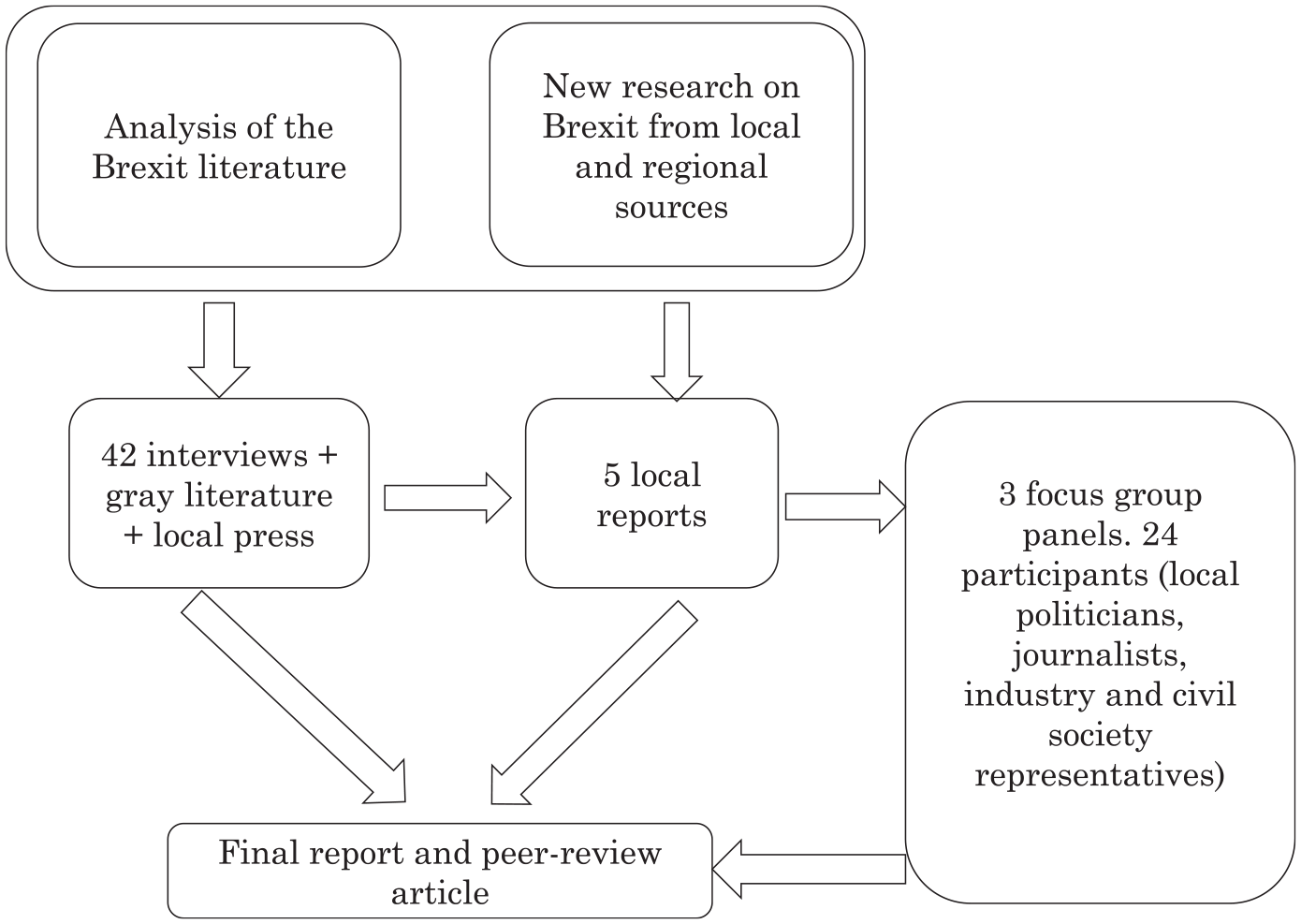
Overview of the research process. Authors’ elaboration.
Case Study Overview
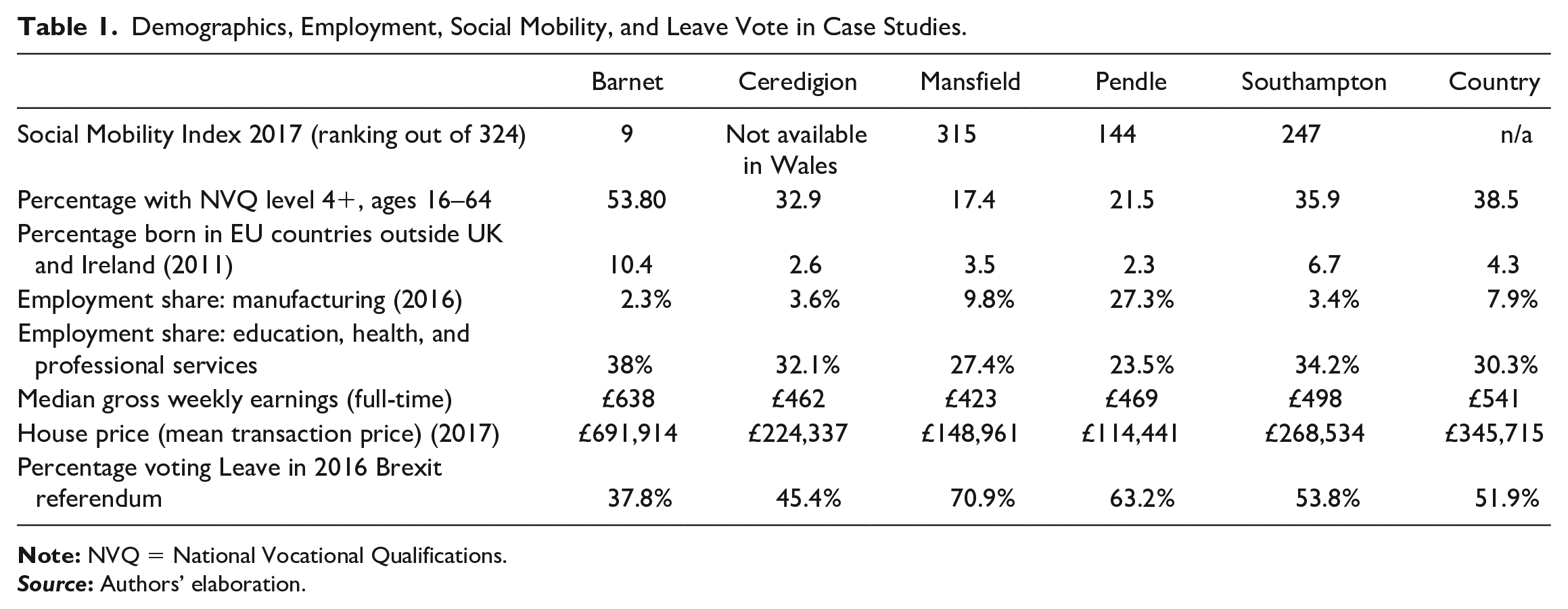
In selecting our case studies, we sought to identify areas that were representative of diverse economic and political experiences across England and Wales. Barnet and Southampton are distinctly urban, Ceredigion is rural and agricultural, and Mansfield and Pendle are postindustrial. In terms of their position in the global knowledge economy, Barnet is a strongly integrated service economy, while Pendle and Mansfield can be characterized as “left out”; 46 the cases of Ceredigion and Southampton are more mixed. Figure 2 shows the geographic location of our cases; Table 1 demonstrates the differences in economic profile, political leaning, and ethnic diversity in our case study areas.
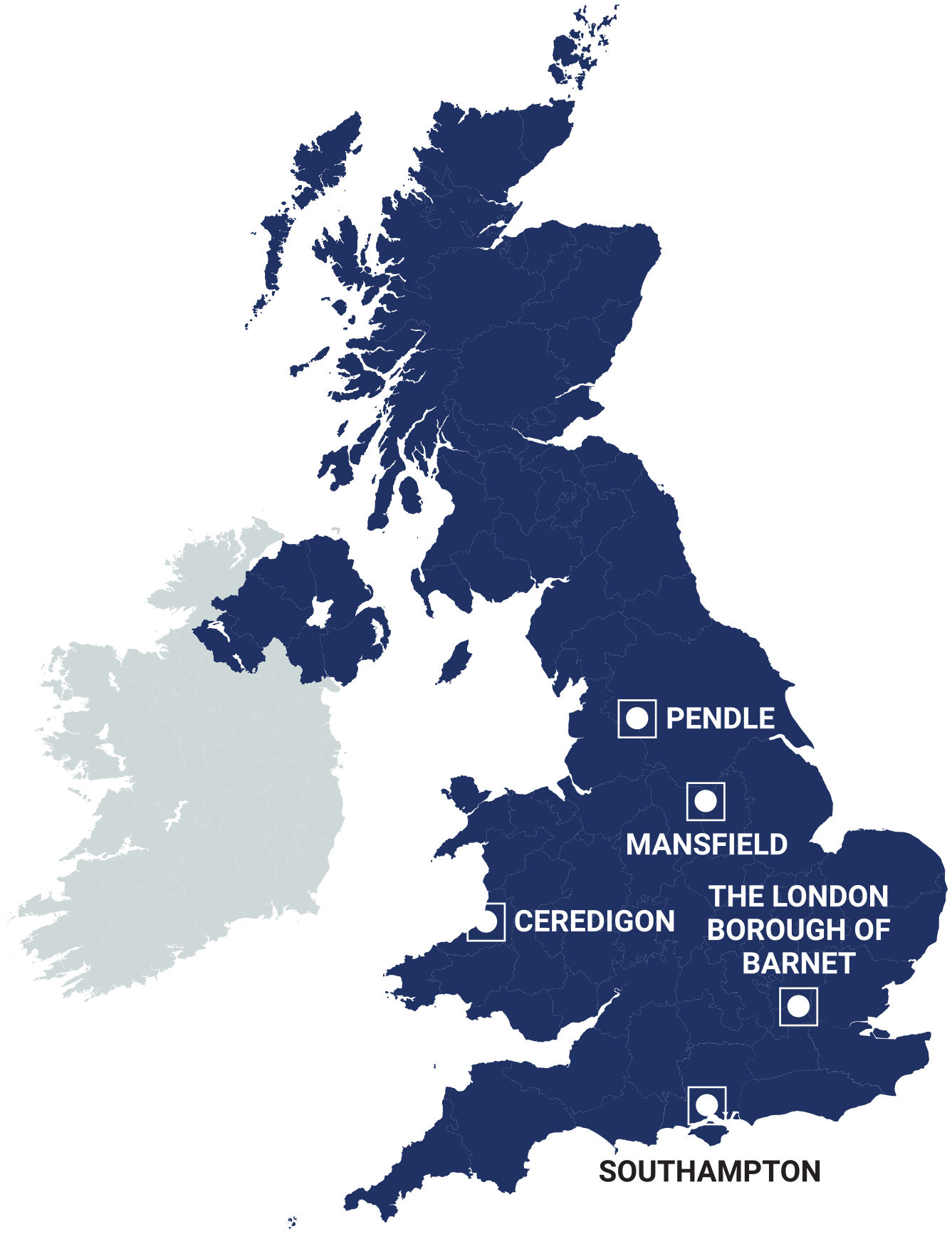
Location of our case study areas. Authors’ elaboration.
Demographics, Employment, Social Mobility, and Leave Vote in Case Studies.
For much of the twentieth century, Mansfield was a highly productive mining region. However, beginning in the 1980s, the area’s mining, engineering, and textile industries faced a steep decline. 47 In recent years, the employment gap has been filled by relatively low-value-added, low-wage jobs in the service sector, where a reliance on agency workers on zero-hour contracts has become a widespread business practice. 48 Whereas Mansfield’s miners enjoyed comparatively high wages, today the median annual earnings of £15,226 are significantly below the average in both the East Midlands and the United Kingdom as a whole. Mansfield, along with the neighbouring local authorities of Ashfield (one authority) and Newark and Sherwood (another authority), is suffering significant relative deprivation. The three areas are ranked 315th, 317th, and 323d, respectively, on the UK government’s social mobility index, out of a total of 324 English local authorities. 49 Mansfield’s white, UK-born population is proportionally higher than the UK average, but since the European Union’s enlargement in 2004 there has been significant immigration of Eastern Europeans into the Mansfield area. Politically, 70.9 percent of voters in Mansfield voted to Leave in the 2016 EU referendum; a year later, at the 2017 general election, the Conservatives won the Mansfield constituency for the first time in almost a hundred years.
In the North West of England, Pendle’s population is split across several towns including Nelson (29,135 residents), Colne (18,806 residents), and Barnoldswick (10,752 residents). Over the twentieth century, these historic mill towns developed into a sizable aerospace manufacturing hub. Today, manufacturing makes up 28.1 percent of total employment, over three times the national average. 50 While a significant part of the manufacturing sector has been retained, most recent employment growth has been concentrated in low-skilled, low-wage sectors. Demographically, the proportion of EU migrants in Pendle is only 2.3 percent, which is 2 percentage points below the UK average. 51 But Pendle does have historically significant Pakistani and Bangladeshi communities, which are largely concentrated in Nelson, where the nonwhite population is 29.2 percent, compared to 13.4 percent in the rest of Pendle. 52 In the early 2000s there were race riots in neighboring Burnley, and Pendle was one of the last holdouts of the extreme-right British National Party. Pendle also had a high share of Leave votes (63.2 percent), but in terms of its parliamentary constituency, the Conservatives’ margin significantly narrowed between the 2015 and 2017 general elections.
As a suburb of outer London, Barnet’s local economy is dominated by services. Education, health, and other professional services account for 37 percent of local employment, while retail accounts for another 11.4 percent. Barnet is home to significant migrant communities. Only 45.5 percent of Barnet’s population is white and UK-born, and 10.4 percent of the local population was born in EU countries outside the United Kingdom and Ireland. Romanians are the largest migrant community in Barnet, and there is also a significant Polish community. 53 Like the rest of London, Barnet had a very high Remain vote at the 2016 referendum. Its two parliamentary constituencies—Chipping Barnet (one constituency) and Finchley and Golders Green (the other constituency)—are marginally held by the Conservatives, but as in other urban constituencies, Labour’s vote has significantly increased over the last decade.
Ceredigion is a largely rural authority on the west coast of Wales. The only sizable town is Aberystwyth, with a population of 13,000. Aberystwyth’s university and the town’s hospital are major employers; education, health, and professional services make up a combined 32.1 percent of local employment. Agriculture is also significant to Ceredigion’s economy, as it accounts for 17.1 percent of local employment and is the primary supplier to the local meat- and dairy-processing industries. As half of the authority’s 74,146 inhabitants speak Welsh, Ceredigion is a historic center of Welsh identity. This aspect of Ceredigion’s identity is currently being challenged by an inflow of middle-class retirees from England and an outflow of young people to urban centers in Wales and England. 54 Nevertheless, the Welsh nationalist party Plaid Cymru is the dominant force in local politics, as it holds twenty of forty-two seats on the local council and it won the region’s parliamentary constituency at the 2017 general election. At the 2016 Brexit referendum, Ceredigion was one of just five regions in Wales to oppose Brexit, by a margin of 54.6 to 45.4 percent.
Finally, Southampton is a medium-size coastal city. Southampton’s port handles over £40 billion in annual exports, while one in six jobs in the city is directly tied to the port. During the last decade, Southampton’s employment growth has been concentrated in professional services and retail, but the area has lost manufacturing jobs. 55 At the time of our fieldwork, Southampton’s 6 percent unemployment rate was relatively low, but the city’s wage levels were below the national average. Unsurprising for a city of its size, the demographic makeup of Southampton is relatively ethnically mixed. The sizable Polish community makes up about 3.5 percent of the population. 56 At the 2016 EU referendum, 53.8 percent of Southampton voters supported the Leave option. There was a clear geographic split to this vote between the more cosmopolitan and Remain-supporting west and the less well-off eastern suburbs, which tended to support Leave. It is interesting that Labour holds the constituency that represents these Leave-leaning suburbs, while the Conservatives hold Southampton’s two other constituencies.
Local Economic Trajectories and Local Narratives of Nostalgic Pride and Blame Shifting
Our fieldwork findings support the argument developed in the literature on “place” that political discontent has both economic and cultural drivers that are closely interconnected in context-specific ways. In this section, we outline how, particularly in our two case study areas with the highest Leave vote share, trajectories of relative economic decline not only generated discontent but were also interpreted in a way that prepared the ground for the political expression of that discontent via support for Brexit. Specifically, we show that the way in which our respondents expressed their frustration and explained the causes of their community’s relative decline reflected a sense of nostalgic pride in their community’s history and identity, even if that pride was expressed through parochial feelings of isolation, disempowerment, and resentment against the visible sources of change. In turn, those blamed as responsible for their negative experiences were outsiders seen as lacking an understanding and appreciation of their type of community.
Narratives of Blame I: The Deterioration of Local Services and the Sense of Insularity from the Centers of Decision Making
Arguments centered on sovereignty and the need to “take back control” appeared frequently in our research about local-level Brexit debates: “When people cast a vote, they want to cast a vote on hope. . . . The Leave side were trying to convey a positive message, that we’re gaining independence.” 57 In the Mansfield press, it was argued that the European Union is “an undemocratic system [and] an attempt to create a single country called Europe,” 58 while in the Pendle press, “the bureaucrats in Brussels” were claimed not to “understand the people of the North West.” 59 The local resonance of such arguments in our Leave-voting case studies cannot be understood without taking into consideration local trajectories of socioeconomic change, particularly the observed decline in the quality of local services and infrastructure, as well as the narratives of blame through which that change was interpreted. 60
Indeed, in both Pendle and Mansfield resentment over the state of local infrastructure fueled discourses of disempowerment and parochialism, as well as feelings of neglect and isolation. Pendle was commonly described as “the cul-de-sac” of Lancashire, because of the poor infrastructure and investment links with the rest of the county. 61 The perceived lack of broader connection between Pendle and the rest of Lancashire, and by extension the United Kingdom, generates highly localized feelings of being hard done by, which filters further downward into a parochial insularity. Respondents reported perceptions that Colne residents considered themselves to be worse off than Nelson residents, while Nelson residents considered themselves to be worse off than Colne residents. 62 A similar sense of insularity was also apparent in Mansfield: “It’s a long way off the motorway, the rail network isn’t fit for purpose. . . . We’ve got a great location, but getting in and out is a nightmare.” 63 And “because Mansfield sits so on its own, it has made for a very sort of insular approach to the world for a lot of people.” 64 It is worth noting that the insularity of Mansfield and Pendle contrasts with the perceptions gathered in Barnet, where “most people would be working in industries which are tied up in Europe, law firms, finance, they are very aware of the connections we have with Europe.” 65
This feeling of isolation gave way to a narrative of blame shifting when local stakeholders sought to explain the decline in social mobility and the quality of infrastructure. The belief that national policymakers ignore the local realities of postindustrial towns was prominent. “I feel sorry for the young today,” remarked a former miner from Kirkby-in-Ashfield. “There’s nothing there for them, nothing. It’s all gone. They’ve let it all go, them powers what be.” 66 In Pendle, this featured in the way in which respondents centered London as the high-point of decision making but distanced themselves from the city:
But remember that most people in this part of the world don’t go to London . . .
And now we’re in a position of listening to London. They’re the intelligent ones making all the decisions and they don’t really know what we think. 67
The proposed remedy for this predicament was greater devolution to northern England. 68 Similarly, a Mansfield Labour Party member argued that “we don’t get enough of the funding that is available [for regeneration], too much goes to the cities. We want and deserve our fair share.” 69 Interestingly, the perception of neglect and miscomprehension by the political elites also seeps into local politics. According to the local press, the sitting MPs in Mansfield and the neighboring constituency Ashfield prior to the 2017 election were “criticized for being out of touch with the town and frequently absent” and “for being isolated from the constituency,” respectively. 70
Narratives of Blame II: Immigrants as Symbolic Proxies for Relative Decline
Discontent with immigration figured in our research as perhaps the most prominent single issue of concern to Leave voters in the run-up to the 2016 referendum. 71 Like the sovereigntist backlash, the appeal of the anti-immigration backlash in areas like Mansfield and Pendle can only be understood in the context of local trajectories of relative economic decline and, particularly in those areas, the spread of new types of low-value-added business models and the narratives of blame through which those changes were interpreted locally.
Indeed, the reaction of the communities in Mansfield and Pendle against recent immigrants from Eastern Europe can be construed as a reaction against the trajectory of declining social mobility and the increasingly dominant position of low-value-added business models within local economies. This reaction has several facets. There are the well-worn arguments over the effect of immigration on wage and job competition. In Mansfield, there was a “general feeling of unease . . . that these jobs were actually being created for people from out of the area.” 72 Likewise, in Pendle, the burgeoning Eastern European community was said to “work hard and you can’t knock them for that, but the view here is that that could be my job or that you keep my wage suppressed.” 73 However, we found that such sentiments also contained a deeper reaction against the type of job itself. The increased prevalence of low-skilled work had stymied the pathway for long-term community development: “This notion of coming here, taking our jobs, isn’t actually true, because none of them want these jobs.” 74
In is interesting that in both our Mansfield and Pendle focus groups the participants, through discussion, also reached the conclusion that there is an element of externalizing the blame for the spread of low-value-added business models on immigrants. In the focus group in Nelson, as part of a broader discussion of whether immigration was a proxy issue, there was a debate about whether the proportion of local residents born in Eastern Europe was really as low as 2 percent:
It’s about control. In Australia they get nurses and that’s it. Here we get everyone. So, it’s no good quoting 2 percent to me and then I go to Morrison’s and it’s certainly not 2 percent. Everyone is Polish, not that I personally have a problem with that, but many do.
There’s a malaise. I don’t think there’s an issue of Polish people taking our jobs. I don’t think that’s an issue around here.
But they’re not the same jobs as they used to be. There aren’t many apprenticeships and there are a lot of zero-hour contracts. 75
This conversation reveals the sense of economic disempowerment that underscores the way in which the issue of immigration is discussed.
The same conclusion was reached even more explicitly in the Mansfield focus group. When asked about her views on the role of immigration in the local economy and its link to the issue of skills, a local employer responded in the following way:
Well, I suppose I’m thinking more from a more macro-level, but for me, immigration is a red herring in all of this. If I look at Mansfield . . . the economy and job opportunities still haven’t recovered from losing textiles, losing the pits, and regardless of immigration or not, this [economic reality] has [prevailed] for decades, and what we really need to do, we need to attract industry here. . . . People always look to blame something, and it’s so easy to blame things like immigration on that, but . . . immigration has absolutely nothing to do with the sheer fact that we lost our industry. This country, and this is my view—we’ve become very London-centric, almost, as a nation, and that North-South divide does exist, and I think this is part of a much bigger problem of which, it’s just a red herring, for me, immigration, in all of this. 76
This intervention had a profound influence on the discussion, as it shifted the focus away from immigration toward a collective brainstorming about the economic and education reforms needed to address the root causes of Mansfield’s economic malaise.
Local economic trajectories also contribute to understanding the backlash against immigration and the referendum results in Southampton. This was clear in the geographic split in the city’s Brexit vote, where the more ethnically diverse and slightly more affluent Southampton Test supported Remain, while the predominantly white working-class eastern part of the city, Southampton Itchen, voted Leave. 77 In the aftermath of the financial crisis, the rapid influx of a migrant population, in particular from Poland, was blamed for aggravating housing and school place shortages in the eastern parts of the city. 78
The Loss of Traditional Industries and Narratives of Nostalgic Pride
The discontent with immigration in Leave-voting areas also seems to be linked with a perception of threat to people’s identity: 79
[Mansfield] just has no history really of welcoming people from different cultures, from different parts of the world. . . . Amongst the population that is largely white working-class . . . all of a sudden there are Polish shops spring up everywhere, they’ve got Polish neighbors, they see their Polish neighbors go out to work when they’re not working—and you know, that kind of isolation naturally breeds an intolerance.
80
In areas that have recently experienced industrial decline, such defensive conceptions of local identity cannot be understood without reference to the hollowing out of traditional working-class identities as a result of the loss of traditional industries, which, given the human desire to feel pride in belonging to a group, has fueled the expression of nostalgic versions of local pride. 81
In Mansfield, the decline of the town’s historic marketplace, which is of great concern in the local public sphere, 82 constitutes a visible manifestation of the blow dealt by industrial decline to local prosperity and identity. Indeed, the low quality of many goods sold in the market today makes it painfully obvious that there are few new local businesses valorizing local resources at the moment. This in itself is “the legacy of a period when a single employer, British Coal, was the dominant employer.” 83 And while there is no doubt that the large number of big nonlocal wholesale stores that visually dominate the broader Mansfield area contribute in a crucial way to the local economy, they typically sell goods that are neither from nor for the local community. A former miner referred to the factory where his wife used to work before it was turned into a warehouse: “Yes they don’t bloody make owt anywhere now. . . . I don’t see hardly anybody going in or out now apart from lorries in the middle of the bloody night.” 84 In the words of a long-time councillor in Ashfield, “What is it—30 years since the mines closed? And we still haven’t got it right. The big problem we have in Ashfield and Mansfield is we don’t have an identity.” 85
This hollowing-out of traditional identities stands in contrast to the visible manifestation of identity-formation by the Eastern European communities. In Mansfield there are a large number of Eastern European grocery stores, barber shops, job advertisements, and other visual cues in space. This juxtaposition creates a fertile ground for defensive perceptions of local identity, which emphasize an attempt to protect “the way of life we have worked hard for” 86 from encroachment by the Other, as well as a nostalgic version of local pride: “[if only] the money [the Mayor] and other top officials receive . . . could be used for improvements in our market . . . then we [would] have an excellent market like we once had when I was a child, with every stall taken.” 87 Leave campaigners capitalized on these sentiments not only by promising to reduce immigration flows but also by stoking feelings of local pride: in the words of Nigel Farage during a referendum campaign event with reference to Nottinghamshire’s Sherwood Forest, “These people are the spirit of Robin Hood!” 88
Similarly, in Pendle, the discontent with the “proliferation of Eastern European shops” 89 is also linked to defensive and nostalgic conceptions of local pride. The following intervention in the Nelson focus group demonstrates this link:
It’s true that if you go into the middle of Nelson that the people queuing up at a cashpoint will often be a Lithuanian family. But I think it’s a question of areas like this and small, old industrial areas where a lot of people remember what it used to be like. . . . [In the 1960s] something like 50 or 60 percent of the working population, worked in cotton weaving areas. Now there aren’t any of them.
In other words, the anti-immigrant backlash also reflects a nostalgic conception of local identity. Any change in the composition of the community since the golden days of industrial prosperity is seen as threatening—the more so, the more visible it is. The contrast between the decaying community institutions of the white population and the construction of new community institutions by the nonwhite population is perhaps best personified by a report in the local newspaper around plans to turn a closed pub that was “plagued by anti-social behaviour” into a mosque. 90
Overall, despite the visible effects of economic decline on our postindustrial case study areas, many of the stakeholders we interviewed spoke with pride about their community—or, better, about an idealized image of how their community used to be.
Discounting the Potential Economic Costs of the Leave Vote: The Role of the Local Predominant Discourse about Resilience
But why did a diffuse sense of discontent that was rooted in negative socioeconomic trajectories manifest itself politically in the potentially economically costly Leave vote? After all, as mentioned in the introduction, there was a near consensus among impact assessment studies and mainstream elites that Brexit was likely to have a negative overall effect on the UK economy through various mechanisms, and several studies also predicted that some of those effects would hit Leave-voting areas particularly hard. These warnings were locally available during the time of the referendum. The then MP for Mansfield identified a long list of individuals and organizations supportive of Remain: [Eighty-two] percent of all MPs at Westminster. The CBI, TUC, individual Trades Unions, . . . The Prime Minister, Chancellor of the Exchequer, most of the Cabinet, Leader of the Opposition—Labour, Liberal Party, Scottish National Party and other smaller part[ies] in the Commons. The Archbishop of Canterbury, Richard Branson, Governor of the Bank of England, a host of leading companies, most UK-based High Street Banks, together with 600 leading artists, writers and others from the entertainment industry. . . . They argue that our economy would be hit to the tune of £4,300 [per annum] per household if we left.
91
Indeed, it is striking “just how far the collective decision to endorse a constitutional unknown flew in the face of received of economic wisdom.” 92
We argue that despite a large degree of consensus among experts that the economic consequences of Brexit were likely to be negative, the inherent complexity of economic forecasting and the conflicting messages emitted by politicians and journalists generated uncertainty. In that context, the local narratives of blame shifting and nostalgic pride identified in the previous section paved the way for the dominance of a local discourse about resilience in the face of adversity. This discourse chimed both with the notion that local economic decline was to be blamed on outside forces and the idea that reactivating traditional community bonds would allow local communities to overcome Brexit-related obstacles. In turn, several national-level tropes associated with the Leave campaign, such as “they need us more than we need them,” “red tape,” and “350 million a week,” resonated with local discourses about resilience, pride, and blame shifting. They thereby found fertile ground in areas that had experienced relative economic decline. Cumulatively, these local-level and national-level discourses gave rise to optimistic expectations about the economic impacts of Brexit, thus playing down the potential risks that were emphasized by a wide range of experts. The more distant, complex to forecast, and removed in time a given Brexit-related impact was, the stronger the role of local predominant discourses in discounting the relevant potential damage.
In this section, we provide evidence about the nature and prevalence among Leave-voting communities of optimistic assessments regarding the future economic impacts of Brexit via four channels: trade, immigration, EU funds, and business climate. These four areas differ in terms of the complexity of the mechanisms through which Brexit will influence the economy and the speed with which those mechanisms operate, thereby providing us with interesting insights about the types of issue areas where local predominant discourses can diverge the most from the predictions of economic analyses. Overall, we contend that although local actors cared deeply about disrupting the trend of socioeconomic decline in their area, even key stakeholders in Leave-voting communities genuinely did not believe that Brexit would have the negative effects predicted by mainstream political and economic elites and expert impact assessments.
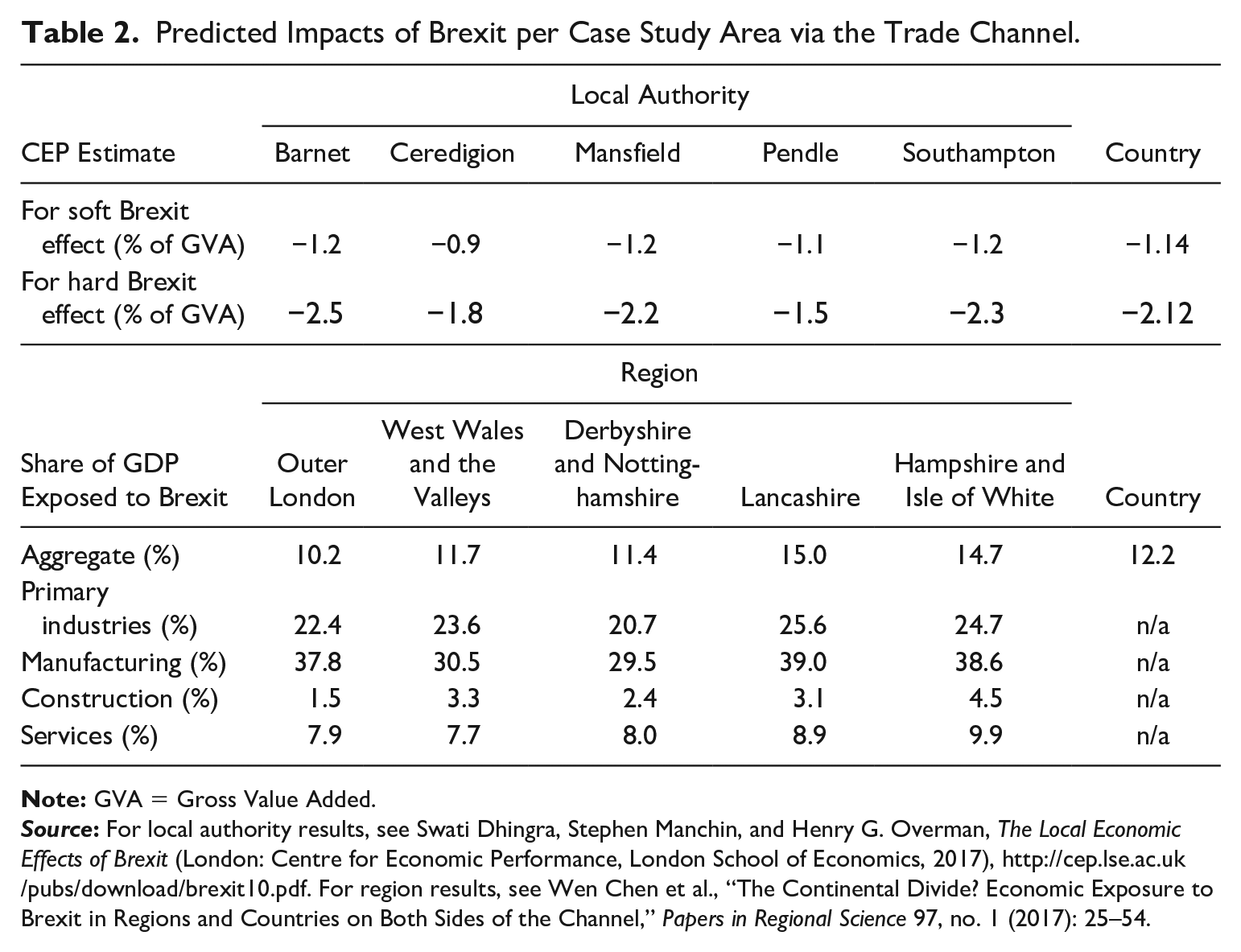
Starting with the trade-related impacts of Brexit, an exit from the customs union had been projected to lead to an annual increase of £2.7 billion in import costs and £1.8 billion in export costs. 93 As such, trade costs are frequently cited as a significant expected negative impact of the United Kingdom’s withdrawal from the European Union. A rise in trade barriers will have a differential impact across sectors and regions. Table 2 summarizes the findings of two impact assessments regarding the forecasted economic effects of such a rise on our case study areas and on the United Kingdom as a whole. While Wen Chen and colleagues conclude that “the highest levels [of local GDP exposure to Brexit] are found for many of the United Kingdom’s noncore regions in the Midlands and the North of England, many of which voted for Brexit,” Swati Dhingra, Stephen Manchin, and Henry G. Overman predict that areas in southern England, including London, will generally be affected more negatively by Brexit-induced increases in trade barriers than areas in the north. 94
Predicted Impacts of Brexit per Case Study Area via the Trade Channel.
The aforementioned impact assessments were published in 2017, prior to our fieldwork but after the referendum. However, warnings about the economic impact of rising trade barriers by political, economic, and academic elites abounded in our case study areas in the run-up to the referendum. The Mansfield MP Alan Meale and the Ashfield MP Gloria de Piero warned that leaving the European Union “would put thousands of jobs at risk and hit trade,” 95 as “half of Britain’s exports go [to the European Union]—accounting for some 3.5 million jobs. The UK sells more to the Netherlands alone than to the whole of China.” 96 Moreover, the Mansfield Chad presented the idea that “we could have free trade with the EU without freedom of movement” as a myth, pointing to the difference in degree between the Single Market, which is “the epitome of free trade,” and a mere “free trade agreement.” 97 Likewise, in Pendle the local press warned that Brexit could impact the local manufacturing sector: “Local businesses . . . will also feel the effect if orders drop [post-Brexit] with thousands of people working indirectly for aerospace industries in the region.” 98
Nevertheless, those warnings were mixed with conflicting messages by the political elites associated with the Leave campaign. Boris Johnson denied that major firms such as Rolls-Royce would offshore, arguing that instead Brexit would actually “galvanize British business.” 99 What is more, Brexit would allow Britain “to trade freely with other countries, and not just the EU.” 100 The difficulty of making precise economic forecasts for an issue as multifaceted and complex as the economic impacts of rising trade barriers created the space for local discourses to influence which side’s argument people found more convincing. In the words of a local journalist in Mansfield, “Nobody actually knows [where the truth lies]—but politicians just grab the arguments that support their position . . . and rubbish the ones that don’t.” 101 With Britain still trading under Single Market rules throughout our research project, experience could not substitute for the uncertainty of complex predictions about the future. On the contrary, the devaluation of the pound generated a short-term competitive advantage for exporters. 102
Shortly before we conducted our fieldwork, Rolls-Royce, the largest employer in Pendle, was reported to be considering offshoring part of its activity if the Brexit agreement is not satisfactory. 103 In the year after the vote, the company suffered significant losses that were in part attributed to the “£4.4 billion write-down from the collapse of the pound since the Brexit vote.” 104 However, local stakeholders said that this is really just a “shove and a threat” to force the UK government’s hand, as, “if you speak to the aerospace sector, they will say they’ve got bigger concerns than Brexit.” 105
A parochial quality of resilience was cited in Pendle’s ability to respond to potential economic harm. Local businesses were “very precious about making our own decisions and being able to look after ourselves.” 106 Pendle’s aerospace sector “can plan for anything if you give them the ability to do that.” 107 This quality of economic resilience, which is the flipside of the discourses of pride and blame shifting analyzed in the previous section, was evident in the way that multiple respondents described the region’s transition over the course of the twentieth century from an area dependent on cotton mills to its development of the United Kingdom’s largest aerospace sector. 108 As one interviewee described, “Pendle has a knack of being able to transform and move with the times and Brexit brings as much opportunity as it does risk.” 109 Long-term resilience was commonly identified as a trait that would mitigate the risk to Pendle’s place in complex international supply chains. In a focus group discussion on whether the Leave vote was contrary to the community’s economic interests, one discussant replied that “we’re resilient, we’ll make changes, we’ll make links with the rest of the world . . . because they will still need what we manufacture and we will find a way around it.” 110
In Southampton, the structural advantage of the city’s port, the largest container- and vehicle-handling port in the United Kingdom, 111 provided the basis for a sense that the city would be spared the negative impacts of Brexit. This shared perception failed to consider that a large share of the exports and passengers that use the port come from or go to other EU member states.
The reactions of several interviewees in Mansfield to the summaries of the aforementioned two impact assessment studies, summarized in Table 2, were also telling. Upon reading the summary of the Dhingra et al. study, an interviewee (who voted Remain) singled out the sentence “Mansfield is one of the urban areas in the UK that will be affected the least by Brexit,” omitting the immediately subsequent phrase “though it is still predicted to be affected in a significant way.” The interviewee commented: “I think actually, the people who run the Mansfield economy, are probably aware . . . that it won’t be so hard here. Everybody seems to be very optimistic.” When we pointed out the omission, the interviewee responded: “I don’t think people want to be too scared by figures either. . . . And I suppose people do adapt, don’t they.” 112 In fact, most interviewees simply did not believe that trade with the European Union would actually decline: “I am absolutely convinced that once whatever rules they try to make are set out, accountants will find their way round them.” 113 Characteristically, during the Mansfield focus group discussion, the owner of a local small business responded as follows to the warnings about the effects of rising trade barriers in our Mansfield case study report:
Companies will still want to deal with each other, irrespective. . . . Unless the powers that be put high tariffs on them. And if they do, then we should get off our back side and start producing stuff over here. And then we can employ people again. 114
This argument chimed not just with narratives of local resilience but also with blame shifting narratives. In a similar vein, in Pendle, the national government’s negotiations with the European Union were described as “passive” and “ludicrous”: “Why have we not been saying well we’re leaving, we’re more important than you are to us, what are your suggestions to make this work?” 115
Apart from the potential trade-related impacts of Brexit, Britain’s withdrawal from the European Union is also likely to result in a decline in immigration from EU member states. This decline will have an impact on labor availability across the country. The magnitude of its effect on specific local areas will depend on the types of industry that structure these communities (see Fig. 3). While a diverse range of industries are at risk of facing labor shortages after Brexit, according to a number of studies, two areas of particular concern include the future ability of high-value-added firms to recruit skilled personnel and the future ability of the National Health Service (NHS) to recruit nurses and doctors. 116
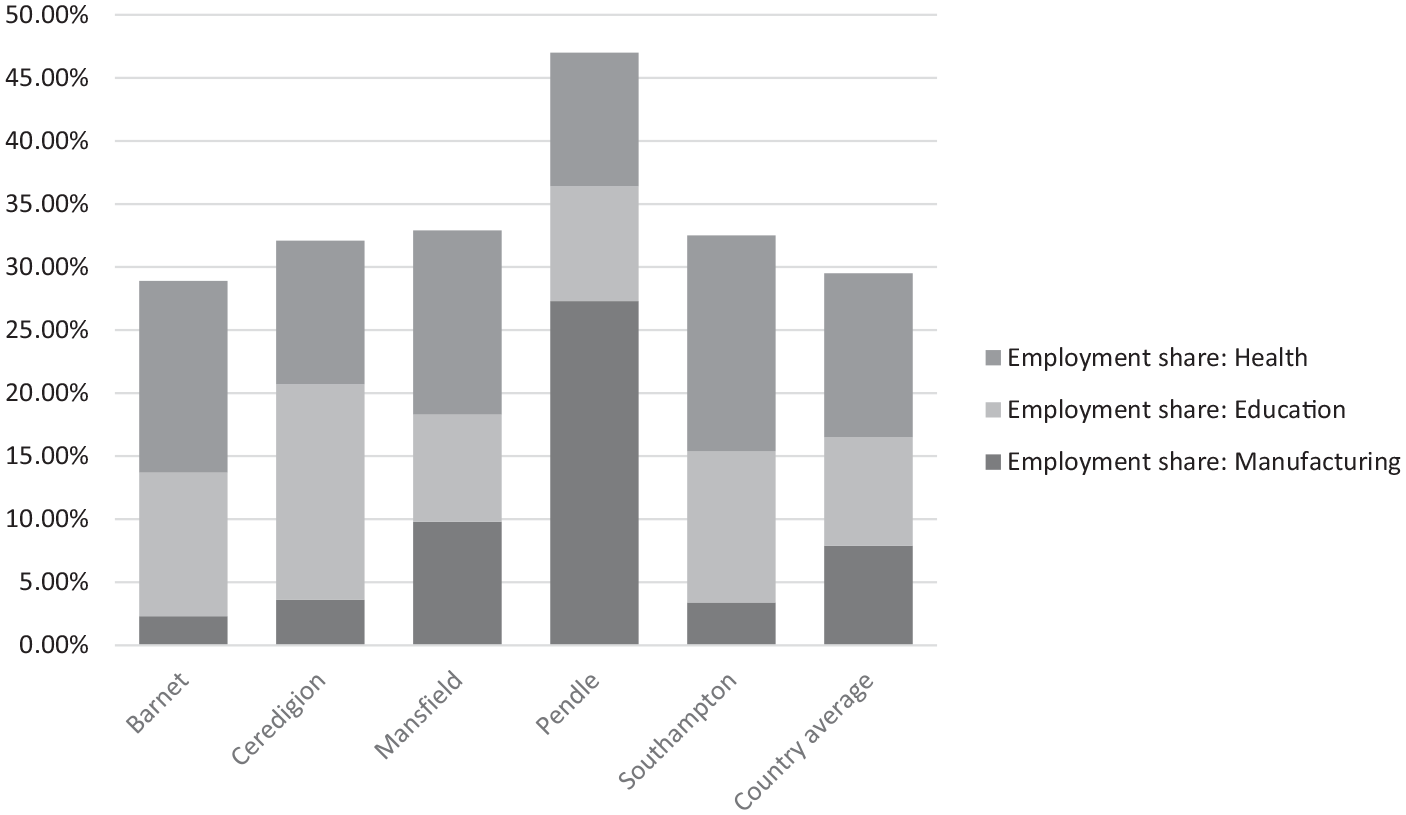
Employment share in manufacturing, education, and health. UK Business Register and Employment Survey 2016.
Most of our local sources acknowledged that existing difficulties recruiting skilled and other types of personnel might be aggravated by Brexit. This can be explained by the simpler, more tangible nature of predictions about the decline in immigration, along with the fact that several stakeholders had personal experience interacting with employees from the European Union either in their firm or in local public services. Moreover, clear, NHS-related warnings have a particular resonance in the British public sphere, while reports that Brexit was already affecting the NHS’s ability to hire personnel at the time of our fieldwork added an immediacy to the subject that trade- and funding-related issues lacked. 117
The immigration-related potential economic costs of Brexit were perceived most strongly in areas where concerns about shortages in human capital were acute for important local industries. Indeed, the problem of attracting and retaining high-skilled students and academics emerged as a very significant issue during the Ceredigion and Southampton fieldwork, as both are home to major UK universities. Faculty members and university executives fear that the limitations to the freedom of movement of academics and students will reduce the appeal of their institutions as places to study and work, which creates substantial financial risk. 118 Twelve percent of faculty members in Southampton University and 15 percent of students in Aberystwyth University come from other EU countries. Geography matters in this context too, as the effects may be particularly severe for universities located in areas with a low population density, as they “have no urban hinterland to recruit from.” 119
The risk of NHS staff shortages after Brexit was a salient issue,
120
particularly in the fieldwork conducted in Barnet and Southampton, both of which host large hospitals. A focus group participant in Barnet explained that we know for a fact that the NHS trusts here have had a huge drop in EU nurses and doctors who want to come here. That has both [an effect on] Britain as a whole, but absolutely it also has a tangible effect on us personally, and the community we live in.
121
Notably, even some interviewees in our strongly Leave-voting areas who did not consider that Brexit will pose “any problem whatsoever” overall for the local economy recognized that “our NHS would not survive if we didn’t have immigrants coming in.” 122
Moreover, in areas like Pendle and Mansfield, where high-value-added manufacturing firms struggle to recruit skilled labor, interviewees mentioned that the inadequacy of tertiary education and professional training of the local population is masked by the availability of skilled EU workers. 123 The CEO of one of Pendle’s major aerospace manufacturers explained that the skilled EU workers were “significant in that they complement the lack of skills that we have.” 124 In Pendle there were also reported concerns that the retail and tourism sectors would be particularly hard hit by declining immigration from the European Union. 125
Nevertheless, predominant discourses about local resilience, drawing on the nostalgic versions of pride analyzed in the previous section, also led some to question the magnitude of the economic damage that would result from a decrease in labor supply. For example, during our Mansfield focus group, a debate ensued after a participant asked, “Why aren’t the English people doing [agricultural work]?”
You know what? When I left school, many, many years ago, a lot of my friends went at university, and they used to work in the fields, picking fruit, picking vegetables, in Lincolnshire, in Kent, in places like that, and actually it was quite difficult to get a job to do that, because there was a waiting list. . . . And I think we’ve sort of missed something somewhere, where we had that work ethic.
Don’t you think those people came from parents that had gone through the war?
Possibly.
And that would make a difference. Because they’ve got parents who’ve got that vision of what the war was and what they suffered, and that was transferred to those children in the 50s and the 60s. 126
The implication of this idealized interpretation of the collective past was that through the recovery of the wartime work ethic, Mansfield could mitigate the labor shortages that might result from Brexit. Complementing this view, the owner of a local factory stated, “We’ve got to compete for skilled people and we don’t have to be told by Europe how to attract the best people.” 127
A third channel through which leaving the European Union may affect the economy of our case study areas concerns EU funding. Although the United Kingdom was a net contributor to the EU budget, particular areas and occupational groups have historically been receiving significant shares of public funding from the EU budget. This funding has been disbursed to promote socioeconomic development in low-income and transition regions, as income to finance academic research and R&D, and as income support for farmers. Indeed, in 2014–15, payments from the European Union’s Common Agricultural Policy accounted for no less than 56 percent of total income across all farm types. 128 And while theoretically these funding programs could be completely replaced and even increased by the UK government after Brexit, Britain’s historic opposition to the Common Agricultural Policy and its reluctance to provide stable, long-term regional development programs make it uncertain whether the funding sources in question will continue to be available in similar form and size to the concerned areas and groups. 129
Although the amount of EU funding received by an area or group is simple to quantify, the distant and indirect method through which the funding is disbursed creates room for multiple interpretations. This effect was reinforced by the fact that Britain was still a member of the European Union at the time of our fieldwork: EU funding continued to be disbursed normally and had even increased in value because of the devaluation of the pound.
130
Moreover, despite warnings by closely involved stakeholders, pro-Brexit political elites provided assurances that the East Midlands has sent far more money to Brussels [than it has received]. Of course you’d keep that. That’s British taxpayers money that wouldn’t be redistributed to other areas of the UK under any circumstances, that would come back to the East Midlands and you’d have more.
131
As a result, while some stakeholders recognized the potential risks that Brexit carried in terms of funding losses for particular areas and sectors, others, drawing on Leave campaign discourses about acquiring an extra “£350 million a week” and getting rid of the European Union’s “red tape,” were optimistic that the sectors and areas concerned would not suffer an economic hit from a loss in funding. In areas that had suffered from relative decline, those narratives found particularly fertile ground as they resonated with local discourses of resilience and blame shifting.
Among our interviewees, university researchers and business managers in the technology sectors were the most concerned that Brexit will affect access to funding programs such as further iterations of Horizon 2020. Notably, 91.4 percent of Southampton University’s funding comes from the European Union, making it the British institution of higher education most reliant on EU funding sources. 132 In Barnet, the owner of a business growth consultancy noted that his company “used to work with partners in Brussels to help UK companies access [the European Union’s Horizon 2020 fund], which has 80 billion euros worth of investment. It is, in essence, free money that the European Union gives to businesses in Europe.” However, “a year ago, our partner in Brussels said we can’t take anymore UK businesses because of Brexit.” 133
Although the impact of Brexit on farm subsidies is also likely to be considerable, several UK farmers voted Leave. This was the case in Ceredigion, even though the main Welsh farmers’ union, like the National Farmers’ Union (NFU), supported Remain in the referendum. After all, 60 percent of the income of UK hill livestock producers comes from the European Union, something of particular relevance in a county with 75,000 habitants, 100,000 cattle, and 885,000 sheep.
134
Moreover, 72.4 percent of all Welsh food and drink exports go to EU markets, including approximately 92 percent of lamb exports.
135
The NFU warns that the scenario of “no deal” with the European Union could halt agricultural exports for six months, with catastrophic consequences for the sector.
136
While Welsh farmers receive £250 million in direct payments from the European Union’s CAP
137
and “know where the money is coming from,”
138
several voted Leave hoping to see the elimination of perceived bureaucratic agri-food product regulations such as the European Union’s electronic tagging system for farm animals, echoing a national-level discourse on “EU red tape.”
139
According to one of our interviewees, In many ways the EU became a scapegoat for some of the mistakes that [the Department for Environment Food and Rural Affairs] (DEFRA) made, you know with the implementation databases, and the single payments were actually delayed for quite a long time for a lot of farmers. I think the farmers saw the vote as in many ways a protest vote against DEFRA. And they seem like they shot themselves in the foot a little bit with it.
140
The uncertainties surrounding the replacement of EU regional funds are a more important concern for the postindustrial areas in our sample, Mansfield and Pendle. Indeed, in these areas, EU regional funding has subsidized precisely the type of activities that are required in order to support development along a higher-value-added path, such as training and sustainable employment programs, university-industry collaborations, and support programs for small and medium-size enterprises and startup businesses: as mentioned by the Lancashire Telegraph, “Our towns, boroughs and transport networks have done very well out of Europe’s structural and social cash pots.” 141 Some stakeholders are concerned that the UK government’s track record on regional policy indicates that EU regional funding is not guaranteed to be replaced: “In the UK, we’ve been hot and cold on regions, we’ve been consistently kind of centralist in our funding policy.” 142
Nevertheless, the predominant discourse of local resilience influenced the way in which these funds were valued locally. In Pendle, one interviewee compared the local use of EU funds to that of other regions: “The North of England is far more efficient in turning that funding into jobs than the South of England.”
143
Given this emphasis on local qualities of adaptability, perceptions of burdensome regulatory requirements have led to a hope that national government alternatives will lead to more opportunities: Within the business support environment there has always been a frustration where we can’t find support through the European sector. . . . After 2021, I don’t think the government are particularly fussed, they want to work with businesses that are energetic and engaged.
144
These hopes were reinforced by the fact that on some occasions, the value of EU regional funding was doubted altogether: interviewees blamed the European Union for failing to understand local needs and suggested that local planning would have been more effective: “The regeneration of Nelson town center . . . it’s a hodgepodge—and that was European funding. People thought it was an absolute waste of money.”
145
Indeed, this project was politicized by the local Leave campaign during the referendum campaign. As the North-West Leave coordinator argued, This work was undertaken in 2011, and conditions have not improved since. . . . If you’d walked on to the street of Pendle before that work and asked every single person what their priority was I doubt one single person would have said this. The people of Lancashire know when they’re getting a bad deal.
146
In turn, participants in the Mansfield focus group downplayed the risk that the UK government might not fully replace the EU funding currently earmarked for their region, which was brought up by a stakeholder in the education sector, pointing to the capacity of local actors to advocate for their area in the national arena:
I’ve always been led to believe, rightly or wrongly, as regards European funding and that, that we pay in twice as much as we get back. So, I’m assuming, rightly or wrongly, that the government will retain a lot of . . .
Yes, but will they give it to Mansfield though?
That’s part of life. In [Mansfield and Ashfield] 2020 [a local business association], that’s what we’ve been doing. You know, as an organization, we lobby the government, and we got our train station in, we got our bus station in. People have got to be more proactive; people have got to sort of go out there, and shout and be heard. It’s no good just sitting here, assuming that someone’s going to drop a big pot of money on the table, because it will not happen. 147
In short, the response to a potential loss of EU funding was often filtered by the interpretation that external policymakers in Brussels did not understand the specific nature and challenges of local communities and their businesses. While this was often a source of these communities’ resentment and sense of disempowerment, it could also be flipped into a more positive message about new opportunities. Despite a lack of government assurances as to how EU funds will be replaced, predominant discourses emphasized the strength of local businesses’ “dynamism,” “energy,” and “eagerness” in adapting to quickly moving business environments, creating a fertile ground for the Leave trope “we pay in more than we get out” to resonate.
Finally, when we prepared our case study reports, we had not devoted much attention to the Leave vote’s effect on business climate, as we were focusing on long-term impacts. Nevertheless, precisely because the impact of uncertainty on business was immediate and tangible, it turned out to be the negative effect of Brexit that our research participants were most willing to acknowledge, a point that was forcefully made during our focus group discussions. The following focus group participant in Mansfield was one of many stressing this subject:
You asked the question of whether it’s a soft, hard, or delayed Brexit. A delayed Brexit is the worst outcome for all, and part of that is the cost of finance. The markets always have a defense mechanism, they’ll always put the cost up where they’re uncertain about what the future looks like. 148
As with other types of impacts mentioned earlier, some interviewees used discourses of blame to attribute the causes of their concern to the incompetence of national-level politicians, who with their indecision are hindering local actors from making the most of the opportunities associated with the present situation: The key issue that I’d like to get across to whoever may be the person to do it, is that we’ve got to just do something. . . . Because the country’s made a decision, and we should get on with it. And I think it’s the politicians who should be around this table now sorting it out, not us. We are being affected by what the politicians are not doing.
149
Cumulatively, this analysis has shown that in Leave-voting areas, people’s interpretations of the likely impacts of Brexit severely discount many of the risks mentioned in a range of economic analyses. Optimistic assessments of the expected consequences of Brexit tend to be particularly widespread when it comes to impacts that are complex, hard to quantify, and not yet felt, such as trade-related effects. Impacts that are simpler to grasp or that have started to be felt already, such as the deterioration of the business climate or particular types of labor shortages, were more widely acknowledged. Yet such effects were not seen as inevitable but were attributed to the incompetence and burdensome regulation of national and EU authorities, which would stymie the potential economic opportunities of Brexit for local areas. The strong resonance of Leave messaging with local discourses of resilience, blame shifting, and nostalgic pride enabled Leave narratives to mount a “narrative coup” 150 and become quasi-hegemonic in areas that had suffered from relative decline, such as Pendle and Mansfield. Overall, local discourses associated with particular socioeconomic trajectories emerge as a crucial link between feelings of discontent and their political expression through the Leave vote, not so much by convincing people that economic costs do not matter but rather by providing a narrative about how local communities can thrive economically, even in the face of potent obstacles.
Concluding Remarks
Economically motivated voting at first sight appears to be hard to square with choosing an option that was forecast by a range of experts to make people worse off. Some scholars have dealt with this conundrum by dismissing the value of economic theories of voting altogether when it comes to the 2016 referendum. On the contrary, in this article, we have argued that in areas like Mansfield and Pendle, trajectories of relative economic decline generated a widespread sense of political discontent. Because they were interpreted through narratives of nostalgic pride and blame shifting, those negative socioeconomic trajectories also created a fertile ground for the emergence of a local predominant discourse about resilience. Nationwide Leave campaign narratives that discounted the economic risks and—compared to expert impact assessments—overemphasized the economic benefits of Brexit resonated with local discourses about resilience, thereby becoming very popular.
In line with Bronk and Jacoby’s argument, the discourses and narratives that we have analyzed here were able to decisively influence individuals’ perceptions about the expected economic impacts of Brexit in the context of uncertainty. This uncertainty was generated by the complexity of economic forecasting, conflicting messages from political elites, and the long time it would take for the economic impacts of Brexit to be felt. The more complex, indirect, and distant the type of economic impact, the stronger the impact of predominant narratives and discourses in shaping voters’ attitudes toward Brexit. A potential corollary of this finding is that the expert near-consensus that leaving the European Union was likely to come at an economic cost was unable to resonate because it could not find expression in appealing discourses of its own. That corollary is worthy of further investigation.
Overall, we contend that many voters in areas like Mansfield and Pendle did not opt for Brexit in an attempt to “take back control” of the United Kingdom’s democratic institutions and borders regardless of the economic cost. Instead, being influenced by a combination of locally specific and nationwide narratives, many voters genuinely did not believe that Brexit would have the negative effects predicted by mainstream political and economic elites and expert impact assessments.
In putting forward this argument, our article brings together insights from the growing literatures on the analytical importance of “place” for understanding today’s political cleavages, the role of discourses in navigating uncertainty, and the socioeconomic origins of local predominant discourses. The way in which communities have developed discourses and identities is intrinsic to how they interpret information and thereby influences political behavior. We invite further research on the role and origins of local discourses that link macro-level trajectories and concrete, individual-level voting decisions. Indeed, given their function as heuristics or shared mental models that facilitate decision making in contexts of uncertainty, we suggest that discourses deserve a central role in analyses of voting behavior, and that such a focus is complementary to analyses that concentrate on macroeconomic trends and macro-institutional frameworks. One important line of future research would concern the connections between gender-based resentments identified in the literature 151 and the local-level economic trajectories outlined in our study.
Moreover, the important role of predominant local discourses in translating political discontent to Vote Leave suggests that policymakers should also take into account the dominance of certain collective interpretative frameworks that overemphasize or underplay certain issues and solutions, consider its implications for the quality of democratic deliberation, and reflect on the best way to encourage open-minded discussions and overcome polarization in dialogue about very sensitive issues. In that regard, we would like to suggest that our participatory research approach constitutes a step in the right direction, encouraging meaningful deliberation between scholars and citizens and between Leave and Remain voters alike.
Supplemental Material
sj-pdf-1-pas-10.1177_0032329221992198 – Supplemental material for Voting for Your Pocketbook, but against Your Pocketbook? A Study of Brexit at the Local Level
Supplemental material, sj-pdf-1-pas-10.1177_0032329221992198 for Voting for Your Pocketbook, but against Your Pocketbook? A Study of Brexit at the Local Level by Kira Gartzou-Katsouyanni, Max Kiefel and Jose Javier Olivas Osuna in Politics & Society
Footnotes
Appendix A
List of Participants in Focus Groups.
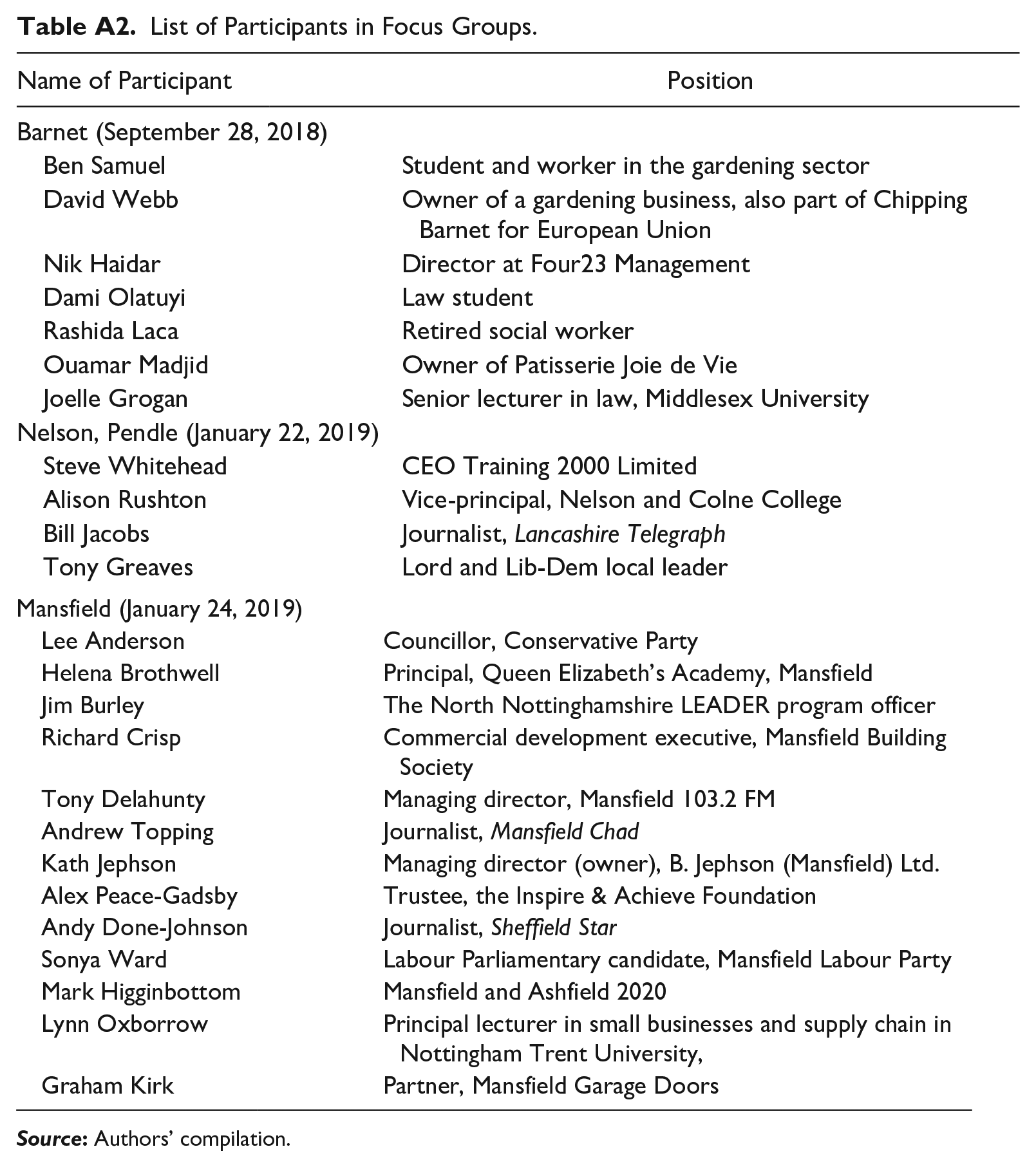
| Name of Participant | Position |
|---|---|
| Barnet (September 28, 2018) | |
| Ben Samuel | Student and worker in the gardening sector |
| David Webb | Owner of a gardening business, also part of Chipping Barnet for European Union |
| Nik Haidar | Director at Four23 Management |
| Dami Olatuyi | Law student |
| Rashida Laca | Retired social worker |
| Ouamar Madjid | Owner of Patisserie Joie de Vie |
| Joelle Grogan | Senior lecturer in law, Middlesex University |
| Nelson, Pendle (January 22, 2019) | |
| Steve Whitehead | CEO Training 2000 Limited |
| Alison Rushton | Vice-principal, Nelson and Colne College |
| Bill Jacobs | Journalist, Lancashire Telegraph |
| Tony Greaves | Lord and Lib-Dem local leader |
| Mansfield (January 24, 2019) | |
| Lee Anderson | Councillor, Conservative Party |
| Helena Brothwell | Principal, Queen Elizabeth’s Academy, Mansfield |
| Jim Burley | The North Nottinghamshire LEADER program officer |
| Richard Crisp | Commercial development executive, Mansfield Building Society |
| Tony Delahunty | Managing director, Mansfield 103.2 FM |
| Andrew Topping | Journalist, Mansfield Chad |
| Kath Jephson | Managing director (owner), B. Jephson (Mansfield) Ltd. |
| Alex Peace-Gadsby | Trustee, the Inspire & Achieve Foundation |
| Andy Done-Johnson | Journalist, Sheffield Star |
| Sonya Ward | Labour Parliamentary candidate, Mansfield Labour Party |
| Mark Higginbottom | Mansfield and Ashfield 2020 |
| Lynn Oxborrow | Principal lecturer in small businesses and supply chain in Nottingham Trent University, |
| Graham Kirk | Partner, Mansfield Garage Doors |
Acknowledgements
We gratefully acknowledge the work and insights of all the other researchers involved in the project “Debating Brexit at the Local Level,” on which this article draws: Alexandra Bulat, Diane Bolet, Josh De Lyon, Kuba Jablonowski, and Mary Kaldor. We would like to thank the London School of Economics’ Knowledge Exchange and Impact (KEI) fund for supporting our fieldwork and the Autonomous Community of Madrid’s Talento Program for its financial support. We would also like to thank Waltraud Schelkle and participants at the European Institute’s EU550 seminar at the LSE for providing invaluable feedback, Sacha Hilhorst for her recommendations about further readings, and all those who provided comments at the 2019 Structure and Organization of Government Conference in Mexico City and the 2019 ECPR General Conference in Wrocław. Finally, we are very grateful to the editorial board of Politics & Society for providing excellent, clear, and constructive feedback on a previous version of this article.
Declaration of Conflicting Interests
The authors declared no potential conflicts of interest with respect to the research, authorship, and/or publication of this article.
Funding
The authors disclosed receipt of the following financial support for the research, authorship, and/or publication of this article: We would like to gratefully acknowledge the financial support of the LSE’s Knowledge Exchange and Impact (KEI) fund, which was crucial for the conduct of our research for this article. This work was also supported by the Autonomous Community of Madrid’s Talento Program (2018-T1/SOC-10152).
Supplemental Material
Supplemental material for this article is available online.
Notes
Author Biographies
Supplementary Material
Please find the following supplemental material available below.
For Open Access articles published under a Creative Commons License, all supplemental material carries the same license as the article it is associated with.
For non-Open Access articles published, all supplemental material carries a non-exclusive license, and permission requests for re-use of supplemental material or any part of supplemental material shall be sent directly to the copyright owner as specified in the copyright notice associated with the article.
