



Abstract
We ask whether and why European political parties receive election news coverage abroad and investigate this phenomenon by combining theoretical stipulations regarding the politicisation of European integration and the horizontal Europeanisation of national public spheres. Based on a content analysis of 64 newspapers in 16 European Union countries following the 2019 European Parliament election, we argue that contestation over European integration increases the likelihood that foreign journalists report election results from a particular member state. Eurosceptic parties are more often visible abroad than Europhile parties, unless they stood for election in a highly polarised party system. Our results have important implications for the European Union's legitimacy as contestation over European integration increases the chances for citizens to learn about election results in other European countries.
Introduction
The European Union (EU) is increasingly contested in domestic politics across Europe (e.g., Hobolt and Rodon, 2020; Kriesi, 2016; Van der Brug et al., 2022). This contestation is particularly manifest in the politicisation of European integration in the electoral arena (De Wilde and Zürn, 2012; Hooghe and Marks, 2009). Although the dynamics and scope of EU politicisation differ across domestic contexts (e.g., Hutter and Kriesi, 2019), we have little knowledge about the extent to which contestation over European integration in one domestic context extends to other domestic contexts across the EU. This question is important because contestation affects election outcomes which in turn shape EU politics – through governmental actors in the European Council, the Council of Ministers or through Members of the European Parliament.
European Parliament (EP) elections are traditionally considered second-order national elections (Reif and Schmitt, 1980) as voters often reward or punish parties and candidates based on their performance in domestic politics – a phenomenon which is still considered valid in more recent elections (e.g., Van der Brug and De Vreese, 2016; Ehin and Talving, 2021; Hix and Marsh, 2011; Schmitt and Toygür, 2016; Van der Eijk and Franklin, 1996). Nonetheless, newer developments such as those related to EU issue voting (e.g., De Vries, 2010) or European issue mobilisation (Braun, 2021), and new initiatives such as the Spitzenkandidaten procedure are indicators of an increased contestation in EP elections. Although EP elections take place at a single point in time across Europe, they are still organised domestically – that is, domestic parties and politicians compete for seats in the EP. Previous research therefore has taken a comparative perspective on election campaigns, media coverage and voter behaviour in EP elections.
The purpose of this article is to shed light on the extent to which media treat EP elections as a transnational contest. From a normative-democratic perspective, by reporting on EP elections beyond the domestic context, journalists therefore contribute to the legitimacy of the elections in particular, and the EU polity more generally (see Trenz, 2008; Walter, 2017a). Specifically, we are interested in how much attention national political parties receive in newspaper coverage abroad and which factors possibly explain the variation in the newspaper visibility of national parties across Europe. Existing research has dealt with questions concerning the extent to which media coverage of EP election campaigns focuses on EU-level actors – often at the expense of domestic political actors (e.g., Belluati, 2016; Boomgaarden and De Vreese, 2016; Schuck et al., 2011; Schulze, 2016). Thereby, these studies often considered explanatory factors related to different media and the political context at home, i.e., in the respective countries where EU news are distributed. In other words, they did not investigate the characteristics of foreign political actors that may explain why they receive more or less media attention. Our contribution is to explain why some political parties from other European countries are more likely to be reported upon than others at times of European elections. Put differently, we take an actor-centred approach in explaining news coverage abroad. In doing so, we argue that increased contestation over EU integration by and between political parties in domestic contexts leads to more news visibility of political actors across Europe.
To test our argument, we rely on an existing dataset (Gattermann et al., 2021b) that consists of a content analysis of articles published immediately after the 2019 EP election in 64 newspapers from 16 EU countries. Since we are not interested in the effects of transnational contestation on voter behaviour, we consider this dataset suitable to study those factors that explain the news visibility of political parties across Europe. Indeed, the data allow us to analyse the extent to which newspapers report on the more than 200 parties in other EU member states. Additionally, the data enable us to control for these parties’ election results, thus providing a rigorous test of our hypotheses. We show that parties from countries with higher levels of party system polarisation over EU integration are more likely to be reported upon in foreign news. Eurosceptic parties are more often visible abroad than Europhile parties, unless they stood for election in a highly polarised party system. We discuss the implications of our findings for party competition in EU politics and the legitimacy of the EU project in the concluding section alongside recommendations for future research.
Party contestation and transnational news coverage of EP elections
Our aim is to explain why some political parties are more visible in European news abroad than others. To do so, we first require an understanding of the European media landscape and the scope of the European public sphere. After that, we shed light on the motivations of journalists to report on political parties in other European countries, before we present our argument concerning the role of contestation over EU integration by and between political parties in domestic contexts for news visibility of political actors across Europe.
The European media landscape is dominated by national media, including broadcasters and newspapers, alongside a few pan-European niche media such as Politico Europe or Euronews. The impact of the latter on the emergence of a (single) transnational public sphere has been considered rather limited thus far (e.g., Brüggemann and Schulz-Forberg, 2009; Statham, 2008) and language barriers entail that most EU citizens consume national media. It is therefore no surprise that extant research has empirically investigated the extent to which national public spheres generated by traditional media are Europeanised (Adam, 2015; Machill et al., 2006). One prominent definition distinguishes between vertical and horizontal Europeanisation (Koopmans and Erbe, 2004): Vertical Europeanisation entails that EU-level actors are visible in the national public sphere, while horizontal Europeanisation means that political actors from other European countries gain attention. The extent to which these two forms can be detected empirically varies across issues (Koopmans and Erbe, 2004) and countries (e.g., Brüggemann and Kleinen von Königslöw, 2007; Walter, 2017b).
We know from previous research that both vertical and horizontal Europeanisation are rather limited. National media coverage of EP election campaigns pays more attention to domestic political actors than to EU-level ones (e.g., Boomgaarden and De Vreese, 2016; Michailidou, 2015; Schuck et al., 2011) or those from other European countries (e.g., Gattermann and Vasilopoulou, 2017). However, when it comes to horizontal Europeanisation we do not know which factors explain the (little) attention political actors from other European countries receive. To rectify this, we need to consider the perspective of journalists working for foreign news media.
Journalists will have to make a choice when deciding which political parties in other European countries to report about. These selection criteria likely concern two levels, namely the country and the political party level. The 2019 EP election was held in (then) 28 European member states, and newspapers (or any other national media) do not have the capacity to report in depth about the respective other 27 countries. Therefore, journalists and editors will choose a few countries (and parties) which they consider newsworthy. Likewise, 182 domestic parties alongside two independent candidates were elected to the ninth EP. 1 This number excludes the many unsuccessful contenders, such as the Dutch right-wing populist Party for Freedom, which only gained one seat after Brexit (compared to the four seats it received in the preceding legislative term). Thus, the question is: Which selection criteria determine whether political parties will be covered by foreign news?
Generally, journalists tend to consider a range of different selection criteria in their reporting (e.g., Galtung and Ruge, 1965; Harcup and O’Neill, 2001, 2017). While we expect that several news values apply, including power, prominence, surprise and proximity, our focus lies on the explanatory power of conflict in order to understand the extent to which contestation over EU integration contributes to the transnational media reporting on EP elections. Indeed, the broader concept of negativity represents one of the key news selection criteria in both foreign (Galtung and Ruge, 1965) and domestic news reporting (Harcup and O'Neill, 2001); and EU affairs arguably fall in between foreign and domestic news given the increased relevance of the EU for the daily lives of European citizens. A classic example for the relevance of conflict in research about the European public sphere is the so-called ‘Haider debate’ (Risse and Van de Steeg, 2003): After the 1999 Austrian legislative election, coalition negotiations between the Social Democratic Party and the People's Party failed. This led the latter to consider a coalition with the Freedom Party and its right-wing extremist leader Jörg Haider as minister in 2000 (he later resigned from the party leadership to allow for this coalition). According to Risse and Van de Steeg (2003), the possibility of a Neo-Nazi entering government in an EU member state has led to numerous similar media debates across Europe at the time. More recently, Gattermann and Vasilopoulou (2017) studied the potential emergence of a ‘Eurosceptic public sphere’ in EP elections arguing that Eurosceptic candidates were on aggregate more visible transnationally in 2014 compared to 2009, although the relationship to the news visibility of Europhile candidates was not assessed. It is therefore necessary to consider the role of conflict more broadly both at the party and at the country level.
Conflict in European politics is multi-dimensional. First, given the increase in policy-making competences at the supranational level, policies have gained relevance among parties and voters in EP elections – either in form of substantive issues or by means of the left-right dimension (e.g., Braun et al., 2016; Hobolt and Wittrock, 2011; Schäfer and Debus, 2018) – thus adding to competition over policies. Second, party contestation over questions pertaining to the EU polity has become more forceful as the rise of Eurosceptic challenger parties suggests (e.g., Adam and Maier, 2011; Hobolt and Tilley, 2016; Schulte-Cloos, 2018; De Vries and Hobolt, 2020). The latter have traditionally owned the ‘EU polity’ issue and campaigned strategically over questions related to EU integration (e.g., Green-Pedersen, 2019; Hobolt and De Vries, 2015), while mainstream parties tended to shun promoting their pro-EU stances in election campaigns to avoid internal party conflict (Hooghe and Marks, 2009; Hooghe et al., 2002; Van de Wardt et al., 2014). More recently, mainstream parties have responded to this competition by increasingly engaging strategically in campaigns over issues related to EU integration (Meijers and Rauh, 2016) or European issues more generally (Maier et al., 2021).
What do these developments mean for news reporting of political parties in other European countries in the aftermath of EP elections? EP elections are still considered second order, despite a few indications that EU policies have played a more important role in the 2019 EP election compared to before (Gattermann et al., 2021a). In other words, questions related to the polity still dominate the campaigns and electoral behaviour. It is therefore likely that media consider contestation over the EU polity a crucial conflict, not least because the outcome of this contestation has important implications for the future of EU integration. We know that media coverage of EP election campaigns is higher in countries with higher levels of party contestation over Europe (Schuck et al., 2011). Similarly, and in line with the news value theory (e.g., Galtung and Ruge, 1965; Harcup and O’Neill, 2001), we expect that journalists prefer to report about parties from countries where EU affairs are highly contested, such as the UK or Italy, because the news value of conflict has more weight here compared to those countries where parties are less divided over European integration, such as Malta, Spain or Luxembourg. In other words, the more parties engage in discourse over European integration, the more salient that discourse becomes (see also Meyer et al., 2020: 287). Additionally, we expect those political actors who actively fuel this contestation, particularly Eurosceptic challenger parties, to be more newsworthy for journalists. This is because they challenge the longstanding ‘permissive consensus’ regarding EU integration (Hooghe and Marks, 2009) and are thus more likely to carry the news value of negativity than pro-European (mainstream) parties. Although Euroscepticism is not necessarily a predictor for more media attention during EP election campaigns at home (Eugster et al., 2021), Eurosceptic parties pose a threat to the legitimacy of the European project as a whole and therefore likely draw newsmakers’ attention abroad. 2
In sum, contestation by individual parties and in the party system should have a positive effect on the likelihood for foreign journalists to report on certain political parties in other European countries. However, we expect that the interplay between these two factors has a differentiated effect on foreign news reporting. In countries where party competition over EU integration is highly polarised, pro-European (mainstream) parties also actively contribute to this contestation. For these countries, we do not expect foreign journalists to consider Eurosceptic parties more newsworthy than Europhile ones. Vice versa, Eurosceptic challengers likely stand out in foreign news in countries where they represent outsiders amid limited contestation over EU integration among parties and voters (see also Eugster et al., 2021: 570). We thus formulate our three hypotheses as follows:
H1: Political parties from countries with higher levels of party system polarisation over EU integration are more likely to receive news coverage abroad. H2: Eurosceptic parties are more likely to receive newspaper coverage abroad than pro-European parties. H3: The expected higher visibility of Eurosceptic parties abroad (H2) is less pronounced for Eurosceptic parties in highly contested party systems.
Data and methods
Sample selection and coding
We test our hypotheses based on an existing dataset consisting of a content analysis of 1955 articles from 64 newspapers in 16 countries that were collected in the aftermath of the 2019 European election (Gattermann et al., 2021b). The selection of countries was driven by two imperatives: First, we aimed for a diverse set of countries in terms of length of EU membership, size (which determines the number of seats in the EP) and geography. The second imperative was data availability: We selected countries where print or digital editions of various newspapers were available from international distributors or from the online news outlets’ websites. In other words, we did not rely on a single database, but acquired print copies or digital versions of individual newspaper editions; we used LexisNexis only for The Guardian. For each country, we selected four outlets to represent the diversity of the newspaper landscape including centre-left and centre-right broadsheets, business newspapers, and the popular press. The countries and news outlets are listed in the Online appendix. Using newspapers to measure the political news coverage in Europe is in line with previous research (e.g., Eugster et al., 2021; Meyer et al., 2020; Schulze, 2016). Traditional media such as radio, television and newspapers still represent a key source of political news for European citizens (Newman et al., 2020). Moreover, relying on actual editions rather than continuously updated news feeds, such as on newspaper websites or social media, provides researchers with considerable control over the content of political news.
We analyse the newspaper coverage of political actors in the three days following the last day of the 2019 EP election (27–29 May 2019). 3 In some countries, regional (e.g., Germany, Ireland) and national elections (e.g., Belgium) or referenda (Ireland) took place at the same time. We therefore preferred manual coding to automated techniques, which are also better able to detect nicknames for politicians and parties. As outlined in Gattermann et al. (2021b), we recruited coders with a high level of language proficiency (often native speakers) and a good understanding of politics (mostly doctoral or master students in political communication or political science). To identify articles dealing with the European election, coders examined all sections that typically cover news about politics: the front page, domestic politics, international affairs, editorials and commentaries by editors or journalists of that newspaper, and any section specifically dedicated to the EU election. We considered an article to be relevant if its headline, sub-headline (if available), lead (font differs from main text; if available) or first paragraph made an explicit reference to the EP election (including candidates and parties) and/or if it featured any graphic visualisations of election results. We disregarded articles that only referred to national or local elections held at the same time (e.g., in Belgium and Ireland). For The Guardian, we disregarded online publications and considered the headline and first two paragraphs for the selection and coding.
Coders identified up to five parties and five politicians covered in the article's headline, sub-headline and lead (if available), and the first paragraph. In our analysis, we only consider political actors from EU countries. Moreover, we subsume politicians (e.g., Angela Merkel) under their respective party label (e.g., CDU). The detailed codebook, which also includes variables that are not relevant for the present analysis, can be found in the Online appendix. The results from several intercoder reliability tests are also reported in the Online appendix.
Data structure
Figure 1 shows the extent to which newspapers in 16 EU member states report on political actors at the domestic and at the EU level, and on parties in other EU member states. Although most reports focus on the electoral performance of domestic parties and politicians, a large fraction of the newspaper reporting also deals with the electoral performance of parties in other EU member states. In three countries (Austria, Germany and the Netherlands) the coverage of foreign parties even exceeds that of domestic parties. In total, we find about 1800 references to foreign national parties (compared to 3000 references to domestic political actors).
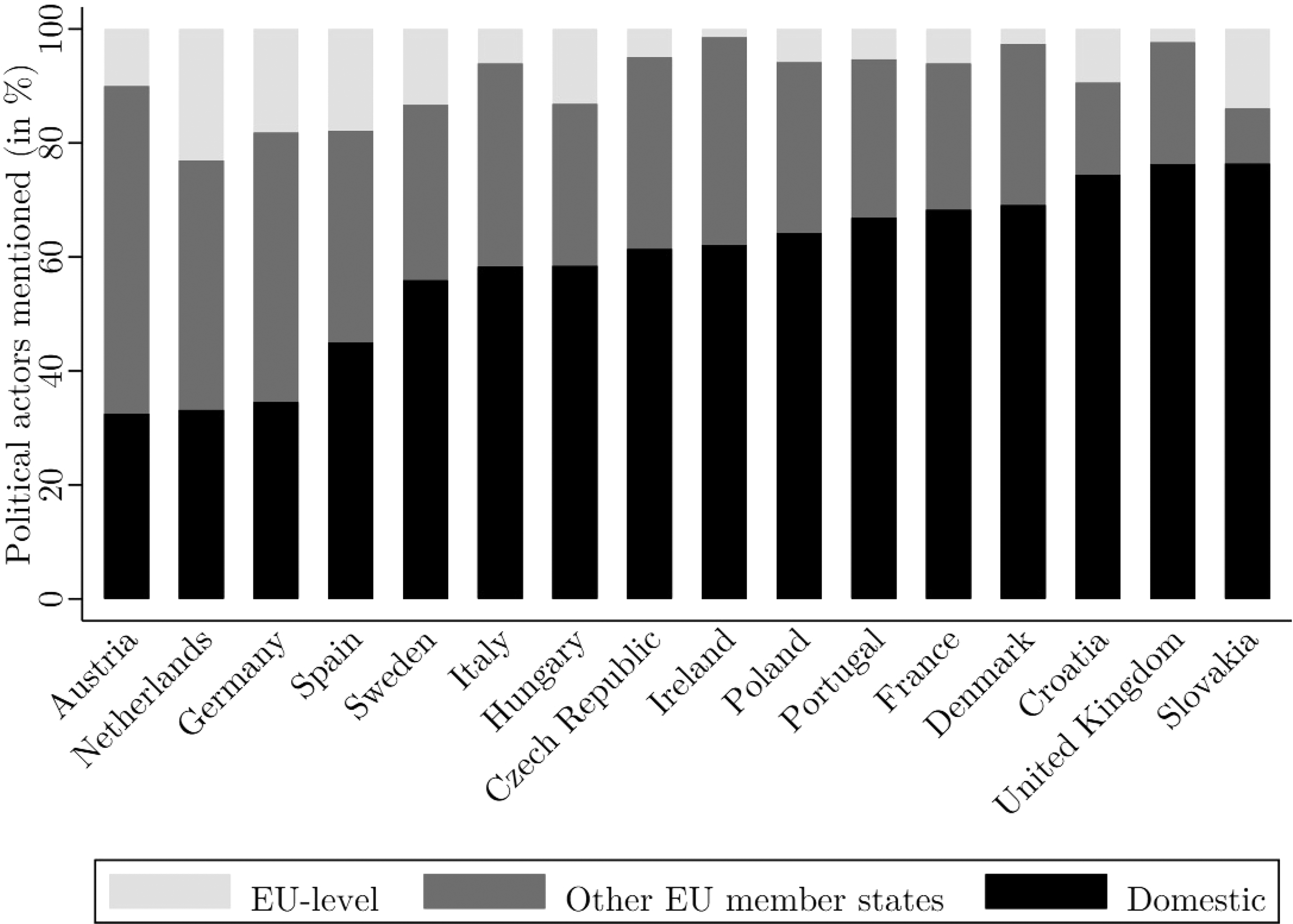
Newspaper coverage of domestic, EU level, and other national parties.
This data overview has a similar structure as existing research that explains why certain media pay more attention to specific actors than others (e.g., Belluati, 2016; Boomgaarden and De Vreese, 2016; Schuck et al., 2011; Schulze, 2016). As outlined above, we divert from that structure and consider an actor-centred approach in the following way: To build the dataset in which the individual party represents the unit of analysis, we rely on the Parlgov Database (Döring and Manow, 2019) that lists 290 entities competing in the 2019 European election. Like Gattermann et al. (2021b), we ignore independent candidates and drop double counts for electoral alliances (that occur when both the alliance and the constituent parties are included in the Parlgov data). 4 Especially for minor parties that are not represented in the EP, information on party ideology is often missing. In total, the empirical analysis is based on 215 observations. As our dependent variable, we measure whether a party's electoral performance is mentioned in the newspapers in a given foreign country (1) or not (0). 5 We then stacked the data so that we initially had 16 observations per party. However, for each of the 16 countries included in our sample, we then dropped the domestic parties from that list resulting in 3315 observations in total (approximately 200 parties for 16 countries). For example, we recorded 15 observations for the Polish Law and Justice, i.e., in all 16 countries of our sample barring Poland itself. But, for a party that comes from a country that is not included in our sample (e.g., the Finish National Coalition Party), we have 16 observations. We account for the multi-layered data structure in a multi-level model with random intercepts for parties that in turn are nested in their respective country. 6
Independent variables
We merge these data with information on party policy positions from the 2019 Chapel Hill Expert Survey (CHES; Bakker et al., 2020) using the Party Facts database (Döring and Regel, 2019) and some minor adaptations for the 2019 EP election. For the first variable of interest relating to H1, party system polarisation on European integration, we draw on Ezrow (2007) and measure polarisation as the weighted (by party vote shares in the 2019 EP election) standard deviation of party positions on European integration in a given country. To test H2, the second variable of interest, Euroscepticism, indicates a party's position on European integration on a scale from 1 (‘Strongly in favour’) to 7 (‘Strongly opposed’). 7 Interacting both variables with one another allows testing H3.
We also include various control variables that tap other news values or tend to correlate with party positions on EU integration (Hooghe et al., 2002) and therefore may affect our results (e.g., Eugster et al., 2021; Meijers and Rauh, 2016; Meyer et al., 2020; Tresch, 2009). We measure party size using the party's vote share (in the 2019 EP election); it also serves as a proxy for the news value ‘prominence’. A dummy variable indicates whether a party is currently in government at home (1) or not (0) and additionally relates to the news value ‘power’. To account for the potential curvilinear relationship between a party's left-right position and its Euroscepticism, we include a variable for a party's position on the economic left-right dimension and its squared term. As for Euroscepticism, left-right positions are taken from the CHES survey. Moreover, media attention might be higher for parties that significantly increased or lost electoral support compared to the last election (see Gattermann et al., 2021b), which additionally taps the news value of ‘surprise’. We therefore account for the absolute change in the party's vote share since the 2014 European election. 8
There are likely other variables related to the origin of the election context that explain variation in newspaper attention abroad. First, we expect more foreign news coverage on parties from larger EU member states as these also correspond to news values of ‘power’ and ‘prominence’. These parties gain more seats in the EP, and thus have greater influence than those from smaller countries. We measure country size as the (logged) seat share for each country delegation in the EP. Second, we also expect journalists to consider the news value of ‘proximity’ and thereby to report more often about parties from countries that are culturally, economically and/or politically close within the EU (see also Brüggemann and Kleinen von Königslöw, 2007). One way to operationalise this is by considering shared borders between the party's country and that of the media outlet. The dichotomous variable neighbouring countries indicate whether two countries (the origin of the election context and the country in which news are distributed) have a shared land border (1) or not (0).
Results
Figure 2 gives an overview of the most visible parties in news abroad following the 2019 European Election. Parties from countries with party systems that are polarised on European integration (e.g., France, the United Kingdom, Italy or Greece) are overrepresented in this list. Among these countries, it is also noticeable that the print media tends to cover both pro-European and Eurosceptic parties (e.g., La République en Marche and Rassemblement National from France). Generally, however, many Eurosceptic parties are among the most visible parties (e.g., the Polish PiS, the Austrian FPÖ, and Fidesz in Hungary). 9 The visibility in foreign newspaper reporting is also likely to be driven by other country- and party-specific factors. For example, larger parties and those from larger EU member states tend to be overrepresented in Figure 2. To disentangle the effects of political contestation of EU affairs from other factors, we test our hypotheses in a multivariate framework.
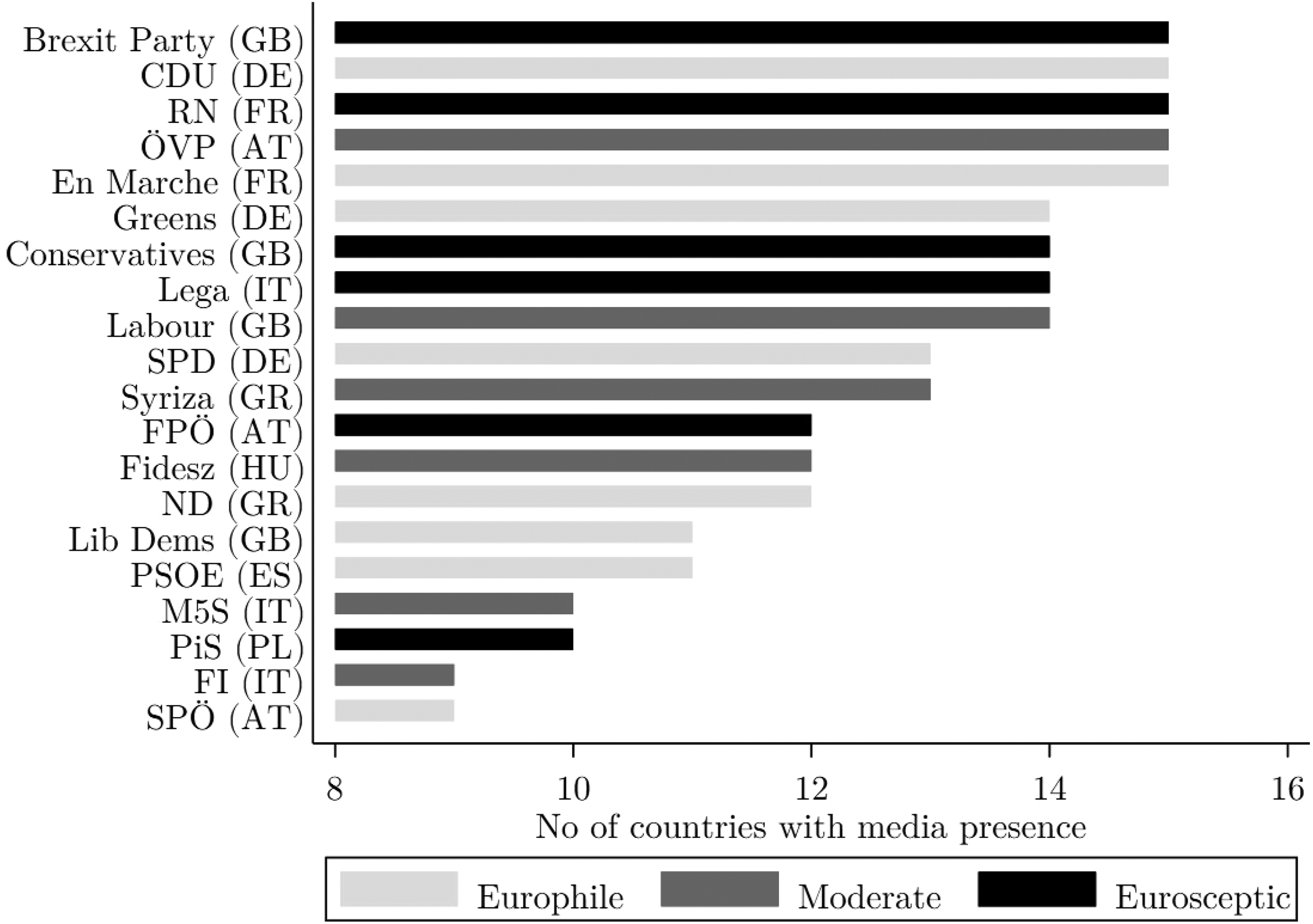
The most visible parties in foreign newspapers.
Table 1 shows the results of two regression models explaining the newspaper coverage of political parties in foreign news. Model 1 serves to test whether news coverage of foreign parties’ election results depends on the polarisation on EU affairs in that country (H1) and the party's own Euroscepticism (H2). In Model 2, we add an interaction effect to test whether the effect of a party's Euroscepticism is smaller in more polarised party systems (H3). To ease the interpretation, we use marginal effect plots to visualise our findings.
Explaining party visibility in foreign newspapers.
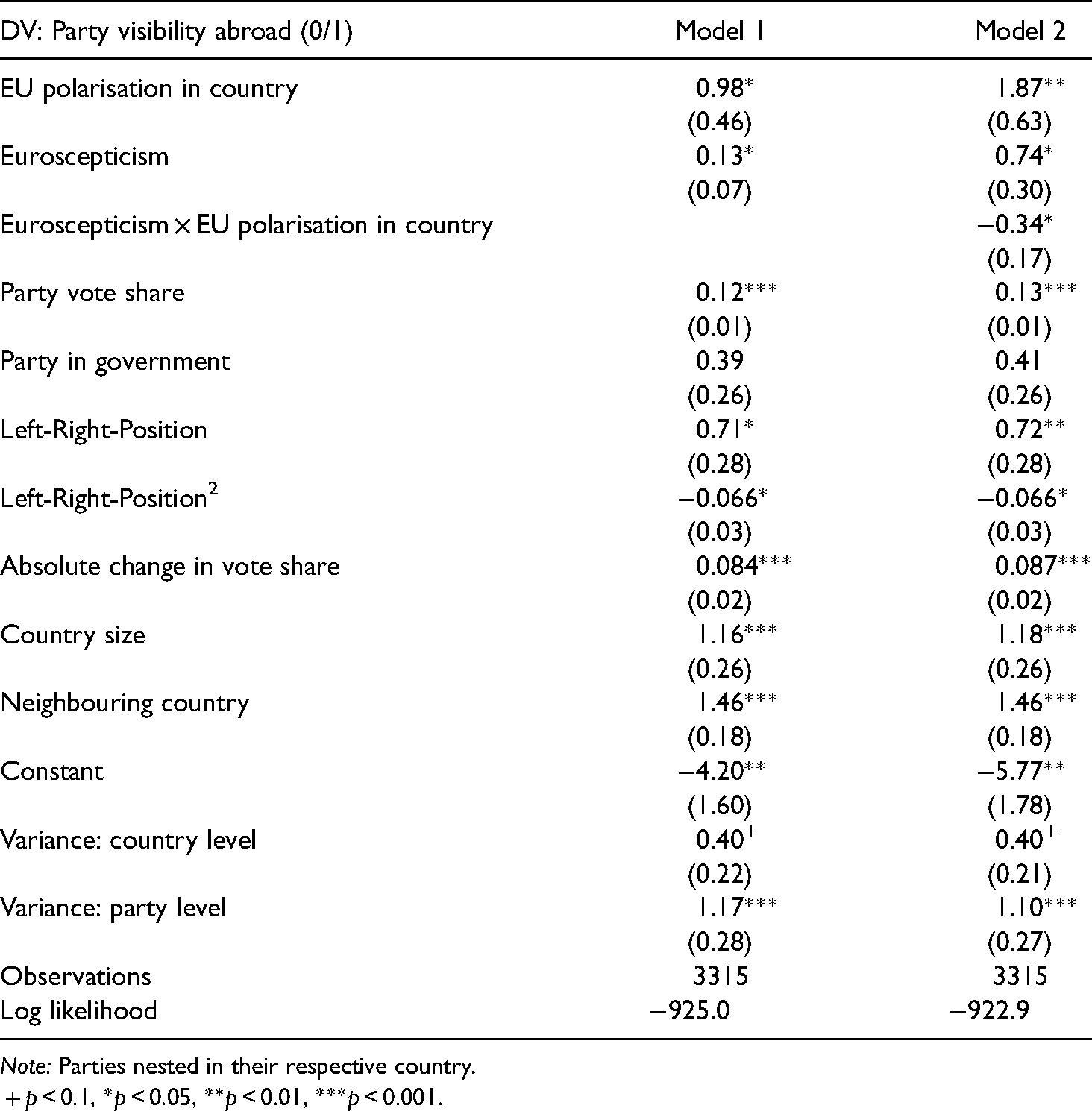
Note: Parties nested in their respective country.
+ p < 0.1, *p < 0.05, **p < 0.01, ***p < 0.001.
Parties from countries with more polarised party systems on EU affairs are indeed more visible in foreign newspapers (H1). Moving from a country with a moderately low polarisation (e.g., Ireland, first quartile) to a country with a relatively high polarisation on EU affairs (e.g., the Netherlands, third quartile) increases the chance that a party from that country is present in foreign news by 5.4 percentage points (see Figure 3). The magnitude of this effect is somewhat larger than that of the absolute change in (party) vote share ( + 3.4 percentage points) when this variable changes from its first to the third quartile (i.e., a change in electoral support from 2.0 to 7.3 percentage points).
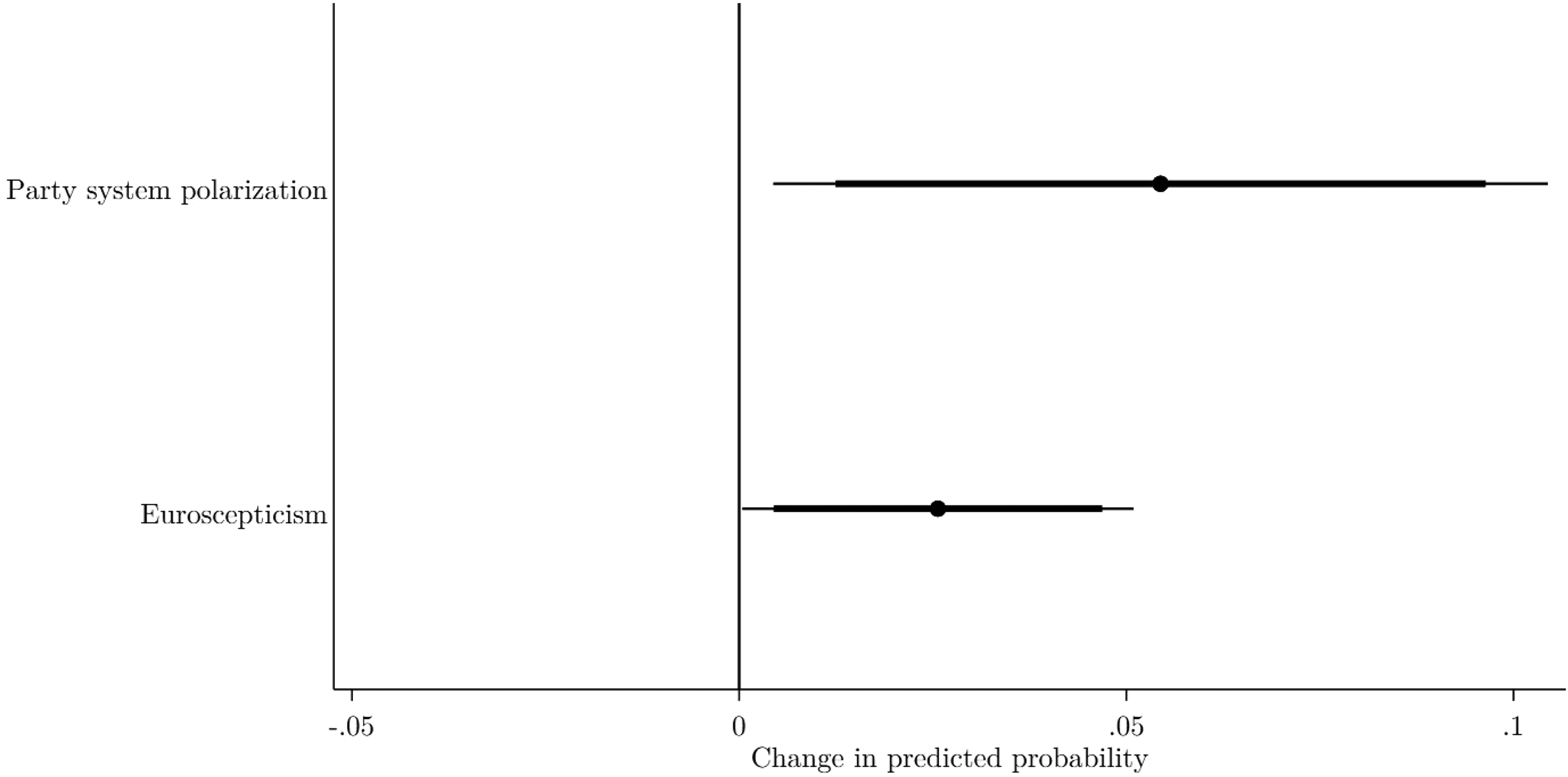
Polarisation on EU integration and Euroscepticism increase visibility in the news.
In line with H2, Eurosceptic parties are more likely to hit the news in other EU member states than pro-European parties. The effect of Euroscepticism is positive and statistically significant at conventional levels. Increasing a party's Euroscepticism from the first to the third quartile (i.e., from 1.5 to 4.0 on the 1–7 scale) increases the probability of news coverage abroad by 2.6 percentage points. Note that this effect holds while we also account for a party's left-right position.
Turning to the control variables, we find that electoral support is a strong predictor for a party's visibility in the news abroad. Increasing a party's vote share from 5 to 16 percent (i.e., the interquartile range) increases the chance of media coverage by 10.7 percentage points. Similarly, parties with a meaningful change in electoral support (i.e., vote gains or losses of 5 percentage points) are 3.4 percentage points more likely to be reported on in foreign news compared to parties with no change in electoral support since the last election. Moreover, we find a significant effect of party ideology on the visibility in news abroad. All else being equal, the probability of foreign news coverage of parties with more moderate policy positions (5 on the 0–10 scale) is about 10 percentage points higher than for parties with extreme policy positions (0 or 10 on the 0–10 scale). 10 Turning to the country-specific covariates, we find a strong and statistically significant effect of country size: Foreign newspapers are more likely to report about elections from larger compared to smaller EU member states (as measured by the size of their delegation in the EP). Increasing the seat share from 1.5 (parties from Croatia) to 3.5 percent (parties from the Netherlands) increases the probability of media coverage by 7.3 percentage points. Finally, journalists and editors are more likely to cover elections from neighbouring countries ( + 13.4 percentage points).
In Model 2, we turn to test the conditional effect of a party's Euroscepticism depending on the overall polarisation on EU affairs in the respective party system (H3). We expect that Eurosceptic parties from party systems with a low level of EU polarisation are particularly visible abroad. Figure 4 shows the conditional effect plot to test this expectation. The y-axis shows the marginal effect of a party's Euroscepticism on the visibility in news abroad depending on the polarisation in the respective country (x-axis). The histogram illustrates the distribution of party system polarisation. The dots indicate the binning estimators along with 90% and 95% confidence intervals to test the linearity assumption that is implicit in the interaction model (Hainmueller et al., 2019).
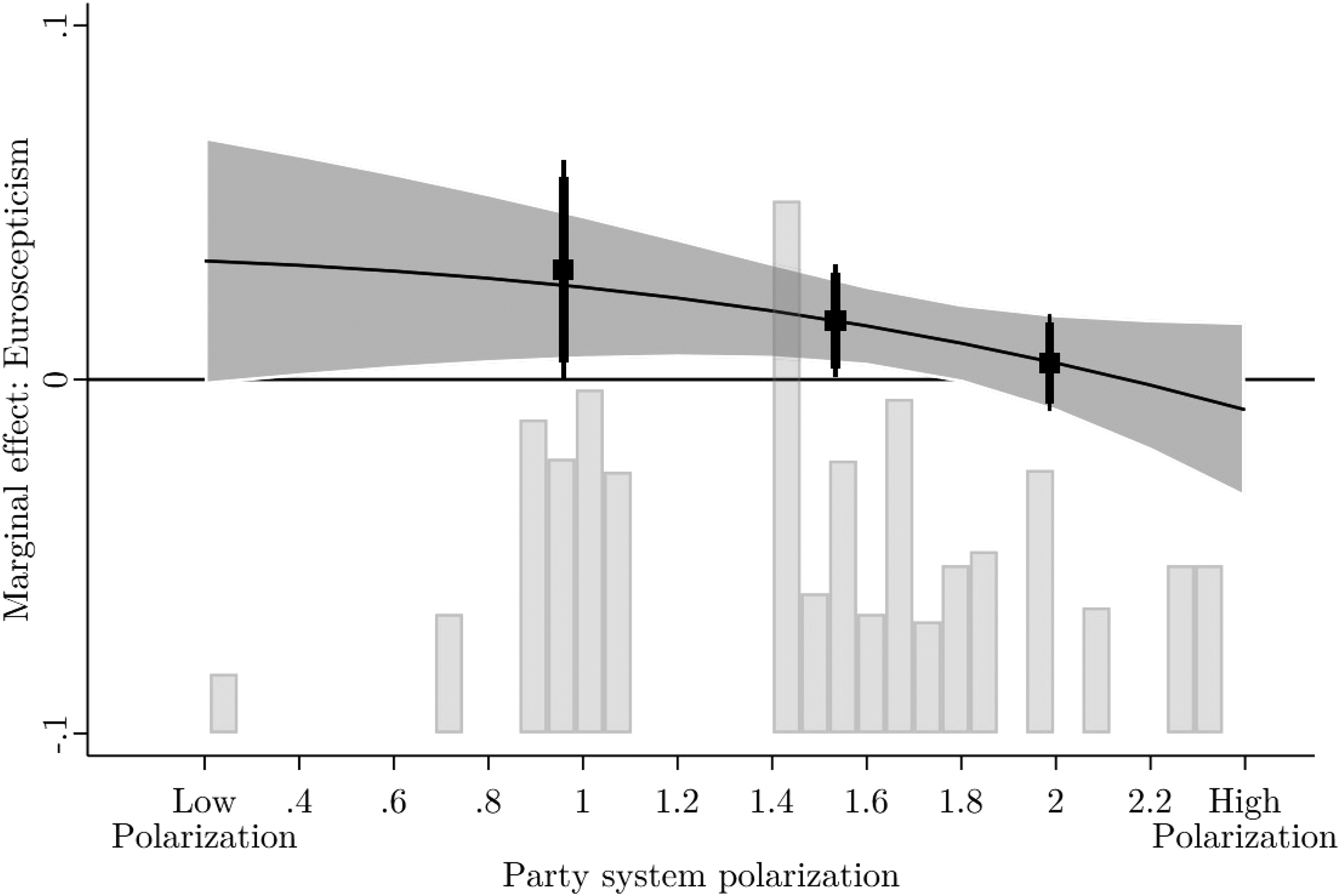
Eurosceptic parties are more visible in news abroad when contestation over the EU is low.
We indeed find evidence in line with H3: Eurosceptic parties are particularly newsworthy in countries with low contestation over EU affairs. For example, consider Spain and France as exemplary countries for a relatively low (Spain) and high (France) polarisation on EU affairs. The Eurosceptic Spanish party Vox competes in the relatively pro-European Spanish party system and, thus, its Euroscepticism demarcates it from its competitors. Vice versa, in a highly polarised party system such as France, the contrast between pro- and anti-European parties (e.g., La République en Marche and Rassemblement National) generates the interest of foreign media outlets. Hence, foreign newspapers are more likely to cover both antagonists and the relative advantage of Eurosceptic parties vanishes.
These findings are robust to several changes in the model specifications. First, the current model specification does not fully account for potential interdependencies between the country of the party and the country of the media outlets covering that party. Yet, as the effect of neighbouring countries suggests, there might be further, unobserved interdependencies between such country dyads. We therefore estimate a multi-level regression model with random intercepts for country dyads. The results are similar and are reported in the Online appendix. Second, we also estimate models with standard errors clustered by parties to account for the interdependence of observations in the stacked data structure. The regression results confirm our main findings and are shown in the Online appendix.
Conclusion
The aim of this article was to examine and to explain variation in newspaper reporting of European parties in other EU member states across Europe. To this end, we employed an original content analysis of newspaper coverage in the three days after the 2019 EP election in 16 EU countries. Previous research has shown that party political contestation (Schuck et al., 2011) or public Euroscepticism (Schuck et al., 2013) at home matters for EU news reporting of EP election campaigns in the domestic context. Our results show that the scope and type of contestation over EU integration and whether political parties are Eurosceptic (or not) explain the extent to which political actors are covered in newspapers abroad. Specifically, our findings demonstrate that party system polarisation over the EU increases the likelihood that foreign journalists report election results from a certain country. Likewise, Eurosceptic parties are more newsworthy abroad than Europhile parties. Yet, in party systems with high levels of party contestation over EU integration, this difference diminishes. In other words, Eurosceptic parties are more likely to gain news attention in other European countries when domestic party contestation is rather low.
Our results have important implications for the politics and the legitimacy of the EU: They imply that contestation over EU integration increases the chances for EU citizens to learn about election results in other European countries. On the one hand, the heightened attention towards Eurosceptic parties and polarised party systems may have a mitigating effect on the perceived legitimacy of the EU in general, and the EP in particular, and can lead to dissatisfaction with European democracy in the long run (see Hoerner and Hobolt, 2020). On the other hand, conflict does not necessarily have negative consequences but also has the potential to mobilise EU citizens (Schuck et al., 2016). Coverage of conflict over Europe in foreign countries can also diminish the support of Eurosceptic parties and the policies they support (Walter, 2021). Future research should therefore further examine the extent to which election news reporting from other European countries affects voter attitudes towards the EU and European democracy. This becomes especially relevant against the backdrop of developments that see clashes between party political defenders and challengers of liberal democracy in Europe, such as with respect to political actors from Hungary or Poland (see Van der Brug et al., 2021). We therefore also recommend that future research studies these dynamics during election campaigns and assesses their potential effects on vote choice.
Our results also inform debates about the emergence of a European public sphere (e.g., Risse and van der Steeg, 2003; Trenz, 2008; Walter, 2017a). About a third of the competitors mentioned in national media were parties and politicians from other EU member states. At the same time, however, horizontal Europeanisation is highly contingent on contestation of the European project between and by Eurosceptic parties in the national context. In sum, these findings suggest that national media create a limited European public sphere because journalists are highly selective in their coverage of parties from other EU member states.
Although our study took an actor-centred approach into explaining variation in news reporting in EU affairs (e.g., see Eugster et al., 2021; Gattermann and Vasilopoulou, 2017), our research design is not ideal to consider explanatory factors related to the context of where news about foreign political parties are distributed (e.g., Schuck et al., 2011; 2013). For example, public Euroscepticism may undermine the interest of the audience to learn about EP election outcomes in other European countries (see Brüggemann and Kleinen von Königslöw, 2007). Yet, considering these factors would reverse the research design allowing us to study only the extent of horizontal Europeanisation in EU news coverage (Koopmans and Erbe, 2004), but not the characteristics of news sources that affect news attention. Future research might find a way to accommodate both perspectives.
Likewise, we were unable to assess differences between newspapers due to the relatively small sample and the circumstance that not all newspapers are directly comparable across countries in their political leaning and/or degree of commercialisation (see the Online appendix). If researchers were to study the phenomenon during election campaigns in the future, particularly focusing on the potential implementation of the so-called transnational electoral lists (see Díaz Crego, 2021), we recommend to consider more reports alongside additional media. Indeed, we rely on traditional media. Social media, in contrast, have a greater potential to show signs of a European public sphere at key moments in time (see Hänska and Bauchowitz, 2019; Stier et al., 2021). They thereby comply with one of the traditional notions of the European public sphere, namely that ‘[a]t a certain point in time, the same topic is discussed by actors who are, in one way or another, in contact with each other’ (Van de Steeg, 2002: 507). Future research should therefore also assess whether party contestation over EU integration affects (post-)election coverage on social media as well. Given that newspapers influence the agenda of other media, including social media (e.g., Harder et al., 2017; Vliegenthart and Walgrave, 2008), we would also expect a knock-on effect of party contestation over EU integration. Our findings provide first insights into the potential of domestic contestation to become salient across Europe and thereby inform scholarly debates about politicisation and the future of EU integration.
Supplemental Material
sj-docx-1-eup-10.1177_14651165221082523 - Supplemental material for Party contestation and news visibility abroad: The 2019 European Parliament election from a pan-European perspective
Supplemental material, sj-docx-1-eup-10.1177_14651165221082523 for Party contestation and news visibility abroad: The 2019 European Parliament election from a pan-European perspective by Thomas M. Meyer and Katjana Gattermann in European Union Politics
Supplemental Material
sj-do-2-eup-10.1177_14651165221082523 - Supplemental material for Party contestation and news visibility abroad: The 2019 European Parliament election from a pan-European perspective
Supplemental material, sj-do-2-eup-10.1177_14651165221082523 for Party contestation and news visibility abroad: The 2019 European Parliament election from a pan-European perspective by Thomas M. Meyer and Katjana Gattermann in European Union Politics
Supplemental Material
sj-dta-3-eup-10.1177_14651165221082523 - Supplemental material for Party contestation and news visibility abroad: The 2019 European Parliament election from a pan-European perspective
Supplemental material, sj-dta-3-eup-10.1177_14651165221082523 for Party contestation and news visibility abroad: The 2019 European Parliament election from a pan-European perspective by Thomas M. Meyer and Katjana Gattermann in European Union Politics
Supplemental Material
sj-dta-4-eup-10.1177_14651165221082523 - Supplemental material for Party contestation and news visibility abroad: The 2019 European Parliament election from a pan-European perspective
Supplemental material, sj-dta-4-eup-10.1177_14651165221082523 for Party contestation and news visibility abroad: The 2019 European Parliament election from a pan-European perspective by Thomas M. Meyer and Katjana Gattermann in European Union Politics
Footnotes
Acknowledgements
The authors thank Nikolina Blažanović, Barbara Erling, Laura Galante, Robin Groß, Jitka Kloudová, Daniel Komáromy, João Palhau, David Ragger, Cady Rasmussen, Katharina Storms, Lisa Zehnter, and Anouk Zwaan for excellent research assistance. The authors are also grateful to Katharina Wurzer, Denise Traber, Jonas Lefevere and all panel participants at the 2021 EPSA Annual Meeting and the 2021 ECPR General Conference for feedback on earlier versions of this article.
Funding
The author(s) received no financial support for the research, authorship, and/or publication of this article.

Supplemental material
Supplemental material for this article is available online.
Notes
References
Supplementary Material
Please find the following supplemental material available below.
For Open Access articles published under a Creative Commons License, all supplemental material carries the same license as the article it is associated with.
For non-Open Access articles published, all supplemental material carries a non-exclusive license, and permission requests for re-use of supplemental material or any part of supplemental material shall be sent directly to the copyright owner as specified in the copyright notice associated with the article.
