



Abstract
Unlike political parties in many other countries, Swedish ones have not adopted more inclusive methods for choosing their election candidates and party leaders. While the party congress formally selects important party offices, the process is managed, prior to the formal vote, by a selection committee vested with the task of filtering the pool of potential leaders and proposing one of them as the new leader. In this article, we survey the composition of these selection committees over time to investigate the extent to which change has taken place. Specifically, we investigate whether the composition of these powerful committees, which decide who joins the ranks of the country’s political leaders, has developed over time in relation to what prominent theories of intra-party power might lead us to expect. We derive testable expectations from prominent conceptualisations of intra-party power and apply these empirically. Specifically, we study the composition of party selection committees in Sweden over 50 years, 1969–2019. In total, this includes 40 different selection committees and almost 400 individuals. Contrary to conventional wisdom on intra-party power relations, the empirical analysis reveals a surprising degree of stability, raising questions about common claims of general power shifts within parties.
Introduction
Political parties in many countries have adopted more inclusive methods for choosing their election candidates and party leaders. Rank-and-file members, and sometimes even non-members, have acquired the right to vote directly in these selections (Cross and Blais, 2012). Hitherto, however, this trend seems to have gone largely unnoticed by Swedish parties. These crucial nominations and appointments work in the same unusual way that they have done for decades. Most leader selections are still ‘coronations’ (Kenig et al., 2015: 61), in which the selectorate – the organ with the formal right to choose the leader, which is, uniformly in Sweden, the party congress – simply approves a single candidate.
This practice is worthy of closer examination. Part of the explanation can be found in an institutional quirk of Swedish party life – and, indeed, of life in almost all democratically run organisations in the country. This is the selection committee, or valberedning. (From here, we use the English and Swedish terms as synonyms.) When a party chooses a new leader, a selection committee is vested with the task of preparing the formal vote. In this role, it filters the pool of potential leaders and, in the end, proposes one of them as the new leader. 1 While the selectorate is not obliged to accept the proposal, it nearly always does. In fact, in most Swedish parties, it is customary for aspiring leaders to withdraw from consideration if the valberedning endorses someone else. This is what makes it so unusual if the selectorate has more than one candidate to choose between.
From an international perspective, a formal mechanism that reliably engineers a single-candidate confirmation by the selectorate might seem like an odd creature; and, as far as we know, comparable practices are indeed rare beyond Sweden (see Allern and Karlsen, 2014: 51–53; Sandri and Seddone, 2021). Despite this, and despite the vital role that this mechanism plays in managing intra-party democracy (Aylott and Bolin, 2017, 2021), very few studies have so far focused on the valberedning – on, for instance, its role in contemporary party politics, or who joins it and how or why (for partial exceptions, see Madestam, 2014; Widenstjerna, 2020). In this article, therefore, we survey the composition of Swedish parties’ selection committees over time to investigate the extent to which change has taken place. Specifically, we investigate whether and, if so, how the composition of these seemingly powerful committees, which decide who joins the ranks of the country’s political leaders, has developed in relation to what prominent theories of intra-party power might lead us to expect.
A core argument in this literature – albeit formulated in different ways, as we shall see – is that contemporary political parties have increasingly become top-down organisations, in which leaders have little or no interest in the ordinary members. Furthermore, this is said to be normatively unfortunate, because it erodes one of the core democratic functions of parties. When leaders orientate themselves less towards members and voters, and more towards each other and the state, the crucial linkage provided by parties, in which they knit together citizens and state, weakens (Dalton and Wattenberg, 2002). This view seems to be widely held. However, research on changes in intra-party power has reached generally ambivalent conclusions about where intra-party power resides.
This is where our study makes its contribution. To our knowledge, ours is the first that systematically analyses the composition of the valberedning in light of extant theory. As such, it taps into the identities and associations of decision-makers, rather than using some of the more common measures of intra-party power. We derive testable expectations from prominent conceptualisations of this power and apply them empirically. We study the composition of these crucial party bodies in Swedish political parties over the last 50 years, 1969–2019. In total, this includes 40 different selection committees and almost 400 individuals. We ask whether the apparent stability of selection practice in Sweden masks a deeper shift in the distribution of intra-party power within these selection committees – a shift that much party organisation theory would lead us to expect. As we shall see below, the empirical analysis tends to confirm the picture of stability rather than change.
While parties in other countries lack a formal equivalent to a valberedning, our study has relevance beyond the Swedish case. Many of the conditions allegedly thought to enhance the power transition from members to the party elites are present in Sweden and also in most other Western European countries. Parties are, for instance, losing members and are to an increasing extent gaining their financial resources from public subventions. Consequently, we argue that the results from our study might well travel to other similar contexts.
The rest of the article proceeds as follows. Next, we present our conception of intra-party power, before we move on to describe the case of the Swedish valberedning in more detail. We then discuss what we might expect to find in Swedish parties’ selection committees, and present hypotheses. After describing the data that constitute the empirical basis of our study, we conduct, in the penultimate section, our empirical analysis. We round off the article with our conclusions and a discussion of its implications.
Intra-party power
Before we go further, an important conceptual issue must be addressed. We understand organisational power in the broad tradition of Dahl (1957) and also influenced by delegation theory (Kiewiet and McCubbins, 1991: 22–38). We define it as the capacity of an actor, the principal (P), to induce another actor, the agent (A), to behave as if it shared P’s preferences, rather than A’s own. In the context of a political party (Müller, 2000), this can be achieved through P’s resorting to the authority of formal rules of subordination within the organisation, or through the implicit threat of sanction if A acts in pursuit of some other set of preferences than P’s. Even implicit threats usually require P’s formal control of certain resources, such as the organisation’s money.
The power conferred by rules and resources can be exercised in various ways, but perhaps the foremost of those is through P’s input into the selection of A – even though that selection may well have to be done in conjunction with other actors, each which can also be envisaged as a principal (or as an agent of another principal). Obviously, P will prefer an agent with qualities that make it likely to pursue P’s agenda reliably. So, when A is selected, P will want to be, as it were, in the room where it happens. This emphasis on the ‘politics of presence’ (cf. Phillips, 1995) underpins our interest in the valberedning as an intra-party unit of observation.
The case of Swedish selection committees
In each Swedish party, the valberedning is appointed by the sovereign decision-making body, the congress. Members of the congress are elected by the membership, usually through regional branches. 2 The job of the valberedning is to consider the range of people who aspire to fill vacant positions in the party organisation and then to propose one or more of them – a prospective leader, perhaps a slate of candidates to the executive committee – to the selectorate. 3
The valberedning deliberates in private. It tries to discern the preferences of the selectorate, without resorting to having these preferences revealed in an open vote between competing aspirants. Of course, electoral competition is usually seen as the essence of representative democracy. The problem for an individual party, however, could be that internal competition becomes so intense that it debilitates all the party’s aspirants, when the focus later switches to their joint competition with other parties in various political arenas. Better, arguably, for a selection committee to orchestrate a form of ‘managed’ intra-party democracy, in which competition for the top job is kept beneath the surface. In this way, the party avoids advertising its disagreements to its rivals, which might exploit them politically, and to the electorate, which might be put off an apparently divided party (Aylott and Bolin, 2017, 2021). Moreover, if the internal representation of certain social groups is prioritised, the valberedning can help to promote such representation among its decision-makers. That Swedish parties’ selection committees take account of gender balance in their appointments, for example, is taken for granted these days.
There are, of course, limits on what a valberedning can propose. Its interpretation of the selectorate’s preferences cannot become too outlandish, because there is always the risk that the selectorate might reject its nomination. Although rare, there have been occasions on which a nominated candidate has been seriously challenged by a rival, which has meant a competitive vote in the party congress – and, very occasionally, the defeat of the selection committee’s preferred aspirant.
Nevertheless, we see a form of intra-party ‘precursory delegation’ to the valberedning (Aylott and Bolin, 2017, 2021). Moreover, any form of delegation involves some scope for ‘agency loss’ – that is, for the agent to act in ways that promote its own preferences in addition to, and perhaps at the expense of, those of its principal. In this context, the Swedish party custom of seeking to present a united front to the outside world when making its most important decisions does render the valberedning a site of significant intra-party power. The committee may not drive internal opinion, but it can channel and sometimes steer it. In the absence of any open voting, each member of the selectorate will have limited knowledge about the preferences of all the other members. So even if a dissenting view about, say, an aspiring party leader is widely held in the selectorate, a particular member might be unsure that this is the case; and that member might thus opt against taking the risk of challenging openly the selection committee’s prescription, for fear of being associated with a losing minority and alienating herself from the victor.
In recent years, the valberedning appears, if anything, to have become more important in intra-party politics in Sweden. The country’s biggest party, the Social Democrats, reinforced the status of theirs in 1997 by making it responsible to the party council, an organ elected by the party’s regional branches. The power to select the selection committee was transferred to the party’s highest decision-making body, the congress, in 2013, when it was also made a standing institution (Madestam, 2014). Likewise, interviews with current valberedning members in other parties suggest that membership of the selection committee has become more prestigious. 4
Given its privileged access to information about what the selectorate wants, it seems reasonable to assume that important party power centres will be keen to obtain representation in the selection committee. What is more, while the valberedning has a clear role in the parties’ statutes, its composition is left rather vague. In some parties, at least, there is no formal requirement for this or that party unit to be represented; and in those in which there are such requirements, there is nothing to stop representatives having multiple associations, which would permit one party section to advance its positions without ostensibly pushing out some other part. We can thus assume that norms of appropriate representation change over time change in response to circumstances – in much the same way that, for instance, rising awareness of women’s political agency became reflected in the custom of equal representation of men and women on Swedish parties’ election lists (Wide, 2006: 265–305). In other words, ‘presence’ in decision-making organs is both a reflection of power and a necessary condition for the exercising of that power. If, then, changes have taken place over time in the composition of a valberedning, we might infer that intra-party power has indeed shifted.
Why expect change in the composition of the valberedning?
Much research in the field has taken its cue from Michels’ (1962 (1915) century-old study of the German Social Democratic Party. He famously claimed that his case illustrated a ‘fundamental sociological law of political parties’, according to which the party organisation ‘gives birth to the dominion of the elected over the electors, of the mandataries over the mandators, of the delegates over the delegators’. The inevitable result is oligarchy within the party organisation. This pessimistic view has inspired many subsequent studies, which tend towards a similarly framed conception of intra-party power as ultimately about its distribution between the party elite and the members. Most studies of intra-party democracy, for example, highlight the distinction between leadership and members, and one strand echoes the Michelsian claim that ordinary members become progressively disempowered as the organisation matures. Some recent research, for instance, suggests that modern parties have become increasingly leader-centred (Schumacher and Giger, 2017).
True, there is no consensus on the issue. Some suggest that the idea of declining intra-party democracy rests on the nostalgic assumption that political parties were once much more internally inclusive, non-hierarchical and democratic than they are now. In fact, such scholars claim, the bottom-up understanding of power in the ideal-typical mass-party type is a poor illustration of how intra-party relations really worked (Loxbo, 2013). A second line of critique holds that parties are actually moving away from oligarchy. Studies have shown that party members are increasingly being included directly, though, for example, being invited into the selectorate for leader selection (Cross and Blais, 2012; Cross and Pilet, 2015; Pilet and Cross, 2014; Sandri and Seddone, 2015; Scarrow, 2015) and candidate selection (Hazan and Rahat, 2010; Pilet et al., 2015). Something similar applies to party policy-making (Gauja, 2013, 2015; Scarrow, 2015).
Still, the idea of an upwards drift of intra-party power has become pervasive in the literature. This trend has been conceptualised in different ways.
One approach to intra-party power has been proposed by Katz and Mair (1993). They split the party organisation into ‘faces’, and argue that power has increasingly been accumulated by one of those faces, the ‘party in public office’. In other words (Katz and Mair, 1995, 2009, 2018), parties have become increasingly dominated by their politicians. Indeed, they talk (Katz and Mair, 2002) of ‘the ascendancy of the party in public office’. The control that the ‘party on the ground’ – sub-national branches and their individual members, passive and activist, plus their direct representative organ, the party congress – has diminished. 5 Indeed, if we infer falling rates of party membership as evidence of the party on the ground’s decline, we must regard such evidence as overwhelming (e.g. van Biezen et al., 2012; van Haute et al., 2018). As for the third face, the ‘party in central office’, which denotes the national leadership of the party organisation, the evidence for its decline is not quite so strong. Some recent studies, however, indicate that the party in public in office has strengthened its position at the expense of the party in central office, indicated by both revenues (mostly from public subsidies) and personnel in parliamentary offices (Bardi et al., 2017; Koskimaa, 2020).
Other scholars, meanwhile, emphasise more strongly another sort of vertical intra-party estrangement. Rather than the hierarchical view of organisation implicit in the iron law of oligarchy, more recent contributions depict modern parties as stratarchical (Bolleyer, 2012; Carty, 2004; cf. Eldersveld, 1964). Power in stratarchical parties is not necessarily concentrated in the leadership, but rather dispersed between the national elite and various sub-national levels. In other words, intra-party power has become segmented and, in some respects, also pulled downwards, not just upwards. Whereas policy formulation, the management of parliamentary life and the direction of national election campaigns are usually the prerogatives of the national leadership, candidate and leader selection tend to be sub-national competences (Carty, 2004; Cross, 2018). 6
In relation to this literature, then, we can formulate hypotheses about possible change in the composition of the valberedning in Swedish parties.
H1. Based on the idea of the ascendancy of the party in public office, we expect elected politicians to have increased their presence in the valberedning, while office-holders in the party organisation have been marginalised.
H2. Prompted by the idea of stratarchical organisations, combined with the trend towards greater inclusivity in the selection of party leaders and candidates, we expect elected politicians and office-holders in the party organisation at sub-national levels to have increased their presence in the valberedning, while their counterparts at national level have been marginalised.
One additional factor to consider is that institutions, despite everything, are brought to life by individual human beings. While party faces and territorial levels are relatively easy to distinguish, there might be considerable overlap among the people who can be associated with each of them. In other words, any increased power concentration could manifest itself through some individuals who happen to have several affiliations.
Previous research does indeed suggest increasing overlap, but the causes and consequences of this trend have been interpreted differently. Katz and Mair (2018: 57) argue that as more parties increasingly experience the spoils of office and are thus ‘governmentalized’, the party in public office is naturally afforded a greater presence within the party in central office. In other words, the advance of the party in public office is partially disguised by the fact that individuals associated with it may also have an additional affiliation. This is not the only way in which such overlap might be interpreted. 7 Nevertheless, it informs our third and final hypothesis.
H3. Based on the idea of a partially disguised advance of the party in public office, we expect that the share of valberedning members with overlapping associations has increased.
To sum up: inquiry into where power in the valberedning resides should address not only the leadership–membership nexus, but also the fact that parties include both an organisational and parliamentary leadership, as well being organised in various territorial levels. In our novel study of the intriguing Swedish party institution, the valberedning, we therefore investigate empirically how power is distributed horizontally and vertically – between (a) various party faces and (2) territorial levels. Moreover, assuming the process of organisational change, we must necessarily consider (3) time. We can thus assess the extent to which widely cited theories of intra-party power illuminate our understanding of the selection committee’s role. We seek evidence of the ascendancy of the party in public office; of the stratarchical organisational model; and of people holding both public and party office. In addition, we survey the generality or particularity of any such trends.
Method and data
Although both organisational resources and party statutes might be indicative of where power resides, they are both proxy measures. As Katz and Mair (1992) remind us, there is a difference between the ‘official story’ and the ‘real story’ of party organisation (see also Borz and Janda, 2020: 6). Few studies have so far sought to gauge power shifts through a systematic survey of who exactly makes crucial intra-party power decisions. Inspired by Detterbeck (2005) and Koskimaa (2020), we therefore argue that analysing the composition of a crucial intra-party body – in our case, the valberedning – is a potentially illuminating insight to intra-party power. Although members of Swedish selection committees are by no means always well-known political figures, they are undoubtedly important power-holders in their respective parties.
Collectively, Swedish parties constitute a compelling case for analysis, because their circumstances could, in various ways, be seen as conducive to intra-party power shifts (Hagevi and Enroth, 2018; Katz and Mair, 1995). Membership numbers have been in continuous decline for the last couple of decades (Bolin et al., 2019). At the same time, an increase in public funding has certainly favoured the party in public office over the party in central office (Hagevi, 2018). Membership decline and a rising proportion of income from public subvention are conditions that are hardly unique to Swedish parties. Even if parties in other countries lack a formal equivalent to a valberedning, the composition of which comprises our dependent variable, we would expect them to experience comparable underlying effects of our independent variables – if, of course, those expected effects can be detected in the Swedish cases.
To test whether intra-party power has shifted in Swedish parties, we collected data on the individuals that comprised the membership of the valberedning in each of the main Swedish parties – that is, those that attained national parliamentary representation in the 2018 election. The investigation of long-term trends, however, presents practical challenges. While recent years’ compositions are quite easily available, we only need to go back about 10 years or so before data collection becomes troublesome and time-consuming. Our approach, then, has been to collect data for a sample of years, which made collection manageable. At the start of the data collection, we began with the most recently elected selection committee in each party, that is, the valberedning of 2019. Thereafter, data were collected for every 10 years back in time. We thus observed the composition of each party’s selection committee in the following years: 1969, 1979, 1989, 1999, 2009, and 2019. 8 The sample thus covers six decades.
Data from recent years came from publicly available congress protocols. Data from further back in time came from the Swedish National Archives and from interviews conducted in 2019. In total, we have data for 40 selection committees and 390 individuals.
To capture the extent of change, we coded these individuals according to their association with various organisational entities that can be related to intra-party power. We differentiate between two types of political actors. Elected politicians are members of the national parliament, or regional and local councils and, in a few cases, of government (Katz and Mair, 1993: 595–596). Party office-holders are people with experience of being, at national level, secretary-general or a member of the executive committee or national executive; or a member of a regional or local party executive (Katz and Mair, 1993: 598–599). To capture any stratarchical tendencies, moreover, we also coded for sub-national membership, which refers to members of elected regional and local councils and of regional and local party executives.
In the next section, we look at what we found in the data.
The distribution of valberedning members across parties and over time
Table 1 displays the share of seats in the valberedning held by elected politicians. They clearly have a big presence. When they were chosen to their respective selection committees, almost three-quarters of all members held an elected office at the time. Their dominance holds for all parties, ranging from 62% in the Christian Democrats to 83% in the Centre Party.
Share of seats in valberedning held by elected politicians.
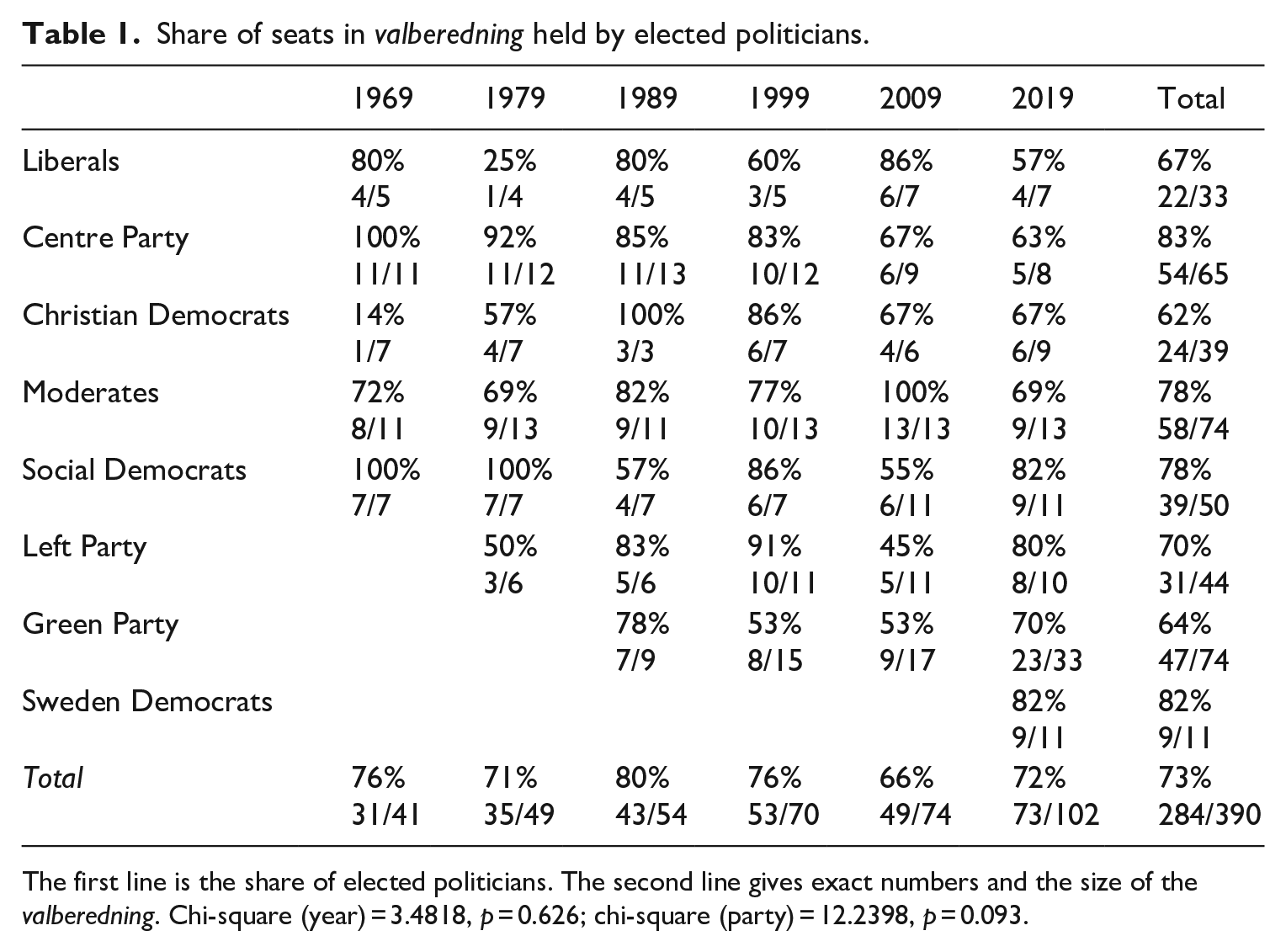
The first line is the share of elected politicians. The second line gives exact numbers and the size of the valberedning. Chi-square (year) = 3.4818, p = 0.626; chi-square (party) = 12.2398, p = 0.093.
What about trends? In 1969, the first time point in our data series, 76% of valberedning members also held elected public office. In 2019, at the end of our series, the corresponding figure was 73%. So, although we see some fluctuation, the level is stable throughout the time series. A chi-square test also reveals no statistically significant differences between each year. Although differences across parties are larger, the chi-square test suggests that they are not significant (p = 0.093).
If we turn to individual parties, we also struggle to detect clear trends in any direction. In two parties, the Christian Democrats and the Left, we observe an increase in the proportion of politicians between each party’s first data point and its most recent. However, there is reason to question whether this indicates an ascendancy of politicians. In the Christian Democrats, the increase is from a low level in 1969, which reflects the simple fact that the party had very few elected politicians at that time. It had been formed only 5 years previously and had only competed once in local elections; it was 22 years away from breaking through into the national parliament. No similar circumstances apply to the much longer-established Left Party, in which the presence of elected politicians began at 50%, but then reached at least 80% in four of the subsequent five observations. Yet even here, there is no clear ascending trend, but rather big fluctuations over time. Fluctuation can also be seen in several other parties, including the four in which the level of politicians’ representation actually dropped between the first and last observations.
While we cannot trace a direct increase in the presence of elected politicians, we must also compare their representation with that of office-holders in the party organisation. Put differently, a relative ascendancy of elected politicians might have taken place if the presence of the party office-holders has declined. (It might be, for instance, that both categories have been displaced in the selection committees by individuals who are neither elected politicians nor party office-holders.)
Table 2 displays the presence over time of party office-holders. Compared with elected politicians, it is clearly weaker. In the total sample, just over half of the seats in the selection committees are held by individuals associated with party offices. Moreover, the variation between parties is greater. In the Liberals, less than a quarter of the seats have been held by party office-holders. The corresponding figure for the Sweden Democrats – the youngest party in the set, which entered parliament in 2010, and for which there is only a single observation – is 82%.
Share of seats in valberedning held by party office-holders.
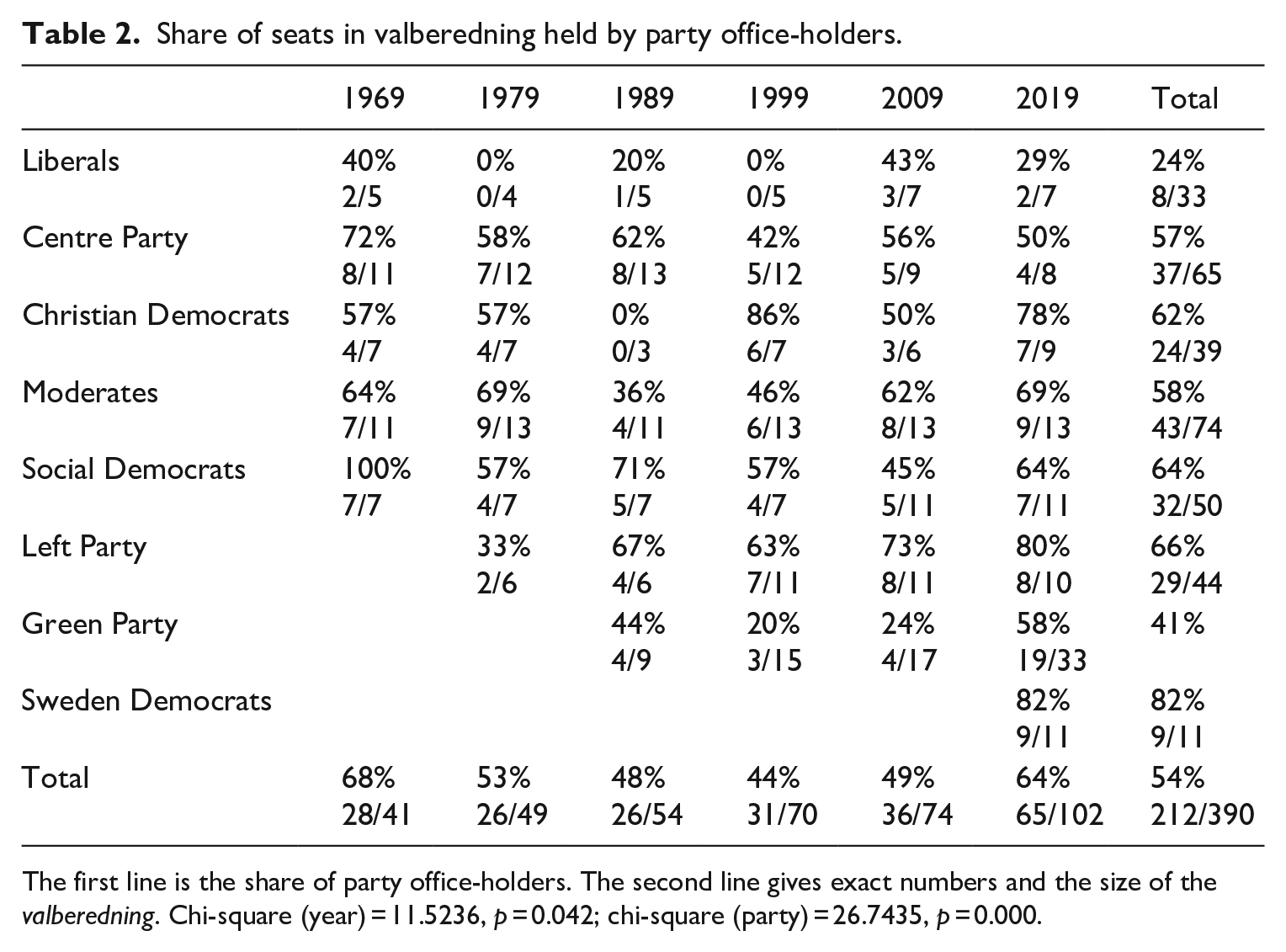
The first line is the share of party office-holders. The second line gives exact numbers and the size of the valberedning. Chi-square (year) = 11.5236, p = 0.042; chi-square (party) = 26.7435, p = 0.000.
This greater variation is not only evident across parties, but also over time. However, while a chi-square test indicates that there are statistically significant differences across years, a closer inspection indicates a U-shaped trend, with a higher share of party office-holders in the valberedning in the start and at the end of the time series. They seemed to lose ground until the 1990s. From that point and onwards, however, the category regained its strength.
Next we look for stratarchical tendencies, in which the local and regional levels advance their position at the expense of the party at national level. The general pattern that emerges (see Table 3) is that the presence of sub-national levels in selection committees is as strong as that of elected politicians. Almost three-quarters of valberedning members are associated with sub-national levels. Although there is some fluctuation across time, it is hard to establish a clear trend. The chi-square test also fails to indicate a significant temporal difference.
Share of seats in valberedning held by individuals from sub-national levels.
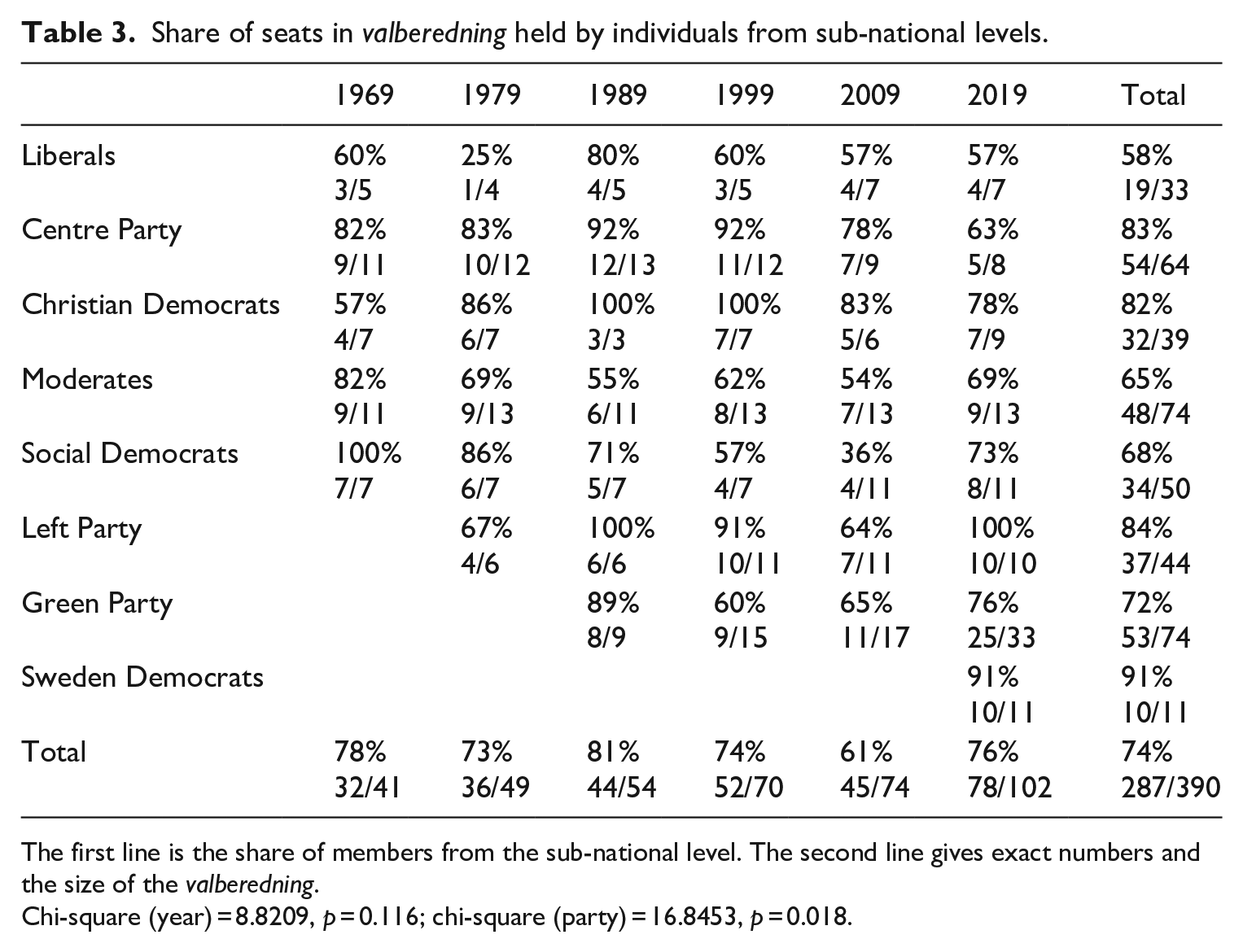
The first line is the share of members from the sub-national level. The second line gives exact numbers and the size of the valberedning.
Chi-square (year) = 8.8209, p = 0.116; chi-square (party) = 16.8453, p = 0.018.
Once again, there is clearer and more statistically significant variation across parties. In some, sub-national presence reaches well over 80%, whereas the Liberals’ rate lies below 60%. Yet even within individual parties, we again find no clear trends over time.
If the presence of elected politicians and of party office-holders is further broken down, the importance of the sub-national level becomes evident (see Appendices A1 and A2). Whereas almost 60% of the elected politicians hold sub-national public offices, the corresponding figure for nationally held offices is about 18%. The relative dominance of the sub-national level is even more pronounced when surveying the presence of party office-holders. More than 50% of the valberedning members are sub-national party office-holders, whereas the share of party office-holders at national level is close to negligible, at less than 5% (19 out of 390).
No clear time trends can be observed, but there is quite a large variation across parties in the presence of elected politicians. In the Social Democrats and the Moderates, the two biggest parties throughout most of the period of study, the share of elected politicians from the national level is rather close to the share of sub-nationally elected politicians, whereas there is a marked difference in the other parties.
So far, we have found no evidence of an ascendancy of elected politicians – that is, a trend in which elected politicians have increased their presence over time. We have established that the sub-national level is of great importance in Swedish parties, but there too, it is hard to see much of a temporal trend. Nevertheless, power concentration might yet have occurred in Swedish parties. More specifically, it could be that members of the selection committees are not just associated with a single party face or territorial level. In fact, we might suspect that a reasonable share holds multiple roles in its party. We know, for example, that MPs can also be leading party figures at regional or local levels.
To assess such potential overlap, we show the extent to which members of the valberedning, at the time of their selection, hold positions in both elected and party offices.
In Figure 1, we show the share of overlapping presence in the valberedning. In the left-hand panel, we compare the combined shares for each party. Visual inspection of the graph, plus the associated chi-square test, reveal significant variation. Some parties – the youngest party, the Sweden Democrats, above all, and also the oldest party, the Social Democrats – display considerable overlap. Others display a lower level. In the Greens’ case, this is not surprising: one of the basic ideas in the formation of the party was that concentration of power should be avoided. Until the early 1990s, its statues even prohibited an individual from holding multiple offices.
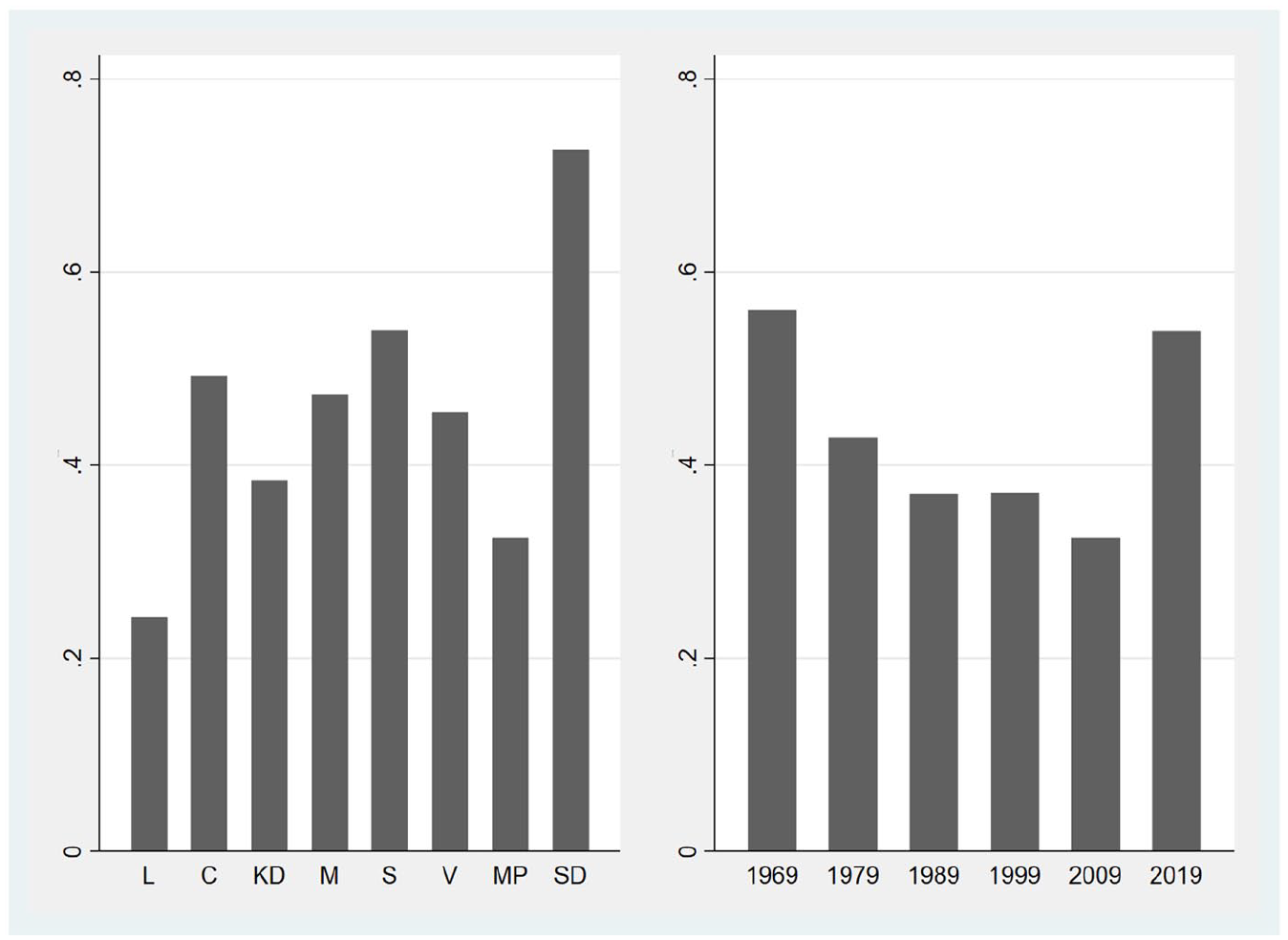
Share of seats held by individuals with overlapping associations.
The right-hand panel in Figure 1 shows aggregate change over time. Interestingly, the level of overlap showed a nearly linear trend from 1969 up to our penultimate time point in 2009. By 2019, however, the share of overlaps was almost back at the same high level as in 1969. We cannot at this stage tell whether this constitutes a trend.
Discussion
Despite its important role in steering some of Swedish political parties’ most important internal decisions, we are not aware of any previous systematic research on the valberedning. This study is a first attempt to fill this research gap.
To guide our analyses, we derived hypotheses based on previous research on intra-party power. Our empirical analysis is revealing, as it fails to verify any of our three hypotheses – and thus confounds expectations that are drawn from widely cited theories of intra-party power. More precisely, we found evidence neither of an ascendancy of elected politicians nor the marginalisation of party office-holders. Nor could it be substantiated that elected politicians and party office-holders at the sub-national level have increased their presence in the valberedning.
Our study does have potential limitations. While our main emphasis has been on exploring the intriguing properties of the Swedish valberedning, we have also framed the analysis as a study of intra-party power. While we argue that the valberedning is an intra-party arena in which important decisions can be influenced, there are, of course, even more important party bodies. At the same time, we think our approach complements, and perhaps improves on, most research into intra-party power.
For sure, resources are of great importance. As Hagevi (2018) has shown, for example, although the party in central office also has gained from increasing levels of party funding in Sweden, the party in public office has been the main beneficiary. Still, we argue that our observations bring us closer to real power within parties. We have assessed the location of power by surveying the individuals involved in decision-making, rather than the distribution of organisational resources. Nor are our conclusions entirely out of line with previous research. Loxbo (2013), for instance, found little evidence of decline in intra-party democracy in Swedish parties. In these cases, indeed, there seems little to suggest that leaders have established oligarchic control (Hagevi and Loxbo, 2018).
Looking at our findings, the clearest result is the remarkable stability over time. Despite profound changes that many observers have observed in party organisation, many of which are said to have changed intra-party dynamics, the distribution of power in Swedish parties in 2019 – at least according to our indicator, the composition of the valberedning – is surprisingly similar to that in 1969. Despite well-documented and significant membership loss, greatly increased public funding, externalisation of policy formulation and administrative professionalisation, the people who shape arguably the most important decisions that Swedish parties make, through their membership of the selection committees, have had similar backgrounds and associations throughout the last 50 years.
Why might this be? To some extent, our findings chime with recent studies that question the validity of the general trends from which we have drawn our hypotheses. Rather than a clear ascendancy of the parliamentary party, Pedersen (2010) finds no uniform pattern among Danish parties. Koskimaa (2016, 2020) arrives at similar conclusions about Finnish ones. Instead, these studies suggest that parties’ intra-party power distribution is conditioned most by party ‘genetics’ – that is, each party’s founding organisational character. Throughout our own analysis, variation across parties has constantly been larger than temporal variation.
Organisational genetics do not, however, explain the limited variation even across party families, so there could be further reasons for the stability that we see. It could be, as Panebianco (1988) argued, that parties are simply conservative organisations, resistant to change. Once a norm of representation is established, even informally, perhaps the represented interests fight to maintain it. Alternatively, it could be that our measure misses a subtler shift in power within selection committees; perhaps ‘presence’ is an imperfect indicator of whose preferences end up being weightiest in collective decisions.
Of course, parties do change, often quite significantly – witness the greater inclusivity in selecting their leaders and candidates. Still, as we have also seen, Swedish parties have been more resistant than most to such trends. Perhaps their relative maturity – their average age is 85, and half of them are over a century old – hardens them against contemporary change. We can thus conclude our article with the customary call for further research.
Footnotes
Appendix A1
Appendix A2
Acknowledgements
The authors like to thank the three anonymous reviewers for their constructive feedback and Joel Jacobsson for excellent research assistance.
Declaration of conflicting interests
The author(s) declared no potential conflicts of interest with respect to the research, authorship and/or publication of this article.
Funding
The author(s) disclosed receipt of the following financial support for the research, authorship and/or publication of this article: The research featured in this article has been partially funded through a project grant from the Foundation for Baltic and East European Studies (ÖSS dnr 19/18).
