



Abstract
The declining political engagement of youth is a concern in many European democracies. However, young people are also spearheading protest movements cross-nationally. While there has been research on political inequalities between generations or inter-generational differences, research looking at differences within youth itself, or inequalities between young people from different social backgrounds, particularly from a cross-national perspective, is rare. In this article, we aim to fill this gap in the literature. Using survey data from 2018 on young people aged 18–34 years, we analyse how social class background differentiates groups of young people in their political engagement and activism across nine European countries. We look at social differentiation by social class background for both political participation in a wide variety of political activities including conventional, unconventional, community and online forms of political participation, and at attitudes linked to broader political engagement, to paint a detailed picture of extant inequalities amongst young people from a cross-national perspective. The results clearly show that major class inequalities exist in political participation and broader political engagement among young people across Europe today.
Introduction
As Dalton (2017) notes, the political disengagement of some social sections of the population is a fundamental political problem deeply undermining the very notions of democracy and democratic government. In particular, if these political inequalities by resources and background such as by social class exist among young people, this can be seen to further problematise the issue given they are the adult citizens of tomorrow and therefore that these negative patterns are likely to reproduce themselves in the future unless reforms are not put in practice to redress this. A world where political disengagement and political inequalities keep rising is clearly a problematic context for the effective functioning and continuation of democracy (Barber, 1984). In particular, examining political inequalities among young people in the current context should allow us to shed light on the extent of contemporary inequalities as opposed to those emerging from past processes (Giugni and Grasso, 2021a). How large are inequalities in political participation and political engagement among young people today? This is a fundamental issue for democracy since the presence of large gaps in political participation undermines political equality, which is a key principle of democratic societies, and further leads to suboptimal government decision-making as not all voices are being heard (Grasso and Bessant, 2018; Giugni and Grasso, 2020).
While some optimistic voices point to the large waves of youth mobilisation around the issues of racism, climate change, austerity and sexual harassment (Grasso and Giugni, 2016; Giugni and Grasso, 2015a,b, 2018, 2021b; Grasso and Bessant, 2018), as some notable recent examples, there remain clear concerns about the exclusion of youth from political decision-making, whether this be in terms of their lower rates of electoral engagement to select representatives (Grasso et al., 2018), the fact that youth voices and issues are seldom centre-stage of the political arena (Giugni and Grasso, 2020), or the fact that the youth deficit model of political engagement still functions today as the key approach in many respects (Earl et al., 2017). Moreover, there have also been concerns that the current generation of youth is less civic-minded and interested in collective pursuits such as political engagement (Putnam, 2000). While others have argued that young people are indeed engaged in other means and that their ‘doing politics’ should be the focus of analysis (Henn et al., 2002; Pickard, 2019), it is likely that as among all age groups, political participation and political engagement amongst youth will be highly patterned by social inequalities in terms of resources and background, particularly in terms of social class background. While it is true that well-off young people may still be very much ‘doing politics’, it remains troubling if particularly those coming from backgrounds with lower levels of resources engage at lower rates, whether this is through activities linked to political parties and other political organisations or political representatives, or whether this is in terms of applying pressure through protest activism, community or volunteer activism or even online participation. In other words, while some healthy scepticism of ‘critical citizens’ (Norris, 1999) is very much to be welcomed in democratic societies, scepticism which leads to withdraw from those means of engagement which would allow us to have an impact on decision-making remains very problematic – particularly if it affects sectors of the population with lower resources to start with (Grasso et al., 2019) thereby reinforcing negative patterns rather than improving democratic conditions. Given the importance of this issue for democratic societies, it is a question that needs to be deeply analysed, scrutinised and the underlying empirical patterns clearly understood and documented to allow for developing means to address current woes into the future and improving the functioning of democratic societies.
To address these important questions, this article examines the nexus between social inequality and political participation and engagement among youth today in a comparative perspective. Using survey data from 2018 on young people aged 18–34 years, we analyse how inequalities impact youth political engagement across nine European countries. We analyse in particular class differences to examine to what extent social inequalities pose a challenge to the widespread democratic engagement of youth in Europe. A key research question guides our empirical analysis: What is the impact of class background in terms of political inequalities among youth across European countries? The rare previous work examining intra-generational differences looking at single country studies (e.g. on Britain) showed that among young people engagement is complex and nuanced with factors like social class having an important impact for explaining social differentiation in young people’s political participation, at least in Britain (Henn and Foard, 2014). These findings lead us to wonder whether this is true also of other European democracies – for example, those that have more social-democratic or corporatist rather than liberal, or indeed neoliberal, arrangements. Therefore, here we look at the questions of political inequalities amongst youth by social background from a comparative European perspective examining survey data on 18-34 year-olds from nine countries. This allows us to clearly analyse intra-generational inequalities with a new and extensive cross-national dataset by zooming in on youth and on class inequalities in participation within this age group. This means we are able to capture the current context of political inequalities among youth most clearly and across a series of indicators of political activism and broader political engagement and also examine how patterns vary cross-nationally. Young people are not a monolithic entity and will have more or less resources based on class background and other factors as well as the national context they are situated in (Grasso, 2013). Therefore, a careful analysis of the data will further allow us to explore this intra-generational diversity in youth political participation to develop our knowledge of these patterns and therefore advance the scientific literature in this area of study.
Previous research
Research hitherto has looked at young people’s supposed lack of political awareness, their political apathy, disinterest, and lack of participation (Furlong and Cartmel, 1996). The worry here is that, if young people have little knowledge about the political processes and distrust politicians in their abilities to address their issues of concern, then the foundations of democracy may further deteriorate in the future. Worse still, if young people from more socially disadvantaged backgrounds are less likely than those who are more well off to engage politically and to have positive attitudes with respect to politics, then this means that those most in need of political voice to redress current imbalances of power in democratic societies are further silenced (Grasso, 2018).
Scholarship has further examined whether a lack of interest and participation in politics among young people is part of a wider generational shift (Park, 1995; Grasso, 2014). In particular, some have linked this to a new emphasis placed on more individualised forms of ‘life politics’ relative to the collectivist ‘emancipatory politics’ of the past (Giddens, 1991). Whereas ‘emancipatory politics’ was understood as the struggle for liberation and the improvement of collective living conditions, ‘life politics’ is defined as the ‘politics of self-actualisation in a reflexively ordered environment’ (Giddens, 1991: 214), and relating to wider moral values and quality of life aspects as opposed to redistribution (Inglehart, 1990, Grasso et al., 2017; Grasso and Giugni, 2018). Norris (2002), in this context, noted a shift from the ‘politics of loyalties’ to the ‘politics of choice’ – a shift from conventional participation linked to parties, trade unions, and various collective agencies, to more unconventional modes of engagement via issue campaigns, social movements, ethical consumerism, and protest politics. In a similar fashion, Dalton (2004) has talked about a shift from ‘dutiful citizens’, who have a conventional view of citizenship as opposed to ‘engaged citizens’, who put forward more individualised and direct forms of action.
Indeed, against studies showing that young people are apathetic and disinterested in politics, another group of studies has argued that young people are not disengaged, but rather they prefer to become involved in other, more direct modes of participation that are unconventional and issue-based such as through protest politics and engagement in social movements (Henn et al., 2002; Pickard, 2019). Other than socio-demographics, low efficacy, apathy, and cynicism have all been suggested as explanations for young people’s lack of involvement in politics (Karampampas, et al., 2019). Furthermore, some have pointed to the rise of a ‘personalized digitally networked politics’ in which diverse individuals address common problems and which might be replacing a more traditional network environment made of direct contacts and ties (Bennett and Segerberg, 2013).
As Brady et al. (1995) famously noted, people do not participate because either they cannot, they do not want to, or no one asked them to. In other words, the key factors for explaining political inequalities in participation rely on differences between people in terms of their relevant resources and skills, their political attitudes, and their links to various modes of recruitment to political action (Giugni and Grasso, 2019a,b; Giugni and Grasso, 2021b). As noted above, important inequalities in participation in the general population have been documented by class and socioeconomic status with people from middle class or professional and managerial class backgrounds in particular more likely to be politically active than those from lower or working classes (see for e.g. Evans and Tilley, 2017). Having higher status is linked to more time, money and access to information, all things which are known to sustain political engagement (Dalton, 2017). As such, we expect that:
H1. Young people from professional/managerial class backgrounds will be more active across types of political activities including conventional, unconventional, community and online forms of political participation than young people from lower class backgrounds.
Previous research on youth in Britain has shown how young people tend to consider politics as something about central government, related to a self-serving political elite not interested in the concerns of young people and as overly complex (Henn and Foard, 2014). These findings were found to echo those of earlier work (Diplock et al., 2002; Henn et al., 2002).
Henn and Foard (2014) also found that young people in Britain still claimed an interest in politics and therefore could be characterised as ‘engaged sceptics’ (Henn et al., 2002) or, in other words, as alienated from politics but neither apolitical nor apathetic (Dermody et al., 2010; Marsh et al., 2007). Henn and Foard (2014) thus argued that their findings appeared to contradict conventional views of young people as having little interest in political matters, but that they also showed that these patterns varied by groups of young people (e.g. in terms of their class background).
Another notable result of this British study was that, despite generally expressing interest in politics, a sizeable portion of young people were insecure in their knowledge and lacked internal political efficacy, once again echoing earlier studies (Westholm and Niemi, 1986). Even in this respect, important intra-generational differences by class background (and educational profile, but also gender, with women less confident than men) were found (Henn and Foard, 2014). They also found low levels of external efficacy, further reflecting findings from previous studies (Diplock et al., 2002; Henn et al., 2002; O’Toole, 2003; White et al., 2000). However, despite low internal and external efficacy, the results of this British study also showed young people to generally hold faith in the democratic process, for example, in the notion of elections (Henn and Foard, 2014). Young people were also found to have an appreciation of civic duty with social class and education background diversifying young people in their views.
With respect to attitudes to political parties and politicians, Henn and Foard (2014) argued that in Britain young people’s broad support of democratic practices is coupled with scepticism about the extent to which elections can lead to meaningful social impact and change and that this is, in turn, likely to be linked to their perceptions of politicians. They showed that young people tend to disagree that politicians can represent and govern effectively, with differences by education, and showed aversion to professional politicians suggesting a lack of ‘diffuse trust’ (Dermody et al., 2010). Young people tend to consider that parties act differently than promised when they win elections, are only interested in votes, not opinions, and are out of touch with people (Henn and Foard, 2014). Based on all this, we expect that:
H2. Young people from professional/managerial class backgrounds will be more likely to be more generally politically engaged than young people from lower class backgrounds (i.e. more likely to use media for political information, to feel more politically efficacious, and to be more positive about democracy).
Dalton (2017) further notes how attitudes are important and how studies show that activists felt politically efficacious and that they could influence government, rather than being politically alienated as had been widely assumed. Moreover, while, traditionally, institutions such as trade unions and leftist parties provided countervailing tendencies to these inequalities by social status, today leftist parties and labour unions are on the decline, and this may be linked to falling group mobilisation amongst individuals with lower resources, further compounding inequalities in political action by social status if individuals with more resources are also those more likely to engage in organisations (Dalton, 2017). Moreover, women have been found to have differential participatory patterns relative to men (Grasso and Smith, 2021). Combining these further factors about gender and membership with the previous research discussed above leads us to analyse the following final hypothesis in this article:
H3. The differences in political activism between young people from professional/managerial and those from lower social class backgrounds will be explained by differences in education, gender, feelings of political efficacy, associational membership, consumption of media for political information, and attitudes towards democracy and the democratic process.
Data and methods
The data employed for the analysis in this article were collected in the context of the Horizon 2020 collaborative project “Reinventing Democracy in Europe: Youth Doing Politics in Times of Increasing Inequalities” (EURYKA) funded by the European Commission (grant agreement no. 727025) in 2018 across nine European countries - France, Germany, Greece, Italy, Poland, Spain, Sweden, Switzerland and the United Kingdom - on young people aged 18–34 years. (The Swiss part of the project was supported by the Swiss State Secretariat for Education, Research and Innovation (SERI) under contract number 16.0103.) The large samples of data (approximately 2000 N per country), collected using quotas (age, gender, region and education) reflecting national population statistics for youth, allow us to conduct detailed intra-group analyses exploring inequalities in political participation and engagement amongst young people.
We contribute to the literature therefore by being able to look at political inequalities by social class background amongst young people from a cross-national perspective. Moreover, an additional richness of our analysis lies in the fact that we include a large battery of indicators of political participation and engagement. By doing so, we are able to analyse political inequalities within better and worse off young people for a wider range of indicators than previously employed and moreover we are able to do so cross-nationally. This allows us to provide a nuanced picture of inequality in political activism and engagement, including how different factors impact on young people’s likelihood to become involved in various types of political activism repertoires. We examine political participation, namely, (1) participation in different types of political activities including conventional, unconventional, community and online political participation and also wider political engagement such as (2) media use for political information, (3) feelings of political efficacy, and (4) democratic attitudes.
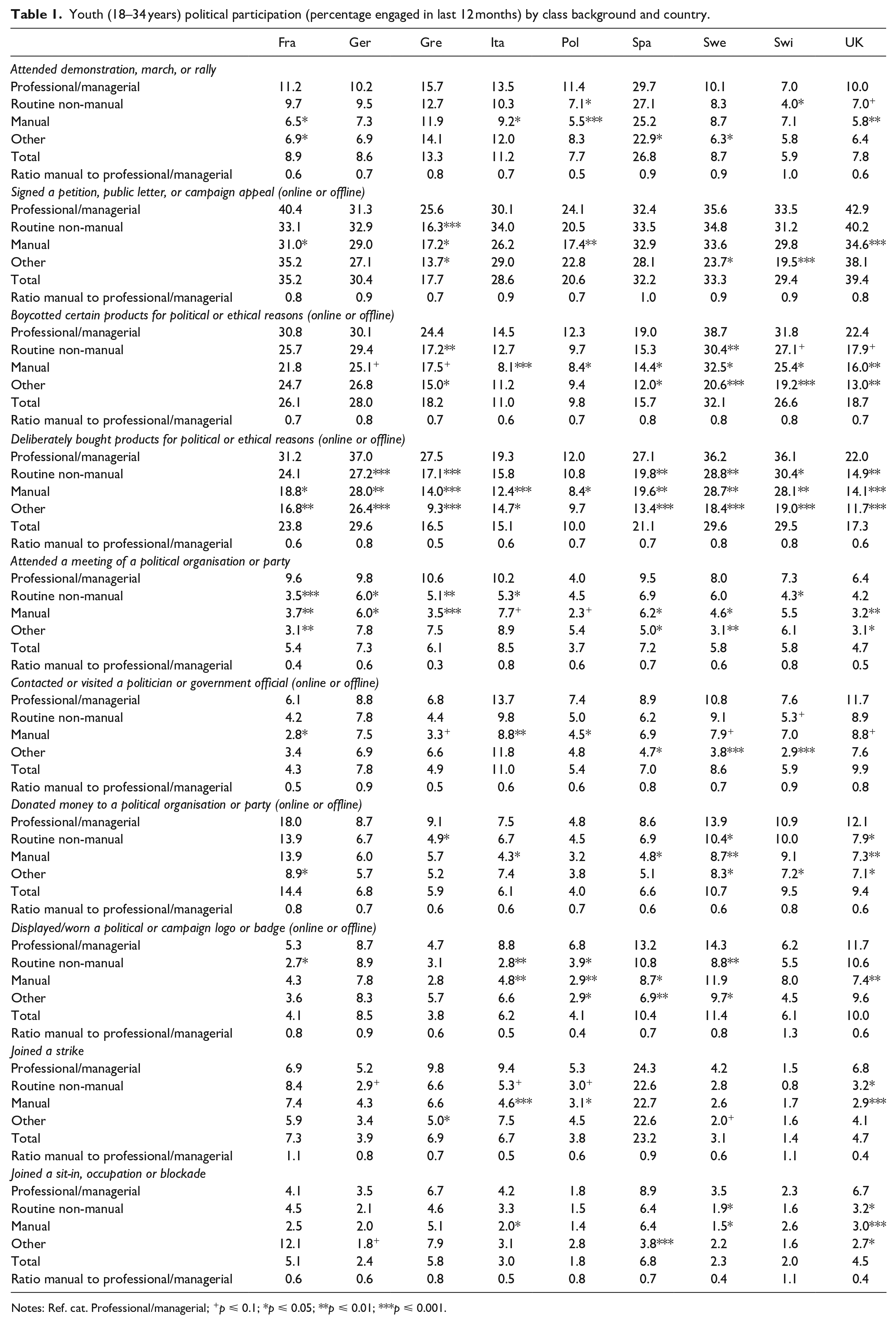
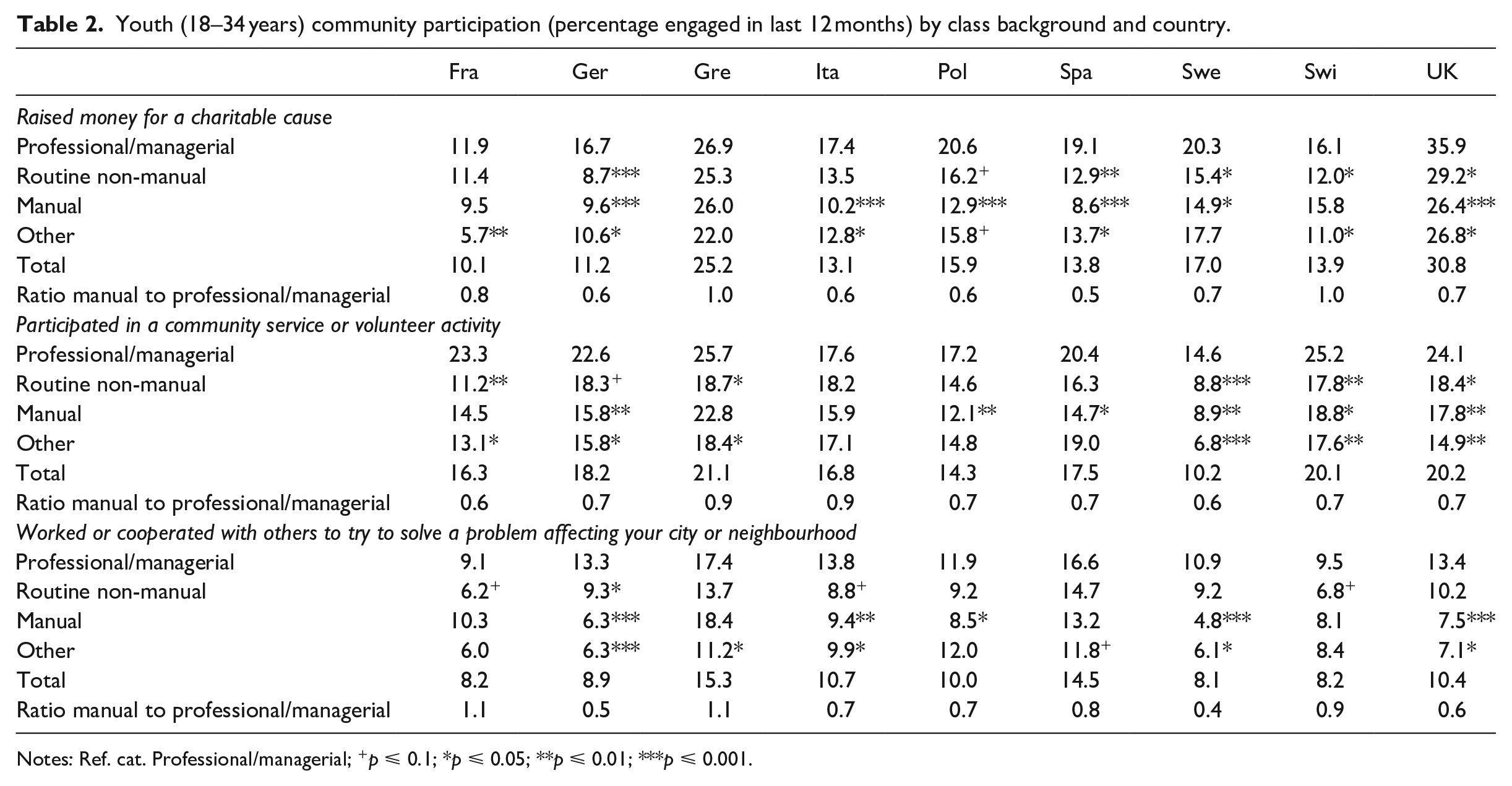
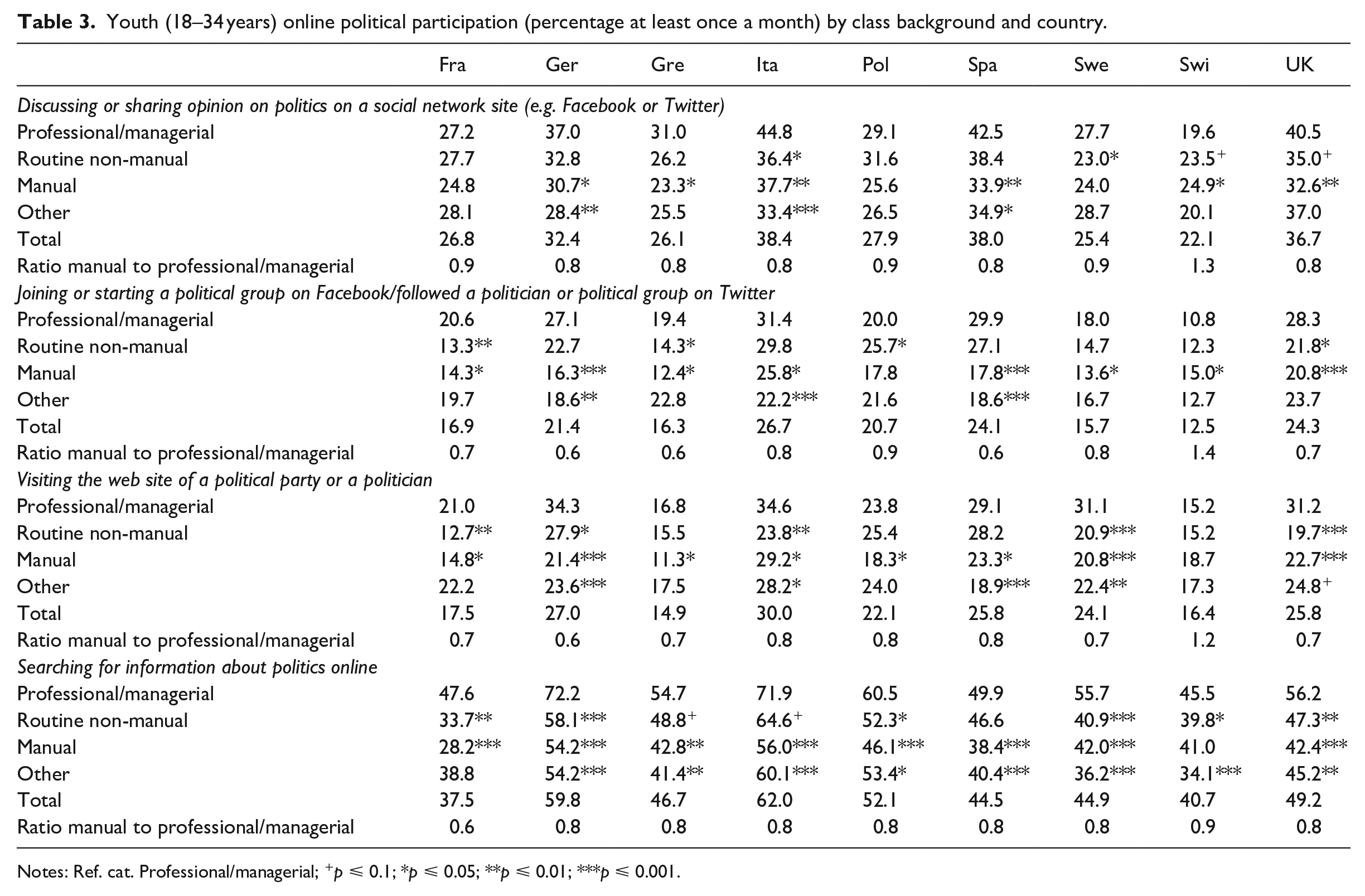
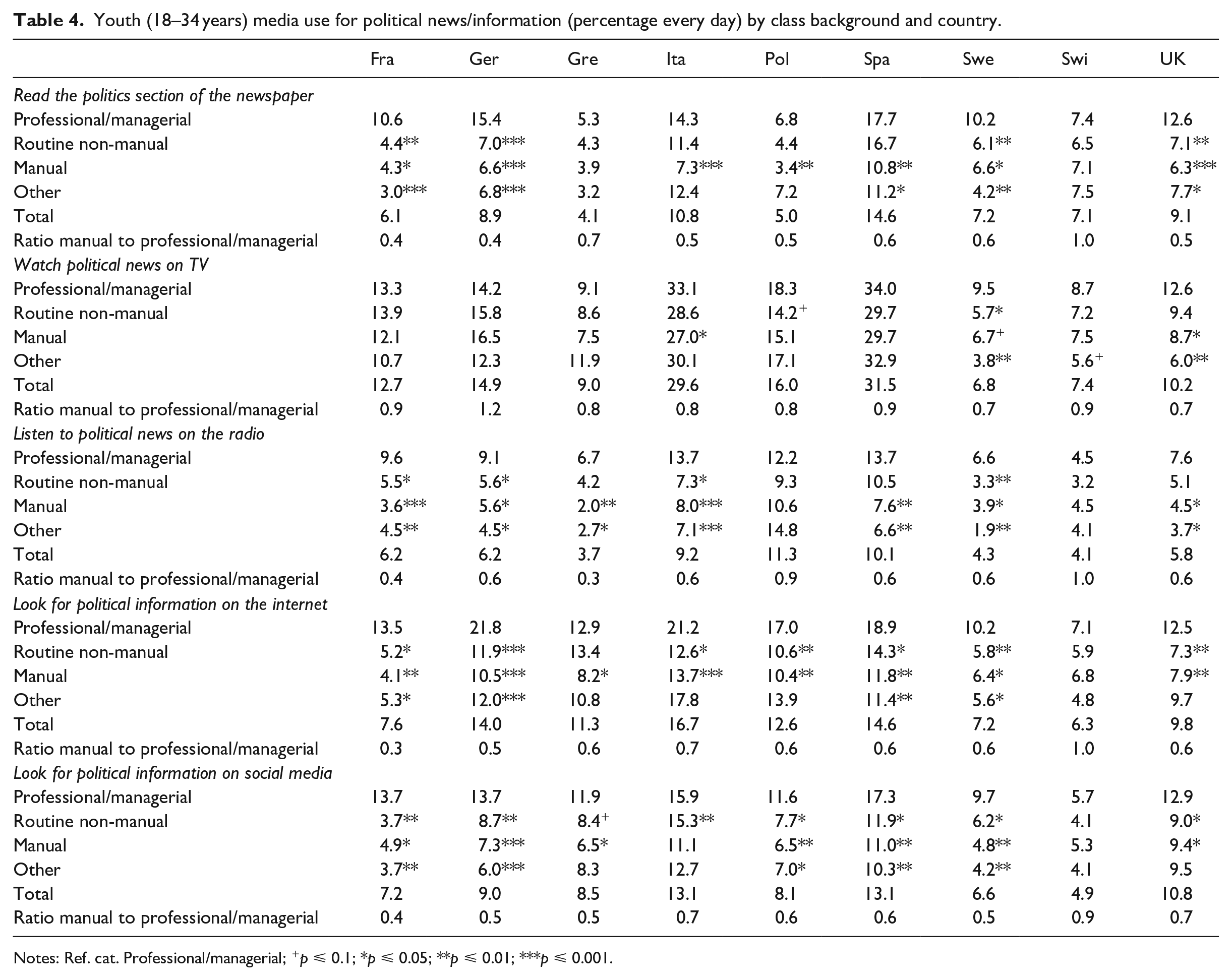
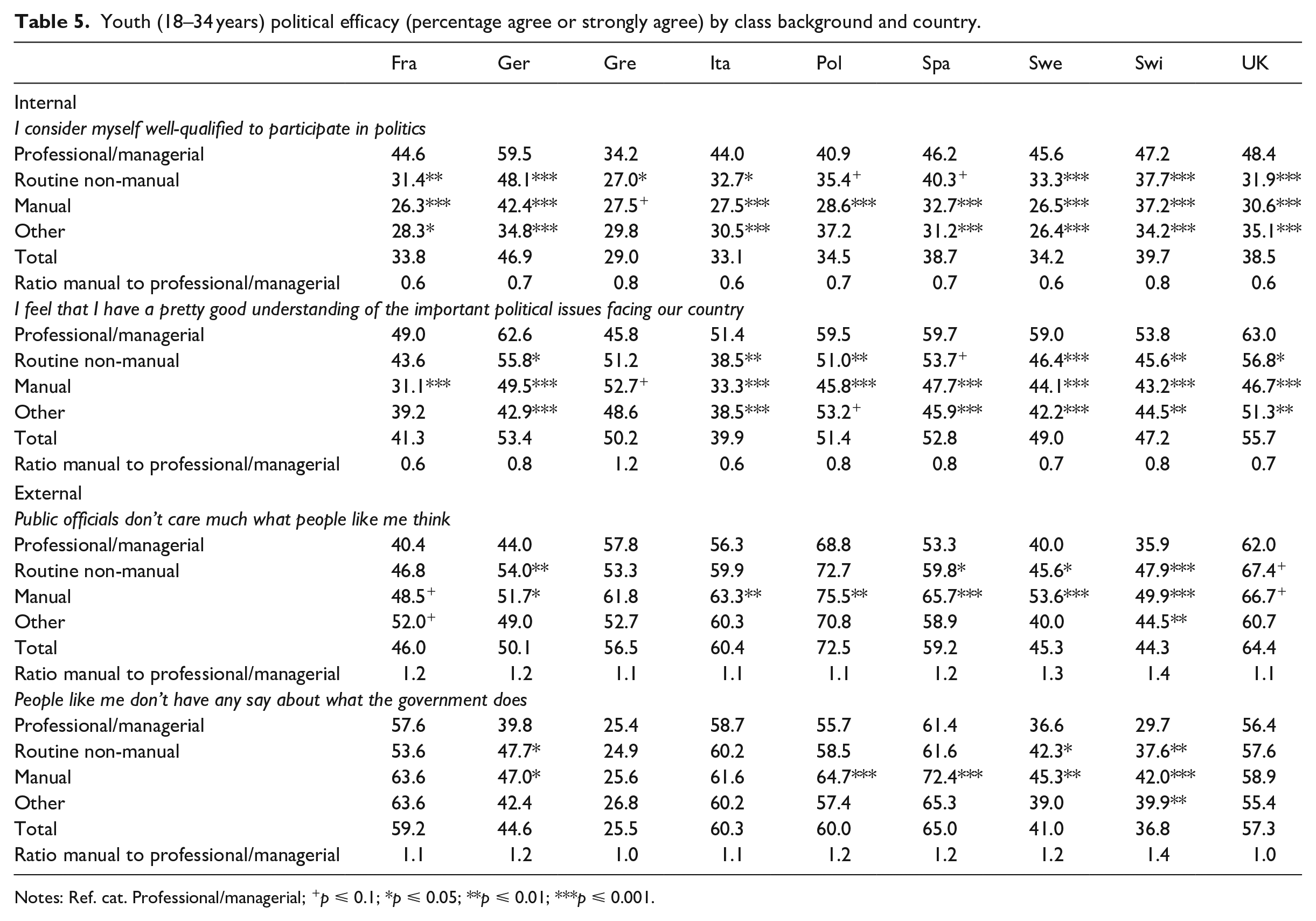
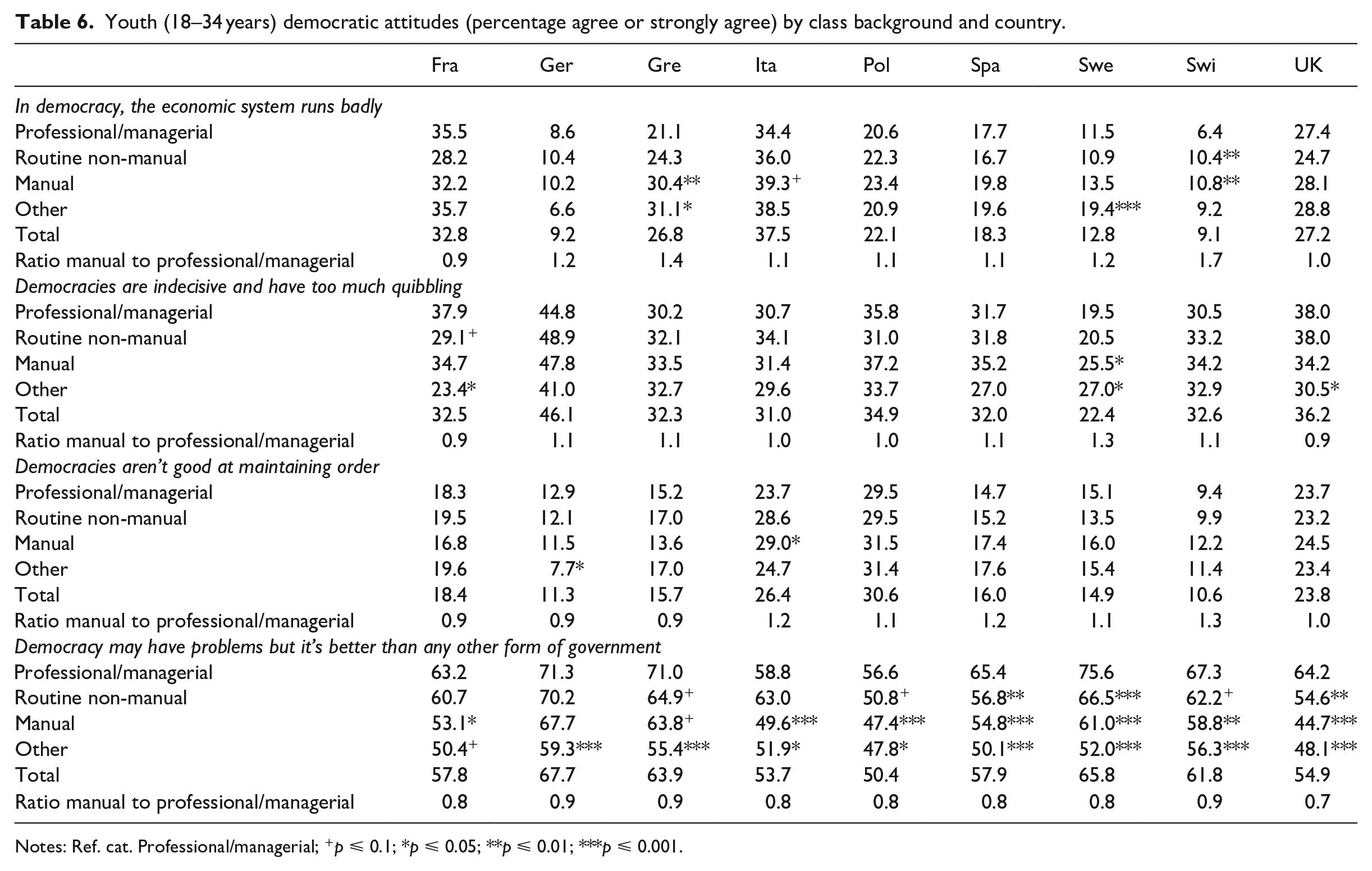
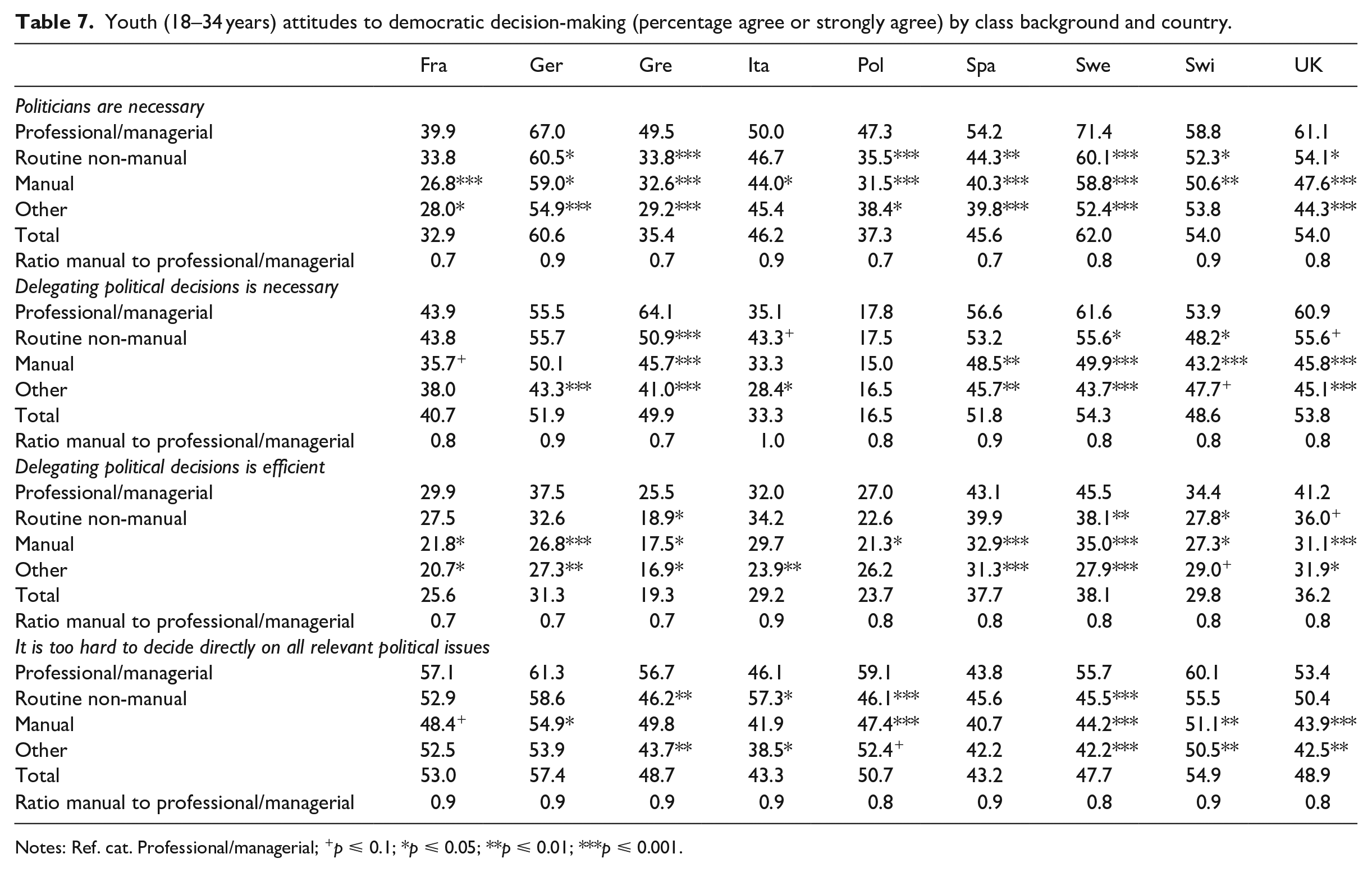
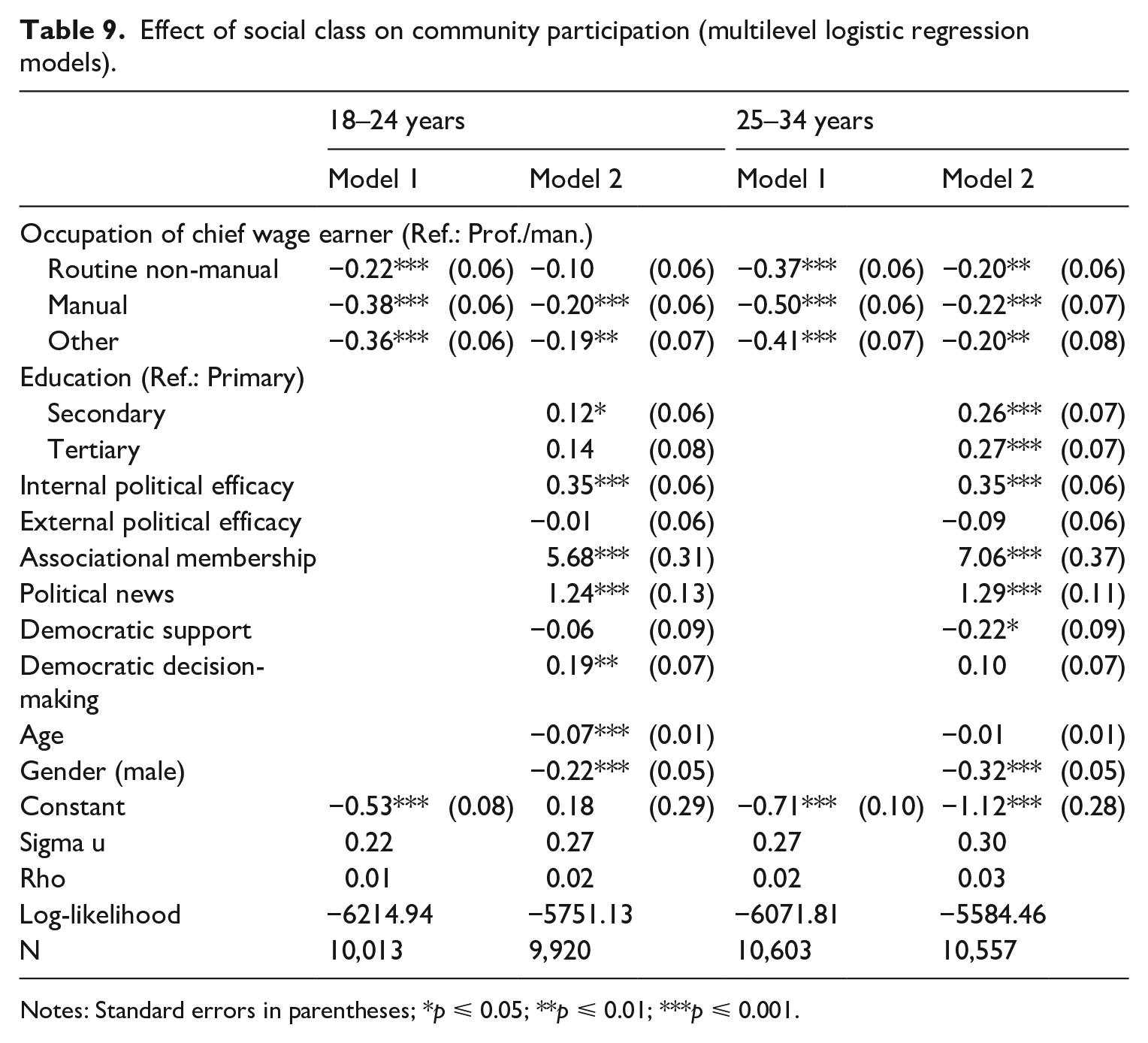
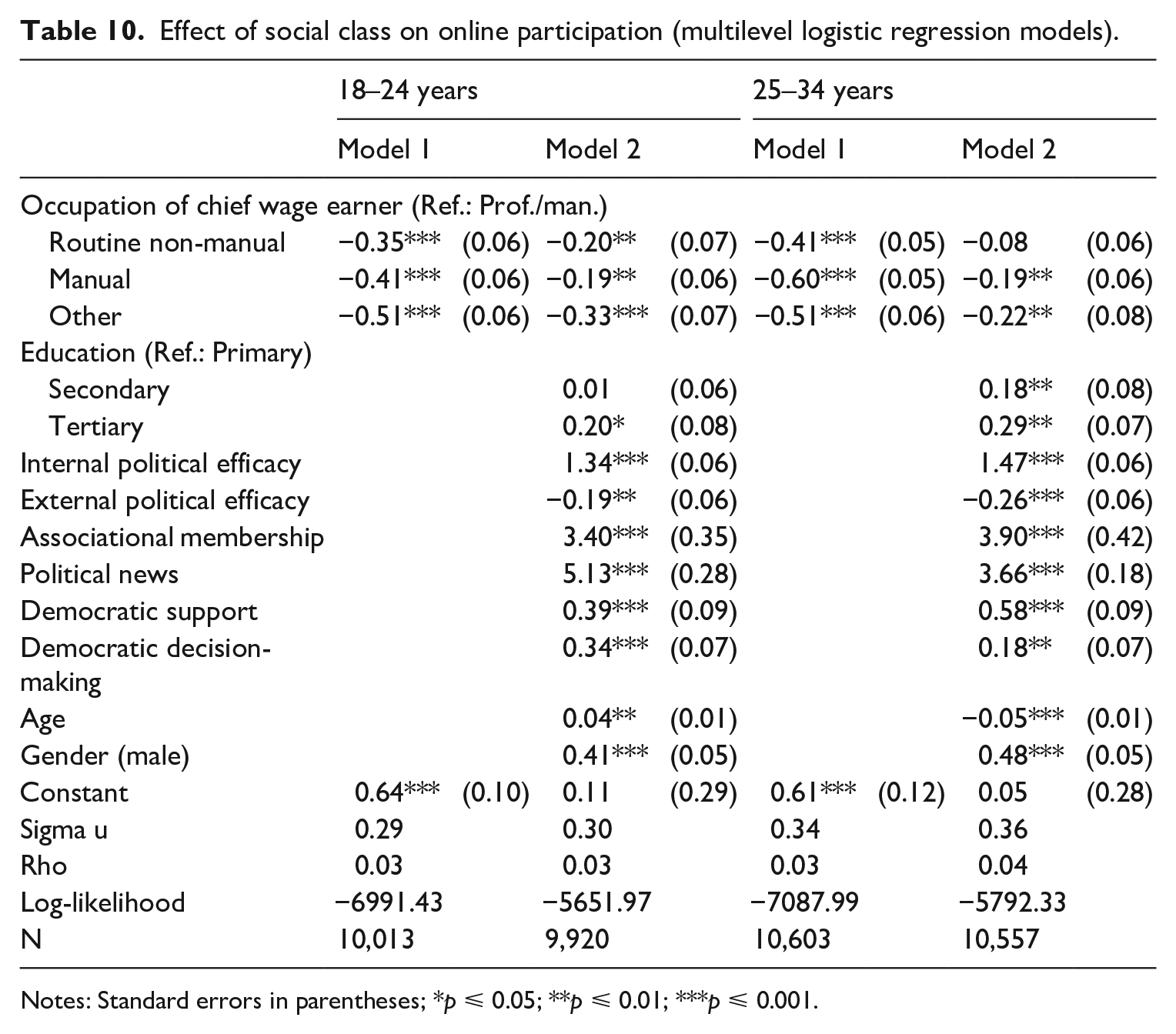
More specifically, on the behavioural side, we include 10 indicators of political participation (all in the last 12 months) in our analysis (see Table 1). We also include three indicators of community participation (all in last 12 months) (see Table 2). Furthermore, we include four indicators of online political participation (at least once a month) (see Table 3). We also examine four items for media use for political news/information (every day) (see Table 4). Concerning political efficacy, we examine four response items (agree or strongly agree), two for internal and two for external efficacy (see Table 5). Finally, we look at democratic attitudes and support for democratic decision-making (agree or strongly agree) (see Tables 6 and 7). To examine intra-generational inequalities in political participation and political engagement amongst young people, we look at differences by class background – in other words, that of the chief wage earner – according to the following categories: (1) professional/managerial, (2) routine non-manual occupations, (3) manual, and (4) other. The analyses are done in two steps: first, by cross-tabulating the class background of the survey respondents across the nine countries included in our study for each of the indicators of political participation and political engagemement listed in Tables 1–7. This allows us to test H1 & H2 by looking at significant differences across the nine European countries included in our study. Next, we run multilevel logistic models on each of three combined measures of political participation (Table 8, whether someone has engaged in the last 12 months in at least one of the activities listed in Table 1), community participation (Table 9, whether someone has engaged in the last 12 months in at least one of the activities listed in Table 2), and online political participation (Table 10, whether someone has engaged at least once a month in at least one of the activities listed in Table 3), by including first only social class in Models 1 and then including a number of other potential predictors in Models 2 as discussed above to see how much of the effect of class they explain and therefore test H3. These types of models take into account country differences.
Youth (18–34 years) political participation (percentage engaged in last 12 months) by class background and country.
Notes: Ref. cat. Professional/managerial;
p ⩽ 0.1; *p ⩽ 0.05; **p ⩽ 0.01; ***p ⩽ 0.001.
Youth (18–34 years) community participation (percentage engaged in last 12 months) by class background and country.
Notes: Ref. cat. Professional/managerial;
p ⩽ 0.1; *p ⩽ 0.05; **p ⩽ 0.01; ***p ⩽ 0.001.
Youth (18–34 years) online political participation (percentage at least once a month) by class background and country.
Notes: Ref. cat. Professional/managerial;
p ⩽ 0.1; *p ⩽ 0.05; **p ⩽ 0.01; ***p ⩽ 0.001.
Youth (18–34 years) media use for political news/information (percentage every day) by class background and country.
Notes: Ref. cat. Professional/managerial;
p ⩽ 0.1; *p ⩽ 0.05; **p ⩽ 0.01; ***p ⩽ 0.001.
Youth (18–34 years) political efficacy (percentage agree or strongly agree) by class background and country.
Notes: Ref. cat. Professional/managerial;
p ⩽ 0.1; *p ⩽ 0.05; **p ⩽ 0.01; ***p ⩽ 0.001.
Youth (18–34 years) democratic attitudes (percentage agree or strongly agree) by class background and country.
Notes: Ref. cat. Professional/managerial;
p ⩽ 0.1; *p ⩽ 0.05; **p ⩽ 0.01; ***p ⩽ 0.001.
Youth (18–34 years) attitudes to democratic decision-making (percentage agree or strongly agree) by class background and country.
Notes: Ref. cat. Professional/managerial;
p ⩽ 0.1; *p ⩽ 0.05; **p ⩽ 0.01; ***p ⩽ 0.001.
Results
As noted above with respect to H1, we expect to see inequalities by class background in different types of political participation activities including community and online political participation among young people. Let us begin with the measures of political participation (Table 1). Starting off with the level of demonstrating, despite the fact that this type of activity could be seen as part of those ‘weapons of the weak’ (Scott, 1985), we can see that in a majority of the nine countries included in this study that young people from professional/managerial class backgrounds are more likely to engage through this repertoire than young people from lower class backgrounds (relative to those from manual class backgrounds in four countries and routine non-manual in three). This is not so for petitioning (significant differences between young people with manual and professional/managerial class backgrounds are only present in four our of nine countries with respect to this activity), whereas differences are particularly marked and present in almost all countries for political consumerism such as boycotting and buycotting. There are also significant class differences in a majority of the nine countries for more institutional or conventional forms of engagement such as attending meetings of a political organisation or party, contacting a politician, donating money to a political organisation or party, and wearing a political campaign logo or badge. This is not so for joining a strike or an occupation, sit-in, or blockade. As such, we find support for H1 with respect to seven out of ten activities in Table 1.
Turning to community participation (Table 2), we also find significant class inequalities among youth in most countries for raising money for a charitable cause, participating in community service or volunteer activity, and working or cooperating with others to try to solve a problem affecting your city or neighbourhood.
If we look at online activism (Table 3), we can also find that in a majority of the nine countries there are class inequalities among youth for discussing or sharing opinions on politics on a social network site such as Facebook or Twitter at least once a month, joining or starting a political group on Facebook or followed a politician or political group on Twitter at least once a month, visiting the website of a political party or a politician at least once a month, and searching for information about politics online at least once a month. As such, to summarise the results with respect to H1, based on all modes of political activism from Tables 1 to 3, including online participation and also community-level activism, more informal, or unconventional, as well as more institutional, or conventional, activism, we found significant differences with young people from professional and managerial class backgrounds being more politically active than those from lower (manual or routine non-manual) class backgrounds in a majority of our nine countries, so fourteen out of seventeen total indicators, with the exception of petitioning, striking, and occupying.
Moving to the evidence for H2 with respect to broader political engagement and looking at daily media use for political news or information consumption more specifically (Table 4), confirming our hypothesis, here too, in a majority of the nine countries we find significant class inequalities among youth for four out of five indicators (with the exception of watching political news on TV): reading the politics section of the newspaper, listening to political news on the radio, looking for political information on the Internet, and looking for political information on social media.
Also with respect to evidence for H2, and more specifically looking at political efficacy (Table 5), we can see significant class inequalities among youth in terms of the two indicators of internal political efficacy, in other words, for who says that they consider themselves well qualified to participate in politics and also in terms of who feels that they have a pretty good understanding of the important political issues facing their country. Concerning external efficacy, we can also see that in a majority of countries, there are significant class inequalities also here: people from professional/managerial backgrounds are less likely to think that public officials do not care much what people like me think, or that people like them do not have any say about what the government does. As such results show important class inequalities amongst youth in terms of both internal and external types of political efficacy.
With respect to democratic attitudes (Table 6), we can see that there are significant class differences in a majority of the countries with respect to the idea that democracy may have problems but it is better than any other form of government with people from lower class backgrounds being less positive about democracy in this respect. Concerning democratic decision-making (Table 7), there are significant class differences in a majority of countries with respect to that the idea that politicians are necessary, that delegating political decisions is necessary, that delegating political decisions is efficient, and that it is too hard to decide directly on all relevant political issues with people from lower class backgrounds being more negative. As such, the evidence supports H2 with thirteen out of seventeen indicators of political engagement (four out of five for media consumption for political news, four out of four for internal and external political efficacy, and five out of eight for attitudes to democracy and democratic decision-making).
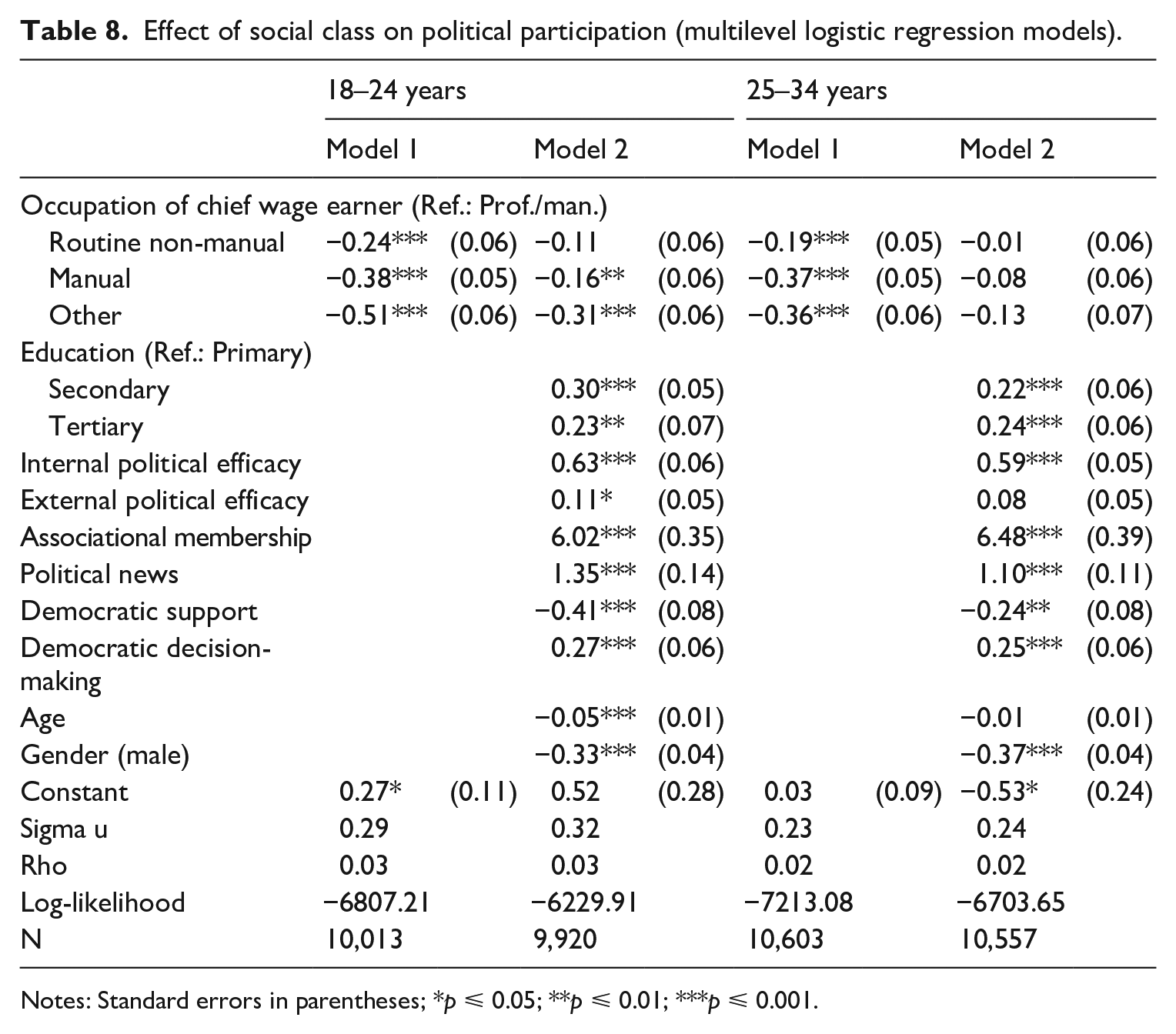
Moving on to the evidence for H3, we examine the results for a series of multilevel logistic regression models in Tables 8 to 10. We want to look at what accounts for the differences in political activism, community participation, and online political participation between young people from different social class backgrounds. Here we make a distinction between two age groups within youth: the 18–24 years old and 25–34 years old to look at the relevance of difference factors for making sense of inequalities. For each of the three combined dependent variables for both youth age groups, we show first a model with only the social class background variable (Model 1) and then a second model (Model 2) that includes the other relevant independent variables.
Effect of social class on political participation (multilevel logistic regression models).
Notes: Standard errors in parentheses;
p ⩽ 0.05; **p ⩽ 0.01; ***p ⩽ 0.001.
Effect of social class on community participation (multilevel logistic regression models).
Notes: Standard errors in parentheses;
p ⩽ 0.05; **p ⩽ 0.01; ***p ⩽ 0.001.
Effect of social class on online participation (multilevel logistic regression models).
Notes: Standard errors in parentheses;
p ⩽ 0.05; **p ⩽ 0.01; ***p ⩽ 0.001.
Starting from political participation (Table 8), when we look at Model 1 for just social class – measured through the occupation of the chief wage earner in the household – we can see that this has a significant and strong effect on participation. Young people from a lower social class background, i.e. routine non-manual and manual given that professional/managerial occupation is the reference category, are less likely to have been involved in political activities in the last 12 months. This pattern holds across the two youth age groups. When we include the controls in the models (Models 2), however, things change somewhat as expected, with the social class background effects becoming weaker for the 18–24 group and insignificant for the 25–34 age group, thus suggesting that the independent variables account by this point for the class difference. This means that class differences are not simply something that one is born into but also something that young people grow into. For the youngest age group, the effects for manual class background remains significant, albeit much weaker if we compare the coefficient size across the models (−0.38 to −0.16), but the significance of the effect of routine non-manual occupations disappears entirely. This suggests that the factors included in Model 2 fully account for class inequalities between young people from routine non-manual and professional/managerial backgrounds across both age groups but that some other unaccounted factors still lie behind some of these class differences (e.g. for those from manual social background). In the case of the older age group of young people i.e. 25–34 years, all the effects disappear altogether, suggesting that the other predictors included in Model 2 fully account for the inequalities observed with respect to social class for political participation. Among them, associational membership stands out as a particularly important factor, but most variables show a statistically significant effect, reflecting previous research on the correlates of political participation, not only among youth (Grasso, 2016; Grasso and Giugni, 2016; Giugni and Grasso, 2019c).
Moving on to community participation (Table 9), we can see that social class has a strong impact also on this mode of participation. For community participation class differences are sharper for the older, 25–34 year old, than the younger age group, 18–24 year olds. Similarly to what occurs with political participation, class differences weaken though are not fully accounted for by the independent variables included in Models 2. This suggests that there remain some other factors not included in the models that may be linked to these remaining differences. However, the coefficients decline by about half and, in some cases, lose significance showing that these independent variables do account for a significant portion of the class inequalities in community participation among youth.
Finally, we can clearly see that social class also matters for the newest mode of participation, namely, online political participation (Table 10). Here too, while the independent variables take up a large part of the effect of class inequalities, and do so entirely for routine non-manual among the older, 25–34 years, age group, they do not completely account for the effect in other respects suggesting some other factors unaccounted for in our models testing H3 are also involved. However, the variables included reduce once more coefficients by about half suggesting that they account for a significant portion of the class inequalities in political action that we uncovered. As such, although the variables do not fully account for class differentials, they do account for a substantial portion and hence we find mixed evidence for H3 overall in terms of the factors explaining class inequalities in political action.
Conclusion
Previous research suggests that it is important to study differences in political engagement not just between older and younger people, which a wide range of studies have looked at (see Grasso, 2013, Grasso, 2016), but also at the inequalities between young haves and have nots. Studying political inequalities by social class background amongst young people is highly deserving of attention, since it can provide a glimpse into the dynamics of class political inequalities moving into the future. However, these studies are very few (see, for example, Henn and Foard, 2014 on Britain), and to date, we have lacked the data to examine in detail inequalities within young people across different types and modes of political participation cross-nationally. In standard surveys, data are only collected on a small sample of youth, and therefore, any sub-group analysis within youth (i.e. intra- as opposed to inter-generational inequalities) is challenging if not impossible to carry out. Here, instead we are able to analyse in detail differences within young people from different class backgrounds cross-nationally thanks to our innovative dataset.
Our analysis showed strong evidence for an impact of social class, on the political engagement of young people aged 18–34 years. This was seen in the analyses showing that young people’s engagement in different modes of political participation considered here including community and online – suffers from inequalities, meaning that their social background forms an obstacle for their involvement. As such, we clearly showed in our paper how political participation and political engagement still suffer from the presence of important social inequalities, even within the younger cohorts and from a cross-national perspective, thus contributing to the literature. Our study therefore suggests that we should pay greater attention to analysing and understanding intra-generational inequalities, in addition to inter-generational differences in political participation and political engagement. This holds across different modes of participation, whether ‘traditional’, or conventional, or more unconventional modes of political participation, participation in community activities or ‘newer’ forms of online political participation, reminding us further of the importance of analysing different repertoires side by side (Giugni and Grasso, 2017; Grasso et al., 2017). This also holds across two different age groups of young people: the younger 18–24 year-olds and the older 25–34 year-olds. However, once we control for the effects of relevant independent variables, whether socio-demographic such as education and gender or attitudinal such as feelings of political efficacy or linked to associational membership, political information, etc the effect of social class becomes weaker or in some cases even disappears altogether. This suggests these factors have at least some role to play for explaining political inequalities by social class background amongst young people across Europe.
Overall, our analysis has shown major class inequalities in political participation and political engagement among youth across Europe across a series of political indicators. As such, our conclusions echo at least in part those from the British study of youth political participation by Henn and Foard (2014) where political engagement was found to be socially differentiated. We have shown important class background differentials in the extent to which young people are politically active, and also with respect to wider political engagement such as how politically efficacious young people feel. These findings link back also to those of previous work (Berry, 2012; Hay, 2007; Hay and Stoker, 2009; Kimberlee, 2002; Sloam, 2007; Youth Citizenship Commission, 2009) including the finding that politicians tended to be seen as not interested in the concerns of youth (Furlong and Cartmel, 2012; Mycock and Tonge, 2012; O’Toole, 2003). We also found class inequalities with respect to support for democracy and the democratic process. Moreover, with respect to work on young people’s aversion and distrust in politicians (Dermody et al., 2010; Farthing, 2010; Hay and Stoker, 2009; Henn et al., 2005; Sloam, 2007; Stoker, 2006) as well as Henn and Foard’s (2014) key argument that youth cannot be considered a monolithic entity we showed how results vary by class and the presence of inequalities also with respect to the consumption of political information. As such, our results clearly show that, despite the increasing individualisation of politics (Beck et al., 1994; Furlong and Cartmel, 2007; Giddens, 1991; Sloam, 2012), and even when we focus on the youngest generations, social characteristics such as class background are still extremely relevant in terms of understanding intra-generational differences with respect to political engagement and the patterning and inequalities in political voice across a variety of available repertoires of action in European democracies.
Footnotes
Funding
The author(s) disclosed receipt of the following financial support for the research, authorship, and/or publication of this article: This project was funded by the European Commission under H2020 (grant agreement no. 727025). The Swiss part of the project was supported by the Swiss State Secretariat for Education, Research and Innovation (SERI) under contract number 16.0103. The opinions expressed and arguments employed herein do not necessarily reflect the official views of the Swiss Government.
