




Abstract
During national crises such as the COVID-19 pandemic, government approval tends to surge. In Poland, however, there was a pronounced resistance to the government’s management of the pandemic in a context of the ongoing democratic backsliding. As part of the crisis response, the Polish right-wing government adopted measures that not only tried to contain the virus but also encroached on civil liberties. This paper sets out to understand the significance of the civic activism that flourished among young people, who took diverse grievances to the streets. An analysis of focus group discussions in two contrasting Polish cities allows us to examine perspectives on the resurgence of civic activism. Under the right-wing government, conservative youth groups received governmental support and refrained from protests, while liberals mobilized to defend democratic values. A Constitutional Tribunal ruling which imposed further restrictions on abortion served as a catalyst for protests. Irrespective of their political orientation, young Poles valued protest as a means of individual expression and as a manifestation of lived democracy. Our findings show that government opponents saw protest as an opportunity to advocate for cultural-liberal issues, while government supporters perceived it as a tipping point, signaling government failure. Despite political divisions, Polish youth stressed the importance of freedoms and human rights. The government’s exploitation of the pandemic to limit human rights led to a rallying in their defense.
Introduction
The level of protest activity in 2020 in Poland marked a watershed in youth protest activity. According to a survey run by Kantar, nearly one in three respondents aged 18-24 participated in the Women’s Strike of October 2020. 1 The streets of post-communist Poland have never seen so many young people protesting, in comparison to the civic activism from around 2015, when a new wave began in response to the rise of the right-wing government led by Law and Justice (Prawo i Sprawiedliwość, PiS), and also in comparison to the big protest waves of 1989.
This significant level of societal resistance is all the more remarkable because it occurred while public health measures were in place. Regulations such as a stay-at-home order alongside limits on public gatherings, mandatory face masks or business closures, aimed at limiting the spread of the COVID-19 virus, did not stop the protesters. Protests culminated when on 22 October 2020, the Constitutional Tribunal ruled that the provision of the Act of 1993 which allowed abortion in the event of severe, irreversible fetal impairment and a life-threatening disease, was inconsistent with the Polish Constitution. Among protesters were not only middle-aged mothers alongside their daughters, as was the case during the black protests in 2016, but in general many young people, including those who supported the governing party. 2
While young people’s political engagement may challenge democratic backsliding and an authoritarian status quo, young people are also known to support regressive or even nationalistic policies. 3 In other cases, young people have withdrawn from the political world altogether. 4 Indeed, young people are generally less likely to become politically involved in electoral forms of participation and instead to engage in flash mobs, pickets, protests and online campaigns. 5 Among the young, there is great diversity in protest participation, with a strong link between higher levels of education and higher protest participation. 6 Support for an authoritarian status quo might be due either to a shared agenda with authoritarian states or a successful instrumentalization and coercion on the part of the state. 7
The rise in youth activism during the pandemic in Poland speaks to a literature that on the diversity of young people’s political goals. Poland makes for a salient case to assess the significance of such a shift in the public visibility and political behavior of young people. This article explores how young people assess the activism that has come to characterize their generation in the eyes of the public and compares the views of young people with varying attitudes to the governing party. Specifically, we address the following questions: How does the perception of protests as a form of political expression vary among young people who support, are critical of or indifferent to the government, and what commonalities and differences emerge in their views of the role and impact of protests? What political and social potential do young Poles associate with protest activities versus other forms of activism?
The empirical heart of this article is represented by focus group discussions, which concentrated on the political agency young people attributed to the activism of their peers. These discussions, conducted in October 2020, involved a total of 72 young people aged 18-34. They took place in two cities with very different political and social profiles: Białystok in the east of Poland, known for its conservative and nationalist tendencies, and Wrocław in the southwest, which is generally more liberal and progressive. This contrasting choice reflects the polarization on social issues inherent within the Polish society. 8 Białystok has experienced significant social tensions related to issues such as LGBT rights and immigration, while Wrocław has often been at the forefront of social movements advocating for these rights. By investigating perspectives in these two cities, we capture the broad spectrum of attitudes and opinions within the country and across the spectrum of what can be considered “young.” 9
Based on these discussions we find that the young generation generally felt entitled and empowered to oppose a government that was perceived to be neglecting its citizens’ interests. Young people, irrespective of their political leanings, demonstrated a strong attachment to their individual right to protest. This commitment aligns with the high levels of support for democratic principles that exists across Central and Eastern Europe and beyond. 10 It emerges across focus groups that the young share a common ground defined by their belief in the right to protest and in democratic values. Meanwhile, both supporters and opponents of the government emphasize that protests should follow the law and avoid chaos. There was also very little desire among respondents for radical demands emanating from protest movements and instead, civic activism was understood as having to work in cooperation with the state.
However, the young generation disagreed over how opposition was to be enacted, and demonstrated notable divergence in their assessments on actual protest activities. This divergence was particularly evident when comparing participants in Wrocław and Białystok. The former, even those who supported the government in principle, expressed a greater willingness to take to the streets, whereas this was far less common in the latter city. Moreover, participants raised concerns about protests being short-lived and not bringing lasting change.
The next section examines how protest activity has developed in Poland over the last decade and the meaning of youth activism within the context of the country’s democratic backsliding. We then present the focus group discussions that illuminate how young people evaluate protest as a form of political participation. The empirical analysis sheds light on how young people assess various types of political participation among their peers. The last section concludes and offers avenues for further research.
The Evolution of Popular Protest in Contemporary Poland
Poland’s democratic standards rapidly declined after the appointment of the populist right-wing government led by PiS in 2015. Under that government, democratic norms weakened, creating new challenges for civil society and leading to further fragmentation of civic engagement. While the extent of democratic decline has varied across Central and Eastern Europe, Poland serves as a stark example of these troubling trends. 11 Prior to the accession to power of Law and Justice, protests in Poland were rare, and contentious politics centered overwhelmingly on economic matters. 12 After 2015, and in response to the disrespect for democratic institutions and the violation of human rights by the PiS-led government, pro-democracy protests grew in number and intensity across Poland, united under the umbrella of the Committee for the Defense of Democracy (Komitet Obrony Demokracji). 13 The targeting of women’s and LGBT rights contributed to the growth of feminist protest movements. Indeed, the Black Protest (Czarny Protest) and the All-Poland Women’s Strike of 2016 constituted the first wave of mass public opposition to the tightening of the abortion law.
With the spread of the COVID-19 pandemic, the PiS-led government benefited from the broad approval of containment measures to severely restrict public life and attempt to further consolidate power. 14 Indeed, as the virus spread across the country, the government strengthened the power of the executive branch, severely weakened checks and balances—most notably by curtailing the independence of the courts. It passed conservative legislation and bypassed the electoral commission by arranging last-minute postal voting for the presidential election. Additionally, the government also limited freedom of assembly and restricted women’s rights further. 15
Throughout the pandemic, new bills were introduced in Poland at great speed without prior discussion with the opposition or consultation with independent experts or civil society organizations. The most controversial decision that was passed in the context of the pandemic was the ban of 22 October 2020. The PiS-controlled Constitutional Tribunal ruled that the Act of 1993, which allowed abortion in cases of severe, irreversible fetal impairment and life-threatening disease, ran counter to the Constitution. As a result, the termination of pregnancy even in cases of “severe and irreversible fetal defect or incurable illness that threatens the fetus’s life” became illegal. 16
Whereas the reform on abortion severely limited personal freedoms, other reforms targeted collective freedoms, notably the independence of the judiciary. The government forcefully extended its control over the judiciary by implementing reforms that curbed the powers of the Constitutional Tribunal. A number of judges loyal to PiS were installed, undermining the tribunal’s impartiality. One of the key components of these reforms was the creation of the Disciplinary Chamber within the Supreme Court in 2017 (abolished in 2022). This chamber was established to oversee the conduct of judges and impose disciplinary measures, effectively allowing the government to exert influence over judicial decisions. Critics argued that this mechanism was used to intimidate judges and deter them from making rulings that could oppose government interests, further eroding judicial independence and the rule of law in Poland. 17
Such far-reaching limitations on civil liberties were passed while pandemic-related restrictions such as a stay-at-home order were in place. At the same time, the level of political activism remained low. 18 However, these reforms tipped the balance and activated the protest mood in society as protesters adjusted their forms of mobilization to comply with the new rules. In particular, some segments of the younger generation emerged as the driving force behind this dissent. Irrespective of their political orientation, young people overwhelmingly expressed support for the All-Poland Women’s Strike (Ogólnopolski Strajk Kobiet), whether they participated or not in the marches. 19 Protesters usually organized themselves via social media, and when their demonstrations encountered police repression, outrage over the disproportionate use of force stimulated further unrest.
These protests, which young people organized, gained significant visibility in Poland and internationally. 20 While the issue of abortion was a decisive catalyst, the activism surrounding these protests also highlighted broader concerns about civic liberties, including women’s rights and reproductive health, which contributed to their visibility. There were three important features of these particular protests that took place during the pandemic. First, even if the protests were sparked by the ruling on abortion, the list of grievances expanded over time to include reproductive, LGBT, and disability rights, rule of law, health care, labor rights, secularization, climate change, and environmental degradation. 21 The pandemic allowed young people to raise these issues again and they resurfaced with renewed urgency when taken up by the youth. Second, the presence of young people contrasted with their relative absence from public space during the previous decades. 22 In those earlier years, many young individuals expressed disinterest in democratic processes and demonstrated a lack of trust in political institutions such as parliament and presidency, a trend supported by various studies and surveys conducted over the years. 23 Third, among the protesters there were not only the liberal anti-government youth but also pro-government youth who opposed the restrictions imposed during the pandemic. 24 This juxtaposition of phenomena indicates a complex landscape of political engagement and illustrates the diverse motivations driving the public’s response to the government’s actions during this period.
In contrast to large-scale protests in 2016, when women formed a clear majority of protesters, the 2020 mobilization saw a more diverse array of protesters. 25 Still, these movements represent the first mass mobilization of Polish women and the first large-scale protest in Poland since 1989. Over 400,000 individuals participated across various cities, reflecting a large level of engagement and visibility not seen in previous demonstrations. 26 So far, no other demonstration has attracted as many protesters since the end of communism. 27 These protests occurred in waves in 2016 and 2021, also taking place in smaller towns and cities. 28
This upsurge of protest activity nevertheless has met with diverse reactions among the young generation in Poland, which is deeply divided in terms of political views and has been exposed to an increasingly dogmatic education system emphasizing culturally conservative values. 29 In this context, we sought to understand what potential a diverse set of young people saw in the political participation of their peers. At the center of this article, which sets out to understand what segment of young Poles opposed or supported protests and why, are questions about how this activism was evaluated by the younger generation and what motivations they perceived among their socially and politically engaged peers. A focus on their narratives helps to explain the extent to which protests were motivated by liberal political norms, and whether opposition to protests was determined by support for the government.
Crisis Perception and Political Participation among Young Poles
There is a significantly lower level of social and political participation in post-communist democracies than in established democracies, reflecting the persistent legacy of communism. 30 While civic activism—defined as engagement in community issues, social movements, and public advocacy—remains an exception, with an overwhelming majority of Poles (80 percent) not engaging in any form of activism, young people were for long the least active across all types of political participation. 31 The literature on political participation is dominated by a focus on the preconditions, factors, correlations, and explanations of political (non)participation and its various forms. Scholars identify the attitudes and opinions of individuals regarding their role in society, political and social trust, as well as perceptions of political efficacy as strong predictors of participation. 32
Low levels of political interest and a growing distrust in institutions and government authorities have led to a noticeable decline in the level of political participation in democracies, especially in terms of voter turnout. 33 As a sign of the growing crisis of democratic values, citizens are becoming increasingly passive or even withdrawing from public life, a fact which further exacerbates the crisis of representative democracy and makes societies susceptible to populism. To young people, traditional channels of political participation at times seemed out of reach or irrelevant, particularly during periods of political disenchantment. When issues relevant to them were marginalized, young people withdrew from the formal political sphere. It is not only that young Poles were absent from the public space; they also overwhelmingly lacked interest and trust in representative democracy and political institutions such as the parliament and the presidency. 34 Having observed the persistent rivalry between parties in Poland, the youth were disengaged from political discourse, doubting the fulfillment of electoral promises and feeling put-off by the quality of public debate. 35
At the same time, historically youth activism has been oriented toward unconventional forms of participation, such as street protests or digital activism. 36 Civic activism and protests make for a more accessible and impactful form of political engagement throughout moments of regime crisis. 37 More recently, young people became concerned with issues such as environmental protection and minority rights, which require types of activism that go beyond the act of voting. 38 These issues are often perceived as urgent and interconnected global challenges that require immediate action and public mobilization, distinguishing them from other political concerns that may not seem as pressing.
Recent research has reevaluated civic engagement in post-communist countries and shifted the focus from formal organizations and institutional conditions to understanding the motivations behind various forms of civic activism from the perspectives of activists and citizens. 39 Following this strand, we contend that the recent engagement of Polish youth can only be understood if we take into account its multiple causes. First, attitudes have shifted across generations, including for new, albeit heavily fragmented, social norms. While some young people are inclined to defend liberal or emancipatory values, others have become more assertive in their opposition to them. The divergence in values that characterizes society in general is particularly pronounced among people who came of age during the era of neoliberal economic development and increasing globalization of the 1990s and the 2000s, commonly referred to as Millennials, i.e. people who are now in their 20s and 30s. Characterized by a strong environmental awareness, segments of this generation prioritize values such as civil liberties, loyalty, justice, tolerance, peace, and ecology. 40 This prioritization has manifested in youth environmental movements exemplified by initiatives like Youth Climate Strike (Młodzieżowy Strajk Klimatyczny). 41
At the same time, a conservative segment of the civil society has gained visibility in Poland, reflecting a dynamic that has always existed but has become more pronounced in recent years. Under the leadership of the PiS government, young people who cherished conservative values no longer felt alienated; instead, they were supported by a government that valued nationalist and religious principles. 42 Consequently, these conservative young people have not resorted to contentious politics, as their values were already protected by mainstream political actors. 43 This was not the case under the government led by the Civic Platform (Platforma Obywatelska, PO) between 2007 and 2015, when certain activities such as the Independence March—an event that celebrates Polish Independence Day but has been associated with far-right groups and nationalism—were either restricted or prohibited, leading young conservatives to resort to more radical actions. 44 In contrast, liberal young people have operated in a rapidly shrinking public space impacted by the decline of democratic values and norms under the PiS-led government. During the pandemic, young liberals expressed opposition to actions taken by the right-wing government. Even if the immediate impulse for the protests was the ruling on abortion, the grievances articulated by protesters expanded to a wide range of cultural-liberal issues. 45
After its investiture, and particularly during the COVID-19 pandemic, the PiS-led government severely curtailed civil liberties and independent civil society activities. Once the government sensed an opportunity to act without restraint in its pandemic response, it attempted to further consolidate power, for instance by using state television to delegitimize protesters. While such actions might have occurred regardless of the pandemic, the government’s pandemic response provided an ideal pretext to justify and amplify these measures. Despite recognizing deficiencies or inadequacies in the political system, their skepticism, frustration with, and disconnection from traditional political discourse shaped their civic participation in unique ways, leading them to choose nonconventional forms of participation such as protest.
Research Design
To understand young people’s opinions about current politics, we conducted twelve focus group discussions in two Polish cities: Białystok and Wrocław. These discussions provide insights into young people’s assessment of the government’s response to the pandemic, their views on the legitimacy of recent protests, and their own involvement in protests. The focus groups, held in October 2020, involved a total of 72 participants aged 18 to 34. This sample size allows us to capture a range of perspectives within the youth population, while the chosen age span covers important differences in political socialization among those born between the early period of national independence in the 1990s and following EU accession in 2004. The number of participants per group furthermore enabled every participant to speak at some length and allowed us to observe group dynamics.
The two cities present starkly contrasting political and socioeconomic profiles. Białystok, near the border with Belarus, has seen significant waves of out-migration, and despite positive economic development since 2020, it remains relatively poor in socio-economic terms. The city and the surrounding regions are characterized by a conservative social outlook and electoral support for PiS. In contrast, Wrocław is one of Poland’s largest cities with a rapidly developing economy. Located in the west of the country, it has attracted significant investment from foreign companies. Its residents generally have a liberal outlook, reflected in a local government that advocates for progressive policies, such as expanded social services, environmental initiatives, and support for minority rights. Wrocław has also seen significant demonstrations over the last few years and has a strong local branch of the All-Poland Women’s Strike (Ogólnopolski Strajk Kobiet).
Focus group participants were selected through a multistep process. Initially, individuals were approached using a prescreening questionnaire to assess their political orientation and general sense of Poland’s political development drawing on the research panel ePanel.pl owned by ARC Rynek i Opinia. This prescreening allowed us to allocate them to one of the three groups, an allocation which guided the sampling procedure, and to ensure gender balance and diversity in terms of personality. A final screening was done on the day of the focus groups itself with very brief on-spot interviews to verify that participants provided accurate information about their views on politics and social questions and to assemble groups that were a good fit in terms of character. The first focus group included participants who supported the government, the second comprised participants who opposed the government, and the third group was mixed. This design enabled us to identify most clearly the in-group discourse and to assess the extent of the participants’ support of or opposition to the government.
Each discussion included around six young people, and the profile of the groups differed according to the participants’ political orientation (Table 1). Given the wide age span, we split participants into those aged 18 to 24 and those older than 25. The discussions took place in Polish and were guided by a professional female moderator based on an extensive interview questionnaire that one of the researchers had discussed in detail with the moderator beforehand to ensure familiarity with the research questions. One of the authors was present during the groups to observe and to intervene on a regular basis to further guide the discussions when necessary. Given the context of the pandemic, a strict hygiene protocol was followed with respondents keeping distance and avoiding physical contact.
Selection Scheme for Focus Group Participants
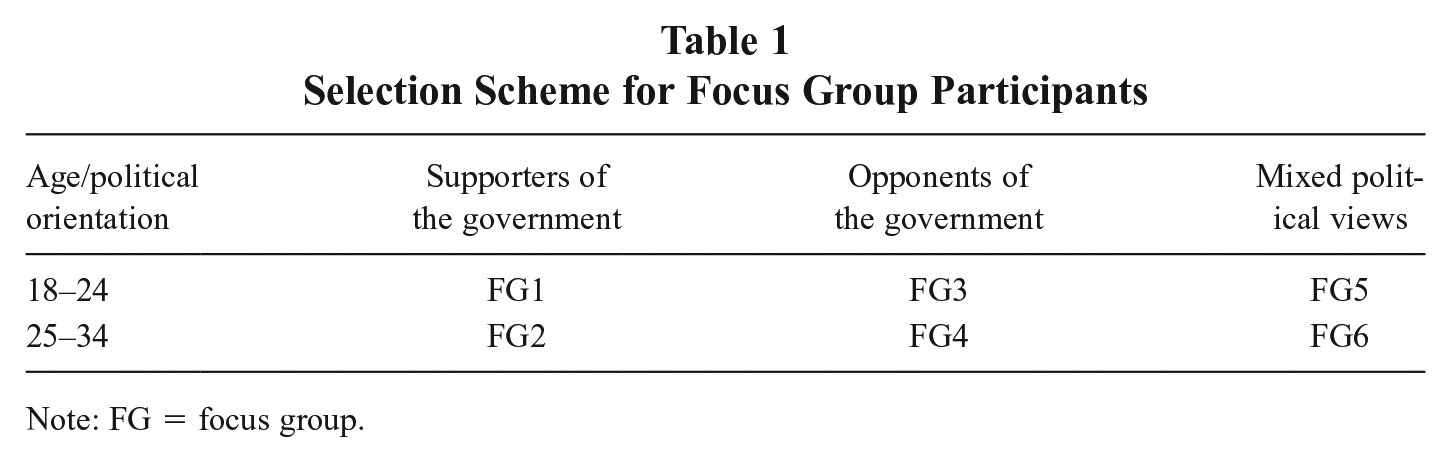
Note: FG = focus group.
The focus group discussions were fully transcribed in an anonymized way and then coded in MaxQDA (a software tool for qualitative data analysis). The coding process was guided by a coding tree developed by one of the authors. The basic structure of codes was set deductively, reflecting the major themes of the discussion and were then refined inductively, responding to the insights that emerged from the data to capture the underlying themes that structured the discussion and to bring to light the different argumentative patterns and assessments. Once coded, the statements were then analyzed thematically for a consistent interpretation across the groups.
Consensus and Disagreement Regarding Civic Activism
The focus group discussions brought to light important insights regarding the young people’s awareness of protests and the potential they associate with protests. While not all participants shared the same views, several expressed the opinion that freedom of speech is a fundamental component of any democratic society. Among those who supported the government, there was acknowledgment that a certain level of civic and political activism, notably by NGOs, is necessary in order to impose checks and balances on the political system (P72-fW22Sup, P85-fW32Sup). 46 Tellingly, it was a young government-supporting participant in Wrocław who declared: “I think it’s important for all of us [to protest], because no one likes to be restricted in any area of life. That would restrict my life and my right to freely express my views” (P81-fW25Sup).
What is remarkable is that even participants supportive of the Polish government underlined the need for opposition and checks on the government at the height of the pandemic. However, as one might expect, a broader appreciation of protests was particularly pronounced among participants critical of the government, who, unlike the government supporters, tended to approve of protests even when they did not adhere to legal norms. What is striking is that, irrespective of their position vis-à-vis the political regime, the young participants stressed the importance of expressing one’s views about political topics on both national themes and more local questions. A participant in Białystok stated,
I believe we have the right to express our opinions. Even if it’s only one person, they can stand close to the parliament [building] and shout that they don’t like the weather today. That’s our right. And we have this right no matter what we do, no matter what is being called for. It’s important that we protest and show that we don’t like something. And anybody can do this (P31-fB21Opp).
Among the young people critical of the government, we often encountered the view that protests were an essential part of a vigilant society, as well as a belief in the importance of people getting involved in political issues beyond the electoral process. Most of the government-critical young people in Wrocław were prepared to take to the streets—the following statement is evocative of such a view, underlining the importance of protests so that people can voice their opinions and get to know viewpoints that they might not agree with:
I think we live in a bubble. When you think about it, your closest friends vote for the same people. That’s because we surround ourselves with people who are similar to us. And if someone lives in their bubble their whole life without ever looking outside, perhaps seeing such a protest can make them aware of a problem they never knew existed (P124-fW28Mix).
At the same time, a rise in the number of protests is a sign that state and society are increasingly drifting apart, which is clearly a matter of concern for the younger generation. Young people in Białystok understood protests as an indication of Poland’s worsening political and social climate, with participants accusing protesters of being responsible for this deterioration: “I have the impression that it’s because of the protests that people quarrel more” (P56-fB24Mix).
Beyond the overall agreement on the importance of protests in principle, supporters of the PiS government were quick to dismiss the actual protests that took place in the country as attended by ill-informed people who did not know what they wanted to achieve. Participants in Białystok, even those who had grown up in politicized households, severely criticized the actual practice of protests. As one participant remarked:
I don’t really get the idea behind it, but it was an equality march. I don’t think my parents would ever protest in the same way as those people. And a lot of bad things happened during that march. That is not what protesting should look like. It should not have happened, because the whole world is watching, and it gives us a bad image (P14-fB23Sup).
An issue around which government supporters and opponents tended to converge was the extent to which protesters ought to respect legal norms. In both cities, participants criticized the chaotic nature of the protests and their lack of organization: “When people take to the streets to protest, they create turmoil, and it’s not worth it. No subject is worth creating the kind of chaos that sometimes ensues” (P73-mW22Sup). Even among those who were generally sympathetic to protests, there was a strong belief that street protests should not simply be “about blocking the streets, walking in line, and blocking traffic” (P11-fBB20Sup). Many young participants also felt that protesters should seek other ways to attract attention to their causes. In the eyes of most focus group participants, protests tended to end in violence, which, in their view, contradicted the democratic principles they supposedly tried to defend. The discussions underscored a deeply held desire for constructive forms of activism that are not radical and follow democratic principles. Frequent mention was made of the potential for protests to get out of control: “All protests result in turmoil. I’m not sure if they [protests] are worth it” (P75-mW19Sup). In the same vein, other participants claimed that protests were less about actual political progress and were primarily aimed at the media: the protests “only brought riots. The media had something to talk about for a few days. Often the media benefit the most, because they have an interesting topic to cover. But I don’t think it brought any results” (P24-fB31Sup).
Young Poles also saw protests as ephemeral in nature, expressing concern about the lack of long-lasting change: “Protests raise the issue for a minute, but it’s soon forgotten” (P74-fW21Sup). Given the political climate, they expressed disillusionment with what protests could achieve, with one government supporter, who approved of protests in principle, claiming: “Protests do not lead to the government taking any action, unfortunately” (P83-mW31Sup). Only a few participants among the 18-24 age group in Wrocław argued that there would be less political freedom without protests: “I think that, if it wasn’t for the protests, it would be even worse. At least we’re giving a sign that we don’t like something, that something is wrong” (P92-fW21Opp). While other participants in Wrocław also stressed that the situation would worsen in the absence of protests (P101-mW30Opp, P105-fW29Opp), only one participant in Białystok expressed a blanket approval of acts of civic resistance: “we have this right, no matter what we do, no matter what is being called for. It’s important we protest and show that we don’t like something. And anybody can do this” (P31-fB21Opp).
A key feature of recent protests in Poland is online activism. When we discussed how young people evaluate online media for political engagement, it became clear that online media benefited from a vague but profound sense of trust among young people. The participatory nature of online media was highly valued by participants of all political orientations. Among the government critics, however, the use of online media was accompanied by severe criticism of official media, considered as biased and supportive only of partisan political positions:
Television is financed by ruling parties of all sorts and from our taxes . . . . Depending on which channel one watches, yes, you finish and switch channels, and then you see something completely different. I have the impression that, well, it’s the same country, but completely different things are happening. (P44-fB29Opp)
With the link between online and offline protests, government supporters also approved of the importance of online mobilization (P24-fB31Sup, P26-mB34Sup), which they felt was a way to avoid the chaos associated with young people’s offline protests: “You can protest elsewhere. Nowadays you can voice your opinion online. There are petitions, all sorts of places to leave a comment. These are more civilized ways to state your arguments and show your disapproval toward the government” (P24-fB31Sup).
Government critics relied on social media to gain political information that they believed was not available in traditional media more frequently than government supporters. The group discussions highlighted how social media is used to access information about protests even among bystanders, and that such information is generally considered to be genuine. The government-critical young people also stated that they actively engaged with political content online and perceived themselves as becoming online activists. Even for some of the government supporters, social media represented the polar opposite of the highly controlled official media landscape:
In times of the information bubble, people get the type of information they want to receive. But if someone is conscientious and wants to view an issue from a different perspective, the internet gives them such an opportunity. Traditional media don’t give you such an option. (P76-mW19Sup)
Others expressed concerns about the spread of misinformation in social media, associating a certain journalistic standard with traditional media sources:
There is still some level of ethics and prestige in traditional media like TV or radio. They care about that. The information that you can find on the internet comes from people like me . . . . There are millions of stories on the internet and each one of them gets distorted at some point. (P85-fW32Sup)
There was also a sense among participants of a general lack of literacy in the use of online sources for political news, with one participant stating: “No one teaches us how to verify information, how to know whether a piece of information is fake”; and further: “Conspiracy theories are becoming more popular. Some are funny, some are absurd, and some are even harmful, like the anti-vaccine movement . . . . The internet has a lot of room for spreading nonsense—often harmful” (P84-mW25Sup). This statement also found agreement among other participants.
Which Issues Polarize Youth?
The focus groups also inform us about the issues that young people thought could be addressed through protests. The group discussions revealed which issues tended to be polarizing (or not) for the younger generation and focused on four such issues: women’s rights (particularly abortion rights), LGBT rights, judicial reform, and the environment.
Participants assessed the large protests related to abortion in very different ways. While all participants were aware of the protests, only a small minority saw them as important. In Białystok, opinions on the topic diverged starkly among government supporters and government opponents: while some participants argued that abortion was murder (P21-fB29Sup, P25-mB34Sup) and dismissed the protests out of hand (P24-mB26Sup), others agreed with the view that “Nobody but us should decide what we can do with our bodies. We have freedom, we have our rights, freedom of speech, and that’s our decision” (P35-fB20Opp; a similar argument is found in P31-fB21Opp and P32-fB23Opp). In Wrocław, however, the young participants of all political orientations supported more freedoms when it comes to reproductive rights. Nevertheless, they occasionally disagreed about whether protests were the appropriate way to express this position. Some believed that street protests were not a suitable way to deal with such a culturally sensitive topic, arguing that they could alienate potential supporters and provoke backlash from more conservative segments of society.
Support for activism related to LGBT rights was low among all young participants, with a small majority considering them unimportant, thereby highlighting a certain convergence with the country’s general conservative social discourse. Nevertheless, young people with more liberal cultural views emphasized the importance of such protests arguing that the ongoing harassment and derogatory comments directed at the LGBT community indicate a troubling trend. As one participant stated,
because things are going in a bad direction. Those people [the LGBT community] are being harassed, derogatory things are being said about them . . . , and that’s a clear sign that things are going in a bad direction, because it will soon be very difficult for this group of people to function in Poland. (P105-fW29Opp)
This perspective certainly highlights the urgency felt by some young individuals regarding the protection of LGBT rights, but discussions also highlighted the polarizing nature of such debates on what to do. Indeed, these participants, a clear minority, perceived protests in support of LGBT rights as a good way to provide information to people who are usually uninterested in such topics, because protests have a greater public impact than social media posts, increase awareness, and, most importantly, “people start to talk about it” (P105-fW29Opp). However, the culturally conservative participants in the focus groups in both cities typically shared the following view:
I was raised in a traditional family, with mom and dad. I was taught that that’s the right model and that everything else is an illness. I still think that way, but I have my doubts. I met a friend in a gay club in Wrocław . . . , and it made me realize how many gay people live among us. My viewpoint is slowly starting to change, but I still have those old values instilled in me. (P106-mW31Opp)
Participants had no clear opinion about the protests related to judicial reforms, but those who were aware of such protests generally approved of them. For young people, such an institutional topic, despite its importance, remained rather abstract and distant from their daily lives. When pressured to offer their opinion, they lacked knowledge about the topic and responded with commonplaces. For example, some suggested that protests about the independence of the judiciary were simply another excuse for those opposing the government to take to the streets. In such critical perspectives, these individuals were accused of using the issue as a pretext to express their discontent with the government or to simply have a good time out on the streets. According to such judgments, there is a belief that protests do not reflect sincere advocacy for judicial reforms.
Another important issue that brought young people out on the streets was climate change and environmental degradation. Overall, the focus group participants provided a heterogeneous assessment of such protests, even if a clear majority considered them illegitimate or simply unnecessary. Some did not think that there was any value in climate strikes and argued that a change in the government’s decision to ban coal, for instance, was unlikely, thus rendering protests pointless. Agreement with the need for climate strikes was most clearly pronounced across the six focus groups in Wrocław, irrespective of the participants’ political orientation (P11-fB20Sup, P84-mW25Sup, P114-mW21Mix). Others, however, maintained that protests were not the right way to raise this issue and held little hope that protests would prevent climate change, a view most strongly expressed in the government-critical group in Białystok, where one young person even stated, “In my opinion, protests about climate change are often counterproductive, because society is laughing about them and downplaying the problem” (P84-mW25Sup).
Poland’s polarized political and societal situation has left its mark on the way young people assess the recent protests. More often than before the pandemic, young people have taken to the streets to advocate for a diverse array of issues. Nevertheless, young people’s assessments of what their peers are doing are divergent and do not correspond to the political perspectives dividing the country. Indeed, our focus groups emphasized the young people’s profoundly divergent assessments of protests, assessments that also reflect the micro-contexts in which they live, as captured in the unlike dynamics in the two contrasting cities where the discussions took place. The above findings are summarized in Table 2.
Attitudes of Young Polish Protesters toward Protests and Other Forms of Activism
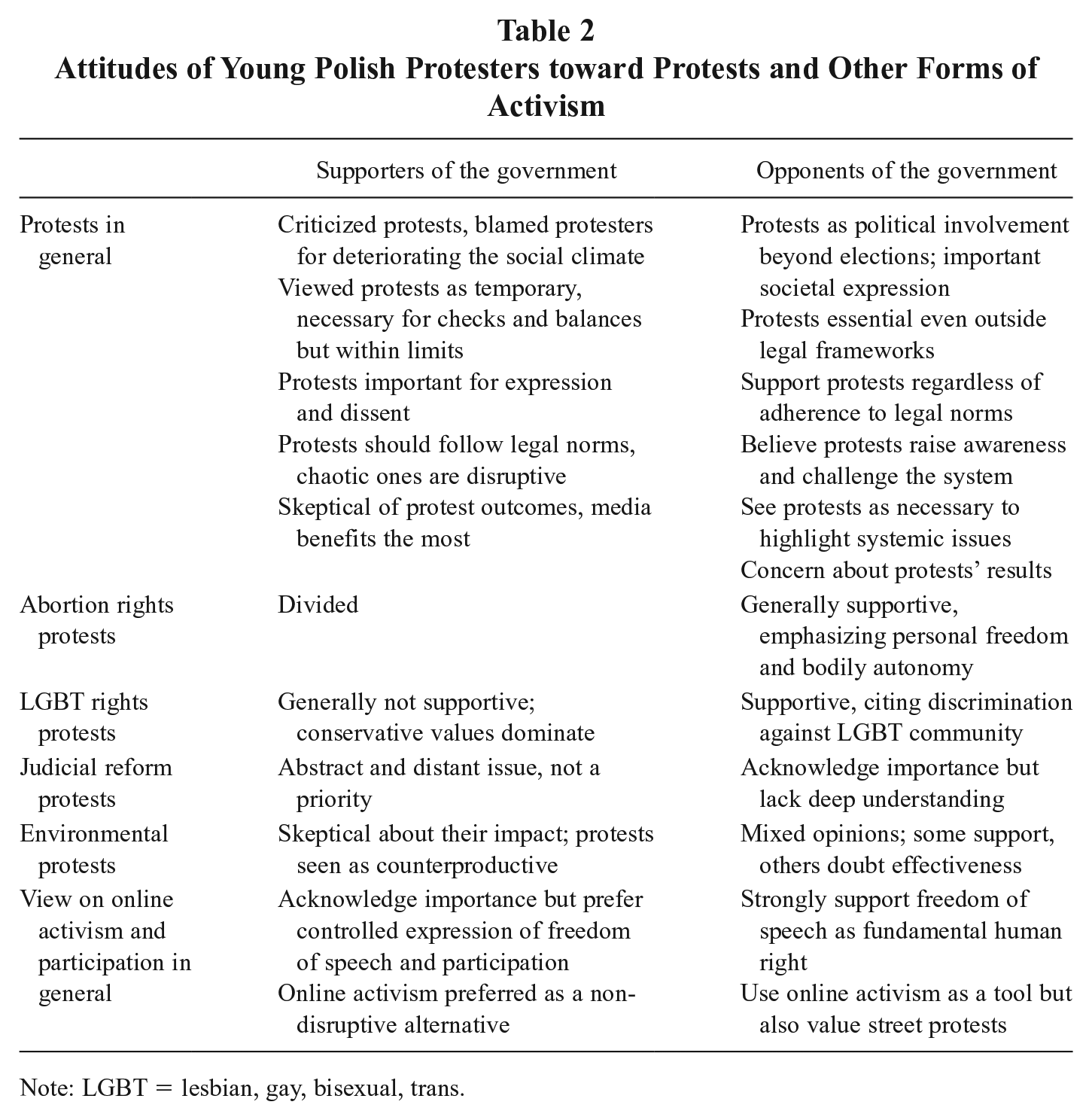
Note: LGBT = lesbian, gay, bisexual, trans.
Conclusion
In Poland, the right-wing populist government instrumentalized the crisis of COVID-19 to consolidate power by enacting conservative social policies. Governmental restrictions spurred societal resistance in Poland, but none of these protests was as spectacular in size and diversity as the protest that occurred in the fall of 2020, during the lockdown, in response to the Constitutional Tribunal ruling banning abortion. Despite government-imposed limitations on public gatherings, young people’s overall level of protest involvement increased markedly, even among those supportive of the government.
The focus groups demonstrate that a significant number of young Poles in principle favor nontraditional forms of civic activism such as protests, and rely on digital tools for organizing such activities. While previous studies have indicated a general trend toward such engagement, our findings provide nuanced insights into the motivations, strategies, and perceptions that drive such preferences among youth in Poland today. These forms of youth activism are more informal and dynamic and are shifting toward non-electoral political participation as well as online activism. Nevertheless, young people overwhelmingly continue to believe that the conventional media is trustworthy.
However, protesters remain only a tiny minority in the society and this article sheds light on the evaluation of protests through the eyes of “ordinary” young people, a perspective which also gives a voice to those who are sidelined in the conventional analysis of protest movements: the bystanders. This group makes up an important part of every society. Our research gives voice to these young people and their diverse social and political preferences. The focus groups allowed us to understand how young people explained the political engagement of their peers who participated in the protests, and to investigate the implications of the combination of democratic erosion and pandemic management for the young generation.
For young people of all political orientations, the protests are important because they draw attention to and educate people about diverse issues. Given Poland’s democratic backsliding, young people resorted to protests as a response to a government that failed to address their needs and abused a national emergency for political gain. While young people generally advocate for the protection of individual human rights and appreciate the value of civic mobilization, different types of protests are evaluated differently among the youth. For instance, the more abstract protests aimed at opposing judicial reforms have failed to resonate with young people at large, possibly due to a perceived disconnect between these issues and their immediate concerns, as well as the complexity and perceived inaccessibility of judicial processes. Moreover, young Poles recognize the limited impact of protests on political outcomes, with many questioning the extent to which they have seen effective change resulting from such actions. It is therefore uncertain whether this rise in activity will have a lasting contribution to democratic endurance in Poland, particularly in terms of institutional resilience, though there may be a positive effect on democratic culture and civic engagement among the youth.
What was remarkable in the focus group discussions was the absence of young people who were advocating for broader and more systemic changes in the country. The young participants considered deep political change to be unrealistic and undesirable, favoring specific protests with tangible goals. This narrower scope of civic activism is shared across political orientations and is a defining characteristic of the political outlook of young Poles. Women’s rights (especially abortion rights), LGBT rights, judicial reform, and environmental concerns, especially climate change, emerged as central topics for protests but among the population of young people that discussed these issues in focus groups, these topics were only rarely considered central and were even opposed in very vocal terms by some participants.
Our analysis of the Polish case allows us to explore the deeper structures that make up the social and political conditions that young people faced in the context of democratic decline one generation after the sweeping institutional changes of 1989. Our study thereby contributes to a better understanding of how young people evaluate various forms of activism and identify the issues mobilizing them. It also conveys the deeply contradictory assessments of specific individual and collective rights that circulate among young people and underlines just how important it is to not think about the young as one homogenous group but rather appreciate the multiple voices that constitute the emerging generation.
Footnotes
Funding
Research for this article was supported with a research grant of the National Science Center (NCN) in Poland. Project no. 2021/42/E/HS5/00155
