




Abstract
Recent calls to ‘decolonise the curriculum’ are especially pertinent to the teaching of political theory, which has traditionally been dominated by a canon made up overwhelmingly of White (and male) thinkers. This article explores why and how political theory curricula might be decolonised. By mapping core political theory modules provided at UK universities, and examining associated textbooks, the article shows that non-White thinkers and discussions of colonialism and race are marginalised and neglected. It then argues that there are intellectual, political, and pedagogical reasons why this neglect is problematic and should be reversed. Finally, the article reflects on the experience of rewriting and delivering a core second-year undergraduate modern political thought module at a post-92 London university, including assessing the impact of the changes on the attainment gap between White students and Black and minority ethnic students.
Introduction
Over the past 5 years, student-led calls to ‘decolonise the curriculum’ at UK universities have become increasingly widespread, vocal, and insistent. These calls are part of a broader, global movement to ‘decolonise the university’, whose most prominent recent iteration has been the ‘Rhodes Must Fall’ campaign in South Africa. In the United Kingdom, high-profile campaigns at several institutions have demanded that the ways in which university syllabi embody and perpetuate the legacies of colonialism be acknowledged and addressed. Of all the sub-disciplines of the arts and social sciences, political theory is ripe for decolonisation, given that it is dominated by a canon of White thinkers, many of whom played significant roles in legitimating and promoting the colonial project (Omar, 2016).
This article explores why and how political theory curricula might be decolonised: it reflects on my own experiences in attempting to decolonise the curriculum at a post-92 London university and it argues that core political theory undergraduate teaching in UK universities is too neglectful of colonialism and its legacies and that this neglect must be confronted and addressed. The article begins by discussing the concept of decolonisation and examining the arguments for why UK universities need to decolonise, noting that one reason is to address forms of racialised inequalities that have their ultimate origins in colonialism. In particular, it has been argued that changes to curricula can be one way to address and remedy differences in attainment between Black and minority ethnic (BME) and White students (Universities UK (UUK) and National Union of Students (NUS), 2019). In order to assess the extent to which existing political theory curricula in the United Kingdom might be considered decolonised, I examined modules at 92 universities across the country: my focus was on the kinds of module that are usually (but not always) compulsory for second-year undergraduates and typically organised around key political thinkers; these modules are important because they promise to introduce students to the canon of ‘great thinkers’ who are said to have laid the foundations of our discipline. Finding that such modules – and their associated textbooks – largely fail to include non-White thinkers or address the topics of colonialism and race, I offer several arguments for why this matters. I then outline the changes that I introduced into the syllabus of the core political theory module at Kingston University and consider the impact of those changes on student engagement and attainment.
Decolonising universities
‘Decolonisation’ is a contested concept that has been used in manifold ways. In a valuable and much-cited article, Tuck and Yang (2012) insist that ‘decolonisation is not a metaphor’. They argue that ‘decolonisation’ must refer to the repatriation of indigenous life and land and that phenomena like ‘decolonising the curriculum’ risk becoming what they call ‘settler moves to innocence’: ways of domesticating decolonisation, relieving the guilt and disavowing the complicity of settlers without challenging existing distributions of power and land.
Yet to argue that decolonisation must refer solely to the repatriation of settled land is to overlook other forms of colonialism (Bhambra et al., 2018: 5). It also risks implying that there is less (or no) decolonising work to do in European states, which cannot straightforwardly be described as ‘settler colonial states’. As Tuck and Yang (2012: 21) themselves note, colonialism takes specific forms. But this implies that strategies of decolonisation must also be particular. Decolonisation must address not only the theft and continuing occupation of indigenous lands but also, for example, existing (neo-)colonial relations between Global North and South and the oppression and discrimination that is faced by people from former colonies and their descendants, both in the North and the South. Thus, while the ultimate aims of decolonisation are radical and far-reaching, it can nonetheless take different forms and involve different stages.
Moreover, the insistence that forms of knowledge, discourse, and culture have played an essential role in colonial power structures and therefore must be challenged and dismantled is a point that has been made by numerous thinkers and activists, beginning with those active in the anti-colonial struggles of the mid-20th century such as Fanon (2001) and Césaire (2000) and taken up by later scholars of postcolonialism (Said, 1995; Spivak, 2010) and decoloniality (Mignolo, 2007; Quijano, 2000). What Anibal Quijano (2000: 540–541) calls the ‘coloniality of power’ is constituted in part by European hegemony over the production of knowledge and the suppression of colonised forms of knowledge. The concept of ‘coloniality’ was developed precisely in order to refer to those power relations that emerged from and have endured beyond colonialism, including those of knowledge production (Maldonado-Torres, 2007: 243). As such, while we should indeed be vigilant against moves to decolonise the curriculum that exist only to assuage White European guilt, it can also be said that knowledge and its formation and dissemination are legitimate and indeed necessary objects of decolonisation (Maldonado-Torres, 2006; Mignolo, 2007).
The university in particular is an important focus of decolonisation because European – and especially British – universities have historically been deeply imbricated in the colonial project: they educated colonial administrators; they acted as models for the establishment of higher education institutions in the colonies, suppressing indigenous knowledges; their wealth was often a product of colonial dispossession; and they developed intellectual justifications for colonial domination (Bhambra et al., 2018; Pimblott, 2019). Universities today remain important centres of the production and validation of knowledge and as such occupy a potentially transformative position. British attitudes towards colonialism are marked and influenced by widespread ignorance: for example, polling by YouGov (2016) has found that 43% of British people think that the British Empire was a good thing – compared to 19% who thought it a bad thing – and 34% would still like Britain to have an Empire. Universities could play a role in challenging such attitudes and educating British people about their country’s imperial past.
What exactly decolonising the curriculum entails in practice is a matter of ongoing debate; indeed, it is not something that can be prescribed in advance, given that one thing that decolonisation definitely involves is an appreciation that there are a plurality of ways of thinking and speaking about social and political phenomena (Saini and Begum, 2020: 3). I would claim, however, that at a minimum a decolonised curriculum will be one that acknowledges and calls for discussion of the colonial contexts within which concepts, arguments, and theories have been developed and advanced; recognises that there are alternatives to Eurocentric knowledges, epistemologies, and pedagogies that were suppressed by colonial domination; and includes study of and readings by non-White and women thinkers, figures, and authors.
The decolonisation of curricula has significance because as well as effecting changes beyond and outside the university, it could effect change within universities, which remain sites of the reproduction of racism and White privilege (Peters, 2015: 643). While decolonial and anti-racist struggles are of course not synonymous, the very concept of race, and the classification and organisation of populations around the category of race, find their origins in colonial conquest and exploitation (Quijano, 2000). As such, any opposition to racism must ultimately address the questions of colonialism and coloniality; equally, any attempt to confront the history and consequences of colonialism must tackle issues of race and racism. Present-day racialised inequalities that are one of the legacies of colonialism are reflected and reproduced within higher education institutions. In the United Kingdom, BME university staff are underrepresented: while around 14% of the population of England and Wales identify as BME (Office for National Statistics (ONS), 2012), in 2016–2017, 9.4% of UK staff identified as BME; the figure is slightly lower for staff in Politics and international studies at 9.2%. BME staff are also less likely than their White peers to have a permanent contract, occupy the highest pay spine, or hold a senior management position (Advance HE, 2018a). Although BME students are better represented than White students, they are less likely than their White peers to qualify with a degree, receive a First or 2.1, or find employment within 6 months of graduating (Advance HE, 2018b).
The experience and performance of BME students is particularly relevant to an institution like Kingston University, which has a high proportion of BME students: in 2017–2018, 54.2% of all UK-domiciled students at Kingston identified as BME (Kingston University, 2019). (The equivalent figure for the United Kingdom as a whole is 21.6%; Higher Education Statistics Agency (HESA), 2019). Since 2014, Kingston University has been measuring and trying to address the so-called BME attainment gap (McDuff et al., 2018), which is defined as the difference between the proportion of White students who achieve a good degree (a First or 2.1) and the proportion of BME students achieving the same. The gap is measured using ‘value added (VA) scores’, which take account of a student’s prior entry qualifications and their subject of study (so it cannot be claimed that BME students do worse because they study ‘harder’ subjects or because they enter university with poorer qualifications). Data for all UK HE graduates over the past 5 years are used to produce a probability of a given student attaining a First or 2.1; these data are aggregated to give an ‘expected’ percentage of a given cohort of students who should achieve a First or 2.1. If a cohort achieves exactly this percentage, their VA score is 1. For the cohort of students who graduated from Kingston in 2018, the VA score for White students was 1.11 (74.7% were expected to attain a good degree and 82.3% did so) and for BME students 0.94 (73.7% were expected to attain a good degree and 69% did so). For students graduating from Kingston in 2018 with a degree in Politics and International Relations, the attainment gap was slightly higher, with a VA score of 1.15 for White students and 0.96 for BME students.
As well as drawing inspiration from global and national campaigns to decolonise the university, then, the curriculum changes that I introduced took place within this specific institutional context. In order to reduce the attainment gap, the university has introduced a range of initiatives, including the creation of an Inclusive Curriculum Framework, 1 and it compiles module-level data on the performance of students by ethnicity. As I will argue, reducing the attainment gap is by no means the only reason to decolonise the curriculum; likewise, it is unlikely that curricula change alone will close the gap. Nonetheless, research has suggested that curricula reform and development plays a significant role in supporting the success of BME students (Singh, 2011: 40–44), and analysis of the attainment gap is one way in which the impact of curriculum changes can be measured. Before looking at the changes I made and their impact, however, I will outline the problem with political theory curricula more generally.
Mapping political theory curricula: Methods and data
As I have argued, a decolonised curriculum must consider the politics of knowledge production: what counts as knowledge and whose knowledge counts? What and who are included and excluded and why (Decolonising SOAS Working Group, 2018; Emejulu, 2019)? In political theory, this must mean reflecting on both topics or themes (are colonialism, race, and related topics taught, and what weight or prominence are they given?) and authors (what is the ethnicity and nationality of the primary thinkers taught and of the authors of secondary readings?). To decolonise the political theory curriculum, therefore, means ensuring both that colonialism and its legacies are addressed through substantial discussion of colonial domination and of the racism that justified, enabled, and was produced by that domination and that reading lists do not include only White authors.
In order to assess the extent to which political theory modules in the United Kingdom might be considered decolonised, I examined provision at every UK university that offers a degree in which Politics forms a primary component. 2 In all, 94 institutions in the United Kingdom offer such a degree. As far as it is possible to discern using publicly available information, only 2 of those 94 universities do not offer any modules in political theory. Of the remaining 92, 69 require their students to take a compulsory political theory module, usually at Level 5 – second year – but often at Level 4 and very occasionally at Level 6. The other 23 institutions provided equivalent modules that addressed the main thinkers, concepts, and/or ideologies in political theory, but in 13 cases, the module was optional; in 3 cases, the module was ‘semi-core’ (students were required to choose between the theory module and one other); and in 7 cases, it was not possible to establish whether or not the theory module was compulsory, optional, or semi-core.
Political theory thus forms a central part of the teaching of Politics at UK universities: most students are required to study political theory, and nearly all are at least offered the opportunity to study theory. At some universities, the political theory module is organised around concepts or ideologies, but most are organised around key thinkers. From each institution, I selected one political theory module to examine. If more than one compulsory theory module was provided – for example, at some institutions, students are required to examine ideologies at Level 4 and thinkers at Level 5 – then I chose the compulsory module on political thinkers. If no compulsory theory module was provided, then I chose the nearest equivalent semi-core or optional module (i.e. the module that introduced students to the ‘foundations’ of political theory, usually by studying canonical thinkers but occasionally by surveying key ideologies or concepts). Where available, I examined module descriptors and reading lists (either found online or provided to me by personal contacts). The quality, detail, and accuracy of module information provided online varies, however: reading lists are not always available and in some cases, only a very brief module description or even only a module name is given. Of the 92 modules examined, 59 had a full reading list; for the remaining 33, no reading list could be found or only an indicative reading list – made up of only a few texts, usually core textbooks – could be found.
The modules examined typically introduce students to the canon of thinkers who are said to have laid the foundations of political thinking, including Machiavelli, Hobbes, Locke, Rousseau, Mill, Marx, and Rawls. The domination of this canon by White (and mostly European) men reflects and rests upon a wider set of exclusions ultimately rooted in the history and development of European societies as colonial, capitalist, and patriarchal: White, property-owning males tend to be the main authors and subjects of political theory because, historically, non-Whites, the working classes, and women have been excluded from the institutions in which political theory has been written and from participation in politics more generally.
Today’s undergraduates are nonetheless increasingly called upon to reflect on the themes of class, gender, and race and the ways in which these themes have been ignored or (mis)represented by political thinkers. Analysis and use of the concept of class is common, thanks to the near-universal acknowledgement of Marx as a canonical figure, while students are also often asked to reflect on the class interests that might lie behind the theories of other thinkers such as Hobbes and Locke. Although the significance of gender to political theory has taken longer to receive recognition, since at least the 1970s, feminist readings of the canon have proliferated (e.g. Coole, 1993; Elshtain, 1993; Okin, 1979; Pateman, 1988) and these interpretations are gradually finding their way onto student reading lists, alongside women thinkers such as Wollstonecraft. Of the 92 political theory modules I examined, 48 of them feature at least 1 week on a woman thinker and/or feminist political thought. If we assess only the 59 modules for which full reading lists were available, then we find that 38 of them – almost two-thirds – feature a week on feminism and/or a woman thinker. So while it can be said that students studying political theory at a UK university today will more likely than not be required to read at least one female thinker and be exposed to debates about gender, feminism, and patriarchy, it is equally true that at least one-third of the modules under consideration do not even have a single week on feminism or a woman thinker – and their inclusion when present is often tokenistic. These figures are thus undoubtedly disappointing, and reflect wider studies that have drawn attention to the lack of provision of the teaching of gender in UK Politics departments (Evans and Amery, 2016; Foster et al., 2012). Nonetheless, the figures are even worse if we consider race, colonialism, and non-White thinkers.
For each of the 92 modules, I searched its module descriptor and (where available) reading lists for both the presence of non-White thinkers and any mention of themes related to colonialism and its legacies, including imperialism, slavery, and the Civil Rights Movement. I then coded the 92 modules according to four categories:
Significant reference to race: modules where at least 1 week of the syllabus is dedicated to a non-White thinker or at least 1 week is dedicated to a race-related theme and at least one of the essential readings comes from a non-White author. Examples include a module which begins by considering gender and race, contains weeks on Locke and colonialism and Marx and Eurocentrism, and which lists Charles Mills as 1 of the 11 core readings for the module.
Some reference to race: modules which dedicate at least 1 week to a race-related theme or list it as a key theme in the module descriptor but for which there are no essential readings by non-White authors. Examples include a module with a week dedicated to ‘Empire and Civilisation in Nineteenth-century Political Thought’ in which the primary readings were by Constant, Mill, Carlyle, Marx, and Seeley.
Minor reference to race: modules which include any reference to race or any race-related theme anywhere in their reading lists. Examples include a module with a single relevant text – Barbara Arneil’s John Locke and America: The Defence of English Colonialism – in a reading list of 661 items.
No reference to race: modules which contain no reference to race or any race-related themes or to any non-White thinkers.
The results are illustrated in Table 1. It can be seen that more than half of the relevant modules contain no reference to race or race-related themes and no readings from non-White thinkers. Only a little more than a fifth of the modules contain a significant reference to race. Table 2 illustrates the same analysis applied only to those 59 modules for which full reading lists were found. While the proportions improve, it remains the case that less than a third of modules have a significant reference to race; almost 60% have no or only a minor reference. Note that the threshold for ‘minor reference’ is very low: it includes modules in which a single secondary reading refers to a race-related theme – and, as such, it is quite possible that students taking such a module would never be required to reflect on race at all. It should also be noted that some of the modules excluded for having no full reading list available did have reasonably detailed module descriptors available online which nonetheless made no reference to race or any non-White thinkers: hence, the proportion of modules with no reference to race is undoubtedly higher than that given in Table 2. Moreover, those modules listed as having a ‘significant reference to race’ can not necessarily be accurately described as ‘decolonised’: included in this category, for example, would be a module with a single week on Gandhi but which taught the traditionally canonical White thinkers without any reference to their relation to and views on colonialism.
Colonialism and race in UK political theory modules.

Colonialism and race in UK political theory modules where reading list was available.

The figures suggest, therefore, that students at UK universities taking the key political theory module will more likely than not read only White thinkers and will not be asked to consider the views of those White thinkers concerning race. The data are of course limited, because it is difficult – perhaps impossible – to tell how a module is taught simply by looking at module descriptors and reading lists. It may be that although it is not explicitly referred to in the module descriptor, a thinker like Locke is in the seminar room taught with reference to his views on native Americans and his writings placed within the context of the expansion of European empires – yet this is highly unlikely if no reference to colonialism or imperialism can be found in the reading list. Moreover, even one-line module summaries can be telling, for they indicate what a university considers to be the essential or key elements of a module, and hence the absence of the concept of ‘race’ from most module descriptors is significant.
Given that I only examined one module from each institution, it might also be that a Politics degree with a core political theory module that makes no reference to race nonetheless provides other modules that include – or are perhaps entirely dedicated to – race and non-White thinkers. But the core theory modules are important because, as indicated by the names of the various modules, they claim to introduce students to the foundations of the discipline, the history of its ideas, and its great thinkers – yet its foundations in colonialism, its history of racism, and the presence of non-White thinkers tend to be obscured. In addition, the little existing research into the teaching of race in UK Politics departments suggests that it is not at all widely taught: in a project unfinished at the time of writing, researchers surveyed 917 modules at 19 ‘top’ UK universities (defined according to Research Excellence Framework and National Student Survey results) and found only 4 modules had any mention of race or ethnicity in their title, and only 33 had any mention of race or ethnicity in their module description (Williams, 2019). 3
In addition to examining university syllabi, I also looked at commonly used textbooks. Most thinker-based modules require students to read primary texts (The Prince, Leviathan, etc.) but many also use textbooks as required or supplementary reading. The most cited textbook on reading lists is Boucher and Kelly’s (2017) Political Thinkers, which contains no chapter on any non-White thinker (with the possible and partial exception of St Augustine, who was of North African origin but who as a central figure in European Christianity is admitted to the otherwise White canon) and only passing references to race-related themes. Many thinker-based textbooks likewise have no chapters on non-White thinkers (other than Augustine) (see Abramson, 2009; Edwards and Townsend, 2002; Hampsher-Monk, 1992; Lively and Reeve, 1989; Warburton et al., 2000). (Most of these books also have no chapters on women thinkers.) Even Adams and Dyson’s (2007) Fifty Major Political Thinkers has only two non-White thinkers (Gandhi and Fanon, plus Augustine). Occasional chapters on international political theory tend to address topics such as Just War Theory rather than colonialism (e.g. Boucher and Kelly, 1994; Roberts and Sutch, 2012). Rare references to slavery are usually within discussions of Aristotle’s work rather than to the transatlantic slave trade. Almost no mention is made of the racism of very many canonical thinkers, and even where mention is made, not much is made of it: for example, Warburton (2000: 312) acknowledges John Stuart Mill’s racist views but tells us pithily that ‘[t]his wasn’t simply blind prejudice’. In short, the coverage of race and non-White thinkers is very poor in political theory modules but even worse in political theory textbooks.
Why it matters
There are several, interrelated reasons why we should consider it important that non-White thinkers and the themes of colonialism and race are marginalised in the syllabi of political theory undergraduate modules. In the first place, the racial divisions introduced by colonialism – as much as, if not more than, class and gender divisions – have been central to politics everywhere on the globe for several hundred years. As such, it is right to expect that modules which claim to survey the most significant political ideas and arguments of the past few hundred years have something to say about race. If they do not, then there is a risk of reinforcing the preconceptions of some students that political theory is ‘abstract’ and unrelated to ‘real-world’ concerns and issues.
It might be argued in response that although it would be welcome if political thought modules included discussion of race, this cannot be done – or can be done only arbitrarily and anachronistically – given that race was not a preoccupation of the major political thinkers. But such a claim does not withstand scrutiny: although it has yet to filter through to undergraduate textbooks, there is a substantial and growing body of literature demonstrating precisely that racial prejudices played an important role in shaping the views and arguments of many canonical political thinkers (e.g. Losurdo, 2014; Mills, 2017; Pitts, 2005; Valls, 2005). Race is not an alien concept to be imported into the canon from the outside: many canonical thinkers either set out explicitly to establish the supremacy of the White ‘race’ or implicitly assumed that supposed supremacy. Students will not have understood modern political thought, therefore, if it is not directly acknowledged that modernity has been characterised by European colonial and imperialistic expansionism and that this colonialism and its institutions have been justified and defended by many of the thinkers who form the canon of modern political theory.
Excluding the concept of race distorts students’ perceptions of political theory not only by limiting their understanding of the White political thinkers who dominate the canon but also by perpetuating the erroneous impression that only White, European thinkers have made a significant or lasting contribution to the history of political ideas and hence that only European knowledge is legitimate. Racism has manifested itself in the history of political thought in both the writings of canonical thinkers and in the formation of the canon itself. Contesting this racism must therefore mean both exposing the racism of Locke, Kant, Mill, and others and introducing students to non-White and non-European thinkers, contesting the Eurocentrism of existing learning.
This approach might be resisted, on the basis that the type of module under consideration here is often explicitly concerned with Western political thought. But this argument – that it is reasonable that students at European universities study their own European or ‘Western’ tradition – is ultimately unsustainable. The desire to differentiate ‘Western’ from ‘non-Western’ is itself a legacy of colonialism: what is Western (and therefore universal, civilised, rational) has historically been defined and constituted only in relation to what is not Western (and therefore particular, barbaric, animalistic), and primarily so that the former could subordinate and dominate the latter. The very attempts of the West to distinguish and separate itself from the non-West, in other words, have been a function of the real interaction between the two. As such, students should be encouraged not only to consider what European thinkers have had to say about the non-European world, but also to challenge the self-understanding of the ‘West’: students should recognise that the ‘West’ and/or ‘Europe’ are not self-contained entities, that their boundaries have always been fluid and porous, and that they have developed in relationships of interdependency and exploitation with the non-European world. ‘Non-Western’ thinkers such as Gandhi, Fanon, and Césaire can be characterised as ‘Western’ in the sense that they were subjects of the very Western empires that their works opposed (Mills, 2015: 7). In today’s world, distinctions between ‘the West and the Rest’ look increasingly tenuous and inadequate (Dabashi, 2015). Are, for example, Amartya Sen, Gayatri Spivak, and Kwame Anthony Appiah ‘Western’ or ‘non-Western’?
The cultural exchange and dependency between ‘West’ and ‘non-West’, moreover, is not merely a recent phenomenon: there is a subterranean and disavowed history of ‘Western’ thought that obscures, for example, the role of Islamic philosophers in transmitting and developing ancient Greek and Roman texts during the Middle Ages (as well as obscuring the fact that those ancient Greeks and Romans had more in common with North Africa than they did with Northern Europe) (Allais, 2016; Park, 2013). Even if one insisted, for whatever reason, that students should study only North American and European thinkers, we can still point to numerous non-White thinkers who could be included on the syllabus but whose work has tended to be suppressed or ignored (such as Frederick Douglass, Anna Julia Cooper, W. E. B. Du Bois, Malcolm X, and Angela Davis).
Finally, an all-White curriculum fails to reflect the diversity of the student body that we teach (especially at a university like Kingston). There are a number of reasons why it might be considered problematic to teach only White thinkers to ethnically diverse groups of students. For some multiculturalists, for example, if students do not see their own ethnic and cultural identities reflected in the curriculum, then this is in itself a form of harm, because they are offered a degraded image of themselves (in the sense that their culture is presented as unworthy of study) (e.g. Taylor, 1994). But there are also more directly pedagogical and pragmatic reasons to diversify curricula: there is a risk of disengagement – which can in turn affect attainment – if BME students are asked to read only White thinkers and hence conclude that political theory is not for ‘people like me’.
Decolonising the curriculum
We have seen, then, that there are strong epistemological, political, moral, and pedagogical reasons for decolonising the curriculum – by which is meant not merely diversifying reading lists to introduce non-White thinkers but also insisting on foregrounding colonialism as one of the contexts in which modern political thought was written. In an attempt to redress the domination of White thinkers and the marginalisation of colonialism and race in the teaching of political theory, in 2016–2017, I made changes to the curriculum content of Kingston University’s PO5001 Modern Political Thought module. This is a two-semester module taught over 24 weeks (with two reading weeks and, since 2016–2017, a School-wide ‘Themed Week’ when regular teaching is suspended). It is compulsory for all second-year undergraduates enrolled on the Politics half-field and Politics and International Relations full-field degree courses (and an option for half-field International Relations students, half-field Human Rights students, and History students). The development of the module is illustrated in Table 3; where a week was organised around a theme or concept rather than a thinker, I have added the author of that week’s essential reading in parentheses. 4
Modern political thought at Kingston University.
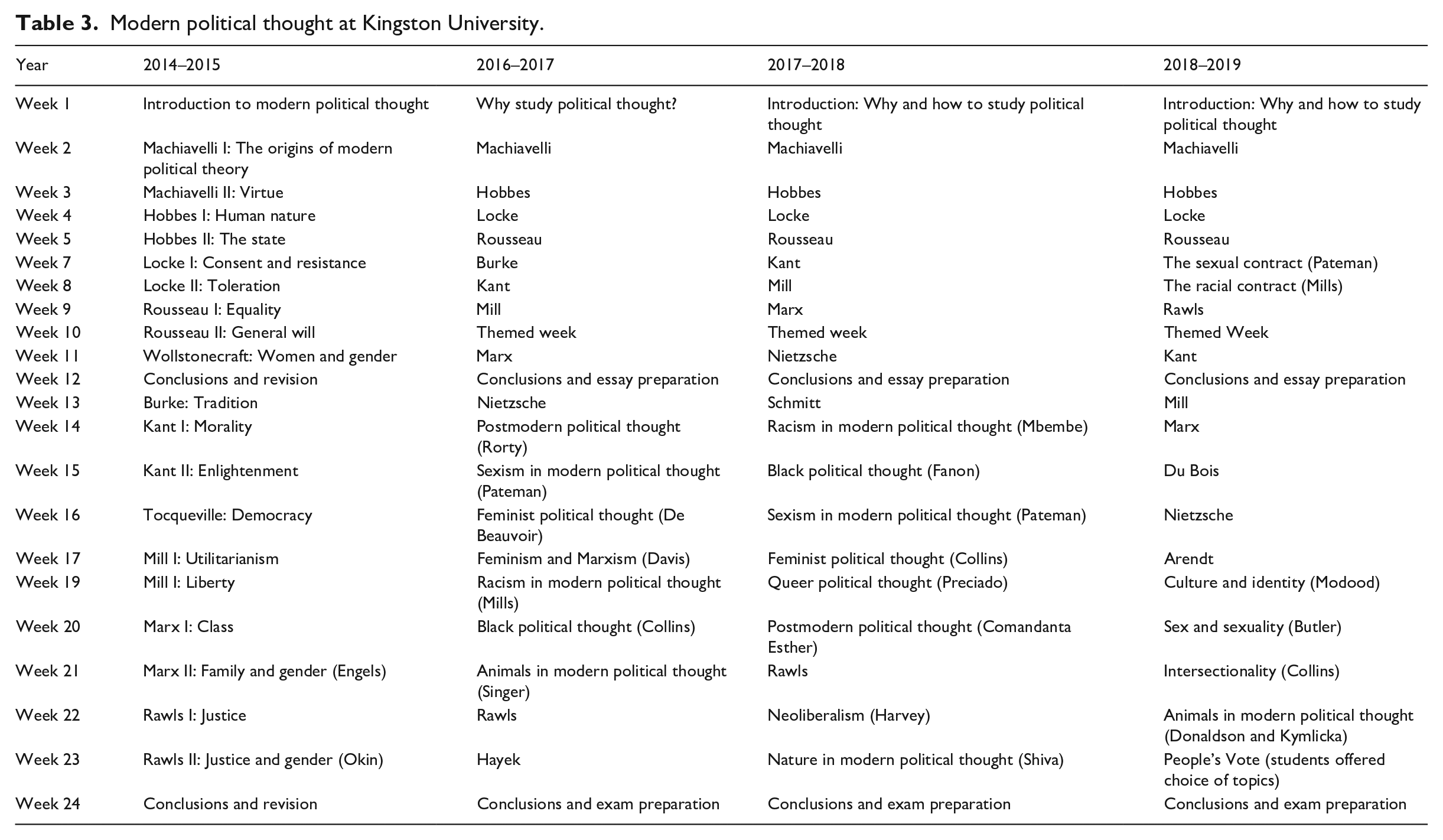
Although the module was revised every year, until 2016–2017, the syllabus remained relatively static. As can be seen in Table 3, in 2014–2015, only one of the thinkers addressed was a woman; all were White and all except Rawls were European. Although the module summary claimed that students would be ‘asked to think about why and in what ways women and non-white people have been excluded from both political theory and political and educational institutions’, in practice critical reflections on gender were limited and engagement with questions of race was largely absent.
For 2016–2017, the module summary, curriculum content, and reading lists were changed in order better to foreground the issues of gender and race. The first semester (weeks 1–12) was titled ‘The Classics’ and students were asked to consider the exclusions, marginalisations, and misrepresentations perpetuated by the canon and the ways in which the universalist, emancipatory, or cosmopolitan aspirations of particular thinkers sit in tension with their more or less explicit sexism and racism. In the second semester (weeks 13–24), titled ‘Beyond the Classics’, we challenged the presuppositions and assumptions of modern political thought more systematically and introduced women and non-White authors. Weeks were dedicated both to sexism and racism and to the works of feminist and Black thinkers, with the intention of dissuading students from viewing women and non-White authors as somehow secondary to or parasitic on the canon, by demonstrating that these authors have both criticised the canon and offered their own unique visions of politics that act as alternatives to the canon. In this way, students were asked to think about how the conceptual innovations of these authors – patriarchy, sex/gender, intersectionality, White supremacy, postcoloniality, and so on – can be used both to interpret the canon (exposing its racism and misogyny) and to move beyond it. This included calling on students to think about how best to respond to the canon in the light of these critiques: should canonical thinkers be rejected as irremediably racist and sexist, or can their theories and concepts be used selectively, applied in different ways, or even repurposed for feminist and anti-racist or decolonial ends?
Despite some minor changes for 2017–2018, two significant limitations remained. First, the structure of the module tended still to sanctify the canon (‘The Classics’), presenting other (non-male, non-White) thinkers as deviations from the canon. While my changes may have gestured towards a democratisation of the canon (bringing in forgotten and suppressed voices), they did not deconstruct or unsettle the canon itself (see also Stuurman, 2000) and hence arguably left in place the idea that political thinking is the province of great (White) men. Further changes for 2018–2019 (see Table 3) tried to address this problem by better integrating critical material on race and gender: weeks 3–9, for example, were titled ‘Social contract theory and its critics’ and included weeks on Charles Mills and Carole Pateman on contract as domination.
A second limitation, which has not yet been addressed, is that while I have brought in women and non-White thinkers, there has been almost no engagement with thinkers and texts outside of Europe and North America. This was primarily a consequence of practical limitations, principally the difficulty of adequately familiarising myself with the material. There is a tension between the desires to broaden the curriculum and to offer research-informed teaching (given that most of my research is on European thinkers), not to mention the conflicting demands of teaching, research, and administration in institutions which are increasingly bureaucratic and workload-heavy. There is also a difficult question of how to include non-European thought. Including weeks on Indian, African, or Chinese thought, for example, simply raises problems about how those bodies of thought are defined (what counts as ‘Chinese thought’?) and what and who to include and exclude (Jenco, 2019). Indiscriminately combining ‘African thought’ into 1 week, for instance, would risk perpetuating colonial ways of seeing and could be as bad as excluding African thought altogether.
One solution I have already begun to put into practice to address these – perhaps ineradicable – difficulties is to allow students to reflect explicitly on such issues in the first week of a module, so that from the very start they think about the production of knowledge and its complex relationship to colonialism and the ways in which a canon is constructed. It may be helpful as well to find different ways of teaching, ones which put less emphasis on the ‘expertise’ of the lecturer and reframe teaching more as a dialogue between lecturer and student. It should also be noted that I am in the fortunate position of having a full-time, permanent contract, with relative autonomy with respect to the leadership of the module and the support of my colleagues and institution: this is not the case for colleagues at other universities, many of whom are on fixed-term, insecure contracts and whose attempts to decolonise the curriculum can generate resistance from within their institutions and abuse from outside their institutions (Begum and Saini, 2019).
Assessing the impact of curriculum changes is not easy, and certainly not easily quantifiable. Feedback from module evaluation questionnaires (MEQs) suggests that students have appreciated the changes, and many students made specific reference to the changes in their qualitative feedback. For example, in response to the question ‘The best things about this module are . . . ’ students answered, ‘diverse curriculum’; ‘learning about political thinkers who aren’t white’; ‘the wide range of topics covered, e.g. feminism, animal rights, black thought’. Informal feedback from students confirms the MEQ results.
As argued above, one reason to decolonise is to attempt to redress racialised inequalities within universities, including the BME attainment gap. In principle, the impact of my curriculum changes on BME student attainment can be measured, using the BME attainment gap data provided by the university. At module level, the BME attainment gap is calculated simply by reference to the relative proportions of White and BME students achieving a 2.1 or First, and not using the VA score: as such, the module-level attainment data does not take account of students’ prior entry qualifications. Table 4 shows the attainment gap for PO5001 for three successive years, beginning in 2015–2016; for comparison, it also shows the VA scores for Kingston University as a whole institution and for students taking a first degree in Politics and International Relations. 5 In 2015–2016, Modern Political Thought had an attainment gap of −3.1%: the 40 BME students who took the module got an average grade of 57.2%, while the 48 White students got an average grade of 60.3%. Some of this gap can be explained by differences in entry qualifications and hence differences in expected results: of the cohort who graduated in 2017 – that is, the same cohort who took Modern Political Thought at Level 5 in 2015–2016 – 68% of BME students were expected to achieve a good degree and 71% of White students were expected to achieve a good degree: that is, there was a 3% gap in expectations (based on differing entry-level qualifications). In other words, it could be said that in 2015–2016, BME Modern Political Thought students were conforming roughly to expectations.
BME attainment gap.
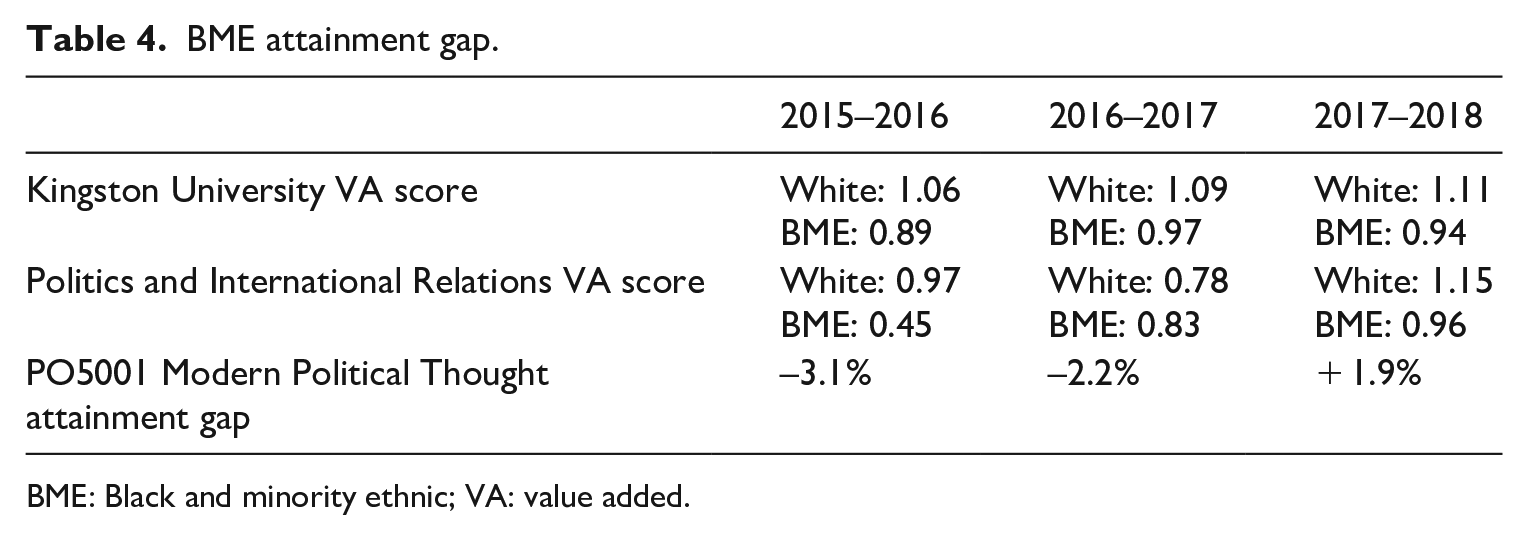
BME: Black and minority ethnic; VA: value added.
As can been seen in Table 4, the PO5001 attainment gap showed modest improvements in 2016–2017, when it fell to −2.2%, and 2017–2018, when BME students actually outperformed White students. It is hard to draw firm conclusions from these figures: they refer only to three cohorts, and it may be that even the small improvement in the attainment gap can be attributed to other factors, such as some changes to the teaching team; the changes also echo – though do not exactly match – improvements since 2015–2016 in the VA score for Politics and International Relations Students and the university-wide VA score. But the fact that the attempts to decolonise the curriculum were matched by an improved BME attainment gap score does offer reason for cautious optimism.
Conclusion
Three points in particular can be made in conclusion. The first is that despite the high profile of campaigns for and debates around the decolonisation of universities, the core political theory modules in which students at UK universities are introduced to the foundational thinkers of our discipline can scarcely be considered decolonised. Most of these modules do not require students to read non-White thinkers or to reflect on the relationship between political thought and colonialism. Despite this, there are – albeit very few – examples of good practice: modules which embed the themes of colonialism and race across a number of weeks and where non-White thinkers are not simply included in a single tokenistic week or (as is more common) excluded altogether.
Second, the failure to decolonise matters for a number of reasons: it fails to acknowledge the importance of race to the modern world; it ignores the importance of race – and of the context of colonialism – to the works of the traditionally canonical thinkers; it erroneously and insultingly implies that people of colour have had little to contribute to political thought; and it does not reflect the diversity of the student body in UK universities, thereby potentially affecting student engagement and attainment. These arguments cannot be plausibly countered by claiming that students in UK universities should be studying Western or European political thought: it is precisely because modern Europe has been built on colonialism that the decolonisation of the curriculum is an urgent necessity! ‘Western’ political thought has only ever been constituted in relation to and in dialogue with the ‘non-West’, and the available body of ‘Western’ thinkers is anyway not exclusively White.
Finally, however, it should be acknowledged that, despite the pressing intellectual, moral, and pedagogical arguments in favour of decolonising the curriculum, attempts to do so face a number of obstacles. Competing pressures on today’s academics – many of whom are in precarious positions on insecure contracts – leave little time for the work needed to decolonise curricula. These pressures disproportionately affect BME staff who in practice might be keenest to pursue decolonisation – though who in principle should not be expected to carry the burden of doing so or of educating White colleagues who may be ignorant of or even hostile to the project of decolonisation. For teachers of political theory, supporting resources are often unavailable or inadequate, with existing textbooks presenting an almost exclusively White canon. There are also intellectual and pedagogical dilemmas to solve, such as whether to retain a canonical approach – albeit a canon diversified and taught with attention to the contexts of colonialism – or to abandon a thinker-based approach altogether.
None of these difficulties is insurmountable. What they suggest instead is that the decolonisation of the curriculum cannot simply be the responsibility of individual module leaders, whether White or BME. In the same way that the ultimate ambitions of attempts to decolonise the curriculum – to address racialised inequalities both within and outside universities – lie beyond specific modules, so it is unlikely that those ambitions will succeed without broader institutional and societal changes.
Footnotes
Acknowledgements
For their help and support I am grateful to the editors and anonymous reviewers; those who saw me present earlier versions of this paper in Leeds and Prague; and Owen Beacock, Adrian Blau, Luke Cooper, Jonathan Dean, Charles Devellennes, Elizabeth Evans, Matthew Johnson, Josh Milburn, Manjeet Ramgotra, Paul Rekret, Alex Sutton, Lasse Thomassen, Dave Tinham, Ben Turner, Helen Williams, and Paula Zoido-Oses.
Funding
The author(s) received no financial support for the research, authorship, and/or publication of this article.
