




Abstract
Through an exploration of the experiences and narratives of racially minoritised students, in this article, I argue that Politics curricula in the United Kingdom can largely be defined as epistemologically ignorant as a result of whiteness and Western-centrism. While there is a growing body of scholarship that has drawn attention to the whiteness and coloniality of Politics curricula, little, if any, has considered this from the perspective of racially minoritised students of Politics. This article addresses this gap in the literature and serves to prompt the Politics disciplines to look inwards and interrogate how whiteness and colonial logics continue to shape the study of Politics while also offering recommendations for curricula change based on students’ lived experiences. After briefly defining ‘the curriculum’, I outline the ways in which racially minoritised students defined Politics curricula as white and/or Western-centric and epistemologically ignorant. I then consider the role of teaching staff in curricula design and delivery and the potential for teaching practices to challenge curricula. Finally, before concluding, I explore what decolonising or ‘widening’ Politics curricula entails from the perspective of students.
Introduction
Universities in the United Kingdom have histories connected with colonialism, slavery, and white supremacy. They are sites where colonial logics were justified; Indigenous, non-white and non-Western knowledges were suppressed; and racist thought was produced (Choat, 2021; Pimblott, 2020). Given this history, and its lasting legacies, it is vital that we interrogate, and transform, the coloniality and whiteness of UK Higher Education (HE). This article, by focussing on the Politics disciplines in particular, is a necessary contribution to this wider project.
While there is a growing body of scholarship that has drawn attention to the whiteness and coloniality of Politics curricula in HE (see Begum and Saini, 2019; Choat, 2021; Choat et al., 2023; Emejulu, 2019; Saini and Begum, 2020; Shilliam, 2010, 2021), little, if any, has done so from the perspective of racially minoritised students. By drawing from research that centred the experiences of racially minoritised students, this article addresses this gap. Centring racially minoritised students’ perspectives is valuable because seeing the knowledge of those who have been minoritised as ‘legitimate, appropriate, and critical’ is decolonial in itself (Yosso, 2005: 74). Moreover, to see racially minoritised students as ‘co-creators of critical knowledge’ (Saini and Begum, 2020: 219), ‘challenges traditional research paradigms, texts and theories’ that have excluded minoritised and student perspectives (Solórzano and Yosso, 2002: 26).
The central argument is that the racially minoritised students who participated in this study largely understood Politics curricula to be epistemologically ignorant as a result of its whiteness and Western-centrism. I draw here on Charles Mills’ (1997: 18–19) definition of epistemological ignorance as the ‘structured blindness and opacities’ that function to maintain white supremacy. I understand Euro-/Western-centrism and whiteness to be interconnected but distinct. Euro-/Western-centrism refers to the belief, implicit or otherwise, that European and Western ways of knowing and being are superior, the standard by which the ‘rest’ of the world can be understood and measured (Bhambra, 2007; Capan, 2017; Joseph et al., 1990). Whiteness, though entangled with Euro-/Western-centrism, is about racialised power. It is a socially constructed power structure that defines those racialised as white – and their interests and knowledges – as the norm, while rendering ‘Others’ different, deviant, abnormal or marginal (Ahmed, 2007; Gillborn, 2008; Seshadri-Crooks, 2000; Sian, 2017).
The aim of this article is to prompt Politics disciplines – and those teaching and producing knowledge here – to look inwards and interrogate how whiteness and colonial logics continue to shape the field and make changes based on students’ experiences.
The contributions of this article are particularly important in a context where ‘post-racial’ narratives are commonplace. Rather than reproducing the post-racial idea of the university as a meritocratic, ‘tolerant and cosmopolitan’ space, and the people within it as ‘arbiters of tolerant anti-racism’ (Tate, 2016: 71–72), this article challenges post-racial claims of neutrality and colour-blindness, and instead recognises that post-racialism serves to maintain the status quo and serve the interests of white supremacy (Gillborn, 2008: 28–29).
After exploring what the curriculum is and what ‘decolonising’ it means, I outline my methodology, methods, and data – interviews, diaries, and follow-up interviews with 30 racially minoritised students at 13 different institutions across England, Wales, and Scotland. I then move to the findings and discussion, where I explore: (1) the ways racially minoritised students defined Politics curricula as epistemologically ignorant; (2) the role of teaching staff in curricula design and delivery and the potential and constraints related to the practice of teaching; and (3) what decolonising or ‘widening’ Politics curricula entails from the perspective of students.
Literature review: What is ‘The Curriculum’ and what does it mean to ‘decolonise’ it?
When we refer to ‘the curriculum’, we are generally talking about a selection of ideas, texts, and knowledge that structure what can be known within a particular field. It is a ‘central instrument’ for communicating to students what kinds of knowledge and cultural capital count as ‘legitimate’ or valuable (Brunsma et al., 2012; Charles, 2019). While the curriculum might then be understood as ‘an official selection that structures knowledge in ways that privilege a particular construction of knowledge’ (Peters, 2015: 644), there are also ‘unofficial’ and unwritten aspects in the form of the hidden curriculum (implicit norms, symbols, and rules that reproduce the dominant culture of the university), the null curriculum (what is left out), and the extra-curriculum (social lives on campus) (Le Grange, 2016: 7; Brunsma et al., 2012: 725).
Understanding the curriculum in this way reveals that there is a ‘disciplining’ that comes out the curriculum; a coercive power and control that ‘trains’ or shapes individuals in ways that maintain systems of power (Foucault, 1977), like white supremacy. Because HE generally reflects and reifies structures of power and human relations in society more broadly (Mngomezulu and Hadebe, 2018: 71) – and those power structures are white and Western-centric as well as neoliberal, classist and patriarchal – the curriculum, and disciplinary institutions like the ‘university’ more broadly, ‘produce’ or mould students and academics in ways that maintain and reproduce white, Western-centric, neoliberal modes of being. In Politics disciplines and curricula specifically, the curriculum similarly works to reproduce whiteness and Western-centrism (see Begum and Saini, 2019; Choat, 2021; Emejulu, 2019; Shilliam, 2021), I discuss this in more depth in the findings.
In recent years, there have been numerous student-led calls and campaigns to ‘decolonise the university’ and, more specifically, ‘decolonise the curriculum’. This includes the #RhodesMustFall and #FeesMustFall protest movements (Mpofu-Walsh, 2016; Ndlovu-Gatsheni, 2018; Pimblott, 2020); ‘Why is my curriculum white?’ and ‘Why isn’t my professor Black?’ initiatives (see Black, 2014; UCL, 2014); and most recently in 2024, pro-Palestine encampments which demand universities’ address their complicity and investment in contemporary colonialism (see The Canary, 2024). Though student-led, these movements and initiatives have been supported by staff too. These movements have shown what decolonising the university looks like in practice, whether that is removing statues of racist colonists; occupying university spaces; or demanding that value is given to the voices and knowledges of non-white and non-Western thinkers both through curricula content and representation in teaching staff. The more focussed calls to ‘decolonise the curriculum’ are a constituent part of this wider project.
Decolonising the curriculum is a refusal to take-for-granted the ways in which the curriculum, ‘embodies and perpetuates legacies of colonialism’ and reproduces whiteness (Choat, 2021: 404). What this might look like can ‘mean many things’ (Sabaratnam, 2017). In this article, I explore the various ways in which racially minoritised students called for changes to be made to the curriculum. This was often, though not always, framed in terms of ‘decolonising the curriculum’. Some participants also referred to diversifying the curriculum, embedding anti-racism into the curriculum or ‘widening’, what they perceived to be, a ‘narrow’ curriculum. For some participants, these various processes were interchangeable; however, there are some important distinctions.
Decolonising the curriculum is about the radical transformation of, and resistance to, coloniality in knowledge. It involves unsettling and decentring Western-centric knowledges and requires a process of pluralising subjects of enquiry and producers of knowledge (Sabaratnam, 2011) and recognising not only of the existence of ‘alternative knowledges, epistemologies, and pedagogies’ (Choat et al., 2023: 1), but valuing and meaningfully engaging with these knowledges. Moreover, it requires us to rethink and traverse disciplinary boundaries (Le Grange, 2016). Relatedly, embedding an anti-racist curriculum requires institutions to work proactively to dismantle structures of racism – in curricula and beyond – and acknowledge the ways in which dominant knowledges have been shaped by, and reproduce, ‘racism, coloniality and white supremacy’ (Joseph-Salisbury, 2019: 12).
Diversifying is far less radical and less (if at all) transformative process than decolonising and embedding anti-racism. It is an additive process of increasing the representation of thinkers and thought that have been excluded – non-white, non-Western thinkers – by, for example, adding them to reading lists without radically challenging existing curricula. Diversifying is not connected to the wider more material decolonial project. Though diversifying is valuable to an extent, adding to the ‘archive of the Western academy’ is a limited intervention at best, and harmful at worst, because it fails to fundamentally challenge institutional structures and decentre colonial modes and forms of knowledge production while appearing to be ‘doing something differently’ (Gabriel, 2017; Saini and Begum, 2020; Shilliam, 2010: 24).
Given the distinctions between these processes, as well as the ways in which they are related and were used interchangeably by some participants, in this article, I refer to a process of ‘widening’ the curriculum to capture all these processes of change.
Methodology
The data discussed in this article are drawn from research which explored the dynamics of race, racism and whiteness in Politics disciplines in UK HE (O’Neill, 2023). The article draws from qualitative data from interviews and diaries with racially minoritised students.
Counter-storytelling
The methodology of this research was ‘counter-storytelling’. Counter-storytelling is about centring minoritised voices with a view to exposing dominant racialised narratives. Counter-stories challenge post-racial, colour-blind accounts of social life and unsettle normative whiteness by amplifying the voices of those who have been marginalised. Interviews and diaries were chosen as they enabled me to capture the counter-stories of racially minoritised students. Through these methods, I gained a rich, qualitative account of the lived experiences of racially minoritised students.
Positionality
In terms of positionality and insider/outsider status, ‘dimensions of sameness and difference’ operated in various ways within my relationships and interactions with participants (Song and Parker, 1995: 246). As a racially minoritised (mixed-race Black African and white) woman, in my early 20s at the time of data collection, and as someone who has studied Politics in UK HE, I felt positioned as an ‘insider’ with shared tacit understanding and ‘sameness’ with many of the participants. Gender symmetry and a shared commitment to anti-racism, also produced a greater sense of commonality and sameness in a number of participant-researcher interactions. I did not assume total ‘insider’ status however, and recognised that my position as researcher – as well as social characteristics such as class, accent, nationality, racial appearance and so on – produced dimensions of difference. Moreover, it would be problematic to assume total ‘insider’ status based on being racially minoritised given the heterogeneity of this group and differential experiences of racialisation and racism.
Interviews and diaries
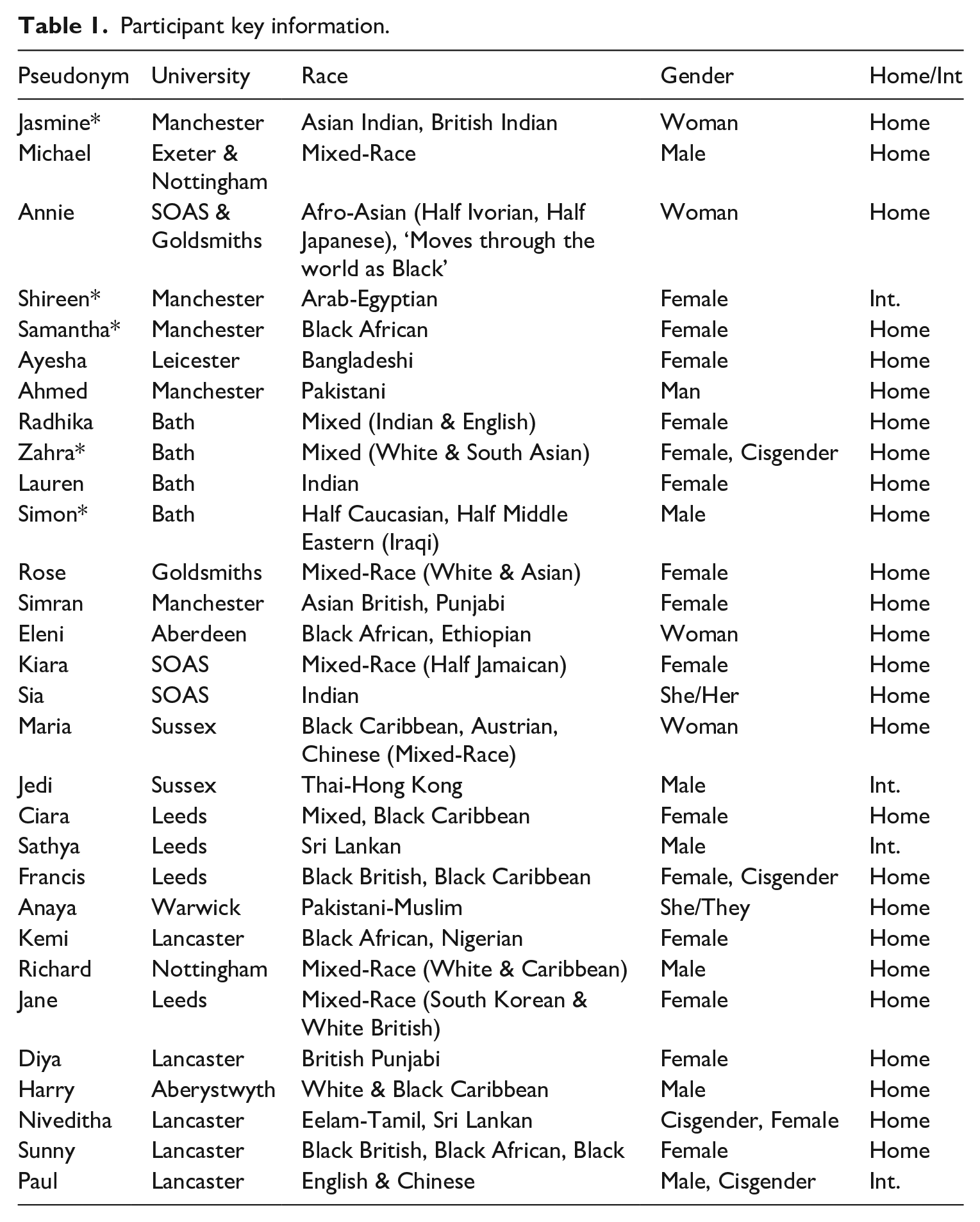
I conducted 30 interviews and collected 5 participant diaries (coupled with diary-based interviews). For the first phase of interviews, semi-structured topic guides were used and a range of questions were asked about: diversity; the curriculum; educational experiences; the role of students; decolonising movements and EDI initiatives; future plans; experiences of race and racism. On the poster advertisements and at the end of the interviews, I invited participation in an optional, longer-term activity of diary-keeping. Those who volunteered to take part in diary-keeping 1 and follow-up interviews, are identified with a * in Table 1.
Participant key information.
The brief for the diaries was to document experiences of race, racism and whiteness. Diary participants were given verbal and written guidance, and, in a second information sheet, I outlined suggested topics such as: experiences of racism; examples of the ways that they resist racism; microaggressions and how classes, teachers and the curriculum affect them. Participants were in charge of when and how much they wrote, what to include and in which format. All 5 participants either sent their entries in an email thread or attached in a word document. For the follow-up interviews, participants were given a copy of their collated diary and discussion guides were based on the content of each participants’ individual diary. Diaries allowed participants to speak more freely and produce a narrative personal everyday account over a longer period. Crucially, they also allowed relationships to develop. As Shireen told me in our diary-based interview, ‘it’s nice knowing who’s interviewing me because I’d be more comfortable saying these things’.
Participants were recruited using Twitter, 2 through the Political Studies Association and British International Studies Association listservs, as well as by making contact with known members of academic staff in Politics departments 3 and asking them to share the call with undergraduates.
The participant group is made up of racially minoritised students at 13 different institutions in England, Wales and Scotland who were studying–or had recently studied–a Politics undergraduate degree programme. This included 5 Russell Group institutions and 8 pre-1992 non-Russell Group institutions. Unfortunately, no students came forward from post-1992 institutions, I discuss the implications of this in the conclusion. Despite this, the participants’ accounts provide valuable insight and represent a range of experiences both in terms of racial identity, geography and university. Data was collected between December 2020 and June 2021. Table 1 outlines the key information for each participant. All participants have been pseudonymised.
Interviews were conducted online, audio recorded and transcribed verbatim. A rigorous thematic analysis was undertaken using NVIVO 11. Rather than using a pre-existing framework of codes, analysis was inductive. I created codes from the data, identifying commonly raised issues, ideas and experiences. Once codes were created across interview transcripts, diaries and diary-based interview transcripts, I constructed themes and organised the data into each theme, adding and amending as new codes and themes emerged. In line with my reflexive approach, and recognising the subjectivity of this process, codes and themes were discussed with supervisors, and, through these discussions, I reflected on how codes and themes had been selected and what had been left out.
Politics curricula as epistemologically ignorant
A partial picture of politics
While participants did not refer explicitly Mills’ (1997) ‘epistemological ignorance’, the ways in which they characterised the curriculum as ‘narrow’ and/or offering a partial or ‘lacking’ account of the field of Politics were consistent with the concept. Though, of course, a curriculum cannot cover everything – to think it possible or desirable to have a ‘complete’ curriculum is problematic – participants were critical of the insular and somewhat singular narrative within Politics and how ‘unfulfilling’ it felt to experience this narrowness (Tuhiwai Smith, 2021: n.p.). What this looked like for participants varied. Paul criticised the ‘Western liberal capitalist democratic perspective’ of his curriculum. For him, whiteness was not a problem, but Western-centrism and a bias for a particular kind of politics was – he said ‘. . . Britain was, and is, a white country overwhelmingly so. So, if the curriculum isn’t white then [. . .] it isn’t representative’. He explained further: I mean if you went to a Chinese university would you go and be saying, ‘Why is my curriculum Chinese?’ [. . .] It just seems a bit strange if you ask me [. . .] being in a specific country with an ethnic majority and complaining that the ethnic majority was the majority.
Paul’s account not only reveals the way that the whiteness of the curriculum is taken-for-granted as ‘common sense’ or ‘natural’ even by some racially minoritised students. It also reveals a common post-racial view of Britain as a ‘white country’ that relies on a view of Britishness and whiteness as interchangeable and a disavowal of Britain’s history and legacies of Empire, migration and diversity (Olusoga, 2017). While he sees whiteness and Western-centrism as separate, and whiteness as a neutral category and national identity, they are in fact interconnected. Despite the problems and complexities with some of Paul’s views, it is significant that Paul, in his own way, points to a ‘narrow’ curriculum just as other participants did too.
For others, the narrowness of the curriculum was explicitly bound up with whiteness. Shireen described an ‘an inherent whiteness in everything that we’re studying’ and Samantha explained that the curriculum was ‘from one narrative’ and has a ‘mind-set’ of ‘the whiteness way or no way’. Lauren and Kiara echoed this feeling of being unfulfilled by a narrow and ignorant curriculum saying that, the curriculum is ‘not thick enough, it wasn’t like rich enough’ (Lauren) and ‘everyone is transcribed the same ideas and same, like, ways of thinking’ (Kiara).
Related to this, was a sense that particular kinds of knowledge were overrepresented in the curriculum with Radhika, Ayesha, Anaya, and Jasmine all pointing to what has been called the ‘dead white men’ approach (Begum and Saini, 2019: 198). This refers to the way Politics disciplines have been, and continue to be, ‘characterised by the same roll call of [white, male] enlightenment [sic] scholars’ (Begum and Saini, 2019: 198). As Ayesha explained, having a curriculum that is ‘completely white, majority male people’ communicates to students that these thinkers are ‘the ideal’ and that theirs is the knowledge that is ‘of any use to us’. Radhika and Anaya noted that ‘I’ve learnt about Rousseau and Locke a lot, like almost to the point where you’re repeating content’ (Radhika) and ‘why do we have four weeks on Hobbes and then like one small week on Martin Luther King and everyone’s like ‘Yep that’s us decolonising the module’’ (Anaya). They experience the predominance of Enlightenment thinkers as problematic, not only because it produces a narrow curriculum, but it is particularly problematic given that racism and the defence of colonialism is bound up in the work of many of these canonical thinkers (Choat and Ramgotra, 2019; Emejulu, 2019).
Failure to reckon with coloniality, sidelining, and wilful ignorance
In addition to the predominance of Western and white knowledges, some participants identified that the ‘narrowness’ of the curriculum, or its epistemological ignorance, was related to its failure to reckon with the coloniality of its content and the sidelining or exclusion of ‘Other’ thinkers, themes, and ideas. Some participants described the ways in which the colonial context of the canon and canonical thinkers were ‘remarkably absent’ from the curriculum (Gruffydd Jones, 2006: 2). For example, Francis and Ciara spoke about the ways colonialism was treated as an ‘isolated topic’ (Francis) and a ‘thing of the past’ (Ciara), unconnected to the contemporary context and without legacies in thinking and knowledge production today. Similarly, Zahra, in a diary entry, noted that one module had an essay question that centred on ‘European integration after the Second World War’ and the required reading failed to mention that ‘Britain, in the 1950s, did not want to be part of the EEC because many thought more profit could be had by exploiting the commonwealth’. Zahra explained that ‘these omissions erase the racism and colonialism that contributed to much of European politics in the late 20th Century’. Francis, Ciara, and Zahra’s accounts all suggest that the Politics disciplines have a ‘systematic politics of forgetting’ or a ‘wilful amnesia’ when it comes to questions of race and colonialism (Krishna, 2001: 401). The epistemological ignorance is neither random nor incidental, rather it is wilful and prescribed (Mills, 1997).
In terms of sidelining of ‘Other’ knowledges and topics like race, racism, and coloniality, Lauren explained that in her curriculum, these were not completely absent, but they ‘wouldn’t spend a lot of time on them’. When the racism of Enlightenment thinking and theories was recognised, this was ‘10 minutes at the end of the lecture’ and like a ‘‘Oh by the way’ kind of thing, right at the end’. Rather than seeing them as core and essential to students’ understanding, the sidelining of race and racism is clear here. Eleni, similarly, said that the curriculum did include theories that ‘face the reality of colonialism’ but that ‘we did not really explore them at all and. . . So, it was in our readings but not discussed’. This lack of attention, time, and depth dedicated to these topics was experienced by Richard and Kemi too who both noted that ‘I wouldn’t say it goes into much depth’ (Richard) and ‘it was so brief. Like you couldn’t even have written an essay on that’ (Kemi). Similar language that described a sidelining of, or lack of meaningful engagement with, these topics was used by Jane, Diya, Zahra, Simran, Ciara, and Niveditha too. Simran’s description of ‘Othered ideas’, that are treated as though ‘they can’t be incorporated into the mainstream’, and Sathya’s explanation of race-related topics being ‘pushed in’ but not ‘ingrained’, capture the way that the curriculum hierarchises knowledge, treating critical theories that cover race, racism, and coloniality as marginal and unimportant.
This was echoed by Francis, Ayesha, Sunny, Richard, Jasmine, and Radhika who noted that race and racism were optional, ‘add-ons’ rather than core topics Jasmine explained that the structuring of the curriculum in this way ‘made the message clear that we have priorities [. . .] And by not making race a priority, you’re just saying it doesn’t matter as much’. These participants’ experiences correlate with findings elsewhere that demonstrate that ‘race- and colonial-related’ content and non-Western thought are not significantly represented in core Politics undergraduate curricula (see Choat et al., 2023: 5–6; O’Neill, 2023). These knowledges are not completely absent, rather, these knowledges are seen as ‘optional’ rather than ‘compulsory’, assigned less value, and sidelined within Politics degree programmes.
It is important to note here that while I, and participants, talk about ‘the curriculum’ here in quite institutional and systemic ways, this epistemological ignorance or ‘narrowness’ is also sustained by individuals. I explore this further in the section on the role of teaching staff and the practice of teaching.
Not a homogeneous experience
While the majority of racially minoritised students who participated experienced a Politics curriculum that can be described as narrow and epistemologically ignorant as a result of its white and/or Western-centrism, not all participants characterised the curriculum in this way and for those who did characterise the curriculum as narrow this experience was not monolithic. Where others experienced ‘wilful amnesia’ and a failure to reckon with coloniality, Maria said that in the International Relations side of her course, they had ‘spent a lot of time [. . .] reflecting on the discipline itself’ and that colonialism, rather than being ‘glossed over’ had been ‘confronted head on’. Harry, who studied at Aberystwyth, said that the content on his course had been ‘surprisingly diverse’ and he praised the curriculum for having ‘a broad range of topics’. He explained that colonialism was the ‘biggest topic’ he had studied that year and he had ‘at least three modules’ that addressed colonialism. Similarly, Sia explained that her university, SOAS, ‘tries to like decolonise its curriculum and teach [. . .] everything from like a sort of non-Eurocentric perspective’. Annie, who had also studied at SOAS, explained that the curriculum had been ‘pretty rich and diverse for the most part’ and students at Leeds – Ciara, Sathya, and Anaya – all talked about a module that had reckoned with coloniality head on. This demonstrates the potential for a decolonised curriculum and the agency of individuals who can either challenge, or reproduce, epistemological ignorance in curricula.
The role of teaching staff and the practice of teaching
Agency and classrooms as spaces of possibility
Participants connected the curriculum to pedagogy and pointed to the ways in which individuals in the institution have agency and, as such, the practice of teaching can be liberatory from an epistemologically ignorant curriculum. This is captured by Kemi and Jasmine who said, ‘it depends how the lecturer interprets it’ (Kemi) and ‘I think that comes down to what lecturer you have and who’s making the course’ (Jasmine). Anaya similarly said: It’s funny how all the lecturers are like, ‘Oh it’s so white, it’s so middle-class’, but then they’re the ones setting up the curriculum [chuckles]. So, it’s kind of like, if you think that, then change it.
The power of ‘setting up the curriculum’ – a power that is not evenly distributed across teaching staff (i.e. Teaching Assistants do not have the same authority as Module Convenors and Professors) – is significant here. Eleni and Radhika also pointed to the way that the curriculum can be challenged and changed through the practice of teaching, interpretation, and implementation with Eleni noting that ‘my lecturers have made the effort’. Radhika, reflecting on one lecturer who actively encouraged students to engage with sources and voices from the countries they were studying, said, ‘he was always sending us papers and articles from journalists from Rwanda, from Uganda [. . .] from The Congo’ and, not only that but, ‘[he] would give us like really easy resources for that. So, we didn’t have to work really hard to try and find that’. Not only is it valuable that he ensures resources were authored by non-Western knowledge producers, in a more practical sense, ensuring that students can easily access resources – rather than burdening them with this work – is an important practical consideration in widening curricula.
These participants’ accounts demonstrate that, in spite of the ways in which the university can be constraining, individuals do have some degree of agency and the classroom can be a ‘breathing space’, a place of ‘possibility’ (Webb, 2018: 99). Through the practice of teaching, curricula design, delivery, and interpretation, there is freedom to resist and challenge a narrow curriculum (hooks, 2010: 27). Because teaching staff can teach in a critical and transgressive way, as noted by Kemi, Jasmine, Anaya, Eleni, and Radhika, the classroom has the potential to be the ‘most radical space of possibility in the university’ (hooks, 1994: 12). However, as Webb argues, we should not ‘overestimate the transformative potential’ of the classroom and of teaching (Webb, 2018: 100).
Institutional constraints
Participants’ accounts pointed to the institutional constraints that mean individual pedagogy cannot itself transform the power dynamics underpinning curricula and embedded within the university more broadly (hooks, 2010; Webb, 2018). Sathya and Simran spoke to this saying that, ‘the lecturers, for the most part, they were trained within the structures of, you know, old International Relations, which is very white’ (Sathya). Simran echoed this view, she explained that ‘even the lecturers who are aware of that have not been able to kind of work outside of that structure’. For her, even though there are teaching staff who are more aware who do not ‘construct reading lists’ that are ‘majority made up of men and who are white’, more radical change was required. Echoing some of the sentiments discussed about the hierarchisation of knowledges, she said, ‘I feel like we still kind of did “this is the main way of looking at something and then at the end it’s like Marxism and race and stuff”’.
Simran and Sathya’s accounts are illuminating here. As Simran points out, not only must teaching staff be willing to do this work – ‘classrooms cannot change if professors are unwilling to [. . .] learn anew’ (hooks, 2010: 31) – even those who are willing are working within and against structural constraints. Teaching staff are up against individuals and institutions that can be ‘hostile’ to more radical modes of teaching and learning (Webb, 2018: 101). HE institutions reinforce metrics like the UK’s Research Excellence Framework – which has been said to ‘impose a single set of narrowly defined norms’ and disadvantage ‘non-traditional research’ (Joseph-Salisbury and Connelly, 2021: 19) – that significantly hinder the transformative potential of critical pedagogy. Moreover, academic colleagues who have been trained and inculcated into white and colonial modes of knowledge production, and who take this for granted, may gatekeep and put up barriers to those members of staff who want to teach critically.
Moreover, Sathya made an important intervention that there are different types of teaching staff – ‘PhD grads’ or Graduate Teaching Assistants, senior lecturers, professors, and so on – and suggested that early-career researchers may be more likely to do this critical work. While this may be the case, it is important to recognise that these members of staff are particularly constrained by precarity in the earlier stages of their career, such precarity in HE means that these people do not always have the ‘resources, power, or job security required’ to do this critical work (Joseph-Salisbury and Connelly, 2021: 164). Furthermore, it is important to consider the ways in which positionality affects what changes teaching staff can make and the potential backlash they may face in so doing. Racially minoritised folks, women and other minoritised teaching staff – who often are the ones working against epistemologically ignorant curricula and university cultures – are at greater risk of marginalisation and backlash because they are already constructed as ‘Other’ and non-belonging in the white space of the university (see Brunsma et al., 2012: 718; hooks, 2010: 16; Joseph-Salisbury and Connelly, 2021: 115–127).
Agency and the pitfalls of individual’s discretion
Francis and Jasmine were wary of how discretionary teaching is. Francis explained that ‘it really depends’ and that she had experience both with teaching staff who were ‘really open’ and with teaching staff who ‘stick to what they’re trying to teach you and won’t really go off and talk about things’. She identifies here that the agency of individuals within the institution can be both radical and liberatory, and can also allow individuals to, intentionally or passively, sustain and reproduce institutional whiteness and coloniality. Reflecting on a positive experience in which a lecturer had ‘very much tried to integrate’ critical approaches like feminism and decolonial thought ‘into the foundation of the learning’, Jasmine warned that ‘there’s a negative in it being so discretionary’. She noted that if it ‘depends on the lecturer going off their own back and going out their way’ – as opposed to transformation at the institutional and structural level that would transform all teaching and learning – some modules will not change because lecturers may not want to make those change or they may be ‘actively against’ making those changes. Whether passively, or because they feel bound by the institution – or because they actively oppose efforts to decolonise and/or teach in more radical ways – individuals who use their agency and discretion to choose not to teach in radical or critical ways, sustain, and reproduce whiteness and coloniality in curricula.
This was clear in the experience of Ayesha who, on a module about counter-terrorism, was taught by a lecturer who was ‘antagonistic’ and hostile towards racially minoritised and Muslim students in the classroom. The lecturer was disrespectful and mocking when she presented on how ‘damaging’ Prevent 4 can be, ‘especially [to] Muslim and Brown people’, he ‘made jokes about everything she said’. Here we can see an individual – one granted authority by status and/or embodied characteristics (e.g. whiteness, masculinity) – using his agency to reproduce whiteness, racism (specifically Islamophobia), and coloniality in his teaching practice. This demonstrates how institutional whiteness can be sustained and reproduced interpersonally, through individuals.
In pointing out the problems with individuals having to ‘elect to concentrate their efforts in this direction’ (hooks, 2010: 27), participants also draw attention to the need for wider and more structural change. I argue, then, that the practice of teaching can be liberatory from a narrow and epistemologically ignorant curriculum to an extent; however, it is in many ways constrained both institutionally and by those individuals who work in ways that sustain and reproduce institutional constraints. Given this, in the next section, I discuss the ways in which participants call for the ‘widening’ and/or decolonising of Politics curricula.
Widening politics curricula
In this penultimate section, I discuss the ways in which participants wanted to see Politics curricula widen and/or decolonise. Though participants thought about these processes in differing ways, there was a shared desire for Politics curricula to be less ‘narrow’ or epistemologically ignorant. For example, Paul explicitly stated that ‘I don’t really see the need to decolonise the curriculum’ and framed his desire for curricula change to be about including different points of view – diversifying rather than decolonising. In contrast, other participants, like Jasmine, explicitly framed changes to the curriculum in terms of ‘decolonising’. In what follows, noting the differential approaches underpinning participants’ views, I explore the following aspects of widening curricula: (1) pluralising knowledge and visibilising race and coloniality and (2) transforming the role of students and traversing disciplinary boundaries.
Pluralising knowledge and visibilising race and coloniality
For all the racially minoritised students who participated in this study, widening the curriculum required the processes of pluralising and/or diversifying. This was noted by Zahra and Kemi. For Zahra, a decolonised curriculum should include ‘required texts from people of colour, about politics of colour. Or from people who don’t live in the West’. Here, we can see how decolonising is distinct from diversifying. Zahra specifies that it is not only about diverse authorship in terms of the identity and geographical location, but also having a particular critical politics represented (‘politics of colour’). For Kemi, ‘there needs to be more in terms of reflecting diversity. Not just in terms of because it looks good but actually because it helps students’. Kemi, demonstrating an awareness of the ways in which initiatives around diversifying can be ‘non-performative’ and a form of ‘ideological pacification’ (Ahmed, 2004; Mackhubela in Saini and Begum, 2020: 218), makes an important qualification that curricula changes ought to go beyond additive diversifying and should be driven by the desire to offer students a more comprehensive knowledge of Politics and, for racially minoritised students in particular, a more inclusive learning environment that represents their lived experiences (Choat and Ramgotra, 2019: 3–4).
Pluralising also necessitates the decentring of knowledges that have dominated the curriculum. As Jasmine put it, ‘the answers to all of politics aren’t just in Rawls’. Where others have called for a de-centring that re-centres voices from the Global South, Black and Brown, Third World, and Indigenous perspectives (De Lissovoy, 2010; Zondi, 2018), participants did not express a desire to replace one form of centrism with another; rather they focussed on plurality. This is captured in Zahra and Kemi’s accounts. In her follow-up interview, Zahra explained that: I don’t want it to be a system where, you know, you have to talk about certain things every single lecture or where you’re restricting things more than you’re opening things up.
Similarly, Kemi explained that ‘there’s no point just having all modules that focus on those kinds of aspects cos I recognise everyone has their own strengths and passions’. Both participants’ accounts, here, show that they do not see decentring as a process of ‘doing away with’ canonical and/or Western-centric knowledges and re-centring ‘Other’ knowledges. They emphasise that the process of decolonising should ‘open things up’. This echoes scholarship that has argued that decolonised curricula should include a plurality of knowledges and that we ought to understand all knowledge as socially constructed that can be vigorously engaged with, compared and challenged rather than accepted as truth (Le Grange, 2018; Matthews, 2018).
One way that this approach can be implemented is through ‘teaching in conversation’. Manjeet Ramgotra uses this pedagogical of teaching ‘canonical’ thinkers in conversation with alternative, critical producers of knowledge (e.g. bell hooks and Aristotle) in order to ‘question the authoritative status of the canon’ and to allow students to better consider studying ideas in historical context (Ramgotra, 2015; see also Ramgotra and Choat, 2023). This approach ‘tests the bounds of conventional political science’ (Shilliam, 2021: 155).
Given that I have argued that decolonising is not about doing away with canonical and/or Enlightenment thinkers and Western-centric knowledges, decolonising the curriculum requires that the racial and colonial contexts of thinkers and thought be visibilised. Jasmine recounted a time that a Political Theory lecturer had included ‘a slave owner’s [Thomas Jefferson] quote to frame the discussion about equality’. She explained that she was frustrated, not that it had been included in and of itself, but that the context of slave ownership was omitted from the conversation. She felt this context was pertinent and ‘relevant to have that discussion’ when thinking about equality. Jasmine’s account speaks to the way that decolonising is not just adding to the existing curriculum but interrogating the racial and/or colonial contexts of, and the exclusions, racism, and subjugation contained within, some of key concepts, frameworks, models, and ideas in the knowledge we have been, and are continuing to be, exposed to (Emejulu, 2019; Sabaratnam, 2017).
Transforming the role of students and traversing disciplinary boundaries
In addition to making changes to curricula content through pluralising and teaching thinkers in context, decolonising the curriculum requires a transformation of the role, and perception of, students. Existing literature has argued that students are constructed as passive ‘consumers’ of knowledge (Freire, 2000; Hughes et al., 2019; Tate and Bagguley, 2017), given this, I asked participants about this, and it resonated with many of them. Simon noted that ‘students aren’t really involved in the knowledge making’, and Shireen described a ‘one-sided’ dynamic between students and teaching staff. She said: . . . no one wants to debate the expert [. . .] and it’s not that I want to debate them, it’s just that I would like to contribute or have a hand in the knowledge, more so than just consume it.
Reflecting this feeling of disempowerment, Samantha felt that the COVID-19 pandemic and changes to teaching and learning that resulted from it, exacerbated this. She said, ‘especially once COVID hit, especially for final year, they reduced a lot of our module selections without consulting us at all’. The lack of consultation with students communicated to Samantha that students are seen as passive consumers within the university. Zahra noted that, particularly in the first year of undergraduate study, students are ‘expected to just take in what’s being said, don’t question it, just take it in, write your essay on what’s been said, agree with the lecturer’. Jasmine, similarly, explained that the degree programme is structured like ‘‘Here’s your content you learn and you’re assessed on that content’’, and this means that she felt she could not be ‘an individual thinker’ because of the lack of room that allowed to ‘explore stuff’ and ‘contribute something that’s a bit original’. These students identify a feeling of disempowerment and are made to feel like ‘docile listeners’ (Freire, 2000: 81), because the university offers them ‘little [to no] scope to create or contribute anything of their own’ (Alvares, 2011: 73). To decolonise, then, requires dismantling this ‘banking system’ of education – where students are seen as ‘depositories’ and ‘teachers as depositors’ of knowledge (Freire, 2000: 72) – and the transformation of students’ roles to active participants in knowledge production (Auerbach, 2019; Charles, 2019; Hughes et al., 2019; Le Grange, 2018; Mbembe, 2016; Saini and Begum, 2020). One of the ways in which this can be achieved is through curriculum ‘co-creation’ (see, for example, Kingston University’s ‘Inclusive Curriculum Framework’ and ‘Student Curriculum Consultant Programme’ (Hughes et al., 2019)).
While it is clear that students had disempowering experiences being positioned as ‘consumers’, this is not something they passive accepted, rather many of them deployed ‘strategies of navigation and resistance’ that allowed them to resist this positioning (O’Neill, 2024). Participants expressed agency by being strategic, where they could be, in their course selection, assessment options, the literature they chose to focus on as well as doing extra research. This empowered them to, at least to some extent, shape and widen their learning so that it included more of what they wanted it to. Jedi, Diya, and Zahra all noted that ‘I also do like extra research as well’ (Jedi), ‘I do my research’ (Diya), and ‘(I do) the research myself]’ (Zahra). For Rose, strategising in this way allowed her to widen the curriculum she had been presented with. She said: . . . I specifically chose to write my essays and answer my exam questions on Gandhi and Fanon, because I was sick to death of writing about like white political theorists who everyone writes about [. . .] where I’ve had the free choice, I’ve definitely kind of chosen to move away from like Eurocentric and Western theorists and topics.
Noting the institutional constraints and limitations on how much she can break free from an ignorant curriculum – ‘where I’ve had the free choice’ – Rose resists in these small, but significant, ways. In so doing, she goes some way in widening the curriculum, exploring topics that would otherwise be sidelined. This strategic resistance was apparent in other participants’ accounts too. Francis and Radhika, for instance, explained how the topics they chose allowed them to ‘filter out areas that interest you’ (Francis), even if those topics go ‘outside of the scope of the module’ (Francis). Radhika also attempted to push the boundaries of what was included within her Politics curriculum. Noting that critical theories of race and colonialism are often sidelined, she said, ‘I chose to do critical theory’ and made sure that she is ‘exposed to that sort of stuff so it isn’t a one-track discipline’. Likewise, Kemi talked about ‘engineering in’ race- and colonial-related content. She recognised that, although this did not make a structural change to the curriculum or university, it was transformative for her – ‘. . .it’s not changing the curriculum, but also I guess it’s changing the curriculum for me’. These participants, though constrained by institutional structures, ‘reorient themselves’ towards the knowledges and thinkers that have been marginalised by a white, Western-centric curriculum (Alvares, 2011: 81).
Strategising in this way does require labour from students who must ‘go out of their way’ or ‘put in my own work’ (Zahra) to do this. This labour would be unnecessary if structural changes were made to the curriculum and university more broadly. This is an example of racially minoritised students exercising their ‘individual agency within, and in spite of, institutional constraints’ (Yosso, 2005: 80).
Finally, as Francis’ account suggests – she noted that she goes ‘beyond the scope’ of her modules – traversing disciplinary boundaries is part of decolonising and/or widening the curriculum (Mbembe, 2016: 37). Reflecting on a module that she felt exemplified what a decolonised and/or more widened Politics curriculum might look like, Annie explained that she had been exposed to knowledge from thinkers who might not be traditionally considered to be ‘political scientists’ or ‘political theorists’. She said, ‘that’s where I discovered bell hooks, where I discovered Patricia Hill Collins’ and explained that the contributions of these thinkers were seen to be as valuable and legitimate. Engaging with the work of those who may be considered to be ‘outside’ or ‘beyond the scope’ of ‘political science’ and ‘political theory’ – though whose work is political and has made valuable contributions to thinking about Politics – goes some way in traversing disciplinary boundaries and widening Politics curricula (Choat and Ramgotra, 2019: 7).
In addition, recognising that ‘theorizing politics does not simply occur in one particular written format’ (Choat and Ramgotra, 2019: 6–7), traversing disciplinary boundaries can also include expanding the sources of knowledge that students engage with – like ‘documentaries and different work other than just like boring reading’ (Kiara). It can also include ‘expanding to include ordinary citizens (including Indigenous communities)’ (Le Grange, 2016: 9) – not only those within the ‘ivory tower’.
The aspects of widening and/or decolonising the curriculum that I have discussed are, of course, not an exhaustive list. Rather, they are some of the significant aspects of widening Politics curricula that emerged out of participants’ accounts of the curriculum and ought to be considered alongside a range of other structural, material, and radical changes to the curriculum and HE more broadly.
Conclusion
This article has built upon and contributed to the important work that seeks to decolonise the Politics disciplines (see Begum and Saini, 2019; Choat, 2021; Choat et al., 2023; Emejulu, 2019; Shilliam, 2021), as well as to decolonising and embedding anti-racism within HE more broadly (see Akel, 2019; Arday et al., 2022; Bhambra et al., 2018; Joseph-Salisbury, 2019; Sian, 2019). This article makes a significant intervention by centring and foregrounding the narratives of racially minoritised students. I have demonstrated that the racially minoritised students who participated in this study tended to characterise the Politics curriculum as ‘narrow’, or epistemologically ignorant, as a result of its whiteness and/or Western-centrism. The findings of this research show that there is a real need within the Politics disciplines to interrogate the ways in which the curriculum reproduces whiteness and colonial logics and, crucially, this ought to encourage us all to work towards making transformative changes to teaching and learning so that students have a more fulfilling and comprehensive understanding of Politics.
The recommendations made in this article, are ‘modest but necessary’ steps that are part of the wider decolonial project (Choat and Ramgotra, 2019: 5. These changes would go some way in ‘disrupting the whiteness’ (Joseph-Salisbury, 2019: 3), racism, and coloniality of Politics curricula. They ought to be implemented alongside other material changes (e.g. addressing the neoliberalisation of HE through fees, addressing complicity in contemporary colonialism, and so on) in order for them to be go beyond ‘widening’ and ‘diversifying’ to decolonising.
To build upon the contributions of this article, future research would benefit from post-1992 representation and a more in-depth engagement with gender. Though participants in this study had a wide range of experiences and racial identities, none were from post-1992 institutions. This is significant because post-1992 universities tend to have a higher proportion of ‘non-traditional’ students in terms of both class and race (Read et al., 2003: 261; Shiner and Noden, 2015). As such, students in these institutions will likely have different experiences and outcomes than students in more ‘prestigious’ institutions. Though I explored elitism and the intersections of race and class exclusions elsewhere in the wider project (see O’Neill, 2023: 234–243), representation from these universities would be beneficial in developing a more in-depth understanding of how class and elitism intersect with race and whiteness in universities and curricula. Furthermore, given that the decolonial project asks us to undermine all harmful colonial binaries, not only race, future research would also benefit from unpacking the gendered dynamics of Politics disciplines. While the wider research project did pay attention to gender (see O’Neill, 2023), and there has been research on the experiences of racially minoritised women in UK HE (see Bhopal, 2011, 2016; Johnson, 2019; Samatar et al., 2021), future research might extend this by focussing at the disciplinary level and exploring how epistemological ignorance is both raced and gendered. This would add a more complicated and textured account about the complex processes of exclusion in Politics and HE.
Footnotes
Acknowledgements
The author would like to thank Dr Neema Begum and Dr Simon Choat for their valuable comments on an earlier draft of this article and the reviewers for their constructive and considered feedback.
Funding
The author disclosed receipt of the following financial support for the research, authorship, and/or publication of this article: The research was funded by the ESRC (+3 Doctoral Funding).
