




Abstract
Reactions to the rise of far-right parties that advocate democratic backsliding, and the dilution of socially liberal democratic norms present a dilemma for existing political parties. How should existing political parties respond to this challenge? A commonly adopted strategy is to apply a cordon sanitaire which excludes radical right-wing challengers from the government-forming process. Do voters support this policy? Leveraging data from Spain – where the mainstream right has accommodated the radical right-wing party, VOX, via numerous governing coalitions – I rely on individual citizens’ views on how parties should respond to rise of the far-right party, to answer this question. Empirically, the results show very low-level support for the cordon sanitaire in Spain. Indeed, the modal position of the electorate, regardless of their ideological position, is to treat the party just like any other. These results are not conditioned by the propensity of individuals to identify VOX as indeed being a “radical right” party. These descriptive findings suggest that whilst radical right-wing parties may present an inimical threat to democratic norms, citizens do not necessarily view the means of squashing this threat to be one of strategic exclusion. This likely explains why the mainstream right has been able to institutionalise VOX as a political ally: where strategic exclusion is not expected, the mainstream right need not fear violating an expectation that does not exist.
Introduction
Far-right mainstreaming is the new normal in many European democracies (Akkerman et al., 2016; Mudde, 2019). Today, the far-right plays a national-level governing role in Finland, Hungary, Italy, Poland, and Sweden, among others. Beyond the limits of the national level arena, the far-right also boasts a seat at the executive table in a number of regional and local level governments including, most recently, in Germany and also in Spain.
The ascendancy of Spain’s far-right party, VOX, has been remarkable. Within a matter of weeks of gaining regional level electoral representation for the first time, the mainstream right-wing party formed an executive-supporting agreement with the far-right party, providing VOX with institutional legitimacy and establishing a precedent in Spain where the cordon sanitaire – conventionally applied to exclude far-right parties (Axelsen, 2023; Capoccia, 2001; De Jonge, 2021; Downs, 2001) – would not be applied (Field and Alonso, 2024).
When it comes to responding to the rise of far-right parties, the cordon sanitaire is one of several different responses that parties may adopt. Do Spanish voters want it?
Measuring mass support for strategic exclusion is important. First: strategic exclusion of far-right parties is, by definition, exclusionary in that it actively and consciously marginalises political parties that seek to represent citizens who endorse a set of (often illlberal) political views. If strategic exclusion via the cordon sanitaire is to wield legitimacy, this active exclusion of political actors (despite their unpalatable and illiberal positions) should be endorsed by a sizeable proportion of the citizens. Second: even if citizens should not necessarily be entrusted to safeguard democracy, they are indeed active enforcers of many democratic principles. If the application of the cordon sanitaire is, as theorised, indeed a social norm (Axelsen, 2023), one would expect widespread public support for the policy. Yet we do not know, empirically, if that is indeed the case. Third: in the concrete case of Spain, where the far-right has been politically institutionalised (Field and Alonso, 2023, 2024), assessing levels of support (or indeed the absence of this support) for the exclusion of the far-right may help explain this rapid normalisation.
The cordon sanitaire: How to keep the rascals out
The strategy behind a cordon sanitaire is rooted in the belief that isolating and strategically excluding radical political actors can safeguard liberal democratic institutions from “reprehensible” (Van Spanje, 2010) extremists whose values and actions may undermine democracy itself (Capoccia, 2001; Downs, 2001).
The efficacy of the cordon sanitaire and strategic exclusion, which is not without contention (Akkerman and Rooduijn, 2015; Minkenberg, 2006; Van Spanje & Van Der Brug, 2007) 1 , relies on a number of mechanisms. First, it serves as a cartel-like block on access to the resources and levels of influence of the state. Without access to government portfolios, executive resources and agenda-shaping powers, like influence or control over legislative proceedings and parliamentary time, far-right parties are limited in their policy-influencing role.
Second, it serves as an information heuristic that signals to citizens that the political system considers the radical positions promoted by the strategically excluded party to be “outside agreed standards of acceptability” (Akkerman and Rooduijn, 2015). When voters observe far-right parties being excluded from state institutions, the party’s perceived legitimacy is undermined and their visibility within these institutions is limited. 2
Third, the cordon sanitaire can reduce electoral support for far-right parties by inducing strategic voting among potential supporters. Assuming voters like to support parties that can actually form or participate in government, strategically excluding these parties from any possible coalition government incentivises voters to back parties that are likely to make the cut as opposed to “wasting” votes on non-viable parties.
As a preventative measure that serves as a means of limiting the contagion of the far-right, the cordon sanitaire enjoys somewhat of a historical pedigree in European party systems (De Jonge, 2021; Heinze, 2018). According to cross-national data on far-right party exclusion and accommodation across Western Europe between 1976 and 2017 (Krause et al., 2023), the cordon sanitaire has been applied in Belgium, France, Germany, Great Britain, the Netherlands, and Sweden. Unlike these European peers, however, in Spain mainstream collaboration with the far-right is nothing new (Field and Alonso, 2023). Once again, Spain is different.
Spain (exceptional again): Mainstreaming the far-right
Until the electoral breakthrough in 2018 of Spain’s main radical right-wing party, VOX, the country had often been highlighted for its exceptional status as a country free from the radical right (Alonso and Rovira Kaltwasser, 2015; Rama et al., 2021). As Alonso and Rovira Kaltwasser (2015) argue, there has always been a demand for a far-right party in Spain but – given the country’s cleavage structure, the mainstream right’s ability to cater to the more radically conservative penchants of its constituents, and the electoral system in Spain – parties like VOX were limited in their ability to boast any widespread success.
While VOX, and other far-right parties (including those categorised as extreme right 3 ), had existed for some time and competed in successive elections at different levels of governance, the party was not able to enjoy any widespread national-level success until after the events of the Catalan crisis in late 2017 when the “defence” of Spanish nationalism emerged as a vote-winning wedge issue with which the party was able to cipher significant proportions of voters away from the mainstream parties (Rama et al., 2021). This strategy proved particularly effective among former supporters of the centre-right Partido Popular (PP) [People’s Party] and the self-penned “liberal” party, Ciudadanos [Citizens] (Heyne and Manucci, 2021; Rama et al., 2021).
Rather than being political ostracised and excluded from access to institutional roles in Spain’s democratic institutions, from the moment of the party’s initial electoral breakthrough in the Andalusian elections of December 2018, VOX has been considered a mainstream political player by the party system and a political “ally” by the mainstream right (Alonso and Field, 2021). In Andalucía, where the party was able to take home 11% of the vote – surpassing polling expectations and increasing it’s vote share by 10.5 points compared to the previous election – and twelve (of 109) seats, it became immediately clear that the formation of a right-wing government in Andalucía would require VOX’s parliamentary support.
The negotiations resulted in VOX signing a confidence-and-supply agreement that would support a coalition between PP and Ciudadanos. The agreement provided VOX with institutional power in the Andalusian parliament in the form of a seat on the parliament’s Mesa de Congreso [Parliamentary Executive] which controls the parliamentary agenda, as well as a policy agreement detailing 37 agreed proposals between VOX and the PP (VOX, 2019). In terms of party strategies, the agreement resulted in a mutually beneficial outcome for the mainstream right and the radical right: the former gained power while the latter gained policy influence and established a precedent where the cordon sanitaire was not the norm (Field and Alonso, 2024).
Rather than following the norm of their European contemporaries who, at least in the first instance, tend to opt for the cordon sanitaire as a means of marginalising the far-right (Akkerman et al., 2016), Spain – exceptional once again – bucked this trend and politically integrated the far-right following its maiden electoral success.
VOX would continue to build upon this success to become Spain’s third largest party in 2019 when, in November, it won 3.6 million votes (15.1% of the vote share) and fifty-two (of 350) seats in the Spanish Congress. Despite experiencing a drop in vote share in July 2023, the party still took home in surplus of three million votes and has retained its position as Spain’s third largest party. Following regional elections in Spain’s devolved Autonomous Communities [Comunidades Autónomas] the party has consolidated it’s king-maker position and formed a number of coalition or extra-governmental (confidence-and-supply) agreements in those regions where the political right was unable to govern without VOX’s support (Field and Alonso, 2024). Whereas in some regions, like Navarra and País Vasco [Basque Country], the party’s regional success is marginal at around 2%. In others, like Ceuta (20.6%), Castilla y León (17.6%), or Murcia (17.4%), the party’s electoral inroads are far more consolidated and constitute a significant proportion of not only all votes in general, but in particular those distributed amongst those parties deemed to belong to the right-wing “bloc” in Spain’s multiparty system (Simón, 2020). These regional disparities and cases of localised and consolidated support for the far-right represent a dilemma for the mainstream right-wing party who, increasingly unable to form a majority government on their own given the parliamentary arithmetic, face a trade-off between (i) conceding power to the opposing ideological bloc alongside insulating institutions from the radical right, or (ii) gaining control of the regional government alongside providing political concessions and/or executive membership to the radical right.
As demonstrated by the entrepreneurial case of Andalucía in 2018 (Spain’s most populous region), and the subsequent cases that have followed since then summarised in Figure 1, Spain’s mainstream right appears to be entirely comfortable with forgoing the cordon sanitaire (Field and Alonso, 2024) and institutionalising the Spanish far-right within the country’s democratic institutions and the executives of the Autonomous Communities. By late 2023, VOX has participated in five formal governing coalitions and four extra-governmental agreements. Following the national elections of July 23rd (and despite falling short of expectations) the PP pursued a (failed) attempt to form a government that would depend on VOX’s support. Far-right regional support & regional government participation.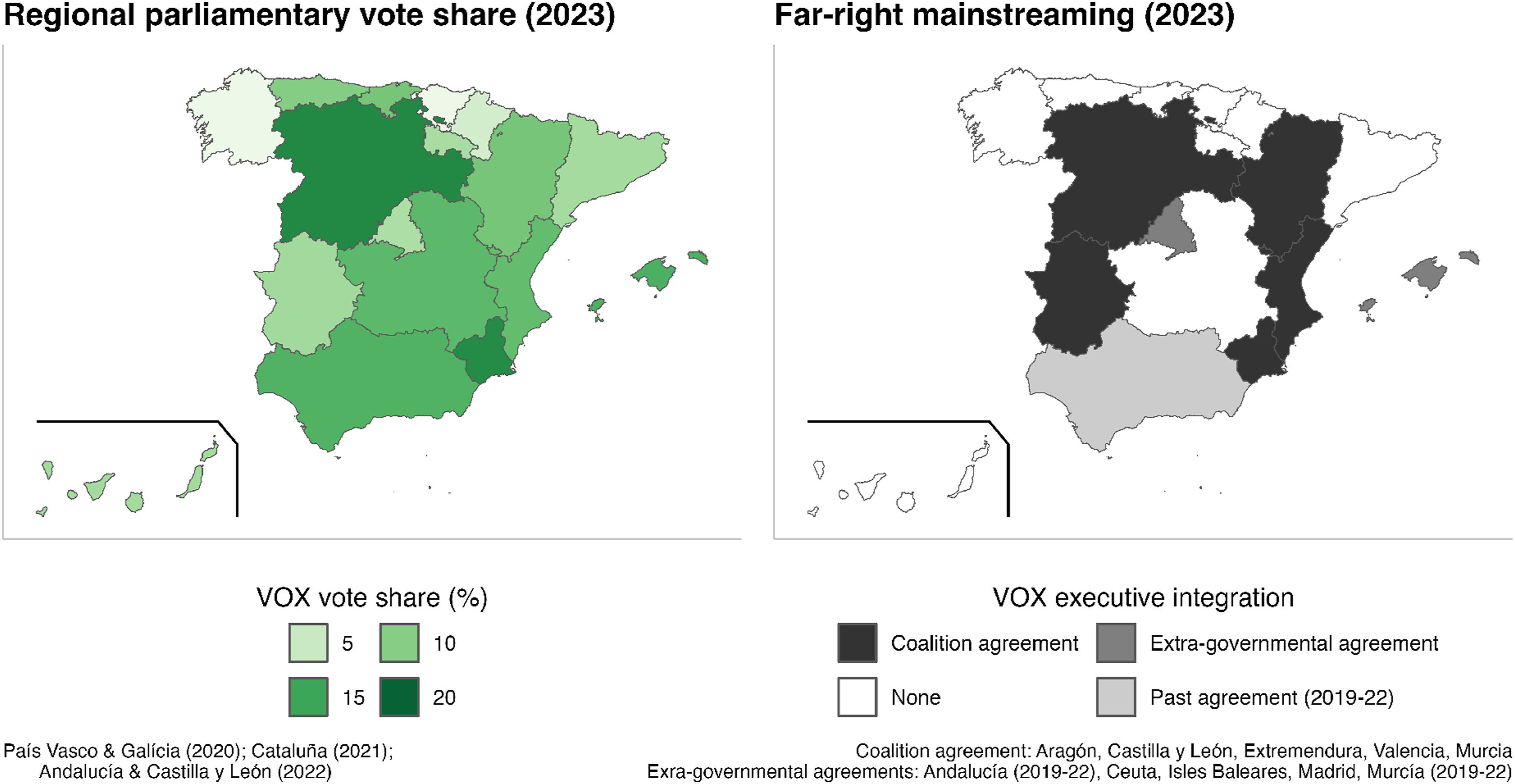
Understanding the Spanish mainstream right’s rejection of the cordon sanitaire without any attempt at all of rejecting the far-right presents something of a puzzle (Field and Alonso, 2024). In the utilitarian sense, forming agreements with the far-right is likely to impose costs and benefits for the mainstream right. The benefits, as well established in the supply-side literature of party strategy, are straight-forward: parties are office-seekers and will accept the dilution of their core principles and party brand (and indeed perhaps moral compass) in order to gain access to power (Meguid, 2008; Strøm, 1990). The costs of accommodation – in addition to emboldening the far-right and their issue positions (Krause et al., 2023) – is that mainstream parties may be perceived to be engaging in the political institutionalisation of parties that the average voter views as being beyond the pale. Political parties, who we assume wish to communicate norm-compliant behaviour, should therefore feel some incentive to reject the far-right in response to these costs. Indeed, and as Downs (2012) argues, excluding far-right parties should provide an “immediate electoral payoff” via the mainstream parties’ signalling of their pro-democratic credentials. The presence of this cost, however, assumes that voters harbour preferences for the marginalisation and exclusion of these parties. Do they?
In Spain, rather than excluding VOX from political institutions and access to the executive, the PP has actively pursued VOX’s parliamentary support in order to gain office (Field and Alonso, 2024). Below, I demonstrate that part of the reason for forgoing the cordon sanitaire and blocking the Spanish far-right may well be that, on average, Spanish voters don’t expect parties to do so.
What do to about the far-right?
As part of their rolling monthly barometer, in January 2022 polling and data insights firm 40 dB asked a representative sample of Spanish citizens (N = 2000) 4 how they thought other political parties should react to VOX. Concretely they asked: With respect to VOX, what do you think other parties should do? In addition to “don’t know”, respondents were able select from five alternatives: legally prohibit the party; block VOX from entering the executive (cordon sanitaire); refuse to debate VOX in parliament, debate the party but refuse to allow it access to the executive; or, treat VOX like any other party.
Figure 2 Public support for mainstream party responses to VOX.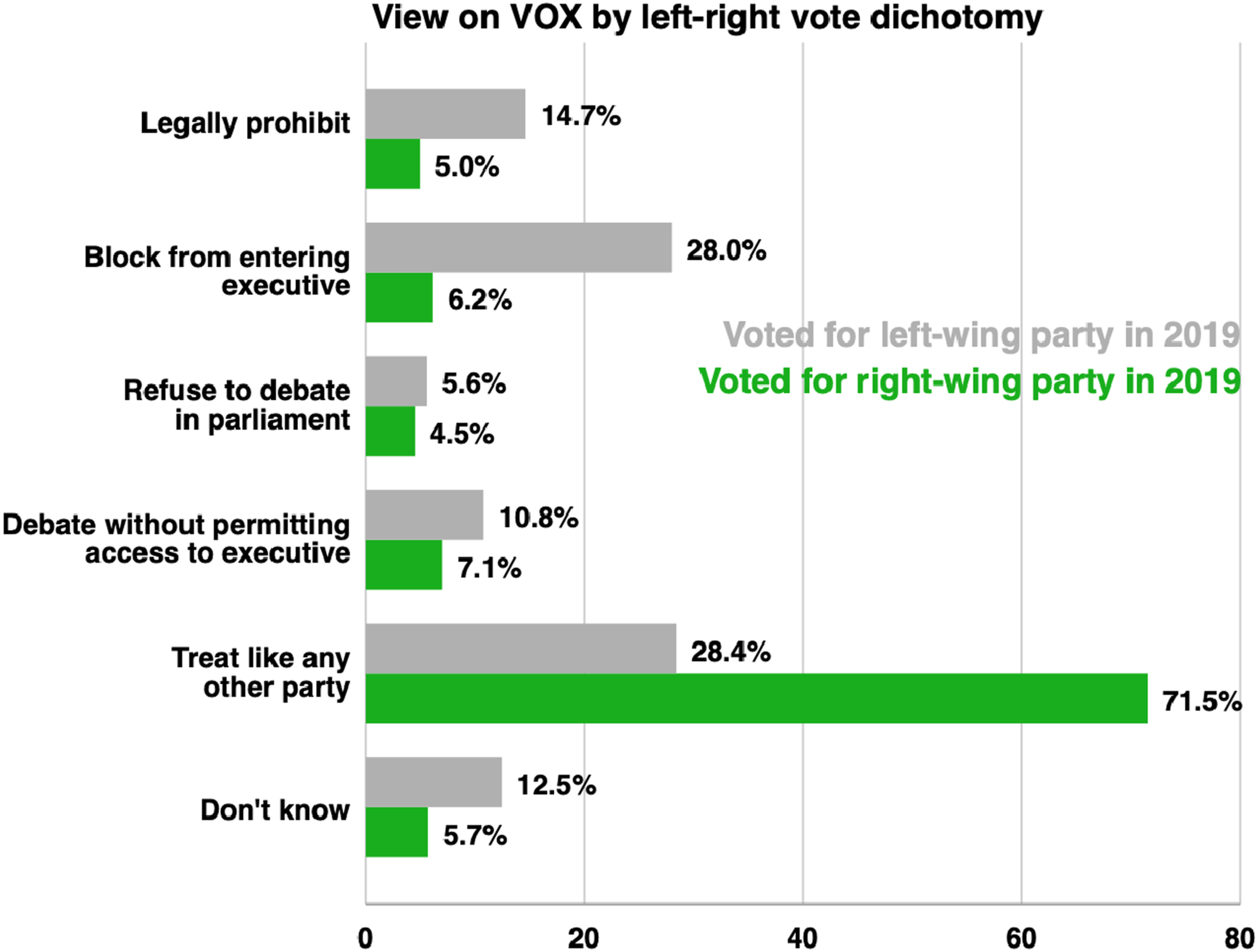
Should the cordon sanitaire represent a social norm (Axelsen, 2023), we would expect to see mass support for the strategic exclusion of VOX among voters, including among left- and right-wing partisans. Unsurprisingly, voters on the right are significantly more inclined to consider that VOX should be treated like any other party with close to three in four right-wing voters expressing this view. If mainstream right-wing parties feel conflicted about getting into political bed with the far-right, these results indicate that these concerns are not shared by their electorate. While voters on the right behave somewhat as expected in opting to forego the cordon sanitaire (or indeed other restrictive measures), preferences among voters on the left are less in line with what we would expect should accommodating the far-right indeed be something that is democratically undesirable (Axelsen, 2023). An equal proportion of left-wing voters think that VOX should be blocked from joining the executive (28%) and that VOX should be treated like any other party (28.4%).
Of course these proportions represent self-reported preferences which may not reflect individuals’ true preferences (Kuran, 1997). If, however, we are to accept that showing sympathies for far-right parties is indeed socially unacceptable (Valentim, 2021), then any bias introduced by self-reports is likely to underestimate the proportion who think the party should be treated like any other alternative rather the proportion who endorse restrictive responses.
The initial findings suggest that there is no widespread popular support for restrictive measures such as the cordon sanitaire. In Figure 3 I report the probability of supporting the two modal responses to VOX – blocking the party from entering the executive, or treating VOX like any other party – among different party electorates in Spain. The reported probabilities are the product of a linear probability model (ordinary least squares) which controls for: gender, age, education, employment status, and urban/rural location. The estimation relies on heteroskedasticity-consistent (HC) standard errors. Full regression output reported in Appendix B. Modelling support for responses to VOX among Spanish partisans.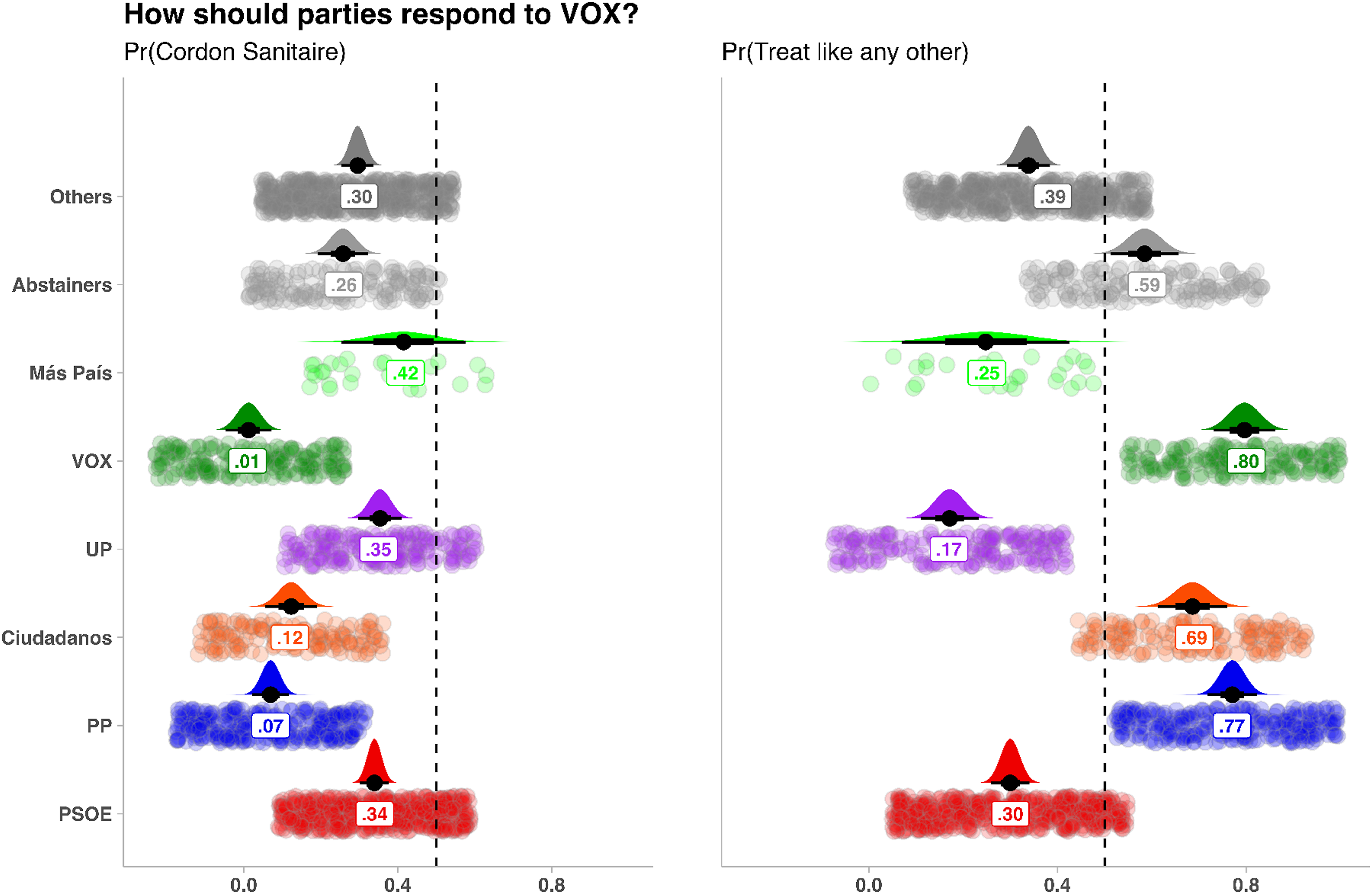
Let us consider first the probability of supporting the cordon sanitaire (left-hand panel Figure 3). There are no instances where the majority of a party’s supporters express mass support for the policy (note that the means are all below 0.5). The largest level of support is observed among the supports of Más País (Spain’s left-wing green party) at 0.42, followed by those of Unidas Podemos and the PSOE at, respectively, 0.35 and 0.34. Among voters of the mainstream right – those who arguably are inclined to influence their parties’ strategy in relation to VOX, there is a clear lack of support for the cordon sanitaire. Replicating this analysis to consider any restrictive actions as opposed to specifically the cordon sanitaire, does not produce different results. While the voters of the left are more inclined than their peers on the right to support the exclusion of the party, their support for the policy is muted in absolute terms. Indeed among voters of the mainstream left (PSOE), respondents are equally likely – both statistically and substantively – to report that VOX should be treated like any other party as they are to say there should be a cordon sanitaire.
As demonstrated in the right-hand panel of Figure 3, the voters of those parties with the capacity to apply restrictive measures to VOX that limit the far-right’s access to Spain’s democratic institutions are not inclined to support strategically restrictive measures. Indeed, more than three in four PP voters (77%), and 69% of Ciudadanos’ supporters (those most inclined to self-identify as “liberals”) believe that parties should treat VOX just like any other legitimate political party. Of course understanding why PP and Ciudadanos voters hold these preferences is more complex. On the one hand, these voters may – regardless of VOX’s radicalism – place a premium on the “their side” of the political aisle gaining access to power. Inter-bloc affective polarisation is widespread in Spain (Comellas Bonsfills, 2022; Rodríguez et al., 2022; Torcal and Comellas, 2022) and, in a context where the emotive rejection of the “other” side is high (Mason, 2018), rejecting a potential coalition partner and conceding political ground to the left-wing bloc is likely psychologically costly for right-wing voters.
On the one hand, these voters may support treating VOX like any other party because they reject the notion that the party is a “radical right-wing” party and, as a result, do not view any substantive value in blocking a legitimate political party. The data available suggests, however, that this not likely the case. As part of the survey, respondents were asked “To what extent do you think that VOX is radical right party?” 74.9% of respondents indicated that it was and 25.1% respondent that it was not (see Appendix C). Stratifying partisan respondents into those who do not believe VOX is a radical right party and those that do think so, we are able to assess of this perception conditions support for the cordon sanitaire. As visualised in Figure 4, it does not. Even among mainstream right-wing voters who do view VOX as a radical right-wing party, there is little support for the strategic exclusion of the party. Distribution of support for the cordon sanitaire among those who perceive VOX as a “radical right” party or not.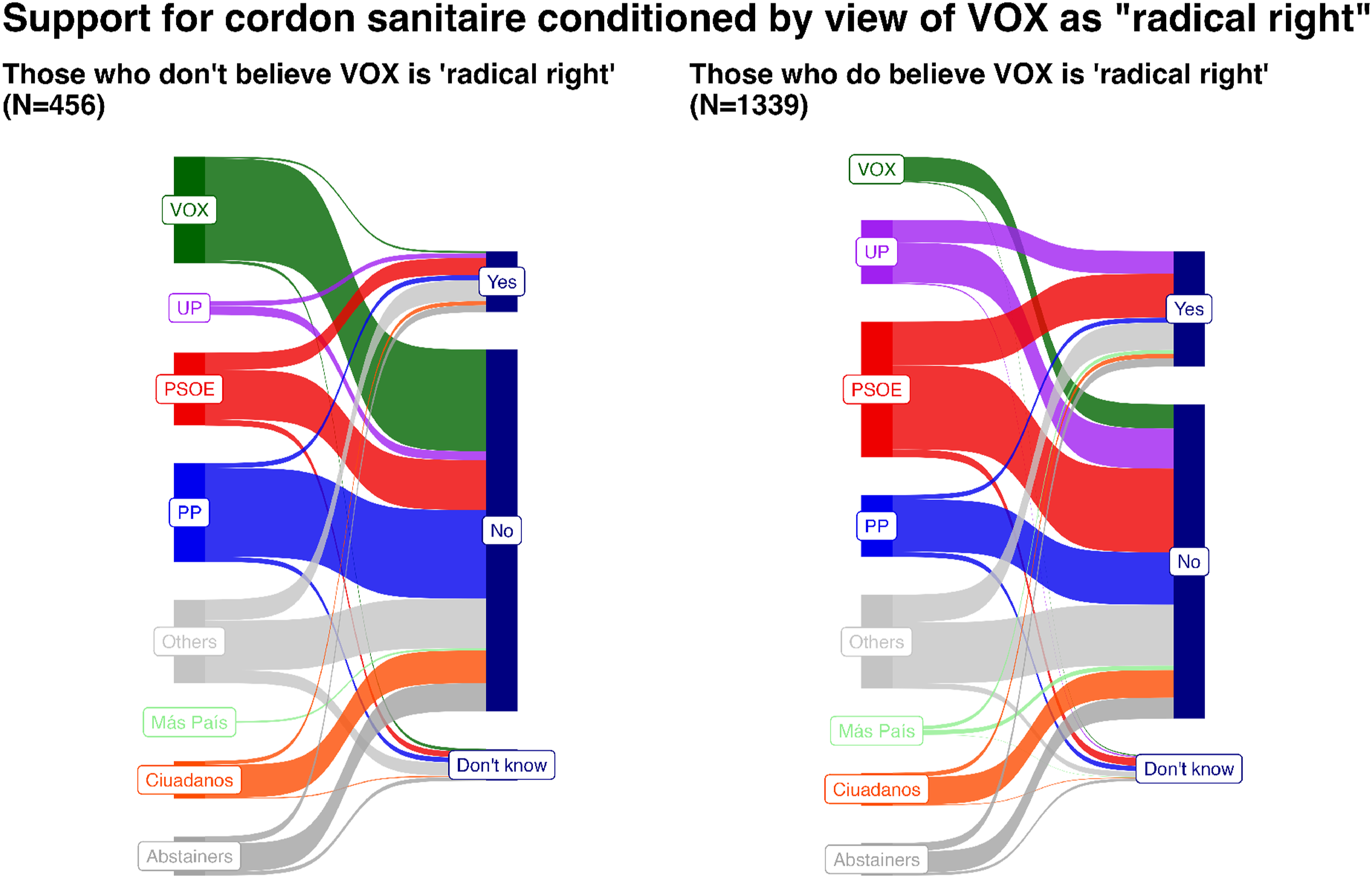
Discussion
A commonly strategy adopted in response to the electoral rise of far-right parties is to apply a cordon sanitaire which excludes radical right-wing challengers from the government-forming process. This process of strategic exclusion, theoretically, marginalises far-right parties by cutting off their access to state institutions and their corresponding policy influence, and also signals that these parties are beyond the pale of ordinary politics. Do voters support this policy? And in Spain, where the far-right has been institutionalised en masse by the mainstream right (Alonso and Field, 2021; Field and Alonso, 2023) can a demand-side look at mass support for the cordon sanitaire help explain Spain’s exceptionalism from the country’s European contemporaries?
Analysing descriptive data from a representative sample of respondents from Spain, I show that there is little overall support for the cordon sanitaire among voters in Spain. Indeed, the modal position of voters, irrespective of their left-wing or right-wing political affiliations, is to treat VOX like any other party.
The contributions here are simple and descriptive: there is little support for strategic exclusion of the far-right in Spain. These demand-side factors may explain, in part, why the cordon sanitaire has not been applied in Spain. At the same time, however, the descriptive findings open up the puzzle of why this strategy is not supported. Future work should visit this question. As discussed above, I argue that the low level of support for the strategic exclusion is not because of voters’ rejecting the far-right label. An alternative mechanism that I propose is one of affective polarisation: individuals are willing to forgo democratic principles if and when it benefits their in-group. In short, in a polarised context, winning at any cost is better than conceding to the opposing side. Such an argument would be congruent with the literature on selective liberalism (Graham and Svolik, 2020; Turnbull-Dugarte and López Ortega, 2023) and democratic hypocrisy (Simonovits et al., 2022).
This argument would not, however, explain the low level support for restrictive responses among left-wing partisans. This may well be explained by left-wing individuals placing a greater premium on political pluralism and, as such, these individuals may be more tolerant of (far-right) intolerance. Related evidence on cross-ideological tolerance would lend support to this interpretation (Lindner and Nosek, 2009), but understanding (low) left-wing support for strategic exclusion in Spain remains an important unanswered empirical question. Of note is that these results, whilst focused on public support for elite-level action, are largely congruent with the evidence of individual-level action towards partisan supporters of the far-right in Spain. Although individuals may be more inclined to socially sanction VOX supporters relative to supporters of other parties (Alvarez-Benjumea and Valentim, 2022), they are – in real terms – very unlikely to socially sanction the supporters of any party at all, including those of VOX.
On average, inclusion, over exclusion, of the far-right is the norm in Spain: the centre-right has mainstreamed VOX by including the party in diverse political pacts (Field and Alonso, 2023, 2024); voters are unwilling, in absolute terms, to socially sanction the party’s supporters (Alvarez-Benjumea and Valentim, 2022); and, as we show here, there is no public support for the strategic exclusion of the party by its mainstream competitors. Of course there are idiosyncrasies in the Spanish case that make it a place where the far-right, despite being electorally unsuccessful, has always had a non-trivial potential electoral constituency (Alonso and Rovira Kaltwasser, 2015). Despite Spain’s authoritarian past, Spain’s transition to democracy placed a premium on a (undeniably successful) peaceful transition that grant amnesty to those involved in Franco’s authoritarian regime (Aguilar, 1997), rather than an open reconciliation process that would recognise and condone the Franco-era dictatorship (Aguilar and Payne, 2016; Encarnación, 2014). Indeed memories of the authoritarian past remain political polarising (Aguilar et al., 2011; Balcells, 2012; Simón, 2020) – which in itself indicates a lack of political consensus (Aguilar and Payne, 2016) – and right-wing individuals tend to react significantly and negatively to ongoing pursuits to engage in reconciliation and transitional justice in the post-authoritarian period (Villamil and Balcells, 2021). Spain is also a country where parties of the radical left have been incorporated into the mainstream and normalised via coalitions with the centre-left PSOE. Citizens may, as a result, simply be rejecting the strategic exclusion of the radical-right given the same was not applied to the radical-left. In tandem, these factors may result in Spain being distinct from its European contemporaries and, consequently, the same rejection of the cordon sanitaire may not be observed elsewhere.
The lack of support for strategic exclusion has significant implications for the understanding of inter-party dynamics in Spain and the rapid mainstreaming of the far-right in the country. The absence of mass public support for the cordon sanitaire, or wider exclusionary responses to the radical right, indicates that alternative means of constraining far-right advancement in Spain may be required. If mainstream right-wing parties and coalitions are not expected to adopt such strategies by citizens, there is even less incentive for the mainstream right to adopt these norms and, as result, it will likely become more challenging to effectively isolate and marginalize far-right parties from democratic institutions.
Supplemental Material
Supplemental Material - Public support for the cordon sanitaire: Descriptive evidence from Spain
Supplemental Material for Public support for the cordon sanitaire: Descriptive evidence from Spain by Stuart J. Turnbull-Dugarte in Party Politics
Footnotes
Acknowledgements
I am grateful to Cas Mudde for his insightful feedback, reflections and comments on an earlier version of this paper. The recommendations from two (of three) anonymous reviewer reports were helpful in refining some of the claims presented in the final manuscript.
Declaration of conflicting interests
The author(s) declared no potential conflicts of interest with respect to the research, authorship, and/or publication of this article.
Funding
The author(s) received no financial support for the research, authorship, and/or publication of this article.

Supplemental Material
Supplemental material for this article is available online.
Notes
Author biography
References
Supplementary Material
Please find the following supplemental material available below.
For Open Access articles published under a Creative Commons License, all supplemental material carries the same license as the article it is associated with.
For non-Open Access articles published, all supplemental material carries a non-exclusive license, and permission requests for re-use of supplemental material or any part of supplemental material shall be sent directly to the copyright owner as specified in the copyright notice associated with the article.
