Abstract
Roland Barthes’ entire career pursued a dream of being freed from the tyranny of ossified, institutionalized, rote language use, as articulated from his first massively influential work on ‘writing degree zero’ in 1953. The anaemic role of institutional rhetoric and its dusty formulations dulled the capacity for using language and thought otherwise. For Barthes, fragments played a privileged role in the escape from the tyranny of meaning imposed by doxa and received wisdom, sometimes called ‘literature’ and ‘rhetoric’. Barthes once referred to almost all of his writing, and indeed theorizing, as ‘a circle of fragments’. The artist and theorist Victor Burgin has been profoundly influenced by Barthes’ writings and his attempts to escape the ideological constraints of language, institutions and images. His visual rhetorical practice now often takes the form of projection loops that are accessible by gallery attendees at any point in the loop. Their basic building block is also the fragment, and the loop constitutes another circle of fragments. His 2016 work Belledonne uses the time Barthes spent in the sanatorium for tuberculosis treatment as the basis for the piece, its computer-generated imagery and textual intertitles. This article examines Barthes’s writings on pre-Socratic rhetoric, as well as his self-reflexive engagement with his own theorizing, combined with Burgin’s reconsideration of moving image work in gallery or museum spaces as attempts to offer potentially liberatory strategies for eluding rote use and effects of language, image and thought.
Introductory Remarks
… series (sequence) of fragments, each of which is given a title = the figures of the Neutral. Figure: rhetorical allusion (= a circled piece of discourse, identifiable since titleable) + face that has an ‘air’, an ‘expression’: fragment not on the Neutral but in which, more vaguely, there is some Neutral, a little like those rebus drawings in which one must look for the silhouette of the hunter, of the rabbit, etc. (Barthes, 2005: 10)
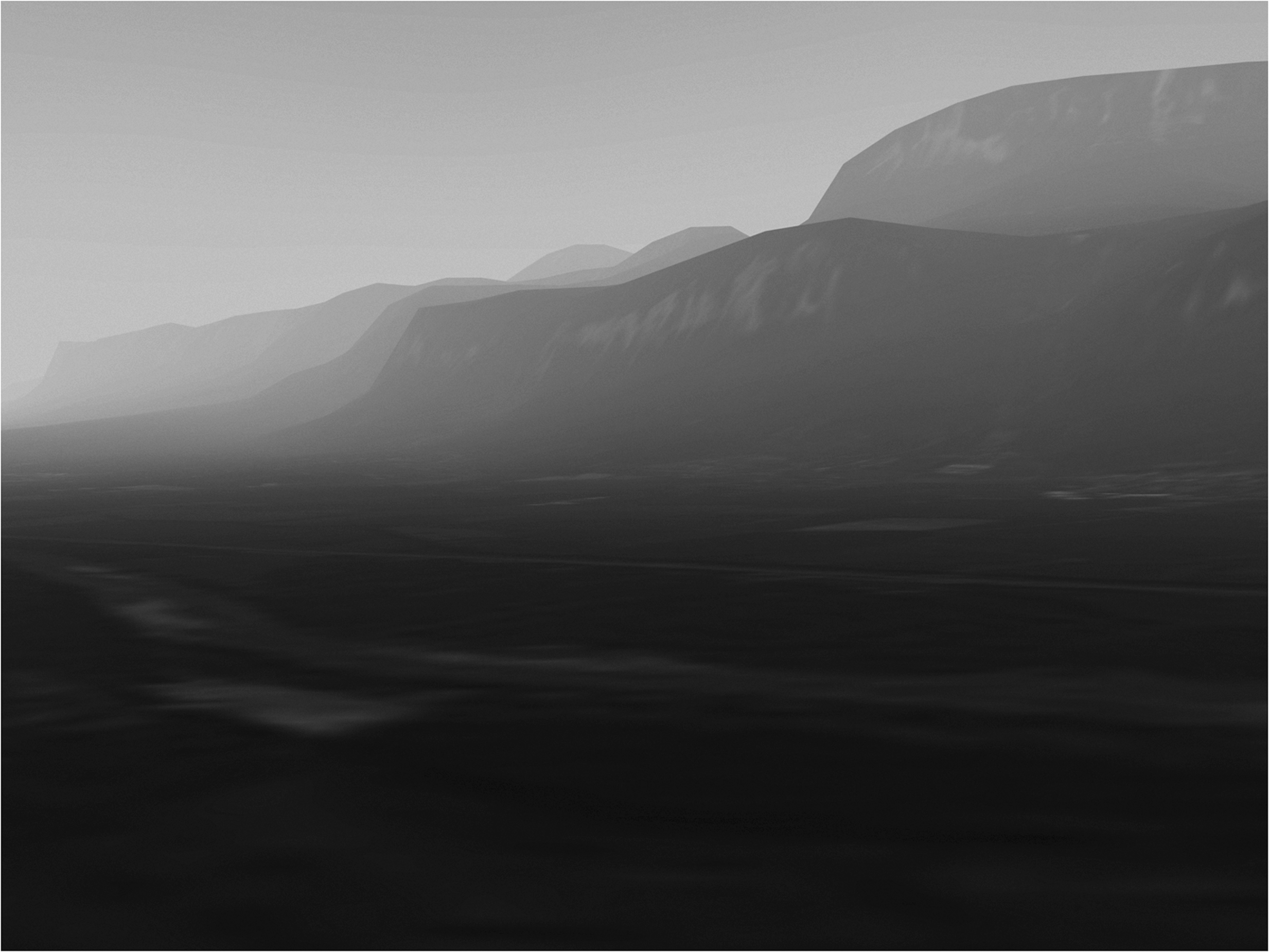
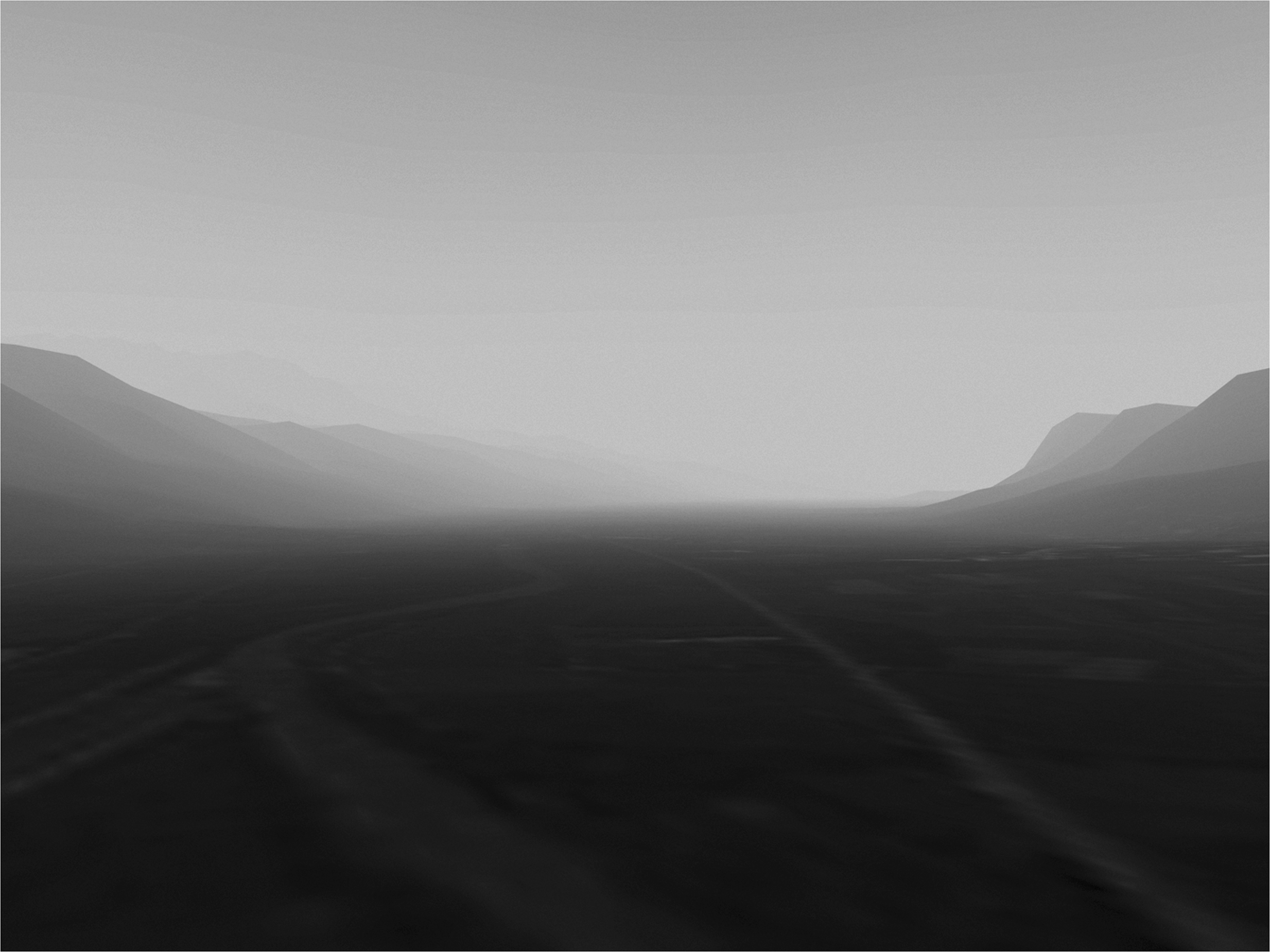
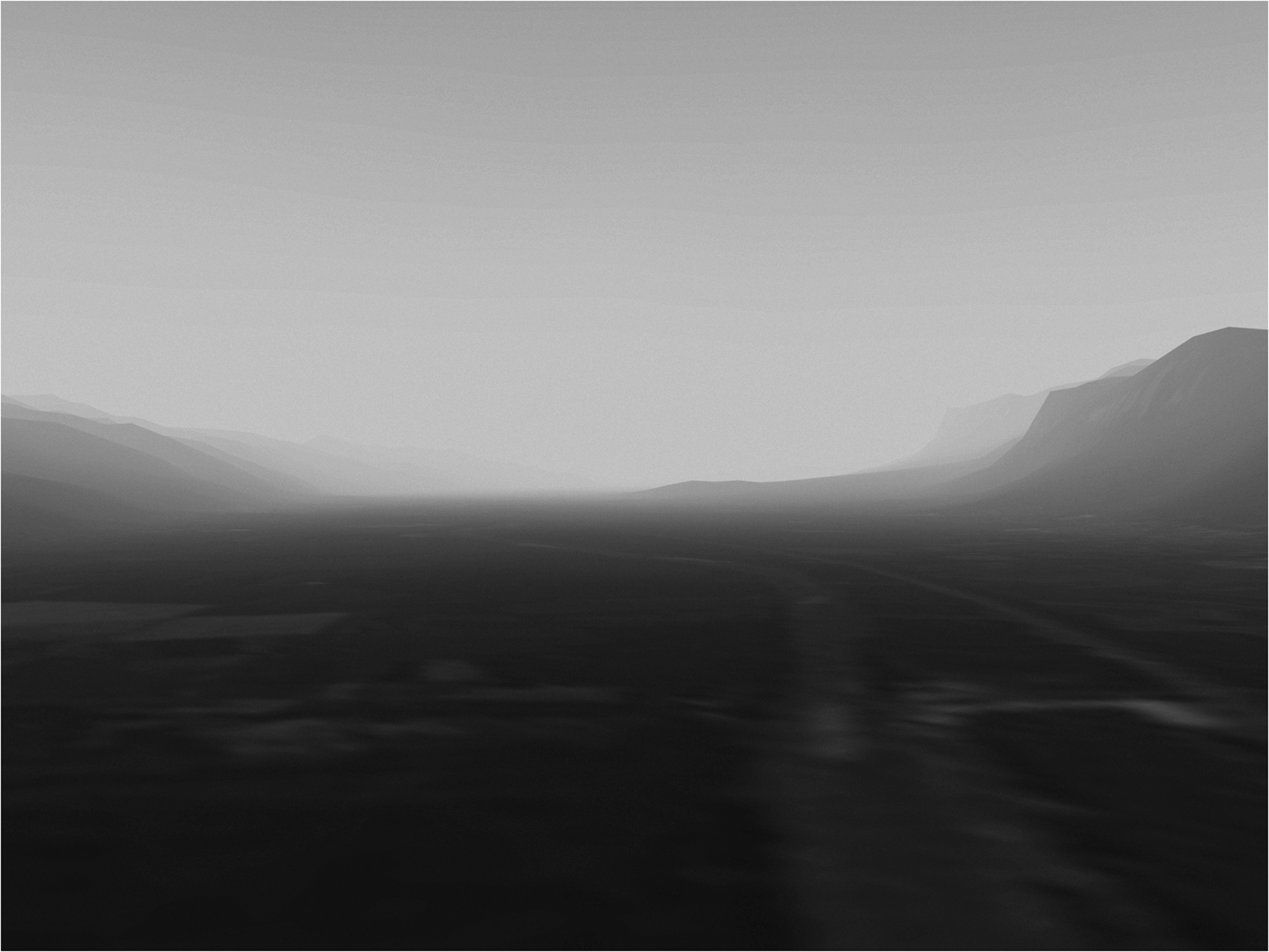
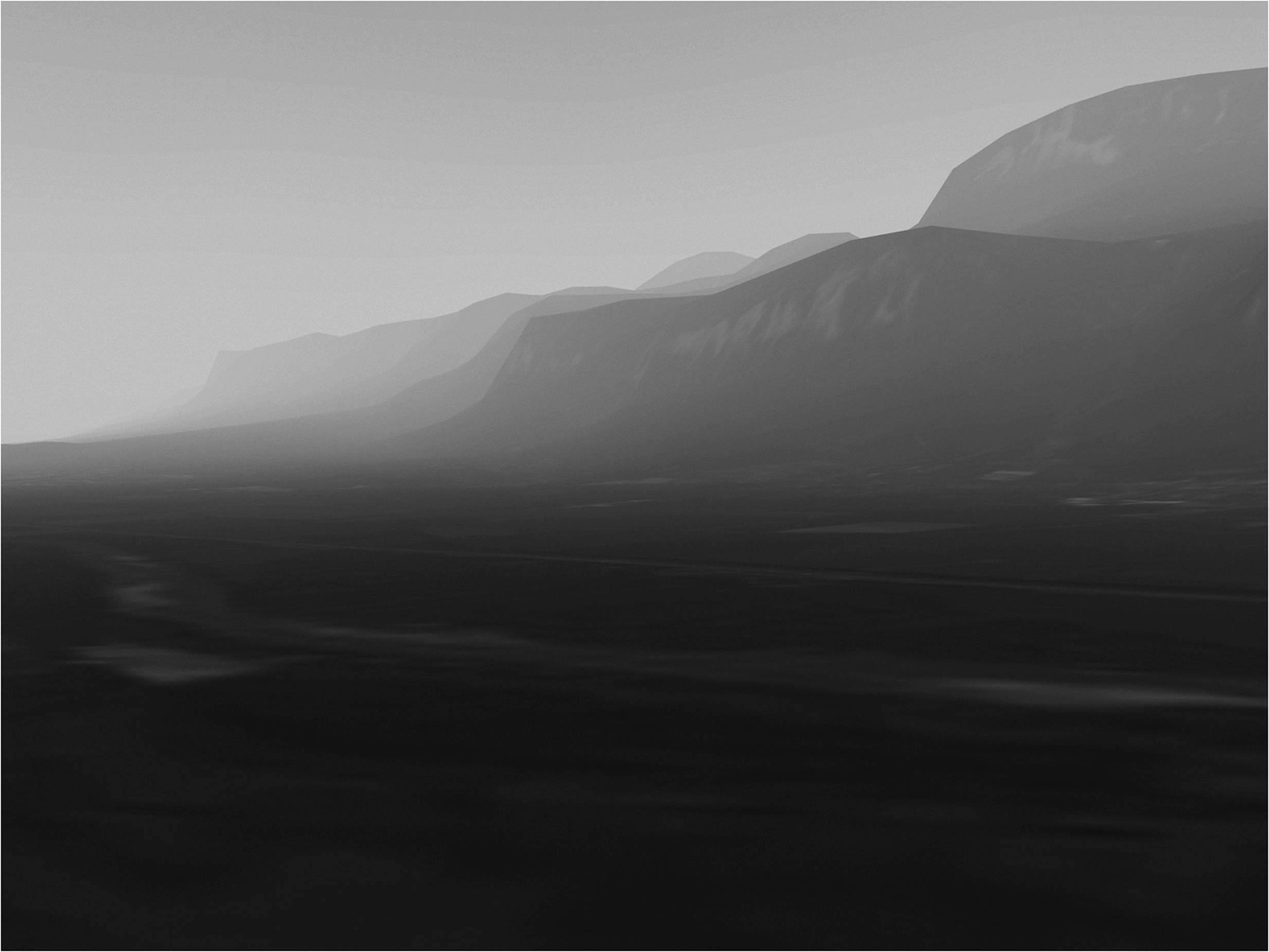
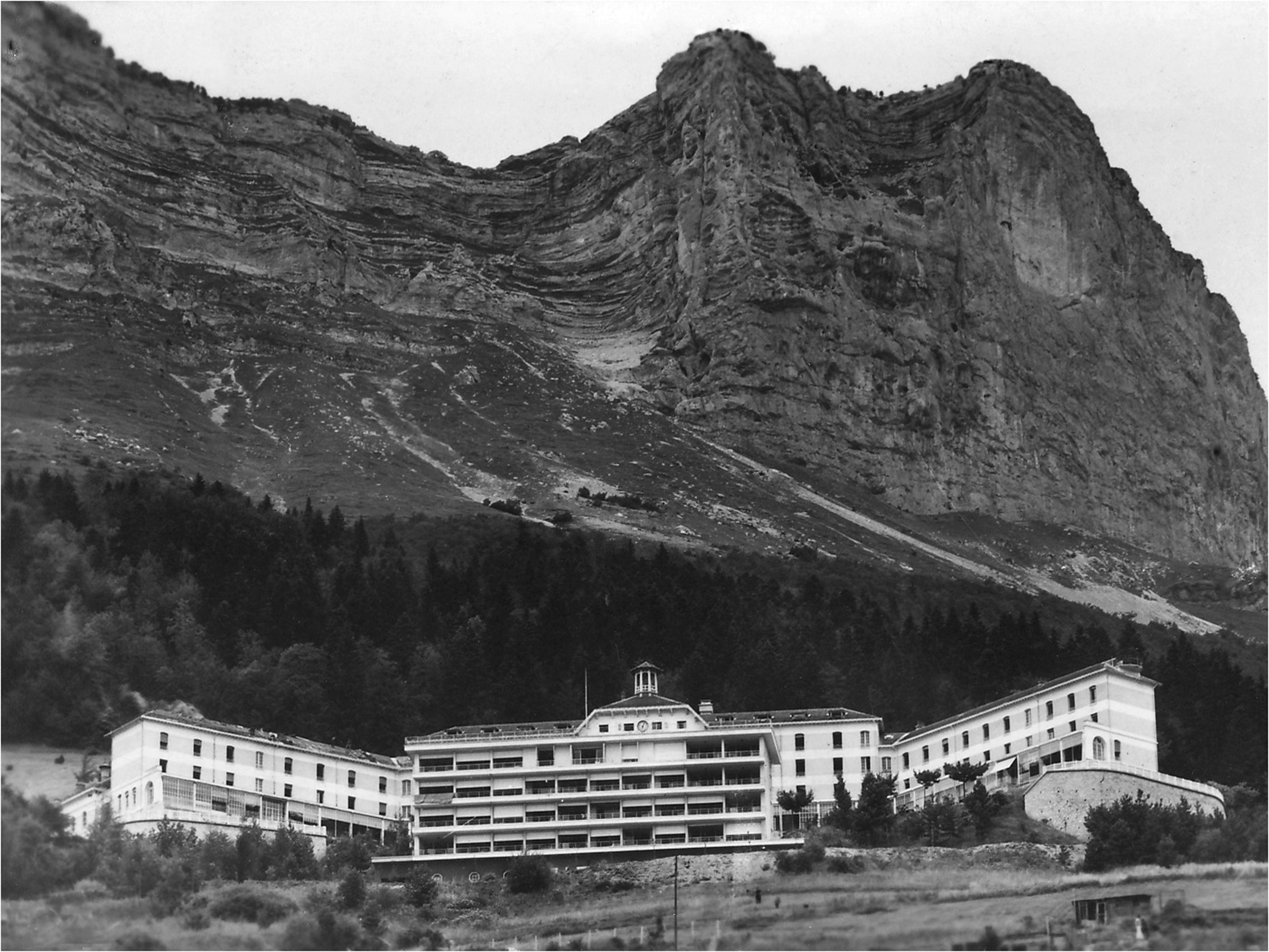
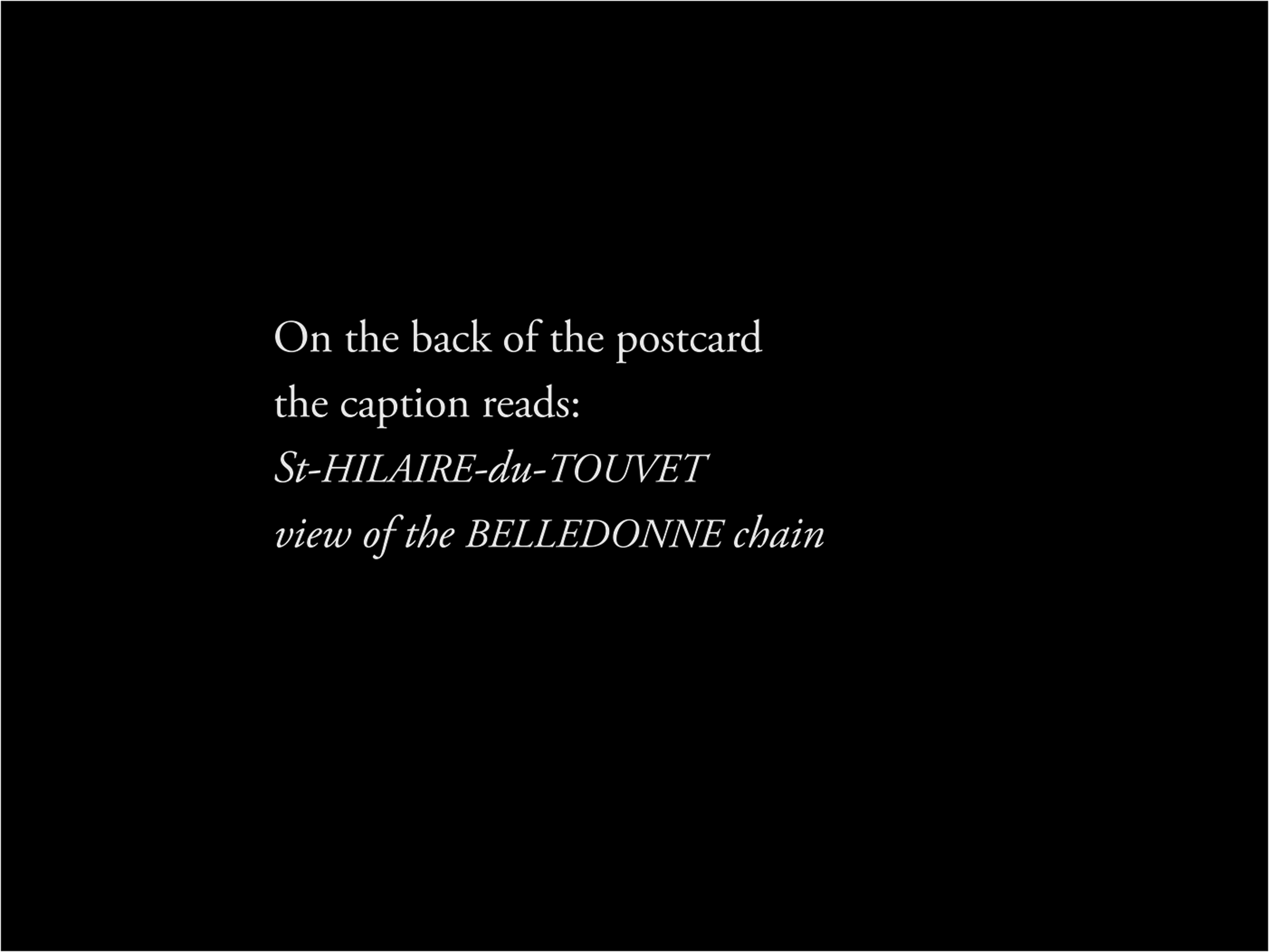
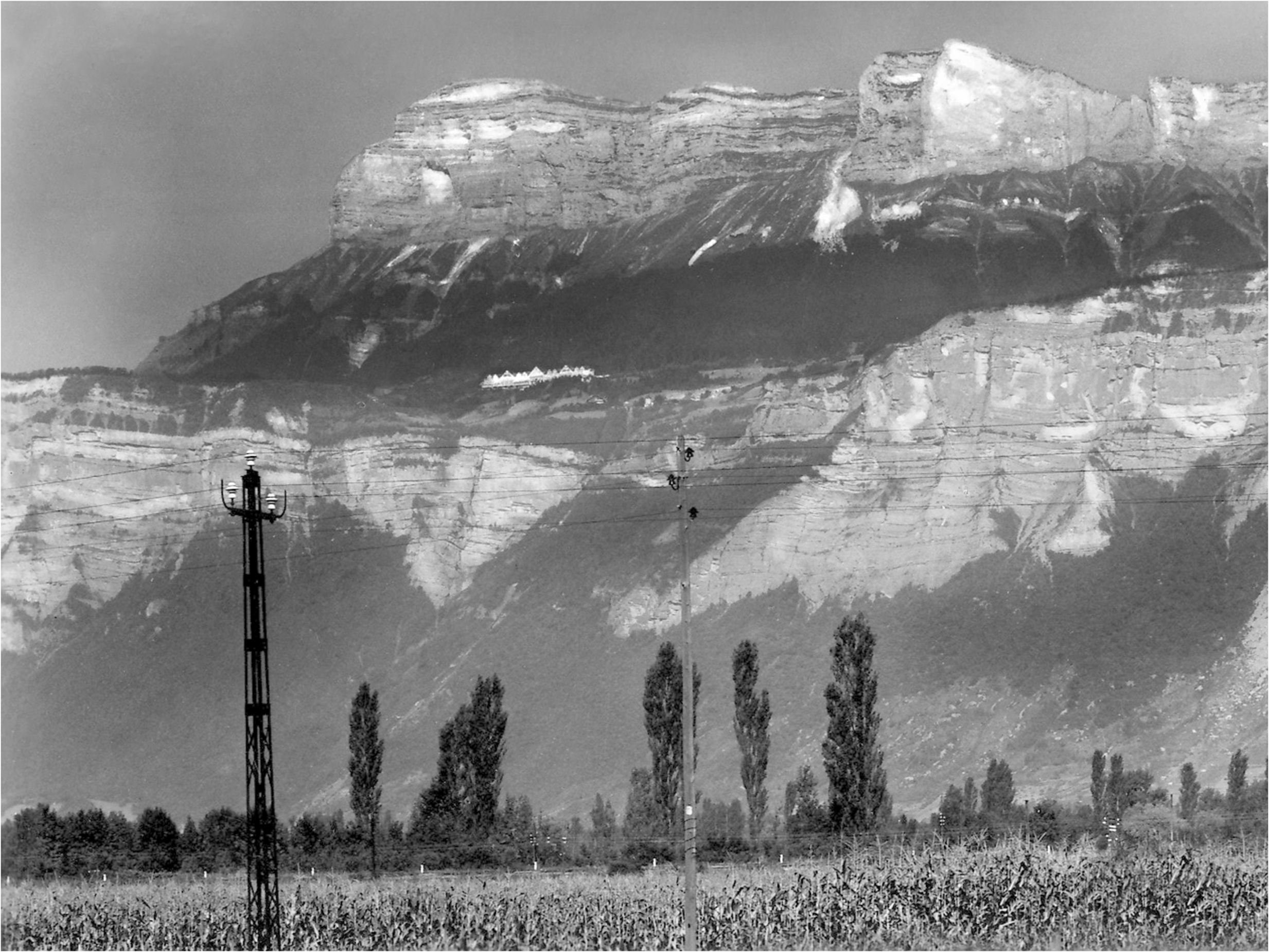
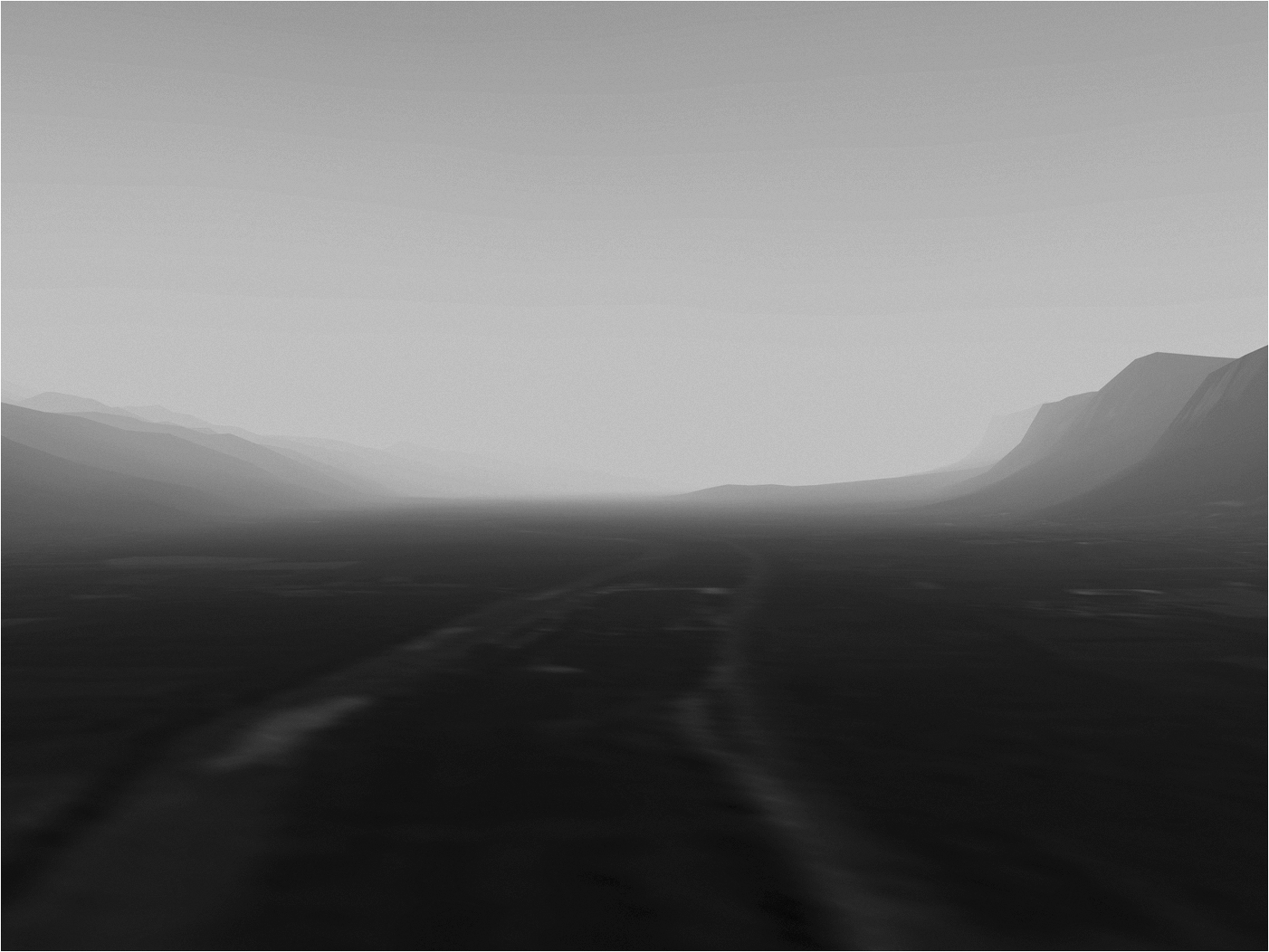
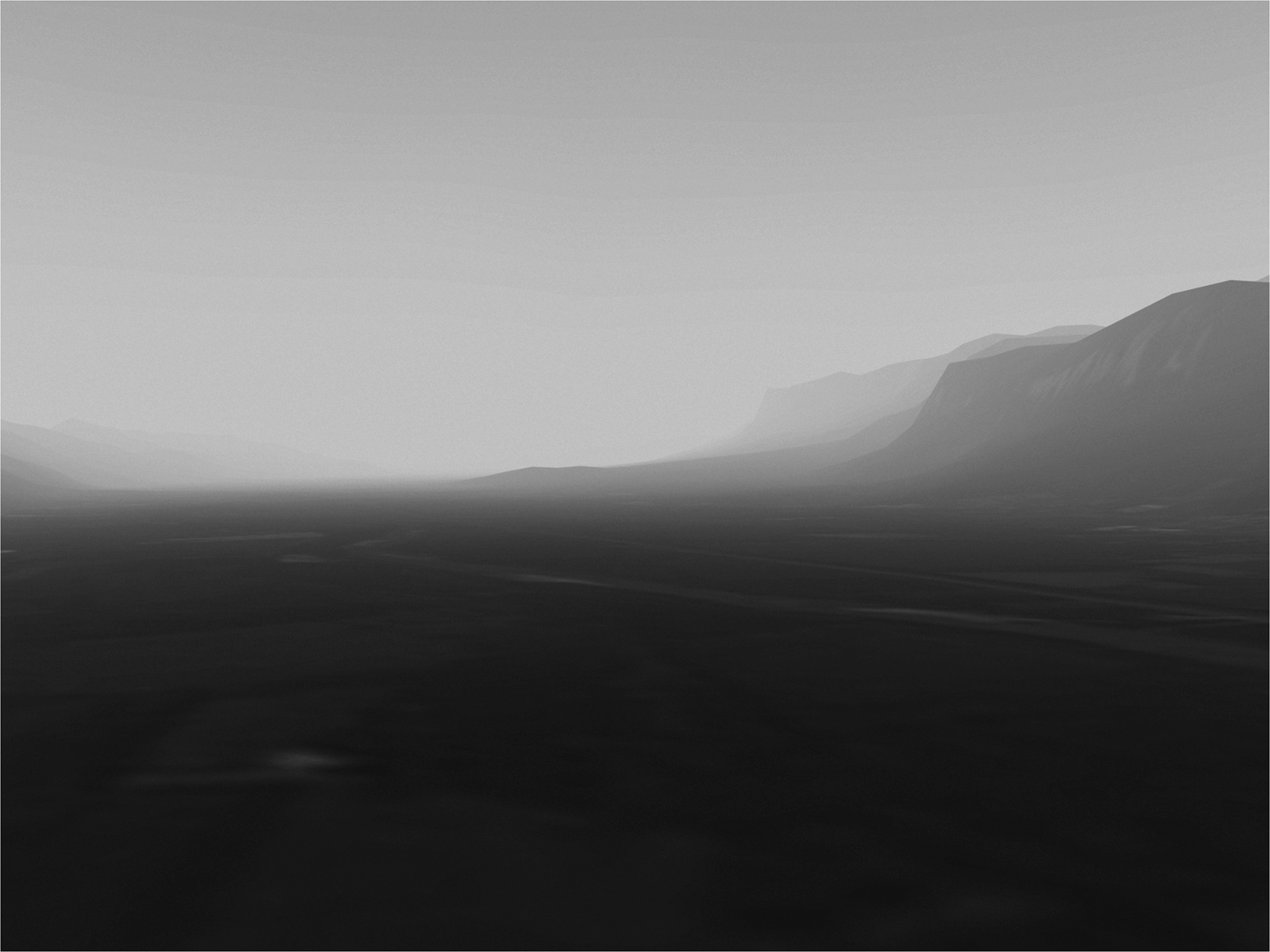
As a notable artist and theorist, Burgin has long been influenced by his close reading of Barthes; in the work of both we might suggest is an unfolding attempt to outplay the ideological constraints of language, institutions and images. Burgin, of course, came to prominence in the late 1960s as a conceptual artist, noted at the time as a political photographer of the left, and subsequently nominated for the Turner Prize. The combinatory and contradictory power of materiality and concept is a hallmark of his handling of media: whether photo-texts, prints, digital video or, in more recent years, the 3D modelling of CGI and game-engine technologies. Belledonne, an 8-minute projection loop, was originally commissioned for the exhibition Barthes/Burgin (2016) at the John Hansard Gallery, which brought a selection of Barthes’ drawings from the 1970s together with three digital projection works by Burgin (Bishop and Manghani, 2016). As one of these works, Belledonne is comprised primarily of computer-generated imagery of a fog-drenched mountain range, interspersed with a recurring image from postcards of St-Hilare-du-Touvet (the site of a sanatorium for tuberculosis in the early 20th century) and a series of aphoristic intertitles. These elements, combining as a form of temporal ‘psychical cubism’, evoke the period of the Second World War when Barthes was a patient at the sanatorium, but also draw upon his interest in the haiku, which pervades much of his late writings.
As Bishop reminds us, the construction of Belledonne as a loop and its use of fragments – i.e. being a ‘circle of fragments’ – is pertinent to its gallery installation, allowing visitors (just as they might a painting) to ‘enter’ into the work at any given moment, and equally to leave at will. Importantly, as a form of ‘writing’ of interruption, the artwork need not be coded as a series or sequence of fragments. Instead, just as Barthes refers ‘vaguely’ to the Neutral, so Burgin refers to his interest in the ‘sequence-image’ (a ‘virtual’ object, and signature of his work) to be similarly a rebus, ‘in all other respects vague: uniting “someone”, “somewhere” and “something”, without specifying who, where and what’ (Burgin, 2004: 16). In looking across from Barthes to Burgin, this article helps us return to the fragment for its rhetorical value, for its potential as a liberatory strategy, to outplay the paradigm, as Barthes would put it; to use language, image and thought for their own destabilizing effects.
What follows these introductory remarks is the presentation of two separate ‘texts’. Running across the bottom of the page is Bishop’s article ‘A Circle of Fragments’, while simultaneously, stills from Belledonne run across the top of the page. To take a musical term, we might consider the running of these two ‘texts’ together as antiphonal – as alternative, but complementary renderings. And, as a coda to these texts, again ‘a little like those rebus drawings’, this special issue on Barthes’ late work ends with a written composition by Victor Burgin, ‘Nagori: Writing with Barthes’, which – structured through the device of an acrostic – offers a further demonstration of how the fragmentary form can allow us to read not ‘on’ a subject but which, ‘more vaguely’, allows for the subject to follow through.
Sunil Manghani
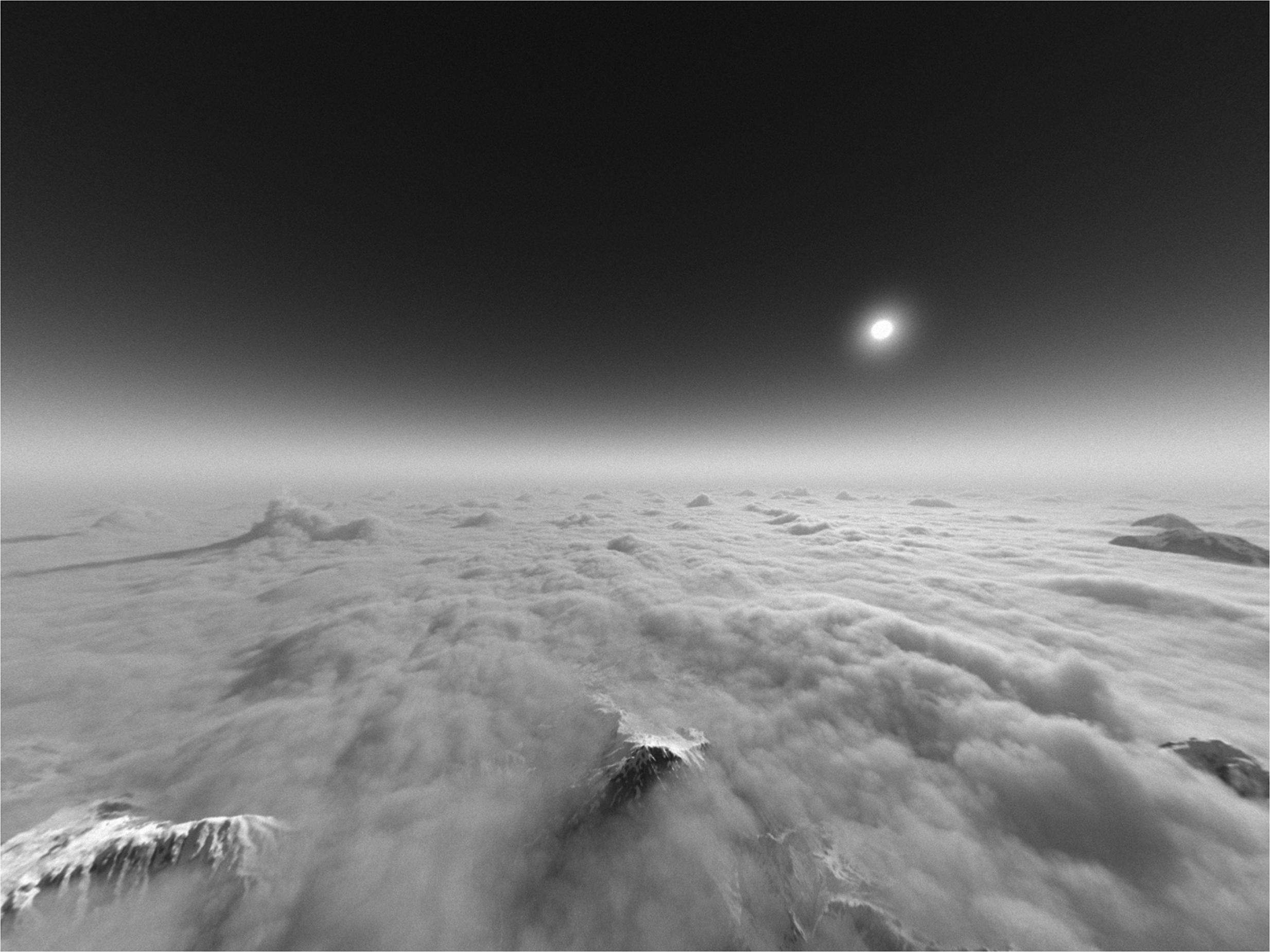
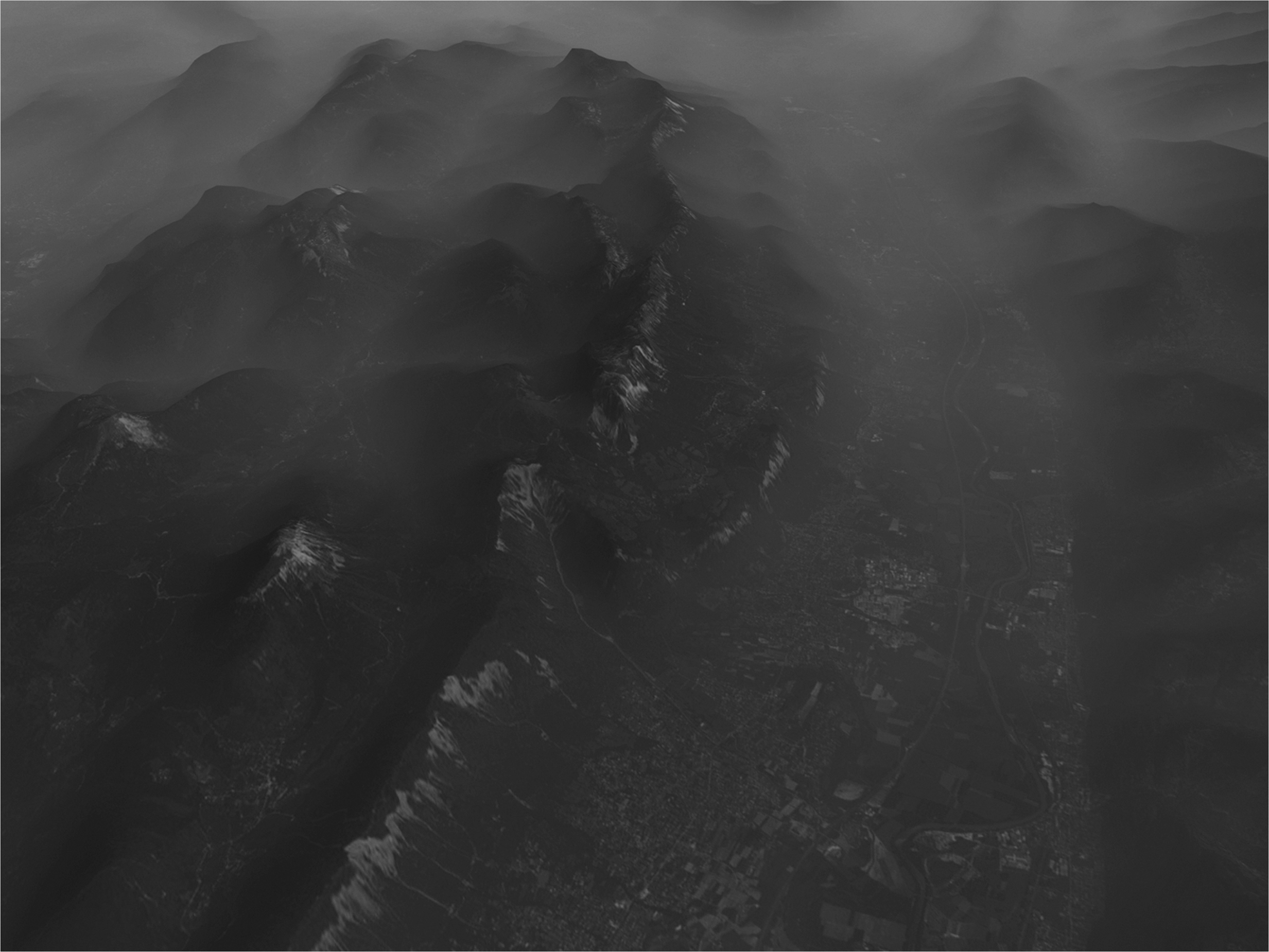
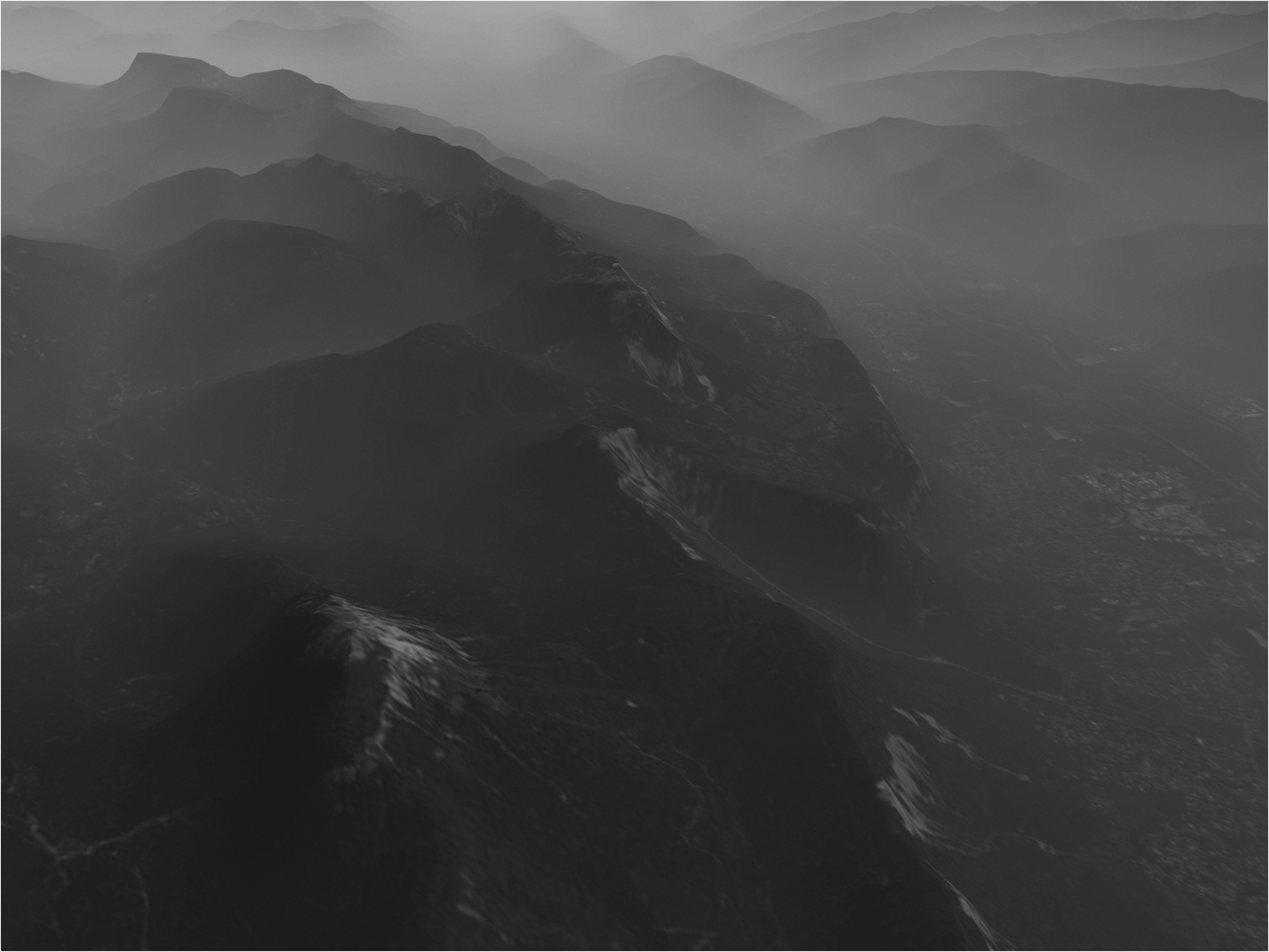
Installation of Victor Burgin’s Belledonne (2016) for Barthes/Burgin, curated by Ryan Bishop and Sunil Manghani, at John Hansard Gallery, 13 February to 16 April 2016. Courtesy of the John Hansard Gallery. All subsequent images are stills from Belledonne. Courtesy of the artist.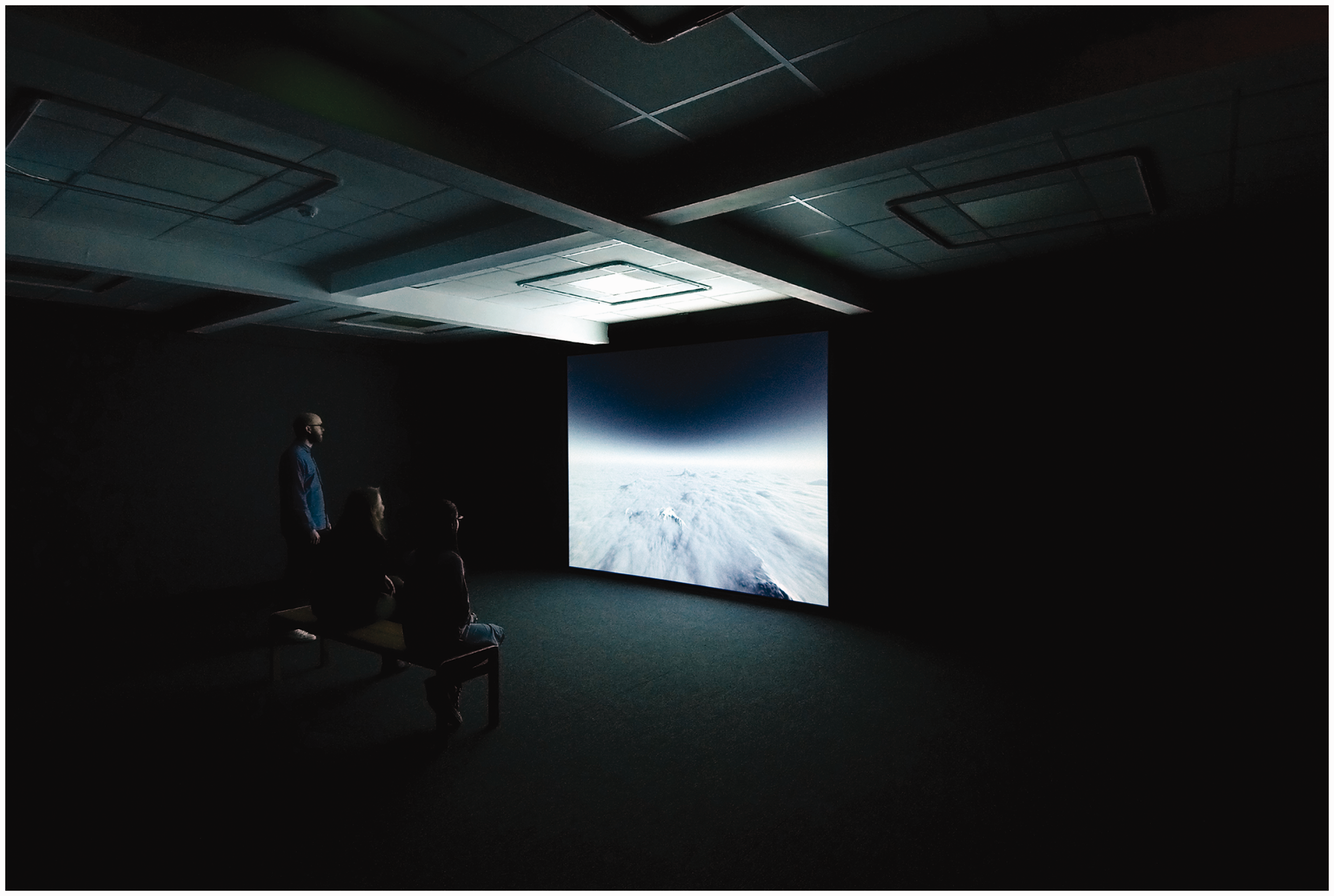
Circle of Fragments
The years Roland Barthes spent in a tuberculosis sanatorium roughly aligned with the years of the Second World War. As described in Victor Burgin’s projection work about these years, Belledonne (2016), Barthes in the facility underwent the déclive treatment, during which the patient must lie at an incline on the affected side for 18 hours a day without any movement or speaking. 1 Later, he wrote a series of unpublished notes, called ‘Sketch of a Sanatorium Society’ (2018), that distilled the puerile state of power and control operative in such institutions as an extended metaphor for inherited social power in the world at large to which he was discharged. The state of infantilization operative in the sanatorium also operates, according to Barthes’ brief sketch, in a century of bourgeois literary discursive tropes about childhood as a state of grace from which we fall as experience crushes innocence into inevitable adult disillusionment. The power of this literary inheritance, as with all discursive regimes, became not only the focus of his influential first book, Writing Degree Zero (1967), but a career-long struggle of discernment, of attempting to resist the stagnant thought wrought by received literary – and indeed all institutional – linguistic formulations.
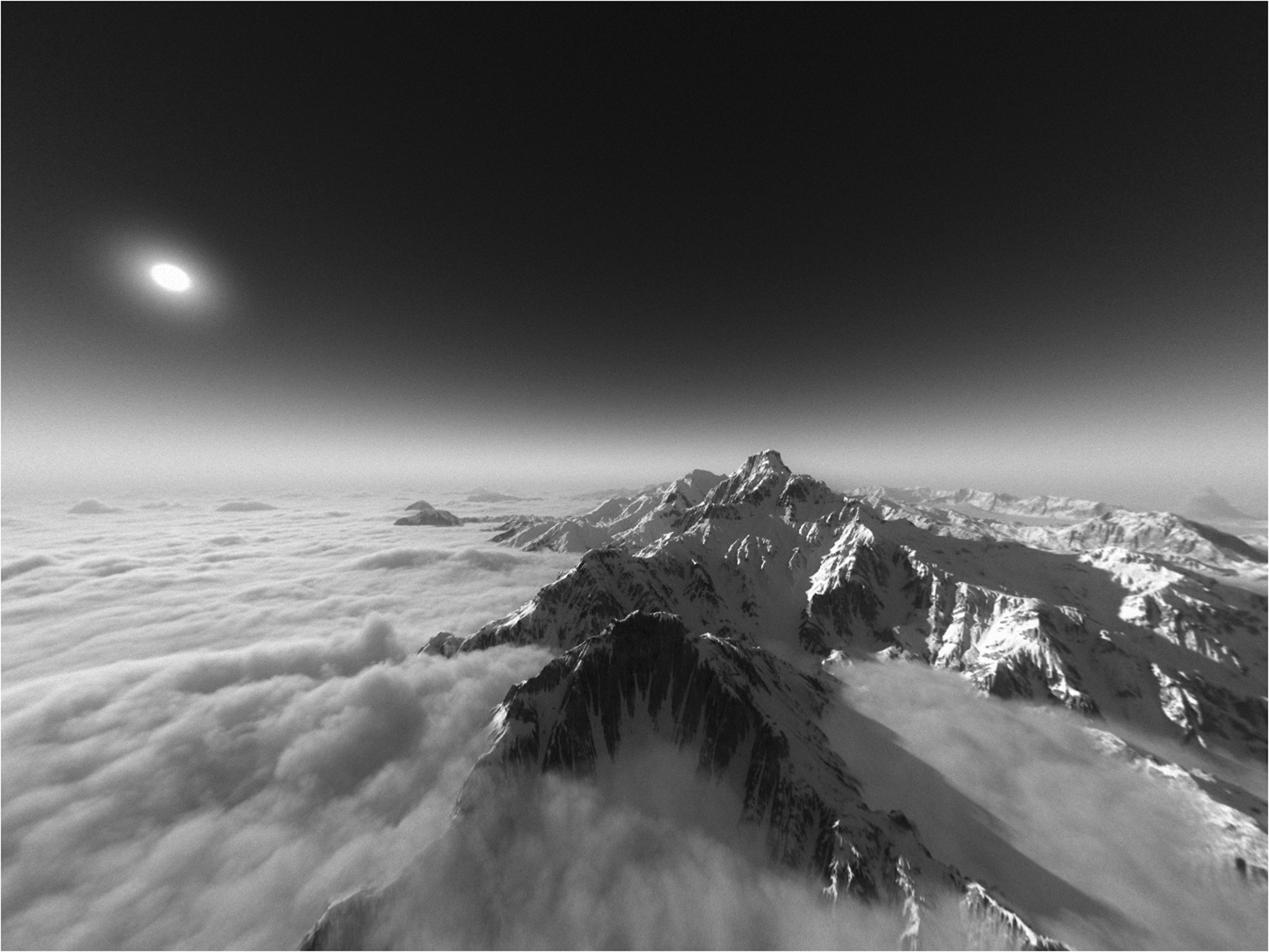
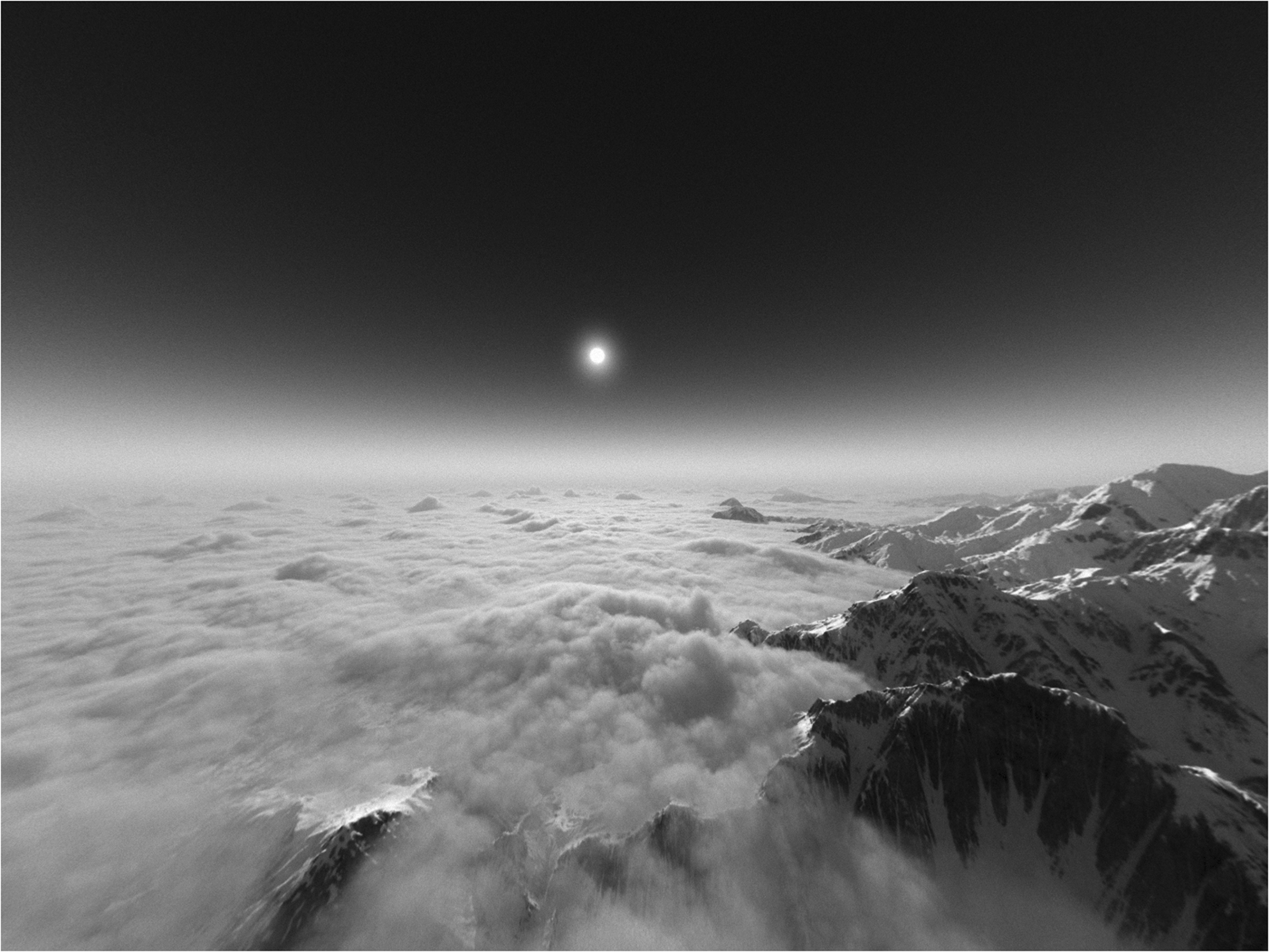
Burgin has had a career-long engagement with Barthes and was instrumental in introducing his theoretical work to the English-speaking art world. Belledonne, which deploys CGI and 3D imaging software, is Burgin’s first artistic engagement with Barthes as a subject in spite of the decades of theoretical writings in which he has worked with and through Barthes. Burgin’s projection provides a disembodied view of an algorithmically produced virtual environment of the Belledonne mountain chain in the Dauphiné Alps where the St-Hilare-du-Touvet sanatorium used to provide care for tubercular patients. Destroyed in 2018, the building lives on in Burgin’s work through the incorporation of a postcard into his projection work, a shot revealing a view of the old building from below and with a mountain looming over it. Part of a series of site-specific CGI projection pieces that Burgin has been making since 2010 that combine virtual environments, archival visual materials, and text (usually as intertitles), the works are constructed as projected image loops. These loops are fashioned in such a manner that viewers/listeners can and do enter at any point in the projection and will likely stay until they have reached their point of entry, ‘the reprise’ (2010: 371) or ‘ritornello’ operating as a kind of unfolding of the layers of the work. 2 Such a viewing condition is not unique to Burgin’s gallery projections, of course, but the situation of the attentive viewer provides Burgin with a specific set of demands that determine the final form of each projection piece. The circular or spiral nature of the image sequence as well as the texts require each part of the loop to be a synecdoche or metonym of the whole: the whole in each moment but also possessing an individual temporality evocative in its own instantiation. As such, the sections of image-sequences punctuated by textual interruptions means that Belledonne emerges as a set of fragmented images and text sutured together in a loop, or as a ‘circle of fragments’. This latter phrase is taken from the title of a short entry by Barthes (1977: 92–5), which serves as a key starting point for this article, opening up a conjoined thinking through of the visual and verbal rhetorics of both Barthes and Burgin.


Roland Barthes relished fragmentation, a disruption of narrative and linear or automatic readings. His defense of Alain Robbe-Grillet revolved around the wedge these novels put into the machinery of narrative, and thus in the thrall received realism and discursive logic held over readership. Barthes acknowledged having a utopian imagination and a utopian agenda, especially when it came to the potential of freeing oneself from the language of others through acts of literature (the novel) and a critical re-examination of what he called ‘the ancient rhetoric’. The fragmentation of narrative continuity that so upset many critics of the nouveau roman at the time provided Barthes with the primary source for his celebration of these works. The pleasure he took in them is articulated in his thoughts on ‘writing degree zero’ (Barthes, 1967), the critical work that first brought Barthes to a larger audience. The ever-elusive and fundamentally illusory dream of ‘writing degree zero’ recurs in Barthes’ work and appears in his autobiography presented as biography, Roland Barthes by Roland Barthes, defined as ‘the absence of every sign’ (1977: 87). The impossibility and fundamental openness of such an extreme zero degree is the seemingly true allure for Barthes, an effect found in numerous examples that he lists though the essence of which is unrepresentable. Fragments, therefore, played a privileged role in the escape from the tyranny of meaning imposed by doxa and received wisdom, sometimes called literature (Bishop and Manghani, 2019: 24). The love Barthes possessed for fragments finds a fragmented form in the title of the work that is translated into English as A Lover’s Discourse. The French title is Fragements d’un discours amoureux, which might playfully be mistranslated as the discourse of a lover of fragments. Perhaps the signature strategy for Barthes to resist discursive control over thought, and certainly the primary element of Burgin’s projection pieces for gallery viewing, the fragment as technique, content and political strategy figures strongly in works by both.

Eluding Discourse: Interruption and Failure
To write by fragments: the fragments are then so many stones on the perimeter of a circle: I spread myself around: my whole little universe in crumbs; at the center, what? (Barthes, 1977: 92–3)
In ‘The Circle of Fragments’ (Barthes, 1977: 92–5), a fragment on fragments (followed by a short entry on ‘The fragment as illusion’, p. 95), found roughly midway through Roland Barthes by Roland Barthes, Barthes ponders linguistic and visual stabs at interrupting the inevitable flow of language or image. Offering a set of meta-commentaries and self-reflexive peregrinations so indicative of Barthes’ style – littered with revealing thoughts on rhetoric, writing, haiku and drawing – he claims that he has always and only ever written in fragments. This is indeed his style. Defending this rhetorical and stylistic move, he returns to a line from Gide that claims ‘incoherence is preferable to a disorienting order’ (p. 93), a line he quotes here and also in ‘On Gide and His Journal’ (Barthes, 2000: 3), one of his earliest texts, from 1942. He continues, in third person, to say that from the start ‘he has never stopped writing in brief bursts’, with S/Z, Mythologies and The Pleasure of the Text serving as examples. In an act that lays bare his writing technique as technique, he offers self-reflexively a list of his favourite concepts of fragmentation as something like ‘a parlour game’ that includes ‘fragment, circle, Gide, wrestling match, asyndeton, painting, discourse, Zen, intermezzo’, and in the spirit of the game asks us ‘to make up a discourse which can link them together’ (1977: 93) – adding that if we did so, it ‘would be this very fragment’ (p. 93). The terms in this generated game of discourse could serve as an index of sorts, ‘a second text which is the relief (remainder and asperity)’ of the discourse. These terms that anchor the discourse also wander ‘interrupted’ in ‘the rationality of the sentences’ (p. 93). The bas-relief of the discourse simultaneously generates the discourse and disrupts it through its operational anchorage. It can be extracted from the rationality of the discourse, yet the rationality of the discourse can only function through it. The meaning remains even in the attempts to undermine it, or perhaps because of these attempts.

The Gide quote, of the choice between incoherence and disorienting order (as well as act of re-quoting), appeals to Barthes at many levels. It is also a false choice. Language and image offer more than these two options. Clearly a poststructuralist move outside of ‘the prison house of language’ (to borrow a phrase from Fredric Jameson), that Barthes had already made, remained a tactic, but it is one he presents in ‘The Circle of Fragments’ as something he has not managed properly. Resorting to a structuralist dyad, the formulation that incoherence – rupture, breakage, elision, cessation – offers a means to stave off the operation of language and its attendant regimes of knowledge, meaning and order (unavoidably partial and controlling) not only reflects a set of concerns much in the air at the time (as found in Derrida’s deconstruction, Foucault’s episteme, Kristeva’s intertextuality, Althusser’s interpellation, and Cixous’ jouissance, to name but a few) but also reveals the ever-evasive and futile attempt to find a position outside of language (or the text) – a world ‘exempt from meaning’ (Barthes, 1977: 87). The dream of ab nihilo existence necessarily excludes language and image. It might even exclude existence itself.
But no mastery or relief is possible, though play certainly is, as the recursive meta-fragment in Roland Barthes by Roland Barthes aptly performs. The false choice this fragment poses operates as if Barthes himself had never posited writing [écriture] as a third (but not dialectic) way, an alternative to the deterministic command of language and style as predetermined givens from history. The law of the neutral, he writes, would be to find a way ‘to disseminate intelligent stuff, as though between the lines (cf. the monochrome) of a flat, dumb (verbal) fabric’ (2005: 85). This dissemination would create meaning unintentionally and without falling into the trap of meaning and discourse. And neutral writing that allows writing degree zero is that which most offers a momentary respite from these persistent entrapments by allowing writing to avoid the many dead ends found in modernity … or so many hoped.
The neutral, as with fragments, releases the shackles of discourse and the plague of history from writing, preventing us from the tired self-delusion that abets history in constituting the transcendental subject as the arbiter of the conditions that formulate rights and subjecthood. This would be the hope of the purveyor of fragments and broken discourse when whistling past the graveyard of history as transcendental subject speaking the language of origin and telos, the subject outside the narrative it narrates. How much does this subject share, one can uncomfortably speculate, with the writer evading discourse – writing and meaning with all of its trailing metaphysical and institutional transcendentals by evoking or voicing the many complex moves of the neutral position.
Ever the rhetorician, Barthes might have appreciated the middle voice of this section’s heading, ‘Eluding Discourse: Interruption and Failure’, hinting at the problematic he takes up in this self-reflexive fragment. The heading suggests both that one evades discourse and that discourse evades one. Like time, discourse is the stuff of thought: preceding it, exceeding it, causing it, revealing it. The fragment offers a momentary respite in which the illusion of evasion liberates the thinking subject/writer/painter to imagine a world shed of the tyranny of meaning – only to be reminded that the flow of language, like that of time, flows within individuals’ thoughts and without them. The fragment simply reveals the irrelevance for discourse of the thinking subject. The middle voice erases the grammatical subject as semantic subject or agent of the action, and neatly evokes the challenge posed by discourse that Barthes wishes to meet with the fragment. And meet it he does, through a set of thoughts on how best to achieve the desired discursive break, on how best to ‘manhandle’ and ‘interrupt’ the text and destroy its ‘naturalness’, as he claims in S/Z (1975: 15).
In his consideration of fragments, Barthes professes a fondness for asyndeton and anacoluthon as ‘figures of interruption and short-circuiting’ (1977: 93) the near-fascistic operation and performance of language. Asyndeton means ‘unconnected’ in Greek and denotes bursts of language, accelerated by the eschewal of traditional punctuation and syntax, as in Sophocles’ line: ‘without looking, without talking, without making a sound’ (Oedipus at Colonus). However, Barthes neatly represses the fact that these bursts remain connected nonetheless through their flaunting of syntactic norms. Without the norms, we would not be able to identify asyndeton as asyndeton – that is, as a linguistic construction that breaks punctuation rules for an intended effect. Similarly, anacoluthon is the Greek grammatical equivalent of the non sequitur, meaning ‘it does not follow’. Yet it is only through knowing the proper sequence (i.e. what should follow) that we can determine that the sequence has been broken, and thus, as with parody or satire and their relation to the logos they presumably oppose or challenge, the sequence (or logos) is reaffirmed.
Such is the reluctant conclusion Barthes arrives at when he bemoans that ‘even within each fragment parataxis reigns’ (1977: 93). The drive to thwart grammatical subordination, to eliminate hierarchy in language and thought, caught inextricably as it is in grammar, does not allow the ‘meta-’ position. Resorting to atomistic or stochastic rhetorical and syntactic tricks only serves to affirm the power one wishes to elude or elide. The fragment operates as an illusion. Which is what he writes in the next entry: ‘the fragment as illusion’ (p. 95). We could take this thought a step further to say that the fragment is an illusion, the product of all that it is not and has attempted to distance itself from in a discursive formulation. The ghost of the discourse allows the embodied fragment to walk amongst us unencumbered.
None of this precludes the allure of and the desire for the fragment or the neutral in the Heraclitian flux of language and images in which we swim. This is the continuous flux his ‘sequence of fragments’ on the Neutral hoped to realize, as he notes at the start of his seminar (2005: 10). The sequence of 30 figures is meant to conjure the neutral, not define or explicate it, derived as it is from a random set of numbers and letters gleaned from a statistics journal (as if Barthes had suddenly fallen under John Cage’s sway). The same process is at play in ‘The Circle of Fragments’. So, besides the obvious structural assembly of Barthes’ writing out of fragments and the aforementioned resemblance to Victor Burgin’s projection assemblies of image and language sequences (asyndeton), what can we take from this exploration of the desire for the fragment’s doomed operation? One answer might reside in temporality and its intersection with space and representation, when Barthes likens the fragment to the ‘thought-sentence’ (1977: 94), a term that complements Burgin’s ‘sequence-image’, in which a specific sequence of moving images forms a kind of spatial unit in memory and experience, one that enfolds the synchronic and the diachronic within a single frame and thus falls outside of standard cinematic and photographic theory (Burgin, 2004: 27–8). Another answer might be musical, or rather an ideal that might be musical, constituted in ‘a high condensation’ in which ‘development’ is countered by ‘tone’ and timbre (Barthes, 1977: 94). For him, intermezzi and fragments in Schumann as well as Webern serve as an exemplar of musical interruption through iteration (1977: 94). All of Schumann, Barthes argues, constitutes an endless composition of insertion, of intercalation.
This leads him to ask: ‘What is the meaning of a pure series of interruption?’ (1977: 94), knowing full well purity here cannot play a part, for an interruption has to be of some inherited discursive or semantic regime, a context that the Text (fragment) can disrupt. Still another answer might be aleatory, the role of chance in the sequences assembled so ‘that the meaning must not gel’, must not become ‘antithesis’ and thus consolidate the meaning (and discourse) it wishes to evade (Barthes, 2005: 11–12), while knowing full well gel they must through the audience/reader engagement of the sequence of fragments. Barthes wants to undermine doxa in his assemblage while Burgin wants attentive spectatorship, both reliant upon the nature of reception and hence the aleatory.
Yet another answer might be anthropological, when the fragment as a strike, or as a blow, becomes linked to the torin or broken opening of Buddhism, or ‘what once would have been called a “turn”’ (1977: 94). Here, for Barthes, without but the pause of a comma, Buddhist thought becomes conflated with Greek drama, in which the movement of the chorus is the turn, counter-turn and return (or strophe, anti-strophe, epode) that marks a kind of dialectic argument of the citizens on stage: theatre and/as theory found in movement. The turns of Greek drama merge with the turn of Burgin’s CGI camera in an impossible panorama, an incorporeal fulcrum of perspective made visible. The impossible panorama is inevitably built on the epode, the return, the turn of the return which can never be achieved, for to return after the panoramic sweep, or the projection loop, is to be forever changed by the process: the impossibility of repetition. The illusion of broken discourse provides Barthes’ justification for writing his Journal (1977: 95) as he circles back to Gide: yet another circle of fragments.
The Loop as Gyre
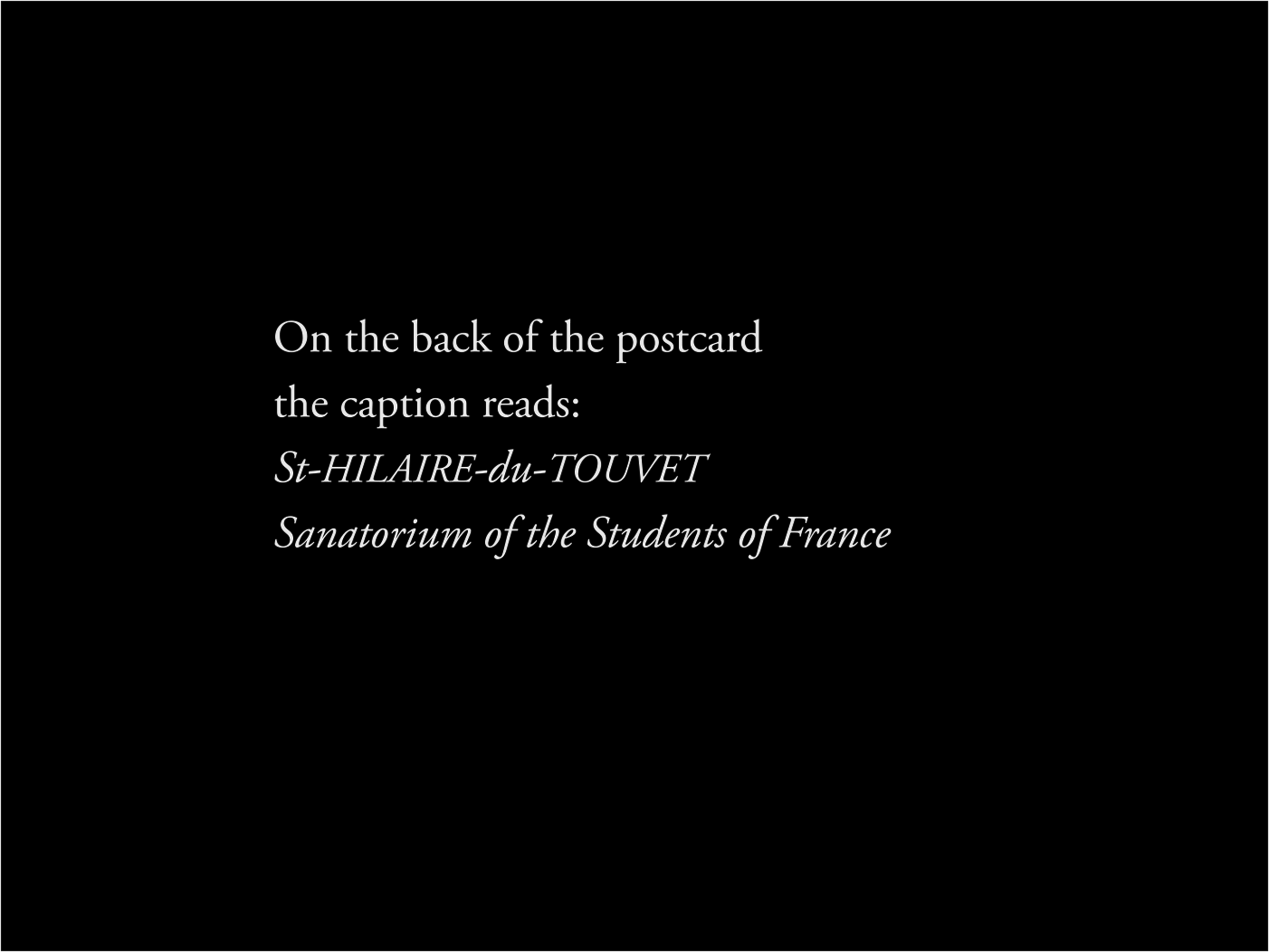
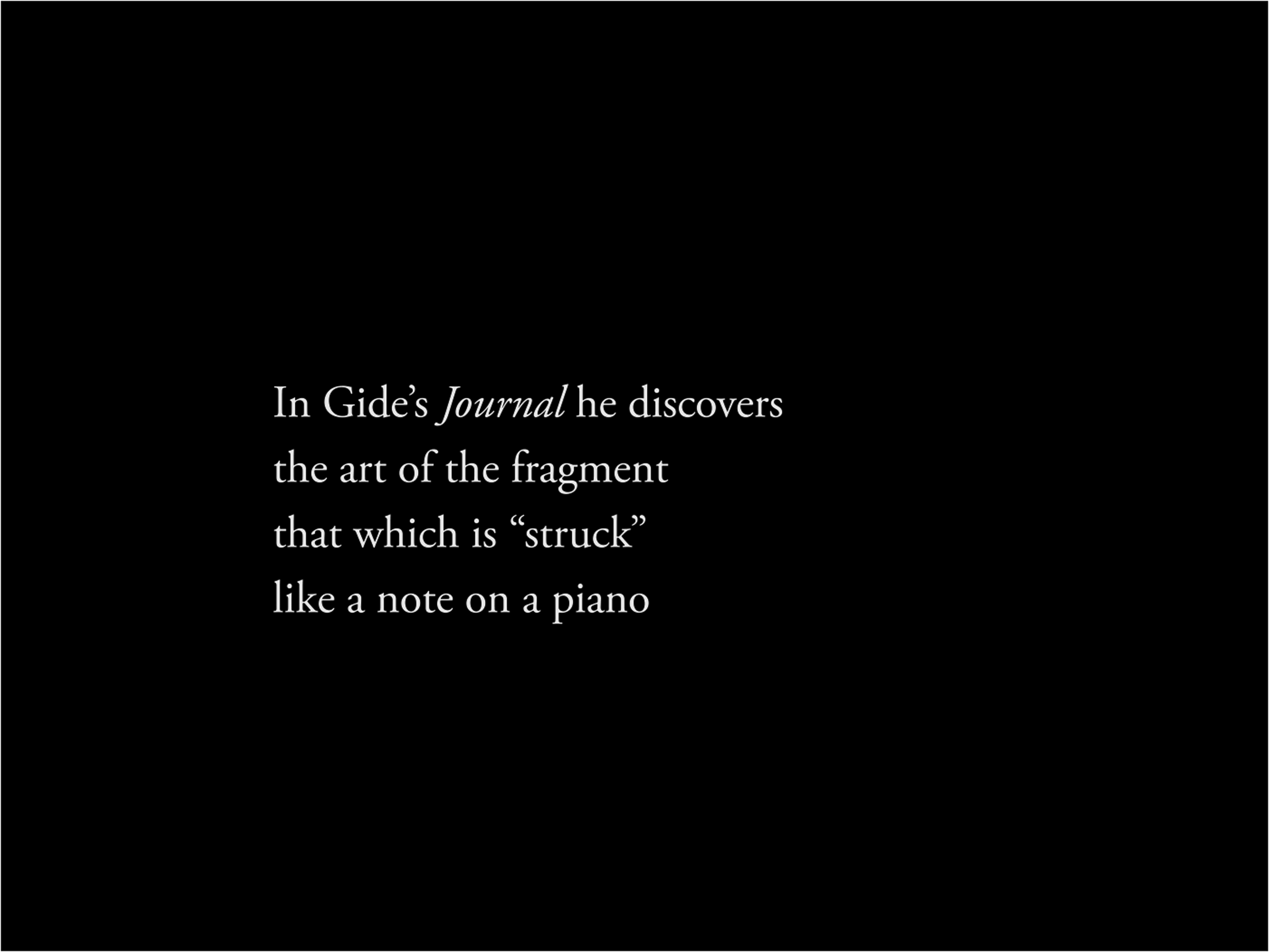
Gide and his journal also figure in Burgin’s projection work, and do so in two intertitles that link fragments to one of Barthes’ favourite fragmentary poetic forms, the haiku. In Gide’s Journal he discovers the art of the fragment that which is ‘struck’ like a note on a piano He will use the same analogy to speak of the haiku (Victor Burgin, Belledonne, 2016 [consecutive intertitles]) the work therefore perpetually loops, with no particular ‘beginning, middle and end.’ In all, the conditions of spectatorship are similar to those of painting, where the relation to the work is one of repetition, or more accurately reprise, and where the ideal viewer is one who accumulates her or his knowledge of the work, as it were, in ‘layers’ – much as a painting is created.
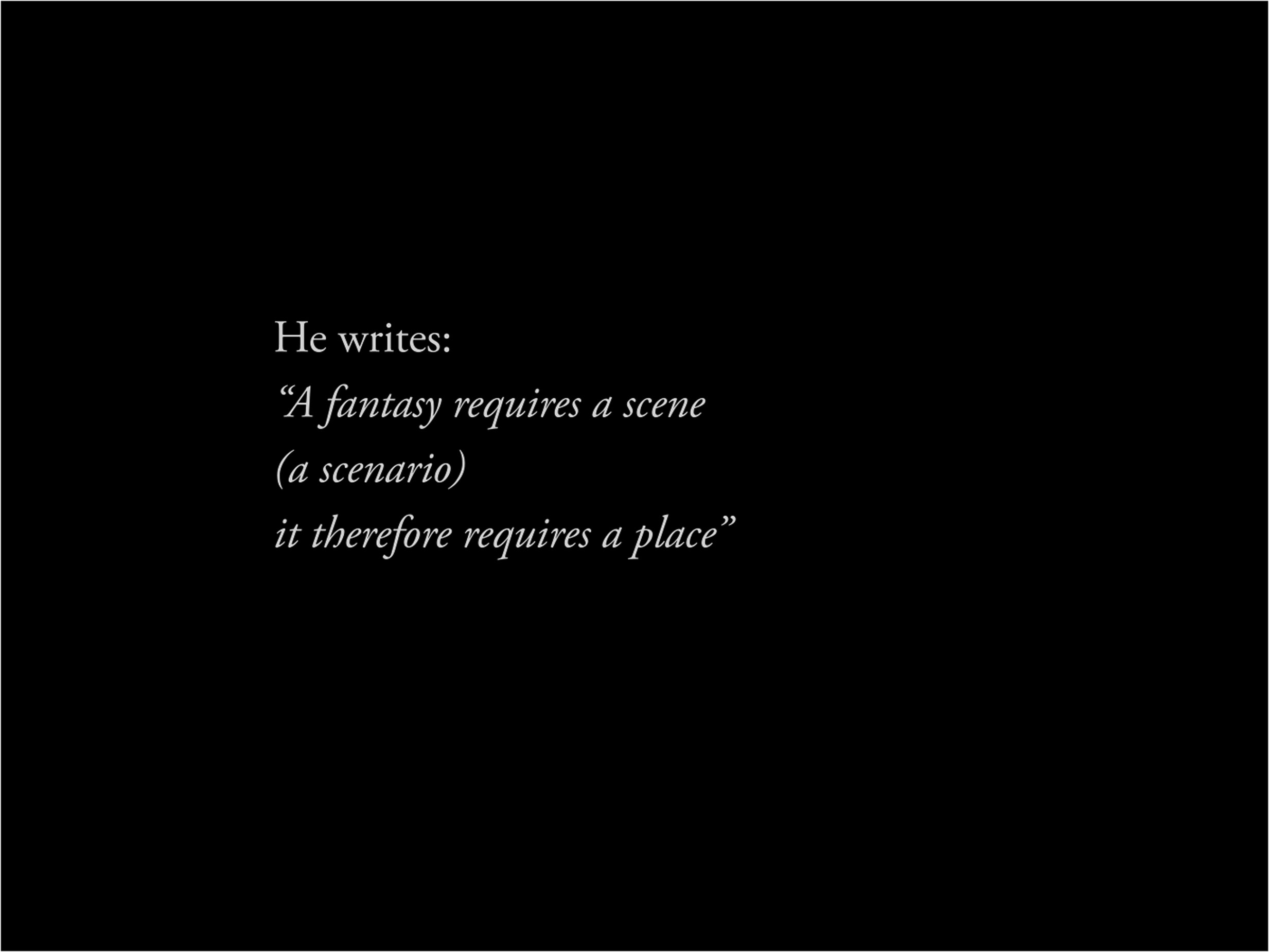
He writes:
A fantasy requires a scene
(a scenario)
it therefore requires a space
(Victor Burgin, Belledonne, 2016)
3
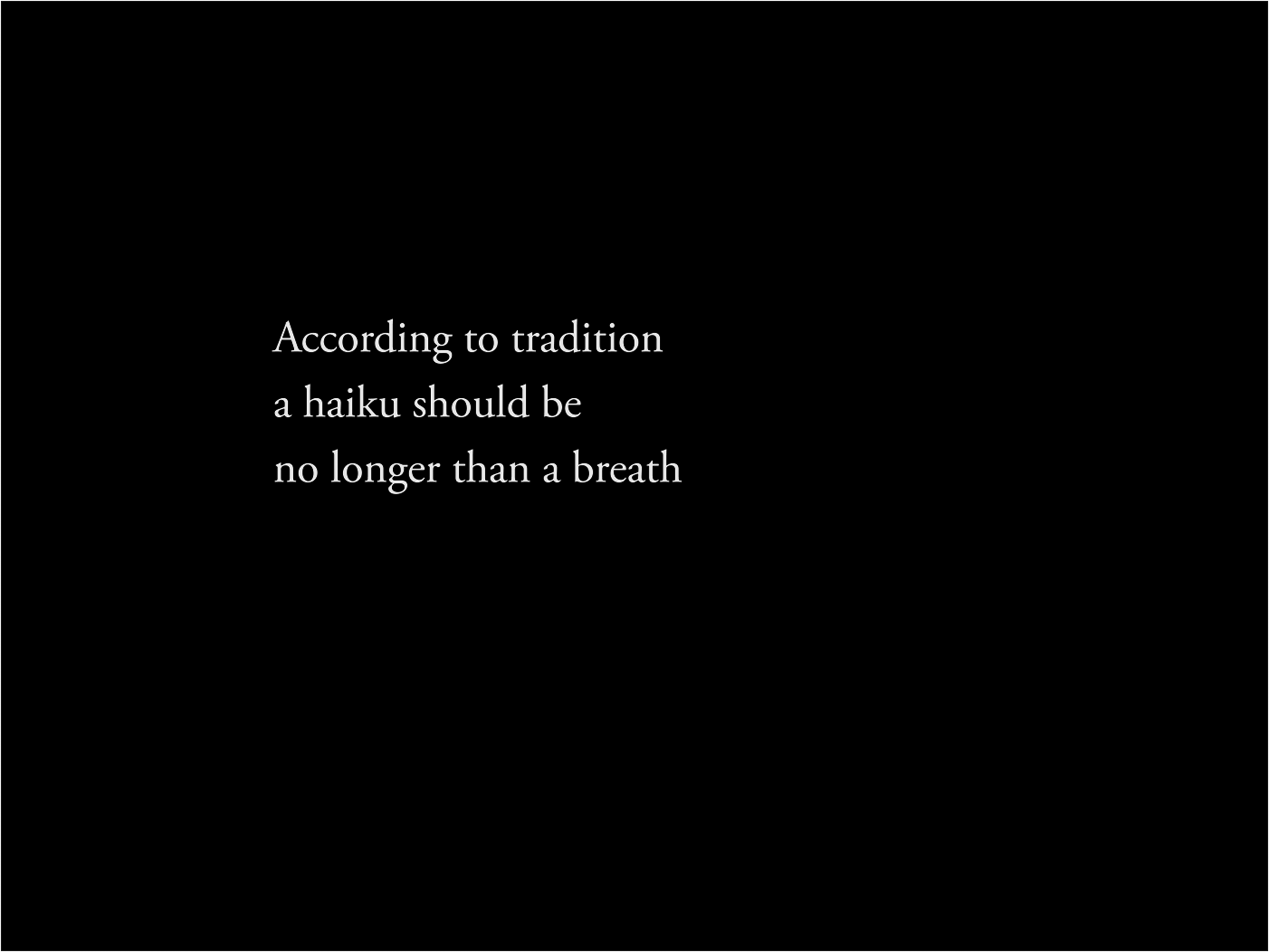
The view of thick mountain cloud cover is sporadically broken by the spiky peaks of the range. The ridged spines of the range plunge in glacial vertical black lines as snow-tipped tops blend with the fluffy cirrus clouds clinging to their sides. This panorama is airless, hermetic in its formal construction and in its affect: mountain air, though supposedly good for tubercular patients, is thin and cold. Viewers of this imagery, too, experience the oxygen-deprived site and pull for air as if they shared the sanatorium with Barthes, which had ‘the appearance of a passenger deck/on an ocean liner on a sea of clouds’. The tubercular landscape pulsates as if in laboured, shallow breath as the revolving incorporeal eye turns. According to tradition a haiku should be no longer than a breath (Burgin, Belledonne, 2016)
Thaw in the valley On the road by the river Columns of soldiers (Burgin, Belledonne, 2016)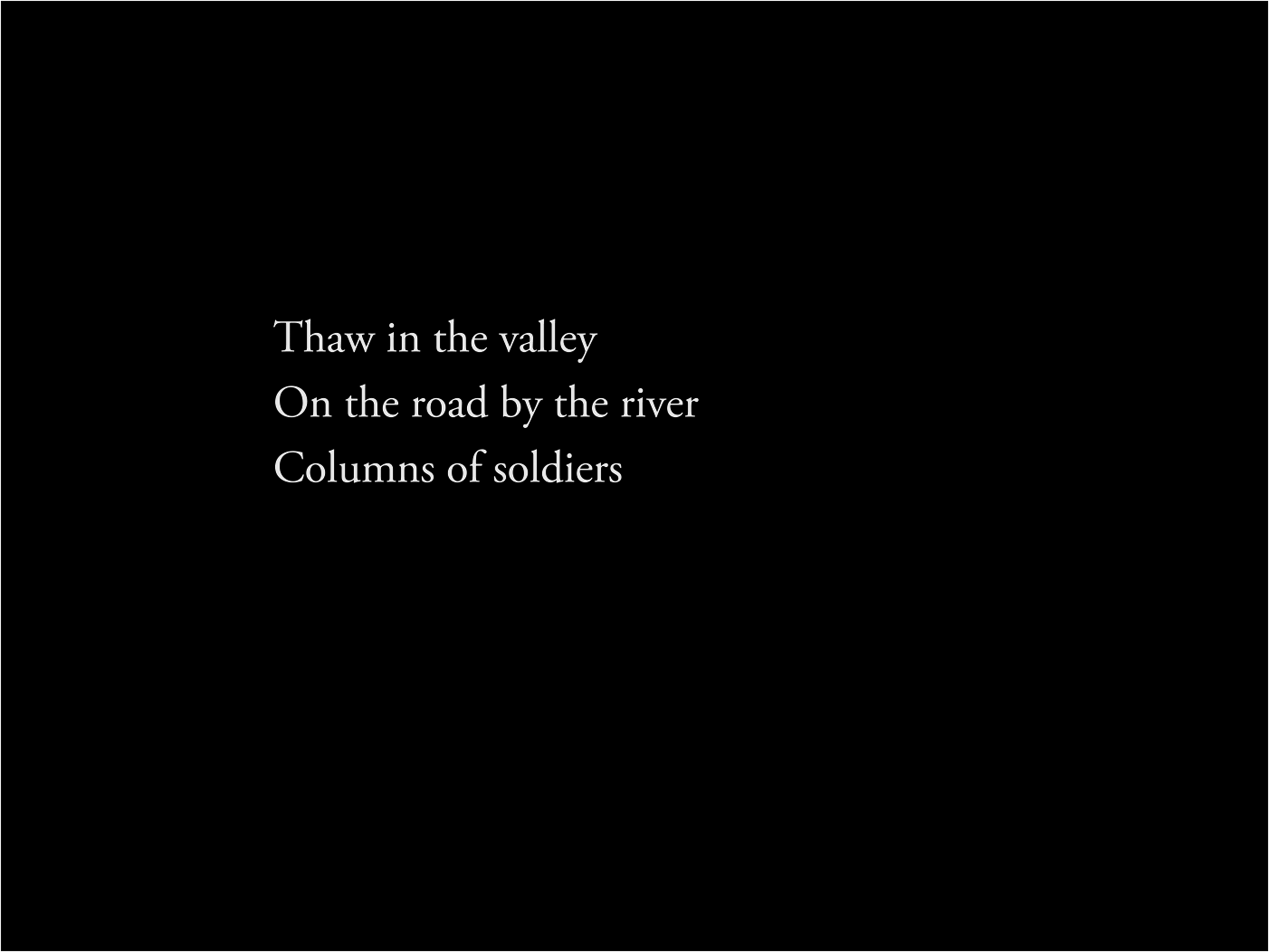
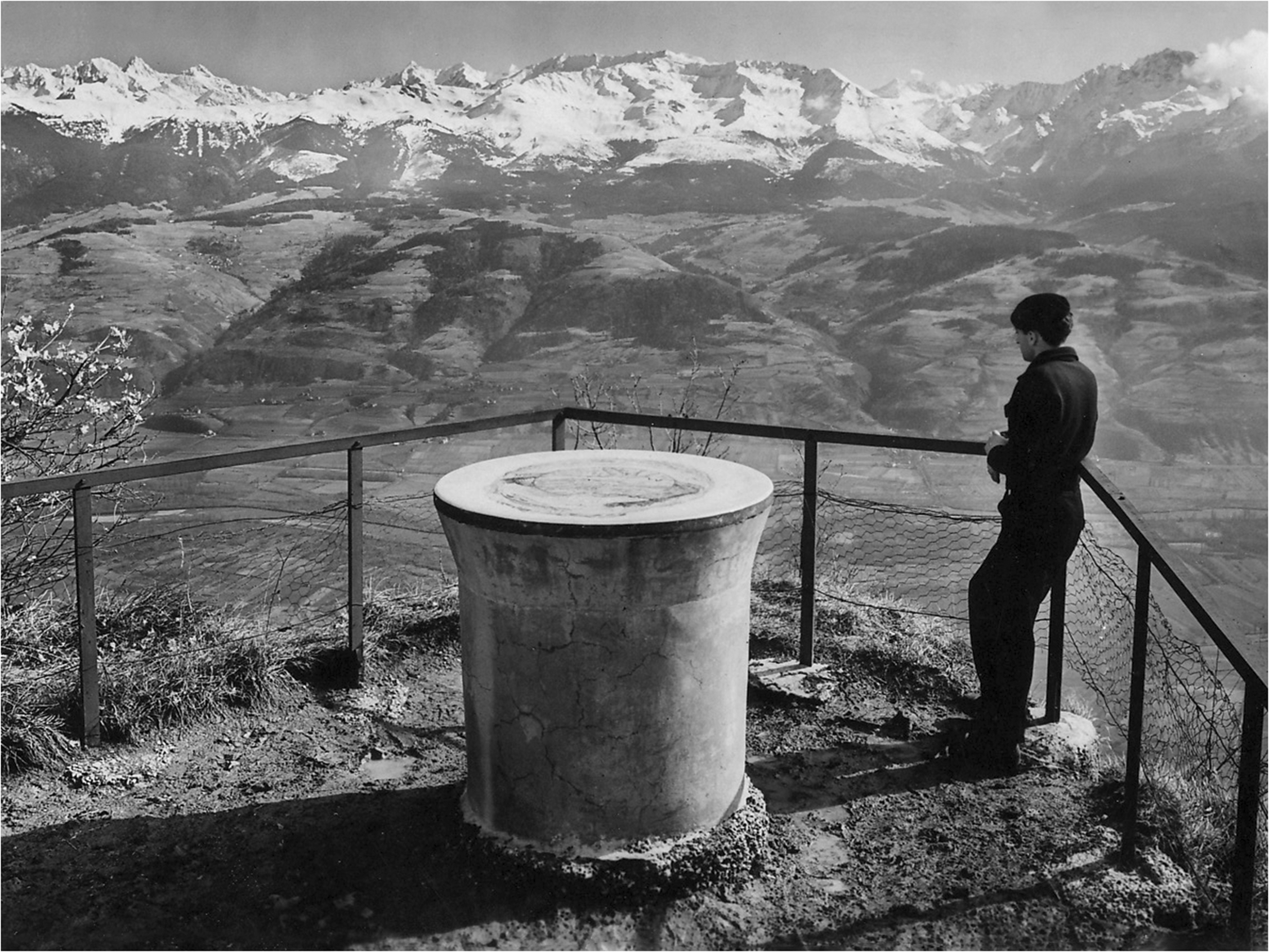
How long is a projection loop? It has a ‘running time’ but that is not its length. As with a painting, the work’s temporality deepens with, and depends on, extended observation. What is still, or seemingly constrained by its unfolding, thickens with engagement and attentive regard. Following the projection loop, and watching it accrue layers of association and evocation, we can note how the loop thickens and tilts to become a gyre, not a closed circle after all. The gyre covers the same terrain but in a different way, or marks the same movement over the same area but in a vertical stack that climbs upward. The long time scale delineated in the rise and fall of human civilizations found in the cycles of Vico’s corso e ricoroso, which were rendered spatially as gyres by Yeats and Joyce, occur in Belledonne in the brief breath of haikus filled with portent. The loop widening in Vichian expansion and collapse offers a history different from that of linearity, and especially of progress. The loop becomes gyre and tells a history of repetition in which repetition is impossible.
(The Neutral) Apostrophe
Irrational streams of blood are staining the earth; Empedocles has thrown all things about. (W. B. Yeats, ‘The Gyres’)
To break this grip, one widely argued by others in the French intellectual milieu of the time but not necessarily approached through rhetorical inheritance, Barthes turned to the linguistic and critical potentialities of the pre-Socratics, especially in his late seminars. Derrida and many of the poststructuralist thinkers in France found the pre-Socratics of much use for rethinking the Western intellectual tradition as inherited from Plato and Aristotle. Bachelard’s frequent engagement in the 1940s with Hesiod and his elements meant that this kind of alternative Western tradition constituted much of Barthes’ intellectual environment. Although pre-Socratic thought and rhetoric served as the foundation and springboard for the emergence of the discursive regimes of codified Aristotelian logics and rhetoric and did so through the fundamental link between the birth of rhetoric and property to settle cases of dispute and litigation, pre-Socratic thought and rhetorical practice embodied lost pathways for the potential development of the West: an ‘other’ West in potentia. The texts of these thinkers as they have been unearthed and discovered, all in fragments, are riddled with ellipses (Barnes, 1979). They constitute the fragment of fragments, the potentially ultimate disruption of received knowledge and linear narrative: the railroad tracks of thought, language and institutional power. The pre-Socratic works, as physical entities, as texts, embodied Text (in Barthes terms) and did so as apostrophes: as holes and marks of absence.
Apostrophe operates as a rhetorical and a poetic device, as well as a punctuation mark. 4 As a rhetorical move, it is a turning away from the audience to address someone or something else; in poetry, it is an address to someone or something absent from the poem, dead or inanimate (such as the sea or the moon) or abstract (like a concept); as a punctuation mark, it indicates possession as well as the absence of letters in a contraction: the removal of letters that results in a fragmented combination of words still recognizable due to their orthographic conventions. 5 The apostrophe has as one of its component parts the root ‘strophe’, meaning ‘turn’, as in the first two movements in Greek drama: strophe and anti-strophe, indicating two opposing directions in which the chorus traverses the stage. The prefix ‘apo-’ denotes spatially the ideas of ‘away, off, apart’, amongst other usages. As a poetic turn, the spatial elements are rather like invocation, bringing into being through the elocutionary act but also addressing abstract concepts without anthropomorphizing them. By allowing the abstraction to remain abstract but with some sort of sensibility or cognition or even agency, the apostrophe allows the speaker/writer latitude to question subject-object relations, especially in terms of power or control. Roland Barthes by Roland Barthes is an apostrophe to the novel Barthes would never write as well as to the author who would never write it – that is, an apostrophe to Roland Barthes, novelist. 6 Belledonne is an apostrophe, not an elegy. It is an apostrophe to Roland Barthes, written and imaged in third person.
Barthes’ call for a new history of ancient rhetoric was a call to understand ‘the rhetorical code’ not through ‘a technique’ or ‘an aesthetic’ or even ‘an ethics of rhetoric’, for he felt these were impossible (Barthes, 1988: 92). Thus a history became almost the only option, given the many failures of literature to shed light on the conditions of its existence and operation. Roland Barthes by Roland Barthes is exactly the kind of rhetorical exercise that he called for and that he wished to avoid when it comes to the demands of discourse, in spite of its employment of fragments and entries in nearly-alphabetic order: a nod to the ‘neutral’ taxonomy of the encyclopaedia. But it can also be read as the desire to rescue a specific ‘eroticized rhetoric’ from the dusty platitudes of insipid formalizations as found in modern rhetorical practice and instruction. This eroticized rhetoric is articulated in Plato, who though eschewing the pre-Socratic influences of the Sophists, considered true rhetoric to be what he called ‘“psychagogy” (formation of souls through speech)’ (p. 19) – which was part of the pre-Socratic rhetorical toolbox. Speaking the communal soul into being and forming it through enunciation comes down from Homer and other early Greek poets and thinkers. This act can also be understood as addressing the receptive souls of one’s audience. For Barthes, though, the attraction resides in its potential for dialogue as an expression of inspired love, of communing and thinking in common. It puts types of souls into correlation with types of discourse and thought. ‘Rhetoric’ in this form, he writes, ‘is a dialogue of love’ (p. 19). The eroticized rhetoric reinvigorates staid forms and sings new ones into being. It allows for the promise of apostrophe to address the absent rhetorical alternatives to the current regimen. That is its gesture, a turn to alternatives we have always had. This is the turn of Roland Barthes by Roland Barthes, the journal as autobiographic novel of rhetorical possibilities: the turn as Text.
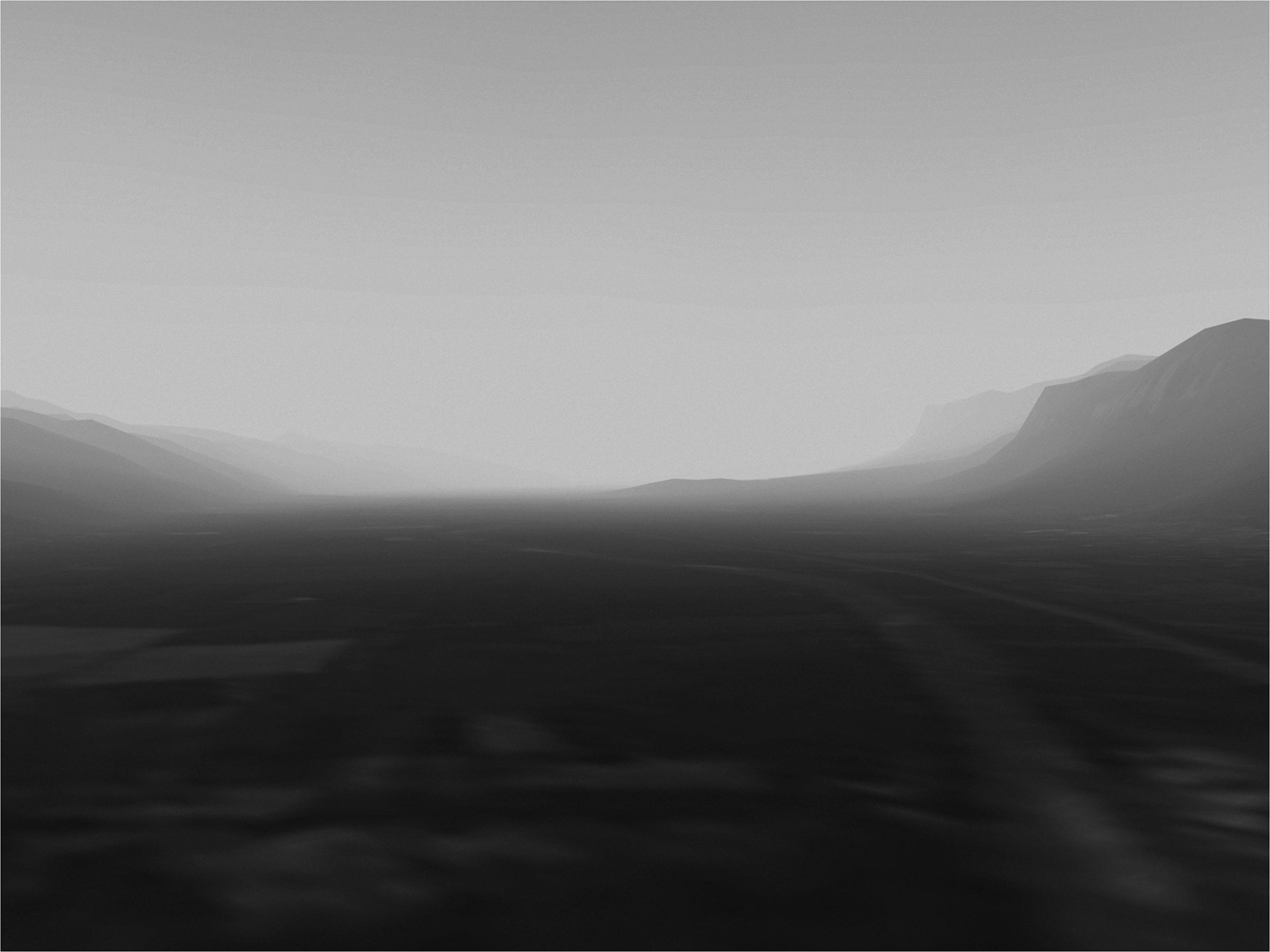
Apostrophes break discourse by drawing attention to and overturning the site of enunciation. They show the constructed nature of seemingly natural address by breaking the standard rules of speech (or writing) by addressing the dead, the absent, the inanimate, those for whom a response is impossible. Belledonne is an apostrophe, as much to Barthes as from him, as much with Barthes as about him in its visual rhetoric of looping fragments. Apostrophes become fragments wedged into the flow of unconscious discourse, of playing by the rules, of the shackles of discourse that Barthes wished to highlight and undermine. The language of institutions, and Barthes asks if there are any institutions without language (p. 92), scale out to become the rhetoric of society and politics and scale down to become routinized thought. Both Barthes and Burgin in their textual, writerly and painterly rhetorics of language and vision use the metonymic capacities of fragments to scale from institutional practice to individual speech to reveal the state’s power to codify the signifier (p. 93) and open the ground for new practices of language and seeing.
Epode (without Return)
The rhetorical turn and the turn of the gyre: torin – turn away, speak absently into the absence, to turn and turn away – apostrophe, tropes and turns that address the absent and the dead – apostrophe marks absence, holes and possession – the topos of possibility, the topos of play to stay the delusions of progress and narrative as they are routed back and away – ‘poli’ means backward, in opposition, in Greek – and yields paliilogia, a rhetorical device of repetition – the metempsychosis of the move manifests itself as parable and parabola: the squashed, closed circle of the Text/projection – parables provide the reverse of synecdoche, the whole resides in every part, thus we eliminate progress – while no part or attribute can stand for the whole, no whole can stand for the whole either …