




Abstract
As the introduction and lead article for a special issue of Theory, Culture & Society, ‘Neutral Life/Late Barthes’, this article offers an overview of the ‘new’ Barthes that emerges from the late writings and recent ‘Barthes Studies’. The account centres upon the posthumous publication of Barthes’ three key lecture courses delivered at the Collège de France, at the end of the 1970s, which reflect his preoccupation with the everyday, yet reveal a new degree of sophistication, both formal and conceptual. Presented in their original note form, the lectures present perhaps the clearest (if incomplete) affirmative project of Barthes’ entire career. The Neutral in particular is pivotal in understanding an ethics of the late works. While Barthes is perhaps most cited for his rumination on the temporality of the photograph, the lecture courses give rise to an ethics of space and distance, rather than of time and telos. Crucially, for Barthes, the Neutral is not neutrality; it is not divestment, but ‘an ardent, burning activity’. In establishing Barthes’ ethics of a Neutral Life, the articles closes – with reference to Derrida’s mourning of Barthes – with a reminder to read Barthes again, or rather a reminder of our current postponed reading of him.
It is unusual, if not unique, for a critical theorist to be the sole subject of a major public exhibition, but in November 2002, the Centre Pompidou in Paris opened R/B, an exhibition of the life and works of Roland Barthes. A full-page review article, which appeared in The Independent on Sunday, playfully noted the happy coincidence ‘that the most endearing champions of popular culture, in theory and practice, are each pronounced “Bart” – the professor would have enjoyed consanguinity with The Simpsons’ (cited in Manghani, 2013: 11). It is a humorous remark, but there is a serious point too. Barthes’ conceptual thinking impacted upon the very culture he examined, famously introducing a way of theorizing the plasticity of all cultural codes. Certainly the cutting wit of The Simpsons as well as the appetite of a sophisticated audience able to read off its layered meanings relates well to Barthes’ writings on popular culture, including his critical reflections on the status of semiotics in the 1970s. Here, Barthes (1977: 165–9) refers to ‘semioclasm’ as the need to articulate a new approach to overcome the ‘mythology doxa’ that in part had been created by his own contribution to semiotics. Of course, while the collected essays and final theoretical exposition of Mythologies, originally published in 1957, remain the most likely introduction anyone has to Roland Barthes, the impact of his work goes far beyond this single volume.
Barthes’ relatively short career spans the period of the 1950s through to the end of the 1970s. The beginning of his life was severely hampered by tuberculosis, forcing him to spend much of his time in a sanatorium, and his death came prematurely at the age of 64, just five years after taking up the prestigious role of professor at the Collège de France. His acceptance of the Chair of Literary Semiology at the Collège de France can be understood as something of a disruption to the establishment. In his biography of Barthes, Louis-Jean Calvet (1994) reveals how Michel Foucault’s report sponsoring Barthes’ professorship is somewhat double-edged. Foucault refers to Barthes’ work as trendy and faddish, yet equally notes how the work reveals ‘existence of more deep-rooted and fertile cultural phenomena’, and suggests the importance of hearing from ‘outside the university’ (cited in Calvet, 1994: 212–13). Barthes echoes such remarks in his inaugural lecture. The establishment of his chair, he suggests, ‘is not so much the consecration of a discipline as the allowing for the continuance of a certain individual labor’, and adds that ‘semiology will replace no other inquiry here, but will, on the contrary, help all the rest, that its chair will be a kind of wheelchair, the wild card of contemporary knowledge’ (Barthes, 2000: 471, 474).
In the 1950s and early 1960s, he wrote extensively on theatre, though he is most known in this period for his first major publication, Writing Degree Zero, in 1953 (a response to Jean-Paul Sartre’s What is Literature?) and his anti-establishment On Racine, a much debated volume of three essays (published in 1963) that is significant for its bringing together of Marxist, psychoanalytic and other critical thinking. Barthes emerges, then, as a key literary theorist from the beginning of his career. However, he is also widely referred to as a founding figure in structuralist semiotics (as acknowledged by his position at the Collège de France), with key publications including the aforementioned Mythologies (in 1957), Elements of Semiotics (published in 1964) and The Fashion System (published in 1967, an example of ‘High Structuralist’, pseudo-scientific semiotics). Through these works, he not only helped give political depth to Saussure’s speculative theory of semiotics, but he also led the way in applying semiotics to all manner of cultural phenomena (including much visual culture) and in so doing can be credited, more than any other semiotician, with having given semiotics a wide and popular appeal.
By the beginning of the 1970s, prior to entry into the Collège de France, Barthes is more readily associated with post-structuralism. His essay ‘From Work to Text’ (Barthes, 1989: 56–64), his pronouncement of the ‘death of the author’ (Barthes, 1989: 49–55) and The Pleasure of the Text (1975) are key statements from this period, as well as A Lover’s Discourse (1977), which became a bestseller in France. His final book, Camera Lucida (1980), is cited as a notable post-structuralist or ‘writerly’ text, not least due to its portrayal of a deliberately idiosyncratic ‘theory’ (that critiques earlier semiotic terminology). However, the book is a highly personal and speculative account of photography, which has had a curious and sustained afterlife (Batchen, 2009; Elkins, 2011). Arguably, the true import of Barthes’ late writings has been somewhat obscured by overexposure to this final book on photography – a subject that Barthes himself notes is not one he was particularly interested in.
This article – and the issue of Theory, Culture & Society it represents – seeks, in part, to redress the balance and reflects the fact that there has been something of a revival, and indeed re-positioning, of the critical interest in Barthes’ writings. Stemming from around 2002, with the aforementioned Pompidou exhibition (Alphant and Ĺger, 2002), a ‘new’ Barthes has emerged, informed by the posthumous publication of a wide range of materials. Most significantly, this includes his final three lecture courses at the Collège de France in the late 1970s. The first of these was only published in French in 2002, and more recently in English by Columbia University Press under the titles of How to Live Together (2013a), The Neutral (2005), and The Preparation of the Novel (2011). In addition, Mourning Diary was published in 2010 and Travels in China in 2013. These later writings have prompted renewed scholarship, captured for example by ‘The Renaissance of Roland Barthes’ conference held in New York in 2013, with key speakers including Rosalind Krauss and Jonathan Culler. 1
This issue of Theory, Culture & Society, ‘Neutral Life/Late Barthes’, offers further consideration of his late work, in particular the lecture course The Neutral, which can be said to give rise to a social ethics, especially when read in conjunction with the prior lecture course, How to Live Together. Barthes’ interests, as they come to light in these courses, are concerned with social space and distances, with a reading of structures as intensities and suspensions, and with differing rhythms, notably ‘idiorrhythmy’, which situates a delicate balance of solitude and sociability. As per the brief account given above of Barthes’ career, it is common to hear of a shift or break in his thinking, from structuralist to post-structuralist. However, this underplays continuities throughout, which pertain to the construction of his lecture courses. Barthes’ use of fragmentary and deconstructive forms, for example, dates back to Michelet, originally published in 1954. And it is often forgotten that his most well-known text, Mythologies, while frequently cited for its final theoretical text on semiotics, is actually in the main a selection of witty and in some cases quite ambiguous essays. In ‘Late Barthes’, Jonathan Culler (2013) argues for the continued importance of the early work, for what he refers to as its ‘ludic systematicity’. Indeed, he is mindful of ‘the regressions of late Barthes’ as being potentially seductive. Nonetheless, he suggests, ‘astute readers should be capable of keeping those analyses [of the early works] in play so as to profit from them, while still finding stimulation in the late Barthes and in the possibilities his conflictedly metalinguistic writing provides’. It is in this vein that this article and the other contributions to this issue place attention upon the late writings.
Furthermore, as made explicit at the close of this text, with reference to Jacques Derrida’s memorial essay on Barthes, the spirit of inquiry of this article turns on the double meaning of ‘late’ Barthes. The legacy of Barthes often comes before our reading of him, which, when turning to the later writings, can overshadow, but equally offers a necessary resource. It is important to keep in mind the historical, intellectual context in which Barthes was working but also, as a reader of late Barthes, we might position ourselves as custodians of new work, which is for another generation to write.
Initial preparation for this issue began in 2015, which was the year of Barthes’ centenary. While the doxa would suggest it only right to mark such an occasion, Barthes, with his inimitable take on both the classification and declassification of culture, would surely have taken delight in remarking that one hundred years is as arbitrary a figure as any other. A centenary, he would likely suggest, all too readily attenuates the reverence held for a person, their significance appearing as if Natural, not Historical (to adopt his characteristic use of capitalization). Writing in the Times Literary Supplement, in reviewing Tiphanie Samoyault’s (2015) critically acclaimed new biography and the centenary exhibition held at the Bibliothèque Nationale de France, Neil Badmington (2015) refers to a ‘Barthes-athon’ taking place over the centenary year. By the end of 2015, he notes, ‘celebratory events will have taken place in Paris, Bordeaux, Orthez, London, Providence, Lisbon, Tarku, Leeds, Cardiff, La Paz, Londrina, São Paulo, Bucharest, Bayonne, Kaslik, St Petersburg, Buenos Aires and Zagreb’. Added to which, the fashion house Hermès unveiled a silk scarf inspired by Barthes’ A Lover’s Discourse (1977). There have been a number of significant new publications. In addition to the aforementioned lecture courses, of Barthes’ own work we have now a large volume of previously unpublished writings, including Album: Inédits, correspondences et varia (2015), and new editions of La Préparation du roman (2015) and L’Empire des signes (2015). In English translation, five volumes of previously untranslated material have been released by Seagull Books. Of volumes about Barthes, these include: Fanny Lorent’s (2015) Barthes et Robbe-Grillet: Un dialogue critique; Magali Nachtergael’s (2015) lavishly illustrated Roland Barthes contemporain; Chantal Thomas’s (2015) Pour Roland Barthes, and Phillipe Sollers’ (2015) L’Amitié de Roland Barthes, along with the newly established open-access journal Barthes Studies (School of English, Communication and Philosophy, Cardiff University) and a special issue of L’Esprit Créateur, ‘What’s So Great About Roland Barthes?’, edited by Thomas Baldwin, Katja Haustein, and Lucy O’Meara (L’Esprit Créateur , Vol. 55, No. 4, 2015). And Barthes continues to have purchase for debates within performing and visual arts, notably, for example, with the exhibition and publication Barthes/Burgin (Bishop and Manghani, 2016), and To Seminar, an ‘exhibition-as-seminar’ and publication produced by BAK (Basis voor Actuele Kunst) in Utrecht (Slager, 2017).
For all the ‘industry’ that surrounds the recent publications of and by Barthes (echoing in some respects the wealth of publications by and about Walter Benjamin over the last couple of decades), we gain a significantly new reading of Barthes. The first biography, by Louis-Jean Calvet (1990), came out a decade after Barthes’ death. Diana Knight (1997a: 17) notes the conflict with François Wahl, Barthes’ editor at Éditions du Seuil and then literary executor. Wahl was ‘hostile to the very idea of a biography (supposedly on the grounds that Barthes himself would have been similarly disapproving)’, and subsequently Calvet was denied access to important collections of private correspondence. Of greater significance, perhaps, Wahl refused to allow publication in any form of the lecture courses at the Collège de France, given between 1977 to 1980, which of course proved to be the final years of Barthes’ life. For Knight, working on her major study, Barthes and Utopia (1997a), the lack of access was ‘especially frustrating’, not least because of explicit utopian themes of the late work (particularly the first course, How to Live Together). Knight’s study remains important for its interest in the combined theoretical and creative significance of Barthes’ work (see also Knight, 2015), a theme also captured in Brown’s (1992) study of Barthes’ differing mode and figures of writing, as well as Ungar’s (1983) earlier study, in which he refers to a ‘progression from theory to figuration’ (p. 85). Knight argues directly against what she considers the oft-misleading separation suggested between Barthes’ political and ethical concerns, and his creative projects in writing. While her range of sources is extremely wide, with a focus on Barthes’ travel-related writings, such as Empire of Signs, Incidents (1991) and ‘Alors, la Chine?’, one has to wonder how her study might have developed had she been in possession of the lecture courses. We can surmise perhaps two alternative considerations: one philosophical, the other methodological.
The lecture courses give stage to a more philosophical Barthes, which augments his literary approach. Barthes makes all sorts of implicit philosophical references in his essays and books, but in the lecture courses he reveals a more sustained reading – indeed the marginalia reproduced as part of the published courses give direct references to his reading. There are also particular insights into ‘method’ that we gain by reading Barthes’ lecture notes directly. The referencing in these volumes helps us understand the range of primary and secondary sources, and the way in which he worked between materials, forming what he refers to as an ‘intertext’ (rather than a straightforward bibliography). Two of Barthes’ well-known publications, Roland Barthes (1977) and A Lover’s Discourse (1990 [1977]), use fragmentary writing and an arbitrary ordering of fragments, which also relates to his penchant for index cards that can be diligently filed, yet equally shuffled (Hollier, 2005). However, in the lecture courses, his use of ‘dossiers’, or different themed entries, which can be infinitely re-ordered, takes on further importance – particularly in The Neutral, in which the subject matter itself goes against any kind of hierarchy and ordering. Barthes reveals the lengths to which he goes to ensure an ‘arbitrary process of sequencing’. For the first lecture course he uses the alphabet to break up and order his materials. For The Neutral he goes further. He again numbers his title entries according to alphabetical order, but then scrambles these by using ‘coordinates’ from a table in a statistical journal: ‘I followed the numbers horizontally, according to the direction of reading: pure and simple chance’. He also suggests the use of computing to generate chance, but he notes that for him this is ‘still in the stage of infancy’ (2005: 12).
Barthes’ use of keyword entries, the wide range of topics, his encouragement for us to flit between entries to render a different ordering, and the various annotations used in the text might lead us to describe a certain ‘encyclopaedic method’. Importantly, the evocation here of the encyclopaedia is by no means to suggest a desire to fix knowledge, to form a ‘complete set’. Barthes refers early on to the lecture as a ‘dictionary not of definitions but of twinklings’ (2005: 10). As will be discussed below, his preference for the ‘incident’ over the ‘event’ is important to the status of knowledge he seeks for the Neutral, which needs to be in ‘continuous flux’. The layout of the course then ‘requires that the sequence of figures be unstructured, inasmuch as it embodies the refusal to dogmatize: the exposition of the nondogmatic cannot itself be dogmatic’ (2005: 10). Barthes would no doubt have taken pleasure in the advent of Wikipedia (at least before it became an ‘institution’). The underlying principle of the wiki has certain commonalities with more writerly modes, as if ‘we are all in the situation of the reader of Queneau’s 100,000 Million Poems, where we can find a different poem by changing a single verse’ (Barthes, 1994: 199). Indeed, Barthes’ acknowledgement of the alternative mode of the encyclopaedia (and/or its being out of mode) can be found in his 1964 essay ‘The Plates of the Encyclopaedia’. He writes: Long before literature, the Encyclopaedia, particularly in its plates, practices what we might call a certain philosophy of the object, i.e., reflects on its being, produces at once an inventory and a definition; technological purpose no doubt compelled the description of objects; but by separating image from text, the Encyclopaedia committed itself to an autonomous iconography of the object whose power we enjoy today, since we no longer look at these illustrations with mere information in mind. (Barthes, 2000: 218) the new encyclopaedia today has the potential to be both archive and a device for classifying and de-classifying knowledges and objects of the world. The new technologies mean that greater fluidity can be introduced in the process of searching databases, enabling the forging of new pathways in reading transversally across disciplines and types of data. This would connect with new research methods that make greater use of serendipity and are less circumscribed within disciplinary boundaries. There are implications in these arguments for a new form of archival hospitality, subversive of disciplinary and access restrictions, and new strategies for learning, and thus new educational processes that need to be invented and taught. (Featherstone and Venn, 2006: 5)
Barthes’ Resignation
There is a certain irony in suggesting the death of Roland Barthes be formulated as myth. The journalistic line so often repeated in giving his biography is that, on 25 February 1980, Roland Barthes was knocked down by a laundry van and a month later died in hospital due to respiratory failure (Smith, 1980). The inference made (arguably a formulation of History described as Nature – in this case the Human Nature of Barthes himself) is that Barthes had resigned himself to death: ‘Run over in Paris in 1980, he died in hospital some weeks later, seemingly having lost his will to live’ (Rogers, 1995). It is perhaps inevitable, the death of this author, a celebrated figure of the French intellectual milieu at the time and synonymous with the controversial, post-structuralist account of writing, would have his own death accounted for in a language unlike his own. Of course, it is not difficult to see how this myth transpires. Like breadcrumbs, Barthes had laid out a good number of the signs for us. The opening of his biography famously reads: ‘It must all be considered as if spoken by a character in a novel’. This is followed by a series of photographs, two of which are captioned as ‘Distress: lecturing’, and ‘Boredom: a panel discussion’ (Barthes, 1977). There is a sense of being trapped by his own making, trapped by ‘language’ (Barthes, 2005: 93). In ‘Soirées de Paris’ – a set of diary entries from 1979 – he tells of his fading interest in the theory of the day: ‘I glance at the first pages of a text M/S, just published by Seuil … wondering what I could say and finding … no more than “yeah yeah,” then I continued, fascinated, with [Chateaubriand’s] Mémoires d’outre-tomb’ (Barthes, 1992: 54). And the posthumous publication of Mourning Diary (Barthes, 2010; 2009 in the French) only adds to the account of a forlorn figure. Two days after his mother’s death he writes of ‘the acceptable notion of [his] own death’ (p. 12).
Barthes was very close to his mother throughout his life (a fact that gives rise to a whole other body of knowledge (Perloff, 1997; Knight, 1997b; Mavor, 2008)), and so it was inevitable the grieving process would be intense. Yet, Barthes remains productive in the last years of his life. Only a few days after his mother’s death he notes the following: The desires I had before her death (while she was sick) can no longer be fulfilled, for that would mean it is her death that allows me to fulfill them – her death might be a liberation in some sense with regard to my desires. But her death has changed me, I no longer desire what I used to desire. I must wait – supposing that such a thing could happen – for a new desire to form, a desire following her death. (Barthes, 2010: 18) Age is a constituent part of the subject who writes … that midway point clearly isn’t mathematical: for who could calculate it in advance? It relates to an event, a moment, a change experienced as meaningful, solemn: a sort of ‘total’ realization of precisely the kind that determine and consecrate a journey, a peregrination in a new continent … Now, for my part, although I’ve gone far beyond the arithmetical middle of my life, it’s today that I’m experiencing the sensation-certainty of living out the middle-of-the-journey, of finding myself at the kind of juncture … beyond which the waters divide. (Barthes, 2011: 3, emphasis in original) I also happened to see him a week before his accident, and watching him with his students at the university, I thought, he is in his element, he’s acquired the distinguished bearing of a man who is mature, serene, completely developed. I remember thinking, he’ll live to be ninety years old; he is one of those men whose most important work will be written between the ages of sixty and ninety. I do believe that in his eyes, his critical works, his essays, were the preliminary sketches of something which would have been very important and interesting. (Foucault, 1987: 188) Barthes more and more entertained an idea of writing which resembles the mystical idea of kenosis, emptying out. He acknowledged that not only systems – his ideas were in a state of melt – but the ‘I’ as well had to be dismantled. […] At the end, he had done with the aesthetics of absence, and now spoke of literature as the embrace of subject and object. There was an emergence of a vision of ‘wisdom’ of the Platonic sort – tempered, to be sure, by a wisdom of a worldly kind: skeptical of dogmatisms, conscientious about gratification, wistfully attached to utopian ideas. (Sontag, 2002: 87–8) Cy Twombly, Letter of Resignation XXXVII, 1967. © Cy Twombly Foundation. ‘… we are not asked to see, to conceive, to savor the product, but to review, to identify, and, so to speak, to “enjoy” the movement which has ended up here.’ (Barthes, 1985a: 164, emphasis in original).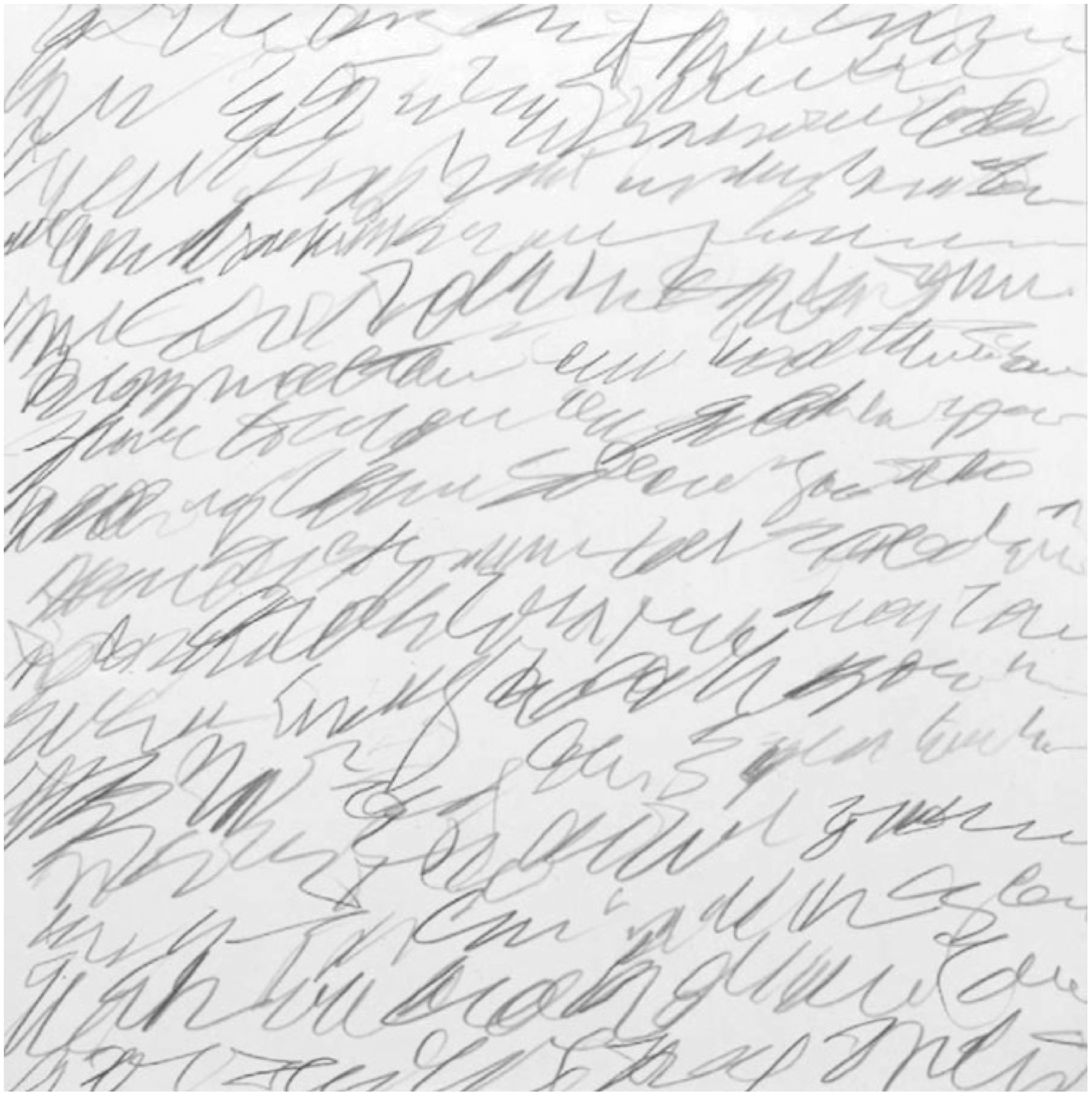
Against the myth of Barthes as being resigned to the end of his life, an alternative picture emerges: a form of resignation as affirmation; to ‘take leave’ as one might take a holiday (perhaps for renewal or simply to rest). Here we might think of Cy Twombly – an artist Barthes (1985a: 157–76; 177–94) greatly admired – and in particular Twombly’s series from 1967, Letter of Resignation (Twombly, 1991). The singular ‘letter’ in the title plays out across 38 drawings to suggest a series of portraits of (and/or attempts at) the same letter. Like blow-ups of minute fragments of writing, we are addressed in these paintings by a continual process of the drafting of a letter, which in itself never ends. If Letter of Resignation is in reference to a farewell or endpoint it is not a literal one. In fact, the drawings show a search for a new language, a new form of expression. Likewise, Barthes’ late writings lead out to new, post-structural forms. In The Pleasure of the Text (1975), for example, Barthes sets out a new ‘community’ that need not hold together – what they share is their difference: Society of the Friends of the Text: its members would have nothing in common (for there is no necessary agreement on the texts of pleasure) but their enemies: fools of all kinds, who decree foreclosure of the text and of its pleasure, either by cultural conformism or by intransigent rationalism (suspecting a ‘mystique’ of literature) or by political moralism or by criticism of the signifier or by stupid pragmatism or by snide vacuity or by destruction of the discourse, loss of verbal desire. Such a society would have no site, could function only in total atopia; yet it would be a kind of phalanstery, for in it contradictions would be acknowledged (and the risks of ideological imposture thereby restricted), difference would be observed, and conflict rendered insignificant (being unproductive of pleasure). (Barthes, 1975: 14–15) How to come unglued from the mirror? I’ll risk a pun to answer: by taking off (in the aeronautical and narcotic sense of the term). […] is this not what the Brechtian alienation-effect involves? Many things can help us to ‘come out of’ (imaginary and/or ideological) hypnosis … But there is another way of going to the movies (besides being armed by the discourse of counter-ideology); by letting oneself be fascinated twice over, by the image and by its surroundings – as if I had two bodies at the same time: a narcissistic body which gazes, lost, into the engulfing mirror, and a perverse body, ready to fetishize not the image but precisely what exceeds it: the texture of the sound, the hall, the darkness, the obscure mass of the other bodies, the rays of light, entering the theatre, leaving the hall; in short, in order to distance, in order to ‘take off’, I complicate a ‘relation’ by a ‘situation’. (Barthes, 1989: 348–9, emphasis in original) Cheng-Chu Weng, After Roland Barthes’ Dessin no. 218 (2019). Courtesy of the artist. The act of painting is a practice (a repetition) that Barthes undertook in response to what he saw as the crisis of language (or language as ideological constraint).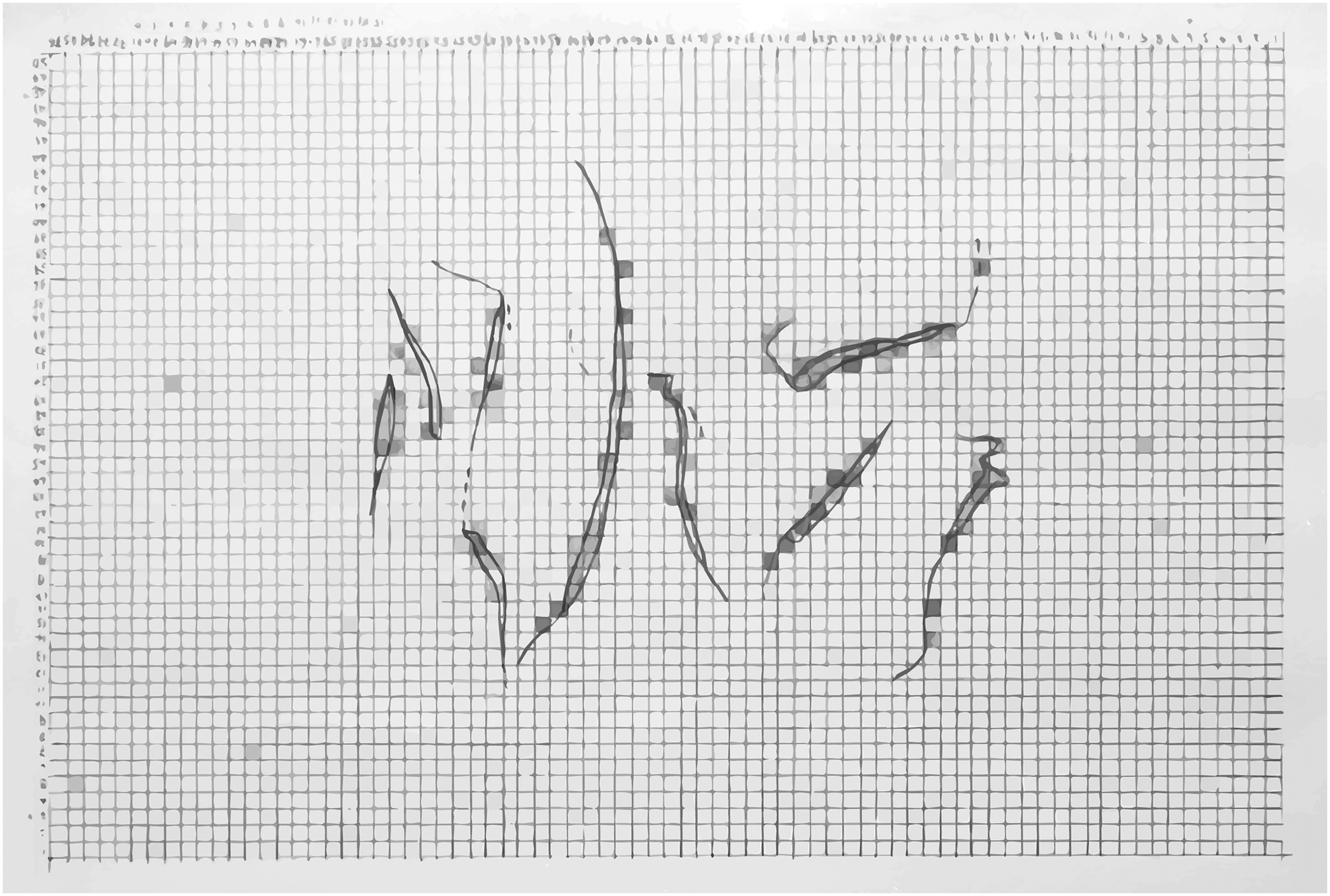
Incidents
The papers collected together for this issue of the journal focus primarily on figures of the Neutral, helping to contextualize the term both within Barthes’ own account and wider intellectual debates. The opening text is Barthes’ own, ‘Colouring, Degree Zero’: a short entry on his somewhat private practice of painting and drawing, which he undertook throughout the 1970s and which he refers to in the text as simply ‘colouring’. The editorial note contextualizes this practice in relation to Barthes’ later, post-structuralist writings, in which the differing terms for ‘pleasure’ emerge, and the relation to the Neutral lecture course is also intimated – an extended argument for which is made in the exhibition catalogue Barthes/Burgin (Manghani, 2016). The text on colouring helps set the scene of Barthes in his late period. The act of painting, it can be argued, is a practice (a repetition) Barthes undertook in response to what he saw as the crisis of language (or language as ideological constraint). The ‘Colouring’ text is followed by an interview with Tiphaine Samoyault, author of Barthes: A Biography (2017). Various extracts from the biography are woven into the dialogue, so offering fuller contextualization of Barthes’ work. Unlike previous biographers, Samoyault was granted access to a wide range of private papers and materials, and as such was able to reflect carefully on his writings and relationship to other key thinkers of the time.
Neil Badmington’s contribution, ‘An Undefined Something Else: Barthes, Culture, Neutral Life’, helps specifically to unpack Barthes’ thinking in the later work, particularly his desire to outplay the ‘trap’ of language. Set against Barthes’ early semiotic project, Badmington shows how the project of the Neutral is a refusal of the expected paradigmatic formats typically ushered in through everyday discourse. The suggestion is that we can challenge discourses of power, but not via the same old critical pieties, of ‘the self-satisfied revelation of what is hidden beneath the surface of the everyday’. As Badmington puts it: ‘We have seen this trick often enough in cultural studies … It is tired, easy, and the moment has come to move on […] Signs are too cunning, too subtle, too stubborn, too strong’. While operating with the devices of an ‘early’ and ‘late’ Barthes, showing a significant shift from the reading of signs to their undoing, Badmington actually brings The Neutral into dialogue with Barthes’ own critique of the semiotic project. In doing so, Badmington poses an open question for what the figure of the Neutral might offer for the analysis of culture. Crucially, an answer to this question will need to come later, beyond Barthes himself, but which, as Badmington shows, can productively work upon ‘the desire for Neutral’. Arguably, we need to start to write like Barthes, not about and ‘with’ him (a particular problem that arises from writings on Barthes’ work, which can often seem insular in their terms of reference).
To gain a fuller account of Barthes’ interest in the Neutral, and its political conception, we can usefully look back to Barthes’ early texts. Yue Zhuo’s contribution to the issue, ‘Commitment to Degree Zero: Barthes’ First Approaches to the Neutral’, provides an extended analysis of the Neutral vis-à-vis the leitmotif of ‘degree zero’ (notably, both Zhuo and Badmington can be described as ‘astute readers’, to echo Culler, keeping the early Barthes in ‘play’ while working through an account of late Barthes). Returning us to Barthes’ early reflections on ‘white’ or ‘neutral’ writing in Writing Degree Zero (but also including consideration of some of Barthes’ lesser-known essays from the student journal Existences and articles from the newspaper Combat), Zhuo shows how Barthes’ first configuration of the ‘neutral’ is in response to (though also in sympathy with) Sartre’s theory of committed literature. While ‘consenting’ to the notion of the political responsibility of literature, Barthes nonetheless offers us something different with his notion of writing, or, as Zhuo explains, the ‘engagement of Form’, which she argues prefigures the Neutral.
Zhuo’s account can be usefully read in conjunction with Lübecker’s (2009: 113–39) ‘Early Barthes, Late Barthes’, from his study of Breton, Bataille, Sartre and Barthes. Lübecker makes reference to Maurice Blanchot’s review of Writing Degree Zero. Blanchot offers a positive account of Barthes’ historical account of literature, which leads up to a degree zero writing as being ‘the neutrality that every writer seeks, deliberately or without realizing it, and which leads some of them to silence’ (Blanchot, 2003: 207). However, Blanchot disagrees with Barthes’ existentialist account of écriture as choice, and furthermore describes literary experience in terms that go beyond socio-historical terms: ‘[i]n its essence literature is the experience of a neutrality that will disperse the individual’ (Lübecker, 2009: 119). Lübecker’s argument is that Barthes’ later writings build upon Blanchot’s critique, taking him beyond a left-Hegelian position that literature can lead to ‘reconciliation’, to a consideration of a post-human dispersal of the subject (in line with the above situation of an ‘amorous distance’). Such an account keeps present a number of tensions between the early and late writings. Zhuo’s article similarly shows how some of the unsolved issues of the early texts reappear in the Neutral course, but are equally refigured in the process.
As Zhuo notes, unlike his peers, Barthes does not attend to explicit political questions, ‘he does not prescribe the Neutral to any political agenda or progressive goal’. Barthes can be criticized for a retreat into aestheticism, yet Zhuo’s contention is that in fact Barthes secures, or at least seeks to secure, however fragile and marginalized, a role for art and literature as forms that resist the appropriation of content and dominant discourse. As she puts it, ‘Barthes has not committed anything to us, but perhaps everything’. Zhuo’s findings are aptly traced in Feng Jie’s article, ‘Clothing Degree Zero: A Late Reading of Barthes’ Fashion “System”’. As a close reading of Barthes’ posthumously published notebooks from his 1974 trip to China, and in picking out specifically his use of the phrase ‘clothing degree zero’, Feng re-considers Barthes’ interest in fashion in post-structuralist terms (which is to present a re-reading of his early, well-known, but conventionally semiotic text, The Fashion System). By combining Barthes’ Neutral with reference to François Jullien’s comments on Barthes’ trip to China (as well as mention of Michelangelo Antonioni’s film Chung Kuo-Cina), Feng presents Barthes’ use of fashion as a neutral form, which in his diary, Travels in China, works precisely in the way Zhuo describes to resist dominant discourse (in this case relating to the very pronounced ideological framing of the Chinese state in the 1970s).
Rudolphus Teeuwen’s ‘“The Dream of a Minimal Sociality”: Roland Barthes’s Sceptic Intensity’, takes us further into a reading of the late writings, in particular How to Live Together and The Neutral. Teeuwen picks up on Barthes’ reference to the notion of épochè, or ‘suspension’, derived from the Greek Sceptics to refer to the suspension of judgement. Where Zhuo helps position the political context of the term the Neutral, Teeuwen focuses on the ethical turn of the late work. He helps show, for example, how Barthes’ development of the Neutral is less attuned to a ‘state’ (as we might consider with ‘degree zero’) and more to do with intensity, of gradient degrees. In the opening session of The Neutral, Barthes gives the example of ‘weariness’, which is not socially coded. We can take time off work for various ailments and situations (including mourning), yet we could never offer weariness as a legitimate excuse. The idea of gradients or intensities is given a further social dimension in the earlier lecture course How to Live Together. Here, as Teeuwen notes, Barthes’ use of the term ‘idiorrhythmy’ refers to the search for an ideal combination or distance between solitude and sociability (see also Manghani, 2020). What underlies Barthes’ interest in intensities, or in-between states, is the refusal to judge (to delineate meaning) – this is what he means by the Neutral. He describes The Neutral as a dictionary of ‘twinklings [scintillations]’ (2005: 10), suggesting it might only be his inability that leads him to present through fleeting, discontinuous moments rather than a critical exposition, though we know this to be a more deliberate approach. We can associate ‘twinklings’ with Barthes’ use also of the Japanese term ‘satori’, which in Empire of Signs is associated with the form of the haiku – a form Barthes returns to extensively in The Preparation of the Novel (with sustained analysis spanning some eight sessions of the course). The various phrases Barthes uses – whether twinkling, trait, figure, satori, or haiku, etc. – can be encapsulated with the term ‘incident’, which, as Lübecker (2009: 124–6) points out, is offered as a counter to the ‘event’. In How to Live Together, under an entry on ‘Event’, Barthes tells of his enjoyment of the novel Robinson Crusoe, particularly its descriptions of everyday life. However, the ‘events’ that occur in the novel (such as Crusoe meeting Friday) intrude upon the fluidity of the everyday: ‘I’m no longer able to fantasize about the way Robinson Crusoe organizes his life’, writes Barthes, ‘The event turns me into a different kind of subject. I become the subject of suspense … the charm of Robinson Crusoe = the non-event’ (p. 84). Methodologically, then, the incident, as a counter to the event, becomes an important device. As discussed in an earlier text by Barthes (2002: 109), he suggests we think of the incident as being as thin or as modest as possible, like a leaf that gently falls to the ground. As Lübecker (2009: 125–6) puts it: ‘The incident is a minimal occurrence: “the minimum required to write something”… It lies before this crystallization of “meaning” that Barthes believes will lead to wars of interpretation; nowhere is the incident better expressed than in the Haiku’. While Barthes could be accused of turning away from the political, indulging even in an individual’s fantasy of incidents, Teeuwen’s account, in conjunction with those presented by Badmington, Feng and Zhuo, shows how Barthes’ late work marks an important refusal of oppositional frames in which contemporary issues are posed, and which, for Barthes, can only lead to forms of arrogance, violence, and narcissism. Thus, Barthes draws attention to the Neutral as a means not only to disrupt dominant frames, but also to refuse entry into them. Barthes’ ‘incidental’ accounts of the Neutral are an attempt to give form to a desire that offers release to the subject, rather than builds it. We come, then, to understand the Neutral less as a form of critique, more as an alternative means of living.
An ethics of the Neutral is also brought out in the final two contributions to this issue, specifically with respect to matters of writing. Ryan Bishop’s article, ‘A Circle of Fragments: Barthes, Burgin, and the Interruption of Rhetoric’, develops an account of Barthes’ use of fragments as set against the dominant order and received wisdom. In part, Bishop reminds us of Barthes’ interest in pre-Socratic rhetoric, but equally, he positions his account in terms of the contemporary art practice of Victor Burgin. Having come to prominence as a conceptual artist in the late 1960s, notably as a political photographer of the left, Burgin has long been influenced by his reading of Barthes – a common engagement of both is upon the relationship between language and the image. Belledonne (2016), a recent CGI projection work by Burgin, is rendered here in parallel to Bishop’s text. The artwork reflects directly upon Barthes’ time spent being treated for tuberculosis in his early life, but equally centres around Barthes’ reading of the haiku (discussed further below), which is developed through the rhythmic relationship of imagery and textual intertitles. As visual ‘fragments’ of a projection work, the images that run throughout Bishop’s piece provide a ‘performance’ of Barthes’ writing as a ‘circle of fragments’. Taken as a whole, we can reflect upon what Bishop refers to as potential liberatory strategies for eluding rote use and effects of language, image and thought. In supplement to Bishop’s article, and as a coda to this special issue on Barthes’ late work, Burgin’s written piece, ‘Nagori: Writing with Barthes’, offers a further reminder (and experience) of the liberatory strategy of the fragmentary form. While this text is subtitled ‘Writing with Barthes’, it can be understood as an example of what it means to write like Barthes.
Neutral Life
Epicurus, the first great theoretician of pleasure, had a highly sceptical understanding of the happy life: pleasure is the absence of suffering. Suffering, then, is the fundamental notion of hedonism: one is happy to the degree that one can avoid suffering […] flung into the world’s misery, man sees that the only clear and reliable value is the pleasure, however paltry, that he can feel for himself: a gulp of cool water, a look at the sky (at God’s windows), a caress. (Kundera, 1996: 8)
In The Pleasure of the Text, Barthes begins to offer an account of an ethics rather than a politics of the text. It is written against the grain of left-wing and Marxist critique, which he took to be iconoclastic (overly concerned with the ‘power’ of the image and pleasure). He focuses upon the term ‘pleasure’ in a ‘tactical fashion’, noting in interview how he felt ‘intellectual language was submitting too easily to moralizing imperatives that eliminated all notion of enjoyment, of bliss. In reaction, I wanted therefore to reintroduce this word within my personal range, to lift its censorship, to unblock it, to un-repress it’ (1985b: 205). However, the use of the two terms pleasure (plaisir) and bliss (jouissance) can lead commentators to overplay the role of hedonism in Barthes’ late work. At the opening of The Pleasure of the Text Barthes introduces an anti-hero, ‘the reader of the text at the moment that he takes his pleasure’, as one who ‘endures contradiction without shame’ (Barthes, 1975: 3). This might suggests a narcissism (as left-wing criticism might have supposed), yet Barthes is actually articulating a point about the post-structural subject (which is always elsewhere, fragmented, deconstructed). The terms of pleasure and bliss together delineate a self-consciously contradictory subject: ‘he enjoys the consistency of his selfhood (that is, his pleasure) and seeks its loss (that is, his bliss). He is a subject split twice over, doubly perverse’ (p. 14). Furthermore, the ‘text of bliss’ is not simply an undoing, or state of loss, it is also ‘the text that discomforts (perhaps to the point of a certain boredom), unsettles the reader’s historical, cultural, psychological assumptions, the consistency of his tastes, values, memories, brings to a crisis his relation with language’ (p. 14). Thus, Barthes’ notion of pleasure (as bliss) is not to be understood in the common sense of hedonism (as the personal pursuit of pleasure for its own end). Instead, in the Epicurean sense, Barthes relates pleasure equally to suffering, identifying with happiness as the avoidance of suffering – a point between suffering and not-suffering: a neutral point. ‘Something neuter?’, he asks. ‘It is obvious that the pleasure of the text is scandalous: not because it is immoral but because it is atopic’ (p. 23).
While The Pleasure of the Text provides further insight into Barthes’ use of the term ‘Neutral’ as a critical concept, it does not necessarily tell us a great deal more about what might constitute a ‘good life’. It is an ethics of reading rather than a general ethics. The final lecture courses, however, present the clearest affirmative project of Barthes’ entire career. The Neutral in particular is pivotal in understanding the development of an ethics. He refers to a transposing of structural concerns: Transposed to the ‘ethical’ level: injunctions addressed by the world to ‘choose’, to produce meaning, to enter conflicts, to ‘take responsibility,’ etc. → temptation to suspend, to thwart, to elude the paradigm, its menacing pressure, its arrogance → to exempt meaning → this polymorphous field of paradigm, of conflict avoidance = the Neutral. (Barthes, 2005: 7)
As cited earlier, Sontag suggests the emergence of a wisdom, ‘a wisdom of a worldly kind’, to which it is worth noting Barthes’ reading of Taoism and Zen. Passing references are made in various texts of the 1970s, but this becomes explicit in the lecture courses. One of the entries in The Neutral is on the Taoist notion of Wou-wei (Barthes, 2005: 175–81), which literally means non-action or non-doing, and, as Lübecker (2009: 125) notes, ‘designates a way of living that inspires others not to act’; indeed, Lübecker goes on to say that a ‘life in Wou-wei is precisely the life of the wise man (a word that Barthes (sometimes) replaces with the less connoted expression “the Tao-subject”)’ (p. 125). As a figure of the Neutral, Wou-wei expresses an idea about actively not choosing: The profound attitude of Tao Wou-wei = not to choose. Now there are two ‘not to chooses’: a panicked, rattled, ashamed, scolded ‘don’t choose’ ≠ a calm, I would say, self-assured ‘don’t choose.’ That one: extremely difficult, because it bucks opinion, harms the imago → one must therefore willfully take responsibility for it → Tao aware of the difficulty: a poem (Tao + Zen) says: ‘The perfect Tao is without difficulty. / Save that it avoids picking and choosing.’ (Barthes, 2005: 176)
Importantly, however, ‘late Barthes … clearly seeks to move beyond the “Hegelian” tradition and the theory of the struggle for recognition: he considers the idea of individualization through conflicts and oppositions as a form of harassment via which subjects are forced to participate in tiresome power struggles’ (Lübecker, 2009: 126). Yet, equally, Lübecker raises the intriguing question as to whether or not Barthes is a post-historical man. Barthes’ reference to Kojève is pertinent, not least because Kojève (1969), in his second edition to Introduction to the Reading of Hegel, famously makes reference to Japan’s closure to the outer world during the years of the Tokugawa-shogunate as an example of post-historical life. Albeit erroneously, Kojève recounts how, from the 16th to the 19th century, the Japanese lived almost without wars and conflicts. Instead of the Hegelian struggle to transform society, the Japanese engaged in an aestheticized culture, a form of an ‘end of history’: They engaged in flower binding competitions, invented meticulous and elaborate tea-drinking rituals and more generally produced a thoroughly formalized society in which even the act of committing suicide became a question of style (the hara-kiri). According to the Kojève of 1968, japanization awaits the Western world. (Lübecker, 2009: 124)
Here a comparison can be drawn between Barthes’ account of desire (and the subject) and Deleuze and Guattari’s ‘politics of desire’ (Goodchild, 1996). As noted above, Deleuze provides Barthes with a reading of Nietzsche (evident from annotations in The Neutral) through which Barthes upholds the idea of the ‘diverse’. His positioning of the Neutral (as a structural re-reading of the ‘political’, as the ‘container’ of politics) can clearly be seen to resonate with the ‘liberation’ of Deleuze and Guattari’s thinking, which brings ‘less a liberation from social expectations than a liberation to enter into social relations’ (Goodchild, 1996: 2). The obstacles to new social relations are the existing conventions, values and structures – the doxa to use Barthes' term – which the Neutral is positioned against, or rather from which it is adrift. However, if we argue Deleuze and Guattari offered a ‘politics of desire’ understood through models of growth (or out-growing) and an affirming of unlimited creative power (Hallward, 2006), Barthes appeared to be working towards an ethics of desire that was about making choices of the finite. As Goodchild puts it: Deleuze and Guattari aim to make multiplicity, creation, and desire present in society. The theorist becomes an athlete of desire, aiming to include as much multiplicity and creation as possible in the work; the theoretical work then becomes a product capable of lying alongside other products, affecting them, interacting with them, leading off on new trails. (1996: 4) People tell me ‘You’ll make a book with this course on the Neutral?’ … my answer: No, the Neutral is the unmarketable. And I think of Bloy’s words: ‘there is nothing perfectly beautiful except what is invisible and above all unbuyable’ → ‘Invisible’? I would say: ‘unsustainable’ → We’ll have to hold on to the unsustainable for thirteen weeks: after that, it will fade. (Barthes, 2005: 13; see also Barthes, 2011:7). If the object is to reach a society where you can do anything at all, the role of organization must be concentrated on the utilities. Well, we can achieve this even now with our technology <utilities: the bathtub, the telephone, water, air, food>. First of all, everyone must have access to what he needs to live, and the others mustn’t try to deprive him of anything whatsoever. (cited in Barthes, 2005: 201)
While Barthes is perhaps most cited for his rumination on the temporality of the photograph, the lecture courses give rise to an ethics of space and of the distances between one another. A figure shared by both How to Live Together and The Neutral is of a school of fish, as a pattern of fluidity preserving ‘tactful’ spaces between (Barthes, 2005: 146; 2013: 37). Barthes’ late writings might appear concerned more with the individual (and individualism), yet he is clearly ‘not enjoying the impotence of contemporary socialism – he is not a liberal intellectual mocking the crisis of the left’ (Lübecker, 2009: 132). In How to Live Together, Barthes introduces the use of the term ‘idiorrhythmy’ to refer to the idiosyncratic rhythms of people, but does so to ask how can we live together. He offers a vivid example of the problem: through his window he witnesses a parent walking, pushing an empty stroller, while holding the hand of their child who is some steps behind. The parent ‘walks at [their] own pace, imperturbably; the child, meanwhile, is being pulled, dragged along, is forced to keep running, like an animal’ (Barthes, 2013: 9). This vignette reveals for Barthes ‘the subtlety of power … effected through disrhythmy, heterorhythmy’ (p. 9). More positively he refers to various monastic living arrangements. What draws his attention, however, is not a form of strict solitude and living apart, but ways of giving space to one another.
For the final lecture of How to Live Together, Barthes had planned to construct, in front of the audience, a utopia of idiorrhythmic Living-Together, based on contributions from his students. However, this does not take place. He confesses to not having had time to collate everyone’s submissions, and that when it came to it he ‘lacked the necessary enthusiasm’ (p. 130). In effect, he performs the very dilemma of idiorrhythmic Living-Together. Admittedly, the high attendance at the lecture course is far from what Barthes would consider the optimum number for an idiorrhythmic group (‘I personally think the optimal number should be under ten – under eight even’; Barthes, 2013: 131). Thus, he does not seek to present a social utopia; if anything, it is more of a ‘domestic utopia’ (p. 130). However, regardless of scale and numbers, his concern is with distance, of what he calls the ‘gift of space’ (p. 132): In the most tightly knit, least individualized animal groups (schools of fish, flocks of birds), and even in what appear to be the most gregarious species, there’s always an attempt to regulate interindividual distance: it’s the critical distance. This would probably be the most significant problem of Living-Together: how to identify and regulate the critical distance, on either side of which a crisis occurs […] A problem that’s all the more acute today (in the industrialized world of a so-called consumer society): what’s most precious, our ultimate possession is space. (Barthes, 2013: 131–2) He is hoping for the momentary realization of these passionate states of non-conflict that constitute his version of stepping out of the History of conflicts and events. In a sense his ‘end of history’ (the liberation of the non-will-to-possess in the non-conflictual sphere) is therefore always a possibility; it is immanent and can be realized instantaneously. (Lübecker, 2009: 129) The text is never a ‘dialogue’: no risk of feint, of aggression, of blackmail, no rivalry of ideolects; the text establishes a sort of islet within the human – the common – relation, manifests the asocial nature of pleasure (only leisure is social), grants a glimpse of the scandalous truth about bliss: that it may well be, once the image-reservoir of speech is abolished, neuter. (Barthes, 1975: 16)
A Desperate Vitality
At the close of his preliminary remarks for The Neutral, Barthes breaks off to say something of his personal situation: Between the moment I chose the subject of this course (last May) and the moment I had to prepare it, there entered my life, some of you know it, a serious event, a mourning: the subject who will speak of the Neutral is no longer the same as the one who had decided to speak of it → Initially, it was a matter of speaking of the suspension of conflicts … but, underneath this discourse … it seems to me that I myself hear, in fleeting moments, another music. With death and senescence before him … Adorno uses the model of late Beethoven to endure ending in the form of lateness but for itself, its own sake, not as a preparation for or obliteration of something else. Lateness is being at the end, fully conscious, full of memory, and also very (even preternaturally) aware of the present. (Said, 2006: 14, emphasis added)
Despite the Neutral being of the undoing or suspending of conflicts and structures of signification, what finally cannot be outplayed is the binary of life and death. Perhaps surprisingly for Barthes, his mother’s death does not give way to his own divestment, but instead reveals a desperate clinging to life: … desperate vitality is the hatred of death. What is it then that sets retreat from arrogance apart from hated death? It’s this difficult, incredibly strong, and almost unthinkable distance that I call the Neutral, the second Neutral. In the end, its essential form is a protestation; it consists of saying: it matters little to me to know if God exists or not; but what I know and will know to the end is that He shouldn’t have simultaneously created love and death. The Neutral is this irreducible No: a No so to speak suspended in front of the hardenings of both faith and certitude and incorruptible by either one. (Barthes, 2005: 14) Which necessity? The one to which everything in the world submits. It is therefore fitting to name it at once … for it is death; that is, the refusal of death – the temptation of the eternal, all that leads men to prepare a space of permanence where truth, even if it should perish, may be restored to life. The concept (therefore all language) is the instrument in this enterprise of establishing a secure sign. We untiringly construct the world in order that the hidden dissolution, the universal corruption that governs what ‘is’ should be forgotten. (Blanchot, 1993: 33) … for what was left unsaid out of discretion, for what was of no use bringing up, either because it was too well known by both of us or else infinitely unknown on either side? To go on speaking of this all alone, after the death of the other, to sketch out the least conjecture or risk the least interpretation, feels to me like an endless insult or wound – and yet also a duty, a duty toward him. Yet I will not be able to carry it out, at least not right here. Always the promise of return. (Derrida, 2001: 55) Roland Barthes is the name of a friend whom, in the end, beyond a certain familiarity, I knew very little, and of whom, it goes without saying, I have not read everything. I mean reread, understood, and so on. And my first response was most often certainly one of approval, solidarity, and gratitude. Yet not always, it seems, and as insignificant as it may be, I must say this so as not to give in too much to the genre. He was, I mean, he remains, one of those of whom I have constantly wondered, for almost twenty years now, in a more or less articulated way: What does he think of this? In the present, the past, the future, the conditional, and so on? Especially, why not say it, since this should surprise no one, at the moment of writing. I even told him this once in a letter long ago. (Derrida, 1991: 56)
