




Abstract
During everyday operations with tractors, drivers are exposed to harmful effects of various factors. In addition to unfavourable temperature and humidity, dust and noise, one of the factors harmful to driver’s health is vibrations. They come from the tractor engine and from the roughness of the ground and are transferred to the cab and through the seat to the body of the driver. In case of high level magnitude vibrations and a long period of exposure to them, many health problems occur. The harmful effect of the vibrations is especially obvious in older models of tractors. High intensities of vibrations (above permitted limits) were found during the measurements of vibrations at the driver seat in such tractors. This study is an attempt to reduce the vibration levels using various vibration-absorbing components, such as cushions, at driver’s seat. The results of the measurements showed that the vibration levels were significantly lower in comparison to original seats.
Introduction
Without a doubt, agricultural tractors have contributed enormously to the efficiency of agricultural operations making them easy and, in some cases, eliminating human labour completely. On the other hand, during their everyday activities, tractor drivers are exposed to many harmful influences which have complex negative effect to the health and hinder driver’s performances. These influences come both from the tractor system (noise, inadequately designed controls) and from working conditions (precipitation – snow and rain, high relative humidity, dust, agriculture chemicals, high or low temperatures, etc.). One of the important negative factors is vibrations. Namely, during the work, the entire tractor construction is subject to complex oscillatory processes induced by the combined influences of the rough ground and the tractor aggregate and the implements. 1 These high levels of vibrations that arise in such a complex system such as a tractor are transferred from the cab floor to the seat and on to the whole body of the driver.
Vibration can impose great risk to the driver’s health. Because of combined influences of vibrations and other occupational health risks, it is not always possible to establish the correlation between the effect of vibrations and the illness of the driver. Numerous studies show that prolonged exposure to high-level vibrations can lead to low back injuries, digestive system illnesses and cardiovascular problems.2–6
The harmful impact of vibrations is especially evident in older models of the tractors which are not equipped with appropriate suspension system for shock and vibration absorption. These tractors have good performances during the farming work, but they are not comfortable in terms of vibrations, i.e. they cannot reduce the vibrations to the lowest possible level. In these tractors, shock and vibration absorption is done only by tyres and simple mechanical seats, without any additional suspension systems.
These types of tractors prevail both in Republic of Serbia and in most of underdeveloped countries. In Serbia, according to 2012 Registry of agricultural resources, 7 there are 410,894 two-axle tractors, out of which even 95% are more than 10 years old. Most of the tractors that work in Serbia were manufactured by Serbian manufacturer Industry of Machinery and Tractors (IMT) – Industry of engines and tractors Belgrade. Most of other tractors are also older ones and were manufactured by Belarus, Ursus and Zetor, whereas most famous manufacturers’ models are rare: Deere & Company, Massey Ferguson, Case IH, New Holland tractors, Fendt, etc. Interestingly, even today, these manufacturers (IMT, MTZ Belarus, etc.) consider the introduction or the optimizing of the elastic suspension system as a very complex designing issue and a significant cost in production.
Cvetanovic8,9 shows that the vibration levels at older tractor seats (also in new models of less known manufacturers) and their evaluations showed that the daily levels of exposure were high. Considering the number of these tractors in Serbian fields (and similar models of tractors in other countries) and the number of drivers whose health is in risk, especially during the summer, it was necessary to reduce the vibration levels that are transferred from the seat to the body of the driver. The problem is more obvious given that 98% of all tractors in Serbia are private property which means tractor driving is not primary occupational activity, therefore vibration-related illnesses are not easy to diagnose.
Hostens et al. 10 and Gohan and Tahmasebi 11 show that the installation of a new, high-quality active seat (or new constructive solution of seat 12 ) provides fully comfortable work. However, given the overall condition of Serbian agriculture, that would be a huge expense for Serbian farmers. In case of these tractors, installation of an appropriate cushion into the seat would be a cost-effective solution. In this way, beside the improved comfort of the driver, the cushion would reduce the vibrations that spread to the body of the driver.
It should be mentioned that this relatively simple and cheap improvement in the seat was considered in Nishiyama et al. 13 researches in the 1990s of the last century. Given that new models of leading manufacturers got good seats, most of the researches abandoned this concept for improvement of driver’s comfort and reduction of vibrations, neglecting the fact that a huge number of older tractors remained with relatively simple seats which could not absorb vibrations and provide comfort driving.
The vibration level measurements were performed on the model IMT 539, in real conditions, during ploughing and on an Ursus C-355 during the transport of a load on a platform. First, the measurements were done on the original tractor seat, and then the measurements were repeated in the same conditions, but with new seat cushions. The cushions were filled with compressed sponge, water and air.
The method of measurements
Characteristics of tractors.

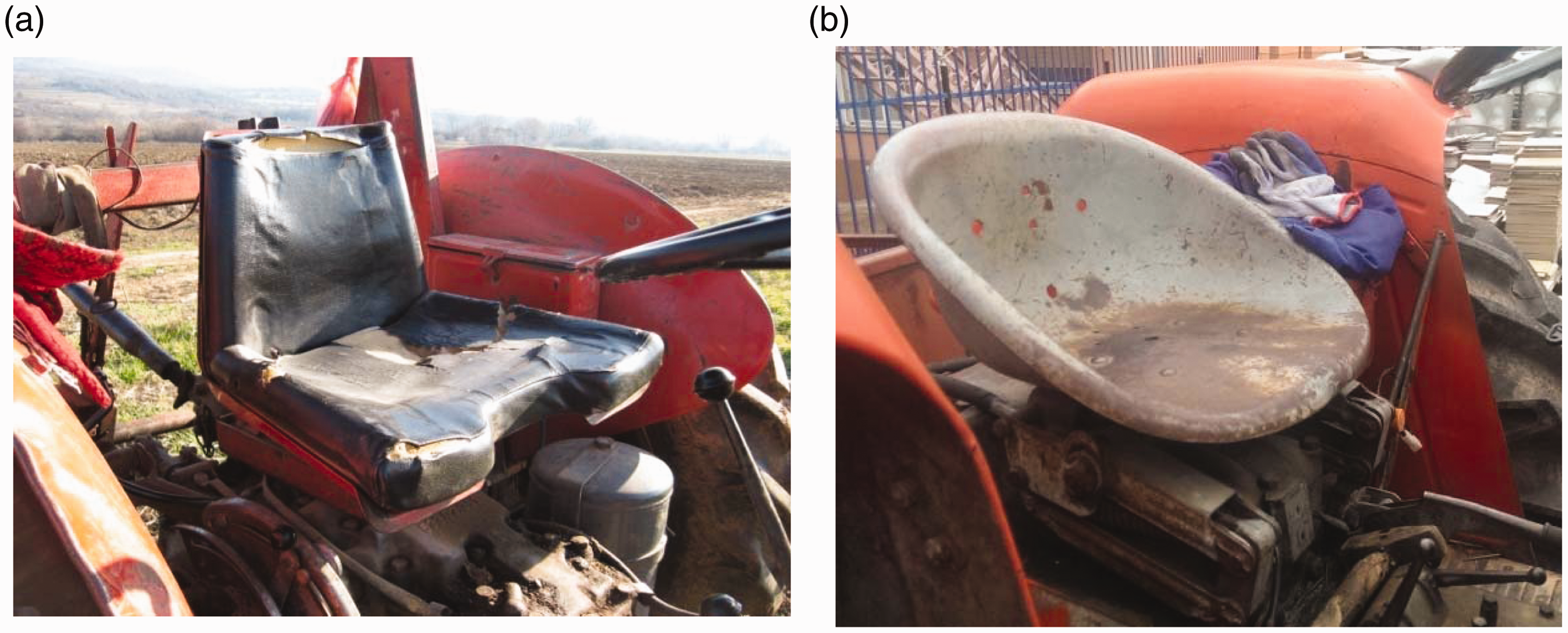
The tractors had no cab, but IMT 539 had a rollover frame with a canopy (Figure 1). Tractors had their original seats, IMT with sponge on a metal base, Ursus with a bare metal seat (Figure 2). For the measurement of vibration level, a Brüel&Kjær 4447 model was used, with an accelerometer enclosed in a rubber pad, placed on the driver’s seat (Figure 3).
Tractors driven in measurements. (a) IMT 539 and (b) Ursus C-355. Seats of the tractors used in measurements. (a) IMT 539 and (b) Ursus C-355. Setting of the accelerometer rubber pad on the seats.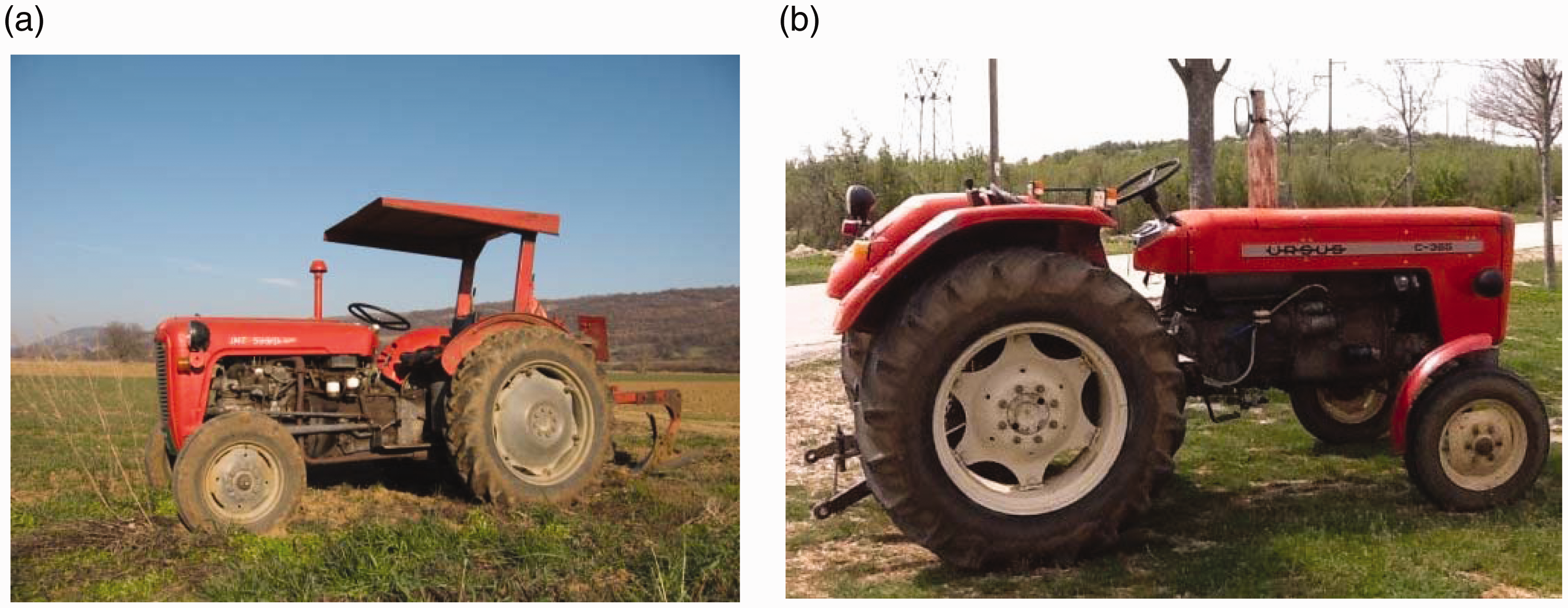
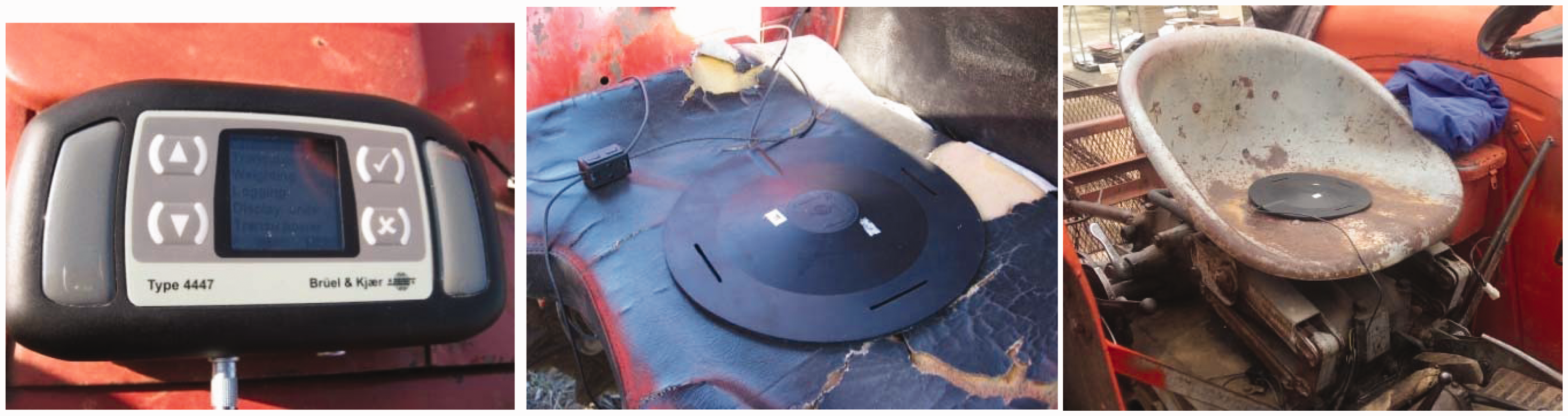
Eight measurements were carried out in total, four per each tractor. The ploughing depth with IMT was 20–25 cm, while the weight of the load on Ursus was 300 kg on the platform.
The daily level of exposure of the driver to vibrations (A8) was calculated according to 8 h reference time. The first measurement in each tractor was done with the rubber pad being placed on the original seat, whereas other measurements were done for each of the cushions separately, the cushions being placed on the driver’s seat as follows: compressed sponge, air and water (Figure 4).
Cushions used in vibration measurements at the tractor seat (compressed sponge, air, water).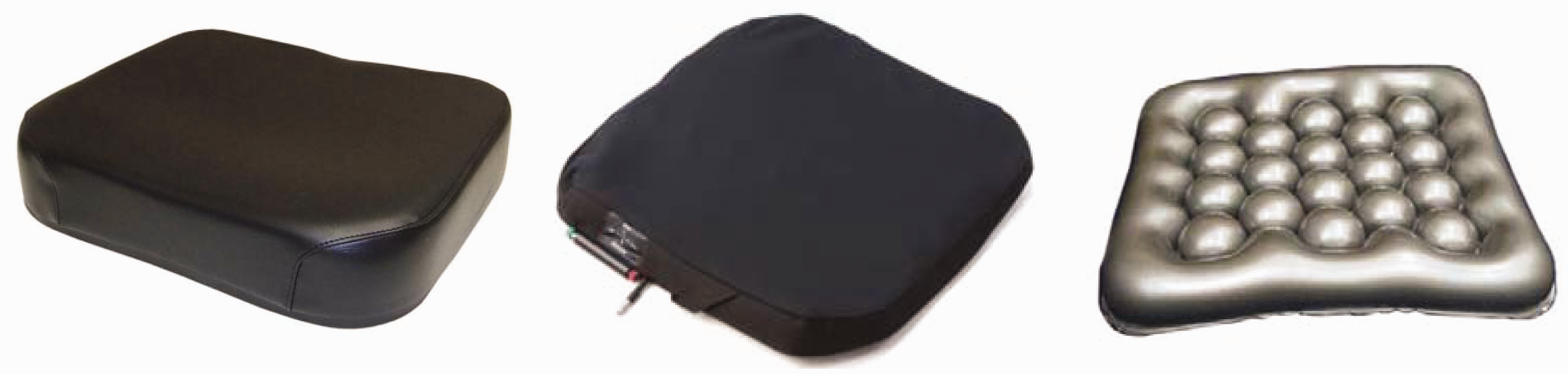
Obtained values of exposure levels were compared to maximum legally permitted values which are specified in EU Directive 2002/44/EC 14 and Pelmear 15 that concerns vibrations and to values specified by Serbian Rulebook of Safety precautions during exposure to vibrations. As for daily exposure to whole body vibrations, the Directive specifies an extreme value – an exposure limit value (ELV) which must not be exceeded in professional working conditions and is 1.15 m/s2 and exposure action value (EAV), above which employers must control health risks deriving from vibrations and which is 0.5 m/s2. It should be stressed that these limit values are observed in professional working conditions. That is usually not the case in Serbia, because most tractor owners have some other primary occupational activities (material handling, for example), whereas tractor driving comes as their side activity. Nevertheless, a comparison with the legally permitted values for professional working was the only way to point out the problem of a large fatigue of tractor drivers in the agricultural season.
Results
Maximum values of vibration acceleration.

RMS: root mean square.
Maximum RMS values were obtained for X-axis during ploughing and for Z-axis during load transport.
Levels of daily exposure to vibrations.
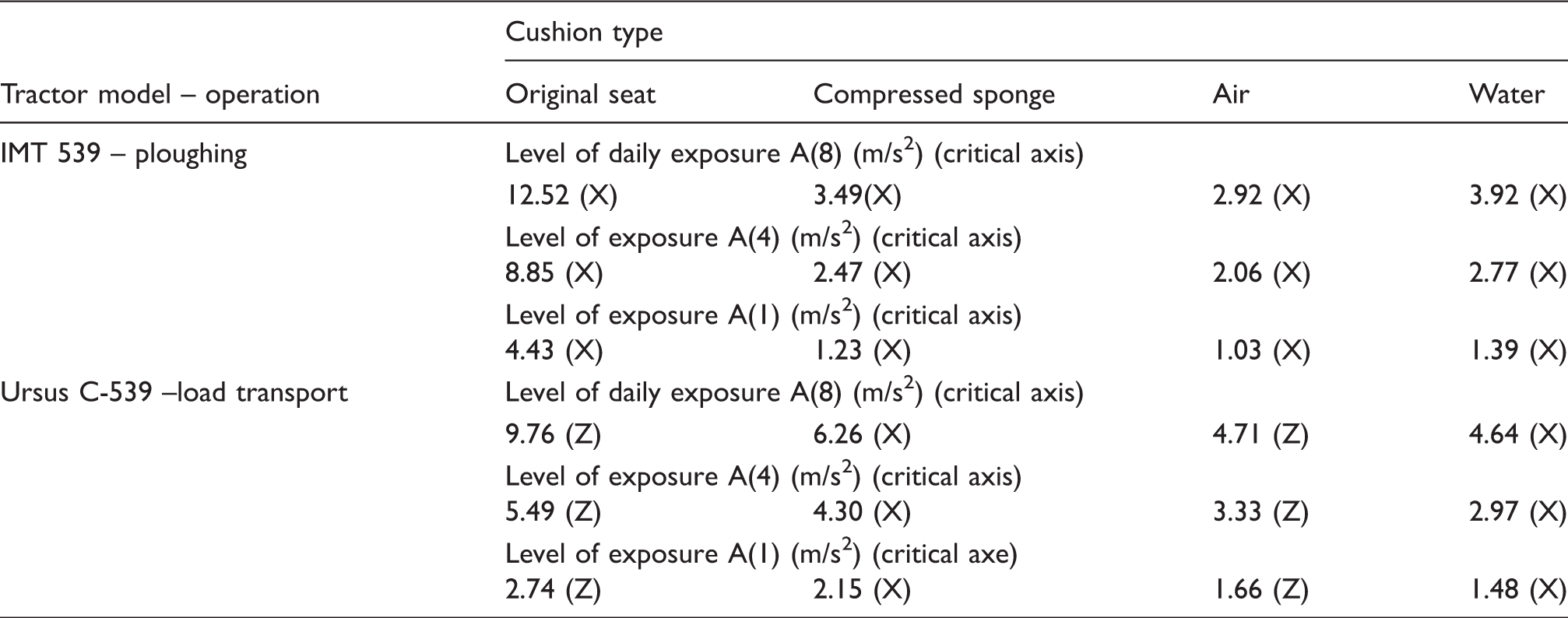
The obtained values show what the daily value of exposure of the driver would have been, if he had spent 8 h of his shift operating with the tractor, without any interruptions, with the values of acceleration obtained during measuring. The instrument itself calculates daily level of exposure for 1 h – A(1), 4 h – A(4) and 8 h of continuous work – A(8), which makes possible to analyse values in case the driver had spent half the shift (or 1 h only) driving, and the rest of the time performing some other activities not related to driving or having breaks during the shift. In the case of Serbian farmers, in season, working with the tractor is never less than 8 h.
Discussion
Time to EAV and ELV.
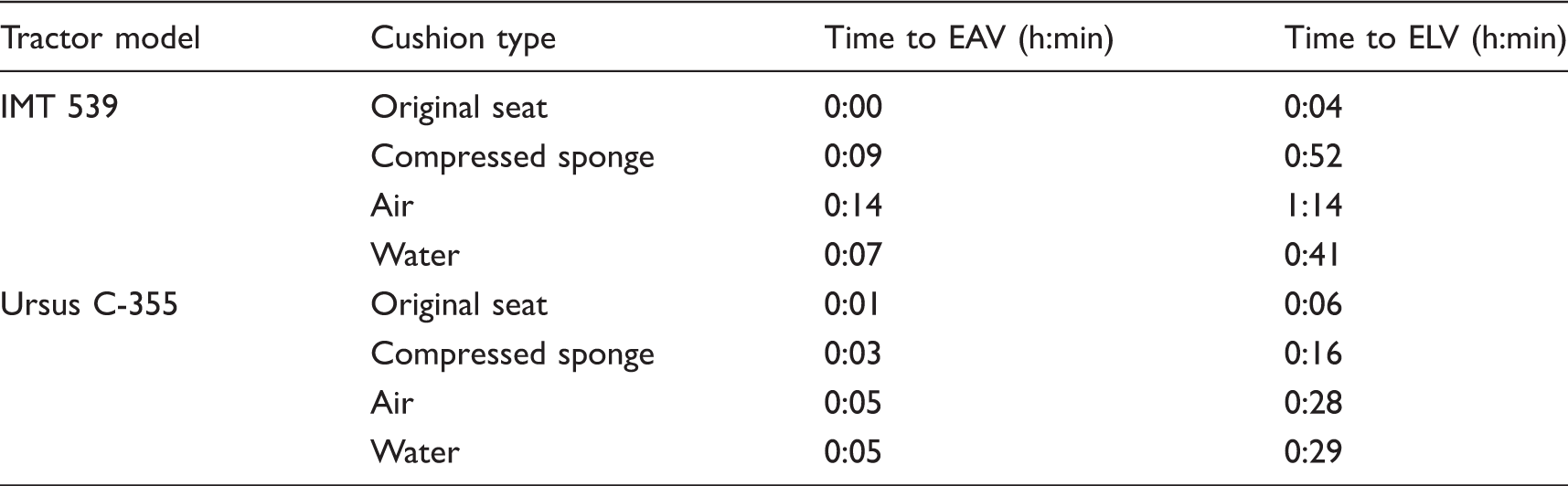
EAV: exposure action value; ELV: exposure limit value.
Rather high values, in comparison to legally permitted values, were obtained by using the original tractor seat. Obtained daily level of exposure in the case of both tractors was more than eight times higher than legally permitted value. A driver could operate this tractor for only around 4–6 min, when the permitted value of exposure would be reached.
In case of professional working conditions, with legally permitted values, none of the vibration-absorbing components would meet the requirements. However, all cushions reduced exposure levels, some of them did it even several times the values of original seats. Given the fact that in most cases drivers are not professionals, but average farmers, it seems that the use of some of the cushions would significantly reduce the difficulties and would improve the comfort. The analysis of the cushion efficiency in IMT during ploughing shows that the air cushion had best results in vibration reduction (Figure 5). The critical axis along which the levels of exposure were highest was X-axis.
Levels of exposure to vibrations during the measurements on tractors. (a) Ursus C-355 and (b) IMT 539.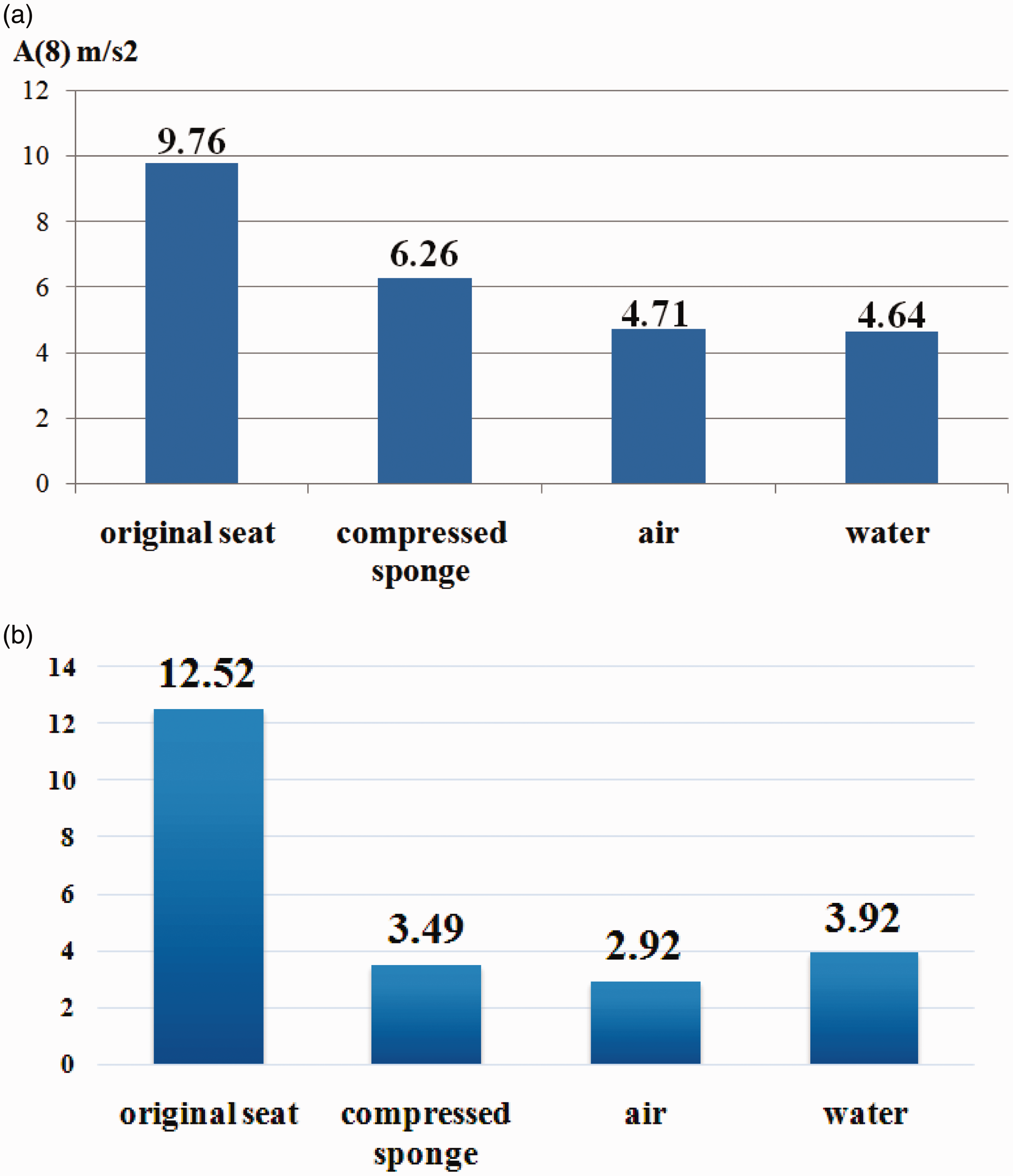
In case of this tractor, compressed sponge proved to be a better option than water. It is important that all cushions were pretty efficient, since they reduced exposure levels in comparison to original seat.
In case of Ursus, during the load transport, maximum values of acceleration were obtained along Z-axis, but after evaluation, critical axis were both X- and Z-axis, depending on the type of cushion. The X-axis also appeared to be critical because the accelerations were frequency weighted for all three axes with corrective factors (1.4aRMSx, 1.4aRMSy, aRMSz). Air and water proved to be the best vibration absorbers, with a minimum difference in levels of exposure.
If obtained values for both tractors are to be compared, one could easily conclude that the cushions, as vibration absorbers, were more efficient during ploughing than during load transport. The analysis of some parameters of the tractors and the driving indicates the difference in the speed of performing the activities: the ploughing was done at 5 km/h, whereas the transport speed was more than 10 km/h, sometimes even 20 km/h, depending on the soil surface.
Before drawing any final conclusions about cushion efficiency, it is good to analyse the amplitude graphs in time domain. Namely, a driver often has several huge peaks, which contributes to RMS value eventually. Therefore, an inadequate perception can be obtained in terms of cushion efficiency, because of bad driving (inadequate speed, driving over holes and uneven surface).
The efficiency of air cushion in comparison to original seat in IMT can be seen in Figure 7. In original seat, RMS values are constantly high and often exceeded even 30 m/s2 (Figure 6).
Display of acceleration in time domain for original seat on IMT tractor. Display of acceleration in time domain for air cushion on IMT tractor.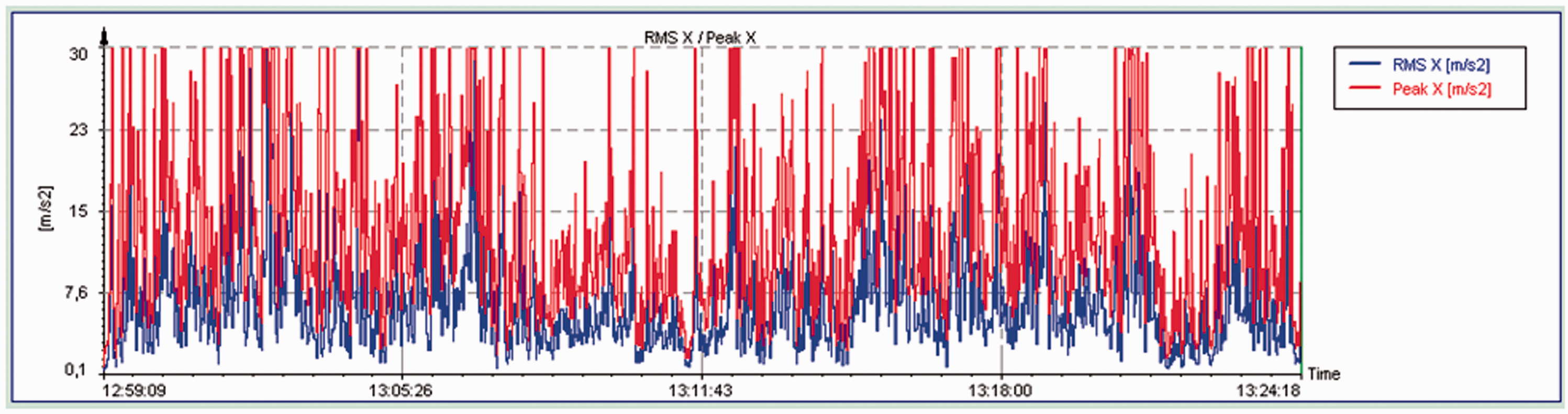
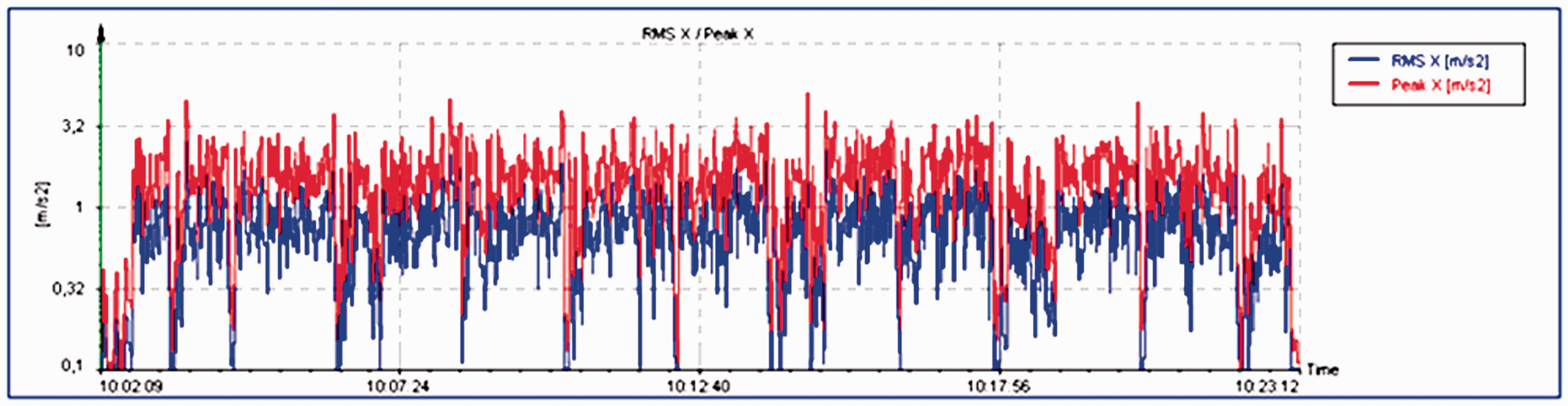
With the air cushion as a vibration absorber, during the same operation, the values were significantly lower and exceeded 3 m/s2 only a few times (Figure 7).
During the measurements, driver’s subjective perception of cushions was examined. In addition to questions about the general comfort, drivers were questioned about the thermal comfort (hot–cold) and height of cushion (low–high). Although it was expected that drivers make a difference between different seat cushions, it did not happen. All tested cushions, received a driver's high rating, in terms of comfort. In terms of thermal comfort, only objection was to the water cushion, especially in cooler weather when the water in the cushion had a low temperature than the usual temperature.
Conclusion
The measurements of vibration levels and the evaluation of the value of daily exposure of drivers indicate that the older models of IMT tractors are harmful from the aspect of whole body vibration. It seems that it is a logical consequence of the length of their lives and the fact that the design and the construction of these models were developed 40 years ago, when ergonomic requests were not observed much. The old suspension and seats can not absorb the vibrations generated during the work of old diesel engines, which are installed in the tractors. Given the fact that the manufacturer of these tractors has not considered developing suspension on new models yet, the purchase of a new, quality seat with, e.g. semi-active or active suspension would be a good solution, but also expensive. The use of new materials for seat has not been researched yet. It seems that simple air cushions on original seats would have significant impact on vibration reduction but the options with water cushions should not be discarded.
One should keep in mind that the level of vibrations, and their spreading as well, can be influenced by the driver himself. A skilful and experienced driver, that is familiar with the capacities of his vehicle, and with the knowledge of the harmful effects of vibrations, can reduce the harm efficiently.
Footnotes
Declaration of conflicting interests
The author(s) declared no potential conflicts of interest with respect to the research, authorship, and/or publication of this article.
Funding
The author(s) disclosed receipt of the following financial support for the research, authorship, and/or publication of this article: This paper is a part of the research done within the TEMPUS project JPHES 15878 ‘Occupational safety and health – degree curricula and lifelong learning’, supported by EU (2010–2013).