




Abstract
The coupled acoustic field of fully elastic plate model is described by the modal analysis method. The acoustic potential energy resonance peaks of the fully elastic plate model are significantly more than that of the one elastic plate model due to the influence of the vibration of multi elastic plates. The acoustic field characteristics of the fully elastic plate model are analyzed when the primary excitation source is applied on the different elastic plates. The results show that the coupled acoustic field of the fully elastic plate model is dominated by the structural mode of the elastic plate with primary excitation, and the acoustic mode of the enclosure, and the structural-acoustic coupling between the plate and the enclosure; the structure modes of the other elastic plates have less effects on the acoustic field in the enclosure except the first ones of them.
Introduction
The noise field in an enclosure is the most representative acoustic fields in practice, such as aircraft,1–3 ship cabin, automobile cab,4,5 work shop, living room 6 and so on. 7 The initial research on active control of enclosed acoustic field began in the 1950s, but due to the limitation of the electronic technology, the active control technology of the enclosed acoustic field has made little progress within the next 30 years. Since the 1980s, with the development of the microprocessor technology, the realization of the active control system of enclosed acoustic field is possible, especially in the area of transportation. Therefore, the study of the active control of enclosed sound field is of great practical value.
In the study of the active noise control of an enclosure, the inner wall of the enclosure is generally treated by rigid or elastic walls. The enclosed acoustic field characteristics of elastic structures are not only related to the characteristics of the noise source and the geometric characteristics of the enclosure, but also directly related to the vibration state of the elastic wall. This is called “structural-acoustic coupling analysis” problem. At present, structural vibration and acoustic researchers are concerned about it.8,9 The structural-acoustic coupling not only has important influence on the secondary source position, but also determines the active control mode selection.
Thus far, an enclosure consisting of one elastic plate and five rigid walls (termed as one elastic plate model in this paper)10–18 is the main research model of the plate-cavity system. Dowell and Voss 10 first study the response of plate-cavity coupling system. Further investigations by Guy, 11 etc. have improved theoretical methods and physical insight. Naryannan and Shanbhag12,13 discuss the problem of acoustic transmission and structural response of a sandwich panel backed by a cavity in an acoustoelastic formulation. Pan and Bies14,15 present a theoretical investigation into the effect of the interaction between an acoustic field and its boundaries upon the characteristics of the acoustic field in an enclosure. Peretti and Dowell 16 analyze the influence of the elastic plate vibration on the acoustic field in an enclosure.
Also, some researchers study coupled acoustic field in an enclosure consisting of two flexible plates and four rigid walls.19–21 Jin et al. 19 present an investigation into the active control of acoustic transmission into a structural-acoustic coupled system. An enclosure with four acoustically rigid walls and two flexible plates is considered. Geng et al. 20 develop a new modeling method for the active minimization of noise within a three-dimensional irregular enclosure. The irregular enclosure is modeled with four rigid walls and two simply supported flexible panels. Cui and Chen 21 present an investigation into the active control of acoustic radiation and transmission into a structural-acoustic coupled system. A rectangular enclosure involving two simply supported flexible plates is considered. But so far, the research on the acoustic field in a rectangular enclosure consisting of six elastic plates (termed as the fully elastic plate model in this paper) has not been reported.
The first problem encountered in active noise control is a determination of the primary acoustic field distribution, and then we can discuss how to use the secondary acoustic source to produce an “anti-acoustic field” which is matched with it. Thus, the accurate description and analysis of the noise field are of great importance. Secondly, the secondary acoustic source is not only related to the type of acoustic field, but also directly with the generation of primary acoustic field and the physical characteristics of peripheral structures. Hence, in order to accurately describe the coupled acoustic field characteristics, this paper presents the fully elastic plate model as shown in Figure 1. The acoustic pressure in the enclosure is expanded in terms of the normal modes of the rigid-walled cavity. The equations of motion of the elastic wall are also derived in terms of in vacuo structural normal modes. The effectiveness of the method by using the normal modes of the cavity with rigid walls has been verified by experiments.
22
The primary excitation source is applied on the different elastic plates according to the three disturbing cases. By analyzing the primary acoustic field in the three different cases, the coupled acoustic field characteristics of the fully elastic plate model are obtained, which lay a theoretical foundation for the design of active structural acoustic. It is necessary to point out that the method in this paper is only applicable to the weak coupling problem. Therefore, the conclusions in this paper are generally used only in the case of simple shape, and good rigidity of the plate or deep cavity.
Acoustic cavity model with six elastic plates.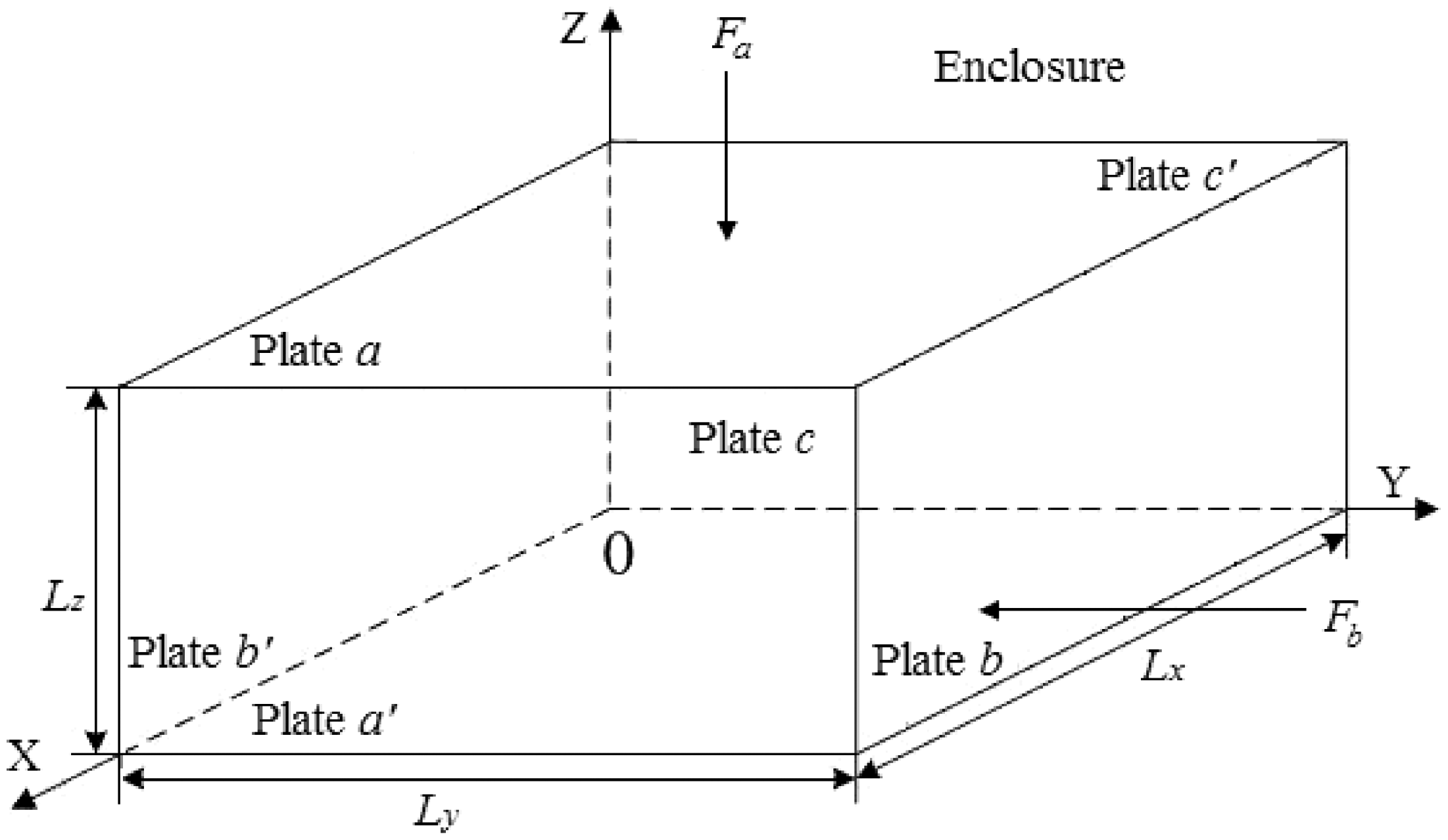
Acoustic field model of fully elastic plates
Figure 1 shows panel-cavity system that is modeled in this analysis. A rectangular enclosure consisting of six simply supported elastic plates are labeled as Plate a, a′, b, b′, c and c′ and located at z = Lz, z = 0, y = Ly, y = 0, x = Lx and x = 0, respectively. The simply supported boundary conditions for these flexible plates are taken into account because a simply supported rectangular panel closely approximates many actual structural configurations. The enclosure is 0.868 m long (Lx), 1.15 m wide (Ly), and 1.0 m high (Lz). The elastic panels with thicknesses of 6 mm are all aluminum plates with the material properties of Young’s modulus E = 71 GPa, mass density ρ1 = 2700 kg/m3, and Poisson’s ratio υ = 0.3. The acoustic speed is c = 344 m/s, and mass density of air is ρ = 1.21 kg/m3.
The characteristics of coupled acoustic field in the enclosure are discussed, respectively, according to three cases: (1) the primary excitation source Fa applied on the Plate a; (2) the primary excitation source Fb applied on the Plate b; (3) the primary excitation sources Fa and Fb applied simultaneously on the Plate a and Plate b, respectively. The forces Fa and Fb are located at
Excitation Fa applied on the plate a
Theoretical formulation
Consider only the excitation source Fa applied on the Plate a, i.e. Fb = 0. With the system described above, the acoustic pressure in the enclosure is governed by the inhomogeneous wave equation as

The equations of motion of the Plate a can be expressed as

The equation of motion of the rest of the elastic plates is expressed as

If the acoustic pressure in the enclosure and the structural vibration of plates are assumed to be described by the summation of N and M, S, L modes, respectively, the acoustic pressure and the normal structural vibration velocities of plates are given, respectively, by23,24


































The generalized modal force

Combining equations (18) to (24), the acoustic and structural modal amplitude vectors can be expressed as













Thus, the acoustic pressure and acoustical potential energy in the enclosure can be expressed as


Coupled acoustic field characteristics
As far as we know, the research about two adjacent coupled plates in dynamics is very few. Yao et al.26,27 analyze the structural acoustic coupling characteristics of a rectangular enclosure consisting of the two simply supported flexible plates and four rigid plates. A general formulation considering the full coupling between the plates and cavity is developed by using Hamiltonian function and Rayleigh-Ritz method. The analytical results and experimental results coincide well with Kim and Brennan’s 25 and Yao et al.26,27 as well as the numerical solution obtained by FEM and BEM. At the same time, the results indicate that the coupling of the two adjacent plates is very weak. In this paper, the coupling between the flexible plates is omitted.
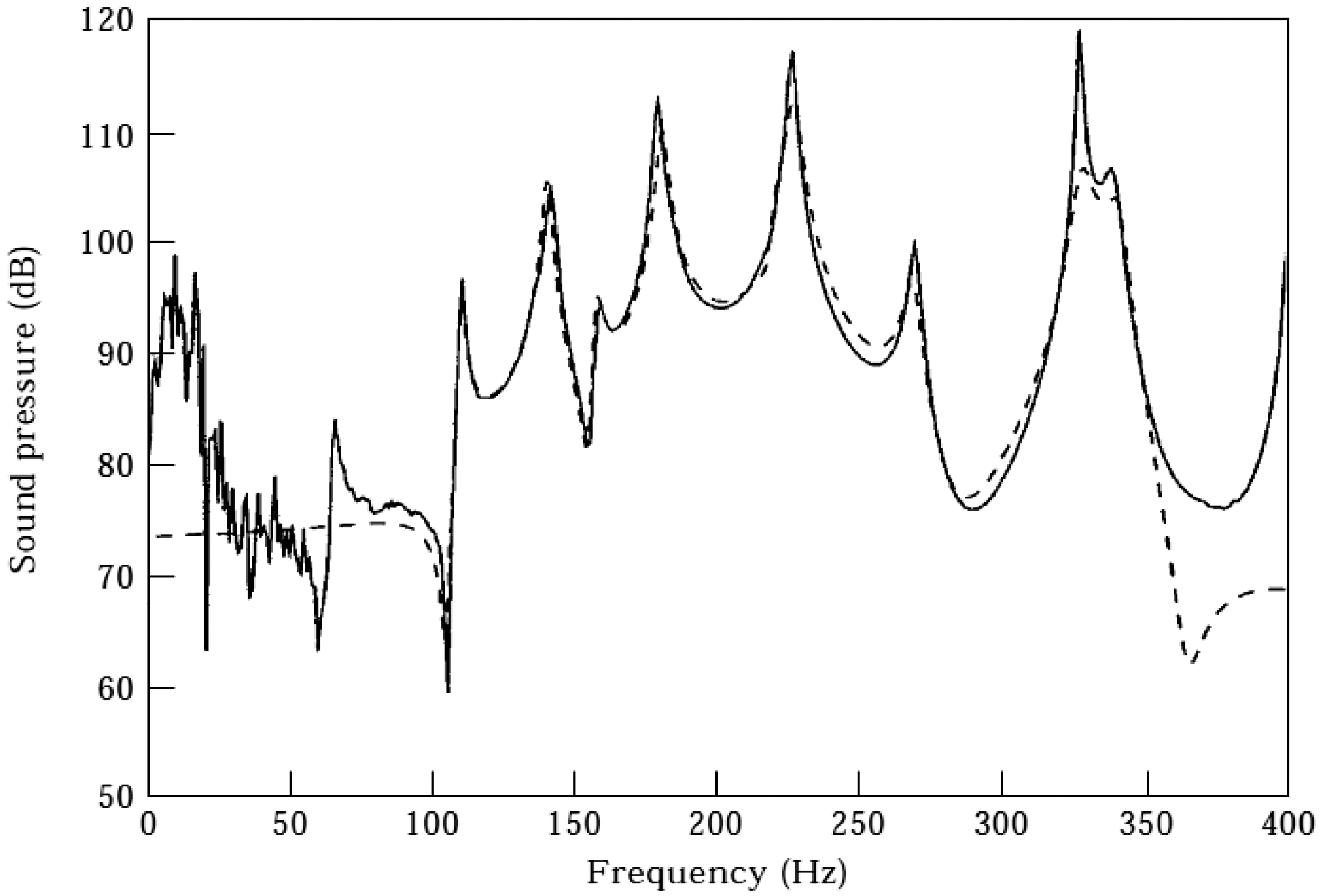
In addition, to check the validity of the formulation derivation, simulations generated are compared with the experimental results of Kim and Brennan.
25
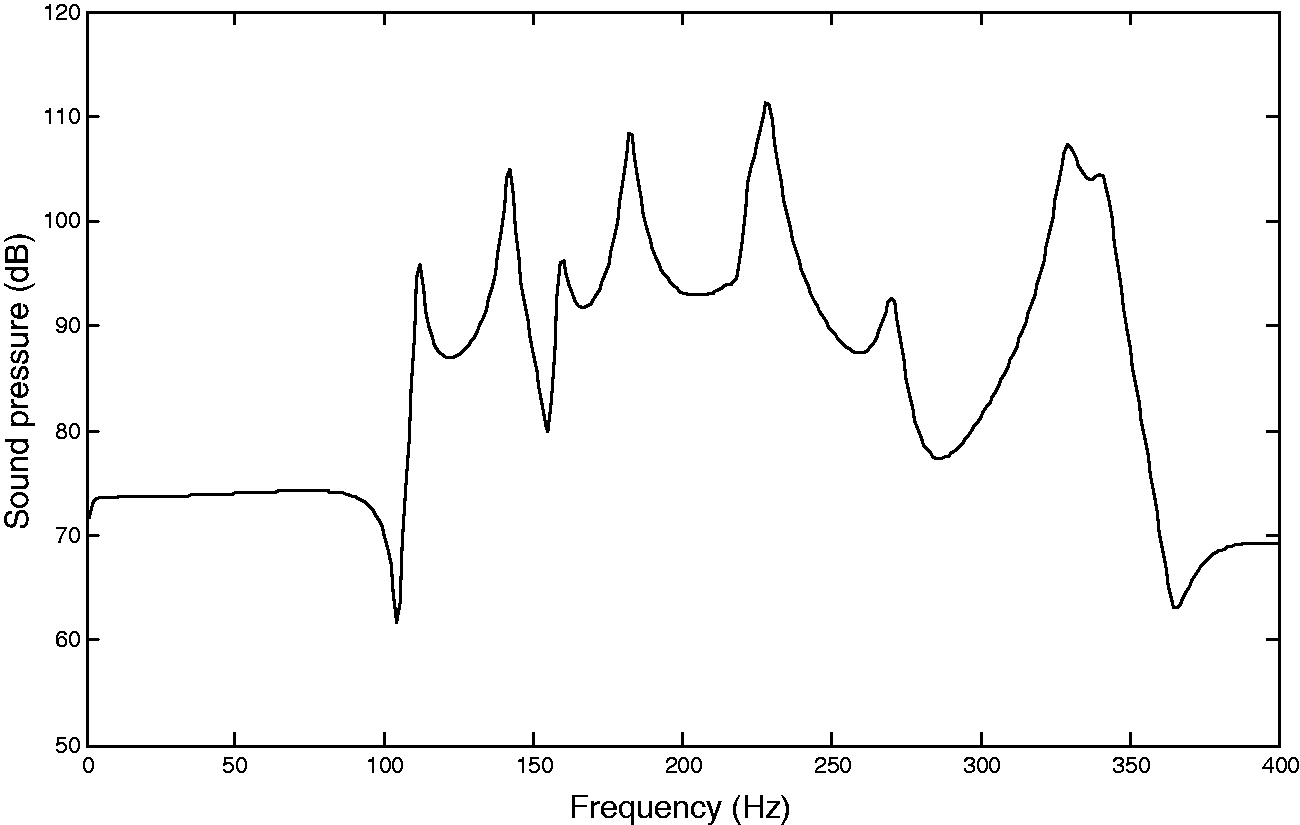
The model has the same parameters as the model of Kim, including the simply supported boundary conditions for plate. Plate a is only driven by a disturbance point force. The results of simulation using the author’s and Kim’s method are perfectly equivalent and coincided well with Kim and Brennan’s experimental results, as shown in Figures 2 and 3.
Sound pressure responses by using the author’s and Kim’s methods, respectively. (The simulated results are perfectly equivalent.) Experimental (—) and simulated (- - -) responses to a point force excitation of the structural-acoustic system (see Figure 7(b), page 109 in Kim and Brennan
25
).
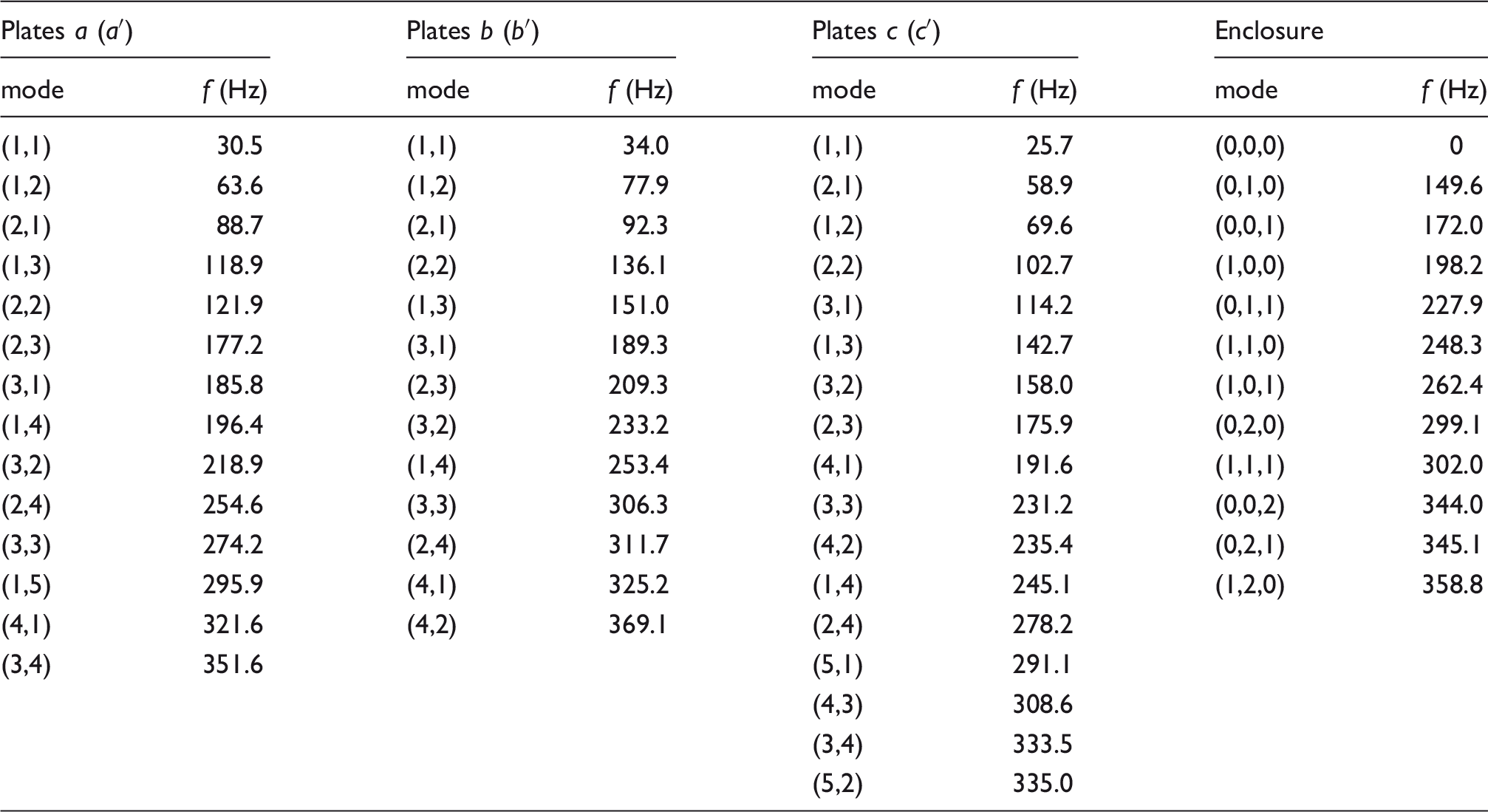
The modal indices and uncoupled natural frequencies of the plates and enclosure.
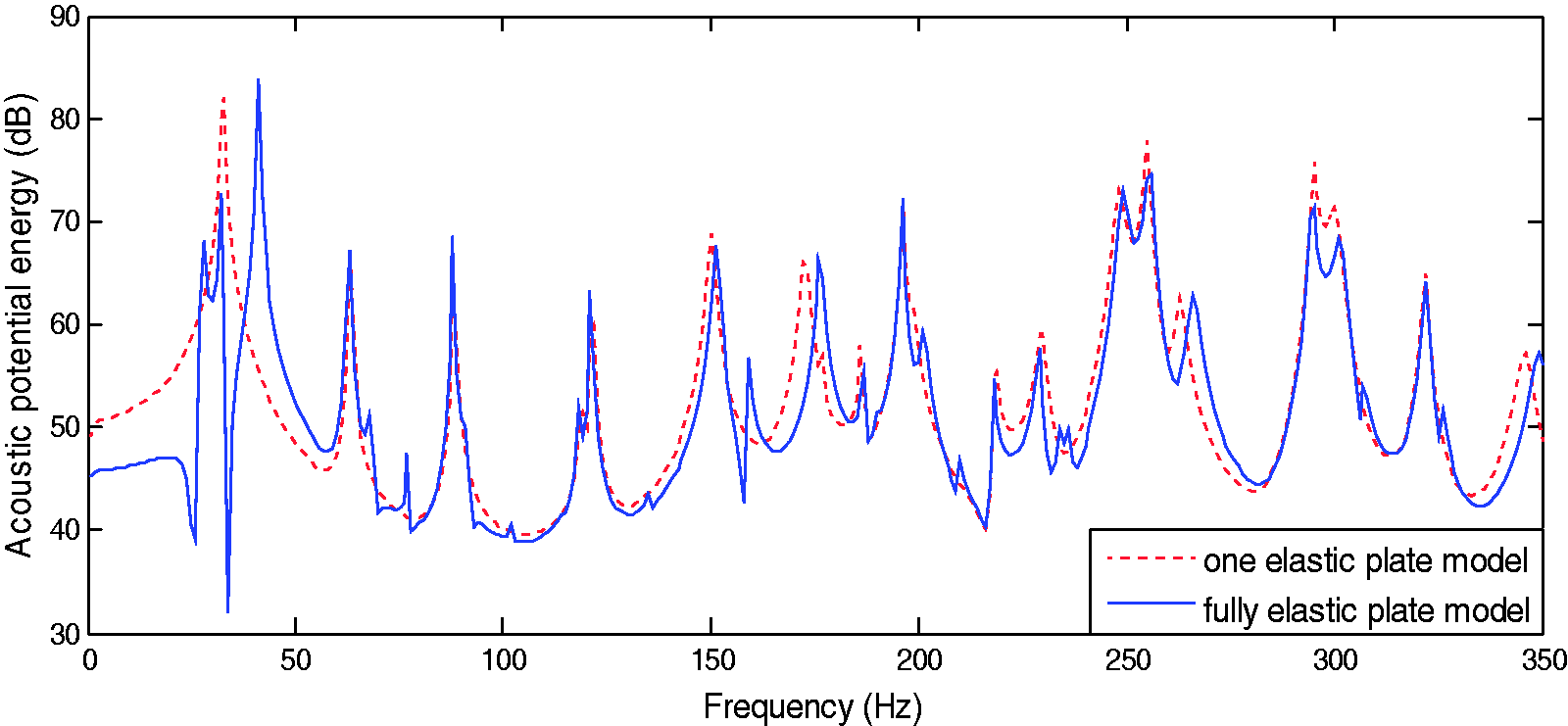
Comparison of coupled acoustic fields in the fully elastic and one elastic plate models.
Excitation Fb applied on the plate b
Theoretical formulation
Consider only the excitation source Fb applied on the Plate b, i.e. Fa = 0. The control equation of the cavity pressure is the same as equation (1). The equations of motion of Plate b can be expressed as

The equation of motion of the rest of the elastic plates is expressed as

The generalized modal force 
According to the theoretical derivation of section ‘Theoretical formulation’ and equations (32) to (34), the following formulas can be derived as



Combining equations (50) to (52), the acoustic modal amplitude vector can be written as

Then the acoustic pressure and acoustical potential energy in the enclosure can be expressed as


Coupled acoustic field characteristics
Figure 5 shows the coupled acoustic field in the fully elastic plate and one elastic plate models. Figure 5 shows that the potential energy resonance peaks of the fully elastic plates model are obviously greater than that of one elastic plate model. Meantime, some resonant frequencies in the fully elastic plates model are changed little compared to those in one elastic plate model. This is similar to the case of the primary excitation force applied on the Plate a. In the fully elastic plates model, the large acoustic potential energy peaks are related to the natural frequencies of the Plate b (such as 34.0, 77.9, 189.3, 233.2, 253.4 Hz) and the enclosure (such as 149.6, 172.0, 248.3 Hz), as shown in Figure 5. In addition, although the first modes of the Plates a ( Acoustic potential energy in the fully elastic plate and one elastic plate models when the excitation applied on the Plate b.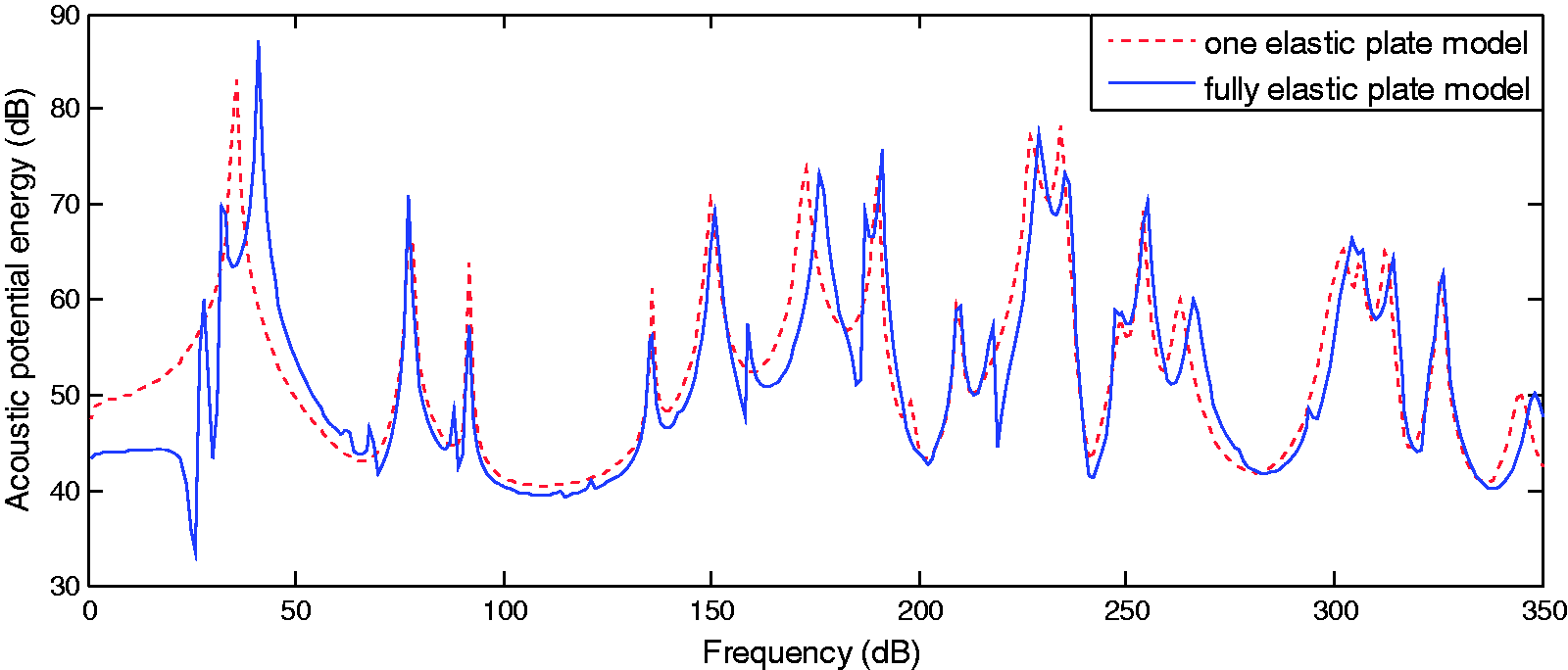
Two excitations applied simultaneously on the plates a and b
Theoretical formulation
The primary excitation sources Fa and Fb are applied simultaneously on the Plate a and Plate b, respectively. The control equation of the acoustic pressure is the same as equation (1). The equations of motion of the Plate a and Plate b are expressed by equations (2) and (47), respectively. The equation of motion of the rest of the elastic plates is expressed as

The structural modal amplitude vectors of the Plate a and Plate b are seen in equations (33) and (51), respectively. Then by the theoretical derivation of section ‘Theoretical formulation’ and equations (32) to (34), the modal amplitude vectors of the cavity pressure and the rest plates’ vibration velocity can be expressed as


By equations (33), (51), (57) and (58), the mode amplitude of the acoustic pressure is

Then the acoustic pressure and acoustical potential energy in the enclosure can be expressed as


Coupled acoustic field characteristics
Figure 6 shows the coupled acoustic field in the enclosure. The large acoustic potential energy peaks are related to the natural frequencies of the Plate a (such as 30.5, 177.2, 196.4, 254.6, 295.5 Hz), the Plate b (such as 34.0, 77.9, 151.0, 189.3, 233.2 Hz) and the enclosure (such as 149.6, 172.0, 198.2, 227.9, 248.3 Hz), as shown in Figure 6. In addition, the contribution of each mode of the Plate c ( Acoustic potential energy in the fully elastic plate model when the two excitations applied simultaneously on the Plate a and b.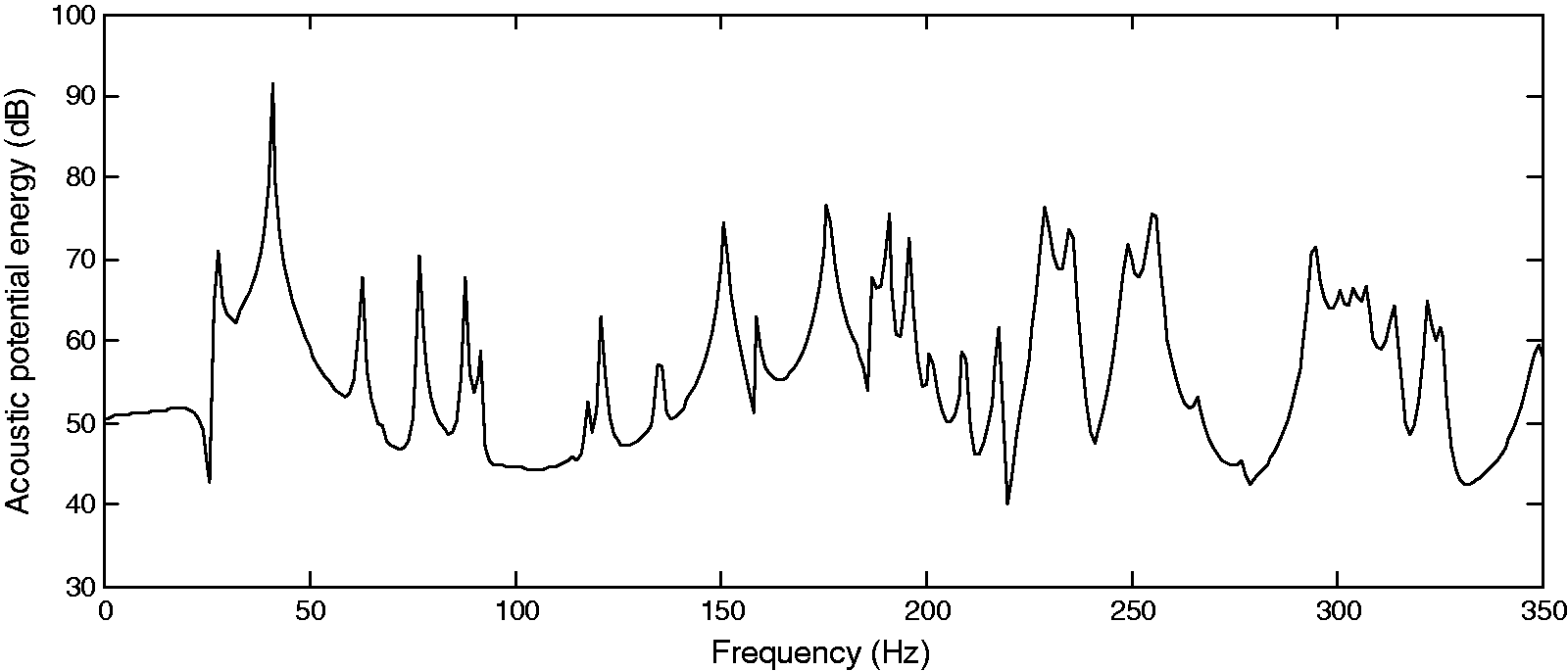
Conclusions
In this paper, the coupled acoustic field of the fully elastic plates model is modeled by the modal superposition method. The acoustic field characteristics of the fully elastic plates and one elastic plate model are compared and analyzed. The simulation results show that the potential energy resonance peaks of the fully elastic plates model are significantly more than that of one elastic plate model. Then the acoustic field characteristics of the fully elastic plate model are analyzed with the three different disturbing cases. The study shows that the high potential energy resonance peaks are dominated by the structural modes of the elastic plate excited by the primary excitation source and the acoustic modes of the enclosure; only the first structural modes of the other elastic plates make a significant contribution to the coupled acoustic field in the enclosure, the contributions of the rest of the structure modes on the acoustic field are smaller.
Footnotes
Declaration of conflicting interests
The author(s) declared no potential conflicts of interest with respect to the research, authorship, and/or publication of this article.
Funding
The author(s) disclosed receipt of the following financial support for the research, authorship, and/or publication of this article: This work was supported by the Natural Science Foundation of Ningbo, China (Grant No. 2016A610107).