




Abstract
This paper presents computation of structural sound power and sound radiation modes, combined with structural dynamic equations to obtain the coupling relationship between sound and structures. As a result, the relationship between sound radiation modes of structures and structural vibration modes is established. The influence of the number and position of optimal secondary force sources on control of sound radiation modes is considered. Results show that sound radiation efficiency of sound radiation modes at the first order was more than that of sound radiation modes at other orders. The main diagonal element of coupling matrix between modes and sound radiation impedances was more than elements at other positions. Sound radiation modes at the first order were dominant sound radiation modes. When the number of secondary force sources was 4, the sound radiation power of structures was the lowest. Four force sources were taken as the basis to conduct on the related experiments in the anechoic chamber and compare with the computational result. Their results had a good consistency, which showed that the mentioned theory method was effective. Finally, the control strategy was applied to roofs of the vehicle. Experiments verified that sound pressure level of the driver in the low frequency was obviously improved, which remedied the defect of other optimization strategies for solving noises in the low frequency.
Introduction
The vibration and sound radiation problem of thin plates has been one of important problems in engineering noises. In the field of vehicles, ships and aerospace, controlling the vibration and sound radiation of thin plates has had important values. For example, a simply supported thin plate in harmonic vibrations, the sound radiation efficiency at each order was not mutually independent. In the mid-low frequency, the total radiation sound power might not be reduced obviously even if the vibration of the structural mode at main orders was reduced. It was mainly because structural modes had strong coupling, which brought difficulties to the computation and control of sound radiation. Therefore, directly using structural vibration modes to study sound radiation problems had a lot of defects.
Johnson and Elliott proposed the concept of sound radiation modes when they were studying the active control of structures and sound.1–3 The concept was very clear and concise. Sound radiation modes decomposed the vibration on the surface of structures into a group of independent sound radiation velocities so that there was no coupling within various modes, and complex coupling items in structural modes were eliminated. In this case, radiation sound power of structures could be represented by the sum of the square of sound radiation modes and eigenvalues. Sound radiation modes which were determined by the geometrical shape and vibration frequency of structures had nothing to do with the material characteristics of structures. Due to these advantages, sound radiation modes attracted wide attentions when structural vibrations and sound radiation were analyzed. Wang and Lai 4 used boundary element method to study the sound radiation efficiency of the circular plate under mechanical excitation and conducted experiments to verify the researched result, but he failed to point out the relationship between structural modes and sound radiation modes. Gibbs et al. 5 studied the relationship between structural modes and sound radiation modes, and found noises in the low frequency could be effectively reduced through controlling sound radiation modes. However, his research was not verified by experiments. Yamaguchi et al. 6 used force radiation modes to reduce the sound radiation of structures and systematically studied the position and amplitude of forces. Rdzanek et al. 7 theoretically studied the sound radiation problems of the plate with flexibly supported, simply supported and free boundary conditions, and verified the studied result through the numerical simulation. Lee and Singh 8 applied two methods to compute sound radiation problems of the circular plate from structural modes of radial vibrations. Hasheminejad and Keshavarzpour 9 studied the active control problem of sound radiation for composite plates based on 3D elastic model, but they failed to consider the corresponding relationship between sound radiation modes and structural modes and the studied process was not verified by experiments. Sahu et al. 10 used multiple piezoelectric actuators and Reddy’s higher order theory to study the structural sound radiation problem of sandwich plates, and analyzed the influence of different parameters on sound radiation. The research was not verified by experiments. In addition, the studied result was not applied to any complex machines. Li 11 numerically analyzed the process for sound from air to water, studied the active control and conducted an analysis on the results of two transmission paths. The mentioned studies were only conducted on the sound radiation performance of the plate from structures or sound radiation modes, and failed to consider the combination of them. In addition, the studied result was not verified by experiments. Meanwhile, the studied result was not further applied to complex machines to realize its engineering values.
This paper discussed the relationship between sound radiation modes and structural modes based on the mentioned studies, studied the influence of the number and amplitude of optimal secondary force sources on control effect from sound radiation modes. Finally, the control strategy was applied to vehicles to realize the active control of interior noises.
Acoustic boundary element and sound radiation modal
Sound radiation modal of structure
According to literature,
12
sound radiation power of the thin plate can be expressed as follows.

If


The sound radiation efficiency of structures is defined as follows.
13


The radiation sound power Wi and radiation efficiency
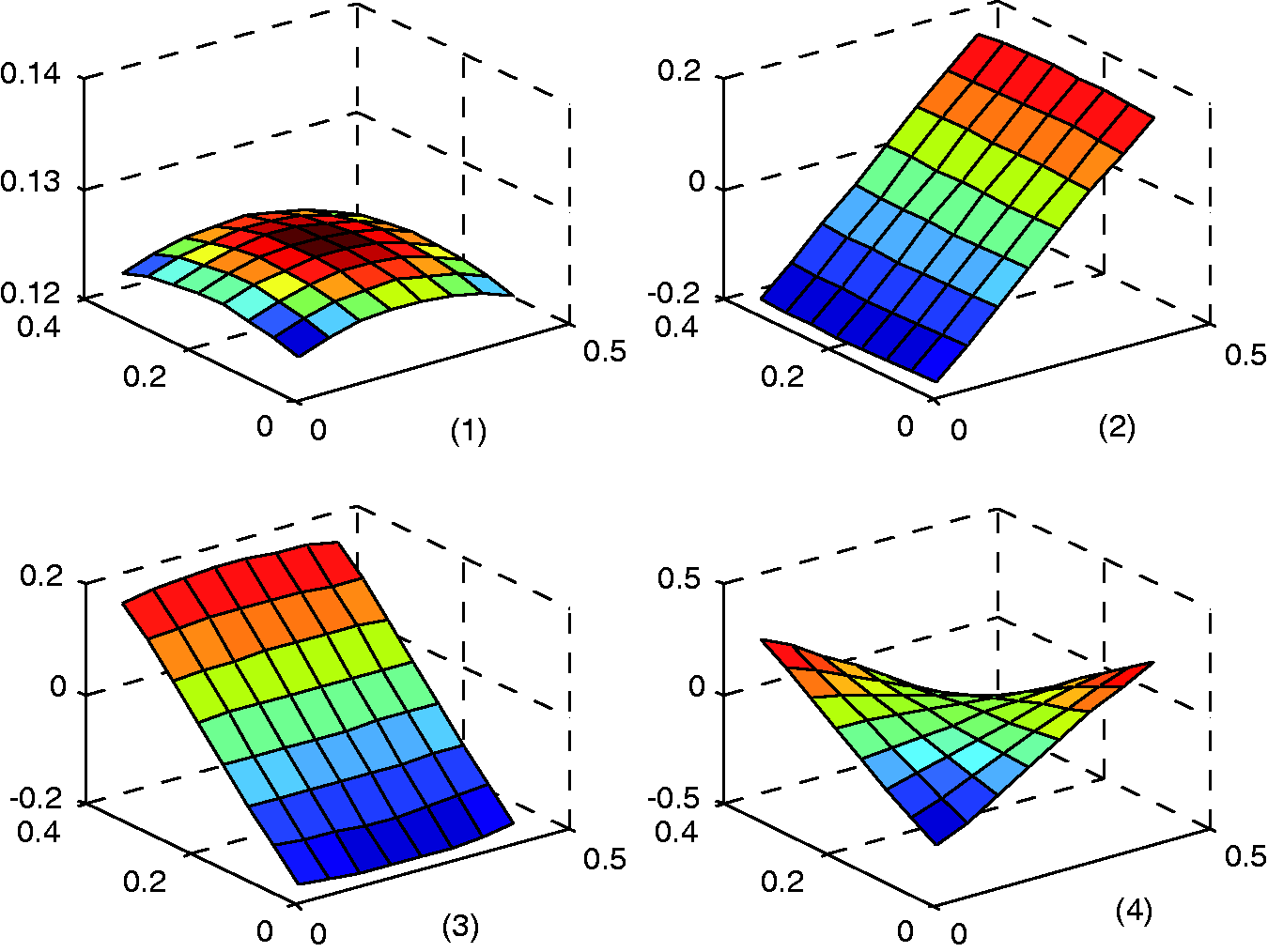
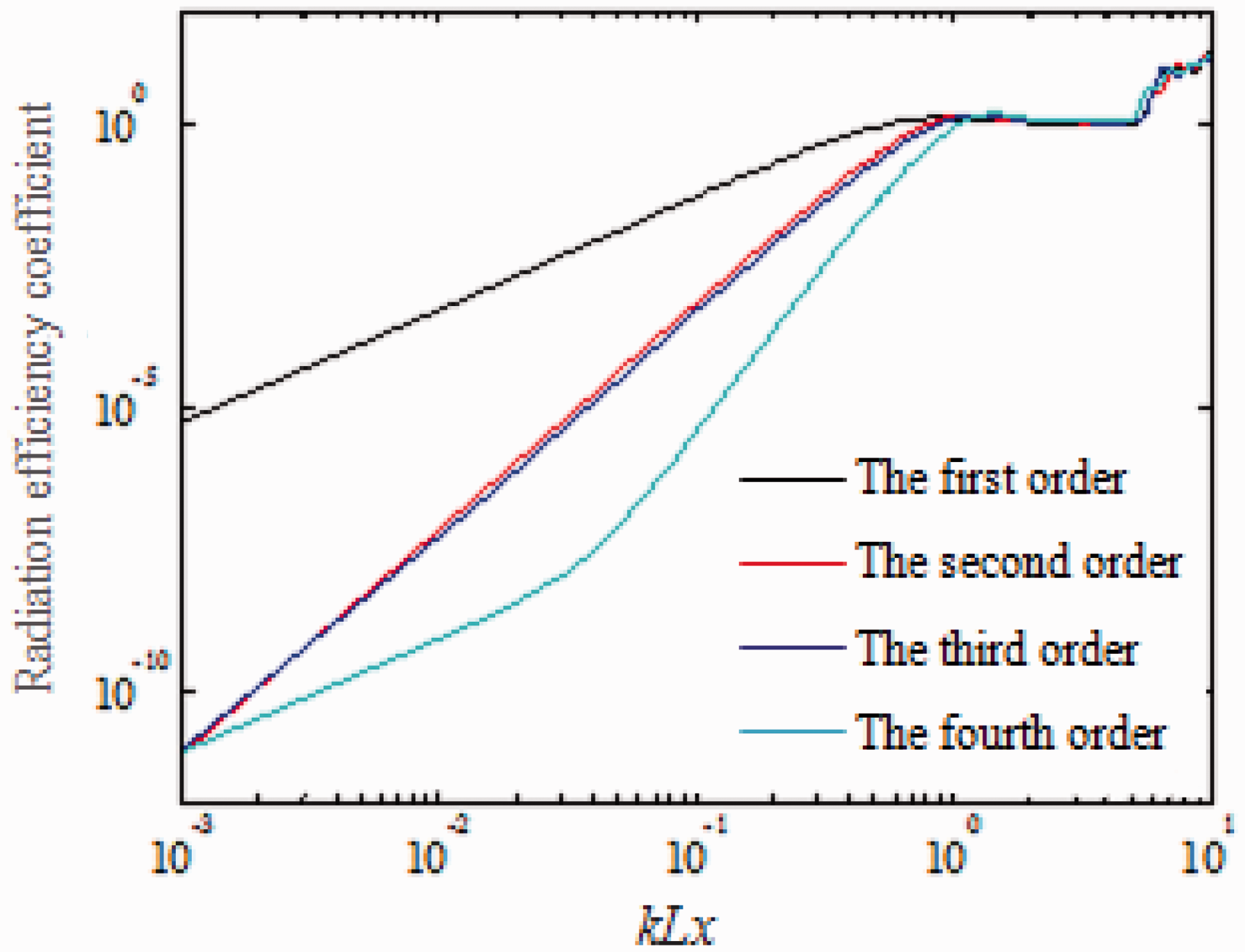
The clamped plate was shown in Figure 1. Length Diagram of the analyzed plate. Sound radiation modes of the rectangular plate, (1) first model, (2) second model, (3) third model, (4) fourth mode. Radiation efficiency coefficients of sound radiation modes.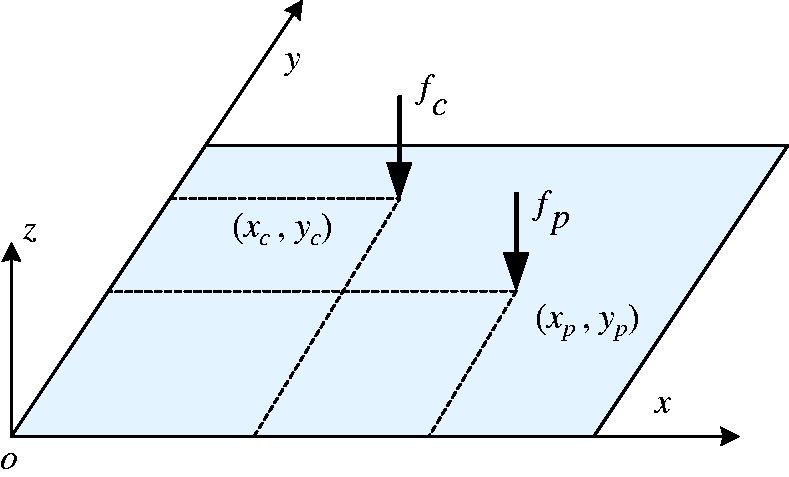
Sound radiation modes and structural vibration modes
For a coupling problem, the coupling coefficient

The dynamic equation of the structure can be expressed as follows.

According to theories of structural dynamics, when the natural mode matrixes of structures are assumed to be


Equation (9) was substituted into equation (1), and then the following equation can be obtained.

If 
The mode function of the analyzed plate is as follows.

Coordinates of elements were substituted to compute modes and natural frequencies of the top-four-order, as shown in Figure 4 and Table 1, respectively. Then, Structural modes of the rectangular plate, (1) first model, (2) second model, (3) third model, (4) fourth mode. Natural frequencies of the rectangular plate.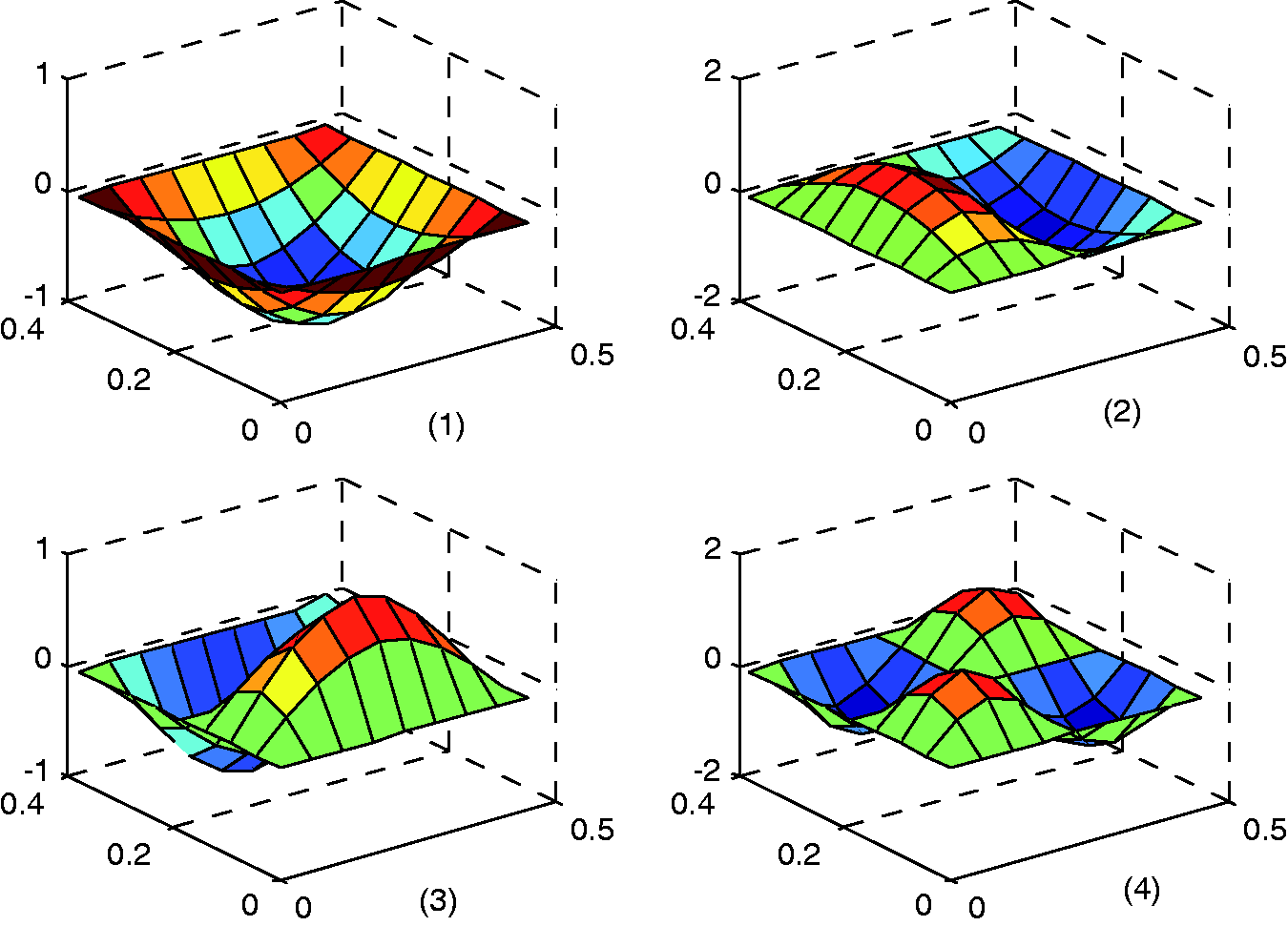

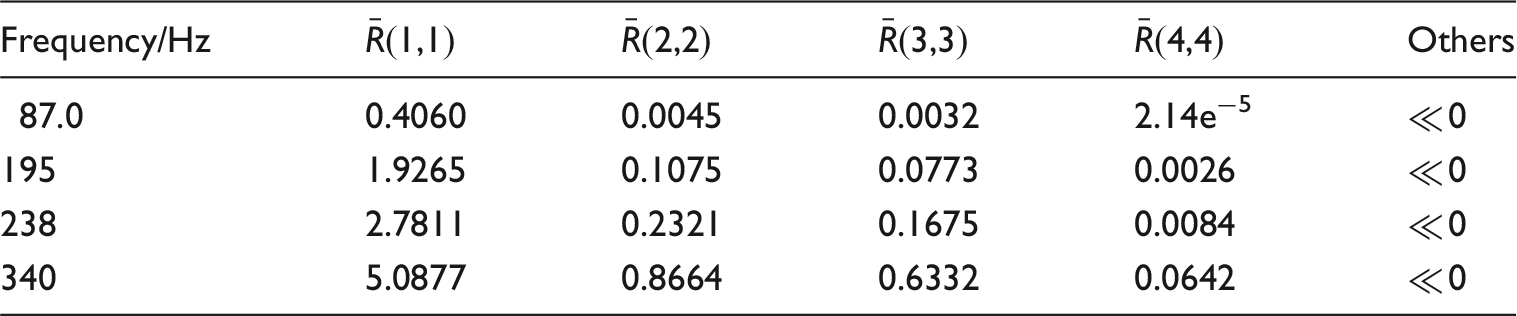
It was shown in Table 2 that the computational value of diagonal elements was more than that of elements at other positions. In addition, values of 
It was shown that the structural mode at the first order was similar to sound radiation modes at the first order through comparing Figure 2(a) with Figure 4(a). Sound radiation efficiency of the sound radiation mode at the first order was more than that of sound radiation modes at other orders. Therefore, it was feasible to control sound radiation by controlling the first-order vibration of the structure. It was also shown in the mentioned analysis that sound radiation modes of structures at each order were independent. Therefore, noise control can be realized by controlling sound radiation modes at the corresponding order.
The change curve of sound power for the plate in 0–500 Hz was computed, as shown in Figure 5. It was shown in Figure 5 that the sound radiation power was the largest at the natural vibration frequency of the structure.
Curves of radiation sound power.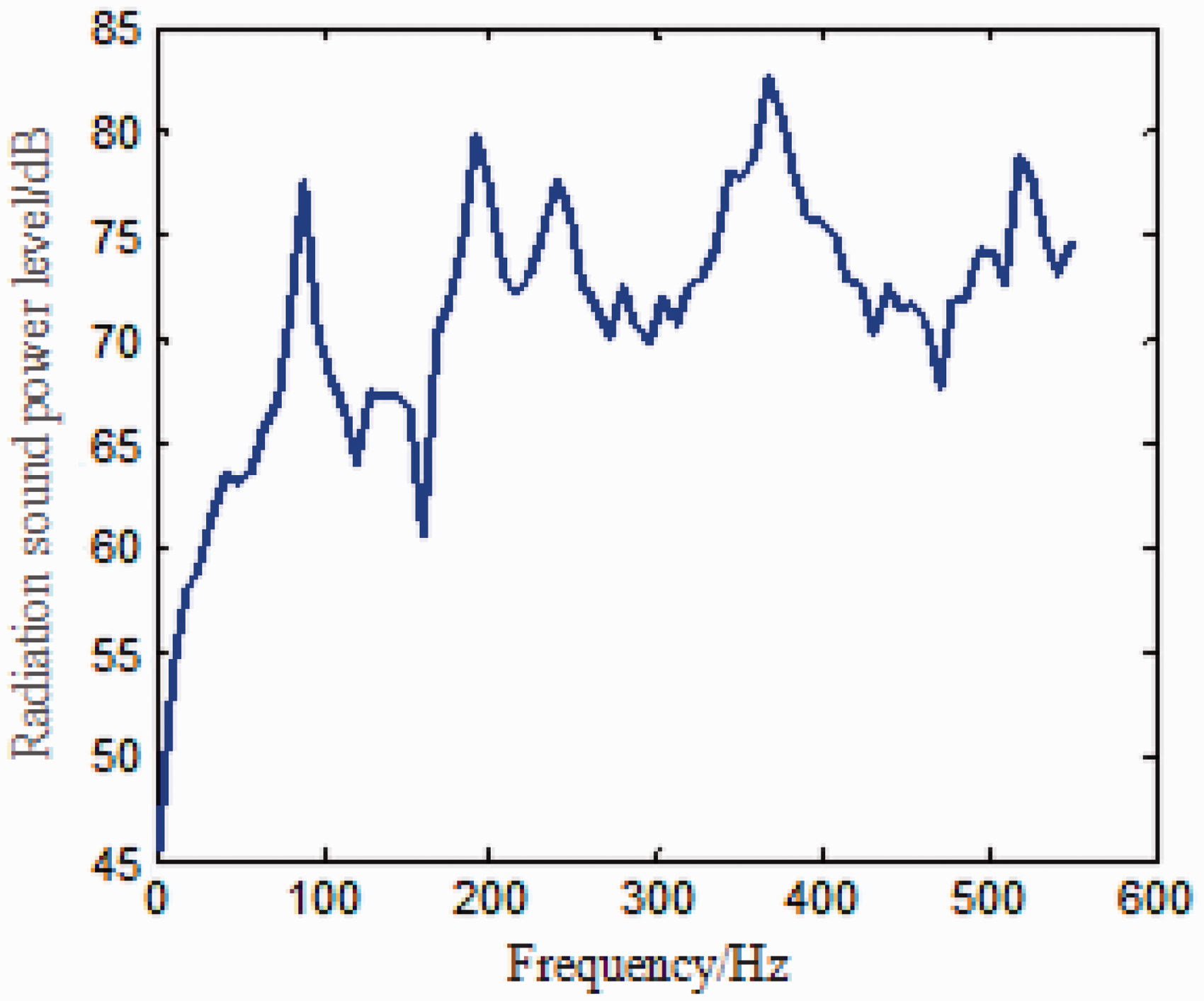
Active controls
It was assumed that the plate was excited by the force 
When the control force is 

Therefore, sound power can be expressed as follows.

In order to minimize the sound power, the following equation is assumed.

Then, the following equation can be obtained.

It was shown in the equation that a control force was needed to eliminate the sound power of the corresponding sound radiation mode. k control forces were needed to eliminate sound powers of sound radiation modes at k orders. It was shown in the mentioned analysis that sound radiation modes at the first order were the main sound radiation modes. Effective control can be realized by controlling the first order. Therefore, the equation can be simplified into the following form.

Figure 6 shows coordinates of control forces. Coordinates of position 1 were (a/4, 3b/4). Coordinates of position 2 were (3a/4, 3b/4). Coordinates of position 3 were (3a/4, b/4). Coordinates of position 4 were (a/4, b/4).
Positions of excitation forces and control forces.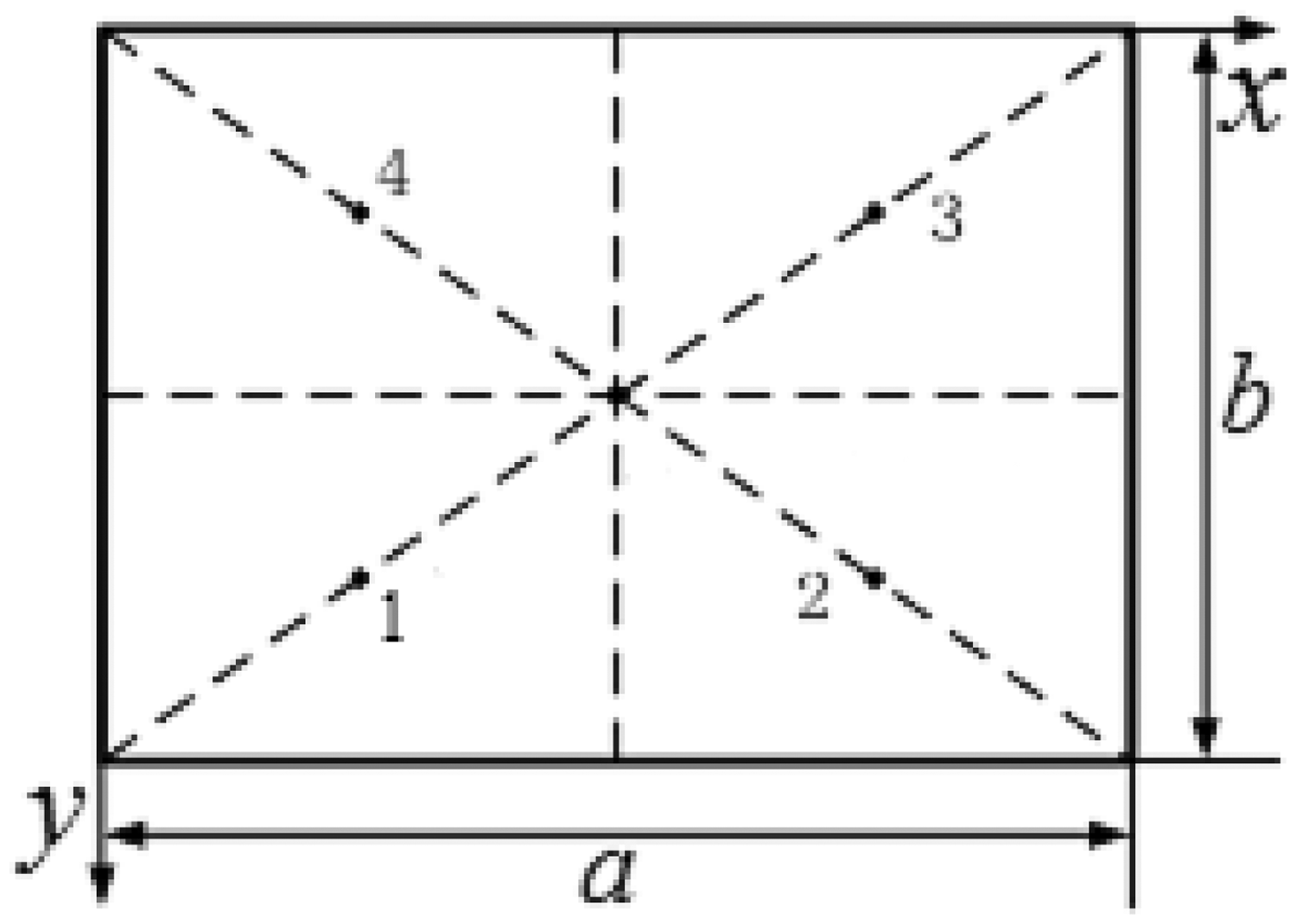
When one control force was applied on positions 1, 2, 3 and 4, respectively. The computational results are shown in Figure 7. It was shown that one control fore could effectively control the sound radiation power of the vibration mode at the first order. Control effects had a great difference with different positions of control forces.
Changes of structural sound radiation power for one control force.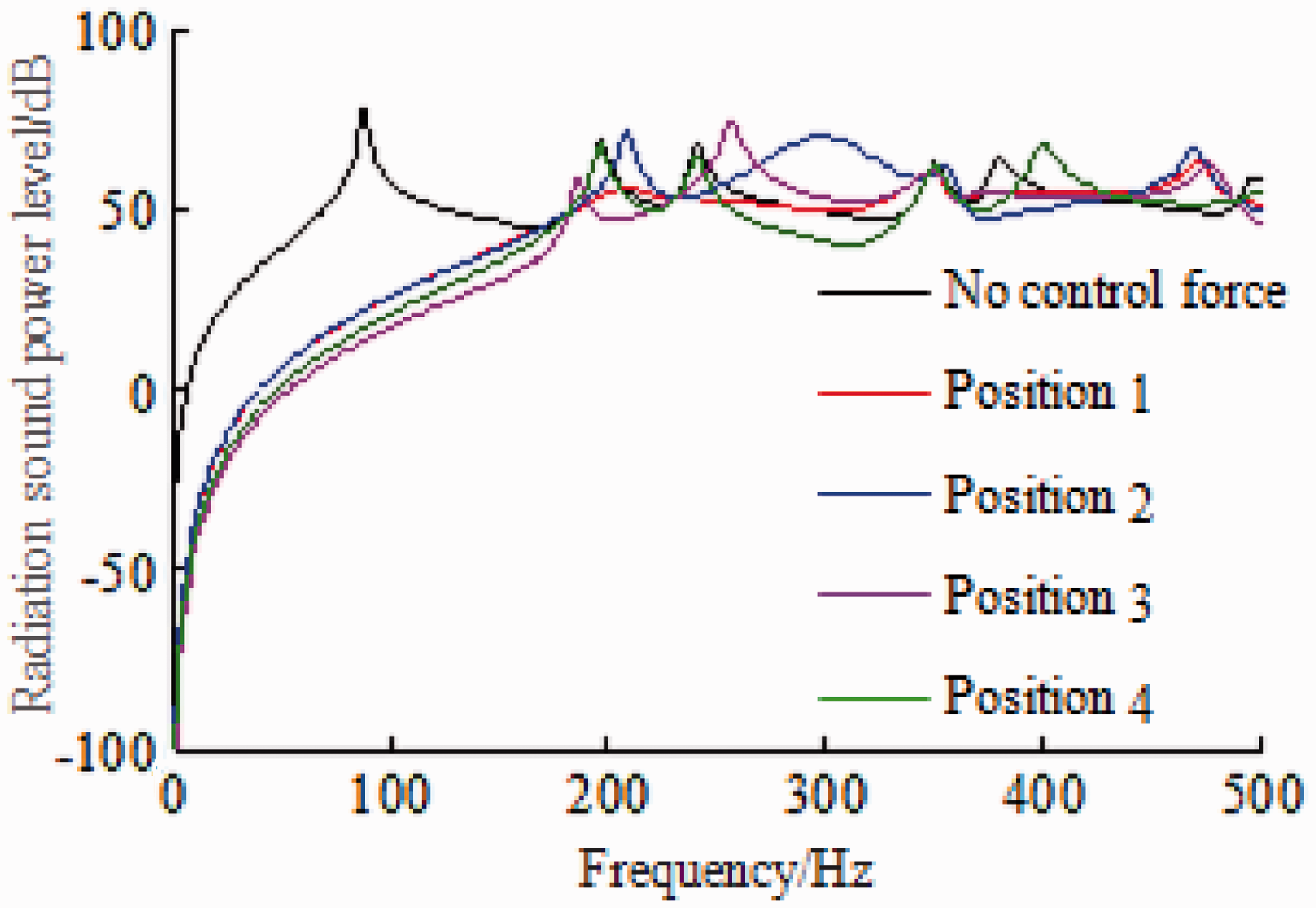
When two control forces were applied on positions 2 and 3, positions 3 and 4, positions 1 and 3, positions 2 and 4, respectively, the computational results were shown in Figure 8. It was shown that two control forces could control the sound radiation power of vibration modes at the first order. However, there were obvious differences with different action positions for other orders. It was shown in the figure that when the control force was applied on positions 1 and 3, sound radiation powers of vibration modes at the top-three-orders can be obviously reduced. When the control force was applied on positions 2 and 4, the control force presented a low control effect for other orders except for the first order.
Changes of structural sound radiation power for two control forces.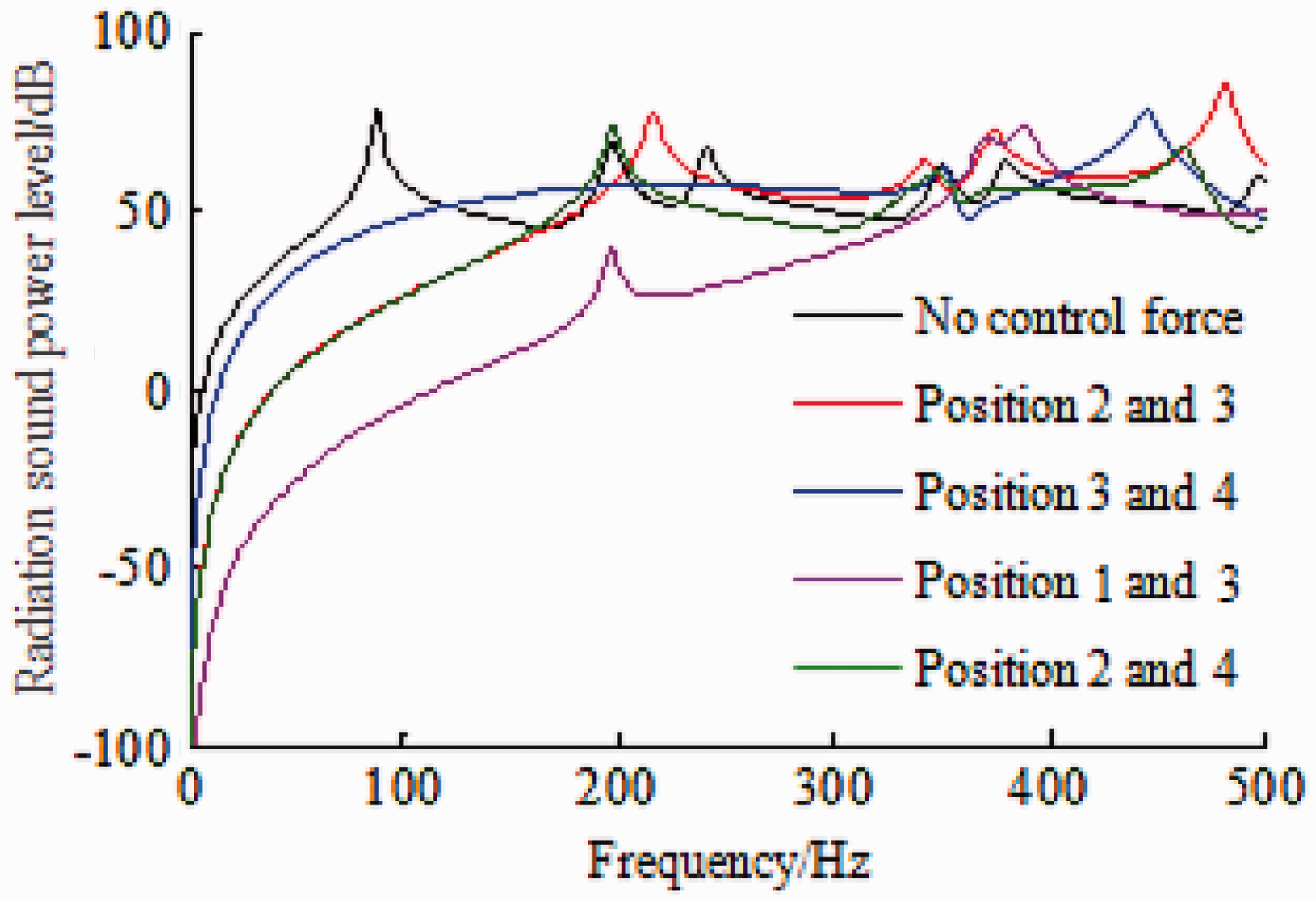
When three or four control forces were applied on positions 1, 2, 3 and positions 1, 2, 3, 4, respectively, the computational results were shown in Figure 9. It was shown that sound radiation power of vibration modes at the top-three-orders can be effectively controlled by applying three control forces. Sound radiation power of vibration modes at the top-four-orders can be effectively controlled by applying four control forces. It was shown in Figures 7 to 9 that k control forces were needed to eliminate sound power of sound radiation modes at the top-k-orders. Control effects were closely related to action positions of control forces.
Changes of structural sound radiation power for three and four control forces.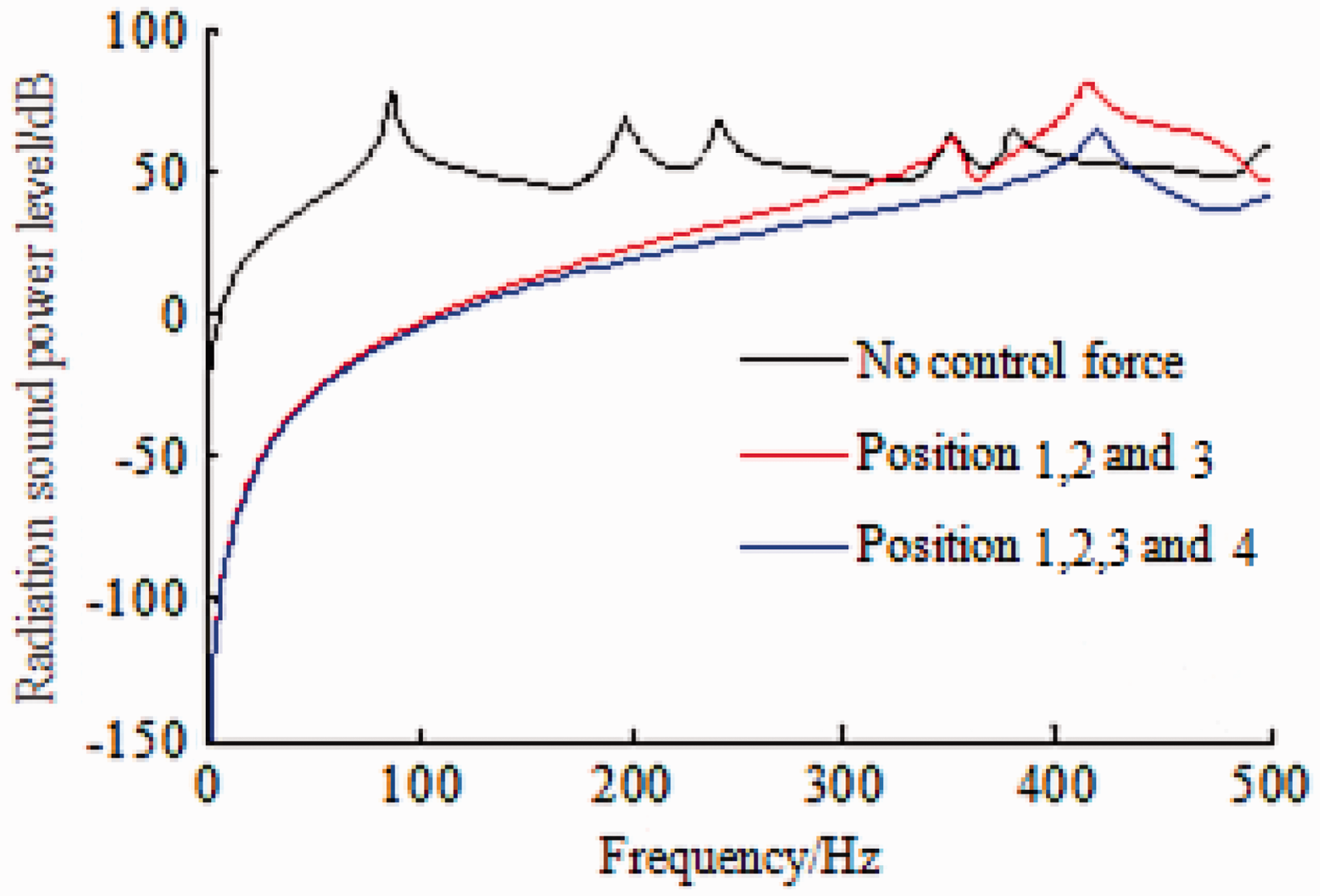
Experimental verification and application
Experimental verification
The computational result should be verified by experiments. Otherwise, the reliability of the mentioned conclusion was difficult to guarantee. From the computational result, the sound radiation power of the plate would be the lowest when 4 control forces were applied to the plate. Therefore, experiments were conducted to verify this condition. In the experimental process, actuators were located at positions of 4 control forces, as shown in Figure 10, and then they were connected to a controller. Through the corresponding control algorithm, the control force can be applied on the structure. In this way, actuators could simulate the control force at four positions. The experimental plate was installed in a window, fixed and constrained by bolts. At the bottom of the plate, an exciter was used to apply excitation forces. At the top of the plate, a microphone was set to receive radiation noises. The microphone was connected with the multi-channel data collection equipment which was produced by B&K Company. Then, the tested signals were imported into a computer. Test.lab software which was produced by LMS Company was used to conduct on post-processing for signals and obtain the radiation sound power in the transmission side. The sample frequency of experiments was 5000 Hz. Each experiment was conducted three times to obtain the average value as the finally experimental result.
Active control of noises for thin plates.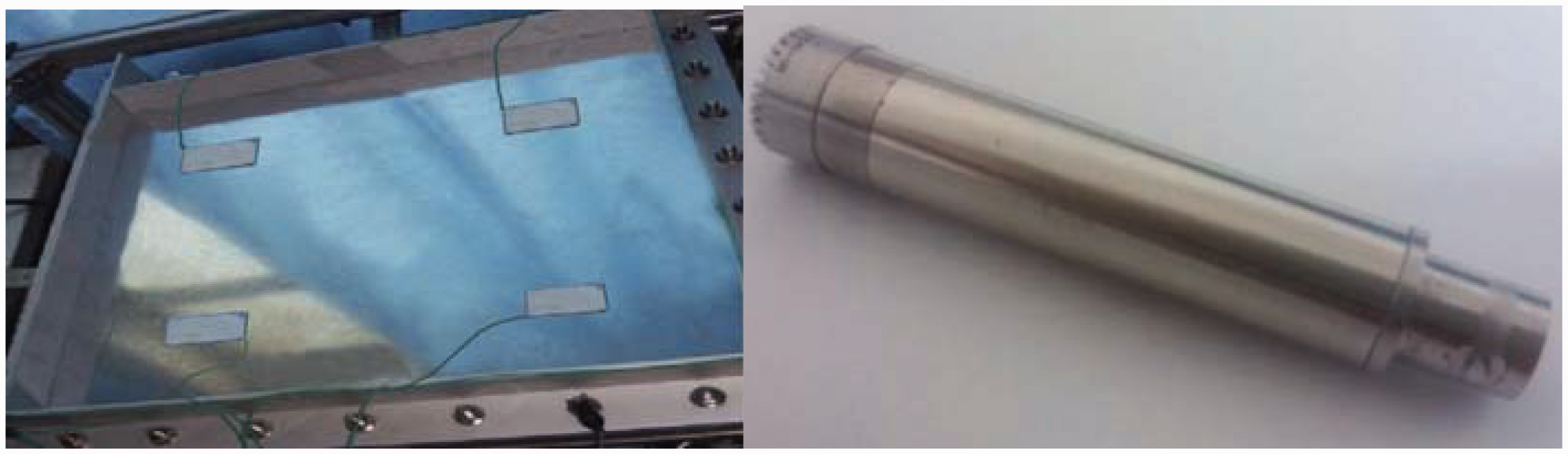
In the process of active control, finite impulse response filter was used, as shown in Figure 11. The output response Interior structures of the adaptive filter.

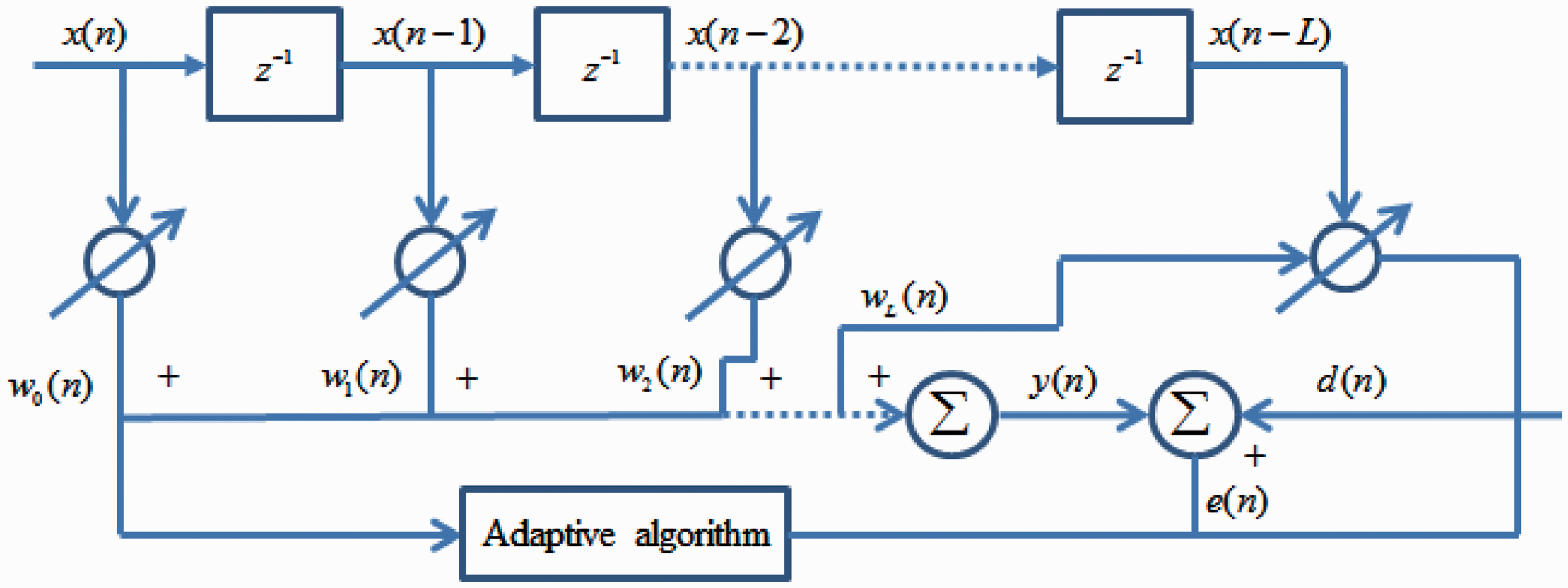
According to the minimum mean square theory of error signals, the optimal weight coefficient of filter was adaptively solved to improve the noise signal of the plate. The adaptive algorithm of weight coefficient was the key for improving the convergence rate and stability of control systems. This paper adopted normalized least mean square algorithm which could reflect the changing characteristics of input capability and had a better anti-interference capability, convergence performance and adaptability.
The experimental results were compared with the computational results as Figure 12. It could be seen that the maximum difference value between theory and experiment was only 5 dB, within the allowable value of engineering. Additionally, experimental result and computational result basically had the consistent change trend, and peak noises were at the same frequency point. This indicated that the results and analysis based on the theoretical computation were reliable in the paper.
Comparison of the experimental and theoretical values.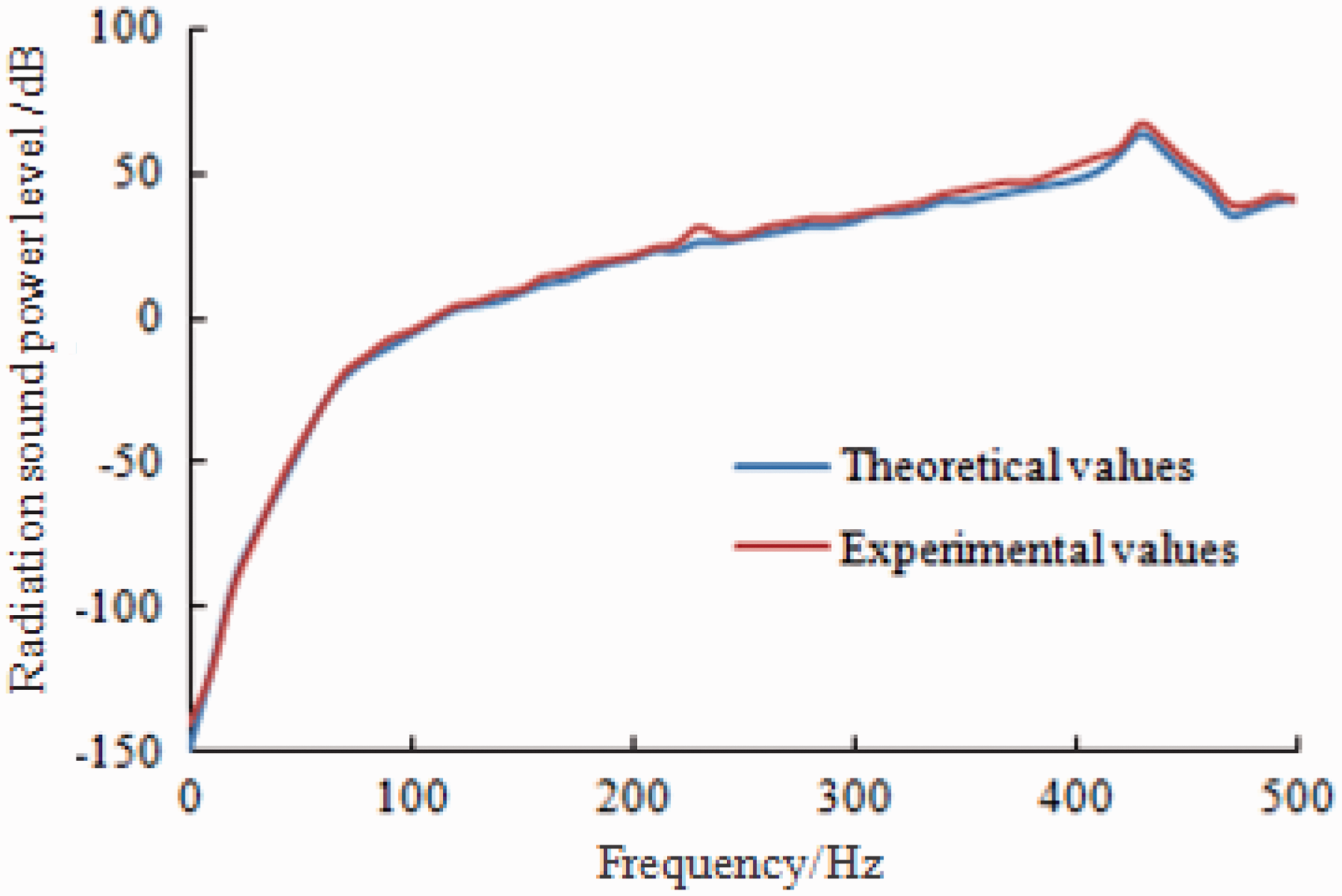
Application of active control in vehicles
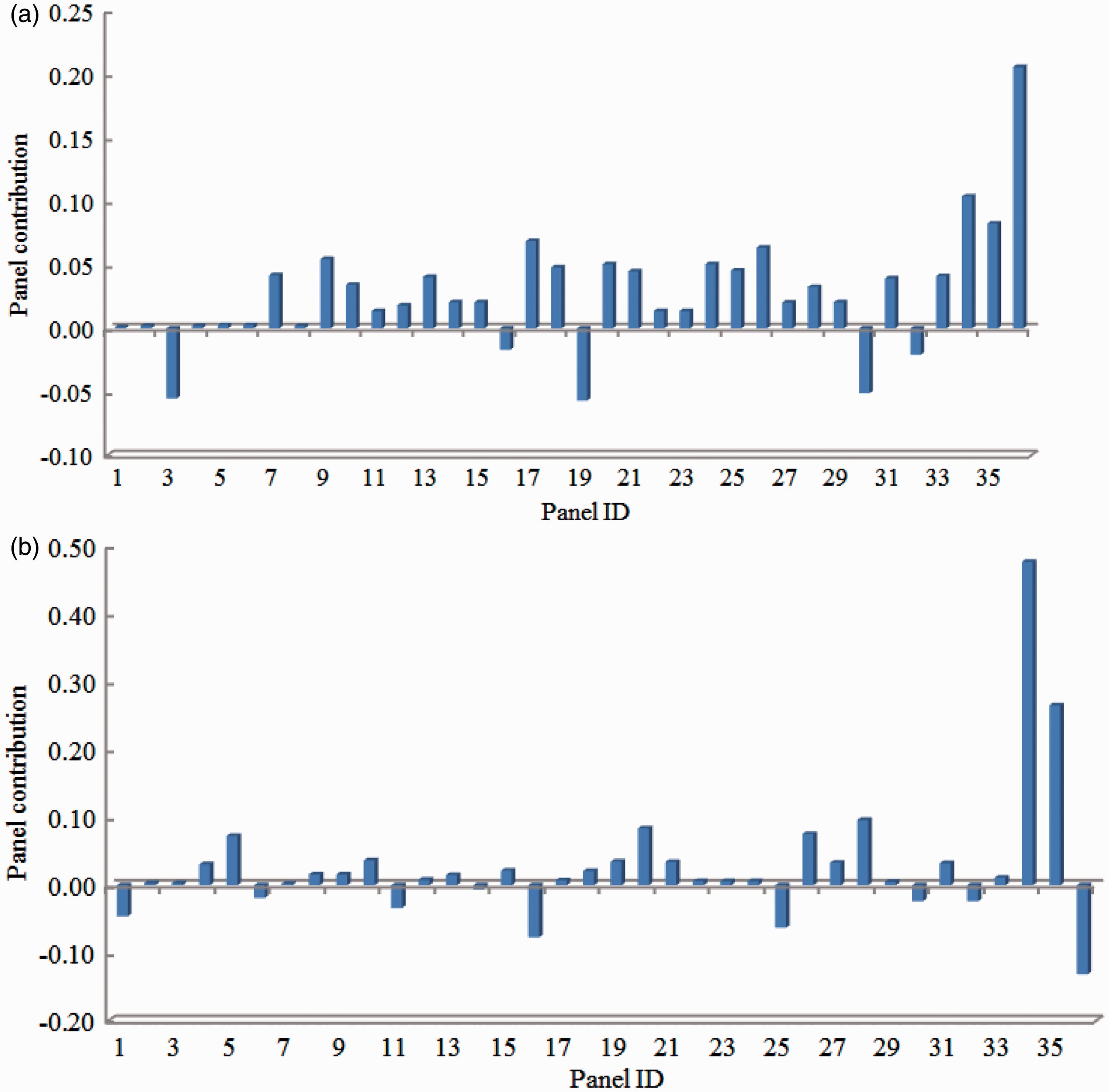
Through the mentioned analysis, it could be seen that sound radiation characteristics of the plate were well controlled in the low frequency when the number of secondary force sources was 4. Vehicles were composed of thin plates. Therefore, the studied control strategy was applied to vehicles. Figure 13 shows the finite element model of cavities in the vehicle. It was divided into 36 panels according to the function and characteristics of the plate. Then, finite element model was applied to compute the acoustic contribution of panels to the driver in the vehicle, and the corresponding result was shown in Figure 14. As can be seen from Figure 14, panels 34, 35 and 36 had the greatest contribution to the noise in the driver. Three panels just were the roof of the vehicle. As a result, measures should be taken for the roof to reduce the noise in the driver.
Finite element model of cavities in the vehicle. Panel contribution at characteristic points: (a) panel contribution at characteristic point 1 and (b) panel contribution at characteristic point 2.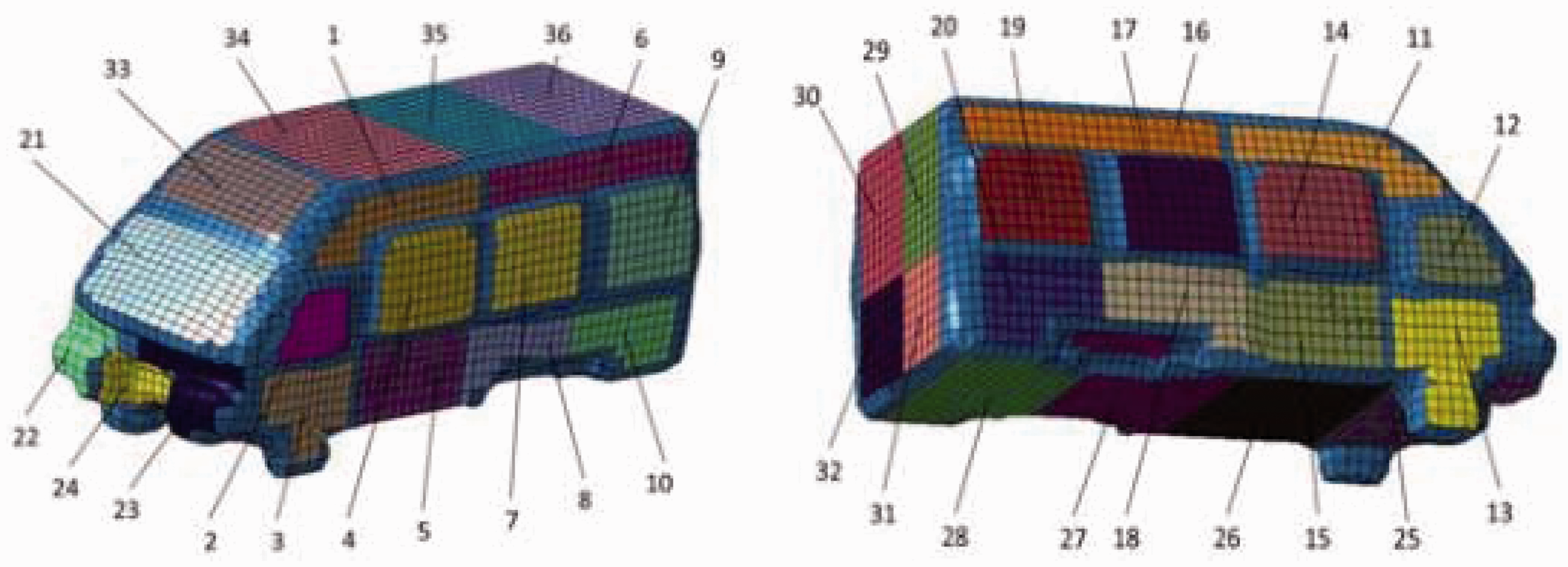
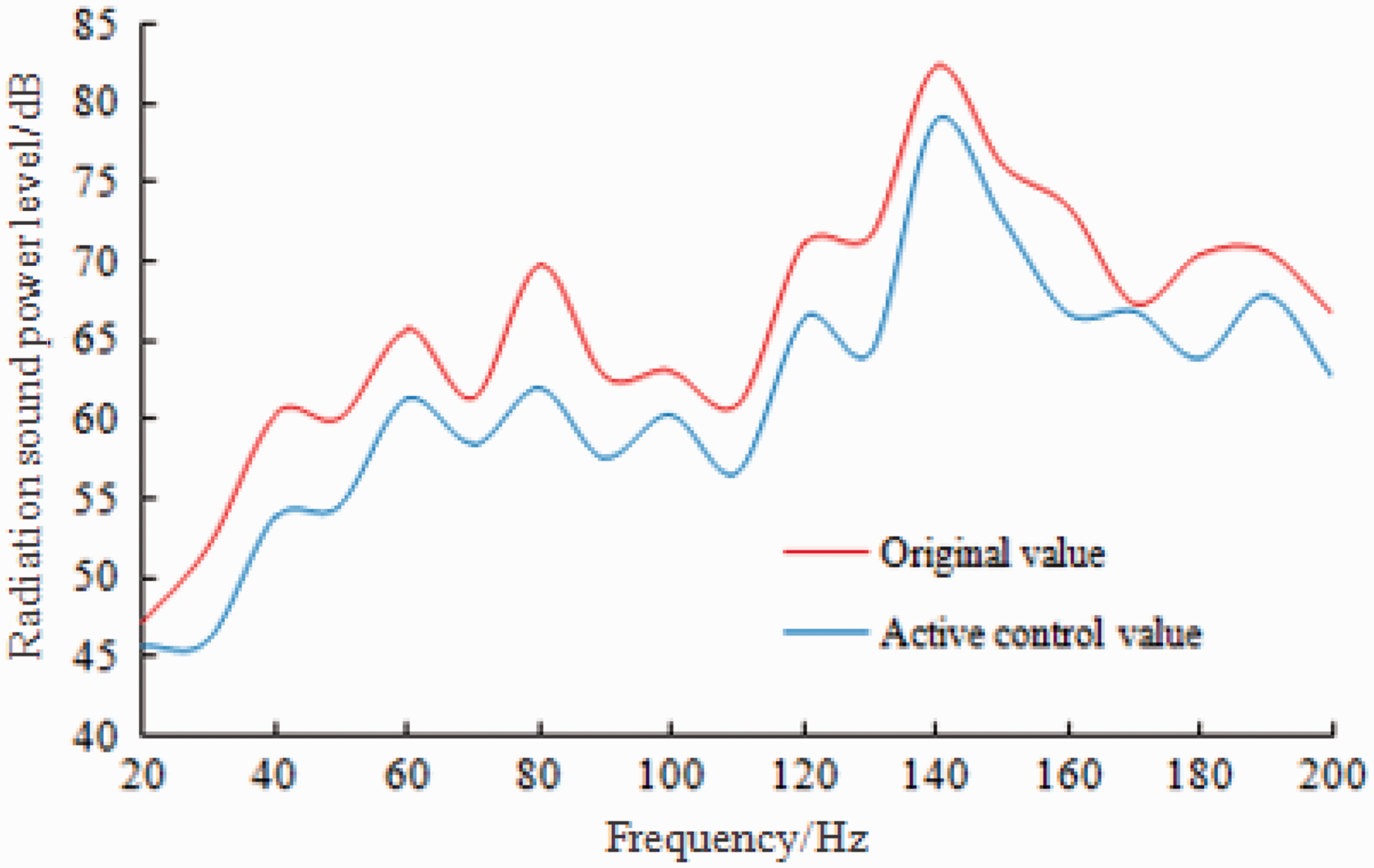
As shown in Figure 13, the roof of the vehicle was a regular plate. Therefore, the mentioned method could be used for active control of noise. First, four actuators were arranged on the position which was next to cab to generate control force. Then, a microphone was used to test sound power level of driver’s ear, as shown in Figure 15. Finally, the interior noise which was measured with active control was compared with the original results, as shown in Figure 16. As can be seen from Figure 16, after applying active control for vehicles, noise of drivers’ ear was significantly reduced, and it indicated that the proposed control strategy was feasible and could be further applied to the other similar structures.
Experiment of sound power for drivers' ear. Comparison of the interior noise between active control and the original results.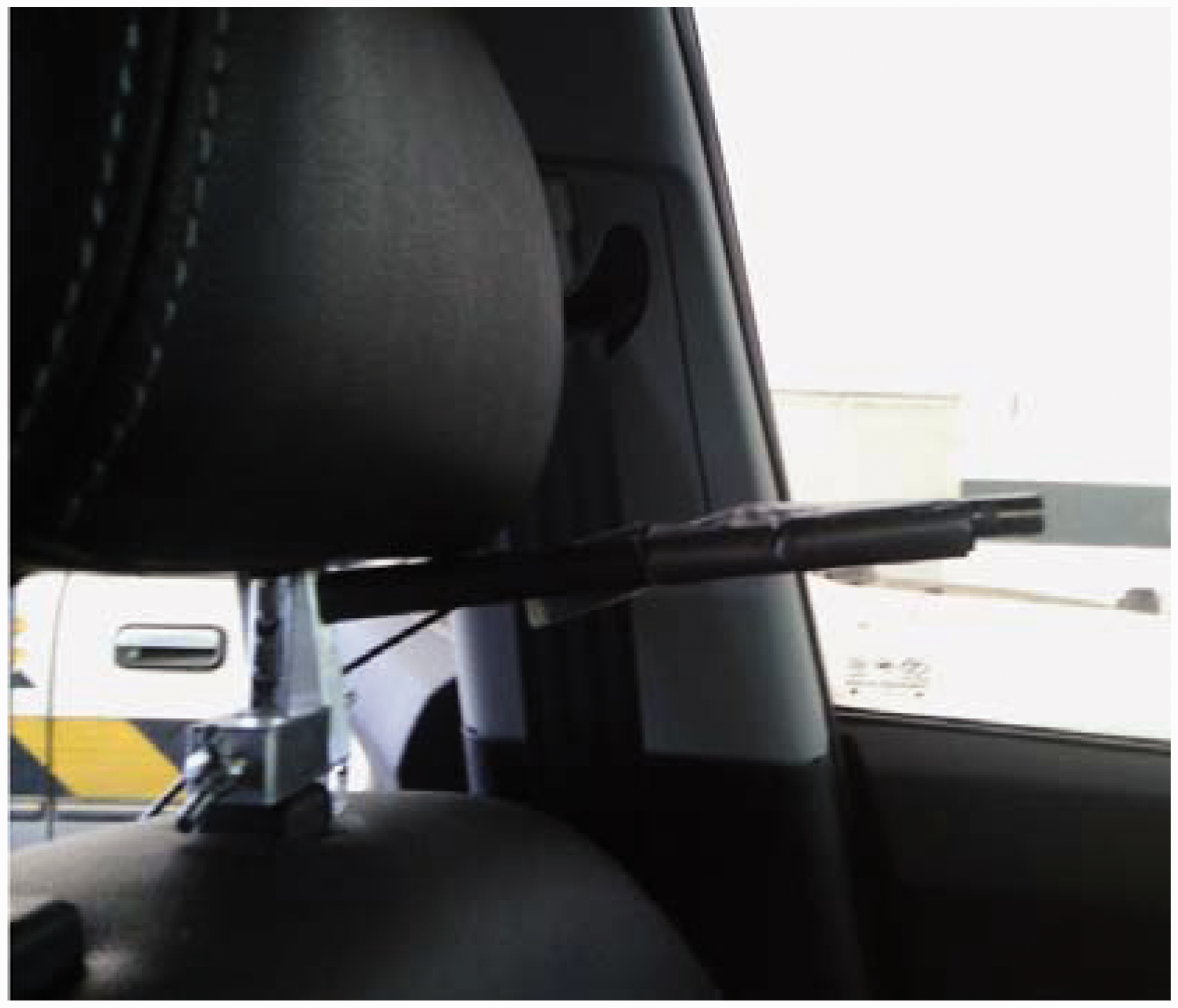
Conclusions
This paper conducted research on the relationship between sound radiation modes and vibration modes of structures. It was shown in the computational results that sound radiation modes of structures at each order were independent. Therefore, noise controls can be realized by controlling sound radiation modes at each order. In the low frequency, mode radiation capabilities of structures at each order had a great difference. The odd–odd mode had the highest radiation efficiency. Radiation efficiencies of odd–even modes and even–odd modes ranked the second position. The even–even mode had the lowest radiation efficiency. In the high frequency, sound radiation efficiencies of each order mode were consistent. The first-order sound radiation mode had the strongest sound radiation capabilities. In addition, its sound radiation mode was similar to the vibration mode of structures. Therefore, it was feasible to reduce sound radiation capabilities by controlling the first-order mode of structures. In the coupling matrix
Footnotes
Acknowledgements
This work is supported by National Natural Science Foundation of China (Grant No: 51667017), the Natural Science Foundation of Tibet Autonomous Region (Grant No.2015ZR2013-38) and the Fundamental Research Funds for the Central Universities of China (Grant No. 2011B09414, 2012B03614).
Declaration of conflicting interests
The author(s) declared no potential conflicts of interest with respect to the research, authorship, and/or publication of this article.
Funding
The author(s) received no financial support for the research, authorship, and/or publication of this article.