




Abstract
Resonance of multi-degree-of-freedom system or structure is a basic and important concept in structural vibration theory, but it lacks a complete and rigorous definition. In order to establish an accurate concept of structural resonance, based on the concept of single-degree-of-freedom system resonance and modal orthogonality, this paper discusses the necessary conditions of system resonance by analyzing the displacement response of multi-degree-of-freedom vibration system, that is, while ensuring that the vibration frequency of the system (a certain natural frequency) is equal to the excitation frequency, its displacement response should also present the corresponding modal shape. An example of simply supported beam is used to illustrate its rationality. At the same time, the theoretical method of pure modal resonance of multi-degree-of-freedom system is given by rational allocation of excitation force. The pure modal resonance of multi-degree-of-freedom system or structure can be realized, which can be used to accurately identify the modal parameters of the structure. It is of great theoretical significance and engineering application value to discriminate the concept of multi-degree-of-freedom system or structure resonance.
Keywords
Introduction
The vibration of engineering structure is a very common natural phenomenon. If its amplitude is too large, it will inevitably cause structural dysfunction or structural damage. For example, bridge structures, structural fatigue damage, or sudden collapse caused by vibration are not uncommon. According to relevant documents, as early as 1850 in Lyon, France, when a group of soldiers marched through a suspension bridge with a span of 102 m, the steel deck broke instantly, and as many as 226 soldiers drowned. 1 In November, 1940, the Taco Ma Haixia Bridge in Washington, USA, was excited by a gust with a wind speed of 19 m/s, and the deck fluctuated rhythmically for more than 3 hours, which eventually led to the complete collapse of the whole bridge. 2 There are also some abnormal vibration phenomena in different degrees, such as Auckland Port Highway Bridge in New Zealand and Millennium Bridge in London. 3 Literature 1 pointed out that “the collapse of Yangmingtan Bridge in Harbin has some problems in its structural design, and the direct cause is the resonance between the bridge and the overloaded truck (that is, the vibration frequency of the engine is close to a certain natural frequency of the bridge structure, resulting in excessive vibration of the bridge).” When analyzing the causes of abnormal vibration of Humen Bridge, the document 4 also mentioned: “The frequency of periodic oscillation from air vortex coincides with the flexural oscillation of the bridge deck itself (author’s note: the frequency of excitation force is equal to the natural frequency of the system), thus forming structural resonance.” All these abnormal vibration phenomena of this kind of bridge structure with excessive amplitude are invariably attributed to the resonance of the bridge structure by the bridge engineering community.
In recent years, some scholars have studied the resonance of multi-degree-of-freedom system. Chen Hongxin 5 pointed out that the initial aerodynamic damping determines whether the box girder bridge can cause resonance. Meng Xin 6 theoretically analyzed the resonance conditions of the bridge, clarified the vertical resonance mechanism of the commonly used span simply supported box girder in high-speed railway, and obtained the calculation formulas of resonance and superharmonic resonance of the simply supported box girder. The resonance of multi-degree-of-freedom system is derived from the resonance of single-degree-of-freedom system, and the principle is the same. 7 When the exciting force frequency is equal to a certain order natural frequency of the multi-degree-of-freedom system, the larger displacement response is resonance. 8 (Here are the newly supplemented references). Resonance of a multi-degree-of-freedom system or elastic structure is the most basic and very important concept in structural vibration theory, and it has not been given a complete and accurate definition in relevant textbooks and documents. However, scholars of structural engineering, even engineers and technicians of related majors, and even a considerable number of ordinary people seem to know a lot about structural resonance. For a single-degree-of-freedom system, when the excitation frequency is close to or equal to the natural frequency of the system, its displacement response will increase rapidly, which is called the resonance of the single-degree-of-freedom system (clearly defined in the textbook). This concept of resonance has been widely accepted by the structural engineering community, and it can be said that it is deeply rooted. If the concept of single-degree-of-freedom system resonance is unconditionally extended to multi-degree-of-freedom systems or elastic structures9–11 (i.e, when the excitation frequency is close to or equal to a certain natural frequency of the system, the phenomenon of excessive structural amplitude is called structural resonance), its scientificity and rigor are still open to question.
Based on the concept of single-degree-of-freedom system resonance and the orthogonality of structural modes, this paper discusses the necessary conditions of structural resonance by analyzing the displacement response of multi-degree-of-freedom vibration system. An appropriate example is used to illustrate its rationality. At the same time, the excitation force is reasonably allocated through theoretical analysis, so as to put forward the theoretical method of pure modal resonance of multi-degree-of-freedom system or structure. The realization of pure modal resonance of multi-degree-of-freedom system or structure can be used to accurately identify the modal parameters of the structure, which has important theoretical significance and engineering application value.
Single-degree-of-freedom system resonance
For damped single-degree-of-freedom systems, the excitation force under the action of vibration differential equation7–12 is

The system uses the excitation frequency

Substitute the equation (2) into the equation (1)


The dynamic amplification factor is defined as

As shown by equation (5), when the excitation frequency
Multi-degree-of-freedom system resonance
The concept of multi-degree-of-freedom system resonance
For the n-degree-of-freedom system with proportional damping

Coordinate transformation

Where:
The differential equation with n modal coordinates decoupling can be obtained by substituting the equation (7) into (6).

It can be seen from equation (8) that it is similar to the forced vibration differential equation of damped single-degree-of-freedom system, and


By equation (9) and equation (10), the equation (8) can be obtained by normalization:

For equation (11), if the initial displacement and initial velocity are both zero, and Duhamel integral is used, the modal coordinates of each order are

Substituting equation (12) into equation (7), the displacement response of the multi-degree-of-freedom system can be expressed as

From equations (12) and (13), if the modal load
Then from the orthogonality of modes, if


Further developed from equation (14) and (15), if the excitation forcesatisfy

Then the system appears as the
For MDOF systems, even if the excitation frequency
Model calculation
Without loss of generality, for the simply supported beam structure shown in Figure 1 (excluding self-weight), set Three degrees of freedom simply supported beam mode.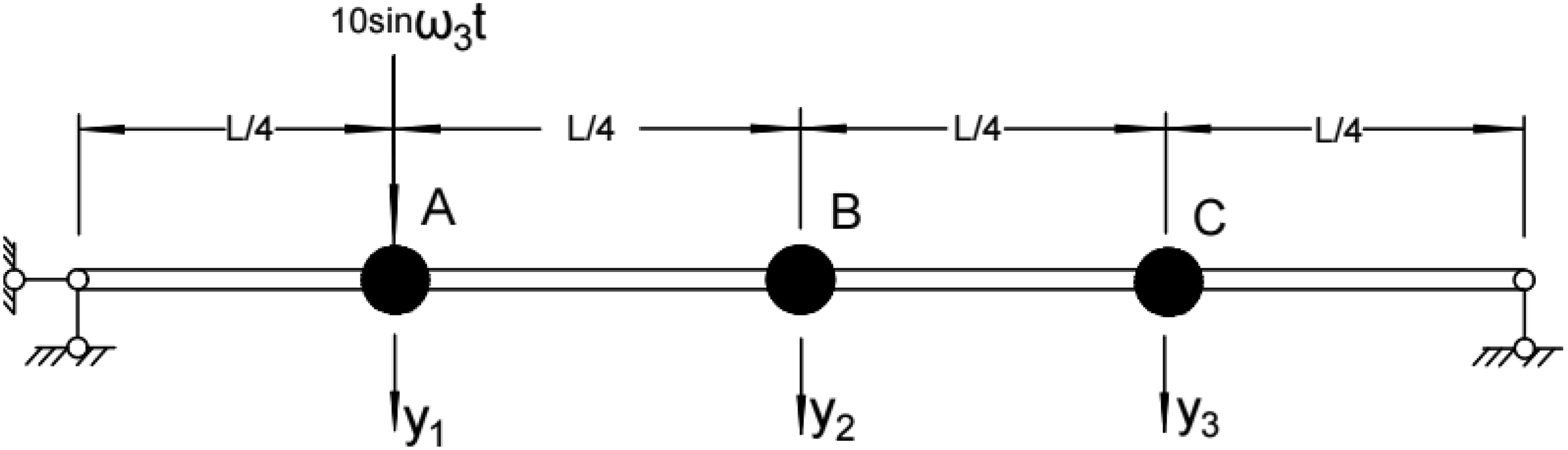
Let the displacement vectors of particles A, B, and C be
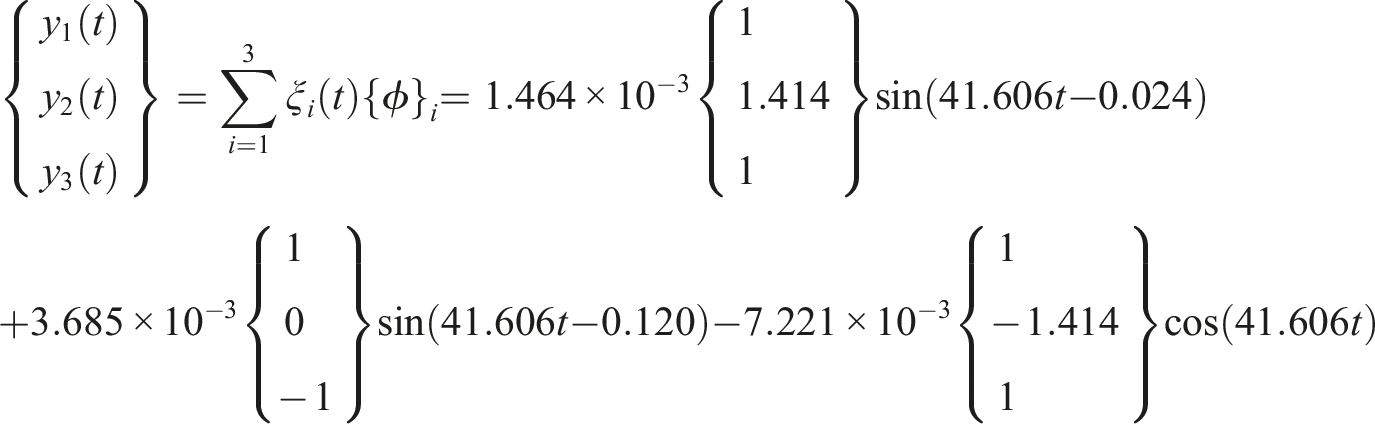
Although the displacements of points A, B, and C all vibrate at
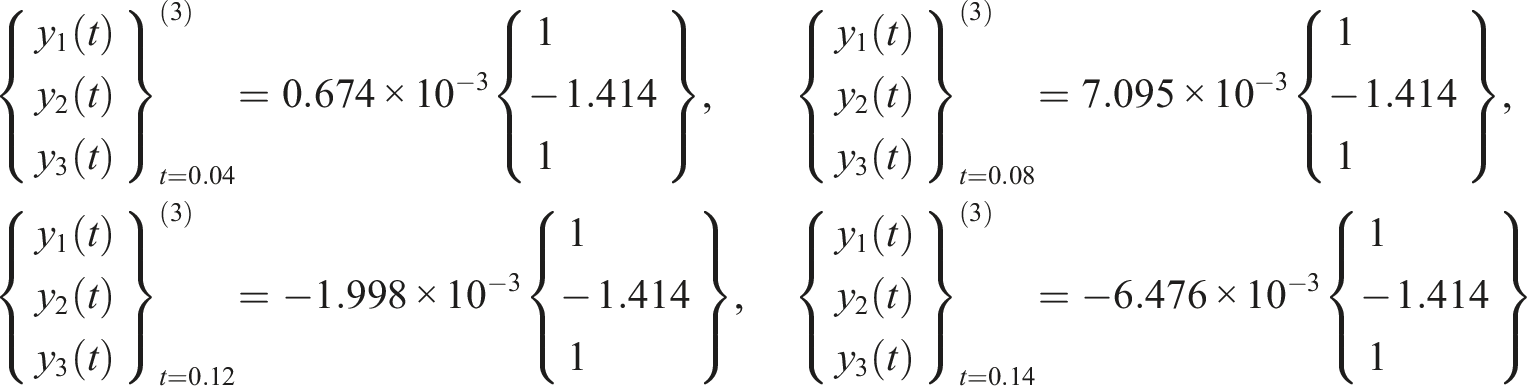
The displacement response corresponding to the third mode is
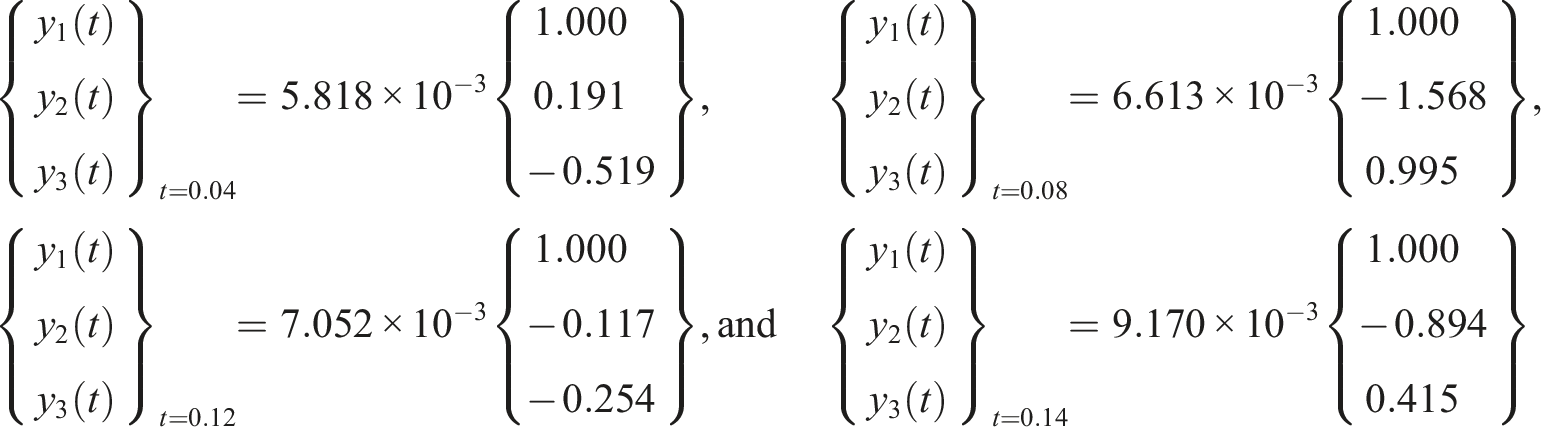
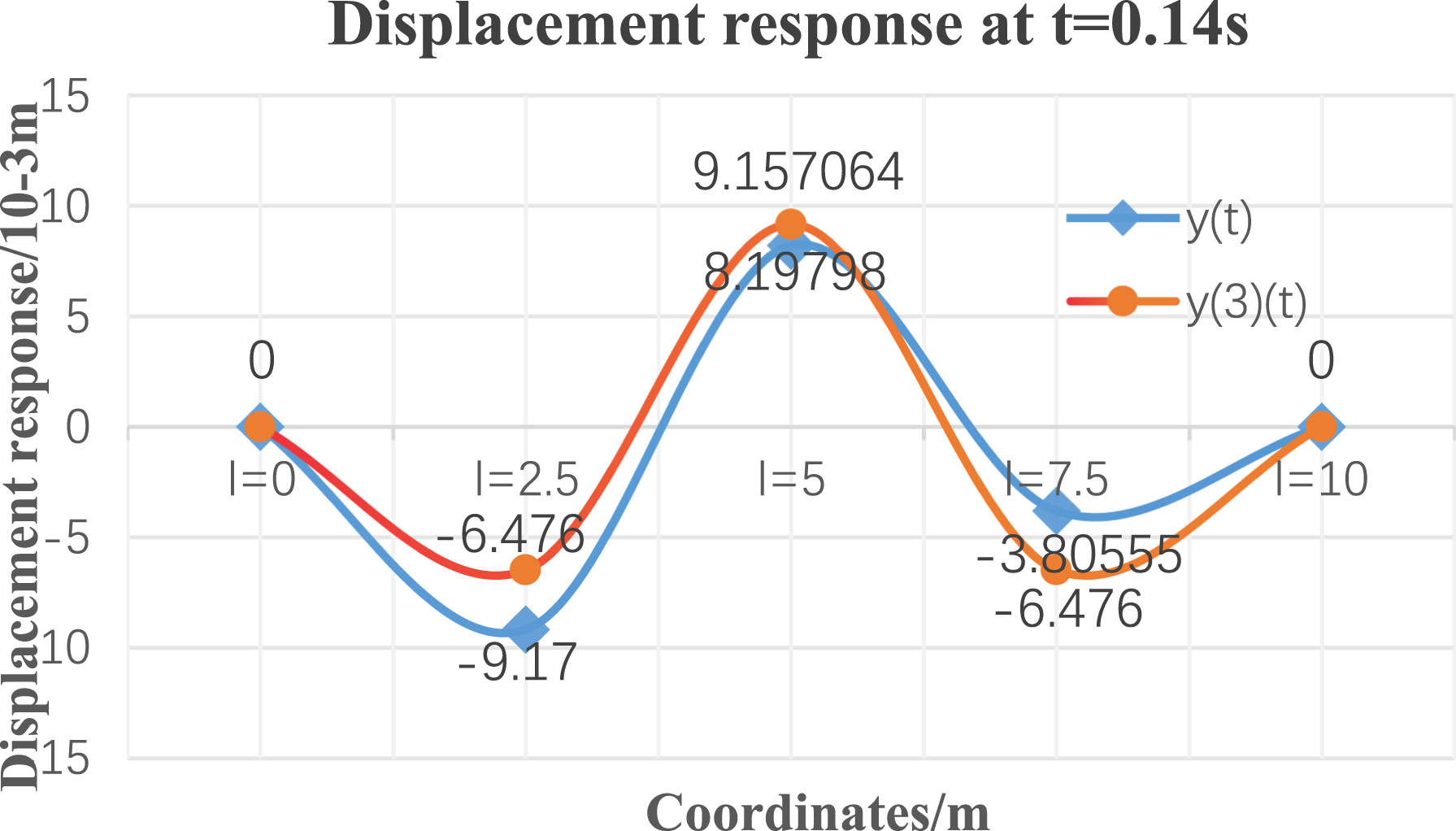
The corresponding displacement response are shown in Figures 2–5. Displacement response of particles at t = 0.04s. Displacement response of particles at t = 0.08s.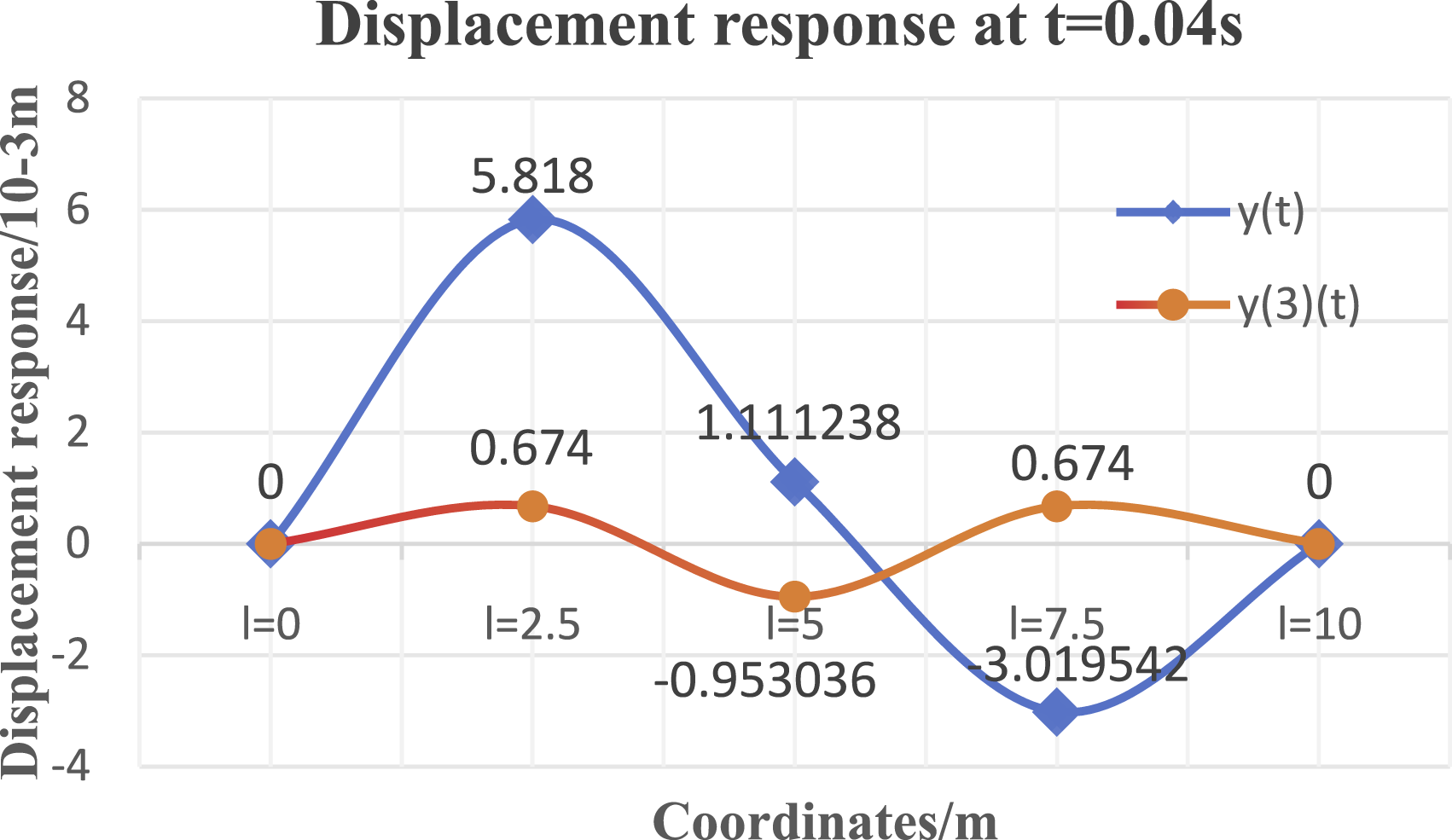
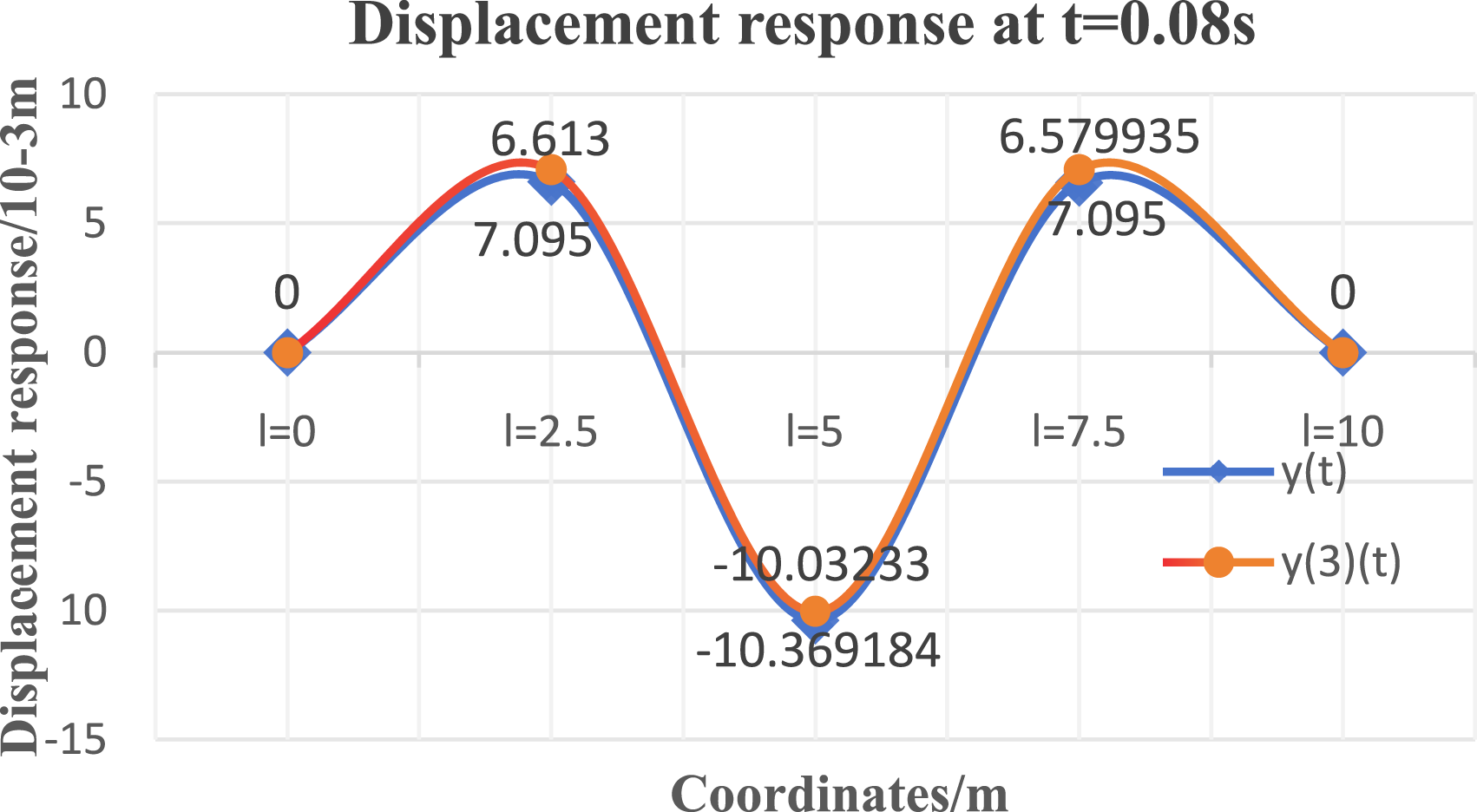
It is easy to find from Figures 2–5 that under the single point excitation force, although the excitation frequency is equal to the third order natural frequency of the system, the first order mode and the second order mode are still excited. Due to the participation of the first and second order modes, the displacement response of particle A, B, and C does not only contain the third order modal component, resulting in different degrees of difference between their displacement response configurations at different times and the third order displacement mode. For example, when t = 0.04s, the displacement response configuration of each point differs greatly from the third displacement mode (as shown in Figure 2); When t = 0.12s, the first and second modes can strengthen the displacement response of point A, while the first and second modes can restrain the displacement response of point B and C (as shown in Figure 4). Displacement response of particles at t = 0.12s. Displacement response of particles at t = 0.14s.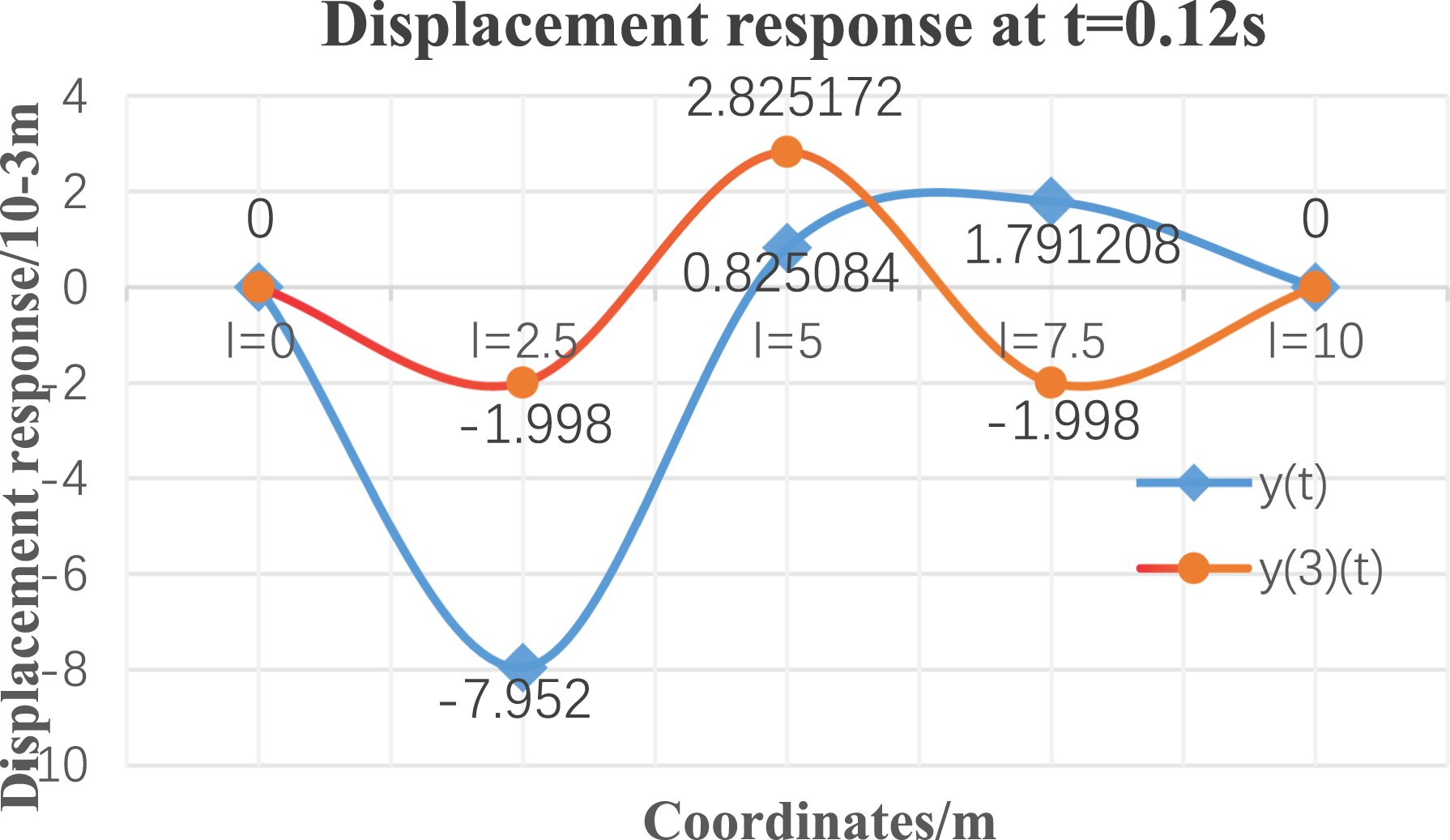
In order to excite the pure third mode of the structure, for the 3-DOF simply supported beam structure shown in Figure 1, the excitation force is reasonably allocated at points A, B, and C

The displacement response of each point is
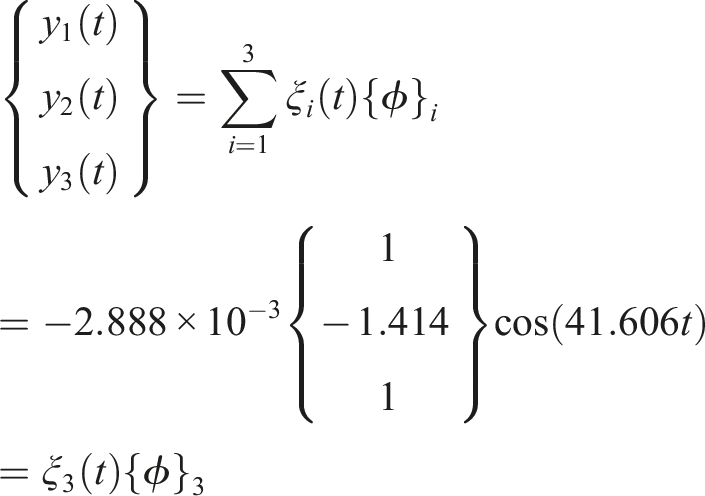
The calculation results show that the configuration of displacement response
Connotation of resonance of multi-degree-of-freedom system
To realize the resonance of a multi-degree-of-freedom system, while satisfying that the frequency of the excitation force is equal to a certain natural frequency of the system, the multi-point excitation of the structure should be reasonably modulated to ensure that the response of the system presents a corresponding single mode. The connotation of resonance of multi-degree-of-freedom system can be accurately understood from two aspects of mathematics and mechanics.
Mathematically, the characteristic equation of n-degree-of-freedom undamped system is
In the sense of mechanics,

On the contrary, if only the vibration when the frequency of the excitation force is equal to a certain order of natural frequency of the system is also called the resonance of the system (there is no limit to the vibration mode of the structure), the resonance of the system will show an infinite number of forms without uniqueness. In general, the vibration of multi-degree-of-freedom system presents a nonsingle mode. According to the mode superposition principle, the response of the system is composed of the contributions of multiple modes, and the strain energy of its vibration

Through the above analysis, the difference between single-degree-of-freedom system resonance and multi-degree-of-freedom system resonance is that the single-degree-of-freedom system resonance only depends on the excitation frequency. The excitation frequency is equal to the natural frequency of the system (there is no concept of vibration mode). The resonance of a multi-degree-of-freedom system depends not only on the excitation frequency, which is equal to a certain natural frequency of the system, but also on the reasonable adjustment of the distribution of multiple excitation forces so that its response shows pure mode (which is limited to the structural vibration mode). It is precisely because most structural engineers lack an accurate understanding of the basic concepts of structural dynamics that the concept of single-degree-of-freedom system resonance is unconditionally extended to the vibration of multi-degree-of-freedom systems and continuum. Through the discrimination and discussion of the concept of structural resonance, in order to ensure its science and rigor, so as to avoid the abuse of the word “structural resonance.”
Engineering application of structural resonance
The discrimination of the concept of multi-degree-of-freedom system or structural resonance lies not only in accurately understanding the basic concept of structural dynamics; At the same time, in the modal analysis of structural test, the structural resonance (pure mode) state has very important engineering practical value for modal parameter identification.8,13–15
In order to ensure the strength, stiffness, and stability, even comfort and durability of structures, it is of great theoretical significance and social value to design structures with excellent dynamic characteristics. Structural dynamics involves structural response analysis, structural parameter identification, and structural load identification. In particular, structural modal parameter identification has been more and more widely used in engineering, which is mainly manifested in structural dynamic optimization design, structural dynamic characteristics modification, structural finite element model modification, and structural fault diagnosis.
At present, structural modal parameters are usually obtained by structural calculation analysis or structural test analysis, which are called structural calculation modal analysis or structural test modal analysis, respectively. The identification of structural modal parameters in experimental modal analysis is mainly divided into frequency domain identification method and time domain identification method, which requires relatively high theoretical reserves and professional quality of structural test engineers and technicians. If the internal damping of the structure is compensated by reasonably adjusting the distribution and magnitude of multiple excitations during the structural modal test, the equivalent undamped natural modes of the structure can be excited. When the structure vibrates in a pure modal state, the modal parameters of the structure (such as natural frequency, displacement mode, and modal damping ratio) can be directly identified with high accuracy through physical tests 16 so that the effect of getting twice the result with half the effort can be achieved. Parameter synchronous optimization stochastic resonance method can effectively detect weak fault signals from strong background noise. 17 Under the periodic load, a small external excitation can excite the large amplitude self-parametric resonance of the frame structure. 18 The galloping of single conductor on overhead lines is studied, and it is considered that the galloping of single conductor without icing is parametric resonance. 19 Aiming at the parameter-principal resonance problem of an axially moving conductive beam between current-carrying wires, the magneto-elastic parameter-principal resonance state equation under different excitation current frequencies is derived. 20 In the modal analysis of structural tests, the “resonance method” has the advantages of clear physical concept and high modal parameter identification accuracy compared with the commonly used frequency domain identification method or time domain identification method. Imagine, if the concept of “structural resonance” is not clear to the technicians of structural tests, how can structural resonance be realized? At the same time, if the frequency of excitation force is equal to a certain natural frequency of the structure, it will be regarded as the “resonance” of the structure, and the “resonance” of any structure will present various forms (depending on the excitation mode rather than uniqueness), and the accuracy of the identified modal parameters also depends on the degree of participation of other modes. It can be seen that it is only an extravagant hope to identify high-precision structural modal parameters by using the so-called “resonance method.”
Conclusion
Based on the concept of single-degree-of-freedom system resonance, this paper discusses the necessary conditions of “structural resonance” by analyzing the displacement response of multi-degree-of-freedom system vibration according to the principle of structural modal superposition and orthogonality. The rationality is illustrated by an appropriate example. At the same time, a theoretical method to realize pure mode resonance of multi-degree-of-freedom system or structure is put forward through reasonable allocation of excitation force. The establishment of accurate concept of multi-degree-of-freedom system or structural resonance (pure mode) and the realization of structural resonance state can be used to accurately identify structural modal parameters by “resonance method,” which has important theoretical significance and engineering application value. The main conclusions are as follows: (1) The resonance of a multi-degree-of-freedom system or structure should ensure that the vibration frequency of the structure (a certain natural frequency) is equal to the excitation frequency, and at the same time, its displacement response should also present the corresponding pure mode; (2) Through the reasonable modulation of excitation force, the theoretical method of pure mode resonance of multi-degree-of-freedom system or structure is put forward; (3) The pure modal resonance of a multi-degree-of-freedom system or structure can be realized, which can be used to accurately identify the modal parameters of the structure (such as the natural frequency, displacement mode, and modal damping ratio of the structure).
Footnotes
Acknowledgments
The support from the National Natural Science Foundation of China (Grant number 51809209) is gratefully acknowledged. The opinions and conclusions presented in this article are those of the authors and do not necessarily reflect the views of the sponsoring organizations.
Declaration of conflicting interest
The authors declare that they have no known competing financial interests or personal relationships that could have appeared to influence the work reported in this paper.
Funding
The author(s) disclosed receipt of the following financial support for the research, authorship, and/or publication of this article: This study is supported by Natural Innovative Research Group Project of the National Natural Science Foundation of China (Grant number 51809209).
