



Abstract
This essay reports three projects that integrate linguistic features of speaking turns into the identification of conversational motifs, which are multiturn segments of dialog within interpersonal interactions. Study 1 focused on support for bereavement, used Linguistic Inquiry and Word Count data to augment characterizations of speaking turns based on speech act, and identified seven 5-turn conversational motifs. Study 2 examined serial argument conversations, used ratings of features and word count to differentiate speaking turns, and identified four conversational motifs within 1-minute segments of interaction. Study 3 analyzed conversations about public health campaign messages, considered functional and structural features of speaking turns, and identified four 4-turn conversational motifs. By elaborating the library of linguistic elements considered when operationalizing speaking turn types and showcasing alternative strategies for identifying conversation motifs, this essay extends recent advancements in a dynamic dyadic systems perspective on interpersonal communication.
Keywords
Over a decade ago, the first author of this essay began a collaboration focused on illuminating the dynamics of dyadic conversation. The driving motivation was to build upon previous theoretical accounts of dyadic interaction (e.g., Burgoon et al., 1995; Cappella, 1987) and expand the library of methods for studying conversation dynamics (e.g., Hewes & Poole, 2012; Van Lear & Canary, 2016). Like other scholars, our focus was on dyadic exchanges where partners use conversation to make progress toward pragmatic ends, such as getting acquainted (Kellermann & Lim, 1990), managing conflict (Canary et al., 2009), and addressing hurt feelings (McLaren & Sillars, 2014). Specifically, we examined emotion regulation conversations recorded as part of laboratory observation studies in which one person (the discloser) described a stressor to a partner (the listener; Solomon et al., 2021). This research led to the articulation of a dynamic dyadic systems (DDS) perspective on interpersonal conversation (Solomon et al., 2021, 2023).
A feature of the DDS perspective is emphasis on turn-to-turn verbal behavior. Solomon et al. (2021) conceptualized conversations as two-person improvisational theatre, where each person's speaking turn is both a response to the previous turn and a stimulus to which the partner responds in the next turn. Over time, contingent speaking turns coalesce into sequences of turns and, ultimately, build a dialogue that is both predictable and novel. Articles developing the DDS perspective discuss its scope conditions, research questions that build from speaking turns to conversational phases, features of dynamic systems (i.e., interdependency, self-stabilization, and self-organization), and alternatives for analyzing dynamic dyadic qualities of conversations (Brinberg et al., 2023; Solomon et al., 2021, 2022, 2023). This essay focuses on strategies for integrating linguistic features of speaking turns into the study of turn-to-turn sequences.
To begin, we elaborate on the notion of conversational motifs, and we highlight the importance of linguistic features to understanding how multi-turn sequences of turn-taking are related to conversational antecedents and outcomes. Then, we discuss studies based on three doctoral dissertations that examined conversations involving support for bereavement (Tian, 2021), serial arguments (Y. Li, 2024), and interpersonal communication stimulated by persuasive anti-obesity media messages (S. Li, 2022). Although these projects have contributed independently to other research articles, bringing them together juxtaposes alternative strategies, highlights decision points for researchers, and sheds light on the trade-offs and affordances of different approaches. 1 Collectively, they illustrate how integrating linguistic features can enhance the insights gained by studying conversational motifs.
Integrating Linguistic Features Into the Study of Conversational Motifs
Solomon et al. (2021) coined the phrase conversational motifs to refer to multi-turn sequences within conversations. Specifically, conversational motifs capture recurrent, ordered combinations of speaking turns that reflect the back-and-forth exchange of messages between partners. Motifs are comprised of speaking turns that are operationalized categorically based on features of the behavior enacted with them (e.g., speech acts, Bodie et al., 2021; emotion coaching/dismissing behaviors, Theiss et al., 2023; direct/indirect and positive/negative conflict communication; Blickman et al., 2023). These categorical turn types allow conversations to be represented as sequences of discrete turns. Then, using sequence analysis (MacIndoe & Abbott, 2004), segments of turns that manifest recurring sequences can be identified. Whereas speaking turns categorize conversational action and turn-pairs index reaction, motifs encompass interaction because they include how a person adjusts to the partner's reaction to their initial action (and so on). Because conversational motifs provide a parsimonious means of capturing rich dynamics of turn-taking in interpersonal interaction, they are useful for studying how conversations are shaped by antecedent conditions and contribute to conversational outcomes.
The studies developing the DDS perspective relied on Stiles’s (1992) explication of therapist–client dialogue to identify verbal response modes (i.e., speech acts, such as question, acknowledgement, disclosure, and advisement) as the essential building blocks of speaking turns in supportive conversations. As reported in Bodie et al. (2021), the research protocol involved unitizing conversations into utterances within speaking turns, coding utterances for verbal response mode, and conducting cluster analysis to identify types of speaking turns based on the combinations of utterances that occurred within them. Applying sequence analysis to these data yielded a typology distinguishing four supportive conversational motifs comprised of five speaking turns (alternating between the discloser and listener; Solomon et al., 2022). Other research has used this turn typology to examine supportive conversations about esteem threats (Holmstrom et al., 2023) and in face-to-face versus technology-mediated channels (Rains et al., 2023). Some studies have applied alternative turn-level coding schemes appropriate to their phenomenon of interest (Blickman et al., 2023; Theiss et al., 2023) before examining turn sequences and motifs. Although these investigations have shed new light on conversational dynamics, they represent a small slice of possibilities for operationalizing the verbal content of speaking turns. In particular, studies to date have focused somewhat narrowly on the speech acts or meanings embodied within verbal behavior, with less attention to other linguistic features that make up a speaking turn.
Research attentive to the linguistic elements prominent within dyadic interactions highlights the value of incorporating these details into the study of conversational motifs. For example, some studies have relied on third party ratings to index theoretically important qualities of language use, such as directness, positivity, elaboration, or logic within conversations that involve interpersonal influence (Dillard, 1989) or support (Priem & Solomon, 2018). McLaren and Sillars (2014) rated parent-child interactions along six dimensions (e.g., confrontation, warmth, and story integration), each of which was defined by more specific verbal behaviors (e.g., confrontation was defined by expressions of blame, criticism, disapproval, hostile questions, and defensiveness). Other studies have focused on pronouns usage (Cannava & Bodie, 2017; Cannava et al., 2018), passive voice (Burgoon et al., 2016), and emotion words (Jones & Wirtz, 2006). In these studies, linguistic features within conversations have shed light on important conversational outcomes, including interpersonal influence, physiological stress recovery, relational repair, and emotion regulation. As this brief review illustrates, a wide variety of linguistic features can be considered to index consequential aspects of verbal behavior in conversations. Although the specific linguistic features relevant to an interpersonal exchange are inevitably grounded in the focus and nature of that conversation—for example, whether partners are engaged in a serial argument or reminiscing about good times—the evidence suggests that both what people say and how they say it are integral to understanding the fabric of conversation.
Why has the study of conversational motifs thus far neglected the information value of nuanced linguistic phenomena? Coding or rating speaking turns is time intensive; therefore, that approach often prioritizes a restricted set of verbal qualities. In comparison, rating conversations in the aggregate is less arduous, and machine coding facilitates measuring precise linguistic features. Although empirical evidence points to the relevance of these features, measures of whole conversations sacrifice turn-by-turn information. Considered together, these limitations suggest that elaborating the linguistic information recovered from speaking turns can add theoretically meaningful texture to the conversational sequences captured by motifs.
In the remainder of this essay, we showcase projects that incorporated expanded foundations for defining turn types and, consequently, conversational motifs. Bringing these projects together addresses three goals. First, whereas the DDS perspective was grounded in studies of supportive conversations about daily hassles, these studies illustrate applications to a variety of social episodes. Relatedly, by examining different types of conversations, these studies highlight different linguistic features and alternative ways to integrate them into operationalizations of turn types. Finally, the studies offer alternative strategies for identifying conversational motifs. Thus, as a set, they provide a more complete picture of the insights possible when linguistic features are integrated into the study of conversational motifs.
Using Speech Act and Turn-Level Linguistic Data to Categorize Speaking Turns and Identify Five-Turn Motifs in Conversations About Bereavement
Bereavement is one of the most stressful events that people experience. The death of a loved one can challenge people's understanding of the world and the self, prompting them to find meaning and significance in their lives (Gillies & Neimeyer, 2006). This process, called the meaning reconstruction of bereavement, can be facilitated by supportive communication (e.g., Toller, 2011). Engaging in conversations with a supportive listener allows bereaved individuals to articulate thoughts and feelings about their grief, attribute meaning to their experience, and reappraise the impact of loss on well-being (Tian & Solomon, 2023). Although previous research has identified features of supportive messages (e.g., Rack et al., 2008) or characterizations of conversations (e.g., Tian et al., 2024a) that promote adjustment after the death of a loved one, less is known about how turn-to-turn patterns of language use in supportive interactions improve bereaved individuals’ emotions and outlook. To explore this, Tian et al. (2024b) expanded upon Bodie et al.'s (2021) operationalization of turn types, and they used this elaborated scheme to identify supportive conversational motifs in the bereavement context.
Adopting Bodie et al.'s (2021) typology of turns, Tian et al. (2024b) characterized each speaking turn according to the speech act(s) performed. In addition, to enrich the linguistic information coded at the turn level, Tian et al. (2024b) consulted prior research to identify linguistic categories relevant to distinguishing qualities of supportive messages (Cannava & Bodie, 2017; Cannava et al., 2018; Hersh, 2011; Jones & Wirtz, 2006; Zhou et al., 2023). This body of work suggests that overall verbalization and the specific words used to describe a stressor influence distressed individuals’ cognitive and emotional states. Accordingly, Linguistic Inquiry and Word Count (LIWC; Boyd et al., 2022) was used to index—for each speaking turn—the word count and the occurrence of six linguistic categories: first-person singular pronouns, second-person pronouns, cognitive process words, positive emotion words, negative emotion words, and family words. These linguistic markers indicate whether the speaker engages in perspective taking, assesses the significance of the stressor, explores the underlying causes of emotional states, and reflects on the relational impact of the situation, which are crucial to generate cognitive reappraisal and, in turn, alleviate emotional distress (Burleson & Goldsmith, 1998).
Method
As reported in Tian et al. (2024b), the sample included young adults (52 women, 32 men) who had experienced the death of a parent in childhood about 5 years, on average, prior to the study. After providing informed consent and responding to a preinteraction questionnaire about parental death, participants had a 10-minute interaction with a research assistant who enacted different supportive behaviors, based on random assignment. Through experimental manipulation, research assistants’ behaviors varied in person-centeredness (low, moderate, and high) and the presence and timing of parallel bereavement disclosures (absent, presented early in the conversation, and presented midway through the conversation; see Tian and Solomon, 2023, for manipulation checks). Then, participants completed a post-conversation questionnaire.
Operationalizing Linguistic Features Within Speaking Turns
Guided by Bodie et al.'s (2021) turn typology, speaking turns were coded as uncodable or for overall pragmatic function: disclosure, sharing one's own experience and conveying objective information; acknowledgement, conveying receptiveness to the other person's message; interpretation, explaining, labeling, or evaluating the other person's experience; question, making request of information or guidance; and advisement, making suggestions or recommendations. 2 The data for each turn also included LIWC generated scores for the word count and the occurrence of first-person singular pronouns, second-person pronouns, cognitive process words, positive emotion words, negative emotion words, and family words. Following Bodie et al. (2021), hierarchical cluster analysis was used to classify speaking turns into groups based on their similarity in function (e.g., disclosure and acknowledgement) and linguistic characteristics (word count and the presence/absence of six linguistic categories).
As reported in Tian et al. (2024b) and summarized in Table 1, the analysis revealed five types of discloser turns, including Acknowledgement and four subtypes of disclosure (Information Sharing, Self-focused Disclosure, Family-focused Disclosure, In-depth Disclosure), as well as nine types of listener turns, including Acknowledgement, three subtypes of disclosure (Information Statement, Perspective Sharing, Elaborated Empathic Disclosure), two subtypes of questions (Fact Checks, Prompts), and three subtypes of interpretation (Brief Validation, Hedged Interpretation, Discloser-focused Emotional Sense making). 3 These results demonstrated that subtypes within categorical speech acts were distinguished by other linguistic information available in the turn. For disclosers, this analysis distinguished turns that all performed the function of sharing information but varied in length, emotional tone, and self or family focus. For listeners, categories distinguishing acts of disclosure, questioning, and interpretation were each further differentiated by the number and type of words within those turns.
Discloser and Listener Turn Types During Supportive Conversations About Bereavement (Tian et al., 2024b).
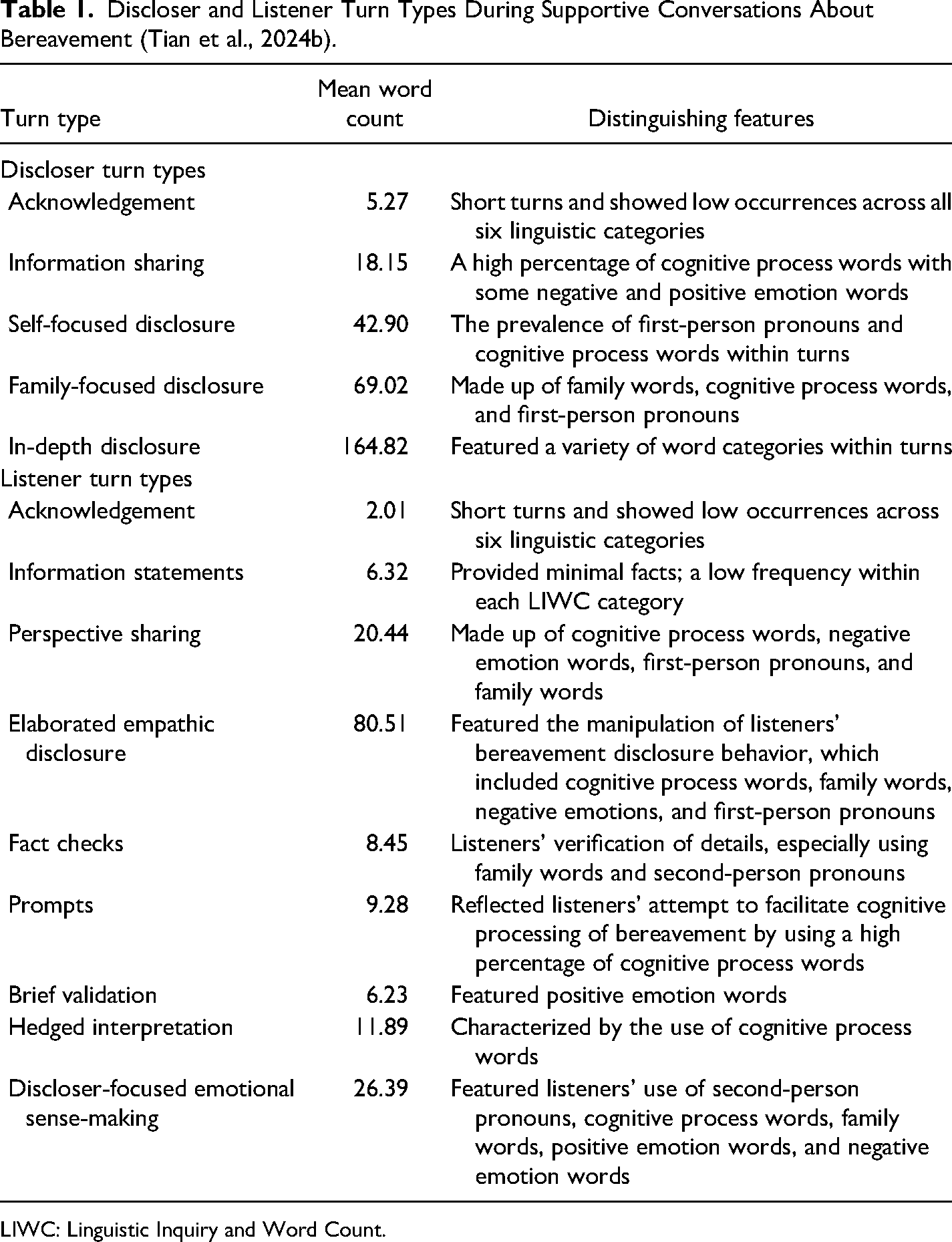
LIWC: Linguistic Inquiry and Word Count.
Analysis of Conversational Motifs
To identify conversational motifs that manifest in supportive communication about bereavement, sequence analysis was conducted following the steps laid out in Solomon et al. (2022; described in full in Tian et al., 2024b). First, all conversations were segmented into overlapping five-turn sequences that started and ended with a discloser turn. The sequence began with the discloser turn because the conversations were structured around disclosers’ loss of a parent and listeners’ facilitation of that emotional expression. Then, dissimilarities among sequences were calculated using a constant cost matrix and an optimal matching algorithm. Dissimilarity between any two sequences was determined based on the cost of transforming one sequence into the other; insertion and deletion costs were set to 1, whereas substitution costs were set to 2 because substitution involves both an insertion and a deletion. Given that the sequences contained categorical data (i.e., turn type), a constant cost matrix was used to reflect that the distance or substitution cost between any categories was the same. The optimal matching algorithm then iteratively calculated the minimum cost required to transform each sequence into every other sequence. Finally, hierarchical cluster analysis was used to determine an appropriate number of clusters that represent different types of conversational motifs.
Results
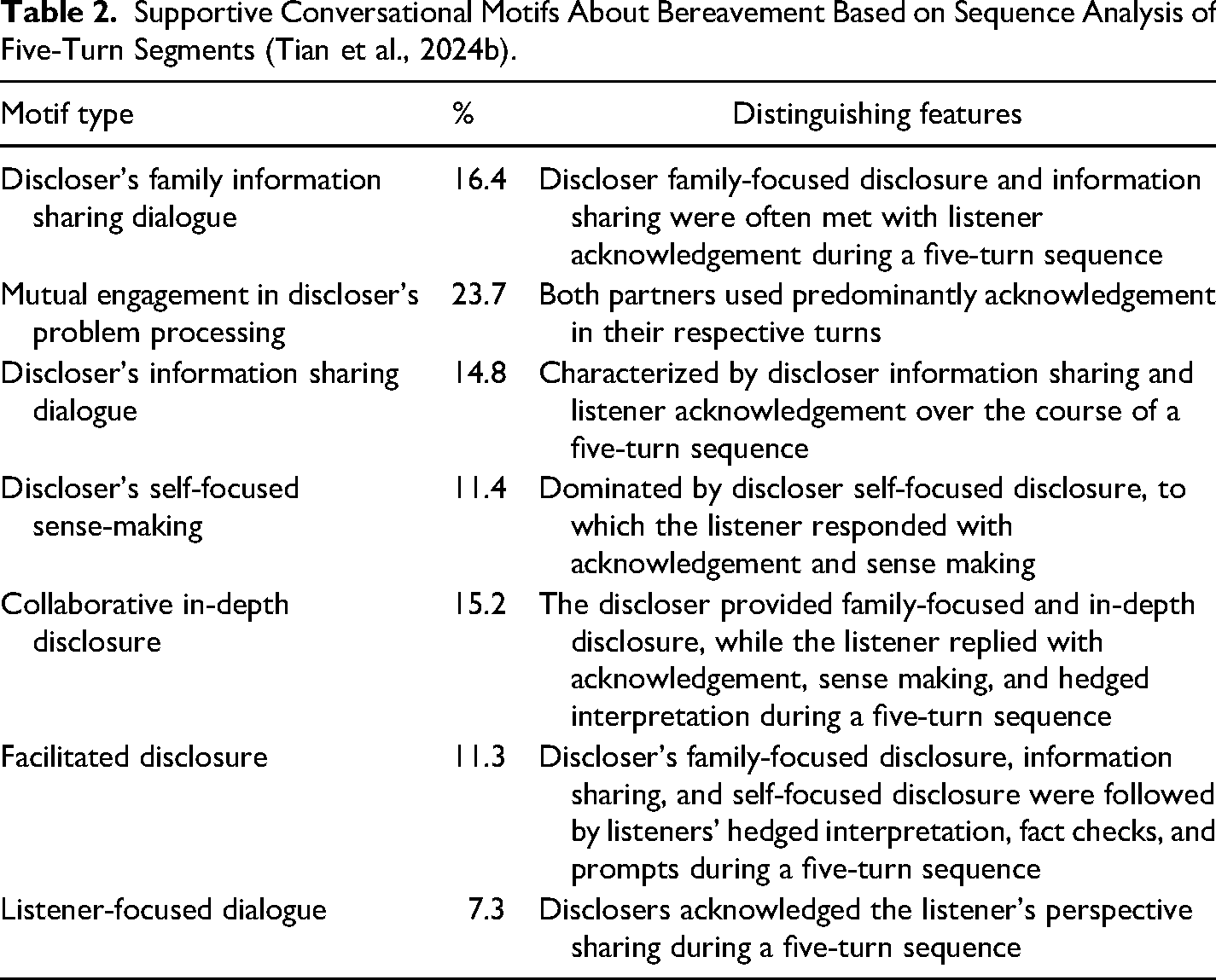
The sequence analysis results suggested the presence of seven conversational motifs (see Table 2), which were distinguished by (a) the information shared by the discloser, to which the listener responded with acknowledgement, question, and interpretation; (b) a focus on either the discloser or the listener; and (c) partners’ predominant use of acknowledgement in their respective turns. Notably, the inclusion of linguistic details in the operationalization of turn types captured nuanced distinctions among supportive conversational motifs. For example, using only verbal response mode information, Solomon et al. (2022) previously identified a discloser problem description motif, which was characterized by alternating turns of discloser elaboration and listener acknowledgement. The results from Tian et al. (2024b) showed that this motif type can be fine-tuned based on the type and depth of information provided by the discloser. When disclosers engaged in family- or self-focused disclosure and information sharing, listeners often responded with acknowledgement, prompts, sense making, and perspective sharing, which prompted more detailed descriptions of the situation from the discloser. The specific combinations of these turns within a five-turn sequence distinguished
Supportive Conversational Motifs About Bereavement Based on Sequence Analysis of Five-Turn Segments (Tian et al., 2024b).
To investigate whether these elaborated supportive conversational motifs illuminate consequential dynamics within conversations about bereavement, Tian et al. (2024b) examined how the prevalence and timing of supportive conversational motifs in the initial, middle, and final phases of the conversation were related to support outcomes. Conversation phases were segmented based on the timing of the experimental manipulation (i.e., the listener's disclosure about a friend's bereavement experience). In general, the results illustrated that conversations that began with discussing and reflecting on the specifics of bereavement (i.e.,
Discussion
This study illustrates that combining human coding of speech acts and machine coding of the occurrence of a variety of linguistic features yields a nuanced conception of turn types. Compared to utterance-level coding (e.g., Bodie et al., 2021), coding speech acts at the speaking turn level is more efficient. Although turn-level coding overlooks the composition of turns, such as the prevalence of speech acts within a turn, this limitation can be offset by integrating additional linguistic information in the identification of turn types. The integration of linguistic features and speech acts also provided a more refined account of sequences of verbal behaviors that partners exchange during supportive conversations. Moreover, the timing of particular sequences of messages within supportive interactions is consequential to the emotion regulation outcomes. For example, Tian et al. (2024b) observed that the proportion of
Using Speaking Turns Defined by Ratings and Word Count to Identify 1-Minute Motifs in Conversations About Serial Arguments
Serial arguments are conflict interactions that recur about the same topic, between the same partners, without achieving resolution (Trapp & Hoff, 1985). These communication episodes are both common and consequential for the well-being of individuals and relationships (for a review, see Li & Worley, 2023). Extant research suggests what happens during serial argument episodes is highly variable with regard to the goals individuals pursue (Bevan et al., 2004), the behaviors they enact (e.g., integrative, distributive, and avoidant behaviors; Vanderbilt & Solomon, 2022), the patterns that emerge from dyadic exchange (e.g., demand-withdraw; Malis & Roloff, 2006), and partners’ global evaluations of communication in those episodes (e.g., valence and directness; Solomon et al., 2024). One limitation of the research on serial arguments is the fact that most studies rely on cross-sectional survey and recall, and the dyadic and dynamic qualities of these interactions—especially as they relate to communication behaviors—remain underexplored (for exceptions, see Keck & Samp, 2007; Samp, 2013). To address this limitation, Y. Li (2024) foregrounded the turn-to-turn features of serial arguments.
To gain insights into the functions and forms of turn-level behaviors in serial arguments, Y. Li (2024) incorporated rated dimensions based on Sillars’s (1986) verbal tactics coding scheme; the presence of fillers, hedges, and backchanneling behaviors; and word count. Of particular relevance was the extent to which a turn was analytic (e.g., disclosure and problem solving), conciliatory (e.g., apologies and perspective taking), and confrontative (e.g., criticism and rejection). Although extant research enumerates and highlights different behaviors in conflict interactions, these dimensions capture a set of speech functions that are fundamental to a variety of conceptions of conflict communication (for reviews, see Canary et al., 1995; Gottman et al., 1977). By rating each turn on these dimensions, the study also accommodated the non-mutually exclusive occurrence of tactic types within turns (e.g., a turn that included both an analysis of past events and an apology). The occurrence of filler-like behaviors signals active listening and receptiveness (e.g., Bodie, 2017) but is typically confounded with other behaviors in coding schemes (e.g., Sillars, 1986); because these behaviors occur often and figure into conversational dynamics, Y. Li (2024) incorporated them in the study. Finally, turn length, or the number of words in a speaking turn, is indicative of cognitive and relational processes, such as strain among multiple goals (Samp & Solomon, 2005), planning effort (Berger & Bell, 1988), and interpersonal control (Palmer, 1989). Thus, prior research pointed to several linguistic features relevant to the study of serial argument motifs.
Method
As reported in Y. Li (2024), this project involved new coding and analysis of a study conducted in the fall of 2018 (Worley et al., 2021), in which undergraduate students enrolled in a basic communication course were invited to bring a romantic partner and participate in a laboratory interaction study. After completing a topic identification task and preinteraction measures, partners were asked to discuss a topic that sparked serial arguments in their relationship. These discussions were video-recorded and lasted up to 7 minutes. Topics included minor disagreements about cleanliness and housekeeping, as well as high-stake issues, such as infidelity and plans after graduation. Conversations from 48 dyads were professionally transcribed and then segmented into speaking turns.
Operationalizing Linguistic Features Within Speaking Turns
As detailed in Y. Li (2024), two groups of undergraduate research assistants were trained to code and rate the speaking turns (total N = 3,547) following a two-phase procedure. The first phase involved categorical judgments to distinguish turns with (vs. without) fillers, hedges, or backchanneling and turns made up entirely of unintelligible speech. In the second phase, research assistants rated all intelligible speaking turns on three dimensions: analytic behaviors captured questions and answers, disclosure of thought processes, and description of events; conciliatory behaviors included showing agreement, giving apologies, compliments, and concessions; and confrontative behaviors were characterized by criticisms, rejections, disagreements, and personal attacks. These three dimensions were rated on a four-point scale (i.e., 0 = not at all, 1 = a little, 2 = somewhat, 3 = very). In addition, the word count variable was computed for all intelligible turns.
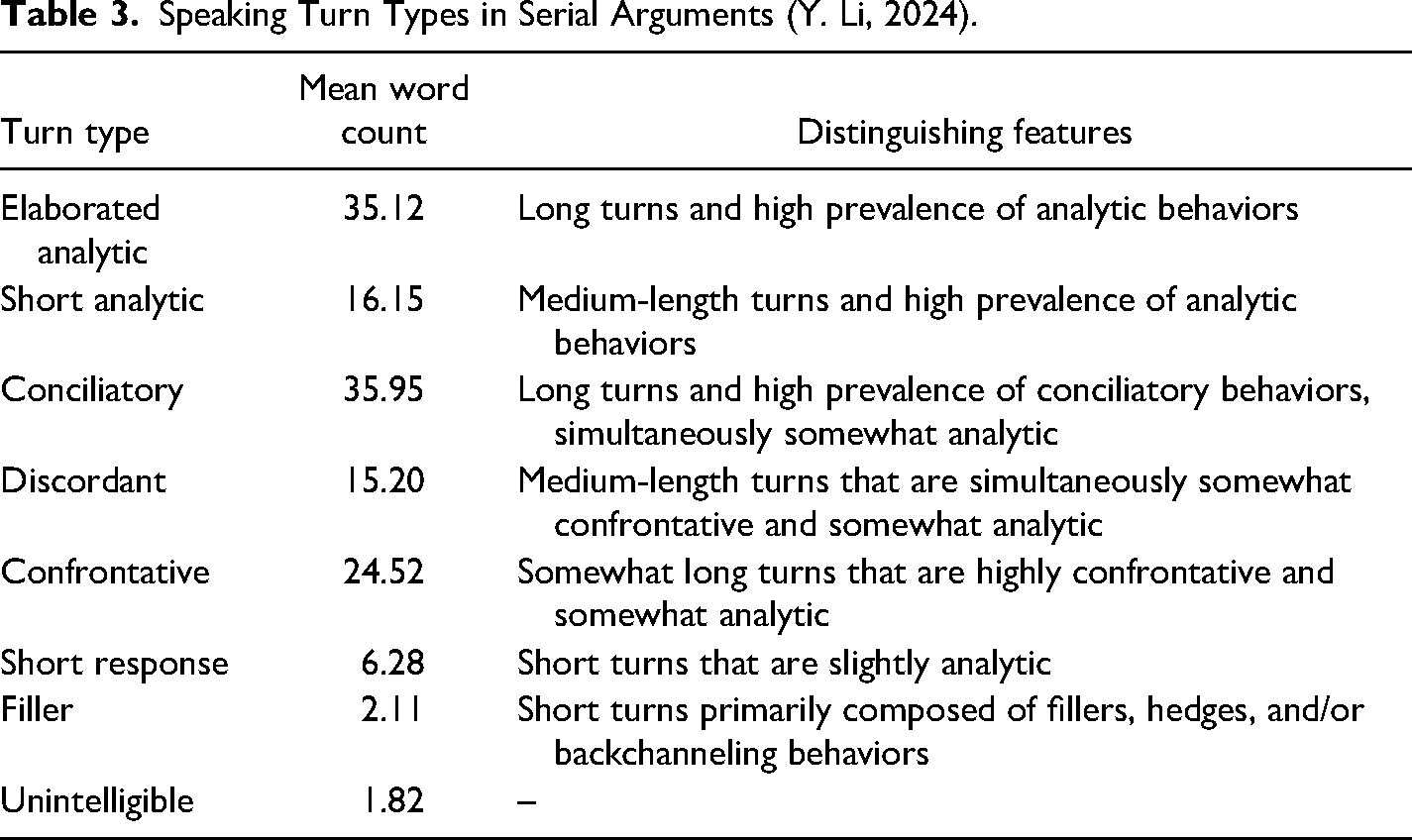
Y. Li (2024) then proceeded with a hierarchical cluster analysis using five variables: (a) the presence/absence of fillers, hedges, and backchanneling; (b) ratings of analytic; (c) conciliatory; and (d) confrontative behaviors; and (e) the number of words in the turn. The results supported a seven-cluster solution, and the inclusion of unintelligible speaking turns resulted in an eight-class turn typology. The categories of turns, their frequency, and distinguishing features are summarized in Table 3. By using both functional and linguistic facets of turn-level behaviors, Y. Li (2024) developed a nuanced turn typology, which formed the foundation for investigating and interpreting conversational motifs.
Speaking Turn Types in Serial Arguments (Y. Li, 2024).
Analysis of Conversational Motifs
Whereas previous research reflecting a DDS perspective used sequences of a specified number of turns to identify conversational motifs (e.g., Blickman et al., 2023; Solomon et al., 2022; Theiss et al., 2023), Y. Li (2024) adopted a different approach. Because retrospective recall methods were used to gather self-reports at 1-minute intervals within the conversations and to address the goals of the original project (see Worley et al., 2021) and also the aims of the dissertation project, Y. Li (2024) used 1-minute segments to investigate serial argument motifs. Specifically, the analysis involved dividing each conversation into 1-minute segments based on transcriptionist-embedded timestamps; this step resulted in a sample of 358 segments in the full data set, with an average of 9.91 turns per segment (SD = 6.17, range = 1–33). Then, Y. Li (2024) constructed a variable substitution cost matrix, which specified the cost of replacing a turn type with conceptually similar turn types (e.g., between a discordant turn and a confrontative turn) to be lower than a replacement that is conceptually distant (e.g., between a conciliatory turn and a confrontative turn). This substitution matrix was used in the sequence analysis, which resulted in a distance matrix measuring dissimilarities between all segment pairs in the sample. Finally, hierarchical cluster analysis based on the distance matrix was used to identify motif types.
Results
The results pointed to four serial argument motifs:
Serial Argument Motifs Based on Sequence Analysis of Turns in Nonoverlapping 1-Minute Segments (Y. Li, 2024).
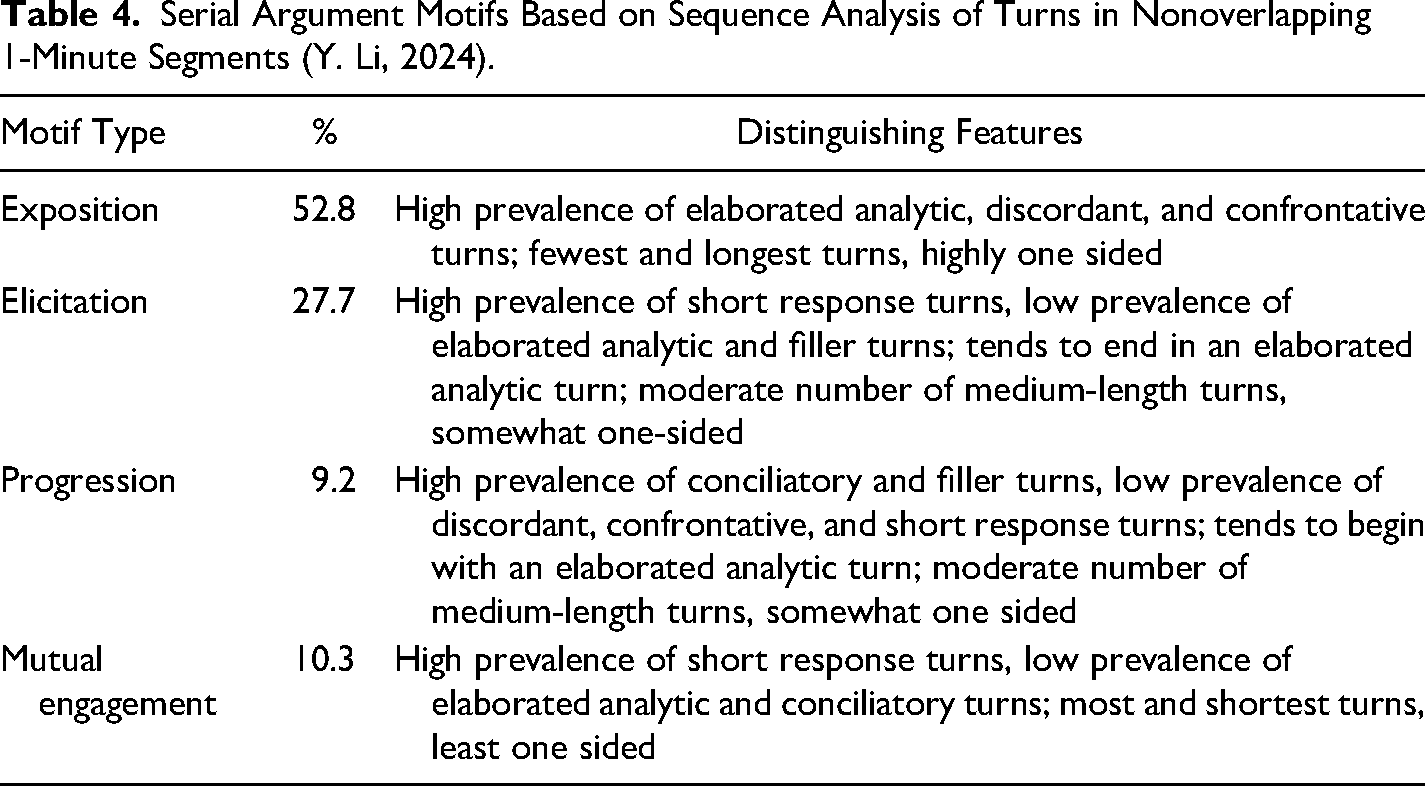
Y. Li (2024) used variations in turn length and turn types to characterize these motifs. Among the motif types, the
Do these motifs provide meaningful insight into serial arguments? An affirmative answer is suggested by evidence that partners’ emotions are associated with the prevalence of particular conversational motifs (see Table 5). Specifically, correlations between the prevalence of each motif and pre- and post-interaction emotions indicated that the prevalence of the
Correlations Between Pre- and Post-interaction Measures and Motif Prevalence During Serial Argument Conversations (Y. Li, 2024).
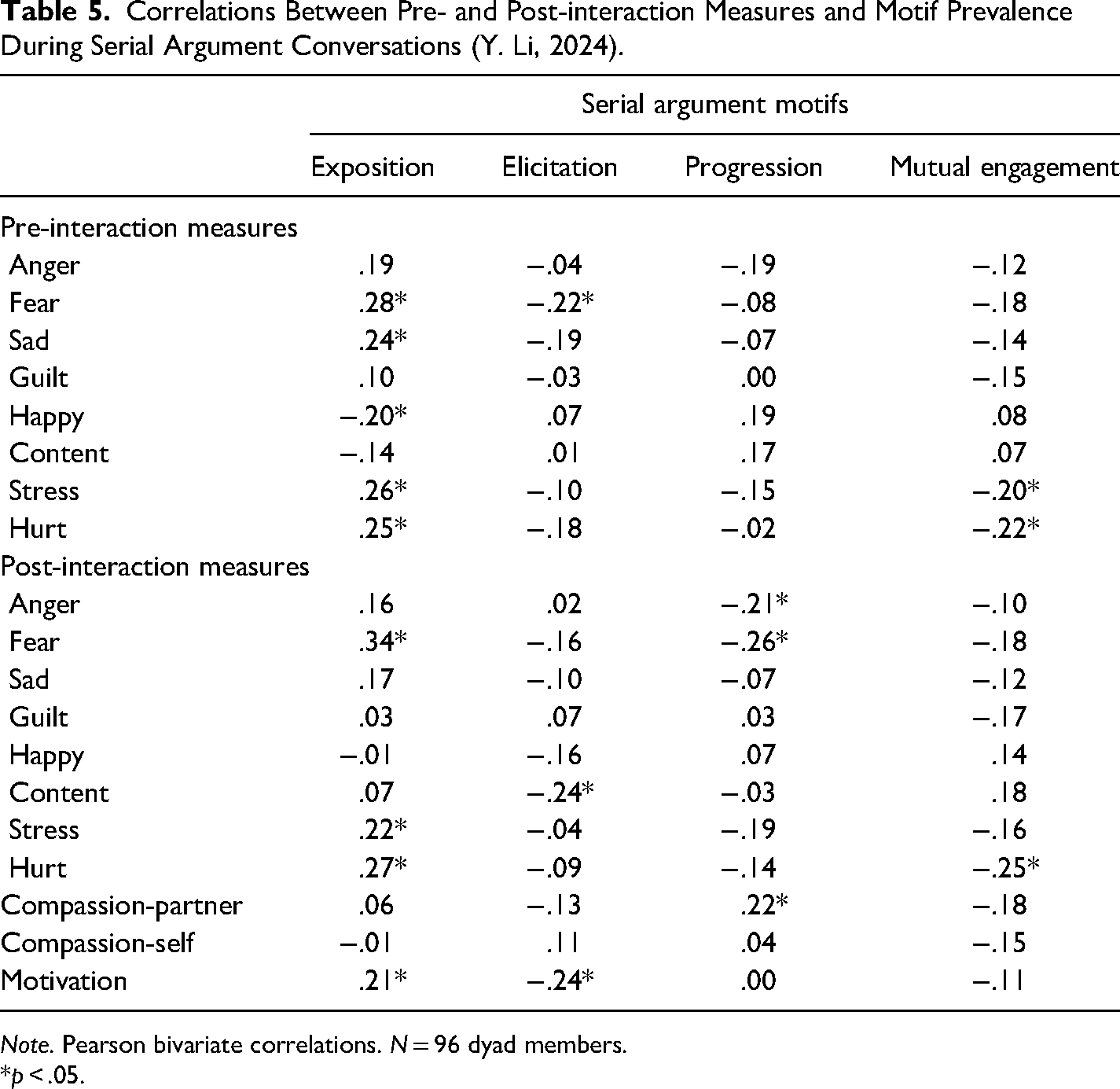
Note. Pearson bivariate correlations. N = 96 dyad members.
*p < .05.
Discussion
This study highlights new approaches to identifying turn-level behaviors and motifs in the context of serial arguments. First, Y. Li (2024) showed that categorical turn codes, continuous ratings, and word count can be integrated to inform and enrich the distinctions among various conversation behaviors. Second, the study employed a temporal (i.e., clock time), rather than turn-based, segmentation of conversations in the identification of conversational motifs. These innovations in establishing turn and motif typologies afforded new insights into the nature, composition, and functions of serial argument conversations. For one, the amount of turn-taking within 1-minute segments informed the characterization of motifs, information that is otherwise lost when segments are defined a priori by turn count. Because motifs were composed of different mixes of turn types, which themselves were distinguished along various functional and linguistic dimensions, Y. Li (2024) was able to draw nuanced contrasts among motif types. In addition, incorporating the number of words per turn as a linguistic feature revealed the balance of verbal contributions by partners as an important feature distinguishing among serial argument motifs.
Using Speaking Turns Defined by Structural and Functional Characteristics to Identify Four-Turn Motifs in Conversations About Health Campaign Messages
Conversations are important venues in which people learn about and develop their perceptions of health and illnesses (Head et al., 2022), and these interactions often arise from individuals’ reactions to health media campaigns (Southwell & Yzer, 2007). After seeing the pictorial warnings on cigarette packs, for example, smokers might discuss the consequences of tobacco use, praise the effectiveness of the warnings, or mock them (Morgan et al., 2018). Conversations such as these constitute campaign-induced interpersonal communication (CIC), defined as interactions among audience members motivated by exposure to some element of a media campaign by one or both interactants (S. Li, 2022). The results of a meta-analysis (Jeong & Bae, 2018) suggest that the presence (vs. absence) of CIC slightly improves campaign impact (equivalent to r = .07), but the overall finding is qualified by substantial variances between studies and evidence of the detrimental effect of CIC (Kam & Lee, 2013; Van den Putte et al., 2011).
Although somewhat limited, previous research points to the role of linguistic features of CIC as consequential to persuasive outcomes. For example, Hendriks et al. (2012) found that supportive talk about anti-alcohol messages produced intentions to refrain from binge drinking. Conversely, the detrimental effects of CIC observed in a group chat about anti-marijuana messages were attributable to critical comments made by at-risk participants (David et al., 2006). Other research has demonstrated the effects of content features, such as emotion words (Brennan et al., 2017) and analytic talk (Dillard et al., 2022). Guided by these findings, S. Li's (2022) project aimed to locate the source of CIC's effects in specific features of speaking turns. In particular, linguistic features of CIC speaking turns were captured through a content analysis of conversations about anti-obesity campaign messages. That analysis documented favorable, neutral, and critical comments on the messages (labeled orientation utterances), as well as agreement/disagreement between interlocutors (alignment utterances). However, people did not always speak with conviction; they expressed uncertainty about the campaign, the messages, each other's position, or themselves. When they spoke convincingly, they used reasoning utterances to support or qualify their claims. Furthermore, CIC was not solely comprised of talk about the focal topic but also overhead utterances that regulated the pace and direction of conversation and expanded its relational context. Finally, nonfluencies included filler words or phrases and incomplete utterances. As a coding scheme, these categories provided a comprehensive representation of the content of CIC. The patterned combination of the categories within speaking turns formed the basis of a turn typology which, subsequently, became part of the motifs that emerged from the back-and-forth exchanges in the conversations.
Method
The project examined conversations about public service announcements (PSAs) designed to discourage consumption of sugar-sweetened beverages (SSBs), a risk factor for obesity. From a set of PSAs that were professionally produced by anti-SSB campaigns in different locations across the country, three served as stimuli in the study. In a laboratory setting, pairs of strangers (N = 203 dyads) watched the three messages together and discussed each one with each other; these interactions were recorded. SSB consumption was measured on two occasions: (a) before exposure to the PSAs, participants estimated their consumption in the past 30 days and (b) after discussing all three messages, participants indicated their planned consumption in the next 30 days.
Operationalizing Linguistic Features Within Speaking Turns
The coding scheme applied to the transcribed conversations is detailed in S. Li (2022). Of note, six macro-categories—orientation, alignment, uncertainty, reasoning, overhead, and nonfluency—were further divided into 13 micro-codes to allow a more nuanced representation of the linguistic features (see Table 6, reproduced with permission from S. Li et al., 2024). Following the example provided by Bodie et al. (2021), each of the 20,379 turns in the data set was indexed by the prevalence of the 13 utterance codes (represented as proportions of the total utterances within the turn), and these data served as input for a hierarchical cluster analysis. The results (reported in S. Li et al., 2024) supported a solution identifying nine types of turns comprising CIC.
Types of Utterances in Campaign-Induced Interpersonal Communication About Anti-Sugar-Sweetened Beverage PSAs: Micro-level Codes Organized by Macro-level Codes (Reproduced With Permission from S. Li et al., 2024).
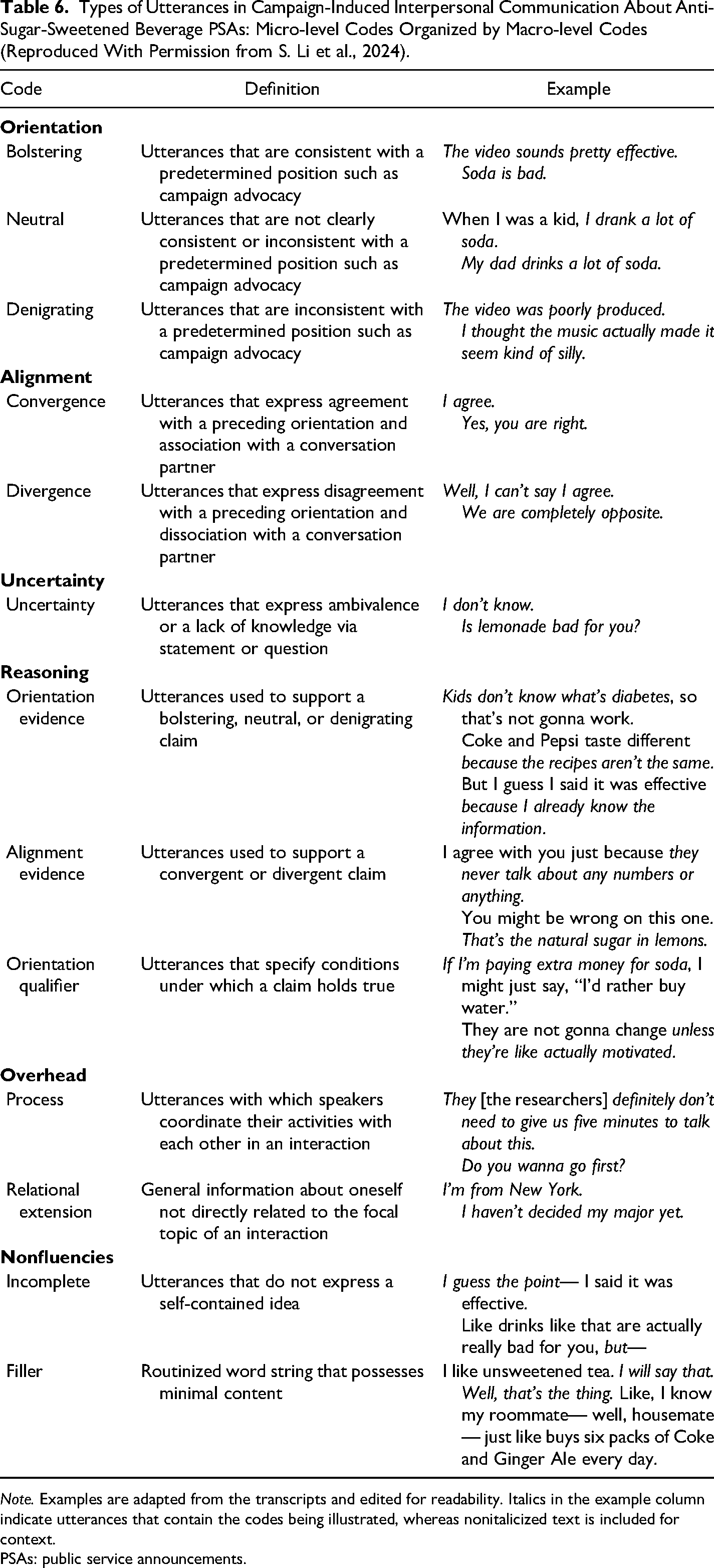
Note. Examples are adapted from the transcripts and edited for readability. Italics in the example column indicate utterances that contain the codes being illustrated, whereas nonitalicized text is included for context.
PSAs: public service announcements.
To clarify the content of the turn types, as well as distinctions among them, S. Li et al. (2024) organized the nine turn types into three broader categories: pure types, majority types, and plurality types (Table 7; adapted from S. Li et al., 2024). Each of the three pure types—Uncertainty, Convergence, and Process—was entirely made up of the utterance code informing the turn name (i.e., no other utterance types occurred in the turn). In the three majority turn types—Bolstering Plus, Neutral Plus, and Relational Extension Plus—the utterance code conveyed by the turn type label accounted for 50%-99% of the utterances in the turn, and the functions served by the majority codes were supported by the other utterances in the turn (hence, the “plus” tag in these turn names). Compared to the pure and majority types, the three plurality types manifested complexity that arose from relational concerns, in the case of Hesitant Denigration, or analytical activities, apparent in the Qualified Deliberation and Substantiated Alignment turn types. As this summary illustrates, the nine turn types—grounded in the utterance-level codes—provided a rich account of verbal behavior to inform the examination of turn-taking sequences.
Speaking Turn Types in Campaign-Induced Interpersonal Conversations (S. Li et al., 2024).
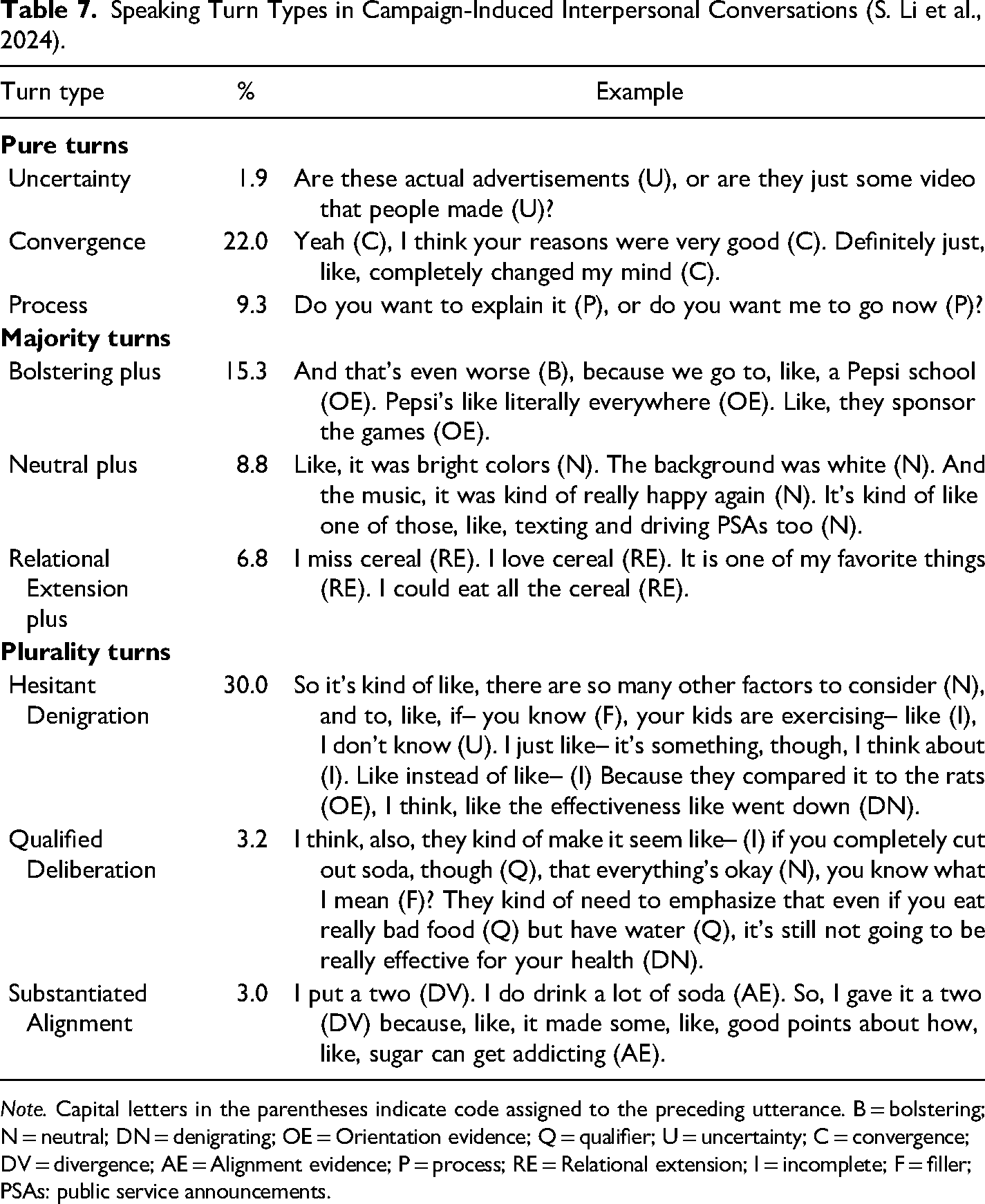
Note. Capital letters in the parentheses indicate code assigned to the preceding utterance. B = bolstering; N = neutral; DN = denigrating; OE = Orientation evidence; Q = qualifier; U = uncertainty; C = convergence; DV = divergence; AE = Alignment evidence; P = process; RE = Relational extension; I = incomplete; F = filler; PSAs: public service announcements.
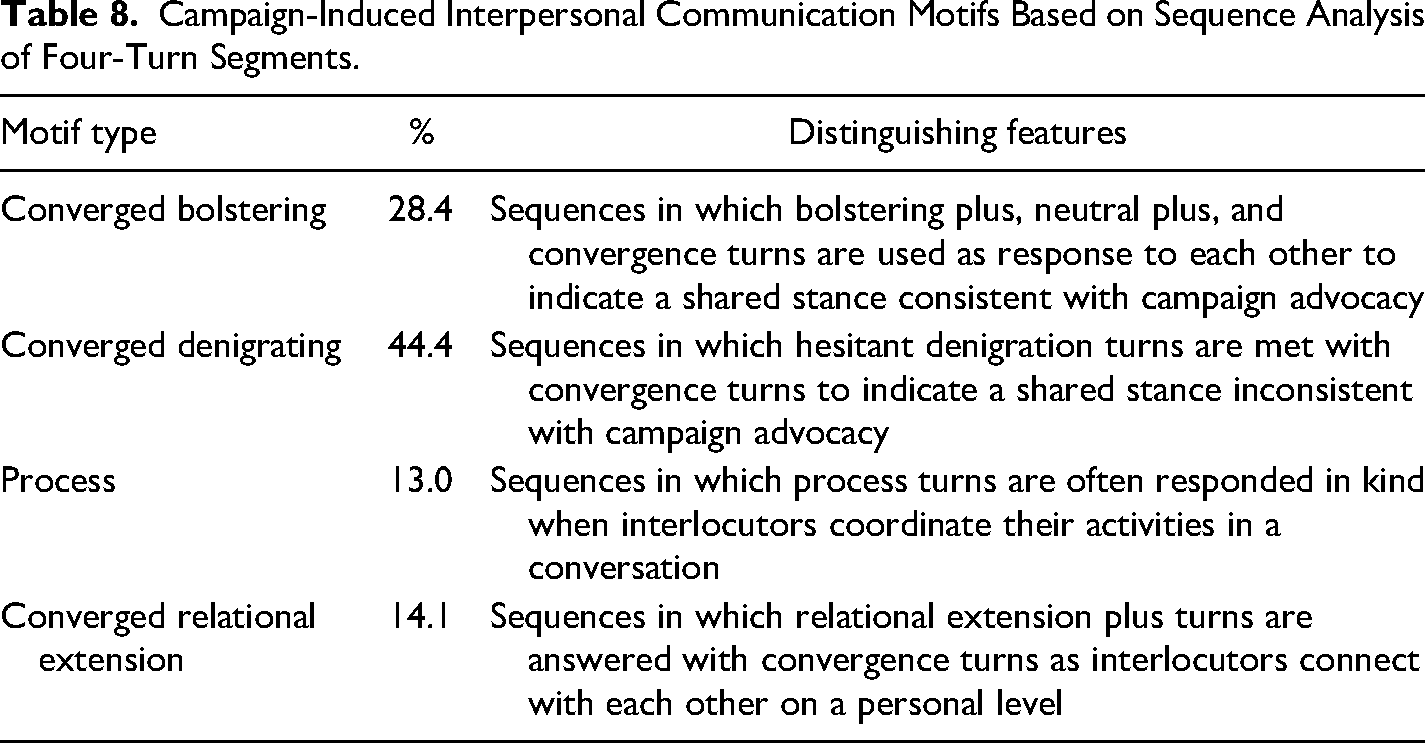
Campaign-Induced Interpersonal Communication Motifs Based on Sequence Analysis of Four-Turn Segments.
Analysis of Conversational Motifs
As illustrated by our previous descriptions of the bereavement support and serial argument studies, researchers have alternatives when considering the window of turns to encompass when deriving conversational motifs. S. Li (2022) opted to examine sequences of a fixed length. The window of turns was determined by conducting separate sets of sequence analysis and hierarchical cluster analysis on sequences of three to seven turns and comparing the results. The data-driven approach to this decision was adopted because, unlike dyad members in the bereavement support study who had distinct roles, those in S. Li's (2022) project were indistinguishable a priori. Constant cost matrices were used to calculate the dissimilarities between sequences of the same length, resulting in five separate distance matrices. Hierarchical cluster analyses were then conducted based on the distance matrices to determine the clustering solution for each sequence length. Finally, the solutions were compared with each other based on two criteria: parsimony and discriminability. Whereas parsimony implies a preference for shorter sequences and fewer clusters, discriminability favors the opposite. An optimal solution strikes a balance between the two criteria.
Results
The cluster analysis solutions for three-turn and five-turn sequences included, respectively, five and six clusters, whereas sequences of four, six, and seven turns each yielded a four-cluster solution. The four-cluster solution of four-turn sequences was chosen because this is the minimum window of turns that (a) included an initial turn, a response, and feedback to the response while (b) allowing equal contributions from both partners (two turns each). The four clusters were labeled
When people engaged in exchanges represented by the
The motifs identified in the preceding analysis present an opportunity to investigate the impact of speaking turn sequences on campaign outcomes. For instance, the
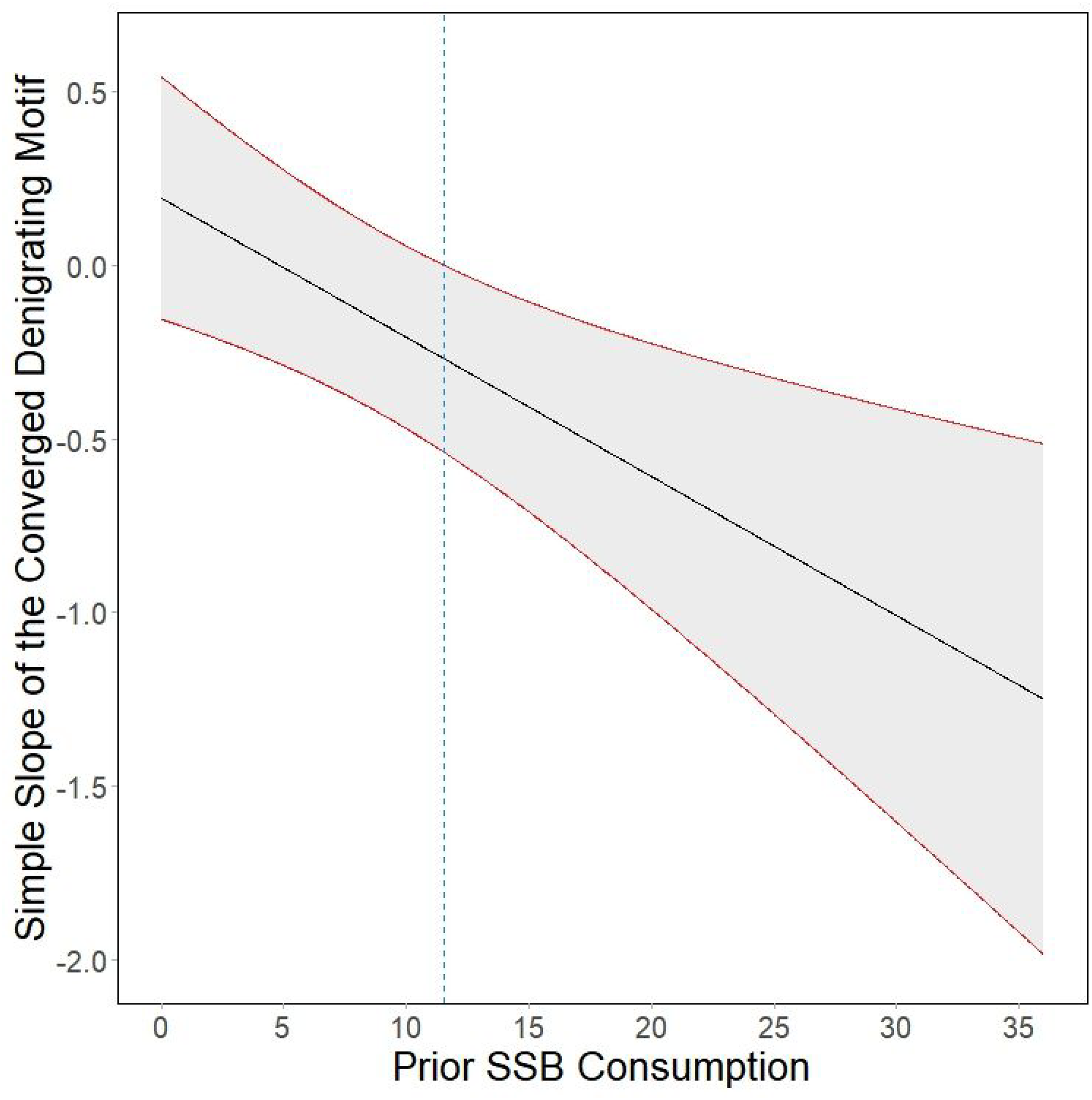
The association between prevalence of the converged denigrating motif and sugar-sweetened beverage (SSB) consumption reduction intention as a function of prior SSB consumption
Discussion
S. Li's (2022) project made contributions to the study of conversational motifs along several lines. First, commencing the study with an utterance-level content analysis allowed a comprehensive representation of what people say in conversations about health campaign messages. Although labor intensive, the cost was well justified by the insights afforded by applying a DDS perspective in a novel topic domain. Second, the turn typology established through the initial cluster analysis demonstrated that the functions of speaking turns were fulfilled not only by the speakers’ production of utterances with various content—as indexed by the utterance-level codes—but also by the structure in which the codes were organized within turns. While some functions required relatively simple structures (the pure and majority turn types), sophisticated discursive moves were made possible by more complex formulations (the plural turn types). Third, the motifs identified in the subsequent cluster analysis revealed how meaning was co-created in the conversations. CIC was composed of more than evaluative, solution-oriented exchanges represented by the
General Discussion
The DDS perspective advanced by Solomon et al. (2021, 2023) underscored the value of examining the back-and-forth dialogue that unfolds to create, ultimately, a conversation between people. Indeed, the study of interpersonal communication offers many theories that forward claims about how conversations reflect antecedent conditions or affect interaction outcomes, while the inner workings of conversations themselves are often not examined. Instead, scholars have examined the perceptions or consequences of discrete messages (e.g., support messages that vary in person centeredness, see High & Dillard, 2012) or they have examined qualities of conversations as a whole (e.g., McLaren & Sillars, 2014; Priem & Solomon, 2018). The studies we showcased exemplify how researchers can operationalize the turn-to-turn verbal behavior that occurs during consequential conversations in ways that enable more exacting tests of interpersonal communication processes.
Although dynamic dyadic systems manifest properties beyond the scope of this report (e.g., phase shifts marking stability vs. reorganization over time; see Solomon et al., 2023), conversational motifs capture important dynamic and dyadic qualities of conversation. First, conversational motifs reveal interdependence between partners because they document how the interplay between partners’ turns defines recurring and distinguishable sequences. For example, in Tian et al. (2024b), a bereaved participant's Family-focused Disclosure followed by listener Acknowledgment led to a sequence of
A key difference among the projects we showcased is how they operationalized speaking turn phenomena. Both Tian (2021) and Y. Li (2024) studied domains that offered established frameworks for studying speaking turns; therefore, they drew upon prior work to code speaking turns rather than utterances within turns. Although that approach risks losing detail, such as the relative prevalence of different speech acts or tactics within speaking turns, they supplemented turn classifications with measures of verbal behavior including ratings of turns on continuous scales, word counts, and/or LIWC-generated indices of specific linguistic forms. Because S. Li (2022) broke new ground in the study of CIC, that project included a content analysis of verbal behavior and utterance-level coding to inform the typology of speaking turns (S. Li et al., 2024). Together, these articles represent alternatives researchers can use, depending on the availability of validated coding schemes for conversational turns (see Van Lear & Canary, 2016), and how coding at the turn level can be meaningfully augmented with additional measures of linguistic phenomena that are more easily obtained.
The studies we summarized also implemented different strategies for identifying conversational motifs. Because Tian (2021) sought to extend research on supportive conversational motifs to interactions about bereavement experiences, that project adopted the same five-turn moving window with two-turn offset (i.e., every segment began with a discloser's turn) employed by Solomon et al. (2022). In S. Li (2022), conversation partners did not have distinguishable roles, which supported a decision to use a four-turn moving window with one-turn offset to define conversation segments. This comparison highlights how unitizing conversational segments for the sequence analysis can vary depending on the differentiation of participant roles, theoretical logic, and other contextual considerations. A different approach was taken by Y. Li (2024), whose data set included self-reports of communication goals that were measured at 1-minute intervals using a retrospective cued-recall procedure (Worley et al., 2021). To complement that aspect of the data, Y. Li (2024) used all turns within nonoverlapping 1-minute intervals to define the length of conversational segments. One affordance of this approach was the ability to observe the role of volume and distribution of verbal behavior within 1-minute segments in distinguishing conversational motifs. Although the use of sequence analysis is fundamentally an inductive means of identifying conversational motifs, the projects summarized here illustrate different considerations that can frame the inductive process.
We are encouraged that the examples gathered in this essay have heuristic value for elaborating the conceptions of language within the study of turn-to-turn dynamics of dyadic interaction, as well as demonstrating the value of integrating linguistic features into the identification of conversational motifs; however, we note important limitations. First, all the projects we discussed were laboratory observations of staged interactions between college students enrolled at the same large university in the northeastern United States. The samples are, as a set, diverse with regard to neither geographical location, race, ethnicity, age nor socioeconomic status. Second, each project had elements in the research design that compromise the ability to make generalizable claims: (a) Tian (2021) included a research confederate and experimental manipulation of some facets of the interaction, (b) S. Li (2022) involved participants who were strangers discussing three PSAs selected for the purpose of the study, and (c) Y. Li (2024) conducted secondary analysis of an existing data set that lacked key demographic information. Third, the inductive reasoning that is inherent in interpreting cluster analysis results—which contributes to both the identification of turn types and motifs—is unavoidably influenced by the subjective perspective of the researchers. The accumulation of research findings is needed to assess whether the typologies of speaking turns and conversational motifs that have emerged from these three projects prove meaningful and replicable.
Conclusion
This essay featured three dissertations that adopted a DDS perspective on interpersonal conversations. Although these projects addressed very different subjects, they each grappled with the challenges of illuminating turn-to-turn patterns of verbal behavior in dyad interaction. By elaborating the library of linguistic elements considered when operationalizing conversation motifs, this essay aimed to enrich the study of interpersonal interactions. By bringing together studies of different types of conversations, we demonstrated the potential for adapting a DDS perspective to a variety of research agendas. In particular, Tian et al. (2024b) and Y. Li (2024) build on previous research that has examined conversation turns and motifs in the context of support (Solomon et al., 2022) or conflict (Blickman et al., 2023), and S. Li (2022) breaks new ground by centering interpersonal conversations as the site where persuasive media campaigns are realized. Although capturing the creativity and novelty of improvisational dialogue may prove endlessly elusive, we hope our examples encourage and enable further progress in this pursuit.
Footnotes
Acknowledgments
The authors are grateful to Anastassia Zabrodskaja and Jessica Gasiorek for the invitation to present this research at the 18th International Conference on Language and Social Psychology. Across the three projects, numerous undergraduate research assistants participated in executing the studies and coding the conversations; the authors are grateful for their essential contributions. We also thank Timothy Worley, who provided the data for the second project; Miriam Brinberg, who advised and assisted with some of the analyses; and Graham Bodie and Susanne Jones, who were consulted about the coding on the first project.
Declaration of Conflicting Interests
The authors declared no potential conflicts of interest with respect to the research, authorship, and/or publication of this article.
Funding
The author(s) disclosed receipt of the following financial support for the research, authorship, and/or publication of this article: This research was partially supported by funding from the National Science Foundation (Award 2140402).
