



Abstract
We compare interpretations of two kinds of statements that are important for stereotype transmission: generics (e.g., “women are helpful”) and comparatives (e.g., “women are more helpful than men”). Participants (N = 338) read and interpreted generic or comparative statements about positive and negative features of gender (Experiment A) and age groups (Experiment B). We found similarities and differences. Participants interpreted both generics and comparatives as conveying information not only about the target (women in the example) but also about the referent (men in the example), whether the statement explicitly mentioned the referent (in comparatives) or not (in generics). When statements said something positive (negative) about the target, they also communicated a rather negative (positive) view of the referent. Remarkably, although comparatives explicitly contrast groups while generics do not, generics implied bigger differences between the groups and provoked more extreme assumptions about the groups. We discuss implications for stereotype transmission.
Keywords
People can express views of social groups (stereotypes) in various manners. Two types of statements particularly relevant for stereotype transmission are bare plural generic statements (“generics” for short, e.g., “women are empathic”; Berio & Musholt, 2023) and comparative statements (“comparatives” for short, e.g., “women are more empathic than men”; e.g., Bruckmüller et al., 2012). Until recently, their roles in stereotype transmission have been examined separately. However, there are reasons to consider generics and comparatives pragmatically similar, urging research that compares the two. We here compare people's interpretations of generic and comparative statements about groups.
Generics and comparatives are pragmatically similar in two ways. First, even though generics only mention one group (e.g., women in “women are empathic”) they imply that this group differs from an unmentioned standard. This standard may be a relevant comparison group (here: men). People's tendency to engage in dichotomous thinking (Fraker, 2023) can thus make them understand generics as implying information about an unmentioned other group (e.g., Moty & Rhodes, 2021). Generics can therefore be conceptualized as implicit difference statements (Lux et al., 2024). Second, even though comparatives describe differences between groups and thus are explicit difference statements (Lux et al., 2024), people tend to understand them as saying more about the target (in the example: women) than about the referent (in the example: men). This is known as focalism (Windschitl et al., 2003). For example, when people try to explain why a target group differs from a referent group, they tend to refer to the target to the neglect of the referent (Bruckmüller & Braun, 2020).
Despite these pragmatic similarities of generics and comparatives, we recently found diverging initial appraisals of truth and acceptability (Lux et al., 2024). Participants found generics about positive features of social groups truer and more acceptable than comparatives stating that these groups had the features more than other groups. Moreover, participants judged stereotypical statements about some groups as truer when they were comparative (e.g., “old people are wiser than young people”) rather than generic (“old people are wise”), but judged counter-stereotypical statements as truer when they were generic (e.g., “young people are wise”) rather than comparative (“young people are wiser than old people”). Thus, while research on focalism and dichotomous thinking suggests some degree of similarity in people's understanding of generics and comparatives, our initial findings suggest systematic differences.
In the present research, we followed up on this by examining more in-depth interpretations of generics and comparatives. Specifically, we examined to what extent participants felt that generics and comparatives were about targets versus referents (tapping into focalism and dichotomous thinking). We also examined to what extent generics and comparatives inspired divergent inferences of communicator views of targets, referents, and the difference between them. Concerning communicator views of referents, we were particularly interested in the extent to which generics and comparatives imply a valenced view of referents, such that saying something positive about one group conveys something negative about another group (as in research on generics about fictitious groups, Moty & Rhodes, 2021, and on comparative bragging, Van Damme et al., 2016).
We have previously described three potential mechanisms that may make generics and comparatives pragmatically different, the Fluency Hypothesis, Etiquette Hypothesis, and Prejudice Avoidance Hypothesis (Lux et al., 2024). The essence of the Fluency Hypothesis is that familiar statements and those that fit with expectations (e.g., stereotypical statements) are easier to process than unfamiliar and unexpected (e.g., counter-stereotypical) ones. It further assumes that people use processing fluency as a cue for social judgment (e.g., Schwarz et al., 2020), including inferences about communicators (Dragojevic & Giles, 2016). This may explain why participants in Lux et al. (2024) found some counter-stereotypical generics (“young people are wise”) truer than the respective comparatives (“young people are wiser than old people”), as the latter were presumably even more unfamiliar, unexpected, and therefore disfluent, than the former.
The essence of the Etiquette Hypothesis is that people judge messages in terms of how well they adhere to a positivity norm that prohibits speaking negatively of others (see Kervyn et al., 2012). This hypothesis further assumes that among statements that attribute a feature to a target, comparatives more openly than generics suggest that the referent has less of the respective feature (e.g., “women are more helpful than men” suggests that men are not helpful). This may explain our previous finding that among statements about positive features, generics seemed truer and more acceptable than comparatives (Lux et al., 2024). Statements about negative features always violate positivity norms whether they are generic or comparative. Yet, comparatives may do so a bit less than generics (as, e.g., “men are more aggressive than women” at least includes the positive suggestion that women are not aggressive). A further Etiquette-based assumption relevant for the present research is that violations of the positivity norm draw attention (e.g., to the referent when a statement implies something negative about the referent), which should affect focalism and dichotomous thinking.
The Prejudice Avoidance Hypothesis, for which we found least support in our previous work (Lux et al., 2024), states that people negatively evaluate prejudice, that they attend to cues that signal a communicator's prejudice (Hogg & Giles, 2012), and that they dislike messages and communicators that give such cues. An example for a prediction based on this hypothesis is that explicitly saying that groups are different (i.e., comparatives) communicates higher differentiation between the groups than only mentioning one group (i.e., generics). We therefore predicted that comparatives would signal higher prejudice than generics.
In sum, we considered one metacognitive (Fluency) and two social norm-based mechanisms (Etiquette; Prejudice Avoidance) that may influence how people interpret generics and comparatives. Based on these assumed mechanisms, we derived and pre-registered specific predictions (https://osf.io/rfp3m). These predictions were sometimes contrasting, but more often concerned different variables. From the Prejudice Avoidance Hypothesis we predicted main effects of generic versus comparative format (see example above). Predictions based on the Fluency Hypothesis involved interactions of format and stereotype-consistency. Predictions derived from the Etiquette Hypothesis involved interactions of format and valence (see Table S3 in online Supplemental material [OSM]). Moreover, given that the three hypotheses tap into different levels (metacognition vs. norm adherence) and into norms of different content (positivity vs. prejudice avoidance), they partially inspired predictions for different dependent variables. In the following, we focus on those analyses and findings that are most informative with regard to interpretations of generics versus comparatives. We mark findings as confirmatory, contradictory, or exploratory with regard to our predictions. For analyses testing additional predictions, we refer to the pre-registrations and the OSM.
Method
We conducted two experiments that differed only in terms of the involved groups (Experiment A: gender groups; Experiment B: age groups), with data collections on the same participants in the same session. We therefore describe them together. Participants interpreted statements attributing positive and negative features to targets (in comparatives: more than to the referent). The statements were always generic or comparative and always stereotypical or counter-stereotypical. We pre-registered manipulations, measures, sample size, and data exclusions (https://osf.io/rfp3m). We received ethical clearance from the Social and Societal Ethical Committee of KU Leuven (G-2020-2584).
Sample
Dutch-speaking students of KU Leuven participated for course credit as part of a class exercise open to all students. This gave us little control over the sample size apart from a pre-registered time window for data collection. Of 350 initial participants we, as pre-registered, excluded those who guessed a prediction (N = 3), reported having known about the study's content beforehand (N = 1), or responded very slowly or very fast (N = 8). The final sample included 338 participants (48 men, 282 women, 8 who did not identify with either or did not report their gender) of 17 to 28 years (Mage = 18.31, SDage = 1.06). A sensitivity power analysis (with G*Power; Faul et al., 2007) revealed that the minimal detectable effect size (α = .05, two-tailed, 95% power) was d = .11 for a within–between interaction, d = .20 for differences in matched pairs, and d = .39 for differences between two independent means.
Design
Participants completed the experiments in random order. We randomly assigned them to one of 2 (format: generic, comparative) × 2 (stereotype-consistency: stereotypical, counter-stereotypical) conditions. Participants were in the same condition of these between-subjects factors across experiments. Valence (positive, negative) varied within subjects.
Materials and Procedure
To create the stimuli, we adapted 20 generics and 20 comparatives about gender groups (for Experiment A, from Hoorens & Bruckmüller, 2015) and age groups (for Experiment B, from Chasteen et al., 2002). We created stereotypical and counter-stereotypical statements by switching targets and, in comparatives, referents. To enhance external validity and make the communicator salient, we showed the statements as posts (“tweets”) on the social media platform Twitter (which became “X” after data collection). To minimize confounds involving communicators’ appearance and group membership (Mackie et al., 1990), we identified communicators with random initials and did not use pictures (see OSM for instructions, stimuli, and an example of their presentation as tweets).
Potential participants received an invitation with a link to an online survey. After informed consent, they first completed an open-response measure of focalism for each tweet (in randomized order). They then saw each tweet a second time, again in random order, and completed the other (rating-type) measures.
Focalism and Dichotomous Thinking
Open Response. We showed the tweets one by one and asked: “Why might people agree or disagree with this statement? Please give 1 to 2 reasons. They do not have to reflect your personal view”, followed by a textbox. Condition-blind coders counted how often participants’ responses referred to men, women, and people of unspecified gender (Experiment A) or old people, young people, and people of unspecified age (Experiment B). Coder agreement was substantial (cf. Landis & Koch, 1977), κExpA = .80, κExpB = .65. A third independent coder decided in cases of disagreement. We calculated the proportion of references to the target (number of references to target divided by number of references to target and referent combined). This value could vary from 0 (exclusive focus on referent) to 1 (exclusive focus on target). A value above .50 indicated a relative focus on the target (i.e., focalism). A value below 1 indicated that participants also mentioned the referent (i.e., dichotomous thinking).
Rating. We asked, separately for target and referent, “To what extent does the communicator wish to express a view about [group]?”. Participants answered using a slider from 0 “not at all” to 100 “very much.” We subtracted referent scores from target scores. Values above 0 indicated focalism, values below 100 dichotomous thinking.
Inferred Views of Communicator
Views on Target and Referent. Participants rated, separately for target and referent, “How many [group] have the feature according to the twitterer?”, on a seven-point scale from “none” to “all [group].” If dichotomous thinking occurred, as we expected it would, any effect of the valence manipulation on the inferred communicator view of the referent would involve potentially complicated interactions. We therefore kept the absolute ratings for the inferred views on the target, but for inferred views on the referent, we derived an index of how positively the communicator, in participants’ view, saw them (positive statements: raw ratings; negative statements: reverse-coded ratings).
Differentiation Between Groups. We derived an index of inferred differentiation by subtracting ratings for the referent from those for the target. Higher values thus indicated stronger differentiation.
Additional Measures and Demographics
Participants guessed the twitterer's communication goals and, at the end of the session (i.e., after having completed all measures for all statements of Experiments A and B), completed a surprise memory task and indicated their general impression of the communicators and their impression of communicators’ gender and age prejudice. Details on these measures are reported in the OSM. Finally, participants reported their gender, age, age group identification, and responded to suspicion probe questions. They were then thanked and dismissed. Full debriefing followed later via email.
Results
We tested for dichotomous thinking and focalism via one-sample t-tests. We tested further effects via mixed-model analysis of variances (ANOVAs) with (generic vs. comparative) format and stereotype-consistency as between-, and valence as within-subjects variable(s). We followed up on interactions with t-tests (Welch's t-test when variances were unequal) applying Bonferroni-corrected significance levels. We here focus on effects that involve the factor format, that is, of generics versus comparatives. For a report of all findings see OSM. Data and syntax files are available here: https://osf.io/rfp3m/.
Dichotomous Thinking and Focalism
Open Responses
Overall means (MExpA = .63, MExpB = .72, both SDs = .23) were significantly below 1, indicating dichotomous thinking, tExpA(335) = 29.71, p < .001, d = 1.62; tExpB(334) = 22.49, p < .001, d = 1.23, but also significantly above .5, indicating focalism, tExpA(335) = 10.96, p < .001, d = .60; tExpB(334) = 17.21, p < .001, d = .94. Generics prompted greater dichotomous thinking if they were about gender groups (MExpA = .77, SD = .18), t(160) = 16.33, p < .001, d = 1.29, than if they were about age groups (MExpB = .90,SD = .09), t(158) = 14.30, p < .001, d = 1.13. Comparatives prompted focalism if they were about age groups (MExpB = .55, SD = .19), t (175) = 3.61, p < .001, d = .27, but not if they were about gender groups (MExpA = .51, SD = .19), t (174) = 0.70, p = .483, d = .05. That is, participants writing about why somebody might make a comparative statement about gender groups equally often mentioned women and men.
Unsurprisingly, focalism was higher for generics than for comparatives, as evidenced by significant format main effects in the ANOVAs, FExpA(1,327) = 274.32, p < .001, ηp² = .46; FExpB(1,329) = 745.55, p < .001, ηp² = .69 (for the means, see above). This format effect was significant across conditions and experiments, all ts ≥ 2.70, all ps ≤ .008, although its strength varied with valence (in line with the Etiquette Hypothesis) and partially with stereotype-consistency (see OSM).
A relevant finding (exploratory with regard to our predictions) was that counter-stereotypical comparatives (e.g., “men nag more than women”; “young people are wiser than old people”) deviated from the generally observed focalism, with mean values significantly below .5 (MExpA = .39, SD = .12, MExpB = .41, SD = .15), tExpA(85) = 8.57, p < .001, d = .92; tExpB(85) = 5.67, p < .001, d = .61. Participants wondering why somebody would tweet such a claim mentioned the referent (here: women; old people) more often than the target (men, young people).
Ratings
Overall means (MExpA = 39.70, SD = 26.64, MExpB = 40.03, SD = 28.74) were significantly below 100, indicating dichotomous thinking, tExpA(299) = 39.20, p < .001, d = 2.26; tExpB(296) = 35.96, p < .001, d = 2.09, and above 0, indicating focalism, tExpA(299) = 25.81, p < .001, d = 1.49; tExpB(296) = 24.01, p < .001, d = 1.39. This was true across conditions and experiments, all ts > 6.28, all ps < .001 (see OSM).
Generics prompted some dichotomous thinking for gender (M = 58.15, SD = 24.06), t(125) = 19.53, p < .001, d = 1.74, and for age groups (M = 61.24, SD = 26.04), t(122) = 16.51, p < .001, d = 1.49. Comparatives prompted focalism for gender (M = 26.34, SD = 19.53), t(173) = 17.79, p < .001, d = 1.35, and age groups (M = 25.04, SD = 19.73), t(173) = 16.74, p < .001, d = 1.27.
As expected, focalism was higher for generics (vs. comparatives), FExpA(1,285) = 158.43, p < .001, ηp² = .36; FExpB(1,275) = 173.86, p < .001, ηp² = .39 (for the means, see above). This format effect was always significant. Its magnitude again varied with valence but, other than for open responses, not with stereotype-consistency (see OSM).
Inferred Views of Communicator
Inferred Views on Target and Referent
Participants inferred that, in the eyes of the communicator, more members of the target group had the described feature if the statement was generic rather than comparative; Experiment A: Mgenerics = 6.40, SD = 0.65, Mcomparatives = 5.83, SD = 0.72, F(1,334) = 67.34, p < .001, ηp² = .17; Experiment B: Mgenerics = 6.34, SD = 0.73, Mcomparatives = 5.80, SD = 0.78, F(1,331) = 52.24, p < .001, ηp² = .14 (for further effects, see OSM).
More relevant for our purposes were participants’ inferences on how the communicator saw the referent. In line with dichotomous thinking, participants assumed that communicators perceived referents to lack the features they ascribed to targets. Across generics and comparisons, positive statements suggested a negative view of the referent (MExpA = 3.07, SD = 1.46; MExpB = 2.95, SD = 1.48), and negative statements suggested a positive view of the referent (MExpA = 5.27, SD = 1.36; MExpB = 5.35, SD = 1.38), valence main effects: FExpA(1,332) = 292.31, p < .001, ηp² = .47; FExpB(1,330) = 329.89, p < .001, ηp² = .50.
However, generics inspired more extreme inferences than comparatives did. This was evidenced by significant format by valence interactions, FExpA(1,332) = 45.09, < .001, ηp² = .12; FExpB(1,330) = 31.01, < .001, ηp² = .09 (means and SDs in Figure 1). Participants who read generics (vs. comparatives) inferred views of referents that were evaluatively more different from the inferred views of targets. For example, participants inferred that the communicator considered women braver (i.e., saw them more positively) when reading “Men are braver than women” than when reading “Men are brave.” Similarly, they considered women more jealous (i.e., saw them more negatively) when reading “Men are more jealous than women” rather than “Men are jealous.” This finding, to which we will return in the discussion, is contrary to a prediction by the Etiquette Hypothesis (for further effects, see OSM).
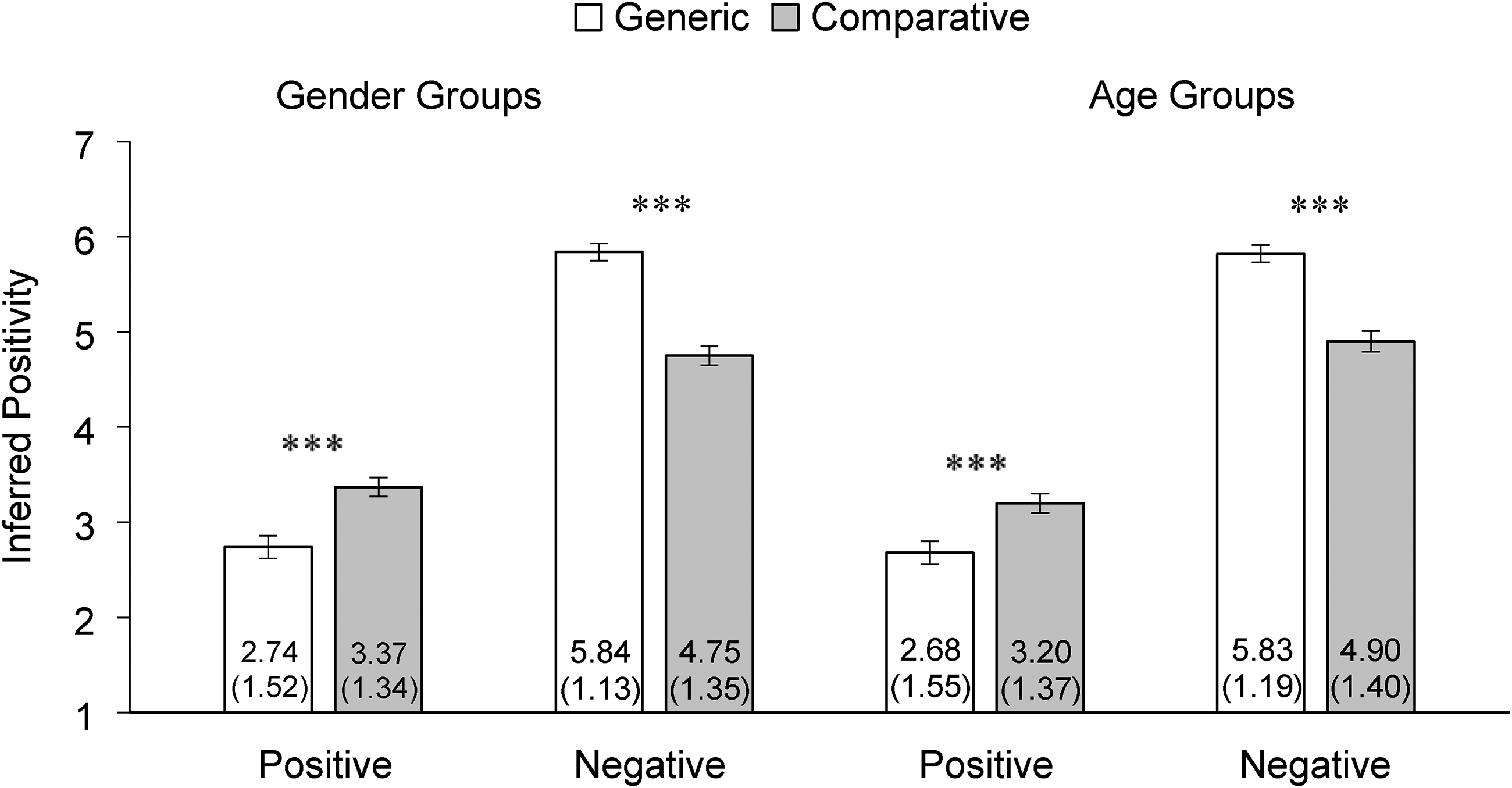
Mean positivity (SDs in parentheses) of referent view ascribed to communicators as a function of the format (generic vs. comparative) and valence (positive vs. negative) of statements.
Differentiation Between Groups
Unexpectedly, but in line with the findings for views on targets and referents, participants inferred greater differentiation between groups from generics than from comparatives, Experiment A: Mgenerics = 3.96, SD = 1.67, Mcomparatives = 2.54, SD = 1.48, F(1,332) = 91.79, p < .001, ηp² = .22; Experiment B: Mgenerics = 3.94, SD = 1.75, Mcomparatives = 2.70, SD = 1.59, F (1,330) = 67.06, p < .001, ηp² = .17. Thus, if a tweet stated something about a target group without mentioning the referent group, readers inferred that the twitterer saw a greater difference between the groups than if the tweet explicitly stated that the groups were different. This effect, which ran counter to the Prejudice Avoidance Hypothesis, was significant in all conditions, all ts > 3.70, all ps < .001, although its strength varied with valence and stereotype-consistency (see OSM).
Other Variables
Findings for inferred communication goals mirrored the effects for inferences on targets and referents (see OSM). For participants’ general impressions and perceived prejudice of the communicator, we found no significant effects of format, even though we had predicted some (see OSM). Participants performed better on the memory task when they had read generics rather than comparatives, F(1,333) = 32.01, p < .001, ηp² = .09 (an exploratory finding, see OSM).
Discussion
We compared interpretations of generic versus comparative statements about groups. We found similarities and differences. Both generics and comparatives provoked focalism as well as dichotomous thinking, that is, participants’ interpretations focused more on the target but also involved the (mentioned or implied) referent. However, and predictably so, generics inspired more focalism than comparatives. Unexpectedly, generics (vs. comparatives) inspired more extreme inferences on communicators’ views of both the target and the referent. Participants also inferred higher differentiation between groups from generics than from comparatives. Aside from one noteworthy exception discussed below, results for gender and age groups were strikingly similar. These findings underline the importance of systematically comparing generics and comparatives. We discuss implications for research and theory on comparative thinking, on generics, and for stereotype change.
Potential Boundary Conditions of Focalism
Participants always rated statements as being more about targets than about referents. Open responses, however, suggested boundary conditions to the otherwise well-documented phenomenon of focalism in comparative thinking (e.g., Windschitl et al., 2003). Open-response interpretations of counter-stereotypical comparatives showed a reversal of focalism, that is, a higher focus on the referent than the target. This suggests that focalism may reverse when statements run counter to clear-cut stereotypes. It also suggests that the predominant use of rating scales may have contributed to the generality of evidence for focalism in previous research. Responses to rating scales arguably prompt less spontaneous and more deliberate cognitive processes than open responses (see Bruckmüller & Braun, 2020, for a similar argument). Importantly, however, the reversal of focalism in our research was unpredicted. It thus requires replication before strong conclusions about boundary conditions of focalism are warranted.
Generics Elicit (Surprisingly Strong) Dichotomous Thinking
Participants reading generics about targets inferred that the communicator had evaluatively opposite views of the implied referents. Previous research has already documented some degree of dichotomous thinking in response to generics (e.g., Moty & Rhodes, 2021). However, two aspects of our findings are remarkable.
First, many people may habitually treat gender as a binary (Morgenroth & Ryan, 2021), but there is no reason to assume such habitual binary thinking for age. Yet, we mostly found parallel effects for age and gender. Our study materials, which contrasted young and old people, apparently caused participants to dichotomously think about age even though they would most likely not do so in other contexts. This corroborates previous findings on dichotomous thinking (Kurdi & Banaji, 2017) and suggests that dichotomous (or binary) thinking is to some extent a matter of context and that it can be induced quite easily.
Second, generics affected participants’ inferences concerning communicators’ views on referents even more than comparatives did, even though generics do not mention referents whereas comparatives do. Generics also made participants see greater differentiation between the groups than comparatives. We discuss this striking finding from two perspectives, comparative communication and generics.
Comparisons Presuppose Similarity (Even When They Describe Differences)
The greater differentiation for generics than for comparatives ran counter a pre-registered hypothesis. However, it is consistent with theoretical arguments that entities need to be somewhat similar for a comparison to make sense. For example, the concept of tertium comparationis poses that comparisons require a shared frame that provides common ground (Chesterman, 1998). The Selective Accessibility Model (Mussweiler & Strack, 2000) implies that processing a comparison requires seeking some similarity between compared entities. The Shared Features Principle (Hughes et al., 2020) holds that when objects share a bridging feature, people assume that they also share additional features. An explicit comparison may function as such a bridging feature.
Applied to our research, the fact that, for example, “Men are braver than women” compares women and men suggests that the two are similar enough for the comparison to make sense whereas “Men are brave” leaves that unclear. The similarity suggested by comparatives may also explain why participants inferred a more positive view on the referent from positive comparatives (vs. generics) and a more negative view on the referent from negative comparatives (vs. generics). The explicit comparison apparently conveyed that the communicators’ view of the referent somewhat resembled their view of the target.
Generics Shape Stereotypes (Even More so Than Comparatives)
The finding that participants inferred particularly big distinctions between targets and (unmentioned) referents of generics dovetails with earlier findings on generics. Previous research has shown that generics are powerful vehicles for stereotypes transmission (e.g., Berio & Musholt, 2023). People readily accept generics as valid even if the characteristics that generics ascribe to groups occur in only a small majority or even a minority of group members. Yet, people infer from generics that most group members possess these characteristics (Cella et al., 2022). Moreover, generics stimulate essentialism (Gelman et al., 2010). They are also hard to falsify because counterexamples can be dismissed as exceptions to the rule. For example, one can defend “Men are aggressive” against counterexamples by saying “I never said that all men are aggressive.”
Our findings suggest that two further characteristics of generics make them particularly impactful vehicles for the transmission of stereotypes. First, they communicate a great gap between groups. Second, they appear easy to memorize. By implication, generics can be expected to play an even bigger role in the transmission of stereotypes than explicit intergroup comparisons do.
Some (Preliminary) Conclusions on Involved Mechanisms
We based our predictions on three hypotheses about psychological mechanisms involved in the interpretation of statements (see Lux et al., 2024). This involved a metacognitive mechanism (Fluency Hypothesis) as well as two norm-based ones (Etiquette Hypothesis; Prejudice Avoidance Hypothesis). No single hypothesis could fully account for the results. As in our work on truth and acceptability appraisals (Lux et al., 2024), we found most support for Etiquette, less for Fluency, and least for Prejudice Avoidance (see Table S2 in OSM). The Etiquette Hypothesis states that people expect others to phrase information about others positively. It also states that attributing a feature to a target always communicates that the referent has less of this feature, and that comparatives do so more than generics. This means that among statements about positive features, generics fit the positivity norm better than comparatives (and, to a lesser extent, vice versa for statements about negative features). A final assumption of the Etiquette Hypothesis is that violations of the positivity norm draw attention.
The Etiquette Hypothesis therefore made us predict higher focalism for statements about negative than about positive features. Evidence for this prediction was mixed. However, as predicted, the higher focalism for generics (vs. comparatives) was particularly strong for negative statements (although not all relevant comparisons were significant; see OSM). Also consistent with the Etiquette Hypothesis, participants inferred more desirable communication goals from generics (vs. comparatives) about positive features and from comparatives (vs. generics) about negative features, although the latter contrast was significant for counter-stereotypical differences only (see OSM). The only findings that ran counter a prediction of the Etiquette Hypothesis were the inferred more positive view of the referent from positive comparatives (vs. generics) and the more negative view of the referent from negative comparatives (vs. generics). We believe that the already discussed similarity that explicit comparisons (but not generics) imply overpowered effects of social norm violations.
We found less support for the Fluency Hypothesis than earlier research did (Lux et al., 2024). This may indicate (but see below) that fluency affects in-depth interpretations less than spontaneous judgments that use processing ease as a cue (Schwarz et al., 2020). We found little support for Prejudice Avoidance (consistent with Lux et al., 2024). Earlier research has shown that cues signaling prejudice are important in the evaluation of others (Dragojevic & Giles, 2016). Our findings suggest that cues signaling adherence to a more general social norm (i.e., not to speak evil) may be more relevant for the evaluation and interpretation of specific verbal messages.
Strengths, Limitations, and Future Directions
One strength of our research is that we tested pre-registered, theoretically grounded predictions. We minimized demand characteristics by manipulating format and stereotype-consistency between subjects (Charness et al., 2012). That also allowed us to use multiple items per format and level of stereotype-consistency while avoiding participant boredom and fatigue. Moreover, we used statements about gender and age groups to ensure that findings were not specific to certain groups.
A limitation is that our operationalization may have set a high bar for the Fluency Hypothesis. First, the experiments began with open responses. When participants reached the other tasks, they had already thought about each statement. In retrospect, this may have favored motivational processes related to norm compliance (i.e., Prejudice Avoidance, Etiquette) over metacognitive processes. Indeed, the open response measure was the only variable where we found support for the Fluency Hypothesis (see OSM). Second, even though our between-subjects design was generally a strength, within-subjects designs tend to yield stronger fluency effects (Nadarevic et al., 2020). We therefore postpone firm conclusions about the importance of fluency (or lack thereof) in interpretations of generics and comparatives until further research.
We suggest two trajectories for future research. First, we avoided confounding our independent variables with communicators’ group membership by presenting anonymized tweets. In real life, communicators’ in-group versus out-group status influences how readers perceive claims about their group (Moscatelli, 2023). Note, however, that our results were highly consistent across our experiments. If interpretations critically depended on communicators’ and participants’ shared or unshared group membership, the fact that most participants were female and young while the majority of Twitter users are male and young (Statista, 2024a, 2024b) should have affected the findings of Experiments A and B in diverging manners. Still, we admit that we could not test group membership effects, and suggest that future research may do so.
Second, we focused on interpretations of generics and comparatives. To better understand how the identified similarities and differences (also in Lux et al., 2024) play out in real-life stereotype transmission, it is important to examine what promotes the use of generics versus comparatives. Our future research will therefore investigate factors contributing to the choice of generics versus comparatives in language production.
Conclusion
People express and transmit stereotypes via generics as well as via comparatives, urging an empirical and theoretical integration of research on the two. We compared interpretations of generics and comparatives as a first step toward that goal. Generics elicited surprisingly strong dichotomous thinking, making them pragmatically similar to comparatives. Comparatives inspired focalism, making them pragmatically similar to generics. However, we identified potential boundary conditions to focalism. Surprisingly, generics suggested that communicators differentiated more between the described target groups and cognitively available but unmentioned referent groups than explicit descriptions of differences between the target and referent groups did. Thus, generics about one group may transfer stereotypes more effectively than comparatives about two groups do. Conversely, acknowledging differences between groups may mitigate stereotypes more than veiling these differences by avoiding explicit comparisons. Communicators may apply these findings to make sure that their audience perceives their messages as intended.
Supplemental Material
sj-docx-1-jls-10.1177_0261927X241292562 - Supplemental material for Interpretations of Generic Versus Comparative Statements About Groups: Similarities and Differences
Supplemental material, sj-docx-1-jls-10.1177_0261927X241292562 for Interpretations of Generic Versus Comparative Statements About Groups: Similarities and Differences by Alexandra Lux, Susanne Bruckmüller and Vera Hoorens in Journal of Language and Social Psychology
Footnotes
Acknowledgment
We thank Chloë Boghe, Ulrike van Asten, and Elisa Van den Brant for coding open responses.
Declaration of Conflicting Interests
The authors declared no potential conflicts of interest with respect to the research, authorship, and/or publication of this article.
Funding
The authors disclosed receipt of the following financial support for the research, authorship, and/or publication of this article: This research was supported by grant C14/19/056 of the Special Research Fund of KU Leuven. The contributions of Susanne Bruckmüller and Vera Hoorens were also supported by Grant G053623N of the Fund for Scientific Research Flanders (FWO).

Supplemental Material
Supplemental material for this article is available online.
Author biographies
References
Supplementary Material
Please find the following supplemental material available below.
For Open Access articles published under a Creative Commons License, all supplemental material carries the same license as the article it is associated with.
For non-Open Access articles published, all supplemental material carries a non-exclusive license, and permission requests for re-use of supplemental material or any part of supplemental material shall be sent directly to the copyright owner as specified in the copyright notice associated with the article.
