



Abstract
This research tests whether self-labelling with a derogatory or reclaimed label is perceived as an act of reclamation. A pilot study (N = 102) identified English terms used to label lesbian women and gay men. The main study (N = 276) used a between-groups vignette design in which participants read about a woman/man self-labelling with a descriptive (lesbian/gay), reclaimed (queer), or derogatory group (dyke/fag) label. We assessed perceptions of the speaker (control/influence, agency, and efficacy) and group power, label offensiveness, and the likelihood of using the label in the future. Descriptive labels were perceived as less offensive and more likely to be used compared to reclaimed and derogatory labels. For gay men, using a derogatory label compared to other labels decreased perceived agency, but did not influence control/influence and efficacy. For lesbian women, there were no differences in perceptions of power depending on the label used.
Categorising the self and others into social groups is a fundamental part of social perception, and these categorisations give the basis for forming beliefs and attitudes regarding the group and its members (Turner et al., 1987). A necessary step in group categorisation is to label the group in question, and the choice of group label can express the speakers’ attitudes towards the group (Carnaghi & Bianchi, 2017). Specifically, derogatory group labels are those used to offensively address membership in a social group as opposed to category labels that only describe group membership (Bianchi et al., 2019; Carnaghi & Bianchi, 2017). Not surprisingly, when a group is labelled with a derogatory group label, negative consequences follow. For instance, being exposed to derogatory group labels can increase the likelihood of negative evaluations and dehumanisation of target group members (Carnaghi & Maass, 2008; Fasoli et al., 2015, 2016). Using derogatory labels to refer to marginalised groups can contribute to dominant groups upholding existing social hierarchies and emphasising their dominant position (Cervone et al., 2021). However, members of marginalised groups can use group labels to challenge hierarchical group relations. One such empowering strategy is reclamation which involves using a derogatory label to describe oneself (Galinsky et al., 2013; Jeshion, 2020). In doing so, a member of a marginalised group attempts to redefine the negative connotations of the label and reclaims the social power, as they become in charge of the word's meaning. In this study, we examine whether self-labelling with different types of group labels (descriptive, derogatory, and reclaimed) influences perceptions of the label valence and the speaker's and group's power.
Reclaiming
There are two primary accounts for how derogatory group labels can be reclaimed (Bianchi, 2014; Jeshion, 2020). The polysemy perspective considers that the same label may hold several meanings at the same time. According to this perspective, when a group label that has been used in a derogatory fashion by members of a dominant group gets co-opted by members of the target group, it gains an additional (positive or neutral) meaning. Hence, the label functions simultaneously as a derogatory and a non-derogatory group label (Jeshion, 2020). In contrast, the echoic account states that a derogatory group label keeps its derogatory meaning even when reclaimed, and the reclamation itself, much like an echo in a cave, distorts the meaning of the term through additional cues to communicate the speaker's ironic use (Bianchi, 2014). In other words, the derogatory group label stays generally derogative, but a speaker can communicate their purposeful distance from that derogation through contextual cues such as, for instance, by using it to label themselves (Bianchi, 2014; Jusińska, 2021). Despite their differences, both perspectives suggest a change in the unequivocally negative connotation of the derogatory label. This, however, raises the question of whether reclamation is an effective strategy for influencing perceptions of power and, if so, in which way.
Reframing and Reappropriation
Galinsky and colleagues (2013) tested a novel model of the process of reclamation in which they suggested that two processes are involved. The first process is reclaiming and suggests that self-labelling with a derogatory group label decreases the perceived offensiveness of the label. The second process is reappropriation which involves the marginalised group taking over the use of derogatory labels with the consequence of increasing the perceived power of the speaker and marginalised group.
These processes represent a socially creative way of challenging the stigma attached to a group since reclaiming a derogatory group label allows for an increase in the value of group membership itself (Galinsky, Hugenberg et al., 2003). According to their model, there are different stages of reappropriation. The first one is self-labelling which represents an act of subversion in which an individual from the marginalised group “takes the power away” from the dominant group by changing the meaning and the way a derogatory label is commonly used. A second stage would involve a collective use of the derogatory label by the marginalised group members suggesting that it is not only an individual but the whole group that engages in this strategy that contributes to the overall revaluation of the label. Finally, the third stage of reclamation involves recognition from the majority of society of the new positive connotation of the label and its use in both a positive and descriptive way (Galinsky, Hugenberg et al., 2003).
Combining the model of reappropriation by Galinsky et al. (2013) with the echoic and polysemous reclaiming perspectives, it is clear that labels can be at different stages of reclamation, and this could affect how the label and the user are perceived. A polysemous reclaimed label is in a more advanced stage as the label holds different meanings, including a second meaning that represents a positive or neutral description of the group. The echoic reclamation may be in a middle phase where the label use represents an explicit act of reclamation when self-labelling is involved. Hence, self-labelling with a derogatory group label (echoic reclamation) might have a stronger effect on perceived power than self-labelling with an already partially reclaimed label (polysemous reclamation). There is, however, some debate on how effective reclamation is and whether any use of derogatory language perpetuates stigma (Croom, 2014). For instance, exposure to derogatory group labels, even when used by group members themselves, could contribute to normalising the group derogation (Cervone et al., 2021).
The ongoing debate regarding reclamation as a strategy indicates a need for further research into the conditions under which reclamation is effective. To do so, we need to understand how different types of labels that are at different stages of reclamation, and their users, are perceived. Moreover, it remains to understand which type of power is affected by the reclamation of derogatory group labels and if reclamation functions in the same way for different social groups. The current research addresses these gaps by measuring the effects of self-labelling with a derogatory or an already reclaimed group label on perceptions of different types of power for the understudied groups of lesbian women and gay men.
Reclamation of Group Labels for Lesbian Women and Gay Men
The sexual minority group labels “homosexual,” “lesbian,” and “bisexual” came into common use in English in the mid to late 1800s (Ambjörnsson, 2016; Hegarty & Rutherford, 2019). Group labels for sexual minorities further changed when the gay rights movements of the 1960s and 1970s suggested replacing the medically associated label “homosexual” with “gay” and “lesbian” (Clarke et al., 2010; Hegarty, 2017). Today, such labels are defined as “category labels” that merely describe a group (see Carnaghi & Bianchi, 2017). “Queer” was a homophobic term but, as a common group label for sexual minorities, it can be traced to the 1990 Gay Pride Parade in New York City where the activist group Queer Nation distributed a zine with the title “Queers read this!” (Anonymous Queers, 1990/2009). In this leaflet, “queer” is suggested as an alternative to “gay” and “lesbian”’ and as “a sly and ironic weapon we can steal from the homophobe’s hands and use against him” (Anonymous Queers, 1990/2009). The purposeful reclamation of the term queer is further manifested in chants like “We’re here, we’re queer, get used to it!” (Zeng, 2021) and slogans like “Not gay as in happy but queer as in fuck you” (Dahl, 2014); showing how reclamation through self-labelling was used as a purposeful strategy to challenge heteronormative power structures by using queer as a self-describing term. “Queer” is now often used as an example of a derogatory group label that has undergone reclamation and is used as a descriptive group label by both sexual minorities and members of dominant groups (Bianchi, 2014; Jeshion, 2020; Jusińska, 2021). However, “queer” remains a subversive term that is still a topic of debate (Jones, 2023; Rotello, 2000) and can be rated as having a negative valence even when used to self-label (Galinsky et al., 2013). In such a way, “queer” can be seen as a term that reflects a polysemy use and that is in an advanced stage of reclamation. The case of homophobic labels such as “fag” is different, as they are still considered offensive (Carnaghi & Maass, 2008; Fasoli et al., 2019) but may be perceived as reclaimed if used in a self-labelling way (Bianchi et al., 2024). Hence, such labels refer to an instance of echoic use and a stage of ongoing reappropriation.
Previous work has shown that when the labels “queer” and “fag” were used in self-labelling they were perceived as more offensive than a category label (Fasoli et al., 2019; Galinsky et al., 2013; Sturaro et al., 2023), but no study has compared the perceived offensiveness of “queer” and “fag” nor have labels referring to lesbian women been considered. More complicated are the results concerning perceived power. Previous research has shown support for an increase in perceived speaker and group power when people witness men self-labelling with the term “queer” compared to being labelled as “queer” by another person (Galinsky et al., 2013). Another study (Fasoli et al., 2019) comparing the use of the homophobic label “fag” and the categorical label “gay” showed no difference in power when a gay speaker self-label or label others with one of the two types of labels. More recent work found that both heterosexual and sexual minority participants perceived a gay man engaging in self-labelling while marching in a Pride parade as more powerful than a heterosexual man doing the same but this effect was not affected by the type of label (Sturaro et al., 2023). These mixed results may be explained by the fact that the studies have considered group labels in different stages of reclamation. However, this explanation has so far not been tested nor analysed in relation to labels referring to women. At the same time, reappropriation has been consistently analysed by assessing only one type of power, but literature suggests power can be defined in different ways.
Types of Power
Reclamation is a process that is triggered by internal motives of members of a marginalised group and that, to be successful, requires others to recognise it as an act of reappropriation (see Galinsky, Hugenberg et al., 2003). Reclamation of derogatory group labels is suggested as one way to empower marginalised groups which, according to the empowerment process model, is a function of an individual's knowledge, competency, and self-efficacy (Cattaneo & Chapman, 2010). Knowledge refers to the awareness of the social context of empowerment goals, competency refers to the actual skills an individual must have to achieve the said goals, and self-efficacy refers to beliefs regarding these skills. This definition of power from an empowerment framework is in contrast with the way power has been operationalised in previous research on reclaiming and reappropriation. Power has been defined in that literature as “the ability to control resources, own and others’, without social interference” (Galinsky, Gruenfeld et al., 2003, p. 454). Hence, in these studies, power was assessed as the degree to which the labelled individual is seen as having the ability to control and influence their surroundings (Fasoli et al., 2019; Galinsky et al., 2013, Experiment 6) or the attribution of agentic traits (Galinsky et al. 2013, Experiment 4). In our research, we combine these perspectives while focusing on perceived rather than self-attributed power, and test perceived power as a function of control, agency, and efficacy attributed to the target group. In this way, we aim to test how reclamation through self-labelling influences perceptions of three types of power: perceived power over external circumstances, autonomy, and competence (Cattaneo & Chapman, 2010; Lammers et al., 2016). By including measurement of multiple aspects of power we also aim to contribute to disentangling contradictory findings regarding effects on perceived power of sexual minorities through reclamation of group labels.
The Present Study
This study provides a test of self-labelling as an act of power by comparing the effects of echoic and polysemous reclamation of labels referring to lesbian women and gay men. For the first time, we include different types of labels (descriptive, derogatory, and reclaimed) with the aim to disentangle their effects on reframing (label offensiveness) and reappropriation (control and influence, agency, efficacy). We also provide a first experimental study on the reclamation of group labels for lesbian women.
This research aims to address the following research questions: (1) Does self-labelling with a derogatory or reclaimed group label influence perceptions of a speaker's power?, (2) Does self-labelling with a derogatory or reclaimed label influence the perceived power of the labelled group?, and (3) What are the boundary conditions of this influence in terms of the referenced social group (lesbian/gay) and type of reclamation (i.e., echoic and polysemic)? In order to achieve this, we first conducted a pilot study to identify culturally relevant labels for lesbian women and gay men in different stages of reclamation. Then, in the main study, we experimentally tested the effect that witnessing an act of reclamation through self-labelling with different types of labels has on a perceiver's view of the speaker's power, group power, and label offensiveness. The project was pre-registered (https://osf.io/dq2he), and all data is openly available at https://osf.io/57ksj/. For the main study, we tested the following confirmatory hypotheses and three exploratory research questions.
Hypotheses (H)
H1a: Participants will attribute more power (control and influence, agency, or efficacy) to a speaker who self-labels with a reclaimed or a derogatory label than to a speaker who self-labels with a descriptive term. Moreover, we expect self-labelling with a derogatory label (echoic reclamation) to elicit a stronger attribution of power than self-labelling with a reclaimed label (polysemic reclamation).
H1b: Participants will attribute more power to the speaker's group (lesbian women or gay men) following exposure to a speaker who self-labels with a reclaimed or derogatory label compared to exposure to a speaker who self-labels with a descriptive term. Moreover, we expect self-labelling with a derogatory label to elicit a stronger attribution of group power than self-labelling with an already reclaimed label.
H2: Perceptions of the speaker's power will mediate the relationship between self-labelling with a derogatory or reclaimed group label and perceptions of group power. In line with Galinsky et al. (2013), the mediation effect will be such that self-labelling with a derogatory or reclaimed group label will predict higher ratings of speaker power, which will in turn predict higher ratings of group power. We will also explore whether this mediation is moderated by speaker’s gender.
Exploratory Research Questions (ERQ)
ERQ1: Do the effects of self-labelling with different types of group labels and different target groups of lesbian women and gay men differ between types of power (control and influence, agency, efficacy)?
ERQ2: Does group power as well as situational and societal label offensiveness differ between the different types of group labels and between lesbian women and gay men?
ERQ3: Does exposure to self-labelling with a reclaimed or derogatory label affect participants’ likelihood to use such labels themselves to label lesbian women and gay men?
ERQ4: Does label offensiveness ratings correlate with participants’ likelihood of using the label in the future?
Pilot Study
To identify descriptive, reclaimed, and derogatory English group labels for lesbian women and gay men in use in the UK today we conducted a pilot study. We recruited both heterosexual and lesbian/gay participants to account for label reclamation involving both in- and out-group members at different stages in the process (Jusińska, 2021). It was important not only to examine label meanings for lesbian/gay individuals but also how heterosexual individuals understand different labels used to refer to sexual minorities as including both lesbian/gay and heterosexual participants gives information needed for creating the stimulus materials for the main study on perceptions of reclamation through self-labelling.
Methods
Participants and Procedure
We used the web panel Prolific.co to recruit self-identified heterosexual and lesbian/gay British nationals. The survey was hosted on Qualtrics.com. Following the consent form, participants completed a label listing task, a label classification task, an attitude toward gay men and lesbian women scale, a group contact measure, and reported their demographic information (political orientation, age, gender, occupation, gender, sexual orientation). Participants responded to all questions concerning both lesbian women and gay men and the order of the target group was randomised across participants. Finally, we asked participants how honest they were when responding and gave them the chance to add comments 1 .
In total, 102 participants took part: lesbian women (n = 27), gay men (n = 25), heterosexual women (n = 25), and heterosexual men (n = 25). The mean age was 34.37 years (SD = 15.07, min = 18, max = 74) and participants were politically liberal (M = 7.32, SD = 2.33) measured on a scale from 0 (conservative) to 10 (liberal). Most of the participants were either employed (43.10%) or studying (31.40%) and had different occupational statuses: 4.90% retired, 8.80% out of work/seeking employment, 2.00% on sick leave, 2.90% stay-at-home parents, 6.90% did not specify an occupation.
Measures
Label Listing Task
Participants were asked to list between 3 and 15 labels for the two groups “women attracted to women” (WAW) and “men attracted to men” (MAM; Mwaw = 4.93, SDwaw = 1.65; Mmam = 5.53 SDmam = 2.22). The terms lesbian women and gay men were not used in any instructions to avoid priming participants with labels such as “gay” and “lesbian.” Participants were provided with a definition of group labels and were asked to list any label they knew regardless of its offensiveness (see Supplementary materials section one for definition). Label classification task. Participants classified the labels they had provided in the listing task as either neutral, offensive, or reclaimed, see pre-registration for complete instructions. The classification task allowed them to assign each label to more than one category (to allow for contextual differences) and descriptions of neutral, offensive, and reclaimed label use were provided (see Supplementary materials section one for descriptions).
Attitude Scale
Attitudes towards gay men and lesbian women were measured with three items (e.g., “If a close family member was a gay man or a lesbian, I would feel ashamed”; α = .69) from the European Social Survey (ESS, 2018) answered on a scale from 1 (strongly agree) to 5 (strongly disagree). Both heterosexual (M = 4.55, SD = 0.61) and lesbian/gay participants (M = 4.87, SD = 0.58) reported highly positive attitudes. 86.40% of heterosexual respondents (94.10% of lesbian/gay respondents) had a mean value corresponding to agreement or strong agreement, which is comparable to available ESS data from the UK (European Social Survey, 2019).
Group Contact
Level of contact with lesbian women and gay men was measured by one question for each target group: “How many people do you personally know who are [men that are attracted to men/women that are attracted to women]?” 2 . 95.10% of participants knew at least one person who is either a gay man or a lesbian woman. Gay men knew significantly more gay men than other groups (all ps < .001) and lesbian women knew significantly more lesbian women than heterosexual participants (compared to heterosexual men, p = .002, compared to heterosexual women: p = .004) but not than gay men (p = .231). Gay men did not know more lesbian women than any other group (pheterosexual women = .869, pheterosexual men = .595) and lesbian women did not know more gay men than other groups (ps = 1.00).
Results
We categorised the labels listed by participants into joint categories for different spellings or slightly different versions of the same label. For “WAW,” the labels that were listed by at least 10% of participants were: “lesbian” (n = 97), “dyke”/“dykes” (n = 65), “gay” (n = 59), “queer” (n = 37), “homosexual” (n = 26), “lesbo”/“lesbos” (n = 26). For “MAM,” the most common labels were: “gay” (n = 100), “homosexual” (n = 69), “queer” (n = 56), “fag”/“faggot” (n = 51), “poof”/“poofter”/“puff” (n = 38), “homo”/“homos” (n = 33), and “bender”/“bent” (n = 24). We divided these labels into descriptive, derogatory, and reclaimed types based on which category they were most frequently assigned to by participants. We then selected the most frequently mentioned label within each category as the stimuli for the main study: the descriptive labels were “lesbian” and “gay,” the derogatory labels were “dyke” and “fag,” and the reclaimed label was “queer” for both groups. Table 1 shows how these labels were classified across the three types of labels 3 and classification differences between lesbian/gay and heterosexual participants.
Absolute (Relative %) Frequencies of Classifications of Group Labels as Descriptive, Reclaimed, or Derogatory in the Pilot Study for Each Target Group and Participant Sexual Orientation.
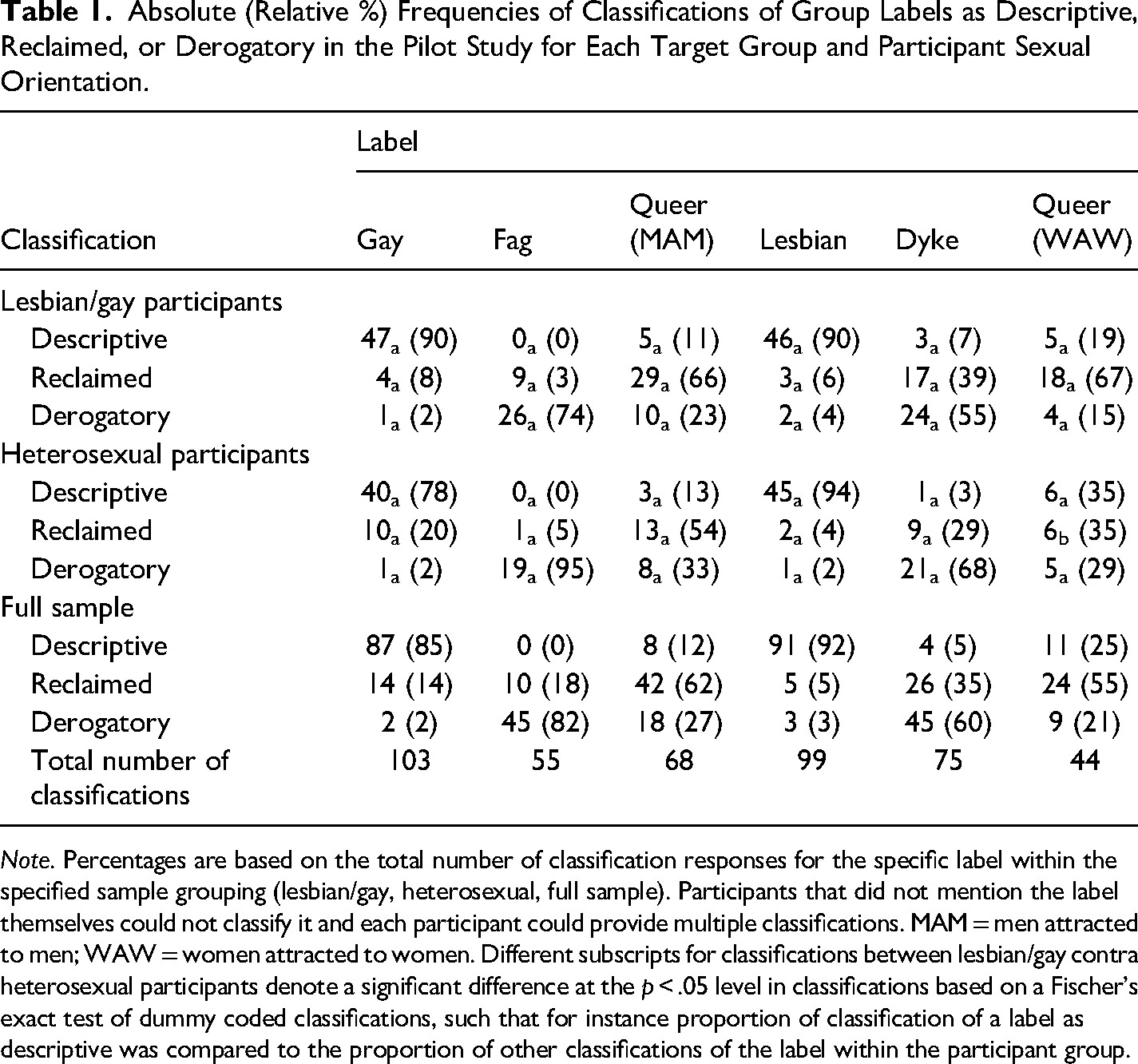
Note. Percentages are based on the total number of classification responses for the specific label within the specified sample grouping (lesbian/gay, heterosexual, full sample). Participants that did not mention the label themselves could not classify it and each participant could provide multiple classifications. MAM = men attracted to men; WAW = women attracted to women. Different subscripts for classifications between lesbian/gay contra heterosexual participants denote a significant difference at the p < .05 level in classifications based on a Fischer's exact test of dummy coded classifications, such that for instance proportion of classification of a label as descriptive was compared to the proportion of other classifications of the label within the participant group.
Main Study
In the main study, we focus only on self-labelling as it represents the first stage of reappropriation (see Galinsky, Hugenberg, et al., 2003) and experimentally tested the effect of different group labels (descriptive vs. derogatory vs. reclaimed) referring to lesbian women and gay men on perceptions of label offensiveness and different types of power. Galinsky et al.’s (2013) model suggests that full reappropriation occurs when the majority group starts using reclaimed labels in a non-derogatory fashion recognising that the labels have been reappropriated. To further explore this aspect of reappropriation, we included whether perceivers were more likely to use reclaimed and derogatory labels after seeing those used in a reclaimed way in this study.
Methods
Participants and Procedure
We used Prolific.co to recruit 276 British nationals 4 . The sample included 138 women and 138 men, of which 260 self-identified as heterosexual (two bisexual, 14 did not respond 5 ). On a modified Kinsey-scale (1 = exclusive attraction to women, 7 = exclusive attraction to men; Kinsey et al., 1948), the sample average for women was 6.65 (SD = 0.68) and the sample average for men was 1.18 (SD = 0.40). Two participants (both women) reported no attraction to women or men. The mean age of the sample was 40.72 years (SD = 14.16, min = 18, max = 74). The sample included participants with different occupational status (66.67% employed, 8.70% students, 7.97% retired, 6.88% out of work/seeking employment, 0.72% on sick leave, 5.80% stay-at-home parents, 3.26% did not specify an occupation) 6 and 80% of participants declared to know at least one person who is gay or lesbian and they reported a moderate intimacy level with this person (M = 4.22, SD = 1.46; on a scale from 1 = very superficial to 7 = very intimate). In terms of political orientation (measured on a scale from 1 = liberal to 10 = conservative, the sample mean was close to the midpoint of the scale (M = 4.68; SD = 2.20), with 65.98% of participants responding on the liberal side of the scale (1–5) and 34.02% responding on the conservative side of the spectrum (6–10). Finally, participants showed highly positive attitudes towards lesbian women and gay men (M = 1.64; SD = 1.01) 7 with 86.80% of respondents having a mean value corresponding to agreement or strong agreement, which is comparable to available ESS data from the UK (European Social Survey, 2019). Table 2 shows the correlations of these variables with the outcome variables.
Means, Standard Deviations, and Correlations for Continuous Variables.
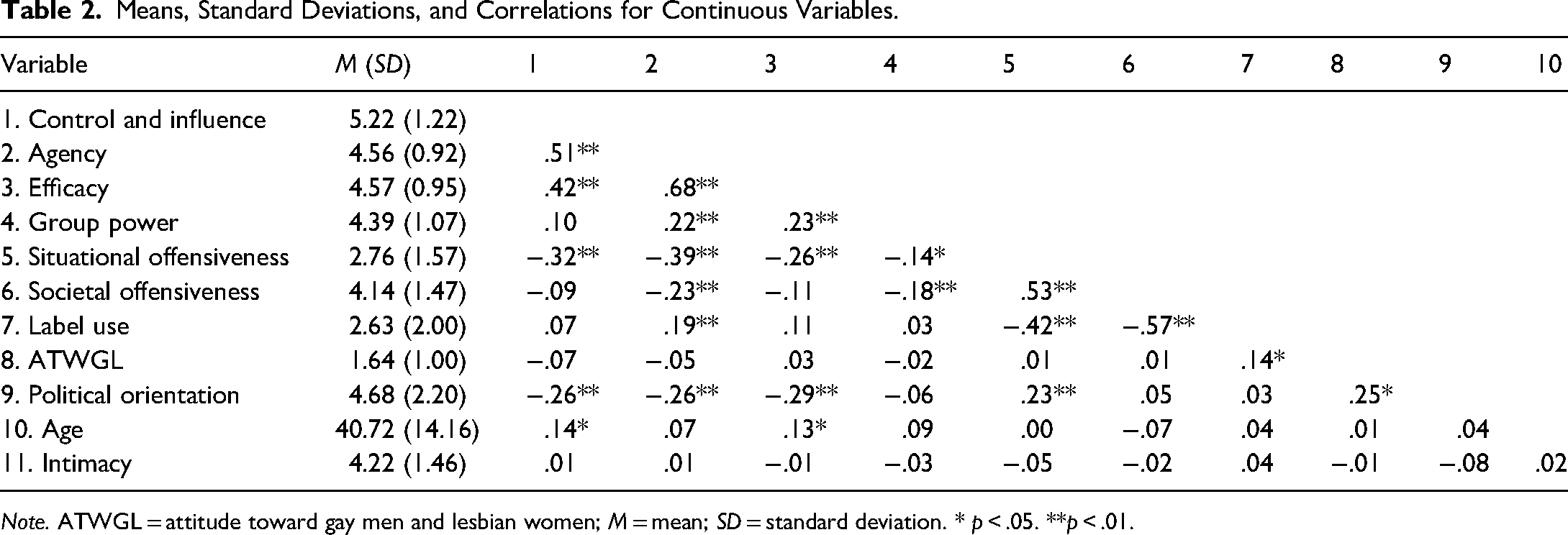
Note. ATWGL = attitude toward gay men and lesbian women; M = mean; SD = standard deviation. * p < .05. **p < .01.
The experiment was hosted on Qualtrics.com, and participants were randomly assigned to read one of six vignettes describing an instance of self-labelling in a 2 (speaker gender: woman, man) × 3 (group label: descriptive, reclaimed, derogatory) between-groups design
8
. The vignette was modelled on those used in previous research on self-labelling to be similar in terms of length and level of contextual information given (Galinsky et al., 2013; Whitson et al., 2017). The full vignette read as follows: “It's Friday night and a friend has invited you to a bar to celebrate their birthday. After a while of catching up with your friends, you walk up to the bar to order some drinks. As you get up, you pass another group of people. You overhear [a man/a woman] saying: “I am [(gay/queer /a fag), (a lesbian/queer/a dyke)].” You keep walking as the conversation continues.”
Participants completed measures of speaker power (control and influence, agency, and efficacy), group power, perceptions of the group label, likelihood of using the label, manipulation check questions, political orientation, attitudes towards lesbian women and gay men, contact with the target group, and demographic variables (age, gender, sexual orientation, occupation, education level). Participant gender was measured in a free-response format as recommended by Lindqvist et al. (2021), and sexual orientation was measured with both a free-response measure and a modified Kinsey scale (Kinsey et al., 1948). Political orientation and attitudes towards gay men and lesbian women (α = .80) were measured as in the pilot study.
Measures
Perceived Power
We assessed perceived power by using three different scales.
Control and Influence
Perception of control and influence of the speaker in the situation was assessed using three items rated on a scale from 1 (not at all) to 7 (extremely) adapted from Galinsky et al. (2013) and Fasoli et al. (2019). The items were, “How powerful do you think the speaker felt in this situation?,” “How in control do you think the speaker felt in this situation?,” “How much influence do you think the speaker had in this situation?” (α = .82).
Agency
Perception of the speaker's agency was assessed using 10 traits from the Big Two Scale (Abele et al., 2016) that measure two facets of agency; assertiveness and competence. Items were evaluated on a bipolar 7-point Likert scale, in the format of “negative trait pole: −3–−2–−1–0–1–2–3 – positive trait pole” (e.g., “the speaker looks not at all self-confident – very self-confident,” “the speaker looks little capable – very capable”). Items were rescored from 1 to 7 for analyses (α = .91).
Efficacy
Perception of the speaker's efficacy was assessed using the General Self-Efficacy scale (Schwarzer & Jerusalem, 1995) consisting of 10 items (e.g., “the speaker can always manage to solve difficult problems if they try hard enough.” “if someone opposes the speaker, they can find the means and ways to get what they want) rated on a scale of 1 (not at all true) to 7 (exactly true) (α = .95).
Group Power
Perceived power of the target group was measured using three items on a scale from 1 (not at all) to 7 (extremely; adapted from Galinsky et al., 2013), that measured control and influence on a group level rather than an individual level. The three items were: “In general, how much power do you think [lesbian women/gay men] has?,” “In general, how much control do you think [lesbian women/gay men] possess?,” “In general, how much influence do you think [lesbian women/gay men] possess?” (α = .89).
Perceived Label Offensiveness
Perception of situational offensiveness was measured by two valence items rated on a scale of 1 (not at all) to 7 (very much; adapted from Galinsky et al., 2013): “In the situation you read about, how negative do you think [LABEL] was?,” “In the situation you read about, how positive do you think [LABEL] was?.” The positive and negative items correlated significantly, r = −.69, p < .001. The positive item was then reversed-coded and combined with the negative to form a measure of situational offensiveness. Perception of societal offensiveness was measured by two valence items rated on a scale of 1 (not at all) to 7 (very much): “As seen by society in general, how negative do you think [LABEL] is?,” “As seen by society in general, how positive do you think [LABEL] is?.” The positive and negative items correlated significantly, r = −.68, p < .001. The positive item was then reversed coded and combined with the negative to form a measure of societal offensiveness.
Likelihood of the Participant Using the Group Label in the Future
This was measured with a single item: “When referring to the group (lesbian women/gay men) in the future, how likely are you to use the group label (descriptive/reclaimed/derogatory)?” rated on a scale from 1 (extremely unlikely) to 7 (extremely likely).
Manipulation Check
We included three questions as manipulation checks asking what gender the speaker had (with the answer options “woman,” “man,” and “not specified in the text”), what sexual orientation the speaker had 9 (with the answer options “heterosexual,” “homosexual,” “bisexual,” and “not specified in the text”), and what group label was used in the text (with the answer options “lesbian,” “gay,” “dyke,” “fag,” “queer”). To further determine how the group labels included were perceived, participants performed the same classification task as in the pilot study. They classified all five labels (lesbian, gay, dyke, fag, queer) according to if they were used in a neutral fashion, a reclaimed fashion, or an offensive fashion (or any combination thereof).
Results
Manipulation Checks
All participants responded that the speaker was gay for both the lesbian and gay conditions. Overall, participants reported the speaker's gender correctly: 85.40% of participants assigned to the condition where the speaker was a lesbian woman answered that the speaker was a woman, 1.50% that the speaker was a man, and 13.10% stated that the speaker's gender was not specified in the text. 62.60% of participants assigned to the condition where the speaker was a gay man answered that the speaker was a man, and 37.40% stated that the speaker's gender was not specified in the text. All of the participants who responded incorrectly to the speaker gender question answered the other two manipulation checks correctly and were therefore judged to have engaged sufficiently with the vignette. All participants in the descriptive and derogatory label conditions chose the correct answer (“lesbian”/“dyke” and “gay”/“fag” respectively) and all but one participant in the reclaimed conditions chose the correct answer (one participant in the reclaimed lesbian condition chose “gay” instead). Overall, most of the sample replied correctly to the manipulation check items. Excluding participants with incorrect answers to speaker gender 10 or group label did not change the results.
Participants generally classified the labels in accordance with the pilot study sample. As shown in Table 3, the descriptive (lesbian, gay) and derogatory (dyke, fag) labels were mostly interpreted as such. The reclaimed group label “queer” was usually classified as reclaimed, although sometimes categorised as offensive. To examine if participants’ classifications were influenced by the target group, we compared the proportion of classifications for each label across the target group with a χ2-test. Classifications were re-grouped as “neutral,” “reclaimed,” or “derogatory” with multiple classified labels being counted for each classification to avoid undue influence of small cells. There was no significant difference in classifications based on target group for any of the labels: χ2lesbian(2) = 3.43, p = .180, χ2dyke(2) = 2.63, p = .269, χ2gay(2) = 5.42, p = .067, χ2fag(2) = 2.55, p = .279, χ2queer(2) = 0.02, p = .989.
Main Analyses
We performed analyses of variance (ANOVAs) with label type (descriptive, reclaimed, derogatory) and speaker group (lesbian woman, gay man) as between-participants factors and perceived power of the speaker's social group, perceived offensiveness, and use likelihood of the label as dependent variables 11 . We also conducted a multivariate analysis of variance (MANOVA) considering the same factors but including the three types of perceived power (control and influence, agency, and efficacy) as dependent variables.
Absolute (Relative %) Frequencies of Classifications of Group Labels as Descriptive, Reclaimed, or Derogatory in the Main Study for Each Target Group.
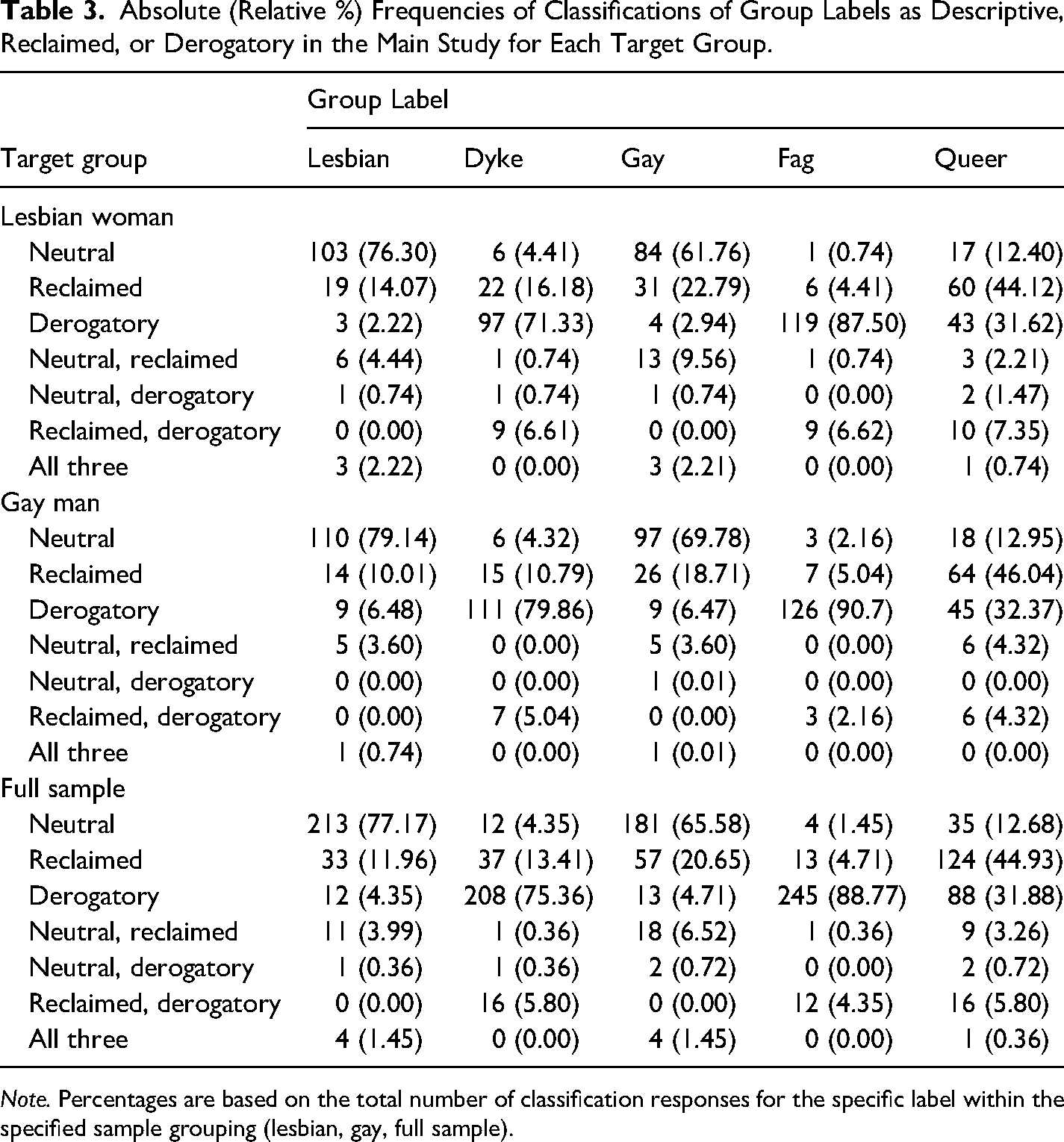
Note. Percentages are based on the total number of classification responses for the specific label within the specified sample grouping (lesbian, gay, full sample).
The analyses were conducted in R Studio (RStudio Team, 2022) using Type 3 sum of squares with the package car (Fox & Weisberg, 2019). Pairwise comparisons were performed using a Bonferroni correction for multiple comparisons, and the moderated mediation analysis was performed using the SPSS macro PROCESS (Hayes, 2018) 12 . Descriptive data for each outcome variable by experimental condition is available in Table 4.
Means and Standard Deviations for Outcome Variables Separated by Label Type and Speaker Gender.
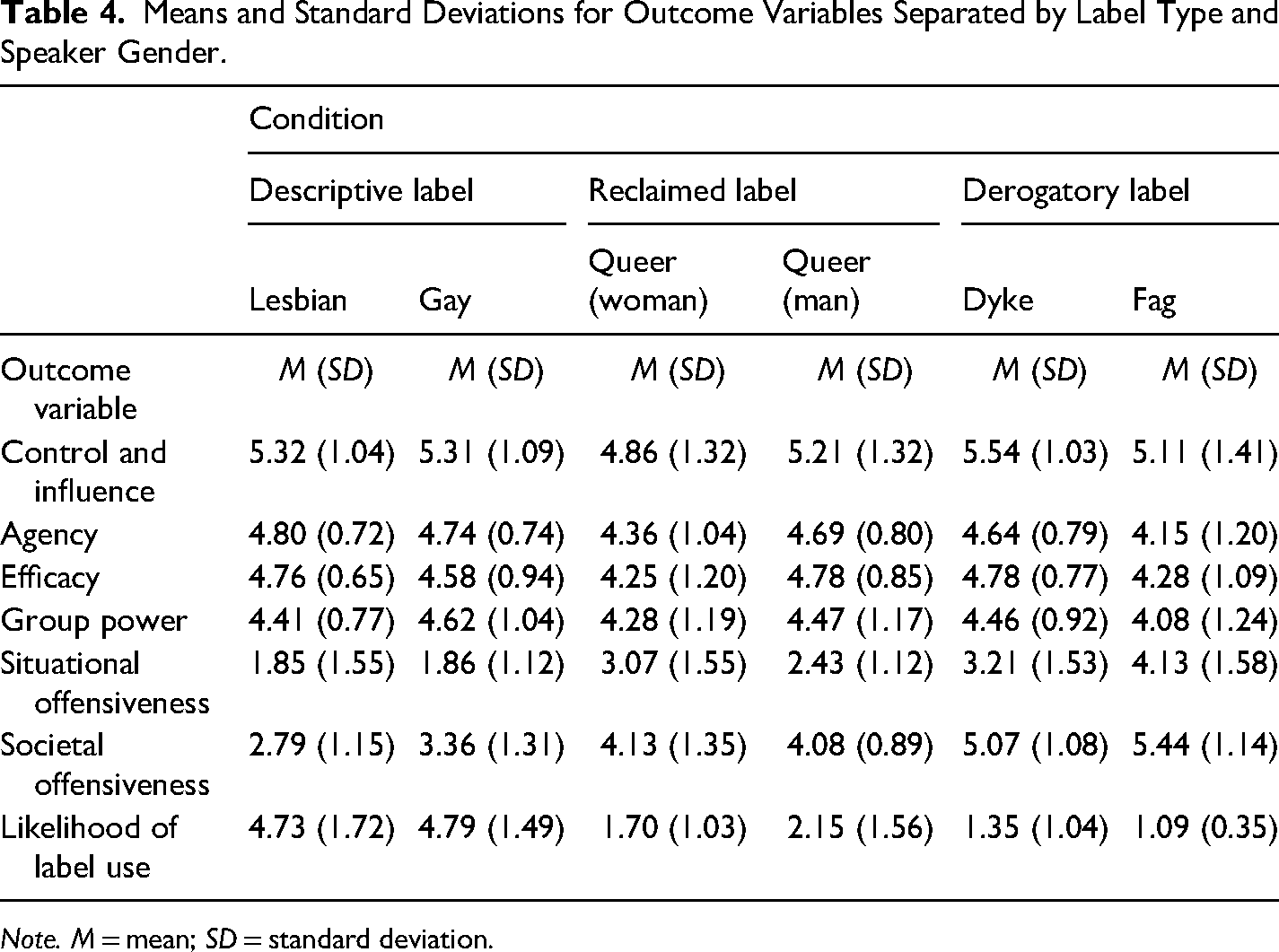
Note. M = mean; SD = standard deviation.
Perceived Power
Since the three types of power were correlated to each other, a 3 (label type) × 2 (speaker) MANOVA was conducted on control and influence, efficacy, and agency (see also Supplementary Materials section three for a complementary analysis using a combined measure of power). We found a significant main effect of label type, Pillai's Trace = 0.06, F(6, 538) = 2.56, p = .019, no significant main effect of speaker gender, Pillai's Trace = 0.002, F(3, 268) = 0.16, p = .922, but a significant interaction effect, Pillai's Trace = 0.06, F(6, 538) = 2.64, p = .016. We then proceeded to consider the follow-up ANOVAs for each type of power.
Control and Influence
We found no significant main effect of label type, F(2, 270) = 1,67, p = .190, ηp2 = .01, no significant effect of speaker gender (F(1, 270) = 0.04, p = .844, ηp2 < .01) nor a significant interaction between the speaker gender and the label type, F(2, 270) = 3.47, p = .096, ηp2 = .02, on perceived control and influence of the speaker.
Agency
We found a significant main effect of label type, F(2, 270) = 4.08, p = .018, ηp2 = .03, but no significant main effect of speaker gender, F(1, 270) = 0.46, p = .499, ηp2 < .01. Moreover, a significant interaction between speaker gender and label type, F(2, 270) = 4.85, p = .009, ηp2 = .04, emerged. As shown in Table 4, pairwise comparisons showed that a gay man self-labelling with a derogatory group label was perceived as significantly less agentic than a gay man self-labelling with a descriptive group label (p = .026, d = 0.59) and marginally significantly less agentic if self-labelling with a reclaimed group label (p = .062, d = 0.53). There was no significant difference between the descriptive and reclaimed group label conditions for gay men (p = 1.00). Moreover, no significant differences between label types were observed when the speaker was a lesbian woman (ps > .311).
Efficacy
We found no significant main effect of label type, F(1, 270) = 0.78, p = .461, ηp2 < .01, no significant main effect of speaker gender, F(1, 270) = 0.22, p = .54, ηp2 < .01, but a significant interaction between speaker gender and label type, F(2, 270) = 7.29, p < .001, ηp2 = .05, on perceived efficacy. However, pairwise comparisons did not reach significance using a Bonferroni correction for multiple comparisons (ps > .10) suggesting that differences across conditions were small (see Table 4).
Overall, the results concerning perceived power did not support H1a. However, the results on agency for gay men inform ERQ1 as differences between labels emerged.
Group Power
No significant main effect of label type, F(1, 270) = 1.21, p = .300, ηp2 < .01, speaker gender, F(1, 270) = 0.001, p = .972, ηp2 < .01, or interaction effects emerged for group power, F(1, 270) = 2.28, p = .104, ηp2 = .02. This does not support H1b and informs ERQ1 through showing no significant effects for either lesbian women or gay men.
Label Offensiveness
For perceived situational offensiveness, we found a significant main effect of label type, F(2, 264) = 40.77, p < .001, ηp2 = .24, no significant effect of speaker gender, F(1, 264) = 0.37, p = .546, ηp2 = .001, but a significant interaction between label type and speaker gender, F(2, 264) = 7.60, p < .001, η p 2 = .05. Pairwise comparisons (see Table 4) showed that for a gay speaker, the derogatory label was seen as more offensive than both the descriptive label (p < .001, d = 1.66) and the reclaimed label (p < .001, d = 1.23). The reclaimed label was not seen as significantly more offensive than the descriptive label (p = .680; see Table 4). For a lesbian speaker, the derogatory label was seen as more offensive than the descriptive label (p < .001, d = 1.04) but not more offensive than the reclaimed label (p = 1.00). The reclaimed label was seen also as significantly more offensive than the descriptive label (p < .001, d = 0.92).
For perceived societal offensiveness, a main effect of label type, F(2, 267) = 79.64, p < .001, ηp2 = .37, and a main effect of speaker gender, F(2, 267) = 4.50, p = .035, ηp2 = .02, were found. The descriptive group labels were seen as less offensive (M = 3.08, SD = 1.26) than the reclaimed (M = 4.10, SD = 1.14, p < .001, d = 0.85) and derogatory group labels (M = 5.26, SD = 1.12, p < .001, d = 1.83), and the reclaimed group labels were seen as less offensive than the derogatory group labels (p < .001, d = 1.03) at the societal level. In addition, participants reading about a gay man believed that the label used was more societally offensive (M = 4.28, SD = 1.42) compared to those reading about a lesbian woman (M = 4.00, SD = 1.51, p = .0344, d = 0.19). The interaction between the two variables was not significant, F(2, 267) = 1.72, p = .181, η p 2 = .01.
Label use likelihood. For estimated likelihood of using a specific group label in the future, there was a significant effect of label type, F(2, 270) = 196.46, p < .001, η p 2 = .59, but not of speaker gender, F(1, 270) = 0.29, p = .591, ηp2 = .001, nor a significant interaction, F(2, 270) = 1.81, p = .166, ηp2 = .01. Participants reported to be less likely to use derogatory (M = 1.22, SD = 0.78) than the reclaimed (M = 1.92, SD = 1.34, p < .001, d = 0.64) or descriptive (M = 4.76, SD = 1.60, p < .001, d = 2.81) labels. Descriptive labels were also significantly more likely to be used than reclaimed labels (p < .001, d = 1.92). There was no influence of speaker gender on likelihood of using the group label in the future, indicating that offensiveness of label had a larger influence than target group (ERQ3).
Perceptions of the group label as offensive within the situation in the vignette had a significant, negative correlation with the likelihood that the participant would use the label in the future (r = −.42), as did the perception of the label as generally offensive (r = −.57). The more offensive the participant believed that the label was, the less likely they were to use it to refer to members of the target group in the future (ERQ3).
Moderated Mediation Analysis
Galinsky et al. (2013) found that power attributed to a gay man self-labelling with the label “queer” increased his perceived power which, in turn, increased the power attributed to the group (gay men). Hence, we tested whether perception of speaker power mediated the relationship between self-labelling with a derogatory or reclaimed group label and perceptions of group power (H2), while checking if the effect was moderated by speaker gender. We performed a moderated mediation analysis 13 . The independent variable was the categorical label type variable with three levels (descriptive, reclaimed, derogatory), which we transformed into two dummy variables using the descriptive label as the reference level. We included three parallel mediator variables: control and influence, agency, and efficacy. The moderator variable was speaker gender (dummy coded with “woman” as the reference level) and the dependent variable was perception of group power. See Figure 1 for a visualisation of the model.
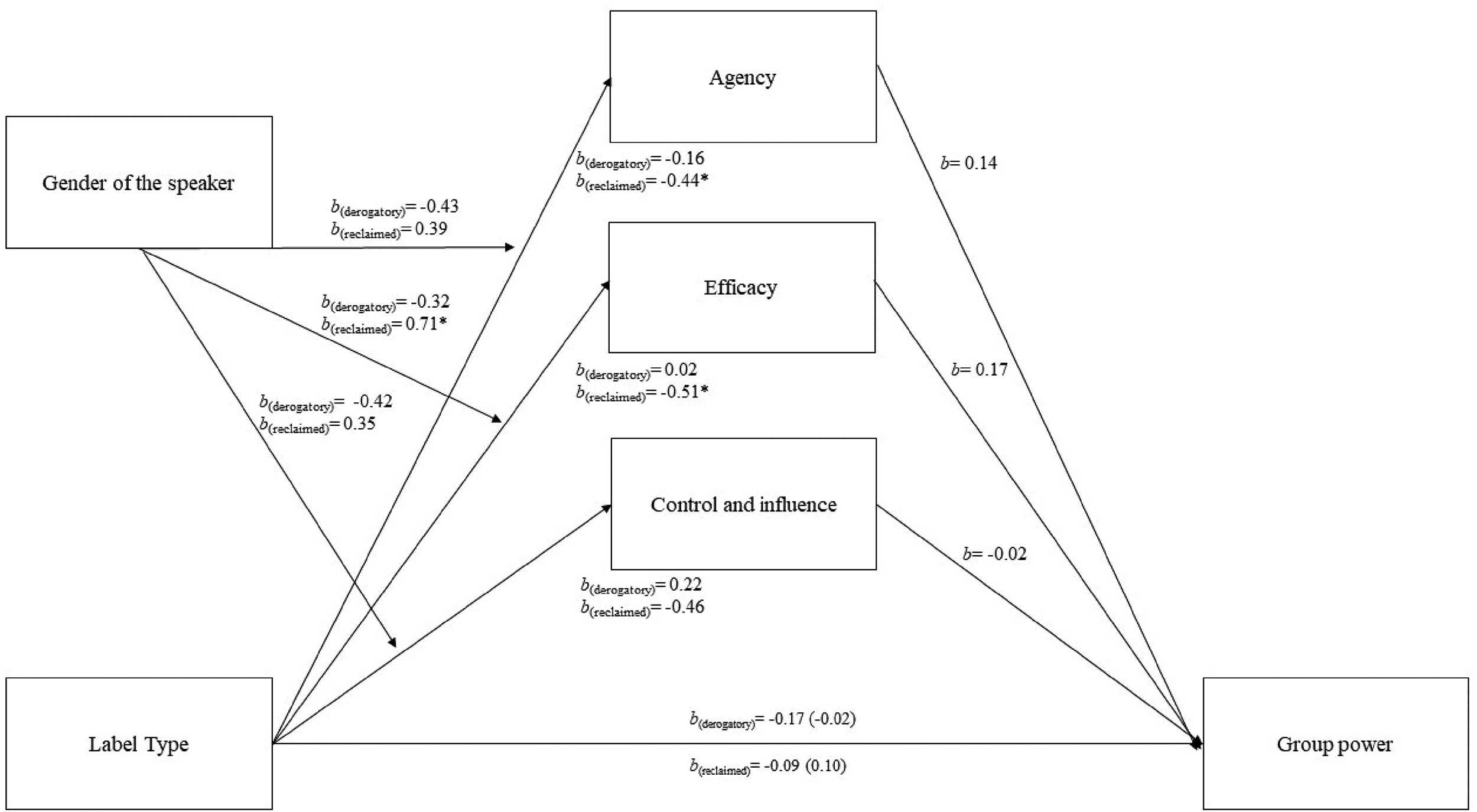
Moderated mediation model.
All path coefficients are presented in Figure 1. As previously shown in the ANOVAs, there was a significant relationship between label type and perceived agency, as well as a significant interaction between label type and speaker gender affecting perceived efficacy. There was no significant direct effect of label type on group power, and neither of the three personal power indicators (control and influence, agency, efficacy) could significantly predict perceived group power. Finally, neither of the three indexes of moderated mediation was significant for the reclaimed (bcontrol = −0.06, p = .52, bagency = −0.04, p = .63, befficacy = −0.01, p = .079) or derogatory conditions (bcontrol = 0.07, p = .47, bagency = .04, p = .62, befficacy = 0.01, p = .83), thus not supporting H2.
Discussion
This research aimed to examine reclaiming in the context of labels referring to lesbian women and gay men. We tested the perception of power attributed to a gay man or lesbian woman self-labelling with a descriptive label, a reclaimed label, and a derogatory label as well as the perceived offensiveness of the labels and the likelihood to use them in the future. We found no support for the hypothesis that speakers who self-labelled with a derogatory group label are perceived as more powerful than those self-labelling with a descriptive or already reclaimed group label (H1a). Reclamation through self-labelling also did not lead to increases in perceived power of the speaker's social group (H1b). Consequently, we found no indication that increased perceived personal power mediates a relationship between reclamation through self-labelling and perceived group power (H2).
The study also aimed to assess differences in types of power attributed to the speaker as a function of self-labelling as a way to assess reappropriation. When operationalising perceived power as control and influence over the situation we found no significant differences between self-labelling with a derogatory, reclaimed, or descriptive group label for either a lesbian woman or a gay man. This result is in line with previous work comparing derogatory and descriptive group labels referring to gay men where the type of label did not influence the control and influence attributed to the speaker (see Fasoli et al., 2019; Sturaro et al., 2023). This result may appear in contrast with previous work by Galinsky et al. (2013) on the reclaimed label “queer.” However, in their studies, the differences in perceived power were due to a comparison between self- and other-labelling, not on the type of label. For power operationalised as efficacy, there was a significant interaction effect between label type and speaker gender, but no condition difference was large enough to reach significance after correction for multiple comparisons. This suggests that the effect on efficacy was too small to be detected. However, speaker's perceived agency did differ between the conditions involving labels referring to gay men, albeit in an unexpected direction. Gay men were perceived as having less agency when self-labelling with a derogatory group label compared to a reclaimed or descriptive group label. This suggests that speakers tend to be seen as more agentic when they self-label with the already reclaimed label “queer” that when doing so with the label “fag” that is still perceived as offensive and ongoing reclamation. It also shows that using a reclaimed label elicits the same level of agency as using a descriptive label. This indicates the importance of taking the polysemy and echoic perspective (Bianchi, 2014) as well as the stages of reclamation (Galinsky, Hugenberg et al., 2003) into account when studying reappropriation. Not only that, it shows that different facets of power need to be considered. Agency is one of the two key dimensions in person perception (Abele & Wojciszke, 2014) and refer to personality traits (e.g., self-confidence). It is possible that power assessed in this way rather than in terms of control and influence in a situation or in terms of skills to be efficient in achieving a goal or navigating situation is a better indicator of how bystander perceive individuals engaging in label reclamation through self-labelling. Interestingly, the effects on agency were not found for labels referring to a lesbian woman. This indicates that labels referring to different groups are not the same and that the label “queer” may be seen as more applicable or representative of reclamation for gay men compared to lesbian women, potentially due to historical differences in label use (Hegarty, 2017). This result speaks to the need to continue to develop theoretical models of reclamation to account for findings regarding a multitude of labels and target groups. This includes accounting for differences in effects of self-labelling for gay men and lesbian women.
When looking at the perceived offensiveness of the labels, namely at the process of reframing, we also found differences related to the target groups. Labels referring to men were rated as societally more offensive than those referring to women. At the same time, derogatory labels were generally perceived as more offensive than reclaimed labels, followed by descriptive labels, clearly illustrating the idea of stages of reclamation, with the reclaimed labels still carrying some sort of negative valence. With regards to the specific situation of self-labelling, derogatory labels for gay men were perceived as the most offensive label, followed by reclaimed and descriptive labels but reclaimed and descriptive labels were seen as equally low on offensiveness. These results largely concur with previous research in that reclaimed labels are not seen as equally offensive to currently derogatory labels, and that derogatory labels are more offensive than descriptive group labels (Fasoli et al., 2019; Galinsky et al., 2013; Sturaro et al., 2023). Also, they indicate that when labels refer to gay men, bystanders believe the terms “queer” has been reframed and has become polysemous. However, this was not the case for labels used by a lesbian woman since the reclaimed label “queer” was rated as equally offensive to a derogatory group label used by a lesbian woman. This is in line with the finding that heterosexual participants in the pilot study were significantly less likely to classify “queer” as a reclaimed label for “WAW” compared to lesbian/gay participants. Hence, we found evidence that reframing does happen, that testing different types of labels allows us to provide evidence of such process, but also that there are nuances depending on which target group we consider.
Besides target group and label, contextual factors may matter for how reclamation through self-labelling is perceived. The vignette used in the current study included only a minimum of contextual information, namely that the interaction was taking place in a bar setting. This is similar to previous studies on the topic (e.g., Galinsky et al., 2013) and reflects a realistic situation in which people overhear someone self-labelling. However, it does not provide information about who the speaker is and what the motives to engage in self-labelling and choosing a specific label could be. For instance, it is possible that participants thought the derogatory or reclaimed group label was used in a self-derogatory or humorous way rather than a reappropriating way, thus lowering estimations of the speaker's personal power. Self-labelling with a derogatory or reclaimed group label can either be seen an instance of reclamation or not, depending on available contextual information (Brontsema, 2004; Fasoli et al., 2019). Galinsky et al. (2013) found that participants reported increased feelings of power when they recalled a situation where they self-label with a derogatory group label compared to imagining being labelled in such a way by someone else that we can assume was perceived as negative in its intent. Additionally, this finding was recently replicated in the context of specifically homophobic epithets (Bianchi et al., 2024). Sturaro et al. (2023) found that self-labelling with either a descriptive or derogatory group label increased bystanders’ attribution of power if the speaker identified as gay rather than heterosexual 14 . This means that additional contextual information can change how labels and their use is perceived. Our findings provide insights that are useful for expanding the theoretical model by Galinsky et al. (2003, 2013). It shows that the type of label under consideration and who the labels refer to matter. To our knowledge, this is the first study to have compared the effects of a reclaimed and a derogatory label when self-labelling is concerned. Our data suggests that “stages” of reclamation exists since different labels triggered different results, at least for labels referring to gay men. Hence, our findings provide evidence but also raise questions. First, it appears that there is more consistency across studies in the literature concerning reframing compared to reappropriation. Mixed results on perceived power may be due to how the construct is conceptualised and operationalised in the context of label reappropriation. At the same time, reappropriation may be a risky phenomenon that can make bystanders ambiguous about power perception (see Fasoli et al., 2019).
One concern that critics of reclamation voice is that the use of stigmatising language can perpetuate stigma even when used in a reclaimed fashion (see Croom, 2014). This concern is motivated by the fact that members of dominant groups who see derogatory terms used by the minority might feel that their use is justified. Our data does not support this claim. Participants who were exposed to derogatory language did not report a higher likelihood of using a derogatory group label in the future and perceptions of group label offensiveness (both situational and societal) correlated negatively with likelihood of using the label in question in the future. In other words, seeing a lesbian woman or a gay man self-labelling with a derogatory group label did not make participants more likely to use the label themselves: likelihood of use was solely determined by how offensive they deemed the label. This is an important finding considering that the theoretical model of label reappropriation by Galinsky et al. (2013) suggests that full reappropriation occurs when everyone, including the dominant group, uses derogatory labels in a neutral reclaimed way. Seeing a minority member self-labelling with a derogatory group label may therefore have little risk of leading to increased use of the group label by dominant group members. This indicates that self-labelling is mainly a form of echoic reclamation, given that polysemic reclamation would also allow for use of the label by members of other groups. However, as this study only exposed participants to one situation of self-labelling it is possible that repeated exposure would show different effects.
Limitations and Future Research
The current study made use of three types of group labels for lesbian women and gay men that had been pre-tested to be culturally relevant in the UK. However, the group label “queer,” chosen as a reclaimed group label, was classified in the main study as being used in an offensive fashion to a relatively high extent (39%). The differential perspectives on the possible uses of “queer” could have obfuscated the relationship between polysemic and echoic reclamation and perceived power that we aimed to investigate. Additionally, even the labels classified as descriptive or derogatory have a history of undergoing reclamation and were also rated to some extent as fitting into all three categories. This overlap of classifications further demonstrates the dynamic nature of the reclamation process (e.g., Jusińska, (2021) and indicates that a full account of which reclamation stage labels for lesbian women and gay men are in is necessary. The dynamic nature of label classification may be one part of explaining differences in results across studies where different labels have been used. To allow for more insight into whether self-labelling with any form of sexual orientation group label influences perceived power, future studies should include a true control condition using a label unrelated to target group. For instance, previous work (Fasoli et al., 2016) has shown that generic insults (e.g., “arsehole”) elicits different reactions than homophobic labels (see also O’Dea & Saucier, 2020 for racial slurs). Another limitation concerned that our participants in the main study mostly identified as heterosexual. Recent work (Sturaro et al., 2023) has shown that sexual minority may be more prompt to perceive self-labelling as reclaiming than heterosexual individuals. Hence, future research should replicate this study and include sexual minority individuals.
The experimental design used a similar vignette structure to previous research on the topic (e.g., Galinsky et al., 2013; Wang et al., 2017), adding to the comparability of results across studies. The vignette was, however, very brief and included no contextual information about the speaker or the relationship between the interlocutors (e.g., friendship). The brevity of the vignette together with the label “gay” often being used both for gay men specifically and non-heterosexual individuals in general were potentially contributing factors to a large number of participants not correctly identifying the speaker gender in the descriptive condition for gay men which weakens our conclusions regarding gender-based differences between the target groups. Contextual factors such as the relationship between the communicating parties and the relationship of the parties to the labelled group have been shown to have an impact on perceptions of derogatory group labels for ethnic groups (O’Dea et al., 2015; O’Dea & Saucier, 2017, 2020), and when homophobic epithets are used for oneself or by another in-group member the motivation is more often humorous or reappropriating, while use by an out-group member is more often reported as stigmatising (Bianchi et al., 2024). Future research should therefore use more detailed vignettes to test the influence of additional contextual variables on reclamation of group labels for lesbian women and gay men.
Finally, the sample in the main study included people with overwhelmingly positive attitudes towards gay men and lesbian women who reported relatively high levels of contact with members of the target groups, and therefore more studies are needed to examine the generalisability of effects to those with more negative attitudes towards and less contact with the LGBTQ community. In the current pilot and main study, we used a combined measure of attitudes towards gay men and lesbian women, with a 5-point response scale, to allow comparability to European Social Survey (2019) measures of national attitudes. However, because attitudes towards gay men and lesbians often differ from each other (e.g., Kite et al., 2021), future research on perception of reclamation of group labels for the groups should use separate attitude measures for gay men and lesbians. These measures should also include response scale with a larger range to ensure that variation in attitudes is properly represented as well as expand to measuring group contact in a more in-depth fashion rather than using a single-item indicator.
Conclusions
Self-labelling using a derogatory or reclaimed group label did not increase perceptions of lesbian and gay speakers’ power compared to when self-labelling with a descriptive group label. Instead, compared to when using descriptive labels gay men self-labelling with a derogatory label were seen as having less agency while perceptions of power for lesbian women showed no difference. This stands in contrast to previous theoretical models that suggest a reciprocal relationship between power and self-labelling (Galinsky et al., 2013) and shows that acts of both polysemic and echoic reclamation can potentially have effects for the evaluation of a speaker. These findings provide key information on the complexity of reclaiming and reappropriation as a strategy to change power dynamics among groups.
Supplemental Material
sj-docx-1-jls-10.1177_0261927X241234047 - Supplemental material for The Use and Perception of Reclaimed Group Labels for Lesbian Women and Gay Men
Supplemental material, sj-docx-1-jls-10.1177_0261927X241234047 for The Use and Perception of Reclaimed Group Labels for Lesbian Women and Gay Men by Amanda Klysing, Maike Braun, Giulia Buscicchio, Catho Jacobs, Magdalena Formanowicz and Fabio Fasoli in Journal of Language and Social Psychology
Footnotes
Acknowledgements
The authors wish to thank the two reviewers and Howard Giles for constructive feedback that improved the manuscript.
Data Availability Statement

Declaration of Conflicting Interests
The authors declared no potential conflicts of interest with respect to the research, authorship, and/or publication of this article.
Funding
This work was supported by a Seedcorn grant from the European Association of Social Psychology.
Supplemental Material
Supplemental material for this article is available online.
Notes
Author Biographies
References
Supplementary Material
Please find the following supplemental material available below.
For Open Access articles published under a Creative Commons License, all supplemental material carries the same license as the article it is associated with.
For non-Open Access articles published, all supplemental material carries a non-exclusive license, and permission requests for re-use of supplemental material or any part of supplemental material shall be sent directly to the copyright owner as specified in the copyright notice associated with the article.
