



Abstract
Social exclusion can exacerbate newcomers’ language difficulties and undermine their social integration. We examined whether language mindsets induce mixed attitudes towards migrants with limited proficiency in the target language, and indirectly affect willingness to interact with migrants and attitudes toward migrants’ language education. Across two pre-registered experiments (N = 531) conducted in Canada, we found that people who were primed with fixed (vs. growth or control) mindsets tended to believe migrants have less potential to improve their English, but were less likely to blame them for their lack of improvement (“not their fault if they can't improve”), suggesting fixed mindsets contribute to mixed attitudes toward migrants. Furthermore, perceived linguistic potential was negatively and blame was positively correlated with contact avoidance and opposition to publicly funded language education for newcomers. These effects held after controlling for political orientations and perceived fluency of the target speaker, suggesting that language mindsets contribute to language judgments that could impact migrants’ acculturation experiences.
They’re not people that would easily assimilate into the United States, into our modern society … They don't speak English. They don't integrate well.
The “lay theory” approach to social cognition assumes that people are “laymen” scientists, who form and use informal, intuitive theories to make sense of, predict, and respond to their experiences and social world (Hong et al., 2009; Hoyt & Burnette, 2020; Levy et al., 2006; Rattan & Georgeac, 2017). In other words, lay theories offer a framework or “mindset” with which to understand social and psychological phenomena. One important mindset concerns the belief about whether human attributes (e.g., language ability, intelligence, personality) are stable traits or malleable capacities (Dweck & Yeager, 2019; Zhang et al., 2021). Viewing others’ attributes as inflexible essences (i.e., fixed mindsets) gives rise to rigid stereotypes, and more discriminatory actions towards minorities; seeing others’ attributes as dynamic and developmental (i.e., growth mindsets) can foster more adaptive intergroup relations (Hong et al., 2009; Levy et al., 1998). As such, those who endorse fixed (vs. growth) mindsets are more likely to avoid interaction with outgroup members and to oppose equitable policies for disadvantaged groups (Levy et al., 1998; Rattan & Georgeac, 2017). For example, they tend to believe that refugees are less likely to adapt to the host country, and thus, are less supportive of programs that resettle refugees (Madan et al., 2019). The mindset approach to intergroup processes can potentially contribute to the understanding of how to change people's biased outlook, with practical implications for social interventions and policymaking to improve intergroup relations (Levy et al., 2006).
Although research on the role of mindsets in intergroup relations is growing (Hoyt & Burnette, 2020; Levy et al., 2006; Rattan & Georgeac, 2017), little work has specifically examined how beliefs about the capacity of outgroup members to learn the ingroup language (e.g., migrants learning the local language) affect relations between ethnolinguistic groups. This research question is important because there are widely held cultural beliefs around the difficulty of learning new languages, particularly in adulthood (Marinova-Todd et al., 2000). Through the theoretical lens of mindsets, people (particularly members of the receiving society) make sense of others’ language ability and learning experiences (particularly those of migrants) by framing their expectations of learners’ potential to improve. This perceived potential may, in turn, justify people's attitudes and behaviors towards migrants. Specifically, people who endorse fixed (vs. growth) mindsets would perceive that migrants have less potential, which in turn predicts their disinterest in interacting with migrants (i.e., social avoidance and rejection) and concerns about supporting migrants’ language (Lou & Noels, 2020a). However, recent research suggested that growth (vs. fixed) mindsets may also lead to harsher judgments, such as blame, towards individuals who show little sign of change or who fail repeatedly (Ryazanov & Christenfeld, 2018), suggesting a caveat in priming a growth mindset in promoting intergroup relations. If growth mindsets can lead to both positive and negative social judgments, can growth mindsets do more harm than good? The primary goal of this study is to better understand whether and how language mindsets can lead simultaneously to mixed judgments (e.g., viewing migrants as having potential, but blaming them for not trying hard enough to learn a new language). The secondary goal is to examine whether the mixed judgments driven by mindsets could impact raters’ contact avoidance and opposition to language education policies.
Judgment About Migrants’ Language Ability
Language skills are widely considered to be among the most important competencies that migrants need to integrate into a new society (Lou, 2021; Pew Research Center, 2017). Despite the importance of communicative competence in the local language(s) for economic, civic and social engagement, migrants often have little opportunity or experience long delays in registering for language courses (Cowie & Delaney, 2019; Office of the Commissioner of Official Languages, 2013). The decline in migrants’ language education opportunities has raised concerns about migrants’ social equity (McHugh & Challinor, 2011; Simpson et al., 2007). In addition, language-related prejudice is manifested in interethnic interactions, such as when mainstream people avoid interaction with non-native speakers of the societal languages (Lippi-Green, 2012). These societal-level attitudes, policies, and prejudice can affect migrants’ on-going acculturation experiences, language development, and psychological and physical well-being (Birney et al., 2020; Collins & Clément, 2012).
Many social factors and psychological processes (e.g., political orientations, group identity, language-learning experiences, etc.) explain people's prejudice and discrimination against ethnolinguistic outgroups, including migrants, and one important aspect that social psychologists have focused on is people's perceptions of non-native speakers and their speech (Gluszek & Dovidio, 2010; Hansen & Dovidio, 2016; Kinzler et al., 2007). People who perceive migrants to have low fluency, strong accents, and low comprehensibility tend to have more negative attitudes toward migrants, and believe migrants are low in social status, less intelligent, credible, attractive, and hirable (Derwing et al., 2002; Dragojevic & Giles, 2016; Elliott & Leach, 2016; Fuertes et al., 2012; Hansen & Dovidio, 2016; Hosoda & Stone-Romero, 2010; Montgomery & Zhang, 2018). In addition, this research has shown that people who perceived migrants to have the potential to improve their language skills were also more supportive to migrants’ language education and more willing to interact with them, even controlling for their perceptions about their language fluency.
People's social inferences about whether migrants have the potential to improve their language skills are influenced by their fundamental beliefs about whether language learning ability is immutable (i.e., fixed mindsets) or malleable (i.e., growth mindsets; Lou & Noels, 2020a). Specifically, people who have a relatively fixed (vs. growth) language mindset tend to hold the view that people cannot change their ability to learn new languages. In contrast, people with a growth (vs. fixed) language mindset are more likely to believe they have control over their ability, attribute endorsed language challenges to controllable factors (e.g., effort, learning strategies; Hong et al., 1999), and thus believe that others also have more potential to learn and improve (Lou & Noels, 2020a). These findings are in line with the work on essentialism, which shows that the belief that a social group (e.g., gender, race, ethnolinguistic) has a fixed, inherent essence is associated with stereotypes and prejudice toward that group (Burgers & Beukeboom, 2020; Haslam et al., 2006). Indeed, research shows that fixed mindsets messages can increase essentialist beliefs about stigmatized groups (Levy et al., 2006).
Mixed Effect of Mindset Messages in Social Judgment
Although extensive research supports the benefit of growth mindsets in mitigating negative social perceptions, recent research suggested that growth mindsets, at the same time, may lead to harsher judgments of others, such as assigning blame towards those who fail repeatedly and show little sign of change (Hansen, 2020). Ryazanov and Christenfeld (2018) found that, compared to people whose fixed mindset was experimentally activated, those whose growth mindset was experimentally activated ascribed more blame to those showing a continuous maladaptive level of a given trait. This effect, however, was not apparent when the target had only a single failure. Specifically, ascribed blame arises when the perceiver believes that another person has the agency that causes outcomes that are in accordance with expectations (Malle et al., 2014). As such, the more control people expect the target has over their ability (a belief that is driven by a growth mindset), the more likely people are to believe the target is blameworthy for their repeated failures. Ryazanov and Christenfeld (2018) found that this effect of mindsets on blame is mediated through perceived control. Compared to people exposed to a fixed message, those who were exposed to a message about growth ability and witnessed repeated failure, are more likely to ascribe blame to the person for not putting in enough effort. These findings suggest that priming a growth mindset may potentially harm intergroup relations by inducing blame, whereas priming a fixed mindset may be potentially beneficial.
Hoyt and Burnette (2020) proposed a double-edged effect model of mindsets, such that growth (vs. fixed) mindset messages can improve outcomes, such as reducing stigma, via an increase in self-efficacy beliefs (e.g., perceived potential), but also simultaneously diminish outcomes via blame. This model suggests that whereas the decreased blame from fixed messages can be beneficial, the increased essentialism from fixed messages can be detrimental, and thus offset any benefits. For example, although messages about the fixed nature of bodyweight reduces the belief that people have control over their weight, which is related to less body-shaming and anti-fat attitudes, these messages also increase stereotypes and stigma, offsetting their positive effect (Burnette et al., 2017).
In light of these paradoxical effects, a mixture of attitudes is important because people can be ambivalent in many social issues, influencing their decision-making and behaviors (van Harreveld et al., 2015). If mindset messages can induce mixed attitudes toward migrants, people may not alter their intention to interact and their attitudes towards public funds after the mindset messages, but rather use their induced attitudes to justify their action/inaction. The goal of this study is to test the mixed effect of mindset messaging in the context of language attitudes to determine whether and how the mixed effect might influence people's language-based prejudice.
Research Overview
We conducted two experiments to investigate the effects of language mindsets on the majority group's perceptions about migrants’ language potential, control of their ability, and blame attribution, as well as their indirect effects on contact avoidance and opposition to language education (see Figure 1). The experiments were disguised as a reading skill and speech evaluation task. Specifically, participants read a brief article with messages that primed either a fixed or a growth mindset, and then listened to a migrant's speech and evaluated the immigrant's language skills and language-related attitudes. In our pre-registration, we hypothesized that people who received fixed (vs. growth) mindset messages are more likely to believe that migrants have less control over their ability, this belief in turn predicts perceptions of migrants having less potential to improve, but also predicts less blame towards migrants. This hypothesis is in line with previous work showing that the effect of mindsets on social judgments is mediated through perceived control (Ryazanov & Christenfeld, 2018). We also hypothesized that fixed (vs. growth) mindset messages influence people's language-based prejudice (i.e., negative attitudes towards migrants’ language programs and avoidance of interaction with migrants), particularly through the mediation of perceived control, perceived potential, and blame attribution.
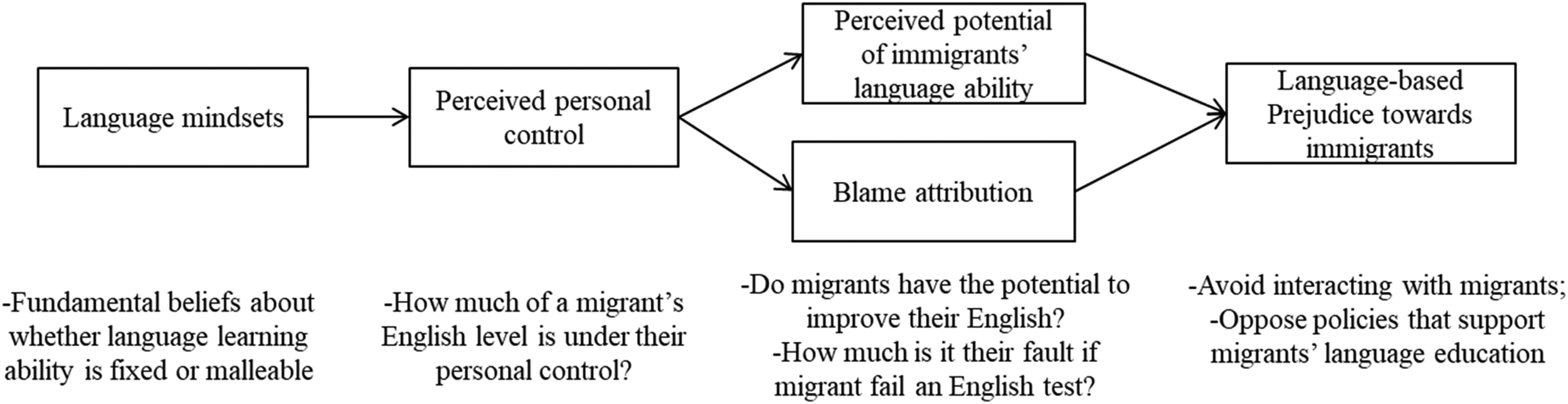
Theoretical model of the double-edged sword effect of mindsets on language-based prejudice.
In addition to conceptually replicating the mixed effect of mindset messages (Burnette et al., 2017; Ryazanov & Christenfeld, 2018) in the language attitudes context, we also improve the experimental paradigm to extend the findings. In Study 1, we examined the effect of language mindsets on the judgment of two types of migrants—a long-term migrant and a newcomer. This manipulation allows us to understand whether the effect of mindsets generalizes across different targets or is different depending on whether the targets have more or less extensive language experience. Because previous studies did not include a control condition as a baseline for the effect of fixed and growth mindset manipulations (e.g., Burnette et al., 2017; Ryazanov & Christenfeld, 2018), it is unclear what the direction of the effect is: that is, whether fixed messages reduce blame, growth mindset message increase blame, or both. Therefore, in Study 2, we include a control condition to provide a more nuanced understanding of how mindset messages influence intergroup relations. In addition, in Study 2, we included assessments of language mindset (1) two months before the experiment to check randomization (i.e., mindsets are the same in all conditions), and (2) immediately after the experiment to check the effect of manipulation (i.e., changes in mindsets).
Both studies were pre-registered before data collection, and all research materials and data are available at Open Science Framework. All the participants were recruited from the participant pool of a psychology program at a western Canadian university. Given the goal of this research is to examine the dominate group's perceptions, eligible participants (1) were born in Canada; (2) had parents who were born in Canada; (3) described their native and heritage language as English; and (4) identified as European Canadian. The research protocol was approved by the university's research ethics board.
Study 1
Method
Participants
We recruited 228 eligible participants (see research overview for selection criterion). Based on an experimental study examining the effect of mindsets on attitudes (d
Procedure
In a mass-testing session at the beginning of an academic semester, university students enrolled in introductory psychology courses reported their demographic information (age, gender, ethnic background, language background, and their own country of birth, as well as their parents’ and grandparents’). One to two months after the survey, eligible participants (see research overview for eligible criterion) were invited to a computer lab.
The participants were told that they were participating in two different studies, one concerning an article assessment and the other a language assessment. In the article assessment (i.e., mindset manipulation), participants were randomly assigned to read a magazine article, either supporting growth theories or fixed theories about language learning ability (Lou & Noels, 2016). The respondents then evaluated whether the article was suitable for students in the introductory course and provided reasons to support their answer. To check whether the participants paid attention to or understood the article, they were asked to answer two multiple-choice questions.
In the language assessment task, the participants were told that the study was about their language assessment ability. They first listened to a sound clip of a migrant describing a story and their life in Canada, and then evaluated the speaker's language ability (see below materials).
The participants were randomly assigned to one of two conditions; they were either informed that the target migrant had lived in Canada for either three months (newcomer condition) or ten years (old-timer condition). This manipulation tested whether the effects of language mindsets were dependent on information regarding the migrant's length of residence (and assumed exposure to opportunities to learn the language). To check whether the participants paid attention to this manipulation information, on a separate page, they answered a multiple-choice question: how long has the speaker lived in Canada? Participants who answered this wrong were excluded from analyses. The participants were also told that the target migrant had failed an English oral test based on their performance in the sound clip. They then answered questions about their perception of the migrant's potential to improve, their attribution of blame for the migrant's failure, their opposition to migrants’ language program, contact avoidance, and language mindsets (see below). They were also asked to describe their political orientation (from 1 = very liberal to 7 = very conservative).
Materials
The descriptive statistics and psychometric properties for each measure are presented in Table 1.
Study 1: Descriptive Statistics and Correlations Among Key Variables.
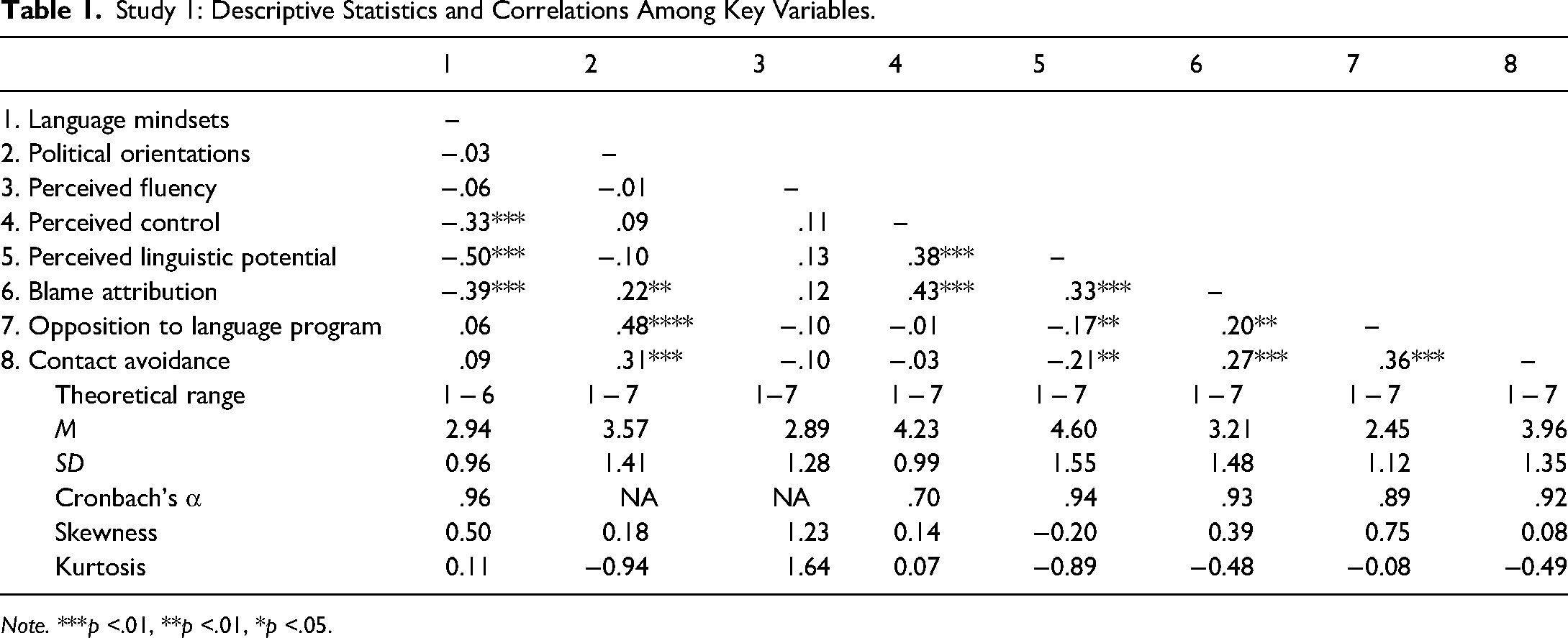
Note. ***p <.01, **p <.01, *p <.05.
Speech Evaluation
The participants listened to a sound clip from a migrant (i.e., a 41-year-old female migrant from China) describing a cartoon and their life living in Canada (the total length was 325 s). 1 To complete the cover story that the study concerned an assessment of the speaker's linguistic competence, participants evaluated the speaker's language characteristics (including the speaker's fluency, accentedness, vocabulary size, comprehensibility, and the number of grammatical errors) on a 7-point scale (from 1 = not at all to 7 = extremely).
Perceived Control
The participants were told that the target migrant failed the English test based on the recorded speech sample. They then responded to three items regarding perceived control of the target migrant's English ability (e.g., “How much of the person's English level is under his/her personal control?”; adapted from Ryazanov & Christenfeld, 2018) on a 7-point scale (1 = not at all, 7 = completely). A higher mean score indicates a stronger agreement that the migrant has control over their ability.
Perceived Linguistic Potential
The participants reported their perceptions of the target speaker's linguistic potential (four items; e.g., “to what extent do you believe this speaker has the potential to be more competent in English?”) on a 7-point scale (from 1 = very unlikely to 7 = very likely).
Blame Attribution
Blame attribution was measured by three items adapted from Ryazanov and Christenfeld (2018; e.g., “It is the person's own fault that they failed the test.”). Participants indicated their agreement on a 7-point scale (1 = not at all to 7 = completely).
Opposition to Language Programming
The participants were told that the speaker in the sound clip was a student in a Language for Newcomers (LINC) English class. They were provided with a brief description of the LINC program and its support from the Canadian government (e.g., “The annual expenditures for these settlement programs were 192.9 million. LINC is free to all newcomers to Canada”; see Appendix). After reading the description, participants rated their agreement with five items regarding their attitudes towards the program (e.g., “We should not spend any more federal money on the LINC program”; “The government should continue supporting the LINC program”; Lou & Noels, 2020a). Positively worded items were reversed, and a higher mean score indicated stronger opposition to the LINC program.
Contact Avoidance
We adapted Plant and Devine's (2003) five-item intergroup contact avoidance measure (e.g., “If I had a choice, I would rather not interact with the person.”). A higher mean score represents a stronger desire to avoid interacting with the migrant from the sound clip. 2
Language Mindsets
The participants answered the Language Mindset Inventory ([LMI]; Lou & Noels, 2017; e.g., “People can't change how capable they are at learning new languages”). A higher mean score represents a stronger endorsement of fixed (vs. growth) mindsets about language-learning ability.
Results
Preliminary Results and Manipulation Check
The descriptive statistics and psychometric properties for each measure are presented in Table 1. We found that political orientation (conservative vs. liberal) predicted blame attribution, opposition to migrants’ language programming, and contact avoidance. Therefore, we controlled for political orientations in the main analysis to understand the unique effect of mindset messaging. We found that the manipulation of language mindsets was effective. As shown in Table 2, participants in the fixed condition scored significantly higher on fixed (vs. growth) language mindsets than those in the growth condition.
Studies 1 and 2: The Language Mindset Manipulation Effects on Outcome Variables.
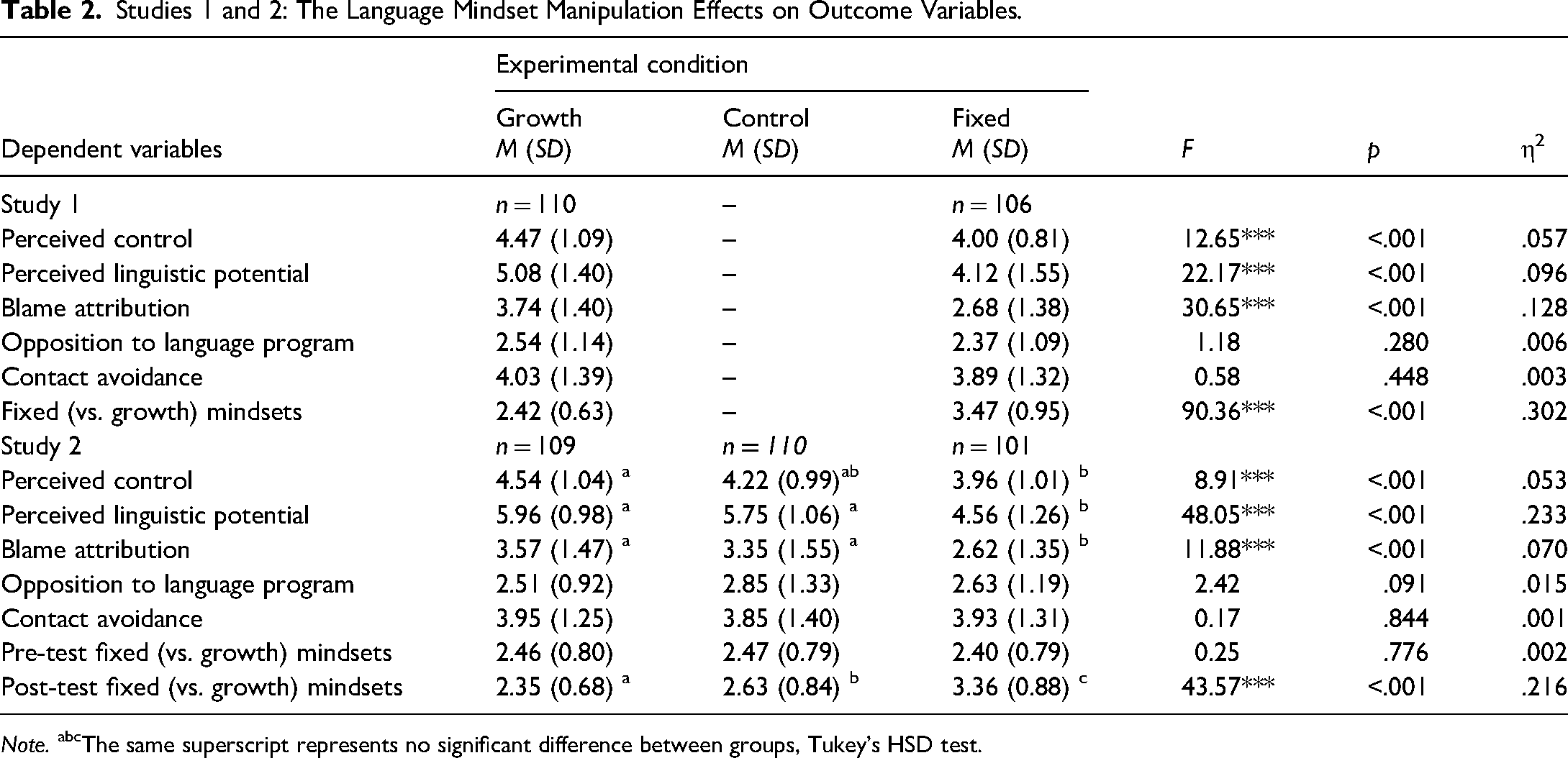
Note. abcThe same superscript represents no significant difference between groups, Tukey's HSD test.
Effects of the Mindset Manipulation
As shown in Table 2, participants in the fixed-mindset condition reported lower perceived control, perceived linguistic potential, and blame attribution towards the target migrant than those in the growth-mindset condition. However, the manipulation of language-mindset did not significantly impact attitudes towards language programs or contact avoidance. Moreover, we found no significant interaction effects between the manipulation of language-mindset and the target migrant's length of residence on any variables (see Online Appendix Table S1). The effect of language mindsets was not moderated by whether the migrant was presented as a recent newcomer or an established migrant.
Indirect Effects
To test the indirect association between mindsets and contact avoidance and opposition to migrants’ language programming, we ran the hypothesized path model using MPlus 8.0. It is important to note that the path model does not to provide a causal explanation. Rather, it explores whether the variables that are influenced by mindsets (i.e., perceived potential and blame attribution) are further associated with contact avoidance and opposition to migrants’ language program. The hypothesized model fit the data well (χ2 = 2.31, df = 4, p = .68, CFI = 1.00, RMSEA = .00, SRMR = .02). Contrary to our hypothesis, however, a multi-group analysis showed that the model was equivalent across the two length-of-residence conditions (Δχ2 = 16.27, df = 10, p = .09), and so we combined the two subsamples for the remaining analyses. After adding the control variable (i.e., political orientation and perceived fluency), the model with combined sample also fit the data well (χ2 = 6.49, df = 6, p = .37, CFI = .998, RMSEA = .02, SRMR = .03).
As shown in Figure 2, the fixed (vs. growth) mindset manipulation negatively influenced perceived control. Moreover, both the mindset manipulation and perceived control negatively predicted perceived linguistic potential and blame attribution. In turn, perceived linguistic potential negatively, and blame attribution positively, predicted contact avoidance and opposition to language programs, even after controlling for political orientation. As shown in Table 3, we found four significant pathways by which fixed (vs. growth) language mindsets were indirectly predicted contact avoidance and opposition to migrants’ language programs: (1) through perceived potential; (2) through blame attribution; (3) through perceived control and then perceived potential; and (4) through perceived control and then blame attributions. In other words, fixed (vs. growth) mindsets positively and indirectly influenced contact avoidance and opposition to language programs through the judgment that migrants have little language potential. However, fixed (vs. growth) mindsets also negatively and indirectly influenced contact avoidance and opposition to language programs through reducing blame attribution.
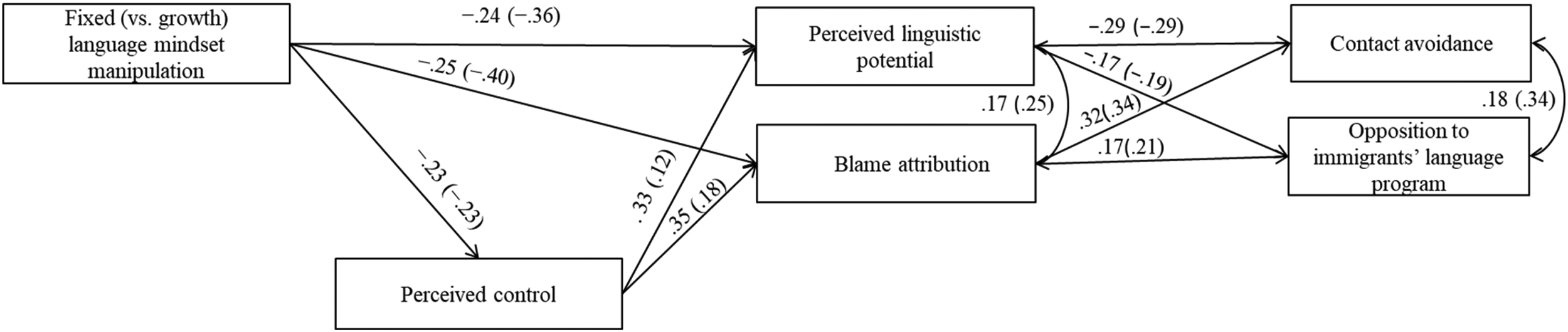
Study 1: Path analysis results for the final model.
Studies 1and 2: Indirect Effects for the Path Model: Estimates, Standard Error (SE), and 95% Confidence Intervals (CIs).
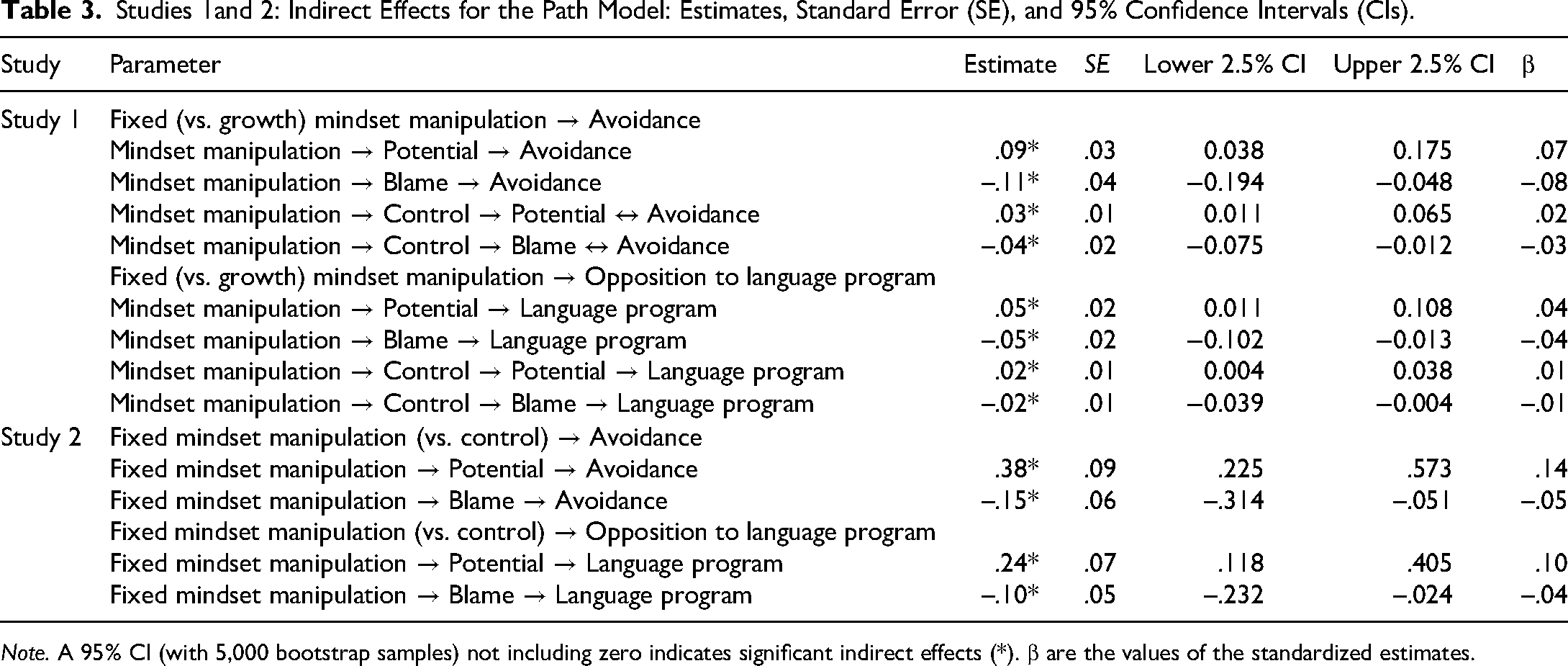
Note. A 95% CI (with 5,000 bootstrap samples) not including zero indicates significant indirect effects (*). β are the values of the standardized estimates.
Study 1 Summary
Study 1 demonstrated that people who were induced with a fixed (vs. growth) mindset were more likely to believe that migrants had less potential to improve but were also less likely to blame them when they failed, partially because they tended to believe the migrant had little control over their language ability. Moreover, perceived potential (negatively) and blame attributions (positively) were associated with contact avoidance and opposition to language programs. These two opposite indirect effects countered each other, which may explain why mindset inductions did not influence contact avoidance or opposition to language programs. However, it is important to note that without the control comparison (i.e., a baseline with no mindset induction), we do not know whether the effects of the mindset induction were driven by the fixed- or growth-mindset condition or both, and whether the fixed- and growth-mindsets influenced outcomes via different mediators of perceived potential or blame attribution.
Study 2
Study 1 showed that experimentally-manipulated mindsets affected perceived control and blame attributions, but the direction of the effect was unclear. Study 2 utilized the same experimental design but included a control condition (i.e., no mindset induction). The control condition served as a baseline to compare with the effect of fixed and growth mindset inductions. Given that the effects of mindsets did not differ whether people judged a newcomer or a long-term migrant, we did not specify the length of residence of the target migrant in Study 2. Moreover, we measured participants’ mindsets before and after the experimental manipulation to check randomization and better understand how different mindset conditions changed participants’ mindsets.
Method
Participants
A power analysis was conducted based on an experimental study examining the effect mindsets on social attitudes (d = .23; Chiu et al., 1997 Study 5), which suggested a recommended n = 88 for one condition (n = 264 for three conditions). We recruited a new sample of 333 eligible participants. After excluding those who failed either attention-check or instruction-check questions (n = 13), all participants passed other inclusion criteria (see pre-registration). The final sample included 320 participants (195 females, Mage = 19.12, SDage = 2.30).
Procedure
The participants reported their pre-test language mindsets, along with their demographic information in a survey conducted at the beginning of the academic semester. About two months after the initial survey, eligible participants were invited to a computer lab. They were randomly assigned to one of the three conditions: (1) the fixed-mindset condition (where they read a magazine article supporting fixed theories about language ability); (2) the growth-mindset condition (where they read an article supporting growth theories); or (3) the control condition (no article). Those in the fixed-and growth-mindset conditions answered two multiple-choice questions regarding their comprehension of the article (five students who failed this check were excluded). Next, the participants engaged in the same language assessment task described in Study 1 and answered questions about the migrant's potential to improve, blame attribution, attitude towards migrants’ language programs, contact avoidance, and language mindsets (see description of these measures in Study 1 and reliability in Table 4). 3
Study 2: Descriptive Statistics and Correlations among Key Variables.
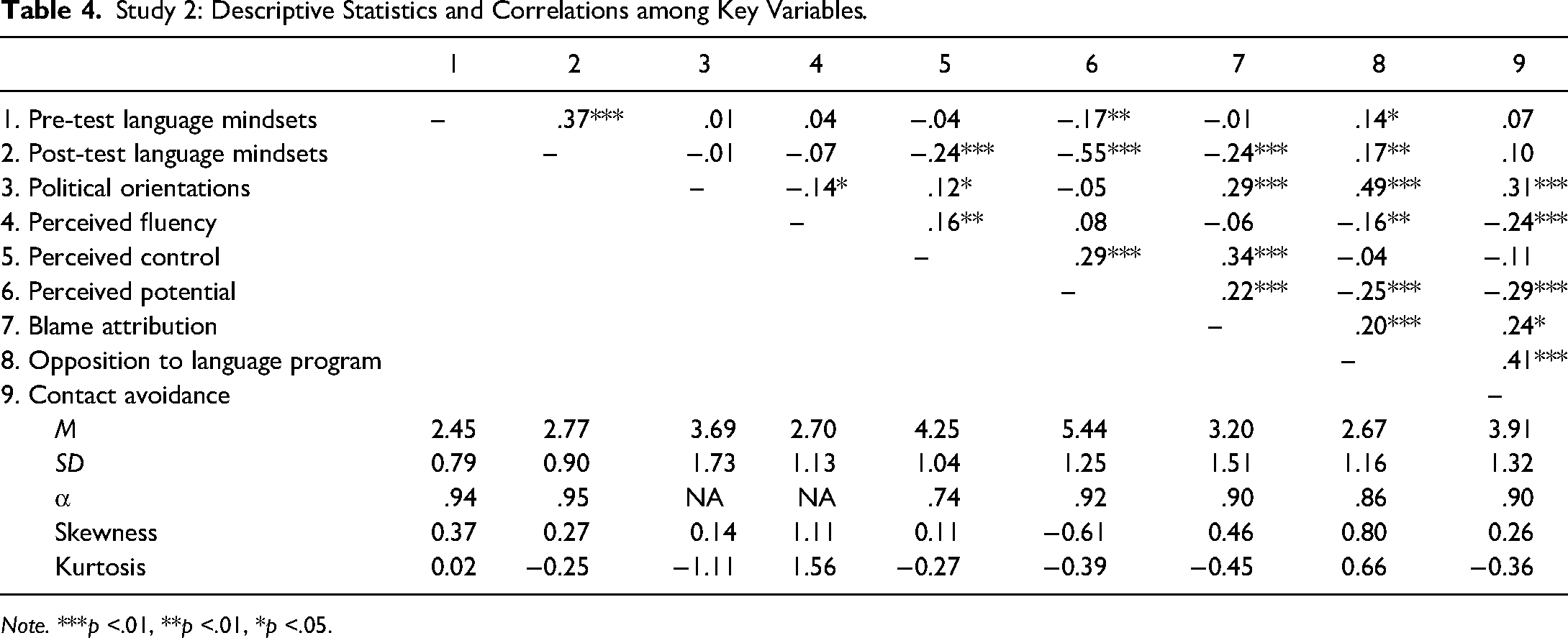
Note. ***p <.01, **p <.01, *p <.05.
Results
Preliminary Results and Manipulation Check
The descriptive statistics and psychometric properties for each measure are presented in Table 4. Consistent with Study 1, the participants’ political orientation (conservative vs. liberal) predicted opposition to migrants’ language programs (r = .49, p <.001) and contact avoidance (r = .31, p <.001). The manipulation of language mindsets was effective: the 3 (between-subject: fixed mindsets vs. growth mindset vs. control condition) × 2 (within-subject: pre- and post-test mindsets) interaction effect was significant, F (2, 291) = 51.11, p <.001, η2 = .26. As shown in Table 2, the pre-test language mindsets were not significantly different across the three experimental conditions. However, the post-test language mindsets were significantly different. Specifically, those in the fixed-mindset condition endorsed stronger fixed (vs. growth) mindsets than those in the growth-mindset condition, and those in the control condition fell between and were significantly different from both fixed- and growth-mindset conditions.
Effects of the Mindset Manipulation
As shown in Table 2, there were significant mean differences in perceived control, perceived potential, and blame attribution across the three conditions. Consistent with Study 1, participants in the fixed-mindset condition perceived lower control, perceived less potential, and less blame attribution towards the target migrant than those in the growth-mindset condition. Compared to participants in the control condition, across all these variables, those in the growth-mindset condition were not significant different, whereas those in the fixed-mindset condition perceived lower potential and ascribed significant less blame toward the accented migrants. However, although the magnitude of the score for perceived control in the control condition was in between the fixed and growth mindset condition, the differences were not significant. In summary, compared to those with no mindset-induction, inducing fixed mindsets led to less perceived potential and less blame, but growth-mindset induction did not change any outcomes.
Indirect Effects of Fixed Mindset
Because the results of ANOVAs showed that the growth mindset manipulation had no significant effect on any variables relative to the control condition, we did not further consider the indirect effect for the growth mindset condition. The mindset manipulation effects on perceived control, perceived migrant's potential, and blame attributions were driven by the fixed mindset condition. This analysis aimed to further explore whether the fixed mindset manipulation had any indirect effects on contact avoidance and policy attitudes. 4 The model fit for the hypothesized model was good (χ2 = 12.16, df = 4, p = .02, CFI = .96, RMSEA = .098, SRMR = .04). After adding control variables (i.e., political orientation and perceived proficiency), the final model fit the data well (χ2 = 12.08, df = 6, p = .06, CFI = .98, RMSEA = .069, SRMR = .03).
As shown in Figure 3, having a fixed language-mindset significantly reduced participants’ perceptions of migrants’ potential and blame attributions, but it did not significantly influence perceived control (consistent with the findings of mean differences). Perceived control was also positively associated with perceived potential and blame attribution. Finally, perceived potential was negatively and blame attribution was positively associated with contact avoidance and opposition to language programs. As shown in Table 3, the indirect effects showed that the induction of a fixed mindset was indirectly associated with outcomes through different pathways. The fixed language mindset was positively linked to contact avoidance and opposition to language programs through a reduction of perceived potential, and negatively linked to these outcomes through reduced blame attribution.
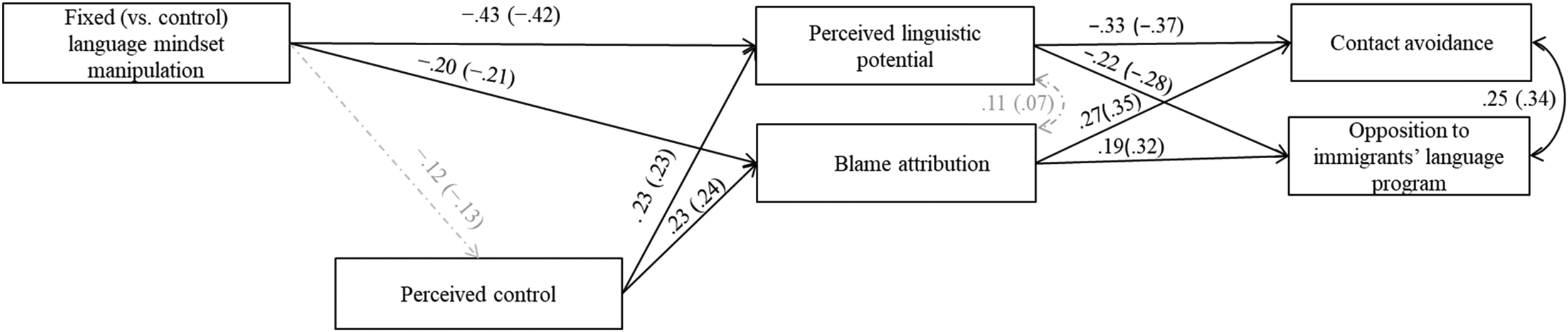
Study 2: Path analysis results for the final model (fixed vs. control condition).
Study 2 Summary
Study 2 is generally consistent with the findings in Study 1. We found that experimentally manipulated mindsets influence perceived linguistic potential, perceived control, and blame attribution. Those who were induced with fixed (vs. growth) mindsets were not only more likely to believe that migrants had less potential to improve, but also less likely to blame them for not making enough effort. In turn, perceived potential was negatively and blame attributions were positively associated with contact avoidance and opposition to language programs. Study 2 also extended the findings in Study 1 by including a control condition to establish a baseline. We found that, compared to those in the control condition, people who were induced with a fixed mindset were more likely to believe that migrants had less potential to improve, but were also less likely to blame them when they failed. However, the opposite was not true for those who were induced with growth mindsets; there was no difference between the growth-mindset condition and the control condition on blame and perceived linguistic potential, suggesting that the effect of mindsets on perceived linguistic potential and blame found in Study 1 was driven by a fixed mindset prime.
General Discussion
Our findings shed new light on understanding the mixed effect of mindsets on language judgments. We identified two factors that explain the effects of mindsets on intergroup dynamics: perceived potential and blame attribution. People who were primed with a fixed (vs. growth or control condition) mindset tended to believe that migrants with limited proficiency in the target language have less potential to improve their language ability, and this belief is associated with avoidance of interaction with migrants with poor language skills and opposition to government-funded language training programs that help migrants to improve their language proficiency. Regarding blame attributions, we found that an experimentally activated fixed mindset decreased blame attributions compared to an experimentally activated growth mindset. Moreover, our findings clarify Ryazanov and Christenfeld's (2018) findings that the effect of mindsets on blame is driven by fixed mindsets; growth mindset messages did not lead to blame attribution. Below, we discuss how language mindsets offer applied implications for language learning and migration research and provide a unique perspective for language perception research.
Our findings provide a clearer picture of using mindset messaging to change attitudes toward ESL migrants. Previous work on mindsets about social judgment focus on how fixed (vs. growth) mindsets undermine positive intergroup relations (e.g., Madan et al., 2019; Lou & Noels, 2020a) or focus on the opposite (e.g., Ryazanov & Christenfeld, 2018). This research examined the mixed effect of mindsets by investigating both negative (reduced perceived potential) and positive (reduced blame) social inferences toward migrants with limited proficiency in the local language. As demonstrated in the current research, although the belief that language ability is fixed can reduce one's attribution of blame about migrants (“it is not their fault if they cannot improve because language ability is fixed”), such beliefs can also lead to the paternalistic inference that migrants do not have potential to improve their language skills. However, our results did not support the claim that perceived control mediates the link between mindsets and social inferences (cf. Ryazanov & Christenfeld, 2018). Although people in the fixed and growth mindset had significantly different levels of perceived control, they were not different from the control condition. Instead, when considering a baseline control condition, fixed mindsets directly influence perceived potential and blame attribution, rather than affecting these outcomes through perceived control.
These induced mixed attitudes have important implications for people's social support of and interaction with migrants. In the context of evaluating migrants who are learning the local language, this mixed judgment is associated with potentially ambivalent outcomes, inspiring avoidance and opposition to migrants’ language education. Although mindset messaging does not directly affect these outcomes, there is an indirect effect via perceived potential and blame attributions. It is possible that people can use their changed attitudes to justify their position after the mindsets message. Imagine two people who do not want to interact with migrants or fund a newcomer program, and they receive two different mindset messages. The person who receives the fixed (vs. growth) message can now justify their biases by saying that, although migrants are not to blame for their unfortunate situation, they have no potential to change. Therefore, it is possible that participants did not directly change their willingness to interact and their support of public funds after the mindset message, or even the way they blame and view migrants’ linguistic potential that are associated with did change.
Previous research shows that language mindsets influence migrants and language learners’ motivation, engagement, and willingness to communicate with speakers of the target languages (Lou & Noels, 2019; Lou & Noels, 2020b; Lou et al., 2022; Zarrinabadi et al., 2021). The current work extends this research and highlights that, in a reciprocal manner, language mindsets also influence how native speakers of the dominate language judge migrants’ language abilities. In other words, a belief about the malleability of second language ability is an important cognitive framework that guides people to make sense of not only their own but also others’ language ability. As shown in this study, this meaning-making process regarding others’ abilities can bias raters’ perception of second language speakers, over and beyond the perceptions of the target's speech. This finding points to the importance of mindsets as an important individual difference in language perception research.
Limitations and Future Directions
In the current research, we examined how mindsets led to mixed judgments of migrants with limited proficiency in the local language. An important question that arises is whether mindsets could lead to different outcomes depending on the target groups or contexts, given that social perceptions about migrants vary depending on the groups’ ethnolinguistic background and immigration status (Kutlu et al., 2021). People in multicultural societies might have more experience in language learning and interactions with other ethnolinguistic groups, contributing to a greater prevalence of growth mindsets and favorable policies about migrants’ language education (Shirvan et al., 2021). As such, future research should also examine how the ethnolinguistic environment and sociopolitical ideologies regarding immigration and acculturation (Berry, 2017; Olsson et al., 2019) affect language mindsets and perceived potential (Lou & Li, 2022).
To better understand the effect of language mindsets on the quantity and quality of intergroup interactions, future research could also examine the duration of mindset interventions in natural settings. For example, participants could keep a daily diary (i.e., experience sampling method) about their interactions with migrants with limited language proficiency (e.g., how often they engaged in contact with non-native speakers and how positive/negative those experiences are). One might predict that those who endorse growth mindsets or experienced the mindset intervention might recount more frequent and positive interactions with migrants with limited proficiency in the local language. Finally, considering the mixed effect of mindsets, it is important to understand how to harness the benefits and minimize the costs. For example, it is possible to directly design messages that alleviate the sense of blame and increase the sense of potential (see Hoyt & Burnette, 2020).
Conclusion
Migrants’ language competence is key to their successful integration into a new society. Accordingly, many governments urge newcomers to learn the mainstream language, sometimes under the threat of deportation if a certain standard is not met within a specific time period (Mirza, 2016). At the same time, in many countries, the educational opportunities for migrants to improve their competence are diminishing (Cowie & Delaney, 2019; Office of the Commissioner of Official Languages, 2013). The general public and employers may rely on their mindsets to make sense of how migrants learn a new language. Those with strong fixed mindsets may be more concerned about whether migrants can feasibly become proficient enough to become contributing members of society. Such fixed mindsets may lead to the misconception that migrants lack the capacity to learn a new language, even though many studies indicate that, with the appropriate training, most newcomers are capable of developing their language skill at least to the level sufficient for daily communication (e.g., Hartshorne et al., 2018; Hou & Beiser, 2006). Although people with fixed mindsets judge the target migrants to have less potential, they are also less likely to blame migrants for their lack of language ability. Future research should continue to address how the ambivalent social inferences driven by mindsets (i.e., perceived potential and blame) may lead to other outcomes, such as hiring decisions, to provide a more comprehensive picture of how implicit theories lead to mixed social inferences.
Supplemental Material
sj-docx-1-jls-10.1177_0261927X231153949 - Supplemental material for “Your English is Good for an Immigrant”: Examining Mixed Effects of Mindset Messages on Perceived Linguistic Potential of and Blame Attributions Towards ESL Migrants
Supplemental material, sj-docx-1-jls-10.1177_0261927X231153949 for “Your English is Good for an Immigrant”: Examining Mixed Effects of Mindset Messages on Perceived Linguistic Potential of and Blame Attributions Towards ESL Migrants by Nigel Mantou Lou and Kimberly A. Noels in Journal of Language and Social Psychology
Footnotes
Acknowledgments
We thank Morgan Cselinacz, Taylor Irvine, Michelle Elliott, and Joshua Katz for their research assistance, as well as the editor, Prof. Howie Giles, and two anonymous reviewers for their helpful feedback.
Open Science Practices
Both studies were pre-registered before data collection. The preregistration, research materials, and data are available at https://osf.io/e5pty/ (Study 1) and  (Study 2).
Declaration of Conflicting Interests
The author(s) declared no potential conflicts of interest with respect to the research, authorship, and/or publication of this article.
Funding
The author(s) disclosed receipt of the following financial support for the research, authorship, and/or publication of this article: This work was supported by the Social Sciences and Humanities Research Council of Canada (grant no. 435-2015-1825) to the second author.
Supplemental Material
Supplemental material for this article is available online.
Notes
Author Biographies
References
Supplementary Material
Please find the following supplemental material available below.
For Open Access articles published under a Creative Commons License, all supplemental material carries the same license as the article it is associated with.
For non-Open Access articles published, all supplemental material carries a non-exclusive license, and permission requests for re-use of supplemental material or any part of supplemental material shall be sent directly to the copyright owner as specified in the copyright notice associated with the article.
