




Abstract
This article focuses on the role of language in social-stereotype formation through interpersonal communication. We conducted a between-subjects experiment (N = 423), in which participants were exposed to differential remarks about (members of) an unknown social group. Remarks varied in two linguistic devices: (a) label type, by distinguishing between generic and specific labels and (b) behavior descriptions, by contrasting negations and affirmations in descriptions of competent (e.g., not stupid vs. smart) and incompetent behaviors (e.g., not smart vs. stupid). Generic (vs. specific) labels increased perceived entitativity (“groupness” of category members), stereotype content (perceived competence) and perceived essentialism of described behaviors. Compared with affirmations, only the communication pattern with negations in descriptions of competent behaviors (e.g., not stupid) decreased perceived competence of group members, and increased perceived essentialism of incompetent behavior. Label type and negations did not interact, suggesting that these linguistic devices play a distinct, parallel role in stereotype formation.
It has been widely accepted that language plays a crucial role in the communication and maintenance of social-category stereotypes (Collins & Clément, 2012; Maass, 1999; Sutton & Douglas, 2008). One problem, however, is that research on this topic is scattered across independent subfields of (psychological) research with little cross-reference. A recent review integrated the major strands of literature in the Social Categories and Stereotype Communication (SCSC) framework (Beukeboom & Burgers, 2019a). This integrative framework summarizes how specific biases in language use (in labeling and behavior descriptions) relate to the formation and maintenance of three fundamental variables in social-category cognition: perceived category entitativity, stereotype content, and perceived essentialism of described behavior and characteristics. Thereby, it facilitates research on the combined effects of various linguistic biases in stereotype communication. In the current article, we pick up some of these implications.
The SCSC framework mentions two broad groups of linguistic biases that contribute to stereotype formation and maintenance. The first group relates to the linguistic labels used to refer to categorized individuals (Beukeboom & Burgers, 2019a). Once social groups are labeled in communication, they are likelier to become targets of stereotyping (Bigler & Liben, 2006). The types of labels used also matter, as different linguistic forms of labels are related to different cognitive inferences about (social) categories (Reynolds et al., 2006). Of particular interest is the distinction between generic and more specific labels, as generics are argued to play a crucial role in stereotype communication (e.g., Gülgöz & Gelman, 2015; Leslie, 2008). Generic labels refer to the category as a whole (e.g., “men are . . . ”), while more specific labels refer to subgroups (e.g., “young men”) or individual category members (e.g., “this man is”). Typically, generic (vs. specific) labels facilitate the communication of stereotypic information, and increase perceptions of category entitativity (Beukeboom & Burgers, 2019a; Bigler & Liben, 2006).
The second group of biases in stereotype communication relates to the ways in which behavior of category members is described. Research on linguistic bias (e.g., Beukeboom & Burgers, 2019a; Maass, 1999) has demonstrated that speakers systematically vary their language use when describing behavior that is either consistent or inconsistent with existing social stereotypes. These linguistic variations relate to perceptions of essentialism. Stereotype-inconsistent information (e.g., a rocket scientist receiving a low score on an IQ test) is typically framed as a one-time event due to specific situational circumstances through the use of, for instance, negations (e.g., “The rocket scientist is not smart”; Beukeboom et al., 2010). Such formulations imply that the described behavior has low essentialism. By contrast, in case of stereotype-consistent information (e.g., a rocket scientist receiving a high score on an IQ test), speakers tend to use language that presents events as stable and dispositional, such as affirmations (e.g., “The rocket scientist is smart”; Beukeboom et al., 2010). This implies that the behavior has high essentialism.
The link between stereotypes and language use is generally seen as two-directional. That is, stereotypes are reflected in language use of speakers, and language use in turn feeds social-category stereotypes in message recipients. To study the effects of biased language use on recipients, we look at how language contributes to the emergence of new stereotypes with previously unknown categories (i.e., stereotype formation). In the stereotype-formation process, both labeling and the communication of category members’ behaviors should play an important role. The formation of new stereotypes has mostly been studied in developmental psychology, in studies with young children (e.g., Cimpian & Markman, 2009). However, these studies have mainly focused on the effects of linguistic labelling (e.g., Cimpian & Markman, 2009; Gelman et al., 2010) or logics (e.g., Leslie et al., 2011), and have hitherto hardly looked at the role of biases in behavior descriptions, like the use of negations (e.g., not smart) over affirmations (e.g., stupid). In contrast, linguistic biases in behavior descriptions have been studied from communication-scientific (e.g., Burgers & Beukeboom, 2016; Schmid & Fiedler, 1996) or social–psychological perspectives (e.g., Sekaquaptewa et al., 2003; Wigboldus et al., 2000), and mostly focused on the communication of existing stereotypes (i.e., stereotype maintenance). Thus, while labelling and linguistic bias can both contribute to stereotype formation in recipients, very few studies have focused on their combined effects.
The current study’s aim is to explore the effects, and potential interaction, of combinations of generics in labelling (e.g., Gülgöz & Gelman, 2015; Leslie, 2008) and of negations in behavior descriptions (e.g., Beukeboom et al., 2010) on the formation of new social-category perceptions (i.e., perceived entitativity, stereotype content, and essentialism) in recipients.
Stereotypes and Language
There is a rich research tradition in the area of social-category stereotypes (e.g., Allport, 1954; Dovidio et al., 2010; Fiske et al., 2007; Moskowitz, 2005). Both mass media (Kroon et al., 2016; Ramasubramanian, 2011) and interpersonal interaction (Lee, 2007; Rimal et al., 2013) are important in communicating and perpetuating existing stereotypes. Stereotypes can eventually lead to discrimination, when people display negative behavior toward specific social groups or their group members.
Stereotypes are “generalized impressions” (Beukeboom & Burgers, 2019a), because associated traits and features are (to a varying extent) expected to apply to all members of the social category and to be stable across situations and over time. In the formation and use of stereotypes, three variables are fundamental (Beukeboom & Burgers, 2019a; Yzerbyt et al., 2004): (a) perceived category entitativity, (b) stereotype content, and (c) perceived essentialism. Perceived category entitativity denotes the extent to “which a category is perceived as a meaningful, unified and coherent group, as opposed to a loose set of individuals” (Beukeboom & Burgers, 2019a, p. 9). Thus, entitativity refers to perceptions of “groupness” of a specific category and of “similarity” between its members (Moskowitz, 2005). Such groupness may be derived from either perceptual features of target members (e.g., physicality; Campbell, 1958) and/or from assumed commonality in certain nonphysical characteristics such as a shared history or common goals (Yzerbyt et al., 2004). Stereotype content is the “content of the cognitive representation people hold about a social category, consisting of beliefs and expectancies about probable behaviors, features, and traits” (Beukeboom & Burgers, 2019a, p. 9). According to Fiske et al. (2007), competence and warmth are the two most fundamental dimensions constituting stereotype content. Finally, perceived essentialism refers to “the extent in which an associated set of characteristics is perceived to be immutable to its members, and stable across time and situations” (Beukeboom & Burgers, 2019a, p. 10). This thus reflects the degree to which stereotype content is perceived as a fundamental and unchangeable feature of group members, as opposed to transient and adaptable over time.
The communication of social-category information can occur at various levels (Beike & Sherman, 1994). At the lowest level of information, speakers refer to a specified individual showing a specific behavior in a specific situation (e.g., that rocket scientist solved the Riemann Hypothesis yesterday evening). By contrast, at the highest level of information, speakers refer to generic traits of a social category as a whole (e.g., rocket scientists are smart), thereby separating the description from both specified individuals and behavioral situations. Thus, communication patterns about a social category can vary in two important ways: (a) in target references (e.g., from specific categorized individual[s] to the social category as a whole) and (b) in the ways in which behaviors, traits and/or characteristics are described (Beukeboom & Burgers, 2019a). The SCSC framework (Beukeboom & Burgers, 2019a) thus explains how variations in both linguistic labelling and behavior descriptions are crucial in the sharing of social-category information.
With respect to linguistic labeling, generic and specific labels respectively correspond to the high and low levels of social information (Beike & Sherman, 1994). Specific labels refer to individual category members (e.g., “this cheetah runs fast”), while generics refer to the category as a whole. Such generic labels can be communicated in various linguistic ways, for instance, through plural nouns with (e.g., “the Dutch are direct”) or without definite articles (e.g., “cheetahs run fast”; Leslie, 2008), but also by a singular noun with an indefinite article (e.g., “a cheetah runs fast”; Rhodes et al., 2012, Study 2).
The use of generics is an important mechanism through which children acquire information about biological categories, such as different animal types (e.g., Cimpian & Markman, 2009; Gülgöz & Gelman, 2015; Rhodes et al., 2012). For instance, Cimpian and Markman (2009) show that 4- and 5-year-old children learn that information presented in generics (e.g., “horses eat grass”) is more central to a specific category compared with information presented in a more specific manner (e.g., “this horse eats grass”). In addition, information presented with generics can lead to overgeneralization. A study by Leslie et al. (2011) demonstrates that sentences with generic labels like “ducks lay eggs” can lead recipients to infer that members of a specific category are all alike, as reflected in agreement with statements like “all ducks lay eggs” (which is false, given that male ducks do not lay eggs).
The use of generics (vs. specifics) has also been connected to social stereotyping. Goldfarb et al. (2017) found that when both children and adults learn about a new social group through generic (vs. specific) information, they are likelier to evaluate individuals based on their group status rather than on individuating information. We aim to link these processes to perceived category entitativity. In line with the SCSC framework (Beukeboom & Burgers, 2019a), we expect that different label types in discussions about an unknown social category induce differences in the perceived groupness of the social category, leading to:
Next to linguistic labels, the way specific behavior of group members is described can affect stereotype formation. Research on linguistic bias demonstrates that speakers systematically vary their language use when describing stereotype-inconsistent and stereotype-consistent behavior (for overviews, see Beukeboom & Burgers, 2019a; Collins & Clément, 2012). In short, these variations typically frame stereotype-consistent behavior as expected and due to the category member’s immutable essence, while stereotype-inconsistent behavior is framed as an unexpected one-time event and due to situational circumstances. One linguistic device that has been associated with stereotype communication is negation usage. 1 Syntactic negations (e.g., no, not) serve to deny part of an assertion or statement (e.g., not smart; not stupid) and thereby add communicative information compared with a more standard formulation with affirmations (e.g., stupid, smart). The negation bias (NB) predicts that the use of such negations is more appropriate for descriptions of stereotype-inconsistent situations (e.g., “The rocket scientist is not smart”; “The hooligan is not stupid”) than for stereotype-consistent situations (e.g., “The rocket scientist is smart”; “The hooligan is stupid”; Beukeboom et al., 2010).
Experimental studies from the field of linguistics (e.g., Giora et al., 2007; Maciuszek & Polczyk, 2017) have demonstrated that, during early word processing, speakers activate the negated concept (e.g., smart in the expression “not smart”) in working memory. Rather than being suppressed, the negated concept remains active and available even when recipients have processed the entire sentence meaning. Likewise, analysis of natural-language data shows a similar pattern, in that speakers pick up and keep referring to negated concepts (e.g., references to elements of smartness after being exposed to not smart; Becker, 2015). This suggests that, when a target person is described as not smart, recipients may still remember and associate the individual with the (negated) concept of smart. In this way, negations (e.g., not smart) can lead to social stereotypes being shared and maintained, even in the wake of counterstereotypic information (Beukeboom et al., 2010; Burgers et al., 2012; Giora et al., 2004).
Most empirical evidence on the NB has focused on the use of negations when communicating about behaviors of (members of) well-known social categories about which stereotypic expectancies are already in place (Beukeboom et al., 2010). For the present study, we were interested in what message recipients infer from behavior descriptions containing either a negation or affirmation and whether this leads to stereotype formation. Beukeboom et al. (2010, Study 4) showed that, compared with affirmations, negations induce recipients to infer that the described characteristics were unexpected and of lower essentialism (i.e., less enduring and less dispositional) for the target. This shows that, based on biased language use of a speaker, recipients may implicitly infer the speaker’s stereotypic beliefs about discussed social-category members. Other studies have demonstrated that recipients form impressions of a sender’s biases based on their variations in the use of language abstraction (Assilaméhou & Testé, 2013; Douglas & Sutton, 2006, 2010) and verbal irony (Beukeboom & Burgers, 2019b; Burgers et al., 2015, Study 2).
Thus, we expect that, when people are exposed to messages about (members of) a new social category, they infer the speaker’s stereotypic expectancies from their biased pattern of negation use. This, in turn, can bias recipient perceptions of the described group. We expect that effects of negation usage may depend on the valence of the behavior described. We thereby focus on competence-related behavior, which according to Fiske et al. (2007), entails one of the fundamental dimensions of stereotype content varying from competent (positive) to incompetent (negative) behavior.
Speakers can use negations in behavior descriptions referring to competent behavior (e.g., not stupid rather than smart). These negations mention and could activate negative concepts (even when the communicated information is positive). Such negation use could thus induce recipients to associate the described target group with the negated negative (incompetence-related) trait (e.g., stupid), and to infer more negative stereotype content and higher essentialism of negative behaviors:
By contrast, negations in negative behavior descriptions (e.g., not smart rather than stupid) mention and could potentially activate competence-related concepts (even when the information presented indicates incompetence). Such negation use could thus induce recipients to associate the described target group with the negated competence-related trait (e.g., smart), and to infer a more positive stereotype content and a higher essentialism of positive behaviors:
In sum, in line with the SCSC framework (Beukeboom & Burgers, 2019a), we argue that linguistic variations in labelling and behavior descriptions can both contribute to the formation of social-category stereotypes. A next question is whether these two types of linguistic variations also interact, in that the effects of negations are potentially stronger when accompanied by generic (vs. specific) labels.
A study by Foster-Hanson et al. (2016) provides empirical evidence for the relevance of combining negations and labelling in the formation of stereotypes among toddlers. In their study, they exposed 4- and 5-year-old children to short stories about the fictional category of Zarpies. In this story, one character gave a description of Zarpies (e.g., “Zarpies have striped hair”), which was subsequently denied by a second character. This denial could feature a generic label and a negation (e.g., “No, no, no! Zarpies don’t have striped hair”), a generic label and a replacement of the target property (e.g., “No, no, no! Zarpies have spotted hair”), or a denial with a specific label (e.g., “No, no, no! This Zarpie has striped hair”). Compared with the denial with a specific label, participants subsequently gave more essentialist responses (as coded in probed verbal explanations of children) in both the generic replacement and the generic negation conditions. Thus, generic statements led to more essentialist utterances than specific statements, even when the generic statements were accompanied by a negation.
While the study by Foster-Hanson et al. (2016) has made an interesting step in combining aspects of linguistic labelling and linguistic bias and shows some promising first evidence for a possible interaction between generics and negations, note that their study lacks a condition of a specific category label with a negation. A question that remains is whether such effects are due to an interaction between generics and negations, or to a main effect of generics only (which occurs regardless of the presence of negations). Moreover, the study by Foster-Hanson et al. (2016) did not measure other fundamental variables in stereotype formation; that is, perceived entitativity and stereotype content. We thus ask the question:
The Present Research
To simulate the common situation in which people are presented with (biased) information about a social group through the stories told by others, we conducted a scenario experiment. Participants were asked to imagine being a new employee in a company and—based on a number of dialogues about the group between their new colleagues—to try form an impression about a distinct group of employees they did not belong to. Participants were presented with eight dialogues about this group (four about competent behaviors and four about incompetent behaviors). To study how label types and negation use affect stereotype formation, we manipulated both label type (generic vs. specific) and negation use (negations in descriptions of competent behavior vs. negations in descriptions of incompetent behavior vs. control) in the behavior descriptions in the dialogues. To test how these linguistic variations affect impression formation, we then measured perceived entitativity and stereotype content about the group, and perceived essentialism with respect to the described competent and incompetent behaviors.
Method
Participants
Participants were recruited via an online panel between 4 and 26 November 2015. The survey link was sent to 2,198 potential participants, of which 430 participants completed the entire questionnaire (19.56% completion rate). Seven participants were excluded because they were nonnative speakers of Dutch. This left a total sample of 423 participants (Mage = 48.86 years, SDage = 15.42, range = 18-87 years; 57.4% males). Most participants (75.4%) were highly educated, having completed a program equivalent with a Bachelor’s degree or higher.
Design
Participants were randomly distributed across a 2 (label type: generic vs. specific) × 3 (negation use in behavior descriptions: negations in descriptions of competent behavior vs. negations in descriptions of incompetent behavior vs. all affirmations) × 2 (presentation order: Sequence A vs. Sequence B) between-subjects design. Dependent variables included (a) perceived entitativity of the described group, (b) perceived stereotype content for the described group, and (c) perceived essentialism of competent and incompetent behavior of the described group. 2
Materials
Participants were asked to imagine that they had just been hired as a new employee for a (fictitious) company. They read that, in this company, employees worked in teams housed in different buildings. Each team was named after the building it was based in. During lunch, colleagues from their own team talked about the members of another corporate team called “Brink,” 3 who were more informally known as “Brinkers.” Participants had to form an impression of Brinkers based on their colleagues’ dialogues.
Then, participants read eight short dialogues between colleagues talking about behavior of Brinkers. All behaviors were competence-related and referred to concrete cases of organizational behavior (such as performance in a meeting). Four dialogues featured positive (competent) behavior and four featured negative (incompetent) behavior. In all experimental conditions, participants thus received similar information with an equal amount of positive and negative anecdotes (see online appendix at https://osf.io/ydnh2/, for full materials). In the dialogues, we manipulated label type (generic vs. specific) and negation use in behavior descriptions, while keeping the dialogues identical in all other aspects.
We manipulated the use of generics following established procedures (Cimpian & Markman, 2009; Foster-Hanson et al., 2016; Rhodes et al., 2012). In the generic-label condition, all dialogues referenced Brinkers as a generic group using plural nouns (e.g., “the Brinkers,” “those Brinkers”). In the specific-label condition, all dialogues referenced a single Brinker using singular nouns (e.g., “the Brinker,” “that Brinker”).
Our independent variable of negation use comprised three experimental conditions: one condition contained negations in descriptions of competent behaviors (e.g., not stupid) and affirmations in descriptions of incompetent behaviors (e.g., dumb), one condition contained negations in descriptions of incompetent behaviors (e.g., not smart) and affirmations in descriptions of competent behaviors (e.g., clever), and a control condition contained affirmations only, for both competent (e.g., smart, clever) and incompetent behaviors (e.g., stupid, dumb).
Finally, we included two different sequences for counterbalancing purposes. All participants were presented with the same dialogues referring to the same behaviors in the same order, but valence differed between the two sequences. In Sequence A, uneven sets were about positive (competent) behaviors, and even sets were about negative (competent) behaviors. In Sequence B, this was reversed.
Procedure and Instrumentation
After exposure to the dialogues, participants had to indicate their impression about the target group as derived from their colleagues’ remarks. Participants subsequently rated perceived category entitativity, stereotype content, and perceived essentialism of positive and negative behaviors of Brinkers. All dependent variables were measured on 7-point scales. See the online appendix (https://osf.io/ydnh2/) for measurements of each variable.
To measure perceived category entitativity, we used a four-item scale, with higher numbers indicating a higher perceived entitativity (Cronbach’s α = .80, M = 3.33, SD = 1.26). Stereotype content was measured through two variables: perceived competence and warmth. Perceived competence was measured through four semantic differential scales (Cronbach’s α = .83, M = 4.46, SD = 0.97). Perceived warmth was tapped through three semantic differential scales (Cronbach’s α = .81, M = 4.32, SD = 0.84). As the behavior descriptions only presented competence-related behaviors and no warmth-related behaviors, perceived competence was the relevant variable to test our hypotheses on the effects on stereotype content.
Next, in order to measure perceived essentialism of behaviors, we exposed participants to both the competent and incompetent behaviors from the eight material sets. All participants thus received the same 16 behavior descriptions, starting with one behavior from Set 1, and on through Set 8 (whereby the competent or incompetent behavior was randomly selected). Subsequently, the remaining competent or incompetent behavior from each set was presented in a second block of eight behaviors (again Sets 1 through 8). Behaviors were presented without the previously shown remarks of colleagues in the dialogues, and were formulated in generic terms using affirmations (e.g., “That they are clear and make smart comments”). Participants were asked to rate their expectancies regarding each specific behavior as derived from their colleagues’ remarks. Specifically, we measured perceived essentialism with four Likert-type scale items (1 = not at all, 7 = very much). The reliability for each description of competent (average Cronbach’s α = .89, range = .86-.91) and incompetent behavior (average Cronbach’s α = .90, range = .86-.92) was high. Subsequently, the scales for the eight competent behaviors (Cronbach’s α = .82, M = 3.98, SD = 0.98) and the eight incompetent behaviors (Cronbach’s α = .82, M = 3.54, SD = 0.92) were collapsed.
We also measured several additional variables: general attitude, opinion strength, positive bias, negative bias, opinion difference, and resistance (see the Online Appendix at https://osf.io/ydnh2/ for results of these variables). Finally, we measured demographic variables for age, gender, education level, nationality and native language, the device used to complete the study, and open questions for remarks. No further variables were measured.
Results
All analyses were conducted with 2 (label type: generic vs. specific) × 3 (negation use in behavior descriptions: all affirmations vs. negations in descriptions of competent behavior vs. negations in descriptions of incompetent behavior) between-subjects analyses of variance 4 in IBM SPSS Statistics for Mac, version 25. Post hoc tests were performed with Bonferroni corrections. Descriptive statistics can be found in Table 1. The full data set is available from the online appendix at https://osf.io/ydnh2/.
Means (and Standard Deviations) of Dependent Variables Across Experimental Conditions.
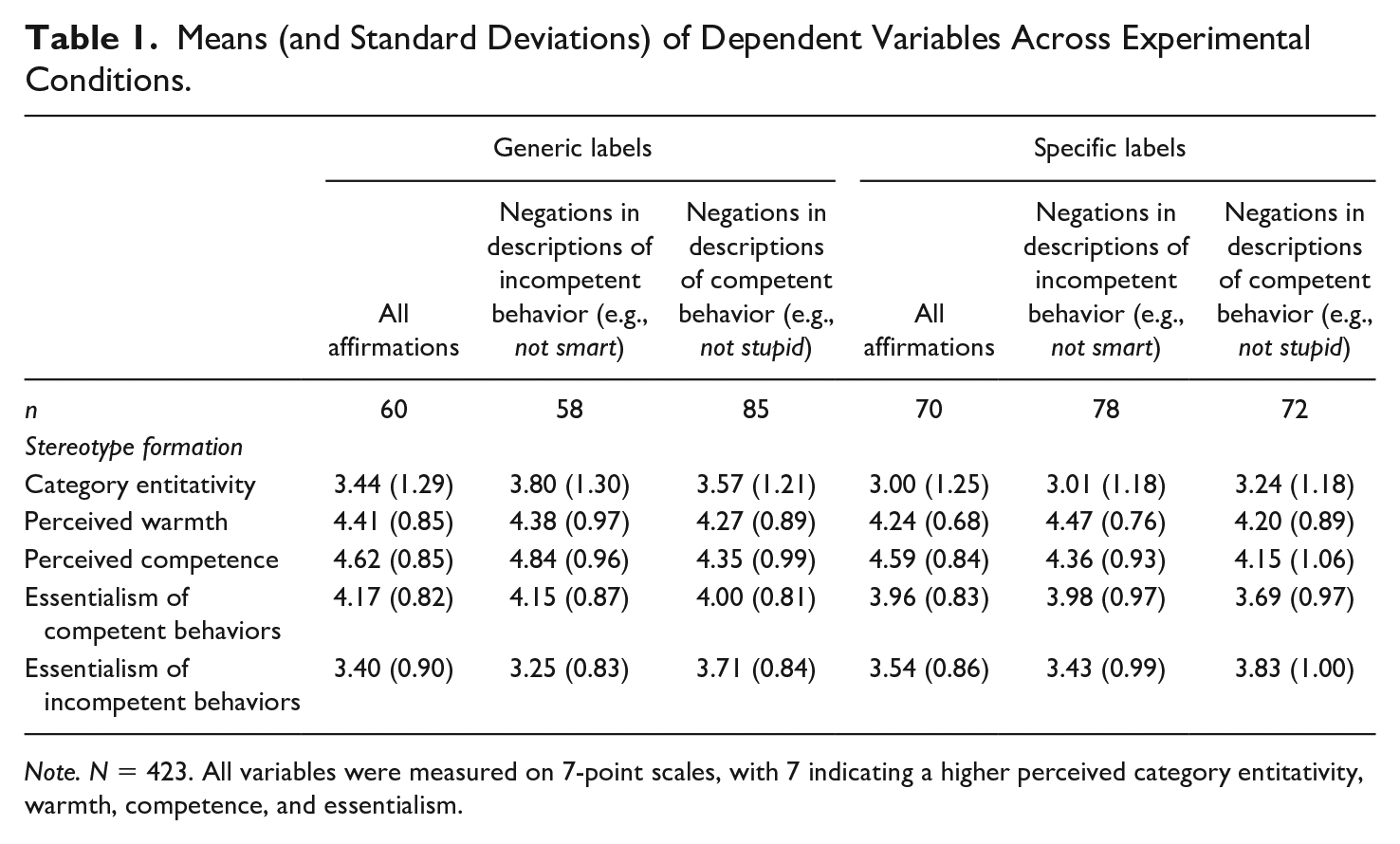
Note. N = 423. All variables were measured on 7-point scales, with 7 indicating a higher perceived category entitativity, warmth, competence, and essentialism.
Hypothesis Tests
Perceived Category Entitativity
Confirming Hypothesis 1, we found a main effect of label type, F(1, 417) = 18.70, p < .001, η p 2 = .043, indicating that generic labels (M = 3.60, SD = 1.26) led to a higher perceived category entitativity than specific labels (M = 3.08, SD = 1.20). We found neither a main effect of negation use in behavior descriptions, F(2, 417) = 1.03, p = .356, η p 2 = .005, nor an interaction effect between label type and negation use, F(2, 417) = 1.28, p = .279, η p 2 = .006 (Research Question 1a).
Stereotype Content
We measured two variables for stereotype content: impressions of competence and of warmth. As our behavior descriptions featured only aspects of competence (but not of warmth), we expected to find no differences on the warmth variable. Indeed, we found no main effects on impression of warmth of label type, F(1, 417) = 0.356, p = .551, η p 2 = .001, nor negation use, F(2, 417) = 1.79, p = .168, η p 2 = .009, and no interaction effect between label type and negation use, F(2, 417) = 0.741, p = .477, η p 2 = .004.
More important, with respect to perceived competence, we did find main effects of both negation use, F(2, 417) = 6.711, p = .001, η p 2 = .031, and label type, F(1, 417) = 6.682, p = .010, η p 2 = .016. First, in line with Hypothesis 2a, post hoc tests demonstrated that participants exposed to the condition with negations of competent behavior (M = 4.26, SD = 1.03; e.g., not stupid) perceived Brinkers to be less competent compared with participants exposed to affirmations only (M = 4.60, SD = 0.84; p = .007) or negations in descriptions of incompetent behavior (M = 4.56, SD = 0.97, p = .020; e.g., not smart). The latter two conditions did not differ on perceived competence (p = 1.00), which means that Hypothesis 3a was not supported by the data.
Furthermore, we found that generic labels (M = 4.57, SD = 0.95) led to a higher perceived competence than specific labels (M = 4.36, SD = 0.96). The interaction term between label type and negation use (Research Question 1b) was nonsignificant, F(2, 417) = 1.926, p = .147, η p 2 = .009.
Perceived Essentialism of Competent and Incompetent Behaviors
Because essentialism was measured for each specific behavior, we analyzed this variable with an additional factor in a 2 (behavior valence: competent vs. incompetent) × 2 (label type: generic vs. specific) × 3 (negation use in behavior descriptions: all affirmations vs. negations in descriptions of competent behavior vs. negations in descriptions of incompetent behavior) mixed analysis of variance with behavior valence as a within-subjects variable and label type and negation use in behavior descriptions as between-subjects variables. First, we found a main effect of behavior type, F(1, 417) = 48.286, p < .001, η p 2 = .104, indicating that perceived essentialism was higher for competent (M = 3.89, SD = 0.89) than for incompetent behaviors (M = 3.54, SD = 0.92). We found no main effect for label type, F(1, 417) = 0.501, p = .479, η p 2 = .001, or negation use, F(2, 417) = 1.213, p = .298, η p 2 = .006, and no interaction between label type and negation use, F(2, 417) = 0.288, p = .750, η p 2 = .001.
More interesting, we did find an interaction between behavior valence and negation use, F(2, 417) = 9.288, p < .001, η p 2 = .043. Post hoc tests support Hypothesis 2b; participants exposed to the communication pattern with negations in descriptions of competent behavior (e.g., not stupid, M = 3.77, SD = 0.92) inferred a higher essentialism of incompetent behavior compared with participants exposed to affirmations only (e.g., smart, M = 3.48, SD = 0.88; p = .016) or negations in descriptions of incompetent behavior (e.g., not smart, M = 3.35, SD = 0.92, p < .001). By contrast, we found no significant comparisons for essentialism of competent behavior, which means that Hypothesis 3b is not supported by the data.
In addition, we observed a significant interaction between behavior type valence and label type, F(1, 417) = 8.00, p = .005, η p 2 = .019. Post hoc tests demonstrate that generic labels, M = 4.10, SD = 0.83) led to a higher perceived essentialism of competent behavior than specific labels (M = 3.88, SD = 0.93, p = .008). For incompetent behavior, we found no differences between generic (M = 3.49, SD = 0.87) and specific labels (M = 3.60, SD = 0.96, p = .094) on perceived essentialism. The three-way interaction between behavior valence, label type, and negation use (Research Question 1c) was nonsignificant, F(2, 417) = 0.033, p = .968, η p 2 < .001.
Discussion and Conclusion
Language is an important means through which social stereotypes are created, shared, and maintained (Beukeboom & Burgers, 2019a; Collins, & Clément, 2012). In certain cases, such social stereotypes may lead to prejudice, discrimination (Dovidio et al., 2010) and social polarization (Rothschild et al., 2019). An important challenge for scholars of language and social psychology thus comprises uncovering the mechanisms through which language facilitates social stereotyping. The goal of the current study was contributing to this debate by analyzing the effects of label type and negation usage in behavior descriptions on the formation of social-category stereotypes.
Our study was motivated by the SCSC framework (Beukeboom & Burgers, 2019a), which summarizes how various linguistic devices relate to three fundamental variables in social-category cognition: perceived category entitativity, stereotype content, and perceived essentialism of described behavior and characteristics. Based on a review of the literature, the SCSC framework (Beukeboom & Burgers, 2019a) predicts that linguistic labels mainly affect perceived entitativity of the described social group. Overall, our results support these predictions in that, when a target group is discussed using generic (vs. specific) labels, this led to higher perceived entitativity. These results are in line with previous studies on the role of generics in stereotype communication (e.g., Gelman et al., 2010; Gülgöz & Gelman, 2015; Rhodes et al., 2012), which demonstrate that generics are powerful linguistic devices in fostering stereotype formation.
Furthermore, we also found that label type affected stereotype content (perceived competence), and perceived essentialism of competent behaviors. 5 This finding fits with the effect of generics on perceived entitativity: when a group of individuals is repeatedly referred to with a generic label, it will gain in entitativity, which, in turn, facilitates the formation of a stereotypic impression consisting of a set of associated essential characteristics. Thus, when perceived entitativity increases, observed behaviors are likelier to be generalized to the group as a whole, because observers cease to view members as individuals (Crawford et al., 2002). In turn, generics may foster and further stimulate stereotyping (Rhodes et al., 2012) or discrimination (Wodak & Leslie, 2018).
In our study, however, participants were exposed to an equal number of competent and incompetent behaviors of group members, which means that the stereotype content that is developed could be both positive or negative. The finding that generic labels facilitated the formation of a positive stereotype content might be due to various factors. First, a large part of the experimental literature on generics focuses on perceptions of nonhuman groups (e.g., Cimpian & Markman, 2009; Leslie et al., 2011; but see Goldfarb et al., 2017, for an exception). Research demonstrates that people typically evaluate human groups described with generics more positively than nonhuman groups described with generics (Tasimi et al., 2017). Second, most literature on generics deals with developmental processes in acquiring category knowledge (e.g., Cimpian & Markman, 2009; Leslie et al., 2011). By contrast, our study used adult participants from the general population with a higher average age (48.86 years) than studies using children or students as participants. Neuroscientific research shows that, as people age, they tend to show an increased positivity bias, giving positive information more weight than negative information (Carstensen & DeLiema, 2018). In that way, participants in our study could have given the positive information about Brinkers more weight than the equal amount of negative information.
Our results also demonstrate that, in behavior descriptions, negations play an important part in stereotype formation, in line with findings on the NB (Beukeboom et al., 2010). That is, negations (e.g., not stupid to refer to competent behavior) can signal to a recipient that a specific behavior was inconsistent with the sender’s expectancy, and that the sender expected the target to display stupid behavior. It is important to note, however, that we mainly found effects of negations when these were used in descriptions of competent behavior (e.g., not stupid). In these cases, negation use decreased perceived competence and increased essentialism of incompetent behaviors. In this condition, participants were exposed to a sender’s communication pattern in which negative terms were used to describe both incompetent (e.g., dumb) and competent behaviors (e.g., not stupid), thereby fostering an essentialist impression connecting the described group to negative traits. Furthermore, the additional analyses reported in the online appendix (https://osf.io/ydnh2/) revealed that participants believed that speakers who consistently used negations when describing competent behavior displayed a higher negative bias and a lower positive bias (see also Douglas & Sutton, 2006). These findings confirm the expectations of the NB (Beukeboom et al., 2010) about the ways in which negations can subtly communicate and maintain expectancies, even when the actual described behaviors disconfirm these expectancies.
By contrast, we found no effects of negations in descriptions of incompetent behavior (e.g., not smart) on any of the dependent variables. This finding reveals an asymmetry between negations of positive and negative concepts, which has been found earlier in both general linguistic studies (Ruytenbeek et al., 2017) and in studies on the specific relation between negations and expectancies (Beukeboom et al., 2010; Burgers et al., 2012). We expect that politeness plays an important part in this asymmetry. When an actor displays negative behavior, the use of negations in a remark (e.g., not smart) is a conventionally polite way to mitigate criticism, compared with using affirmations (e.g., stupid), which can be too blunt in many social situations. By contrast, politeness is not an issue in negated remarks about an actor’s positive behavior. Thus, where negations of negative behavior can serve different communicative goals (i.e., communication of stereotypic expectancies and politeness), negations in remarks about positive behavior primarily serve to mark expectancy violations. We expect that message recipients are sensitive to this distinction when they draw inferences from the use of negations.
These findings also have important implications for the communication of prejudiced beliefs. Prejudice occurs in cases in which affective evaluations of members of a social category are negative. Our results show that, in line with the negation asymmetry, compared with affirmations, negations in remarks about positive (competent) behaviors (not stupid about a good performance) led to a more negative general attitude of the target group. No such negation effects occurred for negations in remarks about negative (incompetent) behaviors. By mitigating the impact of positive behaviors, negations are thus particularly impactful in the formation and perpetuating of negative stereotype beliefs and prejudice. Thus, when aiming to reduce negative stereotypes and prejudice, it is important to be aware of the effects of negated remarks of positive behavior.
Finally, results suggest that label type and language use in behavior descriptions have independent main effects in stereotype formation, but do not interact. This qualifies results from Foster-Hanson et al. (2016) who show that, compared with specific denials, generic statements with negations lead to a higher perceived essentialism. However, their study did not feature an experimental condition with specific labels and negations, which made it difficult to assess the interaction between these two variables. Our results suggest that generics and negations are two linguistic devices that are both important for stereotype formation, but do not reinforce each other. Thereby our results suggest that various linguistic devices (i.e., label variations and negation use in behavior descriptions) work in parallel in stereotype communication.
This result that language can work in different (but parallel) ways in communicating stereotypes is a new finding that warrants further investigation. In natural language, various linguistic biases (like biases in labeling and in behavior descriptions) can occur in combination, but this is usually ignored in experimental studies. The present study is a first attempt of a more integrative approach in studying the role of language in stereotype communication. Future work could look at combining different variations in label type (e.g., subtype labels; Richards & Hewstone, 2001) and different biases in behavior descriptions (e.g., variations in language abstraction, linguistic expectancy bias; Wigboldus et al., 2000). By linking (combinations of) specific linguistic devices to three fundamental variables of social-category cognition (perceived entitativity, stereotype content, and essentialism), we could further improve our understanding of the role of language in stereotype communication.
Some limitations need to be mentioned as well. First, we used a scenario method in which participants imagined listening to dialogues about a fictional target group. While such a method allows for good experimental control of the communication content, at the same time, ecological validity is low. This might also explain that, while our results consistently show main effects of label type and negations, effects are statistically small (Olejnik & Algina, 2003). Nevertheless, our effect sizes seem comparable to those in other studies on the communication of stereotypes (Appel & Weber, 2017) and in communication science in general (R. Weber & Popova, 2012). Furthermore, participants were exposed to only eight situations that were evenly balanced in valence (i.e., four competent, four incompetent). Future research could investigate whether stereotype-formation effects are stronger in cases of more repeated exposure, and when participants are immersed in a more realistic communicative environment that reflects such stereotypes for a longer period of time.
In sum, our study has underscored the importance of language in the formation of social stereotypes. Results are in line with the SCSC framework (Beukeboom & Burgers, 2019a) by revealing that label type (generic vs. specific) and variations in behavior descriptions (with negations or affirmations) relate in predictable ways to perceived entitativity, stereotype content and perceived essentialism of described behaviors. Furthermore, negations in descriptions of positive behaviors fostered a negative general attitude. Our finding that variations in linguistic labelling and behavior descriptions do not interact suggests that these are important parallel factors that contribute to the formation of new social stereotypes.
Footnotes
Acknowledgements
Portions of these findings were presented at the Language Challenges in the 21st-Century Conference in Warsaw (Poland) in June 2019.
Declaration of Conflicting Interests
The author(s) declared no potential conflicts of interest with respect to the research, authorship, and/or publication of this article.
Funding
The author(s) received no financial support for the research, authorship, and/or publication of this article.
