



Abstract
Two experiments investigated whether interpretations of quantitative expressions about described actors’ behaviors are influenced by stereotypic expectancies. Participants rated sentences containing frequency adverbs describing either stereotype-consistent or stereotype-inconsistent behaviors. Results showed that recipients inferred a higher numerical frequency when sentences described stereotype-consistent (vs inconsistent) behaviors. These effects of stereotype consistency were stronger for high (vs low) degree frequency adverbs. The findings show how neutral statements about a person can be interpreted as stereotype-confirming information and thus contribute to stereotype maintenance.
Imagine an employee being evaluated with a sentence like “Donald often reaches the expected targets.” Recipients could interpret this expression in different ways, for instance by evaluating the frequency adverb (often) as meaning either “close to always” or “sometimes.” Interpretations of such quantitative expressions can vary, and several contextual factors can influence their inferred meaning (Nakao & Axelrod, 1983; Pepper & Prytulak, 1974; Willems et al., 2020). In this paper, we investigate whether and how stereotypic expectancies are an additional factor affecting interpretations of quantity expressions. Specially, we focus on whether and how stereotypic expectations that recipients associate with the target (e.g., Donald) induce differences in interpretations of communicative statements (e.g., the manager's performance description).
Communication and language are inherently ambiguous. Recipients often have to interpret what words mean to convey. Stereotypes associated with activated social categories of described individuals may help to disambiguate communicated behaviors. That is, stereotypes 1 are generally assumed to allow people to draw inferences that go “beyond the information given,” and as such help people to make sense of the social world and to gain predictability (Allport, 1954). Although, in general, this is functional, the simplification stereotyping brings has serious downside, because it may lead to prejudice and discrimination (Mackie et al., 1996). Indeed, several studies have shown that cognitively activated stereotypes make observers interpret ambiguous behavior in the direction of stereotypic expectancies. That recipients rely on stereotypes to infer the meaning of communicated information has been demonstrated in various ways.
First, interpretations are affected by activated stereotypes of the speaker. For instance, Pexman and Olineck (2002) showed that the same statements were more likely interpreted as mocking or sarcastic when uttered by a person with “sarcastic occupations” like comedians or talk-show hosts rather than non-sarcastic occupations like army sergeants or accountants. Second, interpretations are affected by activated stereotypes of the described target individual(s). For instance, a behavior like “hitting someone who annoyed them” was construed as more aggressive when shown by a construction worker than a housewife (Kunda & Sherman-Williams, 1993). When reading about categorized individuals’ behavior, recipients thus infer interpretations in line with their stereotypes (Dunning & Sherman, 1997; Sagar & Schofield, 1980).
Different processes underlie effects of activated stereotypes on interpretations of categorized target persons’ behavior descriptions. First, biasing effects are explained by automatic activation of stereotypic associations, which prime a particular construal of the observed behaviors in an assimilative manner (Gawronski et al., 2003). Such effects are most pronounced when perceivers hold strong category-related evaluative associations (Gawronski et al., 2003) and when the described individual behavior is ambiguous and open to multiple interpretations (Kunda & Sherman-Williams, 1993). Furthermore, the shifting-standards model (Biernat & Manis, 1994; Collins et al., 2009) suggests that recipients activate different standards of judgment when presented with (identical) descriptions of members of different social categories. Thus “Paula is very assertive” is then taken to mean that Paula is very assertive relative to the stereotypical woman, while “Paul is very assertive” is compared to what is expected in terms of assertiveness for men. Consequently, men and women characterized in identical terms (e.g., as very assertive) may nonetheless be expected to have engaged in substantially different behavior (Biernat & Manis, 1994).
In sum, recipients rely on activated stereotypes associated with the speaker and/or described target persons to interpret messages in line with their stereotypic expectancies. Previous studies considered biased interpretations of the content of behavior descriptions (e.g., hitting somebody). By contrast, this paper focuses on interpretations of a generally applicable lexical category in descriptions of described target persons: quantity expressions. The idea that frequency adverbs can be interpreted differently has been demonstrated in several areas, including medicine (Nakao & Axelrod, 1983), science communication (Willems et al., 2020), and survey questions (Bass et al., 1974; Bradburn & Miles, 1979; Schwarz, 1990). For instance, Pepper and Prytulak (1974) studied how participants attribute numerical values in percentages to frequency adverbs (e.g., often, sometimes) presented in different contexts. Their results show that recipients assign lower scores to the same frequency adverbs embedded in low-frequency contexts (e.g., describing the number of airplane crashes) compared to high-frequency contexts (e.g., describing the number of Hollywood Westerns containing shooting).
Similarly, interpretations of probability phrases can vary (Budescu et al., 2012; Willems et al., 2020). For instance, recipients reported higher numerical interpretations of the word “likely” in the sentence “It is likely that it will rain in Manchester (England) next June” compared to “It is likely that it will rain in Barcelona (Spain) next June” (Wallsten et al., 1986). Thus, recipients use general expectations (i.e., rain is more probable in England than Spain) in their interpretation of these expressions. Numerical interpretations assigned to specific frequency adverbs or probability expressions thus shift towards the estimated frequency associated with the context event.
Applying these findings to stereotypes in impression formation, we expect recipients to interpret quantitative expressions containing frequency adverbs in line with stereotypic expectancies associated with described actors. Thus, for sentences with quantity expressions, we expect that recipients infer a higher frequency for the described behavior when the sentence describes stereotype-consistent behavior (e.g., The professor constantly scores high when answering questions on an IQ test) compared to stereotype-inconsistent behavior (e.g., The garbage man constantly scores high when answering questions on an IQ test). This leads to:
Furthermore, we explored whether effects of stereotype consistency depend on the type of frequency expression (high-degree vs low-degree frequency adverbs, RQ1a) and behavioral valence (positive vs. negative; RQ1b). Particularly, the type of frequency adverb is a potential moderator, because Pepper and Prytulak (1974) and Wallsten et al. (1986) showed that interpretations of high-degree quantifiers (e.g., often) were more sensitive to context than low-degree quantifiers (e.g., rarely).
Method Studies 1 and 2
We conducted two studies using the same procedures and materials to determine the robustness of findings. Study 1 was conducted in Dutch (N = 104; native Dutch; 66 (64%) female; Mage = 25.0 years, SDage = 9.7). Study 2 was a preregistered direct replication of Study 1 in English (N = 102; native English; 71 (70%) female; Mage = 45.1 years, SDage = 14.6).
Participants read that the study was about the meaning of words in sentences and that they would rate how often they thought specific behaviors described in a number of sentences occurred. After some practice filler items to conceal the experiments’ focus, participants read 40 sentences describing either stereotype-consistent or stereotype-inconsistent behaviors (with positive or negative valence), and containing either high- or low-degree frequency adverbs.
Sentences were designed in five balanced material sets. Both experiments thus had 5 (material sets) x 2 (stereotype consistency: consistent vs. inconsistent) x 2 (behavioral valence: positive vs. negative) x 2 (frequency adverb type: high degree vs. low degree) within-subjects designs. The dependent variable measured perceived frequency for each sentence, answering “How often do you think the following behavior occurs?” on a scale ranging from 0% (never) to 100% (always).
Each material set consisted of two actors and two behaviors to create stereotype-consistent and stereotype-inconsistent actor-behavior sentences, to which we added high-frequency and low-frequency adverbs. For example, one material set contained the sentences “The (1) grandfather/ (2) teenager frequently (A) writes a letter to communicate with family and friends/(B) uses Snapchat to communicate with family and friends.” Combinations of actor 1 and behavior A, and 2-B were stereotype-consistent sentences, and combinations 1-B and 2-A were stereotype-inconsistent sentences. In the low-degree frequency adverb condition, the word “frequently” was replaced with “incidentally.”
Across material sets, different actors, different behaviors, and different high-degree (often, constantly, regularly, mostly) and low-degree frequency adverbs (sometimes, rarely, sporadically, occasionally) were used. Sentences were presented in a mixed random order: a random sentence from Set 1 was followed by a random sentence from Set 2, and so forth until Set 5, and again starting with a remaining sentence from Set 1, until all forty sentences were presented to participants. Note that, in this design, actors, behaviors, and frequency adverbs were identical across stereotype-consistent and stereotype-inconsistent conditions.
After participants rated perceived frequency for all 40 sentences, we measured our manipulation check variable expectedness of the actor's behavior in the sentence. Participants were again presented with all sentences (randomized order), without frequency adverbs, and rated the expectedness of actors’ behaviors in each sentence (1 = very unexpected, 7 = very expected). See the appendix for power analysis, sample information, all instructions and materials, and syntax and data (https://osf.io/fbvwr/).
Results Study 1 and Study 2
Manipulation checks showed that the manipulation was successful. In both studies, actors’ behaviors in stereotype-consistent sentences (Study 1: M = 5.62, SD = 0.57; Study 2: M = 5.47, SD = 0.55) were considered more expected than in stereotype-inconsistent sentences (Study 1: M = 2.88, SD = 0.81, t(103) = 25.70, p < .001, d = 2.52; Study 2: M = 3.00, SD = 0.66, t(101) = 24.70, p < .001, d = 2.45). This also applied to each separate material set (see Appendix Table A2).
To test H1, we conducted a 2 (stereotype consistency of behavior in sentence: consistent vs. inconsistent) x 2 (frequency adverb type: high vs. low degree) x 2 (behavioral valence: positive vs. negative) repeated-measures ANOVA with perceived frequency ratings as the dependent variable. See Tables 1 and 2 for results for both studies.
Means (and Standard Deviations) of Perceived Frequency of Described Behavior in Sentences, as a Function of Stereotype Consistency of Behavior (Consistent vs Inconsistent), Frequency Adverb Type (High Degree vs. Low Degree), and Valence of Behavior (Positive vs. Negative), in Study 1 and 2.
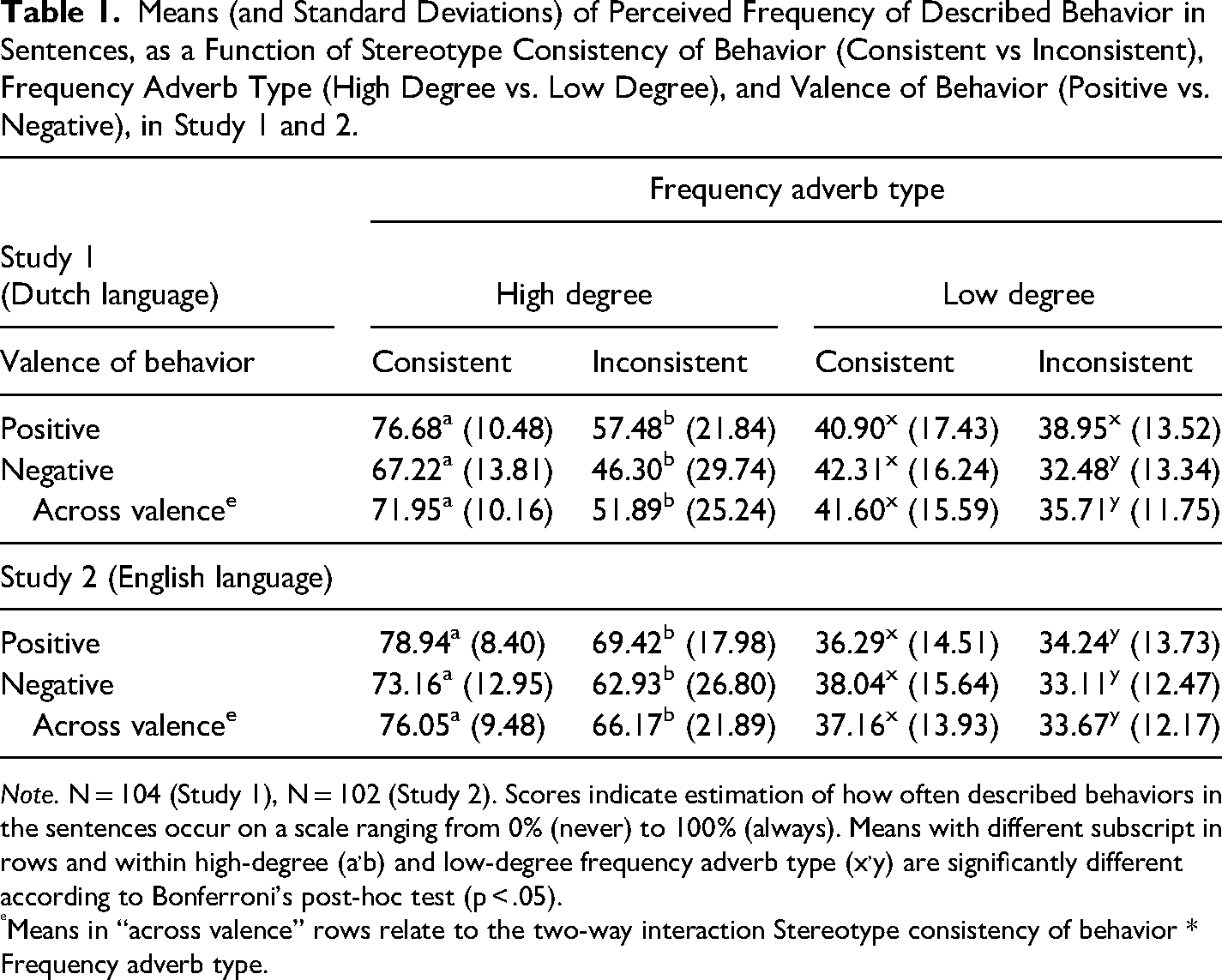
Note. N = 104 (Study 1), N = 102 (Study 2). Scores indicate estimation of how often described behaviors in the sentences occur on a scale ranging from 0% (never) to 100% (always). Means with different subscript in rows and within high-degree (a,b) and low-degree frequency adverb type (x,y) are significantly different according to Bonferroni's post-hoc test (p < .05).
Means in “across valence” rows relate to the two-way interaction Stereotype consistency of behavior * Frequency adverb type.
Results of Repeated-Measures ANOVAs for Study 1 and 2, with 2 (Stereotype Consistency of Behavior: Consistent vs. Inconsistent) x 2 (Frequency Adverb Type: High Degree vs. Low Degree) x 2 (Valence of Behavior: Positive vs. Negative) and Perceived Frequency of Described Behavior as the Dependent Variable.
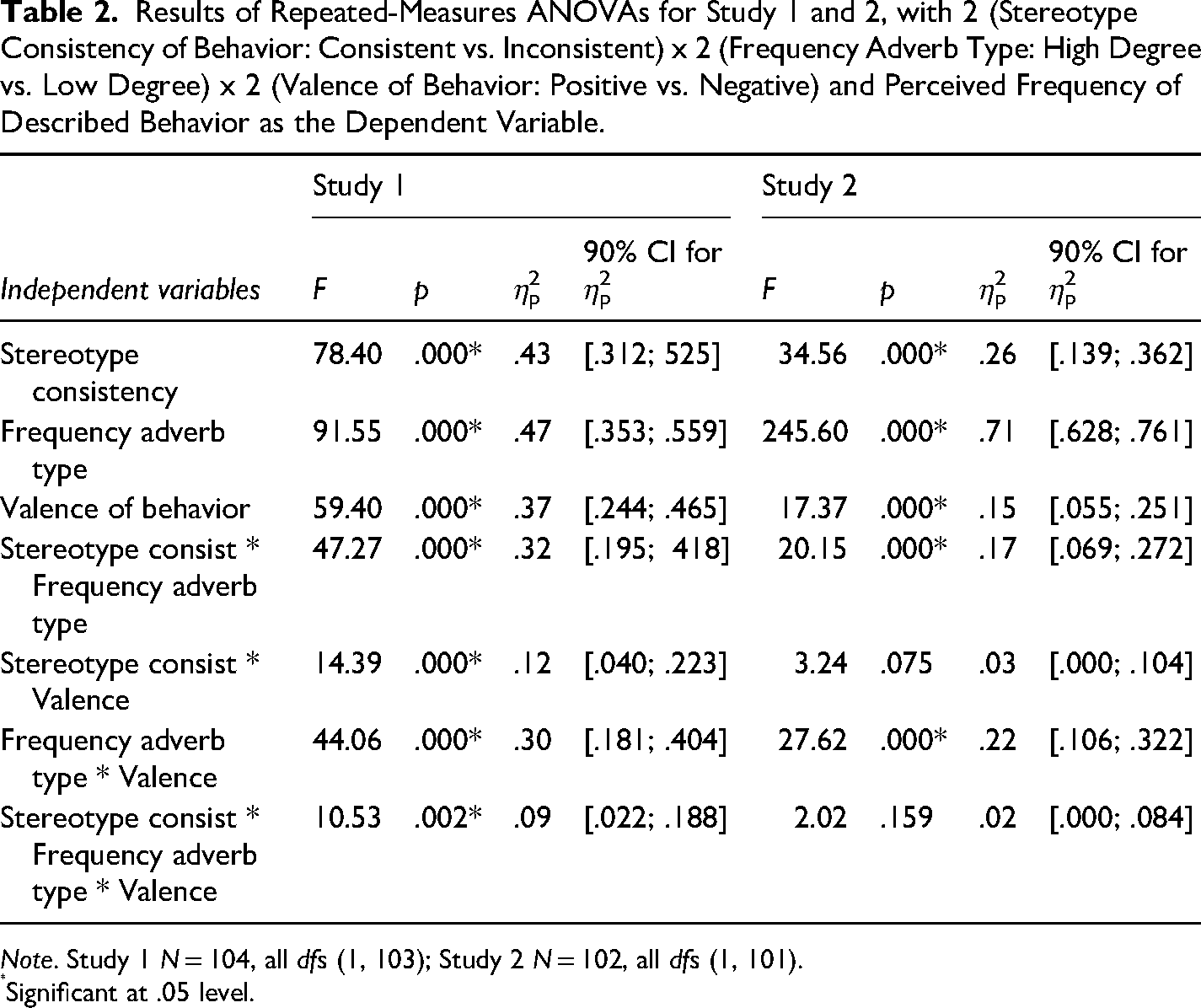
Note. Study 1 N = 104, all dfs (1, 103); Study 2 N = 102, all dfs (1, 101).
Significant at .05 level.
First, in both studies, we found main effects of frequency adverb type showing that perceived frequency was, unsurprisingly, higher when sentences contain high-frequency adverbs (Study 1: M = 61.92, SE =1.56; Study 2: M = 71.11, SE =1.45) versus low-frequency adverbs (Study 1: M = 38.66, SE = 1.17; Study 2: M = 35.42, SE = 1.21). Main effects of behavioral valence showed that perceived frequency was higher for sentences describing positive (Study 1: M = 53.50, SE = 0.58; Study 2: M = 54.72, SE = 0.65) versus negative behaviors (Study 1: M = 47.08, SE = 0.92; Study 2: M = 51.81, SE = 0.89).
More importantly, we found main effects of stereotype consistency, confirming H1 in both studies. Across different frequency adverbs, perceived frequency was higher for sentences describing stereotype-consistent (Study 1: M = 56.78, SE = 0.77; Study 2: M = 56.61, SE = 0.65) versus stereotype-inconsistent behaviors (Study 1: M = 43.80, SE = 1.15; Study 2: M = 49.92, SE = 1.10).
With respect to RQ1a, significant interactions between stereotype consistency and frequency adverb type showed that the effect of stereotype consistency was stronger for sentences with high-degree (vs. low-degree) frequency adverbs. That is, in both studies Bonferroni corrected post-hoc analyses (Table 1) showed that the mean difference between consistent and inconsistent was much larger for sentences with high-degree adverbs (Study 1: Mdifference = 20.06; Study 2: Mdifference = 9.88, p < .001) than for sentences with low-degree adverbs Study 1: Mdifference = 5.89; Study 2: Mdifference = 3.49, p < .001).
Effects of valence (RQ1b) were inconsistent across studies. Study 1 revealed a relatively small interaction effect between stereotype consistency and valence, and a three-way interaction effect. Both interaction effects did not replicate in Study 2 2 . This suggests that behavioral valence is not a meaningful factor.
Discussion
This study investigated whether recipient interpretations of quantitative expressions about actors’ behaviors are influenced by stereotypic expectancies. Confirming H1, two experiments (one in Dutch and one in English) showed that recipients indeed infer a higher numerical frequency when behaviors are stereotype-consistent (vs. inconsistent) for the actor. Even though the stereotype-consistent and stereotype-inconsistent behavior descriptions contained identical words, recipient interpretations differed in line with their stereotypic expectations. The type of frequency adverb (high, low degree; RQ1a) moderated the effect of stereotype consistency in that the effect of stereotype consistency was stronger for sentences with high-degree (vs. low-degree) frequency adverbs. Study 1 also revealed a moderation of behavioral valence, which was not replicated in Study 2 (RQ1b).
Our findings align with previous work showing that people use stereotypes to interpret ambiguous expressions (Fasoli et al., 2020; Pexman & Olineck, 2002) and descriptions of target persons (Dunning & Sherman, 1997; Gawronski et al., 2003; Kunda & Sherman-Williams, 1993; Sagar & Schofield, 1980). Where this earlier work mainly focused on biased interpretations of the content of behavior descriptions (e.g., hitting somebody; Kunda & Sherman-Williams, 1993), the present findings demonstrate how stereotypes affect interpretations of the generally applicable lexical category of quantity expressions.
Our findings can be explained by automatic activation of stereotypic associations (Gawronski et al., 2003; Kunda & Sherman-Williams, 1993) as well as a shifting-standards perspective (Biernat & Manis, 1994). That is, when reading behavior descriptions like “The grandfather (vs. teenager) frequently writes a letter to communicate with family and friends” recipients automatically activate stereotypic associations about grandfathers (vs. teenagers) and a standard to which the described behavior is compared, which then biases their interpretation of frequently.
More broadly, our results relate to a general human tendency to interpret ambiguous information in a manner congruent with current beliefs and expectations (Budescu et al., 2012). Research on the confirmation bias has shown how people's patterns of search, evaluation, weighting and interpretation of evidence are systematically biased in the direction of their expectations, hypotheses and beliefs. Thus, people tend to give a stronger weight to information that is supportive (vs. contradictory) of their beliefs (Nickerson, 1998; Oeberst & Imhoff, 2023). Our studies show that, regardless of speakers’ communicative intentions, recipient interpretations of statements about individuals can be driven by stereotypic expectations that, by definition, do not apply to all individual cases. Consequently, a neutral descriptive statement about a person can turn into a stereotype-confirming piece of information, which, in turn, can induce further judgments and behavior towards this individual.
Our findings have important implications for our understanding of the role of (inferences from) language in stereotype maintenance. Research on linguistic bias (Beukeboom & Burgers, 2019) has shown that stereotypes are reflected in subtle variations in speakers’ word choices (e.g., using abstract vs. concrete terms, Wigboldus et al., 2000; using affirmations vs. negations, Beukeboom et al., 2010; using literal statements vs. irony, Burgers & Beukeboom, 2016). Such biased variations in language use, in turn, feed stereotypic inferences in message recipients, which creates a self-perpetuating cycle in which social-category cognition is continuously shared and maintained (Beukeboom & Burgers, 2019). Our paper adds to this field by showing that recipient inferences alone can be biased by stereotypic expectancies even when identical words are used to describe target persons’ behavior. This introduces an additional mechanism contributing to stereotype maintenance.
Complementing earlier work primarily focusing on linguistic content (Kunda & Sherman-Williams, 1993; Dunning & Sherman, 1997), we show how a specific lexical category is sensitive to biased interpretations. Although the effect of stereotype consistency was present across adverb types, behaviors, and social categories, the moderation of frequency adverb type suggests that interpretations of sentences containing high-degree adverbs (e.g., often, frequently) were influenced more by stereotypes than interpretations of sentences with low-degree adverbs (e.g., sometimes, occasionally). A tentative explanation may relate to the level of certainty conveyed by high-degree (vs. low-degree) frequency adverbs (Dhami & Mandel, 2022). Pepper and Prytulak (1974) and Wallsten et al. (1986) showed that high-degree quantifiers were more sensitive to context variations than low-degree quantifiers. Wallsten et al. (1986) suggested that high-degree quantifiers are vaguer in their meaning and have a broader interval of potential numerical interpretations, while low-degree quantifiers are more precise.
This explanation fits with the observation that effects of stereotypes on impression formation are mainly found when language use is ambiguous (Kunda & Sherman-Williams, 1993; Pexman & Olineck, 2002). Indeed, when more information was provided about individual behaviors (Kunda & Sherman-Williams, 1993) or more contextual cues were given about the utterance (Pexman & Olineck, 2002), stereotypes did not induce different interpretations. If high-frequency expressions are indeed perceived as more ambiguous in their conveyed meaning than low-frequency expressions, it is particularly for these high-frequency expressions that recipients rely on activated stereotypes to disambiguate their meaning. Future research may provide more insight about the further contextual and linguistic factors that play a role in the effects of stereotypes on recipient inferences.
Some limitations of our studies should be noted. First, both studies provide empirical evidence for biased interpretations of quantitative expressions in an experimental setting. Our set-up used balanced sentences that only varied in stereotype consistency which allows for a careful test of the effects of stereotype consistency while keeping language content and formulations identical. At the same time, this set-up relies on a limited set of social categories and behaviors. Furthermore, experimenter-generated sentences come at the cost of ecological validity. Also, in our within-participants design participants were presented with all experimental variations, which could result in a contrast effect in which differences are amplified. Please also note that our behavioral valence manipulation was not very strong, as our focus in creating stimulus sets was on stereotype consistency. To further test external validity and robustness of our findings, future research could extend to other materials, other settings, and other types of linguistic expressions. This could, for instance, be done by focusing on texts that more closely resemble real-life situations (e.g., using actual performance evaluation reports).
In all, we provide an impetus for more research addressing effects of stereotypes on recipient inferences in communication. Daily language use is filled with vague expressions requiring recipient interpretation (Bradburn & Miles, 1979; Jucker et al., 2003). In various contexts such as performance evaluations (e.g., “Donald is mostly on time”) and medicine (e.g., Donald has “some risk” of contracting a disease), stereotypes can induce recipients to infer meanings, and corresponding responses, in line with their expectations. Thus, even when a speaker's intention is fair and unbiased, recipient inferences alone can still lead to stereotype confirmation and maintenance. By revealing such mechanisms, people may become more aware of their biases, which, in turn, could prevent potentially negative effects.
Footnotes
Acknowledgements
We like to thank the editor and anonymous reviewers for their constructive feedback on this article.
Declaration of Conflicting Interests
The authors declared no potential conflicts of interest with respect to the research, authorship, and/or publication of this article.
Funding
The authors received no financial support for the research, authorship, and/or publication of this article.
