




Abstract
The recognised educational opportunities to stimulate children's creative potential make the early identification of creativity an important research challenge. The aim of the present study was to investigate the creative potential of school-aged children in France and Slovenia. The Evaluation of Potential Creativity (EPoC) battery was used to measure creative potential through eight divergent-exploratory and convergent-integrative creative thinking tasks in the graphic and verbal domains. The results show that creative giftedness is rather rare according to the type of thinking process (divergent vs. integrative), and it is best characterised by a domain-specific approach to creativity (verbal vs. graphic) compared to four EPoC thinking process-domain specific indices, regardless of the educational context. In both countries, the results show that there is no specific subtype of process-domain giftedness that is more common than another. Differences in age and educational context are highlighted. Finally, tailored educational interventions are proposed to promote children's creativity
In the landscape of giftedness research, a nuanced distinction is often made between intellectual and creative giftedness, reflecting the multifaceted nature of human potential.
According to contemporary theories, giftedness is a multidimensional construct, encompassing a range of intellectual, creative, and socio-emotional abilities to achieve an exceptional level of aptitude or competence in one or more domains (Ambrose, 2021; Kaufman & Sternberg, 2008; Subotnik et al., 2011). Giftedness is not just about high IQ, but also includes creativity, motivation and a range of other variables that contribute to exceptional performance in different domains (Gagné, 2021; Renzulli, 2005; Renzulli & Reis, 2018). Several theories of giftedness (Gardner, 1983; Renzulli, 2005; Sternberg, 2003) and empirical research showing that intelligence is at least partially independent of creativity (e.g., Guignard & Lubart, 2007; Karwowski et al., 2016; Kim, 2005; Livne & Milgram, 2006) have led to the distinction between intellectual (academic) and creative giftedness, which manifests itself in specific domains such as social, mathematical, and musical expression (Baer, 2012, 2015).
Creativity is defined as the ability to generate new productions that are meaningful in a social context (Kampylis & Valtanen, 2010; Kaufman & Sternberg, 2010; Lubart, 1994; Plucker et al., 2018). Creative giftedness, according to contemporary scholars (Besançon et al., 2013; Lubart & Zenasni, 2010; Runco, 2005; Sternberg & Lubart, 1995; Zenasni et al., 2016), refers to an exceptional ability to generate ideas, original solutions, or products with a high degree of novelty and value. This form of giftedness is stimulated by ill-defined problems and is characterized by a high potential for original thinking, involving a complex interplay of cognitive processes, personality traits, and environmental factors that together facilitate high levels of creative output and favour divergent and associative thinking.
Academic giftedness, traditionally quantified by measures such as IQ tests (Sternberg, 1999; Sternberg & Kaufman, 2018), emphasises cognitive processes in analytical thinking, logical reasoning and problem-solving skills, and is associated with motivation and exceptional performance in academic and logical tasks. It is characterised by a high level of hypothetico-deductive reasoning (Evans, 2007; Kalinowski & Pelakh, 2024; Lawson, 1995) and the generation of rapid solutions to well-defined problems. In contrast, creative giftedness captures a different spectrum of human abilities, (Gardner, 1983; Kaufman & Sternberg, 2010; Lubart, 1994; Plucker et al., 2018; Zenasni et al., 2016). Kim’s (2005) meta-analysis found a small average correlation coefficient between creativity and intelligence (r = .17) and Batey and Furnham’s (2006) empirical review from the earliest research at the end of the 19th century onwards also confirmed a prevailing small positive relationship. In addition, weak but statistically significant correlations were found between scores on the Wechsler Intelligence Scale for children and adolescents (WISC-IV) and Evaluation of Potential of Creativity (EPoC) scores for processing speed and divergent graphic (r = .21), and for perceptual reasoning and integrative verbal (r = −.24) in a sample of 118 intellectually gifted children (total IQ ≥130) in France (Guignard et al., 2016). On the contrary, a Slovenian sample of 46 intellectually gifted students did not show significant correlations between Raven’s Standard Progressive Matrices (SPM) and EPoC scores (Juriševič & Žerak, 2023). Breit et al. (2023) found a positive relationship between fluid intelligence and divergent thinking, using the Berlin Structure-of-Intelligence Test (BIS-HB; Jäger et al., 2006), with some evidence that fluid intelligence, as an indicator of general intelligence, is a necessary but not sufficient condition for divergent thinking as an indicator of creativity. Furthermore, the threshold hypothesis has been confirmed in some other studies (e.g., Cho et al., 2010; Guilford, 1973; Jauk et al., 2013; Karwowski & Gralewski, 2013; Shi et al., 2017).
Given the theoretical distinction between academic and creative giftedness (Kaufman et al., 2009; Renzulli, 2005; Zenasni et al., 2016), supported by initial empirical studies (Abraham, 2013; Carson et al., 2003; Kim, 2005; Runco, 2005) it is valuable to note how creative giftedness can be identified. There are four main ways (Lubart et al., 2019, 2022). First, children, adolescents or adults’ accomplishments indicate when they are highly creative, that the individual has high potential, and has been successful in using that potential. Second, teachers and other adults who serve as gatekeepers may recognize the creative potential of an individual compared to their observations of peers of the observed student. Third, activities, clubs or competitions may provide structured task situations in which high intellectual and creative potential can be expressed. Examples are math and science fairs, or international club-based competitions, like Olympics of the Mind, which focus on creative problem solving (Campbell et al., 2017; Lubart et al., 2022; Pitta-Pantazi, 2017). Fourth, and finally, there are psychometric tests that allow divergent, convergent or both processes to be assessed to detect high potential. Notably, this approach has been used to identify gifted creative children and adolescents. The Torrance test of Creative Thinking or TTCT (Torrance, 1974) is normed, and serves this purpose, but it focuses heavily on divergent thinking, in graphic and verbal domains. In contrast, the Test for Creative Thinking-Drawing Production or TCT-DP (Urban & Jellen, 1996) focuses on a graphic drawing task that involves a creative synthesis of several elements that are provided; there are widely-available norms for this task.
In a synthesis of different assessment psychometric tests, the EPoC battery was proposed (Lubart et al., 2011). This battery includes both divergent-exploratory and convergent-integrative tasks of creative ideation in each domain of production, graphic and verbal; furthermore, the development of test tasks in other domains (social, scientific, mathematical, musical, body movement) is ongoing. Thus, creative potential is measured through two key creative thinking-processes: divergent-exploratory and convergent-integrative in specific domains (Lubart et al., 2011).
Divergent-exploratory thinking, producing many diverse ideas from a stimulus, is well known as a key aspect of creativity since more than a century of work. Divergent-exploratory thinking tasks use fluency-based scores, which are highly correlated with originality measures (de Vries & Lubart, 2019; Guilford, 1950). The divergent-exploratory thinking tasks (i.e., story beginnings, endings, and drawings for abstract or concrete photo stimuli) are norm referenced (performance was compared to the subject’s age group). Specifically, these tasks are scored by counting the number of relevant verbal or graphic productions (Lubart et al., 2011).
The convergent-integrative thinking process refers to the activity of combining, integrating or synthesising elements in new ways, which is another crucial component of creative production (Barbot, Lubart, & Besançon, 2016; Lubart et al., 2011). Conceptually, convergent-integrative thinking tasks include cognitive components such as associative reasoning (e.g., combining distant elements), selective comparison and combination, and conative components such as tolerance of ambiguity, risk-taking and achievement motivation (Barbot, Besançon, & Lubart, 2016; Cropley, 2006; Lubart, 2001). To measure reliably both thinking processes involved in creative production, the EPoC operationalises creative potential as simultaneously domain-specific and thinking process-specific, resulting in an individual’s creative potential profile that indicates relative strengths and weaknesses in each thinking process-domain unit (Barbot, Lubart, & Besançon, 2016; Lubart et al., 2011). Accordingly, activities and programs designed to develop creative potential in school-age children should implement differentiated, targeted approaches that cultivate both dominant and less-developed creative capacities, thereby optimally taking into account each student’s creative potential profile.
Purpose of the Present Study
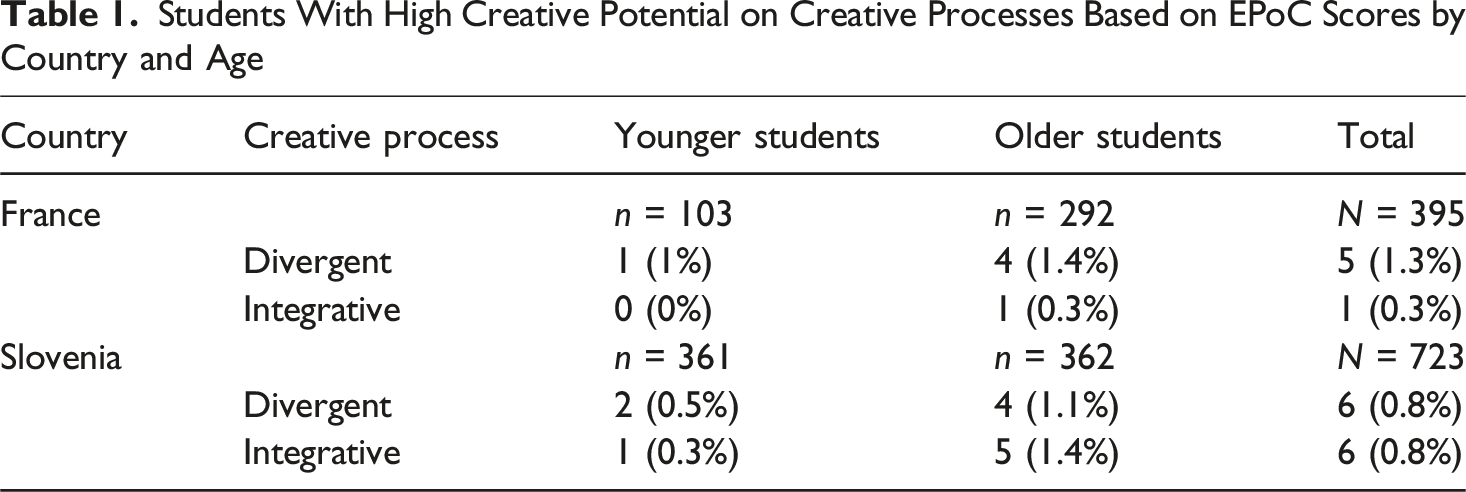
In the present study we explored creative giftedness using the Evaluation of Potential Creativity (EPoC) battery; the main aim was to analyse the profiles of high creative potential in school-age students from France and Slovenia. This comparison was chosen because both French and Slovenian norms exist for EPoC, and these two European countries, with comparable cultural and educational systems allow the relative frequency of different profiles of high creative potential to be assessed (Eurypedia, 2025; Odnosi, 2024). Specifically, we aimed to examine how many children demonstrated the highest level of creative potential in both divergent and integrative thinking, in both the verbal and graphic domains, and in combinations of these (i.e. a fully creative giftedness profile), and how many demonstrated the highest level of creative potential in just one of these areas (i.e. a partial creative giftedness profile); the following three research questions were formulated. RQ1: What is the frequency of high creative potential profiles according to the thinking processes involved in creativity (divergent vs. integrative thinking)? RQ2: What is the frequency of high creative potential profiles according to domain-specific approach to creativity (verbal vs. graphic)? RQ3: What is the frequency of high potential profiles in the combined EPoC thinking process-domain indices (divergent-graphic, divergent-verbal, integrative-graphic, and integrative-verbal)?
For each of the research questions, we were also interested in any differences that might exist between French and Slovenian students, or between younger and older students.
Method
Participants
The participants in this study came from the large cities in two countries using a convenience sampling method. The French sample consisted of 395 children aged 5 to 13 (M = 9.7, SD = 2.1; 51% girls, 49% boys) from eight French public schools (four elementary schools & first year on four secondary schools), from Paris and Lyon regions. The Slovenian sample consisted of 723 students aged 5 to 13 (M = 9.0, SD = 1.8; 52% girls, 48% boys) from eight Slovenian public elementary schools and one preschool from Ljubljana’ region. The students were divided into two age groups according to their level of education. This equates to the second and third cycles of the French elementary school system and the first and second cycles in Slovenia, respectively. Specifically, the younger group comprised students aged 5 to 9 (n French = 103; n Slovenian = 361) whereas the older group comprised students aged 10 to 13 (n French = 292; n Slovenian = 362). Parental consent was obtained before the test was administered, and only students whose parents provided signed informed consent participated in the study. The study was conducted in accordance with the ethical principles of the Declaration of Helsinki (World Medical Association, 2013).
Instrument
Creative potential was assessed by The Evaluation of Creative Potential (EPoC) battery (Lubart et al., 2011). EPoC consists of eight divergent-exploratory and convergent-integrative creative thinking tasks in two content domains, i. e. verbal and graphic; it is administered individually in two sessions of 45 min (four tasks each session) one week apart. The battery was standardised in both countries, and the scoring system was applied according to the manual (Juriševič & Žerak, 2023; Lubart et al., 2011). In France the norming sample included 213 children and adolescents aged from 4 to 11 years (52% girls, 48% boys) and in Slovenia the norming sample included 723 children and adolescents aged 5 to 12 years (52% girls and 48% boys). Confirmatory factor analyses on the norming samples were conducted in R with the lavaan package (Rosseel, 2012), with the robust maximum likelihood estimator (MLM –maximum likelihood parameter estimation with standard errors and mean-adjusted chi-square test statistics that are robust to non-normality). Internal structure showed the good fit of the French (χ2 = 32.5; df = 14; p = .05; χ2/df = 2.3; RMSEA = .08; CFI = .97; TLI = .94) and Slovenia data (χ2 = 30.2; df = 14; p = .007; χ2/df = 2.2; RMSEA = .03; CFI = 1.00; TLI = .99) from the norming samples (Juriševič & Žerak, 2023, 2024; Lubart et al., 2011) to the hypothesized theoretical model.
Procedure
The EPoC battery was administered following the standardised protocol (Lubart et al., 2011). A team of 11 school psychologists and 2 student teachers collected the data in Slovenia, and a team of 4 psychological researchers collected the data in France. All researchers were trained in the use of the EPoC battery.
The divergent-exploratory thinking tasks were scored for fluency based on the number of ideas generated. The convergent-integrative tasks were criterion-referenced and were scored on a 7-point scale, ranging from 1-low creativity to 7-high creativity. Trained judges (i.e. members of the expert team) evaluated independently the creativity of each story and the drawings, using the same scoring system. Inter-rater reliability was calculated (ICC ≥.90), and a final score for the task was a consensus between two independent judges for the production.
The cut-off criteria for detecting high creative potential were established depending on the specific research questions. The EPoC battery uses a scoring system based on a typical score of 100 (average individual) and a standard deviation of 15 points (like the traditional IQ scale). A first cut-off score is based on obtaining a score two standard deviations above the mean of 100 on the two divergent and two convergent tasks for each domain, verbal and graphic. Second, to identify the creatively gifted in graphic, verbal or both domains, the 2.5% of top scores in the particular domain was used. Third, the score 130 and above on single EPoC indices (e.g. divergent-graphic) was used to identify specific forms of creative giftedness.
The chi-square test was used to determine if the observed frequencies differed from the expected frequencies and chi-square independence test was used to examine the differences in frequencies between samples from two countries. When appropriate, Fisher’s exact test was calculated (Field, 2018).
Results
A comparison between French and Slovene school-age children with high creative potential was conducted. The results are presented below according to the research questions.
Students With High Creative Potential on Creative Processes Based on EPoC Scores by Country and Age
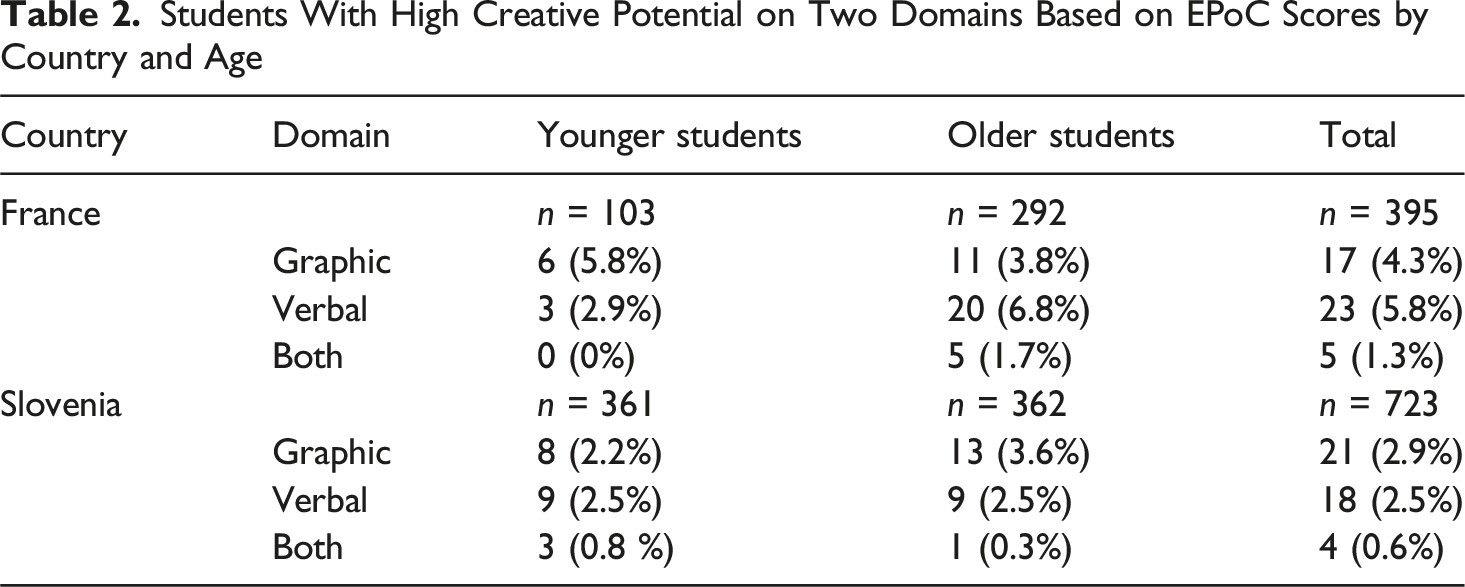
Students With High Creative Potential on Two Domains Based on EPoC Scores by Country and Age
Students With High Creative Potential on EPoC Indices Based on EPoC Scores by Country and Age
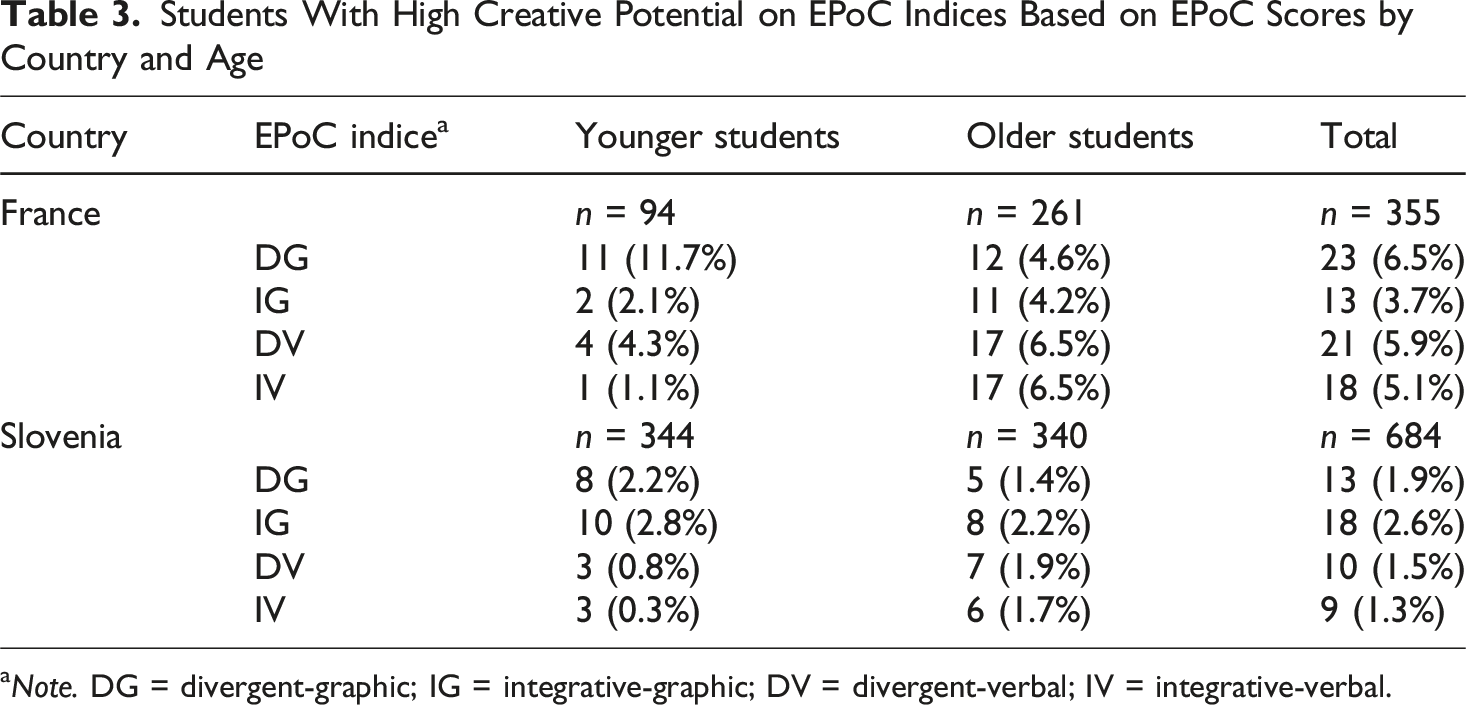
aNote. DG = divergent-graphic; IG = integrative-graphic; DV = divergent-verbal; IV = integrative-verbal.
The chi-square test showed that the proportions of the total sample identified as highly creative students on any particular one of the four EPoC indices, i.e., divergent-graphic, integrative-graphic, divergent-verbal, and integrative-verbal did not differ significantly from chance expectations in France (χ 2 = 3.02; df = 3; p = .39) or in Slovenia (χ 2 = 3.92; df = 3; p = .27). Thus, in both countries, the results reveal that there is no specific subtype of specific process-domain giftedness, which is more frequent than another.
The chi-squared test showed that the proportions of students in the total sample differed significantly between France and Slovenia in three of four EPoC indices, i.e. in divergent-graphic (χ 2 = 14.65; df = 1; p < .001), divergent-verbal (χ 2 = 16.01; df = 1; p < .001) and integrative-verbal (χ 2 = 13.02; df = 1; p < .001); the difference was not significant in the integrative-graphic (χ 2 = 0.86; df = 1; p = .36) EPoC indice.
Discussion
The present study attempted to detect creative giftedness in French and Slovenian school-age children using the Evaluation of Potential Creativity (EPoC) battery. Consistent with previous research on individuals displaying exceptional levels of creativity in multiple domains (e.g., Baer, 1996; Barbot & Tinio, 2015), the results showed that in both countries identification of creative potential is better characterized by domain (graphic and verbal) than thinking process-related (divergent and integrative) descriptions across domains. Namely, creative giftedness by thinking process type is quite rare on both domains simultaneously, suggesting that this is not an optimal way of identifying creative giftedness. Thus, these forms of thinking, which are integral to the creative process, appear to be influenced by the specific field of expression. Future research should further investigate the distinct roles of divergent and integrative thinking across different domains and task contexts, as well as potential developmental trajectories over time (e.g., more domain-general processes in early childhood followed by increasing specialization). These findings also underscore important developmental and methodological considerations for subsequent research, aimed at advancing a more comprehensive and nuanced understanding of creative giftedness profiles in childhood.
In line with previous research on the developmental trajectories of creativity in children and adolescents (Barbot, Lubart, & Besançon, 2016), the results from the French educational context showed a higher proportion of older students identified as creatively gifted in the verbal domain and in three specific EPoC indices (i.e., divergent-verbal, integrative-graphic, integrative-verbal). However, when comparing students’ creative potential in French and Slovenian educational contexts, the proportion of identified creatively gifted students in the verbal domain is significantly higher only in France, as well as in three out of four specific EPoC indices (i.e. divergent-graphic, divergent-verbal and integrative-verbal). This finding could also be understood from the described developmental perspective on an overall upward trend in divergent thinking (Eon Duval et al., 2023; Said-Metwaly et al., 2021; Torrance, 1968), as the French sample was on average slightly older than the Slovenian sample (Hodges’ g = 0.37). Furthermore, it could also be understood from an ecological perspective (Bronfenbrenner, 1979), i.e. considering the socio-environmental influences on students’ creativity that extend beyond school systems in respective countries. Namely, creativity is context dependent, and school and family environments are influential in nurturing and developing students’ creative potential (Acar et al., 2022; Beghetto & Kaufman, 2014; Cheung et al., 2016; Gustafsson, 2022; Kwaśniewska et al., 2018; Niu & Sternberg, 2003; Park et al., 2023). Different cultures may strengthen different skills and cognitive processes (Niu & Sternberg, 2003; Storme et al., 2017). This could explain why the proportion of people who are creatively gifted in the verbal domain is significantly higher in France than in Slovenia, besides the age factor. Cultural differences could also be due to differences in values, which could determine the extent to which individuals invest in creative achievements (Storme et al., 2017). The influences of societal values and schooling could influence students’ creativity (Niu & Sternberg, 2003), which could mean that the French education system offers opportunities and encourages creative behaviour to a greater extent than the Slovenian one (OECD, 2024). Data from the creative thinking test in the PISA 2022 survey show that Slovenian adolescents are below the OECD average in creative thinking and have more negative attitudes towards various aspects of creativity. On the other hand, French adolescents performed at the OECD average in creative thinking, with relatively high self-reported levels of imagination, openness to intellect and creative self-efficacy (OECD, 2024). Of course, cross-cultural differences between France and Slovenia, specifically in the verbal domain, should be interpreted with caution, due to possible methodological biases (Cheung et al., 2016; Lau et al., 2013; Lubart, 2010).
It is important to note the limitations of this study. First, information about students’ characteristics that could impact the expression of creative potential (i.e. socio-economic status, intellectual abilities, personality traits, motivation) and environmental variables (creative climate in schools, teachers’ attitudes, different pedagogical approaches, differences in educational systems, cross-cultural differences) would contribute to the greater understanding of students’ creative giftedness. Second, it would be meaningful to explore further the influence of students’ socioeconomic background on creative giftedness, as some research suggests that students’ socio-economic status influences the development of students’ creative potential (Acar et al., 2022; Castillo-Vergara et al., 2018; Lu et al., 2024; OECD, 2024). Another limitation of the present study is also the relatively small sample size and the lack of information on the influence of family background (Kwaśniewska et al., 2018), perceived parenting, and extracurricular activities of the participants in the sample, as recent research suggests that children’s perceived parenting, family socio-economic status and participation in extracurricular activities play a critical role in the development of creativity (Liang et al., 2021). Finally, a longitudinal research design (Park et al., 2023; Runco, 2000; Torrance, 1968) would shed light on developmental trajectories of students’ creative potential and could inform further inclusive educational interventions.
Educational Implications
Fostering students’ creativity is becoming one of the most important goals of education in the information-driven economy of the 21st century, alongside critical thinking, problem solving, decision making, learning to learn and metacognition (Binkley et al., 2012; OECD, 2022). As creative potential of students can be nurtured, it is important that the promotion of creativity is addressed clearly and systematically implemented throughout the education system (Besançon et al., 2021; Vincent-Lancrin et al., 2019). Based on the findings of this study, we recognise the importance of identifying creative giftedness more precisely (i. e. full or partial creative giftedness). This information could improve our understanding of the specific educational support required for students of different ages and subjects’ areas. Several creative thinking training programs have been designed as sequences of educational activities (Alves-Oliveira et al., 2021). The effects of the programs on students’ creative performance show that programs focusing on idea generation (divergent thinking) and cognitive training are the most effective. In addition, the influence of age can be noted: the older the children, the greater the effects (Ma, 2006).
Creative pedagogy (Besançon et al., 2021; Craft, 2005; Lin, 2011; Munro, 2019; OECD, 2022) emphasises the confluence of three elements in nurturing students’ creative potential: teaching for creativity, which refers to (a) identifying and nurturing students’ creativity and providing opportunities for students to be creative; (b) teaching creatively, using imaginative approaches to make learning more interesting and effective; and (c) learning creatively, learning that stimulates creativity. In addition, creating a learning community with a creative school climate also plays a crucial role in developing creativity in schools (Davies et al., 2013).
In line with the findings regarding the identification of creative giftedness and full or partial creative potential profiles from the present research we suggest applying the inclusive approach to foster creative potential in gifted children and adolescents by addressing students’ diversity in their creative potential along different curricula domains with a tiered teaching and learning response-to-intervention model (RTI, Coleman & Johnsen, 2021; Greenwood et al., 2011; Hughes & Dexter, 2011). Namely, RTI framework could be applied to support the most salient aspects of students’ creative profiles, alongside progress monitoring, and research-based curriculum interventions within a collaborative school community including teachers, parents, and school psychologists. Initial teacher education and continuous professional development courses for teachers in creativity may positively influence teachers’ beliefs and therefore contribute to creativity-fostering educational practices (American Psychological Association, 2017; Bereczki & Karpati, 2018; Kettler et al., 2018; Munro, 2019).
The development of creative giftedness in schools remains a challenge (Ambrose & Machek, 2015; Beghetto & Kaufman, 2014), partly due to the issues related to the early identification of children’s creativity (i.e., chronological age, limited range of expression of creative abilities, the assessment criteria, the observation, and assessment competencies of educators) and partly to other constraints and limitations, including the lack of empirical studies in school-aged children (Beloyianni & Zbainos, 2021; Bereczki & Karpati, 2018; Said-Metwaly et al., 2017), and the fact that highly creative students might be overlooked as gifted by teachers because of lack of their professional knowledge on characteristics of creative giftedness (Renzulli, 2004).
The comprehensive identification of children’s creative potential using multidimensional, contextual assessment approaches, such as the EPoC framework, can greatly facilitate both the evaluation and promotion of creative giftedness. Detailed profiles of children’s creative potential further enable educators to plan developmentally sensitive instruction and to design personalised educational approaches—common in gifted education—or specialised creativity programmes (Agnoli et al., 2022) that optimally address the psychosocial and cognitive needs of creatively gifted children.
Footnotes

Funding
The authors disclosed receipt of the following financial support for the research, authorship, and/or publication of this article: This work was supported by the The Slovenian Research and Innovation Agency; J5-4573, P5-0451, V5-24062.
Declaration of conflicting interests
The authors declared no potential conflicts of interest with respect to the research, authorship, and/or publication of this article.