



Abstract
This article seeks to raise awareness. Despite the centrality of creative expression in art education, giftedness often remains unrecognised or misunderstood in this domain. The absence of any consideration of seeing artists as gifted individuals leaves a serious gap in the pedagogy and curriculum design in higher arts education. This article wishes to address this consciousness gap, break it open, and add new layers to open possibilities for new ways of pedagogical interventions and curriculum adaptations. Another goal is to contribute to making higher arts education more inclusive by providing input for tailor-made education, and to help prevent artists from getting stuck. This article addresses the relationship between creativity and the creative process of artistic practice with giftedness, and argues whether knowledge about giftedness is ultimately necessary within interventions to help artists who struggle with ‘Artist’s Block’.
Introduction
The intersection of creativity and giftedness remains curiously underexplored, especially within the arts, where one might expect such connections to flourish. In the literature about talent development for artists, giftedness is not or is barely mentioned (Burnard, 2012; De Bruin et al., 2018; López-Íñiguez & McPherson, 2025). Rooted in traditional master-apprentice models and valuing intuitive creation over formal assessment (Gruber & Hobbs, 2002), many art schools lack the frameworks to identify or support gifted individuals. Giftedness is not part of standard teacher training programs (Mathijssen et al., 2021), and it cannot be determined from the literature whether this is also the case in teacher training for higher arts academies, conservatories, and other colleges for art education.
Creativity is considered a central factor in theories of giftedness (Bakx, 2019; Choi et al., 2016; Choi & Kaufman, 2021; Faber et al., 2021). Nevertheless, research by Carman (2013), which compared 104 different studies on intelligence, indicated that, despite frequent suggestions by researchers that an IQ score is not the sole criterion for identifying giftedness, it remains the most commonly used method for selecting gifted participants. Consequently, the application of theories of giftedness still appears to be largely confined to the cognitive domain.
A wide range of definitions has been proposed to describe creativity (Amabile & Pratt, 2016; Glăveanu, 2015; Sternberg & Lubart, 1991). Plucker (The Brainwaves Video Anthology, 2014b) conceptualizes creativity as the interaction among competence, process, and environment, through which an individual or group can generate an observable product that is both innovative and socially valuable. Differences in approaches to measuring creativity and in assessment methods may reflect a traditional view in which creative thinking and behavior are treated as fixed constructs, assessable through standardized measures (Beghetto & Karwowski, 2019; Corazza, 2016). Adopting a more dynamic perspective, one that incorporates uncertainty as a catalyst for creativity and recognizes that creative thought and action arise from an organic, evolving process (Beghetto & Corazza, 2019; Beghetto & Karwowski, 2019), can disrupt this fixed approach, thereby allowing the inherent complexity of creativity to be more fully appreciated (Beghetto & Karwowski, 2019).
Research on giftedness is likewise exhibiting a shift toward a more dynamic, process-oriented perspective (Bogoyavlenskaya, 2018; Dai & Chen, 2013; Lo & Porath, 2017), which enhances the potential for examining similarities and differences across the two domains. Consequently, the findings of this literature review are not only relevant to the study of creativity but also contribute to knowledge on giftedness. It further implies that additional research is needed to uncover the direct relationships between these areas.
Given the similarities in theories on creativity and giftedness (Plucker & Esping, 2015; Silvia, 2015), it is likely that there is a significant group of artists who exhibit characteristics of giftedness and face related challenges. It is also likely that among individuals with the potential to excel in creativity, a considerable percentage struggle with traits associated with giftedness (such as the inhibiting factors described in Heller’s Multifactor Model (achievement motivation, stress sensitivity, study strategies, self-regulation skills, and self-confidence/performance anxiety) (1991, 2000; 2004). Moreover, they may be confronted with stigmatization and implicit theories. Due to a lack of awareness about giftedness among teachers, mentors, or therapists, for instance, they may be misjudged or overlooked (Radboud Centrum Sociale Wetenschappen, 2022). This, in turn, can lead to misdiagnosis, inappropriate treatment, or unnecessary medication (Webb et al., 2005).
However, a quiet shift can be detected. The growing movement toward inclusion and (neuro)diversity in (Dutch) higher education (Ministry of Education, Culture and Science, 2020) brings with it increased attention to creatively talented students, including those with mental problems or with a study disability (Gerrit Rietveld Academy, Student Counsellor, z.d.; Studying With a Study Disability – ArtEZ, n.d.) or those considered twice exceptional (McCord, 2016). In parallel, awareness of giftedness and the necessity for differentiated support systems in higher education is gaining ground (Houten & Bruin, 2023). Literature in music education does address the need for creative ways for talent development for musically gifted children (Bareiß et al., 2024). It shows the use of Arts-Based Learning in music education curricula (Burnard, 2012), but it lacks empirical studies of giftedness in musical talents. Literature in music education points out that further research is needed, and specialised talent development programs for music talents should be developed towards a more holistic development of the student, and to see a music career as enrichment, instead of the performance-centric and outcomes-driven environments of the traditional vision (López-Íñiguez & McPherson, 2025; Sanders, 2025). In “Politics of Care,” López-Íñiguez and Westerlund (2023) discuss a much-needed shift in the rights of the talented music student, not just to nurture the talent to contribute to the system, but to let the system help the student develop their talent. In general, these findings add to the presumption that giftedness has not been researched for the benefit of arts education.
The Present Study
From the conceptual and hypothetical perspective outlined in the introduction, the following definition of giftedness is adopted:
‘Giftedness is a collection of observable behaviors, emotions, and attitudes that enable an individual, given appropriate conditions, environmental factors, and support, to develop capacities and skills that allow their individual talents to flourish in ways that are transcendent, innovative, and capable of evoking a sense of wonder.’
This literature review aims to bridge worlds. It wishes to integrate insights from giftedness research within the lived realities of artists.
The research aims to explore how knowledge of giftedness can inform arts education, examine creativity within giftedness models, define and contextualize ‘Artist’s Block’, and highlight the connections between creativity, art, and education in society. This leads to the following research question:
“What insights does the literature offer regarding a possible connection between artists getting stuck in their creative process and characteristics of giftedness?”
Before exploring the relative concepts in detail, a description of the methodology and the procedure employed is provided.
Method and Data Analysis
Artist’s Block, Overlap, Giftedness, and Flow (Selected Literature)
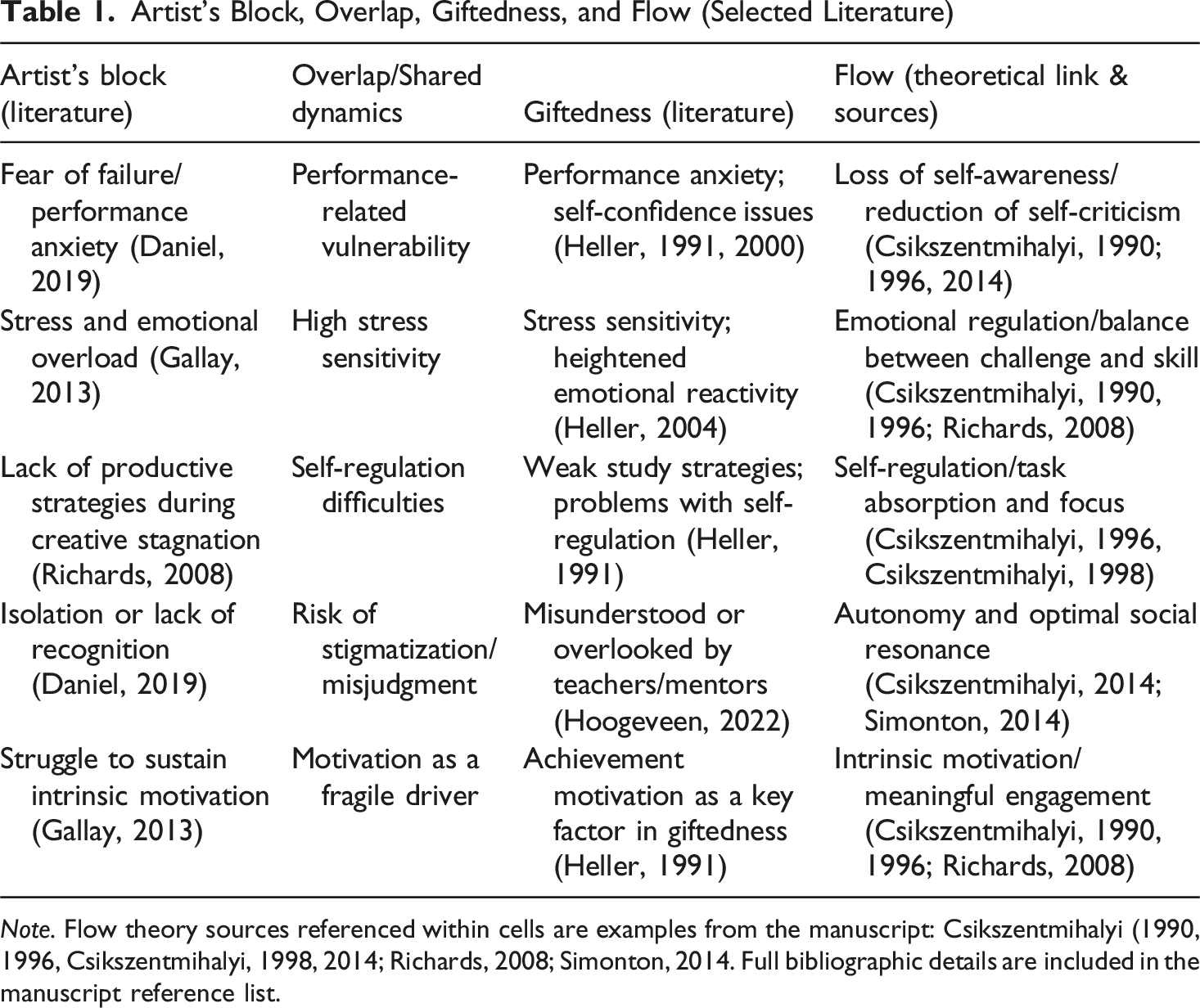
Note. Flow theory sources referenced within cells are examples from the manuscript: Csikszentmihalyi (1990, 1996, Csikszentmihalyi, 1998, 2014; Richards, 2008; Simonton, 2014. Full bibliographic details are included in the manuscript reference list.
The following search terms were entered (including Dutch terms):
Artificial creativity vs human creativity - artists creative process - artist’s block - artist definition - artists giftedness - artists perfectionism - artist research - art talent definitions - artists underachievers - artists view giftedness - arts high iq - creative artists work patterns - creative process longitudinal - componenten theorie van creativiteit - creativity - creativity is intelligence - defining art talent - dynamic model of giftedness - flow - folley musicians - four c - giftedness - giftedness AND talent - inclusive - investeringstheorie - high iq art - hoogbegaafdheid concept - impliciete theorieën - implicit theories - kenmerken hoogbegaafdheid - kunstenaar definitie - multifactorenmodel - Politics of Care - role creativity in giftedness - talent - ‘the gifted in art education’
The study employed an exploratory, process-oriented, and integrative approach, combining analytical methods with the researcher’s intuition, which was recognized as a valid component of the creative process (Pétervári et al., 2016; Raidl & Lubart, 2001). The integrative process behind this literature review emerged from a synergy of intuition and analysis, resulting in a subjective interpretation of overlap between ‘Artists’ Block’ and giftedness (Table 1).
Results
The study defined key concepts, compared theories of giftedness and creativity, mapped statements of artists and gifted individuals, and analyzed process-oriented factors to identify overlaps and potential relationships between Artist’s Block and models of creativity, the creative process, and giftedness.
The Artist and the Artist’s Practice
Over time, the question of what defines an artist has been approached from multiple perspectives. In addition to artistic capability, modern definitions often include income, entrepreneurship, and commercial success (Baldin & Bille, 2021; Lena & Lindemann, 2014). The literature consulted for this study primarily discusses the creative process of professional, generative artists: those who consistently produce new work and publicly present it, such as painters, sculptors, songwriters, and performance artists (Daniel, 2019; Gallay, 2013; Sternberg, 2018). To assess the value and potential of an artist’s practice, funding agencies and grant providers consider education, recent work, CV, and relationships. It is considered crucial to have an ambitious plan that is feasible and demonstrates entrepreneurship and innovation (Mondriaan Fund Terms and Conditions and Procedure - Mondriaan Fund, 2025).
The Creative Process
Artists have a strong drive to be creative (Gallay, 2013). They are skilled in the creative process, which can be described as a sequence of thoughts and actions that lead to original and appropriate productions (Botella et al., 2018; Botella & Lubart, 2015). Although the 4C model (Kaufman & Beghetto, 2009) is not a process model, it provides points of reference to focus on the moments in the creative process where artists experience stagnation. Therefore, it offers a useful framework for identifying the study population. This model is widely studied and referred to, and distinguishes four stages of creativity: mini-c (personal learning and discovery), little-c (everyday creativity at a hobbyist level), Pro-c (expert/professional creativity), and Big-C (eminent creativity). Obstacles often emerge in the transition from Pro-c to Big-C, where an artist moves from professional expertise toward creative genius (Csikszentmihalyi, 1998; Kaufman & Beghetto, 2009). The literature shows that interventions primarily focus on improving “little-c” creativity (Gallay, 2013; Hirst, 1992; Richards, 2008). This improvement in “little-c” creativity refers to creative developments within the personal context; it can be creative (i.e., new and innovative) for the individual, but not on a global scale, because someone else has already thought of it. Nevertheless, this personal “discovery process” can contribute to removing obstacles. However, this is a way to improve creativity in all individuals. No literature was found on interventions that increase creativity in professional artists (Gallay, 2013). This study focuses on this transitional stage from professional expertise to creative genius.
A creative genius is typically characterized by a complex and often contradictory personality (Csikszentmihalyi, 2014), a capacity to integrate knowledge from disparate domains, and the creation of at least one groundbreaking work within an established field (Simonton, 2019). Literature also indicates that creative geniuses frequently possess personality traits that may predispose them to depression and emotional instability (Daniel, 2019; Dewey et al., 1998; Gallay, 2013). Several factors that inhibit creativity in artists are documented in the literature. These include extreme self-criticism to the point of psychological harm (Kozbelt, 2016), maladaptive perfectionism, especially when it leads to compulsive performance improvement (Hill et al., 2015), and negative emotions (Botella et al., 2013). Paradoxically, success itself can reduce or even halt creative output (Cropley et al., 2010). Finally, motivation stands out as a critical factor; without it, other antecedents of creative achievement may lose their impact entirely (Gallay, 2013).
‘Artist’s Block’
In an empirical study exploring the concept of creativity from the perspective of artists, Daniel (2019) identified a range of inhibiting factors that appear consistently across respondents. According to the artists interviewed, creativity is negatively affected by (1) the pressure to repeatedly succeed, (2) negative emotions, (3) a negative self-image, (4) lack of motivation, (5) the need to conform to societal norms, and (6) the pressure to achieve repeatable success. Other factors are self-criticism; the necessity of earning a living through non-artistic employment; negative emotions; limited interpersonal communication skills required to promote their work; societal expectations; demanding clients; health conditions; prevailing conventions and limitations regarding style, medium, or aesthetics; difficult personal relationships; interference from curators in the creative process; and critical feedback from fellow artists and educators.
The top six most frequently cited barrier descriptions closely resemble what is often referred to in the literature as ‘Artist’s Block’ (Gallay, 2013; Richards, 2008). This leads to the following definition:
‘Artist’s Block’ is a temporary disruption of the creative process, marked by reduced motivation, perfectionism, and emotional or cognitive obstacles that hinder artistic production (Daniel, 2019; Gallay, 2013).
This definition concerns all forms of artistic practice (painting, music, theater, dance, design, and writing). It is more suitable for research addressing multiple artistic domains rather than, for example, solely literary work, as intended in the term ‘writer’s block’ (Rose, 1984), which is commonly used in psychology and literary studies, and focuses solely on the cognitive process and block.
Influential Factors in the Creative Process
Sternberg (2018), who has written extensively on both intelligence and creativity, argues that creativity is a decision, implying that it is not a fixed trait but rather a set of skills that can be cultivated. Essential to this process is knowing one’s audience, understanding oneself, and being attuned to the cultural zeitgeist. Sternberg and Lubart (1991) also emphasizes the importance for creatively gifted individuals of “standing up to the crowd”: maintaining one’s creative direction in the face of public opinion is critical for their well-being.
This aligns with the view that creativity arises through a dynamic interaction between individual abilities and environmental opportunities (Simonton, 2014; Subotnik et al., 2011). According to Csikszentmihalyi (2014), genius is not solely the merit of the individual but also a process of recognition and endorsement by peers within a social and cultural domain.
Nevertheless, artists often isolate themselves, whether due to sensory overload (Feist, 2010) or because of divergent thinking (Sternberg, 2018). This isolation may contribute to feelings of loneliness and, as reported in various studies, a relatively high prevalence of depression among artists (Daniel, 2019; Dewey et al., 1998; Gallay, 2013).
Another key concept influencing individual development within society is the experience of “flow.” Flow represents a state in which challenge and skill are optimally balanced, immediate feedback is available, and goals are clear and attainable. This state supports the development of an increasingly complex self, capable of expressing the full range of human potential (Csikszentmihalyi, 1990, 1996; Csikszentmihalyi et al., 2018; Richards, 2008). When in a state of flow, individuals experience a sense of direction and clarity, lose track of time, and often report deep enjoyment (Csikszentmihalyi, 1996, Csikszentmihalyi, 1998). However, if the level of challenge is not appropriately matched to the individual’s cognitive ability, talent development may stagnate.
Despite the complexity of creativity and the creative process, understanding these mechanisms may help artists recognize and intentionally cultivate states of flow.
In addition to flow, creative metacognition plays a vital role. Creative metacognition is the ability to evaluate one’s creative strengths and weaknesses. It enables individuals to judge when to express or hold back ideas and to discern which ideas require immediate action versus further development (Kaufman et al., 2015). Reflection, or the way artists think about their work and creative functioning, is closely related and has been shown to significantly contribute to creative growth (Glăveanu, 2015; Zimmerman, 2006). Another influential concept is creative vision. Yokochi and Okada (2020) distinguish between content-related vision: how one envisions their artistic career, and vision concerning materials, tools, and methods.
Giftedness
Research into giftedness has evolved significantly over the past century, resulting in a wealth of knowledge and experience. These older models are primarily based on the combination of IQ tests, innate cognitive traits, and measurable performance (Gagné, 1985, 1999; Mönks, 1985; Renzulli, 1978). The Pyramid of Talent Development (Piirto, 2021) conceptualizes creativity across multiple artistic domains. Although organically developed, it still relies on models focused on numerous fixed, measurable factors. Nevertheless, Piirto’s Pyramid encourages a more conceptual understanding of creativity, talent, and giftedness.
To address the aims of this study, models with a more dynamic character are required: models that recognize the multifaceted role of creativity and are suited to describing experience-based aspects of giftedness. To gain insight into the personal indicators of artists who exhibit (or are presumed to exhibit) traits of giftedness, the Multifactor Model of Giftedness (Heller, 1991, 2000) offers a valuable framework. This model conceptualizes giftedness as the interaction of cognitive factors (IQ, creative thinking, domain-specific talents), personal factors (motivation, self-confidence, self-regulation, stress sensitivity), environmental factors (education, support, cultural context), and performance factors (measurable achievements, recognition, success experiences). The model holds strong academic credibility, is frequently cited, and has been repeatedly refined and expanded. The Multifactor Model of Giftedness is particularly appropriate for three reasons: (1) It provides a broad overview of both facilitating and inhibiting factors in the development of gifted traits (Heller, 1991, 2000, 2004); (2) It has been recently updated to reflect a more dynamic, process-oriented approach (Heller, 2013; Jessurun et al., 2015), aligning well with current holistic, multifactorial perspectives on giftedness, and (3) It has been used in experimental research involving the support of artists with gifted traits and has proven effective as a tool for identifying gifted characteristics and inhibitory factors (personal communication for contextual illustration, 2022).
Gifted Adults
A valuable overview of the inhibiting factors encountered by adults with traits of giftedness is provided in a recent study by Van Thiel et al. (2019). Similar to Daniel’s (2019) approach, where artists were asked to reflect on their own creative experiences, Van Thiel and colleagues conducted a qualitative inquiry into the self-definition of gifted adults. They also explored the “shadow side” of traits commonly associated with giftedness.
A gifted adult, according to these findings, is typically “a fast and intelligent thinker, able to process complex matters, emotionally sensitive, intensely engaged in life, autonomous, curious, intrinsically driven, and finds joy in creating” (Kooijman-Van Thiel, 2008; Van Thiel et al., 2019).
However, the negative aspects described include “exaggerated traits, social awkwardness, negative byproducts, imbalanced development, or raw and unpolished positive traits.” These may manifest as being perceived as arrogant, having difficulty distinguishing fantasy from reality, emotional overwhelm, or appearing pedantic (Van Thiel et al., 2019).
These descriptions are grounded in the Delphi Model of Giftedness (Kooijman-Van Thiel, 2008), which aligns with a more holistic conceptualization of giftedness, one that no longer treats it as a fixed label but rather as a construct that considers the unique needs of each individual (Borland, 2020; Hoogeveen, 2022; Sak, 2021). The focus thus shifts from the existential question of whether someone is gifted to the educational question of what kind of support or learning environment is appropriate for that individual (Borland, 2020).
By placing the characteristics of creativity and Artist’s Block (Daniel, 2019) alongside traits and challenges described by gifted individuals (Van Thiel et al., 2019), meaningful similarities and differences have been identified (Overlap/Shared dynamics).
The corresponding elements across all frameworks have been consolidated in Table 1 (see below), which presents a comparative overview and highlights shared dimensions of artist’s block and giftedness.
As described in the previous section, flow (Csikszentmihalyi, 1990, 1996) is one of the factors influencing the creative process. Adding the characteristics of flow to Table 1 reveals positive, inverse correspondences with the dynamic overlap points between Artist’s Block and giftedness traits. This implies that pursuing flow may be recommended as a remedy for, or a preventive measure against, Artist’s Block. Further research on this topic is needed.
Conclusion and Discussion
This literature review demonstrates that Artists’s Block and characteristics of giftedness share significant commonalities, and it shows how vulnerability and potential interact dynamically. Both domains describe inhibiting factors, such as performance anxiety, stress sensitivity, difficulties with self-regulation, and stigmatization, that can limit the realization of potential. The reviewed models of creativity and giftedness, in the light of flow, thus point toward a dynamic, process-oriented understanding in which obstacles are not fixed deficits but context-dependent challenges.
From this synthesis, ‘good guidance’ in higher arts education can be understood as mentoring and teaching practices that acknowledge these dual dimensions: the creative process and the traits of giftedness. Such guidance requires awareness of the interplay between vulnerability and potential, offering tailored support that balances challenge with emotional and cognitive scaffolding.
In short, the complexity of creativity and giftedness, their overlapping characteristics, the importance of inclusivity in arts education, and the proven value of art and science collaboration highlight the need for robust knowledge of giftedness within the arts.
Implications
There is little research on the intelligence of artists or on how this diverse group can be identified. Follow-up studies should consider artists who remain invisible, those who have ceased recognized work, or those whose talent has not yet emerged, and examine whether these cases relate to Artist’s Block (Daniel, 2019). Differentiating by professionalism, recognition, education, experience, and career trajectory may clarify which factors foster or hinder artists’ well-being and functioning, and how these intersect with giftedness. Furthermore, peer contact and collective creativity deserve attention, as social sensitivity, isolation, and “scenius” (Eno, 2021) highlight the importance of relational contexts. Conducting such research in the Netherlands would also allow integration of current cultural developments.
According to the theory of implicit theories, an important issue has been raised regarding misdiagnoses. This calls for a shift in mindset from thinking in terms of labels to focusing on individual profiles and needs (Burger-Veltmeijer et al., 2015; Hoogeveen, 2022).
Like flow, other factors influencing the creative process, as mentioned above, can also be related to the dynamic overlap points between Artist’s Block and giftedness traits.
This shift in perspective opens up the possibility of viewing Artist’s Block differently and working toward the development of a more extensive theory integrating these models (Papenborg, 2022).
The analysis focuses heavily on Dutch and European higher education; when further researched, complementary Anglo-American or East-Asian perspectives on creative giftedness could broaden transferability.
Theoretical cohesion by elaborating how giftedness frameworks (e.g., Heller, 1991, 2000; Piirto, 2021; Van Thiel et al., 2019) complement dynamic creativity models (Beghetto & Karwowski, 2019) was explained in the original thesis, which originated this article (Papenborg, 2022).
Recommendations for Practice
The findings imply three directions for practice and research: (1) Curriculum design should integrate awareness of giftedness-related traits when addressing creative development. (2) Teacher training should include recognition of giftedness characteristics and their possible role in creative blocks. (3) Future research should empirically investigate how these theoretical overlaps manifest in students’ lived experiences, particularly how specific interventions can overcome barriers and foster sustainable artistic growth.
In sum, while the connection between Artist’s Blocks and giftedness remains underexplored, the literature provides a strong conceptual foundation. Recognizing and addressing this connection can significantly enhance guidance practices in higher arts education. A care-oriented approach, according to the Politics of Care (López-Íñiguez & Westerlund, 2023), encourages paying more attention to empathy and relational support in the guidance of (highly) gifted artists, so that vulnerabilities such as stress and loss of motivation can be transformed into conditions for flow and sustainable intrinsic motivation.
By integrating knowledge of giftedness into arts education, educators can more effectively support students in overcoming Artist’s Block and help them fully realize their potential. This approach bridges the gap between theory and practice, and contributes to the broader goal of inclusive, personalized education for talented artists.
Footnotes

Funding
The author received no financial support for the research, authorship, and/or publication of this article.
Declaration of Conflicting Interests
The author declared no potential conflicts of interest with respect to the research, authorship, and/or publication of this article.