



Abstract
This study builds on analyses of everyday professional practices to explore de-bordering and re-bordering processes in the field of gender-based violence (GBV). The concepts of de-bordering and re-bordering practices express the tensions arising from the conflictual roles taken on by civil society actors (CSAs) in their double vest of service delivery for the state and advocate for migrant women with a precarious legal status. Further, this study focuses on three types of CSAs: women-led NGOs, faith-based organizations, and other Civil Society Organizations (CSOs) operating in two EU contexts, i.e., Sweden and Italy. The multi-study approach helps to bring to the forefront systems of knowledge and classifications that, on the one hand, are linked to the national sovereign power and its specific way of filtering people based on racialized and gendered socioeconomic categories and, on the other hand, produce spaces of resistance or negotiation of those categories within multiple forms of dominance. Ultimately, based on the empirical cases, it is argued that even though criticalities and limits expressed through re-bordering practices are highly present, these de-bordering practices manifest the efforts of CSAs to break down or transcend territorial borders and divisions with the ultimate goal of moving beyond legal entitlements, territorial boundaries, and nationalist ideologies.
Keywords
Introduction
The study explores the interplay between state power and civil society actors (CSAs) providing gender-based violence (GBV) services for migrant women with precarious legal status. In doing so, the article uses the concepts of de-bordering and re-bordering practices to investigate the role of CSAs in delivering social protection against exclusionary migration policies or through integrating welfare services based on citizenship and residency. Every-day practices carried out by women-led NGOs, voluntary associations, and faith-based organizations are scrutinized in Italy and Sweden, based on a multi-site approach, by looking at how actors assess and interpret situations of GBV experienced by migrant women, and in turn contribute to either reinforcing state territorial sovereignty or resisting it, providing welfare support for migrant women facing precarity.
Regarding the national policy context, Sweden has been historically recognized as a country with a strong universal welfare state, as favourable to immigration, and as a champion of gender equality. Indeed, Sweden scores 82.2% on the Gender Equality Index (Eige, 2023). Italy is historically recognized for having a residual, familistic welfare system, as a country having restrictive policies for immigration and citizenship, and for reproducing gendered roles and stereotypes within the family and the labour market. In line with that, Italy scores 68.2% on the Gender Equality Index (Eige, 2023).
Differences between the two countries, however, become thinner when we look at female migration. Migrant women in both Italy and Sweden make up half of the migrant population (Centralbyrån, 2023; ISTAT, 2023). The few available data (Eige, 2023; GREVIO, 2019, 2020) show that intersecting inequalities are particularly significant in those two countries, pointing out the high risk of experiencing GBV because of the migrant women's positions within the family, the labour market, and the socio-political context at large. Migrant women in Sweden and Italy are mostly segregated in the ‘3-C’ jobs (cooking, caring, and cleaning). In terms of reasons linked to mobility, immigrant women usually have a regular but highly dependent permit, either from their partners or from their employers (PICUM, 2021). Those data are confirmed by the types of permits released to migrant women in both Italy and Sweden (IDOS, 2023; ISTAT, 2023; Migrationsverket, 2023). Further, migrant women's rights to access social protection can be hindered by societal stereotypes and restrictive immigration policies (Di Matteo, 2022; Wave, 2019). Due to the similarities and differences between Italy and Sweden, gathering empirical data from these two countries can enrich the analysis of how access to social rights materializes and is made available to migrant women through the activities carried out by CSAs involved in supporting migrant women with precarious legal status.
The intersection between violence and the politics of borders
The intersection of GBV and border politics raises complex issues involving gender dynamics, power relations, and state immigration controls (Sager, 2011). Migrant women, including refugees and asylum seekers, are exposed to structural inequalities linked with their socio-economic conditions in their homes, during their journeys, and at border crossings, heightening the risk of experiencing cumulative forms of GBV. This violence can include sexual assault, human trafficking, forced labour, and domestic violence, and these experiences are shaped by intersecting factors such as race, ethnicity, class, gender, and sexuality (Khosravi, 2010; Mezzadra and Neilson, 2012). The politics of borders can have a direct impact on access to asylum for women fleeing gender-based persecution and/or access to social protection. For instance, in cases of trafficking and exploitation of human beings, Sweden and Italy manifest two different approaches when it comes to migrant women. In Sweden, the Migration Agency decides on the application for a temporary residence permit and access to anti-trafficking programs based on the victim's collaboration in criminal investigations (Jämställdhetsmyndigheten, 2023). In any case, however, the Migration Agency must assess the possibility for the trafficked victim to return to her home country (the so-called assisted return program). This means that migrant women's access to social rights is hindered by the fact that their access to justice and protection is only temporary and bound to their collaboration in criminal proceedings. In Italy, Art. 18 (Legislative decree. No. 286/98) ensures a temporary residence of one year and the inclusion of the victims into anti-trafficking programs that aim at the rehabilitation and reintegration of migrant women into Italian society. However, the active collaboration of migrant women in criminal cases and the acceptance of the “social program” is a requirement to access residency and welfare benefits, leaving them with no other options in cases where they are too scared to report their abusers to the authorities.
By investigating the link between precarity and violence, early feminist studies on migration (Morokvasic, 1984) highlighted that the precarity of migrant women is sustained by ideologies rooted in male chauvinism and immigration hostility. This reinforces traditional gender roles, strengthening the dependencies on partners and/or employers to access permits and social rights (Morokvasic, 1984: 889). For instance, the Swedish Alien Act (Ch. 5, Sec. 3) specifies that in cases of domestic violence, a spouse or cohabiting partner can be granted a residence permit for a period of two years, but with limitations: the violence should be the primary cause of the end of the relationship, the violence should consist of “repeated incidents of degrading treatment”, and the relationship itself should be proven to be long-lasting and based on love.
In Italy, Article 18-bis of the Legislative decree No. 286/98 (Consolidated Act on Immigration) recognizes a regular permit for migrant women in cases of domestic violence, but like the Swedish context, the permit can be issued only in cases of serious and repeated domestic violence, where the victim faces a “real and present danger” to her safety. Thus, for migrant women experiencing psychological or economic violence, for instance, the public authority might not interpret the violent situation such as a “serious danger”, and it is often difficult to prove the “real” and “degrading” treatment as grounds for protection. In turn, migrant women are left with no options other than to remain in their abusive situations or try to convince the authorities of the veracity of the violence, hoping to get access to protection and regular permits.
Precarious legal status and access to the social protection system
Migrant women are situated in at least two subordinated groups that frequently pursue different political agendas, one linked to migrants’ rights and one to women's rights (Crenshaw, 1991: 1252). This means that migrant women with precarious legal status often find themselves in a complex and challenging situation where they are not only facing issues related to their status as migrants but also as women. In turn, the institutionalization of the problem of GBV within gender equality and immigration policies often overlooks the intersection between race, gender, and legal status (Picum, 2021).
International conventions, such as CEDAW (Committee on the Elimination of Discrimination Against Women, 1979) and the UN Palermo Protocol to combat trafficking and exploitation of human beings (2000), aim to address GBV within the migration context, even if their framework is not limited to it. Both of those International Conventions have been incorporated into the EU framework within the Convention on Preventing and Combating Violence against Women and Domestic Violence (Istanbul Convention, 2011) and the Victims’ Rights Directive (2012/29/EU).
The Istanbul Convention (2011) recognizes violence against women and domestic violence as grounds for access to social protection, regardless of immigration status, providing the possibility of obtaining autonomous residence permits for women in specific vulnerable circumstances (Art. 59). It further establishes the respect of the principle of non-refoulment and the inclusion of a gender-sensitive, human rights approach in asylum procedures (art. 60–61). The Victims’ Rights Directive (2012/29/EU) establishes minimum standards on the rights, support, and protection of victims of crime, with a particular focus on violence against women (Pre. 4, 5, 6, 7, 14, 17) and human trafficking (Pre. 57), looking at the intersectional discrimination while harmonizing social protection programs among EU countries.
Even though Sweden and Italy have signed and ratified both UN Conventions and EU Directives and incorporated them into national and local policies (GREVIO, 2019, 2020), tensions arise between the human rights framework, the EU directives, and the national immigration policies.
Indeed, the focus on immigration control coupled with neoliberal reforms in the welfare domain has strained resources for GBV services (Di Matteo, 2022). This has increased reliance on bureaucratic categories for accessing social protection (Crawley and Skleparis, 2018), further strengthening the connection between an individual's immigrant status and their victim status, which is crucial for non-citizens seeking access to support services (Voolma, 2018). In this context, this study recognizes the role played by CSAs operating at the cutting edge of GBV and migration. CSAs possess not only specialized knowledge, skills, and a gendered understanding of violence but are also key players in protecting migrant women's rights by navigating a complex institutional landscape. Such organizations exist throughout Europe, and in Sweden and Italy, access to service provisions in the field of GBV tends to be assigned to them by the national governments (Wave, 2019). However, the level of service provisions and the criteria for access can vary greatly across national and local levels, depending on the amount of funding and institutional architecture in which CSAs operate. Thus, de-bordering and re-bordering practices can be understood at their best by looking at two different countries, such as Italy and Sweden, where comparison can be truly meaningful to recognize how the humanitarian, international, and EU context can play out locally, given the national immigration policies and securitarian restrictions.
Methods
This study follows a two-country design (Voolma, 2018), multi-site approach (Marcus, 1995), and is based on semi-structured interviews embedded with an experimental, qualitative vignette method (Charmaz 2006; Harrits, 2019: 95; Harrits and Moller, 2021).
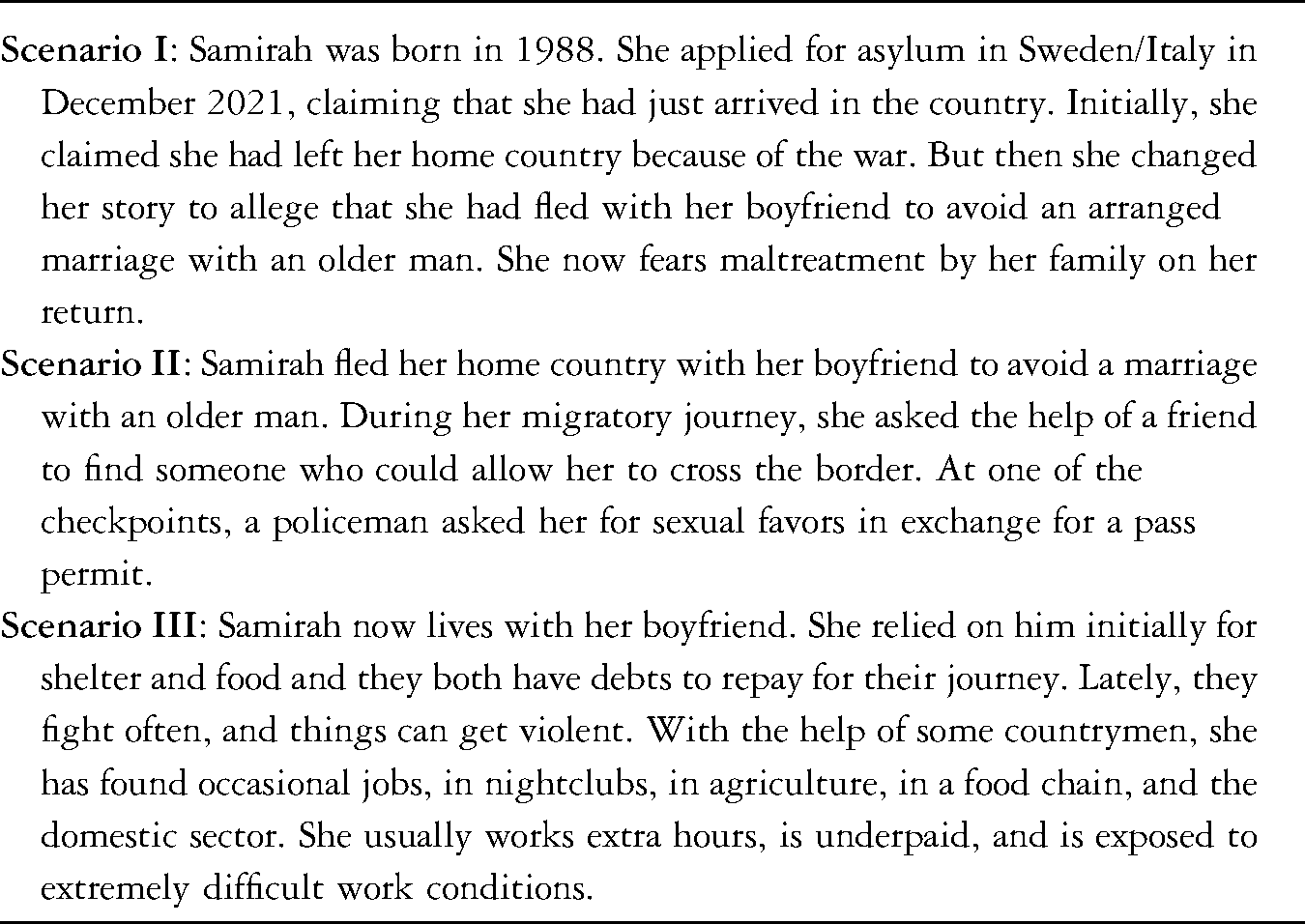
The three scenarios were adapted to the professionals working in three different types of organizations (women-led NGOs, faith-based organizations, and CSOs), and in two different countries (Italy and Sweden). The language was also adapted, and English, Swedish, and Italian were used.
Summary of the three scenarios presented in the vignettes
In Sweden, a total of 18 professionals working in 16 CSAs took part in the interview. In Italy, a total of 21 professionals working in 15 CSAs agreed to participate (Table 1).
Background of the sample.
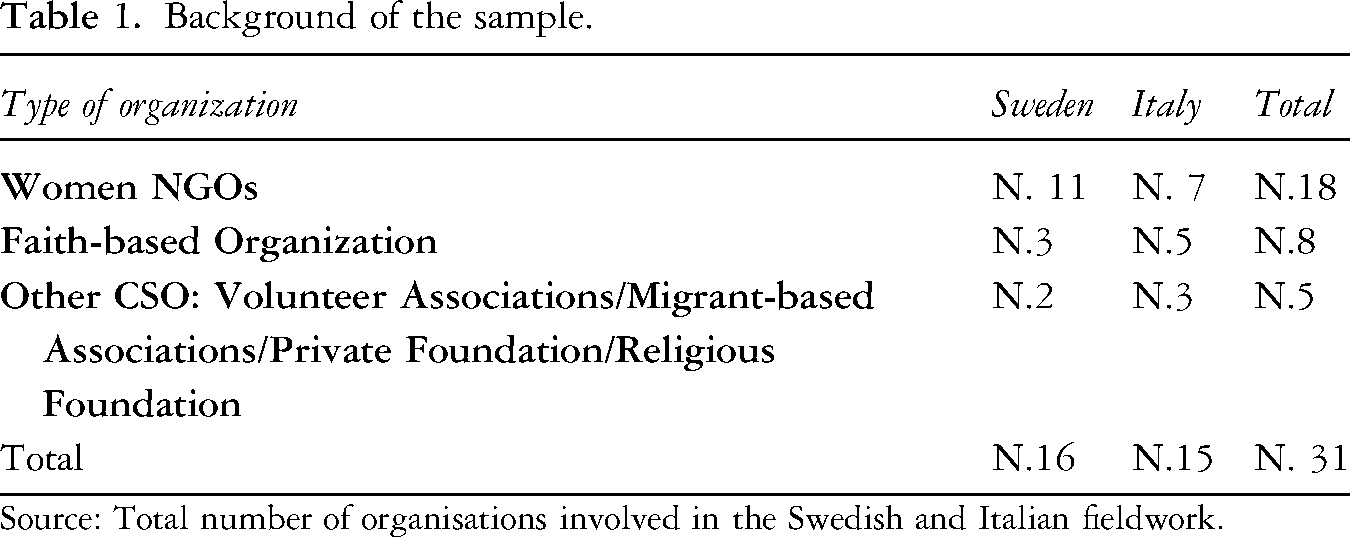
Source: Total number of organisations involved in the Swedish and Italian fieldwork.
The vignettes were sent to the participants via email and then presented to each professional during the interview. The aim of the study was declared during the first email contact with the participants through an information letter and repeated orally at the beginning of each interview. It was highlighted that the research wanted to explore professional interventions and various forms of support for women with precarious legal status. Particularly, the declared aim was to gain knowledge about the organizations’ opportunities to develop initiatives for migrant women with a precarious legal status. Each interviewee gave oral or written informed consent after receiving a written and oral study presentation.
The research question guiding the analysis is “How do professionals working within different CSAs (in a broad sense, including NGOs and other civil society organizations) operating in Sweden and Italy assess GBV cases, and how does precarious immigration status impact their assessment?”
Data were analyzed using an interpretative approach (Yanow and Schwartz-Shea, 2015) to coding qualitative interviews with practitioners (Declercq and van Poppel, 2023; Harrits, 2019; Harrits and Moller, 2021), using MAXQDA software. The baseline for all the codes is the division of the three vignettes in which a story/scenario concerning a migrant woman with precarious legal status is presented.
The analysis of the interviews followed an abductive approach, which means that the aim of the study, as described to the participants in the information letter, was operationalized at the end of the interviews. By reading the participants’ responses several times, de-bordering and re-bordering frameworks were chosen as theoretical concepts to facilitate the coding process. De-bordering practices refer to code segments expressing efforts to break down or transcend traditional boundaries, borders, or divisions. Re-bordering practices, instead, refer to all code segments that reinforce borders, boundaries, or divisions.
Findings
The interplay between de-bordering and re-bordering practices and its logic
In this study, the logic investigated governs the practice situated in the field of GBV, and professionals use it to interpret the situation of migrant women and respond to them by reframing specific social interventions. The concepts of de-bordering and re-bordering are used as models to highlight the interwoven presence of two oppositional generative principles having a dialectic and practical function.
De-bordering practices
Professionals throughout the different scenarios interpret the needs of migrant women and respond to them by using a de-bordering logic, which materializes in the CSA's practice intervention and challenges the very legitimacy of the state apparatus over its territory.
Sweden
Scenario I
In Sweden, the logic of Sisterhood is linked to the activities of women NGOs and other CSOs and refers mainly to their ideology and knowledge of violence developed around the concept of “womanhood”, identified above all in its binary division. “We exist so that women can come to us and be safe and talk in a secure environment, and no one will know what they tell us. Women think: ‘Here I am safe. They believe me.’ We never report them (to the police/immigration authorities). We don’t do stuff like that.” (ID 05, Women's NGO, Central Sweden) “You don’t have to have a personummer (Swedish Identification Number) or be registered in Sweden (to come here). (ID13, Women's NGO, Central Sweden)
The logic of personhood, instead, characterizes the reasoning of professionals working in faith-based organizations, where an increasing centrality of sexuality-sex categories linked to the “migratory dimension” is noted, such as follows: “We work mainly with people who are exploited in prostitution and victims of trafficking. But we generally accept all cases; we also have lawyers who work with us. In my opinion, this case (in Scenario I) deserves legal advice or social support.” (ID01, Faith-based Organization, South Sweden)
As we can read in the quotations above, both the logic of personhood and sisterhood sustain specific social provisions such as legal support, counselling, and contact with other state authorities.
Scenario II
Further, the logic of treatment (Table 2) is employed by professionals working in women's NGOs and other CSOs when assessing the second scenario in which the protagonist, who was an undocumented woman, was raped by a public officer while crossing borders. Treatment refers mainly to counseling and, in some cases, specialized therapeutic support to migrant women whose legal status prevents them from accessing public mental health services. The logic of treatment employed by women NGOs is built around an experience, that of sexual abuse and rape, regardless of the victim's legal status, such as follows: “She has experienced sexual abuse, and that is also something we meet in our open counseling, where we can give support and information. And find out what kind of help she might need, if there are medical issues, or just to process what she lived through if there's been a trauma. (ID07, Women's NGO, Central Sweden)
The logic of interpretation used by professionals in assessing the three vignettes in Italy and Sweden.
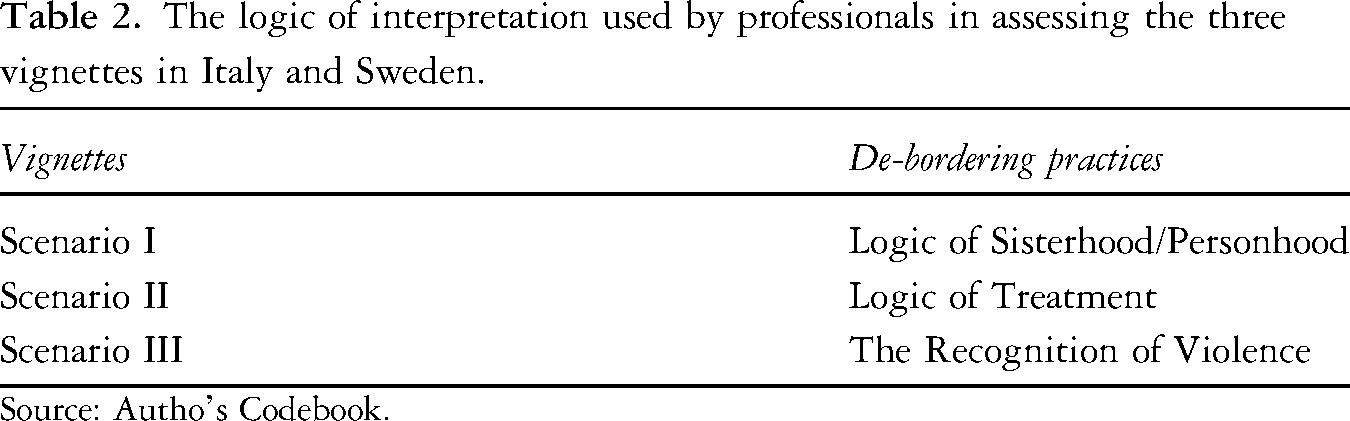
Source: Autho's Codebook.
“Having been sexually abused is a major wound, whether she admit it or not, and she needs to repair this wound in order to move on. That is why we also have a training programme on violence, rape, and sexual exploitation. If the girl is interested, we have summer camps. We propose to the women to come with us for three days of training in a very nice area with food, music, and dance, along with other women who have had similar experiences. At the same time, we train them during this camp.” (ID08, CSO, Central Sweden).
In other words, the logic of treatment aims to address the individual experience of violence lived by the subject, as well as considering the systems in which the violent circumstances took place, e.g., border rape enacted by public officials. Thus, the therapeutic work performed by CSAs represents a de-bordering practice where the reality of suffering linked to borders can find a place for reparation, and where the subject is seen as a social agent − part of a community rather than just being represented as a passive victim.
Scenario III
Last, in the third scenario, the recognition of violence and its logic is situated within a contested political space where different ideological representations of violence against (migrant) women have led to separate political agendas, compartmentalizing the complexity of GBV into a single issue (Domestic Violence vs. Trafficking), and assigning different responsibilities to different administrations and groups of professionals.
In the case of Sweden, some CSAs help migrant women navigate the classification systems available to them for accessing their social rights and, finally, the protection system, such as follows: “So far, we have not directly identified victims of trafficking, because often it is a domestic violence issue. Like … when you are living amongst domestic violence, you can access a free shelter and get support, and they (state authority) will guide you to employment, and loan money to start up your life … and things like that. And Sweden has a very functional social welfare system. And so our job is to tell them (women) that “you have the right to number one, number two, number three”. (ID 03, Faith-based Organization, South Sweden)
Italy
Scenario I
In the Italian context, the analysis of narratives from women-led NGOs reveals an inclusive perspective within the logic of sisterhood that perceives the entanglements between feminism, nationalism, and migrant struggles. In this regard, the logic of sisterhood is used, in certain cases, to resist or even subvert sovereign state power, such as that described by one of the practitioners: “This situation has already happened to us with another girl who has the same story, but her asylum request was rejected (by the Migration Agency) because it was not considered dangerous if she returned to her country of origin. And we have pointed out (to the Migration Agency and the police) that the fact that she refused a marriage put her in real danger because, on her return, she could be kidnapped, and she could not possibly live in society because she was accused of having refused the marriage, and therefore of being a bad person, and we managed to get her asylum granted in that case.” (ID20, Women's NGO, North Italy)
Within the social provisions proposed by faith-based organizations, the logic of personhood is applied to navigate the asylum system using a specific gender lens, such as illustrated in the following: “The request she makes is certainly important. So, first of all, we, as professionals, will delve into her story. With this reconstruction of the story, then, as an organization, we also support her to face the Migration Agency, obviously … if there is also a request for shelter, we will also file a request to shelter her in one of our refuges, or if we assess that another shelter would better suit the woman's needs, we will offer her the opportunity to reside in another place.” (ID29, Faith-based Organization, Central Italy)
Scenario II
The logic of treatment (Table 2) can also be classified as a de-bordering practice, such as the therapeutic and medical interventions aimed at counteracting the interlocking effects of immigrant status and violence on migrant women's mental health, such as described in the quote below: “We always say this when we talk about mental health … in the cases of Dublin women (refused asylum seekers in EU) who come in, are, at the very least, women with post-traumatic stress disorder. And therefore, when we talk about victims in a context of great precariousness, we talk about all this.” (ID19, Faith-based Organization, North Italy)
Scenario III
Finally, within the third scenario, the reduction of violence to a single problem (domestic violence vs. trafficking) follows a practical, logical link to the real options a migrant woman with a precarious legal status has to leave the violence and access an independent residence status: “If she decides to leave him, she will enter our circuit because she runs away, and she has to report a situation of violence (to the police), then she is entitled to a residence permit of protection as a victim of violence. So, at most, if she loses a residence permit for family reasons because she is separating from her spouse, she will get a special residence permit.” (ID 22, Women's NGO, North Italy)
Re-bordering practices
Professionals throughout the different scenarios interpret the needs of migrant women and respond to them by using a re-bordering logic, which materializes in the CSA's practice intervention linked in a dynamic way with imaginary borders, ideas on territoriality, security, control, and human beings’ filter.
Thus, the logic of interpretation used by practitioners has a dialectic character, which means re-bordering and de-bordering practices are simultaneously at play within the same organizational and professional narratives.
Sweden
Scenario I
In Sweden, the best example of bureaucratic logic (Table 3) is when we turn our attention to interventions, such as shelters, for migrant women in the asylum-seeking process or within trafficking cases. In those situations, the bureaucratic logic manifests itself as part of the machinery designated to establish rights based on citizenship and residency, which exclude immigrants with precarious legal status: “Well, she wants asylum. So, then the migration agency needs to offer her accommodation, right? And … if she comes with her boyfriend, and her boyfriend is a threat, then we might need to, or we could offer that kind of help (shelter). But all the women who come to our shelter and get a place here must go through the social services (municipality). (ID07, Women's NGO, South Sweden)
The logic of interpretation used by professionals in assessing the three vignettes in Italy and Sweden.
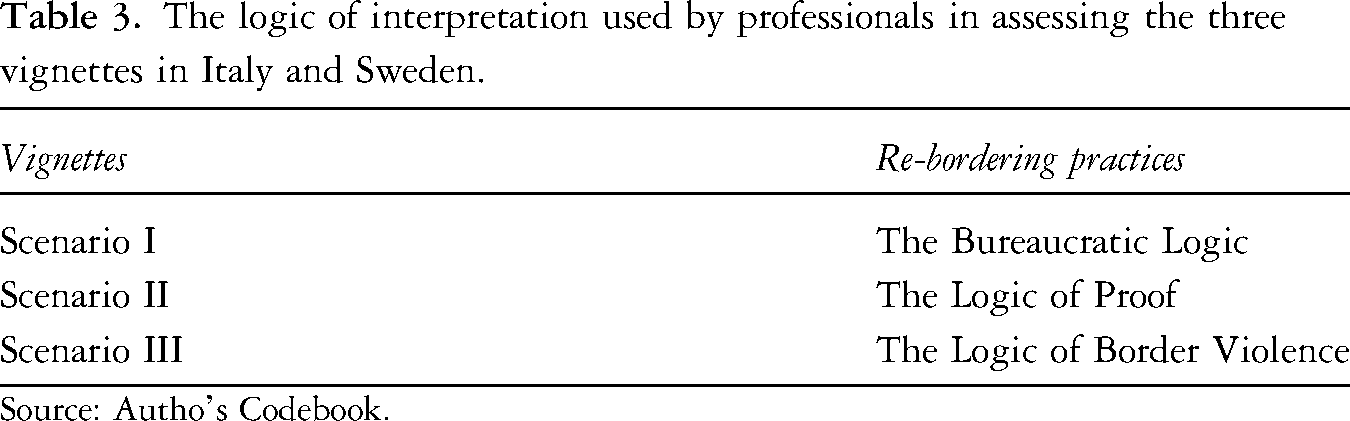
Source: Autho's Codebook.
Scenario II
In Scenario II, there is a shift between the logic of treatment (Table 2) and the logic of proof (Table 3), which means we assist in a political appropriation of the traumatic experience by the bureaucratic machinery. Clinical work enters into the assessment of the credibility of migrant women, whose claims of being “victims” of violence need to be supported by proof. In this sense, the logic of proof is considered a re-bordering practice. In particular, it is employed in the second scenario by professionals who were reasoning on access to justice, and the proof entails reporting the sexual abuse to either the police or the migration agency to make a “case” worthy of bureaucratic attention, as mentioned below: “The reason we report a case to the police is that we need evidence to seek help, for the complaint to be forwarded to the public prosecutor, or to organise accommodation. Arranging accommodation costs more than one thousand SEK per night. For this reason (…) there must be enough material, with evidence. If the police do not have this material, then we can intervene and ensure that the girl is recognized as vulnerable. There are also people who exploit the system, so you have to be careful. But we guarantee that the girl is genuinely vulnerable, even though she does not have the courage to go to the police herself.” (ID08, CSO, Central Sweden)
Scenario III
Finally, in the third scenario, the GBV classification system can be co-opted by a logic of border violence (Table 3), when professionals evaluate their responsibility to deliver services, such as in the following quotation: “From the information here, this doesn’t fall within the remit of our service. It's something that they (social services) should be able to deal with themselves or that they would refer to the migration agency. We would perhaps recommend that they contact women's NGOs because they have a broader scope. They work with all sorts of violence against women. So, it is not just this type that we work with (trafficking and prostitution). We’re very specialist in our services.” (ID15, Faith-based Organization, South Sweden)
Further, within the GBV classification system, professional narratives reveal an asymmetry of power and forms of paternalism entangled with emancipatory desires for the “other”: “We know that if you’ve been in a relationship for a very long time, maybe you don’t see it as violence. And especially also in other cultures, it can be normalised. (…) And if it's a person who is new in Sweden, we talk about the laws in Sweden, and the law says that “this is not okay!”, and that if her boyfriend did this to her, he can actually go to prison for it. So that's our main focus.” (ID13, Women's NGO, Central Sweden)
Italy
Scenario I
In Italy, the bureaucratic logic works similarly to the Swedish context, whereas civil society acts as the third sector in the identification of welfare beneficiaries for sheltering, as expressed below: “Should the woman in the scenario need to be accommodated in sheltered facilities, there must necessarily be a social service take-over. It works like this in our territory because the protected houses we manage have fees to be paid. So there has to be a social service (municipality) that is informed and agrees that we host that woman; therefore, they will pay a specific amount of money for that woman per day. (ID20, Women's NGO, North Italy) “The difficulty in supporting the woman in this scenario for us is in the sheltering. In fact, we have yet to have access here to asylum seekers since we no longer manage the CAS (Emergency Reception Centre for Migrants). After the so-called Salvini Reforms … we could no longer receive them (migrant women) according to our criteria, and we decided to drop out from the CAS program.” (ID18, Women's NGO, Central Italy).
In this quote, the women-led NGO managed both the women's shelter and the Emergency Reception Centre for Migrants, which were structured around women asylum seekers and refugees. However, in open conflict with the securitarian policy reform led by the Salvini Decrees (2018), they decided to leave the program, in turn affecting the possibility for migrant women with precarious legal status (asylum seekers and non-residents) to access their shelters.
Scenario II
The Italian context illustrates the co-optation of the therapeutic space into the realm of testimony and proof (Table 3) for the migrant women to be recognized as victims and, therefore, access the service provided, such as follows: “I do not understand in the vignette if the border control is an Italian border or a foreign border … if it is an Italian border, an offense that took place on Italian territory, a complaint may also be suggested.” (ID22, Women's NGO, North Italy) “In this case, it is sexual and gender violence (SGBV), and the procedure depends on when the violence happened … we can also submit a report to the Migration Agency (Commissione Territoriale). Surely the report should be done with a legal document from a doctor, and the doctor, unfortunately, will ask her when the violence happened because then … you know … they have to identify a number of proofs.” (ID 30, Faith-based Organization, South Italy)
Scenario III
Finally, the logic of border violence (Table 3) is expressed by professionals in a way that reminds us that borders are not only geographical devices but also move around the cultural, social, and political spheres. Thus, the lack of services for single mothers, the migrant women's difficult working conditions, and a hostile, racist context all impact the real opportunities for professionals to help migrant women leave the violence and access housing, work, and social services, which means becoming recognized as full members of a political community: “There is something wrong (in the system) … because there are several issues that are perhaps stronger for women with a migratory background: for example, the issue of babysitting, because how can I (migrant woman) keep a job if I am alone, and I have three children? Or the impossibility of finding housing because the prices are sky-high, and so it is really difficult to pay rent, not to mention all the racism that still exists (in Italian society) preventing women from accessing housing. (ID27, Women's NGO, North Italy)
In the best-case scenario, migrant women have to prove they are victims, and they have to be recognized as beneficiaries to be able to access specialized programs. In the worst-case scenario, even when they are offered options for leaving the violence, the racism, sexism, and the risk of not having a permit discourage women from acting and render the service provisions too weak to counteract the exclusionary migration governance.
Discussions and conclusions
Describing the logic of de-bordering and re-bordering practices developed by CSAs working in the overlapping fields of humanitarianism and welfare nation systems is a contentious task. In this regard, as Ambrosini (2022: 2) observes, “the outsourcing to civil society of public services is often labeled a fundamental feature of the neoliberal project. In particular, service-oriented NGOs are considered useful to the system”.
The intensification of external border protection can also trigger internal re-bordering processes (Schimmelfenning, 2021: 313–316), referring to all institutional activities of closure and retrenchment.
Nevertheless, and even though I understand that de-bordering practices are mostly connected with grassroots activities such as protests or advocacy (Abji, 2018; Della Porta, 2020), in this study, de-bordering practices are conceptualized as expressions of implicit or explicit anti-border initiatives through which CSAs contest borders and migration policies in practice, in line with the most recent literature (Ambrosini, 2022: 3–5). Thus, the concept of de-bordering has an analytical potential to describe the complexity of a system where migrant women's struggles for rights and autonomy from the state, the family, and the market are inherently interconnected with increased control and power asymmetries.
The results of this study are used to shed light on the double directions that characterize organized forms of solidarity, which ironically seem to deepen the problems and the struggles they try to solve as well as positively influence and widen the scope of services provided for migrant women with precarious legal status.
In understanding the rationale shaping the logic of practice deployed by women-led NGOs, Faith-based Organizations, and other CSOs in contexts such as Italy and Sweden, what emerges is a collective knowledge regime shared by a specific transnational community, where professionals constitute a network bounded by symbolic relations, in this study, described as logic, that sustains collective practices with a real, practical, and vital urgent end − that of protecting migrant women from GBV.
Knowledge regimes in practice
By looking at how professionals interpret the vignette scenarios, which represent situations of GBV experienced by migrant women with precarious legal status, results show the existence of a knowledge regime that mediates between different demands and interests of the actors involved in the institutional space created by a multitude of frameworks, from human rights to gender equality and immigration.
In Italy and Sweden, we notice different policy demands that both battle with, and influence, each other in more cooperative forms, and CSAs use diverse reference systems and types of knowledge to mediate between migrant women's demands and social protection responses.
One kind of knowledge regime can be reconducted to the practice-oriented discipline of social work, in its broad form as social protection, whose demand for (feminist) solidarity is governed by the logic of sisterhood/personhood and that creates a space for accessing specific provisions such as legal support, counseling, and contact with other state authorities. In a few specific cases, in both Sweden and Italy, the logic of sisterhood/personhood subsumes sheltering and advocacy, having the capacity to influence the decisions of the Migration Agency and Social Services concerning the rights of regularisation and of accessing welfare benefits. The competitive logic, here, is manifested towards over-specialization and hyper-professionalism, exemplified by the bureaucratic logic through which a classification system is produced to identify types and forms of violence and vulnerabilities, and through which migrant women become legitimate welfare beneficiaries. The contradiction produced by those two competitive principles, solidarity vs. bureaucracy, can be linked to developing a welfare mix, described as a trend of EU welfare regimes to involve state and non-state actors in service delivery (Ranci and Pavolini, 2015). Those trends are largely present in the field of migration in both Sweden (Johansson et al., 2015; Linde and Scaramuzzino, 2018) and Italy (Campomori and Ambrosini, 2020; Ferrera and Maino, 2011). In the field of GBV, it is contested that the nationalization of transnational feminist ideas into locally organized practices of solidarity can be coopted by state sovereignty and has an ambivalent gain linking women's rights to exclusionary citizenship and neo-liberal economies (Farris, 2017).
Another set of knowledge regime is to be recognised as health-related practices and the demand to access health services as well as therapeutic support for the migrant women subjected to violence. Interventions such as therapy, counselling, and specialized medical services are guided by a principle of autonomy, which is central to the practices and refers to professionals putting migrant women's requests and willingness first. This small-scale practice of humanitarianism (Malkki, 2015), however, is contended by the logic of proof, which manifests the appropriation of the clinical language by migration procedures where scars and trauma left by violence are becoming crucial in assessing the validity of requests for protection and support (Fassin and Rechtman, 2009: 252) from migrant women with a precarious legal status.
A third set of knowledge regime can be traced back to the human rights framework, which is linked to the demand for access to justice and respect for human rights. The CSAs’ responses to these demands entail the political and social recognition of well-organized interest groups with access to resources, and mediating between different competitive policy domains, such as gender and migration (Crenshaw, 1991; Di Matteo, 2022). In this sense, even though the options offered by the organizations in the sample vary greatly depending on the resources available and level of institutionalization, the professionals interviewed highlight that migrant women have the right to access protection and support, delinked from the woman's choice to report the crime, confirming that civil society, as an expression of social movements or single-issue coalition, is instrumental in protecting individuals from state control, even when civil society acts through its third-sector institutionalized forms (Della Porta, 2020). In this regard, the degree of institutionalization of women's NGOs in the sample allows them to be incorporated into local political boards with greater opportunities to influence territorial collaboration. Further, it is worth noting that, on several occasions, professionals working in Italy mentioned that local political boards are working together with migrant women to develop more appropriate services, and several organizations were involved in a national project carried out in partnership with UNHCR and migrant women, including asylum seekers and refugees, to tailor the system around specific migrant women's requests (see Leaving Violence, Living Safe, 2020). Within the sample, Swedish CSOs and units within faith-based organizations were led by migrant women who were active in gaining social recognition, state-funded resources, and control over knowledge production, facilitating some non-EU migrant women's groups to access welfare benefits and residency. However, a competing guiding principle seems to emerge while looking at the access to justice, sheltering, and regular permits, which relates to specific types of immigration categories that define who is a woman, what can be considered as GBV, and which in turn impacts criteria and conditions for accessing social rights (Voolma, 2018: 6). In the Swedish context, forms of paternalism linked with emancipatory goals, can reveal a hidden middle-class white feminist heritage, reproducing colonial stereotypes over non-EU women (Farris, 2017). In the Italian context, however, the battleground in the field of migration policies (Campomori and Ambrosini, 2020) reveals some very specific gender dynamics that impact various groups of women differently. Indeed, several women NGOs have pulled away from sheltering women in a precarious legal status as a form of protest against the inhumane forms of reception established by the national government (Salvini Reforms, 2018). However, pulling away from the reception programs means that they would not have the institutional mandate to shelter migrant women in a precarious legal status. In other words, the national migration governance manifests gendered dynamics related to citizenship (Benhabib, 2004) when women's NGOs, led by women citizens, contest asylum and border restriction policies. Nevertheless, the outcome of pulling away from women's shelters turns out to be in line with what the national reform wanted, which is reducing de facto the opportunities to shelter migrant women with a precarious legal status, and hindering their access to services.
In conclusion, the results of this study highlight the complex interplay between different knowledge regimes and frameworks in shaping responses to GBV experienced by migrant women. It illustrates how professionals in various fields, such as social work, healthcare, and human rights advocacy, bring different perspectives and priorities to the table. Using a framework of categories, they can conform or challenge the legitimate institutional architecture of the social protection field, leading to cooperation, competition, conflicts, and contradictions in service delivery and policy outcomes.
Footnotes
Funding
Funding is provided by Lund University.