




Abstract
The mental health and well-being of university staff and students in the UK are reported to have seriously deteriorated. Rather than taking this ‘mental health crisis’ at face value, we carry out network and discourse analyses to investigate the policy assemblages (comprising social actors, institutions, technologies, knowledges and discourses) through which the ‘crisis' is addressed. Our analysis shows how knowledges from positive psychology and behavioural economics, disciplinary techniques driven by metrics and data analytics, and growing markets in digital therapeutic technologies work as an ensemble. Together, they instrumentalise mental health, creating motivational ecologies that allow economic agendas to seep through to subjects who are encouraged to monitor and rehabilitate themselves. Mental health’ as a problem for UK universities has come to be largely defined through the outcomes of ‘resilience’ and ‘employability’ and is addressed through markets that enable training, monitoring, measuring and ‘nudging’ students and staff towards these outcomes.
Introduction
The ‘mental health crisis’ in UK universities is said to have deepened in the past five years, especially after a series of highly publicised student and staff suicides (BBC, 2018; Pells, 2018), as well as, more recently, during the COVID-19 crisis (Johnson and Kendall, 2020). Staff and student unions have pointed to unsustainable workloads, work insecurity, debt-related stress and cuts to student support (UCU, 2019; NUS 2020). On the side of management, representative organisation Universities UK (UUK) has declared mental health a ‘strategic priority’ (2017, n.p.), to be addressed by a ‘whole university approach’ (2020). The Office for Students (OfS), England’s Higher Education regulator, has run competitions for projects to improve students’ ‘mental health outcomes’ (OfS, 2018; 2020).
Within critical university studies, much has been written about the emotional effects of UK higher education (HE) restructuring on students and staff, focusing especially on the stress of self-monitoring and loss of solidarity in increasingly competitive environments (e.g. Hall and Bowles, 2016; Loveday, 2018; Morrish, 2019a). Indeed, while the preoccupation with student mental health extends back to the mid-twentieth century (Crook, 2020), and renewed interest in it was shown under New Labour (Baker et al., 2006), most contemporary critics link the current ‘mental health crisis’ to recent institutional transformations. The restructuring of UK HE itself is typically understood through the loose framing of ‘neoliberalism’ (Smyth, 2017). While useful for locating the ideological lineage of similar public sector restructuring methods across different contexts and countries, this framing hinders tracing the changes produced by successive layers of restructuring in UK HE. Neoliberal New Public Management approaches have been implemented since the 1980s. However, over the past decade, universities became financially dependent on tuition fees – increased in 2017 to £9,250 per year – and are ever more subjected to metrics that feed into a marketplace of qualifications. Rapid institutional expansion has been achieved through unprecedented levels of borrowing (McGettigan, 2015), while ‘soft privatisation’ has embedded private sector services in HE infrastructure, creating new pathways for governance, measurement and intervention (Cone and Brøgger, 2020). Meanwhile, students graduate with increasing debt, whose repayment is dependent on earnings. Thus, the economic model of UK universities now directly links the labour market performance of graduates to the sustainability of HE debt.
How might this context of HE restructuring shape conceptions of, and institutional responses to, the ‘mental health crisis’ in UK universities? We draw on approaches of critical studies of youth and education policy, including those focusing on mental health, that emphasise the power of networks and assemblages of policy production, encompassing governmental organisations, businesses and technologies (e.g. Ball, 2016; McGimpsey et al., 2017; Williamson, 2021). Our study situates HE restructuring as part of a broader dispositif (Foucault, 1980), whose heterogeneous elements contribute to the ‘variegated ecology of knowledge and expertise’ (Bacevic, 2019: 88) making up universities’ mental health policy. We offer an exploratory network analysis of these elements, encompassing social and technical entities (actors, infrastructures, documents, events), combined with discourse analysis of policy, grey literature and relevant media. The policy is thus examined through mapping the management and business networks that contribute to it; the broader political agendas and networks served by it; and how these agendas materialise through particular technologies and relations.
Our findings show that key elements of contemporary university restructuring – metrics, data, outsourcing, digital education tools – are also employed in mental health interventions. While the ‘student mental health crisis’ is predominantly an effect of insufficient support services, the ‘solution’ continues this trend. We replicate observations that link the positive mental health and well being agenda in education to New Labour policy networks (McGimpsey et al., 2017). These policy assemblages tie population mental health to national economic productivity, promote the metricisation, digitalisation and datafication of HE, and establish algorithmic behavioural economics in mental health governance. Technological solutions to student mental health – new apps and learning analytics – are promoted aggressively as the optimal, and labour-saving, approaches by the UK government, UUK, OfS and emerging therapeutic markets. Our network analysis identifies these markets, which are forming around the procurement of resilience and wellbeing workshops, digital mental health apps, and learning analytics for mental health. While our map cannot represent the circulation of value in these markets, we nevertheless note investment in labour-saving technologies, the exploitation of free staff and student labour, and intensified attempts to extract value from student data.
Our critical analysis of the management of mental health in UK HE is not intended as a wholesale critique of psychotherapy discourse. We agree with Wright (2008; 2020) that the politicisation of private suffering in the public domain through therapeutic discourse has powerfully challenged gendered and patriarchal dynamics, in part by politicising vulnerability (Butler, 2006). Instead, our analysis draws attention to particular business networks, technologies and socio-economic/socio-technical assemblages formed around a narrow range of explicitly chosen therapeutic technologies and discourses, which are designed to meet the predetermined business needs of universities. The latter are, in turn, shaped by policies designed to produce an economic motivational ecology within which options are severely limited.
Networked assemblages of policy production
We draw on education policy research that analyses how ‘neo-liberal policy networks’ (Junemann et al., 2016: 537) are constituted and produce subjectivities. These approaches follow connections between governmental organisations, civil society and for-profit businesses, as well as the circulation of policy discourses, money (Ball, 2012, 2016; Au and Ferrare, 2015), and education technologies (Williamson, 2019), so as to map the accelerated, networked neoliberal policymaking Peck and Theodore (2015) have termed ‘fast policy’. The Deleuzian concept of ‘assemblage’ is used increasingly in this research, to indicate ‘complex social formations as made up of a whole array of trans-scalar and temporally multiple orders/levels/components and flows’ that include not only social entities but also ‘cultural forms, discourse, representation, subjectivities and affectivities’ (Youdell and McGimpsey, 2015: 119). Conceptualising ‘the university’ as an assemblage allows us to de-reify its historical form and explore how its elements are constituted and transformed through social processes (Bacevic, 2019). Here, we use the term ‘assemblage’ in the Foucauldian sense, as a subset of a dispositif: ‘a thoroughly heterogeneous ensemble. . .’, ‘the system of relations that can be established between these elements’, which ‘has a dominant strategic function’ (Foucault, 1980: 196). In this approach, the network does not represent social power, but, instead, it displays the institutional and organisational avenues, discourses, technologies, knowledges and regulatory ecologies through which power is exercised and comes to be enacted (Ball et al., 2012) or resisted (Ball and Olmedo, 2013).
Our method thus combines (i) network analysis; and (ii) discourse analysis of policy and other grey literature.
(i) Network analysis: We map actors, market relationships, organisational arrangements, events, products and technologies relevant to universities’ latest mental health agendas, policies and interventions. Our mapping aims to reveal ‘influencers’, managerial hierarchies, the composition of policy communities and associated markets and infrastructures facilitating particular approaches (Jalili, 2013) to mental health. We store data using Neo4J (2014), a NoSQL graph database, which stores information as objects (‘nodes’) and relationships between objects (‘edges’). This technology offers additional dimensions to traditional maps of education policy social networks (e.g. Morris et al., 2020), in that nodes are also projects, products, technologies, events and documents, allowing us to map multiple levels of social-material relationships (e.g. employment relationships, producer or exchange relationships) between nodes. We also trace the temporal mobility and productivity of nodes engaged in policy-making labour (Ball, 2016): commissioning and authoring reports; organising and speaking at policy events; fostering trust at trade fairs (Komljenovic, 2019). The static snapshots of the network we offer in this article cannot represent this temporal information. The power of Neo4J can be exploited by using network visualisations, which we anticipate making available on our project website, mapukhe.net.
Data are not objective representations of fact: their collection, the form they acquire, their analyses and their uses are political and ideological (Beer, 2016; Gitelman, 2013; Prinsloo, 2019). This also applies to network analysis. Our lens, what we ‘map’ and leave out, is shaped by our aim to trace avenues and vehicles of power in UK HE policy networks and guide resistance to deleterious socio-political transformations. But network analysis has also been a governance tool – e.g. to locate ‘troubled families’ associated with the 2011 UK riots (McGimpsey et al., 2017: 914–915). Such collections of data actively produce their objects of knowledge which, simultaneously, are subject to reshaping through intervention (e.g. rearranging ‘troubled’ family networks). Given that data and tools are world-making, we ought to consider their limitations for critical social studies.
One potential limitation is that network visualisations can allow room for reductive theorisation, for example by rendering the social as an accumulation of interpersonal relationships. The network map is not an exhaustive representation of social reality, but only a guide for research, always incomplete and lacking dimensions. Nodes, though similarly visualised, are not equivalent to one-another, nor do we posit equivalence between human and ‘non-human’ nodes – an often criticised feature of actor-network theory (Law, 1992; Kirsch and Mitchell, 2004). Our map can help identify the heterogeneous ensemble through which a strategy or dispositif is relayed, but it does not display the governance strategy itself, the subjects it seeks to produce or the circuits that reproduce societal power relations (class, racialisation, gender and ability), which themselves shape policy. Finally, it tells us little about the level of encounter with subjects. These are all a matter for qualitative research, analysis and theorisation.
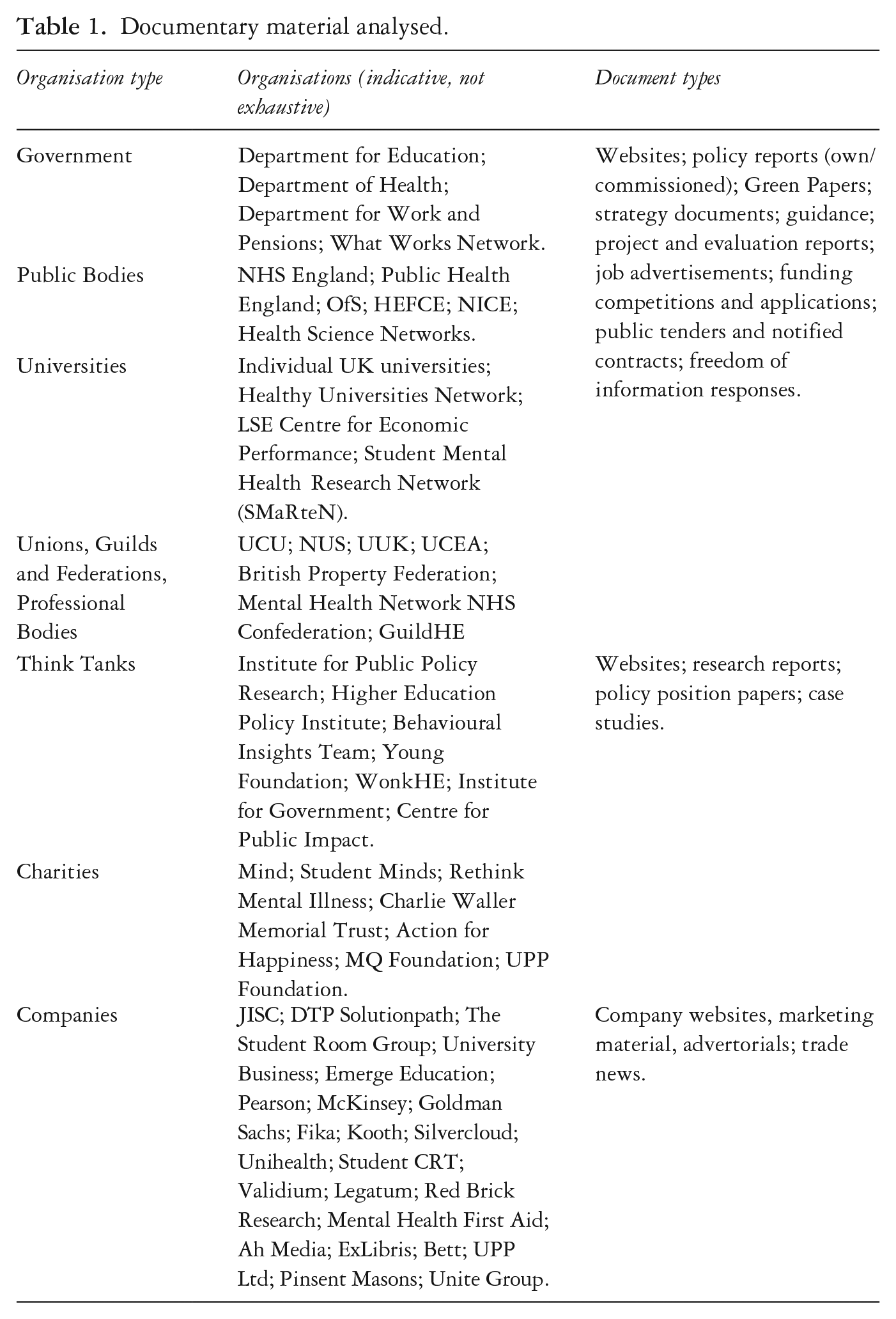
(ii) Discourse analysis: The dispositif and policy assemblages we are studying encompass knowledges, discourses and subjectivities. We examine how these figure in the vocabularies, frameworks, explanatory models and ommissions of strategies and interventions, and what behaviours, outcomes and affectivities they seek to produce. Textual and discourse analysis also guides the network analysis, by following the cross-referencing of influential policy documents, agendas and slogans. Our corpus of analysis includes publicly available policies, grey literature and business media surrounding staff and student mental health in 2010–2020 (see Table 1).
Ethics: The project received ethical approval from the Economics, Law, Management, Politics and Sociology Ethics Committee, University of York. We map information that is not only publicly available (e.g. products organisations sell) but much of it (e.g. board membership) is required to be public by law for UK registered entities. Mapping of this type does however raise ethical issues because aggregated data are more than the sum of their parts: they allow us to view a system as a whole, which is materially different from individual organisations and their board membership. However, we argue this research meets a public interest – that the system should be made visible to provoke further investigation of – and, indeed, resistance to – the strategies and assemblages comprising this site of policy creation at a moment of rapid sector restructuring.
Documentary material analysed.
Mental health crisis
Our research shows intensifying policy interest in student mental health around 2017, although the ‘mental health crisis’ has been in HE media currency since at least 2013 (NUS, 2013). In response to high-profile student suicides, UUK commissioned a report on student mental health by the think-tank Institute of Public Policy Research (IPPR) (Thorley, 2017). The report speaks of ‘dramatic increases’ (3) in demand for counselling and disability services and in disclosure of mental health conditions. Yet it analyses the ‘crisis’ in absolute numbers and not in proportion to the number of students and staff at different institutions. Although mental illness disclosure rates are quoted to have risen from less than 0.5% in 2006 to 2% in 2016 (21), this is far below the prevalence rate of mental disorders in the 16–24 age group, at 18.9% in 2014 (McManus et al., 2016). An analysis that takes volumes into account shows, for example, that at the University of Liverpool, where student numbers rose between 2013 and 2017 from 21,345 to 28,795 (HESA, 2021), students seeking counselling also rose from 526 to 997 (University of Liverpool, 2018), demand thus increased from 2.5 to 3.5%. This is still far from the proportion of students who might need help, but overwhelms the counselling and mental health service, which only expanded from 18 to 25 staff.
IPPR cautions about the risks of ‘students dropping out of university’ and ‘reputational damage’ (37), linking student mental illness to income loss by universities. It proposes a ‘whole-university approach’ whose priority must be ‘to promote positive mental health and wellbeing’ (52) and only secondarily to ‘enable access’ to support and care (56). While they recommend increased funding, this is in a context where universities are ‘redesigning elements of their counselling provision’ because of ‘a huge growth in demand’ (66). Thus, recommendations include training for academics, security/accommodation staff and student ‘peer-supporters’ (52–53); ‘workshops to build resilience’ (54); ‘onsite’ ‘NHS mental health specialists’ and ‘strong relationships with external providers’ (61–62); ‘early intervention’ by ‘monitoring’ students with ‘intelligent use of data and analytics’ (59); and, ironically, ‘robust data and evidence’ (68). IPPR appears to have been commissioned to provide evidence in favour of a service restructuring already under way. We note key elements that welcome new markets: extracting additional unpaid labour from staff and students, outsourcing services, and creating new opportunities for charities and for-profit providers. The emphasis on ‘prevention’ defines the kind of services to be procured: workshops, digital tools and data analytics.
Following IPPR’s report, in September 2017, UUK published its agenda on student mental health, entitled #Stepchange. Echoing IPPR, it championed a ‘whole university approach’ driven by ‘leadership, co-production, information, inclusivity, research and innovation’ (UUK, 2017: np). In December 2017, the Department for Education Green Paper on young people’s mental health (Greening and Hunt, 2017) commended UUK’s approach, endorsing collaboration between ‘student welfare, accommodation and security services’, ‘innovation in data linkage and analytics’ and a ‘new national strategic partnership’ between ‘tertiary education providers, local authorities, and health and care commissioners and providers’. Since then, regional Health Service Networks have been set up to facilitate partnerships for ‘innovation’ among NHS, universities and external providers that facilitate new markets and business-led research on mental health.
Resilience, employability, analytics
Recent research on youth and education policy following the network/assemblage approach has highlighted increased policy activity in youth mental health. McGimpsey et al. (2017) describe projects for youth ‘happiness’, ‘wellbeing’ and ‘resilience’ promoted by New Labour figures such as Richard Layard and associated think-tanks (The Young Foundation, the New Economics Foundation, New Philanthropy Capital). Williamson (2021) has mapped similarly theoretically underpinned global policy trends around the introduction of ‘social and emotional learning’ (SEL) curricula in education, supported by philanthropic institutions (Bill and Melinda Gates Foundation, Chan-Zuckerberg Initiative) and international organisations (OECD, World Bank, UNESCO, World Economic Forum). Driven and validated by psychometric and econometric data to demonstrate ‘value for money’, SEL has created new profit opportunities for educational technology corporations ranging from global-level conglomerates (e.g. Pearson) to smaller startups. The incursion into education of ‘deliverology’ (Barber et al., 2011) – a term to be discussed shortly – and behavioural economics have also been documented as parallel trends (Ball et al., 2012; Bradbury et al., 2013).
Our analysis of the policy assemblage relating to mental health in UK HE shows that it, similarly, comprises knowledges from positive psychology and behavioural economics, disciplinary techniques driven by data and metrics, and digital educational technologies. These work together as an ensemble to link mental health with economic productivity, establish ’nudges’ and digital self-monitoring as therapeutic modalities and promote data-driven interventions. The lasting influence of New Labour policy networks and preoccupations in this area is known, but ought to be more fully appreciated. Baker et al. (2006) suggested that New Labour’s ‘social inclusion’ and ‘widening participation’ agendas forced universities to provide additional student mental health services, as well as expand staff’s pastoral role. Our mapping confirms a strengthening relationship between (student) mental health and the labour market, but also the subsumption of student mental health under a broader agenda of HE restructuring.
Positive psychology, behavioural economics, and ‘deliverology’ jointly shape policy on mental health in universities. Their interconnectedness is evident in the movements across boundaries (public, private, governmental, academic) of three highly networked actors: Richard Layard, Michael Barber and David Halpern. They are linked by their positions in New Labour government, charities and think tanks; by co-authoring policy; and by their combined influence under subsequent Coalition and Conservative governments. We map these actors’ networks in Supplemental Figure 1 (supplemental material, online only). The policy strategies they have espoused are part of a broader governmental dispositif shaping approaches to mental health in UK HE.
Richard Layard, already mentioned for promoting positive psychology curricula in schools, is a key figure in the LSE Centre for Economic Performance, well known for establishing in the government agenda the measurement and cultivation of ‘happiness’ at the service of the national economy (Ahmed, 2010; Binkley, 2011; Cederström and Spicer, 2015; Pickersgill, 2019). Positive psychology and other therapeutic modalities that lend themselves to measurement, like Cognitive Behavioural Therapy, are preferred for their ‘cost-effectiveness’, measurability (Frijters et al., 2019) and cultivation of ‘skills’ for ‘emotional resilience’ against ‘adversity’, especially in young people (Hale et al., 2011). As we discuss next, this discourse figures in the policy and marketing of products for student mental health: resilience is to be cultivated aiming at student productivity, retention and employability.
There is now a sizable literature critical of the ‘neoliberal individualism’ and ‘vulnerability’ promoted by governmental projects for positive psychology in education (see review in Cabanas and Illouz, 2019: 50–81). Framing the problem as an opposition between individualist and collectivist ethos, this criticism often neglects to register how the ‘happiness’ agenda subsumes concern about individual suffering under the presumed common good of economic growth. As argued by Layton (2020) and Wright (2008; 2020), following Butler (2006), the cultivation of ‘resilience’ can entail a denial of vulnerability and interdependence; above all, a repudiation of dependence on social welfare. Indeed, resilience training was first tested on US soldiers aiming to reduce their healthcare needs (Howell, 2015), and has been widely and coercively implemented in workfare programmes in the UK (Friedli and Stearn, 2015) and elsewhere (Ylöstalo and Brunila, 2020). Layard was also initiator of the NHS programme Improving Access to Psychological Therapies (IAPT) – a therapeutic factory where newly trained mental health workers process high caseloads following standardised guidelines. Their stringently monitored targets include getting patients off sick pay and state benefits. Rizq (2012: 7) describes how this setting compels therapists to ‘disavow the realities of suffering, dependence and vulnerability and turn away from the complexities of managing those in psychological distress.’ The high caseloads processed by university counsellors could entail similar kinds of disavowal. While psychology’s intertwining with labour economics has been a constant in its history (Roberts, 2020), these links are now consolidated, subjecting therapeutic practices directly to employability outcomes.
These methods of implementing public sector reform overlap with Barber’s ‘deliverology’, invented within Tony Blair’s Delivery Unit (Richards and Smith, 2006) and imposed in health and education sectors across the world, through the edtech multinational Pearson and the consultancy McKinsey, where Barber subsequently held senior roles. It is composed of ‘the formation of a delivery unit, data collection for setting targets and trajectories, and the establishment of routines’ (Barber et al., 2011: np). Barber’s and deliverology’s influence on UK HE could not have been more direct. As first chair of the OfS (which replaced the HE Funding Council for England in 2017), he oversaw the introduction of the Teaching Excellence Framework (TEF) in 2016–2017 which evaluates teaching quality by the metrics of the National Student Survey (NSS), student retention and graduate employability.
The TEF is, in effect, an instrument to engineer particular policy outcomes under the guise of quality management, and to normalise an economistic discourse on HE learning (Morrish, 2019b). As in many cases of public sector marketisation, metrics simulate market structures (Muller, 2018). The metric of ‘employability’ seeks to contain the investment risk of student loans, particularly when the post-2008 financial crisis and the COVID-19 pandemic render graduate low pay and unemployment more likely. Student retention, employability and satisfaction metrics are now core aims of HE institutions; but – TEF rhetoric aside – teaching alone cannot achieve them. Institutional concern with student mental health and wellbeing becomes another vehicle towards these aims.
OfS has elicited compliance with its policy agenda also through funding competitions for university projects. The two most recent (OfS, 2018; 2020) have addressed student mental health, and encourage digital interventions and partnerships with external organisations (charities, private companies, NHS). This resonates with the restructuring agenda in healthcare and education. Cost-cutting through digital tools and external services is announced in the NHS Long Term Plan (NHS England, 2019), which UUK (2020) and OfS (2020) reference to justify digitisation and data analytics for student mental health. Analytics are promoted to asses risk of student distress and suicides. Yet, as we show below, mental health risk operates as a proxy to the risk of student drop-outs, associated, again, with retention and employability metrics.
Winning bids in OfS’s (2018) competition ‘Achieving a Step Change in Mental Health Outcomes for All Students’ include two projects worth noting: University of Lincoln’s collaborative project with mental health mobile apps Fika and UniHealth, and Northumbria University’s mental health analytics project with Microsoft, Civitas and The Student Room Group app ‘Enlitened’. These bring together positive psychology (the modality and discourse of Fika), data analytics and behavioural economics (UniHealth and Enlitened). The latter two provide behavioural ‘social marketing’ (Crawshaw, 2013) by health lifestyle messaging, self-tracking, and data mining through user surveys and clicks. They are combined with training students to offer unpaid ‘peer support’ (University of Lincoln, 2018).
The toolset of behavioural economics concerns the third key actor in our map, David Halpern: Chief Analyst in Blair’s Strategy Unit, collaborator with Richard Layard (O’Donnell et al., 2014) and Michael Barber, and founder of the Behavioural Insights Unit (now a ‘Team’ – BIT) under the Coalition government. Known for establishing libertarian paternalism as UK’s ‘default policy option’ (Jones et al., 2014), BIT now wins high-value UK public sector bids as an independent company partially owned by NESTA. Halpern also founded the ‘What Works’ government research units whose representative advises UUK’s Mental Health in Higher Education group. Behavioural economics harmonise with the broader dispositif by designing minimal cost interventions to direct citizen behaviour ‘in an environment where “there is no more money”’ (Cadman, 2014). BIT now also promote data analytics, e.g. in the NHS Long Term Plan to predict ‘which cases cycle back into the system’ (Kirkman and Harper, 2019); to alert Ofsted about ‘at risk’ schools (Williamson, 2017), and to prevent university student drop-outs.
Currently dominant approaches to student mental health are thus part of a ‘late-neoliberal’ post-financial-crisis policy context of ‘smart social investments’ (McGimpsey, 2017), which seek to yield the maximum number of ‘resilient’, self-regulating and productive subjects at minimum cost. The discourses and toolsets of positive psychology and behavioural economics, whose libertarian paternalist style exercises power by ‘incitement, provocation, intensification, and seduction’ (Lambert, 2020: 50) are combined with the coercive techniques of deliverology. Metrics, digital technologies and data analytics are arranged into motivational ecologies to compel or induce feelings, actions and behaviours consistent with intended economic outcomes. Next, we look at the markets emerging as part of this assemblage, and their role in making and enacting this policy agenda.
New markets and actors
Our network analysis reflects the intertwining of governmental organisations, civil society and for-profit businesses in policy assemblages, which is characteristic of ‘fast’ neoliberal policy-making (Peck and Theodore, 2015). Powerful not-for-profit HE organisations, such as UUK and JISC (formerly Joint Information Systems Committee) facilitate new markets in mental health by nurturing links between the sector as a whole, individual universities and private providers, through policy workshops, consultancy and tenders.
Outsourcing is the most direct element of ‘redesigning counselling provision’ (Thorley, 2017). For example, University of Bath has outsourced counselling, mental health, disability and wellbeing services to Spectrum.Life, and the London Universities Purchasing Consortium has contracts with a range of occupational health and wellbeing companies including OHWorks, Duradiamond and Monkey Mind Ltd. Other universities have advertised tenders, including London South Bank, Portsmouth, Newcastle, East Anglia and Northumbria.
Alongside direct outsourcing, we identify three new and expanding markets, whose therapeutic modalities, technologies and discourses enact or ‘deliver’the policy agendas we describe. They are: (a) wellbeing and mental health workshops and training; (b) digital tools for mental health; and (c) learning analytics for mental health. Finally, (d) we discuss plans to increase flows and sharing of student data between universities and private providers in the name of student mental health.
(a) Workshops and training
Recommended by IPPR (Thorley, 2017) and promoted by UUK and OfS, positive mental health and resilience workshops are increasingly run by for-profit social enterprises (e.g. Mental Health First Aid England), charities (e.g. Mind, Charlie Waller Memorial Trust, Student Minds), and collaborations between charities and private providers (e.g. Positive Group). We map this market in Supplemental Figure 2 (supplemental material, online only). The ‘Mentally Healthy Universities’ programme, worth £1.5 million and run by Mind (2019) in partnership with Goldman Sachs, aims to train students and staff ‘to support their own mental health and that of others’, in line with UUK’s ‘Stepchange’ framework. ‘Stepchange’ adopts guidelines from the ‘University Mental Health Charter’ (Hughes and Spanner, 2019) by charity Student Minds. Workshops run by Student Minds range from peer-led courses on depression (e.g. ‘Positive Minds’) to resilience workshops (e.g. ‘Sustain Your Brain’, run ‘in collaboration with Positive Group, a specialist consultancy focusing on the science of sustainable high performance’ (Student Minds, 2014: 11)). Students’ unpaid labour in peer-led programmes is said to ‘enable them to develop their own skills and employability’ (5).
The workshops are a site at which power is exercised seductively, promising individual success and wellbeing, while enacting the cost-saving agenda of self-regulation, productivity, employability and service outsourcing. Critical ethnographic research in mental wellbeing workshops would be needed to explore how power and resistance operate in these HE settings, which are likely to be different from those in workfare (Friedli and Stearn, 2015). Yet we might glean from the rise in digital tools and analytics for mental health a desire to replace at least a proportion of mental health workshops by technologies that hardly employ any specialist staff.
(b) Digital tools for mental health
The rapid growth in digital tools for mental health (Bucci et al., 2019), especially for youth (Fullagar et al., 2017), is well documented. In universities, it enacts the labour-saving and student self-regulation agenda, incorporating positive psychology and behavioural economics discourses and methods. As shown on our network map – see Supplemental Figure 3 (supplemental material, online only) – significant players in online therapy tools are, in 2021, SilverCloud and Togetherall: more than half of UK universities and a large number of NHS trusts have contracts with at least one. They provide self-administered programmes based on cognitive behavioural therapy (CBT) and other types of ‘self-help courses’. Online communication with a counsellor or with other users is optional.
Mobile apps are being widely adopted, including via OfS funded projects. Fika won over 35 UK university contracts between 2019 and 2020. Marketed as a ‘mental fitness’ tool consisting of short ‘exercises’ inspired by positive psychology – typically videos of students or sportspersons outlining their obstacles and coping methods – it targets ‘motivation’ and ‘performance’. Students’ ability to ‘manage stress’, find ‘meaning’, and maintain ‘positivity’ and ‘focus’ are rated and traced. Mental health serves academic performance, and indeed, Fika markets itself as a tool to enhance employability and ‘to save universities millions by boosting student retention’ (Hazlegreaves, 2019). Fika not only seeks to become integrated into university curricula (Bennett, 2020), but also to influence the direction of research in this area. It has gained funding by partner institutions to collaborate with their psychology researchers and research students – their labour now serving this market/agenda.
Another category of mobile apps are designed to nudge healthy behaviour while delivering ‘intelligence’ from mined data to universities and plugging into learning analytics projects. Already mentioned, Enlitened (by Student Room Group), which has Mary Curnock Cook, former CEO of Universities and Colleges Admissions Service, on its advisory board, and Unihealth (by Thrive Ltd of BabyCentre) have both been piloted as part of OfS funded projects. However, after resistance to these forms of monitoring by students and staff, these contracts have not been extended. At Exeter, for example, students complained about Enlitened promotional talks during lectures and app surveys bypassing the student union (Church, 2019). Exeter UCU (2019) raised concerns that Enlitened data could monitor staff performance and voted a motion against it.
Yet app entrepreneurs persist. UniWellBeing, adopted by 11 universities over 2020, is CampusM CEO’s next project. CampusM was widely purchased by UK universities, but was criticised for tracing geolocation data to record attendance (Wellington, 2020). UniWellBeing can plug into Collabco’s MyDay student app, used by many universities. In line with the current mental health agenda, it combines self-monitoring for mental/physical ‘wellbeing’, health messaging and nudging, data mining, and marketing of additional services (e.g. financial advice).
(c) Learning analytics
‘Learning analytics’ are widely adopted to attract and retain students, promising to generate superior insights about their behaviour, as well as ‘deliver increased efficiency’ (UUK, Civitas and JISC, 2016: 2) – an imaginary of ever-expanding knowledge of subjects and their futures (Prinsloo, 2019). Analytics comprise databases and algorithms to mine, integrate and process data collected by students through their registration process and movement through security infrastructure to access proprietary resources (rooms, library, platforms). Informing, as already discussed, ‘smart’ interventions targeted to ‘at risk’ individuals and institutions, they are ‘practical relays of policy objectives’ (Williamson, 2018: 1).
The turn towards analytics for mental health emerged with UUK’s call to ‘align learning analytics to the mental health agenda’ so that institutions can ‘identify changes in students’ behaviours . . . address risks and target support’ (UUK, 2017: n.p.). One of its major promoters is JISC, the not-for-profit company that mediates provision of digital infrastructure to UK universities. JISC provides its own learning analytics service and procurement platform. A map of this market is in Supplemental Figure 4 (supplemental material, online only).
DTP Solutionpath’s product StREAM currently leads this market, with its much publicised algorithm tracking ‘student engagement’ to predict student performance. ‘No engagement’ alerts enable (self-) monitoring and comparisons with cohort scores (known in behavioural economics as a ‘social norm nudge’). Although the system accurately predicts student drop-outs, there is little evidence it helps prevent them (Foster and Siddle, 2020), and is criticised for fostering competition and anxiety among students (Jivet et al., 2017: 82). Nonetheless, ‘nudging’ students’ behaviour though analytics monitoring, alerts and self-tracking, including to manage mental health, remains attractive, bringing the BIT to a symposium at Nottingham Trent University (2017), alongside JISC’s Chief Innovation Officer, the OfS Head of Procurement, and psychometric analytics company Thomas International.
We notice, here, a discourse that collapses student mental health into student retention, blurring the distinction between the risk of mental distress and the risk of withdrawal, instrumentalising the former to manage the latter. To avoid ‘financial and reputational implications’ and ‘students drop[ping] out’ (JISC Horizons Group, 2019: 40), ‘[m]etrics . . . of disengagement . . . may give early warning of mental health concerns’ (43). Four successive slides in an advertisement for Solutionpath’s StREAM (Figure 1)make direct associations between drop-outs, £ millions ‘walking out the door’ and student mental distress.
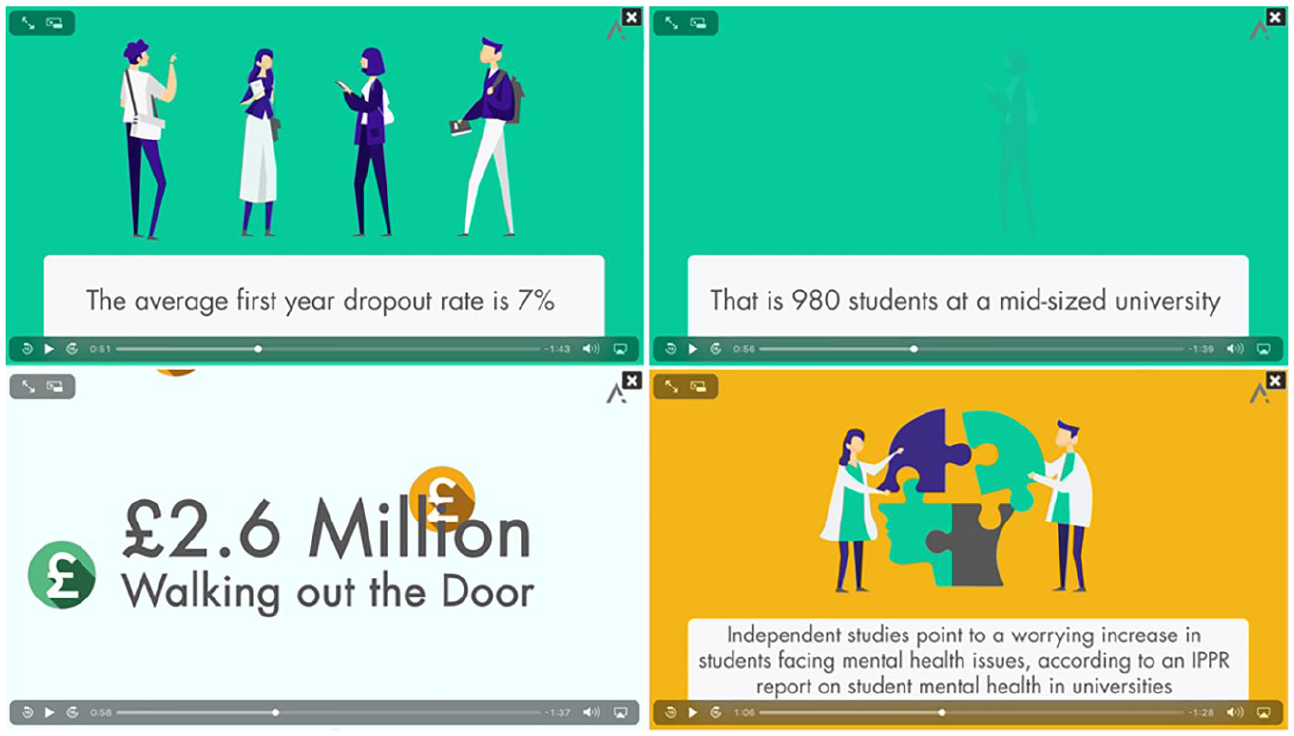
Screenshots of DTP Solutionpath’s advertisement video for StREAM, accessed at https://www.solutionpath.co.uk/stream/ on 18 November 2020.
Analytics algorithms that can identify those ‘at risk’ of mental distress and suicide are still at an experimental stage (Duffy et al., 2020), yet the rush to seize market opportunities renders the evidence-base an afterthought. As is typically the case with digital mental health technologies (Bucci et al., 2019), policy recommendations and adoption precede research. Critical research on the implications of learning analytics for mental health will be crucial, given that analytics research is currently led by the same teams tasked with implementation (e.g. Foster and Siddle, 2020).
(d) Student data as resource
The expansion of algorithmic student data processing into the area of mental health raises ethical issues around data privacy, value extraction from data, and the actions that might follow algorithmic profiling operations. JISC’s (2020) code of practice for mental health analytics states that, although universities should ideally seek consent before collecting special category data and acting on analytics, under certain scenarios they do not have to request explicit consent (including when using the ‘substantial public interest’ justification under Data Protection Act 2018 (17)). Data sharing can also occur under the same premise.
The 2017 Green Paper’s endorsement of accommodation and other service providers’ involvement in students’ mental health has opened the way for actors such as the HE legal consultants Pinsent Masons (Watson and Blackey, 2018) and the British Property Federation (2019) to urge a ‘much freer flow of information between providers and the institutions’. Going further, the JISC Horizons Group (2019) propose a ‘wellbeing data trust’ ‘to enable a variety of organisations to share sensitive data related to student wellbeing’ (12). In the name of their mental health and the ‘public interest’, sensitive student data are becoming (presumably freely) accessible to private companies. This not only adds layers of mediation to students’ ability to control institutional responses to analytics alerts, but allows the valorisation of their data to develop services and products – including proprietary algorithms –sold back to students and universities.
Conclusion
Fifteen years on from Baker et al.’s (2006) analysis, ‘mental health’ as a problem for UK universities is largely defined through economic outcomes and, in turn, addressed through new markets that train, monitor, measure and ‘nudge’ students and staff towards these outcomes. The policy assemblage we have identified encompases key governmental technologies and disciplinary discourses that gained credibility under New Labour and are now embedded within mental health institutional structures as well as in commercial production targeting the HE sector. The discourse of positive psychology, training subjects to develop as competitive human capital (Binkley, 2011), combines with behavioural economics to become enacted through workshops, digital apps and analytics platforms procured as part of universities’ restructuring of counselling services. Largely self-administered, these new ‘interventions’ correspond not only to the institutional rationality of cost-effectiveness, but also to the anticipation that, by producing students as self-regulating and resilient subjects, universities can improve retention, attainment and employability metrics, vital for competing in a restructured HE marketplace.
This is another case of ‘smart social investment’ (McGimpsey, 2017) in post-financial crisis neoliberal governance. It comprises a drive to know subjects and to produce institutional and government-level ‘outcomes’ through accessing expanded masses of data and automating their analysis, as well as intervening to ‘train’ subjects cost effectively. In this way, policy agendas create motivational ecologies that allow them to seep through from the higher levels of governance, aiming to reduce the costs of social reproduction, down to the everyday level of individual students-subjects who are encouraged to monitor and rehabilitate themselves.
Far from recognising vulnerability as a universal condition, or how social oppression affects the emotional dimensions of learning (Martinez-Cola et al., 2018), these interventions erase such awareness, geared to foster academic performance and employability. Our analysis contributes to the critique of governmental techniques and therapeutic industries promoting happiness, productivity and resilience (Ahmed, 2010; Binkley, 2011; Cederström and Spicer, 2015; Cabanas and Illouz, 2019) by demonstrating how these approaches to the student ‘mental health crisis’, especially in their digitised, automated form, are part of a broader policy assemblage that channels the contemporary restructuring of UK HE. The implications of these new technological interventions on the emotional life of students and staff are yet to be adequately explored, but we can already comment on their function of ‘masking a practice which itself remains silent’ (Foucault, 1980: 96), namely, disguising an instrumental HE strategy under a discourse of institutional concern, care and intervention.
Although value circuits are not represented on our map, we can nevertheless see new layers of exploitation in the reducing ratio of counselling staff, the use of (typically unpaid) student and staff labour to deliver or legitimise interventions, and the valorisation of student data by external service providers. Meanwhile, excluded from the field of intervention are areas of UUK’s ‘whole university’ known to cause stress to students: finance departments issuing penalties for unpaid fees or rents; competitive study environments heightened by learning analytics ‘nudging’; stressed, overloaded and precarised staff, and risking student and staff health to contain financial risk during the COVID-19 crisis (Morrish, 2020). Resistance to these processes has already taken place, but the policy assemblage we describe develops at a rapid pace. Our research is a starting point, which, we hope, will help students and staff reclaim the agenda on mental health in universities.
Supplemental Material
sj-zip-1-csp-10.1177_02610183211024820 – Supplemental material for Mapping mental health and the UK university sector: Networks, markets, data
Supplemental material, sj-zip-1-csp-10.1177_02610183211024820 for Mapping mental health and the UK university sector: Networks, markets, data by Dimitra Kotouza, Felicity Callard, Philip Garnett and Leon Rocha in Critical Social Policy
Footnotes
Author statement
Dimitra Kotouza: Writing—Original Draft, Investigation, Data Curation, Analysis, Conceptualisation, Visualisation. Felicity Callard: Writing—Review & Editing, Conceptualisation, Supervision. Philip Garnett: Methodology, Conceptualisation, Software, Validation, Resources, Data Curation, Writing—Review & Editing. Leon Rocha: Conceptualisation, Funding Acquisition, Project Administration, Writing—Review & Editing.
Declaration of conflicting interests
All authors are employed by universities within the sector they are analysing. They are also all members of UCU, a trade union representing staff in post-16 education.
Funding
The authors disclosed receipt of the following financial support for the research, authorship, and/or publication of this article: This research was funded by The Wellcome Trust (219172/Z/19/Z).
Supplemental material
Supplemental material for this article is available online.
Author biographies
References
Supplementary Material
Please find the following supplemental material available below.
For Open Access articles published under a Creative Commons License, all supplemental material carries the same license as the article it is associated with.
For non-Open Access articles published, all supplemental material carries a non-exclusive license, and permission requests for re-use of supplemental material or any part of supplemental material shall be sent directly to the copyright owner as specified in the copyright notice associated with the article.
