




Abstract
In recent years British welfare policy and immigration policy have intertwined in new ways, with widespread cuts alongside increasing conditionality, rationing, and differentiation of rights. This article explores perspectives among activists attempting to resist these developments, with a focus on those that go beyond narrow reactions and engage in systemic critiques. It draws on in-depth qualitative interviews with activists from a variety of campaigns in England. The article presents a conceptual framework, synthesising these activists’ ideas and comprising three elements: racialised profit-seeking as a driver of policy; ‘situated universalism’ as a counter-hegemonic basis for unity; and a theory of change through grassroots campaigns.
Introduction
This article addresses the migration-welfare nexus in social policy (Jørgensen and Thomsen, 2016), with a focus on England, using ideas developed by activists trying to influence change. Following a brief outline of the context in which these ideas developed, the article reports the research methodology followed by a conceptual synthesis of activists’ ideas. This connects with and builds on Marxist, anti-racist, feminist, and postcolonial traditions, which share a concern with exposing and challenging oppressive power relations in social policy and developing a systemic analysis to inform struggles for change.
The interconnections between welfare and borders have been intensified in Britain in recent years by a policy environment marked by austerity and a ‘hostile environment’ for migrants. Severe welfare cuts have combined with differentiation among welfare recipients along the lines of immigration status. These policy developments have prompted academic analyses and a range of activist responses, seeking to influence policy agendas (e.g. Watt 2016). Yet activists’ own analyses have received relatively little attention. This article helps to address this gap, as part of a critical public sociology tradition (e.g. Bassel and Emejulu, 2017; Jones et al., 2017).
Background
Kitson et al. (2011: 292–293) describe an ‘austerity consensus’, following the global economic crisis that erupted in 2007/2008, involving: ‘major cuts and reductions in public spending on a scale not seen for decades . . . reducing the size of the state in favour of the private market’. Migrants, racialised minorities, women and disabled people have been affected particularly severely (Bassel and Emejulu, 2017). Austerity was justified by many politicians as a necessary response to high levels of public debt, the origins of which Kitson et al. (2011: 292) identify in, ‘the banking crisis or the recession or both’, with the cost of direct support to the banks totalling $1.5 trillion. Yet politicians and much of the capitalist media effected an ideological ‘reworking that has focused on the unwieldy and expensive welfare state and public sector, rather than high-risk strategies of banks, as the root cause of the crisis’ (Clarke and Newman, 2012: 300).
Austerity provoked responses, including mass student protests in 2010, urban uprisings and Occupy camps in 2011, tenant-led campaigns against the ‘bedroom tax’ (a cut to housing benefit) in 2013, and numerous campaigns against council cuts, benefit sanctions and more. Housing campaigns such as ‘Focus E15’ 1 and the Radical Housing Network 2 have organised against ‘social cleansing’, used to describe working-class people being forced out of London due to declining council housing stocks and rising private rents. Campaigns like Defend Council Housing 3 and Nottingham Housing Justice Forum 4 have addressed growing housing insecurity outside the capital. Many service users have become activists to defend services. For example, in Newcastle-upon-Tyne ‘Parents against Cuts’ was set up in opposition to 65% funding cuts to Sure Start children’s centres 5 and fed into a further campaign opposing the closure of a swimming pool in one of the poorest areas of Newcastle (Riddell, 2015). Another example is Sisters Uncut, which has organised defence of domestic violence services. 6 Disabled people have been severely affected by austerity, and have been among the most active in resisting, with campaigns such as Disabled People Against Cuts 7 and Black Triangle. 8 Although these latter campaigns were not the source of any of the participants interviewed for this article, disabled people have also been present, sometimes in a less visible way, within many of the other campaigns mentioned here.
The phrase ‘hostile environment’ was first coined by then-Home Secretary Theresa May in 2012 (Kirkup and Winnett, 2012), continuing a long history of racism within British state welfare (Craig, 2007). The Labour government of 1997–2010 took significant steps to fine-tune immigration to the labour needs of capital, passing six immigration laws that combined a Points-Based System with reduced rights for refugees and increased differentiation of rights to health care, housing and employment, alongside a ready supply of low-waged labour from other EU countries (Vickers, 2019). The Conservative-Liberal Democrat coalition of 2010–2015 and the Conservative government that followed passed Immigration Acts in 2014 and 2016 that further extended immigration controls into welfare and service provision, including health care, private-rented housing, employment, banking, and driving licences (Corporate Watch, 2018).
Examples of campaigns challenging the hostile environment include Docs Not Cops, 9 Homes Not Borders, 10 and Against Borders for Children, 11 the Newcastle-based Migration and Asylum Justice Forum, 12 and North East London Migrant Action. 13 These built on the legacy of an earlier wave of resistance, which emerged in the early 2000’s among the growing numbers of asylum seekers who had been waiting years for a decision (Webber, 2012). Although this movement in communities went into decline after 2007 (Vickers, 2014), resistance continued inside immigration detention centres, organised by groups like Movement for Justice, 14 Right to Remain, 15 and Detained Voices. 16
The above campaigns provided the context in which the activists who contributed to this research developed their ideas. This article asks what can be learnt from their understandings of the policies they sought to change, their root causes, and strategies for change.
Methodology
The research design aimed for a serious engagement with activist perspectives. This drew on the insights as activists tested and refined their ideas in the process of trying to effect change. It also attempted to challenge the asymmetries of power in knowledge production that were highlighted by a participant:
even when your truth has been told they think that you’re just talking rubbish, they just want to dismiss people who haven’t got names after you. . . . Why is it that a rich man knows how much a poor man’s got and it’s alright for them but it’s not alright for the poor man to know why the rich man’s rich? (A10)
In-depth qualitative interviews with campaigners revealed insights and nuances that are not always apparent in campaign publications and formal statements, which frequently involve compromise and strategic decisions about what to include in ‘public-facing’ messages.
Seventeen campaigners were interviewed during 2018. Interviewees were selected using the following criteria: coverage of a range of contemporary struggles over migration and welfare (especially where they intersected); a variety of locations within England; a focus on grassroots campaigners, defined as those who were not paid to campaign, although some had jobs that were closely related. The sample did not aim to cover the full range of perspectives among campaigners, but rather to seek out people who were questioning the fundamental structures of society. Informed by these criteria, participants were recruited using a snowball sampling method. In some cases, the author approached specific individuals who were known to them, while in other cases campaigns were contacted online and their organisers either asked specific individuals if they would like to participate or circulated an open call to their membership. The intention behind this was to sample more in-depth analyses, beyond purely reactive or descriptive responses. This often led to the recruitment of activists who applied Marxist, anti-racist, postcolonial, and feminist ideas, sometimes explicitly (for example some were members of organisations that described themselves as Marxist or feminist and others referred to specific theorists in interview), and sometimes implicitly. Selection involved a dialogue between the author and prospective participants, to establish their interest in discussing their views about society and how this informs their activism. It relied heavily on the author’s own experiences of activism over the previous 15 years, which provided political experience that acted as ‘political pivot and editorial razor’ (Mezzadra and Neilson, 2013: 12), to help identify people who fit the criteria. The approach to sampling was thus not representative of all activists in Britain, and contained a significant element of personal experience, positionality and judgement; a different author might have made different judgements about which activists fitted the above criteria, and may have differed in their knowledge of, and access to, activist networks and relationships of trust, which may have affected sampling. It must therefore be emphasised that this article presents perspectives from among activists in England during this period, not necessarily perspectives representative of all activists or any section thereof.
Information about the sample composition is provided in Table 1. Demographic information is not provided for individual participants because this could jeopardise their anonymity given the small number of people currently involved in this field of campaigning. Because participants were not interviewed as formal representatives of their campaigns, the campaigns are not named.
Activist sample.
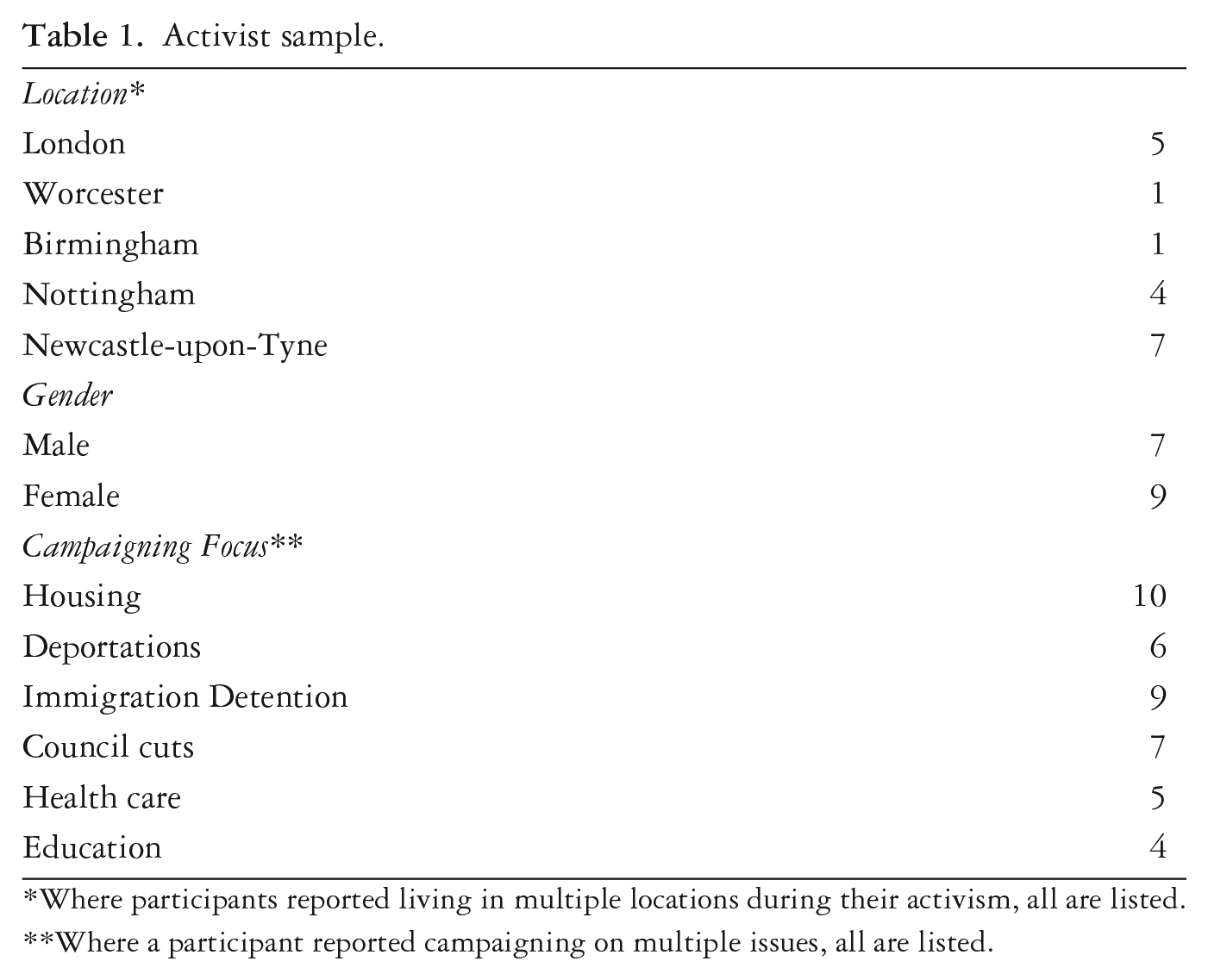
Where participants reported living in multiple locations during their activism, all are listed.
Where a participant reported campaigning on multiple issues, all are listed.
A semi-structured interview elicited participants’ motivations for becoming involved in campaigning, why they thought the government was pursuing the policies they were campaigning on, and their expectations for the future. Nine participants spoke about being directly affected by the issues they were campaigning on, and five were also engaged in professional practice relating to these issues. Three came from countries outside Britain and a further two described being the children of migrants and suggested that this had influenced their perspective. To protect anonymity, specific countries of origin are not given. These varying positionalities, and associated experiences, were clearly important for participants’ perspectives but did not determine them. It should also be highlighted that while participants’ campaigns engaged in varying forms of action, barriers to participation in activism often exist, which affect who engages and on what terms, and consequently affects who had an opportunity to participate in this research. Barriers can include disabilities, caring responsibilities, access to formal and informal support, insecure immigration statuses, multiple forms of stigma, and more. Campaigns can be exclusionary in multiple ways, although it is beyond the scope of this article to assess dynamics of exclusion/inclusion in any specific campaign.
Informed consent was given verbally and in writing by all participants, consistent with the British Sociological Association 2017 Statement of Ethical Practice and approval by the ethics committee at the author’s university. The interviewer emphasised that participants could choose not to answer any question and gave the opportunity to withdraw their data up to a specified date. Data was anonymised to protect individuals’ identities and participants are referred to using reference codes.
The interviews took place alongside writing a book on closely-related issues (Vickers, 2019), and this provided a focus for ongoing discussions with some participants. A draft of this article and the book were shared with participants for comments, strengthening internal validity, creating opportunities to confirm ongoing consent, and further extending the conversation. In total, six participants gave comments, confirming aspects of the author’s interpretations and in some cases adding contextual detail.
Developing a conceptual synthesis
The following discussion synthesises activists’ ideas into a conceptual framework that includes: an analysis of the foundations of policy (racialised profit-seeking); a counter-hegemonic social categorisation (situated universalism); and a theory of change (grassroots alliances).
This conceptual framework was developed by coding interview data, in a multi-stage process that combined Nvivo software and handwritten annotation. In the first stage the data from all 17 interviews was coded using six open themes, informed by the research question: three themes focused on participants’ views about the significance, causes and consequences of the state policies and practices they were seeking to challenge; the other three concerned participants’ critiques of the ideological categories used by the state, their alternative conceptualisations, and their ideas about prospects for change. Coding and annotation of the data against these six open themes produced thematic summaries and illustrative quotations, following the analytic method of Miles and Huberman (1994). This process elicited three significant conceptual themes, which were selected because they represented sets of ideas that were broadly shared among participants, or at least closely connected: the idea that racialised profit-seeking is driving policy; a conception of society that I describe as situated universalism, as a challenge to hegemonic categories that were considered by participants to be divisive; and an approach to influencing the direction of society and policy through grassroots alliances. Data was recoded within these conceptual themes, and they were further elaborated through the inductive development of 11 sub-themes, shown in Table 2.
Coding Matrix.
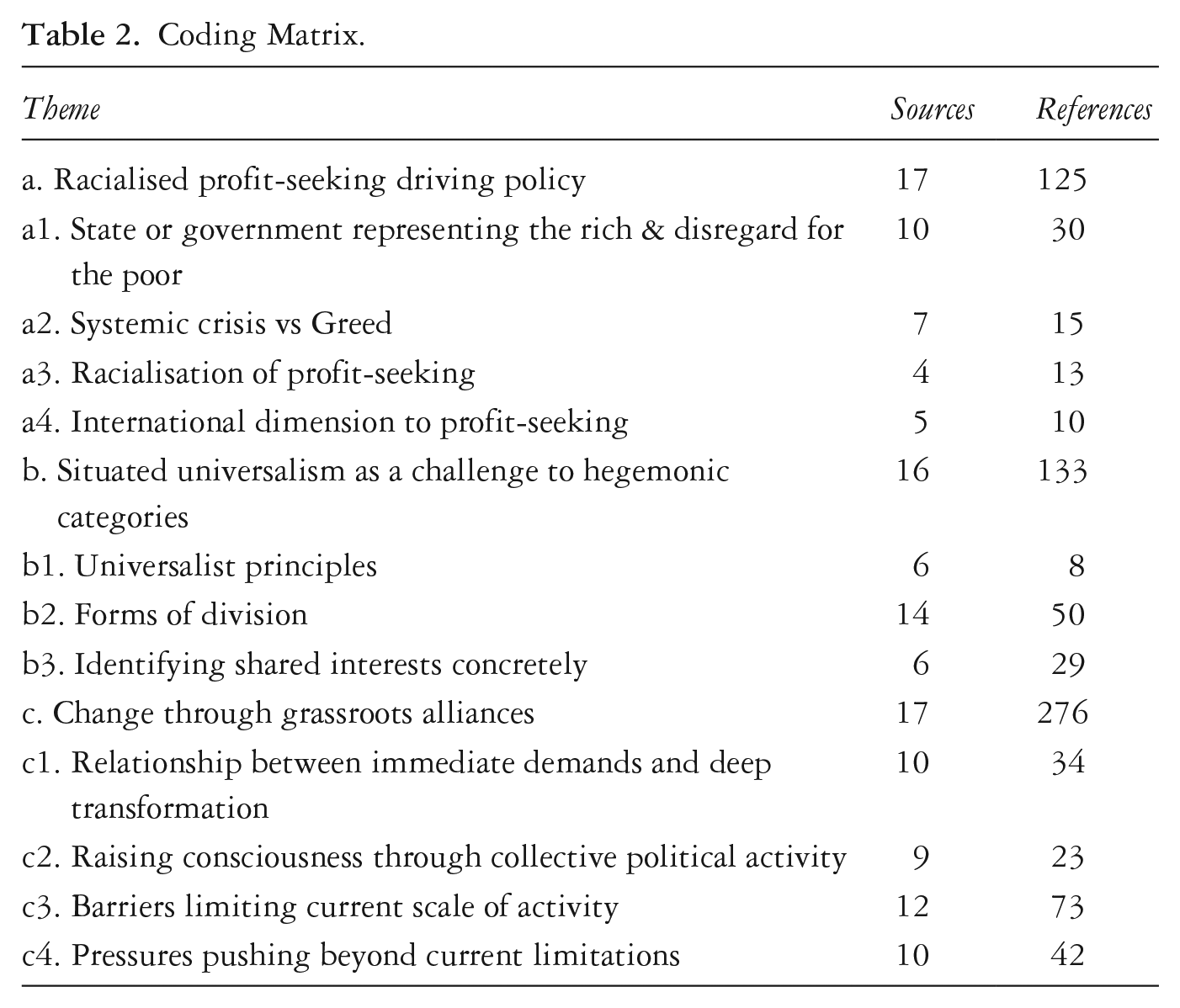
Variations within each theme are addressed in the discussion below.
The following account draws on all the participants’ accounts but necessarily involves selection and synthesis. Nevertheless, the presentation aims for a sympathetic synthesis, by engaging as fully as possible with participants’ perspectives on their own terms and using these perspectives, in dialogue with material from the academic literature, to develop a conceptual framework. As might be expected, participants did not all agree on everything, and an attempt has been made to balance an authentic representation of their various perspectives with a coherent presentation for readers. Direct quotations from interviews are intended here not simply as illustrative of findings, but as integral to the presentation of the conceptual framework, with just as much importance as the author’s commentary. A more comprehensive representation of all aspects of participants’ views would add further nuance and allow the disagreements between participants to be explored more fully, but this is beyond the scope of this article. A co-authored article could have enabled an even more direct presentation of participants’ perspectives but would have also demanded much more of their time and effort, which might be difficult to justify when they would receive little direct benefit from authoring an academic article. In some places the author draws connections between participants’ perspectives and other theorists; the purpose of this is to situate participants’ ideas within the academic literature and help demonstrate their relevance to ongoing intellectual traditions and debates, but the article offers limited scope to explore or apply those other theoretical perspectives.
Racialised profit-seeking driving policy
Many participants considered the British state to be prioritising profit-making for a capitalist minority, even when this contradicted the interests of the majority. This included suggestions that the government represented the rich while disregarding the poor. There were also frequent suggestions that this profit-seeking, and the policies it was seen as driving, were uneven in their targets and impacts, in particular with regard to ‘race’ and Britain’s relationship to countries occupying relatively oppressed and marginalised positions within international capitalism.
Some saw this profit-seeking as resulting from ‘greed’ on the part of corporations and landlords (A01, A10, A17), together with a general disconnect between government and working-class people’s lives and priorities:
It might not seem a lot of money to these rich bastards right, but they don’t have to live like us and they don’t have to feed themselves like the way we do, they don’t have to try and get heat or your gas or electric or that, they just couldn’t live our lives man, they couldn’t do our thing. And we’re the ones who’s paying for their mistakes (A10).
For some, but not all, who expressed such views this was clearly rooted in personal experiences of poverty. For some participants this was seen in systemic terms, as a defence of capitalist interests:
I see the state as serving the interests of capitalism, and different political parties might tinker around with aspects of the state infrastructure, but in between governments you have the civil servants who remain more or less the same . . . it’s just been so consistent. (A04)
Some suggested the state’s defence of capitalist interests was taking a particularly acute form under conditions of capitalist crisis:
the capitalists are looking for ways to stave off the crisis. And they only have a limited amount of options. . . . there’s a drive to war, a . . . scramble for resources, to control geopolitical areas, and I think in this period . . . we’ve seen interventions in Syria, in Libya, in Iraq and Afghanistan. . . . If they can drive down . . . the living conditions of the working class, so that people expect to have a lower living standard . . . with more overcrowding in housing, surviving on less food, surviving with less commodities. . . . [If] they can extend the working day . . . attack benefits so people accept . . . a poor standard of work with . . . less union rights, less sick pay, less holiday pay, less maternity rights . . . that’s all ways that they . . . maximise the profitability, the extraction of surplus value from the working class (A05).
This participant described themselves as a communist, and their perspective was explicitly rooted in Marx’s ([1894] 2006) analysis of capitalism’s tendency toward crisis, in which he identifies a limited number of countervailing factors. This is important because identifying such systemic drivers points toward the scale of struggle required for change.
Examples of the priority attached to private profits by the state included the shift in housing provision toward the private sector:
it is not in rich peoples’ best interest to build a load of affordable social housing. That’s not gonna make them money. So, the whole system is underpinned by capitalism and then this neoliberal idea around the individual being the person who needs to sort themselves out, look after themselves; for getting [out of] this cycle of poverty (A07).
This demonstrates a concrete and applied approach to theory, focused around the issues addressed by the participant in their activism. Fundamental features of capitalism are identified here, coupled with neoliberalism as a more specific period or form of capitalism that embodies these features in a more acute form (Singh and Cowden, 2015). Another example was provided by participants who argued that the profits generated through Britain’s largely-privatised immigration detention system provide a direct incentive to expand and prolong detention, with A02 describing it as: ‘a commodity of people’s misery and people’s destitution’, and A03 arguing: ‘if the Home Office doesn’t deliver the products, Serco has no job. . . . It’s like a production line, it’s an industry at full capacity’. One of these participants had personal experience as an immigration detainee, while the other had supported detainees; for both participants the dehumanising effects of detention appeared deeply felt, feeding into a systemic critique.
Other participants pointed to an underlying conditionality, by which people’s worth is judged according their waged labour, without recognition even for past work:
when you come to the end of that job you’re just forgot about. Because the Government doesn’t even look at you. If you’re going for a job interview or go and try and claim a new benefit after you’ve been . . . terminated from your job . . . and you’re not treated with any respect because you might as well just be the person who has never ever worked in his life (A10).
This perspective was based on personal experience moving between insecure employment and welfare statuses. While this was not explicitly informed by a Marxist analysis, and the participant clarified, ‘I’m not a communist and I’m not a socialist’, it can be interpreted as implicitly speaking to the reduction of people to dehumanised bearers of labour power, which Marx ([1887] 2010) highlights as inherent to capitalism and which has been acutely expressed within the forms of conditionality enforced by austerity and the hostile environment (Vickers, 2019).
This profit-making was understood by some participants as international and racialised, within relations that are characterised by oppression and exploitation:
just ask the question . . . why is the richest land mass on earth permanently on its knees to the west. Africa is perfectly able to manage itself and has all the resources, and we’re somehow keeping it in a position of charity. . . . Most of the ways that we live in this country and in Europe is off the back of countries that are permanently at war . . . so when you’re talking about conflicts that have displaced people, that we’ve had a part in, that we sell arms . . . to . . . arm certain sides . . . or we’ve got . . . enormous companies that are polluting their water supplies and taking their natural resources. (A02)
The ideas expressed here draw implicitly on theoretical traditions interrogating the legacy of colonialism (Young, 2001) and contemporary relations of dependency and imperialism (Smith, 2016). This international exploitation was directly connected in some participants’ understanding to ‘a very colonial form of racism’ (A14):
[A]lthough people from the colonies who settled in this country struggled and fought for liberation and equality . . . the systems that continued to extract value from their labour, continued to profit from their subjugation. . . . Concessions were made without destroying the entire structure (A09).
This activist situated themselves as a child of Pan-Africanist migrants, who emphasised their strong commitment to anti-racism, in both practical and theoretical terms. Some participants implicated racialised immigration controls directly in class exploitation:
I think you have to see . . . immigration control as being central to both the attacks on working class living conditions, getting people to accept less, providing a useful scapegoat for governments to . . . force people to accept less and target their anger against migrants rather than . . . what the government or the ruling class are doing. And at the same time, having tight control over the flow of people who are escaping the increasingly brutal exploitation in oppressed countries and . . . the . . . drive to war (A05).
This is important because it conceptualises racism as facilitating exploitation of both racialised minorities and white people, while also attending to the very significant differences in how this plays out on either side of the racialised divide. While these racialised divides are longstanding, some suggested they have intensified as a result of the economic crisis:
universal benefits – which were never universal, there was always a racial hierarchy of how things were allocated . . . we’ve had a financial crisis and the solution to that is by making more visible the racial hierarchy and ensuring that people . . . can be racialised as ‘other’, and that’s not necessarily Africans, it can and has obviously shifted to Eastern Europeans and Muslims (A09).
In combination, these perspectives can be used to make sense of policy as rooted in material exploitation, offering an understanding that might be called ‘racial capitalism’ (Bhattacharyya, 2018), although this was not a term any of the participants used. ‘Capitalism’ describes a social and economic system dominated by private ownership and control of the ‘means of production’, referring to the machinery, raw materials and infrastructure, directed toward production for exchange. Within this system, the concentration of power in the hands of a small minority and the exploitation of the majority are sustained through processes of categorisation and selection of labour that are heavily racialised. Contemporary British welfare policy and immigration policy can then be understood as part of the enforcement of these racialised relations of exploitation. This analysis is further elaborated in the next section.
Situated universalism as a challenge to hegemonic categories
This section discusses participants’ critiques, of hegemonic categories that are implicated in the kind of racialised profit-seeking described above, and participants’ opposing perspectives, which can be broadly described as situated universalism, emphasising universal human worth, while remaining attentive to lines of difference (Mohanty, 2003). ‘Hegemony’ describes the range of ideas that reflect the interests of the ruling classes but become accepted as ‘common sense’ by large parts of the population (Carroll, 2010). Challenges to these ideas, and the development of alternatives, may therefore be described as ‘counter-hegemonic’. Several participants presented their perspective on society in terms that were quite explicitly universalist, referring in some cases to shared interests across humanity. This universalism formed the basis for critiques of what participants considered divisive categories in state policy, which were seen as normalising the systematic denial of rights and resources to some sections of society. Participants also identified possibilities to overcome these divisions, on the basis of a common interest among those suffering exploitation and oppression under capitalism.
Universalist principles were expressed by participants in a variety of ways, often connected to how they saw humans being divided and degraded within contemporary society:
I believe that every person has dignity and should have the freedom to live their life where they see fit as long as they’re not causing harm to others and I believe that the best way for people to realise their liberty is through collective endeavour and dismantling systems that divide, control and subjugate people. (A09) I’m just a human being who doesn’t like to see things bad for anybody, I want everybody to have a fair square cut of the cake . . . we’re not sheep, we’re not robots and . . . we can’t be shouted at by governments and made to look foolish (A10).
These quotations are important because they demonstrate the continuing relevance of humanism as a basis for resistance to oppression, despite academic critiques (Chernilo, 2017), and the way it is expressed in direct opposition to divisive and dehumanising categorisations within social policy. This was not a crude analysis assuming an a priori universal human experience, but one that was also attentive to class divisions and to lines of division within the working classes, with a particular focus on the way the state structures such divisions, understood concretely as in the following quotation:
you saw the 2014 Immigration Act and the 2016 Immigration Act introduce a lot more policing about what kind of people can access what kinds of services, which means that the categorisation of the working class extends beyond the labour market quite considerably and into aspects of ordinary social life. Whether or not you can access health care . . . housing . . . a driver’s licence or a bank account, and that’s a racial division of the working class used to control the manner in which labour actually enters and what it does within Britain. . . . All of them are ways of manipulating ideologically or physically . . . how the working class and how work is actually constructed in our society, how it operates (A12)
The quotation above emphasises the role of immigration controls in managing labour, placing the ideological and legal categories they produce at the centre of capitalist exploitation. Another participant suggested that these categories play an important role in establishing who is deserving and undeserving, justifying systematic denial of rights to sections of the population:
I think those categories only serve that purpose of splitting people up into essentially those who are considered deserving of help or of their rights and those who aren’t. (A11)
Participants’ problematisation of such an approach by the state implicitly rests on a universalist commitment to all humans as deserving. Furthermore, such distinctions have implications for everybody, where depictions of the ‘Failed Citizen’ and the ‘non-citizen’ mark out the conditions for inclusion as someone of worth within the nation, as Anderson (2013) argues. Some participants described these categories as mutually dependent and mutually detrimental:
it’s dividing people . . . there’s no way that this country or any country could live without migrant labour . . . but those people will always be exploited . . . because they’re not officially allowed to be here. And the people that are also being exploited will turn to them as the enemy, and say, ‘Well these people are undercutting us’, or, ‘These people are taking our jobs’. . . . Whereas in reality, they’re both being treated quite badly and there’s no way that I think either . . . group could really exist without the other. (A02)
This is important because it shows that foregrounding differential forms of oppression can help rather than hinder unity, by identifying how these differential forms of subjection are interdependent; in other words, how a situated form of universalism can be useful in building alliances against oppression. These interrelated conditions of oppression represent one form of the fundamental interdependency that was also articulated by some participants as a potential basis for transformational unity:
I believe that all of our conditions of existence are deeply braided and conjoined and I think that our access to things and our privileges and our ability to be anywhere or do anything is always attendantly related to the delocation of someone else’s life or the proliferation of someone else’s life. So, at a base level, I just think that we need to recognise how connected we are (A14).
This participant situated their perspective within their experiences as a working-class woman descended from migrants, and who was engaged in feminist campaigns that sought to highlight intersectional forms of state violence and resistance. Although she did not make an explicit connection to Judith Butler, her account has similarities to the distinction Butler makes, between precariousness as a fundamental condition of human life arising from our many interdependencies, and precarity as a ‘politically induced condition in which certain populations suffer from failing social and economic networks of support and become differentially exposed to injury, violence, and death’ (Butler, 2009: ii).
Movement beyond divisive categorisations was identified as a necessary part of struggles to defend the interests of oppressed sections of the population:
‘white, working-class’ – a lot of these identity categories that are actually racist and ridiculous. And I think that actually it will only be a more . . . united form of resistance if we can move beyond these fracturing discourses that . . . allow for xenophobia and racism to thrive among . . . the working population of the UK. . . . As long as you’ve got white, working-class populations who think that their conditions of precarity and austerity and low wages and unaffordable houses are as a result of migrants and not the state, we’re fucked. (A14)
Similar critiques have been made in the academic literature, such as Shilliam (2018), who argues that the idea of a ‘white working class’ emerged as an ideological construct within struggles to defend and entrench an imperialist order.
Participants conceptualised the relationship between the interests of different groups in various ways, sometimes taking the form of shared interests around basic human needs such as housing: ‘I wouldn’t actually [say] there’s one type of person that’s in need of housing more than another, everybody needs decent secure housing’ (A13). This participant spoke from experience of long-term deprivation of decent secure housing for themselves, and extensive engagement as a campaigner with others facing housing insecurity, extending across the private rented sector, hostels, and asylum housing. Examples were provided of how grassroots campaigns can provide a vehicle for the identification of points of commonality between people, developing into an analysis of the structural changes that might enable people’s needs to be met more fully:
The slogan we use is: ‘Decent Housing for All’. And so, the question for me is, well, what would that take to be possible? And then it’s about the system of ownership. When you have a diminishing possibility for the state to house people under current conditions, all of these categories [determining eligibility] become necessary both . . . technically, in order to find a way of splitting people up and politically as well. In order to divide people who have the same fundamental interest, against each other. . . . I do not view there being a fundamental conflict of interests between . . . British working-class people and migrants into Britain. I think that fundamentally they have a common interest and that’s in a change to the way society’s organised into a socialist system. . . . Whereas on the other side you’ve got those with power and privilege . . . those who control and own the resources and the means of production (A11).
The above quotation addresses hegemonic categories that imply competing interests (‘British working-class people’ and ‘migrants’), and re-conceptualises their relationship through an analysis of the capitalist system of ownership, arguing that this requires the subjection of both groups, although on different terms, and therefore gives rise to a shared interest in changing the system of ownership, to create an alternative to capitalism.
Synthesising a number of different ideas discussed here, we might say that an idea of shared interests arising from being human coexists with an understanding of multiple forms of division. These divisions are enshrined in state-endorsed hegemonic categories that are rooted in capitalism, which paradoxically also provides a basis to establish alliances across those divisions. It is a form of universalism, in that it places value on all human lives and understands their interests as conjoined; it is situated, in that it does not assume any universal experiences but rather foregrounds the ways in which capitalist systems of class, racialisation, gender, and more, affect people’s experiences, and uses a concrete examination of people’s lives to establish alliances against oppression. This offers an explanation of how the policies discussed here help to sustain the control of a capitalist class over the means of production, by creating divisions among the working class, and identifies the potential for alternative forms of power that could potentially challenge capitalist dominance. The development and application of these forms of power are explored further in the next section, which completes the conceptual framework.
Change through grassroots alliances
Participants expressed hope, although often framed in cautious terms, in the potential for positive change through grassroots alliances, up to and including social revolution. This involved discussion of how immediate demands might be related to deep transformation, often centred on the potential for campaigning to play a role in education and identification of connected interests. Participants also identified barriers that they felt were limiting the current scale of campaigning in Britain, and pressures that they felt might push beyond these barriers.
Participants spoke about concrete short-term victories that campaigns had won, for example empty council homes that were opened up to house people following a political occupation, individual deportations being stopped, and people being freed from immigration detention and securing leave to remain. But some also argued that such short-term concessions were proving harder and harder to win and suggested this was a result of the capitalist crisis. For example, one person commented: ‘the crisis is so deep that these kind of material victories are less and less- or even impossible at this point’ (A12). This led some to argue for a more fundamental transformation in the social structure in order to meet their demands:
I’m not a communist but I would like to get rid of the Labour Party and I would like to get rid of the Tories and all the other parties and start again, something completely radical. It needs a radical change . . . how many more years are people just going to put up with it, it’s pure bullshit and lies (A10).
This participant spoke from a perspective of having lived through many different governments - Conservative, Labour, and Coalition, and in the recent period having been engaged in struggles against Conservative-Liberal Democrat Coalition policies such as the ‘bedroom tax’ and cuts to local services implemented by a Labour-run council. While some argued that, ‘in terms of public face messaging, obviously all the nuances and intricacies of our political ideas are not made explicit’ (A09), others argued for the need to openly and explicitly connect immediate and particular issues to the need for wider and deeper structural transformation:
we need to both fight for the rights of the Windrush Generation [British citizens affected by the 2014 and 2016 Immigration Acts] but at the same time, show how what is happening to them is not happening in isolation but rather is linked to this very colonial, imperial regime of mobility and citizenship which is both external and internal. (A14)
This perspective is important because it emphasises the need to struggle for immediate and specific demands in a way that raises consciousness about systemic causes, the relationships between injustices facing different groups, and the need for more fundamental change.
Some participants spoke about how their own consciousness had been raised through campaigning, including discussion of how political experience accumulated over the long term and was passed down to new generations of activists. Some argued that such consciousness-raising, connected to building community and organisation, was at least as important as winning short-term victories, within the context of a long-term struggle:
we didn’t really achieve many victories during that campaign [on the bedroom tax] in terms of actual concrete things that were affecting loads of people but what we did achieve was challenging people’s views on racism and persuading them over to a different view. . . . Or getting people to understand their immediate history in the area. . . . Those people have come back to us and worked with us on other campaigns. (A12) I think more and more people are coming again to realise that we might have to break from this kind of trap. This trapped within a capitalist ideology. . . . The role of consciousness is to try and break outside of that, but that has to be done practically. You can’t do that as some intellectual that’s detached from action. . . . We’re under no illusions that this campaign is going to solve the housing crisis, but . . . it’s gonna make a growing number of people . . . aware of the fact that it is possible to fight, that you do have agency and that that agency can only be effective collectively. If there is hope for positive change, that’s the hope (A11).
This emphasis on the role of campaigning to raise consciousness, as part of a mobilisation for change, is highly significant in a period that Kyriakides and Torres (2014) argue is characterised by the loss of hope for progress.
Moderating such hopes, participants also offered insights about the barriers they saw as limiting the current scale of campaigning in Britain and undermining the development of social movements. These can be summarised within themes of fear, exhaustion, normalisation, conflicts of interest, and the containment and fragmentation of resistance. Yet participants also discussed how movements might overcome these barriers, pointing to material and ideological factors that can help to further elaborate a theory of change. Some pointed to the growing potential for resistance, and new alliances, as wider sections of society come under attack:
I guess it’s going to develop . . . over time, the more people that this affects. I hope that people do feel that they have to fight back, because they haven’t got another option. The . . . attacks on the working class in relation to the immigration controls and austerity is affecting everybody’s housing, so I kind of see that as then an opportunity to . . . fight back on some kind of common ground, linking all the different attacks into one . . . consistent holistic analysis. (A05) it’s not just happening to the granddads and the grandmas who came here in the fifties, it’s also happening to their great-grand kids on my road and I think that there’s a need to link all of these things together more and to call for more structural abolitionist critique that can talk about the way in which patriarchal white supremacy is just that. (A14)
The latter participant spoke from experience as a descendent of an earlier generation of migrants. This emphasises the importance of objective material conditions, in interaction with the questions of subjective consciousness discussed above. Another participant pointed to past periods of upheaval in the international capitalist system, as an example of how movements might develop in the future:
if you look at the era where [Kwame] Nkrumah lived, it was more difficult than the period we are living in. And what happened was, Europe faced . . . an unprecedented challenge with the [Second] World War, and that was a time that many of the colonies got involved. And that superiority myth was broken. Many of them realised that these people were not as invincible as they had made us believe, and that was where the rallying cry for independence grew. . . . you will see now that there was a wind of change that blew across from the Caribbean to the USA, across to Africa, the continent, and drove the quest for independence. And what I am seeing again is we are at a certain era in history where it starts. . . We’ve been having like fluctuations. We’ve got moments where it’s like that movement is going to spread again. . . . The way to decolonisation took just a few years to . . . happen. It’s going to take that process where many young people will rise up and say, ‘No, we’ve had enough of the IMF [International Monetary Fund], we’ve had enough of the World Bank . . . we don’t know what you really bring to Africa’. . . . I mean I see them already saying that, I mean, ‘We don’t understand what you mean by you giving us foreign aid, we don’t need your aid’. . . . all these sentiments are growing. . . . movements with some really strong ideologies . . . . . . and we’re united on one thing, the quest for justice (A03).
This individual grew up in an African country that won political independence as part of the historic struggles they describe. Their account is important because it emphasises both the international connections within many movements for change and the need to learn from history.
While participants expressed hope for the possibility of mass transformative resistance, many of the same people saw this as far from inevitable:
I think there will have to be mass struggle of the likes that happened in the 60s, 70s and 80s where entire communities were disobeying. I think, for me, the last strong, broad example of this was probably the ‘Poll Tax’ rebellions which was made famous by the Trafalgar Square riots but actually were local communities going to court, supporting people who were being taken to court . . . entire neighbourhoods just refusing to cooperate. . . . In the situation we’re now in, that will only happen as the border hardens further and further and more and more people find themselves either related or directly affected by the border . . . and collectivise, and that can’t be taken for granted that will automatically happen. It may not (A09).
This brings us back to the importance of subjective factors, as discussed above in relation to the potential for campaigning to raise consciousness. While objective conditions push people to take action, its form, direction and outcome are open political questions; the activists’ perspectives that are discussed in this article offer many ideas about how they might be addressed.
Conclusion
Britain’s welfare policies and immigration policies have provoked criticism and opposition on the basis of their negative impact on human welfare. But by itself such moral opposition is a limited guide to how these policies might be changed; a conceptual framework and analysis is therefore needed. By identifying the causes of these policies in structures of racial capitalism, the analysis presented here helps to identify both what needs to change – the system of ownership and control of the means of production that is described here as racial capitalism – and points toward the kind of social forces that could bring this change about, through alliances among those who are currently oppressed and exploited. The critique of hegemonic divisions in which the denial of vital resources and rights is normalised through categories of ‘deserving’ and ‘undeserving’, and the development of counter-hegemonic understandings as a basis for unity, described as situated universalism, provides a means to understand and challenge the ways in which those alliances have been forestalled. Identifying the potential for campaigning to connect immediate demands and structural transformation provides a practical means by which counter-hegemonic understandings, identities and alliances might be fostered and expanded, while remaining aware of the barriers to this. Activists’ perspectives have formed the basis for this analysis, by incorporating insights based on a multitude of political experiences and practical testing of ideas, and increases its significance, because the people holding these ideas are applying them to affect society.
The main limitation on the further development of this analysis within Britain is the limited scale and intensity of contemporary struggles at the migration-welfare nexus. Yet, the general finding of this article, that grassroots activism can contribute important ideas for understanding social policy, implies that as struggles expand and intensify, the available insights will multiply. The pressures that people are under make such further struggle likely if not inevitable.
Footnotes
Funding
The author(s) disclosed receipt of the following financial support for the research, authorship, and/or publication of this article: The research for this article was funded by a grant from the School of Social Sciences at Nottingham Trent University.